
In honor of International Women’s Day, I’d like to offer a lovely little vignette of an inspiring relationship which exemplifies its 2024 themes – “Invest in Women: Accelerate Progress” (U.N.) and “Inspire Inclusion” (IWD). Pope St. John Paul II’s love for Mary and his undying devotion to her is a beautiful image of the complementarity of the masculine and the feminine in the Church and some of the possibilities that emerge from it.
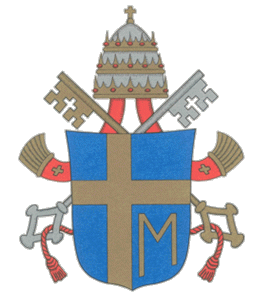
Counter to secular culture which conflates the papacy with patriarchal power, John Paul II chose as his papal motto “Totus Tuus” – offering himself and his papacy totally to Mary. His inclusion of Mary in his papal ministry and his personal investment in Marian prayer and Mariology shined a light on feminine greatness that inspired many, including myself.
vatican.va
The simplicity of the symbol on his papal shield of the Cross with an M, cuts through the political misdirects about the Church and points instead to the distinct but inseparable work of Christ and His Mother, and of the Marian and the Petrine dimensions of the Church. Moreover, through his filial relationship with her, he came to understand and articulate what he termed the feminine genius. Because he knew deeply, and cherished with great love, the woman – Mary – the new Eve, full of grace and the fullness of the feminine vocation, his insights on the feminine calling through Christ were filled with reverence, awe, and respect.
As Pope, John Paul II embodied the Petrine dimension of the Church. Christ instituted Holy Orders through which He wished to be present sacramentally through the ministry of Peter, the apostles, and their successors, particularly in the Eucharist and in the safeguarding of the Deposit of Faith. They teach, sanctify, and rule with the power and authority of Christ to carry on His mission on earth in persona Christi. The Petrine response to Christ is lived through this ministry.
The Marian dimension precedes the Petrine – Mary is the first and perfect disciple of Christ. The apostles, along with us, learn how to be a disciple through imitating her. Through Mary’s total surrender to God and complete gift of self in faith and obedience, the Holy Spirit descended upon her, and Christ’s literal incarnate Body and human nature was conceived. The Mystical Body of Christ begins therefore in Mary’s fiat and fidelity – she is the Mother of the Church and she continues to bring forth new spiritual life and nurture it in grace together with Her Son. The Catechism incredibly states:
“[The Church’s] structure is totally ordered to the holiness of Christ’s members. And holiness is measured according to the ‘great mystery’ in which the Bride responds with the gift of love to the gift of the Bridegroom.”193 Mary goes before us all in the holiness that is the Church’s mystery as “the bride without spot or wrinkle.”194 This is why the “Marian” dimension of the Church precedes the “Petrine.”[i]
John Paul II also underscored the preeminence of her role. He noted that the Petrine dimension relied upon the Marian, and rather than subjugating the feminine he humbly recognized her greater power in the Church than his own:
“The Immaculate Mary precedes all others, including obviously Peter himself and the Apostles. This is so, not only because Peter and the Apostles, being born of the human race under the burden of sin, form part of the Church which is ‘holy with sinners’, but also because their triple function has no other purpose except to form the Church in line with the ideal of sanctity already programmed and prefigured in Mary. A contemporary theologian has well commented: ‘Mary is ‘Queen of the Apostles’ without any pretensions to apostolic powers: she has other and greater powers” (von Balthasar, Nette Klarstellungen, Ital. transl., Milan 1980, p. 181). In this context it is especially significant to note the presence of Mary in the Upper Room, where she assists Peter and the other Apostles, praying for and with them as all await the coming of the Spirit.’”[ii]
vaticannews.va
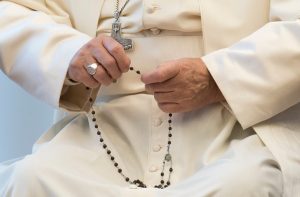
As we look for ways to better appreciate the distinctly feminine contribution in all of the various spheres of societal life, John Paul II provides a beautiful example of how to go about it. He began on his knees, in prayer, and through the lens of love. May we too invest in our relationship with Mary, and learn from her the how to hear and respond to Christ in our own lives and callings.
[i] Catechism of the Catholic Church, 2nd ed., 773
[ii] John Paul II, “The Marian and Petrine Principles” Annual Address to Roman Curia Dec. 22, 1987, https://www.piercedhearts.org/jpii/addresses_speeches/1997/marian_petrine_principles.htm
Related Posts


© 2024 Angela M Jendro
*Scriptural texts, unless otherwise noted, are taken from The Holy Bible: Revised Standard Version Catholic Edition, (Oxford: Oxford University Press, 2004)
*Pray and Reflect with full guided prayer meditations on the Sunday Gospel reading in my book Take Time For Him and its series on Amazon and Kindle!

 Take Time For Him