The Little Way: Guiding Us When We Feel Lost

Today (October 1st) is the Feast Day of St. Therese of Lisieux! I owe so much to her witness, and St. Mother Teresa’s after her. I wrote this in honor of them 🙂

+++++++++++++++++++++++++++++++++++++++++++++++++++++++++++

In such a big world we can easily feel lost.  A big world of ideas – you can be whatever you want to be. A big world of globalization – from corporate industry to personal travel. Even a big virtual world that’s ever expanding. We are blessed to live in an age filled with so many possibilities, but we can also feel overwhelmed by them. God raises up saints in every age who discover a way to live the Gospels amidst the circumstances of their time, and in a way that can be instructive to us all. To guide us through this confusion and find the meaning and purpose we desire, the Lord gave us two great saints of modernity, St. Therese of Lisieux (1873-1897) and of St. Mother Teresa of Calcutta (1910-1997). They illumine a path to greatness available to each of us:  the Little Way of Love.

The industrial revolution brought with it rapid change to life and society. What had formerly been hand made by craftsmen and women became mechanized and mass produced in factories by technicians.  Agrarian and close-knit communities became overshadowed by the growing masses of the city and the factory. The secret ingredient to any well-made thing from baked goods to business – personal creativity and love, was replaced with the higher priority of standardization and efficiency. In the subjugation of creation to science and steel, the supernatural and the personal went increasingly by the wayside. It inspired grand ambitions while at the same time overrunning others. On the one hand the world of opportunity seemed to grow bigger, and on the other the reach of an individual seemed to grow smaller.

In the face of such tensions, the answer of the saints is to embrace them with the supernatural light of Christ. St. Therese was inspired with great ambitions and wished to have a global impact. Though they were spiritual endeavors, she nevertheless had to grapple with the distance between the grandeur of her hopes and the limits of her personal reach. When she turned to Christ in prayer and Scripture as she wrestled with this, she learned several things that we can all benefit from. 

Many people struggle with choosing which occupation to pursue, and research has shown that young people today become paralyzed by the fear of making a mistake.  St. Therese struggled with a desire to be every kind of saint and serve the Church in every possible role. This caused unrest and discontent, but she did not allow herself to become paralyzed. She actively sought help from the Lord and found her answer in St. Paul’s first letter to the Corinthians (chapters 12 & 13). St. Paul noted how in the body of Christ there are many parts, but each is of equal value and ordained by God. The only factor of stratification is love. Contrary to the hedonistic value of status and the modern industrial values of efficiency and output, God judges interiorly by the measure of one’s love in their self-gift. From this, Therese was freed from her anxiety and found her singular purpose, exclaiming “I understood that LOVE COMPRISED ALL VOCATIONS, THAT LOVE WAS EVERYTHING, THAT IT EMBRACED ALL TIMES AND PLACES.”[1]  She found the secret that love gives every effort its value; the task itself is secondary. Love is the unifying factor of life rather than a particular career path.

 Having discovered her vocation, her next hurdle lay in how to achieve it. Tempted by discouragement when she noted the difference between herself and the saints she wished to be like, she reasoned “God cannot inspire unrealizable desires. I can, then, in spite of my littleness, aspire to holiness.”[2]  St. Therese’s logic always included the realness of the love and faithfulness of the Lord. She decided that she would “seek out a means of going to heaven by a little way, a way that is very straight, very short, and totally new.”[3]  She looked towards human progress as an analogy for spiritual progress. Here, she focused on the relatively new invention of the elevator: “We are living now in an age of inventions, and we no longer have to take the trouble of climbing stairs, for, in the homes of the rich, an elevator has replaced these very successfully. I wanted to find an elevator which would raise me to Jesus, for I am too small to climb the rough stairway of perfection.”[4]  St. Therese looked again to Scripture “for some sign of this elevator” and found it: “’Whoever is a LITTLE ONE, let him come to me’…The elevator which must raise me to heaven is Your arms, O Jesus!”.[5]  And so, Jesus raised the young, cloistered Carmelite woman from Lisieux to the heights of sainthood and world renown. When Pope St. John Paull II declared her a doctor of the Church in October of 1997, God proved that a person considered small in every worldly measure, could achieve greatness through simple trust in the Lord and obedience to His will. When we feel tempted to over-systematize our life or discern our path through external values, St. Therese reminds us to acknowledge our desires for greatness by returning to their true origin and end: the Person of Christ as loved day by day and moment by moment.

St. Mother Teresa (inspired by St. Therese before her), lived this same spirituality but on the global stage. With the 24-hour news cycle and international media reach, it’s easy today to feel overwhelmed by the misery, poverty, and affliction we see experienced throughout the world. Tempted to despair, we ask ourselves “what can one person do?”.  Certainly, many organized social and political structures have attempted to cure these ails, but no panacea has yet been found. Abiding by the Little Way, Mother Teresa cut to the heart of the matter.  Every day she simply responded to Christ’s call to care for the poorest of the poor in India.  In prayer, He told her “I thirst”, and she tried to alleviate His thirst for love and for souls by attending to Him present in the poor.  Seeing her success, many tried to organize it, structure it, reproduce it, or expand it. Nevertheless, Mother Teresa held firm to the true foundation for her effectualness – love of the Lord and the movement of the Holy Spirit within individual souls. Programs don’t help people; people help people. Programs may be an organizing principle, but it all comes down to individuals responding with generosity and compassion toward other individuals’ needs. Moreover, that response of love resides in the little things towards those right in our own lives and communities. Inspired by Mother Teresa, many asked her how they could help, to which she responded to go home and love their families. This seemed so inconsequential! How could Mother Teresa, a global force against poverty, recommend such a mundane thing? In truth, although we may now have the technological and media infrastructure to view the world, real richness comes through a sacrificial gift of ourselves for those we love. We do live in a global community, but we are also essential and irreplaceable members of our family community.  Our greatest impact is found not in numbers – a metric of industrial efficiency or personal vainglory – but in the quality of our love, which is the very center of our human nature made in the image and likeness of God, Who is Love.  Knowing that the world needed God, not her, she didn’t succumb to secular hopes in a law of progress or the organization of a process. Instead, she placed her hope in God and disregarded the results altogether. Her famous words, “God has not called me to be successful, but to be faithful” has been one of the most liberating lines of wisdom in my life.

Both St. Therese and St. Mother Teresa took the Blessed Virgin Mary as the model of Faith and learned from her discipleship the original Little Way of Love. Consider the Wedding Feast at Cana (John 2:1-12). Jesus’ first miracle happened in response to a request by His mother about a need in his extended family: “They have no wine.” Jesus, of all people, actually did have a huge world-wide and history transforming mission. Yet, from His actions we can see the answer to His question “O woman, what have you to do with me? My hour has not yet come.”  No need is too small. Jesus always cares about the person not the program. Mary’s trust in the merciful heart of Jesus was poignantly conveyed in her simple order to the servants “Do whatever he tells you.” Often our prayers ask Jesus to execute the plan we give Him. Instead, Mary shows us to simply bring the need to the Lord and do the task that He asks of us, even if we don’t see how it will turn out. We can learn from Mary, who was keenly aware of practical needs and realities within the concrete circumstances of life. As she encountered them, she put them before the Lord unobtrusively and attended to them with simplicity and love. She displayed concern but didn’t fret, she was grounded in trust.

Finaly, in our perfectionistic and increasingly artificial world, the culture’s definition of success and quality of life seems beyond the reach of many people. This despair is further multiplied when comparing oneself to what’s seen on media in our consumer culture. However, much of the competitiveness and comparison is due to the limited resources and status requirements in such a value system.  But the re-valuation of life around love and the beauty of self-gift, offers a new way forward, for it relies on an unlimited resource from which everyone can draw and this affords much more variety. When St. Therese struggled with comparison, she again found her answer in prayer:

“Jesus deigned to teach me this mystery. He set before me the book of nature; I understood how all the flowers He has created are beautiful, how the splendor of the rose and the whiteness of the Lily do not take away the perfume of the little violet or the delightful simplicity of the daisy. I understood that if all flowers wanted to be roses, nature would lose her springtime beauty, and the fields would no longer be decked with little wild flowers. And so it is in the world of souls, Jesus’ garden. He willed to create great souls comparable to Lilies and roses, but He has created smaller ones and these must be content to be daisies or violets destined to give joy to God’s glances when He looks down at his feet. Perfection consists in doing His will, in being what He wills us to be.”[6]

In consequence, rather than seeing points of difference as a matter of comparison, she realized they could be celebrated since each enhanced the beauty of the other by way of variation to the eye of the Beholder.  

On earth we will experience many setbacks, limitations, and even failures. However, we learn from the Little Way that nothing is lost with God.  As the famous Mother Teresa poem closes: “Give the world the best you have, and it may never be enough; Give the world the best you’ve got anyway. You see, in the final analysis, it is between you and your God; It was never between you and them anyway.”

I’m particularly thankful for St. Therese and St. Mother Teresa. In the fall of my freshman year of college, Mother Teresa passed away.  I could no longer rest easily knowing there was a Mother Teresa out there saving the world, I knew I now had to get on it and start following in her footsteps more intentionally. That same fall, John Paul II named St. Therese a doctor of the Church and gave me the priceless gift of showing me what to strive for if I wanted greatness.

St. Therese and the Little Way continue to ground us amidst the many challenges of our present time. In a world of exposure, she calls us to draw within. In a culture of self-absorption, she shows us the higher beauty of giving of ourselves. Distracted by ambition, recognition, and external affirmation, she emboldens us to dismiss them all and set our gaze on the only glory that matters and that lasts – the enduring legacy of love.

[1] Story of a Soul: The Autobiography of St. Therese of Lisieux, third edition, trans. John Clarke, O.C.D., (Washington D.C.: ICS Publications, 1996), 194.

[2] Ibid, 207.

[3] Ibid, 208.

[4] Ibid.

[5] Ibid.

[6] Story of a Soul, 14.

© 2024 Angela M Jendro

*Scriptural texts, unless otherwise noted, are taken from The Holy Bible: Revised Standard Version Catholic Edition, (Oxford: Oxford University Press, 2004)

Rejoicing at the Lord’s Loving & Mysterious Ways – Celebrating the Assumption of Mary into Heaven

Today you’re required to feast and to celebrate!  This holy day of obligation in the Church, reflects on when, at the end of Mary’s life, the Lord brought her up to heaven, body and soul. We rejoice because Mary persevered to the end, and like St. Paul could say “I have fought the good fight, I have finished the race, I have kept the faith” (2 Timothy 4:7).
 
Mary was the first disciple of Christ, and she illumines the path for us all. Her trusting “yes” to the Lord made possible the Incarnation, and Christianity really.  She followed Christ at every moment. She carried Him as an infant where the Lord led her to go – to the house of St. Elizabeth, to Bethlehem, to the Temple for His ritual presentation, to exile in Egypt while Herod sought to kill Him, and back to Nazareth in a quiet life while the Father desired Him to remain Hidden.  During His childhood and young adult life, she prayed, she listened, she contemplated, and she loved Christ and neighbor in her acts of service. 
 
When Jesus’ time had arrived for His public ministry, Mary accepted the pain of separation every mother feels when her child leaves home. Even more so, Mary knew that her Son’s path would include His suffering and sacrifice. Yet, she remained faithful to the Lord in every moment and every act, showing us the Little Way of Love that St. Therese would later articulate for us. She helped prepare the wedding celebration for neighbors in Cana, and rather than being distracted by getting to see her Son again, she noted their waning supply of wine and discreetly responded by asking Jesus to help. Even in this, she surrendered the impulse to control or coerce her Son when He questioned what it had to do with Him. Instead she simply told the servants to “Do whatever he tells you” (John 2:5).  Mary knew how to pray and how to pray purely. She didn’t try to control God but trusted the Lord and His creative and wonderful ways. She knew from experience and believed in her heart God’s words through the prophet Isaiah (55:8-9):
     “For my thoughts are not your thoughts,
             neither are your ways my ways, says the LORD.
      For as the heavens are higher than the earth,
             so are my ways higher than your ways
             and my thoughts than your thoughts.”
 
During Christ’s Passion, Mary was there every step of the way. She suffered alongside Him for love of us!  She knew Christ willingly walked the Via Dolorosa to the Cross and she offered the sacrifice of her own excruciating maternal pain and suffering for the salvation of souls, uniting her yes to the Father’s will to her Son’s. She accepted her next mission from Christ on the Cross: to mother Him by mothering His Church.
“When Jesus saw his mother, and the disciple whom he loved standing near, he said to his mother, ‘Woman, behold, your son!’ Then he said to the disciples, ‘Behold, your mother!’ And from that hour the disciple took her to his own home” (John 19:26-27).
 
She did not lose faith when she held His limp body after being taken down from the Cross or when He was placed in the tomb.  She did not lose faith when she went home alone that night with the apostle John; her Son away in death for three days. She did not curse God in her heartache, she blessed Him and she trusted Him. Mary faced the sacrifice of her Son with the courage and strength of a mighty spiritual warrior.  Whereas Abraham’s hand was stayed at the last moment from sacrificing Isaac, Mary endured the deadly strike to her only child with a faith as great and greater than even that of Abraham. 
 
When Christ rose from the dead Mary rejoiced with all of the disciples. When Jesus ascended into Heaven after forty days, she again accepted the bittersweet pull at her heart when He left His earthly home to enter His heavenly one.  She waited in patience with the apostles in Jerusalem for Pentecost and witnessed the power of the Holy Spirit come upon them. She was at the center of the early Church and maternally ministered to Christ’s spiritual children as He had asked of her. 
 
Finally, at the end of Mary’s life, she entered into eternal life body and soul. The Father had preserved her from Original Sin so she could be the Mother of Christ who is God (note: this miracle included an application of Christ’s merit on the Cross to her conception – thus she too is redeemed by Christ). She entered the world much like Adam and Eve in that way. However, unlike Adam and Eve, she willfully chose obedience and love of the Lord over every temptation she experienced. In consequence, she witnesses for us God’s original plan for mankind – that after our time on earth is completed and our choice is made – we would then enter eternal life without the necessity of death.  Death is a consequence of sin, and Mary never inherited sin nor committed any personal sins. Her love of God grew to completion and she entered into her heavenly home with her Son at last. From there she continues to mother her spiritual children enjoy everlasting life with her beloved Son.
 
Christ promises that all who persevere in faith will one day enjoy heaven with Him in His Father’s house. Christ opened the gates to this ineffable home and honored His mother by bringing her there to be with Him. We rejoice at her Assumption into Heaven because we rejoice at the love of her Son Jesus for His mother, we rejoice at her unmatched faithfulness in discipleship to which we aspire to imitate, and we rejoice at her glory in heaven which we hope to one day share. Mary rejoices in the Lord as the source of every grace in her life, and we rejoice with her as one of the many generations that call her blessed.
 
“My soul magnifies the Lord,
and my spirit rejoices in God my Savior,
for he has regarded the low estate of his handmaiden.
For behold, henceforth all generations will call me blessed;
for he who is mighty had done great things for me,
and holy is his name.” (Luke 2: 46-49)
 

© 2024 Angela M Jendro

*Scriptural texts, unless otherwise noted, are taken from The Holy Bible: Revised Standard Version Catholic Edition, (Oxford: Oxford University Press, 2004)

*Pray and Reflect with full guided prayer meditations on the Sunday Gospel reading in my book Take Time For Him and its series on Amazon and Kindle!


Christian Sunshine – Letting the Light In or Closing the Shades

Living in Minnesota, I always find the summer sun a particular grace. After our long winters it’s a short reprieve, but it makes everything here burst with beauty and lushness. In my house, however, I have mixed feelings. I love its brightness – it gives energy and joy. However, that same brightness shows the dullness of bookshelves that need dusted, floors that need swept and mopped, windows that need washing, and more. As I begin to remedy these, I also begin to notice even more dirty details – baseboards, walls, and doors that need washed, a clutter of possessions that needs sorted and discarded or donated, etc. It seems at first like the more I do, the more behind I get. I begin to look forward to the evening when its shadows will soften the imperfections.

A similar experience can happen in the spiritual life. Much like Jesus’ parable about the Sower and the Seed, the light of the Gospel provokes mixed responses. The warmth and brightness can be refreshing – Truth dispelling lies and errors, Love imbuing our life with purpose and meaning, the call to greatness inflaming our hearts with courage, relief from the forgiveness of our sins, gratitude for the love of the Lord revealed through Jesus, and hope for eternal beatitude. That same warmth, however, can expose our coldness and the need for conversion – especially the most difficult areas such as pride and arrogance, or resentment and unforgiveness. Its brightness can reveal the deeper spiritual cleansing we need to do – leaving us dissatisfied with what previously we took pride in. We may also feel more exposed. The culture sets the bar pretty low to look and feel like a good person. Christ’s bar for His disciples however is as high as heaven. We literally can’t reach it on our own. It requires humility and ongoing reliance on the Lord and communion with Him.

Today is the feast of Saints Peter and Paul, both martyred in Rome around the year AD 67 under the Emperor Nero. Peter was appointed by Christ to be the rock for His whole Church. Paul was appointed by Christ to bring His Gospel to the Gentiles. Both brought the light of Christ far and wide, even into the darkest of places. While many savored the light, like summer sun after a long winter, others despised it for illuminating rooms they had kept hidden or showing the dullness of that which they formerly thought gleaming. Thus, they were killed by the Romans, but honored in memoriam by Christians.

The saints are like torchlights along the road of the disciples of Christ through history. They illuminate the path, and the way to walk it with the Lord, by the light of their own life with Him. They dispel the lie that it can’t be done and unsettle our rationalizations. G.K. Chesterton insightfully wrote, “The problem with Christianity is not that it has been tried and found wanting, but that it has been found difficult and left untried.”

Let’s pray for the grace (for ourselves and for all souls) to receive the summer light of Christ with openness, to accept the work we need to do, and to do it with the energy and joy that His sunshine brings!


© 2024 Angela M Jendro

*Scriptural texts, unless otherwise noted, are taken from The Holy Bible: Revised Standard Version Catholic Edition, (Oxford: Oxford University Press, 2004)

*Pray and Reflect with full guided prayer meditations on the Sunday Gospel reading in my book Take Time For Him and its series on Amazon and Kindle!



Making Space for The Holy Spirit – Lessons from Mary on Mother’s Day

Fra Angelico, Public domain, via Wikimedia Commons

What do Mother’s Day and preparing for Pentecost have to do with one another? Making room to receive divine Love. 

As we celebrate our mothers in May, we also celebrate Christ’s mother Mary. Not only does she nurture, care, guide, and protect us, but she is also the very model from which we learn what it means to be a Church, – how to be a People of God and true disciples of Christ. She who first received the Holy Spirit, from Whom she conceived and bore Christ, was there in the Upper Room praying with the apostles when they too received the Holy Spirit from which the Church was born into the world. We can learn from her how to be more receptive to the gift of the Holy Spirit poured into our hearts at baptism, and for His creative grace to bear fruit in our lives.

Pope Benedict XVI offers rich insights into what the Church learns about herself in and through Mary in a work he did with theologian and priest Hans Urs von Balthasar titled Mary – The Church at the Source.  

He asserts that the Church learns concretely what she is and is meant to be by looking at Mary.”  In contrast to our self-centered tendencies and our individualistic world, Mary shines as a woman completely open to the Lord, the mystery of His will, and participation in His saving work of love for mankind. He writes, “She does not wish to be just this one human being who defends and protects her own ego. She does not regard life as a stock of goods of which everyone wants to get as much as possible for himself. Her life is such that she is transparent to God, ‘habitable’ for him. Her life is such that she is a place for God.

How can we be more “habitable”? How can we make a place for God? This was the work of the prayer and waiting that Christ commanded of the apostles between His Ascension into Heaven and Pentecost. 

“And while staying with them he charged them not to depart from Jerusalem, but to wait for the promise of the Father, which, he said, ‘you heard from me, for John baptized with water, but before many days you shall be baptized with the Holy Spirit.'” Acts 1:4-5

 Relationships grow insofar as we open up to each other. It requires giving of oneself and receptivity to the other. In regard to intimate relationship with God, this requires making space for the Holy Spirit to dwell – not in isolation, but in a continual dialogue of listening prayer.

But how do we pray effectively? How can it be fruitful instead of sterile and dry? Again, Mary provides a model. First, we listen attentively, then contemplate and appropriate His word, then respond with action.  Jesus had the greatest respect for His mother because of this. When Mary was praised for getting to be Jesus’ physical mother, He pointed instead to her strength of faith which made His conception possible:

As he said this, a woman in the crowd raised her voice and said to him, “Blessed is the womb that bore you, and the breasts that you sucked!” But he said, “Blessed rather are those who hear the word of God and keep it!” Luke 11:27-28 RSV

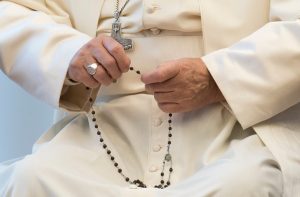
How can we be followers of Christ, if we never actually listen and let Him guide us? If we rarely pray, and if that prayer consists solely of requests to God, then it remains a self-directed life rather than a God-directed life. Oftentimes we try to lead Christ along our path, asking Him to bless our plans and provide earthly prosperity.  Instead, we need to pause and make the time and mental space to really listen to the Lord and what He asks of us.  We do this through praying with Scripture – His Word to us – or reading quality spiritual books that draw us deeper into the mysteries of our faith. We can also meditate using the rosary, since it guides us in reflection on each of the key moments of Christ’s life.  

Robert Cardinal Sarah offers instructive advice about this type of prayer in his work the Catechism of the Spiritual Life

“The important thing, when we pray, is not so much what we say to God but rather the work that He accomplishes in us while we remain silent in His presence, when we agree to let ourselves be cured of our lack of love. Prayer does not consist of laying a hand on God, but of letting God lay his Hand on us. Otherwise, our prayer will be sterile. Such prayer requires silence, recollection, interior availability, humility in the presence of God’s holiness.”

The apostles, who had asked Jesus to teach them to pray, knew the great prayer of surrender – the Our Father. They also knew from His example the importance of regularly drawing away from the crowds to converse in prayer with the Father, and always before a mission.  They also had Mary with them, the first and longest disciple of Christ and a woman who constantly lived in a contemplative openness to the Father, the Son, and the Holy Spirit. 

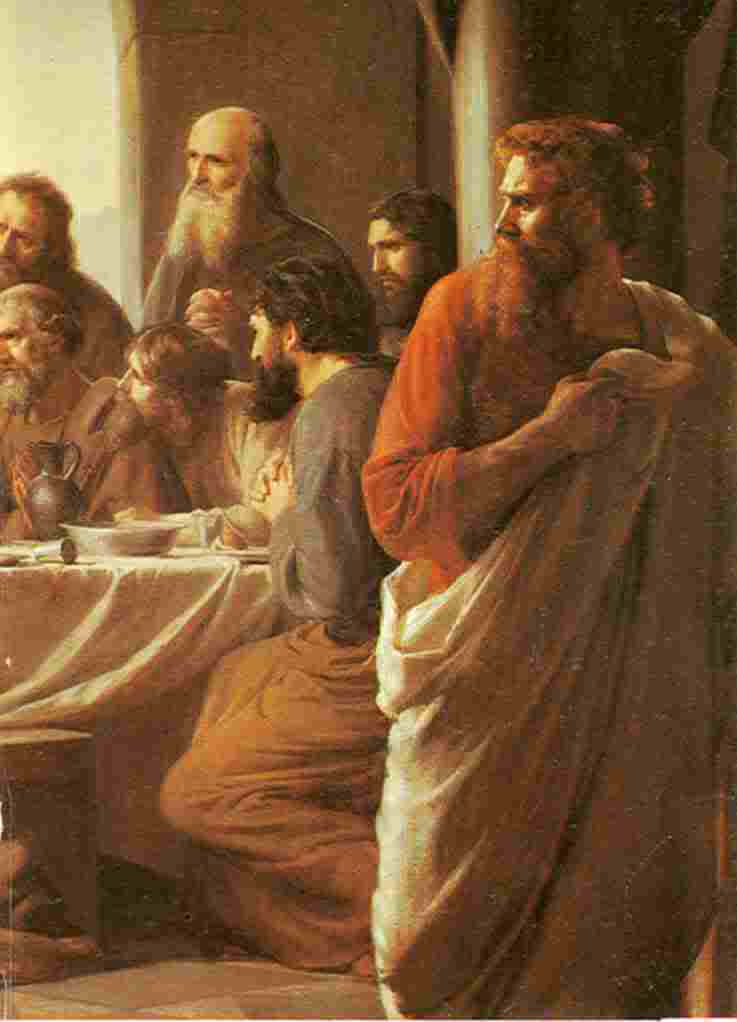
“Then they returned to Jerusalem from the mount called Olivet, which is near Jerusalem, a sabbath day’s journey away; and when they had entered, they went up to the upper room, where they were staying, Peter and John and James and Andrew, Philip and Thomas, Bartholomew and Matthew, James the son of Alphaeus and Simon the Zealot and Judas the son of James. All these with one accord devoted themselves to prayer, together with the women and Mary the mother of Jesus, and with his brothers.”  Acts 1:12-14

What peace Mary must have brought the apostles!  Jesus promised He would not leave them orphans, and He never did. From the Cross, He gave them Mary as their mother, and on Pentecost the Holy Spirit – Who proceeds from love of the Father and the Son.
In closing, let’s take a lesson from Mary.  Let’s make space for silence, for intentional listening to our Lord.  From that listening, let us act on His calling in our hearts, in communion with the Holy Spirit.

“If a man loves me, he will keep my word, and my Father will love him, and we will come to him and make our home with him.” John 14:23

Finally, a special shout out to all the mothers today!  We honor you because you made space in your body and in your heart, giving life through your constant love and care!

Related Posts


© 2024 Angela M Jendro

*Scriptural texts, unless otherwise noted, are taken from The Holy Bible: Revised Standard Version Catholic Edition, (Oxford: Oxford University Press, 2004)

*Pray and Reflect with full guided prayer meditations on the Sunday Gospel reading in my book Take Time For Him and its series on Amazon and Kindle!


4 Takeaways for Us Today from St. Catherine of Siena – Word on Fire

I love Word on Fire ministry, and am so thankful for the honor of getting to write a piece on St. Catherine for her feast day today!

For guidance on how to live as a disciple of Christ in our strange times, look to St. Catherine of Siena. Here are 4 takeaways for us today.
— Read on www.wordonfire.org/articles/4-takeaways-for-us-today-from-st-catherine-of-siena/

Judas and the Limits of Divine Mercy

By Angela M Jendro

Whenever I teach on the topic of the Last Things (Death, Judgment, Heaven, and Hell), a student will inevitably ask about Judas. Despite having just emphasized that only God can judge hearts, they feel that somehow Judas must be an exception and we can at least judge him.  They also question if he might be an exception to Church teaching about hell – that although it does exist and you can go there, we do not definitively know the name of any specific person there.[i] Why doesn’t the Church admit that Judas is in hell? It canonizes saints and names particular people in heaven, why can’t it name Judas as not in heaven?

As Pope St. John Paul II said, “Damnation remains a real possibility, but it is not granted to us, without special divine revelation, to know which human beings are effectively involved in it.”[ii] The Church can only proclaim that which God has revealed for us to know.  The Lord revealed His judgment on Satan and the fallen angels, which is why we know they are in hell.[iii] However, though Christ lamented for Judas’ betrayal, saying it would be better if he had not been born (Matthew 26:24), He nevertheless refrained from declaring definitively that Judas was condemned there, and we cannot know if Judas repented (even of hanging himself) just before the moment of his death.[iv] 

Jesus said that He came not to condemn the world but to save it (John 12:47-49). Christ has done His part – He has gone to every possible length to save us.  Therefore, a person’s condemnation to hell is not Christ’s doing, but our own obstinate rejection of the Way, the Truth, and the Life (John 14:6) which He has offered.

His word is not only about sin however, but also about God’s unfathomable love and mercy – a mystery far beyond our understanding and too often foreign to our personal experience. As we struggle to accept the lengths of this reckless love[v], we look for some limit – and Judas seems to make sense.  Judas literally betrayed Jesus and directly participated in the sentencing of Christ to death.  Judas himself was so horrified by his sin, that in his painful grief and humiliating shame he took his own life.  Judas’ greatest failure, however, may not have been his betrayal of Christ to the chief priests, but his disbelief and distrust in the extent of Christ’s mercy.  In truth, the fact that the Church will not officially declare Judas to be in hell should be a source of hope for us, because as Jesus complained to St. Faustina in an apparition, so many of us commit the fault of disbelief and distrust in the limitlessness of His mercy too. 

Jesus appeared to the young polish nun, St. Faustina (1905-1938) many times to reemphasize this essential Gospel truth.  She obediently shared His messages with her confessor and wrote them in her Diary. In entry 50, on February 22, 1931, she recorded (Jesus’ words to her are in bold):

+ I desire that priests proclaim this great mercy of Mine towards souls of sinners. Let the sinner not be afraid to approach Me. The flames of mercy are burning Me clamoring to be spent; I want to pour them out upon these souls.

Jesus complained to me in these words, Distrust on the part of souls is tearing at My insides. The distrust of a chosen soul causes Me even greater pain; despite My inexhaustible love for them they do not trust Me.”[vi]

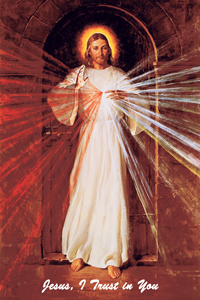
From a desire to make His mercy known and accepted more, Jesus asked Faustina to have an image painted which would illustrate this. The image consisted of Jesus in a white garment, and from His heart emanated two rays – one white and one red – symbolizing the water of baptism and the blood of His sacrifice. Beneath the image He wanted the words “Jesus, I trust in You” printed.[vii] In addition to the image, Jesus wanted the Sunday following Easter to be a Feast of Mercy.[viii] 

Pope St. John Paul II recognized the timeliness of this message and the importance of Faustina’s witness. He canonized her on Sunday April 30, 2000; making her the first saint of the new millennium as well as instituting the Feast of Divine Mercy Sunday to be celebrated the Sunday following Easter each year from then on. In his homily at her canonization, he affirmed,

“Divine Mercy reaches human beings through the heart of Christ crucified: ‘My daughter, say that I am love and mercy personified’, Jesus will ask Sr Faustina (Diary, p. 374). Christ pours out this mercy on humanity though the sending of the Spirit who, in the Trinity, is the Person-Love. And is not mercy love’s ‘second name’ (cf. Dives in misericordia, n. 7), understood in its deepest and most tender aspect, in its ability to take upon itself the burden of any need and, especially, in its immense capacity for forgiveness?”[ix]

Echoing the need for teaching divine mercy, Pope Francis called for a Holy Year of Mercy (Dec. 8, 2015 – Nov. 20, 2016).  In the book The Name of God is Mercy, Pope Francis articulated his concern with why more people do not turn to Christ in their need: “Because humanity is wounded, deeply wounded. Either it does not know how to cure its wounds or it believes that it’s not possible to cure them”[x] This helplessness is compounded by our wounded experiences. He observed that since many people in today’s selfish world haven’t experienced mercy in their own lives, they assume they won’t receive mercy from God.

Consider Judas again.  He had judged Jesus without mercy, and now he judged himself the same way. In addition, when he returned to the chief priests and the elders heartbroken and repentant, they responded with utter coldness.  The great theologian Fr. Romano Guardini captured the anguish of the moment well in his book The Lord, writing:

“After the deed came repentance – an overwhelming recognition of all that was lost. But this consciousness could no longer alter the fait accompli that stared back at Judas from the cold faces of those he had served. Strangely heart-rending gesture of helplessness, this flinging down the silver in the temple sanctuary!”[xi]

In this light, consider how important Jesus’ exhortation to us is in Luke 6:36-38! If only Judas had obeyed Christ’s word, he wouldn’t have had to suffer so terribly from the awful effects of his judgmentalism.

“Be merciful, even as your Father is merciful. Judge not, and you will not be judged; condemn not, and you will not be condemned; forgive, and you will be forgiven; give, and it will be given you; good measure, pressed down, shaken together, running over, will be put into your lap. For the measure you give will be the measure you get back.”

Judgmentalism can quickly become a vicious cycle. Judas judged and condemned Jesus.  However, when he realized he had judged wrongly, he then turned and judged and condemned himself, but was again wrong.  Though not innocent, he judged himself beyond the limits of God’s forgiveness and condemned himself to death.  We can’t judge Judas either. Fr. Guardini warned:

“No, what came to the surface in all its terrible nakedness in Judas, existed as a possibility all around Jesus. Fundamentally not one of his followers had much cause to look down on Judas. Nor have we. Let us be perfectly clear about this. Betrayal of the divine touches us all.”[xii]

Imagine the emotional drama and utter pain when Judas “flung the coins” (Matthew 27:5).  Think of all the frustration – the mental and emotional struggle during his time with Jesus, trying to determine just who Jesus is.  First as a zealous and hopeful follower, then a disenchanted disciple angry that Jesus wouldn’t bend to his expectations. Next as a malicious betrayer helping put to death what he deemed at the moment a false messiah, only to finally realize Jesus’ innocence, but tragically still too narrow minded and hearted to realize the extent of the Messianic redemption meant even for him. 

We at least live in the age of the Church, in the age of grace. Judas’ betrayal – both in Jesus’ death and his own – occurred before the Resurrection, and more importantly, before Pentecost. Had any of the other apostles been as extreme as Judas in their passions, they too may have succumbed to a similar end.  No one can fathom the mercy of God – it’s literally beyond human understanding.  They needed the Holy Spirit to open their minds and hearts to what Christ had been teaching them all along. We rely on the same Holy Spirit to both inspire knowledge of our sins and compunction of heart, and to give us the supernatural courage to trust in divine mercy. This is why it’s essential that we practice mercy, so we can become more habituated (and therefore open) to God’s gift of mercy to us.

Let’s take a final look at Judas from the standpoint of what we do and don’t know.  What was his disposition of soul at death? When he saw the truth of Jesus’ innocence he repented.  What did he do when he saw the truth of Jesus’ mercy, when he saw him face to face at his judgment?  We do not know…  It would be so much more satisfying if we did, we want to know the end of this dramatic story! He could have accepted Jesus’ mercy, been purified (Purgatory), and entered heaven.  Or he could have doubled down in his despair or in his pride, refused to accept mercy, and excluded himself from heaven, which is the definition of hell. 

Our choices matter. It’s incredible to think about the power that God has given to us in the freedom of Love.  May we pray for a merciful heart, which is able to both give and receive mercy. Jesus proclaimed, “Repent and believe in the Gospel.” Repentance of sin and trust in the merciful love of God are meant to be inextricably united. As Jesus said to St. Catherine of Siena:“I do not wish the soul to consider her sins, either in general or in particular, without also remembering the Blood and the broadness of my Mercy.”[xiii]

In conclusion, although it’s natural for students to ask, “what about Judas?”, the truth is it’s between Judas and Jesus.  The more important question to ask is, “what about me?”. Thankfully for us there’s still time.


[i] CCC par. 1033 “To die in mortal sin without repenting and accepting God’s merciful love means remaining separated from him for ever by our own free choice. This state of definitive self-exclusion from communion with God and the blessed is called ‘hell.’” CCC par.1035 “The teaching of the Church affirms the existence of hell and its eternity.” CCC 1036 “The affirmations of Sacred Scripture and the teachings of the Church on the subject of hell are a call to the responsibility incumbent upon man to make use of his freedom in view of his eternal destiny. They are at the same time an urgent call to conversion: “Enter by the narrow gate; for the gate is wide and the way is easy, that leads to destruction, and those who enter by it are many. For the gate is narrow and the way is hard, that leads to life, and those who find it are few.”

[ii] Pope St. John Paul II Audience July 22, 1999. Vatican.va

[iii] Cf CCC par. 391-393

[iv] For Church teaching about suicide, see The Catechism of the Catholic Church, par. 2280-2283. Taking one’s own life is a serious sin. At the same time, the Church recognizes that “grave psychological disturbances, anguish, or grave fear of hardship, suffering, or torture, can diminish the responsibility of the one committing suicide” (par. 2282) It also encourages us that “We should not despair of the eternal salvation of persons who have taken their own lives. By ways known to him alone, God can provide the opportunity for salutary repentance. The Church prays for persons who have taken their own lives. The Church prays for persons who have taken their own lives” (2283).

[v] cf Dorothy Day, The Reckless Way of Love: Notes on Following Jesus”, ed. Carolyn Kurtz, Plough Publishing House, 2017.

[vi] Maria Faustina Kowalska, Divine Mercy in My Soul: Diary of Sister M. Faustina Kowalska. Marian Press, 2003.

[vii] Ibid. Diary entry 47

[viii][viii] Ibid. Diary entry 49

[ix] John Paul II, Homily at the Mass in St. Peter’s Square for the Canonization of Sr Maria Faustina Kowalska, 30 April, 2000. Vatican.va

[x] Pope Francis.  The Name of God is Mercy. Random House, 2016.

[xi] Romano Guardini, The Lord, Gateway Editions 1982, p. 410

[xii] Ibid. p. 411

[xiii] Catherine of Siena, The Dialogue, Edited by Richard J. Payne, Translated by Suzanne Noffke, O.P. Paulist Press, 1980.

Related Posts

© 2024 Angela M Jendro

*Scriptural texts, unless otherwise noted, are taken from The Holy Bible: Revised Standard Version Catholic Edition, (Oxford: Oxford University Press, 2004)

*Pray and Reflect with full guided prayer meditations on the Sunday Gospel reading in my book Take Time For Him and its series on Amazon and Kindle!

Honoring Mary on International Women’s Day

In honor of International Women’s Day, I’d like to offer a lovely little vignette of an inspiring relationship which exemplifies its 2024 themes – “Invest in Women: Accelerate Progress” (U.N.) and “Inspire Inclusion” (IWD). Pope St. John Paul II’s love for Mary and his undying devotion to her is a beautiful image of the complementarity of the masculine and the feminine in the Church and some of the possibilities that emerge from it.

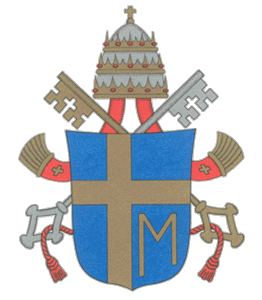
Counter to secular culture which conflates the papacy with patriarchal power, John Paul II chose as his papal motto “Totus Tuus” – offering himself and his papacy totally to Mary. His inclusion of Mary in his papal ministry and his personal investment in Marian prayer and Mariology shined a light on feminine greatness that inspired many, including myself. 

vatican.va

The simplicity of the symbol on his papal shield of the Cross with an M, cuts through the political misdirects about the Church and points instead to the distinct but inseparable work of Christ and His Mother, and of the Marian and the Petrine dimensions of the Church. Moreover, through his filial relationship with her, he came to understand and articulate what he termed the feminine genius. Because he knew deeply, and cherished with great love, the woman – Mary – the new Eve, full of grace and the fullness of the feminine vocation, his insights on the feminine calling through Christ were filled with reverence, awe, and respect. 

 As Pope, John Paul II embodied the Petrine dimension of the Church. Christ instituted Holy Orders through which He wished to be present sacramentally through the ministry of Peter, the apostles, and their successors, particularly in the Eucharist and in the safeguarding of the Deposit of Faith. They teach, sanctify, and rule with the power and authority of Christ to carry on His mission on earth in persona Christi. The Petrine response to Christ is lived through this ministry.

The Marian dimension precedes the Petrine – Mary is the first and perfect disciple of Christ. The apostles, along with us, learn how to be a disciple through imitating her. Through Mary’s total surrender to God and complete gift of self in faith and obedience, the Holy Spirit descended upon her, and Christ’s literal incarnate Body and human nature was conceived. The Mystical Body of Christ begins therefore in Mary’s fiat and fidelity – she is the Mother of the Church and she continues to bring forth new spiritual life and nurture it in grace together with Her Son. The Catechism incredibly states:

“[The Church’s] structure is totally ordered to the holiness of Christ’s members. And holiness is measured according to the ‘great mystery’ in which the Bride responds with the gift of love to the gift of the Bridegroom.”193 Mary goes before us all in the holiness that is the Church’s mystery as “the bride without spot or wrinkle.”194 This is why the “Marian” dimension of the Church precedes the “Petrine.”[i]

John Paul II also underscored the preeminence of her role.  He noted that the Petrine dimension relied upon the Marian, and rather than subjugating the feminine he humbly recognized her greater power in the Church than his own:

“The Immaculate Mary precedes all others, including obviously Peter himself and the Apostles. This is so, not only because Peter and the Apostles, being born of the human race under the burden of sin, form part of the Church which is ‘holy with sinners’, but also because their triple function has no other purpose except to form the Church in line with the ideal of sanctity already programmed and prefigured in Mary. A contemporary theologian has well commented: ‘Mary is ‘Queen of the Apostles’ without any pretensions to apostolic powers: she has other and greater powers” (von Balthasar, Nette Klarstellungen, Ital. transl., Milan 1980, p. 181). In this context it is especially significant to note the presence of Mary in the Upper Room, where she assists Peter and the other Apostles, praying for and with them as all await the coming of the Spirit.’”[ii] 

vaticannews.va

As we look for ways to better appreciate the distinctly feminine contribution in all of the various spheres of societal life, John Paul II provides a beautiful example of how to go about it. He began on his knees, in prayer, and through the lens of love.  May we too invest in our relationship with Mary, and learn from her the how to hear and respond to Christ in our own lives and callings.

[i] Catechism of the Catholic Church, 2nd ed., 773

[ii] John Paul II, “The Marian and Petrine Principles” Annual Address to Roman Curia Dec. 22, 1987, https://www.piercedhearts.org/jpii/addresses_speeches/1997/marian_petrine_principles.htm

Related Posts


© 2024 Angela M Jendro

*Scriptural texts, unless otherwise noted, are taken from The Holy Bible: Revised Standard Version Catholic Edition, (Oxford: Oxford University Press, 2004)

*Pray and Reflect with full guided prayer meditations on the Sunday Gospel reading in my book Take Time For Him and its series on Amazon and Kindle!


The Strange Convergence of Valentine’s Day and Ash Wednesday

On Valentine’s Day this year – when we usually celebrate romantic love with fine dining and indulgent desserts, Catholics will be kicking off Lent with Ash Wednesday – celebrating Christ’s love with fasting and abstinence.  What an apparent mismatch! Does love mean giving your beloved chocolate, or giving chocolate up?

The confusion can be summed up well by recounting a spontaneous dialogue between a teen in one of my bible studies at school and her Christian teammate as they were driving together to practice. When she casually asked her friend what she was giving up for lent, the teammate looked at her with surprise and puzzlement.  Not only had she never heard of lent before, let alone giving things up for it, the very idea seemed counter to her sensibility.  She wondered why Catholics fast or do acts of self-denial, reasoning, “Doesn’t Jesus just want us to love him?”. The Catholic teen was equally confused, wondering “How can you love Jesus without sacrificing in some way?”

St. Francis de Sales offers wise insight into this difference of viewpoint:

“The world sees devout people as they pray, fast, endure injuries, take care of the sick, give alms to the poor, keep vigils, restrain anger, suppress their passions, give up sensual pleasures, and perform other actions painful and rigorous in themselves and by their very nature. But the world does not see the heartfelt inward devotion that renders all such actions pleasant, sweet, and easy…Sugar sweetens green fruit and ripe fruit corrects whatever is crude and unwholesome. Now devotion is true spiritual sugar for it removes bitterness from mortification and anything harmful from our consolations.”[i]

Maybe the conjunction of these two celebrations of love isn’t mismatched after all. Maybe their timing in 2024 is actually brilliant. Too often abstaining from meat on Fridays, spending greater time in prayer, and giving something up is viewed as a tedious burden.  Were they done for their own sake or out of a feeling of guilt or obligation they might be.  However Lent is a beautiful – one could say spiritually romantic – time with Christ. We withdraw from the world to devote time to our relationship. We spend alone time with the Lord through an intentional addition of prayer. We look within to consider that which is unloving and needs healing.  We counter our easy self-centeredness by looking for a way to serve in acts of giving.  As St. John wrote, “We love because He first loved us” (1 John 4:19). The 40 days leading up to Christ’s ultimate act of love for us, is meant to love Christ in return and open our hearts more to receive the love He wishes to pour out on us in His blood on Good Friday and His resurrection on Easter Sunday.

St. Paul described this mismatch of openness in his second letter to the Corinthians (6:11-13):

“Our mouth is open to you, Corinthians; our heart is wide. You are not restricted by us, but you are restricted in your own affections. In return – I speak as to children – widen your hearts also.”

Jesus has opened His heart wide, but we respond to His approach with hearts opened only a crack, letting in very little of the Lord.  Our own preoccupations and love for other things block His entrance – like a child’s room that’s so cluttered in mess you can barely get the door open. In today’s culture especially, Christ can be quickly crowded out by media time, consumerism, and overpacked schedules. From this vantage point, consider some common Lenten sacrifices and their loving effect. Giving up chocolate, sweets, energy drinks, french fries, or other favorite foods or beverages draws back the deluge of impulses that quickly and regularly pull us away from spiritual growth. For example, when you sit down to prayer do you think – “I need a snack?”, or do you run out of time for prayer but not out of time to make a Starbucks run? The sacrifice illumines our affections and the proportion of our heart they hold.  When we crave something, it draws our attention. When we say no to that craving, we remember why – Jesus’ no to His physical craving to avoid the suffering of the cross in favor of a higher craving for our salvation and the will of the Father (cf. Matthew 26:36-46).  At its most basic level, it’s a simple way to say “Jesus I love you more than ….”  – and the more meaningful the sacrifice the more meaningful the statement.  Secondly, impulses often undermine love of neighbor.  Every day we ask, “what’s for dinner?”, but neglect to ask “who needs my kindness today?”.  The strength of our impulses can even cause unloving actions – unrestrained speech devolving into gossip or biting words, fighting over resources, and rushing to attain things for ourselves before someone else, or sadly using others as objects to satisfy a desire rather than loving them as persons. Finally, it keeps us from virtues such as temperance which governs gluttony and other areas in need of self-control. 

Jesus does want us to love Him.  To do that, we need to remove the barriers blocking the door.  Our own attachments make it painful. However, the more we love Jesus, the more enjoyment we take in throwing things out of the way as we excitedly invite Him in. It feels good to gain self-mastery (with the help of grace) over things that regularly win our attention. Moreover, it would be a mistake to imagine the emptying that Catholics work at during lent as creating a barren void. On the contrary, with every inch of room we make for the Lord, He fills it with His presence and His love.  Pope St. John Paul II often exhorted us that self-fulfillment can only be achieved through self-gift.  During lent, we give of ourselves – and in loving Christ and others, we too are filled with love.  Sounds like the perfect Valentine’s gift after all!

[i] St. Francis de Sales, Introduction to the Devout Life, trans. John K. Ryan (New York: Image Books, 1972) p.30

Related Posts

Connection Point – Share Your Experience

+ What are you giving up for Lent or adding in? Share your ideas in the comment section below.

+ What are some fruits from your past Lenten practices? 

Please keep all comments respectful; this is a platform for encouragement and accompaniment, not argument.


© 2024 Angela M Jendro

*Scriptural texts, unless otherwise noted, are taken from The Holy Bible: Revised Standard Version Catholic Edition, (Oxford: Oxford University Press, 2004)


*Pray and Reflect with full guided prayer meditations on the Sunday Gospel reading in my book Take Time For Him and its series on Amazon and Kindle!


A Beautiful Mess: A Few Pro-Life Thoughts on the Mystery of Unplanned Plans

So God created man in his own image, in the image of God he made him; male and female he made them” Genesis 1:27

God is love.” 1 John 4:8

Let all who thirst come; let all who desire it, drink from the life-giving water.” (Revelation 22:17)

Life is messy, and oftentimes the messiness brings pain and difficulty. We grasp at control in an effort to prevent pain or avoid problems, and sometimes it works for a bit. However, the messiness of life is unavoidable and attempts to get around the concomitant pain and trouble only causes other pains and troubles. The ceaseless effort only exacerbates our thirst for happiness and peace.

Everyone desires happiness – a fulfilling life of love and purpose. If we want this thirst satisfied however, we would be better served by looking to Christ. Contemporary cultural solutions tend to be short sighted; Christ alone provides the life-giving water that can redeem our efforts.  Our lives will be messy.  The lives of those we love will be messy. God isn’t afraid of our mess, rather He chose to become man to stand in the middle of it with us, roll up His sleeves, and put it back together.

In this the love of God was made manifest among us, that God sent his only Son into the world, so that we might live through him. In this is love, not that we loved God but that he loved us and sent his Son to be the expiation for our sins.” 1 John 4:9-10.  

With Christ however, He never puts it back the way it was.  Instead, He makes all things new (Revelation 21:5).  He’s so much more loving and wiser than we can imagine, so allowing Him into our mess, also means allowing Him to work in His way. And the Lord has told us ahead of time,For my thoughts are not your thoughts, neither are your ways my ways” (Isaiah 55:8).  He does not see as we see – from outward appearance, rather he sees straight to the heart (cf. 1 Samuel 16:7).

Nothing seems to be as messy as human relationships; probably because it’s where we ought to resemble God the most and where we struggle with our fallenness the most. Anxiety around relationships takes many different forms, but everyone struggles in some way or another.

On January 22nd, we will be remembering a particular relational struggle-that of unplanned and unwanted pregnancies. Rallies will be held around the United States to promote the protection of all human life.  Arguments and pleas on both sides of the abortion debate will be made about choice.  I’m not going to offer an argument – many thoughtful and knowledgeable people have already done so.  Rather, I’d like to offer a reflection on the mystery underlying the dialogue around what choice one should make when faced with such a profoundly delicate and meaningful “mess” – a drink of life-giving water from Christ amidst the stress.

The debates around pregnancy must be heated because the reality of pregnancy and its consequences carry such profound significance – literally life altering.  When considering a “wanted pregnancy”, this profundity is obviously apparent.  The deepest joy and depth of meaning for a couple is becoming a family. However, the exact same act done in love and producing the most beautiful miracle, can also be done without love or without meaning and somehow produces the same miracle. This is the mystery of the mismatch underlying the abortion issue. An unremarkable sexual encounter, or a remarkable encounter but lacking the necessary relational depth or perfect circumstances, should seemingly produce an equally unremarkable or superficial effect. Yet something so short can (and does) produce a someone who is eternal. A forgettable night can create an unforgettable person. One must wonder at this mystery: how can something so simple produce something so complex and weighty?

This brings us back to the messiness of human life. God made the act of love for a love that images Him – unitive, creative, life giving, meaningful, supernatural. Whether we respect nature or not, God does. The intentions of the couple do not determine the gravity of its effects. We can try to control the situation, but unplanned and unwanted pregnancies prove otherwise.

One might counter with a “simple” solution of an abortion. However, abortion isn’t merely a “procedure” – it’s a birth.  All pregnancies end with the birth of a baby, abortion doesn’t avoid that reality.  Instead, it makes it violent toward the child and emotionally traumatizing for the parents.

In our present culture, sex is associated by many with animal instinct. Yet it doesn’t result in animals but in humans, images of God with eternal souls. Maybe this is why making love is a more accurate description of the act than merely having sex.  In our fallen and messy world, we can experience a mismatch between sharing in the holiest of powers to cooperate with God in the creation of new life, and the easy misuse or degraded abuse of that power. We need Christ’s help to recover reverence for this sacred power and gift. We also need profound grace to wield this power against the fallen forces of concupiscence within. Our fallen nature means we have a weakened will and a darkened intellect, meaning we are great at rationalizing what we want to do over what we should do, and find it so hard to do what we ought rather than what we feel.

However, when we sin (and we all do), there can be healing redemption through taking responsibility for our actions and allowing Christ to work in the mess.  In the case of “unwanted pregnancy”, our act of selfish un-love, can be remedied by the reparative act of to-love. A child conceived in a superficial or selfishly motivated encounter is still a gift given by God for an opportunity to restore or grow one’s heart with deep and real love. Even if the conception occurred from merely having sex instead of making love, God Who is Love, created this child, and his or her growth, birth, and life can be a profoundly loving encounter. How beautiful if both the mother and the father should embrace this opportunity! If they turn from using each other, or only loving partially, to loving each other wholly and sacrificially, inspired by love for the child they have begotten together with God.  

Oftentimes when in a mess and feeling overwhelmed, we feel ashamed to let anyone see, and pride undermines reaching out for help.  When we let Christ into the mess, He not only heals us in surprising ways, but He also sends reinforcement.  Just as you have an opportunity to grow, so do others who Christ invites to participate.  It takes faith because we can’t always see the help right away. However, if we can be humble and brave enough to let others into our mess, they too can be part of the gift of love.

St. Paul wrote thatGod works all things together for good” (Romans 8:28). Even though every child deserves to be conceived in love and part of a family ready to receive them, God can redeem every limitation or mistake and make it more beautiful than before. Isn’t this what He did with death?  What Satan thought to be his triumph, turned instead to be God’s weapon against him. In the same way, if we turn our problems over to the Lord, He can use the same circumstance to raise us back up. 

God is love, and we are made in His image. All pregnancies are an opportunity for the sacrificial and heroic love to which we are called, and in which we can find the happiness we are searching for. We are all part of God’s family, and all called to care for one another. Even if a child was not planned by the parents, it has a plan from God and so do they.

For I know the plans I have for you, says the Lord, plans for welfare and not for evil, to give you a future and a hope.” Jeremiah 29:11

Connection Point – Share Your Experience

+ Are you currently in an unplanned struggle? What are your fears or worries? 

+ Have you made it through to the other side of a crisis? What encouragement can you offer those in the middle of one? What did you find most helpful during that time? How has God worked it for good?

Please keep all comments respectful; this is a platform for encouragement and accompaniment, not argument.

Join in prayer: Praying for the Unborn and Mothers in Crisis…Meditations on the Sorrowful Mysteries of the Rosary

Related post: Day of Prayer for the Legal Protection of Unborn Children


© 2024 Angela M Jendro

*Scriptural texts, unless otherwise noted, are taken from The Holy Bible: Revised Standard Version Catholic Edition, (Oxford: Oxford University Press, 2004)


*Pray and Reflect with full guided prayer meditations on the Sunday Gospel reading in my book Take Time For Him and its series on Amazon and Kindle!