28th Sunday in Ordinary Time
Gospel Luke 17:11-19 NAB
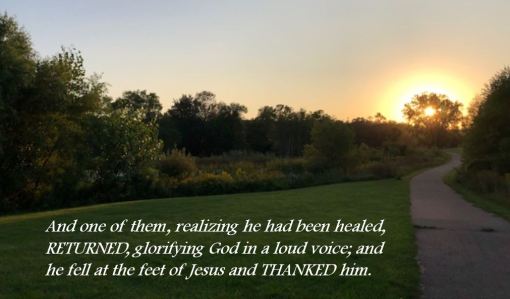
As Jesus continued his journey to Jerusalem, he traveled through Samaria and Galilee. As he was entering a village, ten lepers met him. They stood at a distance from him and raised their voices, saying, “Jesus, Master! Have pity on us!” And when he saw them, he said, “Go show yourselves to the priests.” As they were going they were cleansed. And one of them, realizing he had been healed, returned, glorifying God in a loud voice; and he fell at the feet of Jesus and thanked him. He was a Samaritan. Jesus said in reply, “Ten were cleansed, were they not? Where are the other nine? Has none but this foreigner returned to give thanks to God?” Then he said to him, “Stand up and go; your faith has saved you.”
Meditation Reflection:
On His way to Jerusalem, where He would be rejected and killed for our sins, Jesus encountered ten lepers. Since leprosy is highly contagious those who suffered with its physical harms additionally suffered from social isolation and rejection as well, banished to stay separate from healthy people. When the lepers saw Jesus they called out because they could not approach in their condition. Jesus’ instructions to show themselves to the priests required them to make an act of faith and hope. Faith believes God’s words and hope acts upon those promises before necessarily seeing them. At that time, if someone believed they had been healed from leprosy, they had to show themselves to the priests for examination before being cleared to reenter the community. The lepers did not question Jesus’ command but did as He instructed before they had been healed. They acted with hope based on belief in Jesus and His words. As they walked in hope, they were cured.
The virtues of faith and hope direct one toward the highest of all virtues – charity. Charity is the love of God above all things and love of neighbor out of love for God. Only one leper demonstrated this higher virtue. Jesus, who knows the hearts of all men, indicated that the man who returned had a deeper and more fruitful faith than the other nine. Why? He returned to Jesus to say thank you.
Consider how many of us quickly forget God’s miraculous work in our lives shortly after the crisis is over. We fall back into our regular routines and grow complacent or even complain about mundane things. Even worse, when the next crisis upsets our lives, we sometimes forget God’s power and fall to discouragement and negativity. How can we avoid this common mistake?
A simple thank you and a disposition of gratitude express, as well as develop, the essential virtues of the spiritual life. Every day, and many times throughout the day, we have to choose our attitude. We regularly experience the temptation to succumb to negativity, skepticism, disgust, and even despair. However, with faith in Christ’s promise and hope in His transformative love, we can work through this crisis with the aid of the Holy Spirit and supernatural grace.
If everything depended on us alone, then discouragement and despair would be a sensible response. Take for example the Gospel passage. The lepers would have considered their future to consist merely of painful physical deterioration and utter loneliness. Their lives took a completely new trajectory when they encountered Christ. This surprising, unexpected event, liberated them their illness and gave them new hope for their future.
Propping up hope that man can save himself, then deepening discouragement at the realization that we can’t, are two common ways the devil tries to lead us away from the Lord. We can benefit from doing a daily attitude check and remembering that when we encounter Christ, surprising, unexpected things can happen and change our lives and our world.
A favorite author of mine and Catholic historian, Christopher Dawson, wrote an essay entitled “The Six Ages of the Church”which gives me a hopeful perspective for our current situation as a Church. In this essay he proposed that throughout the course of its 2000 year history, the Church has (and continues) to experience a cycle of three stages: crisis, response, and flourishing. With each challenge the Church experiences setbacks and loss. In response, new apostolates arise and face the challenge resulting in a time of flourishing and achievement. The next crisis sets the Church back again but new responses emerge again as well, and so on and so forth.
Viewing history from this perch inspires hope as we consider every age poses its challenges and Christians have felt the same confusion, disillusionment, and fear that we do. Yet, in every age the Holy Spirit worked in the hearts of God’s people and inspired them with new ways to meet those challenges, adapt, and overcome.
This cycle applies to our individual lives as well. We will encounter challenges that leave us feeling confused and helpless. Nevertheless, if we call out to Jesus and walk forward in faith and hope, He will transform our lives and we will indeed flourish. During times of peace, the challenge is to remain grateful and to return to the Lord, remembering that He is the source of our health. We are always dependent on Him. During times of crisis, we need to remember God’s power to transform, possibly even through us. Thanksgiving, counting our blessings, and confidently surrendering to the Lord should be our daily response. No matter what our crisis – individually, locally, or nationally – there are always things for which to be grateful and always hope for renewal. As St. Paul says in 1 Thessalonians 5: 18 “In all circumstances, give thanks,
for this is the will of God for you in Christ Jesus.”
Consider:
- Reflect back on times that God helped you through a difficulty. Consider the feelings you experienced beforehand and the joy afterward.
- Consider how your faith, hope, and charity have grown over the years. How have your encounters with Christ in your daily life deepened your convictions?
- When do you feel discouraged, pessimistic, and negative? What areas of your life are particularly vulnerable to this attitude? How might you change your perspective? What might you be overlooking or taking for granted in the situation? How might you make a positive difference in it?
- If you have children, consider what kind of formation they will need to be Christian leaders in our present culture. What virtues could you help them develop? What persons or saints could you point them to for inspiration? How might you nurture and develop their faith and their conscience? How can you teach by example in your own life?
Make a Resolution (Practical Application):
- Make a gratitude list. Each day reflect and thank God for three things from that day.
- Do one thing this week to make a positive contribution or change where you are usually negative.
- (examples: bring a treat for everyone to a meeting you would rather avoid and choose to smile; pray for our leaders each day this week; tell someone thank you each day for something; if you don’t like the music at church, volunteer your musical talents; if you don’t like what your spouse cooks for dinner, cook something yourself for everyone; if you keep having negative encounters with your child, proactively plan an activity or time together that will be positive; etc.)
- Reduce discouraging messages this week (either via media or negative friends), and increase encouraging messages (read Scripture, listen to uplifting music or inspiring biographies).
~ Written by Angela (Lambert) Jendro © 2016 and edited © 2019


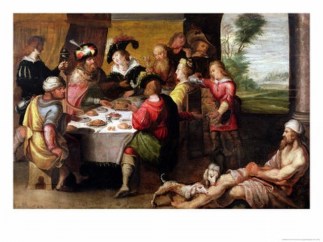 Lazarus, covered with sores, who would gladly have eaten his fill of the scraps that fell from the rich man’s table. Dogs even used to come and lick his sores. When the poor man died, he was carried away by angels to the bosom of Abraham. The rich man also died and was buried, and from the netherworld, where he was in torment, he raised his eyes and saw Abraham far off and Lazarus at his side. And he cried out, ‘Father Abraham, have pity on me. Send Lazarus to dip the tip of his finger in water and cool my tongue, for I am suffering torment in these flames.’ Abraham replied, ‘My child, remember that you received what was good during your lifetime while Lazarus likewise received what was bad; but now he is comforted here, whereas you are tormented. Moreover, between us and you a great chasm is established to prevent anyone from crossing who might wish to go from our side to yours or from your side to ours.’ He said, ‘Then I beg you, father, send him to my father’s house, for I have five brothers, so that he may warn them, lest they too come to this place of torment.’ But Abraham replied, ‘They have Moses and the prophets. Let them listen to them.’ He said, ‘Oh no, father Abraham, but if someone from the dead goes to them, they will repent.’ Then Abraham said, ‘If they will not listen to Moses and the prophets, neither will they be persuaded if someone should rise from the dead.’”
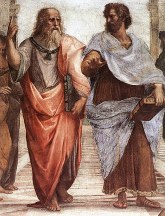 philosopher Aristotle, in his famous book on Ethics, defined virtue as a habit of doing the good. He taught that a person only acquires a virtue after having chosen it regularly over a long period of time and in many circumstances. For instance, if I tell the truth once, it doesn’t make me a truthful person. To say that I have the virtue of honesty means I have told the truth regularly for many years. As Jesus points out in this passage, a person’s character is shown as much, if not more so, in the small matters as in the larger ones. A truthful person will be pained by lying, even in small exaggerations. On the other hand, a person who lies easily about daily matters to avoid responsibility or make things easier, will certainly lie when the stakes are much higher.





 ust choose the path of discipleship or the path of least resistance, Christians must resolve and accept that as they walk to the left after Christ, some of their closest companions may walk to the right instead and their paths will separate. Although Christians, like Christ, ought to keep the door open to those friendships, oftentimes living our faith can mean losing some relationships. Jesus is Goodness, Truth, and Love. Yet, He was rejected by many. As we strive to be more Christ-like, we have to prepare ourselves for the same experience.


 Take Time For Him