Living in Denial…Gospel Meditation for February 28, 2016

by Angela Lambert

denial
February 28, 2016; 3rd Sunday of Lent

Gospel of Luke 13:1-9
Some people told Jesus about the Galileans whose blood Pilate had mingled with the blood of their sacrifices. Jesus said to them in reply, “Do you think that because these Galileans suffered in this way they were greater sinners than all other Galileans? By no means! But I tell you, if you do not repent, you will all perish as they did! Or those eighteen people who were killed when the tower at Siloam fell on them—do you think they were more guilty than everyone else who lived in Jerusalem? By no means! But I tell you, if you do not repent, you will all perish as they did! “And he told them this parable: “There once was a person who had a fig tree planted in his orchard, and when he came in search of fruit on it but found none, he said to the gardener, ‘For three years now I have come in search of fruit on this fig tree but have found none. So cut it down. Why should it exhaust the soil?’ He said to him in reply, ‘Sir, leave it for this year also,and I shall cultivate the ground around it and fertilize it; it may bear fruit in the future. If not you can cut it down.’”

Meditation Reflection:

The mystery of God’s Mercy and Justice extends beyond the limits of our comprehension. Nevertheless, Jesus exhorts us to never forget that God is both. Pope Francis has dedicated this year to reflecting on this mystery and living it out in our own lives through going to Confession and practicing the spiritual and corporal works of mercy. God’s mercy makes salvation possible through even the smallest opening of repentance and desire in our hearts. However the mercy we experience on a day to day basis, the undeserved blessings God showers as a doting Father, can also lead to complacency.

Mercy means healing and transformation. In our complacency we can begin to think that we deserve our blessings and forget our sins, or worse forget our blessings as well. St. Paul reminds us in I Corinthians 10:1-12 that the Israelites, after witnessing the mighty hand of God liberating them from Egypt and walking on dry land through the Red Sea, reverted to doubt, fear, and grumbling in the desert. In consequence, although liberated by God from Egypt, they died in the desert unable to enter the Promised Land. God can work mighty deeds in our lives. His mercy will cut through any sin. God’s forgiveness is not merely “spiritual dry-cleaning” as Pope Francis has termed it. God’s work heals and transforms. This process ought to bear fruits therefore of virtue, sanctity, and love. In fact, one of the ways St. Teresa of Avila verified the authenticity of a spiritual experience was by the fruits of virtue that accompanied it.

Jesus warns today that God’s mercy is inextricably united to God’s justice. God has given us free will. He will honor that gift. If we choose to reject the opportunity for life which comes through healing from sin, then at some point we will die. God offers us more chances than we deserve but they are limited by time and by our choices.

The Year of Mercy Pope Francis has established corresponds to his “Theology of Sin” because we cannot receive the fruits of mercy until we acknowledge and repent of our sin. In an article in First Things (8/19/13), William Doino Jr. addresses this theology of sin by the pope and notes its importance due to our wide-spread denial of sin altogether as a culture. He presents a three-step process Pope Francis has advocated for:

“The first part is to recognize the darkness of contemporary life, and how it leads so many astray: Walking in darkness means being overly pleased with ourselves, believing that we do not need salvation. That is darkness! When we continue on this road of darkness, it is not easy to turn back. Therefore, John continues, because this way of thinking made him reflect: ‘If we say we are without sin, we deceive ourselves and the truth is not in us.’”

If we do not suffer under the oppression of sin, we do not need a redeemer. When we live in denial of our sins and addictions we refuse the opportunity for help. For example, if a person lives in denial of their regular rude or hurtful comments under the rationalization that they are just “speaking their mind”, then they will soon lose relationships and friendship. If a person lives in denial of their intemperance in spending or greed for possessions beyond their means, they will eventually suffer bankruptcy. Similarly, if we live a self-centered life rather than a God-centered life, we could miss the opportunity for heaven.

After opening our eyes to our sins (with the help of the Holy Spirit), the second part of the process is to take them to confession; not with an attitude of a quick shower but with a humble, and deeply contrite heart. The word Pope Francis used to describe this feeling is a word we shy away from in our culture – shame. When we feel truly ashamed however we desire change and open ourselves up to help.

The final part of the process he writes, is:

“having absolute faith in God to renew us: We must have trust, because when we sin we have an advocate with the Father ‘Jesus Christ the righteous.’ And he ‘supports us before the Father’ and defends us in front of our weaknesses.”

Rather than despair at our weaknesses and imperfections, Pope Francis reminds us to put our trust in Christ. We must acknowledge that we cannot change on our own and allow Jesus to apply His healing grace to our souls – enlightening our minds, strengthening our wills, and fanning the flame of love for God and neighbor.

In conclusion, the mystery of God’s Justice and Mercy requires us to make an active decision to turn away from sin and accept God’s help. Because grace is freely given by God, fruits of that grace are expected too. If we do not bear fruit, we can conclude that we have not actually been receptive to grace. If we do bear fruit, it will evoke feelings off gratitude and love because we know who we are and from where those virtues truly came.

Consider:

  • How has facing your faults, though painful, made you a better person with the help of Christ? How are you different today than in years past?
  • Has God ever “rebuked” you? Did it have a positive effect later or lead to greater freedom?
  • Are there faults you continue to rationalize? Do you treat your spouse, children, or family members with the love they deserve or do you excuse your behavior by saying they should love you as you are without an effort to change?
  • Have you ever experienced the pain of seeing someone you love self-destructing or suffering due to living in denial of a serious problem? Have you offered help and been rejected? Consider how this relates to God’s perspective.

Make a Resolution (Practical Application):

  • Read an examination of conscience and prayerfully reflect on it. Most parishes have a pamphlet by the confessional with an examination, you can also find some online. If possible, look for one tailored to your state in life (e.g. single, married, priest, etc.)
  • Read the First Things article on Pope Francis’ Theology of Sin. First Things “The Pope’s Theology of Sin”
  • Choose one sin you have been avoiding admitting and actively root it out through prayer and practicing the opposite virtue. (For example – greed is combated by generosity)

~ Written by Angela Lambert © 2016

* To receive these weekly posts automatically in your email just click the “follow” tab in the bottom right hand corner and enter your email address.


Mount Tabor Moments & Transfiguration in Christ

transfiguration-of-Jesus

by Angela Lambert

February 21st, 2016; 2nd Sunday of Lent

Gospel of Luke 9:28b-36 NAB

Jesus took Peter, John, and James and went up the mountain to pray. While he was praying his face changed in appearance and his clothing became dazzling white. And behold, two men were conversing with him, Moses and Elijah, who appeared in glory and spoke of his exodus that he was going to accomplish in Jerusalem. Peter and his companions had been overcome by sleep, but becoming fully awake, they saw his glory and the two men standing with him. As they were about to part from him, Peter said to Jesus, “Master, it is good that we are here; let us make three tents, one for you, one for Moses, and one for Elijah.” But he did not know what he was saying. While he was still speaking, a cloud came and cast a shadow over them, and they became frightened when they entered the cloud. Then from the cloud came a voice that said, “This is my chosen Son; listen to him.” After the voice had spoken, Jesus was found alone. They fell silent and did not at that time tell anyone what they had seen.

Meditation Reflection:

The relationship between Jesus’ divinity and humanity will always be veiled in mystery. However, we do know that God became man so as to share in our experience and thereby conquer our sin and weakness. Jesus provides us the perfect example to follow and the grace to do it. As a result, we can look to this Gospel account as instructive for our own faith journey.

Jesus went up the mountain to pray, a task that required effort and endurance. He took with Him only a few of His closest companions. He spent time alone in prayer persisting even when the apostles fell asleep. During this solitude Moses and Elijah appeared to Him, representing the Law and the Prophets, both of which Jesus would fulfill. They spoke with Him about His mission and the Father overshadowed them in a cloud speaking words of confirmation and encouragement. Peter, John, and James didn’t know what to think or do. Peter offered to pitch tents for everyone not comprehending what was happening but trying to at least offer some kind of service. Christ usually appears humbly in our lives, veiled in His humanity. He does this so well that we too often react with surprise and an awkward response when we awake to moments of His glory.

This experience of light and glory strengthened Christ as well as the apostles for the upcoming darkness and suffering of Calvary. It was an experience so profound that they “fell silent and did not at that time tell anyone what they had seen.” Peter and James would still abandon Christ in His direst moment but later repented at their actions. John alone of the apostles would remain with Jesus at the Cross. Through darkness, disillusionment, and intense pain that confidence in God’s call and the experience of His encouragement strengthened them to persevere.

Conversion tends to be a slow process of turning away from sin and toward Christ on a daily basis. However, during this long road, we sometimes experience a Transfiguration moment wherein God reveals His plan, His mission, or His love for us in a profound and tangible way. St. Paul’s moment occurred on the road to Damascus. St. Peter’s occurred when Jesus appeared to him after His resurrection and asked him three times if he loved Him then called him to feed His sheep. These moments may confirm our call to the Christian faith or they may confirm our call to our vocation.

Mother Teresa began her mission to serve the poorest of the poor after a profound experience in prayer. She had already been a nun for 15 years when, while on a train travelling to the Loreto Convent in Darjeeling for a retreat, she heard the voice of Christ speak to her. Missionary of Charity and postulator of the Cause of Beatification and Canonization of Mother Teresa, Fr. Brian Kolodiejchuk recounts in his book Mother Teresa: Come Be My Light, that,

“Though she would persist in letting the details remain veiled in silence, she later revealed:

‘It was a call within my vocation. It was a second calling. It was a vocation to give up even Loreto where I was very happy and to go out in the streets to serve the poorest of the poor. It was in that train, I heard the call to give up all and follow Him into the slums.’”

Fr. Kolodiejchuk further records that Mother Teresa considered the date of this mystical experience (September 10, 1946), as the beginning date of, and her entrance into, the Missionaries of Charity. Christ had asked her to “Come, be My light” in the darkness of the poorest of the poor. Jesus continued to speak with her through a gift of interior locutions into the middle of the next year. During this period she presented to Christ her concerns, her happiness serving as a Loreto nun, and her feelings of inadequacy. In her letter to the Archbishop she wrote, “These thoughts were a cause of much suffering – but the voice kept on saying ‘Wilt thou refuse?’” Her love for Jesus could not refuse Him anything and so she said yes to His request.

Mother Teresa had a “Transfiguration moment”. She was thirty-six at the time. The next fifty years of sacrifice and suffering would be motivated by this single call of Christ. She faced many set-backs, rejections, and challenges both materially as well as spiritually. She experienced an interior darkness (meaning lacking in light to see) in which she couldn’t see God or feel the closeness of union that she had enjoyed before. At first she worried that her own sinfulness had caused the feeling of absence. On the contrary however, Fr. Kolodiejchuk records that,

“With the help of her spiritual directors, she progressively came to grasp that her painful inner experience was an essential part of living out her mission. It was a sharing in the passion of Christ on the Cross – with a particular emphasis on the thirst of Jesus as the mystery of His longing for the love and salvation of every human person.”

As a result, what seemed a loss at first turned out to be an extraordinary gift. Some saints have been given the stigmata – the physical wounds of Christ. Mother Teresa was given a share in the suffering of Christ’s heart. She could not have done this however, without being firmly rooted in her faith in Christ first. She could look back to that Transfiguration moment on the train and confidently press forward in humility that Christ would bring to perfection the good work He had begun.

When we feel like we can’t see God or we become disillusioned in our vocation or work, rather than ask for another sign, think back to that first call. Remember your Mt. Tabor and the time you saw Christ transfigured in glory. When you feel most near to Christ’s experience of darkness on the Cross (“My God, My God, why have You forsaken Me?”), draw strength from your experience with Him during the Transfiguration.

Consider:

  • Recall and reflect back on a time when you felt the presence of Christ or saw His glory.
    • Have you witnessed a mighty deed of His like the apostles when He calmed a storm or cast out demons?
    • Did you experience His mercy or love like the Prodigal Son or Peter?
    • Were you healed like the blind, lame, and sick in the Gospels?
    • Were you stopped in your tracks and knocked down like St. Paul?
    • Did you hear Him in “a still small voice” like Elijah?
  • Reflect on times of “darkness” when you could not see or feel the presence of Christ?
    • Did it cause you to doubt?
    • Was Christ still with you even though you couldn’t see it at the time?
    • Did it increase your longing for Christ?
    • Did it deepen your connection to His experience on the Cross?

Make a Resolution (Practical Application):

  • Journal about your Transfiguration moment(s) and keep it to look back on during times of darkness.
  • Encourage or visit someone struggling or suffering.
  • Read the lives of the saints. Read one a day or at least one a week.

~ Written by Angela Lambert © 2016

* To receive these weekly posts automatically in your email just click the “follow” tab in the bottom right hand corner and enter your email address.


Speaking Topics

We are professional speakers on topics related to developing a deeper relationship with God in your everyday life and learning more about our faith in a rich but accessible way.  

If you are looking for a speaker for your event reach out using the contact form below. We will connect with you to discuss the topic/theme you’d like to focus on, length and number of talks for the event, and your goals for audience you are serving.

Most often topics surface as a fruit of the Holy Spirit moving the hearts of the event coordinators and the retreat speakers. If you have a theme, Scripture verse, saint, or topic in mind, reach out and Angela and/or Michelle can put together tailored talks for the needs of your attendees. 

Below are examples of retreat talks from the past.

Contact us to speak at your event!

← Back

Thank you for your response. ✨

Angela:

Past Talks

          • Teaching: A Vocation within a vocation
          • Sisters in the Lord: : Reflecting on Our Identity and Connection as Women
          • Because of His Name: Finding Courage for Authentic Discipleship
          • Sanctification through Motherhood
  • Expressions of Feminine Self-Gift: Part I “Spiritual Motherhood”, Part II “Finding Beatitude”, Part III “Setting the World on Fire”
  • Having the Mindset of Mary
  • God’s Mighty Deeds
  • Prayer: What is it and Why does it Matter?
  • The Battle of Prayer: Working through Obstacles to Prayer
    bible
  • Christian Life in the World

Michelle bio picMichelle:

Past Talks:

    • Spiritual Motherhood
    • Having a Relationship with Jesus in Prayer
    • Contemplative Prayer
    • Being a Woman of God
pope francis motherhood

Strength in the Lord…Gospel Meditation for Feb.14th, 2016

by Angela Lambert

ocean waves

Gospel Luke 4:1-13

Filled with the Holy Spirit, Jesus returned from the Jordan and was led by the Spirit into the desert for forty days, to be tempted by the devil. He ate nothing during those days, and when they were over he was hungry. The devil said to him, “If you are the Son of God, command this stone to become bread.” Jesus answered him, “It is written, One does not live on bread alone.” Then he took him up and showed him all the kingdoms of the world in a single instant. The devil said to him, “I shall give to you all this power and glory; for it has been handed over to me, and I may give it to whomever I wish. All this will be yours, if you worship me.” Jesus said to him in reply, “It is written: You shall worship the Lord, your God, and him alone shall you serve.” Then he led him to Jerusalem, made him stand on the parapet of the temple, and said to him, “If you are the Son of God, throw yourself down from here, for it is written: He will command his angels concerning you, to guard you, and: With their hands they will support you, lest you dash your foot against a stone.” Jesus said to him in reply, “It also says, You shall not put the Lord, your God, to the test.” When the devil had finished every temptation, he departed from him for a time.

Meditation Reflection:

Directly after His Baptism, before He begins His public work, Jesus is first led by the Spirit into the desert to fast, pray, and face temptation. In the same way, the Holy Spirit periodically draws us away from the noise of life and the distractions of the senses to be able to connect with God in a deeper interior way. In some cases we choose to place ourselves in quiet reflection by going on a retreat or planning a weekend of solitude. At other times, the circumstances of life create solitude for us.

It reminds me of standing ankle-deep in the waves of the ocean on the beach. As the water cascades over my feet it carries with it a flurry of sand, shells, sea-weed, and teems with life and energy. Then it recedes, drawing back everything it had just placed before me. Even the sand around my feet recedes leaving me only two small mounds beneath my arches. These times can feel lonely and a little barren like the desert. However, they can be opportunities for prayer and preparation for the next mission God has for us when the water will return again replenished and shimmering.

The devil of course hates for us to follow Christ and he especially despises when we build the kingdom of God. He therefore attempts to derail us in any way possible. He prevents us from God’s work in a myriad of ways tailored to our own personal weaknesses. The devil distracts us with physical pleasures and the lie that if we don’t satisfy our body’s whims and desires we will die, or at least be so miserable it’s not worth living! Giving up sweets, pop, alcohol, snacking, over-sleeping, staying up to late, etc. during Lent help to strengthen our will over our body.

Next the devil tries to redirect the trajectory of our work by aiming our talents at building the kingdom of self rather than the kingdom of God. He tempted Jesus with the enticing offer to be king without the cross. He lures us to avoid suffering and seek success.

Lastly, if both of these tactics are thwarted the devil twists God’s own words and tries to skew our relationship with the Lord. The devil hates the Church because Christ gave it His authority to preach truth by the power of the Holy Spirit. If we listen to the Holy Spirit through Christ’s Church the devil loses his power to trick us “and will depart for a time”.

If we pay careful attention, we can learn the tricks of the devil in our own lives. St. Ignatius of Loyola began to notice this too and developed rules of discernment that have become a classic in the Christian life. Ask the Holy Spirit to help you grow in self-knowledge and provide the grace to overcome temptation so as to live in the freedom of the kingdom of God and work unhindered for His glory.

Consider:

  • Spend some time in prayer reflecting on your average day. Consider what things unnecessarily slow you down, distract you, make you late, frustrate your work, or prevent you from getting started on something. Implement a plan to combat one of them.
  • Consider the three categories of temptations from the Gospel today and how each one applies to you. This Lent build strength by combating the pleasure that has a hold over you, the suffering you are trying to avoid or the status you are trying to achieve, and grow in knowledge of your faith to protect you from the deceptions of the devil.
  • Look back on your life and reflect on how God prepared you before raising you up for something. How did you feel beforehand and after? Have you experienced deeper and richer faith after a time of solitude or difficulty?

Make a Resolution (Practical Application):

  • Commit to a Lenten resolution even if you fail at it periodically. Give something up and/or do something extra to strengthen your relationship with Christ and weaken your relationship with sin.
  • Read (or listen to the audiobook) C.S. Lewis’ Screwtape Letters. It’s short, entertaining, and enlightening. It’s a satirical work which features letters from an experienced demon to a lesser experienced one about how to tempt humans.
  • Listen to Fr. Timothy Gallagher’s podcasts on St. Ignatius’ discernment of spirits. He presents Ignatius’s ideas in an understandable and relatable way. It will aid you in understanding your everyday experiences and how they relate to the spiritual life.

~ Written by Angela Lambert © 2016

* To receive these weekly posts automatically in your email just click the “follow” tab in the bottom right hand corner and enter your email address.


Quick Reflection on Lent…preparing with Christ for transformation in Christ

jesus-fasting-in-wilderness-desert

As a community of believers we begin our preparation for the celebration of Christ’s Paschal Mystery – His suffering, death, and Resurrection at Easter. Since Christ spent 40 days in the desert praying and fasting to prepare for His mission, we too spend 40 days praying and fasting to prepare for receiving the graces He won for us on the Cross. Although Christ offers Redemption freely to all persons, we cannot be redeemed unless we repent of our sins and allow Christ to transform us in His grace. This means change – which is why we try to give up something during Lent and/or add prayer or works of mercy to our daily routine during this time.

The Catechism expresses this dual process by saying:

“God created us without us; but He did not will to save us without us. To receive His mercy we must admit our faults. ‘If we say we have no sin, we deceive ourselves, and the truth is not in us.   If we confess our sins, He is faithful and just, and will forgive our sins and cleanse us from all unrighteousness.’” CCC 1847 1 John 8-9

Catholics don’t reflect on our sins for six weeks because we have a morbid side needing to cultivate “Catholic guilt”. We meditate on our sins because unless we take the time to stop and look or pray to the Holy Spirit about them, life passes by rapidly leaving us older but unchanged and unprepared for eternal life. We receive ashes on our foreheads to remember that this life is short and the key to heaven is to repent and believe in the Gospel.

In the book The Name of God Is Mercy Pope Francis is asked “Why in your opinion, is humanity so in need of mercy?” His response articulates the reasoning underlying Lent as well:

“Because humanity is wounded, deeply wounded. Either it does not know how to cure its wounds or it believes that it’s not possible to cure them…Pius XII, more than half a century ago, said that the tragedy of our age was that it had lost its sense of sin, the awareness of sin.”

Lent is like an annual visit to the doctor. It’s important to evaluate your health once a year and catch abnormalities or diseases early. We don’t take medication unless we know we are sick and the same applies to the spiritual life. If we don’t think we are sick with sin, we don’t see a need for a Redeemer. When we realize our woundedness and repent, it’s then that we can be healed by our Lord.

  • Spend time in prayer today asking the Holy Spirit to reveal what sin He would like to help you battle this Lent or what virtue He wants to build in you.
  • Choose something to give up or do that will help you grow in your relationship with Christ and detach you from things that keep you from Christ.

Who Me?!… Gospel Meditation for Sunday February 7th, 2016

by Angela Lambert

yqhih

February 7th, 2016; 4th Sunday in Ordinary Time

Gospel Luke 5:1-11

While the crowd was pressing in on Jesus and listening to the word of God, he was standing by the Lake of Gennesaret. He saw two boats there alongside the lake; the fishermen had disembarked and were washing their nets. Getting into one of the boats, the one belonging to Simon, he asked him to put out a short distance from the shore. Then he sat down and taught the crowds from the boat. After he had finished speaking, he said to Simon, “Put out into deep water and lower your nets for a catch.” Simon said in reply, “Master, we have worked hard all night and have caught nothing, but at your command I will lower the nets.” When they had done this, they caught a great number of fish and their nets were tearing. They signaled to their partners in the other boat to come to help them. They came and filled both boats so that the boats were in danger of sinking. When Simon Peter saw this, he fell at the knees of Jesus and said, “Depart from me, Lord, for I am a sinful man.” For astonishment at the catch of fish they had made seized him and all those with him, and likewise James and John, the sons of Zebedee, who were partners of Simon. Jesus said to Simon, “Do not be afraid; from now on you will be catching men.” When they brought their boats to the shore, they left everything and followed him.

Meditation Reflection:

I often find myself torn between two emotions. Like Simon Peter my encounter with Christ leaves me astonished with a strong desire to leave everything and follow Him so I can hang on His every word and witness His great works. I want to call out “Pick me! Pick me!” At the same time, when Christ actually calls me to follow Him and participate in His mission, I feel so ridiculous because of my smallness that all I can say is “Who me? Really? Are you certain? Uh oh…” It’s one thing to watch Christ, it’s completely another to be invited to work side by side with Him. I don’t mind blending into the crowd of admirers, but I know what Christ can do through His followers and I feel foolishly unqualified.

Every Christian who has encountered Christ and heard His call struggles with the same emotions. Pick up any account of the life of a saint and they articulate the same tension. Don’t mistake their words for false modesty. The saints knew precisely the greatness of God and their own ineptitude. The only difference is that they had the humility and courage to say yes to God anyway.

Today’s first and second reading give us two such examples. Isaiah (6:1-8) reacts to seeing the glory of the Lord with fear due to his own sinfulness and feelings of being unworthy. God doesn’t disagree with him because Isaiah’s response is appropriate and true. Rather God heals Isaiah and enables him to serve God by having an angel touch Isaiah’s mouth with an ember from God’s altar.   Isaiah’s first words of “Woe is me I am doomed” change to “Here I am, send me”. St. Paul recounts having a similar experience (1 Corinthians 15:1-11). He humbly acknowledges that he of all people has no right to be called an apostle because he began by persecuting the Church. I have to think that not a day went by that Paul did not recall being present at St. Stephen’s martyrdom as a witness on the side of the persecutors. To accept Christ’s call to serve as an apostle had to have required great humility on Paul’s part and a deep trust in the mercy of Christ. Paul was willing to change teams and look like a fool by accepting a leadership position because He decided to say yes to Christ anyway.

Fr. Francis Fernandez-Carvajal, author of many works on the spiritual life, notes that the devil often tries to discourage us from great aspirations by tricking us with false humility. Drawing from Teresa of Avila, he writes in his book Through Wind and Waves,

St. Teresa of Avila, after stressing that the struggle for holiness is grounded on God’s help, and hence the importance of being humble, warns of the danger of a false humility that is short on desire and low in aspirations. The saint says regarding true humility: ‘It is necessary that we know what this humility is like. I believe that the devil harms people who practice prayer and prevents them from advancing by causing them to misunderstand humility. He makes it appear to us that it’s pride to have great desires and want to imitate the saints and long to be martyrs. Then he tells us or causes us to think that since we are sinners the deeds of the saints are for our admiration, not our imitation.’ This false humility leads to spiritual mediocrity, so opposed to the true Christian vocation.”

Although we legitimately feel unworthy, answering Christ’s call demonstrates faith and trust in the merciful love of God. Shrinking from service because of our smallness is not humble it’s mediocre, and mediocrity is not the response to grace that Christ deserves.

Christ calls every Christian to share in His work of saving souls. It’s natural to respond with an astonished “Who, me?!” However, as Pope St. John Paul II exhorted us, we should cling to Christ’s words “Be not afraid”. Push aside the temptation of false humility and step forward in faith to say as Isaiah did, “Here I am, send me”.

Consider:

  • When, like Peter or Isaiah, have you been astonished by Christ?
  • What is Christ asking of you today?
  • What fears or insecurities are holding you back?
  • Do you believe Christ will do great things through you or do you doubt His mercy?

Make a Resolution (Practical Application):

  • Each day this week ask Christ in prayer, “What do you want of me today? Here I am, send me.”
  • Pray the litany of humility prayer each day. It asks Christ to deliver us from the desires and fears that tend to become extreme in us and prevent us from freedom in following Christ.
O Jesus! meek and humble of heart, Hear me.

From the desire of being esteemed, Deliver me, Jesus.

From the desire of being loved, Deliver me, Jesus.

From the desire of being extolled, Deliver me, Jesus.

From the desire of being honored, Deliver me, Jesus.

From the desire of being praised, Deliver me, Jesus.

From the desire of being preferred to others, Deliver me, Jesus.

From the desire of being consulted, Deliver me, Jesus.

From the desire of being approved, Deliver me, Jesus.

From the fear of being humiliated, Deliver me, Jesus.

From the fear of being despised, Deliver me, Jesus.

From the fear of suffering rebukes, Deliver me, Jesus.

From the fear of being calumniated, Deliver me, Jesus.

From the fear of being forgotten, Deliver me, Jesus.

From the fear of being ridiculed, Deliver me, Jesus.

From the fear of being wronged, Deliver me, Jesus.

From the fear of being suspected, Deliver me, Jesus.

That others may be loved more than I, Jesus, grant me the grace to desire it.

That others may be esteemed more than I, Jesus, grant me the grace to desire it.

That, in the opinion of the world, others may increase and I may decrease, Jesus, grant me the grace to desire it.

That others may be chosen and I set aside Jesus, grant me the grace to desire it.

That others may be praised and I unnoticed, Jesus, grant me the grace to desire it.

That others may be preferred to me in everything, Jesus, grant me the grace to desire it.

That others may become holier than I, provided that I may become as holy as I should, Jesus, grant me the grace to desire it.

Rafael Cardinal Merry del Val (1865-1930),
Secretary of State for Pope Saint Pius X


~ Written by Angela Lambert © 2016

* To receive these weekly posts automatically in your email just click the “follow” tab in the bottom right hand corner and enter your email address.


Let Go and Let God

by Angela Lambert

let-god

January 31st, 2016; Fourth Sunday of Ordinary Time

Gospel Luke 4:21-30

Jesus began speaking in the synagogue, saying: “Today this Scripture passage is fulfilled in your hearing.” And all spoke highly of him and were amazed at the gracious words that came from his mouth. They also asked, “Isn’t this the son of Joseph?” He said to them, “Surely you will quote me this proverb, ‘Physician, cure yourself,’ and say, ‘Do here in your native place the things that we heard were done in Capernaum.’” And he said, “Amen, I say to you, no prophet is accepted in his own native place. Indeed, I tell you, there were many widows in Israel in the days of Elijah when the sky was closed for three and a half years and a severe famine spread over the entire land. It was to none of these that Elijah was sent, but only to a widow in Zarephath in the land of Sidon. Again, there were many lepers in Israel during the time of Elisha the prophet; yet not one of them was cleansed, but only Naaman the Syrian.” When the people in the synagogue heard this, they were all filled with fury. They rose up, drove him out of the town, and led him to the brow of the hill on which their town had been built, to hurl him down headlong. But Jesus passed through the midst of them and went away.

Meditation Reflection:

Most of us have had the unfortunate experience of Christ in this passage. All too often so-called friends or groups of admirers show their fickle nature by turning on us at the first instance we upset them, let them down, don’t meet all of their expectations, or they simply become distracted by something else. The home-town crowd listening to Jesus turn from amazement at His gracious words to anger which impels them to hurl Him down a cliff it what seems like a moment.

The daily Gospel readings from this week shed some useful light on this situation that can help sooth our disillusionment. Jesus responded to both praise and rejection with the same calm demeanor. He knows human nature and refrains from getting worked up about the opinion of the masses. His mission is to do the will of the Father not to poll focus groups. Moreover, Jesus teaches that all any of us can do is the will of the Father, the results are in God’s hands not our own. This works both ways – when we seemingly do great works and when we seemingly fail. In Thursday’s Gospel reading from Mark 4:1-20 Jesus told the parable of the Sower and the Seed. As a teacher and mother this is one of my favorite passages. Jesus, and His servants, have the responsibility to sow the seeds of the Gospel wherever God sends. How those seeds grow depends on the soil, or the disposition, of the receiver. Jesus’ words quite often fell on hearts that were hardened toward Him or too distracted by greed or anxiety. Why should we be surprised if we experience the same thing? Sometimes Jesus’ words fell on generous hearts and the Holy Spirit was able to work wonders through His followers. Again, can we really take all the credit when our work bears rich fruit? Some of the credit belongs to the person of faith willing to “hear the word of God and obey it” (Lk 11:28). Thus, Jesus places higher honor on two foreigners over God’s own children the Israelites because they were willing to do something in response to God’s word. Finally, credit ultimately belongs to God. In Friday’s Gospel from Mark 4:26-32 Jesus reflects on how a farmer plants seeds and harvests the crops but the entire process of growth in between is due to the mystery of God’s work in nature.

This Gospel should give us peace that God is in control. He opens people’s ears to hear and eyes to see if He chooses. He decides what persecution He will allow toward His servants and what He won’t allow. In this Gospel Jesus calmly and effortlessly passed through the angry crowd, demonstrating God’s total control over the situation. During His Passion however, God allows His Son to be taken by the angry crowd in the Garden of Gethsemane and eventually crucified. Yet, by the power of God Jesus also rises from the dead. Disciples of Christ can take comfort in Jesus’ words He so often speaks: “Peace be with you” and “Be not afraid”. We can let go and let God because our only task is to do the will of the Father and let Him bring our work to fruition. We have the joy of being His instrument, but the music played through us belongs to Him.

Consider:

  • Have you ever had an experience like Christ’s where a friend or an acquaintance turned on you? What did it teach you about relying on the opinion of others?
  • How much do you worry about what other people think of you?
  • Do you trust your children to God or do you put all the pressure for their good on yourself?
  • In John 15:1-5 Jesus asserts that our fruitfulness depends upon our connection to Him.
“I am the true vine, and my Father is the vine grower. He takes away every branch in me that does not bear fruit, and everyone that does he prunes so that it bears more fruit. You are already pruned because of the word that I spoke to you. Remain in me, as I remain in you. Just as a branch cannot bear fruit on its own unless it remains on the vine, so neither can you unless you remain in me. I am the vine, you are the branches. Whoever remains in me and I in him will bear much fruit, because without me you can do nothing.”
  • How often do you begin your work with prayer?
  • Do you pray for the people in your life?
  • Do you pray for God to guide little decisions and everyday tasks in addition to the larger ones?
  • How has bringing things to prayer enrichened your experience or the outcome?

Make a Resolution (Practical Application):

  • Whatever your work may be, take time in prayer to surrender it to Christ each day. Ask for Him to guide the process as well as the outcome.
  • Choose a time in the middle of your day to connect with Christ. Decide on when, where, and how – even if it’s as simple as 5 minutes of silent prayer or reading Scripture at your desk during lunch.

~ Written by Angela Lambert © 2016

* To receive these weekly posts automatically in your email just click the “follow” tab in the bottom right hand corner and enter your email address.


Do You Have Skin In The Game?

jesus-in-the-synagogue

January 24th, 2016; Third Sunday in Ordinary Time

Gospel Luke 1:1-4; 4:14-21

Since many have undertaken to compile a narrative of the events that have been fulfilled among us, just as those who were eyewitnesses from the beginning and ministers of the word have handed them down to us, I too have decided, after investigating everything accurately anew, to write it down in an orderly sequence for you, most excellent Theophilus, so that you may realize the certainty of the teachings you have received.

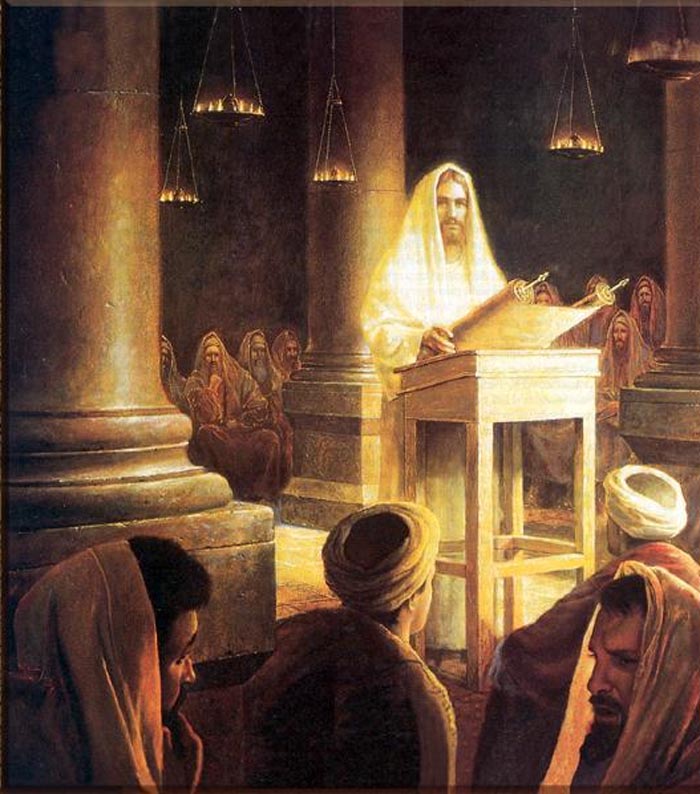
Jesus returned to Galilee in the power of the Spirit, and news of him spread throughout the whole region. He taught in their synagogues and was praised by all. He came to Nazareth, where he had grown up, and went according to his custom into the synagogue on the sabbath day. He stood up to read and was handed a scroll of the prophet Isaiah. He unrolled the scroll and found the passage where it was written: The Spirit of the Lord is upon me, because he has anointed me to bring glad tidings to the poor. He has sent me to proclaim liberty to captives and recovery of sight to the blind, to let the oppressed go free, and to proclaim a year acceptable to the Lord. Rolling up the scroll, he handed it back to the attendant and sat down, and the eyes of all in the synagogue looked intently at him. He said to them, “Today this Scripture passage is fulfilled in your hearing.

Meditation Reflection:

Fables and epic stories begin with something along the lines of “Once upon a time” or “A long long time ago, in a galaxy far away…” Biographies on the other hand begin with concrete dates, places, and people. The Christian faith differs from other religions because it is not the accumulation of man’s wisdom in his search for God, rather it rests on the testimony of men’s experience encountering God in His search for us. St. Luke begins his Gospel as a biography not a story. He underscores his intent to present the research he has compiled through his investigations in an orderly way. The historical reality of Jesus, His place of origin, death under Pontius Pilate, the respect He gained from multitudes of people, and the numerous witnesses of His miracles are written of not only by the Gospel writers but secular historians of the time as well such as the Jewish historian Flavius Josephus.

The apostles believed in Jesus because of what they saw as did many of the first followers of Christ. Their faith centered on the climatic event of the Resurrection and seeing Jesus for the 40 days leading up to His ascension into heaven. When choosing someone to replace Judas for instance, the apostles required that the candidates be men who had followed Jesus from His Baptism through His Ascension and that the person had been a witness of the Resurrected Christ. The early Christians did not preach a “spirituality” or self-help plan and Christ is not our universal imaginary friend. The early Christians died for their belief in the reality of Christ and His promise of resurrection. Their willingness to sacrifice everything this life has to offer proved their belief in the promises of Christ in Heaven. The apostles and martyrs had nothing worldly to gain from their belief and their supernatural deeds of heroism, courage, sacrifice, and love served as a potent witness of the authenticity of their testimony.

Jesus brings “glad tidings to the poor” because He freed captives, healed the blind and lame, comforted the sorrowful, and gave eternal life to those willing to accept His love. He then gave this same power to His followers through His Holy Spirit. Read Acts of the Apostles, also authored by Luke, to see the evident power of God at work through the apostles.

The mission of Christ to free and heal continues in His Church today. St. Paul writes in his first letter the Corinthians:

Now you are Christ’s body, and individually parts of it. Some people God has designated in the church to be, first, apostles; second, prophets; third, teachers; then, mighty deeds; then gifts of healing, assistance, administration, and varieties of tongues. (I Corinthians 12:28)

Every Christian is called to witness to Christ. The early Christians demonstrated their belief by how much they were willing to risk for their faith. The same applies for us as Christians today. Blessed Cardinal John Henry Newman (1801-1890) challenged in his sermon Venture of Faith that we consider how “Christian” we really are by reflecting on our commitment:

Consider for an instant. Let every one who hears me ask himself the question, what stake has he in the truth of Christ’s promise? How would he be a whit the worse off, supposing (which is impossible), but, supposing it to fail? We know what it is to have a stake in any venture of this world. We venture our property in plans which promise a return; in plans which we trust, which we have faith in. What have we ventured for Christ? What have we given to Him on a belief of His promise? The Apostle said, that he and his brethren would be of all men most miserable, if the dead were not raised. Can we in any degree apply this to ourselves? We think, perhaps, at present, we have some hope of heaven; well, this we should lose of course; but after all, how should we be worse off as to our present condition? A trader, who has embarked some property in a speculation which fails, not only loses his prospect of gain, but somewhat of his own, which he ventured with the hope of the gain. This is the question, What have we ventured? I really fear, when we come to examine, it will be found that there is nothing we resolve, nothing we do, nothing we do not do, nothing we avoid, nothing we choose, nothing we give up, nothing we pursue, which we should not resolve, and do, and not do, and avoid, and choose, and give up, and pursue, if Christ had not died, and heaven were not promised us. I really fear that most men called Christians, whatever they may profess, whatever they may think they feel, whatever warmth and illumination and love they may claim as their own, yet would go on almost as they do, neither much better nor much worse, if they believed Christianity to be a fable.

 Every Christian risks something because Christ transforms us which requires breaking things down as well as building things up.   That risk may be something material or it may be immaterial. It may mean putting family before career or taking a risk in your career to reach for greatness. It may mean taking the risk of emotional vulnerability, making connections with people, surrendering fear, or accepting the truth of your worth in God’s eyes. When united to Christ, He will do great things through you. Each person has gifts from the Spirit and they vary. Today’s Gospel reminds us of the mighty deeds of Christ, witnessed by many, and continued today. Let us pray for the courage to take a leap of faith and trust in the power and love of Christ.

Consider:

  • Consider the great things Christ has done in and through you.
  • Consider the great things Christ could do in and through you if you let Him. Reflect on what holds you back and prayerfully surrender it to Christ.
  • Reflect on how Christ has set you free, opened your eyes, and brought you glad tidings.

Make a Resolution (Practical Application):

  • Pray each day for God to work in you.
  • Pray each day for God to work through When given the opportunity, take the risk to follow the prompting of the Holy Spirit.
  • Read Acts of the Apostles.


~ Written by Angela Lambert © 2016

* To receive these weekly posts automatically in your email just click the “follow” tab in the bottom right hand corner and enter your email address.


Praying for the Unborn and Mothers in Crisis…Meditations on the Sorrowful Mysteries of the Rosary

Rosary for Life

 praying for unborn

Sign of the Cross

Lord we offer this rosary in prayer for the protection of every unborn child. We pray that You will renew in our hearts a deep love and appreciation for every precious child that You so generously and tenderly create to share in Your life and happiness.

Apostle’s Creed

I believe in God, the Father Almighty, Creator of Heaven and earth; and in Jesus Christ, His only Son Our Lord, Who was conceived by the Holy Spirit, born of the Virgin Mary, suffered under Pontius Pilate, was crucified, died, and was buried. He descended to the dead; on the third day He rose again; He ascended into Heaven, and is seated at the right hand of God, the Father almighty; from thence He shall come to judge the living and the dead.  I believe in the Holy Spirit, the holy Catholic Church, the communion of saints, the forgiveness of sins, the resurrection of the body and life everlasting. Amen.

Our Father who art in heaven, hallowed be Thy Name. Thy kingdom come, Thy will be done, on earth as it is in heaven.  Give us this day our daily bread and forgive us our trespasses as we forgive those who trespass against us, and lead us not into temptation but deliver us from evil. Amen.

For an increase in Faith:

Lord, grant us the gift of faith, to believe all that You have revealed about the sanctity of life and our duty to protect and nurture life.

Hail Mary full of grace the Lord is with thee. Blessed art thou amongst women and blessed is the fruit of thy womb Jesus.  Holy Mary, Mother of God, pray for us sinners now and at the hour of our death. Amen.

For an increase in Hope:

Lord, give mothers the gift of hope that they may be enabled to trust in You and Your divine providence.

Hail Mary…

For an increase in Charity:

Lord, each human person is called to friendship with You. May we love and protect the unborn because they belong to You and may every mother and father care for the children You have given them in gratitude for Your generosity and mercy toward each one of us.

Hail Mary…

Glory be to the Father, and to the Son, and to the Holy Spirit.  As it was in the beginning, is now and ever shall be world without end. Amen.

The First Sorrowful Mystery: The Agony in the Garden

agony in the garden

Lord, You suffered tremendous anguish as the weight of mankind’s sin was placed upon Your innocent shoulders. One of those sins was the sin of abortion and we can only imagine the pain You must have felt at seeing the lives of Your precious little ones taken when they are most vulnerable and the suffering of the mother in that difficult choice. Forgive us for the times when we were too weak or apathetic to stand up for what is right and did nothing. Forgive those who have chosen to abort an unborn child or have pressured or assisted a mother into aborting her child. May Your mercy open their eyes to the truth and Your love, and grant them the humility and courage to turn to You for healing and forgiveness.
  • Our Father…
  • Hail Mary…(10x)
  • Glory be…

Second Sorrowful Mystery: The Scourging at the Pillar

scourging of Jesus

Lord, when You embraced the pillar to be scourged again and again, You held us in Your embrace and suffered the blows for us due to our sin. Out of love and gratitude for Your sacrifice, may we follow Your example and protect Your most vulnerable loved ones despite the cost. Pour out a special grace upon pregnant mothers who suffer physical and emotional pain to nurture new life as they imitate Your love for us.
  • Our Father…
  • Hail Mary…(10x)
  •  Glory be…

Third Sorrowful Mystery: The Crowning of Thorns

Jesus and Pilate

Lord You were given a crown of thorns as the soldiers mocked You and spat upon Your kingdom in disbelief. Give courage to all pregnant mothers, especially those tempted to have an abortion, and those fighting for an end to abortion as they suffer from mockery and discouragement. Strengthen their faith and hope that the crown of thorns they receive in this life may blossom into a crown of jewels in the next.
  • Our Father…
  • Hail Mary… (10x)
  • Glory be…

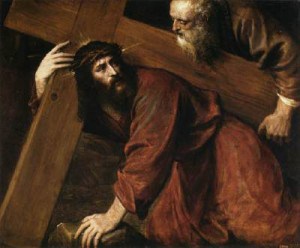
 Fourth Sorrowful Mystery: The Carrying of the Cross

titian-christ-carrying-the-cross

Lord, by the time You carried the Cross to Calvary, You had already been beaten to near death and were exhausted. On the journey to Your crucifixion You fell three times and Simon of Cyrene had to help You carry the cross. Be especially near to mothers exhausted by the many pressures to abort their unborn child and the anxieties they feel in their conscience. Encourage them to carry their cross even if they fall and give us the opportunity to help them carry their burden as Simon helped You. May Your Holy Spirit fill them with the consolation of Your love, strength, and peace and may they know that they are not alone.
  • Our Father…
  • Hail Mary…(10x)
  • Glory be…

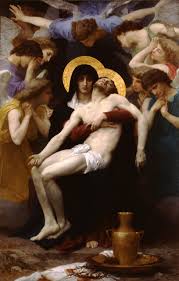
 Fifth Sorrowful Mystery: The Crucifixion

pieta

Lord, You humbled Yourself to come down from heaven so as to suffer and die for us. Yet, through Your suffering and death You also brought resurrection to new life. Give mothers and fathers the faith, hope, charity, and courage to sacrifice for their unborn child. In a culture that values self-gratification, open their eyes to the beauty and joy of self-gift. May we too reflect that joy and belief that “there is no greater love than to lay down one’s life for a friend.”
  • Our Father…
  • Hail Mary…(10x)
  • Glory be…

 Hail Holy Queen, mother of mercy, our life our sweetness and our hope. To you do we cry poor banished children of Eve. To you do we send up our sighs, mourning, and weeping in this valley of tears. Turn then most gracious advocate, your eyes of mercy toward us and after this our exile show unto us the blessed fruit of your womb, Jesus. O clement, O loving, O sweet Virgin Mary.

Pray for us O holy Mother of God,

That we may be made worthy of the promises of Christ.

Amen.

jesus with baby


© Angela M. Lambert 2016

God’s Concern for Our Real, Everyday Problems

by Angela Lambert

wedding at Cana

January 17th, 2016; 2nd Sunday in Ordinary time

Gospel of John 2:1-11 NAB

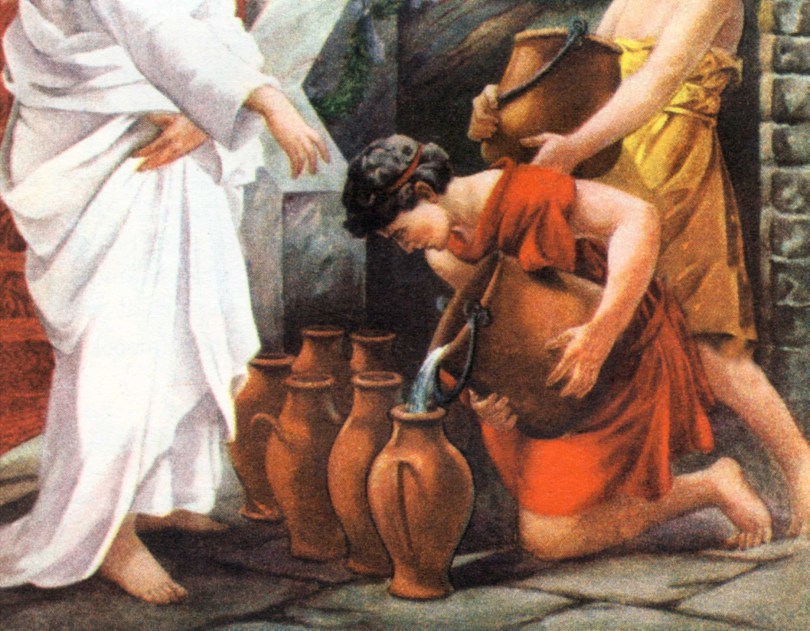
There was a wedding at Cana in Galilee, and the mother of Jesus was there. Jesus and his disciples were also invited to the wedding. When the wine ran short, the mother of Jesus said to him, “They have no wine.” And Jesus said to her, “Woman, how does your concern affect me? My hour has not yet come.” His mother said to the servers, “Do whatever he tells you.” Now there were six stone water jars there for Jewish ceremonial washings, each holding twenty to thirty gallons. Jesus told them, “Fill the jars with water.” So they filled them to the brim. Then he told them, “Draw some out now and take it to the headwaiter.” So they took it. And when the headwaiter tasted the water that had become wine, without knowing where it came from — although the servers who had drawn the water knew —, the headwaiter called the bridegroom and said to him, “Everyone serves good wine first, and then when people have drunk freely, an inferior one; but you have kept the good wine until now.” Jesus did this as the beginning of his signs at Cana in Galilee and so revealed his glory, and his disciples began to believe in him.

Meditation Reflection:

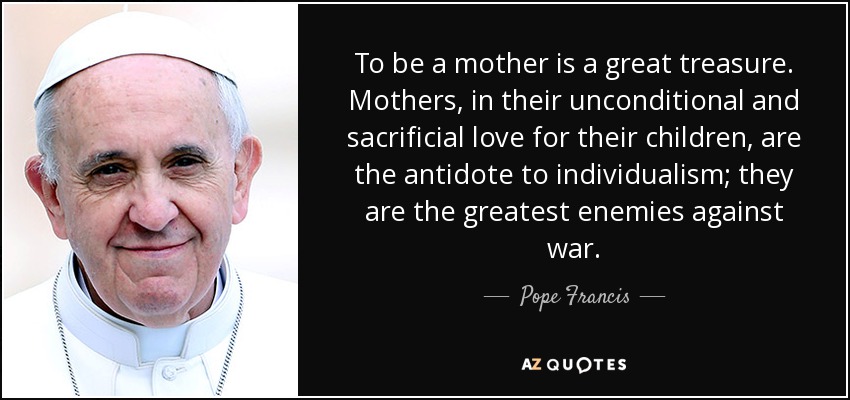
In his weekly Wednesday audience (from January 13, 2016), Pope Francis continued his reflections on God’s mercy by examining the Scriptures. God revealed that He is mercy, so much so that it could accurately be stated as part of His very nature or essence. Pope Francis continued on to assert that the image which best represents this particular kind of mercy is that of a mother. With these poignant words, he said:

The Lord is “merciful”: this word evokes a tender approach like that of a mother toward her child. Indeed, the Hebrew term used in the Bible evokes the viscera or even the maternal womb. Therefore, the image it suggests is that of a God who is moved and who softens for us like a mother when she takes her child in her arms, wanting only to love, protect, help, ready to give everything, even herself. This is the image that this term evokes. A love, therefore, which can be defined in the best sense as “visceral”.

The visceral, or deep inward feelings, of a mother for her child cannot be matched. It moves her to sacrifice everything, even joyfully, for her little ones. She is their best advocate, always working for their good and looking to their future. She offers the most sympathetic comfort and the fiercest protection.

Fathers can also offer an image of God’s love and mercy. Pope Francis goes on to compare God’s revelation that He is gracious to Christ’s parable about the prodigal son (originally titled the merciful father).

Then it is written that the Lord is “gracious”, in the sense of having grace, he has compassion and, in his greatness, he bends down to those who are weak and poor, ever ready to welcome, to understand, to forgive. He is like the father in the parable recounted in the Gospel of Luke (cf. Lk 15:11-32): a father who does not withdraw in resentment at the younger son for having forsaken him, but on the contrary, he continues to await him — he begot him — and then he runs to meet him and embraces him.

At the wedding at Cana, Jesus had just begun His public ministry. He had spent thirty years living a humble and seemingly ordinary Jewish life. He begins His public ministry by being baptized by John and then spending 40 days in the desert praying and fasting. He returns from this preparation and begins calling the apostles. Next He attends a wedding with His mother and brings His apostles along. The humanity of Jesus – the reality of His human relationships, real family, the limits of time and space – become apparent in this account. As Jesus transitions from private to public life, His plans bend around a wedding. Before He begins preaching and healing and casting out demons, He goes to Cana and celebrates the wedding of a couple he must have known or likely been related to. As usually happens at weddings, there occurs a snag. Moreover, this snag could embarrass the couple in a very humiliating way.

Mary’s motherly love advocates for the couple. She looks ahead and sees they are nearly out of wine. Rather than worry the bride and bridegroom, she goes to her Son and pleads for His help. She doesn’t demand He tell her His plan but rather trusts that He will take care of the problem. I imagine this is both because she knows Jesus’ compassionate heart and because she’s His mother and mothers expect their sons to do what they ask.

Jesus vocalizes the inconvenience of the situation. He did not plan that His first miracle would be to fix a snag at a wedding. Yet, in God’s divine providence, it reveals precisely the kind of love God’s miracles were intended for.   God became man to enter our misery and the embarrassing limitations we experience. As Pope Francis teaches, “For God is great and powerful, and this greatness and power are used to love us, who are so small, so incompetent.”

Together Mary and Jesus image the love of God for humankind in today’s Gospel. Mary sees the need and advocates for the couple, Jesus bends in compassion. God operates in the real, everyday of individuals. He did not come to offer propaganda for the masses. He came to care for His beloved children with the self-gift of a deeply loving mother and father.

Prompted by Mary’s presentation of the problem, Jesus is moved and softened. We can have confidence and take comfort in the truth that He will have the same response toward our needs, no matter how seemingly insignificant they may seem to the world. The everyday difficulties and humiliations our lives matter to God and He desires to care for us in our need.

In light of this mystery, Pope Francis offered these encouraging words:

Faithfulness in mercy is the very being of God. For this reason God is totally and always trustworthy. A solid and steadfast presence. This is the assurance of our faith. Thus, in this Jubilee of Mercy, let us entrust ourselves to him totally, and experience the joy of being loved by this “God who is merciful and gracious, slow to anger and abounding in love and faithfulness”.

Consider:

  • Consider the mystery of God’s immanence. The transcendent God, other from His creation, immune from suffering became man that He might share in our experience of pain so He could give us comfort.
  • How long do you wait to ask God for help? Do you reserve only your biggest problems for Him when you have ran out of solutions? Consider bringing to Him every concern as it occurs and sharing the burden with Him.
  • Consider how motherhood or fatherhood has made you more compassionate, merciful, and aware of the needs of others. How has it opened you to spiritual motherhood or fatherhood toward those who aren’t even your biological children?

Make a Resolution (Practical Application):

  • Intentionally entrust to God your difficulties each day this week – even the simple embarrassments.
  • Extend mercy and compassion toward your children or spiritual children this week. Bend toward someone’s need, save someone from humiliation, advocate for someone in need of help.
  • Pray for a tender heart like that of Christ’s.
  • Read Pope Francis’ Wednesday Audience address from this past week: Pope Francis 1/14/16 audience

~ Written by Angela Lambert © 2016

* To receive these weekly posts automatically in your email just click the “follow” tab in the bottom right hand corner and enter your email address.