
Excerpt from Take Time for Him: Simple, Soulful Gospel Meditations to Ignite the Busy Person’s Spiritual Life Get your own papercopy from Amazon!
Remember to rate and review it!
22nd Sunday of Ordinary Time
Readings for Sunday’s Liturgy
Meditation Reflection: Matthew 16:21-27
Peter loved Jesus. He left everything to follow Him. Peter put his whole heart into the mission and his courage and zeal expressed themselves in extraordinary ways. Moved by faith, Peter walked on water. With his heart open to the Holy Spirit, he boldly answered Jesus’ question to the disciples “Who do you say that I am?” by proclaiming that Jesus is the Christ and the Son of God.
Love inspires, emboldens, strengthens, and provides unique insights into the beloved. Like the love between a husband and wife, a mother or father and their children, a beloved brother or sister, or a dearest friend, love wells up inside and can’t help but express itself with exclamations of affection, physical closeness, and fierce protectiveness.
Due to our wounded, fallen nature however, our love can also be misdirected. In this Gospel passage, Peter’s love mixed with his pride and with his worldly understanding to embolden him in a way that undermined, rather than supported, Jesus. Our love needs conversion to be authentic and to be true to our beloved. It requires ongoing formation in what is True and Good as God has revealed it, rather than as our emotions direct us or the culture. It requires practice as well, to break bad habits and form good ones, or to overcome personal weaknesses that hurt the relationship.

Peter loved Jesus and was honored to be given the keys to the kingdom just one chapter prior to this. However, his pride and ambition, together with his cultural assumptions about what that kingdom would look like, misdirected his love to preserving an earthly kingdom by preserving Jesus’ earthly life. Just when Jesus needed the support of His disciples the most, as His “Hour” of Redemptive suffering for all mankind approached, Peter pulled Him aside and tried to dissuade Him.
Like Peter, our love needs Christ’s grace and truth to be authentic. Consider the sentiment “I just want you to be happy.” It can motivate noble sacrifice, but it can also rationalize weakness. If we define happiness as merely earthly comfort, ease, security, and pleasure, we risk encouraging our beloved to turn from their cross rather than helping them carry it. Yet, in trying to save their life, we could actually cripple them.
Consider the paradox inherent in parenting. Kids need protection, nurturing, and comfort. At the same time, to mature into adulthood, they also need to work through difficulties, setbacks, and pain. The temptation to remove every obstacle can undermine the maturation process, whereas supporting them through the struggle without necessarily removing it for them can help them grow. To know when to intervene and when to stand back is NOT easy! It requires the counsel of the Holy Spirit and the grace of fortitude. When Jesus’ life was threatened by King Herod, Mary and Joseph fled to Egypt to protect Him. When Jesus was scourged and crucified however, Mary stood by Him, feeling every pain with Him, but knew it was necessary for His mission.
In marriage, family life, and friendship, authentic love needs conversion. When we say, “I just want you to be happy,” we have to be honest about which kind of happiness we desire for them: worldly or Christian. Jesus is clear,
“Whoever wishes to come after me must deny himself, take up his cross, and follow me. For whoever wishes to save his life will lose it, but whoever loses his life for my sake will find it.”
Those we love will struggle with sin. It’s the battle of this life. Authentic love won’t condone the sin. Rather, it will strengthen a person to speak the truth in love and support the beloved through the pain of conversion because true life and true freedom is found in the Lord.
In the first reading for today (Jeremiah 20:7-9), the prophet Jeremiah exemplifies authentic love. His human nature desired comfort and to simply be liked. Nevertheless, his people had succumbed to habits of sin and needed to be corrected lest they die eternally from their destructive behavior and attitudes. He didn’t want to speak out anymore because every time he did, they met him with anger.
However, when he tried to remain silent, the truth welled up in him and he couldn’t hold it in any longer without suffering even greater pain. True love can’t stand to see sin hurting its beloved. Our friends and family need us to battle for their souls with the strength of prayer, God’s Truth, and the cross, not sentimentality. And we need those who love us to battle for our souls in the same way. To do this, we need to actively cooperate with the Holy Spirit that our love can be fully converted. St. Paul described it well when he instructed:
“Do not conform yourselves to this age but be transformed by the renewal of your mind, that you may discern what is the will of God, what is good and pleasing and perfect.” Romans 12:2
It will take time, effort, and support. However, we can be encouraged by Peter’s example. Peter’s conversion took time as well, but by the end of his life his love had become so perfect, that he accepted the cross and crucifixion for himself that he had once tried to dissuade Jesus from.
I’ll end with two quotes that I read often which give me hope:
Pope Francis quoting St. Augustine (January 19, 2016): “there is no saint without a past and no sinner without a future”
St. Josemaria Escriva: “A saint is a sinner that keeps trying.”
Consider:
- Reflect on Mary’s love for Jesus. Consider her fierce protection when He was young. Consider her fierce loyalty to His mission on the Cross, despite both of their suffering.
- Consider the words “I just want you to be happy.”
- Pray about what true happiness is, where it can be found, and how it can be attained.
- When has Christian love required you to carry a cross?
- Who supported you? Who tried to dissuade you?
- When have you had to stand by someone while they carried a cross?
- In what ways were you tempted to encourage them to leave the cross?
- How were you able to support them in their pain or struggle and make the burden easier?
Make a Resolution (Practical Application):
- Do one thing each day for “the renewal of your mind, that you may discern what is the will of God, what is good and pleasing and perfect.”
- Spend 5 minutes with Scripture
- Read a good Christian book
- Listen to Christian podcasts
- Visit with a Christian friend
- Support a friend on their spiritual journey who is struggling with a sin or with a cross.
- Pray and sacrifice for them; speak truth in love; visit them; encourage them with Scriptures of hope and resurrection after the Cross or the example of a saint or someone you know.
~ Written by Angela Jendro © 2019
| * To receive these weekly posts automatically in your email just click the “follow” tab in the bottom right hand corner and enter your email address. You can also follow me @taketimeforhim on Twitter and Facebook. |
 om
om  In these moments, we can follow the example of the two disciples in today’s Gospel. First, they considered everything that had happened in fellowship together. We too should turn to Christian friends for spiritual guidance and comfort.
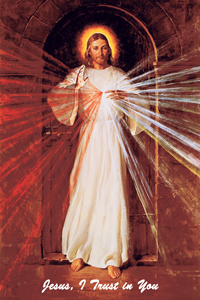 Polish nun, St. Faustina, asking her to spread the message of His mercy anew. Jesus lamented to Faustina that distrust on the part of souls caused His greatest suffering. Jesus burns with love for us and sacrificed to save us, but we cannot be saved if we refuse His love and mercy. He appeared to her many times after that, with a message of mercy He wanted made known. He asked for an image to be painted of Him, with two rays coming forth from His side – white and red – representing the water and blood which poured out of His side from the Cross, and the words “Jesus I Trust in You” beneath. We receive Jesus’ redemptive mercy through the sacraments when we are washed in the waters of baptism and united to Him in the sacrament of His Body and Blood in the Eucharist. He also asked that a Feast of Mercy be instituted, to be a day of extraordinary graces and an opportunity for us to make an act of trust and abandon so that He could be free to pour out His transformative love.
 om
om Abraham’s faith was not blind or irrational. Quite the opposite. Abraham had a relationship with God, and he had faith in who God is, and in God’s character. St. Paul has a moving reflection on Abraham’s faith in his letter to the Hebrews chapter 11. He proclaimed of Abraham that, “He considered that God was able to raise men even from the dead” (Heb. 11:19).
 One reason may be because the woman at the well’s encounter with Christ models the process of conversion. Jesus approached her when she least expected it. She went to the well at noon, the worst time of the day, to avoid the other women. Sin has a way of isolating us from others as we try to cover up our sins or protect our rationalizations.
 tempting the starving Christ with bread. He waited until Jesus was at the end of His fast when He would be tired, hungry, and physically weak. Similarly, the devil tries to exacerbate our problems when we are worn out and vulnerable. How many of us have failed to pray in the morning because we didn’t want to give up the comfort of sleep? When have you missed Mass because it would be an inconvenience or it was cold outside? Are there times when putting your feet up, having a beer or glass of wine, and watching tv took precedence over interacting with your spouse or kids at the end of a long workday (especially when kids require discipline or help with homework)? How many opportunities do we miss simply because it’s uncomfortable or we are too lazy? Unless we overcome our own slothful inertia, we cannot be strong enough to be the salt of the earth that Jesus needs from His disciples.
 After overcoming our desires for pleasure and comfort, the next hurdle is fame and ambition. Satan loves to stroke our ego and promote the lie that the measure of our worth is measured by our success. Yet, our Lord chose a life of humility and rejected some of the apostles’ notions that His kingdom would bring them worldly notoriety. God works the most through the small and the weak. St. Paul even states that in our weakness God’s power is brought to perfection (I Corinthians 2:12). Until we curb our own ambitions, we won’t be free to work for God’s ambitions.
 prepare for His mission, we too spend 40 days praying and fasting to prepare for receiving the graces He won for us by His death and Resurrection at Easter. Christ offers the grace of Redemption to every person; however we cannot be redeemed unless we accept that grace through repentance of our sins and placing our faith in Christ. This means change – which is why we try to give up something during Lent and/or add prayer or works of mercy to our daily routine during this time.


 can only be wrought from an utter realness about ourselves. When Moses asked God to reveal His Name, God responded that it is “YHWH” or “I AM”. God revealed that He is. God is being and existence, He is the source of all that is real. Thus, union with God requires utter realness and authenticity.
 Take Time For Him