“Let the Peace of Christ Rule In Your Hearts”

“Let the peace of Christ rule in your hearts”

Colossians 3:15

At the close of the liturgical year, the Church meditates on the close of the human journey in this life – to eternal life with Christ the king in the home of our Father in heaven. Upon instituting this feast in 1925, Pope Pius XII further exhorted us to remember that the kingdom of heaven includes here on earth – in the hearts and lives of the faithful.

Jesus Christ is a king of peace. When we pledge our fealty to Him, He rules by both word and grace. When we invite Christ into our hearts and surrender our whole selves to Him, He orders all that is unruly within us, bringing calm and peace. The Greek philosopher Aristotle argued that happiness is a life of virtue, one in which a person has self-mastery over their passions and is governed by reason. Self-rule therefore could be achieved through learning and habituation. However, we know from divine revelation and experience, that it’s not that simple. Because of the Fall, we suffer from concupiscence – disordered desires, together with a weakened will and a darkened intellect. As a result, we all lament our lack of self-control – being ruled by our emotions or desires rather than the other way around. As St. Paul bemoaned, “For I do not do the good I want, but the evil I do not want is what I do.” (Romans 7:19). We need to Christ, “the one stronger[i] to bring order to our hearts – settling our competing desires and directing them to the right ends.

Our own inner war and lack of self-control spills into conflicts with others too. St. James observed, “What causes wars, and what causes fightings among you? Is it not your passions that are at war in your members?” (James 4:1). Most social conflict arises from unrestrained jealousy, lust, anger, greed, sloth, and the unrestrained tongue. Christ brings peace through ordering us from within, thereby preventing the conflict and empowering us to love. He frees us from the addiction of sin and being tossed around by our impulses, so we can give to our relationships and experience true happiness.

Without Christ we struggle to rule ourselves in the order of love, but at a national and global level, it can have catastrophic effects. Pope Pius XII instituted this feast in 1925 to shed light on the necessity of Christ’s rule that was being systematically rejected from public life. He wrote,

these manifold evils in the world were due to the fact that the majority of men had thrust Jesus Christ and his holy law out of their lives; that these had no place either in private affairs or in politics: and we said further, that as long as individuals and states refused to submit to the rule of our Savior, there would be no really hopeful prospect of a lasting peace among nations.” Quas Primas par. 1

Pope Pius XII wasn’t arguing for a political theocracy but speaking to the reality that God does play an essential role in public life.  Without Christ governing Christians from within and without the wisdom of Christian principles at least respected by the culture, the inner war inherent in fallen human nature will snowball into terrible outer wars between peoples and nations.

When St. Paul urged the Colossians to let the peace of Christ rule their hearts, he astutely described the source of tension:

If then you have been raised with Christ, seek the things that are above, where Christ is, seated at the right hand of God…Put to death therefore what is earthly in you: fornication, impurity, passion, evil desire, and covetousness, which idolatry…But now put them all away: anger, wrath, malice, slander, and foul talk from your mouth…

Put on then, as God’s chosen ones, holy and beloved, compassion, kindness, lowliness, meekness, and patience, forbearing one another and, if one has a complaint against another, forgiving each other; as the Lord has forgiven you, so you also must forgive. And above all these put on love which binds everything together in perfect harmony. And let the peace of Christ rule in your hearts, to which indeed you were called in the one body. And be thankful.” (Colossians 3:1,5, 8, 12-15)

 Imagine the cultural effect of even a fraction of its members living their Christian faith!  So how do we do that?

The truth will set you free” (John 8:32). It begins by receiving Christ’s truth. He gave us His divine revelation in Scripture and Tradition, speaking to us through the bible and Church teaching. His gave us His Holy Spirit Who illumines our minds and softens our hearts in prayer, moving us to turn away from sin and turn toward our Lord. He raised up saints throughout history and even today, to show us the Christian life in concrete circumstances. Finally, He incorporates us into His Mystical Body, where we find nourishment, healing, and inspiration from holy people in our everyday lives; followers of Christ caring for us and encouraging us in the present moment.

Where sin increased, grace abounded all the more” (Romans 5:20). The more we know, the more culpable we become for our sin; and the more our hearts soften the more guilty we feel. However, Christ came not only to judge, but to heal and restore. When we see the truth about ourselves, it should motivate us to reach out to Christ our king to bestow upon us some of the wealth of His grace. Thankfully, in Christ’s kingdom this is a top priority!  For the healing of mortal wounds of sin, He instituted the sacrament of Confession by which He could physically speak the words of forgiveness through His priests and convey the lifesaving sanctifying grace we had lost. Go to Him in Confession, that He may drive out your sin and fill you with Charity. Go to Him in the Eucharist too, and as you receive Him – Body, Blood, Soul, and Divinity – invite Him to take up His throne in your heart and make your heart like His. Beg Him to govern your heart according to His Father’s will, just as He did: “Thy kingdom  come, Thy will be done, on earth as it is in heaven” (Matthew 6:10), “For I have come down from heaven, not to do my own will, but the will of him who sent me” (John 6:38), “not my will, but thine, be done” (Luke 22:42). Retreat to Him in prayer frequently throughout the day whenever assaulted by unruly desires or when needing the grace to discern or do the loving thing instead of the selfish thing.

Christ is a warrior king and an active prince. He doesn’t sit aloof in fine clothes in the castle, silent but majestic. He rides out into His lands to “seek and to save the lost” (Luke 19:10). Christ rules from within our hearts. He calms the storms of our passions with the authority of His divine word and power. He releases us from the addictions we slavishly attend to whenever they beckon despite the better things we wish for ourselves. Christ can bring our disordered desires and thoughts into line, if we allow Him to wield His grace. May Christ reign, may we lift high the gates of our hearts[ii] that He may enter. And may the peace of Christ rule our hearts!

[i] See Luke 11:20-22. “But if it is by the finger of God that I cast out demons, then the kingdom of God has come upon you. When a strong man, fully armed, guards his own palace, his goods are in peace; but when one stronger than he assails him and overcome him, he takes away his armor in which he trusted, and divides his spoil.”

[ii] See Psalm 24

Questions for reflection:

  • Where do you feel out of control and need Christ’s grace to re-order your emotions and desires?
    • When provoked to anger, does it control you or do you control it?
    • Do you have the power of temperance to control your desires for food and drink, or do they drive you?
    • Are you able to govern your thoughts, or do they run rampant, leading you in all kinds of directions or down unsavory paths?
  • How have you grown over the years? What did you used to struggle with that you don’t as much now? Where has Christ brought order and grace in your heart?
  • Do you see a family member or friend struggling with impulsivity or an area of their life that is out of control? Remember that prayer can effect grace in their hearts and be of help to them too, especially when you feel unable to fix it for them. Take a moment to pray for them.
  • Self-mastery empowers us to actually love ourselves by choosing and following through with doing what is actually best for us. What do you wish you would do more for yourself? Ask Christ to help you.
  • Self-mastery also empowers us to love others because we can govern ourselves to choose the good for them instead of neglecting their needs or hurting them as we tend to our inner impulse in the moment instead. Consider a relationship that is struggling because of this, and pray for the grace to be more loving.

Additional quotes for reflection:

  • 1Peter 2:9
    • “He has won you for Himself”
  • From The Sayings of the Desert Fathers:
    • “Abba Ammonas was asked, ‘What is the “narrow and hard way”’ (Matt.7.14)  He replied, ‘The “narrow and hard way” is this, to control your thoughts, and to strip yourself of your own will, for the sake of God.  This is also the meaning of the sentence, “Lo, we have left everything and followed you.”’ (Matt. 19.27)”
  • From Pope Pius XII, Quas Primas, 33
    • He must reign in our minds, which should assent with perfect submission and firm belief to revealed truths and to the doctrines of Christ. He must reign in our wills, which should obey the laws and precepts of God. He must reign in our hearts, which should spurn natural desires and love God above all things, and cleave to him alone. He must reign in our bodies and in our members, which should serve as instruments for the interior sanctification of our souls, or to use the words of the Apostle Paul, ‘as instruments of justice unto God.’ 


© 2024 Angela M Jendro

*Scriptural texts, unless otherwise noted, are taken from The Holy Bible: Revised Standard Version Catholic Edition, (Oxford: Oxford University Press, 2004)

*Pray and Reflect with full guided prayer meditations on the Sunday Gospel reading in my book Take Time For Him and its series on Amazon and Kindle!

Judas and the Limits of Divine Mercy

By Angela M Jendro

Whenever I teach on the topic of the Last Things (Death, Judgment, Heaven, and Hell), a student will inevitably ask about Judas. Despite having just emphasized that only God can judge hearts, they feel that somehow Judas must be an exception and we can at least judge him.  They also question if he might be an exception to Church teaching about hell – that although it does exist and you can go there, we do not definitively know the name of any specific person there.[i] Why doesn’t the Church admit that Judas is in hell? It canonizes saints and names particular people in heaven, why can’t it name Judas as not in heaven?

As Pope St. John Paul II said, “Damnation remains a real possibility, but it is not granted to us, without special divine revelation, to know which human beings are effectively involved in it.”[ii] The Church can only proclaim that which God has revealed for us to know.  The Lord revealed His judgment on Satan and the fallen angels, which is why we know they are in hell.[iii] However, though Christ lamented for Judas’ betrayal, saying it would be better if he had not been born (Matthew 26:24), He nevertheless refrained from declaring definitively that Judas was condemned there, and we cannot know if Judas repented (even of hanging himself) just before the moment of his death.[iv] 

Jesus said that He came not to condemn the world but to save it (John 12:47-49). Christ has done His part – He has gone to every possible length to save us.  Therefore, a person’s condemnation to hell is not Christ’s doing, but our own obstinate rejection of the Way, the Truth, and the Life (John 14:6) which He has offered.

His word is not only about sin however, but also about God’s unfathomable love and mercy – a mystery far beyond our understanding and too often foreign to our personal experience. As we struggle to accept the lengths of this reckless love[v], we look for some limit – and Judas seems to make sense.  Judas literally betrayed Jesus and directly participated in the sentencing of Christ to death.  Judas himself was so horrified by his sin, that in his painful grief and humiliating shame he took his own life.  Judas’ greatest failure, however, may not have been his betrayal of Christ to the chief priests, but his disbelief and distrust in the extent of Christ’s mercy.  In truth, the fact that the Church will not officially declare Judas to be in hell should be a source of hope for us, because as Jesus complained to St. Faustina in an apparition, so many of us commit the fault of disbelief and distrust in the limitlessness of His mercy too. 

Jesus appeared to the young polish nun, St. Faustina (1905-1938) many times to reemphasize this essential Gospel truth.  She obediently shared His messages with her confessor and wrote them in her Diary. In entry 50, on February 22, 1931, she recorded (Jesus’ words to her are in bold):

+ I desire that priests proclaim this great mercy of Mine towards souls of sinners. Let the sinner not be afraid to approach Me. The flames of mercy are burning Me clamoring to be spent; I want to pour them out upon these souls.

Jesus complained to me in these words, Distrust on the part of souls is tearing at My insides. The distrust of a chosen soul causes Me even greater pain; despite My inexhaustible love for them they do not trust Me.”[vi]

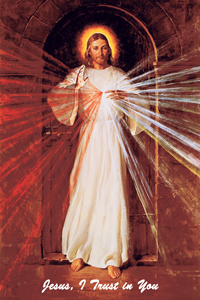
From a desire to make His mercy known and accepted more, Jesus asked Faustina to have an image painted which would illustrate this. The image consisted of Jesus in a white garment, and from His heart emanated two rays – one white and one red – symbolizing the water of baptism and the blood of His sacrifice. Beneath the image He wanted the words “Jesus, I trust in You” printed.[vii] In addition to the image, Jesus wanted the Sunday following Easter to be a Feast of Mercy.[viii] 

Pope St. John Paul II recognized the timeliness of this message and the importance of Faustina’s witness. He canonized her on Sunday April 30, 2000; making her the first saint of the new millennium as well as instituting the Feast of Divine Mercy Sunday to be celebrated the Sunday following Easter each year from then on. In his homily at her canonization, he affirmed,

“Divine Mercy reaches human beings through the heart of Christ crucified: ‘My daughter, say that I am love and mercy personified’, Jesus will ask Sr Faustina (Diary, p. 374). Christ pours out this mercy on humanity though the sending of the Spirit who, in the Trinity, is the Person-Love. And is not mercy love’s ‘second name’ (cf. Dives in misericordia, n. 7), understood in its deepest and most tender aspect, in its ability to take upon itself the burden of any need and, especially, in its immense capacity for forgiveness?”[ix]

Echoing the need for teaching divine mercy, Pope Francis called for a Holy Year of Mercy (Dec. 8, 2015 – Nov. 20, 2016).  In the book The Name of God is Mercy, Pope Francis articulated his concern with why more people do not turn to Christ in their need: “Because humanity is wounded, deeply wounded. Either it does not know how to cure its wounds or it believes that it’s not possible to cure them”[x] This helplessness is compounded by our wounded experiences. He observed that since many people in today’s selfish world haven’t experienced mercy in their own lives, they assume they won’t receive mercy from God.

Consider Judas again.  He had judged Jesus without mercy, and now he judged himself the same way. In addition, when he returned to the chief priests and the elders heartbroken and repentant, they responded with utter coldness.  The great theologian Fr. Romano Guardini captured the anguish of the moment well in his book The Lord, writing:

“After the deed came repentance – an overwhelming recognition of all that was lost. But this consciousness could no longer alter the fait accompli that stared back at Judas from the cold faces of those he had served. Strangely heart-rending gesture of helplessness, this flinging down the silver in the temple sanctuary!”[xi]

In this light, consider how important Jesus’ exhortation to us is in Luke 6:36-38! If only Judas had obeyed Christ’s word, he wouldn’t have had to suffer so terribly from the awful effects of his judgmentalism.

“Be merciful, even as your Father is merciful. Judge not, and you will not be judged; condemn not, and you will not be condemned; forgive, and you will be forgiven; give, and it will be given you; good measure, pressed down, shaken together, running over, will be put into your lap. For the measure you give will be the measure you get back.”

Judgmentalism can quickly become a vicious cycle. Judas judged and condemned Jesus.  However, when he realized he had judged wrongly, he then turned and judged and condemned himself, but was again wrong.  Though not innocent, he judged himself beyond the limits of God’s forgiveness and condemned himself to death.  We can’t judge Judas either. Fr. Guardini warned:

“No, what came to the surface in all its terrible nakedness in Judas, existed as a possibility all around Jesus. Fundamentally not one of his followers had much cause to look down on Judas. Nor have we. Let us be perfectly clear about this. Betrayal of the divine touches us all.”[xii]

Imagine the emotional drama and utter pain when Judas “flung the coins” (Matthew 27:5).  Think of all the frustration – the mental and emotional struggle during his time with Jesus, trying to determine just who Jesus is.  First as a zealous and hopeful follower, then a disenchanted disciple angry that Jesus wouldn’t bend to his expectations. Next as a malicious betrayer helping put to death what he deemed at the moment a false messiah, only to finally realize Jesus’ innocence, but tragically still too narrow minded and hearted to realize the extent of the Messianic redemption meant even for him. 

We at least live in the age of the Church, in the age of grace. Judas’ betrayal – both in Jesus’ death and his own – occurred before the Resurrection, and more importantly, before Pentecost. Had any of the other apostles been as extreme as Judas in their passions, they too may have succumbed to a similar end.  No one can fathom the mercy of God – it’s literally beyond human understanding.  They needed the Holy Spirit to open their minds and hearts to what Christ had been teaching them all along. We rely on the same Holy Spirit to both inspire knowledge of our sins and compunction of heart, and to give us the supernatural courage to trust in divine mercy. This is why it’s essential that we practice mercy, so we can become more habituated (and therefore open) to God’s gift of mercy to us.

Let’s take a final look at Judas from the standpoint of what we do and don’t know.  What was his disposition of soul at death? When he saw the truth of Jesus’ innocence he repented.  What did he do when he saw the truth of Jesus’ mercy, when he saw him face to face at his judgment?  We do not know…  It would be so much more satisfying if we did, we want to know the end of this dramatic story! He could have accepted Jesus’ mercy, been purified (Purgatory), and entered heaven.  Or he could have doubled down in his despair or in his pride, refused to accept mercy, and excluded himself from heaven, which is the definition of hell. 

Our choices matter. It’s incredible to think about the power that God has given to us in the freedom of Love.  May we pray for a merciful heart, which is able to both give and receive mercy. Jesus proclaimed, “Repent and believe in the Gospel.” Repentance of sin and trust in the merciful love of God are meant to be inextricably united. As Jesus said to St. Catherine of Siena:“I do not wish the soul to consider her sins, either in general or in particular, without also remembering the Blood and the broadness of my Mercy.”[xiii]

In conclusion, although it’s natural for students to ask, “what about Judas?”, the truth is it’s between Judas and Jesus.  The more important question to ask is, “what about me?”. Thankfully for us there’s still time.


[i] CCC par. 1033 “To die in mortal sin without repenting and accepting God’s merciful love means remaining separated from him for ever by our own free choice. This state of definitive self-exclusion from communion with God and the blessed is called ‘hell.’” CCC par.1035 “The teaching of the Church affirms the existence of hell and its eternity.” CCC 1036 “The affirmations of Sacred Scripture and the teachings of the Church on the subject of hell are a call to the responsibility incumbent upon man to make use of his freedom in view of his eternal destiny. They are at the same time an urgent call to conversion: “Enter by the narrow gate; for the gate is wide and the way is easy, that leads to destruction, and those who enter by it are many. For the gate is narrow and the way is hard, that leads to life, and those who find it are few.”

[ii] Pope St. John Paul II Audience July 22, 1999. Vatican.va

[iii] Cf CCC par. 391-393

[iv] For Church teaching about suicide, see The Catechism of the Catholic Church, par. 2280-2283. Taking one’s own life is a serious sin. At the same time, the Church recognizes that “grave psychological disturbances, anguish, or grave fear of hardship, suffering, or torture, can diminish the responsibility of the one committing suicide” (par. 2282) It also encourages us that “We should not despair of the eternal salvation of persons who have taken their own lives. By ways known to him alone, God can provide the opportunity for salutary repentance. The Church prays for persons who have taken their own lives. The Church prays for persons who have taken their own lives” (2283).

[v] cf Dorothy Day, The Reckless Way of Love: Notes on Following Jesus”, ed. Carolyn Kurtz, Plough Publishing House, 2017.

[vi] Maria Faustina Kowalska, Divine Mercy in My Soul: Diary of Sister M. Faustina Kowalska. Marian Press, 2003.

[vii] Ibid. Diary entry 47

[viii][viii] Ibid. Diary entry 49

[ix] John Paul II, Homily at the Mass in St. Peter’s Square for the Canonization of Sr Maria Faustina Kowalska, 30 April, 2000. Vatican.va

[x] Pope Francis.  The Name of God is Mercy. Random House, 2016.

[xi] Romano Guardini, The Lord, Gateway Editions 1982, p. 410

[xii] Ibid. p. 411

[xiii] Catherine of Siena, The Dialogue, Edited by Richard J. Payne, Translated by Suzanne Noffke, O.P. Paulist Press, 1980.

Related Posts

© 2024 Angela M Jendro

*Scriptural texts, unless otherwise noted, are taken from The Holy Bible: Revised Standard Version Catholic Edition, (Oxford: Oxford University Press, 2004)

*Pray and Reflect with full guided prayer meditations on the Sunday Gospel reading in my book Take Time For Him and its series on Amazon and Kindle!
Climbing the Mountain of God by Way of the Valley of Humility

Excerpt from Take Time for Him: Simple, Soulful Gospel Meditations to Ignite the Busy Person’s Spiritual Life  Get your own papercopy from Amazon!

Remember to rate and review it!

Readings for Sunday’s Liturgy All Saints Day

Meditation Reflection: Matthew 5:1-12a

Mountains make us think of God. Their height, their beauty, and their majesty inspire a sense of our smallness, and of God’s greatness. Moses ascended Mt. Sinai to encounter God.

When the LORD had finished speaking to Moses on Mount Sinai, he gave him the two tablets of the covenant, the stone tablets inscribed by God’s own finger. (Exodus 31:18)

He prayed and fasted for 40 days and nights, during which God spoke to Him “face to face, as a person speaks to a friend” (Exodus 33:11). To form His People in wisdom, justice, and peace, God gave to Moses the Law, written by God’s own hand.

After this encounter, Moses’ face radiated such glory that Aaron and the other Israelites feared being near to him; so much so that Moses had to wear a veil over his face when in their presence (Ex 34:29-34).

Moses’ relationship with God and the immediacy of God’s interaction with him was unparalleled. At the end of Moses’ life however, he prophesied that God would one day send a New Moses.

I will raise up for them a prophet like you from among their kindred, and will put my words into the mouth of the prophet; the prophet shall tell them all that I command.  (Deuteronomy 18:18)

Jesus ascended the Mount as the New Moses when He taught the Beatitudes. Christ affirmed the Law given to Moses, but he extended it further to its fullness intended by God. Through Moses, God had liberated the Jews from physical slavery and reformed their outward actions through the wisdom of the 10 Commandments. Through His Son, God now liberated His people from spiritual slavery to sin and, empowered by grace, directed them to conversion of interior intentions and desires.  As He set about the task of establishing the eternal Kingdom of God, the Beatitudes mark the fullness of God’s rule for His People – one of authentic love for God and one another.

The best teachers use examples to illustrate their lessons. The beatitudes are the heart of the New Law, but their application can be obscure. On All Saints Day the Church recognizes the lives of the saints throughout history to remember those concrete examples of how to live the beatitudes and apply them.  Saints, those who have been fully transformed in Christ, have come from every age, place, and walk of life. You can find examples of nearly every type of personality, spirituality, vocation, and occupation.

One such saint, St. Thérèse of Lisieux (1873-1897), asserted that we ascend the mountain of God, by way of descending the valley of humility. She was a young, cloistered Carmelite nun in France who pursued sainthood by doing small things with great love; a theme St. Mother Teresa (1910-1997) took as inspiration in her own life. Through the humility and simplicity of Thérèse’s life, she lived the beatitudes in the confines of her small world, but God raised her up as a Doctor of the Church and her Story of a Soul gained worldwide readership after her death.

Using Thérèse ’s analogy of descending the mountain, let’s consider each beatitude as steps on the journey of sanctification.  The first step, poverty in spirit, establishes right relationship with God by recognizing one’s creatureliness and dependency. The poor in spirit surrender the illusion of self-sufficiency and accept their dependence on God as His creature and His child.

How often have you experienced the frustration of wanting to help someone, but they refused to be receptive to your advice or your aid? Common obstacles to accepting dependence on God stem from a desire for security located in things we think we can control – such as wealth, career, relationships, status, self-help, etc. If we cling to a desire to redeem ourselves, we will resist the mercy of our only Redeemer. The poor in spirit have hit rock bottom, they are in the valley.  Regardless of their wealth or accomplishments, they are keenly aware that only God can heal their wounds, release them from self- destructive addictions or thoughts, and provide them with security which isn’t dependent on the market, the weather, what other people think of them, or even their employer.

Once a person looks to God, who is full of mercy, whose Son demonstrated His sacrificial love, they are moved to sorrow. This sorrow wells up from an honest view of themselves and their sins – free of the rationalizations and false beliefs they had clung to in the past. They see sin for what it is: degrading, a trick they fell for, and ingratitude.

Having shed false pretentions about oneself, a person develops a beautiful authenticity which is characterized by meekness. Meekness is not weakness! Meekness means a person has greater compassion and patience toward others because they know that “but for the grace of God, there go I.” In consequence, surrender to God, gratitude for His mercy and comfort, and humble authenticity, causes one to bear much more fruit in their life and work.

As gratitude for God’s love, and experiential knowledge of the wisdom of His ways increases, a person begins to hunger and thirst for righteousness.  They desire even greater freedom and deeper joy, which they know with deep conviction, can only be found in Christ. This is a prayer to which God always says yes.

The joy of freedom in Christ’s love creates so much gratitude that it spills over in a person’s heart and they can’t help wanting to give back to Christ the kindness He has shown to them. Thus, they show mercy to others because they empathize with the struggle of sin and desire to follow the example of Christ who has shown them mercy in their weakness.

Union with Christ in the Beatific Vision is the essence of Heaven. Thus, those that have forsaken all for Him, whose heart is pure, begin to experience a taste of the vision of God. Reconciled to God through His son, they extend this peace to others as it radiates from their own interior peace from union with the Lord.

Finally, the more perfect a union one has with Christ, the more others will treat that person the same way they would of Him. Jesus warned His apostles that those of the world who persecute Him, will persecute them; and those that love Him, will love them (John 15:18-25). Thus, Christ ends the Beatitudes with the summation of the spiritual life – when one is persecuted because of Christ, they ought to rejoice, because it means they are finally living in union with Him and following in His example. In a sense, it’s confirmation that one is conformed to Christ. Others wouldn’t bother with you if you were worldly enough to leave their consciences undisturbed.

Jesus provides the Way by teaching us the Beatitudes and showing us how to follow them by His example.  Moreover, He provides the supernatural grace, virtues, and love we need to live such a profoundly spiritual life and the examples of the Saints to illustrate how it looks in everyday life.

The world offers countless distractions to discourage us from introspection, and our own pride can further resist taking an honest look inside our hearts. Christ exhorts us to bravely journey within, promising to accompany us and to conform what we find to His own perfect love.  If we descend the valley of humility through poverty in spirit, we will ascend the mountain of God and enjoy the beatific view from the top.

Consider:

  • Have you ever seen a mountain up close or hiked up one?  How did it affect your perspective?
  • Consider the immanence of God – His revelation to Moses and His revelation through Christ. In what way does His closeness make you somewhat afraid, like the Israelites? In what way, does it comfort or strengthen you to have Him so near?
  • God continues to dwell with us in an immanent way in the Eucharist. Consider how it has pleased God in every age, to draw near to us. In what ways, do you appreciate His gift? In what ways, do you sometimes take it for granted? How might you increase your appreciation?
  • Consider the spiritual journey laid out by the beatitudes. How does your spiritual life correspond to some of the stages?
  • Which beatitude touches you the most? Is there one that sticks out to you as the most moving?
  • How has your love for God grown through the years as a response of gratitude for His grace at work in your soul. What do you know is His work and not your own?

Make a Resolution (Practical Application):

  • Reflect on one beatitude each day this week and try to live it out in an intentional way.

~ Written by Angela Jendro © 2019

* To receive these weekly posts automatically in your email just click the “follow” tab in the bottom right hand corner and enter your email address. You can also follow me @taketimeforhim on Twitter and Facebook.

The Most Marvelous Mystery!

Solemnity of the Holy Trinity

Gospel of John 16:12-15 NAB

Jesus said to his disciples: “I have much more to tell you, but you cannot bear it now. But when he comes, the Spirit of truth, he will guide you to all truth. He will not speak on his own, but he will speak what he hears, and will declare to you the things that are coming. He will glorify me,because he will take from what is mine and declare it to you. Everything that the Father has is mine; for this reason I told you that he will take from what is mine and declare it to you.”

Meditation Reflection:

The mystery of the Trinity transcends our comprehension and its reality cannot be rightly conceived in our imagination. At the same time, God desired that we know something of His nature and being. Christ revealed this truth during His public ministry since we could not have known it otherwise. Still, we lack understanding without supernatural help and so Jesus explains to His apostles, “I have much more to tell you, but you cannot bear it now. But when he comes, the Spirit of truth, he will guide you to all truth.” When the Holy Spirit descended on the apostles at Pentecost, He opened their eyes of faith, elevated their understanding, and fortified their courage to believe and proclaim such extraordinary truths.

The Holy Spirit continues His work today in our own hearts as well. We know from Genesis that we image God, but because of sin we struggle to know what that looks like. Through Baptism however, the Trinity comes to dwell in our very souls.   His image grows within us and begins to radiate more and more brightly in our minds and in our lives to the extent that we cooperate with His gifts.

So what is the Trinity? What did God reveal about Himself? What are we supposed to image? The Church explains it in this way:

“The Trinity is One. We do not confess three Gods, but one God in three persons, the “consubstantial Trinity”.83 The divine persons do not share the one divinity among themselves but each of them is God whole and entire…” (CCC 253)

“The divine persons are really distinct from one another. “God is one but not solitary.”86 “Father”, “Son”, “Holy Spirit” are not simply names designating modalities of the divine being, for they are really distinct from one another: “He is not the Father who is the Son, nor is the Son he who is the Father, nor is the Holy Spirit he who is the Father or the Son.”87 They are distinct from one another in their relations of origin: “It is the Father who generates, the Son who is begotten, and the Holy Spirit who proceeds.”88 The divine Unity is Triune.” (CCC 254)

The divine persons are relative to one another. Because it does not divide the divine unity, the real distinction of the persons from one another resides solely in the relationships which relate them to one another” (CCC 255)

Understand? Great! Just kidding. I can explain…kind of. First, we must accept that we cannot fully comprehend or imagine the Trinity so let go of that goal. However, it does not mean that we can know nothing of the Trinity. God revealed His Trinitarian reality and so we ought to accept and contemplate this mystery with the help of the Holy Spirit.

First, God is one. He has one divine nature. We tend to imagine it divided into three parts but this is where our imagination fails us. Each person of the Trinity is wholly God.

Secondly, God is three. Our imagination tries to reconcile this with His oneness by imagining God as having three different modes or faces but being essentially the same. Not the case. God is three distinct persons.

So how can God be one and three? In heaven you will see the face of God and something of this mystery. This incredible vision will be the source of joy so great that you will have to be supernaturally empowered to take it in without being overcome. Live a holy life so you can one day have this awesome opportunity! From Christ’s teachings we know that God’s oneness and threeness reveal that His essence is one of relationship. God is a relationship of Three Persons. I mentioned in a prior post that when God created us in His image, He created a family. A man and a woman become “one flesh” and a child is born who is both of their nature and yet distinct as well. The union of persons in life-giving love images God who is also a union of persons in life-giving love. Is it no wonder that Satan’s primary attack against God is directed at His image; thus Satan’s efforts to promote a self-centered individualism in contrast to the other-centered gift of self required for an intimate union of persons.

We cannot imagine God’s Triune nature but we can contemplate it and try to live as an image of it with the help of the Holy Spirit and the graces of the Sacraments. Baptism unites us to God and each other, the Eucharist nourishes that unity, and Confession reconciles us when we have separated ourselves through sin. The more we open ourselves to God the more we will see Him. That process begins on earth and the joy that accompanies it begins here as well. We can look forward with hope and anticipation to the day that God enables us to see more of Him in heaven and we will be free to sing endless songs of praise and love.

Consider:

  • Consider your relationship with God the Father.
    • What does it mean to be a son or daughter of God?
      • Consider your dignity as an heir of heaven where your Christ your brother reigns as king and Mary your mother reigns as queen.
      • In a family, each member is irreplaceable. You are an irreplaceable member of God’s family. You matter to God and to every member of the Christian family.
    • How does that affect the way you see yourself?
    • How does that affect the choices you make?
  • Consider your relationship with God the Son.
    • God became man so you could encounter Him directly. He shared in the human experience so He could be closer to you. Reflect on times you have encountered Christ.
    • Consider the mysteries of His life – how has He experienced similar sufferings to yours?
    • He still draws near to you today through the Eucharist and His Mystical Body the Church. Reflect on the immanence of Christ in your daily life.
  • Consider your relationship with the Holy Spirit.
    • The Holy Spirit opens our eyes to see Christ and enlightens our understanding to appropriate His teachings.
    • When was a time the Holy Spirit brought comfort and peace to your soul?
    • When was a time He gave you fortitude and perseverance in your Christian walk?
    • When was a time He gave you wisdom to discern the right choice to make when faced with a difficult decision? Invite the Holy Spirit to guide your decisions today as well.

Make a Resolution (Practical Application):

  • Take a moment today to appreciate God’s creation.
  • Visit Christ present in the Eucharist.
  • Pray to the Holy Spirit each day to reveal God more to you, and to transform your heart that your life might reveal God more to someone else.

~ Written by Angela Jendro © 2016  edited ©2019

* To receive these weekly posts automatically in your email just click the “follow” tab in the bottom right hand corner and enter your email address.