Prepare for the Coming of Christ’s Mercy by Giving Mercy

3rd Sunday of Advent

Reflection by Angela (Lambert) Jendro


 Gospel Luke 3:10-18 NAB

The crowds asked John the Baptist, “What should we do?” He said to them in reply, “Whoever has two cloaks should share with the person who has none. And whoever has food should do likewise.” Even tax collectors came to be baptized and they said to him, “Teacher, what should we do?” He answered them, “Stop collecting more than what is prescribed.” Soldiers also asked him, “And what is it that we should do?” He told them, “Do not practice extortion, do not falsely accuse anyone, and be satisfied with your wages.” Now the people were filled with expectation, and all were asking in their hearts whether John might be the Christ. John answered them all, saying, “I am baptizing you with water, but one mightier than I is coming. I am not worthy to loosen the thongs of his sandals. He will baptize you with the Holy Spirit and fire. His winnowing fan is in his hand to clear his threshing floor and to gather the wheat into his barn, but the chaff he will burn with unquenchable fire.” Exhorting them in many other ways, he preached good news to the people.

Meditation Reflection:

 To prepare for Christ’s coming, John the Baptist offered practical advice:  God is Justice and Mercy, therefore practice justice and mercy in your everyday life.

To this end, the Church summarizes Jesus’ teaching on how to treat others into two categories of practical mercy: corporal and spiritual.  Corporal works of mercy care for the physical needs of others and the spiritual works of mercy care for those of the soul.  Advent offers a special opportunity to renew our commitment to practicing them in concrete ways on a regular basis.

Corporal Works of Mercy:

1)      Feed the hungry

2)      Give drink to the thirsty

3)      Clothe the naked

4)      Shelter the homeless

5)      Visit the sick

6)      Ransom the captive

7)      Bury the dead

Spiritual Works of

Mercy:

1)      Instruct the ignorant (teaching)

2)      Counsel the doubtful (encouraging someone struggling with the faith)

3)      Admonish sinners (having the courage to tell someone what they are doing is wrong)

4)      Bear wrongs patiently

5)      Forgive offenses willingly

6)      Comfort the afflicted

7)      Pray for the living and the dead

Each of these can be practiced in obvious ways of almsgiving, but they can also be practiced in some very ordinary ways if done with love and intentionality.  Feeding the hungry can mean going to the grocery store despite being tired (or wanting to do anything other than grocery shopping!).  Giving drink to the thirsty can be smiling when you really want to sigh in exasperation when your child asks for a cup of water or milk just as you are about to go to bed for the night.  Admonishing the sinner can mean doing the work of disciplining your children to teach them virtue when you would rather ignore the behavior and avoid the conflict.  It can also mean being honest with your friend when they are doing something wrong.  Burying the dead means making the time to attend a funeral even though you are busy.

Forgiving offenses willing and bearing wrongs patiently can be the most difficult.  They require surrendering bitterness and the desire for retaliation to offer patience and understanding instead.  Apply this to driving in traffic, shopping in a busy store, or putting up with annoying traits of your co-workers.  These things are much easier said than done.  Thankfully, Christ offers the grace we need to be a more merciful person.  He also teaches us in the Lord’s prayer that we will be forgiven insofar as we forgive others.

We all struggle with sin and a fallen nature.  Nevertheless, during Advent we recall the gift of the Incarnation and Christ’s redeeming power.  God made man and woman in His image.  He became man to restore that image by forgiving our sins and opening the possibility of becoming a new creation.  An early Church Father and bishop, St. Athanasius, described it beautifully in this way:

What, then, must God do? or what else was it right to do, but to renew again the grace by which they had been made after His Image, so that through it men might be able once more to know Him? But how could this have been done except by the coming of the very Image Himself of God, our Savior Jesus Christ?

The more we offer mercy the more we will receive mercy, and the more will become like God!

Consider:

  • If John the Baptist were to offer you advice, what would it be? (Would he see an injustice that you could correct or an opportunity for mercy you could take?)
  • Reflect on the mercy God and others have shown to you.  Offer God and those persons your gratitude.
  • Pray about the works of mercy and write a list of ways that you could incorporate them into your life.

Make a Resolution (Practical Application):

  • Do one work of mercy each day.
  • Offer a prayer for those who have shown you mercy.
  • Receive the sacrament of Confession.
  • Visit the Vatican website for the Jubilee of Mercy and read some of Pope Francis’ reflections:   http://www.im.va/content/gdm/en.html

* Image: Pope Francis embraces a patient at St. Francis of Assisi Hospital, where the pontiff addressed a group of recovering drug addicts, offering them a message of compassion and hope on July 24, 2013, in Rio de Janeiro. CNS photo

~ Written by Angela Jendro © 2018

* To receive these weekly posts automatically in your email just click the “follow” tab in the bottom right hand corner and enter your email address.


The Glorious Reign of Christ our King

by Angela (Lambert) Jendro

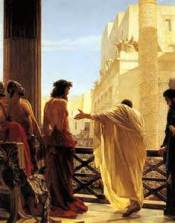
 Jesus and Pilate

Feast of Christ the King

Gospel John 18:33b-37

Pilate said to Jesus, “Are you the King of the Jews?” Jesus answered, “Do you say this on your own or have others told you about me?” Pilate answered, “I am not a Jew, am I? Your own nation and the chief priests handed you over to me. What have you done?” Jesus answered, “My kingdom does not belong to this world. If my kingdom did belong to this world, my attendants would be fighting to keep me from being handed over to the Jews. But as it is, my kingdom is not here.” So Pilate said to him, “Then you are a king?” Jesus answered, “You say I am a king. For this I was born and for this I came into the world, to testify to the truth. Everyone who belongs to the truth listens to my voice.”

Meditation Reflection:

Christ’s humble form in the Eucharist and His life of material poverty can sometimes cause us to forget the magnitude of His greatness and the awe-inspiring power and glory of His kingship. Advent marks the beginning of the New Year for the liturgy. As a result, the week prior marks the end of the year and so we reflect on the end of time when Christ will come again to reign in glory. Scripture attests to the fact that His Second Coming will be very different than His first. In the latter His glory was veiled so that we might have the freedom to accept or reject Him. In the former, everyone will see and know that He is God. The Truth will be revealed and we will no longer be able to live in unreality.

Pontius Pilate articulates this confusion well. He simply asks Jesus if He is the king of the Jews but Jesus describes His kingdom in terms foreign to Pilate’s political experience. Jesus’ kingdom includes those who love and live by Truth. Christ’s kingdom conquers hearts not lands and its members become citizens of this monarchy freely. Pilate asks the famous question “What is truth?” as Truth stands directly before him. At Christ’s Second Coming, no one will ask this question. Reality will be so bright that we cannot hide in blindness or denial.

For those who love Christ, who have been desiring to see in fullness the Lord they can only see by faith, it will be a glorious moment. When our king comes we will truly rejoice and feel both honored and unworthy to be His servants. We will sing songs of praise like those in the book of Revelation, grateful to be in His courts. For those who rely on lies or a self-created image they will cringe when the truth of their emptiness is exposed. The feast of Christ the King should encourage us and strengthen our hope to persevere in aligning ourselves with God who is Truth, Goodness, and Love. It seems unreal to the worldly but the reality check will come and Christ will reward those who know the Truth. In response to the culture of relativism the Christian can respond: You have your truth and I have mine…His name is Jesus.

Consider:

  • Reflect on Jesus’ words to Pilate: “You say I am a king. For this I was born and for this I came into the world, to testify to the truth. Everyone who belongs to the truth listens to my voice. “Who do you listen to when discerning the answers to important questions?
  • Do you consult Scripture, Christian spiritual writers, your priest, etc.?
  • Is there someone you know that loves you enough to speak Christ’s Truth to you despite whether it is something you want to hear or not?
  • Do you ask Christ in prayer?
  • Do you rely on cultural norms to determine your perspective?
  • Do media or secular friends play a role in your decision making?
  • Our culture is permeated by relativism – the belief that there is no objective truth. Do you believe that Truth is objective – the Person of Christ – or do you adhere to the cultural mantra “you have your truth and I have my truth”?
  • Imagine Jesus coming in all of His glory with His hosts of angels. Consider what it would feel like to be in His Kingdom.

Make a Resolution (Practical Application):

  • Pray for Christ’s kingdom to come in your own heart each day this week.
  • Start each day imagining the Second Coming of Christ. Walk through the rest of the day with joy and pride of being a member of His true, everlasting kingdom.
  • If you are blessed with a Truth-speaker in your life, take the time to thank him or her. They could probably use your encouragement. We know how Truth was treated while He was on earth.
  • If you struggle to understand or align yourself with one of Christ’s teachings in Scripture or through His Church, actively seek understanding by learning more through reading, talking with someone educated on the topic, praying about it, etc.

~ Written by Angela Lambert © 2015; edited and reposted © 2018

* To receive these weekly posts automatically in your email just click the “follow” tab in the bottom right hand corner and enter your email address.

Communication and Relationships

Reflection by Angela Jendro

Jesus heals two blind men, an apostle behind him. Mosaic (6th)

September 9th, 2018; 23rd Sunday in Ordinary Time

Gospel of Mark 7:31-37 NAB

Again Jesus left the district of Tyre and went by way of Sidon to the Sea of Galilee, to the district of the Decapolis. And people brought to him a deaf man who had a speech impediment and begged him to lay his hand on him. He took him off by himself away from the crowd. He put his finger into the man’s ears and, spitting, touched his tongue; then he looked up to heaven and groaned, and said to him, “Ephphatha!”— that is, “Be opened!” — And immediately the man’s ears were opened, his speech impediment was removed, and he spoke plainly. He ordered them not to tell anyone. But the more he ordered them not to, the more they proclaimed it. They were exceedingly astonished and they said, “He has done all things well. He makes the deaf hear and the mute speak.”

Meditation Reflection:

People brought to Him a deaf man who had a speech impediment and begged Him to lay His hand on him.”  To have begged Christ, they must have loved the man dearly.  Begging implies a kind of poverty and desperation.  It can be hard enough to ask for help sometimes, but to beg can seem too humiliating to do.  Jesus responds with such personal attention and care that it seems He too shares their concern that the man’s speech and hearing be restored.

This passage underscores the centrality of our relational nature – both our relationship with others and with God.  Relationship depends upon communication.  Clearly the people in this passage had communicated their love to the man through their actions and their expressions.  However, they begged Christ to remove the barrier of deafness and the speech impediment so that they might share words with the man and receive them in return.

Truthful words can communicate our inner thoughts and feelings, a sharing of ourselves that can only be known if we choose to share it with others.  Christ healed the man by restoring his ability to communicate and therefore enabling him to enjoy more freedom to relate to those he loved.  Jesus went even further by connecting the man to God Himself.  He took the man aside, physically touched him, and opened his ears to hear and his tongue to speak – both bodily and spiritually.  Jesus, the Word of God, became man that we might have relationship with God.  We can only know God’s inner thoughts and feelings if He chooses to share them with us verbally.  Jesus is God’s incarnate communication.  He desires to restore all of us to relationship with Him and with others.  If we humble ourselves to beg Him to open our ears and free our tongues, He gives us hope in this passage that He will unite us at a deeper level than we can imagine to God and those we love.

If God is a dialogical unity, a being in relation, the highest creature made in his image and likeness reflects this constitution; thus he is called to fulfill himself in dialogue, in conversation, in encounter.” — Benedict XVI, Trinity Sunday, Genoa, May 18, 2008.

Consider:

  • Jesus healed the man by touching him and praying for him.  Consider the power of human touch, words, and prayer.
  • Do you struggle with either hearing God or with speaking to God? Do you offer general prayers or do you really communicate with the Lord?  How might you open yourself up to deeper communication with God?
  • Is there a person you struggle communicating with?  Why do you think that is?  How might you repair the relationship and soften the communications?
  • Consider the power of words to build up or break down a relationship.  When was a time that someone’s words made a significant and positive difference in your life?

Make a Resolution (Practical Application):

  • Which Scripture passage do you love the most?  Write it down and post it where you will see it every day.
  • Read one psalm a day.  They are God’s words to you and beautiful words of prayer back to God.
  • If there is someone you struggle with, place the relationship before God and beg Him to bless it.
  • Intentionally think about the words you use each day this week.  Ask Christ for self-control to guard against harsh, critical words.  Ask the Holy Spirit to provide you with the right words to say to each person you meet in your day.

~ Written by Angela Lambert-Jendro © 2015

Trust – And the Leap of Faith

Reflection on John 6:60-69

Giusto di Gand Joos Van Wassenhove Instituzione delleucarestia (from commons.wikipedia.org)

by Angela Jendro

August 25th, 2018; 21st Sunday in Ordinary Time

Gospel of John 6:60-69 NAB

Many of Jesus’ disciples who were listening said, “This saying is hard; who can accept it?”
Since Jesus knew that his disciples were murmuring about this, he said to them, “Does this shock you? What if you were to see the Son of Man ascending to where he was before? It is the spirit that gives life, while the flesh is of no avail. The words I have spoken to you are Spirit and life. But there are some of you who do not believe.” Jesus knew from the beginning the ones who would not believe and the one who would betray him. And he said, “For this reason I have told you that no one can come to me unless it is granted him by my Father.” As a result of this, many of his disciples returned to their former way of life and no longer accompanied him. Jesus then said to the Twelve, “Do you also want to leave?” Simon Peter answered him, “Master, to whom shall we go? You have the words of eternal life. We have come to believe and are convinced that you are the Holy One of God.”

Meditation Reflection:

The psalmist exhorts us to “Taste and see the goodness of the Lord” (Psalm 34).  He does not say, “see then taste”.  Rather than requiring scientific evidence to support the miracle of the Eucharist before receiving it, Christ pleads with us to believe in Him and receive the Eucharist after which we will see its power to give life.  Belief in the Eucharist should not be predicated upon whether it satisfies our natural reason or whether or not we feel like it.  Instead, Christ’s word alone, His teaching as Lord and Savior of the world forms the basis for belief in the supernatural miracle of the Real Presence of Christ in the Eucharist.  Because of its supernatural quality, it necessarily exceeds our natural experience and reasoning.  This makes it difficult for any person to believe in such a transformation based on merely human experience.

The Catechism discusses this common problem, writing:

The first announcement of the Eucharist divided the disciples, just as the announcement of the Passion scandalized them: ‘This is a hard saying; who can listen to it?’ (Jn 6:60) The Eucharist and the Cross are stumbling blocks.  It is the same mystery and it never ceases to be an occasion of division.  ‘Will you also go away?’ (Jn 6:61):  The Lord’s question echoes through the ages, as a loving invitation to discover that only He has ‘the words of eternal life’ (Jn 6:68) and that to receive in faith the gift of His Eucharist is to receive the Lord Himself.”

In this passage the followers of Christ divide between those who “returned to their former way of life” where their faith wasn’t challenged and those who, with Peter, can only say “We have come to believe and are convinced that You are the Holy one of God.” The passage seems to indicate that everyone present experienced confusion and found Christ’s teaching difficult to accept.  Many of us share this same experience.  We follow Christ and marvel at His actions in our life.  Then we come to a point where one of His teachings, whether in Scripture or through His Church, seems too difficult.  We are tempted to rationalize that no one could really believe it and then go on living as we were. Christ challenges us to respond instead like Peter by putting our trust in Him.  If we are convinced that Jesus is the Christ, then we should be convinced that everything He says and promises is true.

Consider:

  • What makes you convinced that Jesus is God and Savior?  Are you convinced?
  • What teaching of Christ do you struggle with the most?  Do you follow Christ always or only when it makes sense to your natural reason?
  • Which is more reliable – Christ’s wisdom or your own? Why?
  • Do you find it hard to believe in the real presence of Christ in the Eucharist?  If yes, why?  If no, why not?  If you have a deep belief in the Eucharist, consider how you might share that belief with someone else.  Pray for a providential moment.

Make a Resolution (Practical Application):

  • Faith is a gift.  Pray each day this week for an increase in the gift of faith.  You could share the prayer of the man in Mark 9:24 who said to Christ, “Lord I believe, help my unbelief.”
  • Make an effort to deepen your belief in the Eucharist.  Spend time praying at Church or adoration, go to a daily Mass, read about the Eucharist in the Catechism http://www.vatican.va/archive/ccc_css/archive/catechism/p2s2c1a3.htm, read John 6 again, read about Eucharistic miracles. Ask the Holy Spirit to enlighten your mind and heart.

~ Written by Angela Jendro © 2018 (edited from original post Aug. 23rd, 2015)

Finding Freedom

by Angela (Lambert) Jendro

July 15th,2018 15th Sunday in Ordinary Time

Gospel of Mark 6:7-13 NAB

Jesus summoned the Twelve and began to send them out two by two and gave them authority over unclean spirits. He instructed them to take nothing for the journey but a walking stick— no food, no sack, no money in their belts. They were, however, to wear sandals but not a second tunic. He said to them, “Wherever you enter a house, stay there until you leave. Whatever place does not welcome you or listen to you, leave there and shake the dust off your feet in testimony against them.” So they went off and preached repentance. The Twelve drove out many demons, and they anointed with oil many who were sick and cured them.

Meditation Reflection:

Jesus conquered Satan, and just as He healed persons afflicted by demons, He also gave His authority to His apostles to drive them out as well. Jesus personally extends this opportunity for freedom to you and I through the ministry of His Church and His grace. The question is only if we will invite Christ and His followers in and accept healing, or refuse to listen and force them out.

Satan and his demons, even if they do not take total possession of a person, can and do take control of pieces of us whenever we allow ourselves to be bound by their lies and their allurements.

Whereas Christ is the Truth (John 14:6), Satan is the father of lies (John 8:44).  How can we discern between the two?  Truth builds up and encourages. Even if it’s not what we want to hear, it always leads to our true good and real happiness. In contrast, Satan’s lies derail us from happiness and discourage us, even to the point of despair.

His common tactics include whispers that you are not worthy, that you cannot be loved, that you will never find happiness, that you are a failure, that God is a tyrant and faith is an illusion. Broken with despair, Satan offers false hope through sin.  He promises that happiness can only be found in pleasure so seek it without restraint or any moral boundaries.  He urges you to look out only for yourself and seek total independence – from any need of others and from God, and from anyone relying on you either.  The fruit of these lies however only reveal that the truth is true – that these do not bring happiness but intense sorrow, loneliness, and a degradation of your true dignity.  We need only to look at our secular hedonistic culture to see evidence of this.  In its pursuit of pleasure and freedom without God or morality, it has produced widespread depression, high suicide rates, slavery to addiction, and callousness toward the dignity of human life.

Contrary to Satan’s lies, the truth is in fact liberating.  You CAN find joy and happiness living a moral life in relationship with Christ.  Where do we find evidence of people who experience real freedom of soul, peace of spirit, and radiate joy?  In the lives of the Saints and in the lives of everyday Christians who strive to live a life of holiness with the help of grace.

Christ came to conquer sin and death that we might experience freedom and the fullness of joy (see John 15:11).  In today’s passage we see that He does this by giving His own authority to those He had chosen and sending them out to us.  Christ gave His saving Truth to His Church, not because of the apostles’ perfect character but simply because He willed it and wanted to personally extend His Gospel throughout the whole world.  He continues to do this through the apostles’ successors today, the bishops, who are also flawed human beings, and yet still messengers of the authoritative and saving word of God.  He also does this through every baptized Christian, whom He calls to be witnesses of the truth of the Gospel.

We need witnesses of this reality to give us hope and the strength to choose Christ – who is the Way, the Truth, and the Life.  Consider the battle with addiction. At first it offered relief from pain and promised feelings of happiness for the person.  Instead it brought loss and self-destruction.  Still, the idea of giving up that addiction may feel like facing a life of misery.  The testimony of those who have conquered it and now experience freedom can strengthen the addict to reach for the hope of happiness in sobriety instead of reaching for their drug.

Similarly, in a culture obsessed with lust, chaste love may appear like misery.  The joy and freedom testified by chaste singles and faithful married couples prove the lie to be wrong.  Especially impressive today, are those who struggle with homosexual desires who choose chaste love.  Their witness directly contradicts the current propaganda that they won’t be happy unless they have homosexually physical relationships.  (For examples of their testimonies, see the website couragerc.org).

Satan tempted Jesus to be king without the Cross, and he tempts us the same way.  Nevertheless, Jesus proved that suffering and death brings resurrection and grace.  Following Christ will not be pleasurable all the time, but it will be joyful and meaningful.  The days of my children’s births were not pleasurable, but they were the most joyful and meaningful days of my life.  Any noble and worthwhile pursuit will require sacrifice, but there’s a kind of pleasure in the sacrifice when you know you are working toward something great.  What greater work can we do than taking Christ’s yoke upon us and building up the Kingdom of God?!

Jesus confronts the lies we cling to and our sin.  We must say yes to Him to be free of them, thus the call for repentance before being able to receive healing.  Oftentimes our response to being convicted of sin is to become defensive, attack the messenger, or walk away.  To this response Jesus tells the apostles to “shake the dust from their feet” and move on to those who are open to His Word.  Yet, sin is precisely where the demons have a foothold in our heart and deprive us of true joy.  You may not feel strong enough to overcome a sin, but by acknowledging your sin and inviting Christ in, and His Body the Church, He can drive the demons out and fill you with His peace; and one day you might get to be the hand of Christ to help someone else in your situation.  The choice is up to you.

Consider:

  • Think of one sin you struggle with the most.
    • What are the lies and rationalizations that keep you tied to this sin?
  • People were free to accept or reject the apostles.  Consider how receptive or defensive you are toward those Christ sends to you.  Who specifically are those persons in your life?
  • Invite Christ to free you with the help of His grace, to accept His Truth and to detach from the lie or sin you are struggling against.  You don’t have to do it alone, He gives you the whole Church, infused with His own authority and grace, to strengthen and support you.
  • The Truth is true.  How might you witness to this by your words and life?

Make a Resolution (Practical Application):

  • Identify one specific, practical way you will reach out to accept the support of Christ’s Church to help you overcome your sin and receive freedom and healing.
    • (Examples: talking openly with a spiritual friend or your priest; receiving grace through attending a daily Mass; meditating on Scriptures or spiritual books that address your particular struggles; going to the sacrament of Confession…)

~ Written by Angela Jendro © 2018

* To receive these weekly posts automatically in your email just click the “follow” tab in the bottom right hand corner and enter your email address.

It’s Not Magic, but it is Supernatural

by Angela (Lambert) Jendro


July 1st, 2018 13th Sunday in Ordinary Time

Gospel of Mark 5:21-43 NAB

When Jesus had crossed again in the boat to the other side, a large crowd gathered around him, and he stayed close to the sea. One of the synagogue officials, named Jairus, came forward. Seeing him he fell at his feet and pleaded earnestly with him, saying, “My daughter is at the point of death. Please, come lay your hands on her that she may get well and live.” He went off with him, and a large crowd followed him and pressed upon him.

There was a woman afflicted with hemorrhages for twelve years. She had suffered greatly at the hands of many doctors and had spent all that she had. Yet she was not helped but only grew worse. She had heard about Jesus and came up behind him in the crowd and touched his cloak. She said, “If I but touch his clothes, I shall be cured.” Immediately her flow of blood dried up. She felt in her body that she was healed of her affliction. Jesus, aware at once that power had gone out from him, turned around in the crowd and asked, “Who has touched my clothes?” But his disciples said to Jesus, “You see how the crowd is pressing upon you, and yet you ask, ‘Who touched me?'” And he looked around to see who had done it. The woman, realizing what had happened to her, approached in fear and trembling. She fell down before Jesus and told him the whole truth. He said to her, “Daughter, your faith has saved you. Go in peace and be cured of your affliction.”

While he was still speaking, people from the synagogue official’s house arrived and said, “Your daughter has died; why trouble the teacher any longer?” Disregarding the message that was reported, Jesus said to the synagogue official, “Do not be afraid; just have faith.” He did not allow anyone to accompany him inside except Peter, James, and John, the brother of James. When they arrived at the house of the synagogue official, he caught sight of a commotion, people weeping and wailing loudly. So he went in and said to them, “Why this commotion and weeping? The child is not dead but asleep.” And they ridiculed him. Then he put them all out. He took along the child’s father and mother and those who were with him and entered the room where the child was. He took the child by the hand and said to her, “Talitha koum,”which means, “Little girl, I say to you, arise!” The girl, a child of twelve, arose immediately and walked around. At that they were utterly astounded. He gave strict orders that no one should know this and said that she should be given something to eat.

Meditation Reflection:

The Scriptures today confront our anger at God for death and suffering.  Wisdom 1:13-14 (RSV) however reminds us however that neither of these came from Him:

“God did not make death, and He does not delight in the death of the living.  For He created all things that they might exist.” 

When we read the Creation account in Genesis 1 and 2, nowhere do we find disease, suffering, or death.  Rather, God’s creation reflected His glory and so He commanded all the living things that He made to “be fruitful and multiply.”

Death entered not through God, but through sin.  Satan and the fallen angels sinned against God and chose an eternity of suffering for the sake of prideful rebellion over an eternity of joy at the cost of humble obedience.  Adam and Eve did not experience suffering or death until they joined Satan in sin and disobeyed God as well.  In consequence, Genesis 3-9 relay the sad story of the proliferation of sin and suffering beginning with this first Original Sin.  Toil, pain in childbirth, marital struggles, sibling rivalry, murder, polygamy, sickness, and death each begin with the decision to sin by the free will of individuals.  As much as we want to blame God, the truth is most of our suffering stems from our own poor choices or the choices of others.

Sure, you might say, we’re at fault but can’t God do anything about it?  Why does He sit back in silence?  Doesn’t He care?

YES!  From the beginning, God offered a merciful helping hand to sinful humanity.  When Adam and Eve realized they were naked, He gave them clothes.  When He confronted them about the consequences of their sins He also promised to one day send a Savior (Genesis 3:15).  He made covenants with Noah, Abraham, Moses, David, and so on.  Finally, His only begotten Son left the glory of Heaven to take on a lowly human nature, freely divesting Himself of His divine power to live the life of a creature so as to carry our Cross and personally meet us in our need.   St. Paul describes it well in 2 Corinthians 8:9 (RSV):

“For you know the grace of our Lord Jesus Christ, that though He was rich, yet for your sake He became poor, so that by His poverty you might become rich.”

God literally has some skin in the game.  Not only does He offer healing, in today’s Gospel we see how much He cares when He heals.  He accompanies the grief-stricken father to attend to the dying little girl.  When He enters the room He doesn’t want people gawking or treating it like magic.  Instead Jesus sends everyone out but the parents and a few of His apostles.  When Jesus heals it’s a personal encounter.  Jesus understands our pain and our needs because He lived it.  Being man, He has shared our experience.  Being God, He has the power to re-create us and restore us with a Word.  By His divine power, Jesus commanded the girl to get up, thereby empowering her to do so. “Little girl, I say to you, arise.” From His human experience, He commands the little group with Him to give her something to eat.  What a great little detail!  I imagine her family and the apostles were just standing there in shock when she came back to life.  Jesus moves on to the practical need at hand – after getting well from a long sickness a person is ravishingly hungry.  Therefore He instructed them not to talk about it but instead to give her something to eat.

This encounter with the grieving father and dying girl has all the drama of a great script.  Except, a fiction writer would not have interrupted the momentum with the seemingly tangential account of the woman with a hemorrhage – an encounter with competing drama that would be a distraction to a story.  But, this is not a fictional story, this is real life.    I learned early on as a mom that once you have kids you can say goodbye to uninterrupted focus on any task.  Nothing, not even dishes, can be completed without interruption.  Even now, although my kids are teens, I was interrupted yesterday by all three texting and calling and needing something even though I had said I was travelling for a few hours and would have spotty cell service.  I recall one time in particular that illustrates the mulit-tasking of relational living.  At the time my kids were little.  I was driving home from visiting my dad and my brother caught a ride with me.  As we were talking in the front seat kids asked for snacks, water, help with the dvd, and so on.  I just kept talking, driving, and handing things back or fixing the dvd player with one hand, all while keeping my eyes on the road.  My brother just stopped and laughed and said, “how are you doing this?”.  With my first child I was a rookie for sure, but by three I had practice.

Jesus lived real life and cared for real people.  While helping one family, a woman reached out in faith and needed His help too.  People’s needs are rarely convenient, but love always makes time.  As God, Jesus could easily heal her as He walked along, somewhat like my brother’s astonishment as I tended to needs of three children while we travelled without taking my eyes off the road for even a second.  Here again however, Jesus underscores the relationship between faith, healing, and personal encounter with Him.  He’s not a magic wand or a machine. She was healed because of His power and her faith.  At the same time, He stopped what He was doing to pause and encounter her personally. In asking who touched Him, He invites her to not only receive His healing power, but to be received by Him personally.  He doesn’t want her to feel like a desperate beggar.  He gives her the opportunity to bravely step forward, and then affirms her for her faith and gives her His peace.  How many people must have avoided her for so many years due to her bleeding?  And here Jesus receives her and invites her back into communion with God and with society.

We live in a culture that wants a quick fix with a pill to remedy any ailment.  Thankfully, we live in a time when medicine has produced a pill to fix a myriad of things.  However, some things cannot be alleviated so simply.  Christianity is not a pill that will make you instantly happy and take away all of your problems.  It is however a personal encounter with Christ, Who is both God and man and cares for you.  Suffering and death come from sin.  Life and joy come from God.  Faith does heal.  Sometimes He heals in a moment, other times it takes years of relationship with Him to allow His work to fully take root in our souls.  The Gospel affirms that no matter how dire the situation, Jesus will answer.  We only need to ask in prayer or to reach out to Him and touch Him.   Be prepared though.  After suffering for so long, health can seem foreign.  When Jesus commands you to arise and be at peace, you must leave your sickness behind and live as a new creation.

Consider:

  • Spend some time in silence, reaching out to Christ like the father of the little girl or the woman with the hemorrhage. Bring your troubles and worries to God…be humble like the woman to admit you need help.

Make a Resolution (Practical Application):

  • Set a reminder on your phone or with sticky notes to pause throughout the day and encounter Christ.  Bring your needs of the moment before Him, no matter how small, and offer Him thanks for His presence and help.

~ Written by Angela Jendro © 2018

* To receive these weekly posts automatically in your email just click the “follow” tab in the bottom right hand corner and enter your email address.


Patience

by Angela (Lambert) Jendro


June 24th, 2018 Feast of the Birth of St. John the Baptist

Gospel of Luke 1:57-66, 80 NAB

When the time arrived for Elizabeth to have her child she gave birth to a son. Her neighbors and relatives heard that the Lord had shown his great mercy toward her, and they rejoiced with her. When they came on the eighth day to circumcise the child, they were going to call him Zechariah after his father, but his mother said in reply, “No. He will be called John.” But they answered her, “There is no one among your relatives who has this name.” So they made signs, asking his father what he wished him to be called. He asked for a tablet and wrote, “John is his name,” and all were amazed. Immediately his mouth was opened, his tongue freed, and he spoke blessing God. Then fear came upon all their neighbors, and all these matters were discussed throughout the hill country of Judea. All who heard these things took them to heart, saying, “What, then, will this child be?” For surely the hand of the Lord was with him. The child grew and became strong in spirit, and he was in the desert until the day of his manifestation to Israel.

Meditation Reflection:

Gazing upon a newborn baby, we encounter the mystery of life as we wonder as St. John’s family did, “What then will this child be?”.  Babies are full of potential, their lives completely ahead of them.  Teens and adults grapple with the question again, “What will I do with my life?”  Many of the joys and sorrows of parents correspond to what unfolds as the answer.

Waiting to see requires patience.  Children grow year by year, one stage at a time.  Their personality and character develop and blossom organically.  Discovering God’s plan means patiently waiting, hoping, and praying.

God too is patient.  He cares for us always, at every moment.  From the creation of Adam and Eve, to the Incarnation of His Son, to the end of time – God patiently guides the unfolding of human history in the lives of each individual, each of which are His sons and daughters. Moreover, He guides Salvation history, by which He redeems and heals mankind from the original sin of the Fall and every personal sin committed by individuals thereafter.

Every day since Adam and Eve first turned away from Him by sin, God has faithfully and steadfastly lead us toward salvation.  In His mercy He pours out His grace upon us.  Even when we rebel, and turn away, He waits patiently for our return.  Of course, God is everywhere so we can’t leave Him physically, but we can leave Him spiritually.  Thus, returning to God means a turning of heart – repentance.  God is far more patient than we are. We want everything immediately, at the least by two days or less with free shipping!  God’s work however can take days, weeks, years, decades, and even a lifetime.

St. John the Baptist was the last of the prophets and the precursor to Christ.  His birth was indeed special.  His family waited years to see his role in God’s plan, but the Jewish people had waited hundreds of years for his day, and humanity thousands of years.  John the Baptist proclaimed with fervor God’s faithfulness.  He announced the coming of the Lamb of God Who would take away our sin.  Thus, God kept His promise to save mankind by sending His only Son.  We need only do our part to receive that salvation, as John the Baptist zealously repeated and Jesus exhorted – repent and believe.

Consider:

  • God has a plan for you and for your life.  Pray for patience and openness to the Holy Spirit as it unfolds daily.
  • Is there anything for which you are impatient right now?  Have you complained to God, demanding your prayer to be answered in two days or less like Amazon?
  • Consider God’s faithfulness in your life.  Take a moment to recall His blessings today, this week, this year, and over your lifetime.
  • Imagine your family asking in amazement after your birth “What, then, will this child be?”.  Consider the wonderful things, with God’s help, that you have done with your life so far.  Consider what you might do with the Lord in your life today and into the future also.  How might you become more loving and Christ-like toward others and make an impact in their lives?

Make a Resolution (Practical Application):

  • Intentionally offer each day to the Lord in prayer.  At the close of the day, reflect back on the good you were able to do with God’s grace, and for the moments you failed pray that you might be more receptive to His guidance tomorrow.


~ Written by Angela Jendro © 2018

* To receive these weekly posts automatically in your email just click the “follow” tab in the bottom right hand corner and enter your email address.


Blood Relatives

by Angela (Lambert) Jendro


June 3rd, 2018 4th Feast of the Most Holy Body and Blood of Christ

Gospel of Mark 14:12-16, 22-26 NAB

On the first day of the Feast of Unleavened Bread, when they sacrificed the Passover lamb, Jesus’ disciples said to him, “Where do you want us to go and prepare for you to eat the Passover?” He sent two of his disciples and said to them, “Go into the city and a man will meet you, carrying a jar of water. Follow him. Wherever he enters, say to the master of the house, ‘The Teacher says, “Where is my guest room where I may eat the Passover with my disciples?”‘ Then he will show you a large upper room furnished and ready. Make the preparations for us there.” The disciples then went off, entered the city, and found it just as he had told them; and they prepared the Passover. While they were eating, he took bread, said the blessing, broke it, gave it to them, and said, “Take it; this is my body.” Then he took a cup, gave thanks, and gave it to them, and they all drank from it. He said to them, “This is my blood of the covenant, which will be shed for many. Amen, I say to you, I shall not drink again the fruit of the vine until the day when I drink it new in the kingdom of God.” Then, after singing a hymn, they went out to the Mount of Olives.

Meditation Reflection:

At the Mount of Olives, on the night before His death, Jesus prayed in the Garden of Gethsemane.  His final prayer to the Father begged for us to be one in Jesus, as Jesus is one with the Father. Considering the sublime and mysterious unity of the Blessed Trinity, what a profound request!   Christ invites us into their eternal bond of love and union of mind and will, and He asks the Father to make it possible.

“I pray not only for them, but also for those who will believe in me through their word, so that they may all be one, as you, Father, are in me and I in you, that they also may be in us, that the world may believe that you sent me. And I have given them the glory you gave me, so that they may be one, as we are one, I in them and you in me, that they may be brought to perfection as one, that the world may know that you sent me, and that you loved them even as you loved me. John 17:20-23 NAB

 Jesus asserts that He gave us His glory that we might be one with Him, and therefore also one with the Father.  How did He do this?  What does He mean?

The Eucharist.  Jesus had just given His apostles His Eucharistic Body, Blood, Soul, and Divinity.  Every time we receive Christ in the Eucharist, we become one in Him, sharers in His glory.

When we eat regular bread and wine our bodies digest them into smaller component parts so that the nutrients within can be absorbed by the cells for energy, growth, repair, etc.  Thus, after an hour or so, the toast you ate for breakfast is no longer toast but simply part of you.

In the Eucharist, the opposite process takes place.  Rather than being incorporated into our body, we become incorporated into Christ’s Body.  We become constituent parts which build up, energize, and repair and the Mystical Body of Christ – the Church.  Thus, our nutritional value (love of God and neighbor) edifies the whole body, and our toxins (sin) harm it.

In addition, think about our inherent investment in “blood relatives.”  We take pride in their accomplishments and feel shame in their failures, even if our physical ancestral connection is our only tie. Christ has made the family of the Church blood relatives through His own Body and Blood.  We take pride in the virtue of the Saints and feel deeply hurt and saddened when a Christian falls into a terrible sin like we’ve seen with the recent clergy abuse scandal.

In addition, knowing the genetic history of our blood relatives can be enlightening since their strengths are our strengths and their weaknesses our weaknesses.   Jesus became our blood relative at the Incarnation and willingly accepted the weakness of our human nature.  In return however, He bestowed on us something of the strength and glory of His divine nature.  When we receive Him in the Eucharist, we are strengthened by His Real Presence, by deeper union with His Body, Blood, Soul, and Divinity, we become grafted onto Him and elevated by His relation to us.

“But how can this be?” you might ask.  It’s a mystery.  We know it’s true because Jesus said “This is My Body, this is My Blood…”  and He promised, and warned, in John 6:51-53:

I am the living bread that came down from heaven; whoever eats this bread will live forever; and the bread that I will give is my flesh for the life of the world.” The Jews quarreled among themselves, saying, “How can this man give us [his] flesh to eat?” Jesus said to them, “Amen, amen, I say to you, unless you eat the flesh of the Son of Man and drink his blood, you do not have life within you.

Although certainly a sublime mystery, on what grounds can a Christian believer doubt that God Who created everything out of nothing couldn’t change bread and wine into His Real Presence?  Recall in Genesis that God created by speaking: “Then God said: Let there be light, and there was light. Genesis 1:3.  God created with a Word, and that Word of God is the Son – Jesus Christ.  In addition, if God could daily provide miraculous bread to feed the Israelites during their journey through the desert to the Promised Land, why wouldn’t He provide bread from Heaven for our even more difficult journey through the desert of temptations and suffering in this life on our journey to Heaven?

Today, on the Feast of the Body and Blood of Christ, we meditate on the unimaginable gift of love bestowed on us in the Eucharist by which we become one with Jesus, and through Him one with God and neighbor.

Consider:

  • Consider the special union of love in families which is both a physical and spiritual union.  Reflect on the union of love between Christ and His disciples physically and spiritually in the Eucharist.
  • Consider how you feel when you eat healthy foods and get enough rest.  How might receiving the Eucharist more often boost your spiritual energy and health as well?
  • Reflect on the humility and intimacy of Christ’s love for you.  He became man – sharing in your human nature, lived an earthly life for 33 years – sharing your experiences, and continues to be physically present to you in the Eucharist today where you can be near to Him in prayer and one with Him when you receive Him at Mass.
  • Consider how spending time with family can keep you grounded and more who you really are.  Reflect on how time with Christ purifies your perspective and grounds you as well.

Make a Resolution (Practical Application):

  • Arrive at Mass 5 minutes early to prepare your heart and mind for receiving Christ in the Eucharist, and/or stay for 5 minutes after Mass to pray and thank Christ for receiving Him in the Eucharist.
  • Spend 30 minutes with Christ in prayer at Eucharistic Adoration.

Related Posts:

~ Written by Angela Jendro © 2018

* To receive these weekly posts automatically in your email just click the “follow” tab in the bottom right hand corner and enter your email address.


Being Lifted Up With Christ By Serving With Christ

by Angela (Lambert) Jendro


May 13th, 2018 Ascension of the Lord and 7th Sunday of Easter

Gospel of Mark 16:15-20 NAB

Jesus said to his disciples: “Go into the whole world and proclaim the gospel to every creature. Whoever believes and is baptized will be saved; whoever does not believe will be condemned. These signs will accompany those who believe: in my name they will drive out demons, they will speak new languages. They will pick up serpents with their hands, and if they drink any deadly thing, it will not harm them. They will lay hands on the sick, and they will recover.” So, then the Lord Jesus, after he spoke to them, was taken up into heaven and took his seat at the right hand of God. But they went forth and preached everywhere, while the Lord worked with them and confirmed the word through accompanying signs.

Meditation Reflection:

Today as a Church we remember Christ’s Ascension into Heaven when He returned to His rightful glory.  Jesus our king had left the comfort and majesty of His throne, to battle sin and death for His subjects, which could only be accomplished as one of us.  He entered the war zone at the Incarnation. The Son of God Who is infinite in His divinity accepted the burden of the limitations our human nature.  In addition, as if human kingship wouldn’t already be a far cry from His experience as Divine king, He chose instead the most difficult circumstances in human society – poverty and social rejection.

Our king is someone Who walks among His people, rolls up His sleeves and works side by side with us in our most difficult struggles.  He doesn’t stand aloof but rather He invites us into His own glory.  When He became our Brother by human nature, He raised us to His brothers and sisters in His divinity.  Though we do not become God, we do participate in His divinity and our nature is elevated above its usual limitations.  How?  After His Ascension Jesus sent His Spirit Who dwells in the souls of all the baptized and enables them to share in the work of Christ and become His Mystical Body.

In addition to opening the gates of Heaven for us, Jesus modelled the way.  His glory began with His self-emptying (the fancy theological word for it is kenosis) and so our final glory requires this same emptying of self, service of others, and humble obedience to the Father’s will. St. Paul describes it beautifully in his letter to the Philippians:

“If there is any encouragement in Christ, any solace in love, any participation in the Spirit, any compassion and mercy, complete my joy by being of the same mind, with the same love, united in heart, thinking one thing. Do nothing out of selfishness or out of vainglory; rather, humbly regard others as more important than yourselves, each looking out not for his own interests, but [also] everyone for those of others.

 Have among yourselves the same attitude that is also yours in Christ Jesus, Who, though he was in the form of God, did not regard equality with God something to be grasped. Rather, he emptied himself, taking the form of a slave, coming in human likeness; and found human in appearance, he humbled himself, becoming obedient to death, even death on a cross. Because of this, God greatly exalted him and bestowed on him the name that is above every name, that at the name of Jesus every knee should bend, of those in heaven and on earth and under the earth, and every tongue confess that Jesus Christ is Lord, to the glory of God the Father.”  Philippians 2:1-11 NAB

Jesus took on the hardest and lowest jobs.  He was born in a barn, lived as a refugee in Egypt for the first years of His life, grew up with manual labor as His “career”, and walked wherever He travelled.  During the three years of His public ministry He faced rejection by His own townspeople who tried to throw Him off a cliff, the Pharisees and Sadducees plotted against Him even though He is the Word of God they supposedly protected, His own friends betrayed Him, and He died with an unjust conviction under false claims in the most humiliating and torturous way the Romans had contrived – naked on a Cross.  The night before His death, He prepared His apostles to reign in His stead by washing their feet – the most disgusting task which would traditionally be assigned to whomever was lowest on the totem pole – of the servants the slaves and of the slaves the foreign slaves.

So, who wants to reign with Christ? Doesn’t this sound fun?! If Christ’s life ended on the Cross, then NO.  Absolutely Not!  But it didn’t.  Because He humbled Himself, the Father exalted Him above every name and at His Name, every knee should bend.  Jesus rose from the dead and 40 days later He ascended to unmatched glory in Heaven.  He assures us that if we follow Him, the way will be hard, but it will culminate in unending joy.

“The greatest among you must be your servant. Whoever exalts himself will be humbled; but whoever humbles himself will be exalted.” Matthew 23: 11-12 NAB

Christian disciples share in the mystery of Jesus’ Royal Poverty.  Rather than looking side to side to see what everyone else is doing, we look up and down – up to Christ in glory and to His will, and down to where we might humbly serve.  If we keep our glance up and down, down and up, we will discover harmony within the tension of humble service and risen glory – the royal poverty that can only be found by abiding in the One who accomplished it – Jesus Christ.

So, let us wait in eager anticipation for the coming of the Holy Spirit on Pentecost (next Sunday).  He empowers us to serve and to reign, to obey and to be glorified.  He empowers us to love.  Love puts the beloved before oneself, and experiences joy at every sacrifice.  The Holy Spirit is the love of the Father and Son, and He pours their love into our hearts with such generosity that as it overflows all selfishness and pride pours over the edges with it.  The deepest happiness is love – both given and received.  We have received the greatest of loves from Christ our Lord and Brother and His Spirit gifts us with the same love for Christ and our fellow brothers and sisters in Him.

Consider:

  • Meditate on the love of Christ who desired to become your Brother.  What does it mean to be a brother? What does it mean to be His brother or sister in return?
  • Today is Mother’s Day.  Consider the Christ-like love of motherhood: sacrifice of one’s bodily comfort, unconditional and personal love, the acceptance of humble tasks like changing diapers, the intercession for her children with relentless prayers. Consider your own mother’s love expressed in humble service toward you.  Offer a prayer of thanksgiving and blessing for her.
  • Ask Christ how you might empty yourself more.  To what are you still attached? What holds you back from following Him?  What task feels too low to take up, or what feels too good to give up?
  • Pray for greater faith and hope.  Humbling ourselves is a tremendous risk.  We live in a competitive culture of self-assertion.  If we don’t exalt ourselves, we will be overrun if God doesn’t exalt us.  Pray for the grace to step out in faith that we need only humble ourselves, and God will take care of the exalting.
  • How much do you look side to side – comparing yourself to others or the standards of the world?  How might you look up and down more in those situations?

Make a Resolution (Practical Application):

  • Each day this week acknowledge someone’s humble, loving service and thank them.
  • Each day look up in prayer, then down for an opportunity to serve, then offer that service back up to the Lord as a sacrifice of praise or intercession for someone.  Try to do it in the morning, midday, and evening.  Even every hour if you can.

Related Posts:


~ Written by Angela Jendro © 2018

* To receive these weekly posts automatically in your email just click the “follow” tab in the bottom right hand corner and enter your email address.


Remaining in the Joy of Love

by Angela (Lambert) Jendro


May 6th, 2018 6th Sunday of Easter

Gospel of John 15:9-17 NAB

Jesus said to his disciples: “As the Father loves me, so I also love you. Remain in my love. If you keep my commandments, you will remain in my love, just as I have kept my Father’s commandments and remain in his love. “I have told you this so that my joy may be in you and your joy might be complete. This is my commandment: love one another as I love you. No one has greater love than this, to lay down one’s life for one’s friends. You are my friends if you do what I command you. I no longer call you slaves, because a slave does not know what his master is doing. I have called you friends, because I have told you everything I have heard from my Father. It was not you who chose me, but I who chose you and appointed you to go and bear fruit that will remain, so that whatever you ask the Father in my name he may give you. This I command you: love one another.”

Meditation Reflection:

Here in this passage, Jesus tells you directly, “I love you.”

How much you might ask?  What kind of love?  The term is thrown about loosely these days and unfortunately often conditional.  The popular children’s books Guess How Much I Love You? (by Sam McBratney) and I Love You to the Moon and Back (by Amelia Hepworth) attempt to describe the greatest possible love a person could have for another, making them beloved stories for parents and children.   Jesus too attempts to describe the greatest possible love He could have for you – “As the Father loves me, so I also love you.”  As the Father loves Jesus!  To the moon and back is quiet a distance, but the Father loves infinitely, totally, purely, passionately, and eternally.  Jesus has this love for you!

And He invites you to remain in His love.  How wonderful it is to remain in the sun after a long winter, to linger on the beach past sunset during a vacation, or to relax at home with your significant other or your best friend after a busy week.  Relationship with Christ means soaking up the warmth and brightness of His light, lingering on the beauty of His Word in Scriptures, His presence in the Sacraments, and His presence in your heart.  It means enjoying being with Him in activity and in the quiet of home.

Making time to rest in these things can be hard however.  Our schedules fill quickly to overflowing and the pull of work and achievement rushes us away from the joy we desire.  These same distractions work our souls into a frenzy and tempt us to set Christ to the side until we “get everything done first.”

However, experience proves that making the time to step back from activity for rest and relaxation actually increases overall productivity.  Skimping on sleep and vacation days frazzles our nerves, dulls our judgment, and kills our creativity.  Refreshing ourselves on the other hand gives us the energy to approach our work with our best selves and often provides new inspiration.

Remaining in Jesus’ love requires stepping away for time alone with Him.  Just like we need sleep and food every day, we need prayer every day.  Resting in the Lord for 30 minutes will refresh your soul and provide the spiritual energy to approach everything in your schedule with Christ’s companionship and aid.

In addition, it will grow our love and each stage of love brings out our best selves at ever deeper levels.  First, love makes us joyful, energetic, and generous. Think of newlyweds or those newly in love. They’re easy to spot by their glow, their bubbling joy, and their extra energy.  They see all the best in each other and look forward to every little opportunity to demonstrate their love.  When we abide in Christ’s love, that same excitement bubbles up and we look for ways to demonstrate our love for Him in even the smallest of details.  Moreover, just as young love relates everything back to their beloved (sometimes obnoxiously so to those around them!), Christian love sees Christ in every person they encounter and every event of their day.  This love then imbues their activity, bearing even richer fruit and produces works of charity towards those around them.

As the love grows deeper and the relationship develops history together with time, the commitment and concern for one another becomes apparent in a couple’s intimate knowledge of each other and patient forgiveness.  As relationship with Christ develops it runs deeper as well.  We get to know Him more intimately and experience His patient forgiveness with a heart of respect and gratitude.  This can’t help but extend to our neighbor as an opportunity to show Christ the love and commitment He has shown us.

Finally, perfect love sacrifices joyfully and immediately for the beloved.  “No one has greater love than this, to lay down one’s life for one’s friends.”  I’ve experienced this as a mother as have most parents – I wouldn’t stop to think for even a split second if I had to lay down my life for my child.  Christ chose to become man and He chose to lay down His life on the Cross for us.  Although He suffered immensely every step of the way to Calvary and for the three hours nailed to the Cross, He didn’t consider even for a split second walking away at the expense of our salvation. How can we give Him anything less than our entire selves and our whole lives in return?

When we abide in His love, we abide in Him, His love for us, and His love for others.  In this relationship of reciprocal love, He assures us that “Whatever you ask the Father in My Name He will give you.”  If we love authentically, for what would we ask other than to increase our love for the Lord, to become better disciples, and for the things Jesus wants for us.  Moreover, we will see others with the heart of Jesus and desire the blessings He desires for them.

As the Father loves the Son, the Son loves us; and as the Son loves us, we are to love one another.  Jesus wants us to share in His ministry, to share in His love for us and others.  Therefore, when we abide in Him, whatever we ask in His Name, He will give because He wants us to bear fruit in His work.

So today, let us remain in Jesus’ love for us.  May He “lead us beside still waters and restore our souls” (Psalm 23:2-3).  Then, may that joyous love overflow into every detail of our day and every encounter with Christ in those we meet.

Consider:

  • Meditate on Jesus words “so I also love you.”  Jesus is Truth and His words are true.  He loves you as you truly are, to your very core.
  • Consider the joy inherent in love.  Even in the midst of trials or suffering, it remains and even increases when that suffering is for the person loved.
  • Pray for the gift of seeing Christ in others.  Ask for His love for them to be poured into your heart as well.

Make a Resolution (Practical Application):

  • Pray Psalm 23 each day.
  • Do intentional acts of love toward Jesus throughout the day by acts of love toward others.  For instance, Christ is forgiving toward us, but we never have the opportunity to be forgiving toward Him back.  Be forgiving toward someone else today as an act of loving forgiveness for Jesus.  Jesus is so generous with us, but what could we give Him that wasn’t already a gift from Him?  In consequence, be generous with someone today as an act of generosity toward Christ.

~ Written by Angela Jendro © 2018

* To receive these weekly posts automatically in your email just click the “follow” tab in the bottom right hand corner and enter your email address.