Let Go and Let God

Fourth Sunday of Ordinary Time

Gospel Luke 4:21-30

Jesus began speaking in the synagogue, saying: “Today this Scripture passage is fulfilled in your hearing.” And all spoke highly of him and were amazed at the gracious words that came from his mouth. They also asked, “Isn’t this the son of Joseph?” He said to them, “Surely you will quote me this proverb, ‘Physician, cure yourself,’ and say, ‘Do here in your native place the things that we heard were done in Capernaum.’” And he said, “Amen, I say to you, no prophet is accepted in his own native place. Indeed, I tell you, there were many widows in Israel in the days of Elijah when the sky was closed for three and a half years and a severe famine spread over the entire land. It was to none of these that Elijah was sent, but only to a widow in Zarephath in the land of Sidon. Again, there were many lepers in Israel during the time of Elisha the prophet; yet not one of them was cleansed, but only Naaman the Syrian.” When the people in the synagogue heard this, they were all filled with fury. They rose up, drove him out of the town, and led him to the brow of the hill on which their town had been built, to hurl him down headlong. But Jesus passed through the midst of them and went away.

Meditation Reflection:

Most of us have had the unfortunate experience of Christ in this passage.  All too often so-called friends or groups of admirers show their fickle nature by turning on us at the first instance we upset them, let them down, don’t meet all of their expectations, or they simply become distracted by something else.  The home-town crowd listening to Jesus turned from amazement at His gracious words to anger, impelling them to hurl Him down a cliff in what seems like a moment.

The daily Gospel readings this past week shed light on the situation however, that can help sooth our disillusionment.  Jesus responded to both praise and rejection with the same calm demeanor.  He knows human nature and refrains from getting worked up about the opinion of the masses.  His mission is to do the will of the Father not to poll focus groups.  Moreover, Jesus teaches that all any of us can do is the will of the Father, the results are in God’s hands not our own.  This works both ways – when we seemingly do great works, and when we seemingly fail.  

In Thursdays Gospel reading from Mark 4:1-20 Jesus told the parable of the Sower and the Seed.  As a teacher and mother this is one of my favorite passages.  Jesus, and His servants, have the responsibility to sow the seeds of the Gospel wherever God sends.  How those seeds grow depends on the soil, or the disposition, of the receiver.  Jesus’ words quite often fell on hearts that were hardened toward Him or too distracted by greed or anxiety.  Why should we be surprised if we experience the same thing?  Sometimes Jesus’ words fell on generous hearts and the Holy Spirit was able to work wonders through His followers.  Again, can we really take all the credit when our work bears rich fruit? Some of the credit belongs to the person of faith willing to “hear the word of God and obey it” (Lk 11:28).  Thus, Jesus places higher honor on two foreigners over God’s own children the Israelites because they were willing to do something in response to God’s word.  Finally, credit ultimately belongs to God.  In Friday’s Gospel from Mark 4:26-32 Jesus reflected on how a farmer plants seeds and harvests the crops but the entire process of growth in between is due to the mystery of God’s work in nature.

This Gospel should give us peace that God is in control.  He opens people’s ears to hear and eyes to see if He chooses.  He decides which persecutions He will allow toward His servants and which He won’t.  In this Gospel Jesus calmly and effortlessly passed through the angry crowd, demonstrating God’s total control over the situation.  During His Passion however, the Father allowed His Son to be taken by the angry crowd in the Garden of Gethsemane and eventually crucified.  Yet, by the power of God Jesus also rose from the dead.  

Disciples of Christ can take comfort in Jesus’ words He so often speaks:  “Peace be with you” and “Be not afraid”.  We can let go and let God because our only task is to do the will of the Father and let Him bring our work to fruition.  We have the joy of being His instrument, but the music played through us belongs to Him.

Consider:

 Have you ever had an experience like Christ’s where a friend or an acquaintance turned on you?  What did it teach you about relying on the opinion of others?
 How much do you worry about what other people think of you?
 Do you trust your children to God or do you put all the pressure for their good on yourself?
 In John 15:1-5 Jesus asserts that our fruitfulness depends upon our connection to Him.  

“I am the true vine, and my Father is the vine grower. He takes away every branch in me that does not bear fruit, and everyone that does he prunes so that it bears more fruit. You are already pruned because of the word that I spoke to you. Remain in me, as I remain in you. Just as a branch cannot bear fruit on its own unless it remains on the vine, so neither can you unless you remain in me. I am the vine, you are the branches. Whoever remains in me and I in him will bear much fruit, because without me you can do nothing.


o How often do you begin your work with prayer?  
o Do you pray for the people in your life?  
o Do you pray for God to guide little decisions and everyday tasks in addition to the larger ones? 
o How has bringing things to prayer enrichened your experience or the outcome?    

Make a Resolution (Practical Application):

 Whatever your work may be, take time in prayer to surrender it to Christ each day.  Ask for Him to guide the process as well as the outcome. 
 Choose a time in the middle of your day to connect with Christ.  Decide on when, where, and how – even if it’s as simple as 5 minutes of silent prayer or reading Scripture at your desk during lunch.

~ Written by Angela (Lambert) Jendro © 2016; edited © 2018 Angela Jendro

Do You Have Skin In The Game?

Third Sunday in Ordinary Time

Gospel Luke 1:1-4; 4:14-21

Since many have undertaken to compile a narrative of the events that have been fulfilled among us, just as those who were eyewitnesses from the beginning and ministers of the word have handed them down to us, I too have decided, after investigating everything accurately anew, to write it down in an orderly sequence for you, most excellent Theophilus, so that you may realize the certainty of the teachings you have received.

Jesus returned to Galilee in the power of the Spirit, and news of him spread throughout the whole region. He taught in their synagogues and was praised by all. He came to Nazareth, where he had grown up, and went according to his custom into the synagogue on the sabbath day. He stood up to read and was handed a scroll of the prophet Isaiah. He unrolled the scroll and found the passage where it was written: The Spirit of the Lord is upon me, because he has anointed me to bring glad tidings to the poor. He has sent me to proclaim liberty to captives and recovery of sight to the blind, to let the oppressed go free, and to proclaim a year acceptable to the Lord. Rolling up the scroll, he handed it back to the attendant and sat down, and the eyes of all in the synagogue looked intently at him. He said to them, “Today this Scripture passage is fulfilled in your hearing.

Meditation Reflection:

Fables and epic stories begin with something along the lines of “Once upon a time” or “A long long time ago, in a galaxy far away…”  Biographies on the other hand begin with concrete dates, places, and people.  The Christian faith differs from other religions because it is not a mythical fable rooted in the imagination instead of history, nor is it merely comprised of the accumulation of man’s wisdom in his search for God.  Rather, it is founded on eyewitness of God made man – Jesus Christ; on the testimony of men and women’s experience encountering God in His search for us.  St. Luke begins his Gospel as a biography not a story.  He underscores his intent to present the research he has compiled through his investigations in an orderly way.  The historical reality of Jesus, His place of origin, death under Pontius Pilate, the respect He gained from multitudes of people, and the numerous witnesses of His miracles are written of not only by the Gospel writers but secular historians of the time as well such as the Jewish historian Flavius Josephus.

The apostles believed in Jesus because of what they saw as did many of the first followers of Christ.  Their faith centered on the climatic event of the Resurrection and seeing Jesus for the 40 days leading up to His ascension into heaven.  When choosing someone to replace Judas, for instance, the apostles required that the candidates be men who had followed Jesus from His Baptism through His Ascension and that the person had been a witness of the Resurrected Christ.  The early Christians did not preach a “spirituality” or self-help plan and Christ is not our universal imaginary friend.  The early Christians died for their belief in the reality of Christ and His promise of resurrection.  Their willingness to sacrifice everything this life has to offer proved their belief in the promises of Christ in Heaven.  The apostles and martyrs had nothing worldly to gain from their belief and their supernatural deeds of heroism, courage, sacrifice, and love served as a potent witness of the authenticity of their testimony.

Jesus brings “glad tidings to the poor” because He freed captives, healed the blind and lame, comforted the sorrowful, and gave eternal life to those willing to accept His love.  He then gave this same power to His apostolic Church through His Holy Spirit.  Read Acts of the Apostles, also authored by Luke, to see the evident power of God at work through the apostles and their successors.

The mission of Christ to free and heal continues in His Church today.  St. Paul writes in his first letter the Corinthians:

Now you are Christ’s body, and individually parts of it. Some people God has designated in the church
to be, first, apostles; second, prophets; third, teachers; then, mighty deeds; then gifts of healing, assistance, administration, and varieties of tongues.
(I Corinthians 12:28)

Every Christian is called to witness to Christ.  The early Christians demonstrated their belief by how much they were willing to risk for their faith.  The same applies for us as Christians today.  Blessed Cardinal John Henry Newman (1801-1890) challenged in his sermon Venture of Faith that we consider how “Christian” we really are by weighing our faith by how much we risk for it:

Consider for an instant. Let every one who hears me ask himself the question, what stake has he in the truth of Christ’s promise? How would he be a whit the worse off, supposing (which is impossible), but, supposing it to fail? We know what it is to have a stake in any venture of this world. We venture our property in plans which promise a return; in plans which we trust, which we have faith in. What have we ventured for Christ? What have we given to Him on a belief of His promise? The Apostle said, that he and his brethren would be of all men most miserable, if the dead were not raised. Can we in any degree apply this to ourselves? We think, perhaps, at present, we have some hope of heaven; well, this we should lose of course; but after all, how should we be worse off as to our present condition? A trader, who has embarked some property in a speculation which fails, not only loses his prospect of gain, but somewhat of his own, which he ventured with the hope of the gain. This is the question, What have we ventured? I really fear, when we come to examine, it will be found that there is nothing we resolve, nothing we do, nothing we do not do, nothing we avoid, nothing we choose, nothing we give up, nothing we pursue, which we should not resolve, and do, and not do, and avoid, and choose, and give up, and pursue, if Christ had not died, and heaven were not promised us. I really fear that most men called Christians, whatever they may profess, whatever they may think they feel, whatever warmth and illumination and love they may claim as their own, yet would go on almost as they do, neither much better nor much worse, if they believed Christianity to be a fable.

 Every Christian risks something because Christ transforms us which requires breaking things down as well as building things up.   That risk may be something material or it may be immaterial.  It may mean putting family before career or taking a risk in your career to reach for greatness.  It may mean taking the risk of emotional vulnerability, making connections with people, surrendering fear, or accepting the truth of your worth in God’s eyes.  When united to Christ, He will do great things in you and through you.  Each person has gifts from the Spirit and they vary. Today’s Gospel reminds us of the mighty deeds of Christ, witnessed by many, and continued today.  Let us pray for the courage to take a leap of faith and trust in the power and love of Christ.

Consider:

  • Consider the great things Christ has done in and through you.
  • Consider the great things Christ could do in and through you if you let Him.  Reflect on what holds you back and prayerfully surrender it to Christ.
  • Reflect on how Christ has set you free, opened your eyes, and brought you glad tidings.

Make a Resolution (Practical Application):

  • Pray each day for God to work in you.
  • Pray each day for God to work through you.  When given the opportunity, take the risk to follow the prompting of the Holy Spirit.
  • Read Acts of the Apostles.


~ Written and updated by Angela Jendro © 2018

* To receive these weekly posts automatically in your email just click the “follow” tab in the bottom right hand corner and enter your email address.


The Manifestation of Christ – God & Man – Savior For All Who Will Receive Him.

by Angela (Lambert) Jendro

Feast of the Epiphany

 Gospel of Matthew 2:1-12 NAB

When Jesus was born in Bethlehem of Judea, in the days of King Herod, behold, magi from the east arrived in Jerusalem, saying, “Where is the newborn king of the Jews? We saw his star at its rising and have come to do him homage.” When King Herod heard this, he was greatly troubled, and all Jerusalem with him. Assembling all the chief priests and the scribes of the people, He inquired of them where the Christ was to be born. They said to him, “In Bethlehem of Judea, for thus it has been written through the prophet: And you, Bethlehem, land of Judah, are by no means least among the rulers of Judah; since from you shall come a ruler, who is to shepherd my people Israel.” Then Herod called the magi secretly and ascertained from them the time of the star’s appearance. He sent them to Bethlehem and said, “Go and search diligently for the child. When you have found him, bring me word, that I too may go and do him homage.” After their audience with the king they set out. And behold, the star that they had seen at its rising preceded them, until it came and stopped over the place where the child was. They were overjoyed at seeing the star, and on entering the house they saw the child with Mary his mother. They prostrated themselves and did him homage. Then they opened their treasures and offered him gifts of gold, frankincense, and myrrh. And having been warned in a dream not to return to Herod, they departed for their country by another way.

 Meditation Reflection:

You might be asking yourselves at this point, or at least your kids might like mine, “why do we keep having to go to all of these masses?!”  Feast, after feast, after feast.  For Christians, and Catholics in particular, Christmas season is not shopping season.  It’s a time to reflect, ponder, and grow in our understanding and appreciation of the birth of our savior. A mystery of this grandeur naturally requires several days and weeks to digest and contemplate.  Presently, our culture is celebrating the new-year which causes us to pause, reflect on our lives, and set new goals.  In the liturgical calendar the new-year begins with Advent but has a similar process.  We pause to reflect on our lives, but also to reflect on the great love of God who gave His only Son for our salvation.  We contemplate this gift because it ought to change the way we approach our life and inform our goals for the next year.

During Advent we prepare for the coming of Christ.  We repent of sins that keep us from Him and open our eyes and ears through prayer and spiritual reflection.  On Christmas day we rejoice at the coming of our savior, God incarnate.  The Sunday after Christmas we celebrate the Holy Family.  When God created man and woman in His image, He created them as a family.  God is a communion of Persons whose love is life-giving.  The family images this reality as a communion of a man and woman in life-giving love.  God’s work of restoring His image which had been distorted by sin begins with restoring the family.  He enters humanity and spends His first thirty years simply being the son of Mary and Joseph.  In this way, God bestows renewed greatness and dignity upon the call to family life.

On January 1st, the feast of Mary the Mother of God, we reflect on the question “who/what is Jesus?”  This mystery hinges on His relationship to Mary. Mary has the title “Mother of God” because she is truly Jesus’ mother and Jesus is also God.  At the incarnation, Jesus was conceived in Mary’s womb and received His human nature from her.  Thus, Jesus is both God and man so He could be our Savior.

The next question we need to ask is who did Jesus come to save?  On the Feast of the Epiphany we celebrate that the Christ came to save all people universally who seek Him.  Epiphany means “the manifestation of the divine.” The angels had announced the manifestation of Christ’s coming to the shepherds and they responded by going to visit the Christ child.  Interestingly, they were shepherds from Bethlehem, and King David was not only from Bethlehem but also began as a shepherd.  God announces to His people who have been looking and waiting for Him for almost two thousand years that He had come.   Kings or shepherds, all classes are welcomed.  Moreover, the new star in the sky proclaimed to all creation that the Christ had come and the magi who were looking and searching responded by following the star to the Christ-child as well.  They offered Him gifts that recognized who the baby Jesus is – Gold because He is king, Frankincense because He is God, and Myrrh which is a burial ointment that foreshadowed His death.

God reveals Himself to all who will look and listen.  He might reveal Christ to you through His People, through an angel, or through Creation.  All should lead you to “the child with Mary His mother.”  It should lead us all to offer Christ our worship and every gift we can give.  He calls us all into communion with Him and His People the Church. Christ came to save us from sin and to restore us to unity as a human family in God.  The magi teach by example that seeking the Lord requires openness, effort, perseverance, investigation, and reverence.  As we celebrate the coming of Christ this Christmas season it should set the course of our entire year.  We must live in response to this gracious encounter with our Lord and Savior.

Consider:

  • Reflect on how you first encountered Christ and other times you encountered Him in a deeper way.
    •  How did this encounter enrichen your life?
    • How have you responded to this encounter?
  • The word catholic means “universal.”  Take a moment to praise God for extending His saving Truth and Love to all persons world-wide.  Consider how you might grow in union with God and with others.
  • Spend 5-10 minutes in silence reverencing the new-born king.  Imagine yourself as one of the magi encountering Jesus held in His mother’s arms.

Make a Resolution (Practical Application):

  • Seek God actively in one way this week.
    • Some ideas: reading Scripture, silent prayer, service toward others, or attending a daily Mass.
  • Investigate God’s revelation.
    • Learn about Scripture and our Faith.  Attend a Bible Study, join Faith Formation at your parish, read a book about the Faith or the Catechism, talk to a priest or religion teacher and ask him or her some of your questions.
  • Offer a gift to Christ this week.  Make it thoughtful, something you know He would appreciate from you.

~ Written by Angela Jendro © 2018

* To receive these weekly posts automatically in your email just click the “follow” tab in the bottom right hand corner and enter your email address.

January 1st: Solemnity of the Blessed Virgin Mary, the Mother of God

theotokos

by Angela Jendro

Gospel Luke 2:16-21 NAB

The shepherds went in haste to Bethlehem and found Mary and Joseph, and the infant lying in the manger. When they saw this, they made known the message that had been told them about this child. All who heard it were amazed by what had been told them by the shepherds. And Mary kept all these things, reflecting on them in her heart. Then the shepherds returned, glorifying and praising God for all they had heard and seen, just as it had been told to them.  When eight days were completed for his circumcision, he was named Jesus, the name given him by the angel before he was conceived in the womb.

Meditation Reflection:

“Mary kept all these things, reflecting on them in her heart.”  When it comes to their children, mothers are contemplatives; they treasure and reflect on every little thing and never tire of gazing at their children in love.  I will never forget the first night I spent with my son in the hospital. The nurse urged me to sleep after an exhausting birth, but I couldn’t stop holding him and staring at him.  I was overcome with a love there is no vocabulary to describe, and in awe of this mystery beyond comprehension.  With each subsequent child, I experienced the same awe.  Moreover, rather than dividing my love, each child multiplied it by expanding my heart with love for each of them individually.

As Mary gazed with love on her child, she gazed not only on her son, but the Son of God.  Mary was the first person to contemplate the mystery that Jesus is both God and man, creator and savior, born to die that we might live.  She is the first to love Him with her whole heart and the only to have the privilege of loving Him with a mother’s heart.

When God the Son took on a human nature, He allowed Himself to become weak and vulnerable.  He experienced human development and the daily process of growth and maturation we all go through.  Mary and Joseph were not merely day care providers for Jesus.  They were the first disciples of Christ and lived their vocation as His family to the fullest.  As God, Jesus had all the divine attributes.  As man, He shared DNA with Mary, He adopted Mary and Joseph’s mannerisms, He received a formation within the context of His family.

Though He is both God and Man, Jesus is one Person.  As a result, since Mary is the mother of Jesus she is rightly called Mother of God.  This does not mean she is the origin of the Trinity.  However, we must remember that mothers are mothers of people, not merely bodies.  It would be strange to say that I am the mother of my son’s body but not the mother of my son the person.  In the same way, to bifurcate Mary’s motherhood as merely that of part of Jesus would be to bifurcate Jesus Himself.  Jesus is one Person, the Second Person of the Trinity, who, since the moment of His incarnation, is forever simultaneously both God and Man.

Mary revered our Lord as both.  She nurtured His human needs and she worshipped His divinity.  She, like Him, obeyed the Father in all things.  She was the first human to live fully God’s plan for all mankind – union with God of heart, mind, and will.  Moreover, she is the only human to love Him as her Son and to be loved by Him as His mother.

This deep, pure, motherly love of Mary extends to each one of us as well.  From the Cross, as Christ suffered and died for our redemption and rebirth, He entrusted Mary as mother to St. John.  In doing so, He gave all of us to her as her children.  In baptism, we are united to Christ as His Mystical Body.  In consequence, we are also united to Mary as our mystical Mother.  Rather than dividing her love, each person who accepts her as mother, multiplies her love and experiences the same tender attention she gives to each of her children.  Christ shares our nature, and He has also shared His Heavenly Father and His earthly Mother with us.  Through Christ we become adopted sons and daughters of God and cherished children of Mary.  Through Christ’s humble love to become our brother, He has invited us into His own family.

Mary is the mother of God because God became man.  Mothers never tire telling anyone who will listen about their children.  Moreover, mothers love their children simply for who they are, not merely what they do.  If we ask Mary, she will share with us about her Son and teach us how to love and follow Him for Who He is, and not merely what He can do for us.

“She is so full of love that no one who asks for her intercession is rejected, no matter how sinful he may be. The saints say that it has never been known since the world began that anyone had recourse to our Blessed Lady, with trust and perseverance, and was rejected.”

St. Louis de Montfort

Consider:

  • How has meeting someone’s mother taught you something new about a person?
  • What do you cherish about your mother’s love?
  • If you are a parent, consider the mystery of your love for your children.  Imagine Mary’s love for Jesus at each of the stages of growth your kids have experienced.
  • Adoptive parents repeatedly report that they love their adoptive kids as if they were theirs biologically.  Consider Mary’s motherly love for you as her adoptive child, whom she loves as her very own.
  • Reflect on Christ’s love for Mary as His mother.
    • Consider the deep feelings of admiration and appreciation He has for her.
    • Reflect on their relationship and connection as mother and son.
    • Consider the comfort and strength He drew from her during His public ministry, knowing He had one person who understood His mission and supported Him no matter what.

Make a Resolution (Practical Application):

  • This week, read and reflect on the words of Mary in Scripture.
  • Ask Mary to be your mother and go to her each day with your needs. Ask her to tell you about Jesus and teach you how to follow Him.
  • Pray a decade of the rosary each day.  Consider using the Scriptural rosary if you can.
    • (I have never prayed the rosary without experiencing some kind of grace.  Mary always brings us to Jesus.)
    • Pope St. John Paul II said, “To pray the Rosary is to hand over our burdens to the merciful hearts of Christ and His mother.”


~ Written by Angela Jendro© 2018

* To receive these weekly posts automatically in your email just click the “follow” tab in the bottom right hand corner and enter your email address.


Christmas Day! Up Close and Personal: God Dwells Among Us

by Angela (Lambert) Jendro

Gospel of John 1:1-18

 In the beginning was the Word, and the Word was with God, and the Word was God. He was in the beginning with God. All things came to be through him, and without him nothing came to be. What came to be through him was life, and this life was the light of the human race; the light shines in the darkness, and the darkness has not overcome it. A man named John was sent from God. He came for testimony, to testify to the light, so that all might believe through him. He was not the light, but came to testify to the light. The true light, which enlightens everyone, was coming into the world. He was in the world, and the world came to be through him, but the world did not know him. He came to what was his own, but his own people did not accept him. But to those who did accept him he gave power to become children of God, to those who believe in his name, who were born not by natural generation nor by human choice nor by a man’s decision but of God. And the Word became flesh and made his dwelling among us, and we saw his glory, the glory as of the Father’s only Son, full of grace and truth. John testified to him and cried out, saying, “This was he of whom I said, ‘The one who is coming after me ranks ahead of me because he existed before me.'” From his fullness we have all received, grace in place of grace, because while the law was given through Moses, grace and truth came through Jesus Christ. No one has ever seen God. The only Son, God, who is at the Father’s side, has revealed him.

 Meditation Reflection:

There’s a reason why parents, grandparents, aunts and uncles, and family friends greet children of every age with “I can’t believe how big you’re getting!”  The miracle of human life never ceases to astound.  My first pregnancy I remember marveling that a person who recently never existed, now did, and would for all of eternity.  It hit me that God had done a creating act of my child’s soul in my very womb.   The intimate closeness of God’s activity, and the reality of this miracle which was now kicking inside of me exceeded my understanding and overwhelmed my heart.  To this day, I look at my children and think, “You used to not exist, and now you do, and you are amazing.”

Holding my son for the first time, I finally experienced what it meant to be a contemplative.  I had learned about contemplation and how Mary was the perfect example as she gazed on Jesus and loved Him.  The catechism relates this description of contemplation from one of St. John Vianney’s parishioners:

Contemplation is a gaze of faith, fixed on Jesus. “I look at him and he looks at me”: this is what a certain peasant of Ars in the time of his holy curé used to say while praying before the tabernacle. This focus on Jesus is a renunciation of self. His gaze purifies our heart; the light of the countenance of Jesus illumines the eyes of our heart and teaches us to see everything in the light of his truth and his compassion for all men. CCC 2712

Although I admired this kind of prayer and certainly desired it, I also felt it was unattainable for me.  “How can I just sit and stare at Christ?”, I wondered.  I would do my regular prayers then get on with serving Christ actively but had to leave contemplation to the advanced Christians, or so I thought.  Then I held my newborn son for the first time.  Exhausted from a difficult pregnancy and even more difficult birth full of complications, I nevertheless couldn’t stop staring at him, my heart overflowing with love.  The nurse asked several times if I would like her to take him so I could get some rest.  It was no use, I was wide awake and deep in contemplation. Moreover, this gaze of love changed the way I viewed everyone. From that moment forward, I understood the fierce love and compassion I have for my son is the same fierce love and compassion God has for each of His children.  In consequence, I see people through the Father’s eyes instead of my own.

At Christmas, we encounter the astounding miracle of the Incarnation.  God, Who was completely transcendent and beyond us, became man and lived intimately among us.  He shares our human experience.  He had a human mother, grandparents, cousins, an address.  He grew out of his clothes and sandals like my children are constantly doing.  Finally, whereas in the past God spoke through prophets, now He spoke directly to us.  The Word of God literally resonated through the air and to the ears of listeners.  It continues to resonate through the Church He endowed with His Holy Spirit and the Scriptures as well as in our own prayer through the indwelling of the Spirit as a gift of Baptism.

Contrary to popular cultural myth – God is not dead, not silent, not absent, and not remote.  Today we celebrate His birth, His Word dwelling among us, closer than any Person can get.

During this Christmas season, let us seek Him.  Contemplative prayer is possible for everyone.  We seek sight of those we love – whether through physical presence, facetime on the phone, or photographs on our desk.  It’s a movement of the heart.  God became man, that we might be intimately close to Him.  The catechism teaches:

Contemplative prayer seeks him “whom my soul loves.” CCC 2709 and Song of Songs 1:7; cf 3:14

Let us seek Christ spiritually in prayer and Scripture, physically in the Eucharist and Confession, and in each person we meet.

Consider:

  • When was a time you experienced the miracle of life?  How did it  make you feel closer to God?
  • Reflect on how intimately Jesus walks with you. Consider how He shares your experiences – the joys and the pain.
  • Imagine what it must have been like to be Jesus’ grandparents or extended family?  Imagine what it was like for Mary and Joseph to love Jesus with a mother and foster-father’s love.

 Make a Resolution:

  • Spend 10 minutes a day reading and reflecting on a Gospel passage.  Encounter Christ in His Word.  (I recommend Matthew 5-7 if you don’t know where to start.)
  • Spend 5 minutes in silent prayer.  Set a timer, close your eyes, and try to simply gaze on Jesus in your heart.  Don’t worry about distractions, just push them away and turn your gaze back if they pop up.
  • Encounter Christ in others each day this week.  Try to see them as God the Father does, and care for them as a physical opportunity to care for Christ.

~ Written by Angela Jendro © 2018

* To receive these weekly posts automatically in your email just click the “follow” tab in the bottom right hand corner and enter your email address.

Prepare for the Coming of Christ’s Mercy by Giving Mercy

3rd Sunday of Advent

Reflection by Angela (Lambert) Jendro


 Gospel Luke 3:10-18 NAB

The crowds asked John the Baptist, “What should we do?” He said to them in reply, “Whoever has two cloaks should share with the person who has none. And whoever has food should do likewise.” Even tax collectors came to be baptized and they said to him, “Teacher, what should we do?” He answered them, “Stop collecting more than what is prescribed.” Soldiers also asked him, “And what is it that we should do?” He told them, “Do not practice extortion, do not falsely accuse anyone, and be satisfied with your wages.” Now the people were filled with expectation, and all were asking in their hearts whether John might be the Christ. John answered them all, saying, “I am baptizing you with water, but one mightier than I is coming. I am not worthy to loosen the thongs of his sandals. He will baptize you with the Holy Spirit and fire. His winnowing fan is in his hand to clear his threshing floor and to gather the wheat into his barn, but the chaff he will burn with unquenchable fire.” Exhorting them in many other ways, he preached good news to the people.

Meditation Reflection:

 To prepare for Christ’s coming, John the Baptist offered practical advice:  God is Justice and Mercy, therefore practice justice and mercy in your everyday life.

To this end, the Church summarizes Jesus’ teaching on how to treat others into two categories of practical mercy: corporal and spiritual.  Corporal works of mercy care for the physical needs of others and the spiritual works of mercy care for those of the soul.  Advent offers a special opportunity to renew our commitment to practicing them in concrete ways on a regular basis.

Corporal Works of Mercy:

1)      Feed the hungry

2)      Give drink to the thirsty

3)      Clothe the naked

4)      Shelter the homeless

5)      Visit the sick

6)      Ransom the captive

7)      Bury the dead

Spiritual Works of

Mercy:

1)      Instruct the ignorant (teaching)

2)      Counsel the doubtful (encouraging someone struggling with the faith)

3)      Admonish sinners (having the courage to tell someone what they are doing is wrong)

4)      Bear wrongs patiently

5)      Forgive offenses willingly

6)      Comfort the afflicted

7)      Pray for the living and the dead

Each of these can be practiced in obvious ways of almsgiving, but they can also be practiced in some very ordinary ways if done with love and intentionality.  Feeding the hungry can mean going to the grocery store despite being tired (or wanting to do anything other than grocery shopping!).  Giving drink to the thirsty can be smiling when you really want to sigh in exasperation when your child asks for a cup of water or milk just as you are about to go to bed for the night.  Admonishing the sinner can mean doing the work of disciplining your children to teach them virtue when you would rather ignore the behavior and avoid the conflict.  It can also mean being honest with your friend when they are doing something wrong.  Burying the dead means making the time to attend a funeral even though you are busy.

Forgiving offenses willing and bearing wrongs patiently can be the most difficult.  They require surrendering bitterness and the desire for retaliation to offer patience and understanding instead.  Apply this to driving in traffic, shopping in a busy store, or putting up with annoying traits of your co-workers.  These things are much easier said than done.  Thankfully, Christ offers the grace we need to be a more merciful person.  He also teaches us in the Lord’s prayer that we will be forgiven insofar as we forgive others.

We all struggle with sin and a fallen nature.  Nevertheless, during Advent we recall the gift of the Incarnation and Christ’s redeeming power.  God made man and woman in His image.  He became man to restore that image by forgiving our sins and opening the possibility of becoming a new creation.  An early Church Father and bishop, St. Athanasius, described it beautifully in this way:

What, then, must God do? or what else was it right to do, but to renew again the grace by which they had been made after His Image, so that through it men might be able once more to know Him? But how could this have been done except by the coming of the very Image Himself of God, our Savior Jesus Christ?

The more we offer mercy the more we will receive mercy, and the more will become like God!

Consider:

  • If John the Baptist were to offer you advice, what would it be? (Would he see an injustice that you could correct or an opportunity for mercy you could take?)
  • Reflect on the mercy God and others have shown to you.  Offer God and those persons your gratitude.
  • Pray about the works of mercy and write a list of ways that you could incorporate them into your life.

Make a Resolution (Practical Application):

  • Do one work of mercy each day.
  • Offer a prayer for those who have shown you mercy.
  • Receive the sacrament of Confession.
  • Visit the Vatican website for the Jubilee of Mercy and read some of Pope Francis’ reflections:   http://www.im.va/content/gdm/en.html

* Image: Pope Francis embraces a patient at St. Francis of Assisi Hospital, where the pontiff addressed a group of recovering drug addicts, offering them a message of compassion and hope on July 24, 2013, in Rio de Janeiro. CNS photo

~ Written by Angela Jendro © 2018

* To receive these weekly posts automatically in your email just click the “follow” tab in the bottom right hand corner and enter your email address.


The Glorious Reign of Christ our King

by Angela (Lambert) Jendro

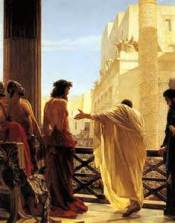
 Jesus and Pilate

Feast of Christ the King

Gospel John 18:33b-37

Pilate said to Jesus, “Are you the King of the Jews?” Jesus answered, “Do you say this on your own or have others told you about me?” Pilate answered, “I am not a Jew, am I? Your own nation and the chief priests handed you over to me. What have you done?” Jesus answered, “My kingdom does not belong to this world. If my kingdom did belong to this world, my attendants would be fighting to keep me from being handed over to the Jews. But as it is, my kingdom is not here.” So Pilate said to him, “Then you are a king?” Jesus answered, “You say I am a king. For this I was born and for this I came into the world, to testify to the truth. Everyone who belongs to the truth listens to my voice.”

Meditation Reflection:

Christ’s humble form in the Eucharist and His life of material poverty can sometimes cause us to forget the magnitude of His greatness and the awe-inspiring power and glory of His kingship. Advent marks the beginning of the New Year for the liturgy. As a result, the week prior marks the end of the year and so we reflect on the end of time when Christ will come again to reign in glory. Scripture attests to the fact that His Second Coming will be very different than His first. In the latter His glory was veiled so that we might have the freedom to accept or reject Him. In the former, everyone will see and know that He is God. The Truth will be revealed and we will no longer be able to live in unreality.

Pontius Pilate articulates this confusion well. He simply asks Jesus if He is the king of the Jews but Jesus describes His kingdom in terms foreign to Pilate’s political experience. Jesus’ kingdom includes those who love and live by Truth. Christ’s kingdom conquers hearts not lands and its members become citizens of this monarchy freely. Pilate asks the famous question “What is truth?” as Truth stands directly before him. At Christ’s Second Coming, no one will ask this question. Reality will be so bright that we cannot hide in blindness or denial.

For those who love Christ, who have been desiring to see in fullness the Lord they can only see by faith, it will be a glorious moment. When our king comes we will truly rejoice and feel both honored and unworthy to be His servants. We will sing songs of praise like those in the book of Revelation, grateful to be in His courts. For those who rely on lies or a self-created image they will cringe when the truth of their emptiness is exposed. The feast of Christ the King should encourage us and strengthen our hope to persevere in aligning ourselves with God who is Truth, Goodness, and Love. It seems unreal to the worldly but the reality check will come and Christ will reward those who know the Truth. In response to the culture of relativism the Christian can respond: You have your truth and I have mine…His name is Jesus.

Consider:

  • Reflect on Jesus’ words to Pilate: “You say I am a king. For this I was born and for this I came into the world, to testify to the truth. Everyone who belongs to the truth listens to my voice. “Who do you listen to when discerning the answers to important questions?
  • Do you consult Scripture, Christian spiritual writers, your priest, etc.?
  • Is there someone you know that loves you enough to speak Christ’s Truth to you despite whether it is something you want to hear or not?
  • Do you ask Christ in prayer?
  • Do you rely on cultural norms to determine your perspective?
  • Do media or secular friends play a role in your decision making?
  • Our culture is permeated by relativism – the belief that there is no objective truth. Do you believe that Truth is objective – the Person of Christ – or do you adhere to the cultural mantra “you have your truth and I have my truth”?
  • Imagine Jesus coming in all of His glory with His hosts of angels. Consider what it would feel like to be in His Kingdom.

Make a Resolution (Practical Application):

  • Pray for Christ’s kingdom to come in your own heart each day this week.
  • Start each day imagining the Second Coming of Christ. Walk through the rest of the day with joy and pride of being a member of His true, everlasting kingdom.
  • If you are blessed with a Truth-speaker in your life, take the time to thank him or her. They could probably use your encouragement. We know how Truth was treated while He was on earth.
  • If you struggle to understand or align yourself with one of Christ’s teachings in Scripture or through His Church, actively seek understanding by learning more through reading, talking with someone educated on the topic, praying about it, etc.

~ Written by Angela Lambert © 2015; edited and reposted © 2018

* To receive these weekly posts automatically in your email just click the “follow” tab in the bottom right hand corner and enter your email address.

Communication and Relationships

Reflection by Angela Jendro

Jesus heals two blind men, an apostle behind him. Mosaic (6th)

September 9th, 2018; 23rd Sunday in Ordinary Time

Gospel of Mark 7:31-37 NAB

Again Jesus left the district of Tyre and went by way of Sidon to the Sea of Galilee, to the district of the Decapolis. And people brought to him a deaf man who had a speech impediment and begged him to lay his hand on him. He took him off by himself away from the crowd. He put his finger into the man’s ears and, spitting, touched his tongue; then he looked up to heaven and groaned, and said to him, “Ephphatha!”— that is, “Be opened!” — And immediately the man’s ears were opened, his speech impediment was removed, and he spoke plainly. He ordered them not to tell anyone. But the more he ordered them not to, the more they proclaimed it. They were exceedingly astonished and they said, “He has done all things well. He makes the deaf hear and the mute speak.”

Meditation Reflection:

People brought to Him a deaf man who had a speech impediment and begged Him to lay His hand on him.”  To have begged Christ, they must have loved the man dearly.  Begging implies a kind of poverty and desperation.  It can be hard enough to ask for help sometimes, but to beg can seem too humiliating to do.  Jesus responds with such personal attention and care that it seems He too shares their concern that the man’s speech and hearing be restored.

This passage underscores the centrality of our relational nature – both our relationship with others and with God.  Relationship depends upon communication.  Clearly the people in this passage had communicated their love to the man through their actions and their expressions.  However, they begged Christ to remove the barrier of deafness and the speech impediment so that they might share words with the man and receive them in return.

Truthful words can communicate our inner thoughts and feelings, a sharing of ourselves that can only be known if we choose to share it with others.  Christ healed the man by restoring his ability to communicate and therefore enabling him to enjoy more freedom to relate to those he loved.  Jesus went even further by connecting the man to God Himself.  He took the man aside, physically touched him, and opened his ears to hear and his tongue to speak – both bodily and spiritually.  Jesus, the Word of God, became man that we might have relationship with God.  We can only know God’s inner thoughts and feelings if He chooses to share them with us verbally.  Jesus is God’s incarnate communication.  He desires to restore all of us to relationship with Him and with others.  If we humble ourselves to beg Him to open our ears and free our tongues, He gives us hope in this passage that He will unite us at a deeper level than we can imagine to God and those we love.

If God is a dialogical unity, a being in relation, the highest creature made in his image and likeness reflects this constitution; thus he is called to fulfill himself in dialogue, in conversation, in encounter.” — Benedict XVI, Trinity Sunday, Genoa, May 18, 2008.

Consider:

  • Jesus healed the man by touching him and praying for him.  Consider the power of human touch, words, and prayer.
  • Do you struggle with either hearing God or with speaking to God? Do you offer general prayers or do you really communicate with the Lord?  How might you open yourself up to deeper communication with God?
  • Is there a person you struggle communicating with?  Why do you think that is?  How might you repair the relationship and soften the communications?
  • Consider the power of words to build up or break down a relationship.  When was a time that someone’s words made a significant and positive difference in your life?

Make a Resolution (Practical Application):

  • Which Scripture passage do you love the most?  Write it down and post it where you will see it every day.
  • Read one psalm a day.  They are God’s words to you and beautiful words of prayer back to God.
  • If there is someone you struggle with, place the relationship before God and beg Him to bless it.
  • Intentionally think about the words you use each day this week.  Ask Christ for self-control to guard against harsh, critical words.  Ask the Holy Spirit to provide you with the right words to say to each person you meet in your day.

~ Written by Angela Lambert-Jendro © 2015

Trust – And the Leap of Faith

Reflection on John 6:60-69

Giusto di Gand Joos Van Wassenhove Instituzione delleucarestia (from commons.wikipedia.org)

by Angela Jendro

August 25th, 2018; 21st Sunday in Ordinary Time

Gospel of John 6:60-69 NAB

Many of Jesus’ disciples who were listening said, “This saying is hard; who can accept it?”
Since Jesus knew that his disciples were murmuring about this, he said to them, “Does this shock you? What if you were to see the Son of Man ascending to where he was before? It is the spirit that gives life, while the flesh is of no avail. The words I have spoken to you are Spirit and life. But there are some of you who do not believe.” Jesus knew from the beginning the ones who would not believe and the one who would betray him. And he said, “For this reason I have told you that no one can come to me unless it is granted him by my Father.” As a result of this, many of his disciples returned to their former way of life and no longer accompanied him. Jesus then said to the Twelve, “Do you also want to leave?” Simon Peter answered him, “Master, to whom shall we go? You have the words of eternal life. We have come to believe and are convinced that you are the Holy One of God.”

Meditation Reflection:

The psalmist exhorts us to “Taste and see the goodness of the Lord” (Psalm 34).  He does not say, “see then taste”.  Rather than requiring scientific evidence to support the miracle of the Eucharist before receiving it, Christ pleads with us to believe in Him and receive the Eucharist after which we will see its power to give life.  Belief in the Eucharist should not be predicated upon whether it satisfies our natural reason or whether or not we feel like it.  Instead, Christ’s word alone, His teaching as Lord and Savior of the world forms the basis for belief in the supernatural miracle of the Real Presence of Christ in the Eucharist.  Because of its supernatural quality, it necessarily exceeds our natural experience and reasoning.  This makes it difficult for any person to believe in such a transformation based on merely human experience.

The Catechism discusses this common problem, writing:

The first announcement of the Eucharist divided the disciples, just as the announcement of the Passion scandalized them: ‘This is a hard saying; who can listen to it?’ (Jn 6:60) The Eucharist and the Cross are stumbling blocks.  It is the same mystery and it never ceases to be an occasion of division.  ‘Will you also go away?’ (Jn 6:61):  The Lord’s question echoes through the ages, as a loving invitation to discover that only He has ‘the words of eternal life’ (Jn 6:68) and that to receive in faith the gift of His Eucharist is to receive the Lord Himself.”

In this passage the followers of Christ divide between those who “returned to their former way of life” where their faith wasn’t challenged and those who, with Peter, can only say “We have come to believe and are convinced that You are the Holy one of God.” The passage seems to indicate that everyone present experienced confusion and found Christ’s teaching difficult to accept.  Many of us share this same experience.  We follow Christ and marvel at His actions in our life.  Then we come to a point where one of His teachings, whether in Scripture or through His Church, seems too difficult.  We are tempted to rationalize that no one could really believe it and then go on living as we were. Christ challenges us to respond instead like Peter by putting our trust in Him.  If we are convinced that Jesus is the Christ, then we should be convinced that everything He says and promises is true.

Consider:

  • What makes you convinced that Jesus is God and Savior?  Are you convinced?
  • What teaching of Christ do you struggle with the most?  Do you follow Christ always or only when it makes sense to your natural reason?
  • Which is more reliable – Christ’s wisdom or your own? Why?
  • Do you find it hard to believe in the real presence of Christ in the Eucharist?  If yes, why?  If no, why not?  If you have a deep belief in the Eucharist, consider how you might share that belief with someone else.  Pray for a providential moment.

Make a Resolution (Practical Application):

  • Faith is a gift.  Pray each day this week for an increase in the gift of faith.  You could share the prayer of the man in Mark 9:24 who said to Christ, “Lord I believe, help my unbelief.”
  • Make an effort to deepen your belief in the Eucharist.  Spend time praying at Church or adoration, go to a daily Mass, read about the Eucharist in the Catechism http://www.vatican.va/archive/ccc_css/archive/catechism/p2s2c1a3.htm, read John 6 again, read about Eucharistic miracles. Ask the Holy Spirit to enlighten your mind and heart.

~ Written by Angela Jendro © 2018 (edited from original post Aug. 23rd, 2015)

Finding Freedom

by Angela (Lambert) Jendro

July 15th,2018 15th Sunday in Ordinary Time

Gospel of Mark 6:7-13 NAB

Jesus summoned the Twelve and began to send them out two by two and gave them authority over unclean spirits. He instructed them to take nothing for the journey but a walking stick— no food, no sack, no money in their belts. They were, however, to wear sandals but not a second tunic. He said to them, “Wherever you enter a house, stay there until you leave. Whatever place does not welcome you or listen to you, leave there and shake the dust off your feet in testimony against them.” So they went off and preached repentance. The Twelve drove out many demons, and they anointed with oil many who were sick and cured them.

Meditation Reflection:

Jesus conquered Satan, and just as He healed persons afflicted by demons, He also gave His authority to His apostles to drive them out as well. Jesus personally extends this opportunity for freedom to you and I through the ministry of His Church and His grace. The question is only if we will invite Christ and His followers in and accept healing, or refuse to listen and force them out.

Satan and his demons, even if they do not take total possession of a person, can and do take control of pieces of us whenever we allow ourselves to be bound by their lies and their allurements.

Whereas Christ is the Truth (John 14:6), Satan is the father of lies (John 8:44).  How can we discern between the two?  Truth builds up and encourages. Even if it’s not what we want to hear, it always leads to our true good and real happiness. In contrast, Satan’s lies derail us from happiness and discourage us, even to the point of despair.

His common tactics include whispers that you are not worthy, that you cannot be loved, that you will never find happiness, that you are a failure, that God is a tyrant and faith is an illusion. Broken with despair, Satan offers false hope through sin.  He promises that happiness can only be found in pleasure so seek it without restraint or any moral boundaries.  He urges you to look out only for yourself and seek total independence – from any need of others and from God, and from anyone relying on you either.  The fruit of these lies however only reveal that the truth is true – that these do not bring happiness but intense sorrow, loneliness, and a degradation of your true dignity.  We need only to look at our secular hedonistic culture to see evidence of this.  In its pursuit of pleasure and freedom without God or morality, it has produced widespread depression, high suicide rates, slavery to addiction, and callousness toward the dignity of human life.

Contrary to Satan’s lies, the truth is in fact liberating.  You CAN find joy and happiness living a moral life in relationship with Christ.  Where do we find evidence of people who experience real freedom of soul, peace of spirit, and radiate joy?  In the lives of the Saints and in the lives of everyday Christians who strive to live a life of holiness with the help of grace.

Christ came to conquer sin and death that we might experience freedom and the fullness of joy (see John 15:11).  In today’s passage we see that He does this by giving His own authority to those He had chosen and sending them out to us.  Christ gave His saving Truth to His Church, not because of the apostles’ perfect character but simply because He willed it and wanted to personally extend His Gospel throughout the whole world.  He continues to do this through the apostles’ successors today, the bishops, who are also flawed human beings, and yet still messengers of the authoritative and saving word of God.  He also does this through every baptized Christian, whom He calls to be witnesses of the truth of the Gospel.

We need witnesses of this reality to give us hope and the strength to choose Christ – who is the Way, the Truth, and the Life.  Consider the battle with addiction. At first it offered relief from pain and promised feelings of happiness for the person.  Instead it brought loss and self-destruction.  Still, the idea of giving up that addiction may feel like facing a life of misery.  The testimony of those who have conquered it and now experience freedom can strengthen the addict to reach for the hope of happiness in sobriety instead of reaching for their drug.

Similarly, in a culture obsessed with lust, chaste love may appear like misery.  The joy and freedom testified by chaste singles and faithful married couples prove the lie to be wrong.  Especially impressive today, are those who struggle with homosexual desires who choose chaste love.  Their witness directly contradicts the current propaganda that they won’t be happy unless they have homosexually physical relationships.  (For examples of their testimonies, see the website couragerc.org).

Satan tempted Jesus to be king without the Cross, and he tempts us the same way.  Nevertheless, Jesus proved that suffering and death brings resurrection and grace.  Following Christ will not be pleasurable all the time, but it will be joyful and meaningful.  The days of my children’s births were not pleasurable, but they were the most joyful and meaningful days of my life.  Any noble and worthwhile pursuit will require sacrifice, but there’s a kind of pleasure in the sacrifice when you know you are working toward something great.  What greater work can we do than taking Christ’s yoke upon us and building up the Kingdom of God?!

Jesus confronts the lies we cling to and our sin.  We must say yes to Him to be free of them, thus the call for repentance before being able to receive healing.  Oftentimes our response to being convicted of sin is to become defensive, attack the messenger, or walk away.  To this response Jesus tells the apostles to “shake the dust from their feet” and move on to those who are open to His Word.  Yet, sin is precisely where the demons have a foothold in our heart and deprive us of true joy.  You may not feel strong enough to overcome a sin, but by acknowledging your sin and inviting Christ in, and His Body the Church, He can drive the demons out and fill you with His peace; and one day you might get to be the hand of Christ to help someone else in your situation.  The choice is up to you.

Consider:

  • Think of one sin you struggle with the most.
    • What are the lies and rationalizations that keep you tied to this sin?
  • People were free to accept or reject the apostles.  Consider how receptive or defensive you are toward those Christ sends to you.  Who specifically are those persons in your life?
  • Invite Christ to free you with the help of His grace, to accept His Truth and to detach from the lie or sin you are struggling against.  You don’t have to do it alone, He gives you the whole Church, infused with His own authority and grace, to strengthen and support you.
  • The Truth is true.  How might you witness to this by your words and life?

Make a Resolution (Practical Application):

  • Identify one specific, practical way you will reach out to accept the support of Christ’s Church to help you overcome your sin and receive freedom and healing.
    • (Examples: talking openly with a spiritual friend or your priest; receiving grace through attending a daily Mass; meditating on Scriptures or spiritual books that address your particular struggles; going to the sacrament of Confession…)

~ Written by Angela Jendro © 2018

* To receive these weekly posts automatically in your email just click the “follow” tab in the bottom right hand corner and enter your email address.