Desert Decisions

Excerpt from Take Time For Him: Some More

by Angela M Jendro

Order your paperback or e-book from Amazon!

Order the kindle e-book (or paperback) to read the Christmas meditation, the meditation for Mary Mother of God, and to reflect on the meditations all year at your convenience.

1st Sunday of Lent

Read the Gospel of Mark 1:12-15

Meditation Reflection:

The transition from Christ’s hidden life to His public ministry began with His Baptism and then the temptation in the desert.  There, He decidedly chose the path of self-sacrifice over self-gain.

At the Incarnation Christ, though the Second Person of the Blessed Trinity, took on a human nature and humbly chose to fully live the human experience with all of its limitations and difficulties.

Who, though he was in the form of God, did not count equality with God a thing to be grasped, but emptied himself, taking the form of a servant, being born in the likeness of men. Philippians 2:6-7

As man, Jesus grew “in wisdom and stature” (Luke 2:52), obedient to His parents, embracing the temporal condition of human development.  He did not begin His public ministry until the age of thirty, which marked full manhood at the time and the transition to leadership roles.  It was also the age Levitical priests would enter the full service of the Lord (see Numbers 4:3, 30).

The commencement of His mission was preceded by temptation and trial.  He, like us, had to choose which trajectory His life would take.  In the desert, Satan enticed the Lord to direct His divine gifts to pampering His human nature.  Matthew (4:1-11) details the temptations specifically: bodily pleasure (bread), tremendous fame (leap from the temple pinnacle), and worldly power (all the kingdoms of the earth).  Satan forced the choice before the Lord: the immediacy of the visible world and self-gain without the Cross, or the work of establishing the invisible kingdom of God which would require self-immolation and suffering Crucifixion before rising again.

Each of us faces the same temptations and the same choice.  We can either use our God-given gifts to promote ourselves and worldly achievements or direct them to the Father’s will and the building up of His kingdom.

Lent provides a time to step into the desert with the Lord, to pray and fast, and to re-orient the trajectory of our lives.  As a Church, the People of God, we take 40 days each year to shed the illusion that we can live for both worlds or that we can have the kingdom without the Cross.

Through fasting, with the help of grace, we deny ourselves tempting pleasures to strengthen our will and remember that:

man shall not live by bread alone,

but by every word that proceeds from the mouth of God” (Matthew 4:4). 

Furthermore, it reveals the truth of just how attached we may be and loosens the hold that habit may have over us.  Fasting also unites us to the redemptive value Christ has placed on suffering through His own suffering and death.  In fact, on one occasion Jesus even said to His disciples that some demons “cannot be driven out by anything but prayer and fasting” (Mark 9:29).  Thus, through our Lenten fasting, we join our sacrifices to His, to cast out the demons in our lives with His help, so that we might share in His mission and thus share in the hope of His Resurrection.

Through prayer we draw closer to the Lord, that the invisible might become more visible and His grace might transform us.  Encountering Christ in the Scriptures, the Mass, the Rosary, the lives of the saints, Eucharistic Adoration, the Stations of the Cross, and other prayerful devotions, our love for Him is enkindled and our discipleship strengthened.

Finally, the Lenten practice of almsgiving moves us outside of ourselves through service toward others.  This can range from sharing your money with the poor to sharing a blanket with your child.  It also includes sharing your time with someone sorrowing, lonely, or sick. It begins with meeting the needs of your family then your co-workers or neighbors and friends, your local parish and community, and finally the world-wide needs of the Church.  Catholic Relief Service’s Operation Rice Bowl provides an opportunity as a family to make simpler meals during Lent and to donate the money saved to feed the hungry in poor areas of the world.

During Lent, we join Christ in the desert.  We withdraw from the immediate pleasures of the moment and usual temptations toward worldliness.  With that space we can draw nearer to Christ and the eternal, even more real, pleasures of the Heaven.  At the end of this purification we share in the joy of His resurrection at Easter.  Easter is the beginning of a new creation, and we hope to be a new, or renewed, creation Easter Sunday as well. Lent is a time to “repent and believe in the gospel” so that, transformed by grace, we may live in the Kingdom of God which is now at hand in Jesus Christ.

Consider:

  • Consider in prayer the deeper, truer, reality of the spiritual world.  Reflect on the illusory promises of pleasure, fame, and status compared with the enduring graces of Christian love, strength, and joy.
  • Ask Christ in prayer to reveal an attachment you may have, that up until now you have been blind to such as subtle forms of pride, vanity, greed, or pleasures.
  • Take time for gratitude.
  • Ask Mary to help you see the needs around you as she did at the Wedding at Cana.

Practical Application:

  • Swap out 15 minutes of media time for 15 minutes of prayer or silence.

All Rights Reserved © 2020 Angela M Jendro
Shining a Light into The Darkness

Excerpt from Take Time For Him: Some More

by Angela M Jendro

Order your paperback or e-book from Amazon!

Order the kindle e-book (or paperback) to read the Christmas meditation, the meditation for Mary Mother of God, and to reflect on the meditations all year at your convenience.

4th Sunday of Ordinary Time

Read the Gospel of Mark 1:21-28

Meditation Reflection:

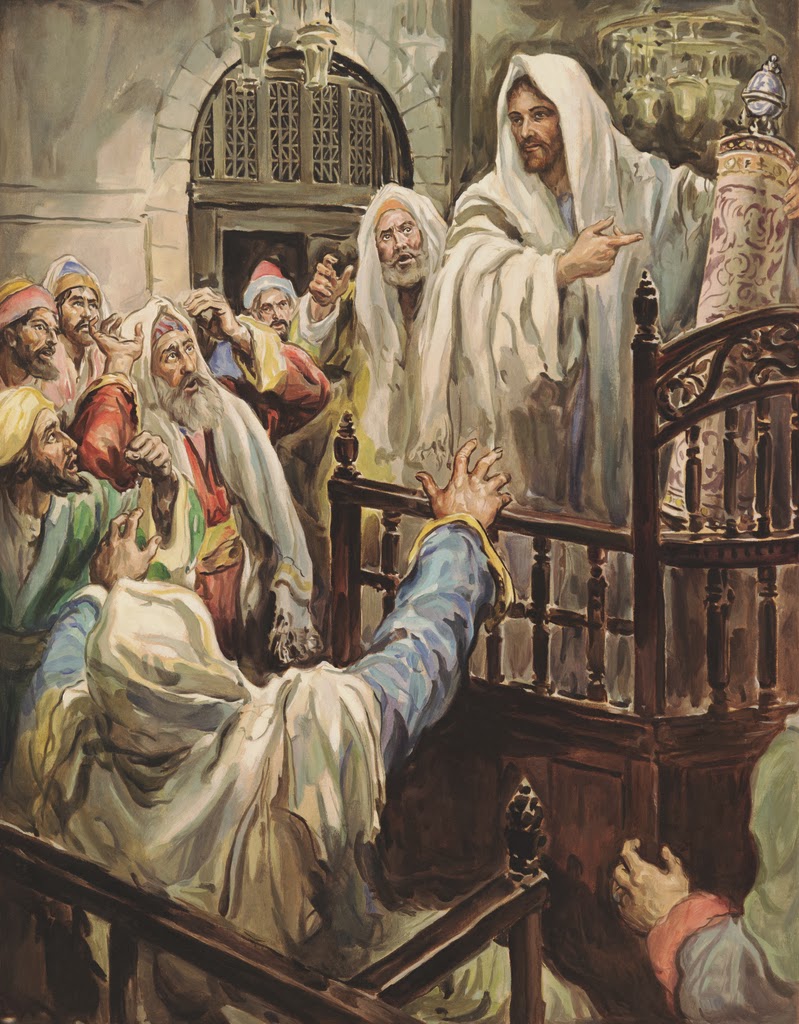
Jesus casts out demons, He frees us from their lies and from the darkness of sin.  This is truly a gift and a great relief! Our present secular culture needs this gift.  Marked by the highest levels of anxiety and depression, the darkness from which these symptoms often proceed need to be cast out with the authority and light of Christ.

The great theologian Hans Urs von Balthasar (1905-1988), explored the relationship between darkness, sin, and anxiety in his work The Christian and Anxiety.  He noted, “The main effect of darkness is that it separates, isolates, makes lonely.”  Similarly, the darkness of sin separates the sinner from others, isolates him from God whose light he evades to continue in sin, resulting in dark loneliness.  In Exodus, the penultimate plague aptly signified the culmination of Pharaoh’s obstinate evasion of God, who had made Himself visibly manifest.  A darkness came over the Egyptians for three days, “a darkness to be felt” (Exodus 10:21) The dense, suffocating, darkness effected a social paralysis, symptomatic of their spiritual sickness. 

and there was thick darkness in all the land of Egypt three days; they did not see one another, nor did any rise from his place for three days; but all the people of Israel had light where they dwelt” (Exodus 10:22-23). 

Von Balthasar asserted that the loss of light signifies the loss of reality.  Without light we cannot see and therefore remain trapped by our imagination. Reflecting on Wisdom chapter 17, he wrote, “The wicked are afraid of Nothing, of nothing real.”  God is Reality.  His divine Name, Yahweh, which means “I Am”, revealed Him to be existence itself.  Therefore, to hide from His Light, to duck His Truth, means to retreat into an imaginary world of one’s own creation. It deprives us of the answers we need most of all – Who am I?  What is my purpose?  What is the meaning of life? How do I find happiness?  

Denial as a coping method may be alluring, but rarely helpful. For example, avoiding the truth about a physical illness provides a temporary relief and façade of healthiness.  However, the illness usually worsens without treatment and the anxiety one initially avoided only intensifies due to procrastinating the cure. In the same way, one can only self-soothe by justifying sin for so long before the underlying dread and pain of spiritual illness becomes too intense to deny.

Sin can become paralyzing.  Left untreated for too long it can feel insurmountable.  Satan, the “Accuser” as Jesus calls him, whispers fearful lies into the darkness to keep a person from reentering the light.  The demons of shame, despair, and distrust bind the sinner to his dark loneliness. 

Yet, into this darkness, Christ the Light broke through.  He “spoke with authority” because He spoke Truth, thereby dispelling lies.  His Light cast out the demons of darkness, His Truth cast out the Father of Lies, and His merciful love strengthened and healed so the sinner could become whole again.  How many miracles of Jesus demonstrate this!  The paralyzed man who could walk again.  The lepers, cast out from society, healed and able to rejoin their families.  The demoniacs freed and restored to their loved ones.  Christ’s light shone on prostitutes, tax collectors, and pagans.  He liberated them from a kingdom of degradation and made them citizens and children of His Kingdom of God. 

Christ continues to bring His light into the darkness through His Mystical Body the Church.  He invites us into His healing love, then His light begins to shine in us.  Wherever we are, that light shines simply by union with Him. 

Elizabeth Leseur (1866-1914), a devout Catholic living in an upper-class, atheistic, French society provides a concrete example of how to be a light in darkness.  Elisabeth and her husband Felix loved one another intensely and shared an inspiring intimacy of marital friendship. As a result, it pained her severely that he was an ardent atheist.  Her love for God and her love for Felix were both so deep, and yet she couldn’t share that deepest part of herself with the man she loved the most, nor see him receive the joys and graces she enjoyed as a Christian. 

She made it her apostolate to pray and sacrifice for his conversion and for their friends.  Most everyone in their society of friendship were intellectuals and anti-Catholic.  Her diary reveals how she prayerfully navigated ministering to them, bringing light to the darkness through her hidden interior life, her faithful exterior practices, her patient silence, and her readiness to speak boldly and intelligently for Christ if the moment necessitated it.  After her death, her husband discovered her secret diary.  The insights into her interior life, together with his experience of her daily love during their marriage, softened his heart and converted his soul.  He went from being a hardened atheist to later becoming a Catholic priest!

Elisabeth brought her light into the darkness and it freed the one she loved the most.  One of her resolutions in her diary can be instructive for us in the same effort.  In today’s Gospel Jesus spoke with authority and it struck people.  Elisabeth discovered the same thing in her own interactions.  She found that somehow her personal conviction of faith, was itself a strong testimony, strengthened more by authenticity and simple truth than by long explanations trying to persuade.  She wrote,

“Each time the conversation leads me to speak of faith, I will do so simply, but in a direct and firm way that will leave no doubt as to my convictions.  Cleverness is nothing in such things; I am struck with the fact that unbelievers have more sympathy with people of deep faith than with those of variable and utilitarian views.  These dear unbelievers attend more to those who are ‘intransigent’ regarding the Faith than to those who by subtlety and compromise hope to bring them to accept the Faith. And yet the bold statement must be made with the most intelligent sympathy and the liveliest and most delicate charity.”[i]

Our culture suffers under “a darkness that can be felt,” but Christ’s light shines into that darkness to cast it out and replace it with freedom. As St. John testified:

“In him was life, and the life was the light of men.  The light shines in the darkness, and the darkness has not overcome it.” John 1:4-5

May the light of Christ shine in and through us!


[i] Elisabeth Leseur, The Secret Diary of Elisabeth Leseur: The Woman Whose Goodness Changed Her Husband from Atheist to Priest, Sophia Institute Press, 2002.

Consider:

  • Are there shadows of darkness with which you struggle?  Bring them to prayer and expose them to the light of Christ in Scripture and the sacraments.
  • Compare who the world says that you are and what your worth is, with who Christ says that you are.  Which do you listen to more?  How might you strengthen Christ’s voice within you?
  • Spend 5 minutes of silent prayer, loving Christ and receiving His love.
  • How might you grow your relationship with Christ and let Him shine more brightly in your life?  How might you bring His warmth, love, and truth to those in your life?

Practical Application:

  • Resolve to pray for and develop a deeper love for Christ and to shine Him more brightly.
  • Pray the Prayer of St. Francis of Assisi daily.
  • Pray the Rosary.  Mary always purifies and strengthens our love for Jesus.

All Rights Reserved © 2020 Angela M Jendro

Have You Found What You Are Looking For?

Excerpt from Take Time For Him: Some More

by Angela M Jendro

Order your paperback or e-book from Amazon!

Order the kindle e-book (or paperback) to read the Christmas meditation, the meditation for Mary Mother of God, and to reflect on the meditations all year at your convenience.

2nd Sunday of Ordinary Time

Read the Gospel of John 1:35-42

Meditation Reflection:

Imagine what it must have been like for the apostles near the end of their lives, to remember back to the very beginning when they first met Jesus – before their zealous and arduous work as the leaders of Jesus’ Church, before they received the Holy Spirit at Pentecost, before Jesus’ astounding Resurrection, before His shocking suffering and death, before witnessing in amazement His teaching and miracles.  Back when they lived ordinary lives, as ordinary men, waiting upon the Lord in His silence.

The Lord had spoken to His People through prophets since His first revelation to Abraham.  They had enjoyed ongoing relationship with Him, even when they experienced the pain of God’s discipline.  Eventually however, their obstinance toward God grew so hardened that it caused God to withdraw His immanent presence from the Temple. Without God’s help the people fell captive to foreign nations and lived in exile.

Years later, King Cyrus of Persia issued an edict allowing the Jews to return to Jerusalem and even contributed funds to aid in the rebuilding of the Temple which had been destroyed.  Eventually some returned to Jerusalem, but God’s divine and immanent presence (which had remained upon the Ark of the Covenant from their time in the desert during the Exodus through its housing in the Temple until the Babylonian Exile), did not return to the Temple.  Although God anointed prophets to mediate His Word through this time, afterward God didn’t speak again until the Incarnation of Christ.

In consequence, the Jews endured about 400 years of divine silence.  During that time they clung to the words of God’s earlier prophets and to His Law given through Moses.  They considered God’s promises and kept hope that one day He, who is always faithful, would fulfill them. 

At long last, their hope for God’s Word and for renewed relationship enlivened with anticipation when John the Baptist appeared, as

“the voice of one crying in the wilderness:

 ‘Prepare the way of the Lord,

make his paths straight’”

(Mark 1:3; Isaiah 40:3).

The long silence finally broken, and the power of John’s prophecy excited some to speculate whether John was in fact the Messiah.

Both Messiah and Christ mean “anointed one.”  In the Old Testament, those God had appointed as either priest, prophet, or king would be anointed with oil.  Each were called in some way to mediate between God and the People, bestowed with a measure of God’s authority.  The priesthood of the Old Covenant foreshadowed the eternal priesthood of Jesus, who would offer Himself as the perfect sacrifice for the sins of all mankind.  The prophets mediated God’s word, preparing us for the incarnation of the Word of God, and later the indwelling of that Word in our souls through Baptism.  Finally, the role of king was to govern the people as a steward of God who is the true king.  Jesus came as king to reign not as a steward, but with the authority of God Himself.

“And they were all amazed, so that they questioned among themselves, saying, ‘What is this? A new teaching!’” Mark 1:27   “Why does this man speak thus? It is blasphemy! Who can forgive sins but God alone?” Mark 2:7

John the Baptist answered the Messianic speculation directly, stating, “I am not the Christ” (John 1:20). He too was waiting patiently upon the Lord.  He faithfully preached repentance, as God had asked of him, and baptized with water as a sign of readiness. 

Finally, the Holy Spirit revealed the Messiah to John – it was Jesus.  There, waiting expectantly, were St. Andrew and another disciple of John. Upon hearing his prophetic declaration, “Behold the Lamb of God,” they began following Jesus immediately, apparently without even saying a word.  When Jesus turned to ask them what they wanted, they expressed their desire to remain with Him.  They accepted Jesus’ invitation to come with Him, and in their encounter with the Person of Jesus, determined with conviction that He was in fact the Messiah.  In consequence, Andrew hurried to his brother to share the unbelievable news. 

That day had probably began like every other day: breakfast, work, prayer, routine.  In that moment however, they dropped everything to find Jesus.  Everything had changed.  In that first encounter, Jesus called Simon by name, and gave him a new name indicating his new role in the New Covenant. Simon would leave the normalcy of the life he knew, to be Peter, “Rock”, upon which Christ would build His Church.  Imagine the trust he must have had in the Lord to persevere in his discipleship through so many changes, so much confusion, and so much responsibility!  So much took place over the course of their lives, but it all began with dropping what they were doing when the time came, and going to find the Messiah. 

The Anointed One has come.  He heals wounds of sin and strengthens us with grace through His sacrifice on the Cross mediated to us in the Sacraments of Baptism, Confession, and the Eucharist. Jesus is the Word of God, who reveals God’s plan for our lives, our purpose, and His constant care. Jesus is king.  We enter His kingdom through Baptism and must work to allow His rule over our lives daily.

We have found the Messiah.”  There’s no more need to search, only to follow; to say yes to Jesus’ invitation “Come, and you will see.”

Christianity is not a consumer product, a happy drug, an interesting philosophy, or a social club.  Christianity is following Christ, the Anointed One of God, and staying with Him. None of us can imagine where it will lead, only follow one step at a time, waiting during times of silence, and acting when He calls our name.  Where it leads only the Lord knows, but it will certainly be an adventure and full of surprises.

Consider:

  • Spend a few minutes in silent prayer, just being in the presence of Christ.
  • When have you felt excitement about your faith like the apostles?
  • How has encountering Christ transformed you? In what ways has it changed the way you think, guided your actions, or changed your desires and priorities?
  • Prayerfully consider what mission Christ has for you.

Practical Application:

  • Take one step toward Christ every day. Follow Him in Scripture reading, works of love, or the sacraments.
  • Take 5 minutes of silence to rest in the Lord.

All Rights Reserved © 2020 Angela M Jendro