Do Not Let Your Hearts Be Troubled…Peace and Surrender in Christ

by Angela Lambert

May 14th, 2017; 5th Sunday of Easter

 Gospel of John 14:1-12

Jesus said to his disciples: “Do not let your hearts be troubled. You have faith in God; have faith also in me. In my Father’s house there are many dwelling places. If there were not, would I have told you that I am going to prepare a place for you? And if I go and prepare a place for you, I will come back again and take you to myself, so that where I am you also may be. Where I am going you know the way.” Thomas said to him, “Master, we do not know where you are going; how can we know the way?” Jesus said to him, I am the way and the truth and the life. No one comes to the Father except through me. If you know me, then you will also know my Father. From now on you do know him and have seen him.” Philip said to him, “Master, show us the Father, and that will be enough for us.” Jesus said to him, “Have I been with you for so long a time and you still do not know me, Philip? Whoever has seen me has seen the Father. How can you say, ‘Show us the Father’? Do you not believe that I am in the Father and the Father is in me? The words that I speak to you I do not speak on my own. The Father who dwells in me is doing his works. Believe me that I am in the Father and the Father is in me, or else, believe because of the works themselves. Amen, amen, I say to you, whoever believes in me will do the works that I do, and will do greater ones than these, because I am going to the Father.”

Meditation Reflection:

Do not let my heart be troubled? Jesus knows what it’s like to work, to have family, to experience crises.  He should know the stress we encounter.  How can He order such a thing?

Then I remember, I say the same thing to my loved ones.  I remind them that everything will be okay.  We can get through anything together and that I am here for them.  Jesus assures us that He is near and that He cares.  When we cry out to God, “where are you?!”, “how can you let this happen?!”, “do you see or care?!”.  He answers, yes.  Jesus tells us, that He and the Father are one. If we wrestle with whether God cares about our struggles, we need look no further than Jesus.  Christ witnesses the Father’s love.  A love that isn’t remote or detached.  Rather, an immanent, incarnate, self-sacrificing, and eternal love.

When Christ says, “everything will be okay,” we can trust Him.  Many of the apostles doubted as Jesus hung on the Cross and died.  His mission appeared extinguished and their hopes dashed.  They reeled in confusion and fear.  We too can experience times like this.  When God allows suffering without revealing His reason, our faith gets tested – we either succumb to the confusion and fear like most of the apostles, or we remain with Him at the Cross like Mary and John.  Mary and John remained because they loved Jesus unconditionally.  They trusted Him when all visible signs were removed.  The more we draw near to Christ and develop our relationship with Him, the stronger our trust will be in times of darkness.  The saints experienced unshakable peace because they cooperated with grace and reached a state of total surrender to the Lord.

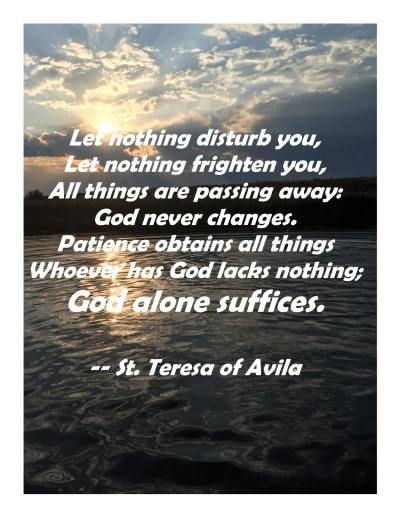
St. Teresa of Avila, declared a doctor of the Church, composed this beautiful prayer which describes this union:

Let nothing disturb you, Let nothing frighten you, All things are passing away: God never changes. Patience obtains all things Whoever has God lacks nothing; God alone suffices. — St. Teresa of Avila

In His Father’s house there are many rooms, and one especially prepared for you by Christ.  Trust in His love, Trust His Wisdom, Trust His Goodness…and let nothing trouble your hearts, that His Peace may be with you always.

Consider:

  • When have you experienced the peace of Christ?  After Mass, in praying with Scripture, in nature, through other Christians?
  • Consider the fears and anxieties you carry.  Lay them before the Lord in prayer and surrender them.  Consider the power of Christ to provide, the love of Christ which motivates Him, and the faithfulness of Christ who remains near us in every trial.
  • In what areas of your life do you trust God completely?  In what areas do you rely on yourself or conventional wisdom rather than Him?

Make a Resolution (Practical Application):

  • Choose your biggest worry.  Begin and end each day surrendering it to God in prayer.
  • Pray the prayer of St. Teresa of Avila each day this week.
  • We make an act of trust in God when we tithe.  If you do not tithe already, begin this week.  If you tithe already but feel called to tithe more (10% is the commonly suggested amount), prayerfully make a financial act of trust in the Lord.
  • Pray Psalm 23 each day this week.
Why do you trust Jesus Christ?  Post in the comments section below!

Related Posts:

~ Written by Angela Lambert © 2017

* To receive these weekly posts automatically in your email just click the “follow” tab in the bottom right hand corner and enter your email address.


We All Need a Loving Gate-Keeper and Filter…Christ the Good Shepherd

by Angela Lambert

May 7th, 2017 4th Sunday of Easter


Gospel of John 10:1-19

Jesus said: “Amen, amen, I say to you, whoever does not enter a sheepfold through the gate but climbs over elsewhere is a thief and a robber. But whoever enters through the gate is the shepherd of the sheep. The gatekeeper opens it for him, and the sheep hear his voice, as the shepherd calls his own sheep by name and leads them out. When he has driven out all his own, he walks ahead of them, and the sheep follow him, because they recognize his voice. But they will not follow a stranger; they will run away from him, because they do not recognize the voice of strangers.” Although Jesus used this figure of speech, the Pharisees did not realize what he was trying to tell them. So Jesus said again, “Amen, amen, I say to you, I am the gate for the sheep. All who came before me are thieves and robbers, but the sheep did not listen to them. I am the gate. Whoever enters through me will be saved, and will come in and go out and find pasture. A thief comes only to steal and slaughter and destroy; I came so that they might have life and have it more abundantly.”

Meditation Reflection:

Quite often as a mom, I feel like a gate-keeper.  Before my kids go somewhere I need to know with whom, who the parents are, and approve.  Technology plagues me even more, with parent controls, ratings evaluations, and restrictions. The ever-multiplying accounts, passwords, devices, programs, and updates can feel like an interminable game of whack-a-mole.  Christmas and birthdays used to be fun, now they feel like a migraine-inducing tidal wave of gate-keeping duties, with impatient children complaining as I set the perimeter that I am being too slow, and of course, too controlling.  I’ve at least developed a one-line response to save my overtaxed brain from responding to the myriad of “logical” arguments and pleas of trust from my young teens. “It’s as simple as this,” I say, “You will not have unfiltered access to the internet.”  The Church could consider adding that as the 11th Commandment for the modern era.

Let’s face it, even adults, as children of God, need filters.   We too can be easily allured by promises of pleasure, freedom, status, or adventure from false advertisers; and I don’t just mean commercially.    Despite having everything, Adam and Eve fell prey to Satan’s proposition that God’s single rule (not to eat the fruit of the tree of knowledge of good and evil) was controlling, and denying them fun out of selfish motivations.  Satan continues to deceive us through similar false promises.

Just as predators try to find ways to get around parents to manipulate children, spiritual “thieves and robbers” try to get around Christ to attack us, God’s children.  First, they try to separate us from His influence by undermining our trust in Him, His Word, or His Church.  Common attempts sound something like: “Christ’s teachings hold you back. If you want to get ahead in life you have to be willing to get your hands dirty”, or “It’s not that you are going against Christ’s teachings, you are just modernizing them.”  In regards to those difficult passages in Scripture, the ones that really strike at your conscience, you will be urged to simply pass over them or interpret them in a more relaxed way – “Forgive others, yes, but forgive my ex?, I don’t think He meant that…”  Jesus stresses that we must die to ourselves in this life and deny ourselves.  Instead we rationalize that He only meant that symbolically, or at least in a modest way – like going on a diet or not aiming too high. Finally, the Church, Christ’s living voice of authority, is the clearest voice of our Shepherd and therefore the harshest recipient of worldly criticism.

We are children of God, in need of a loving gate-keeper.  Christ’s commands, given through Scripture and the Church, can seem restrictive and controlling if we have an adolescent view.  However, as we develop in spiritual maturity, we begin to appreciate the wisdom and the love underlying them.  When I’m tempted to brush off a Church teaching or a little pull at my conscience, I stop and recall that Christ loves me more than I love myself, and He is far wiser than me.  Who am I going to trust?  Any other false shepherd – whether secular culture, another person, or my own impulses – eventually drains rather than fills and proves a destructive, rather than uplifting force.

Christ, our Good Shepherd, leads to green pasture. He refreshes our souls and leads us beside peaceful waters (Psalm 23).  Jesus lamented to St. Faustina that distrust on the part of souls causes Him the greatest pain.  As a mom of teens, I know what He means.   I want my kids to trust me too, and so I repeat the prayer He gave to St. Faustina, “Jesus I trust in You.”

Consider:

  •  When have you been steered wrong – by others, by cultural norms, or by your own impulses?  What was the reason?  What did you learn?
  • When have you been steered right by Christ?  How has His wisdom brought deeper joy and fullness of life, even amidst suffering, than these other voices?
  • Have you ever had to be the gate-keeper for loved ones?  Consider the love it takes to be strong and the need for them to trust you.
  • How can you trust Christ more and listen to His voice more often?  Could you attend Church more regularly?  Could you invest more time into Christian friendships?  Do you make time to study your Bible, read quality devotionals, or learn more about your faith?

Make a Resolution (Practical Application):

  •  Choose one way to listen more to the voice of Christ this week.
    • Ideas:  Add 10 minutes to your prayer time, pray the rosary in the car, listen to Christian radio, listen to Christian podcasts, read the daily Scriptures (these can be found at usccb.org), post inspirational Scripture quotes in places you will see them often, meet with a Christian friend.
  • Consider adding a filter, rating restrictions, or accountability software to your personal technology.

Related posts:

~ Written by Angela Lambert © 2017

* To receive these weekly posts automatically in your email just click the “follow” tab in the bottom right hand corner and enter your email address.


Walking With the Lord

by Angela Lambert

April 30th, 2017; Third Sunday of Easter

Gospel of Luke 24:13-35

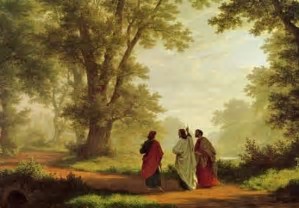
That very day, the first day of the week, two of Jesus’ disciples were going to a village seven miles from Jerusalem called Emmaus, and they were conversing about all the things that had occurred. And it happened that while they were conversing and debating, Jesus himself drew near and walked with them, but their eyes were prevented from recognizing him. He asked them, “What are you discussing as you walk along?” They stopped, looking downcast. One of them, named Cleopas, said to him in reply, “Are you the only visitor to Jerusalem who does not know of the things that have taken place there in these days?” And he replied to them, “What sort of things?” They said to him, “The things that happened to Jesus the Nazarene, who was a prophet mighty in deed and word before God and all the people, how our chief priests and rulers both handed him over to a sentence of death and crucified him. But we were hoping that he would be the one to redeem Israel; and besides all this, it is now the third day since this took place. Some women from our group, however, have astounded us: they were at the tomb early in the morning and did not find his body; they came back and reported that they had indeed seen a vision of angels who announced that he was alive. Then some of those with us went to the tomb and found things just as the women had described, but him they did not see.” And he said to them, “Oh, how foolish you are! How slow of heart to believe all that the prophets spoke! Was it not necessary that the Christ should suffer these things and enter into his glory?” Then beginning with Moses and all the prophets, he interpreted to them what referred to him in all the Scriptures. As they approached the village to which they were going, he gave the impression that he was going on farther. But they urged him, “Stay with us, for it is nearly evening and the day is almost over.” So he went in to stay with them. And it happened that, while he was with them at table, he took bread, said the blessing, broke it, and gave it to them. With that their eyes were opened and they recognized him, but he vanished from their sight. Then they said to each other, “Were not our hearts burning within us while he spoke to us on the way and opened the Scriptures to us?” So they set out at once and returned to Jerusalem where they found gathered together the eleven and those with them who were saying, “The Lord has truly been raised and has appeared to Simon!” Then the two recounted what had taken place on the way and how he was made known to them in the breaking of bread.

Meditation Reflection:

We are an Easter people.  Christians celebrate the Lord’s day on Sunday, the first day of the Jewish week, the day of Christ’s resurrection and the beginning of our new life in Him. The first day Christ rose from the dead, He visited His people, and He continues to visit us today.

Like the disciples on the road to Emmaus, our journey of faith includes moments of inspiration and awe, as well as confusion and discouragement.  At times, Christ’s teachings strike our hearts with the force of truth and His deeds inspire us to marvel at the miracles He works in our daily lives.  At other times, He seems hidden; or the Church, His Mystical Body, seems defeated by the world. Like Cleopas, we struggle to understand how the promise of freedom can be accomplished through suffering rather than political strength.

As disciples, which means followers, we can become too comfortable in our relationship with the Lord.   Christ meets us in our most vulnerable state.  He makes Himself close to us, even in our humanity.  At times, He veils His divinity, that we might approach Him. Yet, we need to remember, that Christ is the Lord and that His immanence proceeds from His loving desire to relate to us, not from a shared limitation as us.  St. Paul proclaims this mystery to the Philippians when he writes,

“Have among yourselves the same attitude that is also yours in Christ Jesus, Who, though he was in the form of God, did not regard equality with God something to be grasped. Rather, he emptied himself, taking the form of a slave, coming in human likeness; and found human in appearance, he humbled himself, becoming obedient to death, even death on a cross.” Philippians 2:5-8

The Christian journey, like the Road to Emmaus, requires faith in the Person of Jesus Christ.  It means trusting Him who is both man and God.  This means that we will have times of elation where our hearts burn within us, and times of confusion.  We must remember, as Isaiah prophesied:

“For my thoughts are not your thoughts, nor are your ways my ways.” Isaiah 55:8

In these moments, we can follow the example of the two disciples in today’s Gospel.  They considered everything that had happened in fellowship together.  We too should turn to Christian friends for spiritual guidance and comfort.  They listened to Christ when He appeared, even though they didn’t realize it was Him at first.  If we keep our hearts open as we do our daily duties, He can speak to us as well without realizing it at first.  Jesus turned them to Scripture to understand what had happened, and His Holy Spirit can open our minds to understand Scripture more deeply.  Their bible study walk with the Lord opened their minds to see God’s plan in a way they had not before.  We too should make an effort to get into our bibles, even reading a bible-study book or listening to Christian podcasts.  As the walk came to an end, Jesus did not push Himself on them.  Rather He provided an opportunity for them to separate from Him politely by pretending to be going on.  Thankfully, the two disciples invited Him in for dinner and pressed Him to stay.   Christ makes Himself available to us, and even takes the initiative in our relationship, nevertheless He desires that we invite Him in further.  Seemingly valid excuses will always present themselves to leave our Lord and go off to do something else.  We must resist letting our Lord walk on without us, and press Him to accompany us in each aspect of our day.

Lastly, the disciples recognized Christ in the breaking of the bread.  He made Himself known to them at Sunday Mass. The Church calls the Eucharist the “source and summit of our faith” because it is the Sacrament of Christ’s Real Presence – Body, Blood, Soul, and Divinity.  The Son of God, who became incarnate, and “pitched His tent among us” (John 1:14),  continues to dwell with us in an immanent way in the Eucharist.  He makes Himself available in every tabernacle, in every Catholic Church, around the world.  All we need to do, is come and break bread with Him.

Our Christian faith is not a philosophy.  It’s an encounter with our Lord.  Founded on relationship, our faith grows deeper through time spent with Him in the Eucharist, in conversation, in Scripture, and in our daily walk.  Jesus suffered for us and with us.  His Cross is a mystery we will revisit throughout our Christian journey.  In times of confusion, we can take heart that He is near, He will bring understanding in His time, and that He is victorious.

Consider:

  • Reflect on what it means to be an Easter people.  How does the joy of the Resurrection, shape your worldview?
  • When have you experienced the humility of Christ?  When has He seemed especially near, compassionate, or merciful?
  • When has your faith required trust in the Person of Christ rather than human wisdom?
  • Imagine walking on the Road to Emmaus with Jesus.   Who would be the Christian friend with you on the journey.  What might you be saying to one another?  What would your reaction be when He revealed Himself in the breaking of the Bread?
  • How might you walk with the Lord each day?

Make a Resolution (Practical Application):

  • Begin each day inviting Christ to walk with you and eat with you.
    • Think through your schedule for the day –  offer each thing to the Lord.  Pray for the grace to shine His light to all those you meet, offer your work as a sacrifice of praise, and pray for the graces needed to meet any challenging people or tasks ahead of you.
  • Visit the Lord in the breaking of the bread by spending time with Him at Eucharistic adoration, praying before Him in the tabernacle at your Church, or attending a daily Mass.
  • Make time for spiritual conversation with a Christian friend.

Related Posts:

Hope When Least Expected

Climbing the Mountain of God By Way of the Valley of Humility

Following Christ at all Costs

Amazing Grace

~ Written by Angela Lambert © 2017

* To receive these weekly posts automatically in your email just click the “follow” tab in the bottom right hand corner and enter your email address.


Behold, I Make All Things New…

by Angela Lambert

April 16th, 2017  Easter Sunday

 Gospel of John 20:1-9

On the first day of the week, Mary of Magdala came to the tomb early in the morning, while it was still dark, and saw the stone removed from the tomb. So she ran and went to Simon Peter and to the other disciple whom Jesus loved, and told them, “They have taken the Lord from the tomb, and we don’t know where they put him.” So Peter and the other disciple went out and came to the tomb. They both ran, but the other disciple ran faster than Peter and arrived at the tomb first; he bent down and saw the burial cloths there, but did not go in. When Simon Peter arrived after him, he went into the tomb and saw the burial cloths there, and the cloth that had covered his head, not with the burial cloths but rolled up in a separate place. Then the other disciple also went in, the one who had arrived at the tomb first, and he saw and believed. For they did not yet understand the Scripture that he had to rise from the dead.

Meditation Reflection:

Jesus is risen! Just when we think all is lost, He makes something new.  Jesus took His most beloved disciples by surprise, and He takes us by surprise as well.

“If anyone wishes to come after Me, he must deny himself, and take up his cross and follow Me. “For whoever wishes to save his life will lose it; but whoever loses his life for My sake will find it.” (MT 16:24-25)

Death scares us by its finality, and the shroud of the mysterious unknown that surrounds it.  Yet, in Christ we can be confident that with death comes resurrection.  Jesus had warned, and promised:

Truly, truly, I say to you, unless a grain of wheat falls into the earth and dies, it remains alone; but if it dies, it bears much fruit” (John 12:24).

Every change, even welcomed ones, require us to leave the old behind in order to embrace the new.  It takes courage to leave a familiar prison, to embrace an unfamiliar freedom.  Today, we celebrate the victory of Christ, Who provides both the courage and the freedom we desire.

God’s love for us exceeds all our expectations.  His intervention in our lives, especially when we surrender completely to His will, always surprises us.  If we trust in Jesus each day, allowing Him to lead, He will bring richness, joy, peace, and deep love to our lives in ways we might not have forseen.

Today we celebrate new life.   We celebrate God’s love.  We celebrate God’s power and His victory over sin and death.  We celebrate His victory in our own lives and within our own hearts.  Our confidence can be renewed, that no struggle or suffering can stop Christ.  If we place our trust Him, He will heal and transform us, putting to rest the old for good and making something new.  Today, we celebrate our fresh start.  During Lent, we endeavored to face our sins and bring our guilt before the Lord.  Now, we get to leave that shame in the past, crucified with Christ, and begin something new.

Revelation 21:3-5“I heard a loud voice from the throne saying, “Behold, God’s dwelling is with the human race.  He will dwell with them and they will be his people and God himself will always be with them as their God. He will wipe every tear from their eyes, and there shall be no more death or mourning, wailing or pain, for the old order has passed away.”

 The one who sat on the throne said, “Behold, I make all things new.”

Consider:

  • Consider Christ’s victories in your life.
    • How have you grown?
    • In what way do you experience greater freedom than before?
    • What were you afraid of before, that you no longer fear?
    • What virtues has Christ developed in you?
    • How has your love for God and others deepened?
  • How has God surprised you?
    • When did He give you something more than you asked for?
    • When did His plan lead you down an unexpected road?
    • When have you experienced His loving mercy when you didn’t think you should?
  • Reflect on Christ’s love for you and His strength.

Make a Resolution (Practical Application):

  • Resolve to begin anew today.  Make a concrete step to leave the old behind, no matter how comfortable it is, and allow Christ to lead you forward.

~ Written by Angela Lambert © 2017

* To receive these weekly posts automatically in your email just click the “follow” tab in the bottom right hand corner and enter your email address.


Stating the Facts & Facing the Conclusions

by Angela Lambert

March 26th, 2017; 4th Sunday of Lent

Gospel of John 9:1-41

As Jesus passed by He saw a man blind from birth. His disciples asked him, “Rabbi, who sinned, this man or his parents, that he was born blind?” Jesus answered, “Neither he nor his parents sinned; it is so that the works of God might be made visible through him. We have to do the works of the one who sent me while it is day. Night is coming when no one can work. While I am in the world, I am the light of the world.” When he had said this, he spat on the ground and made clay with the saliva, and smeared the clay on his eyes, and said to him, “Go wash in the Pool of Siloam” —which means Sent—. So he went and washed, and came back able to see. His neighbors and those who had seen him earlier as a beggar said, “Isn’t this the one who used to sit and beg?” Some said, “It is,” but others said, “No, he just looks like him.” He said, “I am.” So they said to him, “How were your eyes opened?” He replied, “The man called Jesus made clay and anointed my eyes and told me, ‘Go to Siloam and wash.’ So I went there and washed and was able to see.” And they said to him, “Where is he?” He said, “I don’t know.” They brought the one who was once blind to the Pharisees. Now Jesus had made clay and opened his eyes on a sabbath. So then the Pharisees also asked him how he was able to see. He said to them, “He put clay on my eyes, and I washed, and now I can see.” So some of the Pharisees said, “This man is not from God, because he does not keep the sabbath.” But others said, “How can a sinful man do such signs?” And there was a division among them. So they said to the blind man again, “What do you have to say about him, since he opened your eyes?” He said, “He is a prophet.” Now the Jews did not believe that he had been blind and gained his sight until they summoned the parents of the one who had gained his sight. They asked them, “Is this your son, who you say was born blind? How does he now see?” His parents answered and said, “We know that this is our son and that he was born blind. We do not know how he sees now, nor do we know who opened his eyes. Ask him, he is of age; he can speak for himself.” His parents said this because they were afraid of the Jews, for the Jews had already agreed that if anyone acknowledged him as the Christ, he would be expelled from the synagogue. For this reason his parents said, “He is of age; question him.” So a second time they called the man who had been blind and said to him, “Give God the praise! We know that this man is a sinner.” He replied, “If he is a sinner, I do not know. One thing I do know is that I was blind and now I see.” So they said to him, “What did he do to you? How did he open your eyes?” He answered them, “I told you already and you did not listen. Why do you want to hear it again? Do you want to become his disciples, too?” They ridiculed him and said, “You are that man’s disciple; we are disciples of Moses! We know that God spoke to Moses, but we do not know where this one is from.” The man answered and said to them, “This is what is so amazing, that you do not know where he is from, yet he opened my eyes. We know that God does not listen to sinners, but if one is devout and does his will, he listens to him. It is unheard of that anyone ever opened the eyes of a person born blind. If this man were not from God, he would not be able to do anything.” They answered and said to him, “You were born totally in sin, and are you trying to teach us?” Then they threw him out. When Jesus heard that they had thrown him out, he found him and said, “Do you believe in the Son of Man?” He answered and said, “Who is he, sir, that I may believe in him?” Jesus said to him, “You have seen him, the one speaking with you is he.” He said, “I do believe, Lord,” and he worshiped him. Then Jesus said, “I came into this world for judgment, so that those who do not see might see, and those who do see might become blind.” Some of the Pharisees who were with him heard this and said to him, “Surely we are not also blind, are we?” Jesus said to them, “If you were blind, you would have no sin; but now you are saying, ‘We see,’ so your sin remains.

 Meditation Reflection:

Another long passage.  Why?  Two in a row?  Is it because it’s Lent and the Church wants to test or patience?  No, despite our ever-shortening attention spans, we still need to hear real stories of real people’s transformation in Christ.

John could only include a sliver of these experiences in his Gospel, so he reserved room for the most powerful or most instructive.  His Gospel is not written as myth or legend, but as testimony.  Jesus’ encounter with the Samaritan woman at the well taught us the surprising nature of the kingdom of God which we, like many of the Jews at the time, may find difficult to understand on a natural level. Jesus’ healing of the man born blind, testifies to the undeniable evidence of Jesus’ divine origin.  Thus, discipleship of Christ cannot be sustained by natural reason alone, which is why believing in Him as merely a good moral teacher is not enough and not very effective.  Rather, disciples follow Christ based on faith in Who He is.  This faith may develop gradually over a period of time and interaction like the Samaritan woman’s village with whom Jesus spent two days, or happen in a miraculous moment like the man born blind.  Either way, the call of discipleship exceeds our understanding, and can only make sense if we believe that Jesus is truly God.

Discipleship, therefore, begins with encounter and follows with witness.  The man born blind stated the facts of the situation without interpretation several times.  The Pharisees refused to acknowledge the logical conclusion so they tried to raise doubts about the premises.  Finally, the exasperated man connected the dots for them and stated the logical conclusion. He was born blind, now he is not blind; only God could have given him sight ; God only blesses those whom He approves; therefore…Jesus is from God.  For the Pharisees to reject Christ when the miracle was standing right in front of them, was to willingly choose blindness.  God acts in our lives daily and has sent His only Son for our salvation.  We have no more excuses for our ignorance.

The Pharisees tried to pit Jesus against Moses, but Jesus is the fulfillment of God’s promise to send a new Moses.  Moses received the Law from God and brought it to the people.  Jesus is God, and communicates the New Law from His own authority.  He also, therefore, has the authority to correct any misinterpretations or mis-applications of the Old Law.

God also promised, that someone from the line of David would always be king.  As the New David, Jesus takes up the crown as eternal king.  When God told the prophet Samuel to go to the house of Jesse and anoint one of his sons as the new king, Samuel expected the oldest to be chosen.  Instead, God chose the youngest.  This was such an unforeseen call, that David wasn’t even present at the visit but instead was tasked with tending the sheep.  Just as God said to Samuel regarding David, “Not as man sees does God see, because man sees the appearance but the LORD looks into the heart” (1 Samuel 16:7), so the blind man gave witness to Jesus by his miraculous and supernatural sight.  One thing I do know is that I was blind and now I see…It is unheard of that anyone ever opened the eyes of a person born blind. If this man were not from God, he would not be able to do anything.”

All Christians are called to bear witness to Christ, evidenced by His transformative power in their lives.  How others react to that witness, brings to light their true state of soul.  We all have an innate yearning for God.  We sometimes avoid Him however to continue in some of our sins.  Sometimes we feign ignorance, rationalize away Christ’s teaching, or discount the witness given by the lives of strong Christians we know, so we can avoid facing the truth about our attachments.  We cannot hide any longer.  Christ has come, His light has shone, and He continues to live and act through His Mystical Body the Church.  He has given a New Law as our Eternal King.  His expectations exceed our natural abilities and weakness, but His grace makes the Christian life possible.

The more our relationship with Christ develops, the more our faith will strengthen and our trust in Him will grow.  Then, when the Christian life tests our minds and hearts, we will hopefully respond as St. Peter did, “Lord, to whom shall we go? You have the words of eternal life; and we have believed and have come to know, that you are the Holy One of God.” (John 6:68-69) and to give witness as St. John does at the beginning of His Gospel: “the Word became flesh and dwelt among us, full of grace and truth; we have beheld His glory, glory as the only-begotten Son from the Father.” (John 1:14)

Consider:

  • Where would you consider yourself in your spiritual journey?
    • Initial Outreach – just beginning the search for God, curious about Jesus but unsure of whether to follow Him
    • Early Development – responding to Christ, learning His truths, forming convictions, developing Christian habits, shedding sinful habits, wavering but growing stronger
    • Disciple – follower of Christ, faith in Him and trust in Him above oneself, motivated by love and loyalty, allowing Christ full authority to transform you, witness of His life in you
  • If, like the man born blind, you were asked to testify about your encounter with Christ, what would you say?  What would be the “facts” of the case, and what would be your conclusions?
  • How has the Christian witness of others strengthened your faith or moved you to make a serious change in your life?

Make a Resolution (Practical Application):

  • Each morning take five minutes of prayer to think about your day ahead, and resolve to  witness to Christ in one to three concrete ways.
    • Consider in each aspect – home, work, recreation, family time.
    • Think of ways in each area you can live your Christian faith and witness to Christ by either your words or your actions.
    • Resolve on one thing to say or do in each area for the day.
    • At the end of the day, reflect back on how you did.  Praise God for your successes, and where you failed ask for grace to do better tomorrow.

~ Written by Angela Lambert © 2017

* To receive these weekly posts automatically in your email just click the “follow” tab in the bottom right hand corner and enter your email address.


We Have Seen His Glory…Gospel Meditation for Second Sunday of Lent

by Angela Lambert


March 12th, 2017; 2nd Sunday of Lent

Gospel of Matthew 17:1-9

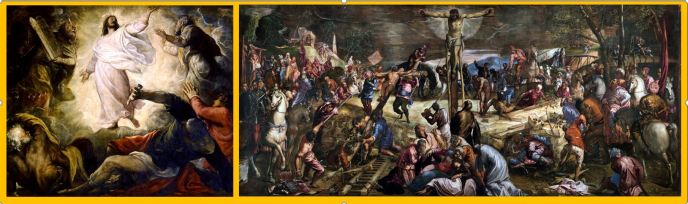
Jesus took Peter, James, and John his brother, and led them up a high mountain by themselves. And he was transfigured before them; his face shone like the sun and his clothes became white as light. And behold, Moses and Elijah appeared to them, conversing with him. Then Peter said to Jesus in reply, “Lord, it is good that we are here. If you wish, I will make three tents here, one for you, one for Moses, and one for Elijah. “While he was still speaking, behold, a bright cloud cast a shadow over them, then from the cloud came a voice that said, “This is my beloved Son, with whom I am well pleased; listen to him.” When the disciples heard this, they fell prostrate and were very much afraid. But Jesus came and touched them, saying, “Rise, and do not be afraid.” And when the disciples raised their eyes, they saw no one else but Jesus alone. As they were coming down from the mountain, Jesus charged them, “Do not tell the vision to anyone
until the Son of Man has been raised from the dead.”

 Meditation Reflection:

It requires little effort to encounter Jesus in His humbled, human form.  Belief in His human existence doesn’t require faith, since the historical evidence regarding His time on earth exceeds that of other great figures of history.  The wisdom of His teachings resonates with Christians, Muslims, Buddhists, and secular persons alike.  Thus, to view Jesus as a great Teacher doesn’t equate to faith per se either, but merely to good education. Limiting Christ to His human form, His own people had no qualms about making Him famous one day, shouting “Hosanna in the highest!”, and killing Him the next, shouting “Crucify Him!”.

Discipleship requires encountering Christ as He truly is – both human and divine; a great teacher, and God’s only Son sent as ransom for our sins.  To see Jesus’ divinity means strenuous effort to move beyond easy earthly worldviews and comforts.  Christ’s divinity and His redemptive love add a supernatural dimension to reality which impacts our decision making. Why turn the other cheek if justice can only be meted out on earth?  Why forsake wealth, travel, status, or pleasures if “you only live once” and this life is it? God works in surprising ways. He calls us to follow Him and to do things we cannot do on our own.   Discipleship requires faith, because it requires decisions that necessitate grace being real, and the Cross being the path to Resurrection.

Jesus took Peter, James, and John up the high mountain.  If invited to climb a high mountain (without the reason even being stated), how many of us would choose to relax at the bottom instead.  Looking up we might say, “I bet the view is beautiful, but it’s too much work.”  Peter, James, and John could not have anticipated what they saw that day.  They embarked on an arduous hike for the simple reason that Christ brought them.  Although easy to imagine as we read it in Scripture, consider the inertia you feel when trying to make time for exercise in the day, or how many excuses and competing priorities crowd out taking time aside for prayer.

These three wanted to be great in Christ’s kingdom.  Climbing the mountain of the Transfiguration, Jesus revealed that greatness meant trust in His Person.  He didn’t make a case to them as to why they should climb, nor did He make any promises about what they would get out of it.  They followed because He took them, and they trusted Him.

True to His character, God gave super-abundantly.  Peter, James, and John witnessed a magnificent sight.  They saw Jesus in His glorified form, His divine nature radiating through His human nature.  They saw Moses and Elijah conversing with Him, and so fulfillment of some of the greatest promises of the Old Covenant. Aware of the presence of God as His voice spoke from the heavens, they fell prostrate on the ground, overwhelmed and unworthy of such a profound gift.

Peter, James, and John did indeed become great in Christ’s kingdom.  Christ made Peter the head of His Church and the first pope.  James became the bishop of the Christian community in Jerusalem.  John, the beloved disciple and the contemplative theologian, received Mary into his home after Jesus’ death, wrote the intensely deep 4th Gospel, three letters included in Scripture, and the book of Revelation.

Their discipleship developed gradually however.  They believed they had found the Messiah when they first encountered Christ and left their possessions and careers to follow Him at His request. Inspired by the Holy Spirit, and having witnessed innumerable miracles, they came to believe He was the only begotten Son of God. Despite all of this however, the last, and hardest belief would be accepting that His messianic kingdom could only come through the Cross.  Whenever Jesus prophesied that He would be rejected, suffer, and die by crucifixion, the disciples vigorously protested.  They could not conceive any way in which that would make sense – naturally or super-naturally.

Jesus had compassion on their weakness.  He brought them up the high mountain and gave them a glimpse of His divine power, so that during the horrific events of His arrest, scourging, crowning of thorns, carrying the cross, and crucifixion, they would not lose faith.

Each person’s spiritual journey, though unique to the individual, at the same time follows a similar pattern.  Discipleship begins with an invitation from Christ.  To follow Him, we must leave some things behind to attain greater things ahead.  To move further, we must develop the conviction that Jesus is truly our Savior. Having begun the work of following Him, we start to witness His miracles, experience wonder at His teachings, and zeal begins to grow.  The most difficult test to discipleship however, remains the cross.  We might praise Jesus for dying for us, but when we must face the cross in our own lives we easily falter.  Jesus sometimes strengthens us with “Transfiguration moments” prior to these tests.  It might be consolation in prayer, blessings in our daily lives, heightened sight of His grace at work, or interior touches of His love in our soul.  Before great crosses, Jesus strengthens our faith, so that when His divinity is utterly hidden, we can recollect the times we saw it unveiled and persevere in trust.

Consider:

  • When have you felt the call of Christ? What have you left behind to pursue Him? How has it exceeded your expectations?
  • What would you consider your “Transfiguration” moment(s)? When have you been moved in awe by Christ’s divinity?
  • When has your faith been tested? When have you found it most hard to trust Christ? How do those transfiguration moments strengthen your faith in Him?

Make a Resolution (Practical Application):

  • At the end of each day this week, write down at least one time you “saw” Christ that day.
  • Pray the serenity-and-suscipe-prayers each day.

~ Written by Angela Lambert © 2017

* To receive these weekly posts automatically in your email just click the “follow” tab in the bottom right hand corner and enter your email address.


Determined Discipleship

by Angela Lambert

(c) National Galleries of Scotland; Supplied by The Public Catalogue Foundation

March 5th, 2017; 9th First Sunday of Lent

Gospel Matthew 4:1-11

At that time Jesus was led by the Spirit into the desert to be tempted by the devil. He fasted for forty days and forty nights, and afterwards he was hungry. The tempter approached and said to him, “If you are the Son of God, command that these stones become loaves of bread.” He said in reply, “It is written: One does not live on bread alone, but on every word that comes forth from the mouth of God.” Then the devil took him to the holy city, and made him stand on the parapet of the temple, and said to him, “If you are the Son of God, throw yourself down. For it is written: He will command his angels concerning you and with their hands they will support you, lest you dash your foot against a stone.” Jesus answered him, “Again it is written, You shall not put the Lord, your God, to the test.” Then the devil took him up to a very high mountain, and showed him all the kingdoms of the world in their magnificence, and he said to him, “All these I shall give to you, if you will prostrate yourself and worship me.” At this, Jesus said to him, “Get away, Satan! It is written: The Lord, your God, shall you worship and him alone shall you serve.” Then the devil left him and, behold, angels came and ministered to him.

Meditation Reflection:

Before Jesus began His public ministry, He went into the desert to pray and fast for forty days. Spending time in the desert meant leaving comforts, distractions, and entertainment, and being alone in solitude.  This may sound appealing, especially if you have a demanding job or little kids.  Yet, when we do make time to be alone in the silence, it can be uncomfortable and disconcerting.  We must face ourselves, the inner thoughts we have been pushing to the side, fears, insecurities, doubts, ambitions, and vanities.  The biggest battle most of us will face, is with ourselves and the enemy loves to bite at our heels as we do.  Thus, Jesus prepares for His ministry by enduring all the temptations you and I experience, and overcoming them.

Satan first tempts Christ with bread.  He waited until Jesus was at the end of His fast when He would be tired, hungry, and physically weak.  Similarly, the devil tries to exacerbate our problems when we are worn out and vulnerable.  How many of us have failed to pray in the morning because we didn’t want to give up the comfort of sleep? When have you missed Mass because it would be an inconvenience or it was cold outside?  Are there times when putting your feet up, having a beer or glass of wine, and watching tv took precedence over interacting with your spouse or kids at the end of a long work day (especially when kids require discipline or help with homework)? How many opportunities do we miss because we would rather stay in our comfort zone?  Unless we overcome our own slothful inertia, we cannot be strong enough to be the salt of the earth that Jesus needs from His disciples.

After overcoming our desires for pleasure and comfort, the next hurdle is fame and ambition.  Satan loves to stroke our ego and promote the lie that the measure of our worth is measured by our success.  Yet, our Lord chose a life of humility and rejected some of the apostles’ notions that His kingdom would bring them worldly notoriety.  God works the most through the small and the weak.  St. Paul even states that in our weakness God’s power is brought to perfection (I Corinthians 2:12). Until we curb our own ambitions, we won’t be free to work for God’s ambitions.

Finally, the ultimate stumbling block of the Christian faith, is suffering.  Satan’s third temptation offered Jesus the kingdom without the Cross;  a short cut around humiliation and struggle.  Whether it’s discipleship, marriage, family, or work, many people give up when things get hard.  Our culture of instant gratification further softens our resolve, along with the false expectation that we should always be happy.

Christ endured and overcame every temptation, that we might be strengthened to do the same.  Jesus unites Himself to us in our struggle and imbues us with His divine grace.

During Lent, we step away into the desert so that we might encounter the truth about ourselves.  We struggle against our own will through acts of fasting and self-denial.  We battle our greed and self-centeredness through works of charity and alms-giving.  We increase our prayer, and contemplate the mystery of Christ’s suffering, death, and resurrection, to deepen our love for our savior and to more closely follow Him.

Don’t be discouraged if you have already cheated on your Lenten sacrifice.  Self-knowledge is the beginning of conversion and develops humility.  Each day, we must pick up our cross, and as our awareness of our own weakness intensifies, our awareness of our need for Christ will also intensify. Whether you give something up or do something extra (or both), choose something that will touch the temptation you find most difficult – comfort, notoriety, or happiness at the expense of Christian fidelity.  Discipleship is difficult, and even the apostles’ conversions took time, so be patient.  Moved by love however, they eventually stopped trying to change Christ, and instead accepted Christ.  If we take time for Him, our love for Him will deepen, and we too will be more conformed to our Lord, and able to joyfully celebrate His final victory at the Resurrection on Easter.

Consider:

  • Which comforts or pleasures tempt you the most? Sleep, soda, alcohol, television, food, desserts, gossip, sports, music, movies?
  • What do you want others to notice about you most? What do you take the most pride in?  Do you feel small or unimportant if your work isn’t acknowledged or honored by others?
  • How do you avoid suffering? Do you avoid conflict with your spouse or kids?  Do you take short cuts at work?  Do you try to get ahead by putting others down or by neglecting your duties toward God or family?
  • Consider past Lents. How has God strengthened you?  How have you grown as a Christian?
  • Invite Christ into this Lent. Be docile to the Holy Spirit and ask Him to strengthen an area of your faith life.

Make a Resolution (Practical Application):

  • Each morning, begin with the prayer by St. Francis de Sales:

My God, I give you this day. I offer you, now, all of the good that I shall do and I promise to accept, for love of you, all of the difficulty that I shall meet. Help me to conduct myself during this day in a manner pleasing to you. Amen.

~ Written by Angela Lambert © 2017

* To receive these weekly posts automatically in your email just click the “follow” tab in the bottom right hand corner and enter your email address.


Lighting the Path and Seasoning the Journey…Because Blending in is Bland

by Angela Lambert


20160321_200727310_ios

February 5th, 2017; Fifth Sunday of Ordinary Time

Gospel Matthew 5:13-16

Jesus said to his disciples: “You are the salt of the earth. But if salt loses its taste, with what can it be seasoned? It is no longer good for anything but to be thrown out and trampled underfoot. You are the light of the world. A city set on a mountain cannot be hidden. Nor do they light a lamp and then put it under a bushel basket; it is set on a lampstand, where it gives light to all in the house. Just so, your light must shine before others, that they may see your good deeds and glorify your heavenly Father.”

Meditation Reflection:

People often complain that they need to see something to believe it.  Although faith requires going beyond sight, the seeds of faith can be planted through allowing others to see for themselves the work of Christ in our lives.  Authentic, Christian discipleship causes deep transformation.  This supernatural change witnesses in an evidentiary way, the reality of the Holy Spirit and the life of grace.

The first converts to Christianity were moved by the way Christians lived differently than everyone else.  In a callous, hedonistic culture, Christians treated one another with love and respect.  Christian men and women treated each other with kindness, dignity, and fidelity.  Slaves were considered brothers and sisters in Christ.  Martyrs sacrificed everything, joyfully, in witness to their belief in the resurrection.  The way martyrs faced their death so peacefully and courageously, converted many onlookers who could see plainly that the dying Christians were acting with a strength and calm that exceeded the limits of human nature.  Tertullian famously articulated this phenomenon saying, “The blood of the martyrs, is the seed of the Church” (197 A.D.).

As modern Christians, our lives ought to witness the reality of grace as well, by following Christ beyond our comfort zone.  Sometimes we can make our faith life a little too neat and tidy.  We make Sunday Mass a casual commitment, and parish fellowship a comfortable social club.  We might look to faith for comfort, but we don’t expect the impossible from God, and we ask that He not expect the impossible of us.

Although this sounds like a reasonable relationship, it doesn’t do much to reveal the life of grace or of the reality of God’s supernatural love and aid.  After teaching the Beatitudes, the heart of the New Law, Jesus followed up with this analogy to salt and light.  The journey of faith, though very personal, also has an evangelistic element; it’s a gift we both receive and give in return.  Christ urges us to follow the path of the Beatitudes to its end.  He’s honest that authentic discipleship will not blend in.  Simply living the Christian faith, is a witness to truths that others try to avoid, and can result in numerous pressures from others to be quiet.   Those pressures come in many forms – accusations of being overly zealous, judgmental, intolerant, or making one’ private faith public.  Secular culture continues to find ways to diminish the witness of faith and put a bushel basket over the light by re-defining religion as personal sentiment, and forbidding it to bear external fruit unless that fruit can be limited to, and labeled, secular humanitarianism.

At the same time, although Christ was persecuted by some, He was sought out by many others.  Jesus promised, “If you continue in My word, you are truly My disciples, and you will know the truth, and the truth will make you free” (John 8:31-32).   Blending in cannot transform us, and it cannot transform society.  Rather, discipleship can make us free and add freedom to our culture.  St. Paul told the Galatians, that the fruits of the Spirit are not of this world.  By drawing near to God in prayer, the Spirit bears fruits within Christians of divine love, joy, peace, patience, kindness, goodness, faithfulness, gentleness, and self-control (Galatians 5:22-23).  The world needs these fruits and hungers for them.  If we keep our faith in a box that we only take out on Sundays or Christmas, we put a bushel over the light of Christ and make it impotent, leaving the world to suffer rather than to offer it hope.

I love Jesus’ analogy to salt.  I love salt.  It’s so basic, but it makes everything taste so wonderful.  Our faith is the salt that makes life seasoned and enjoyable.  If we offer the world a bland form of our faith, what is the point?  We wouldn’t make anyone feel uncomfortable, but we would also deny them the chance to taste something remarkable.

Jesus is “the Way, the Truth, and the Life.”  He teaches us the path to follow and provides the necessary grace needed to make the journey.  When we live in relationship with Him, our life can’t help but radiate His peace, love, and wisdom.  If we can have the courage to follow Christ beyond our comfort zone, Christ promises that we can be a light for others to shine the truth they need to be free, and we can be the salt that seasons their life with His joy.

Consider:

  • What do you find comfortable about your Christian faith?  What’s easy or natural for you?
  • What do you find uncomfortable? What teachings seem “too much”?  In which areas of your life, or among which people, do you try to downplay your faith?
  • How might you live your faith more deeply or more authentically?
  • Reflect on the effect of salt and light. Fast from salt for a day and consider the difference without it.  Try functioning with only the aid of natural light rather than light bulbs.  How does it limit your work and your experience?
  • Consider each aspect of your day – home, work, activities, etc. Reflect on how you can live your faith in each place.

Make a Resolution (Practical Application):

  • At the beginning of each transition in your day, begin with a prayer for Christ to teach you, and help you, live as His disciple in that part of your life.
    • The prayer can be a spontaneous prayer of your own words, or a written prayer you recite at each transition. Ideas: Our Father, Glory Be, Hail Mary, Memorare, a verse from a Psalm, a prayer to the Holy Spirit, the Disciple prayer by Cardinal Newman, etc.  (I personally like the prayer of St. Thomas Aquinas: “Grant O Merciful God, that I may ardently desire, prudently examine, truthfully acknowledge, and perfectly accomplish, what is pleasing to Thee, for the praise and glory of Thy Name.)

Additional Links:

The Beatitudes: Climbing the Mountain of God by Way of the Valley of Humility

~ Written by Angela Lambert © 2017

* To receive these weekly posts automatically in your email just click the “follow” tab in the bottom right hand corner and enter your email address.


The Beatitudes: Climbing the Mountain of God by Way of the Valley of Humility

by Angela Lambert
Credit for picture to: zastavki.com/pictures/originals/2014/Nature_Multicolored_valleys_and_mountains_080436_.jpg

Credit for picture: zastavki.com/pictures/originals/2014/Nature_Multicolored_valleys_and_mountains_080436_.jpg

January 29th, 2017; 4th Sunday of Ordinary Time

Gospel of Matthew 5:1-12a NAB

When Jesus saw the crowds, he went up the mountain, and after he had sat down, his disciples came to him. He began to teach them, saying: “Blessed are the poor in spirit, for theirs is the kingdom of heaven. Blessed are they who mourn, for they will be comforted. Blessed are the meek, for they will inherit the land. Blessed are they who hunger and thirst for righteousness, for they will be satisfied. Blessed are the merciful, for they will be shown mercy. Blessed are the clean of heart, for they will see God. Blessed are the peacemakers, for they will be called children of God. Blessed are they who are persecuted for the sake of righteousness, for theirs is the kingdom of heaven. Blessed are you when they insult you and persecute you and utter every kind of evil against you falsely because of me. Rejoice and be glad, for your reward will be great in heaven.”

Meditation Reflection:

Mountains make us think of God.  Their height, their beauty, and their majesty inspire a sense of our smallness, and of God’s greatness. Moses ascended Mt. Sinai to encounter God. He prayed and fasted for 40 days and nights, during which God spoke to Him “face to face, just as a man speaks to his friend” (Exodus 33:11).  To form His People in wisdom, justice, and peace, God gave to Moses the Law, written by God’s own hand.

When the Lord had finished speaking with Moses on Mount Sinai, He gave Moses the two tablets of the testimony, tablets of stone, written by the finger of God.” Exodus 31:18

After this encounter, Moses’ face radiated such glory that Aaron and the other Israelites feared being near to him; so much so that Moses had to wear a veil when in their presence (Ex 34:29-34).

Moses’ relationship with God, the immediacy of God’s interaction with him, was unparalleled.  At the end of Moses’ life, he prophesied that God would one day send a New Moses. “I will raise up for them a prophet like you from among their brothers. And I will put my words in his mouth, and he shall speak to them all that I command him.” (Deuteronomy 18:15-19)

Jesus ascended the Mount as the New Moses.  The immediacy of God’s word became even more immanent as the Word made Flesh spoke to the people.  Christ affirmed the Law given to Moses, but he further extended it to its full intent by God.  Through Moses, God had liberated the Jews form physical slavery and reformed their actions through the wisdom of the 10 Commandments.  Christ now extended the call to conversion to our interior intentions and desires.  As He set about the task of liberating us from slavery to sin and establishing the eternal Kingdom of God, the Beatitudes mark the fullness of God’s rule for His People – one of authentic love for God and one another.

St. Therese of Lisieux asserted that we ascend the mountain of God, by way of descending the valley of humility.  The Beatitudes, the heart of the New Law, express this paradox, building on one another in a beautiful way, as they signify the progression of the spiritual life.  The first three commandments in the Old Law began by establishing proper relationship with God – worshipping Him alone, with reverence, and every Sabbath.  In the New Law, Christ begins by affirming the interior disposition needed to make this fruitful – poverty of spirit.  The poor recognize their neediness and dependency.  The poor in spirit surrender the illusion of self-sufficiency and accept their dependence on God.

How often have we experienced the frustration of wanting to help someone but they refused to be receptive to our advice or our aid?  Common obstacles to accepting dependence on God stem from a desire for security located in things we think we can control – such as wealth, career, relationships, status, self-help, etc. If we cling to a desire to redeem ourselves, we will resist the mercy of our only Redeemer.  The poor in spirit have hit rock bottom.  Regardless of their wealth or accomplishments, they are keenly aware that only God can heal their wounds, release them from self-destructive addictions or thoughts, and provide them with security which isn’t dependent on the market, the weather, or even their employer.

Once a person looks to God, who is full of mercy, whose Son demonstrated His sacrificial love, they are moved to sorrow.  This sorrow wells up from an honest view of themselves and their sins – free of the rationalizations and false beliefs they had clung to in the past.  They see now that their sinful choices, rather than liberating, were in fact petty at best, and disloyal to their greatest defender at worst.  There’s nothing worse than feeling like you have failed a friend who has been there for you, or worse, betraying them despite their faithfulness through your hardest times.  When a person faces themselves however, rather than the harsh judgment they fear, they experience the warm, merciful, comfort of their Savior.

Having shed false pretentions about oneself, a person develops a beautiful authenticity which is characterized by meekness.  Meekness is not weakness.  Meekness means a person has greater compassion and patience toward others because they know that “but for the grace of God, there go I.”  In consequence, surrender to God, gratitude for His mercy and comfort, and humble authenticity, causes one to bear much more fruit in their life and work.

As gratitude for God’s love, and experiential knowledge of the wisdom of His ways increases, a person begins to hunger and thirst for righteousness.  They desire even greater freedom and deeper joy, which they know with deep conviction, can only be found in Christ.  This is a prayer to which God always says yes.

The joy of freedom in Christ’s love creates so much gratitude that it spills over in a person’s heart and they can’t help wanting to give back to Christ the kindness He has shown to them.  Thus, they show mercy to others because they empathize with the struggle of sin and desire to follow the example of Christ who has shown them mercy in their weakness.

Union with Christ in the Beatific Vision is the essence of Heaven.  Thus, those that have forsaken all for Him, whose heart is pure, begin to experience a taste of the vision of God. Reconciled to God through His son, they extend this peace to others as it radiates from their own interior peace from union with the Lord.

Finally, the more perfect a union one has with Christ, the more others will treat that person the same way they would of Him.  Jesus warned His apostles that those of the world who persecute Him, will persecute them. And those that love Him, will love them (John 15:18-25).  Thus, Christ ends the Beatitudes with the summation of the spiritual life – when one is persecuted because Christ, they ought to rejoice, because it means they are finally living in union with Him and following in His example.  In a sense, it’s confirmation that one is conformed to Christ.  Others wouldn’t bother with you if you were worldly enough to leave their consciences undisturbed.

Jesus provides the Way by teaching us the Beatitudes and showing us how to follow them by His example.  Moreover, He provides the supernatural grace, virtues, and love we need to live such a profoundly spiritual life.  The world offers countless distractions to discourage us from introspection, and our own pride can further resist taking an honest look inside our hearts.  Christ exhorts us to bravely journey within, promising to accompany us and to conform what we find to His own perfect love.

Consider:

  • Have you ever seen a mountain up close or hiked up one?  How did it affect your perspective?
  • Consider the immanence of God – His revelation to Moses and His revelation through Christ. In what way does His closeness make you somewhat afraid, like the Israelites?  In what way, does it comfort or strengthen you to have Him so near?
  • God continues to dwell with us in an immanent way in the Eucharist. Consider how it has pleased God in every age, to draw near to us.  In what ways, do you appreciate His gift?  In what ways, do you sometimes take it for granted?  How might you increase your appreciation?
  • Consider the spiritual journey laid out by the beatitudes. How does your spiritual life correspond to some of the stages?
  • Which beatitude touches you the most? Is there one that sticks out to you as the most moving?
  • How has your love for God grown through the years as a response of gratitude for His grace at work in your soul. What do you know is His work and not your own?


Make a Resolution (Practical Application):

  • Reflect on one beatitude each day this week and try to live it out in an intentional way.


~ Written by Angela Lambert © 2017

* To receive these weekly posts automatically in your email just click the “follow” tab in the bottom right hand corner and enter your email address.


Christ’s Kingdom Come

by Angela Lambert

 Raphael,_The_Miraculous_Draught_of_Fishes_(1515)

January 22nd, 2017; Third Sunday of Ordinary Time

 Gospel Matthew 4:12-23 NA

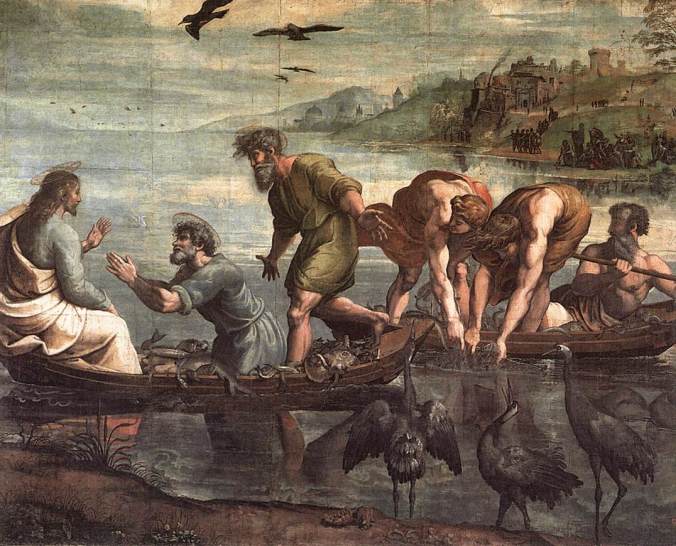
When Jesus heard that John had been arrested, he withdrew to Galilee. He left Nazareth and went to live in Capernaum by the sea, in the region of Zebulun and Naphtali, that what had been said through Isaiah the prophet might be fulfilled: Land of Zebulun and land of Naphtali, the way to the sea, beyond the Jordan, Galilee of the Gentiles, the people who sit in darkness have seen a great light, on those dwelling in a land overshadowed by death light has arisen. From that time on, Jesus began to preach and say, “Repent, for the kingdom of heaven is at hand.” As he was walking by the Sea of Galilee, he saw two brothers, Simon who is called Peter, and his brother Andrew, casting a net into the sea; they were fishermen. He said to them, “Come after me, and I will make you fishers of men.” At once they left their nets and followed him. He walked along from there and saw two other brothers, James, the son of Zebedee, and his brother John. They were in a boat, with their father Zebedee, mending their nets. He called them, and immediately they left their boat and their father and followed him. He went around all of Galilee, teaching in their synagogues, proclaiming the gospel of the kingdom, and curing every disease and illness among the people.

Meditation Reflection:

John the Baptist prepared the way for Christ by proclaiming His coming, and calling to conversion those awaiting a savior.  John’s extreme ascetic life, illuminated consciences to common attachments which hinder people from receiving the Lord.  His lonely, austere, desert living, provides a sharp contrast to our often-inordinate desire for luxury, status, and concern for keeping up with the Jones’.  His fast of locusts and honey, casts light onto our indulgence in food and drink; and his camel-hair clothing convicts our consciences of secret vanity.  Lastly, his rejection of fame and power set an example of true Christian discipleship.  He rejected the title of Messiah for himself and insistently pointed to Jesus as the Christ.  He spoke the truth to peasants, religious leaders, and even political leaders, despite the risk of arrest and even death.  When the Lord finally came, he gracefully stepped to the side, saying “He must increase, but I must decrease.” (Jn 3:30).

Matthew situates the beginning of Jesus’ ministry with the waning of John’s.  Jesus had been baptized and spent 40 days in the desert fasting, praying, and being tempted. John had just been arrested and Jesus, His preparation finished, now began His work.  He commences by preaching the same message as John, “Repent, for the kingdom is at hand.”  Only this time, the kingdom is not coming, but rather has come in the Person of Jesus Christ.

What is the kingdom of God?  Although its meaning has great depth and connections, put simply, it refers to God’s rule over our hearts and the peace of union with Him.  To accept the rule of God, we must first reject the rule of other monarchs.  Thus, repentance is a necessary first step, in which we acknowledge the sins and desires that we have allowed to rule us, and we ask for God to be our liberator.  The Lord’s kingdom is a monarchy, but one that governs free individuals.  The Lord does not annex land through force, but He does liberate people who are enslaved and, through the merits and mercy of His Son, grant them citizenship.  Moreover, this citizenship is more akin to being an adopted member of a loving family than a mere nation-state.

Imagine Christ’s joy as He could finally roll up His sleeves and begin preaching the Gospel, healing the wounded, and most importantly – forgiving sins.  Since the Fall of Adam and Eve, God had patiently waited for the time when we would be ready to receive Him and He could heal all our wounds and strengthen us with His grace.

Jesus goes to Galilee to begin gathering up God’s scattered and lost sheep.  The havoc of disunity caused by human sin, becomes undone through union in Christ.  He rebuilds God’s people by building His Church.  He first calls two sets of brothers who have spent their days fishing, caring for their family, and awaiting the Messiah.  They, like Christ, obeyed the Lord in humble tasks of everyday life until He called them forth.  When asked to follow Him, they immediately left the security of their routines and their community, to say Yes to the Lord and His will.

We can learn from this encounter how to prepare for, and respond to, the coming of the kingdom of God in our own lives.  We can begin by answering the call of John the Baptist to repent.  We can ask the Holy Spirit to reveal to us our sins and our blind spots.  I can say from experience, He will.  Next, we watch and wait.  We live our daily lives open and receptive to God’s will.  St. Thomas taught that “grace builds on nature.”  This means that being a Christian doesn’t make us less ourselves and just robots following commands.  Rather, grace makes us the best version of ourselves.  It actually makes us more ourselves and raises our natural state in life to a super-natural level.  Peter, Andrew, James, and John were all fisherman.  In the kingdom of God, they become fishers of men.

The apostles model Christian discipleship, which is simply receptivity to the Lord in our daily lives.  It means saying “yes”, and following wherever He leads. True peace, justice, and happiness come through Christ alone.  Only He can free us from our worst enemy – our own sins, fears, weakness, and pride.  Only He can provide security.  When we experience the gift of being His disciples, we will understand John the Baptist’s passionate zeal for pointing others to the Lord as well.

Following Christ can look very ordinary on some days, and on others it can completely surprise you.  Whatever might be holding you back when Christ says to you, “Come and see,” let it go.  Drop your nets and set out after Him.

Consider:

  • Ask the Lord for a spirit of repentance.  Invite the Holy Spirit to show you what, or who, comes between you and God.
  • Reflect on the Christ’s call “Come Follow Me.”
  • How has God called you to be faithful in your everyday life? In your family, at your job, in your community?
  • How has grace “built” on your nature. How has encountering Christ made you a better version of yourself?  Where might Christ still want to work in your life?
  • Christ cured “EVERY disease and illness”. There is nothing He can’t conquer for His kingdom. What plagues you? Pray for healing in accord with His will.
  • Spend a few moments in joy, expressing gratitude for the freedom you have found in Christ’s love.

Make a Resolution (Practical Application):

  • Begin each day this week by saying, “Yes Lord, I will follow You.”  Repeat it throughout the day and in every circumstance.


~ Written by Angela Lambert © 2017

* To receive these weekly posts automatically in your email just click the “follow” tab in the bottom right hand corner and enter your email address.