Watch & Wait, Look & See

by Angela Lambert

20160815_171506644_ios

January 15th, 2017; Second Sunday of Ordinary Time

Gospel John 1:29-34 NAB

John the Baptist saw Jesus coming toward him and said, “Behold, the Lamb of God, who takes away the sin of the world. He is the one of whom I said, ‘A man is coming after me who ranks ahead of me because he existed before me.’ I did not know him, but the reason why I came baptizing with water was that he might be made known to Israel.” John testified further, saying, “I saw the Spirit come down like a dove from heaven and remain upon him. I did not know him, but the one who sent me to baptize with water told me, ‘On whomever you see the Spirit come down and remain, he is the one who will baptize with the Holy Spirit.’ Now I have seen and testified that he is the Son of God.”

Meditation Reflection:

How did John recognize Jesus as his Savior?  He prayed, waited, and listened.

Accustomed to instant gratification and the fast pace of life, together with a heavily marketed atmosphere, we can easily develop a tendency to expect Christ to sell Himself to us and to make His pitch with immediate persuasion. Whether we question God’s existence, His nearness, or His willingness to help us, we often complain that God is silent or distant.  Yet, we have to honestly ask ourselves, have we even asked God for His help?  Have we waited on the Lord, or are we expecting an immediate result?  Have we been receptive to the Lord’s prompting, or do we attempt to lead God, deaf to His guidance?

John the Baptist sought the Lord, venturing into the desert where he could encounter God away from the distractions of everyday life.  He waited on God, fully expecting an answer by spending his time preparing through preaching repentance and baptizing.    When the Savior came at last, John could receive Him and recognize Him as Lord because he was looking and listening.

It reminds me a little of family road trips.  The kid engrossed in his iPhone or tablet misses extraordinary sights, or at the very least, out of the ordinary landscapes.  The person vigilantly watching out the window however, can take in the beauty, appreciate the landscape, and spot the surprise spectacles.  By the time he has shouted “look!” and the distracted child responds, the sight has passed. Moreover, at the end of the journey, the one focused on the tablet retains the same vision of the world as when he left home, whereas the one who looked out the window broadened his vision and experience.

If we feel like God is distant, we need simply to look out the window and reach out to Him in prayer.  If we require His help, we need only to ask and listen.  When we look for the Savior, we find Him.  God does His part, and more.  We need to make the effort to look up from our commonplace experience and distractions and seek Him.

Psalm 40 begins by singing, “I have waited, waited for the LORD, and he stooped toward me and heard my cry.”  What a beautiful expression.  God has seen our suffering and heard our pleas.  He stooped to become man and dwell among us, personally healing and strengthening us.  When a person experiences the saving love of Christ, they cannot resist proclaiming it to others.  Like the child shouting “look!”, they instinctively cry out “look!” as well; or as John proclaimed, “Behold! The Lamb of God”.

Everyone seeks happiness, security, and love.  We can search for all these things online, in our careers, or the economy, but only Christ can deliver on His promises.  Archbishop Fulton Sheen described John the Baptist as “no frivolous reed shaken by every breath of popular applause.”  When we seek approval from others or from cultural standards, we become weak like a reed.  We sway at every idea, comment, or attack and easily break. Firmness of character and security of happiness can be found in Jesus Christ alone, who can provide peace and rewards of a supernatural level.  It is the Lord, who provides Faith, Hope, and Love.  It is His Holy Spirit who infuses us with His sevenfold gifts of Wisdom, Understanding, Counsel, Knowledge, Piety, Fortitude, and Fear of the Lord.  If we desire the Spirit’s fruits of love, joy, peace, patience, kindness, goodness, faithfulness, and self-control, we need merely to invite the Lord into our soul to dwell, and be receptive to the transformation He effects.

At the same time, to realize our need for a Savior, we must also acknowledge the reality of our sinfulness.  The first step to seeking the Lord is to grapple with our need for Him and our own insufficiency.  Sheen pointed out that, “Skepticism is never certain of itself, being less a firm intellectual position than a pose to justify bad behavior.”  Some who seem to seek God, actually hide behind their questions in order to avoid moral change.  Those who see the ugliness of their own sin look out the window, and run to the water to be cleansed.  They recognize the savior because they receive His grace and enjoy the beauty of His restoration.    They can proclaim with John, “Now I have seen, and testify that He is the Son of God.”  If you want to find out for yourself, respond to Christ’s invitation to “come and see” (Jn 1:39).  You might just see something incredible!

Consider:

  • Where can you go to encounter the Lord?
    • In a quiet place in your home for prayer? At Church or Eucharistic adoration?  In the Scriptures? In reading about the lives of the saints?  In visiting with a prayerful friend?  Taking time for prayer retreats? By listening to Christian radio in the car.
  • How do you sometimes approach the road trip of life more like the child distracted by a tablet, rather than the child looking out the window?
  • If you were to go out to the desert to see John the Baptist, what do you imagine it would be like? Would you want to receive the baptism of repentance?  For what would he call you to change in your life?
  • When has Christ “stooped toward you and heard your cry?” Did it fill you with peace and joy? Did you want to tell others?

Make a Resolution (Practical Application):

  • Watch, wait, and listen to the Lord this week by setting aside 5 minutes each day to seek Him out in prayer, Scripture, or even Christian radio.


~ Written by Angela Lambert © 2017

* To receive these weekly posts automatically in your email just click the “follow” tab in the bottom right hand corner and enter your email address.


The Universal Search For God

by Angela Lambert

magi

January 8th, 2017 Feast of the Epiphany

Gospel Matthew 2:1-12 NAB

When Jesus was born in Bethlehem of Judea, in the days of King Herod, behold, magi from the east arrived in Jerusalem, saying, “Where is the newborn king of the Jews? We saw his star at its rising and have come to do him homage.” When King Herod heard this, he was greatly troubled, and all Jerusalem with him. Assembling all the chief priests and the scribes of the people, He inquired of them where the Christ was to be born. They said to him, “In Bethlehem of Judea, for thus it has been written through the prophet: And you, Bethlehem, land of Judah, are by no means least among the rulers of Judah; since from you shall come a ruler, who is to shepherd my people Israel.” Then Herod called the magi secretly and ascertained from them the time of the star’s appearance. He sent them to Bethlehem and said, “Go and search diligently for the child. When you have found him, bring me word, that I too may go and do him homage.” After their audience with the king they set out. And behold, the star that they had seen at its rising preceded them, until it came and stopped over the place where the child was. They were overjoyed at seeing the star, and on entering the house they saw the child with Mary his mother. They prostrated themselves and did him homage. Then they opened their treasures and offered him gifts of gold, frankincense, and myrrh. And having been warned in a dream not to return to Herod, they departed for their country by another way.

Meditation Reflection:

Epiphany means “the manifestation of the divine.”  God manifested the Savior to the world, from the poor Jewish shepherds, to the wise Magi from the East. All human persons seek God, whether they call their search one for the divine or not.  It may begin as movement toward God’s Goodness through the conscience, toward His Truth through the pursuit of wisdom, or toward His Beauty through captivation by His creation or art.

Even those who attempt to deny the search, witness to its inherent reality in our nature. Those who develop a direct antagonism for religion expressed in a defiant atheism, reveal that they have grappled with the search, evidenced by their conclusion.  In addition, true atheism expresses a negative despair, rather than a fulfillment of life or joy.  If God’s nonexistence were true, shouldn’t it satiate our nature rather than leaving us feeling depressed?  If we are merely animals, shouldn’t we be content with food, security, and a nap?  And yet we are not.   On the other hand, those who seemingly ignore the search due to idling in the superficial pleasures of the world, also reveal something of the human person’s natural inclination toward God.  If a child shirked healthy food and exercise in favor of foods that pleasure the palette and sedentary entertainment, his body’s natural development would be harmed, evidenced by less development than normal and increased sickness.  Similarly, those who neglect the healthy development of the soul suffer similar emotional and spiritual disfigurement as well.

The birth of Christ fulfilled the desire of all humankind.  God created us with the capacity for love, destined for eternal life, and union with the divine.  The Jews tasted this through His revelation in the Old Covenant and His many signs and miracles.  The Gentiles also sensed this through their observations of creation and philosophy. As a result, the Jewish shepherds learned of Christ’s birth by the appearance of angels, and the magi from the East learned of Him through sighting a new star.  Although the journey may begin in different places and a person may traverse by different means, nevertheless, all converge on Christ.

In addition to the universal search for God, humankind evidences a universal desire for redemption.  We sense the eternal law in our conscience, as well as the pang of guilt for transgressing that law so many times and the feeling of helplessness to be able to perfect ourselves. For instance, we look to psychology, television, news, science, and nutrition, to discover the explanation as to why we do what we know we should not do.  After finding an explanation we seek the cure – again through self-help guides or better diet.  And yet we continue to feel guilt and unrest.  We continue in behaviors we know are self-destructive and negative.  We need a savior.

False gods and false prophets always promised cures in return for some kind of personal gain, promising quick cures that always came up short.  Similar to marketing scams , they do more to manipulate the person’s wound rather than heal it.  Christ proves the opposite of the false gods and demonstrates His authenticity by rejecting anything worldly we might offer.  He came poor and died poor.  He lived a hidden life for thirty years and avoided vainglory by never staying too long in one place during His public ministry and often commanding those He healed to tell no one.  Rather than lengthen His life, it was shortened.  He proved on the Cross that He did not come to take from us, but to give selflessly and unconditionally to us.

Jesus is the Savior we yearn for and there is no gimmick.  He did not come to manipulate, He did not offer false hopes or promises.  He is the Way, the Truth, and the Life, who offers pure, loving, relationship.  He alone satiates our search and nourishes our development.  The magi searched for God and found Him.  Jesus promises us as well, that all who seek Him shall find Him.  Hopefully we, like the Magi, can have the courage to venture out in search of the Lord.  Contemplating this mystery, Archbishop Fulton Sheen observed “No one who ever meets Christ with a good will returns the same way he came” (Life of Christ).

Consider:

  • Reflect on your journey to God.  What “pointed” you toward Him, like the star did for the Magi?
  • Has your search for God grown lax at times? How did your spiritual life atrophy afterward?
  • How might you reinvigorate your search for God? Could you increase your search through prayer, reading of Scripture, studying the faith, or fellowship with friends of faith?
  • Consider the gift of our savior. How has Christ freed and healed you?  What do you need Him to free you from, or heal you, of today?

Make a Resolution (Practical Application):

  • Choose one way to invigorate your search for Christ.
    • Ideas: Read a chapter of a Gospel each day; Read a book about Christ by an inspiring author, make time to visit with a Christian friend about the Lord, join a Bible study, read the lives of the saints and learn from their pursuit of Christ, talk with your family about Christ…


~ Written by Angela Lambert © 2017

* To receive these weekly posts automatically in your email just click the “follow” tab in the bottom right hand corner and enter your email address.


Mary’s Motherhood and Christian Discipleship

by Angela Lambert

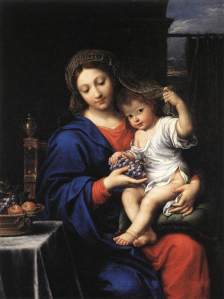
virgin-of-the-grapes

January 1st, 2017; Solemnity of the Blessed Virgin Mary, the Mother of God

Gospel Luke 2:16-21 NAB

The shepherds went in haste to Bethlehem and found Mary and Joseph, and the infant lying in the manger. When they saw this, they made known the message that had been told them about this child. All who heard it were amazed by what had been told them by the shepherds. And Mary kept all these things, reflecting on them in her heart. Then the shepherds returned, glorifying and praising God for all they had heard and seen, just as it had been told to them.
When eight days were completed for his circumcision, he was named Jesus, the name given him by the angel before he was conceived in the womb.

Meditation Reflection:

“Mary kept all these things, reflecting on them in her heart.”  When it comes to their children, mothers are contemplatives; they treasure and reflect on every little thing and never tire of gazing at their children in love.  I will never forget the first night I spent with my son in the hospital. The nurse urged me to sleep after an exhausting birth, but I couldn’t stop holding him and staring at him.  I was overcome with a love there is no vocabulary to describe, and in awe of this mystery beyond comprehension.  With each subsequent child, I experienced the same awe.  Moreover, rather than dividing my love, each child multiplied it by expanding my heart with love for each of them individually.

As Mary gazed with love on her child, she gazed not only on her son, but the Son of God.  Mary was the first person to contemplate the mystery that Jesus is both God and man, creator and savior, born to die that we might live.  She is the first to love Him with her whole heart and the only to have the privilege of loving Him with a mother’s heart.

When God the Son took on a human nature, He allowed Himself to become weak and vulnerable.  He experienced human development and the daily process of growth and maturation we all go through.  Mary and Joseph were not merely day care providers for Jesus.  They were the first disciples of Christ and lived their vocation as His family to the fullest.  As God, Jesus had all the divine attributes.  As man, He shared DNA with Mary, He adopted Mary and Joseph’s mannerisms, He received a formation within the context of His family.  Though He is both God and Man, Jesus is one Person.  As a result, since Mary is the mother of Jesus she is rightly called Mother of God.  This does not mean she is the origin of the Trinity.  However, we must remember that mothers are mothers of people, not merely bodies.  It would be strange to say that I am the mother of my son’s body but not the mother of my son the person.  In the same way, to bifurcate Mary’s motherhood as merely that of part of Jesus would be to bifurcate Jesus Himself.  Jesus is one Person, the Second Person of the Trinity, who, since the moment of His incarnation, is forever simultaneously both God and Man.

Mary revered our Lord as both.  She nurtured His human needs and she worshipped His divinity.  She, like Him, obeyed the Father in all things.  She was the first human to live fully God’s plan for all mankind – union with God of heart, mind, and will.  Moreover, she is the only human to love Him as her Son and to be loved by Him as His mother.

This deep, pure, motherly love of Mary extends to each one of us as well.  From the Cross, as Christ suffered and died for our redemption and rebirth, He entrusted Mary as mother to St. John.  In doing so, He gave all of us to her as her children.  In baptism, we are united to Christ as His Mystical Body.  In consequence, we are also united to Mary as our mystical Mother.  Rather than dividing her love, each person who accepts her as mother, multiplies her love and experiences the same tender attention she gives to each of her children.  Christ shares our nature, and He has also shared His Heavenly Father and His earthly Mother with us.  Through Christ we become adopted sons and daughters of God and cherished children of Mary.  Through Christ’s condescension to become our brother, He has invited us into His own family.

Mary is the mother of God because God became man.  Mothers never tire telling anyone who will listen about their children.  Moreover, mothers love their children simply for who they are, not merely what they do.  If we ask Mary, she will share with us about her Son and teach us how to love and follow Him for Who He is, and not merely what He can do for us.

“She is so full of love that no one who asks for her intercession is rejected, no matter how sinful he may be. The saints say that it has never been known since the world began that anyone had recourse to our Blessed Lady, with trust and perseverance, and was rejected.” St. Louis de Montfort

Consider:

  • How has meeting someone’s mother taught you something new about a person?
  • What do you cherish about your mother’s love?
  • If you are a parent, consider the mystery of your love for your children. Imagine Mary’s love for Jesus at each of the stages of growth your kids have experienced.
  • Adoptive parents repeatedly report that they love their adoptive kids as if they were theirs biologically. Consider Mary’s motherly love for you as her adoptive child, whom she loves as her very own.
  • Reflect on Christ’s love for Mary as His mother.
    • Consider the deep feelings of admiration and appreciation He has for her.
    • Reflect on their relationship and connection as mother and son.
    • Consider the comfort and strength He drew from her during His public ministry, knowing He had one person who understood His mission and supported Him no matter what.

Make a Resolution (Practical Application):

  • This week, read and reflect on the words of Mary in Scripture.
  • Ask Mary to be your mother and go to her each day with your needs. Ask her to tell you about Jesus and teach you how to follow Him.
  • Pray a decade of the rosary each day. Consider using the Scriptural rosary if you can.
    • (I have never prayed the rosary without experiencing some kind of grace. Mary always brings us to Jesus.)
    • Pope St. John Paul II said, “To pray the Rosary is to hand over our burdens to the merciful hearts of Christ and His mother.”


~ Written by Angela Lambert © 2017

* To receive these weekly posts automatically in your email just click the “follow” tab in the bottom right hand corner and enter your email address.


Looking for a Savior

by Angela Lambert


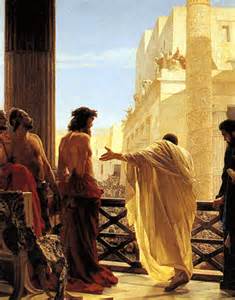
Jesus and Pilate

November 13th, 2016; 33rd Sunday in Ordinary Time

Gospel Luke 21:5-19

While some people were speaking about how the temple was adorned with costly stones and votive offerings, Jesus said, “All that you see here– the days will come when there will not be left a stone upon another stone that will not be thrown down.” Then they asked him, “Teacher, when will this happen? And what sign will there be when all these things are about to happen?” He answered, “See that you not be deceived, for many will come in my name, saying, ‘I am he,’ and ‘The time has come.’ Do not follow them! When you hear of wars and insurrections, do not be terrified; for such things must happen first, but it will not immediately be the end.” Then he said to them, “Nation will rise against nation, and kingdom against kingdom. There will be powerful earthquakes, famines, and plagues from place to place; and awesome sights and mighty signs will come from the sky. “Before all this happens, however, they will seize and persecute you, they will hand you over to the synagogues and to prisons, and they will have you led before kings and governors because of my name. It will lead to your giving testimony. Remember, you are not to prepare your defense beforehand, for I myself shall give you a wisdom in speaking that all your adversaries will be powerless to resist or refute.  You will even be handed over by parents, brothers, relatives, and friends, and they will put some of you to death.  You will be hated by all because of my name, but not a hair on your head will be destroyed. By your perseverance you will secure your lives.”

Meditation Reflection:

Oftentimes we imagine being a Christian means merely letting Jesus smooth out the rough edges of our lives to make it happier and more beautiful.  The Jews made this mistake by imagining that in fulfilling the law and the prophets the Messiah would simply restore the Davidic Kingdom to its former earthly glory.  To be fair, the Incarnation of the Son of God liberated us at an unimaginable level. God’s merciful love exceeds anything we have experienced or could expect.  He also exceeds all expectations of philosophy and the wisdom of the Greeks.  The Jews experienced a taste of God’s powerful action and the Greeks touched on the heights of God’s wisdom.  Jesus, the power and wisdom of God, makes both of these accessible to all and redirects our efforts toward an everlasting destination.

Christ counsels us to view this life as a pilgrimage and a battle.  We develop our faith, hope, and love, on earth which will bring a deep sense of joy but will never create an earthly utopia.  If we hope to find fullness here we will be sorely disappointed.  Just look at the reactions of the people to the current election.  Although presidents have a great deal of power, they are not omnipotent.  Moreover, their policies certainly affect our daily lives but the transformation of heart and development of culture is something only Christ can do through His grace and His followers.  Both candidates have significant flaws and neither are our savior.  The presidential election can never be the beginning of building a utopia or the end of the world, depending on your perspective.  Our reaction ought to be proportionate – working diligently for the common good within our democratic system but relying on Christ alone for the salvation of souls and the spiritual elevation of our country.  We can find relative happiness here, but for our joys to be lasting we need to direct them toward their true end – the heavenly kingdom.

Christ promises to equip us for both the physical and the mental battle.  As long as we live in the tension of sin and its effects, we will have to struggle against ourselves and others who oppose Christ’s kingdom, even family and friends.  Nevertheless, Jesus, the Wisdom of God, provides the supernatural insights to answer the world’s mistaken propaganda or the pressures applied by those we care about.  He also strengthens His disciples with supernatural perseverance to endure the physical suffering or possible martyrdom inflicted by worldly combatants.

As Catholics, we too enjoy beautiful churches that express the glory of God. Rightly so, we adorn them with gorgeous art, precious metals, and the finest materials.  We do this as an act of worship, as demonstrating concretely to ourselves and the world the value of God and of His sacrificial love.  Christian churches are an icon, a sign pointing to a heavenly kingdom much more enduring.  The magnificence of the sight of God will make all earthly analogies disappear. We ought to enjoy earthly icons of beauty, goodness, and truth in churches, nature, and most importantly in persons.  At the same time, we need to daily recall to where they point and adjust our expectations and priorities accordingly.   We should still aim for greatness, justice, and perfection, but remember that it will come to fulfillment in the eternal kingdom where Christ reigns victorious.

Consider:

  • At the end of your life, what do you hope will endure from it afterward? Consider the lives you have and might still change, the love with which you imbue the world, the truths you fought to defend, the family relationships you have built.
  • Imagine your life from the perspective of entering heaven. Though all is certainly a grace, what would you be proud of?  What would you regret? How might you live each day with more eternal purpose and significance?

Make a Resolution (Practical Application):

  • Begin each day by surrendering it to the Lord.  Look for three opportunities each day to build the kingdom of God – by acts of mercy, service, defending truth, helping someone heal or find justice, sharing the good news of Christ, offering up personal disappointments or suffering as a sacrifice… At the end of the day write down the things that built the kingdom of God.  Reflect on any missed opportunities and pray for the grace to act on them tomorrow.

Previous Related Posts:

~ Written by Angela Lambert © 2016

* To receive these weekly posts automatically in your email just click the “follow” tab in the bottom right hand corner and enter your email address.


Keeping Things in Perspective

by Angela Lambert

perspective

November 6th, 2016; 32nd Sunday in Ordinary Time

Gospel Luke 20:27-38

 Some Sadducees, those who deny that there is a resurrection, came forward and put this question to Jesus, saying, “Teacher, Moses wrote for us, If someone’s brother dies leaving a wife but no child, his brother must take the wife and raise up descendants for his brother. Now there were seven brothers; the first married a woman but died childless. Then the second and the third married her, and likewise all the seven died childless. Finally the woman also died. Now at the resurrection whose wife will that woman be? For all seven had been married to her.” Jesus said to them, “The children of this age marry and remarry; but those who are deemed worthy to attain to the coming age and to the resurrection of the dead neither marry nor are given in marriage. They can no longer die, for they are like angels; and they are the children of God because they are the ones who will rise. That the dead will rise even Moses made known in the passage about the bush, when he called out ‘Lord,’ the God of Abraham, the God of Isaac, and the God of Jacob; and he is not God of the dead, but of the living, for to him all are alive.”

Meditation Reflection:

As Christians, we profess a belief in life eternal with Christ in Heaven, yet we can sometimes operate in our daily lives forgetful of this mystery.  Like the Sadducees we ask Christ silly questions about heaven.  When we attach ourselves too much to earthly life, we fall into the trap of imagining heaven as merely an extension of the present but with a few more perks.

Jesus reminds us of the incomparable difference between our journey to God here and union with God there.  As St. Paul put it, “Eye has not seen and ear has not heard what God has ready for those who love Him” (I Corinthians 2:9).  Even the good things we experience here are merely a prelude to heaven.  Here we experience a taste, there we will enjoy the feast.

Jesus proposes to the Sadducees that contemplating the life of the angels can provide some insight into this mystery.  Like humans, angels are persons with rational intellects, free will, and the ability to love.  Unlike humans they do not have bodies, are neither male nor female, and do not procreate.  Each angel was individually created by God and is completely unique, so much so that some have compared it to being like different species from one another.  Because they live in eternity, their choices are permanent.  When God created them they each had the choice to either accept or reject God’s will for their life and His mission for them.  Some said yes to God’s will and others rejected it.  Those who rejected God’s will we call the fallen angels or demons.  Human persons have more than one moment to choose or reject God, but that space of time does have limits.  For us it ends when we die; at which moment our choice becomes permanent.

Consequently, the space of time in which we live on earth really is only a preparation for eternal life.  During this short period, we either choose to grow our love for God or develop a disdain for Him.  Only during our earthly lifespan can we develop and increase our capacity for God.  At the moment of death the opportunity for change ends.

In addition, it’s our chance to aid others in their chance of heaven, even in its most basic form – the beginning of life itself.  Whereas God created all of the angels at once, He creates human persons over a course of time and includes them in His work.  As a result, openness to life means openness to God’s creation of persons who will live eternally.  Those called to spiritual motherhood or fatherhood also contribute to this mystery as they minister to the birth and development of the child’s love for God which is necessary for true life.

The Sadducees’ challenge to Christ with the hypothetical situation of a woman married seven times, merely exposed their ignorance of God.  On earth marriage develops our capacity for love, self-gift, and sacrifice.  It brings new life into the world as well as caring for the development of each family member.  Marriage itself is not needed in heaven because no new life will be born there.  It is the eternal life of those who already exist.  Moreover, love will be perfected as we enjoy the perfect love of God and one another. The relationship of love experienced in marriage will remain a relationship of love in heaven.  However, the title of husband or wife will be eclipsed by the fullness of the title son or daughter of God and sister and brother in Christ.

As the liturgical year comes to a close (Advent marks the beginning of the “New Year” in the Church), we contemplate the end times and remember that this experience of earthly life will eventually come to an end.  We all get bogged down in our daily routine and anxious over matters that, if we considered our heavenly destination, shouldn’t really weigh us down.  Moreover, we could make better use of our limited time if we consider things from an eternal perspective.  This life is a preparation and an opportunity to participate in God’s work of spreading His kingdom.  The more souls that come to accept His will and love on earth, the more that will join the wedding feast of love in Heaven for eternity.

Consider:

  • How does a heavenly perspective change your earthly perspective?
  • When feeling discouraged, remember that this life is a journey not the destination. Endless, secure happiness cannot be found here but the work to attain it in heaven can.
  • Through prayer, identify one area where you struggle to accept God’s will over your own.
  • Each angel has a mission from God. You also have a mission.  How is God calling you to serve?
  • Consider first God’s vocational calling:
    • Is it to work for the salvation of your spouse through love and sacrifice and to possibly grow the human family by being open to life and to raising children in knowledge and love of the Lord?
    • Is it to administer the sacraments as a priest to bring eternal life to spiritual children?
    • Is it to spend your life in prayer and sacrifice for souls as a religious sister or brother?
    • Is it to devote your time and energy to God in a unique way as a single person, ready to do His will at every moment?
  • Consider next God’s occupational calling: How do you grow your love for God and develop it in others through your work?
    • Consider your special apostolate. Does God include you in His work of physical or emotional healing, protecting, providing, instruction of souls, encouragement, etc.?
    • How can you incorporate a heavenly perspective into your daily work? How do your daily activities and duties provide opportunities to detach from selfishness and develop greater love and compassion?  How might you help others to heaven through your work?

Make a Resolution (Practical Application):

  • Begin each day by writing down the tasks, challenges, and opportunities you anticipate that day.  Next to each, write one way it can be directed toward helping yourself and others to heaven.  For example, will it grow a virtue or minimize a vice if tackled with the help of grace?  Is it an opportunity to help others journey to God – either by giving them physical life, sustaining their life, healing, protecting, or developing an aspect of their soul?
  • Identify where your will is most at odds with God’s and do one thing each day to offset it. It could be a refusal or fear to do something God asks of you or an unwillingness to let go of something and trust God in the situation.
  • Pray the Serenity Prayer or the Suscipe of St. Ignatius each day. Click here for a pdf of the two prayrs: serenity-and-suscipe-prayers.

Related Posts:

Real Realism

The Glorious Reign of Christ Our King

The Sight of God… Gospel Meditation for the Feast of All Saints

~ Written by Angela Lambert © 2016

* To receive these weekly posts automatically in your email just click the “follow” tab in the bottom right hand corner and enter your email address.


Hope in Christ in Times of Darkness

by Angela Lambert

light-in-dark

October 9th, 2016 28th Sunday in Ordinary Time

Gospel Luke 17:11-19 NAB

As Jesus continued his journey to Jerusalem, he traveled through Samaria and Galilee. As he was entering a village, ten lepers met him. They stood at a distance from him and raised their voices, saying, “Jesus, Master! Have pity on us!” And when he saw them, he said, “Go show yourselves to the priests.” As they were going they were cleansed. And one of them, realizing he had been healed, returned, glorifying God in a loud voice; and he fell at the feet of Jesus and thanked him. He was a Samaritan. Jesus said in reply, “Ten were cleansed, were they not? Where are the other nine? Has none but this foreigner returned to give thanks to God?” Then he said to him, “Stand up and go; your faith has saved you.”

Meditation Reflection:

On His way to Jerusalem, where He would be rejected and killed for our sins, Jesus encountered ten lepers.  Since leprosy is highly contagious those who suffered with its physical harms additionally suffered from social isolation and rejection as well, banished to stay separate from healthy people.  When the lepers saw Jesus they called out because they could not approach in their condition.  Jesus’ instructions to show themselves to the priests required them to make an act of faith and hope.  Faith believes God’s words and hope acts upon those promises before necessarily seeing them.   At that time, if someone believed they had been healed from leprosy, they had to show themselves to the priests for examination before being cleared to reenter the community.  The lepers did not question Jesus’ command but did as He instructed before they had been healed.  They acted with hope based on belief in Jesus and His words.  As they walked in hope, they were cured.

The virtues of faith and hope direct one toward the highest of all virtues – charity.  Charity is the love of God above all things and love of neighbor out of love for God.  Only one leper demonstrated this higher virtue.  Jesus, who knows the hearts of all men, indicated that the man who returned had a deeper and more fruitful faith than the other nine.  Why?  He returned to Jesus to say thank you.

Consider how many of us quickly forget God’s miraculous work in our lives shortly after the crisis is over. We fall back into our regular routines and grow complacent or even complain about mundane things. Even worse, when the next crisis upsets our lives, we sometimes forget God’s power and fall to discouragement and negativity.  How can we avoid this common mistake?

A simple thank you and a disposition of gratitude express, as well as develop, the essential virtues of the spiritual life. Every day, and many times throughout the day, we have to choose our attitude.  We regularly experience the temptation to succumb to negativity, skepticism, disgust, and even despair.  Our present culture, especially during the current election cycle, presents seemingly constant negative and depressing messages.  From mainstream news to social media to conversations at work, the temptation to view the state of our nation in an overly negative light and give up in despair is constant.  However, with faith in Christ’s promise and hope in His transformative love, we can work through this crisis with the aid of the Holy Spirit and supernatural grace.

If everything depended on us alone, then discouragement and despair would be a sensible response. Take for example the Gospel passage.  The lepers would have considered their future to consist merely of painful physical deterioration and utter loneliness. Their lives took a completely new trajectory when they encountered Christ.  This surprising, unexpected event, liberated them their illness and gave them new hope for their future.

Propping up hope that man can save himself, then deepening discouragement at the realization that we can’t, are two common ways the devil tries to lead us away from the Lord.  We can benefit from doing a daily attitude check and remembering that when we encounter Christ, surprising, unexpected things can happen and change our lives and our world.

A favorite author of mine and Catholic historian, Christopher Dawson, wrote an essay entitled “The Six Ages of the Church” which gives me perspective for our current situation as a Church and as a nation.   In this essay he proposed that throughout the course of its 2000 year history, the Church has (and continues) to experience a cycle of three stages: crisis, response, and flourishing. With each challenge the Church experiences setbacks and loss.  In response, new apostolates arise and face the challenge resulting in a time of flourishing and achievement.  The next crisis sets the Church back again but new responses emerge again as well, and so on and so forth.

Viewing history from this perch inspires hope as we consider every age poses its challenges and Christians have felt the same confusion, disillusionment, and fear that we do.  Yet, in every age the Holy Spirit worked in the hearts of God’s people and inspired them with new ways to meet those challenges, adapt, and overcome.

light-2

This cycle applies to our individual lives as well.  We will encounter challenges that leave us feeling confused and helpless.  Nevertheless, if we call out to Jesus and walk forward in faith and hope, He will transform our lives and we will indeed flourish.  During times of peace, the challenge is to remain grateful and to return to the Lord, remembering that He is the source of our health.  We are always dependent on Him.  During times of crisis, we need to remember God’s power to transform, possibly even through us.  Thanksgiving, counting our blessings, and confidently surrendering to the Lord should be our daily response.  No matter what our crisis – individually, locally, or nationally – there are always things for which to be grateful and always hope for renewal.  As St. Paul says in 1 Thessalonians 5: 18 In all circumstances, give thanks,
for this is the will of God for you in Christ Jesus.”

Consider:

  • Reflect back on times that God helped you through a difficulty.  Consider the feelings you experienced beforehand and the joy afterward.
  • Consider how your faith, hope, and charity have grown over the years. How have your encounters with Christ in your daily life deepened your convictions?
  • When do you feel discouraged, pessimistic, and negative? What areas of your life are particularly vulnerable to this attitude?  How might you change your perspective?  What might you be overlooking or taking for granted in the situation?  How might you make a positive difference in it?
  • If you have children, consider what kind of formation they will need to be Christian leaders in our present culture. What virtues could you help them develop?  What persons or saints could you point them to for inspiration?  How might you nurture and develop their faith and their conscience?  How can you teach by example in your own life?

Make a Resolution (Practical Application):

  • Make a gratitude list. Each day reflect and thank God for three things from that day.
  • Do one thing this week to make a positive contribution or change where you are usually negative.
    • (examples: bring a treat for everyone to a meeting you would rather avoid and choose to smile; pray for our leaders each day this week; tell someone thank you each day for something; if you don’t like the music at church, volunteer your musical talents; if you don’t like what your spouse cooks for dinner, cook something yourself for everyone; if you keep having negative encounters with your child, proactively plan an activity or time together that will be positive; etc.)
  • Reduce discouraging messages this week (either via media or negative friends), and increase encouraging messages (read Scripture, listen to uplifting music or inspiring biographies).

*note of thanks to reader Carl Cadwallader for the topic suggestion of hope in Christ in times of darkness.

light-shine

~ Written by Angela Lambert © 2016

* To receive these weekly posts automatically in your email just click the “follow” tab in the bottom right hand corner and enter your email address.


The View From Mount Humility

by Angela Lambert

20160820_204509111_iOS


August 28th, 2016; 22nd Sunday in Ordinary Time

Gospel of Luke 14:1,7-14  NAB

On a sabbath Jesus went to dine at the home of one of the leading Pharisees, and the people there were observing him carefully. He told a parable to those who had been invited, noticing how they were choosing the places of honor at the table. “When you are invited by someone to a wedding banquet, do not recline at table in the place of honor. A more distinguished guest than you may have been invited by him, and the host who invited both of you may approach you and say, ‘Give your place to this man,’ and then you would proceed with embarrassment to take the lowest place. Rather, when you are invited, go and take the lowest place so that when the host comes to you he may say, ‘My friend, move up to a higher position.’ Then you will enjoy the esteem of your companions at the table. For every one who exalts himself will be humbled, but the one who humbles himself will be exalted.” Then he said to the host who invited him, “When you hold a lunch or a dinner, do not invite your friends or your brothers or your relatives or your wealthy neighbors, in case they may invite you back and you have repayment. Rather, when you hold a banquet, invite the poor, the crippled, the lame, the blind; blessed indeed will you be because of their inability to repay you. For you will be repaid at the resurrection of the righteous.”

Meditation Reflection:

If pride comes before the fall, once could say humility comes before the ascent.  Our selfie-culture promotes self-assertion and our own honor and fame, bolstering pride and feeding competitiveness.  Yet, studies have shown that the social media craze can make persons feel depressed as they strive to compete with the seemingly perfect and glamorous lives of their friends based on the pictures they post.

I can certainly relate.  It seems like the night I order pizza for the kids someone posts a colorful, healthy, made-from-scratch dinner their family is enjoying.  As I take a mental break from the tedium of work, I see a post of someone’s adventurous travels.  When I take a moment to relax after having a difficult parenting day, I see a pictures of friends with their smiling kids, dressed in clean matching clothes, doing a fun family activity.  The temptation can be to respond by working on one’s own image and creating the appearance of similar importance and prestige (the definition of which varies based on what’s important to you).  In Jesus’ time, one’s image and importance could be seen by where one sat at the table. It’s not much different however than seeking social recognition online, at work, or amongst one’s peers based on achievements, physical appearance, or possessions.

For every vice with which one struggles, St. Francis de Sales advises conquering it by aiming for the opposite virtue.  To combat pride therefore, one must cultivate humility.

Humility does NOT mean self-hate or false modesty.  Rather, it refers to an authentic and accurate view of one’s worth as well as the worth of others.  Pride takes many forms as we vie with one another for our place – some obvious and others subtle.

Merriam-Webster defines humility as “not thinking of yourself as better than other people.” God revealed the inherent dignity of every human person by creating each one in His image and likeness (independent of differences in appearance or abilities) and by Christ dying on the cross to save each and every one of us.  If God would become man, to suffer and die for someone, how can I not value them as anything less than priceless?  It doesn’t make me any less, but it also means I’m not anything more.     C.S. Lewis captured this mystery well in his essay, “The Weight of Glory”.  In it, he reflects on the grandeur of the human person, whose immortal nature will share in the either the horror of hell or the magnificent glory of God in Heaven.  He writes:

There are no ordinary people. You have never talked to a mere mortal. Nations, cultures, arts, civilization—these are mortal, and their life is to ours as the life of a gnat. But it is immortals whom we joke with, work with, marry, snub, and exploit—immortal horrors or everlasting splendours. This does not mean that we are to be perpetually solemn. We must play. But our merriment must be of that kind (and it is, in fact, the merriest kind) which exists between people who have, from the outset, taken each other seriously—no flippancy, no superiority, no presumption. And our charity must be a real and costly love, with deep feeling for the sins in spite of which we love the sinner—no mere tolerance or indulgence which parodies love as flippancy parodies merriment. Next to the Blessed Sacrament itself, your neighbour is the holiest object presented to your senses. If he is your Christian neighbour he is holy in almost the same way, for in him also Christ vere latitat—the glorifier and the glorified, Glory Himself, is truly hidden.”

In consequence, we need not honor others because we think so little of ourselves, but rather because we rejoice in our shared glory as sons and daughters of God.

A second reflection on humility relates to a definition which can be found in the Catholic Encyclopedia, which defines it further in this way:

“Humility in a higher and ethical sense is that by which a man has a modest estimate of his own worth, and submits himself to others. According to this meaning no man can humiliate another, but only himself, and this he can do properly only when aided by Divine grace.”

“Submitting oneself to others” is verbiage that sounds as archaic as the Latin in which it was originally written.  In our anti-authroity, “look out for #1” society this just seems antiquated.  I have been blessed however to experience the receiving end of this idea and I will admit that it creates a loving, peaceful community.  Just the other day, I walked in late to a meeting at work and a co-worker saw my need as I scanned the full room futily for an open seat.  He waved me over,  reached for a folding chair next to the wall, then opened it for me in an open spot he had found.  It made me feel cared for and respected.  Similarly, I am blessed to work at a place where colleagues regularly open the door for one another, ask genuinely how one is doing, and offer help whenever they see a need. This practice of showing deference toward others, far from demeaning one, creates esteem.

As a parent however I am finding it ever more difficult to create a sense of deference in my children.  On a recent road trip they argued that I was being a hypocrite because I made them take turns between the bucket seats in our van and the back seat but I always got to sit up front.  “Why do you get to sit up front?” they asked, “and why don’t you have to take a turn being squished in the back bench seat?”  “Because I’m an adult” I replied.  It seemed obvious to me. That thought would never have crossed my mind as a child. I had done my time sitting in the back as a kid.  Yet, it was not so obvious to them.  A similar incident occurred during a trip for my sister’s wedding. My dad had graciously rented a mini-van to help drive us as well as other extended family around.  On one excursion my aunt decided to come along and my kids began to fight over who had to give up a bucket seat for her.  She kindly offered to sit in the far back which, I remarked, was virtuous of her, but denied my kids the opportunity to practice virtue themselves.  Much like Jesus’ parable, her humility resulted in being urged to a place of honor (even if its’ prime seating in a van!), whereas one of my children had to be scolded and moved to the back.

Practicing deference shows love and respect.  It means honoring one another rather than grasping at it for oneself.  This doesn’t mean you will be destined to be a doormat, but as Sirach proclaims in chapter 3:17-18:

“My child, conduct your affairs with humility, and you will be loved more than a giver of gifts. Humble yourself the more, the greater you are, and you will find favor with God.”

Paradoxically, when we celebrate and appreciate others, we ourselves experience celebration and appreciation too.  Moreover, by valuing what truly maters in others, we learn to value ourselves more authentically as well.  It means we feel secure in our worth as sons and daughters of God.  We feel loved for who we are and not just what we can do.  It frees us to be teachable and learn from those who know more or have more experience.  It also frees us to mentor others in love rather than pride who could learn from us.  This builds the kingdom of God and gives us a taste of the wedding feast of heaven, where everyone rejoices in the grace of God and the work He has accomplished in the souls of every person there, including ourselves.

Jesus accepted the invitation to dine at the home of a leading Pharisee.  Humility does not therefore entail avoiding all social opportunities.  Instead, Christ exhorts us to evaluate the reasons for our decisions and to be aware of the snares of subtle pride.  Christ dined with the Pharisee to teach, heal, and save.  Others had come to be taught, healed, and saved.  Still others, Jesus observed, concerned themselves with image, honor, and their place at the prestigious table.  Jesus teaches us to celebrate the honors of others and thereby frees us from the striving and grasping after notoriety.  Instead of de-valuing your own worth, it actually means you feel secure and content with who you are and it frees you from judging yourself in comparison to others.  A good friend of mine once said, “to compare is to despair.”  I have found that to be true.  If however you take joy in other people you will be happy in any circumstance – either celebrating their successes, or being thankful to be in a position to offer help if they are in need.

Consider:

  • In what ways or areas do you sometimes over-estimate yourself? In what ways or areas do you sometimes under-estimate yourself?
  • Consider the deference Christ shows toward you by dying on the Cross for you, inviting you into relationship with Him, and transforming your life with his grace.
  • How might you show greater deference and humility toward others?
    • In your home and family.
    • Toward your peers and colleagues.
  • Reflect on the relationship between being humble and being teachable.
  • Consider the relationship between humility and service.
  • Consider the relationship between being humble and accepting the responsibility of leadership.
  • How does Christ model true humility in each of these ways?
    • Think of His obedience to Mary and Joseph.
    • Consider His relationships with His family, friends, and disciples.
    • Reflect on His humiliation on the Cross to elevate us.
  • With whom, or in what situations, do you struggle with pride, over-competitiveness, or excessive focus on your image the most? Invite Christ to help you with His grace to acquire peace and humility in that.

Make a Resolution (Practical Application):

  • Pray the Litany of Humility each day this week.
  • Choose one person or area of your life in which you struggle with pride, over-competitiveness, or excessive focus on your image. Each morning this week, decide on one way in which you can practice humility in relation to that person or situation.
    • Examples: Towards Persons – ask him/her for help when needed, offer assistance, encouragement, or praise. Toward situations – Let others speak first at meetings, choose a simpler hair style or clothing for the day, invite a visitor in even if the house is a mess.
  • ~ Written by Angela Lambert © 2016
* To receive these weekly posts automatically in your email just click the “follow” tab in the bottom right hand corner and enter your email address.


Becoming Rich: Investment Strategies From Christ

by Angela Lambert


July 31st, 2016; 18th Sunday in Ordinary Time

Gospel of Luke 12:13-21 NAB

Someone in the crowd said to Jesus, “Teacher, tell my brother to share the inheritance with me.” He replied to him, “Friend, who appointed me as your judge and arbitrator?” Then he said to the crowd, “Take care to guard against all greed, for though one may be rich, one’s life does not consist of possessions.” Then he told them a parable. “There was a rich man whose land produced a bountiful harvest. He asked himself, ‘What shall I do, for I do not have space to store my harvest?’ And he said, ‘This is what I shall do: I shall tear down my barns and build larger ones. There I shall store all my grain and other goods and I shall say to myself, “Now as for you,
you have so many good things stored up for many years, rest, eat, drink, be merry!”’ But God said to him, ‘You fool, this night your life will be demanded of you; and the things you have prepared, to whom will they belong?’ Thus will it be for all who store up treasure for themselves
but are not rich in what matters to God.”

Meditation Reflection:

Greed comes in many forms and we can be quite talented at excusing it with innumerable rationalizations.  The man in this encounter masked his greed with a case about justice.  We don’t know the circumstances surrounding the inheritance but Jesus, who knows the truth in each of our hearts, shows greater concern from the man’s motive than the actual facts of the case.

Greed has a vicious way of undermining our relationships with God, each other, and even ourselves.  We often operate with the mentality of the farmer in Christ’s parable.  The modern equivalent would go something like this:  Work hard in school and be successful in a bunch of extracurricular activities so you can get into a good college, so you can get a good job, so you can make a lot of money, so you will be secure and happy.  Yet, how many people follow this plan and find themselves at 40 years old burnt out, lonely, empty inside, and suffering from health issues related to the stressful pace they have been keeping for decades.  Ironically, we are both the richest country in the world and the most depressed. We keep a frenzied pace only to find ourselves exasperatedly sighing the same words of Ecclesiastes “For what profit comes to man from all the toil and anxiety of heart with which he has labored under the sun?” (2:22).

What is the point?! We clean the house and it’s messy again in a matter of hours.  We finish a project at work and another lands on our desk the next day.  Our kids finish one sport’s season and another begins.  Days fly off the calendar, then weeks, then years.  Everyone has to find a balance between work and life.  We have to be prudent, work hard, and plan for the future.  The problem is, it’s just sooooo easy to work and plan for more than we really need and miss out on the good stuff right in front of us.  Rather than plopping on the couch and watching a movie with our kids we run another load of laundry or get some work done on the computer.  Instead of going out with colleagues and deepening friendships, we put in a couple extra hours at work to get ahead.

Jesus reminds us to work and plan for our eternal future too.  We are made for meaning, purpose, and love.  Moreover, we are spiritual beings made for eternity with God.  Work labored for greed will produce a temporary reward, but work offered in love and service to God will bring eternal joy.  It will likely bring a deeper earthly joy as well.  Having the respect of others because of your position can feel good but it can also feel empty, not to mention add paranoia that someone will try to take it from you.  Having the respect of others because of your character is priceless and immune from circumstances.

Greed is an inordinate desire for wealth.  Every day we must pray and reflect on what really matters so we invest our time and efforts wisely and in the right order.  Through the grace of Christ, we have the opportunity to escape the crazed rat race and endless running on what feels like a gerbil wheel going in circles.  If we have the courage to surrender greed we can gain immeasurable wealth unaffected by the volatility of the stock market or our boss, and which produces deeper pleasure than money can buy. Working for your kids will mean more than working merely to afford fashionable clothing which will quickly be out of fashion, or a beautiful boat which won’t be as much fun without kids there to enjoy it with you, or the perfect house which will just be outdone by the Jones’ house that will be built next door in a year.  Doing work that improves the lives of others will give you deeper satisfaction than a simple paycheck.  No matter what your profession, how you conduct yourself and to what end is up to you.

As a teacher, I am reminded of this at graduation parties.  Our bonus, though not monetary, comes in the form of seeing kids we helped develop turn into amazing human beings.  It’s the emails from college or stopping by our classrooms to tell us everything they are up to or how something we taught them has stuck with them that is worth more than any zeros on a check. Similarly, I know wealthy individuals who find great joy in putting it at the service of the Lord and seeing the fruits of those spiritual endeavors. God promises in 2 Corinthians 9:6 “Consider this: whoever sows sparingly will also reap sparingly, and whoever sows bountifully will also reap bountifully.”  Be generous with God and labor to sow what matters so you can be “rich in what matters to God.”

Consider:

  • Reflect on what matters most in your life. Consider what gets in the way of those things versus what develops them.
  • Prayerfully consider what is “enough” for you. What would be sufficient and what work is necessary to meet that goal?
  • Ask God to reveal any desires that have become excessive or obsessive. Is there anything you are grasping after or worried about that prevents you from enjoying the gifts God has already given you?
  • What kind of work or charitable contributions brings you a feeling of satisfaction?
    • Do you find meaning in aspects of your job?
    • Do you enjoy providing for your family and seeing them thrive?
    • Do you have charitable projects you care about?
  • Has greed ever undermined your relationship with God? With another person?  With being true to yourself?

Make a Resolution (Practical Application):

  • Evaluate your investments in God, others, and yourself.  Decide on one thing you could do for each category to enrichen that relationship in your life.
  • The opposite virtue of greed is generosity. Do something generous this week.


~ Written by Angela Lambert © 2016

* To receive these weekly posts automatically in your email just click the “follow” tab in the bottom right hand corner and enter your email address.


Loving Confidence in Prayer

by Angela Lambert

Jesus teach prayerjesus-fasting-in-wilderness-desert

July 24th, 2016; 17th Sunday in Ordinary Time

Gospel of Luke 11:1-13 NAB

Jesus was praying in a certain place, and when he had finished, one of his disciples said to him, “Lord, teach us to pray just as John taught his disciples.” He said to them, “When you pray, say: Father, hallowed be your name, your kingdom come. Give us each day our daily bread and forgive us our sins for we ourselves forgive everyone in debt to us, and do not subject us to the final test.” And he said to them, “Suppose one of you has a friend to whom he goes at midnight and says, ‘Friend, lend me three loaves of bread, for a friend of mine has arrived at my house from a journey and I have nothing to offer him,’ and he says in reply from within, ‘Do not bother me; the door has already been locked and my children and I are already in bed. I cannot get up to give you anything.’ I tell you, if he does not get up to give the visitor the loaves because of their friendship, he will get up to give him whatever he needs because of his persistence. “And I tell you, ask and you will receive; seek and you will find; knock and the door will be opened to you. For everyone who asks, receives; and the one who seeks, finds; and to the one who knocks, the door will be opened. What father among you would hand his son a snake when he asks for a fish? Or hand him a scorpion when he asks for an egg? If you then, who are wicked, know how to give good gifts to your children, how much more will the Father in heaven give the Holy Spirit to those who ask him?”

Meditation Reflection:

Jesus Christ is the visible image of the invisible God.  “Whoever has seen Me has seen the Father” (John 14:9), He says. In contrast, pagan gods tended to be images of the visible traits of humankind.  Thus, they tended to mirror fallen man’s tendencies toward power, greed, lust, and narcissism.

This answered man’s nagging questions about the origins of good and evil but it also left him subject to the whims of unpredictable powers.  Be it Greek, Roman, or Babylonian gods, people tried to satiate the needs of their deities to avoid calamities and possibly manipulate them for favors.  This explains, for instance, why the Romans did not care who a person worshiped provided they did their part to appease the Roman gods too and why they blamed Christians for the fall of Rome.

This appeasement of the gods should not be mistaken for relationship.  It would be more apt to describe it as mutual manipulation.   In some places it spiraled into superstition bordering on the obsessive-compulsive.  For instance, some farmers would address one god for the successful tilling of soil, another for the planting of seed, another for the growth of the seed, another for the harvest, and so on.  Even well after the West became Christianized this practice proved difficult to root out since it had become so ingrained in the culture and in fallen man’s temptation to control rather than to trust.  In modern times, we must resist the secular attempt to lump Christianity with all of the other religions into one vague spirituality.  The history of pagan worship differs in an absolute way from Judeo-Christian worship. God has distinguished Himself from every other faith from the moment He revealed Himself to Abraham to the death and Resurrection of His Son and the sending of His Holy Spirit.

This difference is most notable in the way in which Christians pray.  Rather than the “multiplying of words” to appease or manipulate, Christian prayer is grounded in familial relationship.  When Jesus teaches the apostles to pray He shares with them His own prayer.  Through Baptism we become incorporated into the Mystical Body of Christ, receiving adoption and becoming children of God (see John 1:12, Galatians 3:26, Romans 8:15-16).  We cannot make ourselves someone’s child.  The intimacy and privilege of familial relationship comes to us as a gift – either through nature or through the will of the parents by adoption.  God has willfully adopted us and Christ has made that possible through His sacrifice. Thus, He teaches us to address God as Father and enter into a relationship of sonship or daughterhood with the Lord.  Consequently, we should begin prayer by simply meditating on the gift of God’s fatherhood and the reliable, selfless, pure love that it bestows.  Even one moment of contemplation of this sublime gift moves our hearts to praise God and so Jesus instructs our next words to be “hallowed be Your Name.”

In pagan practices, calling on gods by name provided connection and sometimes a power over them. This can be true to some extent even in our human relationships.  On the positive side, by knowing someone’s name a person can network, get in contact with him or her, or continue the relationship.  On the negative side, it can also mean identity theft, access to personal information for the purpose of fraud, etc.  Christ instructs His disciples to avoid these tendencies with God’s name.  God desires authentic relationship.  He knows every person’s hearts and He cannot be manipulated.  Thus, Jesus warns, “Not everyone who says to me, ‘Lord, Lord,’ will enter the kingdom of heaven, but only the one who does the will of my Father in heaven (MT 7:21)

As a result, authentic relationship with God recognizes Him as the true Good and petitions: “Your kingdom come.”  God ought to rule our lives, not the other way around.  How does God do this?  How does His kingdom of love, joy, and peace come to reign in our hearts?  Through the gift of the Holy Spirit.  Consequently, Jesus teaches us to ask God for our daily bread and explains directly after that God will always increase the Holy Spirit if we ask: “If you then, who are wicked, know how to give good gifts to your children, how much more will the Father in heaven give the Holy Spirit to those who ask him?”

Lastly, since sin and hatred are incompatible with God, Jesus tells us to give forgiveness and ask for forgiveness that we may be reconciled with God and one another.  Moreover, He encourages us to ask in advance for God to spare us from temptations which would be too much for us and lead to abandoning Him.

Should you be afraid of God’s response (or lack thereof) if you pray, Jesus reveals to us how God views our prayers so that we may be confident when we approach Him.  God is not an image of us, we are an image of Him.  Even though we may be lazy or slow to help others, God is not.  As a teenager I noticed the difference between my response to my parents requests and their response to mine.  If asked to run to the store or help with a chore, I might drag my feet, feel too tired, grumble, or say no.  If I needed something however, they always responded promptly and reliably.  When I became a mother I finally understood this phenomenon. (Even while writing this I have been interrupted with requests from my kids a dozen times!)  The difference was mature love.  The love of good parents is an image of the love of God – self-less, prompt, generous, and happy to help.  Hopefully as children of God, we can mature in our prayer so that our petitions move from the emotional demands of a toddler or elementary school child, to the respectful, humble, and grateful petition of an adult child confident in the relationship with his or her parents.

Consider:

  • Have you ever helped someone even when it was inconvenient and would rather have avoided it?  Have you done things for your kids you never would have imagined doing before you had them?
  • Consider the difference between asking your mom or dad for help as opposed to a friend or neighbor. What things might you ask of them that you wouldn’t from the others?
  • Reflect on God’s love as that of a perfect Father. Reflect on the loving gratitude that should emanate from this relationship.
  • Where do you need God’s kingdom to come more in your life? Where do you need His peace, joy, justice, love…?
  • Do you forgive others as you would have God forgive you? Are there any grudges you need to let go?  Are you quick to reconcile when someone apologizes?
  • Imagine how Christ must have looked while praying alone. Imagine you are one of the apostles, witnessing Him regularly taking time in solitude with the Lord.  What do you think moved them so much that they asked Him to teach them to pray in the same way?  Ask Christ to teach you to pray as He did too.
  • Pray for an increase in trust and a purified sight of God.

Make a Resolution (Practical Application):

  • Pray the Our Father slowly and meditatively each day this week.
  • Pray each day for an increase in trust.
    • Maybe repeat the words given to St. Faustina by Christ to have written under His image: “Jesus I Trust in You.”
    • Or pray the words of the father who brought his son possessed by a mute spirit to Christ (MT 9:22-24) “But if you can do anything, have compassion on us and help us.” Jesus said to him, “‘If you can!’ Everything is possible to one who has faith.” Then the boy’s father cried out, “I do believe, help my unbelief!”
  • Each day be forgiving toward someone in the same way you would like God to be patient and forgiving toward you.
    • Ideas: The person who cuts you off in traffic, the colleague who annoyingly one-ups you, the child who throws a tantrum or acts ungratefully, the spouse who forgets something or acts irritably, the fast food employee who messes up your order…

~ Written by Angela Lambert © 2016

* To receive these weekly posts automatically in your email just click the “follow” tab in the bottom right hand corner and enter your email address.


The Priority of Being Present

by Angela Lambert

July 17th, 2016; 16th Sunday in Ordinary Time

20150814_015150000_iOS

Gospel of Luke 10:38-42 NAB

Jesus entered a village where a woman whose name was Martha welcomed him. She had a sister named Mary who sat beside the Lord at his feet listening to him speak. Martha, burdened with much serving, came to him and said, “Lord, do you not care that my sister has left me by myself to do the serving? Tell her to help me.” The Lord said to her in reply, “Martha, Martha, you are anxious and worried about many things. There is need of only one thing. Mary has chosen the better part and it will not be taken from her.”

Meditation Reflection:

Theologians and spiritual writers often reflect on this passage as a teaching on the active life of service and the contemplative life of prayer.  I find it also provides rich insights into the life of family. Martha’s home – her welcoming love and hospitality – together with the company of her sister Mary and brother Lazarus, became a place of respite and comfort for Christ.

His relationship with their family began with Martha’s initiative as He entered their village.  Just prior to this passage, Luke recounted the many places and people that either failed to receive Jesus or rejected him outright.  Martha however invited Him into her home and served Him with gracious hospitality.

In family life, welcoming children begins with a similar openness toward receiving others whenever they arrive and a readiness to serve.  In fact, in Luke 9:48, Jesus confirms this connection when He teaches: “Whoever receives this child in my name receives me, and whoever receives me receives the one who sent me.” Oftentimes however, parents become “burdened with much serving” like Martha.  Babies require constant care day and night, young children need continual help, and pre-teens need a frenetic amount of chauffeuring.

The Lord appreciates every sacrifice we make.  Things get out of balance however when we allow our work to become a source of anxiety and worry.   Jesus did not scold Martha for working too hard, He voiced His concern for her anxiousness.  Her worry had begun to undermine her ability to be present in the moment and began to skew her perspective.  When she tried to drag Mary into her frenzy Jesus prevented her and gently helped Martha see where she had crossed the line.

Pope Francis also noted this challenge to modern families in his newest apostolic letter The Joy of Love.  Citing responses he had received from the pre-synodal questionnaire he had sent out, he acknowledges:

Many of the respondents pointed to the problems families face in raising children.  In many cases, parents come home exhausted, now wanting to talk, and many families no longer even share a common meal.  Distractions abound, including an addiction to television…Other responses pointed to the effect of severe stress on families, who often seem more caught up with securing their future than with enjoying the present.  This is a broader cultural problem, aggravated by fears about steady employment, finances, and the future of children.” (Amoris Laetitia, par. 50)


My watershed moment like Martha’s occurred at Christmas time several years ago.  My three kids were young and yet also old enough to have new Christmas traditions of our own and we were going to host Christmas for our extended family. As a result, I had grand plans worked out into an organized to-do list so that we could accomplish everything from home-made frosted sugar cookies the kids and I would make together in Christmas shapes to the FoodNetwork recipes I would make for the family celebration.   That all came to an abrupt and painful halt when I became sick with the flu one week prior to Christmas day.  As the flu persisted and Christmas approached my stress level reached breaking point.  My mom called to say hi but instead had to methodically walk me back from my emotional cliff.  She went through my list with me one task at a time and asked the simple question over and over again: “and what would happen if that didn’t get done? And what if that didn’t get done…”

Although I had loving intentions behind each task, the element of service had been usurped by a ball of worry.  My mom, like Christ, gently gave me perspective.  Consequently, with the help of a great deal of divine grace, I surrendered our newly established Christmas traditions and accepted that we could do them next year.  I scaled back my expectations for hosting, humbly accepted help, and recalled that spending time together was the most important thing not the elaborate meal.    Since then, with the help of prayer and grace, I have worked to keep my life in better balance.

Christian service is not an end in and of itself.  Rather, it’s a loving encounter with another person.  Whether it’s care for kids, elderly parents, a disabled relative, or dedication at one’s job, we all need to make sure we keep the persons we are serving at the center and resist letting the tasks distract us with worry from the people whom we are caring about in the first place.  Jesus loved visiting Mary, Martha, and Lazarus because of the warm hospitality and because of the personal love, faith, and fellowship that they offered.  Despite our technological advances, we have become busier as a culture rather than more relaxed.  It requires intentional effort and grace to put people first and to be present in the moment.  It’s no small task to order our lives in such a way that we can work hard and have time to stop and listen to those we love.  When we become untethered by our to-do list, Mary appears to just be sitting around doing nothing.  Jesus reminds us that personal attention is just as important a “task” as the others, if not more important.

Mary chose the better part.  We too must pray for the grace to choose to spend time doing what feels like nothing with our kids, parents, and family; to just enjoy being with one another.  Similarly, we must choose to make time to just be with Christ so that our work remains in service to Him imbued with His love.  No one claims they treat their family and friends the best when they are stressed out and anxious.   By “practicing the presence of God”, as Brother Lawrence’s spiritual classic teaches, God will provide the peace we need to practice the presence of others as well.  It will be counter-cultural, and you will have to let go of competing with the super-moms and the super-colleagues, but Jesus assures us that choosing to be present to the people we care about over a frenzied attitude over work that needs to be done is the better part and we shouldn’t let anything take it from us.

Consider:

  •  Prayerfully consider how present you are to Christ.
    • Do you make time to sit with Him and listen?
    • Do you think of Him during the day or while at work?
    • Do you enjoy silent prayer or struggle with the feeling that you are “doing nothing”?
  • Prayerfully consider how present you are to your family.
    • When are your favorite times to connect?
    • What special moments do you recall with your parents or kids where you felt loved and listened to?
    • What things undermine your peace and your ability to focus on those around you?
    • What causes you to become stressed and distracted?
    • How could you re-order your life or adjust your expectations so you can resist unnecessary anxiety and give your loved ones the best version of yourself?
    • What do you need to take care of yourself so you can be a peaceful, present person?
      • How much sleep do you need? Be honest!
      • How and when do you relax?
      • What are your quirks or limitations it would help to acknowledge? (For example – running late makes you stressed so make an effort to arrive 5 minutes early or you need a bite to eat every couple of hours so make time for good food, etc.)
    • Pray for an increase in the virtue of Hope. Consider how worry can be combated by trust in Jesus. Jesus says, “Seek first the kingdom of God, and all these things will be added” (Matthew 6:33).  Pray for the grace to prioritize your life according to God’s will, then allow Him to make sure everything else gets worked out.
    • Reflect on the reality of our limitations: limitations of time in a day, energy, the need for rest and food, etc. It takes humility to live within our limitations but being more realistic about what we expect from ourselves and others as well as what we say yes or no to can greatly reduce unnecessary stress.

Make a Resolution (Practical Application):

  • Read “The Practice of the Presence of God” by Brother Lawrence (it’s a small, thin book but sticks with you)
  • Make a list of priorities. Then make a list of your schedule and activities.  Prayerfully evaluate if they align and make adjustments. Schedule in time for God, time to take care of yourself, and time for serving your family and at work.
  • Each day choose one person to whom you will be present and attentive. If possible decide who, when, and how. (It can be as simple as asking someone at work about their day at lunch or visiting with your kids at the dinner table.)


~ Written by Angela Lambert © 2016

* To receive these weekly posts automatically in your email just click the “follow” tab in the bottom right hand corner and enter your email address.