Order the kindle e-book (or paperback) to read the Christmas meditation, the meditation for Mary Mother of God, and to reflect on the meditations all year at your convenience.
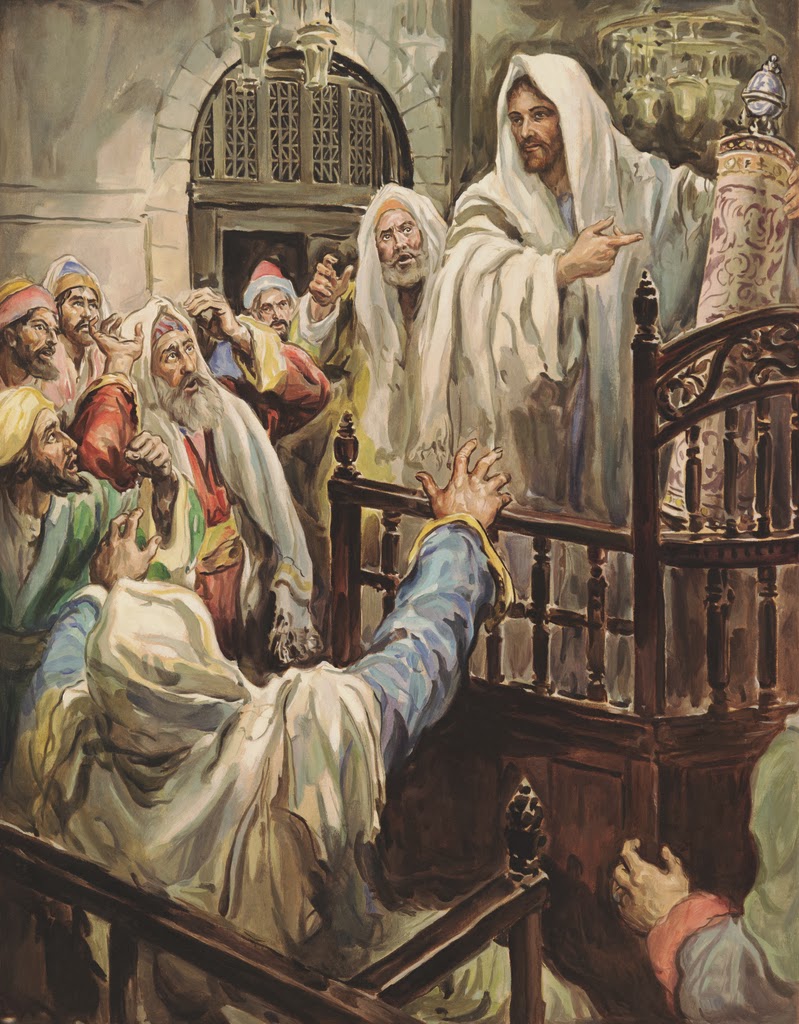
Encounter with Christ can seem paradoxical – both private and public, personal and communal, and silent or exclamatory. We experience the healing of Christ when we go to Him in the quiet solitude of personal pleading in faith to our Lord, whether in moments of private prayer or in approaching him through the sacraments, especially the Eucharist and Confession. At the same time, love and gratitude from this experience overflow our hearts and almost compel us to share it.
In addition, sometimes Jesus instructed people to tell of their experience, and at other times He bade them to be quiet. Similarly, the Church sends out missionaries to preach the Gospel in every corner of the world, and at the same time relies on the cloistered prayer of contemplatives and hermits. Our own duty to attend communal worship at Mass on Sunday, is fed by daily personal prayer all week, and vice versa.
In our own lives we may experience both calls too. At times Jesus asks us to withdraw in quiet faithfulness, alone with Him and just a few close followers. At other times, He calls us to publicly witness our faith to others in a visible way.
How do we discern the difference? Listen. Just listen to the Holy Spirit Who guides the heart’s prayer and provides the words of witness. The man in this passage couldn’t help but share his joy, it was too overwhelming to keep to himself. Jesus did ask him to keep quiet because Jesus wanted it to be a personal not public miracle. Yet, His personal miracles in our lives become public as our joy radiates.
Consider:
How has Christ been working in your life? What are the small (or big) miracles?
Is Jesus calling you now into a time of quiet or of witness, or both?
How does taking time for personal prayer, make your Mass experience richer?
Spend time offering your plea to Christ like the leper in this passage, and time listening and receiving His healing touch.
Practical Application:
Read the lives of the saints this week – they offer real life examples of this paradoxical tension between silence and solitude, and courageous witness.
(If you don’t know who to read about, look up the saint of the day online)
Order the kindle e-book (or paperback) to read the Christmas meditation, the meditation for Mary Mother of God, and to reflect on the meditations all year at your convenience.
Jesus casts out demons, He frees us from their lies and from the darkness of sin. This is truly a gift and a great relief! Our present secular culture needs this gift. Marked by the highest levels of anxiety and depression, the darkness from which these symptoms often proceed need to be cast out with the authority and light of Christ.
The great theologian Hans Urs von Balthasar (1905-1988), explored the relationship between darkness, sin, and anxiety in his work The Christian and Anxiety. He noted, “The main effect of darkness is that it separates, isolates, makes lonely.” Similarly, the darkness of sin separates the sinner from others, isolates him from God whose light he evades to continue in sin, resulting in dark loneliness. In Exodus, the penultimate plague aptly signified the culmination of Pharaoh’s obstinate evasion of God, who had made Himself visibly manifest. A darkness came over the Egyptians for three days, “a darkness to be felt” (Exodus 10:21) The dense, suffocating, darkness effected a social paralysis, symptomatic of their spiritual sickness.
“and there was thick darkness in all the land of Egypt three days; they did not see one another, nor did any rise from his place for three days; but all the people of Israel had light where they dwelt” (Exodus 10:22-23).
Von Balthasar asserted that the loss of light signifies the loss of reality. Without light we cannot see and therefore remain trapped by our imagination. Reflecting on Wisdom chapter 17, he wrote, “The wicked are afraid of Nothing, of nothing real.” God is Reality. His divine Name, Yahweh, which means “I Am”, revealed Him to be existence itself. Therefore, to hide from His Light, to duck His Truth, means to retreat into an imaginary world of one’s own creation. It deprives us of the answers we need most of all – Who am I? What is my purpose? What is the meaning of life? How do I find happiness?
Denial as a coping method may be alluring, but rarely helpful. For example, avoiding the truth about a physical illness provides a temporary relief and façade of healthiness. However, the illness usually worsens without treatment and the anxiety one initially avoided only intensifies due to procrastinating the cure. In the same way, one can only self-soothe by justifying sin for so long before the underlying dread and pain of spiritual illness becomes too intense to deny.
Sin can become paralyzing. Left untreated for too long it can feel insurmountable. Satan, the “Accuser” as Jesus calls him, whispers fearful lies into the darkness to keep a person from reentering the light. The demons of shame, despair, and distrust bind the sinner to his dark loneliness.
Yet, into this darkness, Christ the Light broke through. He “spoke with authority” because He spoke Truth, thereby dispelling lies. His Light cast out the demons of darkness, His Truth cast out the Father of Lies, and His merciful love strengthened and healed so the sinner could become whole again. How many miracles of Jesus demonstrate this! The paralyzed man who could walk again. The lepers, cast out from society, healed and able to rejoin their families. The demoniacs freed and restored to their loved ones. Christ’s light shone on prostitutes, tax collectors, and pagans. He liberated them from a kingdom of degradation and made them citizens and children of His Kingdom of God.
Christ continues to bring His light into the darkness through His Mystical Body the Church. He invites us into His healing love, then His light begins to shine in us. Wherever we are, that light shines simply by union with Him.
Elizabeth Leseur (1866-1914), a devout Catholic living in an upper-class, atheistic, French society provides a concrete example of how to be a light in darkness. Elisabeth and her husband Felix loved one another intensely and shared an inspiring intimacy of marital friendship. As a result, it pained her severely that he was an ardent atheist. Her love for God and her love for Felix were both so deep, and yet she couldn’t share that deepest part of herself with the man she loved the most, nor see him receive the joys and graces she enjoyed as a Christian.
She made it her apostolate to pray and sacrifice for his conversion and for their friends. Most everyone in their society of friendship were intellectuals and anti-Catholic. Her diary reveals how she prayerfully navigated ministering to them, bringing light to the darkness through her hidden interior life, her faithful exterior practices, her patient silence, and her readiness to speak boldly and intelligently for Christ if the moment necessitated it. After her death, her husband discovered her secret diary. The insights into her interior life, together with his experience of her daily love during their marriage, softened his heart and converted his soul. He went from being a hardened atheist to later becoming a Catholic priest!
Elisabeth brought her light into the darkness and it freed the one she loved the most. One of her resolutions in her diary can be instructive for us in the same effort. In today’s Gospel Jesus spoke with authority and it struck people. Elisabeth discovered the same thing in her own interactions. She found that somehow her personal conviction of faith, was itself a strong testimony, strengthened more by authenticity and simple truth than by long explanations trying to persuade. She wrote,
“Each time the conversation leads me to speak of faith, I will do so simply, but in a direct and firm way that will leave no doubt as to my convictions. Cleverness is nothing in such things; I am struck with the fact that unbelievers have more sympathy with people of deep faith than with those of variable and utilitarian views. These dear unbelievers attend more to those who are ‘intransigent’ regarding the Faith than to those who by subtlety and compromise hope to bring them to accept the Faith. And yet the bold statement must be made with the most intelligent sympathy and the liveliest and most delicate charity.”[i]
Our culture suffers under “a darkness that can be felt,” but Christ’s light shines into that darkness to cast it out and replace it with freedom. As St. John testified:
“In him was life, and the life was the light of men. The light shines in the darkness, and the darkness has not overcome it.” John 1:4-5
Are there shadows of darkness with which you struggle? Bring them to prayer and expose them to the light of Christ in Scripture and the sacraments.
Compare who the world says that you are and what your worth is, with who Christ says that you are. Which do you listen to more? How might you strengthen Christ’s voice within you?
Spend 5 minutes of silent prayer, loving Christ and receiving His love.
How might you grow your relationship with Christ and let Him shine more brightly in your life? How might you bring His warmth, love, and truth to those in your life?
Practical Application:
Resolve to pray for and develop a deeper love for Christ and to shine Him more brightly.
Pray the Prayer of St. Francis of Assisi daily.
Pray the Rosary. Mary always purifies and strengthens our love for Jesus.
Order the kindle e-book (or paperback) to read the Christmas meditation, the meditation for Mary Mother of God, and to reflect on the meditations all year at your convenience.
Imagine what it must have been like for the apostles near the end of their lives, to remember back to the very beginning when they first met Jesus – before their zealous and arduous work as the leaders of Jesus’ Church, before they received the Holy Spirit at Pentecost, before Jesus’ astounding Resurrection, before His shocking suffering and death, before witnessing in amazement His teaching and miracles. Back when they lived ordinary lives, as ordinary men, waiting upon the Lord in His silence.
The Lord had spoken to His People through prophets since His first revelation to Abraham. They had enjoyed ongoing relationship with Him, even when they experienced the pain of God’s discipline. Eventually however, their obstinance toward God grew so hardened that it caused God to withdraw His immanent presence from the Temple. Without God’s help the people fell captive to foreign nations and lived in exile.
Years later, King Cyrus of Persia issued an edict allowing the Jews to return to Jerusalem and even contributed funds to aid in the rebuilding of the Temple which had been destroyed. Eventually some returned to Jerusalem, but God’s divine and immanent presence (which had remained upon the Ark of the Covenant from their time in the desert during the Exodus through its housing in the Temple until the Babylonian Exile), did not return to the Temple. Although God anointed prophets to mediate His Word through this time, afterward God didn’t speak again until the Incarnation of Christ.
In consequence, the Jews endured about 400 years of divine silence. During that time they clung to the words of God’s earlier prophets and to His Law given through Moses. They considered God’s promises and kept hope that one day He, who is always faithful, would fulfill them.
At long last, their hope for God’s Word and for renewed relationship enlivened with anticipation when John the Baptist appeared, as
“the voice of one crying in the wilderness:
‘Prepare the way of the Lord,
make his paths straight’”
(Mark 1:3; Isaiah 40:3).
The long silence finally broken, and the power of John’s prophecy excited some to speculate whether John was in fact the Messiah.
Both Messiah and Christ mean “anointed one.” In the Old Testament, those God had appointed as either priest, prophet, or king would be anointed with oil. Each were called in some way to mediate between God and the People, bestowed with a measure of God’s authority. The priesthood of the Old Covenant foreshadowed the eternal priesthood of Jesus, who would offer Himself as the perfect sacrifice for the sins of all mankind. The prophets mediated God’s word, preparing us for the incarnation of the Word of God, and later the indwelling of that Word in our souls through Baptism. Finally, the role of king was to govern the people as a steward of God who is the true king. Jesus came as king to reign not as a steward, but with the authority of God Himself.
“And they were all amazed, so that they questioned among themselves, saying, ‘What is this? A new teaching!’”Mark 1:27“Why does this man speak thus? It is blasphemy! Who can forgive sins but God alone?” Mark 2:7
John the Baptist answered the Messianic speculation directly, stating, “I am not the Christ” (John 1:20). He too was waiting patiently upon the Lord. He faithfully preached repentance, as God had asked of him, and baptized with water as a sign of readiness.
Finally, the Holy Spirit revealed the Messiah to John – it was Jesus. There, waiting expectantly, were St. Andrew and another disciple of John. Upon hearing his prophetic declaration, “Behold the Lamb of God,” they began following Jesus immediately, apparently without even saying a word. When Jesus turned to ask them what they wanted, they expressed their desire to remain with Him. They accepted Jesus’ invitation to come with Him, and in their encounter with the Person of Jesus, determined with conviction that He was in fact the Messiah. In consequence, Andrew hurried to his brother to share the unbelievable news.
That day had probably began like every other day: breakfast, work, prayer, routine. In that moment however, they dropped everything to find Jesus. Everything had changed. In that first encounter, Jesus called Simon by name, and gave him a new name indicating his new role in the New Covenant. Simon would leave the normalcy of the life he knew, to be Peter, “Rock”, upon which Christ would build His Church. Imagine the trust he must have had in the Lord to persevere in his discipleship through so many changes, so much confusion, and so much responsibility! So much took place over the course of their lives, but it all began with dropping what they were doing when the time came, and going to find the Messiah.
The Anointed One has come. He heals wounds of sin and strengthens us with grace through His sacrifice on the Cross mediated to us in the Sacraments of Baptism, Confession, and the Eucharist. Jesus is the Word of God, who reveals God’s plan for our lives, our purpose, and His constant care. Jesus is king. We enter His kingdom through Baptism and must work to allow His rule over our lives daily.
“We have found the Messiah.” There’s no more need to search, only to follow; to say yes to Jesus’ invitation “Come, and you will see.”
Christianity is not a consumer product, a happy drug, an interesting philosophy, or a social club. Christianity is following Christ, the Anointed One of God, and staying with Him. None of us can imagine where it will lead, only follow one step at a time, waiting during times of silence, and acting when He calls our name. Where it leads only the Lord knows, but it will certainly be an adventure and full of surprises.
Consider:
Spend a few minutes in silent prayer, just being in the presence of Christ.
When have you felt excitement about your faith like the apostles?
How has encountering Christ transformed you? In what ways has it changed the way you think, guided your actions, or changed your desires and priorities?
Prayerfully consider what mission Christ has for you.
Practical Application:
Take one step toward Christ every day. Follow Him in Scripture reading, works of love, or the sacraments.
At first glance, this passage can seem a little harsh. We like to imagine a more sentimental Jesus, gently escorting every person to eternal pleasure, not a rigid judge calculating our deeds and sending some to eternal suffering.
Jesus is king and judge, but as He often reminded His followers – His kingdom is not of this world. When pressed by Pilate to explain this, Jesus answered “For this I was born and for this I came into the world, to testify to the truth. Everyone who belongs to the truth listens to my voice.” (John 18:37).
We, like Pilate, may ask “What is Truth?” (John 18:38). Truth is Reality. As Pope Benedict XVI often said in his writings, it means acknowledging that God is the Creator and we are creatures. The laws of nature that govern the health of our soul are as real and concrete as the laws that govern the health our body.
The truth is also that God is love and we are made in His image. Though weakened by sin, we have been re-made by Christ and transformed by His grace to image God’s love again. Thus, St. John can say,
Beloved, let us love one another, because love is of God; everyone who loves is begotten by God and knows God. Whoever is without love does not know God, for God is love…if we love one another, God remains in us, and his love is brought to perfection in us. (1 John 4:7-8,12)
So if the Truth is that God is love and we are love, what does that mean on an everyday level? How does that look? How does it translate to our schedules? Pope St. John Paul II defined love clearly and simply: it is self-gift. Thus the paradox of human happiness he concluded, is that we find fulfillment for ourselves in giving of ourselves. For those of you who like lists, Jesus makes it clear and simple for us:
Works of Mercy
The works of mercy are charitable actions by which we come to the aid of our neighbor in his spiritual and bodily necessities. (CCC 2447)
Corporal Works of Mercy Feed the hungry Give drink to the thirsty Clothe the naked Shelter the homeless Visit the sick Visit the imprisoned Bury the dead
Spiritual Works of Mercy Admonish sinners Instruct the ignorant Counsel the doubtful Comfort the sorrowful Forgive offenses Bear wrongs patiently Pray for the living and the dead
Jesus is Truth and Love. No one can pretend to be something they are not when standing before Him. Those who love will rejoice to be fully united with the King of Love. Confident in His mercy they will say yes to His transforming grace which will free them from any remaining pulls of worldliness or selfishness. Those who prefer the Kingdom of Self will refuse to enter the Kingdom of Self-Gift, preferring to be alone.
We see this in an analogous way during the holidays. Time with family requires a sacrifice of time, generosity of food and travel, hospitality, patience, and attentiveness toward others. The more we love our family, the easier those things become, and are even opportunities of service we look forward to with joy. The less we love, the more burdensome they seem, and some people may choose to remain alone on the holiday rather than deal with it all.
At Jesus’ final coming, it’s not so much that He will decide who “gets” to go to Heaven and who doesn’t, since He came to offer Redemption to all. It’s more the case that He will come as Judge of the Truth about our decision to accept or reject His saving grace in our hearts. The world might say, “show me the money,” but Jesus will say, “show Me your love.”
Life is short, eternity is long. We must begin EVERY day with prayer – even just 5-10 minutes and go to Mass EVERY Sunday, to unite ourselves to the source of Love and Grace.
From this union with Christ, fruits of His Spirit of love will permeate the actions and decisions of our day (see Galatians 5:22-23). If we first love God above all things, we will then love our neighbor as ourselves because we will see God’s image in them and desire as Christ does to mend its wounds of sin that their God-given dignity and glory might shine more gloriously.
Sound too simplistic? Give it a try. Compare a day began with 10 minutes of prayer and a day without. I can attest that I am a far more loving person with prayer and a far more frazzled impatient person without it. See how your week goes after attending Sunday Mass. Try going to one daily Mass in addition and notice the fruits that follow in your interactions with others.
Consider:
Consider how love makes everything less burdensome.
Consider how selfishness undermines relationship and causes discord in your family, friendships, and work.
Consider how Christ’s love and grace has transformed you. How has He changed you for the better over the years? How has His Spirit changed the way you think and act? What are areas of your life that still need transformation?
When have you experienced self-fulfillment/happiness through self-gift? How might you continue to give of yourself to those in your daily life?
Take a moment for gratitude, to thank Christ for the sins that He has conquered so far in you. Then take a moment for petition, asking Christ to conquer those sins that remain. Finally, take a moment for intercession, praying for those in need of healing too.
Close your eyes and imagine the joy of Heaven. Imagine Christ coming in all His glory, shining brighter than the sun, holding out His hand for you to join Him.
Make a Resolution (Practical Application):
Begin every day with 5-10 minutes of prayer. Read the Scriptures, thank God, surrender your day to Christ, spend a couple of minutes in silence.
Intentionally practice one corporal and one spiritual work of mercy a day.
Read about the life of a saint who is like you in some way to learn from his or her example. You can research “patron saint of ” to find someone with an affinity to your work or your struggle.
* To receive these weekly posts automatically in your email just click the “follow” tab in the bottom right hand corner and enter your email address. You can also follow me @taketimeforhimon Twitter and Facebook.
Mountains make us think of God. Their height, their beauty, and their majesty inspire a sense of our smallness, and of God’s greatness. Moses ascended Mt. Sinai to encounter God.
When the LORD had finished speaking to Moses on Mount Sinai, he gave him the two tablets of the covenant, the stone tablets inscribed by God’s own finger. (Exodus 31:18)
He prayed and fasted for 40 days and nights, during which God spoke to Him “face to face, as a person speaks to a friend” (Exodus 33:11). To form His People in wisdom, justice, and peace, God gave to Moses the Law, written by God’s own hand.
After this encounter, Moses’ face radiated such glory that Aaron and the other Israelites feared being near to him; so much so that Moses had to wear a veil over his face when in their presence (Ex 34:29-34).
Moses’ relationship with God and the immediacy of God’s interaction with him was unparalleled. At the end of Moses’ life however, he prophesied that God would one day send a New Moses.
I will raise up for them a prophet like you from among their kindred, and will put my words into the mouth of the prophet; the prophet shall tell them all that I command. (Deuteronomy 18:18)
Jesus ascended the Mount as the New Moses when He taught the Beatitudes. Christ affirmed the Law given to Moses, but he extended it further to its fullness intended by God. Through Moses, God had liberated the Jews from physical slavery and reformed their outward actions through the wisdom of the 10 Commandments. Through His Son, God now liberated His people from spiritual slavery to sin and, empowered by grace, directed them to conversion of interior intentions and desires. As He set about the task of establishing the eternal Kingdom of God, the Beatitudes mark the fullness of God’s rule for His People – one of authentic love for God and one another.
The best teachers use examples to illustrate their lessons. The beatitudes are the heart of the New Law, but their application can be obscure. On All Saints Day the Church recognizes the lives of the saints throughout history to remember those concrete examples of how to live the beatitudes and apply them. Saints, those who have been fully transformed in Christ, have come from every age, place, and walk of life. You can find examples of nearly every type of personality, spirituality, vocation, and occupation.
One such saint, St. Thérèse of Lisieux (1873-1897), asserted that we ascend the mountain of God, by way of descending the valley of humility. She was a young, cloistered Carmelite nun in France who pursued sainthood by doing small things with great love; a theme St. Mother Teresa (1910-1997) took as inspiration in her own life. Through the humility and simplicity of Thérèse’s life, she lived the beatitudes in the confines of her small world, but God raised her up as a Doctor of the Church and her Story of a Soul gained worldwide readership after her death.
Using Thérèse ’s analogy of descending the mountain, let’s consider each beatitude as steps on the journey of sanctification. The first step, poverty in spirit, establishes right relationship with God by recognizing one’s creatureliness and dependency. The poor in spirit surrender the illusion of self-sufficiency and accept their dependence on God as His creature and His child.
How often have you experienced the frustration of wanting to help someone, but they refused to be receptive to your advice or your aid? Common obstacles to accepting dependence on God stem from a desire for security located in things we think we can control – such as wealth, career, relationships, status, self-help, etc. If we cling to a desire to redeem ourselves, we will resist the mercy of our only Redeemer. The poor in spirit have hit rock bottom, they are in the valley. Regardless of their wealth or accomplishments, they are keenly aware that only God can heal their wounds, release them from self- destructive addictions or thoughts, and provide them with security which isn’t dependent on the market, the weather, what other people think of them, or even their employer.
Once a person looks to God, who is full of mercy, whose Son demonstrated His sacrificial love, they are moved to sorrow. This sorrow wells up from an honest view of themselves and their sins – free of the rationalizations and false beliefs they had clung to in the past. They see sin for what it is: degrading, a trick they fell for, and ingratitude.
Having shed false pretentions about oneself, a person develops a beautiful authenticity which is characterized by meekness. Meekness is not weakness! Meekness means a person has greater compassion and patience toward others because they know that “but for the grace of God, there go I.” In consequence, surrender to God, gratitude for His mercy and comfort, and humble authenticity, causes one to bear much more fruit in their life and work.
As gratitude for God’s love, and experiential knowledge of the wisdom of His ways increases, a person begins to hunger and thirst for righteousness. They desire even greater freedom and deeper joy, which they know with deep conviction, can only be found in Christ. This is a prayer to which God always says yes.
The joy of freedom in Christ’s love creates so much gratitude that it spills over in a person’s heart and they can’t help wanting to give back to Christ the kindness He has shown to them. Thus, they show mercy to others because they empathize with the struggle of sin and desire to follow the example of Christ who has shown them mercy in their weakness.
Union with Christ in the Beatific Vision is the essence of Heaven. Thus, those that have forsaken all for Him, whose heart is pure, begin to experience a taste of the vision of God. Reconciled to God through His son, they extend this peace to others as it radiates from their own interior peace from union with the Lord.
Finally, the more perfect a union one has with Christ, the more others will treat that person the same way they would of Him. Jesus warned His apostles that those of the world who persecute Him, will persecute them; and those that love Him, will love them (John 15:18-25). Thus, Christ ends the Beatitudes with the summation of the spiritual life – when one is persecuted because of Christ, they ought to rejoice, because it means they are finally living in union with Him and following in His example. In a sense, it’s confirmation that one is conformed to Christ. Others wouldn’t bother with you if you were worldly enough to leave their consciences undisturbed.
Jesus provides the Way by teaching us the Beatitudes and showing us how to follow them by His example. Moreover, He provides the supernatural grace, virtues, and love we need to live such a profoundly spiritual life and the examples of the Saints to illustrate how it looks in everyday life.
The world offers countless distractions to discourage us from introspection, and our own pride can further resist taking an honest look inside our hearts. Christ exhorts us to bravely journey within, promising to accompany us and to conform what we find to His own perfect love. If we descend the valley of humility through poverty in spirit, we will ascend the mountain of God and enjoy the beatific view from the top.
Consider:
Have you ever seen a mountain up close or hiked up one? How did it affect your perspective?
Consider the immanence of God – His revelation to Moses and His revelation through Christ. In what way does His closeness make you somewhat afraid, like the Israelites? In what way, does it comfort or strengthen you to have Him so near?
God continues to dwell with us in an immanent way in the Eucharist. Consider how it has pleased God in every age, to draw near to us. In what ways, do you appreciate His gift? In what ways, do you sometimes take it for granted? How might you increase your appreciation?
Consider the spiritual journey laid out by the beatitudes. How does your spiritual life correspond to some of the stages?
Which beatitude touches you the most? Is there one that sticks out to you as the most moving?
How has your love for God grown through the years as a response of gratitude for His grace at work in your soul. What do you know is His work and not your own?
Make a Resolution (Practical Application):
Reflect on one beatitude each day this week and try to live it out in an intentional way.
* To receive these weekly posts automatically in your email just click the “follow” tab in the bottom right hand corner and enter your email address. You can also follow me @taketimeforhim on Twitter and Facebook.
Jesus often compares Heaven to a wedding feast. Weddings celebrate a sacred union in love of two persons. It means total gift of self and lifelong commitment. Marriage best represents God’s invitation to relationship with us and His desire for mutual self-gift of mind, heart, and action.
God is both the almighty who existed before creation and exceeds our understanding, and the God Who sent His Son to become incarnate, walk the earth with us, and suffer and die for us. Even now His Holy Spirit dwells within us, and Christ is present to us in the Sacraments and His Mystical Body the Church. Moreover, our Trinitarian God has invited us through His Son into a participation of His self-giving love through a union akin to marriage.
Marriage begins with a wedding and weddings require enormous preparation – both for the event planning and for the relational development needed to become one. The Wedding of the Lamb, described in the book of Revelation, celebrates the fruit of this long process when our final union with Christ will become complete. Jesus has already opened the gates of Heaven for us and ascended there. For our part, our earthly pilgrimage from sinner to saint is our marriage prep. The kind of union the Trinitarian God intends for us is nothing short of total, relational, and loving. In consequence, our journey to the alter requires knowing Christ more deeply, trusting Him completely, and loving Him above all things. It means leaving behind our “single lives” for the gift of a shared life in the Father, Son, and Holy Spirit. Weddings can be draining but when the day arrives it’s all worth it. Similarly, Revelation 19:7-9 describes the joy of our long- awaited union as well:
Let us rejoice and be glad and give him glory. For the wedding day of the Lamb has come, his bride has made herself ready. She was allowed to wear a bright, clean linen garment. (The linen represents the righteous deeds of the holy ones.) Then the angel said to me, “Write this: Blessed are those who have been called to the wedding feast of the Lamb.”
Christ loves each and every person passionately. He pursues them, woos them, fights for them, and offers eternal union with Him in Heaven. In today’s Gospel however, He laments that not everyone says yes. They come up with excuses, put Him off, or avoid Him altogether. Eventually the door is shut. Harsh, you might say?
Jesus strikes at our complacency. We all too easily forget the gift of salvation, of our eternal destination, and our higher calling. The frenetic pace of life, the constant stream of tasks, or the allure of diversions become a dangerous siren call, singing that we are made for earth and we have all the time in the world.
However, every day we are one day closer to eternity. If we didn’t grow our love for the Lord, then we weakened it. Love needs ongoing nurturing. Relationships are work! Even a relationship with God.
Moreover, sometimes indecision is a decision. Deadlines are part of reality. If I stay undecided about my son playing basketball, eventually the registration closes. If I hem and haw about planning a family trip, eventually a year passes without travel and I have essentially said no. Lastly, if a couple is in a serious relationship of several years and one person drags his/her feet about marriage, eventually the other will need to move on from the relationship to find someone else to build a life with.
Thankfully Jesus waits patiently our entire life. He reminds us today however, that death is the deadline. By that point we have said yes or no to the Lord and even our indecision reveals itself as a rejection of Christ.
But let’s not wait until the last moment. I have heard people who put off kids, when they finally held their first in their arms say, “why did we wait so long?” Couples in love when they finally meet say “I wish I had met you sooner.” The more we love, the more we see how much greater it is than anything else we had previously thought to be more important. We will say the same of Christ – I wish I had let you in sooner.
We can ask ourselves, what holds us back from the wedding? What keeps me from union with the Lord? What do I need to do to prepare myself for this marriage? The King of Heaven and Earth has personally invited you. Drop everything, get dressed, and go!
Consider:
The Mass is a mystical participation in the eternal wedding feast of the Lamb in heaven.
What things or habits undermine getting to Mass or distract you during Mass?
Is it sleeping in, kids’ activities, running errands, going into work, exercising instead, watching news, or just relaxing?
What helps you enter more deeply into the Mass?
Getting to know the priest and parishioners so you feel more a part of the community, reading the Gospel ahead of time, learning about the Mass, participating as a musician, greeter, usher, or extraordinary minister of Holy Communion, writing down key points from the homily?
Imagine you were to enter Heaven today.
What aspects of your heart and character would Jesus praise you for, as clothing you in garments for the king?
What vices or attitudes would He ask you to change in order to be properly dressed?
The lives of the saints illustrate the transformation possible with the grace of God. Each began like you and me, but through relationship with Christ they were made perfectly ready for heaven by the end of their life. If you were to appear in a book of the Lives of the Saints, what would it say? Where would it begin, and how would you like it to end?
We cannot perfect ourselves, but we can cooperate with the grace of Christ and let Him purify our hearts. Take a moment to offer a prayer of surrender the Lord. Offer to Him all your struggles, worries, imperfections, and desires.
I am confident of this, that the one who began a good work in you will continue to complete it until the day of Christ Jesus. Philippians 1:6
Make a Resolution (Practical Application):
Do one thing each day this week to prepare for the eternal wedding feast of heaven. Change out of one garment of vice or unforgiveness and put on a garment of virtue and love. As St. Peter says:
Above all, let your love for one another be intense, because love covers a multitude of sins. (I Peter 4:8)
Resolve to attend Mass every Sunday and make the necessary arrangements for that to happen.
Spend five minutes with Christ when you first wake up, midday, and in the evening. Invite Him into your life right where you are at that moment.
Read about the life of a saint. You could research a saint whose personality, experiences, or work is like yours. You could also just read about the saint of the day. Catholicculture.org gives a nice summary. Click on the tab “liturgical year” then select “today”.
Learn more about the Mass. Attend a “teaching Mass” where the priest explains each of the parts as he celebrates it. Read a book about the Mass. Read “The Lamb’s Supper” by Scott Hahn which is about the relationship between the Mass and Heaven based on the book of Revelation.
* To receive these weekly posts automatically in your email just click the “follow” tab in the bottom right hand corner and enter your email address. You can also follow me @taketimeforhim on Twitter and Facebook.
Jesus knows us so well! How often do we pay lip service to God? How many spiritual goals and good intentions fall quickly by the wayside left undone? In the morning, the first words on our mind and lips should be an expression of gratitude to the Lord, entrusting the day to His care. Instead, we hit the snooze button and possibly let less godly words be the first on our lips. As the day progresses, opportunities arise at every moment to be at the service of the Lord. Do we embrace the tasks at hand and the duties before us, or do we try to avoid work and get by on minimal effort?
At the same time, if we hear God’s call, often it may seem outrageous at first, especially His insistence on forgiving others. God challenges us to live beyond our natural limits, to participate in His divine love. Our first response may be no, but upon further reflection and with the softening effect of grace, we may rise to the challenge after all.
Inauthentic love disappoints. It makes big promises and grand plans only to fail to follow through on them. Real love acts. It proves itself by keeping promises, showing up, and responding to the needs of the beloved.
When St. Mother Teresa began her ministry to the poorest of the poor, she simply went out into the streets and showed up to comfort and aid those she met. For the children she found aimless and alone, she began to teach them by gathering them together and writing with a stick in the dirt. For the sick, she begged the pharmacist for medicine. For the dying, she offered what comforts she could along with loving companionship. God grew the ministry; Mother Teresa simply went out into the vineyard each day to work.
Practical goals and intentional habits form a framework of love that infuses our day with charity. However, when we don’t know where to begin, Jesus reminds us to start by jut showing up when asked. It’s amazing how deep of an impression it can make.
When I consider who has touched my life, it has been those who laughed with me, shouldered burdens with me, encouraged me, or reached out in ordinary ways when I needed it. I remember when my mom chose to leave a law firm she enjoyed, so she could open her own and have more time available for her kids. It meant that despite the many responsibilities she had at her job every day, I could count on her to listen when I needed some advice, to cheer for me at school events, and to be there when I had a tough time. Even now as a grown adult, I can still count on my mom to show up no matter what.
Above all, the Lord shows up. He created our souls at the moment of our conception. He became man, suffered and died on the Cross, and rose again for our salvation. His angels guide and protect us. His Mother intercedes for us. His very Spirit dwells within us as His Temple (1Corinthians 6:19). He is united to us as a Head to a body (Colossians 1:18), and as a vine to its branches (John 15:5). God is always faithful.
“The LORD is my shepherd, there is nothing I lack” (Psalm 23:1) “I will rejoice and be glad for thy steadfast love. Be strong, and let your heart take courage, all you who wait for the LORD! (Psalm 31: 7, 24 RSV) “Better one day in your courts than a thousand elsewhere.” (Psalm 84:11) “Blessed are those who keep his testimonies, who seek him with all their hearts.” (Psalm 119:2)
Love is about showing up and being there for someone. Love for Christ answers yes to His call and shows up for prayer.
Love has the strength and perseverance to do the right thing even when it’s hard. It may not be glamorous, but following through on our daily duties, even if we resist at first, makes an eternal impression on God.
Consider:
How can you make yourself more available to God? How can you hear His call more acutely and act more faithfully?
In times of prayer – when, where, and how do you pray. How much do you listen in prayer?
In the duties of family life – what do your spouse, children, or parents need from you?
In the duties of your work life – how might your work become more of an offering to God?
Ask God what He desires from you and spend a few minutes listening to Him.
Is He asking you for greater diligence, or do you need better boundaries on your work?
Is He asking you to reign in some of your conversations with co- workers, or is He asking you to make a greater effort at reaching out to them?
How do you respond to the work God asks of you each day?
What often derails you from following through with your commitments? Is it distractions, tiredness, apathy, fear…?
Reflect on the times God has shown up for you. When has He proven His faithfulness in a time of need? What blessings has He showered upon you?
Make a Resolution (Practical Application):
The Psalms sing God’s praises, especially of His faithful love. Pray one Psalm in the morning, one midday at lunch, and one at night.
Identify one thing you have said “no” to God about and do it today.
A great resource for learning to hear God’s voice is St. Ignatius’ Rules of Discernment. Fr. Timothy Gallagher has an excellent podcast series explaining each one and giving practical examples. You can listen to them HERE
I also recommend the spiritual classic, “The Practice of the Presence of God” by Brother Lawrence. It’s a small, thin book but a little goes a long way.
* To receive these weekly posts automatically in your email just click the “follow” tab in the bottom right hand corner and enter your email address. You can also follow me @taketimeforhim on Twitter and Facebook.
Meditation Reflection: Gospel of Matthew 16: 13-20
Generally speaking, our culture loathes the word “authority.” It appears to undermine our values of autonomy, self- expression, independence, and freedom. Moreover, the idea of monarch-rule seems archaic and undemocratic. In consequence, our cultural norms and assumptions can hinder our understanding and appreciation of the Kingdom of God.
God’s Chosen People first became a kingdom under Saul, then famously David. David’s authority however came from God. He was chosen by God and anointed king by God’s prophet Samuel. In addition, David’s success as a leader corresponded with his fidelity to the Lord.
The Kingdom of Israel served as a glimpse or foreshadowing of the Kingdom Jesus would establish. However Jesus, the New David, did not begin His reign by assigning authoritative positions to protect the physical security of His people, lands, and finances. Instead, He assigned authority to leaders He wished to protect the souls of His people, the Truth He came to reveal, and the path He opened for our salvation. These positions he assigned to Peter, the first pope and His steward/vicar on earth, and the twelve apostles and their successors the bishops.
The Pope, like David, is a human being. This means he will falter at times, sin, and struggle with human limitations. We must be careful however, not to project our cultural norm on our understanding of his role. Our leaders our voted upon to represent our views. They operate at a natural human level, with the responsibility to protect our physical security, rights, lands, and commerce. The Pope’s position, begun with Peter, has a different role. Christ chose Peter. Christ bestowed His authority upon Peter to be Christ’s representative, not the representative of popular opinion. Lastly, no matter what the pope’s natural gifts or limitations may be, the Holy Spirit empowered Peter and his successors to always be able to answer questions about the divinely revealed faith with certainty of truth by supernaturally empowering them to discern correctly answers about Christ. The first controversial question is recorded in Acts of the Apostles. The apostles held a council to address the question of whether Gentiles needed to be circumcised along with baptism or not. Peter was given the grace by Christ to know the answer was no to circumcision.
Moreover, the Pope is called to shepherd people on the way to salvation which means he also has the authority to make rules for His spiritual children that he believes will be important for their development. This resembles a family structure more so than a political one. I am grateful to God to live in our democracy. In my opinion, despite its flaws, it’s still the best, and most free, country in the world. Nevertheless, I don’t run my family like a democracy. If decisions were made by vote we would eat doughnuts every morning, live way outside our means, and discipline would devolve to mob rule. Much to my children’s chagrin, our family is run as a monarchy. Though they push against the rules, we have much more peace, justice, and love as a result. In this monarchy, God is our king, and my husband and I are His stewards.
At times, my kids have accused me of being either overly strict or overly protective when I said no to something they wanted to do. To encourage me to soften, they would make life difficult for me, then add “no one really cares Mom, it’s not that big of a deal.” Even though I felt for them, and in a secular culture what they said was true, I also knew I had to hold the line because, at the end of the day, I would be held responsible before God. So, I often respond to them, “I have to do what’s right for you, because it’s my responsibility and I will have to answer to God one day.” And when I fail to hold the line, and am a weak parent, I ask God for forgiveness and the grace to be stronger.
So, contrary to our cultural norms and assumptions, I have seemingly Medieval parenting methods to my children. Yet, as parents we all know that raising kids to be mature adults is different than running a nation-state. Kids need us to exercise our authority, especially in decisions that they are too young to make. We are in a better position to discern what is safe from what is too risky, truth from lie, and wisdom from folly. Of course, unlike Christ we are not all-knowing, so oftentimes we need the Holy Spirit to guide us in our position and enable us by His grace to make the right choices.
Discipleship means that Christ is our king. We can embrace this monarchy because our king is also our loving, self- sacrificing, and divine Savior. As king, He chose to bestow His authority upon some of His subjects to govern for Him on earth and promised to safeguard it until the end of the world.
Upon Peter, and every pope thereafter, He bestowed the authority to say who Christ is, and gave them the supernatural ability to be correct. The role of pope is to preserve, protect, and promulgate the Deposit of Faith given by Christ. In addition, when confusion over Christ’s revelation occurs, for the sake of unity someone must be the authority that determines which response is correct and which is false. During the first councils of the early church the question of whether Jesus is God, Man, or both was a long, heated, argument. If determined as a vote, our doctrine would be that of Arius’ interpretation – Jesus was only a man but the highest possible one. The pope recognized Athanasius’ response as the true one – that Jesus is both God and man.
In the vocation of marriage, Jesus bestows His authority on mothers and fathers over their children. Thus, as children we have an obligation to obey our parents. And as parents, we have the responsibility of exercising our authority in a Christian manner. It’s not always easy. When kids are fighting I would rather just yell “stop bickering” (which is never really effective), than get up, intervene, and if necessary, impose consequences for bad behavior. Crafting Christian rules takes time and effort, both of which are in short supply. Enforcing the rules with appropriate consequences means suffering the rebuffs and anger of resistant kids. As kids get older, knowing what decision to make in given circumstances becomes even more difficult. They require even more prayer and the inspiration of the Holy Spirit.
Nevertheless, we can find peace and confidence in our divine monarch, Jesus Christ. He reigns in our souls with supernatural power and grace. Despite our natural limitations, He transforms us into one Body, one family in God. His Holy Spirit guides us – enlightening our minds, strengthening our wills, and inflaming our hearts with love. Our unity in Christ can be seen visibly in the family and in the Church. Our trust is not in ourselves, but in Him who enables us to complete the mission He entrusted to us.
Consider:
To what extent does Jesus reign in your heart and in your life? When do you let Him lead, and when do you resist His commands?
Our culture tends to value being a leader over a follower. How does this influence our discipleship? Do we value being followers or wish only to lead?
In what ways has Christ appointed you His steward? In your vocation – who has He entrusted to your care? In your occupation – who or what has He entrusted to you and what fruit do you think He expects to see from it? In His Creation – what does He ask of you for its care?
How do you respond to the authority of Christ’s vicar on earth, the pope? Do you accept his guidance on matters of faith and morals, or do you resist? Is your faith strong enough to see not just the human, visible reality of the Church, but the divine, invisible reality as well? What has made this either easier or harder for you?
Consider the relationship between authority and unity. How are the two related and necessary?
Make a Resolution (Practical Application):
If there’s a teaching of the faith that you presently ignore, begin practicing it instead and try to learn more about why the Church teaches it.
Each morning look ahead at the day. Invite Christ to lead you in each aspect, and for the grace to follow. Even if you are called to lead others, let Christ lead you first.
Examples:
If you make a to-do list at work or home, prayerfully consider first how Christ would prioritize the items rather than how you want to prioritize them.
What expectations would Christ want to see in your family? Are there any that need greater implementation?
What expectations does Christ have for you at work? Do you honor Him by respectful, honest, and edifying language, free from vulgarity or slander? Do you honor Him in action through diligence in your work and mercy towards your co- workers?
Pray the Suscipe prayer by St. Ignatius or the Serenity Prayer.
Exhilaration, adventure, a leap of faith – we get brave and step out onto the water…outside our comfort zone. For a brief moment, his eyes fixed on Jesus, Peter did just that. Then, a gust of wind distracted him, and Peter’s gaze turned to the strength of the wind rather than the strength of the Lord. His faith sank and so did he. Yet, as quickly as he had turned from the Lord, he turned right back. He immediately reached out to Christ for help. Jesus did not delay, He caught Peter as soon as he asked. Jesus didn’t let Peter flounder in the water gasping for air as He lectured him. He cast no words of spite, no “I told you so”, or “that’s what you get for not believing in Me more.” Jesus came to reveal the Father’s love, and on this night He demonstrated the Lord’s compassionate mercy for our weak nature.
Discipleship calls us beyond our comfort zone, and even beyond our natural limits. Yoked to Christ, He enables us to walk on water. Like Peter, we might step out of the boat in total confidence in our Lord. Once on the water however, we become fearful as we realize our total dependence on His supernatural help. It’s much easier to have faith floating on the water in a boat, than walking on water barefoot.
I remember the excitement of getting my first teaching job, and the enthusiasm of teaching students about God. Then, the first day of class arrived and panic struck. “Yikes!” I thought, “How I am I going to get through the day? What I am I going to say for a whole class period?! What if a student misbehaves? What if I’m a terrible teacher?…” I also remember the joy of holding my first child in my arms the day he was born. It was absolutely surreal. Two days later the nurse walked us out to the car and waved goodbye. As we put my son in the car seat and drove away anxiety erupted, “They’re just letting us take him?! We don’t know anything! What if I’m a terrible mother? What if I say or do something that scars him for life?!…” Lastly, when I do speaking engagements or workshops, I’m exhilarated at the opportunity to share the joy of God’s saving love with others. A half hour before the talk however, worried thoughts begin to percolate up, “Why did I agree to do this? It would be far more comfortable to be at home watching Netflix. What if I fail? What if everyone is bored? Who am I to do this, I’m a sinner like everyone else?” Like Peter, I begin to sink but then I cry out to the Jesus. He reminds me that I teach, mother, and speak because He has called me to. He assures me that though I am not worthy, He is, and He is with me. He also pushes me by filling my heart with so much gratitude for His love in my life that I can’t resist sharing it with others.
The challenge of discipleship is living at a level only sustainable if Christ and His grace is real. It requires taking a risk, so much so that if Christ is not real, you would be at a loss. Consider how many times God tells us in Scripture to be not afraid. Pope St. John Paul II chose these words for his first statement as Pope, knowing how much we fear as we look around at the dangers that surround us.
When I begin to sink in fear a few verses come to mind that strengthen me. First, I think of 2 Corinthians 12:8-9
“Three times I begged the Lord about this, that it might leave me, but he said to me, ‘My grace is sufficient for you, for power is made perfect in weakness.’ I will rather boast most gladly of my weaknesses, in order that the power of Christ may dwell with me.”
St. Paul felt too weak to face a challenge on his own. Rather than remove the difficulty, Jesus promised to provide the strength. St. Paul realized therefore, that the weaker he is, the more God’s power must be at work in him to accomplish God’s will. He moved from anxiety to total confidence, and writes in his letter to the Philippians 4:13,
“I have the strength for everything through him who empowers me”
We can trust Jesus to come through for us. We can answer His call, even if it means going beyond our natural limits. When we struggle to take that leap of faith beyond our comfort zone, Christ urges us to simply reach out and He will be there for us as He was for Peter.
“Ask and it will be given to you; seek and you will find; knock and the door will be opened to you. For everyone who asks, receives; and the one who seeks, finds; and to the one who knocks, the door will be opened” Matthew 7:7
Ask, seek, knock, and you just might walk on water.
Consider:
How has following Christ stretched you beyond what you expected?
When has Christ made an endeavor more fruitful than it would have been by your own merits?
Have you ever felt like Peter, walking on water, in awe of Christ’s divine power?
Have you ever faltered because of fear, worry, or anxiety?
What Scripture verses or memories reassure you of Christ’s aid?
Is Christ calling you to something outside your comfort zone right now? What holds you back? What inspires you forward?
Make a Resolution (Practical Application):
Take one risk each day for your faith.
Ideas: Inviting your spouse to pray together, praying as a family, saying “God bless” to someone on the phone or a at work, speaking up when someone is criticizing the Church or using God’s name in vain, sharing your faith with someone in need of comfort, going to the Sacrament of Confession, responding to God’s call in your vocation or job…
Jesus’ parables illustrate the attitude of people who have discovered the treasure of life with God. To be a citizen in His kingdom, a son or daughter of this good Father, is worth trading everything for. Both the landowner and the merchant shrewdly went all-in for this investment, knowing it was a sure bet and incomparably more valuable than anything else that they owned.
Discovering the love of Jesus Christ, experiencing His liberating grace and forgiveness, is an incredible feeling. It overwhelms a person with joy. Yes, Jesus’ kingdom has laws. He says, if you love me then follow my commands. But His commands are the way of love and the way of living to the highest degree of your dignity and will lead you to the fullness of your development.
On the one hand, we hate rules in our culture. We balk at phrases like “submission to authority” and only like a monarchy for the glamorous magazine photos, not as a political system. Our democratic ideals, although a fruit of our Christian heritage, can also color our vision of faith in a negative way. The Kingdom of God is not a democracy because it’s not akin to a political system governing equals, but rather a family governed by our Heavenly Father who has appointed His Son as king. God has revealed the laws of His kingdom, both through the natural moral law, and the divinely revealed law through Moses and through Jesus. We may resist the faith as an imposition of rules to control us, but it would be to assume those rules were imposed arbitrarily by someone without the right authority and for their own personal interest or gain. However, God’s laws are at the heart and foundation of creation. He revealed the ultimate science behind our human nature and the instructions for how to flourish. Our adolescent view of our Father’s rules changes when we mature in the faith and realize His wisdom and His benevolence.
So, what must we sell to buy this field or this pearl, this “treasury of truth” as St. Augustine called it? We must relinquish anything that would edge out Christ or drain our spiritual resources. If we delight in the law of the Lord, as the Psalms often repeat, how can we meditate on them if media edges out our time for prayer? If we wish to love our neighbor as Christ has loved us, how can we see their needs and humbly serve them if our busy schedules consume our thoughts and actions? How can we enjoy the fruits of purity if we are stuck in the mud of lust? How can we enjoy fellowship with our brothers and sisters in Christ if we can’t let go of being overly competitive, cynical, or unforgiving?
We must say no to lesser treasures, to possess the greatest treasure. Without love this seems too much, similar to a single person who can’t imagine being tied down to one person their whole life, until they meet that person and suddenly they can’t wait. St. Augustine famously observed:
“Two cities, then, have been created by two loves: that is, the earthly by love of self extending even to contempt of God, and the heavenly by love of God extending to contempt of self. The one, therefore, glories in itself, the other in the Lord; the one seeks glory from men, the other finds its highest glory in God, the Witness of our conscience.”
Praise be to God that Jesus has cast His net to the whole world, inviting every single person into His kingdom. He has no immigration caps or limits. In the end, those who want to enter may, and those who do not may not. Love is total and generous. As a couple approaches marriage, they move from individual lives to a shared life. In their marriage vows they don’t parse percentages; they vow a gift of their whole selves for their whole lives together. Christ has offered us His perfect love, total and sacrificial. The only proper response is joy, gratitude, and a reciprocal gift of self. You see this joyful abandonment expressed in the life of every saint, beginning with the disciples who “left everything and followed Him” (Luke 5:11).
Consider:
When have you experienced the joy described in these parables? When have you experienced the value of faith in Christ?
What have you had to sacrifice to follow Christ and to love as He loves? Is there anything presently that competes with your discipleship?
Consider the difference between a democracy and a monarchy. How is God’s kingdom different than our own governments? How does it resemble family structure?
Make a Resolution (Practical Application):
Tell one person about a time you experienced Christ and felt tremendous joy.
Make a list of your daily and weekly tasks and goals. Look over them and prioritize them in light of the Gospel.
Pray a Psalm each day. They are prayers filled with praise and trust.