Behold, I Make All Things New

by Angela Jendro  Excerpt from Lenten Journey: Through the Desert to the Eternal 20190328_204247219_iOSSpring 

Easter Sunday!

Gospel of John 20:1-9 NAB

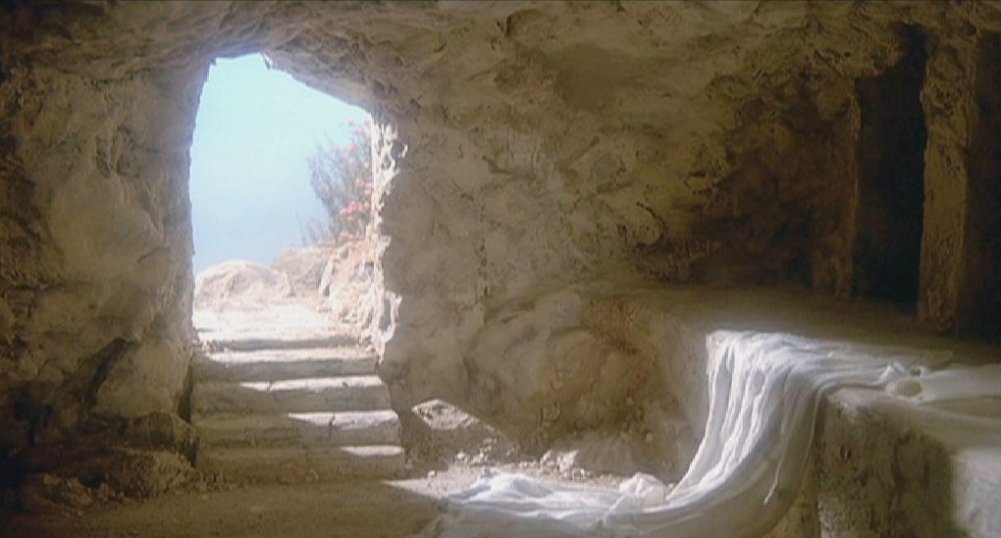
On the first day of the week, Mary of Magdala came to the tomb early in the morning, while it was still dark, and saw the stone removed from the tomb. So she ran and went to Simon Peter and to the other disciple whom Jesus loved, and told them, “They have taken the Lord from the tomb, and we don’t know where they put him.” So Peter and the other disciple went out and came to the tomb. They both ran, but the other disciple ran faster than Peter and arrived at the tomb first; he bent down and saw the burial cloths there, but did not go in. When Simon Peter arrived after him, he went into the tomb and saw the burial cloths there, and the cloth that had covered his head, not with the burial cloths but rolled up in a separate place. Then the other disciple also went in, the one who had arrived at the tomb first, and he saw and believed. For they did not yet understand the Scripture that he had to rise from the dead.

Meditation Reflection:

Jesus is risen! Just when we think all is lost, He makes something new. Jesus took His most beloved disciples by surprise, and He takes us by surprise as well.

“If any man would come after me, let him deny himself and take up his cross and follow me.  For whoever would save his life will lose it, and whoever loses his life for my sake will find it.” (Matthew 16:24-25 RSV)

Death scares us by its finality, and the shroud of the mysterious unknown that surrounds it. Yet, in Christ we can be confident that with death comes resurrection. Jesus had warned, and promised:

Truly, truly, I say to you, unless a grain of wheat falls into the earth and dies, it remains alone; but if it dies, it bears much fruit.” (John 12:24 RSV)

Every change, even welcomed ones, require us to leave the old behind in order to embrace the new. It takes courage to leave a familiar prison, to embrace an unfamiliar freedom. Today, we celebrate the victory of Christ, Who provides both the courage and the freedom we desire.

God’s love for us exceeds all our expectations. His intervention in our lives, especially when we surrender completely to His will, always surprises us. If we trust in Jesus each day, allowing Him to lead, He will bring richness, joy, peace, and deep love to our lives in ways we might not have foreseen.

Today we celebrate new life.   We celebrate God’s love. We celebrate God’s power and His victory over sin and death. We celebrate His victory in our own lives and within our own hearts. Our confidence can be renewed, that no struggle or suffering can stop Christ. If we place our trust Him, He will heal and transform us. Today, we celebrate our fresh start. During Lent, we endeavored to face our sins and bring our guilt before the Lord. Now, we get to leave that shame in the past, crucified with Christ, and begin something new.

Revelation 21:3-5 NAB “I heard a loud voice from the throne saying, “Behold, God’s dwelling is with the human race. He will dwell with them and they will be his people and God himself will always be with them as their God. He will wipe every tear from their eyes, and there shall be no more death or mourning, wailing or pain, for the old order has passed away.”

 The One who sat on the throne said,

Behold, I make all things new.” 

Consider:

  • Consider Christ’s victories in your life.
    • How have you grown?
    • In what way do you experience greater freedom than before?
    • What were you afraid of before, that you no longer fear?
    • What virtues has Christ developed in you?
    • How has your love for God and others deepened?
  • How has God surprised you?
    • When did He give you something more than you asked for?
    • When did His plan lead you down an unexpected road?
    • When have you experienced His loving mercy when you didn’t think you should?
  • Reflect on Christ’s love for you and His strength.

Make a Resolution (Practical Application):

  • Resolve to begin anew today. Make a concrete step to leave the old behind, no matter how comfortable it is, and allow Christ to lead you forward.Cross with heart 2

~ Written by Angela Jendro © 2019

* To receive these weekly posts automatically in your email just click the “follow” tab in the bottom right hand corner and enter your email address.


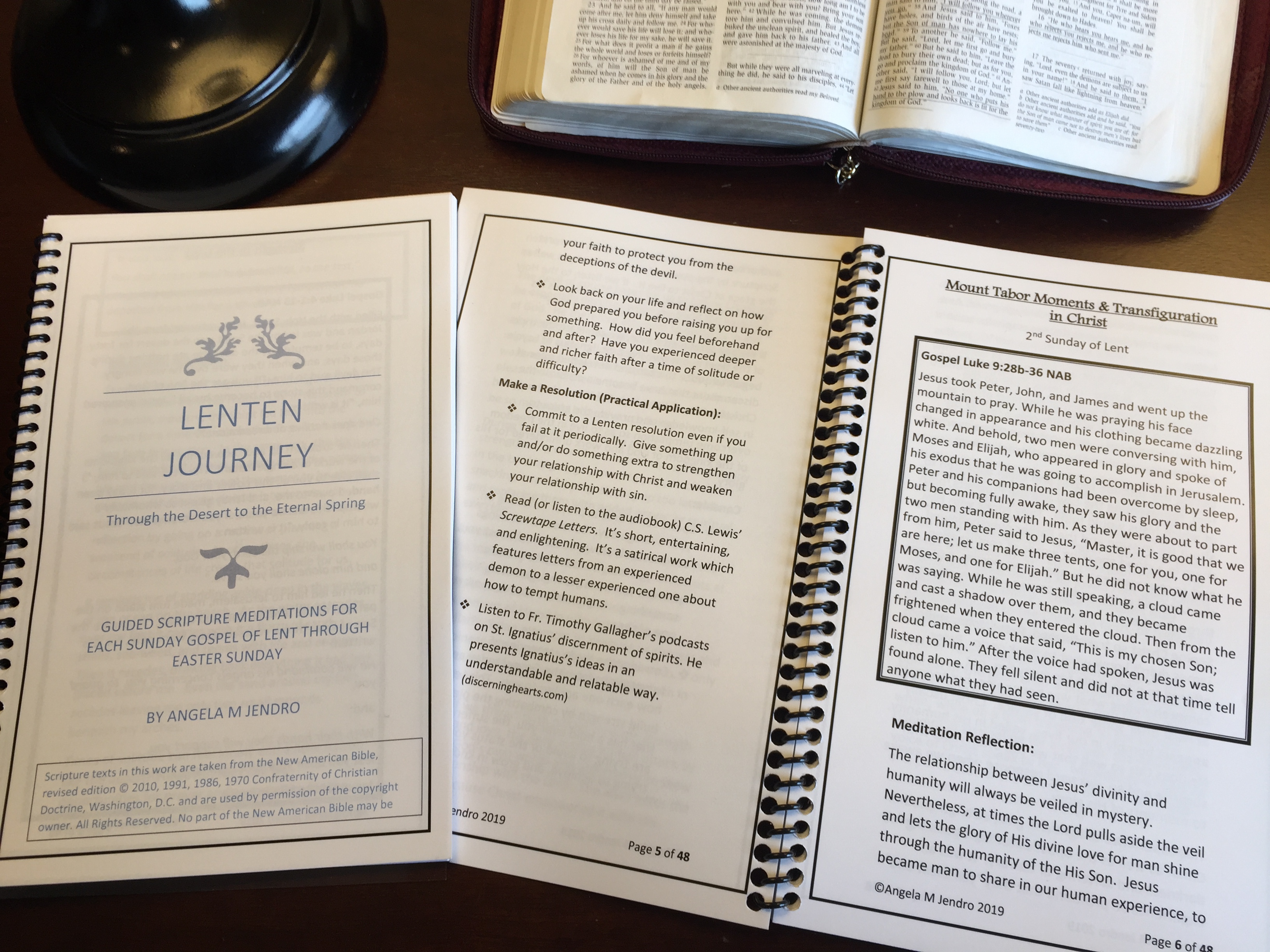
New Book – Lenten Journey: Through the Desert to the Eternal Spring by Angela Jendro


Lenten Journey_Through the Desert to the Eternal Spring by Angela M Jendro

Make a spiritual pilgrimage this Lent with guided meditations on theLenten Journey pic Sunday Gospels by Angela M Jendro, complete with real life applications and ideas for translating your meditation into action.
  • Download for free to your pdf reader for easy access on the go, or print to paper to make your handwritten notes.
  • No price for e-book,  Free Will Offering accepted via Paypal and/or Prayers for the author 🙂


For printed booklet – visit our Online store tab or purchase below:


Printed Booklet – Lenten Journey: Through the Desert to the Eternal Spring

Free shipping within the U.S. 48 pages Guided Scripture meditatins for each Sunday of Lent through Holy Week and Easter Sunday. Encounter Christ in a new way with reflections that relate to your daily life, considerations to take to prayer, and ideas for concrete application.

$15.00


The Trap of Stubborn Self-Reliance

by Angela (Lambert) Jendro

April 8th, 2018 2nd Sunday of Easter, Divine Mercy Sunday

Gospel of John 20:19-31 NAB

On the evening of that first day of the week, when the doors were locked, where the disciples were, for fear of the Jews, Jesus came and stood in their midst and said to them, “Peace be with you.” When he had said this, he showed them his hands and his side. The disciples rejoiced when they saw the Lord. Jesus said to them again, “Peace be with you. As the Father has sent me, so I send you.” And when he had said this, he breathed on them and said to them, “Receive the Holy Spirit. Whose sins you forgive are forgiven them, and whose sins you retain are retained.”

Thomas, called Didymus, one of the Twelve, was not with them when Jesus came. So the other disciples said to him, “We have seen the Lord.” But he said to them, “Unless I see the mark of the nails in his hands and put my finger into the nail marks and put my hand into his side, I will not believe.”

Now a week later his disciples were again inside and Thomas was with them. Jesus came, although the doors were locked, and stood in their midst and said, “Peace be with you.” Then he said to Thomas, “Put your finger here and see my hands, and bring your hand and put it into my side, and do not be unbelieving, but believe.” Thomas answered and said to him, “My Lord and my God!” Jesus said to him, “Have you come to believe because you have seen me? Blessed are those who have not seen and have believed.”

Now Jesus did many other signs in the presence of his disciples that are not written in this book. But these are written that you may come to believe that Jesus is the Christ, the Son of God, and that through this belief you may have life in his name.

Meditation Reflection:

The Christian faith is neither a well-crafted myth nor a brilliant philosophy.  Rather, the Christian religion is based on eye witness testimony of the resurrected Lord.

It began with the testimony of Mary Magdalene, who encountered the risen Christ in the morning when she went to His tomb and was subsequently sent by Him to tell the apostles.  They felt excited and a bit confused “for they did not yet understand the scripture that he had to rise from the dead” (John 20:9).   In the evening, Jesus appeared to them as well except for Thomas who wasn’t there.  Upon seeing Him with their own eyes they believed and rejoiced.

When they shared their Good News with Thomas he refused belief until he could see it for himself.  Thomas had been willing to die with Christ (John 11:7-8, 16) but he couldn’t envision rising with Him. In consequence, his faith – though fiercely loyal – remained limited to his own personal experience.

One week later however, Jesus had mercy on Thomas’ obstinate self-reliance and appeared to him in the flesh and so enabled Thomas to believe.

We too can fall into the trap of self-reliance in matters of faith – limiting our belief to personal experience and rejecting the witness of Jesus’ apostles and His Church.  Our present culture tends toward “cafeteria Christianity”, meaning we pick and choose what we like and leave what we don’t.  We view doctrine as a buffet of ideas that we can take or leave according to our personal preferences and reasoning.

Imagine Thomas saying to the other 10, “you have your truth and I have my truth, one is not better than the other.”  Yet, one is that Jesus is risen and the other is that Jesus is dead!  How could Jesus’ Church endure with such conflicting beliefs?  The same remains true today.  Capitulating to the attitude of an individualistic faith undermines Christ’s work.

Jesus chose to share His Truth and Grace through the apostles’ witness (and their successors – the pope and bishops).  Their interpretation of Scripture and the power of their miracles came from the Holy Spirit bestowed on them by the Lord.

At the final moment of Jesus’ death, He breathed His last and surrendered His Spirit to the Father.  On the evening of His resurrection, He breathed upon the Apostles, and gave them His Spirit and His authority:

“‘As the Father has sent me, so I send you.’ And when he had said this, he breathed on them and said to them, ‘Receive the Holy Spirit. Whose sins you forgive are forgiven them, and whose sins you retain are retained.’”

Christianity is an encounter with the incarnate God who dwells within the very souls of His baptized disciples and makes them one Body.  Jesus is not a restaurateur who offers the world’s greatest buffet.  He is the Son of God who desires all persons to be united as a family in the Lord and therefore established a visible Church endowed with His invisible presence to guide and govern its members to His eternal kingdom.

Today, one week after Easter, we celebrate the inexhaustible, generous, mercy of Christ which He lavishes on all who will accept it. As He did for Thomas on this same day, Christ reaches down into the darkest parts of our souls, to our most acute failures and sins, to apply the healing balm of His Merciful Love poured out on the Cross for our salvation. Our Lord is a crucified Lord.  When He appeared to the apostles “He showed them His hands and His side” (John 20:20).  He did not choose, as Satan tempted Him to be in the desert, king without the Cross.  Similarly, true disciples are crucified disciples.  They have died to self, and self-reliance, and live by the Holy Spirit in communion with the Church.

There’s no sin too great for Jesus to forgive. He only requires a repentant heart which chooses to trust in His love.

There’s also no weakness of faith He can’t strengthen, no doubt He can’t dispel, and no question of doctrine He can’t explain to you – if you let Him.  And remember, He has given us the fellowship of the Apostles through both the Scriptures and the living voice of authority in His Church.

Jesus said, “Blessed are those who have not seen and have believed.”  Today’s Gospel passage concludes with John offering the same witness to us that was offered to Thomas. Today is the day to surrender to Christ in prayer every doubt you harbor and every limitation you place on faith.  Then, receive His mercy in daily prayer, immersion in the Scriptures, the Eucharist at Mass, and trying to learn the Church’s reasons for her doctrines.  In consequence, you too will become an eye-witness of the resurrected Christ to others.

Consider:

  • When buying a product online or hiring someone for a house project, how much credence to you give to people’s reviews?  How much credence to you give to the testimony about Jesus from the Apostles, the saints and martyrs, the Christians you know who testify to the Lords’ work in their lives?
  • It’s hard to trust someone you can’t see.  Do you make Christ visible to others in your life?  How might you witness the reality of His truth and mercy even more?
  • Reflect on the choice presented today: whether to sand stubbornly in self-reliance or enter the communion of the Body of Christ – His Church – and lean on one another.
  • Jesus told St. Faustina that His greatest pain is distrust on the part of souls in His mercy.  Pope Francis, observed that we fail to believe in Christ’s mercy because we have no experience of mercy in our lives and therefore believe no one – not even Christ – will help us. To what extent has this been your experience?  What makes it difficult to trust Christ?  How might you extend mercy to the people in your daily life so that they might be strengthened to trust in Christ’s mercy?

Make a Resolution (Practical Application):

  • Begin each day this week with a prayer of surrender to Christ.
  • Every time you feel helpless, turn to Christ in prayer and throw yourself at His mercy. Repeat the prayer He gave to St. Faustina to have written under His image: “Jesus, I Trust In You.
  • Do at least one corporal or spiritual Work of Mercy every day.

Related Posts:

~ Written by Angela Jendro © 2018

* To receive these weekly posts automatically in your email just click the “follow” tab in the bottom right hand corner and enter your email address.


Rising with Christ

by Angela (Lambert) Jendro

 See the source image

April 1st, 2018 Easter Sunday

Gospel of Mark 16:1-7 NAB

When the sabbath was over, Mary Magdalene, Mary, the mother of James, and Salome bought spices so that they might go and anoint him. Very early when the sun had risen, on the first day of the week, they came to the tomb. They were saying to one another, “Who will roll back the stone for us from the entrance to the tomb?” When they looked up, they saw that the stone had been rolled back; it was very large. On entering the tomb they saw a young man sitting on the right side, clothed in a white robe, and they were utterly amazed. He said to them, “Do not be amazed! You seek Jesus of Nazareth, the crucified. He has been raised; he is not here. Behold the place where they laid him. But go and tell his disciples and Peter,  ‘He is going before you to Galilee; there you will see him, as he told you.'”

Meditation Reflection:

Christ’s resurrection initiated resurrection to new life for every human person who accepts it.  In the Church’s liturgy every Sunday is an Easter. The first day of the new week is now the first day of our new life.

As we worship our Lord and celebrate His victory, we ought to share in His Easter joy.  He invites us to rise with Him.  As hard as suffering and sacrifice may be, rising can also be a challenge.  It means the courage to step forward into a new life, to accept change, and to embrace the unknown new.  It also means forgiveness and letting go of the past.  As painful as cycles of sin or anger may be, we sometimes hold on to them simply because of their familiarity.

Easter joy promises lasting life, not a passing phase.  Christ’s victory over sin and Satan is permanent. When we step forward in faith and hope, we entrust ourselves to the Lord Who has already won.  His grace can sustain us because He has merited it for us and He has proven it. Jesus promised the apostles,

Because I live, you will live also” (John 14:19)

Through the blood and water that poured out from His side on the Cross, Jesus has dispensed His grace through Baptism and the sacraments.  He pours out upon us both the forgiveness of sins and the supernatural grace to sin less and love as He loves more.

This Easter, step out in hope.  Allow Christ to roll away the stone and give you the courage and the humility to begin again in the life He has won for you.

Consider:

  • Reflect on the victory of Christ.  Imagine His reign from Heaven as our Eternal High Priest and King who intercedes for us and fights for our salvation.
  • Consider the areas of your life that have been renewed in Christ.  Reflect on the light and the joy that infuses them.
  • Consider the areas of your life where you still hold on to self-will, fear, pride, or anger.  Pray for Christ to raise you from that tomb as well.
  • Spend 5 minutes in prayers of gratitude for Christ’s blessings to you this past year.

Make a Resolution (Practical Application):

  •  Begin forming a new (good) habit that reflects y our faith in Christ.  For example – one work of mercy a day, 10 minutes of prayer a day, refraining from gossip or crude language, learning about the Bible, listening to Christian music, driving with generosity rather than impatience…
  • Next Sunday is the Feast of Divine Mercy.  Pray the Chaplet of Mercy or read about the devotion given to St. Faustina and commemorated by Pope St. John Paul II. (See my past post Divine Mercy…Can you believe it?)


~ Written by Angela Jendro © 2018

* To receive these weekly posts automatically in your email just click the “follow” tab in the bottom right hand corner and enter your email address.


Pushing the Limits

by Angela (Lambert) Jendro


March 25th, 2018 Palm Sunday

Gospel of Mark 14-15 NAB

The Passover and the Feast of Unleavened Bread were to take place in two days’ time. So the chief priests and the scribes were seeking a way to arrest him by treachery and put him to death. They said, “Not during the festival, for fear that there may be a riot among the people.”

When he was in Bethany reclining at table in the house of Simon the leper, a woman came with an alabaster jar of perfumed oil, costly genuine spikenard. She broke the alabaster jar and poured it on his head. There were some who were indignant. “Why has there been this waste of perfumed oil? It could have been sold for more than three hundred days’ wages and the money given to the poor.” They were infuriated with her. Jesus said, “Let her alone. Why do you make trouble for her? She has done a good thing for me. The poor you will always have with you, and whenever you wish you can do good to them, but you will not always have me. She has done what she could. She has anticipated anointing my body for burial. Amen, I say to you, wherever the gospel is proclaimed to the whole world, what she has done will be told in memory of her.”
Then Judas Iscariot, one of the Twelve, went off to the chief priests to hand him over to them.
When they heard him they were pleased and promised to pay him money. Then he looked for an opportunity to hand him over.

On the first day of the Feast of Unleavened Bread, when they sacrificed the Passover lamb, his disciples said to him, “Where do you want us to go and prepare for you to eat the Passover?” He sent two of his disciples and said to them, “Go into the city and a man will meet you, carrying a jar of water. Follow him. Wherever he enters, say to the master of the house, ‘The Teacher says, “Where is my guest room where I may eat the Passover with my disciples?”‘ Then he will show you a large upper room furnished and ready. Make the preparations for us there.” The disciples then went off, entered the city, and found it just as he had told them; and they prepared the Passover.

When it was evening, he came with the Twelve. And as they reclined at table and were eating, Jesus said, “Amen, I say to you, one of you will betray me, one who is eating with me.” They began to be distressed and to say to him, one by one, “Surely it is not I?” He said to them, “One of the Twelve, the one who dips with me into the dish. For the Son of Man indeed goes, as it is written of him, but woe to that man by whom the Son of Man is betrayed. It would be better for that man if he had never been born.”  While they were eating, he took bread, said the blessing, broke it, and gave it to them, and said, “Take it; this is my body.” Then he took a cup, gave thanks, and gave it to them, and they all drank from it. He said to them, “This is my blood of the covenant, which will be shed for many. Amen, I say to you, I shall not drink again the fruit of the vine until the day when I drink it new in the kingdom of God.”

Then, after singing a hymn, they went out to the Mount of Olives. Then Jesus said to them, “All of you will have your faith shaken, for it is written: I will strike the shepherd, and the sheep will be dispersed. But after I have been raised up, I shall go before you to Galilee.” Peter said to him,
“Even though all should have their faith shaken, mine will not be.” Then Jesus said to him, “Amen, I say to you, this very night before the cock crows twice you will deny me three times.”
But he vehemently replied, “Even though I should have to die with you, I will not deny you.” And they all spoke similarly. Then they came to a place named Gethsemane, and he said to his disciples, “Sit here while I pray.” He took with him Peter, James, and John, and began to be troubled and distressed. Then he said to them, “My soul is sorrowful even to death. Remain here and keep watch.” He advanced a little and fell to the ground and prayed that if it were possible the hour might pass by him; he said, “Abba, Father, all things are possible to you. Take this cup away from me, but not what I will but what you will.” When he returned he found them asleep.
He said to Peter, “Simon, are you asleep? Could you not keep watch for one hour? Watch and pray that you may not undergo the test. The spirit is willing but the flesh is weak.” Withdrawing again, he prayed, saying the same thing. Then he returned once more and found them asleep, for they could not keep their eyes open and did not know what to answer him. He returned a third time and said to them, “Are you still sleeping and taking your rest? It is enough. The hour has come. Behold, the Son of Man is to be handed over to sinners. Get up, let us go. See, my betrayer is at hand.”

Then, while he was still speaking, Judas, one of the Twelve, arrived, accompanied by a crowd with swords and clubs who had come from the chief priests, the scribes, and the elders. His betrayer had arranged a signal with them, saying, “The man I shall kiss is the one; arrest him and lead him away securely.” He came and immediately went over to him and said, “Rabbi.” And he kissed him. At this they laid hands on him and arrested him. One of the bystanders drew his sword, struck the high priest’s servant, and cut off his ear. Jesus said to them in reply, “Have you come out as against a robber, with swords and clubs, to seize me? Day after day I was with you teaching in the temple area, yet you did not arrest me; but that the Scriptures may be fulfilled.” And they all left him and fled. Now a young man followed him wearing nothing but a linen cloth about his body. They seized him, but he left the cloth behind and ran off naked.

They led Jesus away to the high priest, and all the chief priests and the elders and the scribes came together. Peter followed him at a distance into the high priest’s courtyard and was seated with the guards, warming himself at the fire. The chief priests and the entire Sanhedrin kept trying to obtain testimony against Jesus in order to put him to death, but they found none. Many gave false witness against him, but their testimony did not agree. Some took the stand and testified falsely against him, alleging, “We heard him say, ‘I will destroy this temple made with hands and within three days I will build another not made with hands.'”  Even so their testimony did not agree. The high priest rose before the assembly and questioned Jesus, saying, “Have you no answer? What are these men testifying against you?” But he was silent and answered nothing. Again the high priest asked him and said to him, “Are you the Christ, the son of the Blessed One?” Then Jesus answered, “I am; and ‘you will see the Son of Man seated at the right hand of the Power and coming with the clouds of heaven.'” At that the high priest tore his garments and said, “What further need have we of witnesses? You have heard the blasphemy. What do you think?” They all condemned him as deserving to die. Some began to spit on him.
They blindfolded him and struck him and said to him, “Prophesy!” And the guards greeted him with blows.

While Peter was below in the courtyard, one of the high priest’s maids came along. Seeing Peter warming himself, she looked intently at him and said, “You too were with the Nazarene, Jesus.”
But he denied it saying, “I neither know nor understand what you are talking about.” So he went out into the outer court. Then the cock crowed. The maid saw him and began again to say to the bystanders, “This man is one of them.” Once again he denied it. A little later the bystanders said to Peter once more, “Surely you are one of them; for you too are a Galilean.” He began to curse and to swear, “I do not know this man about whom you are talking.” And immediately a cock crowed a second time. Then Peter remembered the word that Jesus had said to him, “Before the cock crows twice you will deny me three times.” He broke down and wept.

As soon as morning came, the chief priests with the elders and the scribes, that is, the whole Sanhedrin held a council. They bound Jesus, led him away, and handed him over to Pilate. Pilate questioned him, “Are you the king of the Jews?” He said to him in reply, “You say so.” The chief priests accused him of many things. Again Pilate questioned him, “Have you no answer? See how many things they accuse you of.” Jesus gave him no further answer, so that Pilate was amazed. Now on the occasion of the feast he used to release to them one prisoner whom they requested. A man called Barabbas was then in prison along with the rebels who had committed murder in a rebellion. The crowd came forward and began to ask him to do for them as he was accustomed. Pilate answered, “Do you want me to release to you the king of the Jews?” For he knew that it was out of envy that the chief priests had handed him over. But the chief priests stirred up the crowd to have him release Barabbas for them instead. Pilate again said to them in reply, “Then what do you want me to do with the man you call the king of the Jews?” They shouted again, “Crucify him. “Pilate said to them, “Why? What evil has he done?” They only shouted the louder, “Crucify him.” So Pilate, wishing to satisfy the crowd, released Barabbas to them and, after he had Jesus scourged, handed him over to be crucified.

The soldiers led him away inside the palace, that is, the praetorium, and assembled the whole cohort. They clothed him in purple and, weaving a crown of thorns, placed it on him. They began to salute him with, “Hail, King of the Jews!” and kept striking his head with a reed and spitting upon him. They knelt before him in homage. And when they had mocked him, they stripped him of the purple cloak, dressed him in his own clothes, and led him out to crucify him. They pressed into service a passer-by, Simon, a Cyrenian, who was coming in from the country, the father of Alexander and Rufus, to carry his cross. They brought him to the place of Golgotha — which is translated Place of the Skull — They gave him wine drugged with myrrh, but he did not take it.
Then they crucified him and divided his garments by casting lots for them to see what each should take. It was nine o’clock in the morning when they crucified him. The inscription of the charge against him read, “The King of the Jews.” With him they crucified two revolutionaries,
one on his right and one on his left. Those passing by reviled him, shaking their heads and saying, “Aha! You who would destroy the temple and rebuild it in three days, save yourself by coming down from the cross.” Likewise the chief priests, with the scribes, mocked him among themselves and said, “He saved others; he cannot save himself. Let the Christ, the King of Israel,
come down now from the cross that we may see and believe.” Those who were crucified with him also kept abusing him.

At noon darkness came over the whole land until three in the afternoon. And at three o’clock Jesus cried out in a loud voice, “Eloi, Eloi, lema sabachthani?” which is translated, “My God, my God, why have you forsaken me?” Some of the bystanders who heard it said, “Look, he is calling Elijah.” One of them ran, soaked a sponge with wine, put it on a reed and gave it to him to drink saying, “Wait, let us see if Elijah comes to take him down.” Jesus gave a loud cry and breathed his last.

The veil of the sanctuary was torn in two from top to bottom. When the centurion who stood facing him saw how he breathed his last he said, “Truly this man was the Son of God!” There were also women looking on from a distance. Among them were Mary Magdalene, Mary the mother of the younger James and of Joses, and Salome. These women had followed him when he was in Galilee and ministered to him. There were also many other women who had come up with him to Jerusalem. When it was already evening, since it was the day of preparation, the day before the sabbath, Joseph of Arimathea, a distinguished member of the council, who was himself awaiting the kingdom of God, came and courageously went to Pilate and asked for the body of Jesus. Pilate was amazed that he was already dead. He summoned the centurion and asked him if Jesus had already died. And when he learned of it from the centurion, he gave the body to Joseph. Having bought a linen cloth, he took him down, wrapped him in the linen cloth,
and laid him in a tomb that had been hewn out of the rock. Then he rolled a stone against the entrance to the tomb. Mary Magdalene and Mary the mother of Joses watched where he was laid.

Meditation Reflection:

Palm Sunday we recall the Passion of Christ.  We remember His entry into Jerusalem received by adoring crowds which quickly turned to Crucifixion and mocking crowds.  In this account we see ourselves and the fickleness of our own faith.  Peter’s exchange with Jesus at the Last Supper depicts the Christian struggle well:

Peter said to him, “Even though all should have their faith shaken, mine will not be.”

Then Jesus said to him, “Amen, I say to you, this very night before the cock crows twice you will deny me three times.”

But he vehemently replied, “Even though I should have to die with you, I will not deny you.”

And they all spoke similarly.

When has Peter’s attitude been our own?  Complete confidence in our loyalty to Christ – our faith in Who He is, our Hope in Him alone, our perception of undivided Love.  Yet, Christ knows the truth in our hearts.  He knows the real limit of our faith, the weakness of our hope, and the dissipation of our love when confronted with suffering and disappointment.  As long as God’s plan corresponds with our plan, we feel ready to follow Him with magnanimous discipleship.  Yet, when His will deviates from ours, especially if it’s inexplicable to our natural understanding, we often falter.

The Passion of Christ’s love reveals our own tepidity.  (Just consider how we complain at reading or standing at Mass for the length of this Gospel passage.  Yet, how much longer it was for Christ to actually endure!)  However, He also redeems it by taking on our weak human failings Himself, and through the power of His victory, bestowing that grace on our souls so that we may have in truth the magnanimous friendship with Christ we desire in intention.

Venerable Archbishop Fulton Sheen, in his reflections for the third station on the Way of the Cross, reflected:

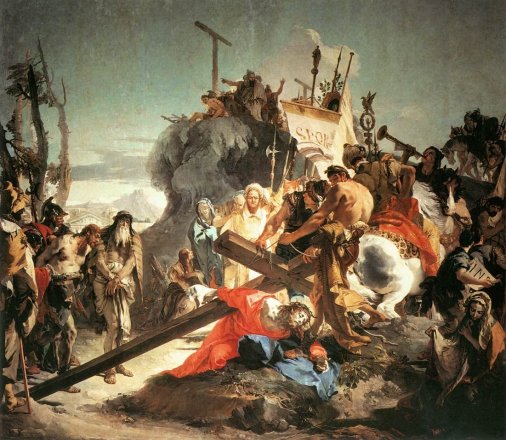
Three times Our Savior was tempted on the mountain, and three times He fell on the way to Mount Calvary.  Thus did He atone for our three falls – to the temptation of the flesh, the world, and the devil.”   (The Way of the Cross, originally written 1932; currently published by Society of St. Paul 2006)

“He advanced a little and fell to the ground and prayed that if it were possible the hour might pass by him; he said, “Abba, Father, all things are possible to you. Take this cup away from me, but not what I will but what you will.””

How we have all prayed the first part of this prayer!  Begging our Heavenly Father, “all things are possible to You, take this cup away from me”.  The agony of the deepest human suffering pleads in these very words.  The proverbial question “if You are all Good and all Powerful God, why am I suffering?”

The mystery is revealed in Jesus Christ alone.  “But not what I will but what You will.”  God wills our eternal salvation.  He wills it in conformity with respect for human free will.  Human choices cause suffering, but God’s will directs all things, even the events of His Son’s suffering and death, to the triumph of love.  Most of the time we won’t know the particulars of how everything will play out, but we do know the final ending.  Christ conquers – sin, human weakness, even death.  Those who exalt themselves in sin will be humbled, and those who persevere in humility will be exalted.  In Him we find healing, wholeness, strength, and eternal joy.  St. Paul promises that God works all things for good for those who love Him (Romans 8:28), not just some things.   Christ promises the Cross to His followers, but He also promises Resurrection. And the two are inseparable.

Fallen human nature resists faith in the power of the Cross.  Instead it often mocks it like the passersby at Jesus’ crucifixion.

In the account of Jesus’ Passion, individuals respond to His impending Cross in ways that we may relate.  Progress in our spiritual journey corresponds to how far we are willing to follow Christ.  Hopefully each year, we walk a step closer to the Cross and abide with Him a little longer.  Many things can trip us up however as we see in today’s Gospel.

I’ll follow until:

  • Jesus isn’t Who I want Him to be.  He won’t make me materially rich:  Judas
  • I’m tired or bored: Apostles asleep during Jesus’ Agony in the Garden
  • I’m threatened: disciples fleeing the crowd with swords; Peter recognized by the maid
  • I’m caught: young man in linen cloth
  • I’ll cause a rift or make waves: Pilate
  • Even still, Jesus invites His betrayers into His mercy.
“But God proves his love for us in that while we were still sinners Christ died for us.” Romans 5:8

This Holy Week, let us remain with Him.  Let us stay close to Him in prayer without falling asleep or rushing off to distractions.  Let us enter into the mystery of His suffering, death, and resurrection by accepting the griefs within our own situations and dying to what we cannot change, so that we may rise with Him who can redeem every sin and every situation.

Consider:

  • First and foremost, consider Christ’s love for you.  Reflect on how He has shared in your suffering.  Have you ever felt alone, betrayed, anxious, mocked, lied about, physically hurting, or exhausted?  Remember that Christ walks with you through the pain to resurrection in Him.
  • How can your love for Christ be strengthened?
    • Jesus observes in us that “The Spirit is willing but the flesh is weak.” Consider times when you have experienced this.  (Sleeping when you should be praying, resting instead of the effort to show up for someone hurting…)
    • Have you ever sold out Christ for a worldly gain? Consider when you have prioritized money, status, or worldly acknowledgement over doing God’s will for you.
    • Pilate’s betrayal sprang from “wishing to satisfy the crowd.” Sometimes we deny Christ by failing to speak up out of fear of being persecuted on His account. When asked “Are you a Christian?” or “Are you Catholic?”, how do you respond?  Do you hesitate or qualify it?  Or do you respond confidently, “Always be ready to give an explanation to anyone who asks you for a reason for your hope as St. Peter tells us (I Peter 3:15).
    • What fears can the devil use to tempt you away from following the Lord? How does he stir up your anxiety, and worry you into hiding, away from the Cross, like the other apostles?

 Make a Resolution (Practical Application):

  • Pray the Stations of the Cross or the Sorrowful Mysteries of the Rosary this week.
  • Reflect on one section of this Gospel passage a day this week.

Related Posts:

~ Written by Angela Jendro © 2018

* To receive these weekly posts automatically in your email just click the “follow” tab in the bottom right hand corner and enter your email address.


Walking With the Lord

by Angela Lambert

April 30th, 2017; Third Sunday of Easter

Gospel of Luke 24:13-35

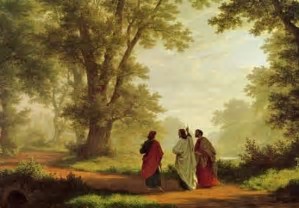
That very day, the first day of the week, two of Jesus’ disciples were going to a village seven miles from Jerusalem called Emmaus, and they were conversing about all the things that had occurred. And it happened that while they were conversing and debating, Jesus himself drew near and walked with them, but their eyes were prevented from recognizing him. He asked them, “What are you discussing as you walk along?” They stopped, looking downcast. One of them, named Cleopas, said to him in reply, “Are you the only visitor to Jerusalem who does not know of the things that have taken place there in these days?” And he replied to them, “What sort of things?” They said to him, “The things that happened to Jesus the Nazarene, who was a prophet mighty in deed and word before God and all the people, how our chief priests and rulers both handed him over to a sentence of death and crucified him. But we were hoping that he would be the one to redeem Israel; and besides all this, it is now the third day since this took place. Some women from our group, however, have astounded us: they were at the tomb early in the morning and did not find his body; they came back and reported that they had indeed seen a vision of angels who announced that he was alive. Then some of those with us went to the tomb and found things just as the women had described, but him they did not see.” And he said to them, “Oh, how foolish you are! How slow of heart to believe all that the prophets spoke! Was it not necessary that the Christ should suffer these things and enter into his glory?” Then beginning with Moses and all the prophets, he interpreted to them what referred to him in all the Scriptures. As they approached the village to which they were going, he gave the impression that he was going on farther. But they urged him, “Stay with us, for it is nearly evening and the day is almost over.” So he went in to stay with them. And it happened that, while he was with them at table, he took bread, said the blessing, broke it, and gave it to them. With that their eyes were opened and they recognized him, but he vanished from their sight. Then they said to each other, “Were not our hearts burning within us while he spoke to us on the way and opened the Scriptures to us?” So they set out at once and returned to Jerusalem where they found gathered together the eleven and those with them who were saying, “The Lord has truly been raised and has appeared to Simon!” Then the two recounted what had taken place on the way and how he was made known to them in the breaking of bread.

Meditation Reflection:

We are an Easter people.  Christians celebrate the Lord’s day on Sunday, the first day of the Jewish week, the day of Christ’s resurrection and the beginning of our new life in Him. The first day Christ rose from the dead, He visited His people, and He continues to visit us today.

Like the disciples on the road to Emmaus, our journey of faith includes moments of inspiration and awe, as well as confusion and discouragement.  At times, Christ’s teachings strike our hearts with the force of truth and His deeds inspire us to marvel at the miracles He works in our daily lives.  At other times, He seems hidden; or the Church, His Mystical Body, seems defeated by the world. Like Cleopas, we struggle to understand how the promise of freedom can be accomplished through suffering rather than political strength.

As disciples, which means followers, we can become too comfortable in our relationship with the Lord.   Christ meets us in our most vulnerable state.  He makes Himself close to us, even in our humanity.  At times, He veils His divinity, that we might approach Him. Yet, we need to remember, that Christ is the Lord and that His immanence proceeds from His loving desire to relate to us, not from a shared limitation as us.  St. Paul proclaims this mystery to the Philippians when he writes,

“Have among yourselves the same attitude that is also yours in Christ Jesus, Who, though he was in the form of God, did not regard equality with God something to be grasped. Rather, he emptied himself, taking the form of a slave, coming in human likeness; and found human in appearance, he humbled himself, becoming obedient to death, even death on a cross.” Philippians 2:5-8

The Christian journey, like the Road to Emmaus, requires faith in the Person of Jesus Christ.  It means trusting Him who is both man and God.  This means that we will have times of elation where our hearts burn within us, and times of confusion.  We must remember, as Isaiah prophesied:

“For my thoughts are not your thoughts, nor are your ways my ways.” Isaiah 55:8

In these moments, we can follow the example of the two disciples in today’s Gospel.  They considered everything that had happened in fellowship together.  We too should turn to Christian friends for spiritual guidance and comfort.  They listened to Christ when He appeared, even though they didn’t realize it was Him at first.  If we keep our hearts open as we do our daily duties, He can speak to us as well without realizing it at first.  Jesus turned them to Scripture to understand what had happened, and His Holy Spirit can open our minds to understand Scripture more deeply.  Their bible study walk with the Lord opened their minds to see God’s plan in a way they had not before.  We too should make an effort to get into our bibles, even reading a bible-study book or listening to Christian podcasts.  As the walk came to an end, Jesus did not push Himself on them.  Rather He provided an opportunity for them to separate from Him politely by pretending to be going on.  Thankfully, the two disciples invited Him in for dinner and pressed Him to stay.   Christ makes Himself available to us, and even takes the initiative in our relationship, nevertheless He desires that we invite Him in further.  Seemingly valid excuses will always present themselves to leave our Lord and go off to do something else.  We must resist letting our Lord walk on without us, and press Him to accompany us in each aspect of our day.

Lastly, the disciples recognized Christ in the breaking of the bread.  He made Himself known to them at Sunday Mass. The Church calls the Eucharist the “source and summit of our faith” because it is the Sacrament of Christ’s Real Presence – Body, Blood, Soul, and Divinity.  The Son of God, who became incarnate, and “pitched His tent among us” (John 1:14),  continues to dwell with us in an immanent way in the Eucharist.  He makes Himself available in every tabernacle, in every Catholic Church, around the world.  All we need to do, is come and break bread with Him.

Our Christian faith is not a philosophy.  It’s an encounter with our Lord.  Founded on relationship, our faith grows deeper through time spent with Him in the Eucharist, in conversation, in Scripture, and in our daily walk.  Jesus suffered for us and with us.  His Cross is a mystery we will revisit throughout our Christian journey.  In times of confusion, we can take heart that He is near, He will bring understanding in His time, and that He is victorious.

Consider:

  • Reflect on what it means to be an Easter people.  How does the joy of the Resurrection, shape your worldview?
  • When have you experienced the humility of Christ?  When has He seemed especially near, compassionate, or merciful?
  • When has your faith required trust in the Person of Christ rather than human wisdom?
  • Imagine walking on the Road to Emmaus with Jesus.   Who would be the Christian friend with you on the journey.  What might you be saying to one another?  What would your reaction be when He revealed Himself in the breaking of the Bread?
  • How might you walk with the Lord each day?

Make a Resolution (Practical Application):

  • Begin each day inviting Christ to walk with you and eat with you.
    • Think through your schedule for the day –  offer each thing to the Lord.  Pray for the grace to shine His light to all those you meet, offer your work as a sacrifice of praise, and pray for the graces needed to meet any challenging people or tasks ahead of you.
  • Visit the Lord in the breaking of the bread by spending time with Him at Eucharistic adoration, praying before Him in the tabernacle at your Church, or attending a daily Mass.
  • Make time for spiritual conversation with a Christian friend.

Related Posts:

Hope When Least Expected

Climbing the Mountain of God By Way of the Valley of Humility

Following Christ at all Costs

Amazing Grace

~ Written by Angela Lambert © 2017

* To receive these weekly posts automatically in your email just click the “follow” tab in the bottom right hand corner and enter your email address.


Hard to Believe

by Angela Lambert

April 23rd, 2017; Divine Mercy Sunday

 Gospel of John 20:19-31

On the evening of that first day of the week, when the doors were locked, where the disciples were, for fear of the Jews, Jesus came and stood in their midst and said to them, “Peace be with you.” When he had said this, he showed them his hands and his side. The disciples rejoiced when they saw the Lord. Jesus said to them again, “Peace be with you. As the Father has sent me, so I send you.” And when he had said this, he breathed on them and said to them, “Receive the Holy Spirit. Whose sins you forgive are forgiven them, and whose sins you retain are retained.” Thomas, called Didymus, one of the Twelve, was not with them when Jesus came. So the other disciples said to him, “We have seen the Lord.” But he said to them, “Unless I see the mark of the nails in his hands and put my finger into the nail marks and put my hand into his side, I will not believe.”   Now a week later his disciples were again inside and Thomas was with them. Jesus came, although the doors were locked, and stood in their midst and said, “Peace be with you.” Then he said to Thomas, “Put your finger here and see my hands, and bring your hand and put it into my side, and do not be unbelieving, but believe.” Thomas answered and said to him, “My Lord and my God!” Jesus said to him, “Have you come to believe because you have seen me? Blessed are those who have not seen and have believed.” Now, Jesus did many other signs in the presence of his disciples that are not written in this book. But these are written that you may come to believe that Jesus is the Christ, the Son of God, and that through this belief you may have life in his name.

Meditation Reflection:

Christ is risen, He has won victory over sin and death.  As He said to the Father from the Cross, His redemptive work “is finished.”  Jesus has done His part, now we must do ours.  When Jesus appeared to the apostles, He offered them Peace and forgiveness of sins; sending them out to extend His peace and forgiveness to the world.

Thomas missed the opportunity to encounter the risen Christ.  However, the apostles shared the Good News with him and offered the peace and hope that Christ had shared with them.  Thomas refused to accept it.  He refused to accept the authoritative word of the apostles and refused the joy and graces of the resurrection. Despite the numerous prophecies of Jesus that this would happen, or Thomas’ witness of Jesus’ power to raise the dead (even very recently with Lazarus), and ignoring the unanimous testimony of his fellow apostles, Thomas demanded to see it for himself before he would submit.

St. John shares with us that Thomas was also called “Didymus”, or “twin.”  How many of us could claim to be Thomas’ twin? We might be passionate about serving Christ, crying out “Let us also go, that we may die with him” (John 11:16), but we struggle to resurrect with Christ.  Maybe we can accept that He has poured out His mercy in the lives of others, but we need to see it to believe it to accept it for ourselves.

When we truly realize the gravity of sin, especially our own sin, our feelings of shame and regret can challenge our trust in Jesus.  It’s easy to say, “Jesus died for our sins”; it’s much harder to believe “Jesus forgives me of this particular sin.”  That shame and regret then spirals further, making it seem impossible to begin anew.  “There can be no fresh start for me”, we say, then fruitlessly endeavor to redeem ourselves or despair altogether and give up.

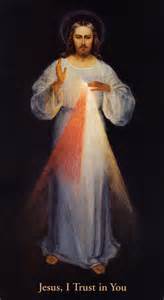
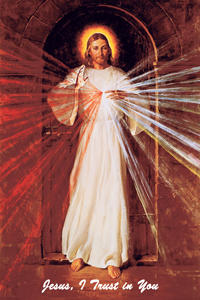
If you struggle with overcoming shame and self-doubt by accepting the mercy of Christ, you are not alone.  Despite Thomas’ disbelief, Jesus mercifully appeared to him that he might believe and receive the gift of peace and life.  In 1931 Jesus appeared to a humble Polish nun, St. Faustina, asking her to spread the message of His mercy anew.  Jesus lamented to Faustina that distrust on the part of souls caused His greatest suffering.  Jesus burns with love for us and sacrificed to save us, but we cannot be saved if we refuse His love and mercy.  He appeared to her many times after that, with a message of mercy He wanted made known.  He asked for an image to be painted of Him, with two rays coming forth from His side – white and red – representing the water and blood which poured out of side from the Cross, and the words “Jesus I Trust in You” beneath.  We receive Jesus’ redemptive mercy through the sacraments when we are washed in the waters of baptism and united to Him in the sacrament of His Body and Blood in the Eucharist.  He also asked that a Feast of Mercy be instituted, to be a day of extraordinary graces and an opportunity for us to make an act of trust and abandon so that He could be free to pour out His transformative love.

St. John Paul II perceived the truth and wisdom of Jesus’ message to St. Faustina.  He affirmed her sanctity, canonizing her in 2000, and established the requested Feast of Divine Mercy as the Sunday following Easter. St. John Paul II witnessed the misery and despair caused by atheism – promoted by communism in his youth, and consumerism in his older age.  He worked tirelessly to the very end, to exhort us to trust in Jesus.  Even when Parkinson’s reduced him to a wheel chair and frustrated his speech, he proclaimed the Good News that Christ loves us and can transform us.  I remember the last time I saw John Paul II.  I attended a Wednesday audience at St. Peter’s in 2002.  The formerly vibrant, strong, energetic, outdoorsy pope, had to be wheeled out on stage.  He personally delivered his message even though his words slurred making it difficult to understand and bits of drool forced their way down his mouth.  I remember thinking, “what courage, what humility, what determination!”  No matter how hard his body fought against him, John Paul II proclaimed the Gospel of Christ with conviction.  George Weigel fittingly titled JPII’s biography as “Witness to Hope”.  Even on his death bed, thousands gathered outside the window to his room and millions (including me) held vigil while viewing it on TV.

St. John Paul II knew our struggle to accept Christ’s mercy and did everything he could to make that merciful love felt.  Pope Francis also perceives this problem and called a Jubilee Year of Mercy to renew the message in a powerful and universal way.  In his book The Name of God is Mercy, Pope Francis responds to the question “Why, in your opinion, is humanity so in need of mercy?” by relating this observation:

“—  Because humanity is wounded, deeply wounded.  Either it does not know how to cure its wounds or it believes that it’s not possible to cure them…  Humanity needs mercy and compassion.  Pius XII, more than half a century ago, said that the tragedy of our age was that it had lost its sense of sin, the awareness of sin.  Today we add further to the tragedy by considering our illness, our sins, to be incurable, things that cannot be healed or forgiven.  We lack the actual concrete experience of mercy. The fragility of our era is this, too:  we don’t believe that there is a chance for redemption; for a hand to raise you up; for an embrace to save you, forgive you, pick you up, flood you with infinite, patient, indulgent love; to put you back on your feet.  We need mercy.”


Like Thomas, many of us need to see mercy to believe it.  Jesus desires that we believe without seeing. Yet, He graciously touches our lives anyway as He did for Thomas, condescending even further to meet our weakness.

Today, on this Feast of Divine Mercy, let us be strengthened by the witnesses of hope that Christ has sent to us.  Let us take a leap of faith and trust Christ with abandon.  He invites us to receive His mercy in the sacraments of Confession and Communion where His blood His poured out in our soul to free us from sin and free us to love. Inspired by this love, He calls us to share the Good News with others and practice the works of mercy that they too might see His mercy through His Mystical Body, and believe.

Consider:

  • When have you experienced mercy?
    • In prayer or at church, did you experience the peace of Christ?
    • After Confession, have you experienced the feeling of joy?
    • Have you experienced emotional or material support from someone when you were in need?
  • Do you find it difficult to accept help from others?  Why do you think that is?
  • Do you find it hard to accept unconditional love from Christ?  Do you struggle with feelings of needing to earn His love or be perfect before you can be saved?  Pray about what underlies that resistance:
    • Is it pride – you want to feel worthy of friendship with the Lord?
    • Is it despair – you don’t believe Christ can accept you as you are?
    • Is it past wounds that need healing – you have been denied mercy by others or your understanding of your dignity has been chipped away by abuse or patterns of toxic thinking.
  • Reflect on the freedom and joy of unconditional, merciful love.
  • Offer prayers of praise and thanksgiving if you have experienced this.
  • If you haven’t experienced it, consider the example of people you know who have this exchange of love, or Christians who surrender to it in their relationship with Christ.  What do you notice about how it affects their perspective, their choices, their demeanor, and the quality of their life?
  • Who might you extend merciful love to?  What relationships have too many conditions?

Make a Resolution (Practical Application):

  • Each day this week, pray the words “Jesus I Trust in You,” multiple times throughout the day.
  • Read a psalm of praise each day, strengthening and proclaiming your belief in God’s love for you. (Try beginning with Psalm 139!)
  • Resolve on one way to be a person of mercy each day.  Decide on who, what, when, and where you can be an encounter with Christ’s merciful love to someone.  Works of Mercy

Related Posts:

Divine Mercy…Can you believe it?  (Divine Mercy Sunday 2016 Post)

Tough, Gentle Mercy

Hope…When Least Expected

Love and Mercy In Superabundance

Behold, I Make All Things New

~ Written by Angela Lambert © 2017

* To receive these weekly posts automatically in your email just click the “follow” tab in the bottom right hand corner and enter your email address.


Behold, I Make All Things New…

by Angela Lambert

April 16th, 2017  Easter Sunday

 Gospel of John 20:1-9

On the first day of the week, Mary of Magdala came to the tomb early in the morning, while it was still dark, and saw the stone removed from the tomb. So she ran and went to Simon Peter and to the other disciple whom Jesus loved, and told them, “They have taken the Lord from the tomb, and we don’t know where they put him.” So Peter and the other disciple went out and came to the tomb. They both ran, but the other disciple ran faster than Peter and arrived at the tomb first; he bent down and saw the burial cloths there, but did not go in. When Simon Peter arrived after him, he went into the tomb and saw the burial cloths there, and the cloth that had covered his head, not with the burial cloths but rolled up in a separate place. Then the other disciple also went in, the one who had arrived at the tomb first, and he saw and believed. For they did not yet understand the Scripture that he had to rise from the dead.

Meditation Reflection:

Jesus is risen! Just when we think all is lost, He makes something new.  Jesus took His most beloved disciples by surprise, and He takes us by surprise as well.

“If anyone wishes to come after Me, he must deny himself, and take up his cross and follow Me. “For whoever wishes to save his life will lose it; but whoever loses his life for My sake will find it.” (MT 16:24-25)

Death scares us by its finality, and the shroud of the mysterious unknown that surrounds it.  Yet, in Christ we can be confident that with death comes resurrection.  Jesus had warned, and promised:

Truly, truly, I say to you, unless a grain of wheat falls into the earth and dies, it remains alone; but if it dies, it bears much fruit” (John 12:24).

Every change, even welcomed ones, require us to leave the old behind in order to embrace the new.  It takes courage to leave a familiar prison, to embrace an unfamiliar freedom.  Today, we celebrate the victory of Christ, Who provides both the courage and the freedom we desire.

God’s love for us exceeds all our expectations.  His intervention in our lives, especially when we surrender completely to His will, always surprises us.  If we trust in Jesus each day, allowing Him to lead, He will bring richness, joy, peace, and deep love to our lives in ways we might not have forseen.

Today we celebrate new life.   We celebrate God’s love.  We celebrate God’s power and His victory over sin and death.  We celebrate His victory in our own lives and within our own hearts.  Our confidence can be renewed, that no struggle or suffering can stop Christ.  If we place our trust Him, He will heal and transform us, putting to rest the old for good and making something new.  Today, we celebrate our fresh start.  During Lent, we endeavored to face our sins and bring our guilt before the Lord.  Now, we get to leave that shame in the past, crucified with Christ, and begin something new.

Revelation 21:3-5“I heard a loud voice from the throne saying, “Behold, God’s dwelling is with the human race.  He will dwell with them and they will be his people and God himself will always be with them as their God. He will wipe every tear from their eyes, and there shall be no more death or mourning, wailing or pain, for the old order has passed away.”

 The one who sat on the throne said, “Behold, I make all things new.”

Consider:

  • Consider Christ’s victories in your life.
    • How have you grown?
    • In what way do you experience greater freedom than before?
    • What were you afraid of before, that you no longer fear?
    • What virtues has Christ developed in you?
    • How has your love for God and others deepened?
  • How has God surprised you?
    • When did He give you something more than you asked for?
    • When did His plan lead you down an unexpected road?
    • When have you experienced His loving mercy when you didn’t think you should?
  • Reflect on Christ’s love for you and His strength.

Make a Resolution (Practical Application):

  • Resolve to begin anew today.  Make a concrete step to leave the old behind, no matter how comfortable it is, and allow Christ to lead you forward.

~ Written by Angela Lambert © 2017

* To receive these weekly posts automatically in your email just click the “follow” tab in the bottom right hand corner and enter your email address.


Attainable Unconditional Love…Gospel Meditation for the 6th Week of Easter

by Angela Lambert

sacred-heart-jesus-chambers-w600x810

May 1st, 2016; 6th Sunday of Easter

Gospel John 14:23-29

Jesus said to his disciples: “Whoever loves me will keep my word, and my Father will love him,
and we will come to him and make our dwelling with him. Whoever does not love me does not keep my words; yet the word you hear is not mine but that of the Father who sent me. “I have told you this while I am with you. The Advocate, the Holy Spirit, whom the Father will send in my name, will teach you everything and remind you of all that I told you. Peace I leave with you; my peace I give to you. Not as the world gives do I give it to you. Do not let your hearts be troubled or afraid. You heard me tell you, ‘I am going away and I will come back to you.’
If you loved me, you would rejoice that I am going to the Father; for the Father is greater than I.
And now I have told you this before it happens, so that when it happens you may believe.”

Meditation Reflection:

“As the world gives” tends to leave a person bitter and disillusioned.  It begins with promises of security and pleasure but lacks real permanency or loyalty.  After awhile we even struggle to relax during periods of calm, worrying that it won’t endure long.    Nothing seems to last and this causes anxiety in good times and in bad.

The philosopher Pascal lamented that man is but a feeble reed, easily brought to its end by the smallest ailment.  Most of our lives, he asserts, are spent trying to distract ourselves from the unsettling dread we feel when we take time to think about the purpose of our lives or the reality of our mortality.  He concludes that this universal experience supports the fact that happiness can be found in God alone:

“All men seek happiness. This is without exception…And yet after such a great number of years, no one without faith has reached the point to which all continually look. All complain, princes and subjects, noblemen and commoners, old and young, strong and weak, learned and ignorant, healthy and sick, of all countries, all times, all ages, and all conditions…A trial so long, so continuous, and so uniform, should certainly convince us of our inability to reach the good by our own efforts.” Pascal Pensees

Pope Francis observed that we have created an entire “throwaway culture,” marked by the readiness to discard even relationships and people as soon as they become inevitably difficult.  Consequently, he says, people begin to despair and make the assumption that they will never experience unconditional love.  Because they have never experienced mercy, they conclude that they never will.  As a result, they struggle in the darkness of sin, feeling alone and without the possibility of healing.

The fragility of our era is this,  too:  we don’t believe that there is a chance for redemption; for a hand to raise you up; for an embrace to save you, forgive you, pick you up, flood you with infinite, patient, indulgent love; to put you back on your feet.  We need mercy.” Pope Francis, The Name of God is Mercy

Christ however offers the peace every human soul longs for – permanent, deep, and healing.  Moreover, we do not have to chase after it like a greyhound that will never catch the rabbit.  Rather, Christ bestows His peace freely as a fruit of His unconditional love.  To receive this peace we merely need to enter into a relationship of love with Him. Relationship with Christ is merciful and enduring.  Jesus doesn’t throw us away when we become difficult or even when we betray Him. He persists in pursuing us, binding our wounds, and transforming our hearts. His greatest pain, he revealed to St. Faustina, is our lack of trust in Him.  To Mother Teresa, He said, “I thirst”; meaning He thirsts for our souls and relationship with us.

Relationships are risky – they require two people to both freely choose to love one another.  No matter how faithful, how loving, how sacrificial one partner is willing to be, if the other walks away the relationship ends.  Christ is the ultimate risk taker.  He loves us no matter what, even if that love is unrequited.  Moreover, the partner who walks away suffers the greatest loss because he or she closes himself off from the riches of the other partner’s love.  When we walk away from Christ, we close ourselves off from the love He longs to bestow upon us.

Jesus offers peace, love, and joy.  All we must do is live in a loving relationship with Christ.  To do this He says, we must follow His commands.  We live in a wounded world confused about authentic love.  Jesus teaches us through His commands and offers the perfect example for us to imitate.

We can chase after the illusion of love or embrace the God who is love.  If we choose the latter, God will dwell within us and our joy will be complete.  It feels more risky because it’s harder to see at first. Ultimately however, it’s the soundest reality and truest love.

Consider:

  • Jesus says, “Do not let your hearts be troubled or afraid.” What do you allow to cause you anxiety and fear?  Surrender each thing to the Lord and entrust your concerns to Him.
  • Reflect on the love of Christ. Consider the freedom and joy experienced by the saints in every generation for the last two thousand years.
  • Reflect on how Christ has blessed you over the course of your life. Then reflect on how He has blessed you this week. What needs has He met?  What has He conquered for you?  When have you felt the embrace of His love?  When have you experienced His beauty or glory?

Make a Resolution (Practical Application):

  • Examine your day each night or morning.  Thank God for His blessings.  Recognize when He came to your aid.  Identify when you failed to love Christ or your neighbor and ask for Jesus’ help to do better the next day.


~ Written by Angela Lambert © 2016

* To receive these weekly posts automatically in your email just click the “follow” tab in the bottom right hand corner and enter your email address.


Divine Mercy…Can you believe it?

by Angela Lambert

Divine Mercy

April 3rd, 2016; 2nd Sunday of Easter/ Divine Mercy Sunday

 Gospel John 20:19-31

On the evening of that first day of the week, when the doors were locked, where the disciples were, for fear of the Jews, Jesus came and stood in their midst and said to them, “Peace be with you.” When he had said this, he showed them his hands and his side. The disciples rejoiced when they saw the Lord. Jesus said to them again, “Peace be with you. As the Father has sent me, so I send you.” And when he had said this, he breathed on them and said to them, “Receive the Holy Spirit. Whose sins you forgive are forgiven them, and whose sins you retain are retained.” Thomas, called Didymus, one of the Twelve, was not with them when Jesus came. So the other disciples said to him, “We have seen the Lord.” But he said to them, “Unless I see the mark of the nails in his hands and put my finger into the nail marks and put my hand into his side, I will not believe.”

Now a week later his disciples were again inside and Thomas was with them. Jesus came, although the doors were locked, and stood in their midst and said, “Peace be with you.” Then he said to Thomas, “Put your finger here and see my hands, and bring your hand and put it into my side, and do not be unbelieving, but believe.” Thomas answered and said to him, “My Lord and my God!” Jesus said to him, “Have you come to believe because you have seen me? Blessed are those who have not seen and have believed.” Now Jesus did many other signs in the presence of his disciples that are not written in this book. But these are written that you may come to believe
that Jesus is the Christ, the Son of God, and that through this belief you may have life in his name.

Meditation Reflection:

We spend so much time and money distracting and soothing ourselves from regret for our mistakes and fear of our mortality.  Christ’s victory over sin and death opens the possibilities of a new beginning during this life and life eternal in the next.  The Risen Christ finds the apostles in fear and brings them Peace.  Thomas misses the opportunity for peace however because he refuses to believe his fellow apostles’ unanimous witness.  Despite his own witness of Jesus’ many miracles and the reliability of the disciples’ account, he refuses to receive Christ’s peace without seeing the healed wounds of the Lord for himself.  Christ would have been in His right to refuse such a demand but in His mercy He appears directly to Thomas so that his faith could be strengthened and he could receive the riches Christ had suffered to give to him.

Imagine the joy Jesus must have felt, having earned our salvation through such intense suffering, when He could then bestow upon His apostles the administration of His Kingdom which is none other than the forgiveness of sins.  Every mother knows the relief of holding her newborn in her arms after a long pregnancy and birth.  Jesus must have experienced a similar relief when He enjoyed our new life given through His loving sacrifice.

Pope St. John Paul II declared in 2000 at the canonization of St. Faustina, that today, the Sunday following Easter, be celebrated as Divine Mercy Sunday.  Christ had appeared to St. Faustina, a simple uneducated nun from Poland, in the 1930s and spoke with her about His great desire to bestow His mercy on us.  His message did not add anything new to the Gospel, however He re-emphasized His view to the modern world relaying to her His greatest pain which He identified as souls refusing to trust in His mercy.  In the Diary of St. Faustina, (recorded at the request of her spiritual director), she relays these words of Jesus to her regarding today:

I desire that priests proclaim this great mercy of Mine towards souls of sinners.  Let the sinner not be afraid to approach Me.  The flames of mercy are burning Me – clamoring to be spent; I want to pour them out upon these souls…Distrust on the part of souls is tearing at My insides.  The distrust of a chosen soul causes Me even greater pain; despite My inexhaustible love for them they do not trust Me.  Even My death is not enough for them.”  (par. 50)

Like Thomas, many of us struggle to trust Christ.  We fail to have confidence in Jesus’ ability to change our lives and renew our souls.  Using Pope Francis’ analogy, we treat Confession like a dry cleaner.  We can imagine being showered off but not truly changed.  In doing so we do not emulate humility but rather wastefulness.

Today we reflect on the mercy of Christ and ask that He increase our hope that we might trust in Him.  The devil steals our joy, but Christ came to give us joy to the full.  He not only forgives us, but enables us to live a supernatural life of virtue and peace. On the Feast of Mercy during the Jubilee of Mercy, God exhorts us in every way possible to receive His mercy, to give mercy, and to trust in Him.  Let us pray for the grace to surrender the myth of perfection in exchange for the truth of sanctifying love.

Consider:

  • Reflect on the joy Christ feels when He can shower upon us the mercy He worked so hard to earn for us. Consider the mystery of a mother or father’s love that takes pleasure in sacrificing for their children.
  • Do you struggle with perfectionism? Do you struggle to accept Christ’s help because you feel unworthy of His love if you make mistakes or fall to sins?  Do you feel you need to be holy all on your own?
    • Pelagianism, a heresy in the early Church, asserted that Christ came to set a good example for us but we have to live up to that example by our own efforts alone. The Church declared that the human will alone could not perfect itself but rather required supernatural grace.  Do you try to perfect yourself to feel worthy of Christ’s love, or do you accept your worthiness of His love and so the possibility of being made perfect by Him?
  • How much do you need to see to believe? What evidence has Christ given you already that you ignore?  What witness could you give to others about the reality of His presence?
  • Consider a time when you experienced the peace of Christ.

Make a Resolution (Practical Application):

  • Do one act of mercy for someone each day this week.
  • Do one act of mercy toward yourself each day this week.
  • Thank Christ each day for His gift of mercy. Make a gratitude list east day of His blessings.
  • Learn about St. Faustina and the Divine Mercy Chaplet, Image, and Feast Day.
  • Say the short prayer, “Jesus I Trust in You”, throughout the day.


~ Written by Angela Lambert © 2016

* To receive these weekly posts automatically in your email just click the “follow” tab in the bottom right hand corner and enter your email address.