Keeping Things in Perspective

by Angela Lambert

perspective

November 6th, 2016; 32nd Sunday in Ordinary Time

Gospel Luke 20:27-38

 Some Sadducees, those who deny that there is a resurrection, came forward and put this question to Jesus, saying, “Teacher, Moses wrote for us, If someone’s brother dies leaving a wife but no child, his brother must take the wife and raise up descendants for his brother. Now there were seven brothers; the first married a woman but died childless. Then the second and the third married her, and likewise all the seven died childless. Finally the woman also died. Now at the resurrection whose wife will that woman be? For all seven had been married to her.” Jesus said to them, “The children of this age marry and remarry; but those who are deemed worthy to attain to the coming age and to the resurrection of the dead neither marry nor are given in marriage. They can no longer die, for they are like angels; and they are the children of God because they are the ones who will rise. That the dead will rise even Moses made known in the passage about the bush, when he called out ‘Lord,’ the God of Abraham, the God of Isaac, and the God of Jacob; and he is not God of the dead, but of the living, for to him all are alive.”

Meditation Reflection:

As Christians, we profess a belief in life eternal with Christ in Heaven, yet we can sometimes operate in our daily lives forgetful of this mystery.  Like the Sadducees we ask Christ silly questions about heaven.  When we attach ourselves too much to earthly life, we fall into the trap of imagining heaven as merely an extension of the present but with a few more perks.

Jesus reminds us of the incomparable difference between our journey to God here and union with God there.  As St. Paul put it, “Eye has not seen and ear has not heard what God has ready for those who love Him” (I Corinthians 2:9).  Even the good things we experience here are merely a prelude to heaven.  Here we experience a taste, there we will enjoy the feast.

Jesus proposes to the Sadducees that contemplating the life of the angels can provide some insight into this mystery.  Like humans, angels are persons with rational intellects, free will, and the ability to love.  Unlike humans they do not have bodies, are neither male nor female, and do not procreate.  Each angel was individually created by God and is completely unique, so much so that some have compared it to being like different species from one another.  Because they live in eternity, their choices are permanent.  When God created them they each had the choice to either accept or reject God’s will for their life and His mission for them.  Some said yes to God’s will and others rejected it.  Those who rejected God’s will we call the fallen angels or demons.  Human persons have more than one moment to choose or reject God, but that space of time does have limits.  For us it ends when we die; at which moment our choice becomes permanent.

Consequently, the space of time in which we live on earth really is only a preparation for eternal life.  During this short period, we either choose to grow our love for God or develop a disdain for Him.  Only during our earthly lifespan can we develop and increase our capacity for God.  At the moment of death the opportunity for change ends.

In addition, it’s our chance to aid others in their chance of heaven, even in its most basic form – the beginning of life itself.  Whereas God created all of the angels at once, He creates human persons over a course of time and includes them in His work.  As a result, openness to life means openness to God’s creation of persons who will live eternally.  Those called to spiritual motherhood or fatherhood also contribute to this mystery as they minister to the birth and development of the child’s love for God which is necessary for true life.

The Sadducees’ challenge to Christ with the hypothetical situation of a woman married seven times, merely exposed their ignorance of God.  On earth marriage develops our capacity for love, self-gift, and sacrifice.  It brings new life into the world as well as caring for the development of each family member.  Marriage itself is not needed in heaven because no new life will be born there.  It is the eternal life of those who already exist.  Moreover, love will be perfected as we enjoy the perfect love of God and one another. The relationship of love experienced in marriage will remain a relationship of love in heaven.  However, the title of husband or wife will be eclipsed by the fullness of the title son or daughter of God and sister and brother in Christ.

As the liturgical year comes to a close (Advent marks the beginning of the “New Year” in the Church), we contemplate the end times and remember that this experience of earthly life will eventually come to an end.  We all get bogged down in our daily routine and anxious over matters that, if we considered our heavenly destination, shouldn’t really weigh us down.  Moreover, we could make better use of our limited time if we consider things from an eternal perspective.  This life is a preparation and an opportunity to participate in God’s work of spreading His kingdom.  The more souls that come to accept His will and love on earth, the more that will join the wedding feast of love in Heaven for eternity.

Consider:

  • How does a heavenly perspective change your earthly perspective?
  • When feeling discouraged, remember that this life is a journey not the destination. Endless, secure happiness cannot be found here but the work to attain it in heaven can.
  • Through prayer, identify one area where you struggle to accept God’s will over your own.
  • Each angel has a mission from God. You also have a mission.  How is God calling you to serve?
  • Consider first God’s vocational calling:
    • Is it to work for the salvation of your spouse through love and sacrifice and to possibly grow the human family by being open to life and to raising children in knowledge and love of the Lord?
    • Is it to administer the sacraments as a priest to bring eternal life to spiritual children?
    • Is it to spend your life in prayer and sacrifice for souls as a religious sister or brother?
    • Is it to devote your time and energy to God in a unique way as a single person, ready to do His will at every moment?
  • Consider next God’s occupational calling: How do you grow your love for God and develop it in others through your work?
    • Consider your special apostolate. Does God include you in His work of physical or emotional healing, protecting, providing, instruction of souls, encouragement, etc.?
    • How can you incorporate a heavenly perspective into your daily work? How do your daily activities and duties provide opportunities to detach from selfishness and develop greater love and compassion?  How might you help others to heaven through your work?

Make a Resolution (Practical Application):

  • Begin each day by writing down the tasks, challenges, and opportunities you anticipate that day.  Next to each, write one way it can be directed toward helping yourself and others to heaven.  For example, will it grow a virtue or minimize a vice if tackled with the help of grace?  Is it an opportunity to help others journey to God – either by giving them physical life, sustaining their life, healing, protecting, or developing an aspect of their soul?
  • Identify where your will is most at odds with God’s and do one thing each day to offset it. It could be a refusal or fear to do something God asks of you or an unwillingness to let go of something and trust God in the situation.
  • Pray the Serenity Prayer or the Suscipe of St. Ignatius each day. Click here for a pdf of the two prayrs: serenity-and-suscipe-prayers.

Related Posts:

Real Realism

The Glorious Reign of Christ Our King

The Sight of God… Gospel Meditation for the Feast of All Saints

~ Written by Angela Lambert © 2016

* To receive these weekly posts automatically in your email just click the “follow” tab in the bottom right hand corner and enter your email address.


Hope in Christ in Times of Darkness

by Angela Lambert

light-in-dark

October 9th, 2016 28th Sunday in Ordinary Time

Gospel Luke 17:11-19 NAB

As Jesus continued his journey to Jerusalem, he traveled through Samaria and Galilee. As he was entering a village, ten lepers met him. They stood at a distance from him and raised their voices, saying, “Jesus, Master! Have pity on us!” And when he saw them, he said, “Go show yourselves to the priests.” As they were going they were cleansed. And one of them, realizing he had been healed, returned, glorifying God in a loud voice; and he fell at the feet of Jesus and thanked him. He was a Samaritan. Jesus said in reply, “Ten were cleansed, were they not? Where are the other nine? Has none but this foreigner returned to give thanks to God?” Then he said to him, “Stand up and go; your faith has saved you.”

Meditation Reflection:

On His way to Jerusalem, where He would be rejected and killed for our sins, Jesus encountered ten lepers.  Since leprosy is highly contagious those who suffered with its physical harms additionally suffered from social isolation and rejection as well, banished to stay separate from healthy people.  When the lepers saw Jesus they called out because they could not approach in their condition.  Jesus’ instructions to show themselves to the priests required them to make an act of faith and hope.  Faith believes God’s words and hope acts upon those promises before necessarily seeing them.   At that time, if someone believed they had been healed from leprosy, they had to show themselves to the priests for examination before being cleared to reenter the community.  The lepers did not question Jesus’ command but did as He instructed before they had been healed.  They acted with hope based on belief in Jesus and His words.  As they walked in hope, they were cured.

The virtues of faith and hope direct one toward the highest of all virtues – charity.  Charity is the love of God above all things and love of neighbor out of love for God.  Only one leper demonstrated this higher virtue.  Jesus, who knows the hearts of all men, indicated that the man who returned had a deeper and more fruitful faith than the other nine.  Why?  He returned to Jesus to say thank you.

Consider how many of us quickly forget God’s miraculous work in our lives shortly after the crisis is over. We fall back into our regular routines and grow complacent or even complain about mundane things. Even worse, when the next crisis upsets our lives, we sometimes forget God’s power and fall to discouragement and negativity.  How can we avoid this common mistake?

A simple thank you and a disposition of gratitude express, as well as develop, the essential virtues of the spiritual life. Every day, and many times throughout the day, we have to choose our attitude.  We regularly experience the temptation to succumb to negativity, skepticism, disgust, and even despair.  Our present culture, especially during the current election cycle, presents seemingly constant negative and depressing messages.  From mainstream news to social media to conversations at work, the temptation to view the state of our nation in an overly negative light and give up in despair is constant.  However, with faith in Christ’s promise and hope in His transformative love, we can work through this crisis with the aid of the Holy Spirit and supernatural grace.

If everything depended on us alone, then discouragement and despair would be a sensible response. Take for example the Gospel passage.  The lepers would have considered their future to consist merely of painful physical deterioration and utter loneliness. Their lives took a completely new trajectory when they encountered Christ.  This surprising, unexpected event, liberated them their illness and gave them new hope for their future.

Propping up hope that man can save himself, then deepening discouragement at the realization that we can’t, are two common ways the devil tries to lead us away from the Lord.  We can benefit from doing a daily attitude check and remembering that when we encounter Christ, surprising, unexpected things can happen and change our lives and our world.

A favorite author of mine and Catholic historian, Christopher Dawson, wrote an essay entitled “The Six Ages of the Church” which gives me perspective for our current situation as a Church and as a nation.   In this essay he proposed that throughout the course of its 2000 year history, the Church has (and continues) to experience a cycle of three stages: crisis, response, and flourishing. With each challenge the Church experiences setbacks and loss.  In response, new apostolates arise and face the challenge resulting in a time of flourishing and achievement.  The next crisis sets the Church back again but new responses emerge again as well, and so on and so forth.

Viewing history from this perch inspires hope as we consider every age poses its challenges and Christians have felt the same confusion, disillusionment, and fear that we do.  Yet, in every age the Holy Spirit worked in the hearts of God’s people and inspired them with new ways to meet those challenges, adapt, and overcome.

light-2

This cycle applies to our individual lives as well.  We will encounter challenges that leave us feeling confused and helpless.  Nevertheless, if we call out to Jesus and walk forward in faith and hope, He will transform our lives and we will indeed flourish.  During times of peace, the challenge is to remain grateful and to return to the Lord, remembering that He is the source of our health.  We are always dependent on Him.  During times of crisis, we need to remember God’s power to transform, possibly even through us.  Thanksgiving, counting our blessings, and confidently surrendering to the Lord should be our daily response.  No matter what our crisis – individually, locally, or nationally – there are always things for which to be grateful and always hope for renewal.  As St. Paul says in 1 Thessalonians 5: 18 In all circumstances, give thanks,
for this is the will of God for you in Christ Jesus.”

Consider:

  • Reflect back on times that God helped you through a difficulty.  Consider the feelings you experienced beforehand and the joy afterward.
  • Consider how your faith, hope, and charity have grown over the years. How have your encounters with Christ in your daily life deepened your convictions?
  • When do you feel discouraged, pessimistic, and negative? What areas of your life are particularly vulnerable to this attitude?  How might you change your perspective?  What might you be overlooking or taking for granted in the situation?  How might you make a positive difference in it?
  • If you have children, consider what kind of formation they will need to be Christian leaders in our present culture. What virtues could you help them develop?  What persons or saints could you point them to for inspiration?  How might you nurture and develop their faith and their conscience?  How can you teach by example in your own life?

Make a Resolution (Practical Application):

  • Make a gratitude list. Each day reflect and thank God for three things from that day.
  • Do one thing this week to make a positive contribution or change where you are usually negative.
    • (examples: bring a treat for everyone to a meeting you would rather avoid and choose to smile; pray for our leaders each day this week; tell someone thank you each day for something; if you don’t like the music at church, volunteer your musical talents; if you don’t like what your spouse cooks for dinner, cook something yourself for everyone; if you keep having negative encounters with your child, proactively plan an activity or time together that will be positive; etc.)
  • Reduce discouraging messages this week (either via media or negative friends), and increase encouraging messages (read Scripture, listen to uplifting music or inspiring biographies).

*note of thanks to reader Carl Cadwallader for the topic suggestion of hope in Christ in times of darkness.

light-shine

~ Written by Angela Lambert © 2016

* To receive these weekly posts automatically in your email just click the “follow” tab in the bottom right hand corner and enter your email address.


Eyes Wide Open…Gospel Meditation for Sunday August 7th, 2016

by Angela Lambert


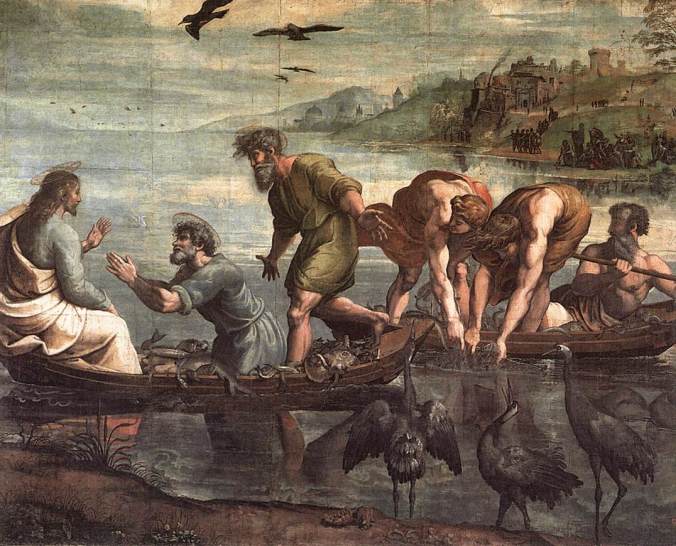
Raphael,_The_Miraculous_Draught_of_Fishes_(1515)

August 7th, 2016; 19th Sunday in Ordinary Time

Gospel of Luke 12:35-40 NAB

 “Jesus said to His disciples: ‘Gird your loins and light your lamps and be like servants who await their master’s return from a wedding, ready to open immediately when he comes and knocks.  Blessed are those servants whom the master finds vigilant on his arrival.  Amen, I say to you, he will gird himself, have them recline at table, and proceed to wait on them.  And should he come in the second or third watch and find them prepared in this way, blessed are those servants. Be sure of this: if the master of the house had known the hour when the thief was coming, he would not have let his house be broken into.  You also must be prepared, for at an hour you do not expect, the Son of Man will come.’”

Meditation Reflection:

Today Jesus emphasizes the need for disciples to be vigilant.  According to Wordbook, vigilant means to be “carefully observant or attentive; on the lookout for possible danger.”  Discipleship can suffer from the same waning of enthusiasm as any of our other noble tasks.  How many New Year’s diets end by February?  How many work-out videos get one viewing before gathering dust?  How many books are left only partially read?  How many friendships or relationships wither from slow neglect?  Jesus exhorts us to head off dangers to our faith by being aware and making efforts to protect ourselves from them.  Discipleship requires the same perseverance, effort, and watchfulness as anything else we hope to accomplish and maintain.

To achieve a goal of getting in shape, having someone to hold you accountable and work out with you will be necessary in order to avoid giving up early or choosing to watch tv instead of going to the gym.  Discipleship requires fellowship as well.  We need faith-filled friends to keep us accountable, inspire us to be better, and keep us in the habit of prayer and worship.  To achieve the goal of developing your mind through reading, you will need to choose a time, place, and frequency or it will never happen.  Forming a book club can also give that added boost of a deadline to motivate you.  Similarly, to grow nearer to Christ you will need to read Scripture regularly.  The same pitfalls apply here so being vigilant about sticking to a routine will be important and joining a bible study could also be motivating.

Wordbook’s synonym for vigilance illuminates the essence of discipleship as well: “open-eyed.” Here however, it’s our eyes of faith that we need to struggle to keep open.  In Hebrews 1:1, St. Paul defines faith as: “the assurance of things hoped for, the conviction of things not seen” (RSV).  He goes on to illustrate this with the example of Abraham who left for a land God promised without any sight of it beforehand – no map, no appraisal or inspection, no google images – only God’s word.  Moreover, after having received a son despite he and Sarah’s old age, Abraham was willing to sacrifice Isaac at God’s command. Imagine the paradox presented to Abraham.  God had promised Abraham many descendants through Isaac, and yet God also asked Abraham to sacrifice Isaac.  How could both of these things be true at the same time?  Abraham could find no assurance in natural reason or human experience and power.  Abraham merited the title Father of Faith by his response.  St. Paul relates, “[Abraham] considered that God was able to raise men even from the dead; hence, figuratively speaking, he did receive him back” (Hebrews 11:19 RSV).  Abraham had confidence that God is all-powerful and that God keeps His promises.  He didn’t limit God to our human experience.  He trusted God and proved his conviction when he risked everything to be obedient to the Lord.

How can we imitate the vigilant, open-eyed faith of Abraham?  Every day we need to open our eyes through prayer.  We need to ask for the gift of faith and trust.  We have to keep sharp through fellowship with faithful Christians and spiritual reading.  We need to deepen our trust through developing our relationship with Christ and receiving His grace in the sacraments.  Finally, many saints and spiritual writers suggest doing an examination of conscience every night.  Look back on the day and evaluate your choices.  When did you show love for God and for others?  What temptations did you overcome?  What inspirations of the Holy Spirit did you follow?  Secondly, where did you lean on your own understanding instead of God’s?  When did you relax into thinking and acting like a child of the world rather than a child of God?  What choices were motivated by a lack of faith, hope, or charity?  Ask God for forgiveness and an increase in grace to do better the next day.

Even if the end of the day doesn’t work for you, try to at least be more introspective throughout the day.  Jesus warned “Be sure of this, if the master of the house had known the hour when the thief was coming, he would not have let his house be broken into.”  Sins can make little strongholds in our soul if we are not vigilant in identifying them and putting them before the Lord for healing.  We never know when we will be attacked by temptation and sometimes it can be very subtle.  By developing a habit of staying alert we will be better able to avoid or overcome them.

Lastly, we never know when Jesus will come.  He too appears at surprising times in surprising ways.  If we live in faith, our hearts will be open to receive the gifts Christ desires to bestow on us.  We may have to take a step that makes no sense from a practical perspective unless God is real, all-powerful, and keeps His promises.  God will provide.  If therefore we seek first His kingdom, we can be assured that everything else will be taken care of (Matthew 6:33), and quite often in ways we could not have foreseen.

We have a tendency today to need to “see it to believe it.”  Although I still have to struggle to patiently trust God, at this point I have seen God act so many times in my life that I can say I believe it because I’ve seen it.  I’ve seen God provide over and over again, always in unexpected ways, and just at the right time.  He has done this at every level – family, relationships, work, finances, and health. Even though it’s easier to trust the wisdom of the world or our own strength which we can see right before us, we ought to vigilantly keep our eyes open to the wisdom and strength of our loving God which is far more reliable. He is coming, and it will be a day of great rejoicing we won’t want to miss!

Consider:

  •  Reflect on what practices have deepened your faith and helped you grow as a disciple of Christ?
  • Consider where you need further growth. Pray about how you could be more vigilant in that area.
  • Meditate on the words Jesus asked St. Faustina to have written below His image: “Jesus I trust in You.”
  • Reflect with gratitude on a time(s) when God came through for you in a surprising or powerful way.
  • Is there a part of your life that needs more trust in Jesus? Pray for an increase in faith and hope.

Make a Resolution (Practical Application):

  • Choose one way to be more vigilant in your faith life. Share your goal with someone who will encourage you and keep you accountable.
  • Pray the short prayer, “Jesus I trust in You” several times each day.
  • Pray Psalm 27 each day this week.


~ Written by Angela Lambert © 2016

* To receive these weekly posts automatically in your email just click the “follow” tab in the bottom right hand corner and enter your email address.


Holy Spirit, Help Me!…Gospel Meditation for the Feast of Pentecost

by Angela Lambert

20150913_234534244_iOS 20150920_001542533_iOS


May 15th, 2016; Pentecost

Gospel of John 14:15-16, 23b-26 NAB

Jesus said to his disciples: “If you love me, you will keep my commandments. And I will ask the Father, and he will give you another Advocate to be with you always. “Whoever loves me will keep my word, and my Father will love him, and we will come to him and make our dwelling with him. Those who do not love me do not keep my words; yet the word you hear is not mine but that of the Father who sent me. “I have told you this while I am with you. The Advocate, the Holy Spirit whom the Father will send in my name, will teach you everything and remind you of all that I told you.

 Meditation Reflection:

Christ’s greatest gift to us – the first fruit of all of His suffering, death, and resurrection, the first thing He asks the Father on our behalf from His throne in Heaven – is the indwelling of the Holy Spirit.  In the gift of the Holy Spirit we experience the mystery of the Trinity.  God is one and therefore the Spirit makes Christ present in our soul along with the Father.  At the same time, God is three Persons, and therefore Jesus explains that He must ascend to Heaven so that the Spirit may descend upon us.  Because Christ merited the forgiveness of our sins, His Spirit could begin His work of cleansing us and sanctifying us.  The Spirit applies the healing balm of Christ’s sacrifice to the wounds of our sins and works as fast as we will allow to help us regain spiritual health and freedom.

The Spirit is the primary mover in our conversion.  He prompts us to turn to God, provides the strength to actually make the conversion, sanctifies our souls with the grace of Baptism and the sacraments, then guides the ongoing process of union with Christ.  At the same time, the Spirit requires our cooperation.  We can hasten or hinder His work.  It reminds me of trying to clean the house with my three kids.  Granted, a mother has to come to peace with a certain level of mess if she ever wants to survive motherhood.  At the same time, order and cleanliness lend beauty and peace to a home.  During those times when I attempt to clean everything up and restore order to the house my kids’ cooperation (or lack there of) unavoidably determines the success and timeframe of my effort.  When my kids were little I felt like a gerbil running in it’s wheel.  As soon as I cleaned up one mess I would turn around to find my kids had made another.  If I stopped to read with them or take them outside where they couldn’t mess up the house, I couldn’t clean it up either.   As they got a little older I could finally kick them outside to play while I cleaned inside or “quarantine” off rooms one by one from the kids as they were cleaned.  Still, work was often slowed by needs for water or snacks, complaints and fighting, etc.  My kids are now at an age where these challenges remain but they are old enough to pitch in and help. Our life is busier with activities and the house gets neglected by our rush in and out.  As a result, on days where we are all home I will tell the kids “We all have to work together for one hour and we can get everything back in order.”  I remind them that I can no longer do it on my own and I need their help.  I am amazed at how the house can turn around so fast when everyone pitches in.  That’s not to say that I don’t take the opportunity to clean when they are all away from the house and I can get things done uninterruptedly.  However, I’ve learned that I have to employ their help on a more regular basis with the schedule of the new stage we’re in.

Similarly, the Holy Spirit can work in our souls to the extent that we cooperate.  When our faith is still immature we tend to act like little kids – creating one mess after another.  We may feel like progress is slow and that God isn’t doing very much.  However, we need to be honest about our expectations.  Every parent who has ever stayed at home with the kids knows how hard they work all day with nothing visible to show for it.  The other parent may leave for work and return with the house looking the same or worse than when they left.  However, what’s not reflected in that picture is the hundreds of other messes cleaned up constantly, the love and nurturing that took place, and the work at developing a child’s heart and mind.  The Spirit works in our souls in a similar way – drawing our minds up to God, comforting us in our sorrows, forming our conscience, encouraging us, and cleaning up our constant messes.

As we mature in the faith we become less of a hindrance to the Spirit and He works more efficiently in our soul.  As we become less attached to sin the messes slow (some) and the Spirit can make greater progress teaching us about Christ and deepening our love.

Finally, the mature Christian cooperates with the Holy Spirit in the work of following Christ and grows quickly in union with God.  The Sacrament of Confirmation celebrates this as we receive an increase in the Holy Spirit and prepare to be soldiers of Christ, contributors to the faith we have received.

It’s natural for children to depend on their parents more heavily when they are young.  It’s also an expectation that they contribute to family life as they get older.  The Holy Spirit makes us adopted sons and daughters of the Lord.  Through His indwelling we experience the nurturing necessary for sanctification and mature love of God.  Moreover, He blesses us with gifts to strengthen and nurture the faith of others.

May we all this Pentecost, reflect on the gracious work of God in our lives, that others may say of us as the crowd did in Acts 2:11“we hear them speaking in our own tongues of the mighty acts of God.”

Consider:

  • Consider your cooperation with the Holy Spirit.
    • Ask the Holy Spirit to show you habitual sins you struggle with and pray for His help to overcome them.
    • Consider how you can grow in virtue so that the Holy Spirit can act even more powerfully within you. The virtue of purity especially increases the Holy Spirit.
  • Christ calls the Holy Spirit the “Paraclete.” Consider each of the meanings of Paraclete – “advocate”, “intercessor”, “teacher, “helper”, “comforter”.
    • When has the Holy Spirit advocated on your behalf? Consider the sins you have been freed from because the Holy Spirit advocated for you before the Father.  Consider a time when you need the Holy Spirit to advocate for you in the heart of another person.
    • The Spirit intercedes for us and teaches us how to pray.  Thank the Holy Spirit for His prayers on your behalf.  Spend 5 minutes of silent prayer just letting the Holy Spirit speak for you to God.
    • Ask the Holy Spirit to open your mind and heart to God’s word in Scripture. Ask Him to help you see God’s truth in the events of your daily life.  Ask the Holy Spirit to reveal Christ to you.
    • Consider a time the Holy Spirit gave you profound peace when you were suffering and in pain. Invite the Holy Spirit to bring His comfort now and for the grace to turn to Him first.
  • Paul tells us in I Corinthians 12 that the Spirit bestows different gifts upon Christians for the upbuilding of the whole body. Read I Corinthinas 12 and pray about what your gift is and how you can put it at the service of Christ.

Make a Resolution (Practical Application):

  • Each day this week ask the Holy Spirit to open your eyes to the presence of Christ, to your sins, and to God’s will.
  • Determine one way to grow in the virtue of purity and do it each day this week.
  • Ask the Holy Spirit for the opportunity to serve God with the gifts He has given you. Then take that opportunity each day.
  • Each day, take a minute to praise God for His mighty works in your life.


~ Written by Angela Lambert © 2016

* To receive these weekly posts automatically in your email just click the “follow” tab in the bottom right hand corner and enter your email address.


Speaking Topics

We are professional speakers on topics related to developing a deeper relationship with God in your everyday life and learning more about our faith in a rich but accessible way.  

If you are looking for a speaker for your event reach out using the contact form below. We will connect with you to discuss the topic/theme you’d like to focus on, length and number of talks for the event, and your goals for audience you are serving.

Most often topics surface as a fruit of the Holy Spirit moving the hearts of the event coordinators and the retreat speakers. If you have a theme, Scripture verse, saint, or topic in mind, reach out and Angela and/or Michelle can put together tailored talks for the needs of your attendees. 

Below are examples of retreat talks from the past.

Contact us to speak at your event!

← Back

Thank you for your response. ✨

Angela:

Past Talks

          • Teaching: A Vocation within a vocation
          • Sisters in the Lord: : Reflecting on Our Identity and Connection as Women
          • Because of His Name: Finding Courage for Authentic Discipleship
          • Sanctification through Motherhood
  • Expressions of Feminine Self-Gift: Part I “Spiritual Motherhood”, Part II “Finding Beatitude”, Part III “Setting the World on Fire”
  • Having the Mindset of Mary
  • God’s Mighty Deeds
  • Prayer: What is it and Why does it Matter?
  • The Battle of Prayer: Working through Obstacles to Prayer
    bible
  • Christian Life in the World

Michelle bio picMichelle:

Past Talks:

    • Spiritual Motherhood
    • Having a Relationship with Jesus in Prayer
    • Contemplative Prayer
    • Being a Woman of God
pope francis motherhood

To Serve is to Reign…Gospel Meditation for Mark 9:30-37

by Angela Jendro

pope-francis-hugging-disabled-childpope-selfie

25th  Sunday in Ordinary Time

Gospel of Mark 9:30-37 NAB

Jesus and his disciples left from there and began a journey through Galilee, but he did not wish anyone to know about it. He was teaching his disciples and telling them, “The Son of Man is to be handed over to men and they will kill him, and three days after his death the Son of Man will rise.” But they did not understand the saying, and they were afraid to question him. They came to Capernaum and, once inside the house, he began to ask them, “What were you arguing about on the way?” But they remained silent. They had been discussing among themselves on the way who was the greatest. Then he sat down, called the Twelve, and said to them, “If anyone wishes to be first, he shall be the last of all and the servant of all.” Taking a child, he placed it in the their midst, and putting his arms around it, he said to them, “Whoever receives one child such as this in my name, receives me; and whoever receives me, receives not me but the One who sent me.”

Meditation Reflection:

This week, a student of mine asked me why a woman cannot be the pope. This question, and its underlying one – why a woman can’t be a priest, gets asked every year. I myself wrestled with this question when I was in college. I’m glad I pursued the answered because there are beautiful theological reasons. Oftentimes however, what we are really asking is why a woman can’t hold what seems to be the highest and most powerful position in the Church. This seems sexist, unfair, and therefore not Christ-like. The apostles in today’s passage viewed leadership in Christ’s kingdom in a similar way. They were arguing along the way about who would have the highest position, the most power and prestige. If Christ’s kingdom resembled worldly kingdoms that would have been an appropriate question. Jesus corrects them in a pointed way. As God says in Isaiah 55:8 “‘For My thoughts are not your thoughts, nor are your ways My ways.” Jesus had just taught the apostles that the Son of Man, the Messiah, would have to suffer and be killed. Rather than considering that they might be called to follow in His footsteps they wonder who will take leadership afterward. Jesus clarifies what He means by His kingdom. His words would have been surprising to the apostles and they are still surprising to us today.

It’s hard to truly believe Jesus when He teaches that “Whoever receives one child such as this in my name, receives me; and whoever receives me, receives not me but the One who sent me.” We would rather believe that discipleship means visible worldly greatness. The world looks at the papacy and sees position and power. However, beginning with Pope Gregory the Great in the 6th century, the title the pope has used for himself has been “the servant of the servants of God.” Discipleship of Christ means following the path of humility and self-sacrifice, the same path Christ took. What can be more humble and self-sacrificing than caring for a small child, especially if you are its mother or father? This path of humility is open to all with equal opportunity. Some might even say that women have an unequal and greater opportunity since we alone have the ability to carry in our wombs new life at its most vulnerable stage.

Every Christian can become a saint if he or she cooperates with the grace of Christ. The Second Vatican Council used the phrase “the universal call to holiness” to describe the doctrine that God desires everyone to have perfect union with Him. The opportunity is equal, it’s or response which is unequal. Teresa of Avila said that what prevents individuals from experiencing greater depths of prayer and union with God is a lack of generosity, courage, and humility.

I wasn’t asked by Christ to be pope, but I was asked to be a mother and a teacher. In the world’s eyes there is nothing notable about my position except that I maybe “wasted” some of my talents and opportunities that I could have used for wealth and power instead. My eyes are on a different prize though. I don’t want to be the one in power, I want to be Jesus’ disciple. All I ask is that He say to me one day, “Well done my good and faithful servant.” I may not be the servant of the servants of God, but I accept being the servant of those He “put His arm around” and placed in my care.

Consider:

  • Who has God placed in your care? How has this made you grow in humility?
  • When do you feel tempted by worldly prestige?
  • Consider how you prioritize your life. How might Christ re-order your priorities? Ask for His help and grace.

Make a Resolution (Practical Application):

  • Write out your priorities – look at where you spend your time and money. Pray about it each day this week and ask Christ to show you where you are doing well and where you need to change.
  • Pope Francis visited the U.S. for the world meeting of families. Read one of his speeches or homilies from when he was here. Consider how he shares Christ’s values as it pertains to family and discipleship. [A couple of my favorite sources: vatican.va (vatican website) and zenit.org (Catholic news agency)]

~ Written by Angela (Lambert) Jendro © 2015; updated  © 2018

* These Sunday meditations are intended to engage the heart and imagination in prayer and include a practical application (resolutions) to your daily life. In our presentation on prayer I offer a more detailed discussion of ways to pray with Scripture that can take 5 minutes, 15 minutes, or half an hour and vary in depth depending on your time-frame and prayer goals.