Eyes Wide Open

Ascension of Christ_ Getty Images

Ascension of Christ: Getty Images

by Angela M Jendro

 19th Sunday in Ordinary Time

Gospel of Luke 12:35-40 NAB

“Jesus said to His disciples: ‘Gird your loins and light your lamps and be like servants who await their master’s return from a wedding, ready to open immediately when he comes and knocks. Blessed are those servants whom the master finds vigilant on his arrival. Amen, I say to you, he will gird himself, have them recline at table, and proceed to wait on them. And should he come in the second or third watch and find them prepared in this way, blessed are those servants. Be sure of this: if the master of the house had known the hour when the thief was coming, he would not have let his house be broken into. You also must be prepared, for at an hour you do not expect, the Son of Man will come.’”

Meditation Reflection:

Jesus emphasized the need for disciples to be vigilant. According to Wordbook, vigilant means to be “carefully observant or attentive; on the lookout for possible danger.” Discipleship can suffer from the same waning of enthusiasm as any of our other noble goals. How many New Year’s diets or exercise plans end by February? How many books are left only partially read? How many friendships or relationships wither from slow neglect? Jesus exhorts us to head off dangers to our faith by being aware and making efforts to protect ourselves from them. Discipleship requires the same perseverance, effort, and watchfulness as anything else we hope to accomplish and maintain.

Similarly, the same strategies to keep healthy habits can be applied to discipleship. For instance, to achieve the goal of getting in shape, partnering with a friend for accountability will greatly increase your chance of success. Discipleship requires fellowship as well. We need faith-filled friends to keep us accountable, inspire us to be better, and keep us in the habit of prayer and worship. To achieve the goal of developing your mind through reading, you will need to choose a time, place, and frequency or it will never happen. Forming a book club can also provide that boost of a deadline to motivate you. Similarly, to grow nearer to Christ you will need to read Scripture regularly. The same pitfalls apply here so being vigilant about sticking to a routine will be important and joining a bible study could be motivating.

The synonym for vigilance illuminates the essence of discipleship as well: “open-eyed.” Thus, Jesus exhorts us to keep our eyes of faith open to judge things from the perspective of faith rather than the world. In Hebrews 1:1, St. Paul defines faith as: “the assurance of things hoped for, the conviction of things not seen” (RSV). He goes on to illustrate this with the example of Abraham who left for a land God promised without any sight of it beforehand – no map, no appraisal or inspection, no google images – only God’s word. Moreover, after having received a son despite he and Sarah’s old age, Abraham was willing to sacrifice Isaac at God’s command. Imagine the paradox presented to Abraham. God had promised Abraham many descendants through Isaac, and yet God also asked Abraham to sacrifice Isaac. How could both of these things be true at the same time? Abraham could find no assurance in natural reason or human experience and power. Abraham merited the title Father of Faith by his response. St. Paul relates, “[Abraham] considered that God was able to raise men even from the dead; hence, figuratively speaking, he did receive him back” (Hebrews 11:19 RSV). Abraham had confidence that God is all-powerful and that God keeps His promises. He didn’t limit God to our human experience. He trusted God and proved his conviction when he risked everything to be obedient to the Lord.

How can we imitate the vigilant, open-eyed faith of Abraham? Every day we need to open our eyes through prayer. We need to ask for the gift of faith and trust. We must stay sharp through fellowship with faithful Christians and spiritual reading. We need to deepen our trust through developing our relationship with Christ and receiving His grace in the sacraments. Finally, many saints and spiritual writers suggest doing an examination of conscience every night. Look back on the day and evaluate your choices. When did you show love for God and for others? What temptations did you overcome? What inspirations of the Holy Spirit did you follow? Secondly, where did you lean on your own understanding instead of God’s? When did you relax into thinking and acting like a child of the world rather than a child of God? What choices were motivated by a lack of faith, hope, or charity? Ask God for forgiveness and an increase in grace to do better the next day.

Even if the end of the day doesn’t work for you, try to at least be more introspective throughout the day. Jesus warned “Be sure of this, if the master of the house had known the hour when the thief was coming, he would not have let his house be broken into.” Sins can make little strongholds in our soul if we are not vigilant in identifying them and putting them before the Lord for healing. We never know when we will be attacked by temptation and sometimes it can be very subtle. By developing a habit of staying alert we will be better prepared to avoid or overcome them.

If we vigilantly live in faith, our hearts will be stay open to receive Christ and to respond to the promptings of His Spirit. A habit of holiness characteristic of the saints is their awareness of God’s presence and activity throughout their day. They also witness fidelity to the Spirit when called to serve in a way that makes no sense from a practical perspective unless God is real, all-powerful, and keeps His promises. Like Abraham, the Father of Faith, they have confidence that if God is asking then God will provide. If therefore we seek first His kingdom, we can be assured that everything else will be taken care of (Matthew 6:33), and quite often in ways we could not have foreseen.

Consider many people’s demand to “see it to believe it.” Yet, Jesus says “Come, and you will see” (John 1:39) Faith means walking with Christ, and in that walk your experience will confirm the faith you embarked upon. It entails some risk which is why encouragement from other believers’ experiences is an essential part of vigilance. I still struggle to patiently trust God, but at the same time I have seen God act so many times in my life that I can say I believe it because I’ve seen it. I just need to recall those times to strengthen my faith when it’s difficult. Consider how often in the Scriptures it exhorts the audience to recall a mighty work of God in the past to keep them strong in the present.

I have seen God provide over and again, always in unexpected ways, and just at the right time. He has done this at every level – family, relationships, work, finances, and health. Even though it’s easier to trust the wisdom of the world or our own strength which we can see right before us, we ought to vigilantly keep our eyes open to the wisdom and strength of our loving God which is far more reliable. He is coming, and it will be a day of great rejoicing we won’t want to miss!

Consider:

  • Reflect on what practices have deepened your faith and helped you grow as a disciple of Christ.
  • Consider where you need further growth. Pray about how you could be more vigilant in that area.
  • Meditate on the words Jesus told St. Faustina to have written below His image: “Jesus I trust in You.”
  • Reflect with gratitude on a time(s) when God came through for you in a surprising or powerful way.
  • Is there a part of your life that needs more trust in Jesus? Pray for an increase in faith and hope.

Make a Resolution (Practical Application):

  • Choose one way to be more vigilant in your faith life. Share your goal with someone who will encourage you and keep you accountable.
  • Pray the short prayer, “Jesus I trust in You” several times each day.
  • Pray Psalm 27 each day this week.

~ Written by Angela Jendro © 2019

Follow bar

Suggested Reading: 

Abandonment to Divine Providence by Fr. Jean Pierre de Caussade

33 Days to Merciful Love: by Fr. Michael Gaitley

Catholic Bible: Revised Standard Version, Compact Edition
 

How to Pray Like Christ

by Angela Jendro

Lord, teach us to pray

17th Sunday in Ordinary Time

Gospel of Luke 11:1-13 NAB

Jesus was praying in a certain place, and when he had finished, one of his disciples said to him, “Lord, teach us to pray just as John taught his disciples.” He said to them, “When you pray, say: Father, hallowed be your name, your kingdom come. Give us each day our daily bread and forgive us our sins for we ourselves forgive everyone in debt to us, and do not subject us to the final test.” And he said to them, “Suppose one of you has a friend to whom he goes at midnight and says, ‘Friend, lend me three loaves of bread, for a friend of mine has arrived at my house from a journey and I have nothing to offer him,’ and he says in reply from within, ‘Do not bother me; the door has already been locked and my children and I are already in bed. I cannot get up to give you anything.’ I tell you, if he does not get up to give the visitor the loaves because of their friendship, he will get up to give him whatever he needs because of his persistence. “And I tell you, ask and you will receive; seek and you will find; knock and the door will be opened to you. For everyone who asks, receives; and the one who seeks, finds; and to the one who knocks, the door will be opened. What father among you would hand his son a snake when he asks for a fish? Or hand him a scorpion when he asks for an egg? If you then, who are wicked, know how to give good gifts to your children, how much more will the Father in heaven give the Holy Spirit to those who ask him?”

Meditation Reflection:

Jesus Christ is the visible image of the invisible God. “Whoever has seen Me has seen the Father” (John 14:9), He says. In contrast, pagan gods tended to be images of the visible traits of humankind. Thus, they tended to mirror fallen man’s tendencies toward power, greed, lust, and narcissism. This answered man’s nagging questions about the origins of good and evil but it also left him subject to the whims of unpredictable powers. Be it Greek, Roman, or Babylonian gods, people tried to satiate the needs of their deities to avoid calamities and possibly manipulate them for favors. This explains, for instance, why the Romans did not care who a person worshipped provided they did their part to appease the Roman gods too and why they blamed Christians for the fall of Rome.

This appeasement of the gods should not be mistaken for relationship. It would be more apt to describe it as mutual manipulation. In some places it spiraled into superstition bordering on the obsessive-compulsive. For instance, some farmers would address one god for the successful tilling of soil, another for the planting of seed, another for the growth of the seed, another for the harvest, and so on. Even well after the West became Christianized this practice proved difficult to root out since it had become so ingrained in the culture and in fallen man’s temptation to control rather than to trust.

In modern times, we must fight the secular attempt to lump Christianity with other religions into one vague spirituality. The history of pagan worship differs in an absolute way from Judeo-Christian worship. God distinguished Himself from every other faith from the moment He revealed Himself to Abraham to the death and Resurrection of His Son and the sending of His Holy Spirit.

This difference is most notable in the way in which Christians pray. Rather than the “multiplying of words” to appease or manipulate, Christian prayer is grounded in familial relationship. When Jesus teaches the apostles to pray, He shares with them His praying togetherown prayer. Through Baptism we become incorporated into the Mystical Body of Christ, receiving adoption and becoming children of God (see John 1:12, Galatians 3:26, Romans 8:15-16). We cannot make ourselves someone’s child. The intimacy and privilege of familial relationship comes to us as a gift – either through nature or through the will of the parents by adoption. God has willfully adopted us, and Christ has made that possible through His sacrifice. Thus, He teaches us to address God as Father and enter into a relationship of sonship or daughterhood with the Lord. Consequently, we should begin prayer by simply meditating on the gift of God’s fatherhood and the reliable, selfless, pure love that it bestows. Even one moment of contemplation of this sublime gift moves our hearts to praise God and so Jesus instructs our next words to be “hallowed be Your Name.”

In pagan practices, calling on gods by name provided connection and sometimes a power over them. This can be true to some extent even in our human relationships. On the positive side, by knowing someone’s name a person can network, get in contact with him or her, or continue the relationship. On the negative side, it can also mean identity theft, access to personal information for the purpose of fraud, etc. Christ instructs His disciples to avoid these tendencies with God’s name. God desires authentic relationship. He knows every person’s hearts and He cannot be manipulated. Thus, Jesus warns, “Not everyone who says to me, ‘Lord, Lord,’ will enter the kingdom of heaven, but only the one who does the will of my Father in heaven (MT 7:21)

As a result, authentic relationship with God recognizes Him as the true Good and petitions: “Your kingdom come.” God ought to rule our lives, not the other way around. How does God do this? How does His kingdom of love, joy, and peace come to reign in our hearts? Through the gift of the Holy Spirit. Consequently, Jesus teaches us to ask God for our daily bread and explains directly after that God will always increase the Holy Spirit if we ask: “If you then, who are wicked, know how to give good gifts to your children, how much more will the Father in heaven give the Holy Spirit to those who ask him?”

Lastly, since sin and hatred are incompatible with God, Jesus tells us to give forgiveness and ask for forgiveness that we may be reconciled with God and one another. Moreover, He encourages us to ask in advance for God to spare us from temptations which would be too much for us and lead to abandoning Him.

Should you be afraid of God’s response (or lack thereof) if you pray, Jesus revealed how the Father views our prayers so we may approach Him with confidence. God is not an image of us, we are an image of Him. Even though we may be lazy or slow to help others, God is not. As a teenager I noticed the difference between my response to my parents requests and their response to mine. If asked to run to the store or help with a chore, I might drag my feet, feel too tired, grumble, or say no. If I needed something however, they always responded promptly and reliably. When I became a mother I finally understood this phenomenon. (Even while writing this I have been interrupted with requests from my kids a dozen times!) The difference was mature love. The love of good parents is an image of the love of God – self-less, prompt, generous, and happy to help. Hopefully as children of God, we can mature in our prayer so that our petitions move from the emotional demands of a toddler or elementary school child, to the respectful, humble, and grateful petition of an adult child confident in the relationship with his or her parents.

Consider:

  • Have you ever helped someone even when it was inconvenient and would rather have avoided it? Have you done things for your kids you never would have imagined doing before you had them?
  • Consider the difference between asking your mom or dad for help as opposed to a friend or neighbor. What things might you ask of them that you wouldn’t from the others?
  • Reflect on God’s love as that of a perfect Father. Reflect on the loving gratitude that should emanate from this relationship.
  • Where do you need God’s kingdom to come more in your life? Where do you need His peace, joy, justice, love…?
  • Do you forgive others as you would have God forgive you? Are there any grudges you need to let go? Are you quick to reconcile when someone apologizes?
  • Imagine how Christ must have looked while praying alone. Imagine you are one of the apostles, witnessing Him regularly taking time in solitude with the Lord. What do you think moved them so much that they asked Him to teach them to pray in the same way? Ask Christ to teach you to pray as He did too.
  • Pray for an increase in trust and a purified sight of God.

Make a Resolution (Practical Application):

  • Pray the Our Father slowly and meditatively each day this week.
  • Pray each day for an increase in trust.
    • Maybe repeat the words given to St. Faustina by Christ to have written under His image: “Jesus I Trust in You.”
    • Or pray the words of the father who brought his son possessed by a mute spirit to Christ (MT 9:22-24) “But if you can do anything, have compassion on us and help us.” Jesus said to him, “‘If you can!’ Everything is possible to one who has faith.” Then the boy’s father cried out, “I do believe, help my unbelief!”
  • Each day be forgiving toward someone in the same way you would like God to be patient and forgiving toward you.
    • Ideas: The person who cuts you off in traffic, the colleague who annoyingly one-ups you, the child who throws a tantrum or acts ungratefully, the spouse who forgets something or acts irritably, the fast food employee who messes up your order…

~ Written by Angela (Lambert) Jendro © 2016 edited © 2019

Follow bar

Recommended books on prayer:

(with links to Amazon)


Finding Beatitude: Part II of Expressions of Feminine Self-Gift

by Angela M Jendro

A summary from my talk last night with the amazing women of Devoted at St. John the Baptist Church. These women are so impressive and their prayerful, thoughtful ministry shows it! What a privilege to spend the evening with them!

Expressions of Feminine Self-Gift: Part II – Finding BeatitudeBeatitude

Paradoxically, we find self-fulfillment and happiness through self-gift (a theme often taught by Pope St. John Paul II)

The culture frames the questions of happiness around self assertion and individualism in pursuit of pleasure and status. Possessions and positions are limited so we must compete for them – against men and even against each other.

In contrast, when we open the Bible we find that God frames the questions completely differently. Creation began with self-gift: God’s gift of self – the Father, Son, and Holy Spirit to one another, and out of that love came creation. God made man and woman in relationship to one another and to God – one of free gift of self, in which they found fulfillment and joy.

Men and Women together image God. “So God created man in His own image, in the image of God He created him; male and female He created them” (Genesis 1:27).

Although equal in dignity and sharing a human nature, men and women are also different and each has unique gifts that complement one another. Therefore, their self-gift will proceed from their masculinity or femininity.

“The personal resources of femininity are certainly no less than the resources of masculinity: they are merely different.   Hence a woman, as well as a man, must understand her ‘fulfillment’ as a person, her dignity and vocation, on the basis of these resources, according to the richness of the femininity which she received on the day of creation and which she inherits as an expression of the ‘image and likeness of God’ that is specifically hers”

John Paul II.   On the Dignity and Vocation of Women Art.10


“In the Spirit of Christ, in fact, women can discover the entire meaning of their femininity and thus be disposed to making a ‘sincere gift of self’ to others, thereby finding themselves.”

John Paul II. On the Dignity and Vocation of Women Art.31

So how do we find happiness? Real happiness – the lasting kind, the beatitude kind. The kind that goes deep, is rich with meaning and honor, the legacy kind that makes you proud of who you are and who God made you to be?

happiness.jpg

The Beatitudes. In these we find the way of happiness.

They proceed one after another as the steps of conversion so we may, as St. Therese put it, ascend the mountain of God by descending the valley of humility. Which Jesus confirmed when He said that “whoever exalts himself will be humbled and whoever humble himself will be exalted” (Matthew 23:12)

Let’s not be afraid of words like self-gift and humility. In Christ we can be assured of the protection of our dignity, to never be taken advantage of, and only to be lifted up to the fullness of our individual personalities and calling.

Christ’s way of acting, the Gospel of His words and deeds, is a consistent protest against whatever offends the dignity of women. Consequently, the women who are close to Christ discover themselves in the truth which he ‘teaches’ and ‘does,’ even when this truth concerns their ‘sinfulness.’ They felt ‘liberated’ by this truth, restored to themselves they feel loved with ‘eternal love,’ with a love which finds direct expression in Christ himself.”

John Paul II. On the Dignity and Vocation of Women Art.15

St. Edith Stein asserted that women’s gifts include concern for the person and their development. This applies to every sphere and vocation.

So, to better guide and nurture others’ development, we need to first give some attention to our own by examining the steps of the beatitudes as they apply to us.

She craves for an unhampered development of her personality just as much as she does to help another toward that same goal.

St. Edith Stein. Woman.

The Beatitudes Step by Step     

  1. Blessed are the Poor in Spirit
  • Poverty includes dependence and vulnerability: Awareness of our need for God as His creatures and as His Children
  • Acknowledging our limitations: physically, emotionally, spiritually, etc. Asking for God’s help and asking for the help of others
  • Allowing God to work in His own time according to His Wisdom as our Father
“God’s response is certain, but it can’t be foreseen or programmed. Patience and sorrow have their place, but in the end even they are positive in that they perform a hidden work, create a desire, prepare an interior space for embracing the compensatory reward when it finally comes… God’s response will be so much more beautiful and rich when the wait has been long and trying. Among other things, interior poverty leads us to consent to the experience of not being masters of our time, unable to manipulate God or oblige Him to enter into our expectations or plans. His intervention remains free and sovereign, unforeseen. Having mastery of a time frame carries with it enormous human security and makes waiting easier. But there is no time frame into which God can be forced…The poverty of not being masters of our own time is hard to bear, but it calls us to a purer hope, one without human support. Little by little it engenders patience, humility, meekness, creating the desire that one day will bring fulfillment beyond all expectations.”

Jacques Philippe The Eight Doors of the Kingdom: Meditations on the Beatitudes

  • Instead of trying to be super-women, allowing ourselves to be daughters of God. This will then free us to become the best version of ourselves.
  1. Blessed are those who mourn for they shall be comforted
  • Realizing our limitations and gaining self-knowledge through poverty of spirit, we mourn over our own sinfulness but in a way that motivates change
  • Example: Friend telling me about how she hated family trips because her mom was so stressed out packing up – realizing that was me!

(go back to poverty of spirit – needed to acknowledge my limitations and ask for grace)

  • Seeing more of God’s blessings in my life, and mourning my sins as foolish or ungrateful
  1. Blessed are the meek for they shall inherit the land
    • Trust in God during difficulties and trials
    • The more we surrender our weakness to God, the more He conquers in us and it grows loyalty and Holy Confidence.
    • Meekness is not weakness. It’s a brave, fierce, strength founded on the proven character of God. Confident that Christ will walk with you and His grace will transform you.
St. Paul: But [the Lord] said to Me,My grace is sufficient for you, for My power is made perfect in weakness.” I will all the more gladly boast of my weaknesses, that the power of Christ may rest upon me. For the sake of Christ, then, I am content with weaknesses, insults, hardships, persecutions, and calamities; for when I am weak, then I am strong.” 2 Corinthians 12:9
  1. Blessed are those who hunger and thirst for righteousness for they shall be satisfiedlittle flower.JPG
  • It gets exciting! Here’s the joy of the Gospel, the zeal to witness Christ’s deeds, to battle for His kingdom
  • Begin with prayer because you want to. Going to Mass because it’s a source of strength and peace. Reading the lives of saints because they inspire you and you want to be the best version of yourself.
  • Choose to be silent when tempted to detract; refrain from gossip
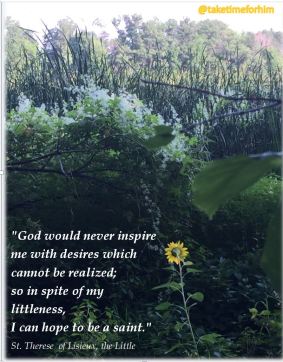
  • St Therese, “though I am little, I can still hope to be a saint”
  1. Blessed are the merciful for they shall receive mercy.
  • Having received mercy, you want to pay it forward
  • Forgiving others and bearing wrongs patiently – because God has done the same for you
  • Works of mercy because you realize your own dependence on God’s blessings and the help of others.
  • Examples:
    • I know what it’s like to be a perfectionist, so I want to help students overcome that slavery too
    • I know how easy it is to be overwhelmed as a mom, so I want to encourage other moms too
    • I appreciate the spiritual authors who have encouraged me, so I want to write what I can as well
    • My parents and teachers were patient with me while I was maturing, so I want to be patient with my kids and students as they mature
    • My husband is compassionate with my faults and quirks, so I want to cut him slack when I have the opportunity
  1. Blessed are the pure of heart for they shall see God
  • Love God above all things
  • The pure of heart aren’t distracted by illusions, they have come to recognize God in His works and they begin to see Him everywhere and in everything and every situation.
  • Purity of Heart à Sight of God à essence of Heaven’s joy
  1. Blessed are the peacemakers for they shall be called sons of God.
  • Deep peace from union with God
  • Extend that peace to others
  • How to be Peacemakers: Insights from St. Edith Stein
“Many of the best women are almost overwhelmed by the double burden of family duties and professional life – or often simply of only gainful employment. Always on the go, they are harassed, nervous, and irritable. Where are they to get the needed inner peace and cheerfulness in order to offer stability, support, and guidance to others?”

“Only by the power of grace… Whoever wants to preserve [divine]life continually within herself must nourish it constantly from the source whence it flows without end – from the holy sacraments, above all from the sacrament of love.”

“When we entrust all the troubles of our earthly existence confidently to the divine heart, we are relieved of them. Then our souls if free to participate in the divine life…it has a liberating power in itself; it lessens the weight of our earthly concerns and grants us a bit of eternity even in this finitude, a reflection of beatitude, a transformation into light.”

  1. Blessed are you when you are persecuted on my account, your reward is great in heaven.
  • Enduring criticism or exclusion because of living out your faith
  • Making sacrifices for your faith
  • It’s verification that you are living an authentically Christian life! You are a true disciple! Congrats!!!

If the world hates you, know that it has hated me before it hated you. If you were of the world, the world would love its own.” (Jn 15: 18)

  • Examples/Sounds like this:
    • “Mom, you are the ONLY parent that…
    • C’mon, we’re just socializing. If you don’t participate in these jokes and gossip you’ll seem antisocial and won’t get ahead at work
  • G.K. Chesterton: “The Catholic Church hasn’t been tried and found wanting, it’s been found hard and left untried.” Living in Christ, He shines through you. You become a witness of the reality of grace. No one can say that the Church’s teachings are unrealistic, because you show that they can be done with grace. The lies of the world are exposed in your joy contrasted with their sadness.

Jesus steps for conversion lead to an experience of beatitude: the child-like freedom that comes from depending on God our loving Father, mourning our sins and surrendering them to His Son for redemption, the strength of conviction in our trust that the Holy Spirit will enable us to fulfill our mission, the mercy and peace we extend in our homes and workplaces which spur us on with zeal. Then we will be free for the total self-gift that results in self-fulfillment.

Follow bar

Links to the books referenced in this talk:


©Angela M Jendro 2019


Experiencing Jesus Christ & Receptivity to His Friendship

by Angela M. Jendro

Jesus sends the 12

14th Sunday in Ordinary Time

Gospel Lk 10:1-12, 17-20

At that time the Lord appointed seventy-two others whom he sent ahead of him in pairs to every town and place he intended to visit. He said to them, “The harvest is abundant but the laborers are few; so ask the master of the harvest to send out laborers for his harvest. Go on your way; behold, I am sending you like lambs among wolves. Carry no money bag, no sack, no sandals; and greet no one along the way. Into whatever house you enter, first say, ‘Peace to this household.’ If a peaceful person lives there, your peace will rest on him; but if not, it will return to you. Stay in the same house and eat and drink what is offered to you, for the laborer deserves his payment. Do not move about from one house to another. Whatever town you enter and they welcome you, eat what is set before you, cure the sick in it and say to them, ‘The kingdom of God is at hand for you.’ Whatever town you enter and they do not receive you, go out into the streets and say, ‘The dust of your town that clings to our feet, even that we shake off against you.’ Yet know this: the kingdom of God is at hand. I tell you, it will be more tolerable for Sodom on that day than for that town.”

The seventy-two returned rejoicing, and said, “Lord, even the demons are subject to us because of your name.” Jesus said, “I have observed Satan fall like lightning from the sky. Behold, I have given you the power to ‘tread upon serpents’ and scorpions and upon the full force of the enemy and nothing will harm you. Nevertheless, do not rejoice because the spirits are subject to you, but rejoice because your names are written in heaven.”

Meditation Reflection:

Jesus desires personal relationship with each human person. At the same time, no man is an island, and therefore Jesus encounters persons within the context of their lives. Our experiences and choices, together with our relationships with others, form the framework through which we receive and respond to Christ.

Our personal encounter with Christ may begin with a personally appointed disciple of His, sent ahead of Him. For some, a certain preparation may be needed before Christ’s visit will be fruitful. Someone whose heart is hardened toward God by experiences of pain or falsehood may need their demons cast out so Christ can fully enter. In some cases, this happens in a literal way through the name of Jesus and the authority granted by Him. In other cases, it happens in a more indirect and organic way, through the softening of a heart by the experience of Christian love, the opening of a mind through seeds of truth, or the reception of mercy in a time of need. An otherwise weak soul, may find the courage to say yes to Christ after being inspired by the bravery of another. A proud soul may see the beauty of meekness through the gentle joy of colleague. Our perception of God can be obscured by our experiences in life – either of prosperity or pain – but it can also be clarified by our experiences in life, especially through encounters with other Christians.

Christ call us to proclaim the kingdom of God to others and He equips us with the supernatural power and grace to do so. The good news of the Lord’s presence and mercy is proclaimed through a myriad of ways and tailored to the individuals who will receive it. God may call you to witness through your example, through your choices, through works of mercy, through your patience and kindness, through your prayers and sacrifices, or through words of teaching, encouragement, conviction, or comfort.

Conversions continue to take place even in surprising places. Peter Leithart, writer for First Things magazine, offers one such example in his article “Islamicization of Europe or Christianization of Islam?” He reports that many Muslim refugees migrating into Europe from Iraq, Afghanistan, Pakistan, and central Asia have been converting to Christianity and requesting baptism by the droves. The article cites a variety of reasons for this phenomena, but at the core of it, the conversions are credited to individuals in need having encountered the Gospel through the Christians who aided them. This Christian love sparked openness to Christianity and set on fire a desire for Christ.

The kingdom of God, which is none other than union with God, begins here on earth at the crucial crossroads of the human will. The seventy-two sent out by Christ recounted their exhilaration at being able to cast out demons. The devil seems oppressively powerful, yet at the simple name of Jesus, he is conquered. Unfortunately, a simple “no” by the human will can shut Jesus out. Relationship requires the reciprocal good will of two people. Christ loves us, but if we do not love Him in return there can be no friendship. As Christian disciples, we must pray to be His missionaries laboring in His harvest and take care to not turn others away by their encounter with us. We should also not become discouraged if even after great feats people in our lives still reject God.  Ultimately, that is between them and God. The stakes are high – heaven! – so let’s pray that we can open hearts to receive the Lord for all of eternity.

Consider:

  • Consider how Christ has sent messengers ahead of Him to you.
    • Who brought to you His truth, sacraments, love, or compassion?
    • How did it increase your faith or clarify your understanding of Christ?
  • Consider how you are a messenger of Christ – to your family, your colleagues, your neighbors, and your friends.
    • In what ways to you demonstrate Christ’s love and truth to them?
    • In what ways could you improve your Christian witness?
  • Reflect on your receptivity. How open are you to the Word of God in Scripture, through His Church, through others? What hinders you and what helps you?
  • Reflect on Christian evangelization occurring in Europe by reading Peter Leithart’s article

Make a Resolution (Practical Application):

  • Each day prayerfully and intentionally decide on one person with whom you will share Christ. Prayerfully decide how and when you will do it. (e.g. Saying a kind word to someone who annoys you at work, praying with your children together before bed, doing something loving toward your spouse, forgiving someone in need of mercy, etc.)
  • Reach out to someone who has been instrumental in your own conversion and thank him or her. It could be as simple as an email, text, hand-written note, or phone call.


~ Written by Angela (Lambert) Jendro © 2016; edited edition © 2019

* To receive these weekly posts automatically in your email just click the “follow” tab in the bottom right hand corner and enter your email address.


Excuses, Excuses…Be Brave! Be Determined!

13th Sunday in Ordinary Time

Gospel of Luke 9:51-62

When the days for Jesus’ being taken up were fulfilled, he resolutely determined to journey to Jerusalem, and he sent messengers ahead of him. On the way they entered a Samaritan village to prepare for his reception there, but they would not welcome him because the destination of his journey was Jerusalem. When the disciples James and John saw this they asked, “Lord, do you want us to call down fire from heaven to consume them?” Jesus turned and rebuked them, and they journeyed to another village. As they were proceeding on their journey someone said to him, “I will follow you wherever you go.” Jesus answered him, “Foxes have dens and birds of the sky have nests, but the Son of Man has nowhere to rest his head.” And to another he said, “Follow me.” But he replied, “Lord, let me go first and bury my father.” But he answered him, “Let the dead bury their dead. But you, go and proclaim the kingdom of God.” And another said, “I will follow you, Lord, but first let me say farewell to my family at home.” To him Jesus said, “No one who sets a hand to the plow and looks to what was left behind is fit for the kingdom of God.”

Meditation Reflection:

Being a Christian means following Christ, wherever and whenever He goes. Full discipleship requires 100% commitment, not the made-to-order or pick and choose buffet we are accustomed to in our culture. Consider Jesus’ own example. He needed to journey to Jerusalem. Notice the attitude He chose – resolution and determination. Followers of Christ need the same resolution and determination. In fact, St. Teresa of Avila, the great Spanish mystic and doctor of the Church, emphasized repeatedly the need for determination in order to advance in the spiritual life.

As Jesus journeyed, doing the Father’s will, those He encountered each had an opportunity to join Him. The Samaritans received messengers from Christ but rejected the Lord before He even arrived when they learned accepting Christ meant surrendering their bitterness toward Jerusalem.

The next person took the initiative to seek Jesus and requested to be in His company. Jesus, who knows the hearts of each one of us, warned the man that being near to Christ would bring spiritual security and comfort but not necessarily the feeling of physical security and comfort.

The next two men Jesus invited to follow Him, but both requested to do something else first. Their requests seem valid and even noble. In fact, burying the dead is a corporal work of mercy and honoring your father and mother is the 4th commandment. Is Jesus asking us to neglect our duties? Does Christian discipleship excuse neglecting our families? Does God contradict Himself? No. Do we sometimes rationalize our cowardice or weakness by twisting God’s commands against Him? Yes. Many of us (including myself!), often excuse our lack of time for prayer by pitting it against the active life of charity. It sounds something like this: “I don’t have time to sit and pray because I need to do…which God would want me to do.” A practical example would be, “I could ‘just’ sit and pray, or work an extra hour to provide for my family, or do a load of laundry and dishes, or run an errand. God wants me to care for my family, that is my prayer.”

Sometimes that might be the case. But, in truth, there’s usually time for both. In addition, without prayer, even our loving activities can tend to be more self-loving rather than other-loving. Jesus knew the hearts of the two men who wanted to return to their families before following Him. Rather than contradicting His command that we love one another, especially our families, He may have been calling them out on their rationalizations. It reminds me of when I gather my kids for family prayer. My two boys will often try to get out of it by appealing to my earlier request that they get outside for awhile or they were just about to start a chore I had assigned. In reality, they had time for both those things before and after prayer, it just sounds like a better excuse.

Let’s face it, we have an inner desire for God and we may even have authentic zeal for discipleship, but we also struggle with attachments that hold us back. The good news is that if we open ourselves up to Christ in prayer, He will reveal those attachments to us and provide the grace to overcome them. It requires resolution, determination, and being honest with ourselves, but with God all things are possible.

Consider:

  • Like the Samaritans, how many of us hold on to bitterness, anger, or un-forgiveness? Prayerfully ask Christ to reveal if any of these are holding you back from following Him. Pray for the grace to surrender it to the Lord.
  • Like the man who proclaimed he would follow Christ wherever He goes, consider why you are a Christian. Is your love for the Lord intermixed with some self-love as well? Do you complain when you encounter trials? Are you impatient or upset when you experience discomfort?
  • What rationalizations do you use to delay responding to Christ or to responding more generously? What rationalizations have you overcome on your spiritual journey?   How has that experience strengthened your will to follow the Lord?
  • A favorite book of mine called “The Fire Within” by Fr. Thomas Dubay provides some great steps for identifying and overcoming attachments. Prayerfully read my summary of Fr. Dubay’s steps and see if you can identify one attachment and make a plan for rooting it out: identifying attachments

Make a Resolution (Practical Application):

  • Each day this week thank God for one deterrent He has helped you overcome or from which He has freed you, and invite Him to reveal and free you from a current hindrance you may or may not realize you have.
  • Pray for an increase in resolution and determination. Choose one concrete thing you can do this week to apply it. (e.g. pray 15 minutes each morning or evening, say something kind to your spouse when you want to say something critical, hug your child when you want to throw your hands up in exasperation, choose a daily Mass to attend and do what it takes to get there, go to Confession…)
  • Using Fr. Dubay’s steps, identify a current attachment and do one thing each day to root it out.identifying attachments


~ Written by Angela Lambert Jendro © 2016; edited and updated © 2019

* To receive these weekly posts automatically in your email just click the “follow” tab in the bottom right hand corner and enter your email address.


New and Improved: This Upgrade is Worth the Price!

5th Sunday in Easter

Gospel of John 13: 31-33A; 34-35 NAB

When Judas had left them, Jesus said, “Now is the Son of Man glorified, and God is glorified in him. If God is glorified in him, God will also glorify him in himself, and God will glorify him at once. My children, I will be with you only a little while longer. I give you a new commandment: love one another. As I have loved you, so you also should love one another. This is how all will know that you are my disciples, if you have love for one another.”

Meditation Reflection:

As consumers we regularly hear the pitch “new and improved” for every product from toothpaste to vehicles. Oftentimes we consider this prospective as something positive. Every time Apple comes out with a new iPhone my kids work to convince me of its superiority over the one I already own. However, although new cars, new appliances, or new clothes can seem appealing, learning a new technology seems more work than it’s worth unless the benefits are considerable. This attitude spills over into my spiritual life as well. I appreciate when God simply keeps things running smoothly as they are. When offered something new, though it sounds exciting, it also sounds like a lot of work. “New” has the allure of surprise and opportunity, but it also has the anxiety of unfamiliarity, making mistakes during the learning process, discomfort of discerning how to act in new situations, and the fear of the unknown. Today’s Gospel recounts the inauguration of the “New” Covenant. A savvy consumer would ask “how is it new” and “is it worth the price”?

During the Last Supper, Christ’s Passion began with Judas’ betrayal. Once Judas left to execute his plans, Jesus spoke to the other disciples about the New Covenant being inaugurated that night. A covenant refers to a solemn agreement between God and man, usually sealed in the blood of a sacrifice. God had made these types of agreements in the past through Noah, Abraham, Moses, and David. His New Covenant however, on the night the Jews celebrated the Passover, was mediated through His Son, Who would also be the sacrificial lamb and Whose blood would bind us to the Father. Moreover, whereas God’s covenant with Abraham extended to Abraham’s family, the covenant with Moses extended to a nation, and the covenant with David extended to a kingdom, the New Covenant extended to all of humanity.

A marketing executive might take issue with Christ’s assertion that He gives a “new” commandment however when He instructed us to love one another. Jews treasured a passage in Deuteronomy as the heart of the Old Covenant. It’s called the Shema (see Deuteronomy 6:4-9). Jesus Himself referenced it in His teaching:

And one of the scribes came up and heard them disputing with one another, and seeing that he answered them well, asked him, “Which commandment is the most important of all?” Jesus answered, “The most important is, ‘Hear, O Israel: The Lord our God, the Lord is one. And you shall love the Lord your God with all your heart and with all your soul and with all your mind and with all your strength.’ The second is this: ‘You shall love your neighbor as yourself.’ There is no other commandment greater than these. Mark 12:28–30

Jesus’ “new” commandment sounds very similar – to love. Is this false advertising? The difference may seem slight on the surface but upon closer investigation it transcends the old model to a remarkable degree. Jesus did not eliminate the old, but he did present a new and improved model. In the new version Christ added the stipulation, “As I have loved you, so you also should love one another.” Christ set a new standard for love of God and neighbor – humble service marked by suffering and sacrifice. Put that on a billboard. Any buyers?

A faith that’s merely a get rich quick scheme – prosperity, reward, and status at no cost – is not the Gospel. Consider Jesus’ difficult teachings about discipleship:

Then he said to all, “If anyone wishes to come after me, he must deny himself and take up his cross daily and follow me. For whoever wishes to save his life will lose it, but whoever loses his life for my sake will save it.” Luke 9:23-24

The early Church verified this teaching by their lives and their instructions:

“[Paul and Barnabas] strengthened the spirits of the disciples and exhorted them to persevere in the faith, saying, “It is necessary for us to undergo many hardships to enter the kingdom of God.” Acts 14:22

Why does it have to be so hard? Human nature. As much as we idolize change in our culture, in practice we avoid it. Change as simple as healthy living often gets abandoned because of the sacrifice and discomfort one experiences in the beginning. Those who have made the change can attest that they feel more energetic, happier, and it would be painful to go back to their bad habits. However one can only experience this feeling if one perseveres through the initial pain of re-habituating one’s body and one’s lifestyle. Similarly, to love as Christ loved will feel uncomfortable and painful in the beginning. It means re-habituating one’s whole lifestyle – the measuring standard must be readjusted, and priorities re-evaluated. Many give up after a short while. However, those who persevere can attest that this new lifestyle makes one feel deeper joy, peace, and energy than before and it would be painful to return to their former habits.

At present, human free will presents a tension between sin and grace, which means we suffer – both interiorly as we wrestle between love of self and love of God, and exteriorly as we suffer from the sinful choices of ourselves and others.

Christ’s Paschal Mystery offers hope in that it did not end on the Cross but rather at the Resurrection and Ascension into Heaven. Eventually, our conversion will be complete, and we will have interior peace. At some point this world will come to an end and those who choose love will spend eternity together with each other and with God.

Oftentimes I just want God to restore things to how they used to be, much like the Jews, who expected God would save them by restoring Israel to its former glory as a kingdom under David’s reign. God’s love exceeds our imagination though, and most of the time His answer is not to go back, but to offer something new and improved. St. John recounts in the book of Revelation:

Then I, John, saw a new heaven and a new earth. The former heaven and the former earth had passed away…I heard a loud voice from the throne saying, “Behold, God’s dwelling is with the human race. He will dwell with them and they will be his people and God himself will always be with them as their God. He will wipe every tear from their eyes, and there shall be no more death or mourning, wailing or pain, for the old order has passed away.” The One who sat on the throne said, “Behold, I make all things new.” (see Revelation 21:1-5)

We can be confident that the time, discomfort, and sacrifice for this upgrade will be worth the effort, and Christ will be there to help. It will be new, surprising, beyond imagining, and exceed all expectations.

Consider:

  • Recall a time when you kicked a bad habit or developed a healthy habit. How long did it take? How did it feel afterward?
  • What healthy spiritual habits have you developed? Consider the work it took to establish them and the fruits you enjoy as a result.
  • What spiritual habits do you need to develop? How might you begin work on one today?
  • Consider what it means to love as Christ loved. In each circumstance below, can you think of a time that you either extended that kind of love to another or received that kind of love from someone else?
    • Humble service
    • Self-sacrifice
    • Suffering for someone’s good
    • Rejoicing at elevating someone else
    • Forgiveness and mercy, even toward an enemy
    • Patience and kindness toward someone who aggravates you

Make a Resolution (Practical Application):

  • Exchange a bad spiritual habit for a good spiritual habit. Make a plan: decide which habit to address and how to develop it. When, where, and how will you achieve it? Remember to pray for grace as you do! Transformation can only take place by the power of the Holy Spirit.
  • Opportunities to love as Christ loved are present every day in family life.
    • Intentionally practice Christ-like love toward family members today.
    • Spend some time each day reading a little bit of Pope Francis’ apostolic exhortationThe Joy of Love, especially the chapters pertaining to family life.


~ Written by Angela Jendro © 2019

* To receive these weekly posts automatically in your email just click the “follow” tab in the bottom right hand corner and enter your email address.


Behold, I Make All Things New

by Angela Jendro  Excerpt from Lenten Journey: Through the Desert to the Eternal 20190328_204247219_iOSSpring 

Easter Sunday!

Gospel of John 20:1-9 NAB

On the first day of the week, Mary of Magdala came to the tomb early in the morning, while it was still dark, and saw the stone removed from the tomb. So she ran and went to Simon Peter and to the other disciple whom Jesus loved, and told them, “They have taken the Lord from the tomb, and we don’t know where they put him.” So Peter and the other disciple went out and came to the tomb. They both ran, but the other disciple ran faster than Peter and arrived at the tomb first; he bent down and saw the burial cloths there, but did not go in. When Simon Peter arrived after him, he went into the tomb and saw the burial cloths there, and the cloth that had covered his head, not with the burial cloths but rolled up in a separate place. Then the other disciple also went in, the one who had arrived at the tomb first, and he saw and believed. For they did not yet understand the Scripture that he had to rise from the dead.

Meditation Reflection:

Jesus is risen! Just when we think all is lost, He makes something new. Jesus took His most beloved disciples by surprise, and He takes us by surprise as well.

“If any man would come after me, let him deny himself and take up his cross and follow me.  For whoever would save his life will lose it, and whoever loses his life for my sake will find it.” (Matthew 16:24-25 RSV)

Death scares us by its finality, and the shroud of the mysterious unknown that surrounds it. Yet, in Christ we can be confident that with death comes resurrection. Jesus had warned, and promised:

Truly, truly, I say to you, unless a grain of wheat falls into the earth and dies, it remains alone; but if it dies, it bears much fruit.” (John 12:24 RSV)

Every change, even welcomed ones, require us to leave the old behind in order to embrace the new. It takes courage to leave a familiar prison, to embrace an unfamiliar freedom. Today, we celebrate the victory of Christ, Who provides both the courage and the freedom we desire.

God’s love for us exceeds all our expectations. His intervention in our lives, especially when we surrender completely to His will, always surprises us. If we trust in Jesus each day, allowing Him to lead, He will bring richness, joy, peace, and deep love to our lives in ways we might not have foreseen.

Today we celebrate new life.   We celebrate God’s love. We celebrate God’s power and His victory over sin and death. We celebrate His victory in our own lives and within our own hearts. Our confidence can be renewed, that no struggle or suffering can stop Christ. If we place our trust Him, He will heal and transform us. Today, we celebrate our fresh start. During Lent, we endeavored to face our sins and bring our guilt before the Lord. Now, we get to leave that shame in the past, crucified with Christ, and begin something new.

Revelation 21:3-5 NAB “I heard a loud voice from the throne saying, “Behold, God’s dwelling is with the human race. He will dwell with them and they will be his people and God himself will always be with them as their God. He will wipe every tear from their eyes, and there shall be no more death or mourning, wailing or pain, for the old order has passed away.”

 The One who sat on the throne said,

Behold, I make all things new.” 

Consider:

  • Consider Christ’s victories in your life.
    • How have you grown?
    • In what way do you experience greater freedom than before?
    • What were you afraid of before, that you no longer fear?
    • What virtues has Christ developed in you?
    • How has your love for God and others deepened?
  • How has God surprised you?
    • When did He give you something more than you asked for?
    • When did His plan lead you down an unexpected road?
    • When have you experienced His loving mercy when you didn’t think you should?
  • Reflect on Christ’s love for you and His strength.

Make a Resolution (Practical Application):

  • Resolve to begin anew today. Make a concrete step to leave the old behind, no matter how comfortable it is, and allow Christ to lead you forward.Cross with heart 2

~ Written by Angela Jendro © 2019

* To receive these weekly posts automatically in your email just click the “follow” tab in the bottom right hand corner and enter your email address.


Receiving Christ’s Gift Graciously

Palm Sunday

excerpt from Lenten Journey: Through the Desert to the Eternal Spring by Angela Jendro

Gospel of Luke 22:14-23:56 NAB full version. Luke 23:1-49 NAB shortened version and reprinted here below.

The elders of the people, chief priests and scribes, arose and brought Jesus before Pilate. They brought charges against him, saying, “We found this man misleading our people; he opposes the payment of taxes to Caesar and maintains that he is the Christ, a king.” Pilate asked him, “Are you the king of the Jews?” He said to him in reply, “You say so.” Pilate then addressed the chief priests and the crowds, “I find this man not guilty.” But they were adamant and said, “He is inciting the people with his teaching throughout all Judea,
from Galilee where he began even to here.”

On hearing this Pilate asked if the man was a Galilean; and upon learning that he was under Herod’s jurisdiction, he sent him to Herod who was in Jerusalem at that time. Herod was very glad to see Jesus; he had been wanting to see him for a long time, for he had heard about him and had been hoping to see him perform some sign. He questioned him at length, but he gave him no answer. The chief priests and scribes, meanwhile, stood by accusing him harshly. Herod and his soldiers treated him contemptuously and mocked him, and after clothing him in resplendent garb, he sent him back to Pilate. Herod and Pilate became friends that very day, even though they had been enemies formerly. Pilate then summoned the chief priests, the rulers, and the people and said to them, “You brought this man to me and accused him of inciting the people to revolt. I have conducted my investigation in your presence and have not found this man guilty of the charges you have brought against him, nor did Herod, for he sent him back to us. So no capital crime has been committed by him. Therefore I shall have him flogged and then release him.”

But all together they shouted out, “Away with this man! Release Barabbas to us.” — Now Barabbas had been imprisoned for a rebellion that had taken place in the city and for murder. — Again Pilate addressed them, still wishing to release Jesus, but they continued their shouting, “Crucify him!  Crucify him!” Pilate addressed them a third time, “What evil has this man done? I found him guilty of no capital crime. Therefore I shall have him flogged and then release him.” With loud shouts, however, they persisted in calling for his crucifixion, and their voices prevailed. The verdict of Pilate was that their demand should be granted. So he released the man who had been imprisoned for rebellion and murder, for whom they asked, and he handed Jesus over to them to deal with as they wished.

As they led him away they took hold of a certain Simon, a Cyrenian, who was coming in from the country; and after laying the cross on him, they made him carry it behind Jesus. A large crowd of people followed Jesus, including many women who mourned and lamented him. Jesus turned to them and said, “Daughters of Jerusalem, do not weep for me; weep instead for yourselves and for your children for indeed, the days are coming when people will say, ‘Blessed are the barren, the wombs that never bore and the breasts that never nursed.’ At that time people will say to the mountains, ‘Fall upon us!’ and to the hills, ‘Cover us!’ for if these things are done when the wood is green what will happen when it is dry?” Now two others, both criminals, were led away with him to be executed.

When they came to the place called the Skull, they crucified him and the criminals there, one on his right, the other on his left. Then Jesus said, “Father, forgive them, they know not what they do.” They divided his garments by casting lots. The people stood by and watched; the rulers, meanwhile, sneered at him and said, “He saved others, let him save himself if he is the chosen one, the Christ of God.” Even the soldiers jeered at him. As they approached to offer him wine they called out, “If you are King of the Jews, save yourself.” Above him there was an inscription that read, “This is the King of the Jews.” Now one of the criminals hanging there reviled Jesus, saying, “Are you not the Christ? Save yourself and us.” The other, however, rebuking him, said in reply, “Have you no fear of God, for you are subject to the same condemnation? And indeed, we have been condemned justly, for the sentence we received corresponds to our crimes, but this man has done nothing criminal. “Then he said, “Jesus, remember me when you come into your kingdom.” He replied to him, “Amen, I say to you, today you will be with me in Paradise.”

It was now about noon and darkness came over the whole land until three in the afternoon because of an eclipse of the sun. Then the veil of the temple was torn down the middle. Jesus cried out in a loud voice, “Father, into your hands I commend my spirit”; and when he had said this he breathed his last.

The centurion who witnessed what had happened glorified God and said, “This man was innocent beyond doubt.” When all the people who had gathered for this spectacle saw what had happened, they returned home beating their breasts; but all his acquaintances stood at a distance, including the women who had followed him from Galilee and saw these events.

Meditation Reflection:

Today marks the beginning of Holy Week with Palm Sunday. The Gospel follows Christ through the events of His Paschal Mystery beginning with His final entrance into Jerusalem and culminating in His death.

Recall the Pope’s theology of sin. He teaches that the process of conversion begins with acknowledging our sin, confessing it with contrition to the Lord, then trusting in Christ’s mercy to forgive and heal us. As we unite ourselves to Christ this week, remembering the events of His suffering let us contemplate the third aspect of conversion – trusting gratitude for Christ’s mercy.

In the Office of Readings for today, a sermon by St. Andrew of Crete (d. 740), a bishop, offers a beautiful idea for how to honor Christ today…

“So let us spread before his feet, not garments or soulless olive branches, which delight the eye for a few hours and then wither, but ourselves, clothed in his grace, or rather, clothed completely in him. We who have been baptized into Christ must ourselves be the garments that we spread before him. Now that the crimson stains of our sins have been washed away in the saving waters of baptism and we have become white as pure wool, let us present the conqueror of death, not with mere branches of palms but with the real rewards of his victory. Let our souls take the place of the welcoming branches as we join today in the children’s holy song: Blessed is he who comes in the name of the Lord. Blessed is the king of Israel.”

This response inspires us to approach holy week with an attitude of deep appreciation; to follow the footsteps of the suffering Christ and feel the grace of His mercy accomplished through His sacrificial love. Numerous Gospel accounts tell of Pharisees or Sadducees wanting to kill Jesus but being unable. Christ could have escaped the Cross, it was within His power. He chose to surrender Himself which was the only reason they could apprehend Him. He chose to suffer as the sacrifice for our sins for the sole purpose of our redemption – to be freed from slavery to sin and death, to experience healing and supernatural strength, to experience union with God as His beloved children, and that our “joy may be full” (John 15:11).

Reflecting on Christ’s suffering however, especially if we have the courage to connect it to our own weakness and personal sins, requires more than a small amount of humility. It means we realize our dependence (something we hate in our culture) and our unworthiness. Christ endured things we could not, and when asked to offer something back in return, even trivial things, we often fail.   How many of us sigh at the length of the reading on Palm Sunday, and yet how much easier to read it than to live it! How much longer it was for Christ to actually endure the events we recall!

Distracted thoughts and limited attention spans will always burden us due to our weakened nature from original sin. We can work to minimize our distractions however and lengthen our attention by changing our habits. For instance, we can replace some of our thoughts about worldly matters with thoughts of spiritual matters through regular Scripture reading, good Christian books and conversation, or listening to Christian talk radio. We can replace worldly images in our imagination with images of Christ through praying the psalms and listening to Christian music. Rather than secular songs interrupting our prayer, over time we might find Christian songs interrupting our mundane tasks instead.

This Holy Week let’s do our best to, as St. Andrew suggested, lay our transformed selves before Christ. Let us ease His suffering with songs of praise and thanksgiving. Let us offer Him hope on the Cross by demonstrating that His sacrifice will bear much fruit.

 Consider:

  • Take time to reflect on those things Christ has conquered in your life – sin, addiction, lies you had believed, fears, pride, loneliness, despair…
  • Examine areas of your life in need of Christ. Imagine His blood washing over them and healing them. Invite Him to free you in that area as a grace of this Holy Week. Resolve to cooperate with Him in this effort.
  • Sacrifice is the proof of love. Christ would have suffered every pain for you alone.

Make a Resolution (Practical Application):

  • Pray the Stations of the Cross.
  • Pray a psalm of thanksgiving each day for God’s help.
  • Pray psalm 21, the psalm Jesus quoted from the Cross when He said, “My God My God, why have you abandoned Me.”
  • Listen to Christian radio on your drive or as you get ready in the morning.
    • Ideas: local Christian music stations; download the Relevant Radio app and listen to Catholic programming.
  • Offer encouragement to someone who is suffering.
  • Offer mercy to someone in thanksgiving for Christ’s mercy to you.

~ Written by Angela Jendro © 2019

* To receive these weekly posts automatically in your email just click the “follow” tab in the bottom right hand corner and enter your email address.

Living in Denial

excerpt from Lenten Journey: Through the Desert to the Eternal Spring by Angela Jendro (download or print)

3rd Sunday of Lent

Gospel of Luke 13:1-9 NAB

Some people told Jesus about the Galileans whose blood Pilate had mingled with the blood of their sacrifices. Jesus said to them in reply, “Do you think that because these Galileans suffered in this way they were greater sinners than all other Galileans? By no means! But I tell you, if you do not repent, you will all perish as they did! Or those eighteen people who were killed when the tower at Siloam fell on them—do you think they were more guilty than everyone else who lived in Jerusalem? By no means! But I tell you, if you do not repent, you will all perish as they did!”

And he told them this parable: “There once was a person who had a fig tree planted in his orchard, and when he came in search of fruit on it but found none, he said to the gardener, ‘For three years now I have come in search of fruit on this fig tree but have found none. So cut it down. Why should it exhaust the soil?’ He said to him in reply, ‘Sir, leave it for this year also, and I shall cultivate the ground around it and fertilize it; it may bear fruit in the future. If not you can cut it down.’”

 Meditation Reflection:

The mystery of God’s Mercy and Justice extend beyond the limits of our comprehension. Nevertheless, Jesus exhorts us to never forget that God is both. God’s mercy makes salvation possible through even the smallest opening of repentance and desire in our hearts. At the same time, the mercy we experience on a day to day basis, the undeserved blessings God showers as a doting Father, can also lead to complacency.

Mercy means healing and transformation. In our complacency we can begin to think that we deserve our blessings and forget our sins, or worse forget our blessings as well. St. Paul reminds us in I Corinthians 10:1-12 that the Israelites, after witnessing the mighty hand of God liberating them from Egypt and walking on dry land through the Red Sea, reverted to doubt, fear, and grumbling in the desert. In consequence, although liberated by God from Egypt, they died in the desert unable to enter the Promised Land. God can work mighty deeds in our lives. His mercy will cut through any sin. God’s forgiveness is not merely “spiritual dry-cleaning” as Pope Francis has termed it. God’s work heals and transforms. This process ought to bear fruits therefore of virtue, sanctity, and love. In fact, one of the ways St. Teresa of Avila verified the authenticity of a spiritual experience was by the fruits of virtue that accompanied it.

Jesus warned in today’s Gospel that God’s mercy is inextricably united to God’s justice. God has given us free will. He will honor that gift. If we choose to reject the opportunity for life which comes through healing from sin, then at some point we will die. God offers us more chances than we deserve but they are limited by time and by our choices. We cannot receive the fruits of mercy until we choose to acknowledge and repent of our sin.

Unfortunately, the general cultural view denies the reality of sin, excusing it away. In consequence, as Pope Francis has preached on Mercy (recall the Year of Mercy 12/8/2015-11/20/2016) he concomitantly needed to preach on sin. In a First Things article, titled “The Pope’s Theology of Sin”, William Doino Jr. provides context for the relationship between sin and mercy and presents Pope Francis’ insights regarding the process of reaching the first step – acknowledgement and repentance:

“The first part is to recognize the darkness of contemporary life, and how it leads so many astray: Walking in darkness means being overly pleased with ourselves, believing that we do not need salvation. That is darkness! When we continue on this road of darkness, it is not

easy to turn back. Therefore, John continues, because this way of thinking made him reflect: ‘If we say we are without sin, we deceive ourselves and the truth is not in us.’”[1]

Why is seeing our sin so important? Isn’t it a bit depressing? If it was analogous to learning you had an incurable cancer, then yes. But if it’s analogous to learning you had a cancer that can be cured with early treatment, then it’s a huge relief. If we do not suffer under the oppression of sin, we do not need a redeemer. When we live in denial of our sins and addictions, we refuse the opportunity for help. For example, if a person lives in denial of their regular rude or hurtful comments under the rationalization that they are just “speaking their mind”, then they will soon lose relationships and friendship. If a person lives in denial of their intemperance in spending or greed for possessions beyond their means, they will eventually suffer bankruptcy. Similarly, if we live a self-centered life rather than a God-centered life, at some point we will experience the harsh reality of our choices.

After opening our eyes to our sins (with the help of the Holy Spirit), the second part of the process is to take them to Confession; not with an attitude of a quick shower but with a humble, and deeply contrite heart. The word Pope Francis used to describe this feeling is one we shy away from in our culture – shame. Yet, when we feel genuine shame for our sin, it also motivates us to change and open ourselves up to receiving help and grace.

The final part of the process he writes, is:

“having absolute faith in God to renew us: We must have trust, because when we sin we have an advocate with the Father ‘Jesus Christ the righteous.’ And he ‘supports us before the Father’ and defends us in front of our weaknesses.” [2]

Rather than despair at our weaknesses and imperfections, Pope Francis reminds us to put our trust in Christ. We must acknowledge that we cannot change on our own and allow Jesus to apply His healing grace to our souls – enlightening our minds, strengthening our wills, and fanning the flame of love for God and neighbor.

In conclusion, the mystery of God’s Justice and Mercy requires us to make an active decision to turn away from sin and accept God’s help. Because grace is freely given by God, fruits of that grace are expected too. If we do not bear fruit, we can conclude that we have not actually been receptive to grace. If we do bear fruit, it will evoke feelings of gratitude and love because we know who we are, and from where those virtues truly came.

 Consider:

  • How has facing your faults, though painful, made you a better person with the help of Christ? How are you different today than in years past?
  • Has God ever “rebuked” you? Did it have a positive effect later or lead to greater freedom?
  • Are there faults you continue to rationalize? Do you treat your spouse, children, or family members with the love they deserve, or do you excuse your behavior by saying they should love you as you are without an effort to change?
  • Have you ever experienced the pain of seeing someone you love self-destructing or suffering due to living in denial of a serious problem? Have you offered help and been rejected? Consider how this relates to God’s perspective.

Make a Resolution (Practical Application):

  • Read an examination of conscience and prayerfully reflect on it. Most parishes have a pamphlet by the confessional with an examination, you can also find some online. If possible, look for one tailored to your state in life (e.g. single, married, priest, etc.)
  • Read the First Things article on Pope Francis’ Theology of Sin. (http://www.firstthings.com/web-exclusives/2013/08/the-popes-theology-of-sin)
  • Choose one sin you have been avoiding admitting and actively root it out through prayer and practicing the opposite virtue. (For example – greed is combatted by generosity, a habit of critical remarks by encouraging ones, pride by humility, etc.)

[1] Doino, William Jr. “The Pope’s Theology of Sin.” First Things. August 2013. https://www.firstthings.com/web-exclusives/2013/08/the-popes-theology-of-sin

[2] Ibid.

New Book – Lenten Journey: Through the Desert to the Eternal Spring by Angela Jendro


Lenten Journey_Through the Desert to the Eternal Spring by Angela M Jendro

Make a spiritual pilgrimage this Lent with guided meditations on theLenten Journey pic Sunday Gospels by Angela M Jendro, complete with real life applications and ideas for translating your meditation into action.
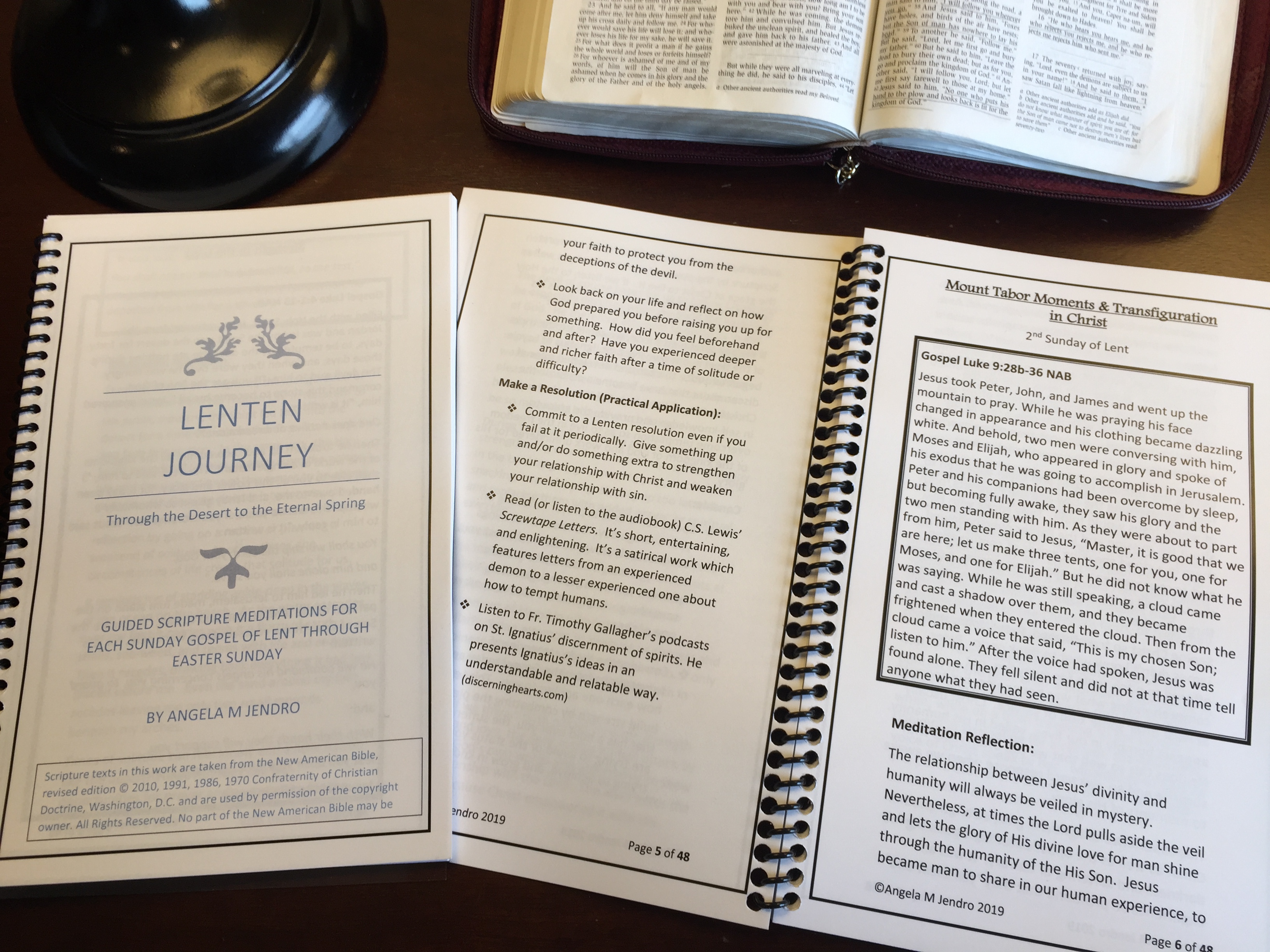
  • Download for free to your pdf reader for easy access on the go, or print to paper to make your handwritten notes.
  • No price for e-book,  Free Will Offering accepted via Paypal and/or Prayers for the author 🙂


For printed booklet – visit our Online store tab or purchase below:


Printed Booklet – Lenten Journey: Through the Desert to the Eternal Spring

Free shipping within the U.S. 48 pages Guided Scripture meditatins for each Sunday of Lent through Holy Week and Easter Sunday. Encounter Christ in a new way with reflections that relate to your daily life, considerations to take to prayer, and ideas for concrete application.

$15.00