Toughening Up

taking up cross

27th Sunday in Ordinary Time

Gospel Luke 17:5-10 NAB

The apostles said to the Lord, “Increase our faith.” The Lord replied, “If you have faith the size of a mustard seed, you would say to this mulberry tree, ‘Be uprooted and planted in the sea,’ and it would obey you.

“Who among you would say to your servant who has just come in from plowing or tending sheep in the field, ‘Come here immediately and take your place at table’? Would he not rather say to him, ‘Prepare something for me to eat. Put on your apron and wait on me while I eat and drink. You may eat and drink when I am finished’? Is he grateful to that servant because he did what was commanded? So should it be with you. When you have done all you have been commanded, say, ‘We are unprofitable servants; we have done what we were obliged to do.’”

Meditation Reflection:

We live in a culture rife with an entitlement attitude. Generation Y-ers get the worst rap for this and to be fair university studies have provided proof of its epidemic. Generation Z is too young to tell for certain but doesn’t appear likely to be much different. (I myself am on the very beginning edge of Gen Y, although I was somewhat sheltered from an entitlement perspective thanks to my mother’s tireless efforts to curb my attitude).

Merriam-Webster defines this attitude as: “the feeling or belief that you deserve to be given something (such as special privileges).” A NY Post article “The worst generation?” from May 10, 2010 cited a University of New Hampshire study which concluded that: “Gen Yers are characterized by a ‘very inflated sense of self’ that leads to ‘unrealistic expectations’ and, ultimately, ‘chronic disappointment.’” ). Granted, not every Gen Yer suffers from an inflated sense of self, it does seem to be a cultural trend and it impacts our relationships and sense of satisfaction at work, in our families, and in our faith.

Because of the effects of Original Sin, we all tend toward a self-centered narcissism and will continue to spiral down if our trajectory isn’t changed by grace, parenting, or other formative agents. Jesus’ interaction with the apostles in this passage reminds me of interactions I’ve had with my own children. When asked to do the dishes, clean a bathroom, or fold laundry I am met with attitudes of “why me?” On other occasions a child of mine actually notices things that need to be done around the house. Rather than simply pitching in and taking care of the problem, they see it as a job opportunity for which they should be rewarded. The conversation looks something like this –

Child: “Mom, what will you give me if I unload the dishes?”

Me.: “Clean dishes on which to eat.”

Child: “Mom, what will you give me if I clean the cat’s litter box?”

Me: “I’ll let you keep having the cat as a pet.”

Child: “Mom, what will you give me if I help with the laundry?”

Me: “Clean clothes.”

Child: “Ackh. Mooooom. Forget it.”

5 mintues later:

Child: “I’m bored.”
Me: “Then do the dishes.”
Child: “That’s boring too. What can I do that’s fun?”

Me: “I’m not your cruise ship captain. Do the dishes and maybe boredom won’t seem like such a bad thing.”

If only we could say our conversations with God didn’t look remarkably similar. How often do we take an entitlement attitude with the Lord? It looks something like “Look Lord, I went to Mass on Sunday! What do I get?” Or, “I put a few dollars in the collection plate, what will you give me?”

The entitlement attitude affects our expectations for the work to reward ratio as well and may be somewhat analogous to the passage for today’s Gospel. The same NY Post article cited another study which summarized the expectations of entitled employees:

According to another study, which will be published in the Journal of Management in September. Co-author Stacy Campbell, an assistant professor of management at Kennesaw State University, says the study revealed that when it comes to work, the two things Gen Yers care most about are a) high salaries, and b) lots of leisure time off the job.

‘They want everything,’ says Campbell. ‘They want the time off. They want the big bucks.’

To reach their conclusions, Campbell and co-author Jean Twenge — a professor of psychology at San Diego State and author of “Generation Me,” a book examining discontent among members of Gen Y — worked over the data from an ongoing survey of high school students conducted annually since 1975 by the University of Michigan. Among their findings was that while both Gen Y and Gen X want sizable salaries, Gen X workers show greater awareness that a hefty paycheck comes with a hefty workload.

As Christians, we ought to evaluate our own expectations of working for the Lord. We can forget that it’s a privilege to work as a laborer for the Lord in bringing in His harvest and that it’s a blessing to have a job. When we feel like complaining, “What do I get for “carrying this cross?”, we can remember that we get to carry a cross. We get to work. We get to be near to Christ in the most intimate and meritorious moment of His work of salvation. We even get to help. We also gain numerous other rewards from carrying our cross and laboring with the Lord, taking His yoke upon our shoulders. Growing up, whenever I would feel sorry for myself or want pity, my mom would respond with a singular word that I detested: “Tough”. Sometimes she would even lengthen her response a little to: “Toughen up”. I loathed these words and swore I would never be so unfeeling toward my own children. Of course, you can guess, there came one fateful day when those same words came issuing from my own mouth in response to my own child’s self-pity moment. I realize now that my mom’s approach helped inoculate me from an entitlement attitude and in fact, made me tougher. In one word she exposed my self-pity for being an “unrealistic expectation” and reset my expectations to something more along the lines of reality. Crosses have a similar effect. Sometimes we whine to God and it feels like He is coldly ignoring our need and simply retorting “tough.” However, sometimes those very crosses strengthen us and enable us to increase in faith as well as hope and love.

If we want the Lord to increase our faith we need not look much further than prayer, sacraments, fellowship, and picking up our cross daily and following Him. Yet, we often expect huge returns for minimal effort. Christ reminds us today that we are blessed to labor in His kingdom. We are blessed to be near Him in the cross. The faith and satisfaction we will gain from hard earned sweat and blood in the field will give a much more satisfying feeling than the superficial reward of a participation trophy.

God provides the supernatural strength we need to follow Him, we just have to adjust our expectations and persevere when things get tough. St. Paul reminds us in second letter to Timothy, that God enables us to toughen up through His grace that we might be courageous and noble:

“Beloved: I remind you, to stir into flame the gift of God that you have through the imposition of my hands. For God did not give us a spirit of cowardice but rather of power and love and self-control… bear your share of hardship for the gospel with the strength that comes from God.” 2Timothy 1:6-8

Consider:

  • What kind of attitude do you have toward God? How has it grown and matured over the years?
  • Reflect on the gift of working side by side with Christ as He brings in the harvest. Jesus says, “the harvest is ready but the laborers are few.” Have you had the chance to be a part of someone’s spiritual journey? How did it feel to see the seeds of faith grow into noble discipleship?
  • In what way could you adjust your expectations of discipleship? Do you suffer from an impulsiveness that needs instant gratification or are you able to delay gratification?
  • My mother’s discipline, though apparently counter-cultural at the time, inoculated me from suffering the poison of entitlement mentality (as much as I tried to get her to cave into the idea!). Who has been courageous enough in your life to lovingly adjust your perspective even if you fought them on it?
  • When have you felt deep satisfaction in work itself rather than the reward at the end? How does this relate to work as a disciple?

Make a Resolution (Practical Application):

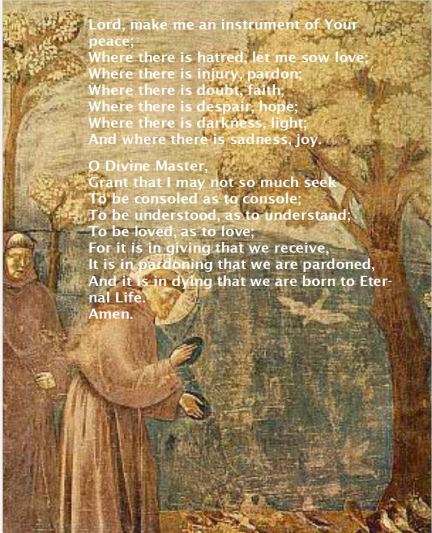
  • Pray and reflect on the prayer of St. Francis this week.
  • Call or write a thank you to someone who has saved you or healed you from an entitlement attitude.
  • If you have children, grandchildren, or work with children, reflect each day on your interactions with them and consider if there is an analogy to your own interactions with the Lord.

~ Written by Angela (Lambert) Jendro © 2016

Follow bar

prayer of st francis

Sometimes the Small Stuff Matters

by Angela Jendro

 25th Sunday in Ordinary Time

Gospel of Luke 16:10-13 NAB

Jesus said to his disciples: “The person who is trustworthy in very small matters is also trustworthy in great ones; and the person who is dishonest in very small matters is also dishonest in great ones. If, therefore, you are not trustworthy with dishonest wealth, who will trust you with true wealth? If you are not trustworthy with what belongs to another, who will give you what is yours? No servant can serve two masters. He will either hate one and love the other, or be devoted to one and despise the other. You cannot serve both God and mammon.”

Meditation Reflection:

Few things of importance are gained overnight with little to no effort. As tempting as the get rich quick scheme can be, it never proves to be reliable or lasting. The temptation appears in many forms but inevitably produces the same results. Diets that promise to drop weight fast only leave you gaining it right back because they don’t involve long-term lifestyle changes. New clothes, cars, or homes you hope will boost your self-confidence leave you with the same empty feeling at night if you haven’t become the person you can be proud of on the inside. Stress might be soothed by pills or substances temporarily, but only the hard work of managing stress through healthy ways will actually change your situation or give you authentic contentment.

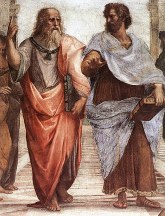
True change comes through the hard, slow, daily process of building character. The Plato and Aristotle_Raphaelphilosopher Aristotle, in his famous book on Ethics, defined virtue as a habit of doing the good. He taught that a person only acquires a virtue after having chosen it regularly over a long period of time and in many circumstances. For instance, if I tell the truth once, it doesn’t make me a truthful person. To say that I have the virtue of honesty means I have told the truth regularly for many years. As Jesus points out in this passage, a person’s character is shown as much, if not more so, in the small matters as in the larger ones. A truthful person will be pained by lying, even in small exaggerations. On the other hand, a person who lies easily about daily matters to avoid responsibility or make things easier, will certainly lie when the stakes are much higher.
It can be tempting to compartmentalize our life, especially our faith life, and not uncommon in our culture for a person to think they can act one way at work, another at home, and another at church. However, our choices become our habits and our character. Like the fast, easy, changes marketed to us, compartmentalization is only a temporary illusion. If you swear around your friends often, you will eventually let a swear word slip at work or in front of your children. If you are dishonest at home with your spouse, you will be dishonest with your boss. We can’t sit in the pew and believe ourselves to be disciples of Christ, if we distort His Gospel the rest of the week by not following Him at work and home too.

Jesus wants to bring us interior peace and this requires being authentic. We build Christian virtues by practicing them daily in all situations. We make choices based on what we care about most. This is why we can’t serve God and the world. Those daily choices build a path one way or the other, like everything else in life. Jesus lived this teaching as well.  He did the Father’s will in everything. Then when in the Garden of Gethsemane He feared His impending crucifixion, He prayed, “Father, if you are willing, take this cup away from me; still, not my will but yours be done” (Luke 22:42).

If we love God and if we truly believe that Jesus is the Way, the Truth, and the Life, then we will try to imitate Christ in every choice no matter where we are. The beautiful result is that the more Christ like you grow, the more He will shine in every work you do. The Church calls this “sanctifying the temporal world.” It may be the slow, difficult, unglamorous path, but it will certainly be more lasting and, thankfully, Jesus gives us His Spirit and grace to help us.

Consider:

  • What virtues would your family or friends confirm that you have already? What kind of person do you try to be?
  • What virtues would you like to acquire that you presently struggle with? How might you begin working on them?
  • In what way do you compartmentalize your faith? Are there places, persons, or circumstances you hide your beliefs or act contrary to your faith?
  • Consider how you might apply Jesus’ teaching to your everyday responsibilities and the people you interact with. Mother Teresa touted the greatness of doing small things with great love. How might you incorporate that into your daily work?
  • Aristotle was right about the necessity of practice to build virtue. However, we often still struggle to overcome our own weakness and we can’t become truly Christ-like without the aid of grace. Consider the power of prayer, reading Scripture, and the sacraments through which the Holy Spirit can strengthen and change your heart.

Make a Resolution (Practical Application):

  • Focus on faithfulness to God in the small matters this week. Be especially diligent in the everyday little tasks or interactions to act Christ-like.

~ Written by Angela Jendro © 2019

Follow bar

How can God be both Justice and Mercy?

by Angela Jendro

24th Sunday in Ordinary Time

Gospel Luke 15:1-32 NAB

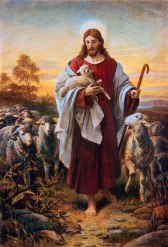
Tax collectors and sinners were all drawing near to listen to Jesus, but the Pharisees and scribes began to complain, saying, “This man welcomes sinners and eats with them.” So to them he addressed this parable. “What man among you having a hundred sheep and losing

490px-Bernhard_Plockhorst_-_Good_Shephard

by Bernhard Plockhorst

one of them would not leave the ninety-nine in the desert and go after the lost one until he finds it? And when he does find it, he sets it on his shoulders with great joy and, upon his arrival home, he calls together his friends and neighbors and says to them, ‘Rejoice with me because I have found my lost sheep.’ I tell you, in just the same way there will be more joy in heaven over one sinner who repents than over ninety-nine righteous people who have no need of repentance.

“Or what woman having ten coins and losing one would not light a lamp and sweep the house, searching carefully until she finds it? And when she does find it, she calls together her friends and neighbors and says to them, ‘Rejoice with me because I have found the coin that I lost.’ In just the same way, I tell you, there will be rejoicing among the angels of God over one sinner who repents.”

Then he said, “A man had two sons, and the younger son said to his father, ‘Father give me the share of your estate that should come to me.’ So the father divided the property between them. After a few days, the younger son collected all his belongings and set off to a distant country where he squandered his inheritance on a life of dissipation.  When he had freely spent everything, a severe famine struck that country, and he found himself in dire need. So he hired himself out to one of the local citizens who sent him to his farm to tend the swine. And he longed to eat his fill of the pods on which the swine fed, but nobody gave him any. Coming to his senses he thought, ‘How many of my father’s hired workers have more than enough food to eat, but here am I, dying from hunger. I shall get up and go to my father and

552px-Rembrandt_Harmensz_van_Rijn_-_Return_of_the_Prodigal_Son_-_Google_Art_Project

Return of the Prodigal Son By Rembrandt

I shall say to him, “Father, I have sinned against heaven and against you. I no longer deserve to be called your son; treat me as you would treat one of your hired workers.”’ So he got up and went back to his father. While he was still a long way off, his father caught sight of him, and was filled with compassion. He ran to his son, embraced him and kissed him. His son said to him, ‘Father, I have sinned against heaven and against you; I no longer deserve to be called your son.’ But his father ordered his servants, ‘Quickly bring the finest robe and put it on him; put a ring on his finger and sandals on his feet. Take the fattened calf and slaughter it. Then let us celebrate with a feast, because this son of mine was dead, and has come to life again; he was lost, and has been found.’ Then the celebration began. Now the older son had been out in the field and, on his way back, as he neared the house, he heard the sound of music and dancing.  He called one of the servants and asked what this might mean. The servant said to him, ‘Your brother has returned and your father has slaughtered the fattened calf because he has him back safe and sound.’ He became angry,
and when he refused to enter the house, his father came out and pleaded with him. He said to his father in reply, ‘Look, all these years I served you and not once did I disobey your orders; yet you never gave me even a young goat to feast on with my friends. But when your son returns, who swallowed up your property with prostitutes, for him you slaughter the fattened calf.’ He said to him, ‘My son, you are here with me always; everything I have is yours. But now we must celebrate and rejoice, because your brother was dead and has come to life again; he was lost and has been found.’”

Meditation Reflection:

Justice versus mercy. How can God be both? And how can we imitate Him when we need to apply concretely a mystery that surpasses our understanding?

In this Gospel Christ illuminates something of this mystery. First, we should remember that we live in a highly competitive culture. Consequently, we feel justice – giving each person his or her due – is necessary to keep things “fair.” Secondly, as St. Augustine pointed out in The City of God, if we are earthly-minded and focused on building the “city of man”, then we often find ourselves at war with one another as we vie for limited resources.

The resources and goods in the “city of God” however, Augustine notes, are unlimited. Moreover, rather than being reduced when given away they multiply, and rather than being limited to temporary gain, they last eternally.

Our human tendency to want justice applied to others but mercy applied to us, often relates more to our striving to build the city of man rather than the noble cause for justice itself. Justice is important, and God is justice as well as mercy. However, we have to be aware of our own prejudices and since we suffer the effects of original sin, we tend to rationalize our double-standard.

The truth is, when God weighs our own faults and violations of divine and natural law, none of us will be able to balance the scale and achieve a just state. We know God cares about justice because for us to rightly spend eternity with Him, the scale had to be balanced and so He sent His only Son to suffer and die for our sake, to tip the scale for us. By helping us reach a state of justice, He acted mercifully.

To even begin to understand something of this mystery, of the harmony between Justice and Mercy in God, Jesus uses comparisons we can relate to – a shepherd looking for a lost sheep and a woman searching for a coin. In each case you or I may not have cared. They care because they view the sheep and the coin as their belonging. When lost, they were impoverished in some way and in finding it their possessions became complete. We belong to God. You or I may not care about a particular person but God does. He views each human person as His own treasure, and to lose one results in a loss, and to regain that person creates completion.

To clarify and impress this on us further, Jesus follows with the Parable of the Prodigal Son (verses 11-32). Whereas in our work life if an employee or colleague leaves it may be disappointing but that person can be replaced by a new hire and eventually life goes on. We see this in every realm of society – politics, business, entertainment, sports – except one, the family. If a child rebels and leaves his or her family, there remains a hole and a lingering pain for as long as the child remains estranged. The family cannot simply find a replacement and move on with life. It will always feel like a loss and incomplete.

The relationship between justice and mercy therefore can only be understood in light of relationship. In the parable of the prodigal son, the rebellious child left home and eventually experienced the reality of the choices he had made. With the money gone, he finally received his due, and this provoked conversion. When he returned home, repentant and interiorly changed, his father was ecstatic to incorporate him back into the family. The older son, focused on the earthly resources, became bitter at the apparent injustice. It wasn’t fair. Had he viewed it from a spiritual perspective, he would have seen that he had become enrichened. Rather than focusing on the fattened calf he felt he “lost” to the feast of his wayward brother, he ought to have focused on the brother he regained.

The deeper we grow in love, the more we begin to understand God’s ways. Rather than seeing him merely as a judge, we need to see that He is foremost a father. He will do what it takes to keep his family together and to help His children flourish. Fathers and mothers make countless material sacrifices for their children and oftentimes with joy. From the outside others might rightly marvel at how this could be. Those who have children however, know by experience the deeper sense of satisfaction and pleasure one gains from these acts.

When considering justice and mercy, Christ exhorts us to view it in light of being God’s possession, His children, and love.

Consider:

  • Consider the difference between being an employee in comparison to being someone’s child. You are God’s own. You are God’s child.
  • Consider how love moves one to mercy and the more loving persons are, the more merciful they become.
  • Consider how you felt when you received mercy or when you gave mercy.
  • Reflect on how justice and mercy relate with one another. Sometimes being just enables one to be merciful.
  • Spend 5 minutes in silent prayer, just gazing on God who is Justice and Mercy.

Make a Resolution (Practical Application):

  • Pray each day for the conversion of someone who has left the faith. If possible, reach out to him or her through acts of kindness and mercy.
  • In light of the parable of the prodigal son, forgive someone who has returned to you apologetically.
  • If there is someone who has made serious changes (for the better) in his or her life, pray about giving them a second chance and incorporating them back into your life.
  • Practice one corporal work of mercy and one spiritual work of mercy each day this week.


~ Written by Angela Jendro © 2019

Follow bar

Following Christ At All Costs

by Angela M. Jendro

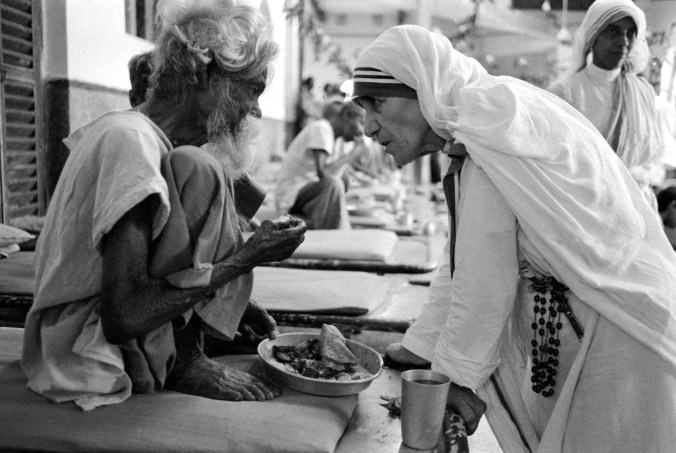
Mother Teresa and the poor in Calcutta, India in October, 1979.

Mother Teresa and the poor in Calcutta, India in October, 1979. Jean-Claude Francolon | Gamma-Rapho | Getty Images

23rd Sunday of Ordinary Time

Gospel Luke 14:25-33 NAB

Great crowds were traveling with Jesus, and he turned and addressed them, “If anyone comes to me without hating his father and mother, wife and children, brothers and sisters, and even his own life, he cannot be my disciple. Whoever does not carry his own cross and come after me cannot be my disciple. Which of you wishing to construct a tower does not first sit down and calculate the cost to see if there is enough for its completion? Otherwise, after laying the foundation and finding himself unable to finish the work the onlookers should laugh at him and say, ‘This one began to build but did not have the resources to finish.’ Or what king marching into battle would not first sit down and decide whether with ten thousand troops he can successfully oppose another king advancing upon him with twenty thousand troops? But if not, while he is still far away, he will send a delegation to ask for peace terms. In the same way, anyone of you who does not renounce all his possessions cannot be my disciple.”

Meditation Reflection:

How can Christ, whose new commandment to us was to “love one another as I have loved you” simultaneously ask that we hate our family members? As we celebrate the feast day of St. Mother Teresa this week, we can look to her example to illuminate this paradox. Jesus’ challenge that “whoever does not carry his own cross and come after Me cannot be my disciple” proved a difficult task and one that required great love, detachment, and grace for Mother Teresa who left her home, her family, and even her beloved convent to serve the poorest of the poor in the streets in India. Jesus rightly warns to count the cost before we set out on a project lest we find ourselves giving up midway. Discipleship calls for a total gift of self, in response to the Lord who made the ultimate gift of self for us through His Incarnation, Death, and Resurrection.

In a perfect world, or at least in heaven, loves do not compete with one another and we aren’t painfully pulled in opposing directions. In our current fallen state however, we come to crossroads where we must choose between two loves. It’s one thing to forsake the love of a material good or a sinful habit, but the hardest love to forsake is that of someone with whom we have a relationship but refuses to share us with Christ and gives us an ultimatum.

This ultimatum may not sound as direct as “it’s me or Christ!” but it will likely pit some aspect of following Christ against something the person wants of you. Following Christ results in a life of sacrifice that’s counter-cultural. Authentic Christians don’t blend in and that bothers people who don’t want to stir the waters. Living your faith, even quietly, can prick the conscience of another and result in lashing out to ease his or her own angst. Similar to Jesus, Christians offer love unconditionally to others. Unfortunately, the same is not always true on the other end and the painful choice between following Christ or making the person you care about happy must be made.

This choice takes as many forms as there are relationships. For a teen it can be a couple breaking up because one chooses purity over promiscuity or being left out of social gatherings because of a refusal to drink. For a young adult it can be a person choosing the religious life despite the discouragement of parents, or moving away from family and friends for a service they are called to by Christ. For parents it can mean getting the silent treatment from a child because you refuse to condone their wrong behavior. For a spouse it can mean suffering the anger of the other because one refuses to compromise living out his or her faith to appease the other’s sin. No one wants a rift in their family – whether between parents, children, or spouses. At the same time not everything is in our control except our own decision to follow the Lord. Navigating these situations can be confusing and spiritual direction should be sought to sort out how to authentically love in particular situations.

Mother Teresa desired to follow Christ and to give her whole life in love to Him. First it meant leaving her family to join the Sisters of Loreto as a nun and serve in India as a teacher. Next, she received her “call within a call” to go out into the streets and serve the poorest of the poor. She was happy as a nun and asked Jesus if she could just serve Him more devoutly in the way she already was. Each time however He repeated His request for her to satiate His thirst for souls by ministering to the poor and destitute. He would ask her each time, “Wouldst thou refuse Me?”

Mother Teresa felt torn between two loves. Her love for the other sisters, her students, and her life in the convent was certainly a noble love, but discipleship called her to follow Christ to a place that meant she would have to choose between the two. Ultimately, Mother Teresa could not surrender her love for Jesus to anything else and so she gave up and gave in to the Lord. As she followed Christ, Mother Teresa surrendered everything to Him – material goods, physical comforts, family, and even the convent walls. She went into the most destitute streets with nothing but a sari and a passion for Jesus.

Contrary to cultural demands, Christians cannot compartmentalize their faith. We are followers of Christ at church, at home, at work, when alone, or when with friends. We have to be prepared that some people, even some we for whom we care deeply, may not tolerate our discipleship and choose to leave us. In these instances, we can look to Christ for the grace and grit to carry our cross, a cross which He promises will end in a resurrection.

This Sunday, may we count the cost and, with the grace of Christ, decide to follow Him to the end. The joy of Mother Teresa, and the light of love and mercy her life became, serves as a witness for us of the glorious destination of discipleship – a project worth completing!

Consider:

  • Are you a disciple of Christ? If the answer is yes, what moves you to love Him and to follow Him? If the answer is no or not yet, what attracts you about Christ or piques your curiosity?
  • In what ways has discipleship caused you to live counter-culturally? Has it strained any of your relationships?
  • How has carrying your cross produced resurrections and blessings in your life? What have been some of the fruits of your discipleship?
  • What cross are you carrying right now? In what way does it resemble Jesus’ cross? How does it bring you closer to Him as you share in His experience?
  • It feels good to accomplish something hard that required grit and perseverance. Consider how it will feel to “finish the race” as St. Paul says, and to have followed Christ (with the help of His grace) to the end.

Make a Resolution (Practical Application):

Follow bar

Expressions of Feminine Self-Gift Part III: Setting the World on Fire (Highlights and quotations from my talk at “Devoted” at St. John the Baptist.)

What a gift to speak at St. John the Baptist tonight with the women of “Devoted”!  I was privileged to spend the evening with such remarkable ladies at such a beautiful event. Below are some highlights and the quotations I referenced.   

Red heart shaped tree

St. Catherine of Siena “Be who God meant you to be, and you will set the world on fire”

God can and DOES do INCREDIBLE things through His children. The life of every saint testifies to God’s mighty work through their little “yes”.

 Who does God mean for your to be? – First: a Woman

Women have particular gifts from God to set the world ablaze with His transformative Truth and Love.

Examples of Women in the Gospels:

  • Mothers: Mary, Elizabeth
  • Prophetess: Anna
  • Some accompanied him on His journey Some provided for them out of their means (Luke 8:1-3) Joanna, Susanna
  • Mary, Martha – friends of Jesus
  • Jesus holds up the poor widow as a model of generosity “This poor widow has put in more than all of them”
  • Most profound teachings given to women
    • Woman at the well
    • Martha about resurrection from the dead
      • “This conversation with Martha is one of the most important in the Gospel” John Paul II On the Dignity of Women 15
    • Mary Magdalene – the first to see the risen Christ; Thomas Aquinas calls her the “apostle to the apostles”

 The Feminine Genius is needed now more than ever

The Second Vatican Council proclaimed:

“The hour is coming, in fact has come, when the vocation of women is being acknowledged in its fullness, the hour in which women acquire in the world an influence, an effect and a power never hitherto achieved.   That is why, at this moment when the human race is undergoing so deep a transformation, women imbued with a spirit of the Gospel can do so much to aid humanity in not falling.”

The Council’s Message to Women as quoted in John Paul II’s On the Dignity and Vocation of Women

Special Genius of Women 

  • Theological insights from feminine perspective
    • Pope Francis remarked that we need more women theologians
    • Julian of Norwich (1342-1416)  English anchorite; Her work is based on a series of 16 visions she received in 1373
      • Meditates on Jesus’ motherly care for us
        • Compares His passion to pregnancy and birth
        • The Eucharist to nursing a baby (“He feeds us with Himself”)
        • The tenderness of a mother holding her child to Christ bringing us close to Him through His Church
      • 4 women doctors of the Church
        • Hildegard of Bingen (1098-1179) German Benedictine abbess, writer, composer, philosopher, mystic;
        • Catherine of Siena (1347-1380)
        • Teresa of Avila (1515-1582)
        • Therese of Lisieux (1873-1897)
      • Contemporary Catholic theologian – Edith Stein, a.k.a. St. Teresa Benedicta of the Cross (1891-1942)
  • Gift for Acknowledging the Person
“Woman naturally seeks to embrace that which is living, personal, and whole. To cherish, guard, protect, nourish and advance growth is her natural maternal yearning.” Edith SteinWoman
  • Building relationships and society – humanizing vs. technocratic and efficiency only
“Thank you, every woman, for the simple fact of being a woman! Through the insight which is so much a part of your womanhood you enrich the world’s understanding and help to make human relations more honest and authentic.” John Paul II Letter to Women 1995
  • Antidote to individualism – motherhood as a white martyrdom
Mothers are the strongest antidote to the spread of self-centered individualism. “Individual” means “what cannot be divided”. Mothers, instead, “divide” themselves, from the moment they bear a child to give him to the world and help him grow… Archbishop Oscar Arnulfo Romero said that mothers experience a “maternal martyrdom”. In the homily for the funeral of a priest assassinated by death squads, he said, recalling the Second Vatican Council: “We must be ready to die for our faith, even if the Lord does not grant us this honor…. Giving one’s life does not only mean being killed; giving one’s life, having the spirit of a martyr, it is in giving in duty, in silence, in prayer, in honest fulfilment of his duty; in that silence of daily life; giving one’s life little by little. Yes, like it is given by a mother, who without fear and with the simplicity of the maternal martyrdom, conceives a child in her womb, gives birth to him, nurses him, helps them grow and cares for them with affection. She gives her life. That’s martyrdom”.

Pope Francis Wednesday Audience January 2015

Obstacles

 Edith Stein noted that our gifts can also become distorted by sin.

  • Concern for the person can get out of control and turn into meddling and gossip
  • The desire to integrate everything can also lead to getting spread too thin and dabbling in too many things
  • A heart of service that sees the needs of others can turn into a dominating or controlling “help” – the “nagging wife” or “helicopter mom”

There is hope in our struggles!

  • Romans 8:28
    • “God works all things together for good for those that love Him”
  • Philippians 1:6
    • “I am sure that He Who began a good work in you will bring it to completion at the day of Jesus Christ.”

 Your expression of self gift will also include your PERSONAL circumstances, vocation, temperament, talents, opportunities

Family Life

  • Innate wisdom to guide the family – including the husband and wife
    • “She craves for an unhampered development of her personality just as much as she does to help another toward that same goal.   And thus the husband will find that she can give him invaluable advice in guiding the lives of the children as well as of themselves.” Edith Stein Woman

Making a house a home

  • “Part of her natural feminine concern for the right development of the beings surrounding her involves the creation of an ambience, of order and beauty conducive to their development.” Edith Stein Woman

Spiritual Motherhood 

  • Example of Elisabeth LeSeur 1866-1914
    • Her husband Felix remarking on the days approaching her death (after which he converted to Catholicism and later became a priest!):
“She did indeed uplift all who surrounded or approached her, and it was a strange thing to see this woman, so modest, so humble of heart, condemned to practical immobility, shedding around her far and wide the light of her great influence.”

An atheist friend after her passing:

“Some beings are a light toward which all turn who need light to live by!”

Work Life

Edith Stein notes that some jobs naturally align with feminine genius more than others.  However, women have something unique to offer every kind of work and in every case they bring their interpersonal gifts to the culture of the workplace.

“Thus the participation of women in the most diverse professional disciplines could be a blessing for the entire society, private or public, precisely if the specifically feminine ethos would be preserved.” Edith Stein Woman

Work-life balance

“Her professional activity counterbalances the risk of submerging herself all too intimately in another’s life and thereby sacrificing her own; however, an exclusive preoccupation with her professional activity would bring the opposite danger of infidelity toward her feminine vocation. Only those who surrender themselves completely into the Lord’s hand can trust that they will avoid disaster between Scylla and Charybdis.   Whatever is surrendered to Him is not lost but saved, chastened, exalted and proportioned out in true measure.”

Edith Stein Woman

Public Life

“In our own time, the successes of science and technology make it possible to attain material well being to a degree hitherto unknown. While this favors some, it pushes others to the margines of society. In this way, unilateral progress can also lead to a gradual loss of sensitivity for man, that is, for what is essentially human.   In this sense, our time in particular awaits the manifestation of that ‘genius’ which belongs to women, and which can ensure sensititivty for human beings in every circumstance: because they are human! – and because ‘the greatest of these is love’ (cf. 1 Cor 13:13)”

John Paul II On the Dignity and Vocation of Woman


Progress usually tends to be measured according to the criteria of science and technology. Nor from this point of view has the contribution of women been negligible. Even so, this is not the only measure of progress, nor in fact is it the principal one. Much more important is the social and ethical dimension, which deals with human relations and spiritual values. In this area, which often develops in an inconspicuous way beginning with the daily relationships between people, especially within the family, society certainly owes much to the “genius of women”.

John Paul II Letter to Women 1995

Closing:

Jeremiah 29:11

“Yes, I know what plans I have in mind for you, the LORD declares, plans for peace, not for disaster, to give you a future and a hope.”

MUSTARD SEED

Matthew 13:31-32

“He put another parable before them, ‘The kingdom of Heaven is like a mustard seed which a man took and sowed in his field. It is the smallest of all the seeds, but when it has grown it is the biggest of shrubs and becomes a tree, so that the birds of the air can come and shelter in its branches”

The greatest example of feminine genius is Mary. Her yes brought about the incarnation of God and our salvation!

Mary models perfect discipleship. Each of us are being called by God.  We need only be our true selves to set the world on fire with His love!

~ Written by Angela Jendro © 2019

Follow bar

Amazon Links for further reading


Eyes Wide Open

Ascension of Christ_ Getty Images

Ascension of Christ: Getty Images

by Angela M Jendro

 19th Sunday in Ordinary Time

Gospel of Luke 12:35-40 NAB

“Jesus said to His disciples: ‘Gird your loins and light your lamps and be like servants who await their master’s return from a wedding, ready to open immediately when he comes and knocks. Blessed are those servants whom the master finds vigilant on his arrival. Amen, I say to you, he will gird himself, have them recline at table, and proceed to wait on them. And should he come in the second or third watch and find them prepared in this way, blessed are those servants. Be sure of this: if the master of the house had known the hour when the thief was coming, he would not have let his house be broken into. You also must be prepared, for at an hour you do not expect, the Son of Man will come.’”

Meditation Reflection:

Jesus emphasized the need for disciples to be vigilant. According to Wordbook, vigilant means to be “carefully observant or attentive; on the lookout for possible danger.” Discipleship can suffer from the same waning of enthusiasm as any of our other noble goals. How many New Year’s diets or exercise plans end by February? How many books are left only partially read? How many friendships or relationships wither from slow neglect? Jesus exhorts us to head off dangers to our faith by being aware and making efforts to protect ourselves from them. Discipleship requires the same perseverance, effort, and watchfulness as anything else we hope to accomplish and maintain.

Similarly, the same strategies to keep healthy habits can be applied to discipleship. For instance, to achieve the goal of getting in shape, partnering with a friend for accountability will greatly increase your chance of success. Discipleship requires fellowship as well. We need faith-filled friends to keep us accountable, inspire us to be better, and keep us in the habit of prayer and worship. To achieve the goal of developing your mind through reading, you will need to choose a time, place, and frequency or it will never happen. Forming a book club can also provide that boost of a deadline to motivate you. Similarly, to grow nearer to Christ you will need to read Scripture regularly. The same pitfalls apply here so being vigilant about sticking to a routine will be important and joining a bible study could be motivating.

The synonym for vigilance illuminates the essence of discipleship as well: “open-eyed.” Thus, Jesus exhorts us to keep our eyes of faith open to judge things from the perspective of faith rather than the world. In Hebrews 1:1, St. Paul defines faith as: “the assurance of things hoped for, the conviction of things not seen” (RSV). He goes on to illustrate this with the example of Abraham who left for a land God promised without any sight of it beforehand – no map, no appraisal or inspection, no google images – only God’s word. Moreover, after having received a son despite he and Sarah’s old age, Abraham was willing to sacrifice Isaac at God’s command. Imagine the paradox presented to Abraham. God had promised Abraham many descendants through Isaac, and yet God also asked Abraham to sacrifice Isaac. How could both of these things be true at the same time? Abraham could find no assurance in natural reason or human experience and power. Abraham merited the title Father of Faith by his response. St. Paul relates, “[Abraham] considered that God was able to raise men even from the dead; hence, figuratively speaking, he did receive him back” (Hebrews 11:19 RSV). Abraham had confidence that God is all-powerful and that God keeps His promises. He didn’t limit God to our human experience. He trusted God and proved his conviction when he risked everything to be obedient to the Lord.

How can we imitate the vigilant, open-eyed faith of Abraham? Every day we need to open our eyes through prayer. We need to ask for the gift of faith and trust. We must stay sharp through fellowship with faithful Christians and spiritual reading. We need to deepen our trust through developing our relationship with Christ and receiving His grace in the sacraments. Finally, many saints and spiritual writers suggest doing an examination of conscience every night. Look back on the day and evaluate your choices. When did you show love for God and for others? What temptations did you overcome? What inspirations of the Holy Spirit did you follow? Secondly, where did you lean on your own understanding instead of God’s? When did you relax into thinking and acting like a child of the world rather than a child of God? What choices were motivated by a lack of faith, hope, or charity? Ask God for forgiveness and an increase in grace to do better the next day.

Even if the end of the day doesn’t work for you, try to at least be more introspective throughout the day. Jesus warned “Be sure of this, if the master of the house had known the hour when the thief was coming, he would not have let his house be broken into.” Sins can make little strongholds in our soul if we are not vigilant in identifying them and putting them before the Lord for healing. We never know when we will be attacked by temptation and sometimes it can be very subtle. By developing a habit of staying alert we will be better prepared to avoid or overcome them.

If we vigilantly live in faith, our hearts will be stay open to receive Christ and to respond to the promptings of His Spirit. A habit of holiness characteristic of the saints is their awareness of God’s presence and activity throughout their day. They also witness fidelity to the Spirit when called to serve in a way that makes no sense from a practical perspective unless God is real, all-powerful, and keeps His promises. Like Abraham, the Father of Faith, they have confidence that if God is asking then God will provide. If therefore we seek first His kingdom, we can be assured that everything else will be taken care of (Matthew 6:33), and quite often in ways we could not have foreseen.

Consider many people’s demand to “see it to believe it.” Yet, Jesus says “Come, and you will see” (John 1:39) Faith means walking with Christ, and in that walk your experience will confirm the faith you embarked upon. It entails some risk which is why encouragement from other believers’ experiences is an essential part of vigilance. I still struggle to patiently trust God, but at the same time I have seen God act so many times in my life that I can say I believe it because I’ve seen it. I just need to recall those times to strengthen my faith when it’s difficult. Consider how often in the Scriptures it exhorts the audience to recall a mighty work of God in the past to keep them strong in the present.

I have seen God provide over and again, always in unexpected ways, and just at the right time. He has done this at every level – family, relationships, work, finances, and health. Even though it’s easier to trust the wisdom of the world or our own strength which we can see right before us, we ought to vigilantly keep our eyes open to the wisdom and strength of our loving God which is far more reliable. He is coming, and it will be a day of great rejoicing we won’t want to miss!

Consider:

  • Reflect on what practices have deepened your faith and helped you grow as a disciple of Christ.
  • Consider where you need further growth. Pray about how you could be more vigilant in that area.
  • Meditate on the words Jesus told St. Faustina to have written below His image: “Jesus I trust in You.”
  • Reflect with gratitude on a time(s) when God came through for you in a surprising or powerful way.
  • Is there a part of your life that needs more trust in Jesus? Pray for an increase in faith and hope.

Make a Resolution (Practical Application):

  • Choose one way to be more vigilant in your faith life. Share your goal with someone who will encourage you and keep you accountable.
  • Pray the short prayer, “Jesus I trust in You” several times each day.
  • Pray Psalm 27 each day this week.

~ Written by Angela Jendro © 2019

Follow bar

Suggested Reading: 

Abandonment to Divine Providence by Fr. Jean Pierre de Caussade

33 Days to Merciful Love: by Fr. Michael Gaitley

Catholic Bible: Revised Standard Version, Compact Edition


How to Pray Like Christ

by Angela Jendro

Lord, teach us to pray

17th Sunday in Ordinary Time

Gospel of Luke 11:1-13 NAB

Jesus was praying in a certain place, and when he had finished, one of his disciples said to him, “Lord, teach us to pray just as John taught his disciples.” He said to them, “When you pray, say: Father, hallowed be your name, your kingdom come. Give us each day our daily bread and forgive us our sins for we ourselves forgive everyone in debt to us, and do not subject us to the final test.” And he said to them, “Suppose one of you has a friend to whom he goes at midnight and says, ‘Friend, lend me three loaves of bread, for a friend of mine has arrived at my house from a journey and I have nothing to offer him,’ and he says in reply from within, ‘Do not bother me; the door has already been locked and my children and I are already in bed. I cannot get up to give you anything.’ I tell you, if he does not get up to give the visitor the loaves because of their friendship, he will get up to give him whatever he needs because of his persistence. “And I tell you, ask and you will receive; seek and you will find; knock and the door will be opened to you. For everyone who asks, receives; and the one who seeks, finds; and to the one who knocks, the door will be opened. What father among you would hand his son a snake when he asks for a fish? Or hand him a scorpion when he asks for an egg? If you then, who are wicked, know how to give good gifts to your children, how much more will the Father in heaven give the Holy Spirit to those who ask him?”

Meditation Reflection:

Jesus Christ is the visible image of the invisible God. “Whoever has seen Me has seen the Father” (John 14:9), He says. In contrast, pagan gods tended to be images of the visible traits of humankind. Thus, they tended to mirror fallen man’s tendencies toward power, greed, lust, and narcissism. This answered man’s nagging questions about the origins of good and evil but it also left him subject to the whims of unpredictable powers. Be it Greek, Roman, or Babylonian gods, people tried to satiate the needs of their deities to avoid calamities and possibly manipulate them for favors. This explains, for instance, why the Romans did not care who a person worshipped provided they did their part to appease the Roman gods too and why they blamed Christians for the fall of Rome.

This appeasement of the gods should not be mistaken for relationship. It would be more apt to describe it as mutual manipulation. In some places it spiraled into superstition bordering on the obsessive-compulsive. For instance, some farmers would address one god for the successful tilling of soil, another for the planting of seed, another for the growth of the seed, another for the harvest, and so on. Even well after the West became Christianized this practice proved difficult to root out since it had become so ingrained in the culture and in fallen man’s temptation to control rather than to trust.

In modern times, we must fight the secular attempt to lump Christianity with other religions into one vague spirituality. The history of pagan worship differs in an absolute way from Judeo-Christian worship. God distinguished Himself from every other faith from the moment He revealed Himself to Abraham to the death and Resurrection of His Son and the sending of His Holy Spirit.

This difference is most notable in the way in which Christians pray. Rather than the “multiplying of words” to appease or manipulate, Christian prayer is grounded in familial relationship. When Jesus teaches the apostles to pray, He shares with them His praying togetherown prayer. Through Baptism we become incorporated into the Mystical Body of Christ, receiving adoption and becoming children of God (see John 1:12, Galatians 3:26, Romans 8:15-16). We cannot make ourselves someone’s child. The intimacy and privilege of familial relationship comes to us as a gift – either through nature or through the will of the parents by adoption. God has willfully adopted us, and Christ has made that possible through His sacrifice. Thus, He teaches us to address God as Father and enter into a relationship of sonship or daughterhood with the Lord. Consequently, we should begin prayer by simply meditating on the gift of God’s fatherhood and the reliable, selfless, pure love that it bestows. Even one moment of contemplation of this sublime gift moves our hearts to praise God and so Jesus instructs our next words to be “hallowed be Your Name.”

In pagan practices, calling on gods by name provided connection and sometimes a power over them. This can be true to some extent even in our human relationships. On the positive side, by knowing someone’s name a person can network, get in contact with him or her, or continue the relationship. On the negative side, it can also mean identity theft, access to personal information for the purpose of fraud, etc. Christ instructs His disciples to avoid these tendencies with God’s name. God desires authentic relationship. He knows every person’s hearts and He cannot be manipulated. Thus, Jesus warns, “Not everyone who says to me, ‘Lord, Lord,’ will enter the kingdom of heaven, but only the one who does the will of my Father in heaven (MT 7:21)

As a result, authentic relationship with God recognizes Him as the true Good and petitions: “Your kingdom come.” God ought to rule our lives, not the other way around. How does God do this? How does His kingdom of love, joy, and peace come to reign in our hearts? Through the gift of the Holy Spirit. Consequently, Jesus teaches us to ask God for our daily bread and explains directly after that God will always increase the Holy Spirit if we ask: “If you then, who are wicked, know how to give good gifts to your children, how much more will the Father in heaven give the Holy Spirit to those who ask him?”

Lastly, since sin and hatred are incompatible with God, Jesus tells us to give forgiveness and ask for forgiveness that we may be reconciled with God and one another. Moreover, He encourages us to ask in advance for God to spare us from temptations which would be too much for us and lead to abandoning Him.

Should you be afraid of God’s response (or lack thereof) if you pray, Jesus revealed how the Father views our prayers so we may approach Him with confidence. God is not an image of us, we are an image of Him. Even though we may be lazy or slow to help others, God is not. As a teenager I noticed the difference between my response to my parents requests and their response to mine. If asked to run to the store or help with a chore, I might drag my feet, feel too tired, grumble, or say no. If I needed something however, they always responded promptly and reliably. When I became a mother I finally understood this phenomenon. (Even while writing this I have been interrupted with requests from my kids a dozen times!) The difference was mature love. The love of good parents is an image of the love of God – self-less, prompt, generous, and happy to help. Hopefully as children of God, we can mature in our prayer so that our petitions move from the emotional demands of a toddler or elementary school child, to the respectful, humble, and grateful petition of an adult child confident in the relationship with his or her parents.

Consider:

  • Have you ever helped someone even when it was inconvenient and would rather have avoided it? Have you done things for your kids you never would have imagined doing before you had them?
  • Consider the difference between asking your mom or dad for help as opposed to a friend or neighbor. What things might you ask of them that you wouldn’t from the others?
  • Reflect on God’s love as that of a perfect Father. Reflect on the loving gratitude that should emanate from this relationship.
  • Where do you need God’s kingdom to come more in your life? Where do you need His peace, joy, justice, love…?
  • Do you forgive others as you would have God forgive you? Are there any grudges you need to let go? Are you quick to reconcile when someone apologizes?
  • Imagine how Christ must have looked while praying alone. Imagine you are one of the apostles, witnessing Him regularly taking time in solitude with the Lord. What do you think moved them so much that they asked Him to teach them to pray in the same way? Ask Christ to teach you to pray as He did too.
  • Pray for an increase in trust and a purified sight of God.

Make a Resolution (Practical Application):

  • Pray the Our Father slowly and meditatively each day this week.
  • Pray each day for an increase in trust.
    • Maybe repeat the words given to St. Faustina by Christ to have written under His image: “Jesus I Trust in You.”
    • Or pray the words of the father who brought his son possessed by a mute spirit to Christ (MT 9:22-24) “But if you can do anything, have compassion on us and help us.” Jesus said to him, “‘If you can!’ Everything is possible to one who has faith.” Then the boy’s father cried out, “I do believe, help my unbelief!”
  • Each day be forgiving toward someone in the same way you would like God to be patient and forgiving toward you.
    • Ideas: The person who cuts you off in traffic, the colleague who annoyingly one-ups you, the child who throws a tantrum or acts ungratefully, the spouse who forgets something or acts irritably, the fast food employee who messes up your order…

~ Written by Angela (Lambert) Jendro © 2016 edited © 2019

Follow bar

Recommended books on prayer:

(with links to Amazon)


Finding Beatitude: Part II of Expressions of Feminine Self-Gift

by Angela M Jendro

A summary from my talk last night with the amazing women of Devoted at St. John the Baptist Church. These women are so impressive and their prayerful, thoughtful ministry shows it! What a privilege to spend the evening with them!

Expressions of Feminine Self-Gift: Part II – Finding BeatitudeBeatitude

Paradoxically, we find self-fulfillment and happiness through self-gift (a theme often taught by Pope St. John Paul II)

The culture frames the questions of happiness around self assertion and individualism in pursuit of pleasure and status. Possessions and positions are limited so we must compete for them – against men and even against each other.

In contrast, when we open the Bible we find that God frames the questions completely differently. Creation began with self-gift: God’s gift of self – the Father, Son, and Holy Spirit to one another, and out of that love came creation. God made man and woman in relationship to one another and to God – one of free gift of self, in which they found fulfillment and joy.

Men and Women together image God. “So God created man in His own image, in the image of God He created him; male and female He created them” (Genesis 1:27).

Although equal in dignity and sharing a human nature, men and women are also different and each has unique gifts that complement one another. Therefore, their self-gift will proceed from their masculinity or femininity.

“The personal resources of femininity are certainly no less than the resources of masculinity: they are merely different.   Hence a woman, as well as a man, must understand her ‘fulfillment’ as a person, her dignity and vocation, on the basis of these resources, according to the richness of the femininity which she received on the day of creation and which she inherits as an expression of the ‘image and likeness of God’ that is specifically hers”

John Paul II.   On the Dignity and Vocation of Women Art.10


“In the Spirit of Christ, in fact, women can discover the entire meaning of their femininity and thus be disposed to making a ‘sincere gift of self’ to others, thereby finding themselves.”

John Paul II. On the Dignity and Vocation of Women Art.31

So how do we find happiness? Real happiness – the lasting kind, the beatitude kind. The kind that goes deep, is rich with meaning and honor, the legacy kind that makes you proud of who you are and who God made you to be?

happiness.jpg

The Beatitudes. In these we find the way of happiness.

They proceed one after another as the steps of conversion so we may, as St. Therese put it, ascend the mountain of God by descending the valley of humility. Which Jesus confirmed when He said that “whoever exalts himself will be humbled and whoever humble himself will be exalted” (Matthew 23:12)

Let’s not be afraid of words like self-gift and humility. In Christ we can be assured of the protection of our dignity, to never be taken advantage of, and only to be lifted up to the fullness of our individual personalities and calling.

Christ’s way of acting, the Gospel of His words and deeds, is a consistent protest against whatever offends the dignity of women. Consequently, the women who are close to Christ discover themselves in the truth which he ‘teaches’ and ‘does,’ even when this truth concerns their ‘sinfulness.’ They felt ‘liberated’ by this truth, restored to themselves they feel loved with ‘eternal love,’ with a love which finds direct expression in Christ himself.”

John Paul II. On the Dignity and Vocation of Women Art.15

St. Edith Stein asserted that women’s gifts include concern for the person and their development. This applies to every sphere and vocation.

So, to better guide and nurture others’ development, we need to first give some attention to our own by examining the steps of the beatitudes as they apply to us.

She craves for an unhampered development of her personality just as much as she does to help another toward that same goal.

St. Edith Stein. Woman.

The Beatitudes Step by Step     

  1. Blessed are the Poor in Spirit
  • Poverty includes dependence and vulnerability: Awareness of our need for God as His creatures and as His Children
  • Acknowledging our limitations: physically, emotionally, spiritually, etc. Asking for God’s help and asking for the help of others
  • Allowing God to work in His own time according to His Wisdom as our Father
“God’s response is certain, but it can’t be foreseen or programmed. Patience and sorrow have their place, but in the end even they are positive in that they perform a hidden work, create a desire, prepare an interior space for embracing the compensatory reward when it finally comes… God’s response will be so much more beautiful and rich when the wait has been long and trying. Among other things, interior poverty leads us to consent to the experience of not being masters of our time, unable to manipulate God or oblige Him to enter into our expectations or plans. His intervention remains free and sovereign, unforeseen. Having mastery of a time frame carries with it enormous human security and makes waiting easier. But there is no time frame into which God can be forced…The poverty of not being masters of our own time is hard to bear, but it calls us to a purer hope, one without human support. Little by little it engenders patience, humility, meekness, creating the desire that one day will bring fulfillment beyond all expectations.”

Jacques Philippe The Eight Doors of the Kingdom: Meditations on the Beatitudes

  • Instead of trying to be super-women, allowing ourselves to be daughters of God. This will then free us to become the best version of ourselves.
  1. Blessed are those who mourn for they shall be comforted
  • Realizing our limitations and gaining self-knowledge through poverty of spirit, we mourn over our own sinfulness but in a way that motivates change
  • Example: Friend telling me about how she hated family trips because her mom was so stressed out packing up – realizing that was me!

(go back to poverty of spirit – needed to acknowledge my limitations and ask for grace)

  • Seeing more of God’s blessings in my life, and mourning my sins as foolish or ungrateful
  1. Blessed are the meek for they shall inherit the land
    • Trust in God during difficulties and trials
    • The more we surrender our weakness to God, the more He conquers in us and it grows loyalty and Holy Confidence.
    • Meekness is not weakness. It’s a brave, fierce, strength founded on the proven character of God. Confident that Christ will walk with you and His grace will transform you.
St. Paul: But [the Lord] said to Me,My grace is sufficient for you, for My power is made perfect in weakness.” I will all the more gladly boast of my weaknesses, that the power of Christ may rest upon me. For the sake of Christ, then, I am content with weaknesses, insults, hardships, persecutions, and calamities; for when I am weak, then I am strong.” 2 Corinthians 12:9
  1. Blessed are those who hunger and thirst for righteousness for they shall be satisfiedlittle flower.JPG
  • It gets exciting! Here’s the joy of the Gospel, the zeal to witness Christ’s deeds, to battle for His kingdom
  • Begin with prayer because you want to. Going to Mass because it’s a source of strength and peace. Reading the lives of saints because they inspire you and you want to be the best version of yourself.
  • Choose to be silent when tempted to detract; refrain from gossip
  • St Therese, “though I am little, I can still hope to be a saint”
  1. Blessed are the merciful for they shall receive mercy.
  • Having received mercy, you want to pay it forward
  • Forgiving others and bearing wrongs patiently – because God has done the same for you
  • Works of mercy because you realize your own dependence on God’s blessings and the help of others.
  • Examples:
    • I know what it’s like to be a perfectionist, so I want to help students overcome that slavery too
    • I know how easy it is to be overwhelmed as a mom, so I want to encourage other moms too
    • I appreciate the spiritual authors who have encouraged me, so I want to write what I can as well
    • My parents and teachers were patient with me while I was maturing, so I want to be patient with my kids and students as they mature
    • My husband is compassionate with my faults and quirks, so I want to cut him slack when I have the opportunity
  1. Blessed are the pure of heart for they shall see God
  • Love God above all things
  • The pure of heart aren’t distracted by illusions, they have come to recognize God in His works and they begin to see Him everywhere and in everything and every situation.
  • Purity of Heart à Sight of God à essence of Heaven’s joy
  1. Blessed are the peacemakers for they shall be called sons of God.
  • Deep peace from union with God
  • Extend that peace to others
  • How to be Peacemakers: Insights from St. Edith Stein
“Many of the best women are almost overwhelmed by the double burden of family duties and professional life – or often simply of only gainful employment. Always on the go, they are harassed, nervous, and irritable. Where are they to get the needed inner peace and cheerfulness in order to offer stability, support, and guidance to others?”

“Only by the power of grace… Whoever wants to preserve [divine]life continually within herself must nourish it constantly from the source whence it flows without end – from the holy sacraments, above all from the sacrament of love.”

“When we entrust all the troubles of our earthly existence confidently to the divine heart, we are relieved of them. Then our souls if free to participate in the divine life…it has a liberating power in itself; it lessens the weight of our earthly concerns and grants us a bit of eternity even in this finitude, a reflection of beatitude, a transformation into light.”

  1. Blessed are you when you are persecuted on my account, your reward is great in heaven.
  • Enduring criticism or exclusion because of living out your faith
  • Making sacrifices for your faith
  • It’s verification that you are living an authentically Christian life! You are a true disciple! Congrats!!!

If the world hates you, know that it has hated me before it hated you. If you were of the world, the world would love its own.” (Jn 15: 18)

  • Examples/Sounds like this:
    • “Mom, you are the ONLY parent that…
    • C’mon, we’re just socializing. If you don’t participate in these jokes and gossip you’ll seem antisocial and won’t get ahead at work
  • G.K. Chesterton: “The Catholic Church hasn’t been tried and found wanting, it’s been found hard and left untried.” Living in Christ, He shines through you. You become a witness of the reality of grace. No one can say that the Church’s teachings are unrealistic, because you show that they can be done with grace. The lies of the world are exposed in your joy contrasted with their sadness.

Jesus steps for conversion lead to an experience of beatitude: the child-like freedom that comes from depending on God our loving Father, mourning our sins and surrendering them to His Son for redemption, the strength of conviction in our trust that the Holy Spirit will enable us to fulfill our mission, the mercy and peace we extend in our homes and workplaces which spur us on with zeal. Then we will be free for the total self-gift that results in self-fulfillment.

Follow bar

Links to the books referenced in this talk:


©Angela M Jendro 2019


Experiencing Jesus Christ & Receptivity to His Friendship

by Angela M. Jendro

Jesus sends the 12

14th Sunday in Ordinary Time

Gospel Lk 10:1-12, 17-20

At that time the Lord appointed seventy-two others whom he sent ahead of him in pairs to every town and place he intended to visit. He said to them, “The harvest is abundant but the laborers are few; so ask the master of the harvest to send out laborers for his harvest. Go on your way; behold, I am sending you like lambs among wolves. Carry no money bag, no sack, no sandals; and greet no one along the way. Into whatever house you enter, first say, ‘Peace to this household.’ If a peaceful person lives there, your peace will rest on him; but if not, it will return to you. Stay in the same house and eat and drink what is offered to you, for the laborer deserves his payment. Do not move about from one house to another. Whatever town you enter and they welcome you, eat what is set before you, cure the sick in it and say to them, ‘The kingdom of God is at hand for you.’ Whatever town you enter and they do not receive you, go out into the streets and say, ‘The dust of your town that clings to our feet, even that we shake off against you.’ Yet know this: the kingdom of God is at hand. I tell you, it will be more tolerable for Sodom on that day than for that town.”

The seventy-two returned rejoicing, and said, “Lord, even the demons are subject to us because of your name.” Jesus said, “I have observed Satan fall like lightning from the sky. Behold, I have given you the power to ‘tread upon serpents’ and scorpions and upon the full force of the enemy and nothing will harm you. Nevertheless, do not rejoice because the spirits are subject to you, but rejoice because your names are written in heaven.”

Meditation Reflection:

Jesus desires personal relationship with each human person. At the same time, no man is an island, and therefore Jesus encounters persons within the context of their lives. Our experiences and choices, together with our relationships with others, form the framework through which we receive and respond to Christ.

Our personal encounter with Christ may begin with a personally appointed disciple of His, sent ahead of Him. For some, a certain preparation may be needed before Christ’s visit will be fruitful. Someone whose heart is hardened toward God by experiences of pain or falsehood may need their demons cast out so Christ can fully enter. In some cases, this happens in a literal way through the name of Jesus and the authority granted by Him. In other cases, it happens in a more indirect and organic way, through the softening of a heart by the experience of Christian love, the opening of a mind through seeds of truth, or the reception of mercy in a time of need. An otherwise weak soul, may find the courage to say yes to Christ after being inspired by the bravery of another. A proud soul may see the beauty of meekness through the gentle joy of colleague. Our perception of God can be obscured by our experiences in life – either of prosperity or pain – but it can also be clarified by our experiences in life, especially through encounters with other Christians.

Christ call us to proclaim the kingdom of God to others and He equips us with the supernatural power and grace to do so. The good news of the Lord’s presence and mercy is proclaimed through a myriad of ways and tailored to the individuals who will receive it. God may call you to witness through your example, through your choices, through works of mercy, through your patience and kindness, through your prayers and sacrifices, or through words of teaching, encouragement, conviction, or comfort.

Conversions continue to take place even in surprising places. Peter Leithart, writer for First Things magazine, offers one such example in his article “Islamicization of Europe or Christianization of Islam?” He reports that many Muslim refugees migrating into Europe from Iraq, Afghanistan, Pakistan, and central Asia have been converting to Christianity and requesting baptism by the droves. The article cites a variety of reasons for this phenomena, but at the core of it, the conversions are credited to individuals in need having encountered the Gospel through the Christians who aided them. This Christian love sparked openness to Christianity and set on fire a desire for Christ.

The kingdom of God, which is none other than union with God, begins here on earth at the crucial crossroads of the human will. The seventy-two sent out by Christ recounted their exhilaration at being able to cast out demons. The devil seems oppressively powerful, yet at the simple name of Jesus, he is conquered. Unfortunately, a simple “no” by the human will can shut Jesus out. Relationship requires the reciprocal good will of two people. Christ loves us, but if we do not love Him in return there can be no friendship. As Christian disciples, we must pray to be His missionaries laboring in His harvest and take care to not turn others away by their encounter with us. We should also not become discouraged if even after great feats people in our lives still reject God.  Ultimately, that is between them and God. The stakes are high – heaven! – so let’s pray that we can open hearts to receive the Lord for all of eternity.

Consider:

  • Consider how Christ has sent messengers ahead of Him to you.
    • Who brought to you His truth, sacraments, love, or compassion?
    • How did it increase your faith or clarify your understanding of Christ?
  • Consider how you are a messenger of Christ – to your family, your colleagues, your neighbors, and your friends.
    • In what ways to you demonstrate Christ’s love and truth to them?
    • In what ways could you improve your Christian witness?
  • Reflect on your receptivity. How open are you to the Word of God in Scripture, through His Church, through others? What hinders you and what helps you?
  • Reflect on Christian evangelization occurring in Europe by reading Peter Leithart’s article

Make a Resolution (Practical Application):

  • Each day prayerfully and intentionally decide on one person with whom you will share Christ. Prayerfully decide how and when you will do it. (e.g. Saying a kind word to someone who annoys you at work, praying with your children together before bed, doing something loving toward your spouse, forgiving someone in need of mercy, etc.)
  • Reach out to someone who has been instrumental in your own conversion and thank him or her. It could be as simple as an email, text, hand-written note, or phone call.


~ Written by Angela (Lambert) Jendro © 2016; edited edition © 2019

* To receive these weekly posts automatically in your email just click the “follow” tab in the bottom right hand corner and enter your email address.


Excuses, Excuses…Be Brave! Be Determined!

13th Sunday in Ordinary Time

Gospel of Luke 9:51-62

When the days for Jesus’ being taken up were fulfilled, he resolutely determined to journey to Jerusalem, and he sent messengers ahead of him. On the way they entered a Samaritan village to prepare for his reception there, but they would not welcome him because the destination of his journey was Jerusalem. When the disciples James and John saw this they asked, “Lord, do you want us to call down fire from heaven to consume them?” Jesus turned and rebuked them, and they journeyed to another village. As they were proceeding on their journey someone said to him, “I will follow you wherever you go.” Jesus answered him, “Foxes have dens and birds of the sky have nests, but the Son of Man has nowhere to rest his head.” And to another he said, “Follow me.” But he replied, “Lord, let me go first and bury my father.” But he answered him, “Let the dead bury their dead. But you, go and proclaim the kingdom of God.” And another said, “I will follow you, Lord, but first let me say farewell to my family at home.” To him Jesus said, “No one who sets a hand to the plow and looks to what was left behind is fit for the kingdom of God.”

Meditation Reflection:

Being a Christian means following Christ, wherever and whenever He goes. Full discipleship requires 100% commitment, not the made-to-order or pick and choose buffet we are accustomed to in our culture. Consider Jesus’ own example. He needed to journey to Jerusalem. Notice the attitude He chose – resolution and determination. Followers of Christ need the same resolution and determination. In fact, St. Teresa of Avila, the great Spanish mystic and doctor of the Church, emphasized repeatedly the need for determination in order to advance in the spiritual life.

As Jesus journeyed, doing the Father’s will, those He encountered each had an opportunity to join Him. The Samaritans received messengers from Christ but rejected the Lord before He even arrived when they learned accepting Christ meant surrendering their bitterness toward Jerusalem.

The next person took the initiative to seek Jesus and requested to be in His company. Jesus, who knows the hearts of each one of us, warned the man that being near to Christ would bring spiritual security and comfort but not necessarily the feeling of physical security and comfort.

The next two men Jesus invited to follow Him, but both requested to do something else first. Their requests seem valid and even noble. In fact, burying the dead is a corporal work of mercy and honoring your father and mother is the 4th commandment. Is Jesus asking us to neglect our duties? Does Christian discipleship excuse neglecting our families? Does God contradict Himself? No. Do we sometimes rationalize our cowardice or weakness by twisting God’s commands against Him? Yes. Many of us (including myself!), often excuse our lack of time for prayer by pitting it against the active life of charity. It sounds something like this: “I don’t have time to sit and pray because I need to do…which God would want me to do.” A practical example would be, “I could ‘just’ sit and pray, or work an extra hour to provide for my family, or do a load of laundry and dishes, or run an errand. God wants me to care for my family, that is my prayer.”

Sometimes that might be the case. But, in truth, there’s usually time for both. In addition, without prayer, even our loving activities can tend to be more self-loving rather than other-loving. Jesus knew the hearts of the two men who wanted to return to their families before following Him. Rather than contradicting His command that we love one another, especially our families, He may have been calling them out on their rationalizations. It reminds me of when I gather my kids for family prayer. My two boys will often try to get out of it by appealing to my earlier request that they get outside for awhile or they were just about to start a chore I had assigned. In reality, they had time for both those things before and after prayer, it just sounds like a better excuse.

Let’s face it, we have an inner desire for God and we may even have authentic zeal for discipleship, but we also struggle with attachments that hold us back. The good news is that if we open ourselves up to Christ in prayer, He will reveal those attachments to us and provide the grace to overcome them. It requires resolution, determination, and being honest with ourselves, but with God all things are possible.

Consider:

  • Like the Samaritans, how many of us hold on to bitterness, anger, or un-forgiveness? Prayerfully ask Christ to reveal if any of these are holding you back from following Him. Pray for the grace to surrender it to the Lord.
  • Like the man who proclaimed he would follow Christ wherever He goes, consider why you are a Christian. Is your love for the Lord intermixed with some self-love as well? Do you complain when you encounter trials? Are you impatient or upset when you experience discomfort?
  • What rationalizations do you use to delay responding to Christ or to responding more generously? What rationalizations have you overcome on your spiritual journey?   How has that experience strengthened your will to follow the Lord?
  • A favorite book of mine called “The Fire Within” by Fr. Thomas Dubay provides some great steps for identifying and overcoming attachments. Prayerfully read my summary of Fr. Dubay’s steps and see if you can identify one attachment and make a plan for rooting it out: identifying attachments

Make a Resolution (Practical Application):

  • Each day this week thank God for one deterrent He has helped you overcome or from which He has freed you, and invite Him to reveal and free you from a current hindrance you may or may not realize you have.
  • Pray for an increase in resolution and determination. Choose one concrete thing you can do this week to apply it. (e.g. pray 15 minutes each morning or evening, say something kind to your spouse when you want to say something critical, hug your child when you want to throw your hands up in exasperation, choose a daily Mass to attend and do what it takes to get there, go to Confession…)
  • Using Fr. Dubay’s steps, identify a current attachment and do one thing each day to root it out.identifying attachments


~ Written by Angela Lambert Jendro © 2016; edited and updated © 2019

* To receive these weekly posts automatically in your email just click the “follow” tab in the bottom right hand corner and enter your email address.