Finding True Love

by Angela Lambert

May 21st, 2017; 6th Sunday Easter

Gospel of John 14:15-21

Jesus said to his disciples: “If you love me, you will keep my commandments. And I will ask the Father, and he will give you another Advocate to be with you always, the Spirit of truth, whom the world cannot accept, because it neither sees nor knows him. But you know him, because he remains with you, and will be in you. I will not leave you orphans; I will come to you. In a little while the world will no longer see me, but you will see me, because I live and you will live. On that day you will realize that I am in my Father and you are in me and I in you. Whoever has my commandments and observes them is the one who loves me. And whoever loves me will be loved by my Father, and I will love him and reveal myself to him.”

Meditation Reflection:

Every human person yearns for love, intimacy, and understanding.  We may not need to be loved or understood by everyone, but we desire that connection with at least one person and preferably a whole community.  Without it, we suffer an oppressive loneliness leading to depression, anxiety, and confusion.

Given the rapid advances in communication, it would seem we should feel more connected than ever and therefore happier than ever.  Yet, consider the high rate of depression and suicide in our culture, despite the unprecedented wealth and physical well-being compared to any other time in history.  So, if we are relatively wealthy, healthy, and connected, why aren’t we happy?

Jesus reveals the answer in today’s Gospel passage.  The world offers superficial connection, defining love as self-gratification rather than self-gift. Self-centered love uses others to make oneself feel good or to advance one toward a personal goal.  It might demonstrate a modicum of virtue, but only insofar as it provides personal reward.  Intimate married love has been replaced with casual sex and pornography.  Intimate family love through the gift of children has been replaced with pets (not that pets are bad, just that they are not kids).  Intimacy of friendship or shared work carry some comradery, but disillusionment ensues when they are quickly exchanged for a personal advancement.  All of these experiences leave people feeling used and alone, rather than loved.

Pope Francis sheds light on our pain by identifying the source of our wounds.  He connects our pain with our disconnect from Truth and the experience of mercy.  In his book, The Name of God is Mercy, he writes,

“…humanity is wounded, deeply wounded.  Either it does not know how to cure its wounds or it believes that it’s not possible to cure them.  And it’s not just a question of social ills or people wounded by poverty, social exclusion, or one of the many slaveries of the third millennium.  Relativism wounds people too:  all things seem equal, all things appear the same…  Pius XII, more than half a century ago, said that the tragedy of our age was that it had lost its sense of sin, the awareness of sin.  Today we add further to the tragedy by considering our illness, our sins, to be incurable, things that cannot be healed or forgiven.  We lack the actual concrete experience of mercy. The fragility of our era is this, too:  we don’t believe that there is a chance for redemption; for a hand to raise you up; for an embrace to save you, forgive you, pick you up, flood you with infinite, patient, indulgent love; to put you back on your feet.  We need mercy.”

Pope Francis calls relativism a wound because it disables our ability to determine right from wrong and truth from error.  Christ forbids us from judging other people because only He knows what is in their hearts.  However, we must be able to make moral judgements about actions and choices.  It’s just as important to know the dangers of sin to the spiritual life, as it is to know the dangers of gravity when leaping from high places.   I tell my boys all the time, especially in the summer when they are careening down the hill on their bikes or scooters, “Force = Mass times Acceleration –  think about how fast you are going, because you could get hurt badly!”  The same truth becomes even more important as they get older.  Now that my oldest has his driving permit and is nearing his license, I try to curb the teenage boy’s “need for speed” with the same physics lesson.  I’m not being judgmental, I’m being loving by teaching him the truth.  The same applies to the spiritual life.  Sin wounds, hurts, and can even kill.  The Truth of Christ is a saving gift.

In today’s Gospel Jesus teaches that Truth, Goodness, and Love are inseparable.  Without truth and without virtue, we will miss out on love.  Jesus said that He is the Truth (Jn 14:6), and those who love Him follow His commands.  God is a relationship of three distinct Persons in one divine nature.  The three Persons of the Trinity share a unity that exceeds our understanding, but Jesus unveiled a glimpse of its experience.  He speaks on numerous occasions of the unity of He and the Father. That unity comes from a relationship of love and obedience through an eternal self-gift.  The Holy Spirit is described as the Love between the Father and the Son. For us to share in the intimate relationship of the Trinity, we must share in God’s love through the gift of the Holy Spirit.

When we place our faith in Christ, He sends the Holy Spirit that we may live by His Truth, following His commands, and thereby grow in intimate love.  Jesus told the apostles,

I give you a new commandment: love one another. As I have loved you, so you also should love one another. This is how all will know that you are my disciples, if you have love for one another.” (John 13:34-35)

Christians must not only love, but love like Christ – sacrificial, unconditional, and merciful.  Merciful love means speaking the Truth instead of enabling someone in their self-deception or rationalization.  It means never helping someone sin, but always helping them when they try to leave their sin.

To love in this way, we need supernatural grace which flows from the indwelling of the Holy Spirit.  St. Cyril of Alexandria, a bishop and Doctor of the Church, describes the Spirit’s transformative power in a beautiful way in a commentary he wrote on the Gospel of John:

 “After Christ had completed his mission on earth, it still remained necessary for us to become sharers in the divine nature of the Word. We had to give up our own life and be so transformed that we would begin to live an entirely new kind of life that would be pleasing to God. This was something we could do only by sharing in the Holy Spirit…

Only by his own presence within us in this way could he give us confidence to cry out, Abba, Father, make it easy for us to grow in holiness and, through our possession of the all-powerful Spirit, fortify us invincibly against the wiles of the devil and the assaults of men.

 It can easily be shown from examples both in the Old Testament and the New that the Spirit changes those in whom he comes to dwell; he so transforms them that they begin to live a completely new kind of life…

Does this not show that the Spirit changes those in whom he comes to dwell and alters the whole pattern of their lives? With the Spirit within them it is quite natural for people who had been absorbed by the things of this world to become entirely other-worldly in outlook, and for cowards to become men of great courage.”

The Holy Spirit infuses us with Divine Love which bears fruit in our lives.  This love is so exceptional, that Jesus tells His disciples it will be evident to the world that they are His followers.  The fruit of worldly love is loneliness, anxiety, and depression.  The fruit of Christian love is intimacy with God and His followers, peace, and joy.  Worldly wisdom wounds, but Christian wisdom heals.  The great paradox of happiness, which Pope St. John Paul II re-iterated time and again, is that self-fulfillment can only be found in self-gift.  Christians experience the intimacy of friendship in their shared vision of the Truth, the intimacy of true love in living their vocational call to sacramental married love, Holy Orders, vows of religious life, or the single vocation, and above all – the deepest, most intimate, abiding love of our Trinitarian God dwelling in our soul as His very own Temple.    Happiness is loving and being loved, Truly.

Consider:

  •  Consider the relationship between Truth and Love.  Why is honesty necessary for relationship?  How does honesty deepen intimacy?
  • Have you ever had to make a decision that required you to choose between worldly wisdom and Christian wisdom?  Which did you follow and why?  What were the results?
  • Consider the power of the Holy Spirit to transform us.  Have you experienced spiritual healing, transformation, or love through the Holy Spirit?  Have you witnessed it at work in another person?

Make a Resolution (Practical Application):

  •  Grow in your relationship with Christ who is the Truth, by studying Scripture or studying the faith.  Read a spiritual book, join a bible study, listen to Christian talk radio or podcasts, or visit with someone advanced in the faith who can teach you.
  • Invite the Holy Spirit to bear more fruits of love within you by connecting with Him in prayer and/or the sacraments.  Add just 5-10 minutes of prayer to your day (or if possible, I highly recommend adding a daily Mass), and note the change in your reactions to others and to situations, or to the level of peace you feel amidst whatever is happening around you.

Related Posts:

~ Written by Angela Lambert © 2017

* To receive these weekly posts automatically in your email just click the “follow” tab in the bottom right hand corner and enter your email address.


Do Not Let Your Hearts Be Troubled…Peace and Surrender in Christ

by Angela Lambert

May 14th, 2017; 5th Sunday of Easter

 Gospel of John 14:1-12

Jesus said to his disciples: “Do not let your hearts be troubled. You have faith in God; have faith also in me. In my Father’s house there are many dwelling places. If there were not, would I have told you that I am going to prepare a place for you? And if I go and prepare a place for you, I will come back again and take you to myself, so that where I am you also may be. Where I am going you know the way.” Thomas said to him, “Master, we do not know where you are going; how can we know the way?” Jesus said to him, I am the way and the truth and the life. No one comes to the Father except through me. If you know me, then you will also know my Father. From now on you do know him and have seen him.” Philip said to him, “Master, show us the Father, and that will be enough for us.” Jesus said to him, “Have I been with you for so long a time and you still do not know me, Philip? Whoever has seen me has seen the Father. How can you say, ‘Show us the Father’? Do you not believe that I am in the Father and the Father is in me? The words that I speak to you I do not speak on my own. The Father who dwells in me is doing his works. Believe me that I am in the Father and the Father is in me, or else, believe because of the works themselves. Amen, amen, I say to you, whoever believes in me will do the works that I do, and will do greater ones than these, because I am going to the Father.”

Meditation Reflection:

Do not let my heart be troubled? Jesus knows what it’s like to work, to have family, to experience crises.  He should know the stress we encounter.  How can He order such a thing?

Then I remember, I say the same thing to my loved ones.  I remind them that everything will be okay.  We can get through anything together and that I am here for them.  Jesus assures us that He is near and that He cares.  When we cry out to God, “where are you?!”, “how can you let this happen?!”, “do you see or care?!”.  He answers, yes.  Jesus tells us, that He and the Father are one. If we wrestle with whether God cares about our struggles, we need look no further than Jesus.  Christ witnesses the Father’s love.  A love that isn’t remote or detached.  Rather, an immanent, incarnate, self-sacrificing, and eternal love.

When Christ says, “everything will be okay,” we can trust Him.  Many of the apostles doubted as Jesus hung on the Cross and died.  His mission appeared extinguished and their hopes dashed.  They reeled in confusion and fear.  We too can experience times like this.  When God allows suffering without revealing His reason, our faith gets tested – we either succumb to the confusion and fear like most of the apostles, or we remain with Him at the Cross like Mary and John.  Mary and John remained because they loved Jesus unconditionally.  They trusted Him when all visible signs were removed.  The more we draw near to Christ and develop our relationship with Him, the stronger our trust will be in times of darkness.  The saints experienced unshakable peace because they cooperated with grace and reached a state of total surrender to the Lord.

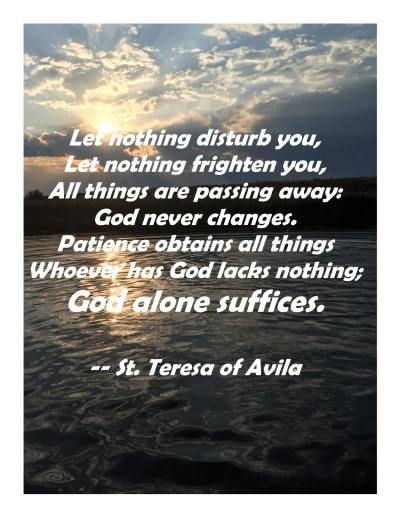
St. Teresa of Avila, declared a doctor of the Church, composed this beautiful prayer which describes this union:

Let nothing disturb you, Let nothing frighten you, All things are passing away: God never changes. Patience obtains all things Whoever has God lacks nothing; God alone suffices. — St. Teresa of Avila

In His Father’s house there are many rooms, and one especially prepared for you by Christ.  Trust in His love, Trust His Wisdom, Trust His Goodness…and let nothing trouble your hearts, that His Peace may be with you always.

Consider:

  • When have you experienced the peace of Christ?  After Mass, in praying with Scripture, in nature, through other Christians?
  • Consider the fears and anxieties you carry.  Lay them before the Lord in prayer and surrender them.  Consider the power of Christ to provide, the love of Christ which motivates Him, and the faithfulness of Christ who remains near us in every trial.
  • In what areas of your life do you trust God completely?  In what areas do you rely on yourself or conventional wisdom rather than Him?

Make a Resolution (Practical Application):

  • Choose your biggest worry.  Begin and end each day surrendering it to God in prayer.
  • Pray the prayer of St. Teresa of Avila each day this week.
  • We make an act of trust in God when we tithe.  If you do not tithe already, begin this week.  If you tithe already but feel called to tithe more (10% is the commonly suggested amount), prayerfully make a financial act of trust in the Lord.
  • Pray Psalm 23 each day this week.
Why do you trust Jesus Christ?  Post in the comments section below!

Related Posts:

~ Written by Angela Lambert © 2017

* To receive these weekly posts automatically in your email just click the “follow” tab in the bottom right hand corner and enter your email address.


We All Need a Loving Gate-Keeper and Filter…Christ the Good Shepherd

by Angela Lambert

May 7th, 2017 4th Sunday of Easter


Gospel of John 10:1-19

Jesus said: “Amen, amen, I say to you, whoever does not enter a sheepfold through the gate but climbs over elsewhere is a thief and a robber. But whoever enters through the gate is the shepherd of the sheep. The gatekeeper opens it for him, and the sheep hear his voice, as the shepherd calls his own sheep by name and leads them out. When he has driven out all his own, he walks ahead of them, and the sheep follow him, because they recognize his voice. But they will not follow a stranger; they will run away from him, because they do not recognize the voice of strangers.” Although Jesus used this figure of speech, the Pharisees did not realize what he was trying to tell them. So Jesus said again, “Amen, amen, I say to you, I am the gate for the sheep. All who came before me are thieves and robbers, but the sheep did not listen to them. I am the gate. Whoever enters through me will be saved, and will come in and go out and find pasture. A thief comes only to steal and slaughter and destroy; I came so that they might have life and have it more abundantly.”

Meditation Reflection:

Quite often as a mom, I feel like a gate-keeper.  Before my kids go somewhere I need to know with whom, who the parents are, and approve.  Technology plagues me even more, with parent controls, ratings evaluations, and restrictions. The ever-multiplying accounts, passwords, devices, programs, and updates can feel like an interminable game of whack-a-mole.  Christmas and birthdays used to be fun, now they feel like a migraine-inducing tidal wave of gate-keeping duties, with impatient children complaining as I set the perimeter that I am being too slow, and of course, too controlling.  I’ve at least developed a one-line response to save my overtaxed brain from responding to the myriad of “logical” arguments and pleas of trust from my young teens. “It’s as simple as this,” I say, “You will not have unfiltered access to the internet.”  The Church could consider adding that as the 11th Commandment for the modern era.

Let’s face it, even adults, as children of God, need filters.   We too can be easily allured by promises of pleasure, freedom, status, or adventure from false advertisers; and I don’t just mean commercially.    Despite having everything, Adam and Eve fell prey to Satan’s proposition that God’s single rule (not to eat the fruit of the tree of knowledge of good and evil) was controlling, and denying them fun out of selfish motivations.  Satan continues to deceive us through similar false promises.

Just as predators try to find ways to get around parents to manipulate children, spiritual “thieves and robbers” try to get around Christ to attack us, God’s children.  First, they try to separate us from His influence by undermining our trust in Him, His Word, or His Church.  Common attempts sound something like: “Christ’s teachings hold you back. If you want to get ahead in life you have to be willing to get your hands dirty”, or “It’s not that you are going against Christ’s teachings, you are just modernizing them.”  In regards to those difficult passages in Scripture, the ones that really strike at your conscience, you will be urged to simply pass over them or interpret them in a more relaxed way – “Forgive others, yes, but forgive my ex?, I don’t think He meant that…”  Jesus stresses that we must die to ourselves in this life and deny ourselves.  Instead we rationalize that He only meant that symbolically, or at least in a modest way – like going on a diet or not aiming too high. Finally, the Church, Christ’s living voice of authority, is the clearest voice of our Shepherd and therefore the harshest recipient of worldly criticism.

We are children of God, in need of a loving gate-keeper.  Christ’s commands, given through Scripture and the Church, can seem restrictive and controlling if we have an adolescent view.  However, as we develop in spiritual maturity, we begin to appreciate the wisdom and the love underlying them.  When I’m tempted to brush off a Church teaching or a little pull at my conscience, I stop and recall that Christ loves me more than I love myself, and He is far wiser than me.  Who am I going to trust?  Any other false shepherd – whether secular culture, another person, or my own impulses – eventually drains rather than fills and proves a destructive, rather than uplifting force.

Christ, our Good Shepherd, leads to green pasture. He refreshes our souls and leads us beside peaceful waters (Psalm 23).  Jesus lamented to St. Faustina that distrust on the part of souls causes Him the greatest pain.  As a mom of teens, I know what He means.   I want my kids to trust me too, and so I repeat the prayer He gave to St. Faustina, “Jesus I trust in You.”

Consider:

  •  When have you been steered wrong – by others, by cultural norms, or by your own impulses?  What was the reason?  What did you learn?
  • When have you been steered right by Christ?  How has His wisdom brought deeper joy and fullness of life, even amidst suffering, than these other voices?
  • Have you ever had to be the gate-keeper for loved ones?  Consider the love it takes to be strong and the need for them to trust you.
  • How can you trust Christ more and listen to His voice more often?  Could you attend Church more regularly?  Could you invest more time into Christian friendships?  Do you make time to study your Bible, read quality devotionals, or learn more about your faith?

Make a Resolution (Practical Application):

  •  Choose one way to listen more to the voice of Christ this week.
    • Ideas:  Add 10 minutes to your prayer time, pray the rosary in the car, listen to Christian radio, listen to Christian podcasts, read the daily Scriptures (these can be found at usccb.org), post inspirational Scripture quotes in places you will see them often, meet with a Christian friend.
  • Consider adding a filter, rating restrictions, or accountability software to your personal technology.

Related posts:

~ Written by Angela Lambert © 2017

* To receive these weekly posts automatically in your email just click the “follow” tab in the bottom right hand corner and enter your email address.


Getting the Last Word…but Making it a Blessing

by Angela Lambert


February 18th, 2017; 7th Sunday of Ordinary Time

Gospel Matthew 5:38-48

Jesus said to his disciples: “You have heard that it was said, An eye for an eye and a tooth for a tooth. But I say to you, offer no resistance to one who is evil. When someone strikes you on your right cheek, turn the other one as well. If anyone wants to go to law with you over your tunic, hand over your cloak as well. Should anyone press you into service for one mile, go for two miles. Give to the one who asks of you, and do not turn your back on one who wants to borrow. “You have heard that it was said, You shall love your neighbor and hate your enemy. But I say to you, love your enemies and pray for those who persecute you, that you may be children of your heavenly Father, for he makes his sun rise on the bad and the good, and causes rain to fall on the just and the unjust. For if you love those who love you, what recompense will you have? Do not the tax collectors do the same? And if you greet your brothers only, what is unusual about that? Do not the pagans do the same? So be perfect, just as your heavenly Father is perfect.”

Meditation Reflection:

In 1981, Pope St. John Paul II was shot by a Turkish assassin Ali Agca.  The attempt occurred on the feast of Our Lady of Fatima and JPII credits Mary for “guiding the bullet” which just barely missed a major artery.  Even while in the ambulance, JPII voiced his forgiveness of the assassin.  Later after he had recovered, he visited Agca in prison and offered his forgiveness in person.  Agca had not offered an apology and only inquired as to why he wasn’t dead.  This encounter however had an impact and later when he was released from prison, Agca travelled to St. Peter’s to place roses on John Paul II’s tomb.

Forgiveness and love is the mark of Christ, and therefore the signifier of His followers.  John tells us that “God is Love.”  The term “perfect” means “full, or complete.” When Jesus refers to His Heavenly Father’s perfection therefore, He means that God’s love lacks nothing and is total.  By contrast, “even tax collectors” love their friends, but their love is imperfect because it is incomplete.  Total love includes those who love us and those who do not.

But how we can love someone who hates us or hurts us?  Does Jesus mean we must be friends with people who wish us harm or take advantage of us?  No.  Love is defined as “willing another person’s good.”  Thankfully, this does not require feelings of love, or even reciprocal friendship.  It doesn’t even mean trusting the person. It simply means choosing not to act in revenge or anger, and instead doing that which promotes the good of the other.  Thus, we can pray for our enemies, in which we petition God on their behalf for graces to be bestowed upon them.  We can speak kindly, act respectfully, and do the right thing toward others, not because they necessarily deserve it, but because it’s the kind of person we want to be.

Authentic love sometimes means tough love.  It can require choices that appear unloving but are in fact healthy boundaries.  Loving an addict for instance or someone with mental illness will require tough love, but will be more effective toward their health than enabling them in their sickness.  Disciplining children is tough love, but it helps the child grow in goodness.

Christ calls His followers to imitate His mercy.  This demand goes above and beyond natural strength and even natural wisdom or common sense.  It only makes sense considering the mystery of Christ’s suffering, death, and resurrection for our salvation, and it can only be accomplished with the aid of His divine grace.

Christ loved us while we were yet sinners.  He willed our good and worked for our salvation even when we were mired in sin and rejected Him.  As His disciples, we can work for the salvation of others, even when they too are mired in sin and working against us.

This can be tricky, but my mother offered me advice about these situations that I have found to be a guiding principle. When tempted to react vengefully when faced with difficult people and situations, she would say, “don’t let their behavior change who you are.”  Her wisdom strengthened my resolve and shed light on how to decide what to do.  No matter what others are doing or how low they sink, the truth is, if we just fire back we sink to their level too.  Jesus wants us to rise above, with the help of His grace and the light of His example.  Whether it transforms the other person or not, it will definitely transform us.

Loving our enemy is necessary to stop the cycle of violence, and our only hope for human unity.  When we are the ones caught up in it, we want to get the last word in or throw the last punch.  When we are the observer however, we just want it to stop.  As a mom, I get tired of hearing my kids bicker. Both claim it’s the other’s fault and point the finger at who started it.  Both go on and on and on, despite my attempts to break it up because they are obsessed with having the last word.  I wonder if God views our bickering in the same way.  Maybe the other person did start it, so what?  Why can’t we just stop?  No one can move on unless we do and everyone is miserable.

Loving our enemy is a supernatural virtue.  To cultivate charity, we need to connect to God and His stream of grace in prayer and the sacraments.  We must meditate on the Gospels to develop our sense of what Jesus would do.  We need to make time for fellowship with Christians walking the walk and learn from their insights and examples.  In this way, we can grow in love until it fills every gap in our heart and reaches the fullness of perfection like that of our Father in heaven.

Consider:

  • Who do you find easy to love and why?
  • Who do you find difficult to love? Who could you identify as your enemy?
    • In what way do they provoke you to strike back?
    • How might you react with love instead? How could you “will their good”?
  • Consider how we love our children even when they disobey, say hurtful things, or work against us. Do you ever feel anger toward your kids, but choose/will what’s good for them?
  • Consider God’s perspective as our Father and us as His children. How does He view our bickering, feuds, back-biting, and competitiveness?  What would He say to you about how you treat your brother or sister in Christ?
  • We can pick our friends but we can’t pick our family. Consider how loving our natural siblings can cultivate the virtues needed to love our spiritual siblings.
  • Read the story of St. Maria Goretti and reflect on her example of tough love, forgiveness, and the transformation it caused in her assailant.

Make a Resolution (Practical Application):

  • Pick one person who makes your life difficult.
    • 1) Begin each day with a sincere prayer for them. (not a list of all their flaws that God should fix, but rather for God’s blessing upon them!)
    • 2) Resolve each day this week to refrain from snide remarks to them or about them, gossip, or any kind of action that would anger or hurt them.
    • 3) Do one kind thing for them.


~ Written by Angela Lambert © 2017

* To receive these weekly posts automatically in your email just click the “follow” tab in the bottom right hand corner and enter your email address.


Keeping it Real

by Angela Lambert

20141130_175201795_ios

February 11th, 2017; 6th Sunday of Ordinary Time

Gospel of Matthew 5:20-22a, 27-28, 33-34a, 37

Jesus said to his disciples: “I tell you, unless your righteousness surpasses that of the scribes and Pharisees, you will not enter the kingdom of heaven.  “You have heard that it was said to your ancestors, You shall not kill; and whoever kills will be liable to judgment. But I say to you, whoever is angry with brother will be liable to judgment. “You have heard that it was said, You shall not commit adultery. But I say to you, everyone who looks at a woman with lust has already committed adultery with her in his heart. “Again you have heard that it was said to your ancestors, Do not take a false oath, but make good to the Lord all that you vow. But I say to you, do not swear at all. Let your ‘Yes’ mean ‘Yes,’ and your ‘No’ mean ‘No.’ Anything more is from the evil one.”

 Meditation Reflection:

Freedom in Christ, is founded on freedom from being fake.  We are masters at the false front.  By an early age most of us can pull off “I’m fine” to anyone who asks, no matter how untrue it may be.  Keeping up appearances, looking successful, and seeming to be more than we are occurs in every time period and culture.   Social media amplifies today’s version, as we can literally craft our public persona via selective posts and pictures.

We not only mask our imperfections, we often mask our sins as well.  From the back-handed compliment, to disparaging remarks prefaced by “God bless her soul, but…”, to shallow mantras like “You only live once” or “it’s not like it’s against the law”, we rationalize our viciousness in countless ways.  Like addicts, we deny we have a problem with sin and we excuse and blame our behavior on everyone and everything but ourselves.

Just has sobriety can only be achieved through facing reality, so human freedom from sin can only be wrought from an utter realness about ourselves.  When Moses asked God to reveal His Name, God responded that it is “YHWH” or “I AM”.  God revealed that He is.  God is being and existence.  Thus, union with God requires utter realness and authenticity.

C.S. Lewis writes about this mystery in a brilliantly imaginative way in his book “The Great Divorce.”  The divorce in this case refers to the divide between heaven and hell, and describes the process of purgation for those still travelling to heaven.  He describes inhabitants of hell, drawing from scriptural imagery, as phantoms.  On the opposite spectrum, he calls those in heaven “solid people.” The main character arrives at a gray bus stop, phantom-ish, and his journey toward heaven is one of becoming more solid – or more “real”.  To do this he must surrender all that he keeps false within himself.  I won’t give away more than that, as I highly recommend this read!  I will only offer this teaser – Lewis creates numerous characters whose struggle to move from ghostish versions of themselves to the authentic provides deep insight into the rationalizations with which most of us struggle, the pain of conversion, and the joy of authentic freedom.

In the Beatitudes, Jesus teaches us interior conversion and introspection.  In today’s Gospel passage, He directly calls us out on how we tip toe around the truth and avoid real virtue and, in consequence, real love and relationship.

How many times have we heard the excuse, “well, it’s not like I’ve killed anyone.  I’m a decent person.”  Yet, harboring anger can be deeply destructive and emerge in violence that might be more subtle, but no less real.  Passive-aggressive behaviors, online bullying, slander, gossip, critical remarks and callous attitudes prevent relationship and they hold us back from heaven.  Jesus states clearly, “I tell you, unless your righteousness surpasses that of the scribes and Pharisees, you will not enter the kingdom of heaven”  (MT 5:20) and “be perfect therefore, as your heavenly father is perfect” (MT 5:48)  A man who loves his wife, doesn’t look lustfully at other women.  A woman who loves her husband, doesn’t flirt with other men.  Does it matter whether or not it’s technically adultery?  Jesus calls out the dishonesty.  Either way, it certainly feels like cheating to the other spouse.  Why?  Because love is total, exclusive, and lifelong.  Our love for our spouse should mirror love for God. In fact, God created the first man and woman in the state of marriage because as two persons in a relationship of life-giving love, they imaged the Triune God.

Authenticity begins by simply letting our Yes be yes, and our No be no.  Drop the exaggerations and minimizations.  Leave the white lies.  Take down the false fronts.  It feels like going a day without make-up at first, but not forever.  As we become more at peace with ourselves, we become more comfortable in the truth.  Eventually the fake-ness we clung to in the past will feel like too much make-up, caked on, that you can’t wait to wash off at the end of the day.

Jesus wants us, not the façades we create.  He accepts us as we are and helps us become the truest version of ourselves.  When this happens, we can begin to experience the real relationship, and real love necessary for heaven.

Consider:

  • List your most common struggles in a day, then pray about what interior attitude or disposition underlies it.
    • consider the 7 capital sins for ideas (pride, envy, greed, anger, sloth, lust, and gluttony)
  • What is your most common/tempting rationalization?
  • In what ways have you grown in authenticity over the years? Reflect on how good it feels to be yourself.
  • Who is someone you can be completely yourself around; who knows the “real” you?
  • Consider how honesty is necessary for relationship.

Make a Resolution (Practical Application):

  • Tackle one rationalization this week.  Be direct with yourself and with God.  Name the struggle, occasions of temptation, and the rationalization you use.  Decide on how you will avoid the temptation or create a counter-mantra to repeat when you hear yourself rationalizing.
    • Example:
      • Daily struggle: Crabby toward your spouse and kids
      • Occasions of temptation: Getting out the door in the morning, right after a long day at work, or when interrupted during a project.
      • Rationalizations: “They’re my family and should love me unconditionally – this is just who I am”; “I work hard to care for my family, and it just means I will be stressed out”
      • Counter-mantras: “They’re my family – they deserve my best behavior”;  “I need to find balance in my life so I can be a peaceful person to my family”
      • Avoiding temptation – Begin the day 10 minutes earlier so you aren’t stressed about running late (even better, begin with a prayer!); create transition time between work and home – listen to Christian music on the drive and count your blessings so you arrive with a positive attitude; adjust expectations for completing projects – expect to get interrupted by kids and be grateful for them, try to include them in the project if possible


~ Written by Angela Lambert © 2017

* To receive these weekly posts automatically in your email just click the “follow” tab in the bottom right hand corner and enter your email address.


Joseph’s Steady Leadership When Faced With “It’s Complicated”

by Angela Lambert

st-joseph

December 18th, 2016; 4th Sunday in Advent

 Gospel Matthew 1:18-24 NAB

This is how the birth of Jesus Christ came about. When his mother Mary was betrothed to Joseph, but before they lived together, she was found with child through the Holy Spirit. Joseph her husband, since he was a righteous man, yet unwilling to expose her to shame, decided to divorce her quietly. Such was his intention when, behold, the angel of the Lord appeared to him in a dream and said, “Joseph, son of David, do not be afraid to take Mary your wife into your home. For it is through the Holy Spirit that this child has been conceived in her. She will bear a son and you are to name him Jesus, because he will save his people from their sins.” All this took place to fulfill what the Lord had said through the prophet: Behold, the virgin shall conceive and bear a son, and they shall name him Emmanuel, which means “God is with us.” When Joseph awoke, he did as the angel of the Lord had commanded him and took his wife into his home.

Meditation Reflection:

Immanuel, God-with-us.  We no longer must suffer alone, weak and afraid.  The Lord has come and brought with Him the comfort, strength, and peace of His holy presence dwelling in our souls and working in the world with His transforming grace.  We experience something of this peace and strength in family life.  Being with our parents makes us feel secure and protected.  Being with our children brings us joy and comfort.

The Holy Family experienced this as well, and made it possible for all of us.  Mary’s fiat, her “yes”, made the Incarnation possible and therefore the redemption of all mankind.  Joseph’s fiat, his “yes”, made the Holy Family possible.  He accepted Christ as He was, in the surprising and shocking form in which He came.  His decision to take Jesus and Mary into his home and make them His own family was the fruit of God’s grace in concert with his virtues.  This required serious discernment and prayer, both of which he models for all Christians.

Joseph was a just, or righteous man.  This does not mean he was without sin whatsoever, but it did mean he consistently strove for virtue, followed the Mosaic Law, and lived his faith.  Early Christian writings not included in the Bible, such as the Protoevangelium of James, indicate that Mary’s parents consecrated her to God and so she would serve God in the temple and take a vow of virginity.  As a result, she grew up in the Temple from the age of 3 until she was of marrying age.  It was a Jewish practice that at that point she would be entrusted to the care of a guardian who would protect her and would respect her vow of virginity by taking a vow of celibacy himself.  Oftentimes this would be a man who was older and widowed.  Some think this explains why Joseph had died by the time of Jesus’ public ministry.  According to the Protoevangelium of James, from among the men who wished to take Mary as their wife, Joseph was chosen as Mary’s husband by a miraculous sign.  Imagine his surprise, confusion, and disillusionment, when he learned she was pregnant. His response to the situation is so admirable, strong, and level-headed.  He’s a model for anyone who must make difficult decisions in complicated and emotional situations.

Joseph made a prudent decision, based on who he was and his faith.  Purity and honor being important virtues, he decided he could not take her into his home as his wife. (At the time, betrothal was a solemn contract with the weight of marriage, but preceded living together as husband and wife).  At the same time, he was a compassionate and merciful man.  Matthew tells us Joseph was “unwilling” to expose her to shame.  I imagine he had plenty of men and women urging him to exact the full measure of the Jewish law against her, to publicly humiliate her, and to get sweet revenge for embarrassing him. Joseph would not.  He was unwilling.  Joseph made a decision to do the right thing quietly. In the RSV translation, it says he “resolved to send her away quietly.”  To be resolved indicates a decision made with prudence, strength, and determination, detached from pettiness and emotion.

Joseph focused on how to thoughtfully and prayerfully doing the next right thing.  Because of this, God guided his discernment.  The RSV translation says, “But as he considered this, behold an angel of the Lord appeared to him”.  The word “considered” is important.  The spiritual life is ultimately one of love, fidelity, and receptivity.  We are followers of God, not leaders of God.  God guided Joseph’s considerations for his family, just as God guides every father who will invite the Lord into his discernment.  When God spoke, Joseph faithfully and lovingly followed through with God’s will.

Immanuel, God-with-us.  How might we as mothers and fathers invite God to be with us in our families and our decision-making?  How might we say yes to the Father and welcome His Son?  How might we accept the family that God has entrusted to us, rather than the one we imagine for ourselves?  God works in surprising and shocking ways.  This Advent, taking a moment to consider who we are and what we believe, may St. Joseph pray for us to have the kind of steady and faith-filled approach to life’s complications that he did.


Consider:

  • Joseph’s yes made it possible for Jesus to have a family.  Consider what a gift it was for him to grow up with Mary as His mom and Joseph as His foster-father.
  • Consider Joseph’s prayerful leadership. How might you imitate St. Joseph’s discernment in your own life?
  • Do you take time to “consider” things and “resolve” to follow through?
    • What things, habits, or people undermine that, urging you to react immediately and emotionally?
    • What things, habits, or people could help you develop deeper consideration and stronger resolve?
  • Ask Joseph to lead you and your family, as He did for Jesus and Mary. Pray for his protection, guidance, and love.

Make a Resolution (Practical Application):

  • Teresa of Avila and numerous other saints recommend devotion to St. Joseph and credit his powerful intercession for answers to their prayers.  I too can attest to this from my own life.  This week, ask St. Joseph to pray for you and for your family. st-joseph-prayer
  • Do you know someone who is like St. Joseph? Spend more time with that person and learn from his example.  Take him to coffee and ask him lots of questions and take his advice.
  • Surrender a complicated decision to the Lord in quiet prayer. Consider who you are, what our Christian faith says about the situation, and resolve to do the next right thing with the help of the Holy Spirit.


~ Written by Angela Lambert © 2016

* To receive these weekly posts automatically in your email just click the “follow” tab in the bottom right hand corner and enter your email address.


Keeping Things in Perspective

by Angela Lambert

perspective

November 6th, 2016; 32nd Sunday in Ordinary Time

Gospel Luke 20:27-38

 Some Sadducees, those who deny that there is a resurrection, came forward and put this question to Jesus, saying, “Teacher, Moses wrote for us, If someone’s brother dies leaving a wife but no child, his brother must take the wife and raise up descendants for his brother. Now there were seven brothers; the first married a woman but died childless. Then the second and the third married her, and likewise all the seven died childless. Finally the woman also died. Now at the resurrection whose wife will that woman be? For all seven had been married to her.” Jesus said to them, “The children of this age marry and remarry; but those who are deemed worthy to attain to the coming age and to the resurrection of the dead neither marry nor are given in marriage. They can no longer die, for they are like angels; and they are the children of God because they are the ones who will rise. That the dead will rise even Moses made known in the passage about the bush, when he called out ‘Lord,’ the God of Abraham, the God of Isaac, and the God of Jacob; and he is not God of the dead, but of the living, for to him all are alive.”

Meditation Reflection:

As Christians, we profess a belief in life eternal with Christ in Heaven, yet we can sometimes operate in our daily lives forgetful of this mystery.  Like the Sadducees we ask Christ silly questions about heaven.  When we attach ourselves too much to earthly life, we fall into the trap of imagining heaven as merely an extension of the present but with a few more perks.

Jesus reminds us of the incomparable difference between our journey to God here and union with God there.  As St. Paul put it, “Eye has not seen and ear has not heard what God has ready for those who love Him” (I Corinthians 2:9).  Even the good things we experience here are merely a prelude to heaven.  Here we experience a taste, there we will enjoy the feast.

Jesus proposes to the Sadducees that contemplating the life of the angels can provide some insight into this mystery.  Like humans, angels are persons with rational intellects, free will, and the ability to love.  Unlike humans they do not have bodies, are neither male nor female, and do not procreate.  Each angel was individually created by God and is completely unique, so much so that some have compared it to being like different species from one another.  Because they live in eternity, their choices are permanent.  When God created them they each had the choice to either accept or reject God’s will for their life and His mission for them.  Some said yes to God’s will and others rejected it.  Those who rejected God’s will we call the fallen angels or demons.  Human persons have more than one moment to choose or reject God, but that space of time does have limits.  For us it ends when we die; at which moment our choice becomes permanent.

Consequently, the space of time in which we live on earth really is only a preparation for eternal life.  During this short period, we either choose to grow our love for God or develop a disdain for Him.  Only during our earthly lifespan can we develop and increase our capacity for God.  At the moment of death the opportunity for change ends.

In addition, it’s our chance to aid others in their chance of heaven, even in its most basic form – the beginning of life itself.  Whereas God created all of the angels at once, He creates human persons over a course of time and includes them in His work.  As a result, openness to life means openness to God’s creation of persons who will live eternally.  Those called to spiritual motherhood or fatherhood also contribute to this mystery as they minister to the birth and development of the child’s love for God which is necessary for true life.

The Sadducees’ challenge to Christ with the hypothetical situation of a woman married seven times, merely exposed their ignorance of God.  On earth marriage develops our capacity for love, self-gift, and sacrifice.  It brings new life into the world as well as caring for the development of each family member.  Marriage itself is not needed in heaven because no new life will be born there.  It is the eternal life of those who already exist.  Moreover, love will be perfected as we enjoy the perfect love of God and one another. The relationship of love experienced in marriage will remain a relationship of love in heaven.  However, the title of husband or wife will be eclipsed by the fullness of the title son or daughter of God and sister and brother in Christ.

As the liturgical year comes to a close (Advent marks the beginning of the “New Year” in the Church), we contemplate the end times and remember that this experience of earthly life will eventually come to an end.  We all get bogged down in our daily routine and anxious over matters that, if we considered our heavenly destination, shouldn’t really weigh us down.  Moreover, we could make better use of our limited time if we consider things from an eternal perspective.  This life is a preparation and an opportunity to participate in God’s work of spreading His kingdom.  The more souls that come to accept His will and love on earth, the more that will join the wedding feast of love in Heaven for eternity.

Consider:

  • How does a heavenly perspective change your earthly perspective?
  • When feeling discouraged, remember that this life is a journey not the destination. Endless, secure happiness cannot be found here but the work to attain it in heaven can.
  • Through prayer, identify one area where you struggle to accept God’s will over your own.
  • Each angel has a mission from God. You also have a mission.  How is God calling you to serve?
  • Consider first God’s vocational calling:
    • Is it to work for the salvation of your spouse through love and sacrifice and to possibly grow the human family by being open to life and to raising children in knowledge and love of the Lord?
    • Is it to administer the sacraments as a priest to bring eternal life to spiritual children?
    • Is it to spend your life in prayer and sacrifice for souls as a religious sister or brother?
    • Is it to devote your time and energy to God in a unique way as a single person, ready to do His will at every moment?
  • Consider next God’s occupational calling: How do you grow your love for God and develop it in others through your work?
    • Consider your special apostolate. Does God include you in His work of physical or emotional healing, protecting, providing, instruction of souls, encouragement, etc.?
    • How can you incorporate a heavenly perspective into your daily work? How do your daily activities and duties provide opportunities to detach from selfishness and develop greater love and compassion?  How might you help others to heaven through your work?

Make a Resolution (Practical Application):

  • Begin each day by writing down the tasks, challenges, and opportunities you anticipate that day.  Next to each, write one way it can be directed toward helping yourself and others to heaven.  For example, will it grow a virtue or minimize a vice if tackled with the help of grace?  Is it an opportunity to help others journey to God – either by giving them physical life, sustaining their life, healing, protecting, or developing an aspect of their soul?
  • Identify where your will is most at odds with God’s and do one thing each day to offset it. It could be a refusal or fear to do something God asks of you or an unwillingness to let go of something and trust God in the situation.
  • Pray the Serenity Prayer or the Suscipe of St. Ignatius each day. Click here for a pdf of the two prayrs: serenity-and-suscipe-prayers.

Related Posts:

Real Realism

The Glorious Reign of Christ Our King

The Sight of God… Gospel Meditation for the Feast of All Saints

~ Written by Angela Lambert © 2016

* To receive these weekly posts automatically in your email just click the “follow” tab in the bottom right hand corner and enter your email address.


Tough, Gentle Mercy

by Angela Lambert


littleacts-of-kindness

October 29th, 2016; 31st Sunday in Ordinary Time

Gospel Luke 19:1-10

At that time, Jesus came to Jericho and intended to pass through the town. Now a man there named Zacchaeus, who was a chief tax collector and also a wealthy man, was seeking to see who Jesus was; but he could not see him because of the crowd, for he was short in stature. So he ran ahead and climbed a sycamore tree in order to see Jesus, who was about to pass that way. When he reached the place, Jesus looked up and said, “Zacchaeus, come down quickly, for today I must stay at your house.” And he came down quickly and received him with joy. When they all saw this, they began to grumble, saying, “He has gone to stay at the house of a sinner.” But Zacchaeus stood there and said to the Lord, “Behold, half of my possessions, Lord, I shall give to the poor, and if I have extorted anything from anyone I shall repay it four times over.” And Jesus said to him, “Today salvation has come to this house because this man too is a descendant of Abraham. For the Son of Man has come to seek and to save what was lost.”

Meditation Reflection:

As Jesus’ disciples, we too share in His mission to seek and save the lost.  During the Jubilee Year of Mercy, Pope Francis has exhorted us to be more proactive in this mission – to intentionally practice mercy daily through concrete actions and to make efforts to see those in need of help around us.  People who are lost, by definition, don’t know their way back home.  Thus, we need to seek them out, to find them where they are drifting, and to gently walk the journey back with them.

How do we do this?  It depends on the relationship and the situation.  The one consistent in every attempt however, is prayer.  Since we follow Christ, we must begin by listening to Him and letting Him lead.

Each person and each situation require prudence and a tailored response.  I can propose some general ideas and lessons I’ve learned, but every lost or drifting soul must be cared for on a prayerful and individual basis.

Seeking the lost begins at home with the people God has entrusted to us.  It’s much easier to dote on our children than to discipline them and to complain or criticize our parents or spouse than to gently correct them.  Yet, those closest to us can drift away and get lost if sins get left unchecked.  Although people make their own choices, we must do what we can to seek them out when they begin to pull away from God or goodness.

For parents, this means doing the work of discipline.  For young children, it teaches them self-control, right from wrong, and starts them off on the right track with good habits.  For teens, it can be trickier.  Their struggles are heavier, more embarrassing at times, and better hidden.  Discipline has to not only reform their habits but also their minds and hearts.  How to reach a child’s heart is a daunting task to attempt and one prone to failure, nevertheless we have a Christian and parental duty to try the best we can out of love.  We must endeavor to be bold, suck it up, and lovingly try to help them get back on track just as our heavenly Father does for us.

“But you spare all things, because they are yours, O LORD and lover of souls, for your imperishable spirit is in all things! Therefore you rebuke offenders little by little, warn them and remind them of the sins they are committing, that they may abandon their wickedness and believe in you, O LORD!”  Wisdom 11:26-12:2

When another adult in one’s family begins to stray, it requires just as much care and prudence.  It also requires greater understanding, compassion, and forgiveness on our part since we will likely be affected ourselves by their choices or we may struggle with feelings of disappointment or betrayal.  If we can be patient and prayerful however, knowing them so well can work in our favor to gently move them in a way that resonates with them personally.

Friends and acquaintances may be less open about their struggles but we can do small things to let them know we see they’re hurting and we are here to help.  Pray about whether to have a direct conversation or to indirectly point them through example, invitations, or suggestions.  Ask Mary to help you see their need and do what you can to meet it.  It may be material needs that can be met with physical gifts, emotional needs that can be met with a listening ear or a word of encouragement, loneliness which can be soothed through invitation to coffee or dinner, or spiritual need which might be aided by being brave enough to share your own faith openly with them or to pray with them.

little-acts-of-love-2

Consider:

  • When have you received merciful love? How did it change you?
  • How have the challenges you have faced enabled you to recognize the same struggle in others and better equipped to help?
  • Who do you find the most difficult to love and who do you find it easiest to care for?

Make a Resolution (Practical Application):

  • Pray for Christ to show you an opportunity to offer mercy to someone each day this week.Works of Mercy
  • Consider joining with others to help: volunteer at a crisis pregnancy center, lead a bible study, volunteer at a food shelf, organize meals for a neighbor or colleague who is sick…


~ Written by Angela Lambert © 2016

* To receive these weekly posts automatically in your email just click the “follow” tab in the bottom right hand corner and enter your email address.


Christ in the Distressing Disguise of the Poor at our Doorstep

by Angela Lambert

richmanlazarus

September 25th, 2016; 26th Sunday in Ordinary Time

Gospel of Luke 16:19-31 NAB

Jesus said to the Pharisees: “There was a rich man who dressed in purple garments and fine linen and dined sumptuously each day. And lying at his door was a poor man named Lazarus, covered with sores, who would gladly have eaten his fill of the scraps that fell from the rich man’s table. Dogs even used to come and lick his sores. When the poor man died, he was carried away by angels to the bosom of Abraham. The rich man also died and was buried, and from the netherworld, where he was in torment, he raised his eyes and saw Abraham far off and Lazarus at his side. And he cried out, ‘Father Abraham, have pity on me. Send Lazarus to dip the tip of his finger in water and cool my tongue, for I am suffering torment in these flames.’ Abraham replied, ‘My child, remember that you received what was good during your lifetime while Lazarus likewise received what was bad; but now he is comforted here, whereas you are tormented. Moreover, between us and you a great chasm is established to prevent anyone from crossing who might wish to go from our side to yours or from your side to ours.’ He said, ‘Then I beg you, father, send him to my father’s house, for I have five brothers, so that he may warn them, lest they too come to this place of torment.’ But Abraham replied, ‘They have Moses and the prophets. Let them listen to them.’ He said, ‘Oh no, father Abraham, but if someone from the dead goes to them, they will repent.’ Then Abraham said, ‘If they will not listen to Moses and the prophets, neither will they be persuaded if someone should rise from the dead.’”

 Meditation Reflection:

Pope St. John Paul II often said that self-fulfillment and happiness can only be found in self-gift.  This paradoxical truth flies in the face of our cultural idolization of individualism summarized in mottos such as “looking out for number 1” or “YOLO – you only live once.”  We often ignore the needs of those right in front of us.  Lazarus lay at the rich man’s doorstep but we often ignore family members who live within our own home or are only a phone call away.

I recently read an article by Pierre Manent in First Things magazine  (“Repurposing Europe” April, 2016)  in which he reflects on the current state of political life in France from which any of us who lives in Western culture could learn.  Politics refers to the way in which people organize themselves as a community and view their responsibility toward the common good.  He observes that the move from Christendom to nationalism has been superseded by a move from nationalism to individualism.  Moreover, in a secular culture, the problem has been compounded by a lack of belief/reliance on divine providence.  In consequence, he asserts, France struggles with “a growing incapacity to propose goals for common action.”  Because of the “great withdrawal of loyalty from the community,” a society united merely by individual rights lacks the “capacity to gather and direct our powers, to give our common life form and force.”

Manent’s observations of his own French history resonates with the American experience as well.  Hyper-individualism, secularism, and a world-view that lacks an eternal horizon creates its own set of problems.  There are problems that are too big for us as individuals and require a unified effort which is only possible with a common view of the good and willingness to sacrifice for it.  There are also problems that are too big for us as a nation and can only be approached with a confidence in divine providence and the aid of a God who “protects the resident alien, comes to the aid of the orphan and the widow, but thwarts the way of the wicked” (Psalm 146:9).

In this year of mercy, Christ’s words exhort us in a special way to look beyond ourselves and to discover that our own happiness can only be found in concern for the well-being of others.  He does not scold the rich man for fine dinners, Jesus scolds him for ignoring Lazarus – who was sitting on his doorstep – while eating that dinner.  The cold-heartedness and lack of compassion for the suffering of another person fails to fit us for heaven – a place of perfect love and communion with God and all the saints.

Mother Teresa, famous for her compassion for the poor and recently canonized, advised us all to serve the poor in our own families and to comfort those in our own life who suffer spiritually, emotionally, or physically.    She found Christ in “the distressing disguise of the poorest of the poor.”  Sometimes we might hesitate to look too closely because it can be quite distressing.  We’d rather accept the fake smile and the rote “I’m fine” than dig deeper.  St. Mother Teresa acknowledges, “It is easy to love the people far away.  It is not always easy to love those close to us.  Bring love into your home, for this is where our love for each other must start.” I am challenged by this often as a teacher and a mother.  However, I pray for the grace to “cast out into the deep” (Luke 5:4), encouraged and convicted by Christ’s words that “whatever you did for one of these least brothers of mine, you did for Me” (Matthew 25:40).

We grow our capacity to love on earth.  People often complain about how mean it is that God would “send someone to Hell.”  In reality, individuals send themselves there.  God has made hell out of mercy that we might have the freedom to choose Him or reject Him, to choose Love or to reject Love.  We can see a glimpse of this in the differing experiences of people at the same event.  Sacrificing time to serve the needs of another will either bring you joy or pain depending on your disposition.  For example, with my first child, I had difficulty adjusting at first to the constant needs which thwarted at every moment whatever I wanted to do at the time.  At one point I felt like I could literally feel the fires of purgatory burning away my self-will as I stopped what I was doing to tend to his interrupting need.  The experience made me realize just how attached I actually was to my own desires and plans.  Thankfully, God’s grace and love for my children helped me to grow and detach.  I still struggle with impatience sometimes but I have a lot more peace now and enjoy my new priorities.  I have learned by experience that I was trading something less valuable for something much more valuable.  Rather than losing an opportunity I had been given the greatest opportunity:

“Then Jesus said to his disciples, ‘Whoever wishes to come after me must deny himself, take up his cross, and follow me.  For whoever wishes to save his life will lose it, but whoever loses his life for my sake will find it. What profit would there be for one to gain the whole world and forfeit his life? Or what can one give in exchange for his life? For the Son of Man will come with his angels in his Father’s glory, and then he will repay everyone according to his conduct.” Matthew 16:24-27

Let us continue to renew our efforts to share our joys with others and to invite them to our feast. Let’s keep practicing the works of mercy and praying for God to open our eyes to the needs of those around us.  I like to ask Mary’s intercession for this particular request because she especially showed compassion and insight toward the needs of others during her life (consider the Wedding Feast at Cana). Comforting the sorrowful, counseling the doubtful, and feeding the hungry can be met in a simple family meal together.  Kids soak up stability and comfort around the kitchen counter and something as simple as dinner or making banana bread can provide peace for their souls.

We accept God or reject God here, in this life and You Only Live Once.  I’ll close with this story of St. Martin of Tours surprising encounter with the Lord and his example of the right choice:

“Even in the military Martin attempted to live the life of a monk. Though he was entitled to a servant because he was an officer, he insisted on switching roles with his servant, cleaning the servant’s boots instead of the other way around! It was on this garrison duty at Amiens that the event took place that has been portrayed in art throughout the ages. On a bitterly cold winter day, the young tribune Martin rode through the gates, probably dressed in the regalia of his unit — gleaming, flexible armor, ridged helmet, and a beautiful white cloak whose upper section was lined with lambswool. As he approached the gates he saw a beggar, with clothes so ragged that he was practically naked. The beggar must have been shaking and blue from the cold but no one reached out to help him. Martin, overcome with compassion, took off his mantle. In one quick stroke he slashed the lovely mantle in two with his sword, handed half to the freezing man and wrapped the remainder on his own shoulders. Many in the crowd thought this was so ridiculous a sight that they laughed and jeered but some realized that they were seeing Christian goodness. That night Martin dreamed that he saw Jesus wearing the half mantle he had given the beggar. Jesus said to the angels and saints that surrounded him, “See! this is the mantle that Martin, yet a catechumen, gave me.” When he woke, it was the “yet a catechumen” that spurred Martin on and he went immediately to be baptized. He was eighteen years old.” (http://www.catholic.org/saints/saint.php?saint_id=81)

Consider:

  • Why do the poor “distress” us? What do we worry will happen if we reach out?
  • Who are the poor at your doorstep? Children with many needs, a relative or colleague going through a difficult time, someone struggling with sorrow or mental illness, someone dealing with a chronic illness, a new employee or colleague who is overwhelmed and needing a little mentoring or a word of encouragement…
  • When serving others, what is most difficult for you to give up?
  • When have you experienced that “in giving you received”? Have you found that when you took a leap of faith and made a gift of self through sacrifice you actually found fulfillment and joy?
  • We all have different gifts to put at the service of the Lord. Consider and pray about what your gifts are and how you might use them more.  (Some ideas: encouraging, teaching, healing, serving, financial giving, leadership, administrating, prayer and fasting, offering up suffering, understanding, hospitality…)

Make a Resolution (Practical Application):

  • Make a list of all the people in your life and one need for each. Every day this week meet a need of at least one or two people on that list.
  • Read about the life of a saint each day. They provide concrete examples for us of love in action.


~ Written by Angela Lambert © 2016

* To receive these weekly posts automatically in your email just click the “follow” tab in the bottom right hand corner and enter your email address.


Love and Mercy in Superabundance

by Angela Lambert

Raphael,_The_Miraculous_Draught_of_Fishes_(1515)

Gospel John 21:1-19 (April 10th, 2016; 3rd Sunday in Easter)

At that time, Jesus revealed himself again to his disciples at the Sea of Tiberias. He revealed himself in this way. Together were Simon Peter, Thomas called Didymus, Nathanael from Cana in Galilee, Zebedee’s sons, and two others of his disciples. Simon Peter said to them, “I am going fishing.” They said to him, “We also will come with you.” So they went out and got into the boat, but that night they caught nothing. When it was already dawn, Jesus was standing on the shore; but the disciples did not realize that it was Jesus. Jesus said to them, “Children, have you caught anything to eat?” They answered him, “No.” So he said to them, “Cast the net over the right side of the boat and you will find something.” So they cast it, and were not able to pull it in because of the number of fish. So the disciple whom Jesus loved said to Peter, “It is the Lord.” When Simon Peter heard that it was the Lord, he tucked in his garment, for he was lightly clad, and jumped into the sea. The other disciples came in the boat, for they were not far from shore, only about a hundred yards, dragging the net with the fish. When they climbed out on shore, they saw a charcoal fire with fish on it and bread. Jesus said to them, “Bring some of the fish you just caught.” So Simon Peter went over and dragged the net ashore full of one hundred fifty-three large fish. Even though there were so many, the net was not torn. Jesus said to them, “Come, have breakfast.” And none of the disciples dared to ask him, “Who are you?” because they realized it was the Lord. Jesus came over and took the bread and gave it to them, and in like manner the fish. This was now the third time Jesus was revealed to his disciples after being raised from the dead. When they had finished breakfast, Jesus said to Simon Peter, “Simon, son of John, do you love me more than these?” Simon Peter answered him, “Yes, Lord, you know that I love you.” Jesus said to him, “Feed my lambs.” He then said to Simon Peter a second time, “Simon, son of John, do you love me?” Simon Peter answered him, “Yes, Lord, you know that I love you.” Jesus said to him, “Tend my sheep.” Jesus said to him the third time, “Simon, son of John, do you love me?” Peter was distressed that Jesus had said to him a third time, “Do you love me?” and he said to him, “Lord, you know everything; you know that I love you.” Jesus said to him, “Feed my sheep. Amen, amen, I say to you, when you were younger, you used to dress yourself and go where you wanted; but when you grow old, you will stretch out your hands, and someone else will dress you and lead you where you do not want to go.” He said this signifying by what kind of death he would glorify God. And when he had said this, he said to him, “Follow me.”

 Meditation Reflection:

I was recently presented with the question, “How can we know that the Christian religion is the true one as opposed to others?”  I responded that ours is the only one whose founder has risen from the dead.

The miracle of Christ’s resurrection affirms the truth of His teachings and the divinity of His truths.  The apostles evangelized by bearing witness to this event, one that they experienced with their own eyes. Many struggle to trust in Jesus because we cannot see Him.  However, the Gospels, Acts of the Apostles, and numerous Epistles all testify that our faith does not rely on mere ideology but rather the physical resurrection of our Lord witnessed by reputable persons who all suffered for their testimony.  Not a single apostle recanted his position to avoid martyrdom.  All of them endured severe trials and difficulties with no monetary or physical reward.  They had no ulterior motive.  They did not say they “believed” Jesus had risen from the dead, but rather that they had all “seen” the risen Lord.

God knows we struggle to believe without seeing.  Despite our weak faith, He mercifully became incarnate that we might see Him when He redeemed us.  Moreover, He exceeded all expectations of the imagination by liberating us Himself rather than sending someone in his place.

We have all heard stories of backpackers or journalists who cross an enemy line and become imprisoned in a dangerous or violent country.  Imagine if you were that person, afraid in your cell as to what will come of you, praying that your president will learn of your state and send someone to save you.  You might hope for a diplomatic solution or even military special ops to heroically liberate you.  Consider your surprise however if the president himself were to show up in military gear and break you out of prison at his own personal risk.

Christ reveals the love of God that exceeds any possible expectation or imagination.  He condescends to our limitations even though He deserves better.  He liberates us at His own painful expense.  Moreover, He gives us a share in His resurrection and a chance at new life.

The Christian life is a response to the love and mercy we have first received from our Lord.  Peter fed the Lord’s sheep because of his love and gratitude for His mercy.  Jesus did not throw away their friendship after Peter’s betrayal.  Instead He gave Peter a second chance, an opportunity for contrition, forgiveness, and conversion.

Jesus gives each of us this same opportunity.  He comes to wherever we are, offering us something to eat and an outstretched hand of friendship.  He asks each of us the same question: “Do you love Me?”  If the answer is yes, then He insists we respond in kind by extending a hand up to others and accompany them toward their conversion.

Pope Francis just released his apostolic exhortation “The Joy of Love” on Friday.  It’s a beautiful, rich document of encouragement based on the proceedings of the synod on the family.  Although it’s quite lengthy Pope Francis encourages us in the opening pages to take our time reading it.  He addresses in a comprehensive way the joy of love in families – both the ideal as the gift God has given to us, and the painful “irregularities” that need careful healing.  The love of Christ and the call to feed His sheep begins in our families.   Jesus asks that if we love Him, we ought to give generously and tenderly to those placed by Him in our daily lives, beginning with our families and reaching out from there.

Consider:

  •  It’s easy to be discouraged by our failures.  Consider the encounter of Peter with Christ.  What failure would weigh heavy on your heart if you faced the Lord?  How would you respond to His hand up and His offer of mercy?
  • Who in your life needs your mercy? How might you offer him or her a hand up?
  • Consider how Christ can be recognized by His superabundance. When the apostles pulled in such a large catch, John knew immediately it was the Lord.
    • When has Christ surprised you by exceeding your expectations?
    • Ask for the gift of surrender and openness. Rather than giving Christ a list of tasks you would like Him to help accomplish, surrender the logistics to Him and do the tasks He sets before

Make a Resolution (Practical Application):

  • Offer mercy toward someone each day this week. (See this link for a list of the corporal and spiritual Works of Mercy)
  • Offer Christ your work week. Give him one week of being in charge and trust Him to accomplish His will.  Just do the tasks He sets before you and let Him bring things together.
  • Begin reading Pope Francis “The Joy of Love””

~ Written by Angela Lambert © 2016

* To receive these weekly posts automatically in your email just click the “follow” tab in the bottom right hand corner and enter your email address.