God’s Power in Man

Here is my latest column for the Catholic Spirit! It’s a reflection on the purpose of our power, which is meant to image God’s – for loving service. It’s called “God’s Power in Man”. There are many great articles in this issue of the Catholic Spirit. Here is a link to their digital edition https://www.thecatholicspirit.com/digital-edition/digital-edition-october-23-2025/

*Pray and Reflect with full guided prayer meditations on the Sunday Gospel reading in my book Take Time For Him and its series on Amazon and Kindle!

“Let the Peace of Christ Rule In Your Hearts”

“Let the peace of Christ rule in your hearts”

Colossians 3:15

At the close of the liturgical year, the Church meditates on the close of the human journey in this life – to eternal life with Christ the king in the home of our Father in heaven. Upon instituting this feast in 1925, Pope Pius XII further exhorted us to remember that the kingdom of heaven includes here on earth – in the hearts and lives of the faithful.

Jesus Christ is a king of peace. When we pledge our fealty to Him, He rules by both word and grace. When we invite Christ into our hearts and surrender our whole selves to Him, He orders all that is unruly within us, bringing calm and peace. The Greek philosopher Aristotle argued that happiness is a life of virtue, one in which a person has self-mastery over their passions and is governed by reason. Self-rule therefore could be achieved through learning and habituation. However, we know from divine revelation and experience, that it’s not that simple. Because of the Fall, we suffer from concupiscence – disordered desires, together with a weakened will and a darkened intellect. As a result, we all lament our lack of self-control – being ruled by our emotions or desires rather than the other way around. As St. Paul bemoaned, “For I do not do the good I want, but the evil I do not want is what I do.” (Romans 7:19). We need to Christ, “the one stronger[i] to bring order to our hearts – settling our competing desires and directing them to the right ends.

Our own inner war and lack of self-control spills into conflicts with others too. St. James observed, “What causes wars, and what causes fightings among you? Is it not your passions that are at war in your members?” (James 4:1). Most social conflict arises from unrestrained jealousy, lust, anger, greed, sloth, and the unrestrained tongue. Christ brings peace through ordering us from within, thereby preventing the conflict and empowering us to love. He frees us from the addiction of sin and being tossed around by our impulses, so we can give to our relationships and experience true happiness.

Without Christ we struggle to rule ourselves in the order of love, but at a national and global level, it can have catastrophic effects. Pope Pius XII instituted this feast in 1925 to shed light on the necessity of Christ’s rule that was being systematically rejected from public life. He wrote,

these manifold evils in the world were due to the fact that the majority of men had thrust Jesus Christ and his holy law out of their lives; that these had no place either in private affairs or in politics: and we said further, that as long as individuals and states refused to submit to the rule of our Savior, there would be no really hopeful prospect of a lasting peace among nations.” Quas Primas par. 1

Pope Pius XII wasn’t arguing for a political theocracy but speaking to the reality that God does play an essential role in public life.  Without Christ governing Christians from within and without the wisdom of Christian principles at least respected by the culture, the inner war inherent in fallen human nature will snowball into terrible outer wars between peoples and nations.

When St. Paul urged the Colossians to let the peace of Christ rule their hearts, he astutely described the source of tension:

If then you have been raised with Christ, seek the things that are above, where Christ is, seated at the right hand of God…Put to death therefore what is earthly in you: fornication, impurity, passion, evil desire, and covetousness, which idolatry…But now put them all away: anger, wrath, malice, slander, and foul talk from your mouth…

Put on then, as God’s chosen ones, holy and beloved, compassion, kindness, lowliness, meekness, and patience, forbearing one another and, if one has a complaint against another, forgiving each other; as the Lord has forgiven you, so you also must forgive. And above all these put on love which binds everything together in perfect harmony. And let the peace of Christ rule in your hearts, to which indeed you were called in the one body. And be thankful.” (Colossians 3:1,5, 8, 12-15)

 Imagine the cultural effect of even a fraction of its members living their Christian faith!  So how do we do that?

The truth will set you free” (John 8:32). It begins by receiving Christ’s truth. He gave us His divine revelation in Scripture and Tradition, speaking to us through the bible and Church teaching. His gave us His Holy Spirit Who illumines our minds and softens our hearts in prayer, moving us to turn away from sin and turn toward our Lord. He raised up saints throughout history and even today, to show us the Christian life in concrete circumstances. Finally, He incorporates us into His Mystical Body, where we find nourishment, healing, and inspiration from holy people in our everyday lives; followers of Christ caring for us and encouraging us in the present moment.

Where sin increased, grace abounded all the more” (Romans 5:20). The more we know, the more culpable we become for our sin; and the more our hearts soften the more guilty we feel. However, Christ came not only to judge, but to heal and restore. When we see the truth about ourselves, it should motivate us to reach out to Christ our king to bestow upon us some of the wealth of His grace. Thankfully, in Christ’s kingdom this is a top priority!  For the healing of mortal wounds of sin, He instituted the sacrament of Confession by which He could physically speak the words of forgiveness through His priests and convey the lifesaving sanctifying grace we had lost. Go to Him in Confession, that He may drive out your sin and fill you with Charity. Go to Him in the Eucharist too, and as you receive Him – Body, Blood, Soul, and Divinity – invite Him to take up His throne in your heart and make your heart like His. Beg Him to govern your heart according to His Father’s will, just as He did: “Thy kingdom  come, Thy will be done, on earth as it is in heaven” (Matthew 6:10), “For I have come down from heaven, not to do my own will, but the will of him who sent me” (John 6:38), “not my will, but thine, be done” (Luke 22:42). Retreat to Him in prayer frequently throughout the day whenever assaulted by unruly desires or when needing the grace to discern or do the loving thing instead of the selfish thing.

Christ is a warrior king and an active prince. He doesn’t sit aloof in fine clothes in the castle, silent but majestic. He rides out into His lands to “seek and to save the lost” (Luke 19:10). Christ rules from within our hearts. He calms the storms of our passions with the authority of His divine word and power. He releases us from the addictions we slavishly attend to whenever they beckon despite the better things we wish for ourselves. Christ can bring our disordered desires and thoughts into line, if we allow Him to wield His grace. May Christ reign, may we lift high the gates of our hearts[ii] that He may enter. And may the peace of Christ rule our hearts!

[i] See Luke 11:20-22. “But if it is by the finger of God that I cast out demons, then the kingdom of God has come upon you. When a strong man, fully armed, guards his own palace, his goods are in peace; but when one stronger than he assails him and overcome him, he takes away his armor in which he trusted, and divides his spoil.”

[ii] See Psalm 24

Questions for reflection:

  • Where do you feel out of control and need Christ’s grace to re-order your emotions and desires?
    • When provoked to anger, does it control you or do you control it?
    • Do you have the power of temperance to control your desires for food and drink, or do they drive you?
    • Are you able to govern your thoughts, or do they run rampant, leading you in all kinds of directions or down unsavory paths?
  • How have you grown over the years? What did you used to struggle with that you don’t as much now? Where has Christ brought order and grace in your heart?
  • Do you see a family member or friend struggling with impulsivity or an area of their life that is out of control? Remember that prayer can effect grace in their hearts and be of help to them too, especially when you feel unable to fix it for them. Take a moment to pray for them.
  • Self-mastery empowers us to actually love ourselves by choosing and following through with doing what is actually best for us. What do you wish you would do more for yourself? Ask Christ to help you.
  • Self-mastery also empowers us to love others because we can govern ourselves to choose the good for them instead of neglecting their needs or hurting them as we tend to our inner impulse in the moment instead. Consider a relationship that is struggling because of this, and pray for the grace to be more loving.

Additional quotes for reflection:

  • 1Peter 2:9
    • “He has won you for Himself”
  • From The Sayings of the Desert Fathers:
    • “Abba Ammonas was asked, ‘What is the “narrow and hard way”’ (Matt.7.14)  He replied, ‘The “narrow and hard way” is this, to control your thoughts, and to strip yourself of your own will, for the sake of God.  This is also the meaning of the sentence, “Lo, we have left everything and followed you.”’ (Matt. 19.27)”
  • From Pope Pius XII, Quas Primas, 33
    • He must reign in our minds, which should assent with perfect submission and firm belief to revealed truths and to the doctrines of Christ. He must reign in our wills, which should obey the laws and precepts of God. He must reign in our hearts, which should spurn natural desires and love God above all things, and cleave to him alone. He must reign in our bodies and in our members, which should serve as instruments for the interior sanctification of our souls, or to use the words of the Apostle Paul, ‘as instruments of justice unto God.’ 


© 2024 Angela M Jendro

*Scriptural texts, unless otherwise noted, are taken from The Holy Bible: Revised Standard Version Catholic Edition, (Oxford: Oxford University Press, 2004)

*Pray and Reflect with full guided prayer meditations on the Sunday Gospel reading in my book Take Time For Him and its series on Amazon and Kindle!

Choosing between Adolescent Illusions or Adult Freedom

Excerpt from Take Time for Him: Simple, Soulful Gospel Meditations to Ignite the Busy Person’s Spiritual Life  Get your own papercopy from Amazon!

Remember to rate and review it!

27th Sunday of Ordinary Time

Readings for Sunday’s Liturgy

Meditation Reflection: Matthew 21:33-43

Spiritual growth, like physical and emotional development, must move from childhood and adolescence to reach mature adulthood. As our Heavenly Father, the Lord patiently endures our annoying behaviors of immaturity and lovingly guides us into adulthood. Unfortunately, just as some grown adults seem stuck in adolescent thinking and habits, so too many of us hold on to immature spiritual attitudes and resist the leadership of our Father, thus stunting our spiritual growth.

Weighed down by the effects of original sin, tempted by the Enemy and bolstered by our own pride, most often we substitute a false sense of entitlement and independence for rightful gratitude and obedience to God. Like the teen who begins to think his parents owe him everything he desires, or defies their rules with a sense of superiority, we can get stuck in the trap of demanding God’s goodness while denying His Lordship.

Pope Benedict XVI related this struggle to the original temptation of Adam and Eve, which he described as a denial of their “creatureliness” (In the Beginning). Having grown accustomed to the paradisiacal gift of their existence and the beautiful Garden, the Enemy introduced the idea of entitlement and ingratitude. Satan himself had refused to live in gratitude, preferring his own self-centered pride. He then enticed Adam and Eve to distrust God, deny their state as creatures, and become their own creators.

Called “the father of lies,” Satan lives in eternal anger at God who is reality itself (as revealed to Moses when He shared His Name – YHWH – “I AM”). The Enemy prefers his Illusions of entitled independence to a life of gift. However, illusions are just that – empty and unreal. Angry at God, he tries to recruit others to his side. He hates to see persons living in the joy of God’s love; therefore he proposed an alternative, distorted view of the Lord to Adam and Eve. He suggested that their experience was not in fact paradisiacal, but rather quite impoverished. To depend on God or obey His laws, he proposed, would be to accept slavery to a selfish and manipulative deity. 

In truth Satan was the selfish, manipulative one with a god-complex, whereas the Lord had been nothing but generous and truthful with Adam and Eve. Satan argued that contrary to their experience, freedom and happiness lay in rebellion rather than rightful relationship with the Lord. Rather than rebuking the serpent for such hateful lies, they thought about the serpent’s words and chose to reject what they knew about God from experience for the false hope of a more liberated life without God.

This same temptation infects each of us, their children, both from within our own rebellious hearts and the sly lies of the Enemy. Jesus’ parable tells of God’s care for us, providing everything we need. He rightly expects only His due, and yet we resist Him. God blesses us with every good thing, but envy looks outward and turns back to God in complaint that we don’t have more. Every week that God blesses us with life, He asks only for one day in return.  Moreover, as our loving Father, He doesn’t even ask that the day be spent in chores but rather that we rest and spend time with Him and our family. Yet, how often do we complain that setting aside work to worship the Lord is burdensome!

Consider also our prayers of entreaty for God to provide – a job, a home, possibly a spouse and children.  We praise God for a short while when He bestows these gifts, but soon begin to complain about them.  Even worse, we easily forget that they were even gifts at all and delude ourselves into thinking we have achieved them single-handedly. Confident now in our own abilities we fall into the destructive cycle of always grasping for more, never satisfied and never at rest, spiritually alone; producing the hell-ish existence that Satan hoped for us.

“Do not be deceived, my beloved brothers: all good giving and every perfect gift is from above, coming down from the Father of lights.” (James 1:16-17)

Today’s Gospel reiterates the theme of The Kingdom of God is at hand” (Luke 10:11). Christ has come and He invites every human person to relationship with Him. We must make a choice and take responsibility for the consequences like adults.

Moreover, we must examine or attitude toward those whom Jesus has sent with His authority to bring God’s truth to us. Jesus told His apostles that:

“Whoever listens to you listens to me. Whoever rejects you rejects me. And whoever rejects me rejects the one who sent me.” (Luke 10:16)

Jesus established the Church to preserve, protect, and promulgate His Word. When we feel like characterizing the moral law or Church teaching as oppressive rather than freeing, we can remember from whom that lie comes. We must decide if we trust God or tempting illusions.

Jesus invites us into mature relationship with the Lord. He offers the freedom and dignity of spiritual adulthood through the guidance of the Holy Spirit, Scripture, and the Church. He even provides the grace to transform our hearts from weakness to strength, from selfishness to self-gift, and from illusions to Truth.  He asks each and every one of us, “which do you choose”?

Consider:

  • Invite the Holy Spirit to guide you in a prayer of gratitude; to open your heart and mind as you reflect on every good thing that comes from God.
  • Consider where envy, greed, or pride distorts your perception and causes discontentment to fester.
  • Consider how an adult views freedom in contrast with an adolescent. Do you trust God’s guidance to be freeing, or do you prefer your own judgment or worldly wisdom?
  • How is the Lord visiting you today? What fruits is He asking for as produce of the gifts He has bestowed upon you? How might you put your gifts more at the service of God and others?

Make a Resolution (Practical Application):

  • Make a list of each of God’s gifts in your life.
    • For each gift, offer one fruit a day for each back to God. For example:
      • Your Job: Offer the fruit of Christian witness by refraining from vulgar language or joining in crude jokes. Be truthful where you are tempted to lie or exaggerate. Do one act of service for a co-worker. Be joyful for the day and refrain from complaint.  Refuse to begin or join gossip.
      • Your Family: Do one act of humble service for your spouse, children, or parents. Combat taking your spouse or parents for granted by recognizing them with a word of thanks or deed of kindness, out of gratitude their contributions.

~ Written by Angela Jendro © 2019

* To receive these weekly posts automatically in your email just click the “follow” tab in the bottom right hand corner and enter your email address. You can also follow me @taketimeforhim on Twitter and Facebook.

Watch & Wait, Look & See

Excerpt frTake Time For Him Book coverom Take Time for Him: Simple, Soulful Gospel Meditations to Ignite the Busy Person’s Spiritual Life  Get your own papercopy from Amazon!

Remember to rate and review it!

2nd Sunday of Ordinary Time

Gospel of John 1:29-34

Meditation Reflection:

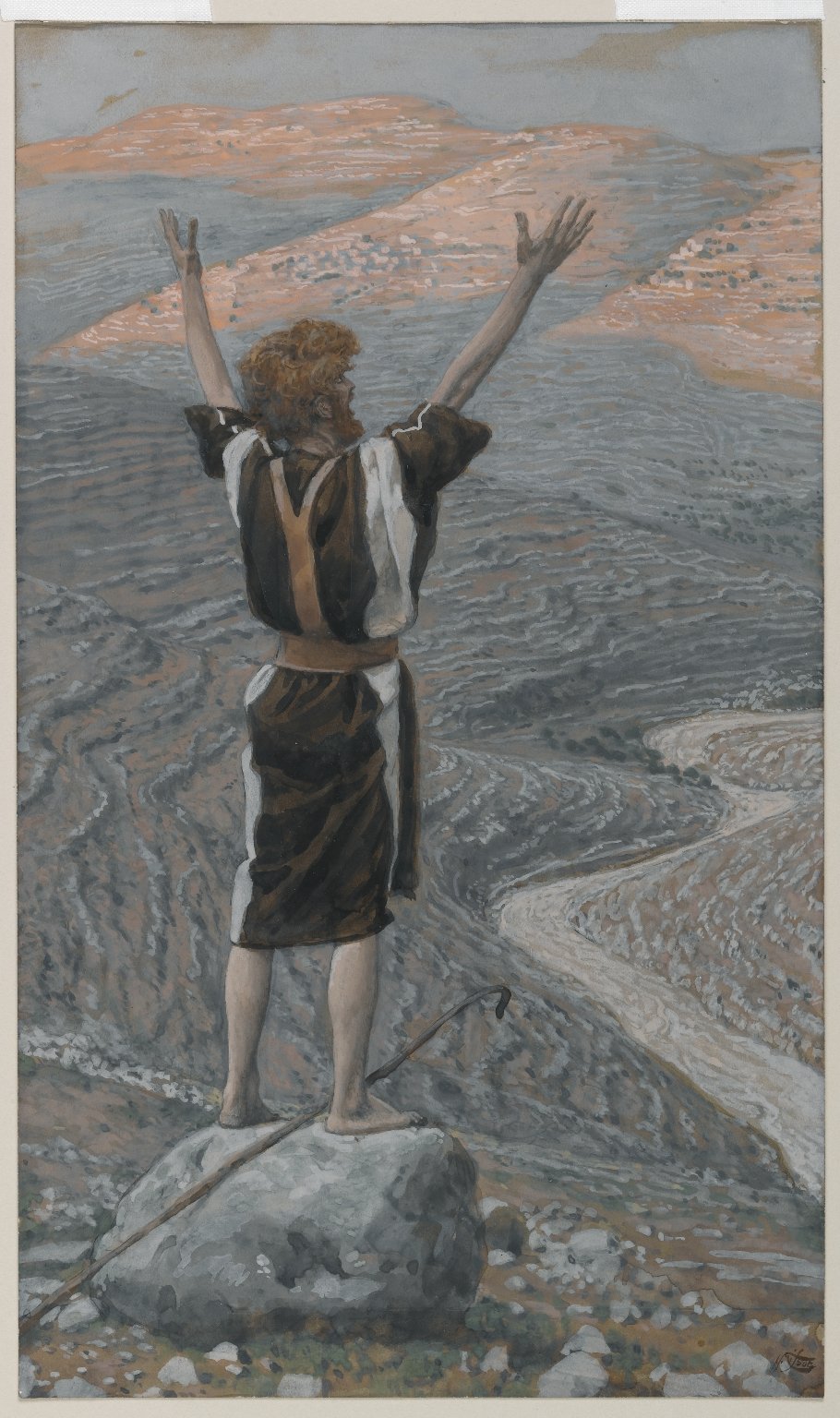
John the Baptist_Tissot_Brooklyn Museum

The Voice in the Desert by James Tissot Brooklyn Museum

 How did John the Baptist know that Jesus was the Savior before He even said a word to him? You might be thinking: “Easy, the Holy Spirit revealed it to John in that moment”. While that’s true, what wasn’t easy was the receptivity John nurtured during the years leading up to that moment. What if he had been distracted by the heat or his hunger, or too busy talking to notice? John heard the Holy Spirit as Jesus approached because he had first spent years in the desert praying, waiting, and listening.

Accustomed to instant gratification and the fast pace of life, together with a heavily marketed atmosphere, we can easily develop a tendency to expect Christ to sell Himself to us and to make His pitch with immediate persuasion. Whether we question God’s existence, His nearness, or His willingness to help us, we often complain that God is silent or distant. Yet, we have to honestly ask ourselves, have we even sought God out? Have we taken even 5-10 minutes of silence a day to listen? Have we cracked open our Bible, His Word to us, to see if He might speak there? Maybe God is silent, or maybe His response is right there on the coffee table unopened. Have we waited on the Lord, or are we expecting an immediate result? Have we been receptive to the Lord’s prompting, or do we attempt to lead God and boss Him around, deaf to His guidance?

John the Baptist sought the Lord, venturing into the desert where he could encounter God away from the distractions of everyday life. He waited on God, fully expecting an answer by spending his time preparing through preaching repentance and baptizing. When the Savior came at last, John could receive Him and recognize Him as Lord because he was looking and listening.

It reminds me a little of family road trips. The kid engrossed in his iPhone or tablet misses extraordinary sights, or at the very least, out of the ordinary landscapes. The person vigilantly watching out the window however, can take in the beauty, appreciate the landscape, and spot the surprise spectacles. By the time he has shouted “look!” and the distracted child responds, the sight has passed. Moreover, at the end of the journey, the one focused on the tablet retains the same vision of the world as when he left home, whereas the one who looked out the window broadened his vision and experience.

If we feel like God is distant, we need simply to look out the window and reach out to Him in prayer. If we require His help, we need only to ask and listen. When we look for the Savior, we find Him. God does His part, and more. We need to make the effort to look up from our commonplace experience and distractions and seek Him.

Psalm 40 begins by singing,

I have waited, waited for the LORD,

and he stooped toward me and heard my cry.

What a beautiful expression. God has seen our suffering and heard our pleas. He stooped to become man and dwell among us, personally healing and strengthening us. When a person experiences the saving love of Christ, they cannot resist proclaiming it to others. Like the child shouting “look!”, they instinctively cry out “look!” as well; or as John proclaimed, “Behold! The Lamb of God”.

Everyone seeks happiness, security, and love. We can search for all these things online, in our careers, or the economy, but only Christ can deliver on His promises. Blessed Archbishop Fulton Sheen described John the Baptist as “no frivolous reed shaken by every breath of popular applause.” When we seek approval from others or from cultural standards, we become feeble like a reed. We sway at every idea, comment, or attack and easily break. Firmness of character and security of happiness can be found in Jesus Christ alone, who can provide peace and rewards of a supernatural level. It is the Lord, who provides Faith, Hope, and Love. It is His Holy Spirit who infuses us with His sevenfold gifts of Wisdom, Understanding, Counsel, Knowledge, Piety, Fortitude, and Fear of the Lord. If we desire the Spirit’s fruits of love, joy, peace, patience, kindness, goodness, faithfulness, and self- control, we need merely to invite the Lord into our soul to dwell and be receptive to the transformation He effects.

At the same time, to realize our need for a Savior, we must also acknowledge the reality of our sinfulness. The first step to seeking the Lord is to grapple with our need for Him and our own insufficiency. Sheen pointed out that, “Skepticism is never certain of itself, being less a firm intellectual position than a pose to justify bad behavior.” Some who seem to seek God, actually hide behind their questions in order to avoid moral change. Those who see the degrading effect their sin has on their life run to the water to be cleansed like those who came out to John the Baptist in droves. Those who encounter Christ’s mercy proclaim with John, “Now I have seen, and testify that he is the Son of God.” If you want to find out for yourself, respond to Christ’s invitation to “come and see” (Jn 1:39). You might just see something incredible!

Consider:

  • Where can you go to encounter the Lord?
    • In a quiet place for prayer in your home, Church or Eucharistic adoration? In the Scriptures or reading the lives of the saints? In visiting with a prayerful friend? By listening to Christian radio?
  • On the road trip of life, are you more like the child distracted by a tablet or the child looking out the window?
  • If you were to go out to the desert to see John the Baptist, what do you imagine it would be like? Would you want to receive the baptism of repentance? What would he exhort you to change in your life?
  • When has Christ “stooped toward you and heard your cry?” Did it fill you with peace and joy? Did you want to tell others?

Make a Resolution (Practical Application):

  • Watch, wait, and listen to the Lord this week by setting aside 5-10 minutes each day to seek Him in prayer, Scripture, or Christian

Follow bar

Additional Recommendations for Spiritual Reading:

*As an Amazon Associate I earn from qualifying purchases.

Authentic Love

by Angela (Lambert) Jendro

August 19th, 2017; 20th Sunday in Ordinary Time

Gospel of Matthew 16:21-27 NAB

Jesus began to show his disciples that he must go to Jerusalem and suffer greatly from the elders, the chief priests, and the scribes, and be killed and on the third day be raised. Then Peter took Jesus aside and began to rebuke him, “God forbid, Lord! No such thing shall ever happen to you.” He turned and said to Peter, “Get behind me, Satan! You are an obstacle to me. You are thinking not as God does, but as human beings do.” Then Jesus said to his disciples, “Whoever wishes to come after me must deny himself, take up his cross, and follow me. For whoever wishes to save his life will lose it, but whoever loses his life for my sake will find it. What profit would there be for one to gain the whole world and forfeit his life? Or what can one give in exchange for his life? For the Son of Man will come with his angels in his Father’s glory, and then he will repay all according to his conduct.”

Meditation Reflection:

Peter loved Jesus.  He left everything to follow Him. Peter put his whole heart into the mission and his courage and zeal expressed themselves in extraordinary ways.  Moved by faith, Peter walked on water.  With his heart open to the Holy Spirit, he boldly answered Jesus’ questions to the disciples “Who do you say that I am?” by proclaiming that Jesus is the Christ and the Son of God.

Love inspires, emboldens, strengthens, and provides unique insights into the beloved.  Like the love between a husband and wife, a mother or father and their children, a beloved brother or sister, or a dearest friend, love wells up inside and can’t help but express itself exclamations of affection, physical closeness, and fierce protectiveness.

Due to our wounded, fallen nature however, our love can also be misdirected.  In this Gospel passage, Peter’s love mixed with his pride and with his worldly understanding to embolden him in a way that undermined, rather than supported, Jesus.

Our love needs conversion to be authentic and to be true to our beloved.  It requires ongoing formation in what is True and Good as God has revealed it, rather than as our emotions direct us or the culture.  It requires practice as well, to break bad habits and form good ones, or to overcome personal weaknesses that hurt the relationship.

Peter loved Jesus and was honored to be given the keys to the kingdom just one chapter prior to this.  However, his pride and ambition, together with his cultural assumptions about what that kingdom would look like, misdirected his love to preserving an earthly kingdom by preserving Jesus’ earthly life.  Just when Jesus needed the support of His disciples the most, as His “Hour” of Redemptive suffering for all mankind approached, Peter pulled Him aside and tried to dissuade Him.

Similar to Peter, our love needs Christ’s grace and truth to be authentic.  Consider the sentiment “I just want you to be happy.”  It can motivate noble sacrifice, but it can also rationalize weakness.  If we define happiness as merely earthly comfort, ease, security, and pleasure, we risk encouraging our beloved to turn from their cross rather than helping them carry it.  Yet, in trying to save their life, we could actually cripple them.

Consider the paradox inherent in parenting.  Kids need protection, nurturing, and comfort.  At the same time, to mature into adulthood, they also need to work through difficulties, setbacks, and pain.  The temptation to remove everything hard undermines the maturation process, whereas supporting them through the struggle without removing it for them can aid their maturation.  To know when to intervene and when to stand back is NOT easy!  It requires the counsel of the Holy Spirit and the grace of fortitude.  When Jesus’ life was threatened by King Herod, Mary and Joseph fled to Egypt to protect Him.  When Jesus was scourged and crucified however, Mary stood by Him, feeling every pain with Him, but knew it was necessary for His mission.

In marriage, family life, and friendship, authentic love needs conversion.  When we say “I just want you to be happy,” we have to be honest about which kind of happiness we desire for them.  Jesus is clear,

Whoever wishes to come after me must deny himself, take up his cross, and follow me. For whoever wishes to save his life will lose it, but whoever loses his life for my sake will find it.” 


Those we love will struggle with sin.  It’s the battle of this life.  Authentic love won’t condone the sin or escaping it.  Rather, it will strengthen a person to speak the truth in love and support the beloved through the pain of conversion because true life and true freedom is found in the Lord. In the first reading for today (Jeremiah 20:7-9), the prophet Jeremiah expresses authentic love.  His human nature desired comfort and to simply be liked.  Nevertheless, his people had succumbed to habits of sin and needed to be corrected lest they die eternally from their destructive behavior and attitudes.  He didn’t want to speak out anymore because every time he did they met him with anger.  However, when he tried to remain silent, the truth welled up in him and he couldn’t hold it in any longer without suffering even greater pain.

True love can’t stand to see sin hurting it’s beloved.  Our friends and family need us to battle for their souls with the strength of prayer, God’s Truth, and the cross, not sentimentality.  And we need those who love us to battle for our souls in the same way.

To do this, we need to actively cooperate with the Holy Spirit that our love can be fully converted.  St. Paul states it well when he says,

“Do not conform yourselves to this age but be transformed by the renewal of your mind, that you may discern what is the will of God, what is good and pleasing and perfect.” Romans 12:2

It will take time, effort, and support.  However, we can be encouraged by Peter’s example.  Peter’s conversion took time as well, but by the end of his life his love had become so perfect, that he accepted the cross and crucifixion for himself that he had once tried to dissuade Jesus from.

I’ll end with two quotes that I read often which give me hope:

Pope Francis   January 19, 2016

“there is no saint without a past and no sinner without a future


St. Josemaria Escriva

“A saint is a sinner that keeps trying.”

Consider:

  • Reflect on Mary’s love for Jesus.  Consider her fierce protection when He was young.  Consider her fierce loyalty to His mission on the Cross, despite both of their suffering.
  • Consider the words “I just want you to be happy.”  Pray about what true happiness is, where it can be found, and how it can be attained.
  • When has Christian love required you to carry a cross?  Who supported you?  Who tried to dissuade you?
  • When have you had to stand by someone while they carried a cross?  In what ways were you tempted to encourage them to leave the cross?  How were you able to support them in their pain or struggle and make the burden easier?

Make a Resolution (Practical Application):

  • Do one thing each day for “the renewal of your mind, that you may discern what is the will of God, what is good and pleasing and perfect.”
    • Spend 5 minutes with Scripture
    • Read a good Christian book
    • Listen to Christian podcasts
    • Visit with a Christian friend
  • Support a friend on their spiritual journey who is struggling with a sin or with a cross.
    • Pray and sacrifice for them; Speak truth in love; Visit them; encourage them with Scriptures of hope and resurrection after the Cross.


~ Written by Angela Jendro © 2017

* To receive these weekly posts automatically in your email just click the “follow” tab in the bottom right hand corner and enter your email address.


Stepping Outside Our Comfort Zone & Walking On Water

by Angela (Lambert) Jendro

lake superior pic


August 13th, 2017; 19th Sunday in Ordinary Time

Gospel of Matthew 14:22-33

After he had fed the people, Jesus made the disciples get into a boat and precede him to the other side, while he dismissed the crowds. After doing so, he went up on the mountain by himself to pray. When it was evening he was there alone. Meanwhile the boat, already a few miles offshore, was being tossed about by the waves, for the wind was against it. During the fourth watch of the night, he came toward them walking on the sea. When the disciples saw him walking on the sea they were terrified. “It is a ghost,” they said, and they cried out in fear. At once Jesus spoke to them, “Take courage, it is I; do not be afraid.” Peter said to him in reply, “Lord, if it is you, command me to come to you on the water.” He said, “Come.” Peter got out of the boat and began to walk on the water toward Jesus. But when he saw how strong the wind was he became frightened; and, beginning to sink, he cried out, “Lord, save me!” Immediately Jesus stretched out his hand and caught Peter, and said to him, “O you of little faith, why did you doubt?” After they got into the boat, the wind died down. Those who were in the boat did him homage, saying, “Truly, you are the Son of God.”

Meditation Reflection:

Exhilaration, adventure, a leap of faith – we get brave and step out onto the water…outside our comfort zone.   For a brief moment, his eyes fixed on Jesus, Peter did just that.  Then, a gust of wind distracted him, and Peter’s gaze turned to the strength of the wind rather than the strength of the Lord.  His faith sank and so did he.  Yet, as quick as he had turned from the Lord, he turned right back.  He immediately reached out to Christ for help.  Jesus did not delay, He caught Peter as soon as he asked. Jesus didn’t let Peter flounder in the water gasping for air as He lectured him.  He cast no words of spite, no “I told you so”, or “that’s what you get for not believing more in Me.”   Jesus came to reveal the Father’s love, and on this night He demonstrated the Lord’s compassionate mercy for our weak nature.

Discipleship calls us beyond our comfort zone, and even beyond our natural limits.  Yoked to Christ, He enables us to walk on water.  Like Peter, we might step out of the boat in total confidence in our Lord.  Once on the water however, we become fearful as we realize our total dependence on His supernatural help.  It’s much easier to have faith floating on the water in a boat, than walking on water barefooted.

I remember the excitement of getting my first teaching job, and the enthusiasm of teaching students about God.  Then, the first day of class arrived, and panic struck.  “Yikes!” I thought, “How I am I going to get through the day? What I am I going to say for a whole class period?! What if a student misbehaves? What if I’m a terrible teacher?…”  I also remember the joy of holding my first child in my arms the day he was born.  It was absolutely surreal.  Two days later the nurse walked us out to the car and waved goodbye.  As we put my son in the car seat and drove away anxiety erupted, “They’re just letting us take him?!  We don’t know anything!  What if I’m a terrible mother? What if I say or do something that scars him for life?!…”  Lastly, when I do speaking engagements or workshops, I’m exhilarated at the opportunity to share the joy of God’s saving love with others.  A half hour before the talk however, worried thoughts begin to percolate up, “Why did I agree to do this?  It would be far more comfortable to be at home watching Netflix.  What if I fail? What if everyone is bored? Who am I to do this, I’m a sinner like everyone else?”  Like Peter, I begin to sink but then I cry out to the Jesus.  He reminds me that I teach, mother, and speak because He has called me to.  He assures me that though I am not worthy, He is, and He is with me.  He also pushes me by filling my heart with so much gratitude for His love in my life that I can’t resist sharing it with others.

The challenge of discipleship is living at a level only sustainable if Christ is real, and if He’s someone ready to help.  It requires taking a risk, so much so that if Christ is not real, you would be at a loss.  Consider how many times God tells us in Scripture to be not afraid.  Pope St. John Paul II chose these words for his first statement as Pope, knowing how much we fear as we look around at the dangers that surround us.

When I begin to sink in fear a few verses come to mind that strengthen me.  First, I think of 2 Corinthians 12:8-9

“Three times I begged the Lord about this, that it might leave me, but he said to me, ‘My grace is sufficient for you, for power is made perfect in weakness.’ I will rather boast most gladly of my weaknesses, in order that the power of Christ may dwell with me.”

St. Paul felt too weak to face a challenge on his own.  Rather than remove the difficulty, Jesus promised to provide the strength.  St. Paul realized therefore, that the weaker he is, the more God’s power must be at work in him to accomplish God’s will.  He moved from anxiety to total confidence, and writes in his letter to the Philippians,

“I have the strength for everything through him who empowers me” (4:13)

We can trust Jesus to come through for us.  We can answer His call, even if it means going beyond our natural limits.   When we struggle to take that leap of faith beyond our comfort zone, Christ urges us to simply reach out and He will be there for us as He was for Peter.

“Ask and it will be given to you; seek and you will find; knock and the door will be opened to you. For everyone who asks, receives; and the one who seeks, finds; and to the one who knocks, the door will be opened” Matthew 7:7

Ask, seek, knock, and you just might walk on water.

Consider:

  • How has following Christ stretched you beyond what you expected?
  • When has Christ made an endeavor more fruitful than it would have been by your own merits?
  • Have you ever felt like Peter, walking on water, in awe of Christ’s divine power?
  • Have you ever faltered because of fear, worry, or anxiety?
  • What Scripture verses or memories reassure you of Christ’s aid?
  • Is Christ calling you to something outside your comfort zone right now?  What holds you back?  What inspires you forward?

Make a Resolution (Practical Application):

  • Take one risk each day for your faith.
    • Ideas: Inviting your spouse to pray together, praying as a family, saying “God bless” to someone on the phone or a at work, speaking up when someone is criticizing the Church or using God’s name in vain, sharing your faith with someone in need of comfort, going to the Sacrament of Confession, responding to God’s call in your vocation or job…

Related Posts:

On Taking Risks…Gospel Meditation John 6:1-15 for Sunday July 26th

Do You Have Skin In The Game?

Being a Worrier or a Wildflower

Do Not Let Your Hearts be Troubled… Peace and Surrender in Christ

~ Written by Angela M. Jendro © 2017

* To receive these weekly posts automatically in your email just click the “follow” tab in the bottom right hand corner and enter your email address.


Because of Your Name….

by Angela Lambert

person in prayer


June 25th 2017; 12th Sunday Ordinary Time

Gospel of Matthew 10:26-33

Jesus said to the Twelve: “Fear no one. Nothing is concealed that will not be revealed, nor secret that will not be known. What I say to you in the darkness, speak in the light; what you hear whispered, proclaim on the housetops. And do not be afraid of those who kill the body but cannot kill the soul; rather, be afraid of the one who can destroy both soul and body in Gehenna. Are not two sparrows sold for a small coin? Yet not one of them falls to the ground without your Father’s knowledge. Even all the hairs of your head are counted. So do not be afraid; you are worth more than many sparrows. Everyone who acknowledges me before others I will acknowledge before my heavenly Father. But whoever denies me before others, I will deny before my heavenly Father.”

Meditation Reflection:

Because of Christ’ Name, we suffer.  But by His Holy Name, we are saved.

As long as you remain lukewarm in your faith, keep it private, and compartmentalize it from the rest of your life, you will likely enjoy peace with the world.  If you proclaim Jesus to be a great teacher like Buddha, but refrain from calling Him God, people will respect you and your “spirituality.”  If you acknowledge Christ as one way and not The Way, most people will put up with your belief, since they afford everyone a little bit of foolishness.

One problem…to proclaim a nice moral teacher who isn’t God and isn’t the Way, the Truth, and the Life, is not to proclaim Jesus Christ.  Jesus promises that “Everyone who acknowledges Me before others I will acknowledge before My heavenly Father.”  To do that however, we must  proclaim the God Who became Man, that He is the fullness of Revelation – Divine Truth, the Savior of all mankind, and Love incarnate.  To proclaim a myth of our own making, and worse to belittle Christ by using a weakened, distorted, version of Him as our inspiration, is to deny Christ.  Jesus warns “But whoever denies Me before others, I will deny before My heavenly Father.”

To proclaim Christ takes serious guts, and I don’t’ just mean speaking about Christ.  Simply living your faith in everyday life will incite criticism and even personal attacks by others.

If you go to Church every Sunday despite competing demands for your time, you may be accused of being too rigid or too zealous.  Those who would prefer you prioritize them over God will accuse you of being uncharitable or having an unhealthy scrupulosity.  Those whose own church attendance looks lackluster in comparison will more likely try to find fault with your devotion rather than to imitate it.

If you believe that Jesus is the Truth – the Word of God, prepare to be accused of intolerance, close-mindedness, and archaic thinking.  Even if you do not “push your beliefs on others”, your simple rejection of the religion of Relativism will offend its many followers (note: Relativism states that there is no objective truth, except, paradoxically, Relativism).  Moreover, no matter how hard persons try to rationalize sins, their God-given consciences sense the truth and can’t help but react at reminders.  People who want to live in darkness hate the light. It happens at every age.  Teens who don’t drink or engage in pre-marital sex, get left out of parties and certain social groups. Adults who put God and family first, get left out of some events or opportunities at work, or in neighborhood gatherings.

It’s hard to follow Christ, especially when it means staying up at night with a newborn, while colleagues or friends fly off to sunny vacations.  It takes humility to make time for Mass and soccer games, knowing others will “get ahead” in their career because of their willingness to work all hours and days.  And what do you get for your sacrifice and virtue? Consider, how did Cain react toward Abel? How did Joseph’s brothers treat his piety? You will be honored by God and those who are Godly, but you will be scorned by those of the world.

Jesus is the Truth, and Satan is the father of lies.  Those who live by Truth will threaten those lies.  In retaliation, just as Satan spread lies to Adam and Eve about God, and just as he continues to spread lies about Jesus, Satan will spread lies about Jesus’ followers too.  We can feel helpless in these situations because it’s hard to defend ourselves when the other person fights dirty.  Jesus knows our struggle and has experienced our pain.  Thus, He assures us beforehand to “Fear no one.  Nothing is concealed that will not be revealed.”  Jesus promises that the Truth will conquer in the end.  It requires more patience, a lot of faith, and Holy Spirit courage though.

It’s hard to suffer unjust treatment and unwarranted animosity, especially when you are simply trying to live your own quiet Christian life.  Take heart however, people don’t get bothered by the lukewarm or the mediocre; whereas greatness is always challenged.  The more you are treated like Christ (the real Christ, not the mythical nice guy in sandals), the more it means you are becoming Christ-like.  So, as Pope St. John Paul II repeated again and again, “Be not afraid.”  Let Christ’s love in you soften hearts, even if they scream at you first.  Let the light of Christ radiate in you and cut through the darkness.  As the prophet Jeremiah witnessed in today’s first reading (Jer 20:10-13), “the Lord is with me, like a mighty champion: my persecutors will stumble, they will not triumph.”

Consider:

  • When did Jesus experience the most criticism and rejection?  Consider how His mighty works of healing and love, were met with envy and anger by some of the Jews.
  • Consider the mystery of the Cross.  Christ suffered out of love for us and was rejected.  Yet He rose again to new life and brought about our salvation.  How might we offer our pain and suffering from others’ rejections for their salvation, like Christ has done for us?
  • Reflect on a time when you “preferred darkness to light.”  How did you rationalize your sin or your way of thinking?  How did you react toward someone whose life shined a light on it?
  • Reflect on a time when you preferred light to darkness.  When have you experienced joy and freedom when the Truth in someone else’s life, freed you from a lie in your own?

 Make a Resolution (Practical Application):

  • Each day this week, pray an Our Father or a Hail Mary for someone who is persecuting you.
  • Each day this week, pray Psalm 69.
  • Offer this prayer each day:
Lord, I don’t want my light to be so dim as to not make a difference.

I beg You to make Your Divine Light shine through me with such radiance,

That it frees with Your Truth, those held captive by lies,

Guides those who are lost, back to You,

And lifts up lonely, discouraged souls with Your Love.


~ Written by Angela Lambert © 2017

* To receive these weekly posts automatically in your email just click the “follow” tab in the bottom right hand corner and enter your email address.


Finding Fulfillment in Self-Gift

by Angela Lambert

June 11th, 2017;  Solemnity of the Most Holy Trinity


Gospel of John 3:16-18

God so loved the world that he gave his only Son, so that everyone who believes in him might not perish but might have eternal life. For God did not send his Son into the world to condemn the world, but that the world might be saved through him. Whoever believes in him will not be condemned, but whoever does not believe has already been condemned, because he has not believed in the name of the only Son of God.

Meditation Reflection:

Consider for a moment this incredible fact: we are made in the image and likeness of the Trinitarian God.  Although God’s essence exceeds our understanding, He has nevertheless revealed His nature to us and even given us an experience of it imprinted on our own human nature.

God has revealed that He is Love (1 Jn 4:8) and that He is Father, Son, and Holy Spirit (Mt 28:19).  From the Father, we observe that God is creative.  From the Holy Spirit, we observe His immanent might and love operative in our souls.  And from the Son, we learn that God’s creative, mighty, love, is sacrificial.

What does this mean for you and me?

We live in a culture that forms us to be autonomous, independent, and self-seeking.  Humanitarian works and acts of kindness may be valued to the extent that they make life more  pleasant in general, but not to the extent that it requires personal sacrifice – a real loss of some kind.

Human happiness does come through self-realization and self-fulfillment, but not in the way our culture defines those terms.  The Trinity is a relationship of three divine Persons in mutual self-gift and love.  This means that, as creatures made in the image of the Trinity, we achieve self-fulfillment through self-giving love.

It’s a paradox, but one that Christ emphasized over and over in both His teachings and His life.

“For whoever would save his life will lose it, and whoever loses his life for My sake, will find it.”  (MT 16:25)

Christian discipleship means living and being as Christ.  The Gospel today proclaims that Jesus came from the Father, for us.  Pope Benedict XVI concludes from this that Jesus’ whole “being itself is service” (Introduction to Christianity; Ignatius Press).  Avoid imagining Jesus as just a really nice guy however.  Pope Benedict isn’t referring to volunteering more.  He means that Jesus’ whole existence is one of relationship, and a relationship of service.  Thus, Christian discipleship transforms us from self-centered lives, to God and others-centered lives.

To be God-centered, to be from God and for others as Christ was, requires a radically different worldview than our secular culture.

Pope St. John Paul II, as he examined God’s words in Genesis (2:18) that “It is not good that the man should be alone; I will make him a helper fit for him,” concludes that the human person is made for relationship.  He writes

“ ‘alone,’ man does not completely realize this essence.  He realizes it only by existing ‘with someone’ – and even more deeply and completely – by existing ‘for someone.’”

He’s not saying that we must become slaves with no individual identity.  Rather, he’s saying that men and women find self-fulfillment through self-gift.  Self-gift, by definition, means giving yourself to someone.  It means we find happiness in loving sacrifice.

St. Mother Teresa said that everyone has an opportunity to love as Christ did, and therein find happiness.  To find that someone we simply need to look around us.   As we celebrate the Blessed Trinity today, let us celebrate the gift of relational love.  Mary always perceived the needs of others around her, let us pray for her intercession to see opportunities for self-gift around us as well, even it means sacrifice.

Consider:

  • Consider the eternal relationship of love between the Father, the Son, and the Holy Spirit.
  • Imagine the joy of heaven, where the saints share in that relationship of love.
  • Reflect in a prayer of gratitude for each experience of loving relationship God has gifted you with.
  • Pray for reconciliation in relationships that need healing.

Make a Resolution (Practical Application):

  • Each day this week, find one way to love another person.  Ask for Mary’s intercession.

Related Posts:

The Most Marvelous Mystery! Gospel Meditation for the Solemnity of the Most Holy Trinity

Determined Discipleship

Do Not Let Your Hearts Be Troubled…Peace and Surrender in Christ

Finding True Love

~ Written by Angela Lambert © 2017

* To receive these weekly posts automatically in your email just click the “follow” tab in the bottom right hand corner and enter your email address.


Finding True Love

by Angela Lambert

May 21st, 2017; 6th Sunday Easter

Gospel of John 14:15-21

Jesus said to his disciples: “If you love me, you will keep my commandments. And I will ask the Father, and he will give you another Advocate to be with you always, the Spirit of truth, whom the world cannot accept, because it neither sees nor knows him. But you know him, because he remains with you, and will be in you. I will not leave you orphans; I will come to you. In a little while the world will no longer see me, but you will see me, because I live and you will live. On that day you will realize that I am in my Father and you are in me and I in you. Whoever has my commandments and observes them is the one who loves me. And whoever loves me will be loved by my Father, and I will love him and reveal myself to him.”

Meditation Reflection:

Every human person yearns for love, intimacy, and understanding.  We may not need to be loved or understood by everyone, but we desire that connection with at least one person and preferably a whole community.  Without it, we suffer an oppressive loneliness leading to depression, anxiety, and confusion.

Given the rapid advances in communication, it would seem we should feel more connected than ever and therefore happier than ever.  Yet, consider the high rate of depression and suicide in our culture, despite the unprecedented wealth and physical well-being compared to any other time in history.  So, if we are relatively wealthy, healthy, and connected, why aren’t we happy?

Jesus reveals the answer in today’s Gospel passage.  The world offers superficial connection, defining love as self-gratification rather than self-gift. Self-centered love uses others to make oneself feel good or to advance one toward a personal goal.  It might demonstrate a modicum of virtue, but only insofar as it provides personal reward.  Intimate married love has been replaced with casual sex and pornography.  Intimate family love through the gift of children has been replaced with pets (not that pets are bad, just that they are not kids).  Intimacy of friendship or shared work carry some comradery, but disillusionment ensues when they are quickly exchanged for a personal advancement.  All of these experiences leave people feeling used and alone, rather than loved.

Pope Francis sheds light on our pain by identifying the source of our wounds.  He connects our pain with our disconnect from Truth and the experience of mercy.  In his book, The Name of God is Mercy, he writes,

“…humanity is wounded, deeply wounded.  Either it does not know how to cure its wounds or it believes that it’s not possible to cure them.  And it’s not just a question of social ills or people wounded by poverty, social exclusion, or one of the many slaveries of the third millennium.  Relativism wounds people too:  all things seem equal, all things appear the same…  Pius XII, more than half a century ago, said that the tragedy of our age was that it had lost its sense of sin, the awareness of sin.  Today we add further to the tragedy by considering our illness, our sins, to be incurable, things that cannot be healed or forgiven.  We lack the actual concrete experience of mercy. The fragility of our era is this, too:  we don’t believe that there is a chance for redemption; for a hand to raise you up; for an embrace to save you, forgive you, pick you up, flood you with infinite, patient, indulgent love; to put you back on your feet.  We need mercy.”

Pope Francis calls relativism a wound because it disables our ability to determine right from wrong and truth from error.  Christ forbids us from judging other people because only He knows what is in their hearts.  However, we must be able to make moral judgements about actions and choices.  It’s just as important to know the dangers of sin to the spiritual life, as it is to know the dangers of gravity when leaping from high places.   I tell my boys all the time, especially in the summer when they are careening down the hill on their bikes or scooters, “Force = Mass times Acceleration –  think about how fast you are going, because you could get hurt badly!”  The same truth becomes even more important as they get older.  Now that my oldest has his driving permit and is nearing his license, I try to curb the teenage boy’s “need for speed” with the same physics lesson.  I’m not being judgmental, I’m being loving by teaching him the truth.  The same applies to the spiritual life.  Sin wounds, hurts, and can even kill.  The Truth of Christ is a saving gift.

In today’s Gospel Jesus teaches that Truth, Goodness, and Love are inseparable.  Without truth and without virtue, we will miss out on love.  Jesus said that He is the Truth (Jn 14:6), and those who love Him follow His commands.  God is a relationship of three distinct Persons in one divine nature.  The three Persons of the Trinity share a unity that exceeds our understanding, but Jesus unveiled a glimpse of its experience.  He speaks on numerous occasions of the unity of He and the Father. That unity comes from a relationship of love and obedience through an eternal self-gift.  The Holy Spirit is described as the Love between the Father and the Son. For us to share in the intimate relationship of the Trinity, we must share in God’s love through the gift of the Holy Spirit.

When we place our faith in Christ, He sends the Holy Spirit that we may live by His Truth, following His commands, and thereby grow in intimate love.  Jesus told the apostles,

I give you a new commandment: love one another. As I have loved you, so you also should love one another. This is how all will know that you are my disciples, if you have love for one another.” (John 13:34-35)

Christians must not only love, but love like Christ – sacrificial, unconditional, and merciful.  Merciful love means speaking the Truth instead of enabling someone in their self-deception or rationalization.  It means never helping someone sin, but always helping them when they try to leave their sin.

To love in this way, we need supernatural grace which flows from the indwelling of the Holy Spirit.  St. Cyril of Alexandria, a bishop and Doctor of the Church, describes the Spirit’s transformative power in a beautiful way in a commentary he wrote on the Gospel of John:

 “After Christ had completed his mission on earth, it still remained necessary for us to become sharers in the divine nature of the Word. We had to give up our own life and be so transformed that we would begin to live an entirely new kind of life that would be pleasing to God. This was something we could do only by sharing in the Holy Spirit…

Only by his own presence within us in this way could he give us confidence to cry out, Abba, Father, make it easy for us to grow in holiness and, through our possession of the all-powerful Spirit, fortify us invincibly against the wiles of the devil and the assaults of men.

 It can easily be shown from examples both in the Old Testament and the New that the Spirit changes those in whom he comes to dwell; he so transforms them that they begin to live a completely new kind of life…

Does this not show that the Spirit changes those in whom he comes to dwell and alters the whole pattern of their lives? With the Spirit within them it is quite natural for people who had been absorbed by the things of this world to become entirely other-worldly in outlook, and for cowards to become men of great courage.”

The Holy Spirit infuses us with Divine Love which bears fruit in our lives.  This love is so exceptional, that Jesus tells His disciples it will be evident to the world that they are His followers.  The fruit of worldly love is loneliness, anxiety, and depression.  The fruit of Christian love is intimacy with God and His followers, peace, and joy.  Worldly wisdom wounds, but Christian wisdom heals.  The great paradox of happiness, which Pope St. John Paul II re-iterated time and again, is that self-fulfillment can only be found in self-gift.  Christians experience the intimacy of friendship in their shared vision of the Truth, the intimacy of true love in living their vocational call to sacramental married love, Holy Orders, vows of religious life, or the single vocation, and above all – the deepest, most intimate, abiding love of our Trinitarian God dwelling in our soul as His very own Temple.    Happiness is loving and being loved, Truly.

Consider:

  •  Consider the relationship between Truth and Love.  Why is honesty necessary for relationship?  How does honesty deepen intimacy?
  • Have you ever had to make a decision that required you to choose between worldly wisdom and Christian wisdom?  Which did you follow and why?  What were the results?
  • Consider the power of the Holy Spirit to transform us.  Have you experienced spiritual healing, transformation, or love through the Holy Spirit?  Have you witnessed it at work in another person?

Make a Resolution (Practical Application):

  •  Grow in your relationship with Christ who is the Truth, by studying Scripture or studying the faith.  Read a spiritual book, join a bible study, listen to Christian talk radio or podcasts, or visit with someone advanced in the faith who can teach you.
  • Invite the Holy Spirit to bear more fruits of love within you by connecting with Him in prayer and/or the sacraments.  Add just 5-10 minutes of prayer to your day (or if possible, I highly recommend adding a daily Mass), and note the change in your reactions to others and to situations, or to the level of peace you feel amidst whatever is happening around you.

Related Posts:

~ Written by Angela Lambert © 2017

* To receive these weekly posts automatically in your email just click the “follow” tab in the bottom right hand corner and enter your email address.