The Simple Truth – Love

Love alone counts

by Angela (Lambert) Jendro

 November 3rd, 2018 31st Sunday in Ordinary Time

Gospel of Mark 12:28B-34 NAB

One of the scribes came to Jesus and asked him, “Which is the first of all the commandments?” Jesus replied, “The first is this: Hear, O Israel! The Lord our God is Lord alone! You shall love the Lord your God with all your heart, with all your soul, with all your mind, and with all your strength. The second is this: You shall love your neighbor as yourself. There is no other commandment greater than these.” The scribe said to him, “Well said, teacher. You are right in saying, ‘He is One and there is no other than he.’ And ‘to love him with all your heart, with all your understanding, with all your strength, and to love your neighbor as yourself’ is worth more than all burnt offerings and sacrifices.” And when Jesus saw that he answered with understanding, he said to him, “You are not far from the kingdom of God.”  And no one dared to ask him any more questions.

Meditation Reflection:

A couple of weeks into the school year, a new student of mine stopped by my room after the bell and asked, “How does a person become a saint?”.  As a religion teacher, my first thought went to if she was asking about the process of being canonized, but I stopped, thinking maybe she means on a more spiritual level – like the process of detachment from the world or the three stages of the spiritual life, then I stopped again as my mind jumped to other possibilities for the source of her question until I quit guessing in my mind altogether and simply said, “Why do you ask?  What is it you want to know?”

The Holy Spirit must have prompted me to ask instead of assume, because I never could have anticipated the beauty and simplicity of her answer.  In all sincerity, and with a beaming sweet smile on her face, she replied “because I want to be one!” “Ah” I said, “then it’s simple, love God with all your heart.”  “Really?!” she asked.  “Yep,” I said, that’s it.”

God, the Blessed Trinity, is a union of 3 Persons – Father, Son, and Holy Spirit.  He created human persons in His image as a union of persons in relationship of love with Him and with each other.  When we love God, we can’t help but love our neighbor whom we see as God’s image on earth and our brother or sister in Christ.

The answer is simple.  Jesus’ answer was simple.  It was the same command God had given in Deuteronomy over a thousand years before, and the mission He had given Adam and Eve at their creation.

We are the ones who make sainthood difficult.  We turn our eyes from the Beauty of God and prefer baser pleasures instead.  Because of our wounded nature, we worry that obedience to God will somehow restrict our freedom and deter us from our full potential.  This same self-assertion applies to our neighbor whom we view in light of our own pleasure or gain.  If he or she will add happiness or pleasure, we love them.  Otherwise, we tend to suspect them, like jealous siblings, worried that they will steal something from us, compete for the same resources and attention, or annoy us.

Thankfully, as we mature spiritually, we grow out of these childish concerns.  We understand that our Heavenly Father sets us high upon the rock in safety (Ps 27:5) fills our cup to overflowing (Ps 23), corrects the ones He loves as a Father does for His child (Proverbs3:12), and offers true freedom (John 8:32).  We also grow into a more adult relationship with our brothers and sisters in the Lord, realizing they are not a burden but a blessing. Moreover, filled with God’s love it necessarily overflows to others (cf 1 John 4:7)

Loving God means taking time for Him, in prayer and Scripture.  It means learning more about Him and deepening our understanding of His self-revelation.  It’s also the “simple raising of the heart and mind toward God” (CCC par. 2559) and the desires of love from deep within the soul.

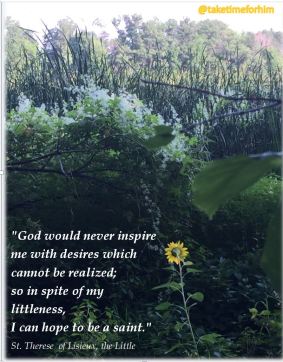
As St. Therese of Lisieux, the Little Flower, put it:

“For me, prayer is a surge of the heart; it is a simple look turned toward heaven, it is a cry of recognition and of love, embracing both trial and joy”

The Christian disciple follows the example of Christ, who modelled and taught the way of Love – prayer and sacrificial works of mercy. His prayer life was so deep, His disciples asked Him to teach them how to pray, upon which He gave them the Our Father.  His merciful actions were so numerous John states at the end of His Gospel that if everything He did was written down, the whole world could not contain it (John 21:25).

Everyone searches for the key to happiness.  It’s simple, Love the Lord with all your heart:

“Find your delight in the Lord, and He will give you your heart’s desire” (Psalm 37:4)

 Consider:

  • Ask God for the grace to love Him with all your heart, soul, mind, and strength and to love your neighbor as Christ as loved you.
  • Reflect on Psalm 27:4 “One thing I ask of the LORD; this I seek: To dwell in the LORD’s house all the days of my life, To gaze on the LORD’s beauty, to visit his temple.”
  •  Imagine the people in your life – at work, in your neighborhood, driving on the highway, etc. – as your brother and sister.  What prayer might you have for them if they were family?  How might you see them more personally and with more compassion?
  • Consider this passage from St. Catherine of Siena’s Dialogue which describes how our hearts can be taken up, and on fire, with love for God. It is written from the perspective of God the Father speaking to her:
     No virtue can have life in it except from charity (love), and charity is nursed and mothered by humility.  You will find humility in the knowledge of yourself when you see that even your own existence comes not from yourself but from Me, for I loved you before you came into being.  And in My unspeakable love for you I willed to create you anew in grace.  So I washed you and made you a new creation in the blood that My only-begotten Son poured out with such burning love.

     This blood gives you knowledge of the truth when knowledge of yourself leads you to shed the cloud of selfish love.  There is no other way to know the truth.  In so knowing Me the soul catches fire with unspeakable love…”

Make a Resolution (Practical Application):

  • What sets your heart on fire with love for God?  Do that every day this week.
  • Pray one psalm a day, one chapter of a Gospel, or one chapter of Acts of the Apostles each day.
  • Choose someone from your daily life and imagine them as your brother or sister.  Pray for them by name and do something kind for them.

~ Written by Angela Jendro © 2018

* To receive these weekly posts automatically in your email just click the “follow” tab in the bottom right hand corner and enter your email address.


Have You Found What You’re Looking For?

by Angela (Lambert) Jendro


Peter and andrew

January 14th, 2018 2nd Sunday in Ordinary Time

Gospel of John 1:35-42 NAB

John was standing with two of his disciples, and as he watched Jesus walk by, he said, “Behold, the Lamb of God.” The two disciples heard what he said and followed Jesus. Jesus turned and saw them following him and said to them, “What are you looking for?” They said to him, “Rabbi” — which translated means Teacher —, “where are you staying?” He said to them, “Come, and you will see.” So they went and saw where Jesus was staying, and they stayed with him that day. It was about four in the afternoon. Andrew, the brother of Simon Peter, was one of the two who heard John and followed Jesus. He first found his own brother Simon and told him, “We have found the Messiah” — which is translated Christ —. Then he brought him to Jesus. Jesus looked at him and said, “You are Simon the son of John; you will be called Cephas” — which is translated Peter.

 Meditation Reflection:

Imagine what it must have been like for the apostles near the end of their lives, to remember back to the very beginning when they first met Jesus – before their zealous and arduous work as the leaders of Jesus’ Church, before they received the Holy Spirit at Pentecost, before Jesus’ astounding Resurrection, before His shocking suffering and death, before witnessing in amazement His teaching and miracles.  Back when they lived ordinary lives, as ordinary men, waiting upon the Lord in His silence.

The Lord had spoken to His People through prophets since His first revelation to Abraham.  They had enjoyed ongoing relationship with Him, even when they experienced the pain of God’s discipline.  Eventually however, their obstinacy toward God grew so hardened that it caused God to withdraw His immanent presence from the Temple. Without God’s help the people fell captive to foreign nations and lived in exile.

Years later, King Cyrus of Persia issued an edict allowing the Jews to return to Jerusalem and even contributed funds to aid in the rebuilding of the Temple which had been destroyed.  Eventually some returned to Jerusalem, but God’s divine and immanent presence (which had remained upon the Ark of the Covenant from their time in the desert during the Exodus through its housing in the Temple until the Babylonian Exile), did not return to the Temple.  Although God anointed prophets to mediate His Word through this time, God then remained silent for about 400 years leading up to the Incarnation of Christ.

In consequence, the Jews endured about 400 years of divine silence.  During that time they clung to the words of God’s earlier prophets and to His Law given through Moses.  They considered God’s promises and kept hope that one day He, who is always faithful, would fulfill them.

At long last, their hope for God’s Word and for renewed relationship enlivened with anticipation when John the Baptist appeared, as “A voice of one crying out in the desert: ‘Prepare the way of the Lord, make straight his paths” (Mark 1:3; Isaiah 40:3).

The long silence finally broken and the power of John’s prophecy excited some to speculate whether John was in fact the Messiah.

Both Messiah and Christ mean “anointed one.”  In the Old Testament, those God had appointed as either priest, prophet, or king would be anointed with oil.  Each were called in some way to mediate between God and the People, and were bestowed with a measure of God’s authority.

The priesthood of the Old Covenant foreshadowed the eternal priesthood of Jesus, who would offer Himself as the perfect sacrifice for the sins of all mankind.  The prophets mediated God’s word, preparing us for the incarnation of the Word of God, and later the indwelling of that Word in our souls through Baptism.  Finally, the role of king was to govern the people as a steward of God who is the true king.  Jesus came as king to reign not as a steward, but with the authority of God.

“All were amazed and asked one another, “What is this? A new teaching with authority. He commands even the unclean spirits and they obey him.” Mark 1:27

 “Why does this man speak that way? He is blaspheming. Who but God alone can forgive sins?” Mark 2:7

John the Baptist answered the Messianic speculation directly, stating, “I am not the Messiah” (John 1:20). He too was waiting patiently upon the Lord.  He faithfully preached repentance, as God had asked of him, and baptized with water as a sign of readiness.

Finally, the Holy Spirit revealed the Messiah to John – it was Jesus.  There, waiting expectantly, were St. Andrew and another disciple of John. Upon hearing his prophetic declaration, “Behold the Lamb of God,” they began following Jesus immediately, apparently without even saying a word.  When Jesus turned to ask them what they wanted, they expressed their desire to remain with Him.  They accepted Jesus’ invitation to come, and in their encounter with the Person of Jesus, determined with conviction that He was in fact the Messiah.  In consequence, Andrew hurried to his brother to share the unbelievable news.

Their day probably began like every other day.  Breakfast, work, prayer, routine.  In that moment however, they dropped everything to find Jesus.

Everything had changed.

In that first encounter, Jesus called Simon by name, and gave him a new name indicating his new role in the New Covenant. Simon would leave the normalcy of the life he knew, to be Peter, “Rock”, upon which Christ would build His Church.  Imagine the trust he must have had in the Lord to persevere in his discipleship through so many changes, so much confusion, and so much responsibility.

So much took place over the course of their lives, but it all began with dropping what they were doing when the time came, and going to find the Messiah.

We are all searching and waiting –  for meaning, for purpose, and for happiness.  We go about our everyday, on the lookout for the answer to come.  Yet, Christ has come.  He is what we have been looking for, even if we couldn’t put a name to it like the Jews.  Praise be to God!

The Anointed One has come.  He heals wounds of sin and strengthens us with grace through His sacrifice on the Cross, poured out for us in the Sacraments.

Jesus is the Word of God, who reveals God’s plan for our lives, our purpose, and His constant care.

Jesus is king.  We enter His kingdom through Baptism and must work to allow His rule over our lives daily.  Through our adoption as sons and daughters of God, He makes us rich as heirs of heaven.

We have found the Messiah.”  There’s no more need to search, only to follow; to say yes to Jesus’ invitation “Come, and you will see.”

Christianity is not a consumer product, a happy drug, an interesting philosophy, or a social club.  Christianity is following Christ, the Anointed One of God, and staying with Him. None of us can imagine where it will lead, only follow one step at a time, waiting during times of silence, and acting when He calls our name.  Where it leads only the Lord knows, but it will certainly be an adventure and full of surprises.

Consider:

  • Spend a few minutes in silent prayer, just being in the presence of Christ.
  • When have you felt excitement about your faith like the apostles?
  • How has encountering Christ transformed you? In what ways has it changed the way you think, guided your actions, or changed your desires and priorities?
  • Prayerfully consider what mission Christ has for you.

Make a Resolution (Practical Application):

  • Take one step toward Christ every day. Follow Him in Scripture reading, works of love, or the sacraments.
  • Take 5 minutes of silence to rest in the Lord.


~ Written by Angela Jendro © 2018

* To receive these weekly posts automatically in your email just click the “follow” tab in the bottom right hand corner and enter your email address.


Keeping it Simple and Keeping it Real

by Angela (Lambert) Jendro


October 29th, 2017 30th Sunday in Ordinary Time

Gospel of Matthew 22:32-40 NAB

When the Pharisees heard that Jesus had silenced the Sadducees, they gathered together, and one of them, a scholar of the law tested him by asking, “Teacher, which commandment in the law is the greatest?” He said to him, “You shall love the Lord, your God, with all your heart, with all your soul, and with all your mind. This is the greatest and the first commandment. The second is like it: You shall love your neighbor as yourself. The whole law and the prophets depend on these two commandments.”

Meditation Reflection:

St. John tells us that “God is Love” (I John 4:8).  He actively loves you and I at every moment.  He created the world out of nothing to be a home for humankind and continues to hold all things in existence and guide them by His divine providence. He created each of our souls at the moment of our conception.  The Second Person of the Trinity even became man, suffered, and died for our Redemption after we sinned so we could become new creations by grace.  Even before creation however, He was Love.  In His very essence God is a union of three divine Persons – Father, Son, and Holy Spirit.  His very nature is an eternal relationship of love.

Moreover, Genesis reveals that God’s love is so great He made humankind in His image to participate in His love. Thus the God who is love, created us to also be love. In the first creation account He created man and woman at the same time, that they too might be a union of persons, capable of love and creativity like God.

“God created mankind in His image; in the image of God He created them; male and female He created them. God blessed them and God said to them: Be fertile and multiply.” Genesis 1:27-28

In the second Genesis account God created man first but he felt alone and unfulfilled.  There was no suitable partner for him among all of God’s animals.  Why?  Aren’t dogs and cats adorable?  Wouldn’t it be wonderful to enjoy God-given reign over all of creation without having to share it with anyone? Adam had water front property, lush gardens, and plenty of food.  He had everything a single person could desire – power, pleasure, abundance, security, and was surrounded by affectionate pets.  Why was he unhappy?

“The LORD God said: It is not good for the man to be alone. I will make a helper suited to him. Genesis 2:18

Made in the image of God, Adam could only find fulfillment through being a union of persons.  Together Adam and Eve could unite both body and soul.  They could know one another, choose one another, and love one another, both spiritually and physically.

In the Beginning, living in God’s image was simple and joy-filled.  Adam and Eve walked with God in the Garden.  Their work was without toil and they rested each Sabbath to worship God and rejoice in gratitude.  As Pope Benedict XVI explains:

In the creation account the sabbath is depicted as the day when the human being, in the freedom of worship, participates in God’s freedom, in God’s rest, and thus in God’s peace.” (In the Beginning…A Catholic Understanding of the Story of Creation and the Fall, 1990)

Things only get complicated after the Fall, that first dreadful sin.  God is a realist.  He made everything according to a rational order and taught Adam and Eve those laws so they might be safe and flourish.  In their moment of temptation however, they rebelled in pride, chasing the illusion that they could be the creators of reality rather than creatures already a part of reality.  Yet, the truth is always true.  God said their choice would bring death, the serpent said it wouldn’t, and Adam and Eve chose based on their senses – “it seemed good and looked delightful.”  They chose against God and they found He was right – death entered the world.

It’s easy to point the finger at their foolishness, but consider our own common teenage rebellions.  Despite the love and trustworthy guidance of good parents, how often do teens think to themselves, “I know more than mom and dad.  I’m going to do this my way and ignore their rules,” only to find themselves suffering the results their parents had warned them of?

When have you thought the same thing about God’s guidance?  God guides us through the natural law, Scriptures, and the Church.  Yet, we still struggle with the tempting thought that what we feel like doing is better than what we ought to do.  Again and again, we suffer when our feelings prove illusory and God’s guidance true.

People will often say, “The Church isn’t realistic.  It needs to get with the times.”  Abstinence for unmarried persons instead of birth control? Fantasy.  Truthfulness at work?  You’ll never get ahead.  Children instead of pets?  Maybe one or two, but beyond that will be misery.  Church every Sunday?  That’s excessive.  Resting on Sunday?  Who will get all the work done?

Yet, the truth remains the truth.  Our illusions do not change reality.  We chase where our impulses lead only to find ourselves depressed and unhappy.

Happiness is simple.  It means being a real realist. It means living as a human person not something else you or the culture imagines.  It may not be easy, but God gives us grace to live in His truth.

God’s laws only become complicated inasmuch as we make them complicated.  In my classroom I have a mini basketball and hoop for kids to play during passing time.  I begin the year with two rules: when the bell rings the ball gets put away, and no blood (I don’t want kids getting hurt and there’s a reason I’m a teacher and not a doctor or nurse).  Some classes get it and those are the only two rules that I ever need.  They have a little fun and our class begins on a positive note.  Others overcomplicate things.  They start fighting over the ball, becoming overly rough or competitive, launching it over people’s heads, or they keep trying to shoot the ball into its rightful place despite missing many times.  In consequence, they force me to make more rules to ensure that my basic two are met and what began as simple fun becomes a frustration.

Jesus teaches that God really only has two rules as well.  If we simply love God with our whole self – heart, mind, and soul, everything else falls into place.  Living in union with God we find our true selves and the source of all happiness.  From our free relationship of love with God, we then seek to love others, His image among us.  Through self-gift and loving relationship, we find self-fulfillment and deep joy because we are living in reality, feeding on real food and journeying toward our real end.

All the other rules are in response to the myriad of ways we violate the basic two.  If we loved God first then our neighbor, we would have the common sense to do the other things as well.  If I love God, I’m going to spend Sunday with Him.  If I love my neighbor, I’m not going to lie or cheat him, and if I see him in need I will want to help.

Developing Christian common sense may take time, depending on your past formation or experiences.  Jesus knows our brokenness, blindness, and weakness.  He came to be our Healer, the true Light to guide us, and the source of Strength to transform us.  Love has a mysterious and beautiful power to melt away sadness and hurt, and fill us with joy.  You might begin by needing a rule to go to Mass on Sunday, but once you experience the touch of Christ’s love, you will find it a gift instead.

Consider:

  • When have you experienced God’s love – through another person, in prayer, or at Mass?
  • When has God’s truth been a sure guide for you during a confusing time?
  • Which laws of God, either through Scripture or the Church, do you find most difficult to accept or to live out?
  • How has God’s grace enabled you to live virtuously or love at a level you couldn’t have imagined before?
  • How might you love God more?  What areas of your heart, mind, soul, or strength do you still withhold from him?  Is there a teaching of Christ you struggle to accept?  Is there someone you find difficult to give generously of your heart to? Do you spend Sunday with the Lord and family or use your strength for more work instead? Do you spend time thanking God and being in His presence, or do you love something else more?
  • Reflect on Mary’s perfect love exemplified by her simple Yes at every moment.

Make a Resolution (Practical Application):

  • Each day this week give God more of your heart, mind, or strength.  Ask Him to increase your love for Him in each of these areas then do one concrete thing a day to act on that love.
  •               Ideas:
    • To love God more with your mind spend 5 more minutes a day with Scripture, listen to Christian podcasts or radio, learn about the faith at your parish or by reading a spiritual book.
    • To love God more with your heart, increase your affection for Him by making a gratitude list, praying a Psalm  (especially 23, 27, 119, or 139), meditating on the rosary, or attending a daily Mass.
    • To love God more with your strength, do something of service for someone in need.  Care for someone who is sick, help out a co-worker who is swamped, volunteer to help at your church by taking care of the building or grounds or by helping with the service as a greeter or usher.   Most importantly, resolve to avoid servile work on Sunday and instead play with your kids or go visit a friend.

Related Posts

~ Written by Angela Jendro © 2017

* To receive these weekly posts automatically in your email just click the “follow” tab in the bottom right hand corner and enter your email address.