The Ascension of Christ & the Surprising Nature of the Kingdom of God

by Angela Lambert

May 28th, 2017; The Ascension of the Lord

 Acts of the Apostles 1:1-11

In the first book, Theophilus, I dealt with all that Jesus did and taught until the day he was taken up, after giving instructions through the Holy Spirit to the apostles whom he had chosen. He presented himself alive to them by many proofs after he had suffered, appearing to them during forty days and speaking about the kingdom of God. While meeting with them, he enjoined them not to depart from Jerusalem, but to wait for “the promise of the Father about which you have heard me speak; for John baptized with water, but in a few days you will be baptized with the Holy Spirit.” When they had gathered together they asked him, “Lord, are you at this time going to restore the kingdom to Israel?” He answered them, “It is not for you to know the times or seasons that the Father has established by his own authority. But you will receive power when the Holy Spirit comes upon you, and you will be my witnesses in Jerusalem, throughout Judea and Samaria, and to the ends of the earth.” When he had said this, as they were looking on, he was lifted up, and a cloud took him from their sight. While they were looking intently at the sky as he was going, suddenly two men dressed in white garments stood beside them. They said, “Men of Galilee, why are you standing there looking at the sky? This Jesus who has been taken up from you into heaven will return in the same way as you have seen him going into heaven.”

Meditation Reflection:

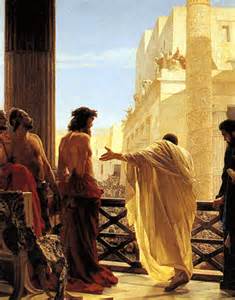
Christ is so humble in His Incarnation that we, like the apostles in today’s passage, can forget the awesome reality of His divinity.  For most of His earthly life, Jesus chose to veil His divinity.   He humbly lived among us as one of us, choosing a life of poverty and sacrifice.  Even when condemned to crucifixion, He told Pilate that He was not powerless in the situation (John 18:36).  Jesus chose to be sacrificed to save us.  He could have saved Himself, as those taunting Him urged, or defended Himself as Pilate suggested, but love kept Him on the Cross.

Christ came down from heaven to be a ransom for our sins.  At the completion of His mission however, He ascended back to heaven to reign in glory as the Son of God. Because of His humility during His earthly life, we overlook at times His divine dignity and His rightful place in Heaven.  Beyond anything we could have imagined, He promised to prepare a place for us there as well!

Jesus kept surprising His apostles and He continues to surprise us.  They imagined the savior as someone who would overpower their persecutors and restore things to how they used to be during the best time in Jewish history.  It took a while for them to accept that He would die and rise again.  Confused and scattered at His crucifixion, they rejoiced in awe at His resurrection.  Overwhelmed with joy that Christ was alive, and excited by His show of power they still imagined that they would enjoy the booty of His victory in an earthly kingdom.  Finally, they thought, now He will bring to fruition all our hopes and desires.  Thus, they ask, “Lord, are you at this time going to restore the kingdom to Israel?”

Jesus did not come to stay on earth however, but to bring us back to Heaven.  He does not put new wine into old wine skins (Matthew 9:14-17).  His kingdom exceeds our imagination.  The experience the Jews had under King David provided a foretaste and glimpse of the kingdom of God.  Jesus reveals that God has much more in store for us.

In order for them to receive the Holy Spirit and to begin their new life in Christ, they had to let go of their previous hopes and plans.  To rule in the Kingdom of God meant to surrender worldly power for the power of the Holy Spirit.  The Spirit which transforms lives with saving grace, Truth, peace, and love.    No other nation or religion has had the same universal, enduring, transformative effect, of the Christian faith.    The only explanation for this miracle is the Holy Spirit.

Jesus makes all things new (Revelation 21:5).  As we celebrate the Ascension of Christ into heaven, we let go of our desires for Jesus to make things how they used to be, or how we wish them to be.  Christ’s physical absence grieved the apostles and we too can be grieved by the absence of tangible comfort and security.  However, by letting Jesus ascend to Heaven, they received Him back even more intimately and powerfully in their very souls on Pentecost when they received the Holy Spirit.

Christian discipleship means sharing in Christ’s death that we might also share in His resurrection.  But it doesn’t stop there.  Discipleship means accepting the unanticipated, unimaginable “new” that Jesus has for us.  He wants so much more for us than we can plan and blesses us with so much more than we deserve.  By surrendering our grip on control in our Christian walk, we get to live in the freedom of gift.  There are no words to describe this freedom and joy other than surprise; or as John puts it: “From His fullness have we all received, grace upon grace” (John 1:16).

Consider:

  • When has God surprised you?  How have His plans for your life exceeded your own expectations?
  • In what areas of your life do you struggle to surrender control?  Consider what underlies your resistance.  Is it fear of the unknown or of change, distrust, lack of faith, perfectionism, pride and the desire to accomplish things yourself, or vanity and concern for what others will think?
  • Reflect on your life from the point of view of the kingdom of God rather than the kingdom of earth.  Re-value wealth and status from this perspective.  What is truly valuable?  What is true greatness?
  • Consider God’s love for you.  He has prepared a place for you, provided the Way, opened the gates, and given you the Holy Spirit and the Church to guide you and empower you.  He has done everything in His mighty power to be with you and shower His love upon you.   What can you do to be with Him and love Him in return?

Make a Resolution (Practical Application):

  • Each day this week, be open to God’s surprises.  In the morning, offer your day to God and surrender control to Him.  In the evening, reflect back on the day and recount when you were resistant or when He surprised you.

~ Written by Angela Lambert © 2017

* To receive these weekly posts automatically in your email just click the “follow” tab in the bottom right hand corner and enter your email address.

Related Posts:

Longing for Nearness to the One We Love…Scripture Meditation for the Solemnity of the Ascension

Behold, I Make All Things New

The Spiritual Merry-Go-Round


Do Not Let Your Hearts Be Troubled…Peace and Surrender in Christ

by Angela Lambert

May 14th, 2017; 5th Sunday of Easter

 Gospel of John 14:1-12

Jesus said to his disciples: “Do not let your hearts be troubled. You have faith in God; have faith also in me. In my Father’s house there are many dwelling places. If there were not, would I have told you that I am going to prepare a place for you? And if I go and prepare a place for you, I will come back again and take you to myself, so that where I am you also may be. Where I am going you know the way.” Thomas said to him, “Master, we do not know where you are going; how can we know the way?” Jesus said to him, I am the way and the truth and the life. No one comes to the Father except through me. If you know me, then you will also know my Father. From now on you do know him and have seen him.” Philip said to him, “Master, show us the Father, and that will be enough for us.” Jesus said to him, “Have I been with you for so long a time and you still do not know me, Philip? Whoever has seen me has seen the Father. How can you say, ‘Show us the Father’? Do you not believe that I am in the Father and the Father is in me? The words that I speak to you I do not speak on my own. The Father who dwells in me is doing his works. Believe me that I am in the Father and the Father is in me, or else, believe because of the works themselves. Amen, amen, I say to you, whoever believes in me will do the works that I do, and will do greater ones than these, because I am going to the Father.”

Meditation Reflection:

Do not let my heart be troubled? Jesus knows what it’s like to work, to have family, to experience crises.  He should know the stress we encounter.  How can He order such a thing?

Then I remember, I say the same thing to my loved ones.  I remind them that everything will be okay.  We can get through anything together and that I am here for them.  Jesus assures us that He is near and that He cares.  When we cry out to God, “where are you?!”, “how can you let this happen?!”, “do you see or care?!”.  He answers, yes.  Jesus tells us, that He and the Father are one. If we wrestle with whether God cares about our struggles, we need look no further than Jesus.  Christ witnesses the Father’s love.  A love that isn’t remote or detached.  Rather, an immanent, incarnate, self-sacrificing, and eternal love.

When Christ says, “everything will be okay,” we can trust Him.  Many of the apostles doubted as Jesus hung on the Cross and died.  His mission appeared extinguished and their hopes dashed.  They reeled in confusion and fear.  We too can experience times like this.  When God allows suffering without revealing His reason, our faith gets tested – we either succumb to the confusion and fear like most of the apostles, or we remain with Him at the Cross like Mary and John.  Mary and John remained because they loved Jesus unconditionally.  They trusted Him when all visible signs were removed.  The more we draw near to Christ and develop our relationship with Him, the stronger our trust will be in times of darkness.  The saints experienced unshakable peace because they cooperated with grace and reached a state of total surrender to the Lord.

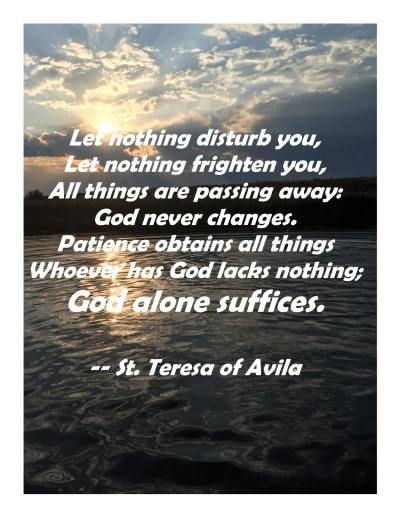
St. Teresa of Avila, declared a doctor of the Church, composed this beautiful prayer which describes this union:

Let nothing disturb you, Let nothing frighten you, All things are passing away: God never changes. Patience obtains all things Whoever has God lacks nothing; God alone suffices. — St. Teresa of Avila

In His Father’s house there are many rooms, and one especially prepared for you by Christ.  Trust in His love, Trust His Wisdom, Trust His Goodness…and let nothing trouble your hearts, that His Peace may be with you always.

Consider:

  • When have you experienced the peace of Christ?  After Mass, in praying with Scripture, in nature, through other Christians?
  • Consider the fears and anxieties you carry.  Lay them before the Lord in prayer and surrender them.  Consider the power of Christ to provide, the love of Christ which motivates Him, and the faithfulness of Christ who remains near us in every trial.
  • In what areas of your life do you trust God completely?  In what areas do you rely on yourself or conventional wisdom rather than Him?

Make a Resolution (Practical Application):

  • Choose your biggest worry.  Begin and end each day surrendering it to God in prayer.
  • Pray the prayer of St. Teresa of Avila each day this week.
  • We make an act of trust in God when we tithe.  If you do not tithe already, begin this week.  If you tithe already but feel called to tithe more (10% is the commonly suggested amount), prayerfully make a financial act of trust in the Lord.
  • Pray Psalm 23 each day this week.
Why do you trust Jesus Christ?  Post in the comments section below!

Related Posts:

~ Written by Angela Lambert © 2017

* To receive these weekly posts automatically in your email just click the “follow” tab in the bottom right hand corner and enter your email address.


Hope…When Least Expected

by Angela Lambert

woman at well

March 19th, 2017; 3rd Sunday of Lent

Gospel of John 4:5-42

 Jesus came to a town of Samaria called Sychar, near the plot of land that Jacob had given to his son Joseph. Jacob’s well was there. Jesus, tired from his journey, sat down there at the well. It was about noon. A woman of Samaria came to draw water. Jesus said to her, “Give me a drink.” His disciples had gone into the town to buy food. The Samaritan woman said to him, “How can you, a Jew, ask me, a Samaritan woman, for a drink?” —For Jews use nothing in common with Samaritans.— Jesus answered and said to her, “If you knew the gift of God and who is saying to you, ‘Give me a drink, ‘ you would have asked him and he would have given you living water.” The woman said to him, “Sir, you do not even have a bucket and the cistern is deep; where then can you get this living water? Are you greater than our father Jacob, who gave us this cistern and drank from it himself with his children and his flocks?”

Jesus answered and said to her, “Everyone who drinks this water will be thirsty again; but whoever drinks the water I shall give will never thirst; the water I shall give will become in him a spring of water welling up to eternal life.” The woman said to him, “Sir, give me this water, so that I may not be thirsty or have to keep coming here to draw water.”

Jesus said to her, “Go call your husband and come back.” The woman answered and said to him, “I do not have a husband.  Jesus answered her, “You are right in saying, ‘I do not have a husband.’ For you have had five husbands, and the one you have now is not your husband. What you have said is true.” The woman said to him, “Sir, I can see that you are a prophet. Our ancestors worshiped on this mountain; but you people say that the place to worship is in Jerusalem.” Jesus said to her, “Believe me, woman, the hour is coming when you will worship the Father neither on this mountain nor in Jerusalem. You people worship what you do not understand; we worship what we understand, because salvation is from the Jews. But the hour is coming, and is now here, when true worshipers will worship the Father in Spirit and truth; and indeed the Father seeks such people to worship him. God is Spirit, and those who worship him must worship in Spirit and truth.” The woman said to him, “I know that the Messiah is coming, the one called the Christ; when he comes, he will tell us everything.” Jesus said to her, “I am he, the one speaking with you.”

At that moment his disciples returned, and were amazed that he was talking with a woman, but still no one said, “What are you looking for?” or “Why are you talking with her?” The woman left her water jar and went into the town and said to the people, “Come see a man who told me everything I have done. Could he possibly be the Christ?” They went out of the town and came to him. Meanwhile, the disciples urged him, “Rabbi, eat.” But he said to them, “I have food to eat of which you do not know.” So the disciples said to one another, “Could someone have brought him something to eat?” Jesus said to them, “My food is to do the will of the one who sent me and to finish his work. Do you not say, ‘In four months the harvest will be here’? I tell you, look up and see the fields ripe for the harvest. The reaper is already receiving payment and gathering crops for eternal life, so that the sower and reaper can rejoice together. For here the saying is verified that ‘One sows and another reaps.’ I sent you to reap what you have not worked for; others have done the work, and you are sharing the fruits of their work.”

Many of the Samaritans of that town began to believe in him because of the word of the woman who testified, “He told me everything I have done.” When the Samaritans came to him, they invited him to stay with them; and he stayed there two days. Many more began to believe in him because of his word, and they said to the woman, “We no longer believe because of your word; for we have heard for ourselves, and we know that this is truly the savior of the world.”

Meditation Reflection:

What a long passage.  Why?  Why does John give this much space in his Gospel to one woman’s conversion?  Jesus encountered multitudes of people during His brief public ministry.  John even gives a disclaimer at the end of his Gospel, apologizing that he could only include a handful of Jesus’ miracles, enough to make the point that He is the Son of God, because they were too innumerable to recount in written form.

The woman at the well’s encounter with Christ, models the process of conversion.  Jesus approached her when she least expected it.  She went to the well at noon, the worst time of the day, to avoid the other women.  Sin has a way of isolating us from others as we try to cover up our sins or rationalize our choices.

Jesus initiated the conversation.  He sought her.  He began with a request, but in fact desired to offer her healing and salvation.  Every Christian’s conversion begins with an encounter with Christ, and the experience of Him having sought us before we sought Him.  Discipleship is not a project, club, or philosophy.  It’s a response.  It’s a realization that what Christ asks of us, is in fact His invitation to receive from Him.

Next, He addressed her sins.  She skirted the issue, and even when confronted directly, she tried to distract Him with a theological debate.  By the end however, she felt relief and joy. From her encounter, she learned that the Christ, the anointed one of God, had come.  Moreover, He had come to her – despite her personal unfaithfulness, as well as the unfaithfulness of her people the Samaritans. Jesus revealed Himself as the Savior, come through the promise of the Jews, and at the same time for the salvation of all.

Imagine her hopelessness as she approached the well in the heat of the day.  Women of her time would view success as a good marriage and large family.  She had already had five husbands and given up on marriage altogether with the man she was living with. She had no friends and was excluded from the community of women.  There was no way back for her, and no opportunity going forward.

God gives surprisingly and super-abundantly.  Met with physical thirst, Jesus offered her the living waters of eternal life.  It took awhile for her to wrap her mind around what He was saying.  Eventually however, she recognized the work of God and ran to the people of her town to tell them.  She left her water jug, despite her physical thirst and needs.  She boldly told everyone of her experience, despite the shame of her reputation among them.

Her witness was so moving that they went to Jesus to see for themselves.  They too encountered Christ in an unexpected and surprising way – through the seemingly least religious woman in town.  By the end of their encounter however, they too were converted.

During Lent, Jesus comes to meet us in our shame and our thirst.  As a Church, we endeavor to hear Him through increased prayer and introspection.  We recall that He came to save us, while we were still sinners.  We remember that He first sought us, but we must respond.  Thankfully, He is patient.  Our transformation in Christ will become our witness, and our witness will bring Christ to others.  But first, we must set aside our tactics for avoiding our sins, and allow Christ to lead us through them.

Consider:

  • The woman went to the well at noon instead of morning because of shame:
    • What are you ashamed of? What do you hide from others?
  • Imagine meeting Jesus there.
    • Would you feel surprised? What excuses might you make?
  • Imagine Jesus calling you out on your sins.
    • What are your competing loves? Be honest.
  • How is Jesus the living water compared to these other “spouses”?
  • How are the other pleasures you seek temporary and always needing replenishing, whereas Christ’s joy is abiding?
  • Jesus offers her life, and commands her to sin no more.  Let Jesus confront your sin.  You too must choose. You cannot have both.

Make a Resolution (Practical Application):

  • When God confronted King David about his sin through the prophet Nathan, David responded by composing Psalm 51.  He acknowledged his sin, asked for forgiveness, and trusted God to transform his heart.
  • Do an examination of conscience this week.  If possible, meet Christ in the sacrament of Confession.

~ Written by Angela Lambert © 2017

* To receive these weekly posts automatically in your email just click the “follow” tab in the bottom right hand corner and enter your email address.


Watch & Wait, Look & See

by Angela Lambert

20160815_171506644_ios

January 15th, 2017; Second Sunday of Ordinary Time

Gospel John 1:29-34 NAB

John the Baptist saw Jesus coming toward him and said, “Behold, the Lamb of God, who takes away the sin of the world. He is the one of whom I said, ‘A man is coming after me who ranks ahead of me because he existed before me.’ I did not know him, but the reason why I came baptizing with water was that he might be made known to Israel.” John testified further, saying, “I saw the Spirit come down like a dove from heaven and remain upon him. I did not know him, but the one who sent me to baptize with water told me, ‘On whomever you see the Spirit come down and remain, he is the one who will baptize with the Holy Spirit.’ Now I have seen and testified that he is the Son of God.”

Meditation Reflection:

How did John recognize Jesus as his Savior?  He prayed, waited, and listened.

Accustomed to instant gratification and the fast pace of life, together with a heavily marketed atmosphere, we can easily develop a tendency to expect Christ to sell Himself to us and to make His pitch with immediate persuasion. Whether we question God’s existence, His nearness, or His willingness to help us, we often complain that God is silent or distant.  Yet, we have to honestly ask ourselves, have we even asked God for His help?  Have we waited on the Lord, or are we expecting an immediate result?  Have we been receptive to the Lord’s prompting, or do we attempt to lead God, deaf to His guidance?

John the Baptist sought the Lord, venturing into the desert where he could encounter God away from the distractions of everyday life.  He waited on God, fully expecting an answer by spending his time preparing through preaching repentance and baptizing.    When the Savior came at last, John could receive Him and recognize Him as Lord because he was looking and listening.

It reminds me a little of family road trips.  The kid engrossed in his iPhone or tablet misses extraordinary sights, or at the very least, out of the ordinary landscapes.  The person vigilantly watching out the window however, can take in the beauty, appreciate the landscape, and spot the surprise spectacles.  By the time he has shouted “look!” and the distracted child responds, the sight has passed. Moreover, at the end of the journey, the one focused on the tablet retains the same vision of the world as when he left home, whereas the one who looked out the window broadened his vision and experience.

If we feel like God is distant, we need simply to look out the window and reach out to Him in prayer.  If we require His help, we need only to ask and listen.  When we look for the Savior, we find Him.  God does His part, and more.  We need to make the effort to look up from our commonplace experience and distractions and seek Him.

Psalm 40 begins by singing, “I have waited, waited for the LORD, and he stooped toward me and heard my cry.”  What a beautiful expression.  God has seen our suffering and heard our pleas.  He stooped to become man and dwell among us, personally healing and strengthening us.  When a person experiences the saving love of Christ, they cannot resist proclaiming it to others.  Like the child shouting “look!”, they instinctively cry out “look!” as well; or as John proclaimed, “Behold! The Lamb of God”.

Everyone seeks happiness, security, and love.  We can search for all these things online, in our careers, or the economy, but only Christ can deliver on His promises.  Archbishop Fulton Sheen described John the Baptist as “no frivolous reed shaken by every breath of popular applause.”  When we seek approval from others or from cultural standards, we become weak like a reed.  We sway at every idea, comment, or attack and easily break. Firmness of character and security of happiness can be found in Jesus Christ alone, who can provide peace and rewards of a supernatural level.  It is the Lord, who provides Faith, Hope, and Love.  It is His Holy Spirit who infuses us with His sevenfold gifts of Wisdom, Understanding, Counsel, Knowledge, Piety, Fortitude, and Fear of the Lord.  If we desire the Spirit’s fruits of love, joy, peace, patience, kindness, goodness, faithfulness, and self-control, we need merely to invite the Lord into our soul to dwell, and be receptive to the transformation He effects.

At the same time, to realize our need for a Savior, we must also acknowledge the reality of our sinfulness.  The first step to seeking the Lord is to grapple with our need for Him and our own insufficiency.  Sheen pointed out that, “Skepticism is never certain of itself, being less a firm intellectual position than a pose to justify bad behavior.”  Some who seem to seek God, actually hide behind their questions in order to avoid moral change.  Those who see the ugliness of their own sin look out the window, and run to the water to be cleansed.  They recognize the savior because they receive His grace and enjoy the beauty of His restoration.    They can proclaim with John, “Now I have seen, and testify that He is the Son of God.”  If you want to find out for yourself, respond to Christ’s invitation to “come and see” (Jn 1:39).  You might just see something incredible!

Consider:

  • Where can you go to encounter the Lord?
    • In a quiet place in your home for prayer? At Church or Eucharistic adoration?  In the Scriptures? In reading about the lives of the saints?  In visiting with a prayerful friend?  Taking time for prayer retreats? By listening to Christian radio in the car.
  • How do you sometimes approach the road trip of life more like the child distracted by a tablet, rather than the child looking out the window?
  • If you were to go out to the desert to see John the Baptist, what do you imagine it would be like? Would you want to receive the baptism of repentance?  For what would he call you to change in your life?
  • When has Christ “stooped toward you and heard your cry?” Did it fill you with peace and joy? Did you want to tell others?

Make a Resolution (Practical Application):

  • Watch, wait, and listen to the Lord this week by setting aside 5 minutes each day to seek Him out in prayer, Scripture, or even Christian radio.


~ Written by Angela Lambert © 2017

* To receive these weekly posts automatically in your email just click the “follow” tab in the bottom right hand corner and enter your email address.


Looking for a Savior

by Angela Lambert


Jesus and Pilate

November 13th, 2016; 33rd Sunday in Ordinary Time

Gospel Luke 21:5-19

While some people were speaking about how the temple was adorned with costly stones and votive offerings, Jesus said, “All that you see here– the days will come when there will not be left a stone upon another stone that will not be thrown down.” Then they asked him, “Teacher, when will this happen? And what sign will there be when all these things are about to happen?” He answered, “See that you not be deceived, for many will come in my name, saying, ‘I am he,’ and ‘The time has come.’ Do not follow them! When you hear of wars and insurrections, do not be terrified; for such things must happen first, but it will not immediately be the end.” Then he said to them, “Nation will rise against nation, and kingdom against kingdom. There will be powerful earthquakes, famines, and plagues from place to place; and awesome sights and mighty signs will come from the sky. “Before all this happens, however, they will seize and persecute you, they will hand you over to the synagogues and to prisons, and they will have you led before kings and governors because of my name. It will lead to your giving testimony. Remember, you are not to prepare your defense beforehand, for I myself shall give you a wisdom in speaking that all your adversaries will be powerless to resist or refute.  You will even be handed over by parents, brothers, relatives, and friends, and they will put some of you to death.  You will be hated by all because of my name, but not a hair on your head will be destroyed. By your perseverance you will secure your lives.”

Meditation Reflection:

Oftentimes we imagine being a Christian means merely letting Jesus smooth out the rough edges of our lives to make it happier and more beautiful.  The Jews made this mistake by imagining that in fulfilling the law and the prophets the Messiah would simply restore the Davidic Kingdom to its former earthly glory.  To be fair, the Incarnation of the Son of God liberated us at an unimaginable level. God’s merciful love exceeds anything we have experienced or could expect.  He also exceeds all expectations of philosophy and the wisdom of the Greeks.  The Jews experienced a taste of God’s powerful action and the Greeks touched on the heights of God’s wisdom.  Jesus, the power and wisdom of God, makes both of these accessible to all and redirects our efforts toward an everlasting destination.

Christ counsels us to view this life as a pilgrimage and a battle.  We develop our faith, hope, and love, on earth which will bring a deep sense of joy but will never create an earthly utopia.  If we hope to find fullness here we will be sorely disappointed.  Just look at the reactions of the people to the current election.  Although presidents have a great deal of power, they are not omnipotent.  Moreover, their policies certainly affect our daily lives but the transformation of heart and development of culture is something only Christ can do through His grace and His followers.  Both candidates have significant flaws and neither are our savior.  The presidential election can never be the beginning of building a utopia or the end of the world, depending on your perspective.  Our reaction ought to be proportionate – working diligently for the common good within our democratic system but relying on Christ alone for the salvation of souls and the spiritual elevation of our country.  We can find relative happiness here, but for our joys to be lasting we need to direct them toward their true end – the heavenly kingdom.

Christ promises to equip us for both the physical and the mental battle.  As long as we live in the tension of sin and its effects, we will have to struggle against ourselves and others who oppose Christ’s kingdom, even family and friends.  Nevertheless, Jesus, the Wisdom of God, provides the supernatural insights to answer the world’s mistaken propaganda or the pressures applied by those we care about.  He also strengthens His disciples with supernatural perseverance to endure the physical suffering or possible martyrdom inflicted by worldly combatants.

As Catholics, we too enjoy beautiful churches that express the glory of God. Rightly so, we adorn them with gorgeous art, precious metals, and the finest materials.  We do this as an act of worship, as demonstrating concretely to ourselves and the world the value of God and of His sacrificial love.  Christian churches are an icon, a sign pointing to a heavenly kingdom much more enduring.  The magnificence of the sight of God will make all earthly analogies disappear. We ought to enjoy earthly icons of beauty, goodness, and truth in churches, nature, and most importantly in persons.  At the same time, we need to daily recall to where they point and adjust our expectations and priorities accordingly.   We should still aim for greatness, justice, and perfection, but remember that it will come to fulfillment in the eternal kingdom where Christ reigns victorious.

Consider:

  • At the end of your life, what do you hope will endure from it afterward? Consider the lives you have and might still change, the love with which you imbue the world, the truths you fought to defend, the family relationships you have built.
  • Imagine your life from the perspective of entering heaven. Though all is certainly a grace, what would you be proud of?  What would you regret? How might you live each day with more eternal purpose and significance?

Make a Resolution (Practical Application):

  • Begin each day by surrendering it to the Lord.  Look for three opportunities each day to build the kingdom of God – by acts of mercy, service, defending truth, helping someone heal or find justice, sharing the good news of Christ, offering up personal disappointments or suffering as a sacrifice… At the end of the day write down the things that built the kingdom of God.  Reflect on any missed opportunities and pray for the grace to act on them tomorrow.

Previous Related Posts:

~ Written by Angela Lambert © 2016

* To receive these weekly posts automatically in your email just click the “follow” tab in the bottom right hand corner and enter your email address.


The View From Mount Humility

by Angela Lambert

20160820_204509111_iOS


August 28th, 2016; 22nd Sunday in Ordinary Time

Gospel of Luke 14:1,7-14  NAB

On a sabbath Jesus went to dine at the home of one of the leading Pharisees, and the people there were observing him carefully. He told a parable to those who had been invited, noticing how they were choosing the places of honor at the table. “When you are invited by someone to a wedding banquet, do not recline at table in the place of honor. A more distinguished guest than you may have been invited by him, and the host who invited both of you may approach you and say, ‘Give your place to this man,’ and then you would proceed with embarrassment to take the lowest place. Rather, when you are invited, go and take the lowest place so that when the host comes to you he may say, ‘My friend, move up to a higher position.’ Then you will enjoy the esteem of your companions at the table. For every one who exalts himself will be humbled, but the one who humbles himself will be exalted.” Then he said to the host who invited him, “When you hold a lunch or a dinner, do not invite your friends or your brothers or your relatives or your wealthy neighbors, in case they may invite you back and you have repayment. Rather, when you hold a banquet, invite the poor, the crippled, the lame, the blind; blessed indeed will you be because of their inability to repay you. For you will be repaid at the resurrection of the righteous.”

Meditation Reflection:

If pride comes before the fall, once could say humility comes before the ascent.  Our selfie-culture promotes self-assertion and our own honor and fame, bolstering pride and feeding competitiveness.  Yet, studies have shown that the social media craze can make persons feel depressed as they strive to compete with the seemingly perfect and glamorous lives of their friends based on the pictures they post.

I can certainly relate.  It seems like the night I order pizza for the kids someone posts a colorful, healthy, made-from-scratch dinner their family is enjoying.  As I take a mental break from the tedium of work, I see a post of someone’s adventurous travels.  When I take a moment to relax after having a difficult parenting day, I see a pictures of friends with their smiling kids, dressed in clean matching clothes, doing a fun family activity.  The temptation can be to respond by working on one’s own image and creating the appearance of similar importance and prestige (the definition of which varies based on what’s important to you).  In Jesus’ time, one’s image and importance could be seen by where one sat at the table. It’s not much different however than seeking social recognition online, at work, or amongst one’s peers based on achievements, physical appearance, or possessions.

For every vice with which one struggles, St. Francis de Sales advises conquering it by aiming for the opposite virtue.  To combat pride therefore, one must cultivate humility.

Humility does NOT mean self-hate or false modesty.  Rather, it refers to an authentic and accurate view of one’s worth as well as the worth of others.  Pride takes many forms as we vie with one another for our place – some obvious and others subtle.

Merriam-Webster defines humility as “not thinking of yourself as better than other people.” God revealed the inherent dignity of every human person by creating each one in His image and likeness (independent of differences in appearance or abilities) and by Christ dying on the cross to save each and every one of us.  If God would become man, to suffer and die for someone, how can I not value them as anything less than priceless?  It doesn’t make me any less, but it also means I’m not anything more.     C.S. Lewis captured this mystery well in his essay, “The Weight of Glory”.  In it, he reflects on the grandeur of the human person, whose immortal nature will share in the either the horror of hell or the magnificent glory of God in Heaven.  He writes:

There are no ordinary people. You have never talked to a mere mortal. Nations, cultures, arts, civilization—these are mortal, and their life is to ours as the life of a gnat. But it is immortals whom we joke with, work with, marry, snub, and exploit—immortal horrors or everlasting splendours. This does not mean that we are to be perpetually solemn. We must play. But our merriment must be of that kind (and it is, in fact, the merriest kind) which exists between people who have, from the outset, taken each other seriously—no flippancy, no superiority, no presumption. And our charity must be a real and costly love, with deep feeling for the sins in spite of which we love the sinner—no mere tolerance or indulgence which parodies love as flippancy parodies merriment. Next to the Blessed Sacrament itself, your neighbour is the holiest object presented to your senses. If he is your Christian neighbour he is holy in almost the same way, for in him also Christ vere latitat—the glorifier and the glorified, Glory Himself, is truly hidden.”

In consequence, we need not honor others because we think so little of ourselves, but rather because we rejoice in our shared glory as sons and daughters of God.

A second reflection on humility relates to a definition which can be found in the Catholic Encyclopedia, which defines it further in this way:

“Humility in a higher and ethical sense is that by which a man has a modest estimate of his own worth, and submits himself to others. According to this meaning no man can humiliate another, but only himself, and this he can do properly only when aided by Divine grace.”

“Submitting oneself to others” is verbiage that sounds as archaic as the Latin in which it was originally written.  In our anti-authroity, “look out for #1” society this just seems antiquated.  I have been blessed however to experience the receiving end of this idea and I will admit that it creates a loving, peaceful community.  Just the other day, I walked in late to a meeting at work and a co-worker saw my need as I scanned the full room futily for an open seat.  He waved me over,  reached for a folding chair next to the wall, then opened it for me in an open spot he had found.  It made me feel cared for and respected.  Similarly, I am blessed to work at a place where colleagues regularly open the door for one another, ask genuinely how one is doing, and offer help whenever they see a need. This practice of showing deference toward others, far from demeaning one, creates esteem.

As a parent however I am finding it ever more difficult to create a sense of deference in my children.  On a recent road trip they argued that I was being a hypocrite because I made them take turns between the bucket seats in our van and the back seat but I always got to sit up front.  “Why do you get to sit up front?” they asked, “and why don’t you have to take a turn being squished in the back bench seat?”  “Because I’m an adult” I replied.  It seemed obvious to me. That thought would never have crossed my mind as a child. I had done my time sitting in the back as a kid.  Yet, it was not so obvious to them.  A similar incident occurred during a trip for my sister’s wedding. My dad had graciously rented a mini-van to help drive us as well as other extended family around.  On one excursion my aunt decided to come along and my kids began to fight over who had to give up a bucket seat for her.  She kindly offered to sit in the far back which, I remarked, was virtuous of her, but denied my kids the opportunity to practice virtue themselves.  Much like Jesus’ parable, her humility resulted in being urged to a place of honor (even if its’ prime seating in a van!), whereas one of my children had to be scolded and moved to the back.

Practicing deference shows love and respect.  It means honoring one another rather than grasping at it for oneself.  This doesn’t mean you will be destined to be a doormat, but as Sirach proclaims in chapter 3:17-18:

“My child, conduct your affairs with humility, and you will be loved more than a giver of gifts. Humble yourself the more, the greater you are, and you will find favor with God.”

Paradoxically, when we celebrate and appreciate others, we ourselves experience celebration and appreciation too.  Moreover, by valuing what truly maters in others, we learn to value ourselves more authentically as well.  It means we feel secure in our worth as sons and daughters of God.  We feel loved for who we are and not just what we can do.  It frees us to be teachable and learn from those who know more or have more experience.  It also frees us to mentor others in love rather than pride who could learn from us.  This builds the kingdom of God and gives us a taste of the wedding feast of heaven, where everyone rejoices in the grace of God and the work He has accomplished in the souls of every person there, including ourselves.

Jesus accepted the invitation to dine at the home of a leading Pharisee.  Humility does not therefore entail avoiding all social opportunities.  Instead, Christ exhorts us to evaluate the reasons for our decisions and to be aware of the snares of subtle pride.  Christ dined with the Pharisee to teach, heal, and save.  Others had come to be taught, healed, and saved.  Still others, Jesus observed, concerned themselves with image, honor, and their place at the prestigious table.  Jesus teaches us to celebrate the honors of others and thereby frees us from the striving and grasping after notoriety.  Instead of de-valuing your own worth, it actually means you feel secure and content with who you are and it frees you from judging yourself in comparison to others.  A good friend of mine once said, “to compare is to despair.”  I have found that to be true.  If however you take joy in other people you will be happy in any circumstance – either celebrating their successes, or being thankful to be in a position to offer help if they are in need.

Consider:

  • In what ways or areas do you sometimes over-estimate yourself? In what ways or areas do you sometimes under-estimate yourself?
  • Consider the deference Christ shows toward you by dying on the Cross for you, inviting you into relationship with Him, and transforming your life with his grace.
  • How might you show greater deference and humility toward others?
    • In your home and family.
    • Toward your peers and colleagues.
  • Reflect on the relationship between being humble and being teachable.
  • Consider the relationship between humility and service.
  • Consider the relationship between being humble and accepting the responsibility of leadership.
  • How does Christ model true humility in each of these ways?
    • Think of His obedience to Mary and Joseph.
    • Consider His relationships with His family, friends, and disciples.
    • Reflect on His humiliation on the Cross to elevate us.
  • With whom, or in what situations, do you struggle with pride, over-competitiveness, or excessive focus on your image the most? Invite Christ to help you with His grace to acquire peace and humility in that.

Make a Resolution (Practical Application):

  • Pray the Litany of Humility each day this week.
  • Choose one person or area of your life in which you struggle with pride, over-competitiveness, or excessive focus on your image. Each morning this week, decide on one way in which you can practice humility in relation to that person or situation.
    • Examples: Towards Persons – ask him/her for help when needed, offer assistance, encouragement, or praise. Toward situations – Let others speak first at meetings, choose a simpler hair style or clothing for the day, invite a visitor in even if the house is a mess.
  • ~ Written by Angela Lambert © 2016
* To receive these weekly posts automatically in your email just click the “follow” tab in the bottom right hand corner and enter your email address.


Why is There Suffering, and What is God Doing About It?…Gospel meditation for June 5th, 2016

by Angela Lambert

Jesus raises widow of Nain's son

June 5th, 2016; 10th Sunday in Ordinary Time

Gospel of Luke 7:11-17 NAB

Jesus journeyed to a city called Nain, and his disciples and a large crowd accompanied him. As he drew near to the gate of the city, a man who had died was being carried out, the only son of his mother, and she was a widow. A large crowd from the city was with her. When the Lord saw her, he was moved with pity for her and said to her, “Do not weep.” He stepped forward and touched the coffin; at this the bearers halted, and he said, “Young man, I tell you, arise!” The dead man sat up and began to speak, and Jesus gave him to his mother. Fear seized them all, and they glorified God, crying out “A great prophet has arisen in our midst,” and “God has visited his people.” This report about him spread through the whole of Judea and in all the surrounding region.

 Meditation Reflection:

Why is there evil in the world?  Why doesn’t God do anything about it? Some persons will answer that either God doesn’t exist or God doesn’t care.  Those persons willing to investigate the question further however, universally discover two things: human free will causes most evils and the person who has consistently done the most to alleviate suffering is God.  Utopian ideologies of the 19th and 20th centuries, endeavoring to eradicate evil through human efforts alone, all ended in countless deaths and totalitarian rule. Sin causes evil and only God can save us from ourselves.  Even death, God has revealed, did not originate with faulty genetics or evolution.  Sickness, death, toil, and pain entered the world through the original sin of Adam and Eve (Genesis 3; Romans 8:19-23).

God created human persons to experience Truth, Goodness, and Beauty.  He designed us to live in perfect friendship with Him and with each other in a unity of love and joy for eternity.    We all experience deep suffering at some point(s) in life.   The woman in this Gospel provides an example of both deep spiritual pain from losing her only son after having already lost her husband, as well as utter material destitution since she would have no legal rights to property or work without a husband or son.  Upon seeing this, Jesus is “moved with pity for her.” When we feel most vulnerable, most alone, and our hearts are breaking, we can look to this passage and take comfort in knowing that Christ is looking on us with pity.  Moreover, this pity moves Him to do something to alleviate our pain.  In this case, Jesus restored the man to life.  In doing so, He restored the woman’s life as well.  Although Christ does not always save those we love from earthly death, this miracle demonstrates His power and His love which brings new life in surprising and supernatural ways.  It also points to the hope that all will be made new in the resurrected life in the kingdom of God.

God became man to dwell among us (John 1:14) and to personally alleviate our suffering through His Word, His touch, and His sacrifice.  As the psalmist proclaims: “The LORD is near to the brokenhearted, and saves those who are crushed in spirit” (Ps. 34:18).  Moved with pity, Christ continues to reach directly into our hearts to dry our tears and heal our wounds. He anoints our wounds with grace through His sacraments, He dispels hurtful lies with His divine revelation, He forgives our sins in the sacrament of Confession and fortifies us with grace to overcome them, and He feeds us with His very own body and blood in the Eucharist.  Finally, He unites us as members of His body and extends His hand of mercy through His disciples operating under the direction and love of the Holy Spirit.

Does God care about our suffering?  Is He going to do anything about it?  Yes.  Quite a lot actually, if only you will allow Him.  Christ offers new life if we will accept it.  He offers healing if we turn to Him.  This is the witness of every Christian disciple.

Consider:

  •  Re-read the Gospel and imagine you are one of the persons present.
    • Consider the love of the mother for her only son. Consider her love for her husband as well.  The death of her son means the image of her husband is gone as well as their family together.  In addition, imagine you will now be destitute with no way to provide for yourself.  To your surprise, a man emerges from the crowd and gives your son, your family, your life, back to you.
    • Imagine you are one of the members of the crowd. Why might you be present and how might you be feeling toward the woman?  What would you think of Christ’s miracle?
    • Imagine Christ’s perspective. What does His response reveal about His heart and His character?
  • Consider the definition of pity. Dictionary.com defines it as: “sympathetic or kindly sorrow evoked by the suffering, distress, or misfortune of another, often leading one to give relief or aid or to show mercy.” The heart of Christ felt sorrow at the sight of the woman’s pain and it moved Him to help her.  Imagine Christ seeing you in your pain.  Consider His merciful look of pity which shares your sorrow and desires to bring you comfort.
  • Reflect on a time Christ comforted you or saved you when you were in dire need. Take time to appreciate all that He did and the incredible ways He acted in your life during that time.

Make a Resolution (Practical Application):

  • Begin each day with this prayer: “Lord show me the needs around me.  Move my heart with pity and enable me to show mercy to someone today.”
  • Surrender a pain to Christ to heal. Reach out to Him in His Word, His Sacraments, or His Church.  Spend 5 minutes of silence with Christ and your pain.
  • Make a gratitude list of the mercies Christ has shown you over the years and then each day.


~ Written by Angela Lambert © 2016

* To receive these weekly posts automatically in your email just click the “follow” tab in the bottom right hand corner and enter your email address.


Christ’s gift and a Mother’s gift…Gospel meditation for the Solemnity of the Most Holy Body and Blood of Christ

by Angela Lambert

eucharist and crowd

May 29th, 2016; The Solemnity of the Most Holy Body and Blood of Christ

 Gospel of Luke 9:11b-17 NAB

Jesus spoke to the crowds about the kingdom of God, and he healed those who needed to be cured. As the day was drawing to a close, the Twelve approached him and said, “Dismiss the crowd so that they can go to the surrounding villages and farms and find lodging and provisions; for we are in a deserted place here.” He said to them, “Give them some food yourselves.” They replied, “Five loaves and two fish are all we have, unless we ourselves go and buy food for all these people.” Now the men there numbered about five thousand. Then he said to his disciples, “Have them sit down in groups of about fifty.” They did so and made them all sit down. Then taking the five loaves and the two fish, and looking up to heaven, he said the blessing over them, broke them, and gave them to the disciples to set before the crowd. They all ate and were satisfied. And when the leftover fragments were picked up, they filled twelve wicker baskets.

Meditation Reflection:

Christ loves us with His whole being.  He became man that He might personally uplift our hearts with His truth, extend His hand to heal our wounds, and feed us with His own Body and Blood.  Mothers have the privilege of experiencing this kind of self-gift.  A mother literally shares her body with her child and shares in Christ’s pain at his or her birth.  A mother continues to feed her infant with her own body and tend to the constant needs of her newborn.  As her child grows a mother does everything she possibly can to care for the child’s physical, emotional, and intellectual development.  Mothers take joy when their kids eat and grow, when they can comfort and guide them, and when they can make sure their child knows how loved he or she is.

Christ urges us to trust Him and His love as well.  He soothes us in our worries assuring us of His care:

“Therefore I tell you, do not be anxious about your life, what you shall eat or what you shall drink, nor about your body, what you shall put on.  Is not life more than food, and the body more than clothing?  Look at the birds of the air they neither sow nor reap nor gather into barns, and yet your heavenly Father feeds them.  Are you not of more value than they?…But seek first His kingdom and His righteousness, and all these things shall be yours as well.” Matthew 6: 25-33)

Today’s Gospel confirms that Jesus cares about our needs, even the basic ones like what’s for dinner. Moreover, He can provide in surprising ways since He can do the miraculous.  The crowd of thousands ate their fill after having spent the day in a deserted place listening to Christ speak about the kingdom.  So many times we try to cure ourselves or numb the pain in ways that only turn out to be self-destructive and leave us hungering.  Instead, we should try reaching out to Christ in prayer and receiving the cure for all our pain in His Eucharistic Body and Blood.

Jesus heals our hearts and frees us from the lies that we allow to burden us.  He forgives our sins and gives us a new start with the grace and hope to be better.  He fortifies us with His strength to persevere and He gently provides rest for our soul with His peace.  He does all of this personally, directly, through His incarnate and immanent presence in the Eucharist.  Christ gave His Body and Blood on the Cross to give birth to our new life.  He instructed us to take and eat of this same Body and Blood which He made the sacrifice of the New Covenant.    The Son of God became man that He might dwell among us and apply His grace to our soul.  Today we honor the gift of His Body and Blood through which He feeds us superabundantly, strengthens us, comforts us, and nourishes our growth.  Through the gift of His most holy Body and Blood, we receive life.  Moreover, He continues to provide this gift that we might grow in health and maturity to the fullness of Christian life in the kingdom of God.

Consider:

  • Imagine you are one of the person’s in the crowd listening to Jesus speak about the kingdom of God and curing all those who needed it.
    • What would you hear Jesus say?
    • From what would He heal you?
    • How might His Truth and His touch free you?
    • Consider how you have this very opportunity at the Mass – to hear Christ preach about the Kingdom through His priest and to touch you through His Eucharistic presence.
  •  Consider how a mother gives of her body for her child.  A mother’s love tends to be a complete self – gift.  Consider how the gift of her very body and blood, given in love,  is a unique way to give of her whole self in imitation of Christ.

Make a Resolution (Practical Application):

  • Reflect on the gift of Christ’s most holy Body and Blood on the Cross and in the Eucharist each day this week.
  • Attend a daily Mass this week in addition to the Sunday Mass.
  • Give Christ your own Body through a physical sacrifice. Cheerfully offer Christ your labor of service for your family or work, look for a providential opportunity to serve Christ with your physical efforts, offer your sickness or suffering, or prayerfully consider something to fast from each day.


~ Written by Angela Lambert © 2016

* To receive these weekly posts automatically in your email just click the “follow” tab in the bottom right hand corner and enter your email address.


Divine Mercy…Can you believe it?

by Angela Lambert

Divine Mercy

April 3rd, 2016; 2nd Sunday of Easter/ Divine Mercy Sunday

 Gospel John 20:19-31

On the evening of that first day of the week, when the doors were locked, where the disciples were, for fear of the Jews, Jesus came and stood in their midst and said to them, “Peace be with you.” When he had said this, he showed them his hands and his side. The disciples rejoiced when they saw the Lord. Jesus said to them again, “Peace be with you. As the Father has sent me, so I send you.” And when he had said this, he breathed on them and said to them, “Receive the Holy Spirit. Whose sins you forgive are forgiven them, and whose sins you retain are retained.” Thomas, called Didymus, one of the Twelve, was not with them when Jesus came. So the other disciples said to him, “We have seen the Lord.” But he said to them, “Unless I see the mark of the nails in his hands and put my finger into the nail marks and put my hand into his side, I will not believe.”

Now a week later his disciples were again inside and Thomas was with them. Jesus came, although the doors were locked, and stood in their midst and said, “Peace be with you.” Then he said to Thomas, “Put your finger here and see my hands, and bring your hand and put it into my side, and do not be unbelieving, but believe.” Thomas answered and said to him, “My Lord and my God!” Jesus said to him, “Have you come to believe because you have seen me? Blessed are those who have not seen and have believed.” Now Jesus did many other signs in the presence of his disciples that are not written in this book. But these are written that you may come to believe
that Jesus is the Christ, the Son of God, and that through this belief you may have life in his name.

Meditation Reflection:

We spend so much time and money distracting and soothing ourselves from regret for our mistakes and fear of our mortality.  Christ’s victory over sin and death opens the possibilities of a new beginning during this life and life eternal in the next.  The Risen Christ finds the apostles in fear and brings them Peace.  Thomas misses the opportunity for peace however because he refuses to believe his fellow apostles’ unanimous witness.  Despite his own witness of Jesus’ many miracles and the reliability of the disciples’ account, he refuses to receive Christ’s peace without seeing the healed wounds of the Lord for himself.  Christ would have been in His right to refuse such a demand but in His mercy He appears directly to Thomas so that his faith could be strengthened and he could receive the riches Christ had suffered to give to him.

Imagine the joy Jesus must have felt, having earned our salvation through such intense suffering, when He could then bestow upon His apostles the administration of His Kingdom which is none other than the forgiveness of sins.  Every mother knows the relief of holding her newborn in her arms after a long pregnancy and birth.  Jesus must have experienced a similar relief when He enjoyed our new life given through His loving sacrifice.

Pope St. John Paul II declared in 2000 at the canonization of St. Faustina, that today, the Sunday following Easter, be celebrated as Divine Mercy Sunday.  Christ had appeared to St. Faustina, a simple uneducated nun from Poland, in the 1930s and spoke with her about His great desire to bestow His mercy on us.  His message did not add anything new to the Gospel, however He re-emphasized His view to the modern world relaying to her His greatest pain which He identified as souls refusing to trust in His mercy.  In the Diary of St. Faustina, (recorded at the request of her spiritual director), she relays these words of Jesus to her regarding today:

I desire that priests proclaim this great mercy of Mine towards souls of sinners.  Let the sinner not be afraid to approach Me.  The flames of mercy are burning Me – clamoring to be spent; I want to pour them out upon these souls…Distrust on the part of souls is tearing at My insides.  The distrust of a chosen soul causes Me even greater pain; despite My inexhaustible love for them they do not trust Me.  Even My death is not enough for them.”  (par. 50)

Like Thomas, many of us struggle to trust Christ.  We fail to have confidence in Jesus’ ability to change our lives and renew our souls.  Using Pope Francis’ analogy, we treat Confession like a dry cleaner.  We can imagine being showered off but not truly changed.  In doing so we do not emulate humility but rather wastefulness.

Today we reflect on the mercy of Christ and ask that He increase our hope that we might trust in Him.  The devil steals our joy, but Christ came to give us joy to the full.  He not only forgives us, but enables us to live a supernatural life of virtue and peace. On the Feast of Mercy during the Jubilee of Mercy, God exhorts us in every way possible to receive His mercy, to give mercy, and to trust in Him.  Let us pray for the grace to surrender the myth of perfection in exchange for the truth of sanctifying love.

Consider:

  • Reflect on the joy Christ feels when He can shower upon us the mercy He worked so hard to earn for us. Consider the mystery of a mother or father’s love that takes pleasure in sacrificing for their children.
  • Do you struggle with perfectionism? Do you struggle to accept Christ’s help because you feel unworthy of His love if you make mistakes or fall to sins?  Do you feel you need to be holy all on your own?
    • Pelagianism, a heresy in the early Church, asserted that Christ came to set a good example for us but we have to live up to that example by our own efforts alone. The Church declared that the human will alone could not perfect itself but rather required supernatural grace.  Do you try to perfect yourself to feel worthy of Christ’s love, or do you accept your worthiness of His love and so the possibility of being made perfect by Him?
  • How much do you need to see to believe? What evidence has Christ given you already that you ignore?  What witness could you give to others about the reality of His presence?
  • Consider a time when you experienced the peace of Christ.

Make a Resolution (Practical Application):

  • Do one act of mercy for someone each day this week.
  • Do one act of mercy toward yourself each day this week.
  • Thank Christ each day for His gift of mercy. Make a gratitude list east day of His blessings.
  • Learn about St. Faustina and the Divine Mercy Chaplet, Image, and Feast Day.
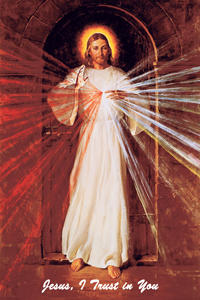
  • Say the short prayer, “Jesus I Trust in You”, throughout the day.


~ Written by Angela Lambert © 2016

* To receive these weekly posts automatically in your email just click the “follow” tab in the bottom right hand corner and enter your email address.