It’s the season of watching. Watching for sales and gifts, watching beautiful Christmas lights, watching school Christmas programs, watching Hallmark movies, watching the mail for Christmas cards and watching for our loved ones to visit. It can also become watching the calendar fill with a myriad of commitments and watching our to-do list lengthen like the unfurling of a scroll that tumbles across the floor to the end of the room.
The excitement of the season can also be draining. We endeavor to conserve our energy and find balance between the work to prepare for Christmas, and actually relaxing enough to enjoy it. The thrill of finding the perfect gift on Black Friday devolves just a few short weeks later into frantic stress over the hard-to-buy-for person. The hours in the day seem to disappear as fast as the shrinking sunlight. Upon lighting the first advent candle as a child, I would groan at the long wait ahead of four interminable weeks. Now, as I pull the advent wreath from my tub of Christmas decorations, I groan that there are only four short weeks left to get everything done.
If we let the activity distract our aim, we may miss the target and lose the opportunity for reconnection and generosity that Christmas offers. However, if we keep our sight on the purpose of each of our activities, we may hit the mark. The cleaning, decorating, cooking, shopping, travelling, and planning can either leave us exhausted and cranky toward those we love, or they can invigorate us with energy and joy as we revel in lavishing our love on them and treasuring precious time together.
This time is also rich in opportunities to lavish our love upon Christ. During Advent, parishes often offer a spiritual retreat or host an evening with a speaker. The liturgy of the mass includes special prayers and Scriptures, and many people add advent traditions of prayer in their home such as lighting advent candles, reading Scriptures alongside a Jesse Tree with children, or another devotion. Community outreach is everywhere you turn from winter wear drives at work or school, to food donations, and toy drives.
Today, the first Sunday of Advent, our Gospel reading serves to focus our sight on the right target – the Good News that Christ has come and will come again. He has saved us, freed us from sin, and heals our souls. During the present age we have been entrusted by Him, “each with [our] own work,”(v.34) but we must always remember that He is the Lord and ultimately we watch and await His return.
So how do we keep watch? Daily in prayer, weekly at Mass, and at every moment by showing love toward Christ in those around us. Mother Teresa served others each day with Jesus’ words in mind: “as you did it to one of the least of these my brethren, you did it to me.” (Matthew 25:40)
May this season of Advent and Christmas invigorate rather than drain, as we keep our aim on love and on Christ.
Consider:
What do you enjoy most about the weeks leading up to Christmas? How might you enjoy them more, and prioritize your time better?
Reflect on the gift of the Incarnation. Consider the humility of Christ to become man. Contemplate His love for you, that He desired to be so close. Reflect on the gift of His grace and redemption.
What gifts has Christ given to you over the years? What gifts has He blessed you with this year? Are there any spiritual gifts you might put on your Christmas list to Him presently?
What gift might you offer to Christ?
Practical Application:
As we spend more time with family, friends, and coworkers this season, spend more time with Christ as well. Decide on how you will do this – go on a retreat, attend a speaker at your church, read an advent devotional each day, spend 5 minutes a day with Scripture.
* To receive these weekly posts automatically in your email just click the “follow” tab in the bottom right hand corner and enter your email address. You can also follow me @taketimeforhim on Twitter and Facebook.
Mountains make us think of God. Their height, their beauty, and their majesty inspire a sense of our smallness, and of God’s greatness. Moses ascended Mt. Sinai to encounter God.
When the LORD had finished speaking to Moses on Mount Sinai, he gave him the two tablets of the covenant, the stone tablets inscribed by God’s own finger. (Exodus 31:18)
He prayed and fasted for 40 days and nights, during which God spoke to Him “face to face, as a person speaks to a friend” (Exodus 33:11). To form His People in wisdom, justice, and peace, God gave to Moses the Law, written by God’s own hand.
After this encounter, Moses’ face radiated such glory that Aaron and the other Israelites feared being near to him; so much so that Moses had to wear a veil over his face when in their presence (Ex 34:29-34).
Moses’ relationship with God and the immediacy of God’s interaction with him was unparalleled. At the end of Moses’ life however, he prophesied that God would one day send a New Moses.
I will raise up for them a prophet like you from among their kindred, and will put my words into the mouth of the prophet; the prophet shall tell them all that I command. (Deuteronomy 18:18)
Jesus ascended the Mount as the New Moses when He taught the Beatitudes. Christ affirmed the Law given to Moses, but he extended it further to its fullness intended by God. Through Moses, God had liberated the Jews from physical slavery and reformed their outward actions through the wisdom of the 10 Commandments. Through His Son, God now liberated His people from spiritual slavery to sin and, empowered by grace, directed them to conversion of interior intentions and desires. As He set about the task of establishing the eternal Kingdom of God, the Beatitudes mark the fullness of God’s rule for His People – one of authentic love for God and one another.
The best teachers use examples to illustrate their lessons. The beatitudes are the heart of the New Law, but their application can be obscure. On All Saints Day the Church recognizes the lives of the saints throughout history to remember those concrete examples of how to live the beatitudes and apply them. Saints, those who have been fully transformed in Christ, have come from every age, place, and walk of life. You can find examples of nearly every type of personality, spirituality, vocation, and occupation.
One such saint, St. Thérèse of Lisieux (1873-1897), asserted that we ascend the mountain of God, by way of descending the valley of humility. She was a young, cloistered Carmelite nun in France who pursued sainthood by doing small things with great love; a theme St. Mother Teresa (1910-1997) took as inspiration in her own life. Through the humility and simplicity of Thérèse’s life, she lived the beatitudes in the confines of her small world, but God raised her up as a Doctor of the Church and her Story of a Soul gained worldwide readership after her death.
Using Thérèse ’s analogy of descending the mountain, let’s consider each beatitude as steps on the journey of sanctification. The first step, poverty in spirit, establishes right relationship with God by recognizing one’s creatureliness and dependency. The poor in spirit surrender the illusion of self-sufficiency and accept their dependence on God as His creature and His child.
How often have you experienced the frustration of wanting to help someone, but they refused to be receptive to your advice or your aid? Common obstacles to accepting dependence on God stem from a desire for security located in things we think we can control – such as wealth, career, relationships, status, self-help, etc. If we cling to a desire to redeem ourselves, we will resist the mercy of our only Redeemer. The poor in spirit have hit rock bottom, they are in the valley. Regardless of their wealth or accomplishments, they are keenly aware that only God can heal their wounds, release them from self- destructive addictions or thoughts, and provide them with security which isn’t dependent on the market, the weather, what other people think of them, or even their employer.
Once a person looks to God, who is full of mercy, whose Son demonstrated His sacrificial love, they are moved to sorrow. This sorrow wells up from an honest view of themselves and their sins – free of the rationalizations and false beliefs they had clung to in the past. They see sin for what it is: degrading, a trick they fell for, and ingratitude.
Having shed false pretentions about oneself, a person develops a beautiful authenticity which is characterized by meekness. Meekness is not weakness! Meekness means a person has greater compassion and patience toward others because they know that “but for the grace of God, there go I.” In consequence, surrender to God, gratitude for His mercy and comfort, and humble authenticity, causes one to bear much more fruit in their life and work.
As gratitude for God’s love, and experiential knowledge of the wisdom of His ways increases, a person begins to hunger and thirst for righteousness. They desire even greater freedom and deeper joy, which they know with deep conviction, can only be found in Christ. This is a prayer to which God always says yes.
The joy of freedom in Christ’s love creates so much gratitude that it spills over in a person’s heart and they can’t help wanting to give back to Christ the kindness He has shown to them. Thus, they show mercy to others because they empathize with the struggle of sin and desire to follow the example of Christ who has shown them mercy in their weakness.
Union with Christ in the Beatific Vision is the essence of Heaven. Thus, those that have forsaken all for Him, whose heart is pure, begin to experience a taste of the vision of God. Reconciled to God through His son, they extend this peace to others as it radiates from their own interior peace from union with the Lord.
Finally, the more perfect a union one has with Christ, the more others will treat that person the same way they would of Him. Jesus warned His apostles that those of the world who persecute Him, will persecute them; and those that love Him, will love them (John 15:18-25). Thus, Christ ends the Beatitudes with the summation of the spiritual life – when one is persecuted because of Christ, they ought to rejoice, because it means they are finally living in union with Him and following in His example. In a sense, it’s confirmation that one is conformed to Christ. Others wouldn’t bother with you if you were worldly enough to leave their consciences undisturbed.
Jesus provides the Way by teaching us the Beatitudes and showing us how to follow them by His example. Moreover, He provides the supernatural grace, virtues, and love we need to live such a profoundly spiritual life and the examples of the Saints to illustrate how it looks in everyday life.
The world offers countless distractions to discourage us from introspection, and our own pride can further resist taking an honest look inside our hearts. Christ exhorts us to bravely journey within, promising to accompany us and to conform what we find to His own perfect love. If we descend the valley of humility through poverty in spirit, we will ascend the mountain of God and enjoy the beatific view from the top.
Consider:
Have you ever seen a mountain up close or hiked up one? How did it affect your perspective?
Consider the immanence of God – His revelation to Moses and His revelation through Christ. In what way does His closeness make you somewhat afraid, like the Israelites? In what way, does it comfort or strengthen you to have Him so near?
God continues to dwell with us in an immanent way in the Eucharist. Consider how it has pleased God in every age, to draw near to us. In what ways, do you appreciate His gift? In what ways, do you sometimes take it for granted? How might you increase your appreciation?
Consider the spiritual journey laid out by the beatitudes. How does your spiritual life correspond to some of the stages?
Which beatitude touches you the most? Is there one that sticks out to you as the most moving?
How has your love for God grown through the years as a response of gratitude for His grace at work in your soul. What do you know is His work and not your own?
Make a Resolution (Practical Application):
Reflect on one beatitude each day this week and try to live it out in an intentional way.
* To receive these weekly posts automatically in your email just click the “follow” tab in the bottom right hand corner and enter your email address. You can also follow me @taketimeforhim on Twitter and Facebook.
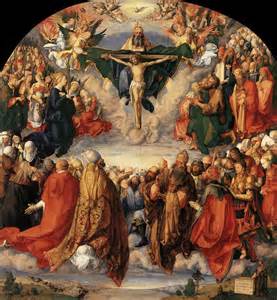
Consider for a moment this incredible fact: we are made in the image and likeness of the Trinitarian God. Although God’s essence exceeds our understanding, He has nevertheless chosen to reveal His nature to us and even given us an experience of it imprinted on our own human nature.
So what did God reveal about Himself?
God has revealed that He is Love (1 John 4:8) and that He is Father, Son, and Holy Spirit (Matthew 28:19). From the Father, we observe that God is creative. From the Holy Spirit, we observe His immanent might and love operative in our souls. And from the Son, we learn that God’s creative, mighty, love, is sacrificial.
What does this mean for you and me?
We live in a culture that forms us to be autonomous, independent, and self-seeking. Humanitarian works and acts of kindness may be valued to the extent that they make life more pleasant in general, but not to the extent that it requires personal sacrifice – a real loss of some kind.
Human happiness does come through self-realization and self-fulfillment, but not in the way our culture defines those terms. The Trinity is a relationship of three divine Persons in mutual self-gift and love. This means that, as creatures made in the image of the Trinity, we achieve self-fulfillment through self-giving love. It’s a paradox, but one that Christ emphasized over and over in both His teachings and His life.
“For whoever would save his life will lose it, and whoever loses his life for my sake, will find it.” (Matthew 16:25 RSV)
Christian discipleship means living and being as Christ. In his book, Introduction to Christianity, Pope Benedict XVI described Jesus’ mission as being from the Father, for us. In other words, he says, Jesus’ whole “being itself is service”. Avoid imagining Jesus as just a nice guy, however. Pope Benedict isn’t referring to volunteering more. He means that Jesus’ whole existence is one of relationship, and a relationship of service. Thus, Christian discipleship transforms us from self- centered lives, to God and others-centered lives.
To be God-centered, from God and for others as Christ was, requires a radically different worldview than our secular culture. Pope St. John Paul II, as he examined God’s words in Genesis asserted that this relational character lies at the heart of our nature and our happiness. He wrote:
When God-Yahweh said, “It is not good that the man should be alone,” (Genesis 2:18) he affirmed that “alone,” man does not completely realize this essence. He realizes it only by existing “with someone”– and even more deeply and completely – by existing “for someone.” (Pope St. John Paul II. “General Audience of January 9, 1980.” The Theology of the Body: Human Love in the Divine Plan. Pauline Books and Media, 1997)
He’s not saying that we must become slaves with no individual identity. Rather, he’s saying that men and women find self-fulfillment through self-gift. Self-gift, by definition, means giving yourself to someone. It means we find happiness in loving sacrifice.
St. Mother Teresa said that everyone has an opportunity to love as Christ did, and therein find happiness. To find that someone we simply need to look around us. As we celebrate the Blessed Trinity today, let us celebrate the gift of relational love. Mary always perceived the needs of others around her, let us pray for her intercession to see opportunities for self-gift around us as well, even when it requires personal sacrifice.
Consider:
Consider the eternal relationship of love between the Father, the Son, and the Holy Spirit.
Imagine the joy of heaven, where the saints share in that relationship of love.
Reflect in a prayer of gratitude for each experience of loving relationship God has gifted you with.
Pray for reconciliation in relationships that need healing.
Make a Resolution (Practical Application):
Each day this week, find one way to concretely show love to another person. Ask for Mary’s intercession.
Every human person yearns for love, intimacy, and understanding. We may not need to be loved or understood by everyone, but we desire that connection with at least one person and preferably a whole community. Without it, we suffer an oppressive loneliness leading to depression, anxiety, and confusion.
Given the rapid advances in communication, it would seem we should feel more connected than ever and therefore happier than ever. Yet, consider the high rate of depression and suicide in our culture, despite the unprecedented wealth and physical well-being compared to any other time in history. So, if we are relatively wealthy, healthy, and connected, why aren’t we happy?
Jesus reveals the answer in today’s Gospel passage. The world offers superficial connection, defining love as self- gratification rather than self-gift. Self-centered love uses others to make oneself feel good or to advance one toward a personal goal. It might demonstrate a modicum of virtue, but only insofar as it provides personal reward. Intimate married love has been replaced with casual sex and pornography. Intimate family love through the gift of children has been replaced with pets (not that pets are bad, just that they are not kids). Intimacy of friendship or shared work carry some comradery, but disillusionment ensues when they are quickly exchanged for a personal advancement. All these experiences leave people feeling used and alone, rather than loved.
Pope Francis shed light on our pain by identifying the source of our wounds. He connected our pain with our disconnect from Truth and the experience of mercy. In his book, The Name of God is Mercy, he wrote,
“…humanity is wounded, deeply wounded. Either it does not know how to cure its wounds or it believes that it’s not possible to cure them. And it’s not just a question of social ills or people wounded by poverty, social exclusion, or one of the many slaveries of the third millennium. Relativism wounds people too: all things seem equal, all things appear the same…
Pope Francis identified relativism as a wound because it disables our ability to determine right from wrong and truth from error. Christ forbids us from judging other people because only He knows what is in their hearts. However, we must be able to make moral judgements about actions and choices. It’s just as important to know the dangers of sin to the spiritual life, as it is to know the dangers of gravity when leaping from high places. I tell my boys all the time, especially in the summer when they are careening down the hill on their bikes or scooters, “Force = Mass times Acceleration – think about how fast you are going, because you could get hurt badly!” The same truth becomes even more important as they get older. Now that my oldest has his driving permit and is nearing his license, I try to curb the teenage boy’s “need for speed” with the same physics lesson. I’m not being judgmental; I’m being loving by teaching him the truth. The same applies to the spiritual life. Sin wounds, hurts, and can even kill. The Truth of Christ is a saving gift.
In today’s Gospel Jesus teaches that Truth, Goodness, and Love are inseparable. Without truth and without virtue, we will miss out on love. Jesus said that He is the Truth (John 14:6), and those who love Him follow His commands. God is a relationship of three distinct Persons in one divine nature.
The three Persons of the Trinity share a unity that exceeds our understanding, but Jesus unveiled a glimpse of its experience. He speaks on numerous occasions of the unity of He and the Father. That unity comes from a relationship of love and obedience through an eternal self-gift. The Holy Spirit is described as the Love between the Father and the Son. For us to share in the intimate relationship of the Trinity, we must share in God’s love through the gift of the Holy Spirit.
When we place our faith in Christ, He sends the Holy Spirit that we may live by His Truth, following His commands, and thereby grow in intimate love. Jesus told the apostles,
I give you a new commandment: love one another. As I have loved you, so you also should love one another. This is how all will know that you are my disciples, if you have love for one another.” (John 13:34-35)
In other words, we must not only love in general but love like Christ – sacrificial, unconditional, and merciful. Merciful love means forgiveness, and it also means speaking the Truth instead of enabling someone in their self-deception or rationalization. It means never helping someone sin, but always helping them when they try to leave their sin.
To love in this way, we need supernatural grace which flows from the indwelling of the Holy Spirit. St. Cyril of Alexandria (c. AD 375 – 444), a bishop and Doctor of the Church, describes the Spirit’s transformative power in a beautiful way in a commentary he wrote on the Gospel of John:
“After Christ had completed his mission on earth, it still remained necessary for us to become sharers in the divine nature of the Word. We had to give up our own life and be so transformed that we would begin to live an entirely new kind of life that would be pleasing to God. This was something we could do only by sharing in the Holy Spirit…
Only by his own presence within us in this way could he give us confidence to cry out, Abba, Father, make it easy for us to grow in holiness and, through our possession of the all-powerful Spirit, fortify us invincibly against the wiles of the devil and the assaults of men.
It can easily be shown from examples both in the Old Testament and the New that the Spirit changes those in whom he comes to dwell; he so transforms them that they begin to live a completely new kind of life…
Does this not show that the Spirit changes those in whom he comes to dwell and alters the whole pattern of their lives? With the Spirit within them it is quite natural for people who had been absorbed by the things of this world to become entirely other-worldly in outlook, and for cowards to become men of great courage.”
The Holy Spirit infuses us with Divine Love which bears fruit in our lives. This love is so exceptional, that Jesus tells His disciples it will be evident to the world that they are His followers. The fruit of worldly love is loneliness, anxiety, and depression. The fruit of Christian love is intimacy with God and His followers, peace, and joy. Worldly wisdom wounds, but Christian wisdom heals. The great paradox of happiness, which Pope St. John Paul II re-iterated time and again, is that self-fulfillment can only be found in self-gift. Christians experience the intimacy of friendship in their shared vision of the Truth, the intimacy of true love in living their vocational call to sacramental married love, Holy Orders, vows of religious life, or the single vocation, and above all – the deepest, most intimate, abiding love of our Trinitarian God dwelling in our soul as His very own Temple. Happiness is loving and being loved, Truly.
Consider:
Consider the relationship between Truth and Love. Why is honesty necessary for relationship? How does honesty deepen intimacy?
Have you ever had to make a decision that required you to choose between worldly wisdom and Christian wisdom? Which did you follow and why? What were the results?
Consider the power of the Holy Spirit to transform us. Have you experienced spiritual healing, transformation, or love through the Holy Spirit? Have you witnessed it at work in another person?
Make a Resolution (Practical Application):
Grow in your relationship with Christ who is the Truth, by studying Scripture or studying the faith. Read a spiritual book, join a bible study, listen to Christian talk radio or podcasts, or visit with someone advanced in the faith who can teach you.
Invite the Holy Spirit to bear more fruits of love within you by connecting with Him in prayer and/or the sacraments. Add just 5-10 minutes of prayer to your day (or if possible, I highly recommend adding a daily Mass), and note the change in your reactions to others and to situations, or to the level of peace you feel amidst whatever is happening around
* To receive these weekly posts automatically in your email just click the “follow” tab in the bottom right hand corner and enter your email address. You can also follow me @taketimeforhim on Twitter and Facebook.
We are an Easter people. Christians celebrate the Lord’s day on Sunday, the first day of the Jewish week, the day of Christ’s resurrection and the beginning of our new life in Him. The first day Christ rose from the dead, He visited His people, and He continues to visit us today. Like the disciples on the road to Emmaus, our journey of faith includes moments of inspiration and awe, as well as confusion and discouragement. At times, Christ’s teachings strike our hearts with the force of truth and His deeds inspire us to marvel at the miracles He works in our daily lives. At other times He seems hidden; or the Church, His Mystical Body, seems defeated by the world. Like Cleopas, we struggle to understand how the promise of freedom can be accomplished through suffering rather than political strength.
As disciples of Christ, we can sometimes grow too comfortable in our relationship with the Lord and forget His divine glory and transcendence. Christ meets us in our most vulnerable state. He makes Himself close to us, even in our humanity. At times, He veils His divinity, that we might approach Him. Yet, we need to remember that Christ is the Lord and that His immanence proceeds from His loving desire to relate to us. St. Paul proclaims this mystery to the Philippians when he writes,
“Have among yourselves the same attitude that is also yours in Christ Jesus,
Who, though he was in the form of God,
did not regard equality with God something to be grasped.
Rather, he emptied himself,
taking the form of a slave,
coming in human likeness;
and found human in appearance,
he humbled himself,
becoming obedient to death, even death on a cross.”
Philippians 2:5-8
The Christian journey, like the Road to Emmaus, requires faith in the Person of Jesus Christ. It means trusting Him who is both man and God. This means that we will have times of elation where our hearts burn within us, and times of confusion. We must remember, as Isaiah prophesied:
“For my thoughts are not your thoughts,
nor are your ways my ways.” Isaiah 55:8
In these moments, we can follow the example of the two disciples in today’s Gospel. First, they considered everything that had happened in fellowship together. We too should turn to Christian friends for spiritual guidance and comfort.
Second, they listened to Christ when He appeared, even though they didn’t realize it was Him at first. If we keep our hearts open as we do our daily duties, He can speak to us as well even without us realizing it at first. Third, Jesus turned them to Scripture to understand what had happened, and His Holy Spirit can open our minds to understand Scripture more deeply. Their bible-study walk with the Lord opened their minds to see God’s plan in a way they had not before. We too should try to get into our bibles, even reading a bible-study book or listening to Christian podcasts. Fourth, as the walk came to an end, Jesus did not push Himself on them. Rather He provided an opportunity for them to separate from Him politely by pretending to be going on. Thankfully, the two disciples invited Him in for dinner and pressed Him to stay. Christ makes Himself available to us, and even takes the initiative in our relationship, nevertheless He desires that we invite Him in further. Seemingly valid excuses will always present themselves to leave our Lord and go off to do something else. We must resist letting our Lord walk on without us and press Him to accompany us in each aspect of our day.
Finally, the disciples recognized Christ in the breaking of the bread. He made Himself known to them at Sunday Mass. The Church calls the Eucharist the “source and summit of our faith” because it is the Sacrament of Christ’s Real Presence – Body, Blood, Soul, and Divinity. The Son of God, who became incarnate, and “pitched his tent among us” (cf. John 1:14), continues to dwell with us in an immanent way in the Eucharist. He makes Himself available in every tabernacle, in every Catholic Church, around the world. All we need to do, is come and break bread with Him.
Our Christian faith is not merely a philosophy. It’s an encounter with our Lord. Founded on relationship, our faith grows deeper through time spent with Him in the Eucharist, in conversation, in Scripture, and in our daily walk. Jesus suffered for us and with us. His Cross is a mystery we will revisit throughout our Christian journey. In times of confusion, we can take heart that He is near, He will bring understanding in His time, and that He is victorious.
Consider:
Reflect on what it means to be an Easter people. How does the joy of the Resurrection, shape your worldview?
When have you experienced the humility of Christ? When has He seemed especially near, compassionate, or merciful?
When has your faith required trust in the Person of Christ rather than human wisdom?
Have you ever been discouraged during a time of suffering when it appeared as if Christ remained silent or refused to act?
In retrospect, how did that suffering become a means of resurrection and freedom?
Imagine walking on the Road to Emmaus with Jesus. Who would be the Christian friend with you on the journey? What might you be saying to one another? What would your reaction be when He revealed Himself in the breaking of the Bread?
How might you walk with the Lord each day?
Make a Resolution (Practical Application):
Begin each day inviting Christ to walk with you and eat with you.
Think through your schedule for the day – offer each thing to the Lord. Pray for the grace to shine His light to all those you meet, offer your work as a sacrifice of praise, and pray for the graces needed to meet any challenging people or tasks ahead of you.
Visit the Lord in the breaking of the bread by spending time with Him at Eucharistic adoration, praying before Him in the tabernacle at your Church, or attending a daily Mass.
Make time for spiritual conversation with a Christian friend.
* To receive these weekly posts automatically in your email just click the “follow” tab in the bottom right hand corner and enter your email address. You can also follow me @taketimeforhim on Twitter and Facebook.
Before Jesus began His public ministry, He went into the desert to pray and fast for forty days. Spending time in the desert meant leaving comforts, distractions, and entertainment, and being alone in solitude. This may sound appealing, especially if you have a demanding job or little kids. Yet, when we do make time to be alone in the silence, it can be uncomfortable and disconcerting. We must face ourselves, the inner thoughts we have been pushing to the side, fears, insecurities, doubts, ambitions, and vanities. The biggest battle most of will face, is with ourselves and the enemy loves to bite at our heels as we do. Thus, Jesus prepared for His ministry by enduring all the temptations you and I experience and overcoming them.
Satan began with the stomach and physical pleasure (where he trips most of us up!), by tempting the starving Christ with bread. He waited until Jesus was at the end of His fast when He would be tired, hungry, and physically weak. Similarly, the devil tries to exacerbate our problems when we are worn out and vulnerable. How many of us have failed to pray in the morning because we didn’t want to give up the comfort of sleep? When have you missed Mass because it would be an inconvenience or it was cold outside? Are there times when putting your feet up, having a beer or glass of wine, and watching tv took precedence over interacting with your spouse or kids at the end of a long workday (especially when kids require discipline or help with homework)? How many opportunities do we miss simply because it’s uncomfortable or we are too lazy? Unless we overcome our own slothful inertia, we cannot be strong enough to be the salt of the earth that Jesus needs from His disciples.
After overcoming our desires for pleasure and comfort, the next hurdle is fame and ambition. Satan loves to stroke our ego and promote the lie that the measure of our worth is measured by our success. Yet, our Lord chose a life of humility and rejected some of the apostles’ notions that His kingdom would bring them worldly notoriety. God works the most through the small and the weak. St. Paul even states that in our weakness God’s power is brought to perfection (I Corinthians 2:12). Until we curb our own ambitions, we won’t be free to work for God’s ambitions.
Finally, the ultimate stumbling block of the Christian faith, is suffering. Satan’s third temptation offered Jesus the kingdom without the Cross; a short cut around humiliation and struggle. Whether its discipleship, marriage, family, or work, many people give up when things get hard. Our culture of instant gratification further softens our resolve along with an expectation that we should always be happy.
Christ endured and overcame every temptation, that we might be strengthened to do the same. Jesus unites Himself to us in our struggle and imbues us with His divine grace.
During Lent, we step away into the desert so that we might encounter the truth about ourselves. We struggle against our own will through acts of fasting and self-denial. We battle our greed and self-centeredness through works of charity and almsgiving. We increase our prayer, and contemplate the mystery of Christ’s suffering, death, and resurrection, to deepen our love for our savior and to more closely follow Him.
Don’t be discouraged if you have already cheated on your Lenten sacrifice. Self-knowledge is the beginning of conversion and develops humility. Each day, we must pick up our cross, and as our awareness of our own weakness intensifies, our awareness of our need for Christ will also intensify. Whether you give something up or do something extra (or both), choose something that will touch the temptation you find most difficult – comfort, notoriety, or happiness at the expense of Christian fidelity. Discipleship is difficult, and even the apostles’ conversions took time, so be patient. After three years with Christ and the gift of the Holy Spirit at Pentecost, they eventually stopped trying to change Christ, and instead surrendered to being changed by Him. If we spend more time with our Lord, our love for Him will deepen, and we too will be more conformed to Him, and able to joyfully celebrate His final victory at the Resurrection.
Consider:
Which comforts or pleasures tempt you the most? Sleep, soda, alcohol, television, food, desserts, music, movies?
What do you want others to notice about you most? What do you take the most pride in? Do you feel small or unimportant if your work isn’t acknowledged or honored by others?
How do you avoid suffering? Do you avoid conflict with your spouse or kids? Do you take short cuts at work? Do you try to get ahead by putting others down or by neglecting your duties toward God or family?
Consider past Lents. How has God strengthened you? How have you grown as a Christian?
Invite Christ into this Lent. Be docile to the Holy Spirit and ask Him to strengthen an area of your faith
Make a Resolution (Practical Application):
Each morning this week begin with this prayer by Francis de Sales:
My God, I give you this day. I offer you, now, all of the good that I shall do, and I promise to accept, for love of you, all of the difficulty that I shall meet. Help me to conduct myself during this day in a manner pleasing to you. Amen.
* To receive these weekly posts automatically in your email just click the “follow” tab in the bottom right hand corner and enter your email address. You can also find me @taketimeforhim on Twitterand Facebook.
Additional Recommendations for Spiritual Reading:
*As an Amazon Associate I earn from qualifying purchases.
Epiphany means “the manifestation of the divine.” God manifested the Savior to the world: from the poor Jewish shepherds to the wise Magi from the East. All human persons seek God, whether they call their search one for the divine or not. It may begin as a movement toward God’s Goodness through the conscience, toward His Truth through the pursuit of wisdom, or toward His Beauty through captivation by His creation or art. It may be through a search for meaning or to answer the tug at the heart that whispers “there’s more to life than this.”
Even those who deny God’s existence, still witness to the reality of the spiritual world. Our pets don’t ponder, and they don’t wrestle with questions about whether God exists. Those who develop a direct antagonism for religion expressed in a defiant atheism, still reveal that they have grappled with the search, a search that requires spiritual pondering, evidenced by their conclusion. In addition, true atheism expresses a negative despair, rather than a fulfillment of life or joy. If God’s nonexistence were true, shouldn’t it satiate our nature rather than leaving us feeling depressed? If we are merely animals, shouldn’t we be content with food, security, and a nap? Why even address the question at all? And yet we are not content with the same things as our pets and we all experience this question in our hearts.
On the other hand, those who seemingly ignore the search due to idling in the superficial pleasures of the world, also reveal something of the human person’s natural inclination toward God. If a child shirked healthy food and exercise in favor of foods that pleasure the palette and sedentary entertainment, his body’s natural development would be harmed, evidenced by less development than normal and increased sickness. Similarly, those who neglect the healthy development of the soul suffer similar emotional and spiritual deformation, which evidences the reality of the soul and its needs.
The birth of Christ fulfilled the desire of all humankind. God created us with the capacity for love, destined for eternal life, and union with the divine. The Jews tasted this through His revelation in the Old Covenant and His many signs and miracles. The Gentiles also sensed this through their observations of creation and philosophy. As a result, the Jewish shepherds learned of Christ’s birth by the appearance of angels, and the magi from the East learned of Him through sighting a new star. Although the journey may begin in different places and a person may traverse by different means, nevertheless, all converge on Christ.
In addition to the universal search for God, humankind evidences a universal desire for redemption. Blessed Cardinal John Henry Newman noted that we sense the eternal law in our conscience, as well as the pang of guilt for transgressing that law so many times and the feeling of helplessness to be able to perfect ourselves. For instance, we look to psychology, television, news, science, and nutrition, to discover the explanation as to why we do what we know we should not do. After finding an explanation we seek the cure – again through self-help guides or better diet. And yet we continue to feel guilt and unrest. We continue in behaviors we know are self-destructive and negative. We need a savior.
False gods and false prophets have always offered easy cures in exchange for their own personal gain, but those quick fixes always came up short. Similar to marketing scams, they do more to manipulate the person’s wound rather than heal it.
Christ operates differently. He received no personal gain, but instead He came poor and died poor. He lived a hidden life for thirty years and avoided vainglory by never staying too long in one place during His public ministry and often commanding those He healed to tell no one. Rather than lengthen His life, it was shortened. He proved on the Cross that He did not come to take from us, but to give selflessly and unconditionally to us.
“For you know the gracious act of our Lord Jesus Christ, that for your sake he became poor although he was rich, so that by his poverty you might become rich.” 2 Corinthians 8:9
Jesus is the Savior we yearn for and there is no gimmick. He did not come to manipulate; He did not offer false hopes or promises. He is the Way, the Truth, and the Life, who offers pure, loving, relationship. He alone satiates our search and nourishes our development. The magi searched for God and found Him. Jesus promises us as well, that all who seek Him shall find Him. Hopefully we, like the Magi, can have the courage to venture out in search of the Lord. Contemplating this mystery, Blessed Archbishop Fulton Sheen observed “No one who ever meets Christ with a good will returns the same way he came”.
Consider:
Reflect on your journey to God. What “pointed” you toward Him, like the star did for the Magi?
Has your search for God grown lax at times? How did your spiritual life atrophy afterward?
How might you reinvigorate your search for God? Could you increase your search through prayer, reading of Scripture, studying the faith, or fellowship with friends of faith?
Consider the gift of our savior. How has Christ freed and healed you? What do you need Him to free you from, or heal you of today?
Make a Resolution (Practical Application):
Choose one way to reinvigorate your search for God
Ideas: Read a chapter of a Gospel each day; Read a book about Christ by an inspiring author, make time to visit with a Christian friend about the Lord, join a Bible study, read the lives of the saints and learn from their pursuit of Christ, talk with your family about Christ…
Additional Recommendations for Spiritual Reading:
*As an Amazon Associate I earn from qualifying purchases.
Immanuel: God-with-us! We no longer must suffer alone, weak and afraid. The Lord has come and brought with Him the comfort, strength, and peace of His holy presence dwelling in our souls and working in the world with His transforming grace.
We experience something of this peace and strength in family life. Being with our parents makes us feel secure and protected. Being with our children brings us joy and comfort. The Holy Family experienced this at a supernatural level through Christ and have extended an invitation into their family as spiritual sons and daughters. Jesus’ saving work began with the cooperation of Mary and Joseph. Mary’s fiat, her “yes”, made the Incarnation possible and therefore the redemption of all mankind. Joseph’s fiat, his “yes”, made the Holy Family possible.
Joseph acted on faith when He accepted the role of earthly father over Jesus despite the surprising and shocking form in which He was conceived. His decision to take Jesus and Mary into his home and make them His own family was the fruit of God’s grace in concert with his virtues. This required serious discernment and prayer, both of which he models for all Christians.
Joseph was a just, or righteous man. This does not mean he was without sin whatsoever, but it did mean he consistently strove for virtue, followed the Mosaic Law, and lived his faith. Early Christian writings not included in the Bible, such as the Protoevangelium of James, indicate that Mary’s parents consecrated her to God and so she would serve God in the temple and take a vow of virginity. As a result, she grew up in the Temple from the age of 3 until she was of marrying age. It was a Jewish practice that at that point she would be entrusted to the care of a guardian who would protect her and would respect her vow of virginity by taking a vow of celibacy himself. Oftentimes this would be a man who was older and widowed. Some think this explains why Joseph had died by the time of Jesus’ public ministry. According to the Protoevangelium of James, from among the men who wished to take Mary as their wife, Joseph was chosen as Mary’s husband by a miraculous sign. After such a holy betrothal, imagine his surprise, confusion, and disillusionment, when he learned she was pregnant before they lived together in marriage. His response to the situation is so admirable, strong, and level- headed. He’s a model for anyone who must make difficult decisions in complicated and emotional situations.
Let’s examine what he did. Joseph made a prudent decision, based on who he was and his faith. Purity and honor being important virtues, he decided he could not take her into his home as his wife. (At the time, betrothal was a solemn contract with the weight of marriage but preceded living together as husband and wife). At the same time, he was a compassionate and merciful man. Matthew tells us Joseph was “unwilling” to expose her to shame. I imagine he had plenty of men and women urging him to exact the full measure of the Jewish law against her, to publicly humiliate her, and to get sweet revenge for embarrassing him. Joseph would not. He was unwilling. Joseph made an intentional decision to do the right thing, quietly. In the RSV translation, it says he “resolved to send her away quietly.” To be resolved indicates a decision made with prudence, strength of will, and determination, intentionally detached from pettiness and emotion.
Joseph focused on how to thoughtfully and prayerfully do the next right thing. Because of this, God guided his discernment. The RSV translation says, “But as he considered this, behold an angel of the Lord appeared to him”. The word “considered” is important. The spiritual life is ultimately one of love, fidelity, and receptivity. We are followers of God, not leaders of God. God guided Joseph’s considerations for his family, just as God guides every father who will invite the Lord into his discernment. When God spoke, Joseph faithfully and lovingly followed through with God’s will.
Immanuel: God-with-us. How might we as mothers and fathers invite God to be with us in our families and our decision-making? How might we say yes to the Father and welcome His Son? How might we accept the family that God has entrusted to us, rather than the one we imagine for ourselves? God works in surprising and shocking ways. This Advent, taking a moment to consider who we are and what we believe, may St. Joseph pray for us to have the kind of steady and faith-filled approach to life’s complications that he did.
Consider:
Joseph’s yes made it possible for Jesus to have a family. Consider what a gift it was for him to grow up with Mary as His mom and Joseph as His foster-father.
Consider Joseph’s prayerful leadership. How might you imitate St. Joseph’s discernment in your own life?
Do you take time to “consider” things and “resolve” to follow through?
What things, habits, or people undermine that, urging you to react immediately and emotionally?
What things, habits, or people could help you develop deeper consideration and stronger resolve?
Ask Joseph to lead you and your family, as He did for Jesus and Mary. Pray for his protection, guidance, and love.
Make a Resolution (Practical Application):
Teresa of Avila and numerous other saints recommend devotion to St. Joseph and credit his powerful intercession for answers to their prayers. I too can attest to this from my own life. This week ask St. Joseph to pray for you and for your family.
Do you know someone who is like St. Joseph? Spend more time with that person and learn from his example. Take him to coffee and ask him lots of questions and take his advice.
Surrender a complicated decision to the Lord in quiet prayer. Consider who you are, what our Christian faith says about the situation, and resolve to do the next right thing with the help of the Holy Spirit.
Additional Recommendations for Spiritual Reading:
*As an Amazon Associate I earn from qualifying purchases.
Jesus is the Christ for all mankind, and His coming marks the very climax and axis of history; everything prior had been preparing for this moment, and everything after would be altered – transformed by His liberating grace. Blessed Archbishop Fulton Sheen, in his book Life of Christ, observed:
“What separates Christ from all men is that first he was expected…A second distinguishing fact is that once he appeared, he struck history with such impact that he split it in two, dividing it into two periods: one before his coming, the other after it. Buddha did not do this, nor any of the great Indian philosophers. Even those who deny God must date their attacks upon Him, A.D. so and so, or so many years after His coming.”
Jesus was expected. In addition to the hundreds of prophecies in the Old Testament (all which Jesus fulfilled, a statistical near impossibility), Archbishop Sheen further asserts that prophecies pointing to Christ can also be discerned from the Romans, Greeks, and even the Chinese. Sheen explains the logic behind this universal prescience:
“Automobile manufacturers tell their customers when to expect a new model. If God sent anyone from Himself, or if He came Himself with a vitally important message for all men, it would seem reasonable that He would first let men know when His messenger was coming, where He would be born, where He would live, the doctrine He would teach…”
In consequence, when John the Baptist sent his followers to inquire of Jesus as to whether He was the awaited Messiah, Jesus responded by citing His works, which even at the beginning of His public ministry, already fulfilled a host of long-awaited prophecies.
John the Baptist is considered the last of the Old Testament prophets. “Testament” means “Covenant” and John represents the fullness of God’s covenant with Israel, at its height and its end. This end, however, was not an eradication but rather a new beginning. Jesus made this clear when He said, “Do not think that I came to abolish the law or the prophets; I have come not to abolish but to fulfill” (Matthew 5:17). John’s mission to prepare the way for the messiah also prepared the way for the New Covenant, one which fulfills and exceeds the Old to such an extent that the “least in the kingdom of heaven” will exceed the “greatest” in the old.
Up to this point, since the Fall of Adam and Eve, all of humanity suffered under the weight of sin, guilt, discord, injustice, flight from God, failure, and death. God’s preparation took time and patience to ready the human heart to receive His incarnate Son. God began small but personal. He began by initiating a relationship with one man, Abraham, and his family. Through that relationship, God revealed key aspects of His character – His truthfulness, fidelity, power, and love. Later, God formed Abraham’s descendants into a nation when He freed them from slavery in Egypt to be a free people, gave them a mighty prophet and leader – Moses, Laws to govern them – written by the finger of God, and the promised land where they could nurture their hope for a new garden of paradise. Finally, God allowed them to become a formal kingdom and promised a man from the line of king David would always be on their throne. Nevertheless, even the chosen people of God had to struggle along without the aid of supernatural grace. They knew the law and yet failed to follow it. They knew where to find happiness yet chased after futile and false pleasures. Their unified kingdom split and eventually their sin caused them to be conquered and scattered by foreign invaders.
With the incarnation of Christ, the painful wait for a redeemer had finally come to an end. The angels could sing at His birth,
“Glory to God in the highest,
and on earth peace to those on whom his favor rests” (Luke 2:14).
As Isaiah prophesied:
“The people who walked in darkness
have seen a great light” (Isaiah 9:1),
and Jesus proclaimed of Himself, “I am the light of the world. Whoever follows me will not walk in darkness, but will have the light of life” (John 8:12). With the advent of Christ came the advent of grace and the possibility of transformation, strengthening, and healing. Now every person can confidently face the trials of life. St. Paul boldly testifies from his own experience, “I can do all things in him who strengthens me” (Philippians 4:13, RSV).
Being the light of the world is no small thing. We rely on it more than we realize. For example, at my son’s basketball tournament one day, the lights in the entire complex went out. At first the deafening noise became instantly silenced as we all felt startled. Within seconds however, iPhone flashlights lit up the gymnasium and kids began laughing, chatting, and shooting hoops while they waited. I grew up in a time before iPhone flashlights, when sudden darkness meant an indeterminate amount of time searching for a source of light, hoping someone had a lighter or flashlight stored somewhere. Whereas I felt a bit unnerved when the gymnasium went dark, the kids weren’t all that worried because their fears were instantly assuaged. Kids today experience a blessed security by always having a light source on them and around them constantly. I thought of the gift of Christ’s light within us, which even though it’s often taken for granted, it still provides an underlying sense of peace and security as it permeates our culture and our consciousness. Prior to Christ, like prior to the iPhone, that light was more difficult to come by and less stable.
We are beyond blessed to be living “in the year of the Lord” (Anno Domini, or A.D.). We live in an age of grace where Christ has made possible the forgiveness of our sins, peace in our souls, and the sight of God Himself, made visible in His Son.
Christ has come, and it has changed everything. This is why belief in Christ, as the Son of God made man, our Redeemer, has endured for over 2,000 years and persuaded peoples over the entire earth in every culture. Jesus changes us and we are witnesses to it.
Consider:
How has Jesus changed your life? In what way(s) are you different now than before?
Consider the impact Christ has had on the world. Reflect on His power to transform hearts, minds, and lives in every place and in every
Reflect on Christ being the Light of the World. Consider how light provides sight, warmth, peace, and protection.
Jesus, the Word of God through Whom all things were made, is also man. He is related to all of us as our brother.
Consider how the most important moment in history hinged on the “yes” of Mary.
Consider the things God has done through you because of your “yes” to Him.
Make a Resolution (Practical Application):
Each day this week, share the gift of Christ’s light with another person. It can be through word or deed. (remember the works of mercy)
Pray and work for the conversion of someone you know. Pray for Christ to enter his or her life and to change it
*For posts directly to your email click the FOLLOW tab! You can also follow me on Facebook or Twitter @ taketimeforhim
Additional Recommendations for Spiritual Reading:
*As an Amazon Associate I earn from qualifying purchases.
The image of John the Baptist, dressed in camel hair and eating locusts, preaching the message of repentance and authentic sorrow for sins, provides a stark contrast to the marketing images flooding us of jolly Santas, piles of presents, and delicious foods. I can understand why marketers find Santa and reindeer more appealing for sales than a desert ascetic speaking about sin, but the ubiquitous advertising easily obscures the serious spiritual work we are meant to do. People also feel ever more pressure to prepare for Christmas by finding the perfect gifts within the time constraints of frantic schedules and limited budgets. Nevertheless, the Gospel writers remind us that preparation for Christmas is ultimately preparation for the Incarnation of God our Savior. He brings the gift of heaven, but we must prepare ourselves to receive that gift through repentance.
The push to start Christmas sales has lamentably encroached on Thanksgiving and even cast a shadow over Halloween. Even worse, it has completely usurped Advent in our culture, making it seem nearly impossible in the four weeks leading up to Christmas to make time for introspection, increased prayer, and sacrifice. On the flip side, by the time Catholics celebrate Christmas on the Eve of Christmas day and for the two weeks following it, the rest of the culture has already moved on and we feel we are celebrating alone.
So how can we balance living in the culture that we do, and still honor the important process of conversion Advent is meant to procure? We can no longer wait to buy a Christmas tree until December 23rd because there won’t be any left. We can’t leave them up for the duration of the Liturgical Christmas season because the tree will be a fire hazard at that point, plus we will have missed our road-side tree pick up provided by our garbage companies. Each person must determine how to be “in the world but not of the world” (cf. 1 John 2) in their own situation. For myself, I have surrendered the Christmas tree battle and get one the weekend after Thanksgiving. I love Christmas trees, and if I’m going to go to all the work of decorating it with the kids, I want it to last as long as possible! I also must admit that I look forward to the Hallmark Christmas movies that start up on Thanksgiving and, if possible, make a weekend of it during Advent with my mother and my daughter. Black Friday deals make Christmas gifts more affordable although I am too exhausted on Cyber Mondays to get online after work. However, I reserve some Christmas feasting for the real Christmas season. I play Christmas music all the way to the Epiphany even though secular stations have returned to their normal broadcasting. I keep my Christmas decorations out (except for the live tree). In my classroom at school I leave Christmas lights up in my room until Lent, reminding the kids that Jesus is the Light of the World.
Amidst the early holiday cheer and parties however, spiritual sacrifice, examination of conscience, and remorse for sins is harder to carve time for, and yet the most important. When the kids were little, I would do Bible crafts and the kids had fun placing a felt ornament on our Jesse tree corresponding to a daily Scripture passage we would read. Now that my kids are older, it’s harder to find a time we are all home to pray together. As a busy mom, I appreciate that the Church offers practical advice regarding spiritual preparation during Advent, and oftentimes opportunities organized by the parish to help us. Scripturally, spiritual preparation consists of prayer, fasting, and almsgiving. Parishes often offer Advent reflections, retreats, and youth ministry events to facilitate more introspective prayer during this time. I would recommend adding one of these events to your calendar just as you would any Christmas party invitation.
Fasting during advent is especially difficult, with so many Christmas parties and cookie exchanges taking place, but consider fasting from something simple and achievable, so that even during the celebration, you remain connected to Christ and honor the preparation for His coming that He deserves. I wouldn’t suggest giving up sweets altogether, but maybe you set a limit for yourself or give up something else that’s meaningful to you, especially something you tend to overindulge in. Maybe you decide you will only have one adult beverage at the Christmas party or one desert, or you resolve to bite your tongue when tempted to gossip about a coworker of family member.
Almsgiving may be the one aspect of Advent that lingers in our culture as generosity during the Christmas season seems to be a sentiment that still resonates in people’s hearts. Parishes, schools, offices, and neighborhoods band together for charitable causes and provide opportunities for us to give. We can participate with a spirit of giving to Christ who says, “Whatever you did for one of these least brothers of mine, you did it for me” (Matthew 25:40). Let’s not forget that Christmas also provides less visible opportunities for giving, like keeping our eyes open for family members, neighbors, or colleagues who are lonely and inviting them to our homes.
Fasting and almsgiving can further be applied in our interactions with one another. Christmas get-togethers bring out the best and the worst in people. The heightened social contact creates situations for enjoyable fellowship but also tense discord. Here we can practice the spiritual works of mercy. We can fast from gossip and give encouragement, fast from pettiness and bear wrongs patiently, fast from competitiveness and offer warmth. When we encounter someone, we find annoying, frustrating, or difficult to be around, we can reflect on the compassion of the Lord, who became man, for love of that same person. When we are moved by the generosity and love of others towards ourselves, we can praise Christ as we tangibly experience His love in our own lives.
Advent has become an uphill battle, but the view from the top makes climbing it worth all the effort it took to get there. This Advent I hope you can find a way to prepare your heart and your life for Christ a little more in some small way. I hope you experience the peace from repenting of sin to receive His generous healing. Let’s demonstrate our authentic gratitude for his grace through prayer and acts of love. Let’s try to keep Christ in Christmas, and John the Baptist in Advent.
Consider:
“Emmanuel” means God-with-us. Consider the gift of the Incarnation, that God became man, and dwelt among
How has your heart and life opened to Christ over the years? How has He dwelt more and more in your life?
Are there any areas of your life from which you keep Christ closed off? Are there any places, people, or activities you wouldn’t feel comfortable having Christ present?
Reflect on the people you will encounter this season. Consider them from Christ’s point of view. How might you be the hands and heart of Christ to them in your interactions?
Make a Resolution (Practical Application):
Choose one way this Advent to pray, fast, and
Put a church sponsored Advent or Christmas event on your calendar, then attend
Fast from gossip and critical
Intentionally give to Christ, above your regular Choose a charity or a particular person and be generous to Jesus by being generous to them.
*For posts directly to your email click the FOLLOW tab! You can also follow me on Facebook or Twitter @ taketimeforhim
Additional Recommendations for Spiritual Reading:
*As an Amazon Associate I earn from qualifying purchases.