Appreciating the Advent of Christ

Guided reflection: by Angela Jendro

1st Sunday in Advent

Gospel Luke 21:25-28, 34-36 NAB

 Jesus said to his disciples: “There will be signs in the sun, the moon, and the stars, and on earth nations will be in dismay, perplexed by the roaring of the sea and the waves. People will die of fright in anticipation of what is coming upon the world, for the powers of the heavens will be shaken. And then they will see the Son of Man coming in a cloud with power and great glory. But when these signs begin to happen, stand erect and raise your heads because your redemption is at hand. “Beware that your hearts do not become drowsy from carousing and drunkenness and the anxieties of daily life, and that day catch you by surprise like a trap. For that day will assault everyone who lives on the face of the earth. Be vigilant at all times and pray that you have the strength to escape the tribulations that are imminent and to stand before the Son of Man.”

 Meditation Reflection:

 Today marks the first Sunday of Advent, a word which means “coming” and therefore a time of preparation for the coming of Christ at Christmas.  The nativity scene of Jesus as a baby in a manger may be quaint, but it has nevertheless had world-changing and life-changing effects.  The incarnation of Christ stands as the axis of history.  When the Son of God became man, He raised the dignity of human nature higher than that of the angels.  No other creature shares such intimacy with God!  In consequence, life after the coming of Christ looks radically different than before – both in terms of history and in terms of our personal encounter with Him.

The early Christians expressed the significance of this by affirming the intrinsic dignity of every human person from the moment of conception. In the Didache, one of the first “catechisms” or statements of faith possibly dating before A.D. 100, it is written: “you shall not murder a child by abortion nor kill that which is begotten.”  Contrary to the Roman practice of infanticide, Christians believed that every stage of human life was sacred, including that of the child in the womb, because it experienced union with Christ who took up our humanity at the moment of His conception in Mary’s womb.  Consequently, human value is not subject to one’s usefulness, accomplishments, or convenience.  Rather, every human has inherent value because he or she enjoys the dignity of union with God.  The Catechism of the Catholic Church summarizes the Christian belief in this way:

The Word became flesh to make us “partakers of the divine nature”:78 “For this is why the Word became man, and the Son of God became the Son of man: so that man, by entering into communion with the Word and thus receiving divine sonship, might become a son of God.”79 “For the Son of God became man so that we might become God.”80 “The only–begotten Son of God, wanting to make us sharers in his divinity, assumed our nature, so that he, made man, might make men gods.”81  CCC par 460

Despite secular attempts to downplay the impact of Christ, our calendar retains the mark of His coming.  Modern attempts to replace B.C. (before Christ) with B.C.E. (before the common era) and A.D. (Anno Domini – in the year of our Lord) with C.E. (common era) still doesn’t change the fact that the “common era” is counted from before and after the coming of Christ.  In fact, the coming of Christ has changed history universally to an extent unmatched by any other person, empire, or movement.

Jesus tells us to “Beware that your hearts do not become drowsy from carousing and drunkenness and the anxieties of daily life, and that day catch you by surprise like a trap.”  During Advent we take a step back to readjust our perspective.  Unfortunately, the craze leading up to Christmas tempts us to step backward rather than forward.  We can too easily become either stressed by the anxieties of Christmas celebrations or distracted by feasting and consumerism that we forget the impact and gift of Christ in our lives.  God became man, that we might become God.  Advent is a time to reflect on this mystery and invite Christ to bring to perfection this good work that He has begun in us.

I am confident of this, that the one who began a good work in you will continue to complete it until the day of Christ Jesus. Philippians 1:6 NAB

 Consider:

  • Reflect on the inestimable dignity you have in Christ.  How might you align your view of yourself with God’s view of you?
  • Consider the gift of God becoming man.  How does this deepen your feeling of confidence and security knowing that God has united Himself with our very nature?
  •  God’s intimacy through Christ is startling and should have a startling effect on your life.  Thank God for how He has transformed your heart and your life.  Invite Him to transform it even more.


Make a Resolution (Practical Application):

  • Each day this week, thank Christ for His closeness to you.  Keep it present to your mind by wearing a cross or carrying a scripture verse in your pocket.
  •   Pray for the unborn and for greater appreciation for the sacredness of life from conception to natural death.
  • Identify one way that you don’t live up to the dignity Christ has given you.  Resolve to act or be treated in the way you ought to be, as a son or daughter of God.


Christian, recognize your dignity and, now that you share in God’s own nature, do not return to your former base condition by sinning. Remember who is your head and of whose body you are a member. Never forget that you have been rescued from the power of darkness and brought into the light of the Kingdom of God.” [St. Leo the Great, Sermo 22 in nat. Dom., 3:PL 54,192C.] CCC 1691

~ Written by Angela Jendro © 2018

* To receive these weekly posts automatically in your email just click the “follow” tab in the bottom right hand corner and enter your email address.

The Glorious Reign of Christ our King

by Angela (Lambert) Jendro

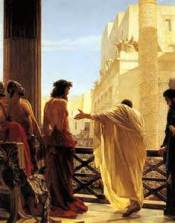
 Jesus and Pilate

Feast of Christ the King

Gospel John 18:33b-37

Pilate said to Jesus, “Are you the King of the Jews?” Jesus answered, “Do you say this on your own or have others told you about me?” Pilate answered, “I am not a Jew, am I? Your own nation and the chief priests handed you over to me. What have you done?” Jesus answered, “My kingdom does not belong to this world. If my kingdom did belong to this world, my attendants would be fighting to keep me from being handed over to the Jews. But as it is, my kingdom is not here.” So Pilate said to him, “Then you are a king?” Jesus answered, “You say I am a king. For this I was born and for this I came into the world, to testify to the truth. Everyone who belongs to the truth listens to my voice.”

Meditation Reflection:

Christ’s humble form in the Eucharist and His life of material poverty can sometimes cause us to forget the magnitude of His greatness and the awe-inspiring power and glory of His kingship. Advent marks the beginning of the New Year for the liturgy. As a result, the week prior marks the end of the year and so we reflect on the end of time when Christ will come again to reign in glory. Scripture attests to the fact that His Second Coming will be very different than His first. In the latter His glory was veiled so that we might have the freedom to accept or reject Him. In the former, everyone will see and know that He is God. The Truth will be revealed and we will no longer be able to live in unreality.

Pontius Pilate articulates this confusion well. He simply asks Jesus if He is the king of the Jews but Jesus describes His kingdom in terms foreign to Pilate’s political experience. Jesus’ kingdom includes those who love and live by Truth. Christ’s kingdom conquers hearts not lands and its members become citizens of this monarchy freely. Pilate asks the famous question “What is truth?” as Truth stands directly before him. At Christ’s Second Coming, no one will ask this question. Reality will be so bright that we cannot hide in blindness or denial.

For those who love Christ, who have been desiring to see in fullness the Lord they can only see by faith, it will be a glorious moment. When our king comes we will truly rejoice and feel both honored and unworthy to be His servants. We will sing songs of praise like those in the book of Revelation, grateful to be in His courts. For those who rely on lies or a self-created image they will cringe when the truth of their emptiness is exposed. The feast of Christ the King should encourage us and strengthen our hope to persevere in aligning ourselves with God who is Truth, Goodness, and Love. It seems unreal to the worldly but the reality check will come and Christ will reward those who know the Truth. In response to the culture of relativism the Christian can respond: You have your truth and I have mine…His name is Jesus.

Consider:

  • Reflect on Jesus’ words to Pilate: “You say I am a king. For this I was born and for this I came into the world, to testify to the truth. Everyone who belongs to the truth listens to my voice. “Who do you listen to when discerning the answers to important questions?
  • Do you consult Scripture, Christian spiritual writers, your priest, etc.?
  • Is there someone you know that loves you enough to speak Christ’s Truth to you despite whether it is something you want to hear or not?
  • Do you ask Christ in prayer?
  • Do you rely on cultural norms to determine your perspective?
  • Do media or secular friends play a role in your decision making?
  • Our culture is permeated by relativism – the belief that there is no objective truth. Do you believe that Truth is objective – the Person of Christ – or do you adhere to the cultural mantra “you have your truth and I have my truth”?
  • Imagine Jesus coming in all of His glory with His hosts of angels. Consider what it would feel like to be in His Kingdom.

Make a Resolution (Practical Application):

  • Pray for Christ’s kingdom to come in your own heart each day this week.
  • Start each day imagining the Second Coming of Christ. Walk through the rest of the day with joy and pride of being a member of His true, everlasting kingdom.
  • If you are blessed with a Truth-speaker in your life, take the time to thank him or her. They could probably use your encouragement. We know how Truth was treated while He was on earth.
  • If you struggle to understand or align yourself with one of Christ’s teachings in Scripture or through His Church, actively seek understanding by learning more through reading, talking with someone educated on the topic, praying about it, etc.

~ Written by Angela Lambert © 2015; edited and reposted © 2018

* To receive these weekly posts automatically in your email just click the “follow” tab in the bottom right hand corner and enter your email address.

The Simple Truth – Love

Love alone counts

by Angela (Lambert) Jendro

 November 3rd, 2018 31st Sunday in Ordinary Time

Gospel of Mark 12:28B-34 NAB

One of the scribes came to Jesus and asked him, “Which is the first of all the commandments?” Jesus replied, “The first is this: Hear, O Israel! The Lord our God is Lord alone! You shall love the Lord your God with all your heart, with all your soul, with all your mind, and with all your strength. The second is this: You shall love your neighbor as yourself. There is no other commandment greater than these.” The scribe said to him, “Well said, teacher. You are right in saying, ‘He is One and there is no other than he.’ And ‘to love him with all your heart, with all your understanding, with all your strength, and to love your neighbor as yourself’ is worth more than all burnt offerings and sacrifices.” And when Jesus saw that he answered with understanding, he said to him, “You are not far from the kingdom of God.”  And no one dared to ask him any more questions.

Meditation Reflection:

A couple of weeks into the school year, a new student of mine stopped by my room after the bell and asked, “How does a person become a saint?”.  As a religion teacher, my first thought went to if she was asking about the process of being canonized, but I stopped, thinking maybe she means on a more spiritual level – like the process of detachment from the world or the three stages of the spiritual life, then I stopped again as my mind jumped to other possibilities for the source of her question until I quit guessing in my mind altogether and simply said, “Why do you ask?  What is it you want to know?”

The Holy Spirit must have prompted me to ask instead of assume, because I never could have anticipated the beauty and simplicity of her answer.  In all sincerity, and with a beaming sweet smile on her face, she replied “because I want to be one!” “Ah” I said, “then it’s simple, love God with all your heart.”  “Really?!” she asked.  “Yep,” I said, that’s it.”

God, the Blessed Trinity, is a union of 3 Persons – Father, Son, and Holy Spirit.  He created human persons in His image as a union of persons in relationship of love with Him and with each other.  When we love God, we can’t help but love our neighbor whom we see as God’s image on earth and our brother or sister in Christ.

The answer is simple.  Jesus’ answer was simple.  It was the same command God had given in Deuteronomy over a thousand years before, and the mission He had given Adam and Eve at their creation.

We are the ones who make sainthood difficult.  We turn our eyes from the Beauty of God and prefer baser pleasures instead.  Because of our wounded nature, we worry that obedience to God will somehow restrict our freedom and deter us from our full potential.  This same self-assertion applies to our neighbor whom we view in light of our own pleasure or gain.  If he or she will add happiness or pleasure, we love them.  Otherwise, we tend to suspect them, like jealous siblings, worried that they will steal something from us, compete for the same resources and attention, or annoy us.

Thankfully, as we mature spiritually, we grow out of these childish concerns.  We understand that our Heavenly Father sets us high upon the rock in safety (Ps 27:5) fills our cup to overflowing (Ps 23), corrects the ones He loves as a Father does for His child (Proverbs3:12), and offers true freedom (John 8:32).  We also grow into a more adult relationship with our brothers and sisters in the Lord, realizing they are not a burden but a blessing. Moreover, filled with God’s love it necessarily overflows to others (cf 1 John 4:7)

Loving God means taking time for Him, in prayer and Scripture.  It means learning more about Him and deepening our understanding of His self-revelation.  It’s also the “simple raising of the heart and mind toward God” (CCC par. 2559) and the desires of love from deep within the soul.

As St. Therese of Lisieux, the Little Flower, put it:

“For me, prayer is a surge of the heart; it is a simple look turned toward heaven, it is a cry of recognition and of love, embracing both trial and joy”

The Christian disciple follows the example of Christ, who modelled and taught the way of Love – prayer and sacrificial works of mercy. His prayer life was so deep, His disciples asked Him to teach them how to pray, upon which He gave them the Our Father.  His merciful actions were so numerous John states at the end of His Gospel that if everything He did was written down, the whole world could not contain it (John 21:25).

Everyone searches for the key to happiness.  It’s simple, Love the Lord with all your heart:

“Find your delight in the Lord, and He will give you your heart’s desire” (Psalm 37:4)

 Consider:

  • Ask God for the grace to love Him with all your heart, soul, mind, and strength and to love your neighbor as Christ as loved you.
  • Reflect on Psalm 27:4 “One thing I ask of the LORD; this I seek: To dwell in the LORD’s house all the days of my life, To gaze on the LORD’s beauty, to visit his temple.”
  •  Imagine the people in your life – at work, in your neighborhood, driving on the highway, etc. – as your brother and sister.  What prayer might you have for them if they were family?  How might you see them more personally and with more compassion?
  • Consider this passage from St. Catherine of Siena’s Dialogue which describes how our hearts can be taken up, and on fire, with love for God. It is written from the perspective of God the Father speaking to her:
     No virtue can have life in it except from charity (love), and charity is nursed and mothered by humility.  You will find humility in the knowledge of yourself when you see that even your own existence comes not from yourself but from Me, for I loved you before you came into being.  And in My unspeakable love for you I willed to create you anew in grace.  So I washed you and made you a new creation in the blood that My only-begotten Son poured out with such burning love.

     This blood gives you knowledge of the truth when knowledge of yourself leads you to shed the cloud of selfish love.  There is no other way to know the truth.  In so knowing Me the soul catches fire with unspeakable love…”

Make a Resolution (Practical Application):

  • What sets your heart on fire with love for God?  Do that every day this week.
  • Pray one psalm a day, one chapter of a Gospel, or one chapter of Acts of the Apostles each day.
  • Choose someone from your daily life and imagine them as your brother or sister.  Pray for them by name and do something kind for them.

~ Written by Angela Jendro © 2018

* To receive these weekly posts automatically in your email just click the “follow” tab in the bottom right hand corner and enter your email address.


The Courage to Transcend Mediocrity…Gospel Meditation for Mark 10:17-30 for 28th Sunday

by Angela Lambert

Jesus and the Rich man

Gospel of Mark 10:17-30 NAB

As Jesus was setting out on a journey, a man ran up, knelt down before him, and asked him, “Good teacher, what must I do to inherit eternal life?” Jesus answered him, “Why do you call me good? No one is good but God alone. You know the commandments: You shall not kill; you shall not commit adultery; you shall not steal; you shall not bear false witness; you shall not defraud; honor your father and your mother.” He replied and said to him, “Teacher, all of these I have observed from my youth.” Jesus, looking at him, loved him and said to him, “You are lacking in one thing. Go, sell what you have, and give to the poor and you will have treasure in heaven; then come, follow me.” At that statement his face fell, and he went away sad, for he had many possessions. Jesus looked around and said to his disciples, “How hard it is for those who have wealth to enter the kingdom of God!” The disciples were amazed at his words. So Jesus again said to them in reply, “Children, how hard it is to enter the kingdom of God! It is easier for a camel to pass through the eye of a needle than for one who is rich to enter the kingdom of God.” They were exceedingly astonished and said among themselves, “Then who can be saved?” Jesus looked at them and said, “For human beings it is impossible, but not for God. All things are possible for God.” Peter began to say to him, “We have given up everything and followed you.” Jesus said, “Amen, I say to you, there is no one who has given up house or brothers or sisters or mother or father or children or lands for my sake and for the sake of the gospel who will not receive a hundred times more now in this present age: houses and brothers and sisters and mothers and children and lands, with persecutions, and eternal life in the age to come.”

Meditation Reflection:

Jesus is about to leave when the young man comes running to Him. The question must have been burning on his heart and he knew he had to get to Jesus and ask Him before He left. In every human soul, the question of eternal life singes until satisfied.

In his work, Pensees, the philosopher Pascal observed that we fill our lives with distractions just to avoid this very question. When we are quiet or alone, it surges up and must be dealt with. We realize the feebleness of our nature and our true vulnerability. We are then faced with the clear decision that either there is no God in which case I can live as I want but my life is meaningless, or there is a God and I can live forever but I must acknowledge His authority and live by His precepts.

Many of us make something of an effort. Like the rich young man, many of us modern religious persons live comfortable and fairly moral lives. We follow God’s rules while we pursue the average American dream. Yet, our hearts still burn for more. Thankfully, the man in the passage pushes Jesus on the issue. Jesus affirms that the man has done the minimum requirement for eternal life. So why isn’t he satisfied? This is why “Jesus, looking at him, loved him.” The man had opened his heart with a listening ear, courageous enough to seek out the answer rather than bury the discomfort. He asked Jesus that challenging question I have suggested in past posts – “Lord show me my blind spot.” And Jesus does, out of love.

Christ calls us beyond the minimum.

“You, therefore, must be perfect, as your heavenly Father is perfect” (Matthew 5:48)

The philosophical and theological definition of “perfect” is “full or complete.” This is why He tells the man he is “lacking” one thing only. Christ, God incarnate, is about to set out for a journey. He offers the man the opportunity to come follow Him. What a privilege! Yet to do this, he would have to leave everything behind – another fork in the road.

How many times do we turn down incredible opportunities to stay in our comfort zone?   We get sentimental or attached to any number of our possessions and it undermines our freedom to say yes to the gifts of Christ that come in the form of service opportunities, vocation, relationships, even careers we may end up finding more fulfilling but less lucrative. When we let fear, comfort, or greed hold even a small part of us back from God, we experience a nagging feeling of hunger because we are not quite full. It’s normal to feel this divided heart – a simultaneous desire for complete abandonment to God and the fullness of joy and peace that accompany it, and the safe visible comforts of a worldly success which give us a kind of safety net but leave us feeling a bit cowardly.

I appreciate that Jesus says it’s impossible for us to make this leap by human effort alone because it speaks to my own experience. Rather than being discouraged by my own failure, I find hope in Jesus’ words that “all is possible for God.” The difference between the Old and New Covenant, is that in the first God gave His saving truth but in the second He gave us the grace to live by that truth. The young man in this passage encountered Christ and saw His gaze of love. May we too be blessed to see this gaze of love for us and say yes to perfect fullness. It’s okay if we leave feeling sad. It’s difficult to give up attachments. We don’t actually know if the man in this passage is sad because he won’t give up his possessions or because he will. The important thing is that we respond to grace, confident in Christ’s promise that our “sadness will be turned to joy” (John 16:20).

Consider:

  • Do you avoid solitude or quiet? Do you have a nagging feeling inside? Do you know why? With the help of Christ, consider honestly what fears, comforts, or ambitions hold you back from following Him with complete freedom and abandonment.
  • When did you make a sacrifice for Christ that turned out to be a terrific blessing? What held you back at first? How did you overcome those inhibitions? How did Christ exceed your expectations?
    • (for example: when I personally felt called by Christ to stay home with my children I found it hard to leave my job and the feeling of achievement. However, I came to experience freedom from taking my identity in accomplishments and a fullness of love in my heart I had never imagined. When my kids were school aged and Christ called me back to teaching, I found it difficult to transition again. However, I have a richer experience at work than before because now it’s more fully in union with Christ and I am less pulled by earlier attachments. It has also enriched my relationship with my kids as God has purified me of attachments I had grown while at home with them.)

Make a Resolution (Practical Application):

  • Christ challenges that possessions hold us back. Give away a possession this week.
  • Choose one fear, comfort, or ambition that is holding you back from following Christ’s lead completely. Practice the opposite virtue and do concrete actions to detach yourself. Be sure to pray and ask for grace. You will need Christ to help. Talk with a Christian who knows and cares about you so they can offer ideas and perspective.
  • Thank God for His grace in your life. Make a list of His gifts and of all the fears He has already freed you from up to now.
  • If God’s providence creates the opportunity, have the courage and humility to encourage someone else with your witness about how God freed and fulfilled you.

~ Written by Angela (Lambert) Jendro © 2015

To receive these weekly posts automatically in your email just click the “follow” tab in the bottom right hand corner and enter your email address.


To Serve is to Reign…Gospel Meditation for Mark 9:30-37

by Angela Jendro

pope-francis-hugging-disabled-childpope-selfie

25th  Sunday in Ordinary Time

Gospel of Mark 9:30-37 NAB

Jesus and his disciples left from there and began a journey through Galilee, but he did not wish anyone to know about it. He was teaching his disciples and telling them, “The Son of Man is to be handed over to men and they will kill him, and three days after his death the Son of Man will rise.” But they did not understand the saying, and they were afraid to question him. They came to Capernaum and, once inside the house, he began to ask them, “What were you arguing about on the way?” But they remained silent. They had been discussing among themselves on the way who was the greatest. Then he sat down, called the Twelve, and said to them, “If anyone wishes to be first, he shall be the last of all and the servant of all.” Taking a child, he placed it in the their midst, and putting his arms around it, he said to them, “Whoever receives one child such as this in my name, receives me; and whoever receives me, receives not me but the One who sent me.”

Meditation Reflection:

This week, a student of mine asked me why a woman cannot be the pope. This question, and its underlying one – why a woman can’t be a priest, gets asked every year. I myself wrestled with this question when I was in college. I’m glad I pursued the answered because there are beautiful theological reasons. Oftentimes however, what we are really asking is why a woman can’t hold what seems to be the highest and most powerful position in the Church. This seems sexist, unfair, and therefore not Christ-like. The apostles in today’s passage viewed leadership in Christ’s kingdom in a similar way. They were arguing along the way about who would have the highest position, the most power and prestige. If Christ’s kingdom resembled worldly kingdoms that would have been an appropriate question. Jesus corrects them in a pointed way. As God says in Isaiah 55:8 “‘For My thoughts are not your thoughts, nor are your ways My ways.” Jesus had just taught the apostles that the Son of Man, the Messiah, would have to suffer and be killed. Rather than considering that they might be called to follow in His footsteps they wonder who will take leadership afterward. Jesus clarifies what He means by His kingdom. His words would have been surprising to the apostles and they are still surprising to us today.

It’s hard to truly believe Jesus when He teaches that “Whoever receives one child such as this in my name, receives me; and whoever receives me, receives not me but the One who sent me.” We would rather believe that discipleship means visible worldly greatness. The world looks at the papacy and sees position and power. However, beginning with Pope Gregory the Great in the 6th century, the title the pope has used for himself has been “the servant of the servants of God.” Discipleship of Christ means following the path of humility and self-sacrifice, the same path Christ took. What can be more humble and self-sacrificing than caring for a small child, especially if you are its mother or father? This path of humility is open to all with equal opportunity. Some might even say that women have an unequal and greater opportunity since we alone have the ability to carry in our wombs new life at its most vulnerable stage.

Every Christian can become a saint if he or she cooperates with the grace of Christ. The Second Vatican Council used the phrase “the universal call to holiness” to describe the doctrine that God desires everyone to have perfect union with Him. The opportunity is equal, it’s or response which is unequal. Teresa of Avila said that what prevents individuals from experiencing greater depths of prayer and union with God is a lack of generosity, courage, and humility.

I wasn’t asked by Christ to be pope, but I was asked to be a mother and a teacher. In the world’s eyes there is nothing notable about my position except that I maybe “wasted” some of my talents and opportunities that I could have used for wealth and power instead. My eyes are on a different prize though. I don’t want to be the one in power, I want to be Jesus’ disciple. All I ask is that He say to me one day, “Well done my good and faithful servant.” I may not be the servant of the servants of God, but I accept being the servant of those He “put His arm around” and placed in my care.

Consider:

  • Who has God placed in your care? How has this made you grow in humility?
  • When do you feel tempted by worldly prestige?
  • Consider how you prioritize your life. How might Christ re-order your priorities? Ask for His help and grace.

Make a Resolution (Practical Application):

  • Write out your priorities – look at where you spend your time and money. Pray about it each day this week and ask Christ to show you where you are doing well and where you need to change.
  • Pope Francis visited the U.S. for the world meeting of families. Read one of his speeches or homilies from when he was here. Consider how he shares Christ’s values as it pertains to family and discipleship. [A couple of my favorite sources: vatican.va (vatican website) and zenit.org (Catholic news agency)]

~ Written by Angela (Lambert) Jendro © 2015; updated  © 2018

* These Sunday meditations are intended to engage the heart and imagination in prayer and include a practical application (resolutions) to your daily life. In our presentation on prayer I offer a more detailed discussion of ways to pray with Scripture that can take 5 minutes, 15 minutes, or half an hour and vary in depth depending on your time-frame and prayer goals.  


Hard but Satisfying Work…Gospel Meditation John 6:24-35

by Angela Jendro
Fra_Angelico_coronation of Mary

Fra Angelico – Coronation of Mary

August 5th, 2018; 18th Sunday in Ordinary Time

(updated and edited from post August 2nd, 2015)

Gospel of John 6: 24-35 NAB

When the crowd saw that neither Jesus nor his disciples were there, they themselves got into boats and came to Capernaum looking for Jesus. And when they found him across the sea they said to him, “Rabbi, when did you get here?” Jesus answered them and said, “Amen, amen, I say to you, you are looking for me not because you saw signs but because you ate the loaves and were filled. Do not work for food that perishes but for the food that endures for eternal life, which the Son of Man will give you. For on him the Father, God, has set his seal.” So they said to him, “What can we do to accomplish the works of God?” Jesus answered and said to them, “This is the work of God, that you believe in the one he sent.” So they said to him, “What sign can you do, that we may see and believe in you? What can you do? Our ancestors ate manna in the desert, as it is written: He gave them bread from heaven to eat.” So Jesus said to them, “Amen, amen, I say to you, it was not Moses who gave the bread from heaven; my Father gives you the true bread from heaven. For the bread of God is that which comes down from heaven and gives life to the world.” So they said to him, “Sir, give us this bread always.” Jesus said to them, “I am the bread of life; whoever comes to me will never hunger, and whoever believes in me will never thirst.”

Meditation Reflection:

Jesus instructs us to “work for the food that endures for eternal life.” The people responded wisely  by asking a follow up question, which in modern language could be phrased “tell us the job description.” The task seems simple enough – “believe in the one God sent.”

How is believing in Christ work though? If believing in Christ were merely an intellectual assent then it wouldn’t be much work at all. However, believing in Christ means believing He is the Savior sent to transform our hearts and lives. This requires not merely an assent of the intellect, but the arduous work of aligning our will with His, and allowing Him to change our lives. Consider the life changing “yes” of Mary, Joseph, the Apostles, all the saints, and the transformation in lives of people you know who have accepted Christ and follow Him intentionally.

In his famous book, What’s Wrong with the World, G.K. Chesterton astutely states the reason why so many people forsake believing in Christ and the reward that comes with it. He writes,

“The Christian ideal has not been tried and found wanting; it has been found difficult and left untried.”

Jesus does not say “I am the bread of life who will force feed you”. Rather, He states that those who come to Him will never hunger. Still, you may ask, how hard is it to come to Christ? Well, how hard is it to make it to Mass every Sunday? How difficult is it to attend one or more daily masses a week? How hard is it to find 30 minutes to pray with Scripture? How hard is it to listen, with your full attention, to your child, spouse, or friend in need? How difficult is it to turn to Christ in prayer when you are feeling anxious, frustrated, or angry rather than escaping through t.v., drinking, or shopping?

Coming to Christ and believing in Him is work, but like any job it gets easier as you get the hang of it. Imagine the career satisfaction you could experience in a job with that kind of reward. We all want happiness and we go to great lengths to achieve it. Christ promises that if we are wise enough to put all of our efforts toward relationship with Him, we will be guaranteed an abiding happiness we can find nowhere else.

Consider:

  • In your daily life, what is the biggest challenge to seeking Christ?
  • What do you hunger for most? How do you try to fill that hunger? How long does it last before feeling hungry again?
  • When was a time you experienced delight, satisfaction, peace, or happiness from God?

Make a Resolution (Practical Application):

  • Choose one way to come to Christ this week that has been difficult in the past. (wake up 30 minutes early to pray, spend 10 minutes with each of your kids, download a bible app to your phone, attend a daily Mass, make a holy hour at adoration)
  • Start a gratitude journal for God’s gifts to you each day. Before bed think back on your day and identify God’s grace at work in your heart and life.
  • The next time you feel anxious, frustrated, or angry, stop and sit in silence with God for 5 minutes. Find a quiet spot (even if it’s your car or bedroom), set a timer, and just turn your heart and ears toward God. Gently push away distractions and be in God’s presence. Let Christ fill your hunger and soothe your thirst.

~ Written by Angela Jendro © 2018


It’s Not Magic, but it is Supernatural

by Angela (Lambert) Jendro


July 1st, 2018 13th Sunday in Ordinary Time

Gospel of Mark 5:21-43 NAB

When Jesus had crossed again in the boat to the other side, a large crowd gathered around him, and he stayed close to the sea. One of the synagogue officials, named Jairus, came forward. Seeing him he fell at his feet and pleaded earnestly with him, saying, “My daughter is at the point of death. Please, come lay your hands on her that she may get well and live.” He went off with him, and a large crowd followed him and pressed upon him.

There was a woman afflicted with hemorrhages for twelve years. She had suffered greatly at the hands of many doctors and had spent all that she had. Yet she was not helped but only grew worse. She had heard about Jesus and came up behind him in the crowd and touched his cloak. She said, “If I but touch his clothes, I shall be cured.” Immediately her flow of blood dried up. She felt in her body that she was healed of her affliction. Jesus, aware at once that power had gone out from him, turned around in the crowd and asked, “Who has touched my clothes?” But his disciples said to Jesus, “You see how the crowd is pressing upon you, and yet you ask, ‘Who touched me?'” And he looked around to see who had done it. The woman, realizing what had happened to her, approached in fear and trembling. She fell down before Jesus and told him the whole truth. He said to her, “Daughter, your faith has saved you. Go in peace and be cured of your affliction.”

While he was still speaking, people from the synagogue official’s house arrived and said, “Your daughter has died; why trouble the teacher any longer?” Disregarding the message that was reported, Jesus said to the synagogue official, “Do not be afraid; just have faith.” He did not allow anyone to accompany him inside except Peter, James, and John, the brother of James. When they arrived at the house of the synagogue official, he caught sight of a commotion, people weeping and wailing loudly. So he went in and said to them, “Why this commotion and weeping? The child is not dead but asleep.” And they ridiculed him. Then he put them all out. He took along the child’s father and mother and those who were with him and entered the room where the child was. He took the child by the hand and said to her, “Talitha koum,”which means, “Little girl, I say to you, arise!” The girl, a child of twelve, arose immediately and walked around. At that they were utterly astounded. He gave strict orders that no one should know this and said that she should be given something to eat.

Meditation Reflection:

The Scriptures today confront our anger at God for death and suffering.  Wisdom 1:13-14 (RSV) however reminds us however that neither of these came from Him:

“God did not make death, and He does not delight in the death of the living.  For He created all things that they might exist.” 

When we read the Creation account in Genesis 1 and 2, nowhere do we find disease, suffering, or death.  Rather, God’s creation reflected His glory and so He commanded all the living things that He made to “be fruitful and multiply.”

Death entered not through God, but through sin.  Satan and the fallen angels sinned against God and chose an eternity of suffering for the sake of prideful rebellion over an eternity of joy at the cost of humble obedience.  Adam and Eve did not experience suffering or death until they joined Satan in sin and disobeyed God as well.  In consequence, Genesis 3-9 relay the sad story of the proliferation of sin and suffering beginning with this first Original Sin.  Toil, pain in childbirth, marital struggles, sibling rivalry, murder, polygamy, sickness, and death each begin with the decision to sin by the free will of individuals.  As much as we want to blame God, the truth is most of our suffering stems from our own poor choices or the choices of others.

Sure, you might say, we’re at fault but can’t God do anything about it?  Why does He sit back in silence?  Doesn’t He care?

YES!  From the beginning, God offered a merciful helping hand to sinful humanity.  When Adam and Eve realized they were naked, He gave them clothes.  When He confronted them about the consequences of their sins He also promised to one day send a Savior (Genesis 3:15).  He made covenants with Noah, Abraham, Moses, David, and so on.  Finally, His only begotten Son left the glory of Heaven to take on a lowly human nature, freely divesting Himself of His divine power to live the life of a creature so as to carry our Cross and personally meet us in our need.   St. Paul describes it well in 2 Corinthians 8:9 (RSV):

“For you know the grace of our Lord Jesus Christ, that though He was rich, yet for your sake He became poor, so that by His poverty you might become rich.”

God literally has some skin in the game.  Not only does He offer healing, in today’s Gospel we see how much He cares when He heals.  He accompanies the grief-stricken father to attend to the dying little girl.  When He enters the room He doesn’t want people gawking or treating it like magic.  Instead Jesus sends everyone out but the parents and a few of His apostles.  When Jesus heals it’s a personal encounter.  Jesus understands our pain and our needs because He lived it.  Being man, He has shared our experience.  Being God, He has the power to re-create us and restore us with a Word.  By His divine power, Jesus commanded the girl to get up, thereby empowering her to do so. “Little girl, I say to you, arise.” From His human experience, He commands the little group with Him to give her something to eat.  What a great little detail!  I imagine her family and the apostles were just standing there in shock when she came back to life.  Jesus moves on to the practical need at hand – after getting well from a long sickness a person is ravishingly hungry.  Therefore He instructed them not to talk about it but instead to give her something to eat.

This encounter with the grieving father and dying girl has all the drama of a great script.  Except, a fiction writer would not have interrupted the momentum with the seemingly tangential account of the woman with a hemorrhage – an encounter with competing drama that would be a distraction to a story.  But, this is not a fictional story, this is real life.    I learned early on as a mom that once you have kids you can say goodbye to uninterrupted focus on any task.  Nothing, not even dishes, can be completed without interruption.  Even now, although my kids are teens, I was interrupted yesterday by all three texting and calling and needing something even though I had said I was travelling for a few hours and would have spotty cell service.  I recall one time in particular that illustrates the mulit-tasking of relational living.  At the time my kids were little.  I was driving home from visiting my dad and my brother caught a ride with me.  As we were talking in the front seat kids asked for snacks, water, help with the dvd, and so on.  I just kept talking, driving, and handing things back or fixing the dvd player with one hand, all while keeping my eyes on the road.  My brother just stopped and laughed and said, “how are you doing this?”.  With my first child I was a rookie for sure, but by three I had practice.

Jesus lived real life and cared for real people.  While helping one family, a woman reached out in faith and needed His help too.  People’s needs are rarely convenient, but love always makes time.  As God, Jesus could easily heal her as He walked along, somewhat like my brother’s astonishment as I tended to needs of three children while we travelled without taking my eyes off the road for even a second.  Here again however, Jesus underscores the relationship between faith, healing, and personal encounter with Him.  He’s not a magic wand or a machine. She was healed because of His power and her faith.  At the same time, He stopped what He was doing to pause and encounter her personally. In asking who touched Him, He invites her to not only receive His healing power, but to be received by Him personally.  He doesn’t want her to feel like a desperate beggar.  He gives her the opportunity to bravely step forward, and then affirms her for her faith and gives her His peace.  How many people must have avoided her for so many years due to her bleeding?  And here Jesus receives her and invites her back into communion with God and with society.

We live in a culture that wants a quick fix with a pill to remedy any ailment.  Thankfully, we live in a time when medicine has produced a pill to fix a myriad of things.  However, some things cannot be alleviated so simply.  Christianity is not a pill that will make you instantly happy and take away all of your problems.  It is however a personal encounter with Christ, Who is both God and man and cares for you.  Suffering and death come from sin.  Life and joy come from God.  Faith does heal.  Sometimes He heals in a moment, other times it takes years of relationship with Him to allow His work to fully take root in our souls.  The Gospel affirms that no matter how dire the situation, Jesus will answer.  We only need to ask in prayer or to reach out to Him and touch Him.   Be prepared though.  After suffering for so long, health can seem foreign.  When Jesus commands you to arise and be at peace, you must leave your sickness behind and live as a new creation.

Consider:

  • Spend some time in silence, reaching out to Christ like the father of the little girl or the woman with the hemorrhage. Bring your troubles and worries to God…be humble like the woman to admit you need help.

Make a Resolution (Practical Application):

  • Set a reminder on your phone or with sticky notes to pause throughout the day and encounter Christ.  Bring your needs of the moment before Him, no matter how small, and offer Him thanks for His presence and help.

~ Written by Angela Jendro © 2018

* To receive these weekly posts automatically in your email just click the “follow” tab in the bottom right hand corner and enter your email address.


Patience

by Angela (Lambert) Jendro


June 24th, 2018 Feast of the Birth of St. John the Baptist

Gospel of Luke 1:57-66, 80 NAB

When the time arrived for Elizabeth to have her child she gave birth to a son. Her neighbors and relatives heard that the Lord had shown his great mercy toward her, and they rejoiced with her. When they came on the eighth day to circumcise the child, they were going to call him Zechariah after his father, but his mother said in reply, “No. He will be called John.” But they answered her, “There is no one among your relatives who has this name.” So they made signs, asking his father what he wished him to be called. He asked for a tablet and wrote, “John is his name,” and all were amazed. Immediately his mouth was opened, his tongue freed, and he spoke blessing God. Then fear came upon all their neighbors, and all these matters were discussed throughout the hill country of Judea. All who heard these things took them to heart, saying, “What, then, will this child be?” For surely the hand of the Lord was with him. The child grew and became strong in spirit, and he was in the desert until the day of his manifestation to Israel.

Meditation Reflection:

Gazing upon a newborn baby, we encounter the mystery of life as we wonder as St. John’s family did, “What then will this child be?”.  Babies are full of potential, their lives completely ahead of them.  Teens and adults grapple with the question again, “What will I do with my life?”  Many of the joys and sorrows of parents correspond to what unfolds as the answer.

Waiting to see requires patience.  Children grow year by year, one stage at a time.  Their personality and character develop and blossom organically.  Discovering God’s plan means patiently waiting, hoping, and praying.

God too is patient.  He cares for us always, at every moment.  From the creation of Adam and Eve, to the Incarnation of His Son, to the end of time – God patiently guides the unfolding of human history in the lives of each individual, each of which are His sons and daughters. Moreover, He guides Salvation history, by which He redeems and heals mankind from the original sin of the Fall and every personal sin committed by individuals thereafter.

Every day since Adam and Eve first turned away from Him by sin, God has faithfully and steadfastly lead us toward salvation.  In His mercy He pours out His grace upon us.  Even when we rebel, and turn away, He waits patiently for our return.  Of course, God is everywhere so we can’t leave Him physically, but we can leave Him spiritually.  Thus, returning to God means a turning of heart – repentance.  God is far more patient than we are. We want everything immediately, at the least by two days or less with free shipping!  God’s work however can take days, weeks, years, decades, and even a lifetime.

St. John the Baptist was the last of the prophets and the precursor to Christ.  His birth was indeed special.  His family waited years to see his role in God’s plan, but the Jewish people had waited hundreds of years for his day, and humanity thousands of years.  John the Baptist proclaimed with fervor God’s faithfulness.  He announced the coming of the Lamb of God Who would take away our sin.  Thus, God kept His promise to save mankind by sending His only Son.  We need only do our part to receive that salvation, as John the Baptist zealously repeated and Jesus exhorted – repent and believe.

Consider:

  • God has a plan for you and for your life.  Pray for patience and openness to the Holy Spirit as it unfolds daily.
  • Is there anything for which you are impatient right now?  Have you complained to God, demanding your prayer to be answered in two days or less like Amazon?
  • Consider God’s faithfulness in your life.  Take a moment to recall His blessings today, this week, this year, and over your lifetime.
  • Imagine your family asking in amazement after your birth “What, then, will this child be?”.  Consider the wonderful things, with God’s help, that you have done with your life so far.  Consider what you might do with the Lord in your life today and into the future also.  How might you become more loving and Christ-like toward others and make an impact in their lives?

Make a Resolution (Practical Application):

  • Intentionally offer each day to the Lord in prayer.  At the close of the day, reflect back on the good you were able to do with God’s grace, and for the moments you failed pray that you might be more receptive to His guidance tomorrow.


~ Written by Angela Jendro © 2018

* To receive these weekly posts automatically in your email just click the “follow” tab in the bottom right hand corner and enter your email address.


Blood Relatives

by Angela (Lambert) Jendro


June 3rd, 2018 4th Feast of the Most Holy Body and Blood of Christ

Gospel of Mark 14:12-16, 22-26 NAB

On the first day of the Feast of Unleavened Bread, when they sacrificed the Passover lamb, Jesus’ disciples said to him, “Where do you want us to go and prepare for you to eat the Passover?” He sent two of his disciples and said to them, “Go into the city and a man will meet you, carrying a jar of water. Follow him. Wherever he enters, say to the master of the house, ‘The Teacher says, “Where is my guest room where I may eat the Passover with my disciples?”‘ Then he will show you a large upper room furnished and ready. Make the preparations for us there.” The disciples then went off, entered the city, and found it just as he had told them; and they prepared the Passover. While they were eating, he took bread, said the blessing, broke it, gave it to them, and said, “Take it; this is my body.” Then he took a cup, gave thanks, and gave it to them, and they all drank from it. He said to them, “This is my blood of the covenant, which will be shed for many. Amen, I say to you, I shall not drink again the fruit of the vine until the day when I drink it new in the kingdom of God.” Then, after singing a hymn, they went out to the Mount of Olives.

Meditation Reflection:

At the Mount of Olives, on the night before His death, Jesus prayed in the Garden of Gethsemane.  His final prayer to the Father begged for us to be one in Jesus, as Jesus is one with the Father. Considering the sublime and mysterious unity of the Blessed Trinity, what a profound request!   Christ invites us into their eternal bond of love and union of mind and will, and He asks the Father to make it possible.

“I pray not only for them, but also for those who will believe in me through their word, so that they may all be one, as you, Father, are in me and I in you, that they also may be in us, that the world may believe that you sent me. And I have given them the glory you gave me, so that they may be one, as we are one, I in them and you in me, that they may be brought to perfection as one, that the world may know that you sent me, and that you loved them even as you loved me. John 17:20-23 NAB

 Jesus asserts that He gave us His glory that we might be one with Him, and therefore also one with the Father.  How did He do this?  What does He mean?

The Eucharist.  Jesus had just given His apostles His Eucharistic Body, Blood, Soul, and Divinity.  Every time we receive Christ in the Eucharist, we become one in Him, sharers in His glory.

When we eat regular bread and wine our bodies digest them into smaller component parts so that the nutrients within can be absorbed by the cells for energy, growth, repair, etc.  Thus, after an hour or so, the toast you ate for breakfast is no longer toast but simply part of you.

In the Eucharist, the opposite process takes place.  Rather than being incorporated into our body, we become incorporated into Christ’s Body.  We become constituent parts which build up, energize, and repair and the Mystical Body of Christ – the Church.  Thus, our nutritional value (love of God and neighbor) edifies the whole body, and our toxins (sin) harm it.

In addition, think about our inherent investment in “blood relatives.”  We take pride in their accomplishments and feel shame in their failures, even if our physical ancestral connection is our only tie. Christ has made the family of the Church blood relatives through His own Body and Blood.  We take pride in the virtue of the Saints and feel deeply hurt and saddened when a Christian falls into a terrible sin like we’ve seen with the recent clergy abuse scandal.

In addition, knowing the genetic history of our blood relatives can be enlightening since their strengths are our strengths and their weaknesses our weaknesses.   Jesus became our blood relative at the Incarnation and willingly accepted the weakness of our human nature.  In return however, He bestowed on us something of the strength and glory of His divine nature.  When we receive Him in the Eucharist, we are strengthened by His Real Presence, by deeper union with His Body, Blood, Soul, and Divinity, we become grafted onto Him and elevated by His relation to us.

“But how can this be?” you might ask.  It’s a mystery.  We know it’s true because Jesus said “This is My Body, this is My Blood…”  and He promised, and warned, in John 6:51-53:

I am the living bread that came down from heaven; whoever eats this bread will live forever; and the bread that I will give is my flesh for the life of the world.” The Jews quarreled among themselves, saying, “How can this man give us [his] flesh to eat?” Jesus said to them, “Amen, amen, I say to you, unless you eat the flesh of the Son of Man and drink his blood, you do not have life within you.

Although certainly a sublime mystery, on what grounds can a Christian believer doubt that God Who created everything out of nothing couldn’t change bread and wine into His Real Presence?  Recall in Genesis that God created by speaking: “Then God said: Let there be light, and there was light. Genesis 1:3.  God created with a Word, and that Word of God is the Son – Jesus Christ.  In addition, if God could daily provide miraculous bread to feed the Israelites during their journey through the desert to the Promised Land, why wouldn’t He provide bread from Heaven for our even more difficult journey through the desert of temptations and suffering in this life on our journey to Heaven?

Today, on the Feast of the Body and Blood of Christ, we meditate on the unimaginable gift of love bestowed on us in the Eucharist by which we become one with Jesus, and through Him one with God and neighbor.

Consider:

  • Consider the special union of love in families which is both a physical and spiritual union.  Reflect on the union of love between Christ and His disciples physically and spiritually in the Eucharist.
  • Consider how you feel when you eat healthy foods and get enough rest.  How might receiving the Eucharist more often boost your spiritual energy and health as well?
  • Reflect on the humility and intimacy of Christ’s love for you.  He became man – sharing in your human nature, lived an earthly life for 33 years – sharing your experiences, and continues to be physically present to you in the Eucharist today where you can be near to Him in prayer and one with Him when you receive Him at Mass.
  • Consider how spending time with family can keep you grounded and more who you really are.  Reflect on how time with Christ purifies your perspective and grounds you as well.

Make a Resolution (Practical Application):

  • Arrive at Mass 5 minutes early to prepare your heart and mind for receiving Christ in the Eucharist, and/or stay for 5 minutes after Mass to pray and thank Christ for receiving Him in the Eucharist.
  • Spend 30 minutes with Christ in prayer at Eucharistic Adoration.

Related Posts:

~ Written by Angela Jendro © 2018

* To receive these weekly posts automatically in your email just click the “follow” tab in the bottom right hand corner and enter your email address.


Being Lifted Up With Christ By Serving With Christ

by Angela (Lambert) Jendro


May 13th, 2018 Ascension of the Lord and 7th Sunday of Easter

Gospel of Mark 16:15-20 NAB

Jesus said to his disciples: “Go into the whole world and proclaim the gospel to every creature. Whoever believes and is baptized will be saved; whoever does not believe will be condemned. These signs will accompany those who believe: in my name they will drive out demons, they will speak new languages. They will pick up serpents with their hands, and if they drink any deadly thing, it will not harm them. They will lay hands on the sick, and they will recover.” So, then the Lord Jesus, after he spoke to them, was taken up into heaven and took his seat at the right hand of God. But they went forth and preached everywhere, while the Lord worked with them and confirmed the word through accompanying signs.

Meditation Reflection:

Today as a Church we remember Christ’s Ascension into Heaven when He returned to His rightful glory.  Jesus our king had left the comfort and majesty of His throne, to battle sin and death for His subjects, which could only be accomplished as one of us.  He entered the war zone at the Incarnation. The Son of God Who is infinite in His divinity accepted the burden of the limitations our human nature.  In addition, as if human kingship wouldn’t already be a far cry from His experience as Divine king, He chose instead the most difficult circumstances in human society – poverty and social rejection.

Our king is someone Who walks among His people, rolls up His sleeves and works side by side with us in our most difficult struggles.  He doesn’t stand aloof but rather He invites us into His own glory.  When He became our Brother by human nature, He raised us to His brothers and sisters in His divinity.  Though we do not become God, we do participate in His divinity and our nature is elevated above its usual limitations.  How?  After His Ascension Jesus sent His Spirit Who dwells in the souls of all the baptized and enables them to share in the work of Christ and become His Mystical Body.

In addition to opening the gates of Heaven for us, Jesus modelled the way.  His glory began with His self-emptying (the fancy theological word for it is kenosis) and so our final glory requires this same emptying of self, service of others, and humble obedience to the Father’s will. St. Paul describes it beautifully in his letter to the Philippians:

“If there is any encouragement in Christ, any solace in love, any participation in the Spirit, any compassion and mercy, complete my joy by being of the same mind, with the same love, united in heart, thinking one thing. Do nothing out of selfishness or out of vainglory; rather, humbly regard others as more important than yourselves, each looking out not for his own interests, but [also] everyone for those of others.

 Have among yourselves the same attitude that is also yours in Christ Jesus, Who, though he was in the form of God, did not regard equality with God something to be grasped. Rather, he emptied himself, taking the form of a slave, coming in human likeness; and found human in appearance, he humbled himself, becoming obedient to death, even death on a cross. Because of this, God greatly exalted him and bestowed on him the name that is above every name, that at the name of Jesus every knee should bend, of those in heaven and on earth and under the earth, and every tongue confess that Jesus Christ is Lord, to the glory of God the Father.”  Philippians 2:1-11 NAB

Jesus took on the hardest and lowest jobs.  He was born in a barn, lived as a refugee in Egypt for the first years of His life, grew up with manual labor as His “career”, and walked wherever He travelled.  During the three years of His public ministry He faced rejection by His own townspeople who tried to throw Him off a cliff, the Pharisees and Sadducees plotted against Him even though He is the Word of God they supposedly protected, His own friends betrayed Him, and He died with an unjust conviction under false claims in the most humiliating and torturous way the Romans had contrived – naked on a Cross.  The night before His death, He prepared His apostles to reign in His stead by washing their feet – the most disgusting task which would traditionally be assigned to whomever was lowest on the totem pole – of the servants the slaves and of the slaves the foreign slaves.

So, who wants to reign with Christ? Doesn’t this sound fun?! If Christ’s life ended on the Cross, then NO.  Absolutely Not!  But it didn’t.  Because He humbled Himself, the Father exalted Him above every name and at His Name, every knee should bend.  Jesus rose from the dead and 40 days later He ascended to unmatched glory in Heaven.  He assures us that if we follow Him, the way will be hard, but it will culminate in unending joy.

“The greatest among you must be your servant. Whoever exalts himself will be humbled; but whoever humbles himself will be exalted.” Matthew 23: 11-12 NAB

Christian disciples share in the mystery of Jesus’ Royal Poverty.  Rather than looking side to side to see what everyone else is doing, we look up and down – up to Christ in glory and to His will, and down to where we might humbly serve.  If we keep our glance up and down, down and up, we will discover harmony within the tension of humble service and risen glory – the royal poverty that can only be found by abiding in the One who accomplished it – Jesus Christ.

So, let us wait in eager anticipation for the coming of the Holy Spirit on Pentecost (next Sunday).  He empowers us to serve and to reign, to obey and to be glorified.  He empowers us to love.  Love puts the beloved before oneself, and experiences joy at every sacrifice.  The Holy Spirit is the love of the Father and Son, and He pours their love into our hearts with such generosity that as it overflows all selfishness and pride pours over the edges with it.  The deepest happiness is love – both given and received.  We have received the greatest of loves from Christ our Lord and Brother and His Spirit gifts us with the same love for Christ and our fellow brothers and sisters in Him.

Consider:

  • Meditate on the love of Christ who desired to become your Brother.  What does it mean to be a brother? What does it mean to be His brother or sister in return?
  • Today is Mother’s Day.  Consider the Christ-like love of motherhood: sacrifice of one’s bodily comfort, unconditional and personal love, the acceptance of humble tasks like changing diapers, the intercession for her children with relentless prayers. Consider your own mother’s love expressed in humble service toward you.  Offer a prayer of thanksgiving and blessing for her.
  • Ask Christ how you might empty yourself more.  To what are you still attached? What holds you back from following Him?  What task feels too low to take up, or what feels too good to give up?
  • Pray for greater faith and hope.  Humbling ourselves is a tremendous risk.  We live in a competitive culture of self-assertion.  If we don’t exalt ourselves, we will be overrun if God doesn’t exalt us.  Pray for the grace to step out in faith that we need only humble ourselves, and God will take care of the exalting.
  • How much do you look side to side – comparing yourself to others or the standards of the world?  How might you look up and down more in those situations?

Make a Resolution (Practical Application):

  • Each day this week acknowledge someone’s humble, loving service and thank them.
  • Each day look up in prayer, then down for an opportunity to serve, then offer that service back up to the Lord as a sacrifice of praise or intercession for someone.  Try to do it in the morning, midday, and evening.  Even every hour if you can.

Related Posts:


~ Written by Angela Jendro © 2018

* To receive these weekly posts automatically in your email just click the “follow” tab in the bottom right hand corner and enter your email address.