| by Angela Jendro |

30th Sunday in Ordinary Time
Gospel of Luke 18:9-14 NAB
Meditation Reflection:
When we reach out to Christ in our crises, needing a savior, we experience the reality of His saving grace along with the reality of our own weakness. Together, these produce humility in the soul, a recognition of our dependence on God and His graciousness. Unfortunately, over time fallen human nature tends to forget the extent of God’s help and exaggerates its own abilities. Likewise, together, these produce pride in the soul, a false conviction of our own independence.
In the Old Testament, we can find account after account of this cycle with the People of God. It looks something like this:
- They love and obey God and things are going well.
- As things go well they begin to attribute it to themselves and grow lax in their fidelity to God.
- God warns them to turn back to Him and His help, otherwise on their own they will suffer defeat at the hands of an enemy.
- They ignore God’s warning, put their trust in themselves and/or false gods, and a foreign enemy conquers and enslaves them.
- They cry out to God in their helplessness and need, realize their mistake, and beg Him to help.
- God liberates and restores them.
- They love and obey God and things go well….and the cycle starts over.
Most of us can relate to this cycle in our own lives, whether one begins with stage #1, having grown up in the faith before falling away or at #2 trusting in oneself until hitting rock bottom. Time has a funny way of dulling or obscuring our memories and unless we make a conscious effort to cultivate gratitude and humility we can easily forget our need. Not only does this diminish our relationship with God but it can also obscure our judgment of others. Confident in our own success we can dismiss the struggles of others currently working through a spiritual crisis. In Jesus’ parable, the Pharisee could be described as at stage 2 and the tax collector at stage 5. From the Pharisee’s vantage point, his forgetfulness of His own redemption led to callousness toward the tax collector’s need.
Pope Francis addressed contemporary examples of this attitude in his book “The Name of God is Mercy.” He describes what happens when we begin to take grace for granted, noting:
| “This conduct comes when a person loses a sense of awe for salvation that has been granted to him. When a person feels a little more secure, He begins to appropriate faculties which are not his own, but which are the Lord’s. The awe seems to fade, and this is the basis for clericalism or for the conduct of people who feel pure. What then prevails is a formal adherence to rules and to mental schemes. When awe wears off, we think we can do everything alone, that we are the protagonists. |
He even goes so far as to say he almost wishes the person to fall to produce the greater good of humility. He admits that “The degradation of awe’ is an expression that speaks to me. At times, I have surprised myself by thinking that a few very rigid people would do well to slip a little, so that they could remember that they are sinners and thus meet Jesus.” (p. 97) Of course he does not wish someone to sin, however a reality check about the true state of our natural weakness and the need for grace many times only comes through the experience of failure. Just as God allowed the Hebrews to stand on their own and fall in order that they might repent and return, Pope Francis acknowledges that by God allowing a person to stand on their own in virtue (which no one can do well or for long without grace) and fall He reveals a higher truth to them and deepens their conversion.
St. Paul, for instance, attributes his unanswered prayers for a suffering to be alleviated, to God’s efforts to protect Paul from falling to an even greater suffering of pride and self-aggrandizement from the extraordinary graces God had given to him. God desires us to grow in holiness and reach perfection; surprisingly, that can sometimes mean allowing us to struggle a little so we remain on the right trajectory.
| “Therefore, that I might not become too elated, a thorn in the flesh was given to me, an angel of Satan, to beat me, to keep me from being too elated. Three times I begged the Lord about this, that it might leave me, but he said to me, “My grace is sufficient for you, for power is made perfect in weakness.” I will rather boast most gladly of my weaknesses, in order that the power of Christ may dwell with me. Therefore, I am content with weaknesses, insults, hardships, persecutions, and constraints, for the sake of Christ, for when I am weak, then I am strong.“ 2 Corinthians 12:7-10 |
St. Augustine offers insights as well in his letter to Proba. Commenting on St. Paul’s words in the above passage, Augustine encourages us that during times of suffering we may pray for God to remove the difficulty but not to despair if God chooses an alternative instead. The alternative resolution may be greater provisions of His grace that you may endure the trial, rather than its removal after which you might merely return to the illusion of self-sufficiency.
| “In the kind of affliction, then, which can bring either good or ill, we do not know what it is right to pray for; yet, because it is difficult, troublesome and against the grain for us, weak as we are, we do what every human would do, we pray that it may be taken away from us. We owe, however, at least this much in our duty to God: if he does not take it away, we must not imagine that we are being forgotten by him but because of our loving endurance of evil, must await greater blessings in its place. In this way, power shines forth more perfectly in weakness. These words are written to prevent us from having too great an opinion of ourselves if our prayer is granted, when we are impatient in asking for something that it would be better not to receive; and to prevent us from being dejected, and distrustful of God’s mercy toward us, if our prayer is not granted, when we ask for something that would bring us greater affliction, or completely ruin us through the corrupting influence of prosperity.” |
God knows our nature. He knows our timeless struggle of cycling through humility and pride, gratitude and forgetfulness. Daily prayer and surrender to divine providence provide strong medicine to break the destructive cycle in our own spiritual lives. Whenever we feel quick to judge or a little too self-sufficient, let us remember back to the times we cried out to our savior and received His mercy and in turn cultivate compassion and empathy for others crying out to our savior from their own needs. As my mother frequently recites, “But for the grace of God, there go I…”
Consider:
- When have you cried out to God to save you? When has God’s grace liberated you from the snares of a sin or vice?
- In what ways do you rely on God every day? How does His grace continue to transform you and bless you?
- Is there someone you feel tempted to judge or feel calloused toward rather than compassionate?
- Can you recognize the above seven stage spiritual cycle in your own life? Was there a point where God helped break the cycle or do you feel you still keep circling? Which number might describe your current situation?
Make a Resolution (Practical Application):
- Show compassion toward someone struggling with a sin or vice. Reach out in a concrete way this week to encourage or strengthen them.
- Pray the Litany of Humility each day this week.
- Make a gratitude list of all the things you only have as a result of God’s mercy.
~ Written by Angela Jendro © 2016



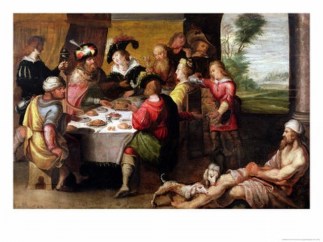 Lazarus, covered with sores, who would gladly have eaten his fill of the scraps that fell from the rich man’s table. Dogs even used to come and lick his sores. When the poor man died, he was carried away by angels to the bosom of Abraham. The rich man also died and was buried, and from the netherworld, where he was in torment, he raised his eyes and saw Abraham far off and Lazarus at his side. And he cried out, ‘Father Abraham, have pity on me. Send Lazarus to dip the tip of his finger in water and cool my tongue, for I am suffering torment in these flames.’ Abraham replied, ‘My child, remember that you received what was good during your lifetime while Lazarus likewise received what was bad; but now he is comforted here, whereas you are tormented. Moreover, between us and you a great chasm is established to prevent anyone from crossing who might wish to go from our side to yours or from your side to ours.’ He said, ‘Then I beg you, father, send him to my father’s house, for I have five brothers, so that he may warn them, lest they too come to this place of torment.’ But Abraham replied, ‘They have Moses and the prophets. Let them listen to them.’ He said, ‘Oh no, father Abraham, but if someone from the dead goes to them, they will repent.’ Then Abraham said, ‘If they will not listen to Moses and the prophets, neither will they be persuaded if someone should rise from the dead.’”
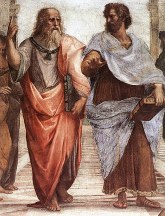 philosopher Aristotle, in his famous book on Ethics, defined virtue as a habit of doing the good. He taught that a person only acquires a virtue after having chosen it regularly over a long period of time and in many circumstances. For instance, if I tell the truth once, it doesn’t make me a truthful person. To say that I have the virtue of honesty means I have told the truth regularly for many years. As Jesus points out in this passage, a person’s character is shown as much, if not more so, in the small matters as in the larger ones. A truthful person will be pained by lying, even in small exaggerations. On the other hand, a person who lies easily about daily matters to avoid responsibility or make things easier, will certainly lie when the stakes are much higher.





 ust choose the path of discipleship or the path of least resistance, Christians must resolve and accept that as they walk to the left after Christ, some of their closest companions may walk to the right instead and their paths will separate. Although Christians, like Christ, ought to keep the door open to those friendships, oftentimes living our faith can mean losing some relationships. Jesus is Goodness, Truth, and Love. Yet, He was rejected by many. As we strive to be more Christ-like, we have to prepare ourselves for the same experience.

 Take Time For Him