Joseph’s Steady Leadership When Faced With “It’s Complicated”

4th Sunday of Advent

Take Time For Him Book cover

Excerpt from Take Time For Him: Simple, Soulful Gospel Meditations to Ignite the Busy Person’s Spiritual Life (click to order your own copy from Amazon!  Remember to rate it and leave a review!)

Gospel of Matthew 1:18-24

Meditation Reflection:

Immanuel: God-with-us! We no longer must suffer alone, weak and afraid. The Lord has come and brought with Him the comfort, strength, and peace of His holy presence dwelling in our souls and working in the world with His transforming grace.

We experience something of this peace and strength in family life. Being with our parents makes us feel secure HolyFamilybyGutierrez_wikipediaand protected. Being with our children brings us joy and comfort. The Holy Family experienced this at a supernatural level through Christ and have extended an invitation into their family as spiritual sons and daughters. Jesus’ saving work began with the cooperation of Mary and Joseph. Mary’s fiat, her “yes”, made the Incarnation possible and therefore the redemption of all mankind. Joseph’s fiat, his “yes”, made the Holy Family possible.
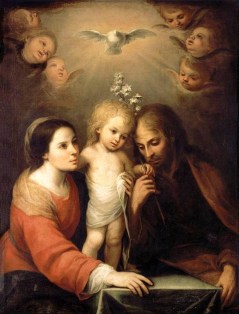
Joseph acted on faith when He accepted the role of earthly father over Jesus despite the surprising and shocking form in which He was conceived. His decision to take Jesus and Mary into his home and make them His own family was the fruit of God’s grace in concert with his virtues. This required serious discernment and prayer, both of which he models for all Christians.

Joseph was a just, or righteous man. This does not mean he was without sin whatsoever, but it did mean he consistently strove for virtue, followed the Mosaic Law, and lived his faith. Early Christian writings not included in the Bible, such as the Protoevangelium of James, indicate that Mary’s parents consecrated her to God and so she would serve God in the temple and take a vow of virginity. As a result, she grew up in the Temple from the age of 3 until she was of marrying age. It was a Jewish practice that at that point she would be entrusted to the care of a guardian who would protect her and would respect her vow of virginity by taking a vow of celibacy himself. Oftentimes this would be a man who was older and widowed. Some think this explains why Joseph had died by the time of Jesus’ public ministry. According to the Protoevangelium of James, from among the men who wished to take Mary as their wife, Joseph was chosen as Mary’s husband by a miraculous sign. After such a holy betrothal, imagine his surprise, confusion, and disillusionment, when he learned she was pregnant before they lived together in marriage. His response to the situation is so admirable, strong, and level- headed. He’s a model for anyone who must make difficult decisions in complicated and emotional situations.

Let’s examine what he did. Joseph made a prudent decision, based on who he was and his faith. Purity and honor being important virtues, he decided he could not take her into his home as his wife. (At the time, betrothal was a solemn contract with the weight of marriage but preceded living together as husband and wife). At the same time, he was a compassionate and merciful man. Matthew tells us Joseph was “unwilling” to expose her to shame. I imagine he had plenty of men and women urging him to exact the full measure of the Jewish law against her, to publicly humiliate her, and to get sweet revenge for embarrassing him. Joseph would not. He was unwilling. Joseph made an intentional decision to do the right thing, quietly. In the RSV translation, it says he “resolved to send her away quietly.” To be resolved indicates a decision made with prudence, strength of will, and determination, intentionally detached from pettiness and emotion.

Joseph focused on how to thoughtfully and prayerfully do the next right thing. Because of this, God guided his discernment. The RSV translation says, “But as he considered this, behold an angel of the Lord appeared to him”. The word “considered” is important. The spiritual life is ultimately one of love, fidelity, and receptivity. We are followers of God, not leaders of God. God guided Joseph’s considerations for his family, just as God guides every father who will invite the Lord into his discernment. When God spoke, Joseph faithfully and lovingly followed through with God’s will.

Immanuel: God-with-us. How might we as mothers and fathers invite God to be with us in our families and our decision-making? How might we say yes to the Father and welcome His Son? How might we accept the family that God has entrusted to us, rather than the one we imagine for ourselves? God works in surprising and shocking ways. This Advent, taking a moment to consider who we are and what we believe, may St. Joseph pray for us to have the kind of steady and faith-filled approach to life’s complications that he did.

Consider:

  • Joseph’s yes made it possible for Jesus to have a family. Consider what a gift it was for him to grow up with Mary as His mom and Joseph as His foster-father.
  • Consider Joseph’s prayerful leadership. How might you imitate St. Joseph’s discernment in your own life?
  • Do you take time to “consider” things and “resolve” to follow through?
    • What things, habits, or people undermine that, urging you to react immediately and emotionally?
    • What things, habits, or people could help you develop deeper consideration and stronger resolve?
  • Ask Joseph to lead you and your family, as He did for Jesus and Mary. Pray for his protection, guidance, and love.

Make a Resolution (Practical Application):

  • Teresa of Avila and numerous other saints recommend devotion to St. Joseph and credit his powerful intercession for answers to their prayers. I too can attest to this from my own life. This week ask St. Joseph to pray for you and for your family.
  • Do you know someone who is like St. Joseph? Spend more time with that person and learn from his example. Take him to coffee and ask him lots of questions and take his advice.
  • Surrender a complicated decision to the Lord in quiet prayer. Consider who you are, what our Christian faith says about the situation, and resolve to do the next right thing with the help of the Holy Spirit.

Additional Recommendations for Spiritual Reading:

*As an Amazon Associate I earn from qualifying purchases.


Follow bar

The Man Who Changed the World, And Can Change Me

3rd Sunday of Advent

Take Time For Him Book cover

Excerpt from Take Time For Him: Simple, Soulful Gospel Meditations to Ignite the Busy Person’s Spiritual Life (click to order your own copy from Amazon!  Remember to rate it and leave a review!)

Gospel of Matthew 11:2-11

Meditation Reflection:

Jesus is the Christ for all mankind, and His coming marks the very climax and axis of history; everything prior had been preparing for this moment, and everything after would be altered – transformed by His liberating grace. Blessed Archbishop Fulton Sheen, in his book Life of Christ, observed:

“What separates Christ from all men is that first he was expected…A second distinguishing fact is that once he appeared, he struck history with such impact that he split it in two, dividing it into two periods: one before his coming, the other after it. Buddha did not do this, nor any of the great Indian philosophers.   Even those who deny God must date their attacks upon Him, A.D. so and so, or so many years after His coming.”

Jesus was expected. In addition to the hundreds of prophecies in the Old Testament (all which Jesus fulfilled, a statistical near impossibility), Archbishop Sheen further asserts that prophecies pointing to Christ can also be discerned from the Romans, Greeks, and even the Chinese. Sheen explains the logic behind this universal prescience:

Automobile manufacturers tell their customers when to expect a new model. If God sent anyone from Himself, or if He came Himself with a vitally important message for all men, it would seem reasonable that He would first let men know when His messenger was coming, where He would be born, where He would live, the doctrine He would teach…

In consequence, when John the Baptist sent his followers to inquire of Jesus as to whether He was the awaited Messiah, Jesus responded by citing His works, which even at the beginning of His public ministry, already fulfilled a host of long-awaited prophecies.

John the Baptist is considered the last of the Old Testament prophets. “Testament” means “Covenant” and John represents the fullness of God’s covenant with Israel, at its height and its end. This end, however, was not an eradication but rather a new beginning. Jesus made this clear when He said, “Do not think that I came to abolish the law or the prophets; I have come not to abolish but to fulfill” (Matthew 5:17). John’s mission to prepare the way for the messiah also prepared the way for the New Covenant, one which fulfills and exceeds the Old to such an extent that the “least in the kingdom of heaven” will exceed the “greatest” in the old.

Up to this point, since the Fall of Adam and Eve, all of humanity suffered under the weight of sin, guilt, discord, injustice, flight from God, failure, and death. God’s preparation took time and patience to ready the human heart to receive His incarnate Son. God began small but personal. He began by initiating a relationship with one man, Abraham, and his family. Through that relationship, God revealed key aspects of His character – His truthfulness, fidelity, power, and love. Later, God formed Abraham’s descendants into a nation when He freed them from slavery in Egypt to be a free people, gave them a mighty prophet and leader – Moses, Laws to govern them – written by the finger of God, and the promised land where they could nurture their hope for a new garden of paradise. Finally, God allowed them to become a formal kingdom and promised a man from the line of king David would always be on their throne. Nevertheless, even the chosen people of God had to struggle along without the aid of supernatural grace. They knew the law and yet failed to follow it. They knew where to find happiness yet chased after futile and false pleasures. Their unified kingdom split and eventually their sin caused them to be conquered and scattered by foreign invaders.

With the incarnation of Christ, the painful wait for a redeemer had finally come to an end. The angels could sing at His birth,

Glory to God in the highest,

     and on earth peace to those on whom his favor rests” (Luke 2:14).

As Isaiah prophesied:

The people who walked in darkness

     have seen a great light” (Isaiah 9:1),

and Jesus proclaimed of Himself, “I am the light of the world. Whoever follows me will not walk in darkness, but will have the light of life” (John 8:12). With the advent of Christ came the advent of grace and the possibility of transformation, strengthening, and healing. Now every person can confidently face the trials of life. St. Paul boldly testifies from his own experience, “I can do all things in him who strengthens me” (Philippians 4:13, RSV).

Being the light of the world is no small thing. We rely on it more than we realize. For example, at my son’s basketball tournament one day, the lights in the entire complex went out. At first the deafening noise became instantly silenced as we all felt startled. Within seconds however, iPhone flashlights lit up the gymnasium and kids began laughing, chatting, and shooting hoops while they waited. I grew up in a time before iPhone flashlights, when sudden darkness meant an indeterminate amount of time searching for a source of light, hoping someone had a lighter or flashlight stored somewhere. Whereas I felt a bit unnerved when the gymnasium went dark, the kids weren’t all that worried because their fears were instantly assuaged. Kids today experience a blessed security by always having a light source on them and around them constantly. I thought of the gift of Christ’s light within us, which even though it’s often taken for granted, it still provides an underlying sense of peace and security as it permeates our culture and our consciousness. Prior to Christ, like prior to the iPhone, that light was more difficult to come by and less stable.

We are beyond blessed to be living “in the year of the Lord” (Anno Domini, or A.D.). We live in an age of grace where Christ has made possible the forgiveness of our sins, peace in our souls, and the sight of God Himself, made visible in His Son.

Christ has come, and it has changed everything. This is why belief in Christ, as the Son of God made man, our Redeemer, has endured for over 2,000 years and persuaded peoples over the entire earth in every culture. Jesus changes us and we are witnesses to it.

Consider:

  • How has Jesus changed your life? In what way(s) are you different now than before?
  • Consider the impact Christ has had on the world. Reflect on His power to transform hearts, minds, and lives in every place and in every
  • Reflect on Christ being the Light of the World. Consider how light provides sight, warmth, peace, and protection.
  • Jesus, the Word of God through Whom all things were made, is also man. He is related to all of us as our brother.
  • Consider how the most important moment in history hinged on the “yes” of Mary.
  • Consider the things God has done through you because of your “yes” to Him.

Make a Resolution (Practical Application):

  • Each day this week, share the gift of Christ’s light with another person. It can be through word or deed. (remember the works of mercy)
  • Pray and work for the conversion of someone you know. Pray for Christ to enter his or her life and to change it

*For posts directly to your email click the FOLLOW tab!  You can also follow me on Facebook or Twitter @ taketimeforhim

Additional Recommendations for Spiritual Reading:

*As an Amazon Associate I earn from qualifying purchases.

A Gift Well Received- Mary’s Immaculate Conception

Readings for the Solemnity of the Immaculate Conception of the Blessed Virgin Mary

Antolinez-inmaculada-bilbao public domain

Antolinez-immaculada-bilbao [public domain]

By a miracle of God, the Holy Spirit would overshadow Mary and Jesus Christ would be conceived in the womb of a virgin.  For this to happen, another miracle had to take place first.  The Son of God received His human nature from His Mother Mary, but since God and sin are incompatible it was necessary that she too be without the stain of sin. So today the Church prayerfully remembers and praises God for the other miraculous conception – Mary’s. Through His grace she was preserved from Original Sin from the moment of her conception.  Incredibly, this saving grace is the same grace merited on the Cross by Jesus which saves us, except that she received this gift from her beginning whereas we are cleansed from sin in Baptism.

Mary received this state of grace as a gift from God, but unlike Eve (and Adam), she remained faithful to God and this gift through every temptation.  Mary suffered difficulties, anxieties, troubles, danger, and excruciating emotional pain, especially at the foot of the Cross, yet she trusted God above all and surrendered always and completely to His will.

As we praise God today for His great love and mercy in the miraculous conception of the Blessed Virgin Mary, may we look to her for motherly guidance and love.  She is both our mother and our role model.  We are cleansed from sin in Baptism, may we strive to remain faithful to that gift, trusting in God and glorifying Him as Mary did, in every circumstance.

Consider:

  • God’s miracles are a fruit of His power, mercy, and love.  Consider the gift of Mary’s Immaculate Conception and the beauty of human nature in the fullness God created it to be.
  • Consider the miracle of your life and the great dignity God has given you.  Take a moment to thank God for the gift of His grace in your life and freedom from sin at your Baptism. Consider the fullness of life God desires for you which He makes possible through His grace, and teaches through His commands.
  • Sin appears as freedom and pleasure but in fact only degrades us.  Examine your conscience for the ways you have fallen to temptations and sin, especially since your Baptism. Go to the Sacrament of Confession this Advent Season to receive Christ’s healing grace and to begin anew.

Make a Resolution:

~ Written by Angela M. Jendro © 2019


Keeping Christ in Christmas, and John the Baptist in Advent

2nd Sunday of Advent

Take Time For Him Book cover

Excerpt from Take Time For Him: Simple, Soulful Gospel Meditations to Ignite the Busy Person’s Spiritual Life (click to order your own copy from Amazon!  Remember to rate it and leave a review!)

Gospel of Matthew 3:1-12

Meditation Reflection:

 The image of John the Baptist, dressed in camel hair and eating locusts, preaching the message of repentance and authentic sorrow for sins, provides a stark contrast to the marketing images flooding us of jolly Santas, piles of presents, and delicious foods. I can understand why marketers find Santa and reindeer more appealing for sales than a desert ascetic speaking about sin, but the ubiquitous advertising easily obscures the serious spiritual work we are meant to do. People also feel ever more pressure to prepare for Christmas by finding the perfect gifts within the time constraints of frantic schedules and limited budgets. Nevertheless, the Gospel writers remind us that preparation for Christmas is ultimately preparation for the Incarnation of God our Savior. He brings the gift of heaven, but we must prepare ourselves to receive that gift through repentance.

The push to start Christmas sales has lamentably encroached on Thanksgiving and even cast a shadow over Halloween.  Even worse, it has completely usurped Advent in our culture, making it seem nearly impossible in the four weeks leading up to Christmas to make time for introspection, increased prayer, and sacrifice. On the flip side, by the time Catholics celebrate Christmas on the Eve of Christmas day and for the two weeks following it, the rest of the culture has already moved on and we feel we are celebrating alone.

So how can we balance living in the culture that we do, and still honor the important process of conversion Advent is meant to procure? We can no longer wait to buy a Christmas tree until December 23rd because there won’t be any left. We can’t leave them up for the duration of the Liturgical Christmas season because the tree will be a fire hazard at that point, plus we will have missed our road-side tree pick up provided by our garbage companies. Each person must determine how to be “in the world but not of the world” (cf. 1 John 2) in their own situation. For myself, I have surrendered the Christmas tree battle and get one the weekend after Thanksgiving. I love Christmas trees, and if I’m going to go to all the work of decorating it with the kids, I want it to last as long as possible! I also must admit that I look forward to the Hallmark Christmas movies that start up on Thanksgiving and, if possible, make a weekend of it during Advent with my mother and my daughter. Black Friday deals make Christmas gifts more affordable although I am too exhausted on Cyber Mondays to get online after work. However, I reserve some Christmas feasting for the real Christmas season. I play Christmas music all the way to the Epiphany even though secular stations have returned to their normal broadcasting. I keep my Christmas decorations out (except for the live tree). In my classroom at school I leave Christmas lights up in my room until Lent, reminding the kids that Jesus is the Light of the World.

Amidst the early holiday cheer and parties however, spiritual sacrifice, examination of conscience, and remorse for sins is harder to carve time for, and yet the most important. When the kids were little, I would do Bible crafts and the kids had fun placing a felt ornament on our Jesse tree corresponding to a daily Scripture passage we would read. Now that my kids are older, it’s harder to find a time we are all home to pray together. As a busy mom, I appreciate that the Church offers practical advice regarding spiritual preparation during Advent, and oftentimes opportunities organized by the parish to help us. Scripturally, spiritual preparation consists of prayer, fasting, and almsgiving. Parishes often offer Advent reflections, retreats, and youth ministry events to facilitate more introspective prayer during this time. I would recommend adding one of these events to your calendar just as you would any Christmas party invitation.

Fasting during advent is especially difficult, with so many Christmas parties and cookie exchanges taking place, but consider fasting from something simple and achievable, so that even during the celebration, you remain connected to Christ and honor the preparation for His coming that He deserves. I wouldn’t suggest giving up sweets altogether, but maybe you set a limit for yourself or give up something else that’s meaningful to you, especially something you tend to overindulge in. Maybe you decide you will only have one adult beverage at the Christmas party or one desert, or you resolve to bite your tongue when tempted to gossip about a coworker of family member.

Almsgiving may be the one aspect of Advent that lingers in our culture as generosity during the Christmas season seems to be a sentiment that still resonates in people’s hearts. Parishes, schools, offices, and neighborhoods band together for charitable causes and provide opportunities for us to give. We can participate with a spirit of giving to Christ who says, “Whatever you did for one of these least brothers of mine, you did it for me” (Matthew 25:40). Let’s not forget that Christmas also provides less visible opportunities for giving, like keeping our eyes open for family members, neighbors, or colleagues who are lonely and inviting them to our homes.

Fasting and almsgiving can further be applied in our interactions with one another. Christmas get-togethers bring out the best and the worst in people. The heightened social contact creates situations for enjoyable fellowship but also tense discord. Here we can practice the spiritual works of mercy. We can fast from gossip and give encouragement, fast from pettiness and bear wrongs patiently, fast from competitiveness and offer warmth. When we encounter someone, we find annoying, frustrating, or difficult to be around, we can reflect on the compassion of the Lord, who became man, for love of that same person. When we are moved by the generosity and love of others towards ourselves, we can praise Christ as we tangibly experience His love in our own lives.

Advent has become an uphill battle, but the view from the top makes climbing it worth all the effort it took to get there. This Advent I hope you can find a way to prepare your heart and your life for Christ a little more in some small way. I hope you experience the peace from repenting of sin to receive His generous healing. Let’s demonstrate our authentic gratitude for his grace through prayer and acts of love. Let’s try to keep Christ in Christmas, and John the Baptist in Advent.

Consider:

  • “Emmanuel” means God-with-us. Consider the gift of the Incarnation, that God became man, and dwelt among
  • How has your heart and life opened to Christ over the years? How has He dwelt more and more in your life?
  • Are there any areas of your life from which you keep Christ closed off? Are there any places, people, or activities you wouldn’t feel comfortable having Christ present?
  • Reflect on the people you will encounter this season. Consider them from Christ’s point of view. How might you be the hands and heart of Christ to them in your interactions?

Make a Resolution (Practical Application):

  • Choose one way this Advent to pray, fast, and
  • Put a church sponsored Advent or Christmas event on your calendar, then attend
  • Fast from gossip and critical
  • Intentionally give to Christ, above your regular Choose a charity or a particular person and be generous to Jesus by being generous to them.

*For posts directly to your email click the FOLLOW tab!  You can also follow me on Facebook or Twitter @ taketimeforhim

Additional Recommendations for Spiritual Reading:

*As an Amazon Associate I earn from qualifying purchases.

Mid-week Christ Connection

Gospel of Matthew 15:29-30 NAB In-the-World-Not-of-the-World-DESKTOP

At that time:
Jesus walked by the Sea of Galilee,
went up on the mountain, and sat down there.
Great crowds came to him,
having with them the lame, the blind, the deformed, the mute,
and many others.
They placed them at his feet, and he cured them.

Meditation Reflection:

Imagine walking with Jesus by the Sea, then sitting on the mountainside.  As you bring your needs before Him, no matter how impossible they seem, He calms you and provides for all your needs.

Consider:

Surrender to Christ all your worries, and difficulties.  Lay before Him the needs of those you love too.


~ Written by Angela Jendro © 2019

Take Time For Him Book cover

Order your own copy of weekly guided meditations for the entire year!  Available on Amazon.

Begin Again: New Year’s Resolutions for the New Liturgical Year

Excerpt from Take Time For Him: Simple, Soulful Gospel Meditations to Ignite the Busy Person’s Spiritual LifeTake Time For Him Book cover by Angela M. Jendro © 2019. Available on Amazon.  Order your own copy!

          • *Have the Sunday Gospel at your fingertips
          • *Highlight and write in the margins
          • *A place to keep your meditations for the year

First Sunday of Advent

Gospel of Matthew 24:37-44

Meditation Reflection:

Advent marks the beginning of a new year (liturgically speaking). We pause to praise God that we made it through last year on the wings of His grace, and to begin anew for the next. A lot can happen in a year, so we need to re-center ourselves in the Lord, to ground ourselves in His love, His strength, His Wisdom, and His peace. Yoked to Christ, we will be able to embrace unexpected joys and successes with humble gratitude and persevere through sorrows and failures without fear.

In the spirit of new year’s resolutions, Advent also provides the opportunity for Christians to step back, evaluate their lives, and make renewed goals for personal growth. Like most resolutions, we hope to imbue the next year with deeper meaning and healthier living (physically, emotionally, and spiritually). We can’t know when our lives will end or when Christ will come again, but we can be our best selves when it does and try to live with as few regrets as possible.

So how do we do this, especially in our complicated and fast- paced culture? Where do we even begin and what steps can we take? To start, we absolutely MUST make following Christ our first and highest priority. Jesus assures us in Matthew 6:33 that if we “seek first the kingdom [of God] and his righteousness”, everything else will fall into place. The first habit we need to make, is turning to Christ EVERY day and to develop the ability to “Practice the Presence of God”i as Brother Lawrence famously termed it. It’s human nature to grow lax over time and most of us can’t avoid being overwhelmed periodically by daily life. In these moments, when we need prayer the most, it’s usually the first to be neglected. Instead, in your stress, make your prayer the rock that soothes your anxiety or sadness, that calms your anger, and dispels the clouds of confusion. By the same token, during times of success and feelings of happiness, we can easily be distracted from our connection to Christ or our underlying need for Him. Instead, rejoice with Christ, let Him share your joy especially since He was instrumental in achieving it. These annual pauses can reorient us in a positive way if we use our triumphs and our failures as fuel for richer discipleship.

Although goals need to be tailored to the individual, they endure the longest and bear the most fruit if done in community. For example, last year during faculty workshops leading up to the start of school (I’m a middle and high school teacher), a colleague and I decided to go for a walk during our lunch break each day. We lamented that our healthy summer living would be quickly replaced by the frenetic schedule of the school year and our summer habits of regular exercise would fade away leaving us tired and downcast. We resolved to walk together for an hour once a week after school. Plenty of reasons presented themselves every week to cancel the walk, but we stuck to our priority of that small bit of exercise (and friendship and spiritual conversation) together. This was the baby step that kept me in the habit each week and soon I added another day of exercise on my own. Not long after, a friend told me about an opportunity for a family gym membership that was affordable and a good way for our kids to burn off energy together.   When school began the following year, I smiled as I didn’t have to complain to my colleague about the impending physical atrophy and stress. Instead I felt amazing knowing I had been able to develop a much healthier balance in my life and knew I could take care of myself and keep up at work and home.

Like our bodies, our spiritual lives have a tremendous ability to bounce back with a little determination and perseverance. It’s tempting to look back with nostalgia at our previous achievements and make excuses for our current atrophy. Instead, find a friend and make a small, achievable goal to reinvigorate your spiritual life. Over the course of the year, similar to exercise, it will begin to bear greater and greater fruit, spurring you on to take more steps toward spiritual health and endurance. What sometimes begins as feeling laborious and painful eventually becomes something that feels so good you look forward to it and find ways to increase it.

Begin with the basics – go to Mass EVERY Sunday. No excuses. (Unless you are seriously ill of course). My kids and I have a tradition of getting doughnuts afterward to celebrate Sunday. As they’ve gotten older doughnuts are sometimes replaced with McDonald’s breakfast or as teens a mocha latte fun coffee drink. Whatever the treat, find a way to keep the celebration of Christ at Mass going afterward.

Pray, EVERY day. Start with saying thank you. Praise God and consider His goodness and greatness. Next, be honest with God about the day ahead and the help you will need to radiate Christ in the situations you will be in. Finally, intercede for others. Consider the needs of those around you, especially your family and people at work. Ask God for his help. Decide ahead of time when this conversation with God will take place. Know yourself and be realistic. For instance, as much as I wish I could end my day with prayer, as soon as I remotely begin to relax, I immediately fall asleep. I’ve considered a midday prayer, but I get distracted by everything in the day. However, when my kids were infants and toddlers, midday during their nap time was the only chance I had for scheduled time with God. Now that my kids are older and I am back at work, I choose morning to pray, when my mind is clear, and I can enjoy a cup of coffee with the Lord. Once I got into this habit however, it was so fruitful I yearned for more time with the Lord but struggled to get up earlier; the spirit was willing, but the flesh was weak (cf. Matthew 26:41). So, when day light savings time began and I had to adjust my body to staying up later and getting up later, I decided to stay on the same schedule instead and the extra time for prayer was immediately available!

Next step, read a spiritual book about the faith. Unlike fiction or pop culture, spiritual books are best read a few pages at a time and may take a year or more to complete. A good book about the faith should inspire a movement of love and reflection in your heart and spur contemplation. Don’t get caught up in the progress of pages as much as the progress of personal transformation.

Praying with Scripture is always a great idea. You could read through a book of the bible, especially the Gospels, a chapter or so at a time. You could also read the daily readings for the Mass and reflect on the Gospel of the day. I find tremendous divine providence in these passages. You can go to usccb.org and click on the calendar on the right-hand side of the page to see the readings for the day. You could also pray with the psalms or even pray the Liturgy of the Hours.

Finally, if possible, try to set aside 5 minutes of silence with the Lord into your day. Lots of distractions will fill your mind but gently push them away and try to make 5 minutes of space for being in the presence of the Lord and listening.

Personally, I like to end prayer with 5 minutes of silence. I set a timer on my phone so I don’t have to check the clock. Other times, spiritual reading moves my heart and I pause in the middle of it for the 5 minutes.

Like building any new habit, you will have to make your own prudential decisions about what merits exceptions, versus the slippery slope of letting other things edge out your time with God. I have experienced both. For instance, when I would pray during my kids’ nap time I often felt pulled by the long list of things that needed to get done. I could easily excuse skipping prayer for doing dishes or cleaning up by considering my work as prayer. Although our work is prayerful if offered to God, actual time alone with the Lord is irreplaceable and a higher priority. On the other hand, I have also encountered situations where I was up all night with sick kids or unavoidable extra work at my job or in works of mercy that presented themselves. On those mornings I sometimes had to cut into my prayer time to get the necessary sleep I knew I needed to function for the Lord the next day. I try to be prayerfully prudent though to make sure I’m not letting other things come before prayer and try to say no to things that would interfere. Even on mornings I get a little extra sleep I make sure I still retain some time for prayer and not skip it altogether.

Don’t be afraid to adjust your new year’s resolutions to your current state in life. Things change from year to year, which makes Advent a perfect time to consider where you are now and what your next steps should be. Some periods of life are very peaceful, and you can plan structured times for prayer and methodically work on building needed virtues. Other times you may feel like you are in survival mode and leaning on the Lord takes a different form for the time being as you are in the trenches together. Whatever you decide, make the decision with Christ and ask the Holy Spirit to guide you. Reach out to fellow Christians and accept the support of others and of grace. In this way, whenever Christ comes, He will find you ready – reaching for him.

Consider:

  • Ask the Holy Spirit to show you where you need to grow.
    • How might you grow deeper in prayer?
    • How might you develop more virtuous habits?
    • How might you be more Christ-like toward others?
  • Consider past spiritual resolutions you have made. How have they born fruit in your life? Reflect on the effort it took to begin them and how they grew to become a
  • Where do you need more balance? What undermines higher priorities? How might you put boundaries on those things to keep your priorities better aligned?

Make a Resolution (Practical Application):

  • Make one prayer resolution. Decide when, how, and what you will do to deepen your prayer
  • Make one virtue resolution. Identify one way you would like to better imitate Christ and make a daily plan to grow in that
  • Make one detachment resolution. Choose one vice or sin to overcome. Ask others to keep you accountable about it, pray daily for grace to overcome it, and practice the opposite virtue.


Follow bar

Get your own published papercopy of this year’s guided meditations!

Hi Everyone!Take Time For Him Book cover

By God’s grace, I have finally published a book of guided Scripture meditations for this year!  Check out Take Time For Him: Simple, Soulful Gospel Meditations to Ignite the Busy Person’s Spiritual Life on Amazon!  

ORDER YOUR OWN COPY TO PRAY WITH!  Highlight passages you love and freely write notes and thoughts in the margins.  Keep on your shelf to look back and reflect on your year with the Lord.

This is my first book on Amazon, so please RATE and REVIEW it so more people can find it as they search for prayer tools.  If you feel moved to, please SHARE it on your social media page.

My hope is for us to grow in prayer together. I will be praying for you, and please pray for me!

Thank you all for your encouragement and requests over the years.  The idea came from a reader and each time I was tempted to quit the attempt, another reader would reach out with encouraging words at just the right moment.  This book is an effort to serve you better and to, through Christ, “continually offer up a sacrifice of praise to God.” (Hebrews 13:15 RSV)

May God embrace you in His Divine Love,

+Angela M. Jendro 


*I am also an amazon affiliate, so by clicking the link on this page I earn additional proceeds from the book.

Looking For a Savior

by Angela M. Jendro

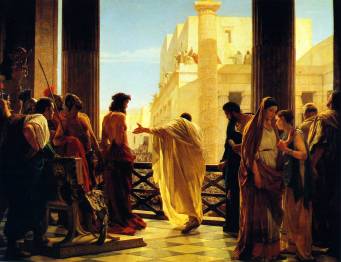
Ecce Homo by Antonio Ciseri

Gospel of Luke 21:5-19 (click here for the readings)

Meditation Reflection:

Oftentimes we imagine being a Christian means merely letting Jesus smooth out the rough edges of our lives to make it happier and more beautiful. The Jews made this mistake by imagining that in fulfilling the law and the prophets, the Messiah would merely restore the Davidic Kingdom to its former earthly glory. To be fair, the Incarnation of the Son of God liberated us at an unimaginable level. God’s merciful love exceeds anything we have experienced or could expect. He also exceeds all expectations of philosophy and the wisdom of the Greeks. The Jews experienced a taste of God’s powerful action and the Greeks touched on the heights of God’s wisdom. Jesus, the power and wisdom of God, makes both of these accessible to all and redirects our efforts toward an everlasting destination.

Christ counsels us to view this life as a pilgrimage and a battle. We develop our faith, hope, and love, on earth which will bring a deep sense of joy but will never create an earthly utopia. If we hope to find fullness here we will be sorely disappointed. Just look at the reactions of people to political news. Although presidents and congressmen have a great deal of power, they are not omnipotent. Moreover, their policies certainly affect our daily lives, but the transformation of hearts and the development of culture is something only Christ can do through His grace and His followers. All leaders have significant flaws and though they may do some measure of good, none can be our savior. No election can ever be the beginning of building a utopia or the end of the world, depending on your perspective. Our reaction ought to be proportionate – working diligently for the common good within our democratic system but relying on Christ alone for the salvation of souls and the spiritual elevation of our country. We can find relative happiness here, but for our joys to be lasting we need to direct them toward their true end – the heavenly kingdom. Besides, the most significant work is often done by everyday individuals serving those around them with Christian love, it just doesn’t get the same news press.

Christ promises to equip us for both the physical and the mental battle. As long as we live in the tension of sin and its effects, we will have to struggle against ourselves and others who oppose Christ’s kingdom, even family and friends. Nevertheless, Jesus, the Wisdom of God, provides the supernatural insights to answer the world’s mistaken propaganda or the pressures applied by those we care about. He also strengthens His disciples with supernatural perseverance to endure the physical suffering or possible martyrdom inflicted by worldly combatants.

As Catholics, we enjoy beautiful churches that express the glory of God. Rightly so, we adorn them with gorgeous art, precious metals, and the finest materials. We do this as an act of worship, as demonstrating concretely to ourselves and the world the value of God and of His sacrificial love. Christian churches are an icon, a sign pointing to a heavenly kingdom much more enduring. The magnificence of the sight of God will make all earthly analogies disappear. We ought to enjoy earthly icons of beauty, goodness, and truth in churches, nature, and most importantly in persons. At the same time, we need to daily recall to where they point and adjust our expectations and priorities accordingly.  We should still aim for greatness, justice, and perfection, but remember that it will come to fulfillment in the eternal kingdom where Christ reigns victorious.

Consider:

  • At the end of your life, what do you hope will endure from it afterward? Consider the lives you have and might still change, the love with which you imbue the world, the truths you fought to defend, the family relationships you have built.
  • Imagine your life from the perspective of entering heaven. Though all is certainly a grace, what would you be proud of? What would you regret? How might you live each day with more eternal purpose and significance?

Make a Resolution (Practical Application):

  • Begin each day by surrendering it to the Lord. Look for three opportunities each day to build the kingdom of God – by acts of mercy, service, defending truth, helping someone heal or find justice, sharing the good news of Christ, offering up personal disappointments or suffering as a sacrifice… At the end of the day write down the things that built the kingdom of God. Reflect on any missed opportunities and pray for the grace to act on them tomorrow.

Follow bar

~ Written by Angela Jendro © 2019 updated from Angela Lambert Jendro © 2016

Finding Perspective

by Angela M. Jendro
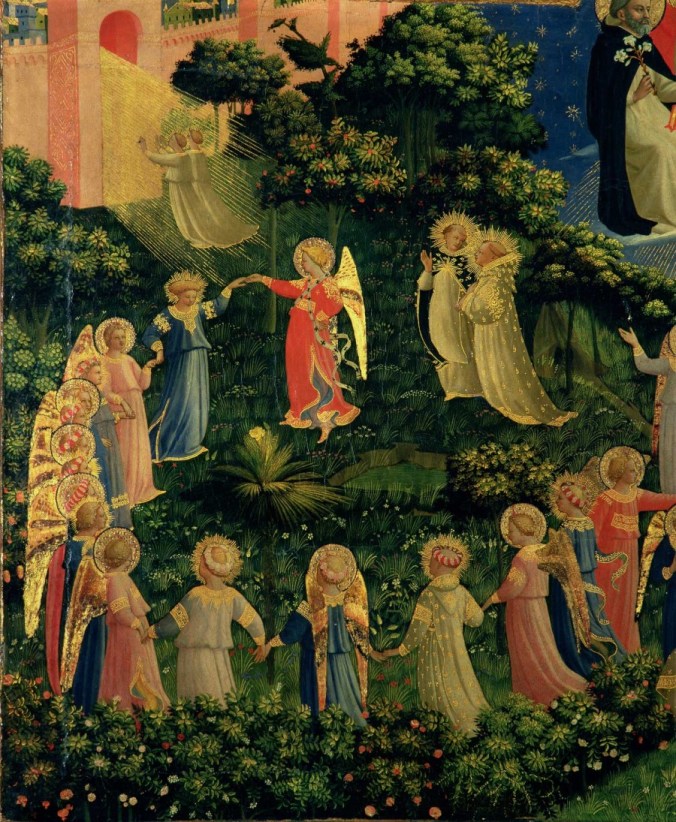
Fra_Angelico_Last_Judgment

Fra Angelico “The Last Judgment” (detail: Paradise)

32nd Sunday in Ordinary Time

Gospel Luke 20:27-38

Meditation Reflection:

As Christians, we profess a belief in life eternal with Christ in Heaven, yet we can sometimes operate in our daily lives forgetful of this mystery. Like the Sadducees we ask Christ silly questions about heaven. When we attach ourselves too much to earthly life, we fall into the trap of imagining heaven as merely an extension of the present but with a few more perks.

Jesus reminds us of the incomparable difference between our journey to God here, and union with God there. As St. Paul says: “But, as it is written,

     ‘What no eye has seen, nor ear heard,

     Nor the heart of man conceived,

     What God has prepared for those who love him,’” (I Corinthians 2:9 RSV).

Even the good things we experience here are merely a prelude to heaven. Here we experience a taste, there we will enjoy the feast.

Jesus proposes to the Sadducees that contemplating the life of the angels can provide some insight into this mystery. Like humans, angels are persons with rational intellects, free will, and the ability to love. Unlike humans they do not have bodies, are neither male nor female, and do not procreate. Each angel was individually created by God and is completely unique, so much so that some have compared it to being like different species from one another. Because they live in eternity, their choices are permanent. When God created them they each had the choice to either accept or reject God’s will for their life and His mission for them. Some said yes to God’s will and others rejected it. Those who rejected God’s will we call the fallen angels or demons. Human persons have more than one moment to choose or reject God, but that space of time does have limits. For us it ends when we die; at which moment our choice becomes permanent.

Consequently, the space of time in which we live on earth really is only a preparation for eternal life. During this short period, we either choose to grow our love for God or develop a disdain for Him. Only during our earthly lifespan can we develop and increase our capacity for God. At the moment of death the opportunity for change ends.

In addition, it’s our chance to aid others in their openness to heaven, even in its most basic form – the beginning of life itself. Whereas God created all of the angels at once, He creates human persons over a course of time and includes them in His work. As a result, openness to having children means openness to God’s creation of persons who will live eternally! For those called to spiritual motherhood or fatherhood, they contribute to this mystery as they minister to the birth and development of the child’s love for God which is also necessary for true life.

The Sadducees’ challenge to Christ with the hypothetical situation of a woman married seven times, merely exposed their ignorance of God. On earth marriage develops our capacity for love, self-gift, and sacrifice. It brings new life into the world as well as caring for the development of each family member. Marriage itself is not needed in heaven because no new life will be born there. It is the eternal life of those who already exist. Moreover, love will be perfected as we enjoy the perfect love of God and one another. The relationship of love experienced in marriage will remain a relationship of love in heaven. However, the title of husband or wife will be eclipsed by the fullness of the title son or daughter of God and sister and brother in Christ.

As the liturgical year comes to a close (Advent marks the beginning of the “New Year” in the Church), we contemplate the end times and remember that this experience of earthly life will eventually come to an end. We all get bogged down in our daily routine and anxious over matters that, if we considered our heavenly destination, shouldn’t really weigh us down. Moreover, we could make better use of our limited time if we consider things from an eternal perspective. This life is a preparation and an opportunity to participate in God’s work of spreading His kingdom. The more souls that come to accept His will and love on earth, the more that will join the wedding feast of love in Heaven for eternity.

Consider:

  • How does a heavenly perspective change your earthly perspective?
  • When feeling discouraged, remember that this life is a journey not the destination. Endless, secure happiness cannot be found here but the work to attain it in heaven can.
  • Through prayer, identify one area where you struggle to accept God’s will over your own.
  • Each angel has a mission from God. You also have a mission. How is God calling you to serve?
  • Consider first God’s vocational calling:
    • Is it to work for the salvation of your spouse through love and sacrifice and to possibly grow the human family by being open to life and to raising children in knowledge and love of the Lord?
    • Is it to administer the sacraments as a priest to bring eternal life to spiritual children?
    • Is it to spend your life in prayer and sacrifice for souls as a religious sister or brother?
    • Is it to devote your time and energy to God in a unique way as a single person, ready to do His will at every moment?
  • Consider next God’s occupational calling: How do you grow your love for God and develop it in others through your work?
    • Consider your special apostolate. Does God include you in His work of physical or emotional healing, protecting, providing, instruction of souls, encouragement, etc.?
    • How can you incorporate a heavenly perspective into your daily work? How do your daily activities and duties provide opportunities to detach from selfishness and develop greater love and compassion? How might you help others to heaven through your work?

Make a Resolution (Practical Application):

  • Begin each day by writing down the tasks, challenges, and opportunities you anticipate that day. Next to each, write one way it can be directed toward helping yourself and others to heaven. For example, will it grow a virtue or minimize a vice if tackled with the help of grace? Is it an opportunity to help others journey to God – either by giving them physical life, sustaining their life, healing, protecting, or developing an aspect of their soul?
  • Identify where your will is most at odds with God’s and do one thing each day to offset it. It could be a refusal or fear to do something God asks of you or an unwillingness to let go of something and trust God in the situation.
  • Pray the Serenity Prayer or the Suscipe of St. Ignatius each day.


~ Written by Angela Lambert Jendro © 2016 and edited © 2019

Follow bar

For additional reading on this topic here are some suggestions below:

They are linked to Amazon.  As a disclaimer, please know that I am an affiliate and do  make a percentage of sales.