Judas and the Limits of Divine Mercy

By Angela M Jendro

Whenever I teach on the topic of the Last Things (Death, Judgment, Heaven, and Hell), a student will inevitably ask about Judas. Despite having just emphasized that only God can judge hearts, they feel that somehow Judas must be an exception and we can at least judge him.  They also question if he might be an exception to Church teaching about hell – that although it does exist and you can go there, we do not definitively know the name of any specific person there.[i] Why doesn’t the Church admit that Judas is in hell? It canonizes saints and names particular people in heaven, why can’t it name Judas as not in heaven?

As Pope St. John Paul II said, “Damnation remains a real possibility, but it is not granted to us, without special divine revelation, to know which human beings are effectively involved in it.”[ii] The Church can only proclaim that which God has revealed for us to know.  The Lord revealed His judgment on Satan and the fallen angels, which is why we know they are in hell.[iii] However, though Christ lamented for Judas’ betrayal, saying it would be better if he had not been born (Matthew 26:24), He nevertheless refrained from declaring definitively that Judas was condemned there, and we cannot know if Judas repented (even of hanging himself) just before the moment of his death.[iv] 

Jesus said that He came not to condemn the world but to save it (John 12:47-49). Christ has done His part – He has gone to every possible length to save us.  Therefore, a person’s condemnation to hell is not Christ’s doing, but our own obstinate rejection of the Way, the Truth, and the Life (John 14:6) which He has offered.

His word is not only about sin however, but also about God’s unfathomable love and mercy – a mystery far beyond our understanding and too often foreign to our personal experience. As we struggle to accept the lengths of this reckless love[v], we look for some limit – and Judas seems to make sense.  Judas literally betrayed Jesus and directly participated in the sentencing of Christ to death.  Judas himself was so horrified by his sin, that in his painful grief and humiliating shame he took his own life.  Judas’ greatest failure, however, may not have been his betrayal of Christ to the chief priests, but his disbelief and distrust in the extent of Christ’s mercy.  In truth, the fact that the Church will not officially declare Judas to be in hell should be a source of hope for us, because as Jesus complained to St. Faustina in an apparition, so many of us commit the fault of disbelief and distrust in the limitlessness of His mercy too. 

Jesus appeared to the young polish nun, St. Faustina (1905-1938) many times to reemphasize this essential Gospel truth.  She obediently shared His messages with her confessor and wrote them in her Diary. In entry 50, on February 22, 1931, she recorded (Jesus’ words to her are in bold):

+ I desire that priests proclaim this great mercy of Mine towards souls of sinners. Let the sinner not be afraid to approach Me. The flames of mercy are burning Me clamoring to be spent; I want to pour them out upon these souls.

Jesus complained to me in these words, Distrust on the part of souls is tearing at My insides. The distrust of a chosen soul causes Me even greater pain; despite My inexhaustible love for them they do not trust Me.”[vi]
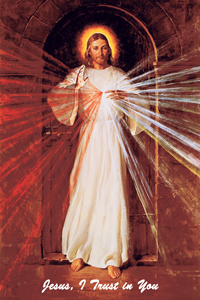
From a desire to make His mercy known and accepted more, Jesus asked Faustina to have an image painted which would illustrate this. The image consisted of Jesus in a white garment, and from His heart emanated two rays – one white and one red – symbolizing the water of baptism and the blood of His sacrifice. Beneath the image He wanted the words “Jesus, I trust in You” printed.[vii] In addition to the image, Jesus wanted the Sunday following Easter to be a Feast of Mercy.[viii] 

Pope St. John Paul II recognized the timeliness of this message and the importance of Faustina’s witness. He canonized her on Sunday April 30, 2000; making her the first saint of the new millennium as well as instituting the Feast of Divine Mercy Sunday to be celebrated the Sunday following Easter each year from then on. In his homily at her canonization, he affirmed,

“Divine Mercy reaches human beings through the heart of Christ crucified: ‘My daughter, say that I am love and mercy personified’, Jesus will ask Sr Faustina (Diary, p. 374). Christ pours out this mercy on humanity though the sending of the Spirit who, in the Trinity, is the Person-Love. And is not mercy love’s ‘second name’ (cf. Dives in misericordia, n. 7), understood in its deepest and most tender aspect, in its ability to take upon itself the burden of any need and, especially, in its immense capacity for forgiveness?”[ix]

Echoing the need for teaching divine mercy, Pope Francis called for a Holy Year of Mercy (Dec. 8, 2015 – Nov. 20, 2016).  In the book The Name of God is Mercy, Pope Francis articulated his concern with why more people do not turn to Christ in their need: “Because humanity is wounded, deeply wounded. Either it does not know how to cure its wounds or it believes that it’s not possible to cure them”[x] This helplessness is compounded by our wounded experiences. He observed that since many people in today’s selfish world haven’t experienced mercy in their own lives, they assume they won’t receive mercy from God.

Consider Judas again.  He had judged Jesus without mercy, and now he judged himself the same way. In addition, when he returned to the chief priests and the elders heartbroken and repentant, they responded with utter coldness.  The great theologian Fr. Romano Guardini captured the anguish of the moment well in his book The Lord, writing:

“After the deed came repentance – an overwhelming recognition of all that was lost. But this consciousness could no longer alter the fait accompli that stared back at Judas from the cold faces of those he had served. Strangely heart-rending gesture of helplessness, this flinging down the silver in the temple sanctuary!”[xi]

In this light, consider how important Jesus’ exhortation to us is in Luke 6:36-38! If only Judas had obeyed Christ’s word, he wouldn’t have had to suffer so terribly from the awful effects of his judgmentalism.

“Be merciful, even as your Father is merciful. Judge not, and you will not be judged; condemn not, and you will not be condemned; forgive, and you will be forgiven; give, and it will be given you; good measure, pressed down, shaken together, running over, will be put into your lap. For the measure you give will be the measure you get back.”

Judgmentalism can quickly become a vicious cycle. Judas judged and condemned Jesus.  However, when he realized he had judged wrongly, he then turned and judged and condemned himself, but was again wrong.  Though not innocent, he judged himself beyond the limits of God’s forgiveness and condemned himself to death.  We can’t judge Judas either. Fr. Guardini warned:

“No, what came to the surface in all its terrible nakedness in Judas, existed as a possibility all around Jesus. Fundamentally not one of his followers had much cause to look down on Judas. Nor have we. Let us be perfectly clear about this. Betrayal of the divine touches us all.”[xii]

Imagine the emotional drama and utter pain when Judas “flung the coins” (Matthew 27:5).  Think of all the frustration – the mental and emotional struggle during his time with Jesus, trying to determine just who Jesus is.  First as a zealous and hopeful follower, then a disenchanted disciple angry that Jesus wouldn’t bend to his expectations. Next as a malicious betrayer helping put to death what he deemed at the moment a false messiah, only to finally realize Jesus’ innocence, but tragically still too narrow minded and hearted to realize the extent of the Messianic redemption meant even for him. 

We at least live in the age of the Church, in the age of grace. Judas’ betrayal – both in Jesus’ death and his own – occurred before the Resurrection, and more importantly, before Pentecost. Had any of the other apostles been as extreme as Judas in their passions, they too may have succumbed to a similar end.  No one can fathom the mercy of God – it’s literally beyond human understanding.  They needed the Holy Spirit to open their minds and hearts to what Christ had been teaching them all along. We rely on the same Holy Spirit to both inspire knowledge of our sins and compunction of heart, and to give us the supernatural courage to trust in divine mercy. This is why it’s essential that we practice mercy, so we can become more habituated (and therefore open) to God’s gift of mercy to us.

Let’s take a final look at Judas from the standpoint of what we do and don’t know.  What was his disposition of soul at death? When he saw the truth of Jesus’ innocence he repented.  What did he do when he saw the truth of Jesus’ mercy, when he saw him face to face at his judgment?  We do not know…  It would be so much more satisfying if we did, we want to know the end of this dramatic story! He could have accepted Jesus’ mercy, been purified (Purgatory), and entered heaven.  Or he could have doubled down in his despair or in his pride, refused to accept mercy, and excluded himself from heaven, which is the definition of hell. 

Our choices matter. It’s incredible to think about the power that God has given to us in the freedom of Love.  May we pray for a merciful heart, which is able to both give and receive mercy. Jesus proclaimed, “Repent and believe in the Gospel.” Repentance of sin and trust in the merciful love of God are meant to be inextricably united. As Jesus said to St. Catherine of Siena:“I do not wish the soul to consider her sins, either in general or in particular, without also remembering the Blood and the broadness of my Mercy.”[xiii]

In conclusion, although it’s natural for students to ask, “what about Judas?”, the truth is it’s between Judas and Jesus.  The more important question to ask is, “what about me?”. Thankfully for us there’s still time.


[i] CCC par. 1033 “To die in mortal sin without repenting and accepting God’s merciful love means remaining separated from him for ever by our own free choice. This state of definitive self-exclusion from communion with God and the blessed is called ‘hell.’” CCC par.1035 “The teaching of the Church affirms the existence of hell and its eternity.” CCC 1036 “The affirmations of Sacred Scripture and the teachings of the Church on the subject of hell are a call to the responsibility incumbent upon man to make use of his freedom in view of his eternal destiny. They are at the same time an urgent call to conversion: “Enter by the narrow gate; for the gate is wide and the way is easy, that leads to destruction, and those who enter by it are many. For the gate is narrow and the way is hard, that leads to life, and those who find it are few.”

[ii] Pope St. John Paul II Audience July 22, 1999. Vatican.va

[iii] Cf CCC par. 391-393

[iv] For Church teaching about suicide, see The Catechism of the Catholic Church, par. 2280-2283. Taking one’s own life is a serious sin. At the same time, the Church recognizes that “grave psychological disturbances, anguish, or grave fear of hardship, suffering, or torture, can diminish the responsibility of the one committing suicide” (par. 2282) It also encourages us that “We should not despair of the eternal salvation of persons who have taken their own lives. By ways known to him alone, God can provide the opportunity for salutary repentance. The Church prays for persons who have taken their own lives. The Church prays for persons who have taken their own lives” (2283).

[v] cf Dorothy Day, The Reckless Way of Love: Notes on Following Jesus”, ed. Carolyn Kurtz, Plough Publishing House, 2017.

[vi] Maria Faustina Kowalska, Divine Mercy in My Soul: Diary of Sister M. Faustina Kowalska. Marian Press, 2003.

[vii] Ibid. Diary entry 47

[viii][viii] Ibid. Diary entry 49

[ix] John Paul II, Homily at the Mass in St. Peter’s Square for the Canonization of Sr Maria Faustina Kowalska, 30 April, 2000. Vatican.va

[x] Pope Francis.  The Name of God is Mercy. Random House, 2016.

[xi] Romano Guardini, The Lord, Gateway Editions 1982, p. 410

[xii] Ibid. p. 411

[xiii] Catherine of Siena, The Dialogue, Edited by Richard J. Payne, Translated by Suzanne Noffke, O.P. Paulist Press, 1980.

Related Posts

© 2024 Angela M Jendro

*Scriptural texts, unless otherwise noted, are taken from The Holy Bible: Revised Standard Version Catholic Edition, (Oxford: Oxford University Press, 2004)

*Pray and Reflect with full guided prayer meditations on the Sunday Gospel reading in my book Take Time For Him and its series on Amazon and Kindle!

Sunday Food For Thought: A Joyful House of Prayer

“For my house shall be called a house of prayer

     for all peoples” Isaiah 56:7 

Full Sunday Scripture Readings Link

Food For Thought

We usually associate the house of the Lord with church, and this is true as churches are consecrated places of worship for the Lord alone.  However, through the gift of Baptism, our souls become the house of the Lord too.  St. Teresa of Avila described the Christian soul as an Interior Castle wherein our Divine King dwells. 

From this perspective, consider again the Lord’s words through the prophet Isaiah: “my house shall be a house of prayer.” The Lord invites and challenges us to make our souls a prayerful place.  One in which St. Paul exhorts that we can “pray constantly” (1 Thessalonians 5:17).

How can we do this?  First, as always, ask the Holy Spirit.  Next, build a habit of being recollected. From the earliest times in the Christian church through the present day you will find spiritual authors and saints who have sought the same thing and written about how to pursue it.  (Below I have listed and linked a handful of classics.)  

Essentially, it means quieting our inner self, and being attentive to the Lord within.  Just as close friends or couples can feel connected through a simple glance amidst a crowd, so too recollection could be described as an attentive glance at the Lord.  

Building this intimacy resembles that of all relationships.  Initially it requires getting to know the Lord more through extended and intentional time set aside to listen to Him (remember He speaks to us through Scripture, His Church, His saints, and His creation, so listening can be as simple as opening the bible, attending mass, going for a nature walk, reading a spiritual book or life of a saint).  

To listen we must make room for silence: physically as well as mentally and spiritually.  Don’t be discouraged if you find yourself distracted by a clamor of thoughts when attempting to recollect yourself for prayer.  Simply ask the Holy Spirit for help.  Since our soul is the house of the Lord, I also like to ask Mary to help me prepare my home for Christ as she so lovingly did every day when He was on earth. 

As with any practice or habit, it may feel awkward at first or you may struggle with consistency. Nevertheless, persevere.  God can do so much with so little! Every bit counts.  In time, your efforts and His grace can result in a relationship of continual interior unity and love.  

The Lord promises in Isaiah 56 verse 7, that he will “make them joyful in my house of prayer“.  Recollection leads to peace in the presence of the Beloved Lord, and an abundance of joy. With this within, you can travel through your da

y “giv[ing] thanks in all circumstances” (1 Thessalonians 5:18) and offering all things as a prayer pleasing to the Lord. 

May the Lord make our hearts, a house of ardent, loving, joyful, intimate, prayer.

A few Spiritual Classics on Recollection and Interior union with the Lord:

A couple of modern books on the subject:

*Pray and Reflect with full guided prayer meditations on the Sunday Gospel reading in my book Take Time For Him and its series on Amazon and Kindle!


© 2023 Angela M Jendro

*Scriptural texts, unless otherwise noted, are taken from The Holy Bible: Revised Standard Version Catholic Edition, (Oxford: Oxford University Press, 2004)

God Can Do Anything!

God can do Anything!

by Angela M Jendro

God can do anything. Although it can be used as a cheap and quick answer to theological difficulties, at the same time there’s tremendous richness to this simple, yet powerful truth. Think about that for a moment…God can do anything! How many times in the Gospels does someone ask Jesus, “if you will it, you can…” In response to cries for mercy, healing, and forgiveness, Jesus consistently responded, “I do will it,” and miraculously restored the person with His human touch or word, and His divine power.

Granted, sometimes God says no to our plea, or at least “not yet” or “not in the way you are asking.”  Pride or pain responds with rage.  “God can do anything, but He won’t do this which I have asked of Him!”  In these moments we are challenged to surrender our reasoning and/or our emotions to the Lord in trust.  Yes, God can do anything, but God is also love.  Not only that, but God’s love is superabundant and prefers to give the very best over the mediocre.  The most loving thing a parent can say to their child sometimes is “no.”  We see this especially today in American culture. We have so much we can give our children that we risk spoiling them and stunting their personal growth if we do not refuse them things we could give, but shouldn’t.  For us, it can be difficult to discern when to say yes, and when to say no.  Sometimes we know the right answer but are too weak to follow through with a no, or don’t have the resources to say yes. Thankfully, our heavenly Father has perfect wisdom and perfect power which He applies with perfect love.  We can trust His will, which is what Jesus did at all times and exhorts us to do as well.  

We should seek to know the Lord, and to pursue deeper understanding of His revelation. God invites dialogue and investigation.  At the same time, we need to remember that it’s not a dialogue with an equal.  There will be times we must simply surrender to His care and trust His word. Jesus taught and did things that went beyond human understanding.  Sometimes we can forget His divinity due to His extraordinary nearness; He had such humility that He “ who, though he was in the form of God, did not count equality with God a thing to be grasped, but emptied himself, taking the form of a servant, being born in the likeness of men” (Philippians 2:6-7).  Yet, because of that nearness, many also witnessed his divine power – healing the blind, calming the storm, raising people from the dead, and Himself rising from the dead and glorified.  

Do you believe God can do anything? Do you believe Jesus can do anything? That is the question posed to us during Easter.  Jesus has risen! Do you believe it?  You shall rise too! Can you believe that? If so, then the rest of Christ’s teachings, in Scripture and through His Church, deserve our belief.  Can bread and wine become the Body, Blood, Soul, and Divinity of Christ in the Eucharist? Why not?!  If Jesus said so, and He can do anything, then it’s so.  

In our Christian life of discipleship Christ challenges us both to exert our mind and seek understanding as far as possible, as well as accepting when we are in mystery territory and responding with trust, surrender, and praise before the power and glory of God.

Meditate on this truth in prayer: God – Father, Son, and Holy Spirit, cares for me with the full strength of His all-powerful Love. Rejoice in this and take comfort in it.

© 2023 Angela M Jendro

*Pray and Reflect with weekly Sunday Gospel meditations by Angela available in paperback or e-book on Amazon


Sunday Food For Thought…Gratitude

Scripture Readings

Food For Thought

*Pray and Reflect with full meditations in my book Take Time For Him: Remain In His Love

Meditation Reflection: Luke 17:11-19

Consider the saying, “I owe you a debt of gratitude”.  The virtue of justice means giving each person his or her due.  When someone offers us a gratuitous kindness, we do in fact “owe” them our gratitude. I don’t mean this in the sense of a gift with strings attached, but rather as an expression of virtue and right relationship.  When someone offers a mercy in love, it is relational – they offer something of themselves to you as a gift.  If you in turn offer your gratitude, then not only has there been an exchange of some good, but additionally an exchange of love and mutual encouragement.

Christ is the ultimate gratuitous giver. He gives His mercy in love, no strings attached.  Offering Him back our gratitude however, is good for us as it reciprocates love for love.  Christ promises our love will always be received and appreciated by Him.  Rather than walk away with a blessing as merely divine pity for your situation, return to the Lord the love and gratitude He truly deserves and rejoice in loving relationship  with Him Who is so abundantly good to us!

Practical Application:

Praise God!  Praise Him in SONG!  Here are a couple of recommendations:

Take Time For Him: Remain in His Love available in ebook or paperback. Order a copy and don’t miss a single week!


Order the new set of guided meditations for this year’s Sunday Gospels!


© 2021 Angela M Jendro

Sunday Food For Thought…Clingy sin

Scripture Readings

Food For Thought

*Pray and Reflect with full guided meditations in my book Take Time For Him: Remain In His Love

Meditation Reflection: 

Mud clings.  I remember walking home from school as a sixth grader one spring and cutting through an open lot only to find myself stopped in my tracks, literally.  My feet sunk into the mud so deeply that I couldn’t get my foot out for quite awhile and when I finally did my shoe remained behind!  Later when the ground dried enough for me to recover the shoe I learned just how tedious and difficult restoring it would be.

In St. Paul’s letter to the Hebrews today (12:1-4), he exhorts us to “rid ourselves of every burden and sin that clings to us”.  Imagine Jeremiah being pulled out of the cistern.  Scripture describes it as having no water, “only mud, and Jeremiah sank into the mud” (Jeremiah 38:6).  How long it must have taken him to get cleaned up! Sin clings to us – whether we fell in by accident, were drawn into it by others, or simply formed the bad habit over time.  We might knock off big chunks at first but the tedium of removing the clingy bits in the crevices, grooves, and fibers can discourage us to the point of despair. However, St. Paul encourages us to persevere because muddy shoes slow you down and tire you out in a race and we are running the race to heaven. 

Thankfully you don’t have to do it alone, but you do need to ask for help.  The waters of grace have the power to cleanse even the most difficult stain. If we turn to Christ and ask the Holy Spirit to remove the clinging sin then it can be done.  Psalm 40:1-2 praises the Lord for just such a miracle:

“I have waited, waited for the LORD,

     and he stooped toward me.

The LORD heard my cry.

He drew me out of the pit of destruction,

     out of the mud of the swamp;

he set my feet upon a crag;

     he made firm my steps.”

We resist clingy people, pets, and even clothing because they restrict our freedom and flourishing.  Let us resist clingy sin for the same reason. It will require patience, perseverance, and prayer, but as St. Paul reminds us “we are surrounded by so great a cloud of witnesses” (Hebrews 12:1) and they give us hope that it can be done!

Take Time For Him: Remain in His Love available in ebook or paperback. Order a copy and don’t miss a single week!


Order the new set of guided meditations for this year’s Sunday Gospels!


© 2021 Angela M Jendro

Sunday Food For Thought: Taking a Leap of Faith

This Sunday’s Scripture Readings

Food For Thought

*Pray and Reflect with a complete guided meditation in my book Take Time For Him: Remain In His Love

Meditation Reflection: Hebrews 11:1-2, 8-19

St. Paul honors Abraham as a man of faith because Abraham acted on God’s word.  Abraham left his very comfortable home where he was already prosperous for a land that God would show him,  not one God had already shown to him.  Abraham received his son Isaac through two impossible circumstances in which he acted based on trust in God over trust in his own natural limitations: first, Isaac’s birth despite Abraham and Sarah’s old age and Sarah’s prior sterility, and secondly at the sacrifice of Isaac wherein Isaac’s life would be taken but would have to be restored by God.  Abraham acted on faith, he took huge risks. This wasn’t blind faith however, in some obscure and unknowable mythological or philosophical God.  Rather, Abraham responded in faith to a loving God Who revealed Himself to Abraham and Who reveals Himself to you and I even today. 

God acted in faith too and took a huge risk for us. God sent His only Son to become man, die for us, and rise again for our salvation.  Jesus Christ lived among us, taught profound Truth, and performed great miracles. This is the most historically verified fact of anyone in history. 

How will you and I respond to the revelation given to us?  Will we avoid the challenge and drown ourselves in distractions (like the unfaithful servant in Luke 12:32-48) or will we rise up like Abraham, our father in faith, and act.  

May we act, not on the reward we have in hand, but in faith in the God Who promises it and has given His own outstretched hand to us.

For a full guided Gospel Meditation on this Sunday’s readings, check out Take Time For Him: Remain in His Love available in ebook or paperback. Order a copy and don’t miss a single week!


Order the new set of guided meditations for this year’s Sunday Gospels!


© 2021 Angela M Jendro

Sunday Food For Thought: Excuses, Excuses…Be Brave! Be Determined!

13th Sunday in Ordinary Time:   Scripture Readings

Food For Thought

*excerpt from Take Time For Him: Remain In His Love

Meditation Reflection: Luke 9:51-62

Being a Christian means following Christ, wherever and whenever He goes.  Full discipleship requires 100% commitment, not the made-to-order or pick and choose buffet we are accustomed to in our culture.  Consider Jesus’ own example.  He had to journey to Jerusalem and to sacrificial suffering.  Notice the attitude He chose – resolution and determination. 

Followers of Christ need the same resolution and determination.  St. Teresa of Avila, the great Spanish mystic, emphasized repeatedly the necessity of determination to advance in the spiritual life.  In her instructional work The Way of Perfection, she warned against our tendency to draw back and complain when things become difficult:

“Be determined, Sisters, that you came to die for Christ, not to live comfortably for Christ.”[i]

Saint Paul also exhorted the Corinthians to live their faith with bold resolution.  He warned against conditional discipleship and encouraged the Christian community to be generous and steadfast:

“The point is this: he who sows sparingly will also reap sparingly, and he who sows bountifully will also reap bountifully. Each one must do as he has made up his mind, not reluctantly or under compulsion, for God loves a cheerful giver.” 2 Corinthians 9:6-7

As Jesus journeyed doing the Father’s will, those He encountered each had an opportunity to join Him, but their conditional stipulations determined whether they would accept it or turn it down.  The Samaritans received messengers from Christ but rejected the Lord before He even arrived when they learned accepting Christ meant surrendering their bitterness toward Jerusalem.  The next person took the initiative to seek Jesus out and requested to be in His company. However Jesus, who knows the hearts of each one of us, also knew the man’s interior conditions for discipleship. Thus, Jesus cautioned him that He would provide spiritual security and comfort but not necessarily the feeling of physical security and comfort. 

The next two men Jesus invited to follow Him procrastinated and avoided discipleship by requesting to finish up their other work first.  Their requests seem valid and even noble.  In fact, burying the dead is a corporal work of mercy and honoring your father and mother is the 4th commandment. Is Jesus asking us to neglect our duties?  Does Christian discipleship excuse neglecting our families?  Does God contradict Himself?  No.  Do we sometimes rationalize our cowardice or weakness by twisting God’s commands against Him?  Yes.  It reminds me of kids who try to avoid chores by claiming they need to work on their homework all of a sudden.

Many of us (including myself!), often excuse our lack of time for prayer by pitting it against the active life of charity.  It sounds something like this: “I don’t have time to sit and pray because I need to do [fill in the blank] which God would want me to do.”  A practical example would be, “I could sit and pray/ ‘doing nothing’, or work an extra hour to provide for my family, or do a load of laundry and dishes, or run an errand.  God wants me to care for my family, that is my prayer.”  Sometimes that might be the case.  But, in truth, there’s usually time for both.  This mentality has sometimes been referred to as the heresy of activism. 

Spending quality time with Christ in prayer first is the foundation of discipleship. How can we follow Him if we rarely take time to listen? In addition, without prayer, even our loving activities can tend to be more self-loving rather than other-loving. Jesus knew the hearts of the two men who wanted to return to their families before following Him.  Rather than contradicting His command that we love one another, especially our families, He may have been calling them out on their rationalizations. 

Let’s face it, we have an inner desire for God, and we may even have authentic zeal for discipleship, but we also struggle with attachments that hold us back.  The good news is that if we open ourselves up to Christ in prayer, He will reveal those attachments to us and provide the grace to overcome them.  It requires resolution and determination, but with God all things are possible!  

[i] Kavanaugh, Kieran, and Otilio Rodriguez, translators. The Way of Perfection: A Study Edition. ICS, 2000.

Consider:

+ Like the Samaritans, how many of us hold on to bitterness, anger, or un-forgiveness? Prayerfully ask Christ to reveal if any of these are holding you back from following Him.  Pray for the grace to surrender it to the Lord.

+ Like the man who proclaimed he would follow Christ wherever He goes, consider why you are a Christian. Is your love for the Lord intermixed with some self-love as well?  Do you complain when you encounter trials?  Are you impatient or upset when you experience discomfort?

+ What rationalizations do you use to delay responding to Christ or to responding more generously?

Practical Application:

+ Each day this week thank God for one deterrent He has helped you overcome or from which He has freed you. Invite Him to reveal and free you from a current hindrance you may or may not realize you have.

+ Pray for an increase in resolution and determination. Choose one concrete thing you can do this week to apply it.  (e.g. pray 15 minutes each morning or evening, say something kind to your spouse when you want to say something critical, hug your child when you want to throw your hands up in exasperation, choose a daily Mass to attend and do what it takes to get there, go to Confession…)

This reflection is an excerpt from Take Time For Him: Remain in His Love available in ebook or paperback. Order a copy and don’t miss a single week!


Order the new set of guided meditations for this year’s Sunday Gospels!


© 2021 Angela M Jendro

Sunday Food For Thought: Attainable Unconditional Love

6th Sunday of Easter:   Scripture Readings

Food For Thought

*excerpt from Take Time For Him: Remain In His Love

Meditation Reflection: John 14:23-29

“As the world gives” tends to leave a person bitter and disillusioned.  It begins with promises of security and pleasure but lacks real permanency or loyalty.  After a while we even struggle to relax during periods of calm, worrying that it won’t endure long.    Nothing seems to last, and this causes anxiety in good times and in bad.

[…] 

Christ however offers the peace every human soul longs for – permanent, deep, and healing.  Moreover, we do not have to chase after it like a greyhound that will never catch the rabbit.  Rather, Christ bestows His peace freely as a fruit of His unconditional love.  To receive this peace, we merely need to enter into a relationship of love with Him. Relationship with Christ is merciful and enduring.  Jesus doesn’t throw us away when we become difficult or even when we betray Him. He persists in pursuing us, binding our wounds, and transforming our hearts. His greatest pain, he revealed to St. Faustina, is our lack of trust in Him.  To Mother Teresa, He said, “I thirst”; meaning He thirsts for our souls and relationship with us. 

Relationships are risky – they require two people to both freely choose to love one another.  No matter how faithful, how loving, how sacrificial one partner is willing to be, if the other walks away the relationship ends.  Christ is the ultimate risk taker.  He loves us no matter what, even if that love is unrequited.  Moreover, the partner who walks away suffers the greatest loss because he or she closes himself off from the riches of the other partner’s love.  When we walk away from Christ, we close ourselves off from the love He longs to bestow upon us.

Jesus offers peace, love, and joy.  All we must do is live in a loving relationship with Christ.  To do this He says, we must follow His commands.  We live in a wounded world confused about authentic love.  Jesus teaches us through His commands and offers the perfect example for us to imitate. We can chase after the illusion of love or embrace the God who is love.  If we choose the latter, God will dwell within us and our joy will be complete.  It feels more risky because it’s harder to see at first. Ultimately however, it’s the soundest reality and truest love.

Consider:

+ Jesus says, “Do not let your hearts be troubled or afraid.” What do you allow to cause you anxiety and fear?  Surrender each thing to the Lord and entrust your concerns to Him.

Practical Application:

+ Examine your day each night or morning.  Thank God for His blessings.  Recognize when He came to your aid.  Identify when you failed to love Christ or your neighbor and ask for Jesus’ help to do better the next day.

This reflection is an excerpt from Take Time For Him: Remain in His Love available in ebook or paperback. Order a copy and don’t miss a single week!


Order the new set of guided meditations for this year’s Sunday Gospels!


© 2021 Angela M Jendro

Sunday Food For Thought: Secure Relationship

4th Sunday of Easter:   Scripture Readings

Food For Thought

*excerpt from Take Time For Him: Remain In His Love

Meditation Reflection: John 10:27-30

We often hear in psychology, parenting advice, or therapy about the importance of attachment and bonding. The intimacy and security derived from these relationships provide critical ingredients for overall mental and emotional health. How might we develop this essential bond with Jesus, the source of our spiritual wellbeing?

First: what not to do.  Jesus described His relationship with His flock in response to stubborn hearted Jews who had pressed Him once again to declare clearly that He was the Christ. Jesus expressed anger at the question because He had demonstrated it so many times at this point, that their blindness was sharply willful and to repeat Himself would be pointless. They did not ask for an answer, they asked simply to argue with no real intent of listening.  You may have experienced this type of frustrating exchange with someone yourself. It’s one of those points at which you must just walk away.    

Jesus encounters the same blind argument today: “How can I be sure Jesus is God if He lived so long ago? What evidence is there that He even rose again from the dead or that the Bible is reliable? Maybe there were miracles back then, but not anymore.  How can I believe if Jesus doesn’t work a miracle in my time?”  Despite the myriad of evidence to the contrary all around us or at our fingertips, we need to choose to open our eyes.  In addition to the tomes of scholarly work in every discipline which has proven the reliability of the bible against every modern standard, or the witness of the apostles and early church that Jesus truly rose from the dead (why die a martyr for this if there is no resurrection?), Jesus is still present today and He works in our lives constantly if we would simply be open minded and open hearted enough to see.  He literally speaks to us through His Word in the Scriptures and His Church. He cares for our needs through His followers and even “the heavens are telling the glory of God” (Psalm 19:1). Finally, in the quiet of our hearts His Holy Spirit speaks, gently guiding us. If we really want to see, if we really want to follow, we need only ask the Spirit to heal our sight that we may see all this abundance around us.

When a person truly encounters Christ, their hearts burn with love; their bond and attachment to Him welded solid. They enter the intimate security of being in His flock, from which no one can snatch them from Him (v.28). A person becomes Christ’s sheep through Baptism and permanently marked as Christ’s forever. In consequence, secure in His love, Jesus’ sheep listen to His voice and let Him lead that they may remain near Him and under His protection and compassionate care.

Easter celebrates Jesus’ conquering of evil, sin, and death.  He opened the gates of heaven, the gates of His fold, where He and the Father invite us to share in their love and receive it in our own hearts – the Holy Spirit.

 It takes humility to be a sheep or to be a child. Both require a poverty of spirit that accepts its own dependence.  Just as pride restricts and blinds us however, humility expands and frees us:

Truly, I say to you, unless you turn and become like children, you will never enter the kingdom of heaven. Whoever humbles himself like this child he is the greatest in the kingdom of heaven.” Matthew 18:4

 What peace and joy to belong to Christ!  Fr. Jean-Pierre de Caussade (1675-1751) expressed it well in his spiritual classic Abandonment to Divine Providence:

“The truly faithful soul, well versed in all the secrets of God, lives in peace, and, instead of being frightened by what happens to it, is comforted, for it is quite, quite certain that God is guiding it.”[i]

[i] Jean-Pierre de Caussade. Abandonment to Divine Providence. Translated by  

          John Beevers. (Image Books: New York, 1975).

Consider:

+ To what extent to do you trust Christ, and to what extent to do you resist Him?

+ Do you have the humility to accept your dependence on His grace, to surrender your wisdom to His, to belong to Him instead of yourself?

+ Consider Christ’s strong love and attachment to you. Pause to reflect on His faithfulness and the security that flows from it.

+ Pray to Jesus with these words and reflect on this beautiful gift: “I belong to You”.

Practical Application:

+ Prayerfully pray and recall several times throughout the day: “I belong to You, Jesus”. Be at peace, secure in His love.

This reflection is an excerpt from Take Time For Him: Remain in His Love available in ebook or paperback. Order a copy and don’t miss a single week!


Order the new set of guided meditations for this year’s Sunday Gospels!


© 2021 Angela M Jendro

Sunday Food For Thought: Love and Mercy in Superabundance

3rd Sunday of Easter:   Scripture Readings

Food For Thought

*excerpt from Take Time For Him: Remain In His Love

Meditation Reflection: John 21:1-19

I was recently presented with the question, “How can we know that the Christian religion is the true one as opposed to others?”  I responded, “ours is the only one whose founder has risen from the dead”! 

The miracle of Christ’s resurrection affirms the truth of His teachings and the divinity of His Person.  The apostles evangelized by bearing witness to this event, one that they experienced with their own eyes. Many struggle to trust in Jesus because we cannot see Him.  However, the Gospels, Acts of the Apostles, and numerous Epistles all testify that our faith does not rely on mere ideology but rather the physical resurrection of our Lord witnessed by reputable persons who all suffered for their testimony.  Not a single apostle recanted his position to avoid martyrdom.  All of them endured severe trials and difficulties with no monetary or physical reward.  They had no ulterior motive.  They did not say they “believed” Jesus had risen from the dead, but rather that they had all “seen” the risen Lord.

God knows we struggle to believe without seeing.  Despite our weak faith, He mercifully became incarnate that we might see Him when He redeemed us.  Moreover, He exceeded all expectations of the imagination by liberating us Himself rather than sending someone in his place.

We have all heard stories of backpackers or journalists who cross an enemy line and become imprisoned in a dangerous or violent country.  Imagine if you were that person, afraid in your cell as to what will become of you, praying that your president will learn of your state and send someone to save you.  You might hope for a diplomatic solution or even military special ops to heroically liberate you.  Consider your surprise however if the president himself were to show up in military gear and break you out of prison at his own personal risk.

Christ reveals the love of God that exceeds any possible expectation or imagination.  He condescends to our limitations even though He deserves better.  He liberates us at His own painful expense.  Moreover, He gives us a share in His resurrection and a chance at new life. 

The Christian life is a response to the love and mercy we have first received from our Lord.  Peter fed the Lord’s sheep because of his love and gratitude for His mercy.  Jesus did not throw away their friendship after Peter’s betrayal.  Instead, He gave Peter a second chance, an opportunity for contrition, forgiveness, and conversion.

Jesus gives each of us this same opportunity.  He comes to wherever we are, offering us something to eat and an outstretched hand of friendship.  He asks each of us the same question: “Do you love Me?”  If the answer is yes, then He insists we respond in kind by extending a hand up to others and accompanying them in their conversion.

Pope Francis’ apostolic exhortation The Joy of Love addresses in a comprehensive way the joy of love in families – both the ideal as the gift God has given to us, and the painful “irregularities” that need careful healing.  The love of Christ and the call to feed His sheep begins in our families.   Jesus asks that if we love Him, we ought to give generously and tenderly to those placed by Him in our daily lives, beginning with our families and reaching out from there.

Consider:

+ It’s easy to be discouraged by our failures.  Consider the encounter of Peter with Christ.  What failure would weigh heavy on your heart if you faced the Lord?  How would you respond to His hand up and His offer of mercy?

+ Who in your life needs your mercy? How might you offer him or her a hand up?

+ Consider how Christ can be recognized by His superabundance. When the apostles pulled in such a large catch, John knew immediately it was the Lord. 

  • When has Christ surprised you by exceeding your expectations?
  • Ask for the gift of surrender and openness. Rather than giving Christ a list of tasks you would like Him to help accomplish, surrender the logistics to Him and do the tasks He sets before

Practical Application:

Offer mercy toward someone each day this week.

Offer Christ your work week. Give him one week of being in charge and trust Him to accomplish His will.  Just do the tasks He sets before you and let Him bring things together.

This reflection is an excerpt from Take Time For Him: Remain in His Love available in ebook or paperback. Order a copy and don’t miss a single week!


Order the new set of guided meditations for this year’s Sunday Gospels!


© 2021 Angela M Jendro