Encountering Christ Through Your Life…Gospel Meditation for Sunday July 3rd, 2016

by Angela Lambert

pope francis and refugees

Pope Francis welcomes a group of Syrian refugees after landing at Ciampino airport in Rome following a visit at the Moria refugee camp in the Greek island of Lesbos, April 16. Filippo Monteforte / Pool via Reuters

July 3rd, 2016; 14th Sunday in Ordinary Time

Gospel of Luke 10:1-12, 17-20 NAB

At that time the Lord appointed seventy-two others whom he sent ahead of him in pairs to every town and place he intended to visit. He said to them, “The harvest is abundant but the laborers are few; so ask the master of the harvest to send out laborers for his harvest. Go on your way; behold, I am sending you like lambs among wolves. Carry no money bag, no sack, no sandals;
and greet no one along the way. Into whatever house you enter, first say, ‘Peace to this household.’ If a peaceful person lives there, your peace will rest on him; but if not, it will return to you. Stay in the same house and eat and drink what is offered to you, for the laborer deserves his payment. Do not move about from one house to another. Whatever town you enter and they welcome you, eat what is set before you, cure the sick in it and say to them, ‘The kingdom of God is at hand for you.’ Whatever town you enter and they do not receive you, go out into the streets and say, ‘The dust of your town that clings to our feet, even that we shake off against you.’ Yet know this: the kingdom of God is at hand. I tell you, it will be more tolerable for Sodom on that day than for that town.”

The seventy-two returned rejoicing, and said, “Lord, even the demons are subject to us because of your name.” Jesus said, “I have observed Satan fall like lightning from the sky. Behold, I have given you the power to ‘tread upon serpents’ and scorpions and upon the full force of the enemy and nothing will harm you. Nevertheless, do not rejoice because the spirits are subject to you,
but rejoice because your names are written in heaven.”

Meditation Reflection:

Jesus desires personal relationship with each human person.  At the same time, no man is an island, and therefore Jesus encounters persons within the context of their lives. Our experiences and choices, together with our relationships with others, form the framework through which we receive and respond to Christ.

Our personal encounter with Christ may begin with a personally appointed disciple of His, sent ahead of Him.  For some, a certain preparation may be needed before Christ’s visit will be fruitful.  Someone whose heart is hardened toward God by experiences of pain or falsehood may need their demons cast out so Christ can fully enter.  In some cases, this happens in a literal way through the name of Jesus and the authority granted by Him.  In other cases, it happens in a more analogous way through the softening of a heart by the experience of Christian love, the opening of a mind through seeds of truth, or the reception of mercy in a time of need.  An otherwise weak soul, may find the courage to say yes to Christ after being inspired by the bravery of another.  A proud soul may see the beauty of meekness through the gentle joy of colleague.  Our perception of God can be obscured by our experiences in life – either of prosperity or pain – but it can also be clarified by our experiences in life, especially through encounters with other Christians.

Christ call us to proclaim the kingdom of God to others and He equips us with the supernatural power and grace to do so.  The good news of the Lord’s presence and mercy is proclaimed through a myriad of ways and tailored to the individuals who will receive it.  God may call you to witness through your example, through your choices, through works of mercy, through your patience and kindness, through your prayers and sacrifices, or through words of teaching, encouragement, conviction, or comfort.  Conversions continue to take place even in surprising places.  Peter Leithart, writer for First Things magazine, reports in his article “Islamicization of Europe or Christianization of Islam?”, that many Muslim refugees migrating into Europe from Iraq, Afghanistan, Pakistan, and central Asia have been converting to Christianity and requesting baptism by the droves.  The article cites a variety of reasons for this phenomena but ultimately individuals in need have encountered Christ through the Christians who have aided them which sparked openness to Christianity and a desire for Christ.

The kingdom of God, which is none other than union with God, begins here on earth at the crucial crossroads of the human will.  The seventy-two sent out by Christ recounted their exhilaration at being able to cast out demons.  The devil seems oppressively powerful, yet at the simple name of Jesus, he is conquered.  Unfortunately, a simple “no” by the human will can shut Jesus out.  Relationship requires the reciprocal good will of two people.  Christ loves us, but if we do not love Him in return there can be no friendship.  As Christian disciples, we must pray to be His missionaries laboring in His harvest and take care to not turn others away by their encounter with us.  We should also not become discouraged if even after great feats people in our lives still reject God.    Ultimately, that is between them and God.  The stakes are high – heaven! – so let’s pray that we can open hearts to receive the Lord for all of eternity.

Consider:

  •  Consider how Christ has sent messengers ahead of Him to you.
    • Who brought to you His truth, sacraments, love, or compassion?
    • How did it increase your faith or clarify your understanding of Christ?
  • Consider how you are a messenger of Christ – to your family, your colleagues, your neighbors, and your friends.
    • In what ways to you demonstrate Christ’s love and truth to them?
    • In what ways could you improve your Christian witness?
  • Reflect on your receptivity. How open are you to the Word of God in Scripture, through His Church, through others?  What hinders you and what helps you?
  • Reflect on Christian evangelization occurring in Europe by reading Peter Leithart’s article:First Things. “Islamicization of Europe or Christianization of Islam?”

Make a Resolution (Practical Application):

  •  Each day prayerfully and intentionally decide on one person with whom you will share Christ.  Prayerfully decide how and when you will do it. (e.g. saying a kind word to someone who annoys you at work, praying with your children together before bed, doing something loving toward your spouse, forgiving someone in need of mercy, etc.)
  • Reach out to someone who has been instrumental in your own conversion and thank him or her. It could be as simple as an email, text, hand-written note, or phone call.

~ Written by Angela Lambert © 2016

* To receive these weekly posts automatically in your email just click the “follow” tab in the bottom right hand corner and enter your email address.


Why is There Suffering, and What is God Doing About It?…Gospel meditation for June 5th, 2016

by Angela Lambert

Jesus raises widow of Nain's son

June 5th, 2016; 10th Sunday in Ordinary Time

Gospel of Luke 7:11-17 NAB

Jesus journeyed to a city called Nain, and his disciples and a large crowd accompanied him. As he drew near to the gate of the city, a man who had died was being carried out, the only son of his mother, and she was a widow. A large crowd from the city was with her. When the Lord saw her, he was moved with pity for her and said to her, “Do not weep.” He stepped forward and touched the coffin; at this the bearers halted, and he said, “Young man, I tell you, arise!” The dead man sat up and began to speak, and Jesus gave him to his mother. Fear seized them all, and they glorified God, crying out “A great prophet has arisen in our midst,” and “God has visited his people.” This report about him spread through the whole of Judea and in all the surrounding region.

 Meditation Reflection:

Why is there evil in the world?  Why doesn’t God do anything about it? Some persons will answer that either God doesn’t exist or God doesn’t care.  Those persons willing to investigate the question further however, universally discover two things: human free will causes most evils and the person who has consistently done the most to alleviate suffering is God.  Utopian ideologies of the 19th and 20th centuries, endeavoring to eradicate evil through human efforts alone, all ended in countless deaths and totalitarian rule. Sin causes evil and only God can save us from ourselves.  Even death, God has revealed, did not originate with faulty genetics or evolution.  Sickness, death, toil, and pain entered the world through the original sin of Adam and Eve (Genesis 3; Romans 8:19-23).

God created human persons to experience Truth, Goodness, and Beauty.  He designed us to live in perfect friendship with Him and with each other in a unity of love and joy for eternity.    We all experience deep suffering at some point(s) in life.   The woman in this Gospel provides an example of both deep spiritual pain from losing her only son after having already lost her husband, as well as utter material destitution since she would have no legal rights to property or work without a husband or son.  Upon seeing this, Jesus is “moved with pity for her.” When we feel most vulnerable, most alone, and our hearts are breaking, we can look to this passage and take comfort in knowing that Christ is looking on us with pity.  Moreover, this pity moves Him to do something to alleviate our pain.  In this case, Jesus restored the man to life.  In doing so, He restored the woman’s life as well.  Although Christ does not always save those we love from earthly death, this miracle demonstrates His power and His love which brings new life in surprising and supernatural ways.  It also points to the hope that all will be made new in the resurrected life in the kingdom of God.

God became man to dwell among us (John 1:14) and to personally alleviate our suffering through His Word, His touch, and His sacrifice.  As the psalmist proclaims: “The LORD is near to the brokenhearted, and saves those who are crushed in spirit” (Ps. 34:18).  Moved with pity, Christ continues to reach directly into our hearts to dry our tears and heal our wounds. He anoints our wounds with grace through His sacraments, He dispels hurtful lies with His divine revelation, He forgives our sins in the sacrament of Confession and fortifies us with grace to overcome them, and He feeds us with His very own body and blood in the Eucharist.  Finally, He unites us as members of His body and extends His hand of mercy through His disciples operating under the direction and love of the Holy Spirit.

Does God care about our suffering?  Is He going to do anything about it?  Yes.  Quite a lot actually, if only you will allow Him.  Christ offers new life if we will accept it.  He offers healing if we turn to Him.  This is the witness of every Christian disciple.

Consider:

  •  Re-read the Gospel and imagine you are one of the persons present.
    • Consider the love of the mother for her only son. Consider her love for her husband as well.  The death of her son means the image of her husband is gone as well as their family together.  In addition, imagine you will now be destitute with no way to provide for yourself.  To your surprise, a man emerges from the crowd and gives your son, your family, your life, back to you.
    • Imagine you are one of the members of the crowd. Why might you be present and how might you be feeling toward the woman?  What would you think of Christ’s miracle?
    • Imagine Christ’s perspective. What does His response reveal about His heart and His character?
  • Consider the definition of pity. Dictionary.com defines it as: “sympathetic or kindly sorrow evoked by the suffering, distress, or misfortune of another, often leading one to give relief or aid or to show mercy.” The heart of Christ felt sorrow at the sight of the woman’s pain and it moved Him to help her.  Imagine Christ seeing you in your pain.  Consider His merciful look of pity which shares your sorrow and desires to bring you comfort.
  • Reflect on a time Christ comforted you or saved you when you were in dire need. Take time to appreciate all that He did and the incredible ways He acted in your life during that time.

Make a Resolution (Practical Application):

  • Begin each day with this prayer: “Lord show me the needs around me.  Move my heart with pity and enable me to show mercy to someone today.”
  • Surrender a pain to Christ to heal. Reach out to Him in His Word, His Sacraments, or His Church.  Spend 5 minutes of silence with Christ and your pain.
  • Make a gratitude list of the mercies Christ has shown you over the years and then each day.


~ Written by Angela Lambert © 2016

* To receive these weekly posts automatically in your email just click the “follow” tab in the bottom right hand corner and enter your email address.


Attainable Unconditional Love…Gospel Meditation for the 6th Week of Easter

by Angela Lambert

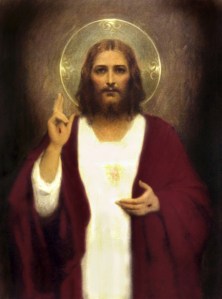
sacred-heart-jesus-chambers-w600x810

May 1st, 2016; 6th Sunday of Easter

Gospel John 14:23-29

Jesus said to his disciples: “Whoever loves me will keep my word, and my Father will love him,
and we will come to him and make our dwelling with him. Whoever does not love me does not keep my words; yet the word you hear is not mine but that of the Father who sent me. “I have told you this while I am with you. The Advocate, the Holy Spirit, whom the Father will send in my name, will teach you everything and remind you of all that I told you. Peace I leave with you; my peace I give to you. Not as the world gives do I give it to you. Do not let your hearts be troubled or afraid. You heard me tell you, ‘I am going away and I will come back to you.’
If you loved me, you would rejoice that I am going to the Father; for the Father is greater than I.
And now I have told you this before it happens, so that when it happens you may believe.”

Meditation Reflection:

“As the world gives” tends to leave a person bitter and disillusioned.  It begins with promises of security and pleasure but lacks real permanency or loyalty.  After awhile we even struggle to relax during periods of calm, worrying that it won’t endure long.    Nothing seems to last and this causes anxiety in good times and in bad.

The philosopher Pascal lamented that man is but a feeble reed, easily brought to its end by the smallest ailment.  Most of our lives, he asserts, are spent trying to distract ourselves from the unsettling dread we feel when we take time to think about the purpose of our lives or the reality of our mortality.  He concludes that this universal experience supports the fact that happiness can be found in God alone:

“All men seek happiness. This is without exception…And yet after such a great number of years, no one without faith has reached the point to which all continually look. All complain, princes and subjects, noblemen and commoners, old and young, strong and weak, learned and ignorant, healthy and sick, of all countries, all times, all ages, and all conditions…A trial so long, so continuous, and so uniform, should certainly convince us of our inability to reach the good by our own efforts.” Pascal Pensees

Pope Francis observed that we have created an entire “throwaway culture,” marked by the readiness to discard even relationships and people as soon as they become inevitably difficult.  Consequently, he says, people begin to despair and make the assumption that they will never experience unconditional love.  Because they have never experienced mercy, they conclude that they never will.  As a result, they struggle in the darkness of sin, feeling alone and without the possibility of healing.

The fragility of our era is this,  too:  we don’t believe that there is a chance for redemption; for a hand to raise you up; for an embrace to save you, forgive you, pick you up, flood you with infinite, patient, indulgent love; to put you back on your feet.  We need mercy.” Pope Francis, The Name of God is Mercy

Christ however offers the peace every human soul longs for – permanent, deep, and healing.  Moreover, we do not have to chase after it like a greyhound that will never catch the rabbit.  Rather, Christ bestows His peace freely as a fruit of His unconditional love.  To receive this peace we merely need to enter into a relationship of love with Him. Relationship with Christ is merciful and enduring.  Jesus doesn’t throw us away when we become difficult or even when we betray Him. He persists in pursuing us, binding our wounds, and transforming our hearts. His greatest pain, he revealed to St. Faustina, is our lack of trust in Him.  To Mother Teresa, He said, “I thirst”; meaning He thirsts for our souls and relationship with us.

Relationships are risky – they require two people to both freely choose to love one another.  No matter how faithful, how loving, how sacrificial one partner is willing to be, if the other walks away the relationship ends.  Christ is the ultimate risk taker.  He loves us no matter what, even if that love is unrequited.  Moreover, the partner who walks away suffers the greatest loss because he or she closes himself off from the riches of the other partner’s love.  When we walk away from Christ, we close ourselves off from the love He longs to bestow upon us.

Jesus offers peace, love, and joy.  All we must do is live in a loving relationship with Christ.  To do this He says, we must follow His commands.  We live in a wounded world confused about authentic love.  Jesus teaches us through His commands and offers the perfect example for us to imitate.

We can chase after the illusion of love or embrace the God who is love.  If we choose the latter, God will dwell within us and our joy will be complete.  It feels more risky because it’s harder to see at first. Ultimately however, it’s the soundest reality and truest love.

Consider:

  • Jesus says, “Do not let your hearts be troubled or afraid.” What do you allow to cause you anxiety and fear?  Surrender each thing to the Lord and entrust your concerns to Him.
  • Reflect on the love of Christ. Consider the freedom and joy experienced by the saints in every generation for the last two thousand years.
  • Reflect on how Christ has blessed you over the course of your life. Then reflect on how He has blessed you this week. What needs has He met?  What has He conquered for you?  When have you felt the embrace of His love?  When have you experienced His beauty or glory?

Make a Resolution (Practical Application):

  • Examine your day each night or morning.  Thank God for His blessings.  Recognize when He came to your aid.  Identify when you failed to love Christ or your neighbor and ask for Jesus’ help to do better the next day.


~ Written by Angela Lambert © 2016

* To receive these weekly posts automatically in your email just click the “follow” tab in the bottom right hand corner and enter your email address.


Love and Mercy in Superabundance

by Angela Lambert

Raphael,_The_Miraculous_Draught_of_Fishes_(1515)

Gospel John 21:1-19 (April 10th, 2016; 3rd Sunday in Easter)

At that time, Jesus revealed himself again to his disciples at the Sea of Tiberias. He revealed himself in this way. Together were Simon Peter, Thomas called Didymus, Nathanael from Cana in Galilee, Zebedee’s sons, and two others of his disciples. Simon Peter said to them, “I am going fishing.” They said to him, “We also will come with you.” So they went out and got into the boat, but that night they caught nothing. When it was already dawn, Jesus was standing on the shore; but the disciples did not realize that it was Jesus. Jesus said to them, “Children, have you caught anything to eat?” They answered him, “No.” So he said to them, “Cast the net over the right side of the boat and you will find something.” So they cast it, and were not able to pull it in because of the number of fish. So the disciple whom Jesus loved said to Peter, “It is the Lord.” When Simon Peter heard that it was the Lord, he tucked in his garment, for he was lightly clad, and jumped into the sea. The other disciples came in the boat, for they were not far from shore, only about a hundred yards, dragging the net with the fish. When they climbed out on shore, they saw a charcoal fire with fish on it and bread. Jesus said to them, “Bring some of the fish you just caught.” So Simon Peter went over and dragged the net ashore full of one hundred fifty-three large fish. Even though there were so many, the net was not torn. Jesus said to them, “Come, have breakfast.” And none of the disciples dared to ask him, “Who are you?” because they realized it was the Lord. Jesus came over and took the bread and gave it to them, and in like manner the fish. This was now the third time Jesus was revealed to his disciples after being raised from the dead. When they had finished breakfast, Jesus said to Simon Peter, “Simon, son of John, do you love me more than these?” Simon Peter answered him, “Yes, Lord, you know that I love you.” Jesus said to him, “Feed my lambs.” He then said to Simon Peter a second time, “Simon, son of John, do you love me?” Simon Peter answered him, “Yes, Lord, you know that I love you.” Jesus said to him, “Tend my sheep.” Jesus said to him the third time, “Simon, son of John, do you love me?” Peter was distressed that Jesus had said to him a third time, “Do you love me?” and he said to him, “Lord, you know everything; you know that I love you.” Jesus said to him, “Feed my sheep. Amen, amen, I say to you, when you were younger, you used to dress yourself and go where you wanted; but when you grow old, you will stretch out your hands, and someone else will dress you and lead you where you do not want to go.” He said this signifying by what kind of death he would glorify God. And when he had said this, he said to him, “Follow me.”

 Meditation Reflection:

I was recently presented with the question, “How can we know that the Christian religion is the true one as opposed to others?”  I responded that ours is the only one whose founder has risen from the dead.

The miracle of Christ’s resurrection affirms the truth of His teachings and the divinity of His truths.  The apostles evangelized by bearing witness to this event, one that they experienced with their own eyes. Many struggle to trust in Jesus because we cannot see Him.  However, the Gospels, Acts of the Apostles, and numerous Epistles all testify that our faith does not rely on mere ideology but rather the physical resurrection of our Lord witnessed by reputable persons who all suffered for their testimony.  Not a single apostle recanted his position to avoid martyrdom.  All of them endured severe trials and difficulties with no monetary or physical reward.  They had no ulterior motive.  They did not say they “believed” Jesus had risen from the dead, but rather that they had all “seen” the risen Lord.

God knows we struggle to believe without seeing.  Despite our weak faith, He mercifully became incarnate that we might see Him when He redeemed us.  Moreover, He exceeded all expectations of the imagination by liberating us Himself rather than sending someone in his place.

We have all heard stories of backpackers or journalists who cross an enemy line and become imprisoned in a dangerous or violent country.  Imagine if you were that person, afraid in your cell as to what will come of you, praying that your president will learn of your state and send someone to save you.  You might hope for a diplomatic solution or even military special ops to heroically liberate you.  Consider your surprise however if the president himself were to show up in military gear and break you out of prison at his own personal risk.

Christ reveals the love of God that exceeds any possible expectation or imagination.  He condescends to our limitations even though He deserves better.  He liberates us at His own painful expense.  Moreover, He gives us a share in His resurrection and a chance at new life.

The Christian life is a response to the love and mercy we have first received from our Lord.  Peter fed the Lord’s sheep because of his love and gratitude for His mercy.  Jesus did not throw away their friendship after Peter’s betrayal.  Instead He gave Peter a second chance, an opportunity for contrition, forgiveness, and conversion.

Jesus gives each of us this same opportunity.  He comes to wherever we are, offering us something to eat and an outstretched hand of friendship.  He asks each of us the same question: “Do you love Me?”  If the answer is yes, then He insists we respond in kind by extending a hand up to others and accompany them toward their conversion.

Pope Francis just released his apostolic exhortation “The Joy of Love” on Friday.  It’s a beautiful, rich document of encouragement based on the proceedings of the synod on the family.  Although it’s quite lengthy Pope Francis encourages us in the opening pages to take our time reading it.  He addresses in a comprehensive way the joy of love in families – both the ideal as the gift God has given to us, and the painful “irregularities” that need careful healing.  The love of Christ and the call to feed His sheep begins in our families.   Jesus asks that if we love Him, we ought to give generously and tenderly to those placed by Him in our daily lives, beginning with our families and reaching out from there.

Consider:

  •  It’s easy to be discouraged by our failures.  Consider the encounter of Peter with Christ.  What failure would weigh heavy on your heart if you faced the Lord?  How would you respond to His hand up and His offer of mercy?
  • Who in your life needs your mercy? How might you offer him or her a hand up?
  • Consider how Christ can be recognized by His superabundance. When the apostles pulled in such a large catch, John knew immediately it was the Lord.
    • When has Christ surprised you by exceeding your expectations?
    • Ask for the gift of surrender and openness. Rather than giving Christ a list of tasks you would like Him to help accomplish, surrender the logistics to Him and do the tasks He sets before

Make a Resolution (Practical Application):

  • Offer mercy toward someone each day this week. (See this link for a list of the corporal and spiritual Works of Mercy)
  • Offer Christ your work week. Give him one week of being in charge and trust Him to accomplish His will.  Just do the tasks He sets before you and let Him bring things together.
  • Begin reading Pope Francis “The Joy of Love”

~ Written by Angela Lambert © 2016

* To receive these weekly posts automatically in your email just click the “follow” tab in the bottom right hand corner and enter your email address.


Living in Denial…Gospel Meditation for February 28, 2016

by Angela Lambert

denial
February 28, 2016; 3rd Sunday of Lent

Gospel of Luke 13:1-9
Some people told Jesus about the Galileans whose blood Pilate had mingled with the blood of their sacrifices. Jesus said to them in reply, “Do you think that because these Galileans suffered in this way they were greater sinners than all other Galileans? By no means! But I tell you, if you do not repent, you will all perish as they did! Or those eighteen people who were killed when the tower at Siloam fell on them—do you think they were more guilty than everyone else who lived in Jerusalem? By no means! But I tell you, if you do not repent, you will all perish as they did! “And he told them this parable: “There once was a person who had a fig tree planted in his orchard, and when he came in search of fruit on it but found none, he said to the gardener, ‘For three years now I have come in search of fruit on this fig tree but have found none. So cut it down. Why should it exhaust the soil?’ He said to him in reply, ‘Sir, leave it for this year also,and I shall cultivate the ground around it and fertilize it; it may bear fruit in the future. If not you can cut it down.’”

Meditation Reflection:

The mystery of God’s Mercy and Justice extends beyond the limits of our comprehension. Nevertheless, Jesus exhorts us to never forget that God is both. Pope Francis has dedicated this year to reflecting on this mystery and living it out in our own lives through going to Confession and practicing the spiritual and corporal works of mercy. God’s mercy makes salvation possible through even the smallest opening of repentance and desire in our hearts. However the mercy we experience on a day to day basis, the undeserved blessings God showers as a doting Father, can also lead to complacency.

Mercy means healing and transformation. In our complacency we can begin to think that we deserve our blessings and forget our sins, or worse forget our blessings as well. St. Paul reminds us in I Corinthians 10:1-12 that the Israelites, after witnessing the mighty hand of God liberating them from Egypt and walking on dry land through the Red Sea, reverted to doubt, fear, and grumbling in the desert. In consequence, although liberated by God from Egypt, they died in the desert unable to enter the Promised Land. God can work mighty deeds in our lives. His mercy will cut through any sin. God’s forgiveness is not merely “spiritual dry-cleaning” as Pope Francis has termed it. God’s work heals and transforms. This process ought to bear fruits therefore of virtue, sanctity, and love. In fact, one of the ways St. Teresa of Avila verified the authenticity of a spiritual experience was by the fruits of virtue that accompanied it.

Jesus warns today that God’s mercy is inextricably united to God’s justice. God has given us free will. He will honor that gift. If we choose to reject the opportunity for life which comes through healing from sin, then at some point we will die. God offers us more chances than we deserve but they are limited by time and by our choices.

The Year of Mercy Pope Francis has established corresponds to his “Theology of Sin” because we cannot receive the fruits of mercy until we acknowledge and repent of our sin. In an article in First Things (8/19/13), William Doino Jr. addresses this theology of sin by the pope and notes its importance due to our wide-spread denial of sin altogether as a culture. He presents a three-step process Pope Francis has advocated for:

“The first part is to recognize the darkness of contemporary life, and how it leads so many astray: Walking in darkness means being overly pleased with ourselves, believing that we do not need salvation. That is darkness! When we continue on this road of darkness, it is not easy to turn back. Therefore, John continues, because this way of thinking made him reflect: ‘If we say we are without sin, we deceive ourselves and the truth is not in us.’”

If we do not suffer under the oppression of sin, we do not need a redeemer. When we live in denial of our sins and addictions we refuse the opportunity for help. For example, if a person lives in denial of their regular rude or hurtful comments under the rationalization that they are just “speaking their mind”, then they will soon lose relationships and friendship. If a person lives in denial of their intemperance in spending or greed for possessions beyond their means, they will eventually suffer bankruptcy. Similarly, if we live a self-centered life rather than a God-centered life, we could miss the opportunity for heaven.

After opening our eyes to our sins (with the help of the Holy Spirit), the second part of the process is to take them to confession; not with an attitude of a quick shower but with a humble, and deeply contrite heart. The word Pope Francis used to describe this feeling is a word we shy away from in our culture – shame. When we feel truly ashamed however we desire change and open ourselves up to help.

The final part of the process he writes, is:

“having absolute faith in God to renew us: We must have trust, because when we sin we have an advocate with the Father ‘Jesus Christ the righteous.’ And he ‘supports us before the Father’ and defends us in front of our weaknesses.”

Rather than despair at our weaknesses and imperfections, Pope Francis reminds us to put our trust in Christ. We must acknowledge that we cannot change on our own and allow Jesus to apply His healing grace to our souls – enlightening our minds, strengthening our wills, and fanning the flame of love for God and neighbor.

In conclusion, the mystery of God’s Justice and Mercy requires us to make an active decision to turn away from sin and accept God’s help. Because grace is freely given by God, fruits of that grace are expected too. If we do not bear fruit, we can conclude that we have not actually been receptive to grace. If we do bear fruit, it will evoke feelings off gratitude and love because we know who we are and from where those virtues truly came.

Consider:

  • How has facing your faults, though painful, made you a better person with the help of Christ? How are you different today than in years past?
  • Has God ever “rebuked” you? Did it have a positive effect later or lead to greater freedom?
  • Are there faults you continue to rationalize? Do you treat your spouse, children, or family members with the love they deserve or do you excuse your behavior by saying they should love you as you are without an effort to change?
  • Have you ever experienced the pain of seeing someone you love self-destructing or suffering due to living in denial of a serious problem? Have you offered help and been rejected? Consider how this relates to God’s perspective.

Make a Resolution (Practical Application):

  • Read an examination of conscience and prayerfully reflect on it. Most parishes have a pamphlet by the confessional with an examination, you can also find some online. If possible, look for one tailored to your state in life (e.g. single, married, priest, etc.)
  • Read the First Things article on Pope Francis’ Theology of Sin. First Things “The Pope’s Theology of Sin”
  • Choose one sin you have been avoiding admitting and actively root it out through prayer and practicing the opposite virtue. (For example – greed is combated by generosity)

~ Written by Angela Lambert © 2016

* To receive these weekly posts automatically in your email just click the “follow” tab in the bottom right hand corner and enter your email address.