Finding Yourself…

by Angela Lambert

July 2nd, 2017; 13th Sunday Ordinary Time

 Gospel of Matthew 10:37-42

Jesus said to his apostles: “Whoever loves father or mother more than me is not worthy of me, and whoever loves son or daughter more than me is not worthy of me; and whoever does not take up his cross and follow after me is not worthy of me. Whoever finds his life will lose it, and whoever loses his life for my sake will find it. “Whoever receives you receives me, and whoever receives me receives the one who sent me. Whoever receives a prophet because he is a prophet will receive a prophet’s reward, and whoever receives a righteous man because he is a righteous man will receive a righteous man’s reward. And whoever gives only a cup of cold water to one of these little ones to drink because the little one is a disciple—amen, I say to you, he will surely not lose his reward.”

Meditation Reflection:

I would think of this passage often when my kids were little.  After finally getting them tucked into bed, just as I would sit down to finally relax, I would hear a little voice call out “Mooooooooom.   I’m thirsty.” Fighting the frustration in my thoughts and body, I would remind myself, “And whoever gives only a cup of cold water to one of these little ones to drink…”

Following Christ means loving Him above all things, including all people, and most importantly above ourselves.  If He were only a man this directive would be ridiculous and arrogant.  Jesus gives this command because He is God.  St. Augustine famously wrote:

“There can only be two basic loves… the love of God unto the forgetfulness of self, or the love of self unto the forgetfulness and denial of God.”

As much as we may try to avoid this decision, the limits imposed on us by time and space force a choice.  Sometimes it means a clear fork in the road, while at other times it may mean small daily sacrifices.

Discipleship applies to every vocation – priest, religious, married, and single. Priests and religious give a clear witness of total gift of self to God.  Their remarkable vows and their counter-cultural lives attest to their faith in eternal life as they sacrifice worldly goods for heavenly.  Just this week, a friend of mine who’s a nun, came by with three sisters to take some furniture I was giving away.  That same day two workmen were at the house working on taping and mudding the basement that’s being finished.  As they came upstairs to take a break, they saw three nuns in full habit and me carrying a large bookshelf out of the house.  Imagine their surprise!  One offered to help when he saw us struggle to lift it to the truck.  Later one of the sisters asked him to help us tie down the furniture and he generously assisted. I have no doubts that will be a sight they remember forever, and a story they will tell for at least the next week.

Married and single persons blend in to society more as even secular persons marry or remain single.  However, it doesn’t take long for Christians to stand out even in these vocations.  The disciple of Christ remains faithful to marriage vows even when the culture dismisses them.  Catholic families notoriously stand out as they tend to (though are not required to) exceed the usual one girl and one boy trend.  Every mother I know who has more than three kids, has recounted to me comments made to them about the number of children they have.  These comments come from family members as well as complete strangers in places as random as the grocery store.  Openness to life necessitates losing your “life” to receive it back from Christ.  It affects your body, your sleep, your emotions, your free time, your career choices, your travel, your finances, and so on. Once when I was congratulating a couple I know who were pregnant with their sixth child, the father conveyed his struggle that now they would have to get a full size van.  Many of lamented the min-van transition, but the large 12 passenger van step is even harder.  That is sacrifice.  However, any mother or father will tell you, when you hold that baby in your arms you realize it’s completely worth it.

Finally, single persons stand out in their discipleship too.  the Christian who lives chastely and temperately, puts others before themselves, and makes decisions prayerfully, shines a bright light in a culture that glamorizes promiscuity, partying, and self-advancement. They use their freedom to give of their time generously rather than selfishly.  A single woman I know put it this way to me – she said that she was totally free for the Lord to call at any moment.  Whereas others served God through their obligations to their family or religious order, she said, God needs some people who can be available any time anywhere.  I hadn’t thought of that before she shared that insight with me.  Of course she had to go to work and take care of her home, but she recognized that she had tremendously more “free” time and flexibility than the other vocations and intentionally chose to consecrate that time and freedom to God.

Discipleship comes at a cost, but Jesus promises it to be an investment.  Things of this world will always be insecure.  Jobs can be lost, stock markets dive, beauty and health get marred by illness, and so on.  Every investment we make in the Lord however will merit glory in heaven forever.  When I drag my tired body off the couch to give my thirsty daughter a cup of water at night, it remains treasured by God forever along with every sacrifice of love that we make.

We can’t be in two places at once and there will always be only 24 hours in a day.  We have to make choices.  Jesus encourages us to be strong against temptations no matter where, or from whom, they come. He also sent the Holy Spirit to provide the gifts of fortitude and counsel we will need to make those decisions prayerfully and follow through on them courageously.  He also gave us the gift of the Church to guide us and inspire us.

Jesus pointed out that you can tell a tree by it’s fruits.  Even though self-love appears prudent, in our culture it has produced the highest levels of depression, “anger issues”, and suicide in history.  Love of God above all things is only prudent from an eternal perspective, it requires faith. However it has produced thousands upon thousands of saints, the first mark of which is Joy.

Consider:

  • When have you chosen yourself over God?  How did you rationalize it?  How did you feel afterward?
  • When have you chosen God over yourself?  How did God provide for you in that decision and bless you afterward?
  • Reflect on Jesus’ paradoxical words that we find ourselves in losing ourselves.  Pope St. John Paul II expressed the same idea saying that we find self-fulfillment through self-gift.  Others have expressed this phenomenon by saying that when they volunteered somewhere, they received more than they gave.
  • Who has been a witness to you by their Christian discipleship?  What stuck out to you about them?
  • In what ways do you witness to Christ in your life?  What makes it difficult?  What makes it rewarding?
  • How can you practice Works of Mercy in your everyday life and your vocation.

Make a Resolution (Practical Application):

  • Pray for an increase in the Gifts of the Holy Spirit (Wisdom, Understanding, Counsel, Knowledge, Fortitude, Piety, and Fear of the Lord), and the grace needed to follow Christ.
  • Intentionally practice one Works of Mercy each day this week.


~ Written by Angela Lambert © 2017

* To receive these weekly posts automatically in your email just click the “follow” tab in the bottom right hand corner and enter your email address.


Because of Your Name….

by Angela Lambert

person in prayer


June 25th 2017; 12th Sunday Ordinary Time

Gospel of Matthew 10:26-33

Jesus said to the Twelve: “Fear no one. Nothing is concealed that will not be revealed, nor secret that will not be known. What I say to you in the darkness, speak in the light; what you hear whispered, proclaim on the housetops. And do not be afraid of those who kill the body but cannot kill the soul; rather, be afraid of the one who can destroy both soul and body in Gehenna. Are not two sparrows sold for a small coin? Yet not one of them falls to the ground without your Father’s knowledge. Even all the hairs of your head are counted. So do not be afraid; you are worth more than many sparrows. Everyone who acknowledges me before others I will acknowledge before my heavenly Father. But whoever denies me before others, I will deny before my heavenly Father.”

Meditation Reflection:

Because of Christ’ Name, we suffer.  But by His Holy Name, we are saved.

As long as you remain lukewarm in your faith, keep it private, and compartmentalize it from the rest of your life, you will likely enjoy peace with the world.  If you proclaim Jesus to be a great teacher like Buddha, but refrain from calling Him God, people will respect you and your “spirituality.”  If you acknowledge Christ as one way and not The Way, most people will put up with your belief, since they afford everyone a little bit of foolishness.

One problem…to proclaim a nice moral teacher who isn’t God and isn’t the Way, the Truth, and the Life, is not to proclaim Jesus Christ.  Jesus promises that “Everyone who acknowledges Me before others I will acknowledge before My heavenly Father.”  To do that however, we must  proclaim the God Who became Man, that He is the fullness of Revelation – Divine Truth, the Savior of all mankind, and Love incarnate.  To proclaim a myth of our own making, and worse to belittle Christ by using a weakened, distorted, version of Him as our inspiration, is to deny Christ.  Jesus warns “But whoever denies Me before others, I will deny before My heavenly Father.”

To proclaim Christ takes serious guts, and I don’t’ just mean speaking about Christ.  Simply living your faith in everyday life will incite criticism and even personal attacks by others.

If you go to Church every Sunday despite competing demands for your time, you may be accused of being too rigid or too zealous.  Those who would prefer you prioritize them over God will accuse you of being uncharitable or having an unhealthy scrupulosity.  Those whose own church attendance looks lackluster in comparison will more likely try to find fault with your devotion rather than to imitate it.

If you believe that Jesus is the Truth – the Word of God, prepare to be accused of intolerance, close-mindedness, and archaic thinking.  Even if you do not “push your beliefs on others”, your simple rejection of the religion of Relativism will offend its many followers (note: Relativism states that there is no objective truth, except, paradoxically, Relativism).  Moreover, no matter how hard persons try to rationalize sins, their God-given consciences sense the truth and can’t help but react at reminders.  People who want to live in darkness hate the light. It happens at every age.  Teens who don’t drink or engage in pre-marital sex, get left out of parties and certain social groups. Adults who put God and family first, get left out of some events or opportunities at work, or in neighborhood gatherings.

It’s hard to follow Christ, especially when it means staying up at night with a newborn, while colleagues or friends fly off to sunny vacations.  It takes humility to make time for Mass and soccer games, knowing others will “get ahead” in their career because of their willingness to work all hours and days.  And what do you get for your sacrifice and virtue? Consider, how did Cain react toward Abel? How did Joseph’s brothers treat his piety? You will be honored by God and those who are Godly, but you will be scorned by those of the world.

Jesus is the Truth, and Satan is the father of lies.  Those who live by Truth will threaten those lies.  In retaliation, just as Satan spread lies to Adam and Eve about God, and just as he continues to spread lies about Jesus, Satan will spread lies about Jesus’ followers too.  We can feel helpless in these situations because it’s hard to defend ourselves when the other person fights dirty.  Jesus knows our struggle and has experienced our pain.  Thus, He assures us beforehand to “Fear no one.  Nothing is concealed that will not be revealed.”  Jesus promises that the Truth will conquer in the end.  It requires more patience, a lot of faith, and Holy Spirit courage though.

It’s hard to suffer unjust treatment and unwarranted animosity, especially when you are simply trying to live your own quiet Christian life.  Take heart however, people don’t get bothered by the lukewarm or the mediocre; whereas greatness is always challenged.  The more you are treated like Christ (the real Christ, not the mythical nice guy in sandals), the more it means you are becoming Christ-like.  So, as Pope St. John Paul II repeated again and again, “Be not afraid.”  Let Christ’s love in you soften hearts, even if they scream at you first.  Let the light of Christ radiate in you and cut through the darkness.  As the prophet Jeremiah witnessed in today’s first reading (Jer 20:10-13), “the Lord is with me, like a mighty champion: my persecutors will stumble, they will not triumph.”

Consider:

  • When did Jesus experience the most criticism and rejection?  Consider how His mighty works of healing and love, were met with envy and anger by some of the Jews.
  • Consider the mystery of the Cross.  Christ suffered out of love for us and was rejected.  Yet He rose again to new life and brought about our salvation.  How might we offer our pain and suffering from others’ rejections for their salvation, like Christ has done for us?
  • Reflect on a time when you “preferred darkness to light.”  How did you rationalize your sin or your way of thinking?  How did you react toward someone whose life shined a light on it?
  • Reflect on a time when you preferred light to darkness.  When have you experienced joy and freedom when the Truth in someone else’s life, freed you from a lie in your own?

 Make a Resolution (Practical Application):

  • Each day this week, pray an Our Father or a Hail Mary for someone who is persecuting you.
  • Each day this week, pray Psalm 69.
  • Offer this prayer each day:
Lord, I don’t want my light to be so dim as to not make a difference.

I beg You to make Your Divine Light shine through me with such radiance,

That it frees with Your Truth, those held captive by lies,

Guides those who are lost, back to You,

And lifts up lonely, discouraged souls with Your Love.


~ Written by Angela Lambert © 2017

* To receive these weekly posts automatically in your email just click the “follow” tab in the bottom right hand corner and enter your email address.


Putting your sweat and blood into it…

by Angela Lambert

June 18th,2017;  Solemnity of the Body and Blood of Christ

 Gospel of John 6:51-58

Jesus said to the Jewish crowds: “I am the living bread that came down from heaven; whoever eats this bread will live forever; and the bread that I will give is my flesh for the life of the world.” The Jews quarreled among themselves, saying, “How can this man give us his flesh to eat?” Jesus said to them, “Amen, amen, I say to you, unless you eat the flesh of the Son of Man and drink his blood, you do not have life within you. Whoever eats my flesh and drinks my blood has eternal life, and I will raise him on the last day. For my flesh is true food, and my blood is true drink. Whoever eats my flesh and drinks my blood remains in me and I in him. Just as the living Father sent me and I have life because of the Father, so also the one who feeds on me will have life because of me. This is the bread that came down from heaven. Unlike your ancestors who ate and still died, whoever eats this bread will live forever.”

Meditation Reflection:

Today we celebrate Christ’s gift of His Body and Blood.  Consider the meaning of giving our body to another.  Husband and wife express the intimacy and totality of their love in physical unity.  Every new life enters the world through the sacrificial gift of a mother, who offers her body and blood to her child.  Fathers invest their sweat and blood in their children as well in the myriad of ways they meet their children’s needs. How many dads have went to bed after a day of working to provide for their family, playing with their kids, building out part of the house to make room for more kids, or helping to finish their adult child’s basement saying, “my whole body hurts.”  Even friendship is demonstrated in physical sacrifice.  If you’ve ever called on friends to help you move, or been the friend who said yes to that call, you know what I mean!

The Son of God became man, in every way.  He invested His mind and heart, and His body and blood.  He desires nearness to us in the most intimate of ways.  Jesus spent thirty-three years living humbly, and bringing tangible, immanent love to those He encountered.  His sacrificial suffering and death of the Cross atoned for our sins, giving us new life as children of God for eternity.

Jesus instituted the Sacrament of the Eucharist for two reasons.  He established it as memorial so that His sacrifice on the Cross would be made present again every time the Mass is celebrated so that we might be nourished by its graces.  Secondly, because He wants to be as near to us as possible.  When we receive the Eucharist at Communion, Jesus offers Himself in the most intimate and loving way, like that of a husband and wife.  Through His Eucharistic presence, He continues to be with us in a tangible way.  Human beings need physical closeness, especially when we need comfort in sorrow or in expressions of love.  Jesus Christ is, and will forever continue to be, both God and man.  It’s easy to take His presence in the Eucharist for granted, especially when it requires the eyes and heart of faith.  Today we take time to reflect as a Church on the beautiful, and mysterious gift, to cherish our Lord, and to deepen our appreciation for the sweat and blood He puts into His love.

Consider:

  • Consider the many ways we express love physically.  Why is physical love so important?  How does it create intimacy in relationships?
  • Reflect on Christ’s physical expressions of love – during His hidden life, His public ministry, His sacrifice on the Cross, and His Eucharistic presence today.
  • This year the Solemnity of Christ’s Body and Blood falls on the same Sunday as Father’s day.  Consider the ways in which dad’s offer their bodies and blood for their families.

Make a Resolution (Practical Application):

  • Visit Christ at Church this week.  Spend time in prayer near the tabernacle, or at Eucharistic Adoration.
  • Make a physical sacrifice of love for someone this week, in appreciation of Christ’s physical sacrifice.


~ Written by Angela Lambert © 2017

* To receive these weekly posts automatically in your email just click the “follow” tab in the bottom right hand corner and enter your email address.


Finding Fulfillment in Self-Gift

by Angela Lambert

June 11th, 2017;  Solemnity of the Most Holy Trinity


Gospel of John 3:16-18

God so loved the world that he gave his only Son, so that everyone who believes in him might not perish but might have eternal life. For God did not send his Son into the world to condemn the world, but that the world might be saved through him. Whoever believes in him will not be condemned, but whoever does not believe has already been condemned, because he has not believed in the name of the only Son of God.

Meditation Reflection:

Consider for a moment this incredible fact: we are made in the image and likeness of the Trinitarian God.  Although God’s essence exceeds our understanding, He has nevertheless revealed His nature to us and even given us an experience of it imprinted on our own human nature.

God has revealed that He is Love (1 Jn 4:8) and that He is Father, Son, and Holy Spirit (Mt 28:19).  From the Father, we observe that God is creative.  From the Holy Spirit, we observe His immanent might and love operative in our souls.  And from the Son, we learn that God’s creative, mighty, love, is sacrificial.

What does this mean for you and me?

We live in a culture that forms us to be autonomous, independent, and self-seeking.  Humanitarian works and acts of kindness may be valued to the extent that they make life more  pleasant in general, but not to the extent that it requires personal sacrifice – a real loss of some kind.

Human happiness does come through self-realization and self-fulfillment, but not in the way our culture defines those terms.  The Trinity is a relationship of three divine Persons in mutual self-gift and love.  This means that, as creatures made in the image of the Trinity, we achieve self-fulfillment through self-giving love.

It’s a paradox, but one that Christ emphasized over and over in both His teachings and His life.

“For whoever would save his life will lose it, and whoever loses his life for My sake, will find it.”  (MT 16:25)

Christian discipleship means living and being as Christ.  The Gospel today proclaims that Jesus came from the Father, for us.  Pope Benedict XVI concludes from this that Jesus’ whole “being itself is service” (Introduction to Christianity; Ignatius Press).  Avoid imagining Jesus as just a really nice guy however.  Pope Benedict isn’t referring to volunteering more.  He means that Jesus’ whole existence is one of relationship, and a relationship of service.  Thus, Christian discipleship transforms us from self-centered lives, to God and others-centered lives.

To be God-centered, to be from God and for others as Christ was, requires a radically different worldview than our secular culture.

Pope St. John Paul II, as he examined God’s words in Genesis (2:18) that “It is not good that the man should be alone; I will make him a helper fit for him,” concludes that the human person is made for relationship.  He writes

“ ‘alone,’ man does not completely realize this essence.  He realizes it only by existing ‘with someone’ – and even more deeply and completely – by existing ‘for someone.’”

He’s not saying that we must become slaves with no individual identity.  Rather, he’s saying that men and women find self-fulfillment through self-gift.  Self-gift, by definition, means giving yourself to someone.  It means we find happiness in loving sacrifice.

St. Mother Teresa said that everyone has an opportunity to love as Christ did, and therein find happiness.  To find that someone we simply need to look around us.   As we celebrate the Blessed Trinity today, let us celebrate the gift of relational love.  Mary always perceived the needs of others around her, let us pray for her intercession to see opportunities for self-gift around us as well, even it means sacrifice.

Consider:

  • Consider the eternal relationship of love between the Father, the Son, and the Holy Spirit.
  • Imagine the joy of heaven, where the saints share in that relationship of love.
  • Reflect in a prayer of gratitude for each experience of loving relationship God has gifted you with.
  • Pray for reconciliation in relationships that need healing.

Make a Resolution (Practical Application):

  • Each day this week, find one way to love another person.  Ask for Mary’s intercession.

Related Posts:

The Most Marvelous Mystery! Gospel Meditation for the Solemnity of the Most Holy Trinity

Determined Discipleship

Do Not Let Your Hearts Be Troubled…Peace and Surrender in Christ

Finding True Love

~ Written by Angela Lambert © 2017

* To receive these weekly posts automatically in your email just click the “follow” tab in the bottom right hand corner and enter your email address.


Real Super-Powers…Meditation on Pentecost

by Angela Lambert

June 4th, 2017 Pentecost

 (First Reading) Acts of the Apostles 2:1-11

When the time for Pentecost was fulfilled, they were all in one place together. And suddenly there came from the sky a noise like a strong driving wind, and it filled the entire house in which they were. Then there appeared to them tongues as of fire, which parted and came to rest on each one of them. And they were all filled with the Holy Spirit and began to speak in different tongues, as the Spirit enabled them to proclaim. Now there were devout Jews from every nation under heaven staying in Jerusalem. At this sound, they gathered in a large crowd, but they were confused because each one heard them speaking in his own language. They were astounded, and in amazement they asked, “Are not all these people who are speaking Galileans? Then how does each of us hear them in his native language? We are Parthians, Medes, and Elamites, inhabitants of Mesopotamia, Judea and Cappadocia, Pontus and Asia, Phrygia and Pamphylia, Egypt and the districts of Libya near Cyrene, as well as travelers from Rome, both Jews and converts to Judaism, Cretans and Arabs, yet we hear them speaking in our own tongues of the mighty acts of God.”

Meditation Reflection:

Not only is God’s kingdom surprising in nature, He empowers us to do surprising things.  Just when we think we have God figured out, that we have the rituals down and expectations met and relax into comfortable religion, He surprises us again.  Jesus’ requests can seem boring at times – Jesus had told the apostles not to depart from Jerusalem, but to wait for the gift of the Holy Spirit (Acts 1:4-5).  They waited 10 days, from the time Jesus ascended into heaven, before the Holy Spirit came.  Imagine if they had given up, gotten antsy, decided to re-interpret what Jesus said, or do things their own way.  Instead, they faithfully waited together, spending their time in prayer.

Their trust in Christ’s word produced great fruit.  They received the gift of the Holy Spirit and unexpected abilities.  They could speak in different languages despite never having learned them.  Peter, a fisherman, could understand Scripture at new depths and articulate the connection between the events of Christ’s life with the Old Testament prophecies.  In the Name of Jesus, the apostles healed many people, and by the authority given to them by Christ, began baptizing and forgiving sins.  On Pentecost day alone, about 3,000 people were baptized.  Christ’s kingdom had finally come and all who believed received freedom in the Spirit.

The Holy Spirit continues to be operative in the Church and in the souls of every baptized individual.  It’s easy to theorize about the Holy Spirit without realizing just how immanent and active He is.  If we open ourselves up to Him, we may be surprised at just how much He empowers us.  To make a modern analogy, consider our cultural love for super-heroes.  Most of them are humans with an added power which enables them to do super-natural things.   While super hero stories make for great entertainment (and t-shirts), the super powers of the Holy Spirit are real.  Real people have been given the power to turn away from addictions and sins to live in the freedom of Christian virtue.  Real people have forgiven hated enemies and found reconciliation.  People paralyzed by anxiety and fear have found peace.  People in sorrow or depression have found comfort and joy.

The lives of the saints evidence the super-heroic power of the Holy Spirit in generous souls.  Some have endured torture and martyrdom with boldness, singing hymns of praise as they were killed.  Others have plumbed great depths of Scripture and Theology.  Still others have been given the mystical gift of the stigmata, suffering with the wounds of Christ.

Recent saints such as Pope St. John Paul II, St. Mother Teresa of Calcutta, St. Gianna Molla, and St. Padre Pio show the myriad of ways the Holy Spirit works in persons of faith in every vocation and state in life.  Each of them needed super-natural fortitude to persevere through the trials they encountered.  Each needed infused faith to stay close to God when all seemed lost.  Each brought healing, mercy, and super-natural love to those God had placed in their lives.  And each was enabled by the Spirit to sacrifice their lives in a heroic way out of Christian love.  Every saint testifies that the heroic things they do come from the Holy Spirit.  They too marvel at the miracles wrought through them, because they know more than anyone their own limitations.

Although these examples seem extraordinary, the Church teaches that the Holy Spirit makes sainthood possible for each of us if we allow Him.  The Gifts and Fruits of the Holy Spirit transform us and allow us to live as sons and daughters of God.  The only thing holding us back, is resistance by our own self-will.  The more we surrender to the Holy Spirit the more operative He can be within us.  When I neglect prayer, even for industrious reasons, I see my natural self and how easily I become frustrated, impatient, selfish, anxious, unfocused, or short-tempered.  On the other hand, when I make time for prayer a priority, my whole day I experience fruits of the Spirit that make me the best version of myself, or you could say the “super-natural” version of myself.  When tempted to skip prayer “to get more done”, I ask myself, “What do my kids, students, family, and friends need more from me – peacefulness or a longer checklist”?  Paradoxically, when I make time for prayer, more actually gets done as well, or at least the most important things.

We are saved by the merits of Christ’s sacrifice on the Cross, but we are sanctified (which means to be made holy) through the Holy Spirit.  Christ sent the Spirit on Pentecost to continue His work of Redemption.  We are forgiven in Baptism, and we are transformed over the course of our lives more and more through the working of the Spirit within us.  Jesus proclaimed that His kingdom was not of this world, meaning it exceeds the natural.  With the gift of the Holy Spirit, He has enabled us to live in the freedom and truth of His kingdom – to live super-naturally.  Maybe we all love super-hero stories, because we sense in our hearts that we are all called to be super-heroes too.

Consider:

  • Our culture tries to compartmentalize faith to something reserved for Sundays, or reduce it to a natural level like a social club or charitable works.  Consider to what extent you are affected by this tendency.   Do you compartmentalize your faith or reduce it to a natural level?
  • Consider the living, real, Person of the Holy Spirit.  Reflect on the incredible gift of baptism that He dwells within your very soul.
  • When have you experienced the Gifts of the Holy Spirit in your soul?
    • Gifts of the Holy Spirit enable us to fight for our faith and follow Christ’s command to love as He did (which goes above and beyond natural love – thus requires super-natural help).
    • The 7 gifts of the Holy Spirit are: Wisdom, Understanding, Knowledge, Counsel, Fortitude, Piety, Fear of the Lord.
  • When have you seen the Fruits of the Holy Spirit in your life?
  • Jesus said that you can tell a tree by its fruits.  Similarly, when we are docile to the Holy Spirit and unite ourselves to Him through prayer, He bears fruits in us.
  • The Fruits of the Spirit can be found in Galatians 5:22-23: love, joy, peace, patience, kindness, generosity, faithfulness, gentleness, and self-control.
  • Simply by adding a few minutes of prayer each day, you could grow in each of these fruits.  Imagine if you added 10 minutes of prayer or more!  Imagine if you sprinkled a couple of minutes of prayer throughout your day, inviting the Spirit to bear fruit in you.

Make a Resolution (Practical Application):

  • Reflect on one Gift or Fruit of the Holy Spirit a day.  Pray for an increase in it and greater awareness of the Holy Spirit working in your soul.
  • Pray the Prayer to the Holy Spirit each day:
Come, Holy Spirit, fill the hearts of your faithful. And kindle in them the fire of your love. Send forth your Spirit and they shall be created. And you will renew the face of the earth. Lord, by the light of the Holy Spirit you have taught the hearts of your faithful. In the same Spirit help us to relish what is right and always rejoice in your consolation. We ask this through Christ our Lord. Amen.

Related Posts:

Holy Spirit Help Me!

The Most Marvelous Mystery! Gospel Meditation for the Solemnity of the Most Holy Trinity

Love and Mercy in Superabundance


~ Written by Angela Lambert © 2017

* To receive these weekly posts automatically in your email just click the “follow” tab in the bottom right hand corner and enter your email address.


The Ascension of Christ & the Surprising Nature of the Kingdom of God

by Angela Lambert

May 28th, 2017; The Ascension of the Lord

 Acts of the Apostles 1:1-11

In the first book, Theophilus, I dealt with all that Jesus did and taught until the day he was taken up, after giving instructions through the Holy Spirit to the apostles whom he had chosen. He presented himself alive to them by many proofs after he had suffered, appearing to them during forty days and speaking about the kingdom of God. While meeting with them, he enjoined them not to depart from Jerusalem, but to wait for “the promise of the Father about which you have heard me speak; for John baptized with water, but in a few days you will be baptized with the Holy Spirit.” When they had gathered together they asked him, “Lord, are you at this time going to restore the kingdom to Israel?” He answered them, “It is not for you to know the times or seasons that the Father has established by his own authority. But you will receive power when the Holy Spirit comes upon you, and you will be my witnesses in Jerusalem, throughout Judea and Samaria, and to the ends of the earth.” When he had said this, as they were looking on, he was lifted up, and a cloud took him from their sight. While they were looking intently at the sky as he was going, suddenly two men dressed in white garments stood beside them. They said, “Men of Galilee, why are you standing there looking at the sky? This Jesus who has been taken up from you into heaven will return in the same way as you have seen him going into heaven.”

Meditation Reflection:

Christ is so humble in His Incarnation that we, like the apostles in today’s passage, can forget the awesome reality of His divinity.  For most of His earthly life, Jesus chose to veil His divinity.   He humbly lived among us as one of us, choosing a life of poverty and sacrifice.  Even when condemned to crucifixion, He told Pilate that He was not powerless in the situation (John 18:36).  Jesus chose to be sacrificed to save us.  He could have saved Himself, as those taunting Him urged, or defended Himself as Pilate suggested, but love kept Him on the Cross.

Christ came down from heaven to be a ransom for our sins.  At the completion of His mission however, He ascended back to heaven to reign in glory as the Son of God. Because of His humility during His earthly life, we overlook at times His divine dignity and His rightful place in Heaven.  Beyond anything we could have imagined, He promised to prepare a place for us there as well!

Jesus kept surprising His apostles and He continues to surprise us.  They imagined the savior as someone who would overpower their persecutors and restore things to how they used to be during the best time in Jewish history.  It took a while for them to accept that He would die and rise again.  Confused and scattered at His crucifixion, they rejoiced in awe at His resurrection.  Overwhelmed with joy that Christ was alive, and excited by His show of power they still imagined that they would enjoy the booty of His victory in an earthly kingdom.  Finally, they thought, now He will bring to fruition all our hopes and desires.  Thus, they ask, “Lord, are you at this time going to restore the kingdom to Israel?”

Jesus did not come to stay on earth however, but to bring us back to Heaven.  He does not put new wine into old wine skins (Matthew 9:14-17).  His kingdom exceeds our imagination.  The experience the Jews had under King David provided a foretaste and glimpse of the kingdom of God.  Jesus reveals that God has much more in store for us.

In order for them to receive the Holy Spirit and to begin their new life in Christ, they had to let go of their previous hopes and plans.  To rule in the Kingdom of God meant to surrender worldly power for the power of the Holy Spirit.  The Spirit which transforms lives with saving grace, Truth, peace, and love.    No other nation or religion has had the same universal, enduring, transformative effect, of the Christian faith.    The only explanation for this miracle is the Holy Spirit.

Jesus makes all things new (Revelation 21:5).  As we celebrate the Ascension of Christ into heaven, we let go of our desires for Jesus to make things how they used to be, or how we wish them to be.  Christ’s physical absence grieved the apostles and we too can be grieved by the absence of tangible comfort and security.  However, by letting Jesus ascend to Heaven, they received Him back even more intimately and powerfully in their very souls on Pentecost when they received the Holy Spirit.

Christian discipleship means sharing in Christ’s death that we might also share in His resurrection.  But it doesn’t stop there.  Discipleship means accepting the unanticipated, unimaginable “new” that Jesus has for us.  He wants so much more for us than we can plan and blesses us with so much more than we deserve.  By surrendering our grip on control in our Christian walk, we get to live in the freedom of gift.  There are no words to describe this freedom and joy other than surprise; or as John puts it: “From His fullness have we all received, grace upon grace” (John 1:16).

Consider:

  • When has God surprised you?  How have His plans for your life exceeded your own expectations?
  • In what areas of your life do you struggle to surrender control?  Consider what underlies your resistance.  Is it fear of the unknown or of change, distrust, lack of faith, perfectionism, pride and the desire to accomplish things yourself, or vanity and concern for what others will think?
  • Reflect on your life from the point of view of the kingdom of God rather than the kingdom of earth.  Re-value wealth and status from this perspective.  What is truly valuable?  What is true greatness?
  • Consider God’s love for you.  He has prepared a place for you, provided the Way, opened the gates, and given you the Holy Spirit and the Church to guide you and empower you.  He has done everything in His mighty power to be with you and shower His love upon you.   What can you do to be with Him and love Him in return?

Make a Resolution (Practical Application):

  • Each day this week, be open to God’s surprises.  In the morning, offer your day to God and surrender control to Him.  In the evening, reflect back on the day and recount when you were resistant or when He surprised you.

~ Written by Angela Lambert © 2017

* To receive these weekly posts automatically in your email just click the “follow” tab in the bottom right hand corner and enter your email address.

Related Posts:

Longing for Nearness to the One We Love…Scripture Meditation for the Solemnity of the Ascension

Behold, I Make All Things New

The Spiritual Merry-Go-Round


Do Not Let Your Hearts Be Troubled…Peace and Surrender in Christ

by Angela Lambert

May 14th, 2017; 5th Sunday of Easter

 Gospel of John 14:1-12

Jesus said to his disciples: “Do not let your hearts be troubled. You have faith in God; have faith also in me. In my Father’s house there are many dwelling places. If there were not, would I have told you that I am going to prepare a place for you? And if I go and prepare a place for you, I will come back again and take you to myself, so that where I am you also may be. Where I am going you know the way.” Thomas said to him, “Master, we do not know where you are going; how can we know the way?” Jesus said to him, I am the way and the truth and the life. No one comes to the Father except through me. If you know me, then you will also know my Father. From now on you do know him and have seen him.” Philip said to him, “Master, show us the Father, and that will be enough for us.” Jesus said to him, “Have I been with you for so long a time and you still do not know me, Philip? Whoever has seen me has seen the Father. How can you say, ‘Show us the Father’? Do you not believe that I am in the Father and the Father is in me? The words that I speak to you I do not speak on my own. The Father who dwells in me is doing his works. Believe me that I am in the Father and the Father is in me, or else, believe because of the works themselves. Amen, amen, I say to you, whoever believes in me will do the works that I do, and will do greater ones than these, because I am going to the Father.”

Meditation Reflection:

Do not let my heart be troubled? Jesus knows what it’s like to work, to have family, to experience crises.  He should know the stress we encounter.  How can He order such a thing?

Then I remember, I say the same thing to my loved ones.  I remind them that everything will be okay.  We can get through anything together and that I am here for them.  Jesus assures us that He is near and that He cares.  When we cry out to God, “where are you?!”, “how can you let this happen?!”, “do you see or care?!”.  He answers, yes.  Jesus tells us, that He and the Father are one. If we wrestle with whether God cares about our struggles, we need look no further than Jesus.  Christ witnesses the Father’s love.  A love that isn’t remote or detached.  Rather, an immanent, incarnate, self-sacrificing, and eternal love.

When Christ says, “everything will be okay,” we can trust Him.  Many of the apostles doubted as Jesus hung on the Cross and died.  His mission appeared extinguished and their hopes dashed.  They reeled in confusion and fear.  We too can experience times like this.  When God allows suffering without revealing His reason, our faith gets tested – we either succumb to the confusion and fear like most of the apostles, or we remain with Him at the Cross like Mary and John.  Mary and John remained because they loved Jesus unconditionally.  They trusted Him when all visible signs were removed.  The more we draw near to Christ and develop our relationship with Him, the stronger our trust will be in times of darkness.  The saints experienced unshakable peace because they cooperated with grace and reached a state of total surrender to the Lord.

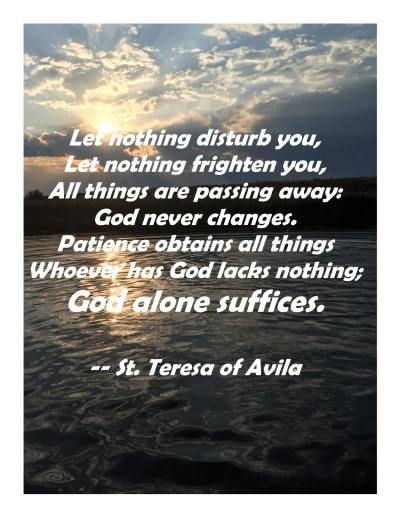
St. Teresa of Avila, declared a doctor of the Church, composed this beautiful prayer which describes this union:

Let nothing disturb you, Let nothing frighten you, All things are passing away: God never changes. Patience obtains all things Whoever has God lacks nothing; God alone suffices. — St. Teresa of Avila

In His Father’s house there are many rooms, and one especially prepared for you by Christ.  Trust in His love, Trust His Wisdom, Trust His Goodness…and let nothing trouble your hearts, that His Peace may be with you always.

Consider:

  • When have you experienced the peace of Christ?  After Mass, in praying with Scripture, in nature, through other Christians?
  • Consider the fears and anxieties you carry.  Lay them before the Lord in prayer and surrender them.  Consider the power of Christ to provide, the love of Christ which motivates Him, and the faithfulness of Christ who remains near us in every trial.
  • In what areas of your life do you trust God completely?  In what areas do you rely on yourself or conventional wisdom rather than Him?

Make a Resolution (Practical Application):

  • Choose your biggest worry.  Begin and end each day surrendering it to God in prayer.
  • Pray the prayer of St. Teresa of Avila each day this week.
  • We make an act of trust in God when we tithe.  If you do not tithe already, begin this week.  If you tithe already but feel called to tithe more (10% is the commonly suggested amount), prayerfully make a financial act of trust in the Lord.
  • Pray Psalm 23 each day this week.
Why do you trust Jesus Christ?  Post in the comments section below!

Related Posts:

~ Written by Angela Lambert © 2017

* To receive these weekly posts automatically in your email just click the “follow” tab in the bottom right hand corner and enter your email address.


Stating the Facts & Facing the Conclusions

by Angela Lambert

March 26th, 2017; 4th Sunday of Lent

Gospel of John 9:1-41

As Jesus passed by He saw a man blind from birth. His disciples asked him, “Rabbi, who sinned, this man or his parents, that he was born blind?” Jesus answered, “Neither he nor his parents sinned; it is so that the works of God might be made visible through him. We have to do the works of the one who sent me while it is day. Night is coming when no one can work. While I am in the world, I am the light of the world.” When he had said this, he spat on the ground and made clay with the saliva, and smeared the clay on his eyes, and said to him, “Go wash in the Pool of Siloam” —which means Sent—. So he went and washed, and came back able to see. His neighbors and those who had seen him earlier as a beggar said, “Isn’t this the one who used to sit and beg?” Some said, “It is,” but others said, “No, he just looks like him.” He said, “I am.” So they said to him, “How were your eyes opened?” He replied, “The man called Jesus made clay and anointed my eyes and told me, ‘Go to Siloam and wash.’ So I went there and washed and was able to see.” And they said to him, “Where is he?” He said, “I don’t know.” They brought the one who was once blind to the Pharisees. Now Jesus had made clay and opened his eyes on a sabbath. So then the Pharisees also asked him how he was able to see. He said to them, “He put clay on my eyes, and I washed, and now I can see.” So some of the Pharisees said, “This man is not from God, because he does not keep the sabbath.” But others said, “How can a sinful man do such signs?” And there was a division among them. So they said to the blind man again, “What do you have to say about him, since he opened your eyes?” He said, “He is a prophet.” Now the Jews did not believe that he had been blind and gained his sight until they summoned the parents of the one who had gained his sight. They asked them, “Is this your son, who you say was born blind? How does he now see?” His parents answered and said, “We know that this is our son and that he was born blind. We do not know how he sees now, nor do we know who opened his eyes. Ask him, he is of age; he can speak for himself.” His parents said this because they were afraid of the Jews, for the Jews had already agreed that if anyone acknowledged him as the Christ, he would be expelled from the synagogue. For this reason his parents said, “He is of age; question him.” So a second time they called the man who had been blind and said to him, “Give God the praise! We know that this man is a sinner.” He replied, “If he is a sinner, I do not know. One thing I do know is that I was blind and now I see.” So they said to him, “What did he do to you? How did he open your eyes?” He answered them, “I told you already and you did not listen. Why do you want to hear it again? Do you want to become his disciples, too?” They ridiculed him and said, “You are that man’s disciple; we are disciples of Moses! We know that God spoke to Moses, but we do not know where this one is from.” The man answered and said to them, “This is what is so amazing, that you do not know where he is from, yet he opened my eyes. We know that God does not listen to sinners, but if one is devout and does his will, he listens to him. It is unheard of that anyone ever opened the eyes of a person born blind. If this man were not from God, he would not be able to do anything.” They answered and said to him, “You were born totally in sin, and are you trying to teach us?” Then they threw him out. When Jesus heard that they had thrown him out, he found him and said, “Do you believe in the Son of Man?” He answered and said, “Who is he, sir, that I may believe in him?” Jesus said to him, “You have seen him, the one speaking with you is he.” He said, “I do believe, Lord,” and he worshiped him. Then Jesus said, “I came into this world for judgment, so that those who do not see might see, and those who do see might become blind.” Some of the Pharisees who were with him heard this and said to him, “Surely we are not also blind, are we?” Jesus said to them, “If you were blind, you would have no sin; but now you are saying, ‘We see,’ so your sin remains.

 Meditation Reflection:

Another long passage.  Why?  Two in a row?  Is it because it’s Lent and the Church wants to test or patience?  No, despite our ever-shortening attention spans, we still need to hear real stories of real people’s transformation in Christ.

John could only include a sliver of these experiences in his Gospel, so he reserved room for the most powerful or most instructive.  His Gospel is not written as myth or legend, but as testimony.  Jesus’ encounter with the Samaritan woman at the well taught us the surprising nature of the kingdom of God which we, like many of the Jews at the time, may find difficult to understand on a natural level. Jesus’ healing of the man born blind, testifies to the undeniable evidence of Jesus’ divine origin.  Thus, discipleship of Christ cannot be sustained by natural reason alone, which is why believing in Him as merely a good moral teacher is not enough and not very effective.  Rather, disciples follow Christ based on faith in Who He is.  This faith may develop gradually over a period of time and interaction like the Samaritan woman’s village with whom Jesus spent two days, or happen in a miraculous moment like the man born blind.  Either way, the call of discipleship exceeds our understanding, and can only make sense if we believe that Jesus is truly God.

Discipleship, therefore, begins with encounter and follows with witness.  The man born blind stated the facts of the situation without interpretation several times.  The Pharisees refused to acknowledge the logical conclusion so they tried to raise doubts about the premises.  Finally, the exasperated man connected the dots for them and stated the logical conclusion. He was born blind, now he is not blind; only God could have given him sight ; God only blesses those whom He approves; therefore…Jesus is from God.  For the Pharisees to reject Christ when the miracle was standing right in front of them, was to willingly choose blindness.  God acts in our lives daily and has sent His only Son for our salvation.  We have no more excuses for our ignorance.

The Pharisees tried to pit Jesus against Moses, but Jesus is the fulfillment of God’s promise to send a new Moses.  Moses received the Law from God and brought it to the people.  Jesus is God, and communicates the New Law from His own authority.  He also, therefore, has the authority to correct any misinterpretations or mis-applications of the Old Law.

God also promised, that someone from the line of David would always be king.  As the New David, Jesus takes up the crown as eternal king.  When God told the prophet Samuel to go to the house of Jesse and anoint one of his sons as the new king, Samuel expected the oldest to be chosen.  Instead, God chose the youngest.  This was such an unforeseen call, that David wasn’t even present at the visit but instead was tasked with tending the sheep.  Just as God said to Samuel regarding David, “Not as man sees does God see, because man sees the appearance but the LORD looks into the heart” (1 Samuel 16:7), so the blind man gave witness to Jesus by his miraculous and supernatural sight.  One thing I do know is that I was blind and now I see…It is unheard of that anyone ever opened the eyes of a person born blind. If this man were not from God, he would not be able to do anything.”

All Christians are called to bear witness to Christ, evidenced by His transformative power in their lives.  How others react to that witness, brings to light their true state of soul.  We all have an innate yearning for God.  We sometimes avoid Him however to continue in some of our sins.  Sometimes we feign ignorance, rationalize away Christ’s teaching, or discount the witness given by the lives of strong Christians we know, so we can avoid facing the truth about our attachments.  We cannot hide any longer.  Christ has come, His light has shone, and He continues to live and act through His Mystical Body the Church.  He has given a New Law as our Eternal King.  His expectations exceed our natural abilities and weakness, but His grace makes the Christian life possible.

The more our relationship with Christ develops, the more our faith will strengthen and our trust in Him will grow.  Then, when the Christian life tests our minds and hearts, we will hopefully respond as St. Peter did, “Lord, to whom shall we go? You have the words of eternal life; and we have believed and have come to know, that you are the Holy One of God.” (John 6:68-69) and to give witness as St. John does at the beginning of His Gospel: “the Word became flesh and dwelt among us, full of grace and truth; we have beheld His glory, glory as the only-begotten Son from the Father.” (John 1:14)

Consider:

  • Where would you consider yourself in your spiritual journey?
    • Initial Outreach – just beginning the search for God, curious about Jesus but unsure of whether to follow Him
    • Early Development – responding to Christ, learning His truths, forming convictions, developing Christian habits, shedding sinful habits, wavering but growing stronger
    • Disciple – follower of Christ, faith in Him and trust in Him above oneself, motivated by love and loyalty, allowing Christ full authority to transform you, witness of His life in you
  • If, like the man born blind, you were asked to testify about your encounter with Christ, what would you say?  What would be the “facts” of the case, and what would be your conclusions?
  • How has the Christian witness of others strengthened your faith or moved you to make a serious change in your life?

Make a Resolution (Practical Application):

  • Each morning take five minutes of prayer to think about your day ahead, and resolve to  witness to Christ in one to three concrete ways.
    • Consider in each aspect – home, work, recreation, family time.
    • Think of ways in each area you can live your Christian faith and witness to Christ by either your words or your actions.
    • Resolve on one thing to say or do in each area for the day.
    • At the end of the day, reflect back on how you did.  Praise God for your successes, and where you failed ask for grace to do better tomorrow.

~ Written by Angela Lambert © 2017

* To receive these weekly posts automatically in your email just click the “follow” tab in the bottom right hand corner and enter your email address.


Determined Discipleship

by Angela Lambert

(c) National Galleries of Scotland; Supplied by The Public Catalogue Foundation

March 5th, 2017; 9th First Sunday of Lent

Gospel Matthew 4:1-11

At that time Jesus was led by the Spirit into the desert to be tempted by the devil. He fasted for forty days and forty nights, and afterwards he was hungry. The tempter approached and said to him, “If you are the Son of God, command that these stones become loaves of bread.” He said in reply, “It is written: One does not live on bread alone, but on every word that comes forth from the mouth of God.” Then the devil took him to the holy city, and made him stand on the parapet of the temple, and said to him, “If you are the Son of God, throw yourself down. For it is written: He will command his angels concerning you and with their hands they will support you, lest you dash your foot against a stone.” Jesus answered him, “Again it is written, You shall not put the Lord, your God, to the test.” Then the devil took him up to a very high mountain, and showed him all the kingdoms of the world in their magnificence, and he said to him, “All these I shall give to you, if you will prostrate yourself and worship me.” At this, Jesus said to him, “Get away, Satan! It is written: The Lord, your God, shall you worship and him alone shall you serve.” Then the devil left him and, behold, angels came and ministered to him.

Meditation Reflection:

Before Jesus began His public ministry, He went into the desert to pray and fast for forty days. Spending time in the desert meant leaving comforts, distractions, and entertainment, and being alone in solitude.  This may sound appealing, especially if you have a demanding job or little kids.  Yet, when we do make time to be alone in the silence, it can be uncomfortable and disconcerting.  We must face ourselves, the inner thoughts we have been pushing to the side, fears, insecurities, doubts, ambitions, and vanities.  The biggest battle most of us will face, is with ourselves and the enemy loves to bite at our heels as we do.  Thus, Jesus prepares for His ministry by enduring all the temptations you and I experience, and overcoming them.

Satan first tempts Christ with bread.  He waited until Jesus was at the end of His fast when He would be tired, hungry, and physically weak.  Similarly, the devil tries to exacerbate our problems when we are worn out and vulnerable.  How many of us have failed to pray in the morning because we didn’t want to give up the comfort of sleep? When have you missed Mass because it would be an inconvenience or it was cold outside?  Are there times when putting your feet up, having a beer or glass of wine, and watching tv took precedence over interacting with your spouse or kids at the end of a long work day (especially when kids require discipline or help with homework)? How many opportunities do we miss because we would rather stay in our comfort zone?  Unless we overcome our own slothful inertia, we cannot be strong enough to be the salt of the earth that Jesus needs from His disciples.

After overcoming our desires for pleasure and comfort, the next hurdle is fame and ambition.  Satan loves to stroke our ego and promote the lie that the measure of our worth is measured by our success.  Yet, our Lord chose a life of humility and rejected some of the apostles’ notions that His kingdom would bring them worldly notoriety.  God works the most through the small and the weak.  St. Paul even states that in our weakness God’s power is brought to perfection (I Corinthians 2:12). Until we curb our own ambitions, we won’t be free to work for God’s ambitions.

Finally, the ultimate stumbling block of the Christian faith, is suffering.  Satan’s third temptation offered Jesus the kingdom without the Cross;  a short cut around humiliation and struggle.  Whether it’s discipleship, marriage, family, or work, many people give up when things get hard.  Our culture of instant gratification further softens our resolve, along with the false expectation that we should always be happy.

Christ endured and overcame every temptation, that we might be strengthened to do the same.  Jesus unites Himself to us in our struggle and imbues us with His divine grace.

During Lent, we step away into the desert so that we might encounter the truth about ourselves.  We struggle against our own will through acts of fasting and self-denial.  We battle our greed and self-centeredness through works of charity and alms-giving.  We increase our prayer, and contemplate the mystery of Christ’s suffering, death, and resurrection, to deepen our love for our savior and to more closely follow Him.

Don’t be discouraged if you have already cheated on your Lenten sacrifice.  Self-knowledge is the beginning of conversion and develops humility.  Each day, we must pick up our cross, and as our awareness of our own weakness intensifies, our awareness of our need for Christ will also intensify. Whether you give something up or do something extra (or both), choose something that will touch the temptation you find most difficult – comfort, notoriety, or happiness at the expense of Christian fidelity.  Discipleship is difficult, and even the apostles’ conversions took time, so be patient.  Moved by love however, they eventually stopped trying to change Christ, and instead accepted Christ.  If we take time for Him, our love for Him will deepen, and we too will be more conformed to our Lord, and able to joyfully celebrate His final victory at the Resurrection on Easter.

Consider:

  • Which comforts or pleasures tempt you the most? Sleep, soda, alcohol, television, food, desserts, gossip, sports, music, movies?
  • What do you want others to notice about you most? What do you take the most pride in?  Do you feel small or unimportant if your work isn’t acknowledged or honored by others?
  • How do you avoid suffering? Do you avoid conflict with your spouse or kids?  Do you take short cuts at work?  Do you try to get ahead by putting others down or by neglecting your duties toward God or family?
  • Consider past Lents. How has God strengthened you?  How have you grown as a Christian?
  • Invite Christ into this Lent. Be docile to the Holy Spirit and ask Him to strengthen an area of your faith life.

Make a Resolution (Practical Application):

  • Each morning, begin with the prayer by St. Francis de Sales:

My God, I give you this day. I offer you, now, all of the good that I shall do and I promise to accept, for love of you, all of the difficulty that I shall meet. Help me to conduct myself during this day in a manner pleasing to you. Amen.

~ Written by Angela Lambert © 2017

* To receive these weekly posts automatically in your email just click the “follow” tab in the bottom right hand corner and enter your email address.


Keeping it Real

by Angela Lambert

20141130_175201795_ios

February 11th, 2017; 6th Sunday of Ordinary Time

Gospel of Matthew 5:20-22a, 27-28, 33-34a, 37

Jesus said to his disciples: “I tell you, unless your righteousness surpasses that of the scribes and Pharisees, you will not enter the kingdom of heaven.  “You have heard that it was said to your ancestors, You shall not kill; and whoever kills will be liable to judgment. But I say to you, whoever is angry with brother will be liable to judgment. “You have heard that it was said, You shall not commit adultery. But I say to you, everyone who looks at a woman with lust has already committed adultery with her in his heart. “Again you have heard that it was said to your ancestors, Do not take a false oath, but make good to the Lord all that you vow. But I say to you, do not swear at all. Let your ‘Yes’ mean ‘Yes,’ and your ‘No’ mean ‘No.’ Anything more is from the evil one.”

 Meditation Reflection:

Freedom in Christ, is founded on freedom from being fake.  We are masters at the false front.  By an early age most of us can pull off “I’m fine” to anyone who asks, no matter how untrue it may be.  Keeping up appearances, looking successful, and seeming to be more than we are occurs in every time period and culture.   Social media amplifies today’s version, as we can literally craft our public persona via selective posts and pictures.

We not only mask our imperfections, we often mask our sins as well.  From the back-handed compliment, to disparaging remarks prefaced by “God bless her soul, but…”, to shallow mantras like “You only live once” or “it’s not like it’s against the law”, we rationalize our viciousness in countless ways.  Like addicts, we deny we have a problem with sin and we excuse and blame our behavior on everyone and everything but ourselves.

Just has sobriety can only be achieved through facing reality, so human freedom from sin can only be wrought from an utter realness about ourselves.  When Moses asked God to reveal His Name, God responded that it is “YHWH” or “I AM”.  God revealed that He is.  God is being and existence.  Thus, union with God requires utter realness and authenticity.

C.S. Lewis writes about this mystery in a brilliantly imaginative way in his book “The Great Divorce.”  The divorce in this case refers to the divide between heaven and hell, and describes the process of purgation for those still travelling to heaven.  He describes inhabitants of hell, drawing from scriptural imagery, as phantoms.  On the opposite spectrum, he calls those in heaven “solid people.” The main character arrives at a gray bus stop, phantom-ish, and his journey toward heaven is one of becoming more solid – or more “real”.  To do this he must surrender all that he keeps false within himself.  I won’t give away more than that, as I highly recommend this read!  I will only offer this teaser – Lewis creates numerous characters whose struggle to move from ghostish versions of themselves to the authentic provides deep insight into the rationalizations with which most of us struggle, the pain of conversion, and the joy of authentic freedom.

In the Beatitudes, Jesus teaches us interior conversion and introspection.  In today’s Gospel passage, He directly calls us out on how we tip toe around the truth and avoid real virtue and, in consequence, real love and relationship.

How many times have we heard the excuse, “well, it’s not like I’ve killed anyone.  I’m a decent person.”  Yet, harboring anger can be deeply destructive and emerge in violence that might be more subtle, but no less real.  Passive-aggressive behaviors, online bullying, slander, gossip, critical remarks and callous attitudes prevent relationship and they hold us back from heaven.  Jesus states clearly, “I tell you, unless your righteousness surpasses that of the scribes and Pharisees, you will not enter the kingdom of heaven”  (MT 5:20) and “be perfect therefore, as your heavenly father is perfect” (MT 5:48)  A man who loves his wife, doesn’t look lustfully at other women.  A woman who loves her husband, doesn’t flirt with other men.  Does it matter whether or not it’s technically adultery?  Jesus calls out the dishonesty.  Either way, it certainly feels like cheating to the other spouse.  Why?  Because love is total, exclusive, and lifelong.  Our love for our spouse should mirror love for God. In fact, God created the first man and woman in the state of marriage because as two persons in a relationship of life-giving love, they imaged the Triune God.

Authenticity begins by simply letting our Yes be yes, and our No be no.  Drop the exaggerations and minimizations.  Leave the white lies.  Take down the false fronts.  It feels like going a day without make-up at first, but not forever.  As we become more at peace with ourselves, we become more comfortable in the truth.  Eventually the fake-ness we clung to in the past will feel like too much make-up, caked on, that you can’t wait to wash off at the end of the day.

Jesus wants us, not the façades we create.  He accepts us as we are and helps us become the truest version of ourselves.  When this happens, we can begin to experience the real relationship, and real love necessary for heaven.

Consider:

  • List your most common struggles in a day, then pray about what interior attitude or disposition underlies it.
    • consider the 7 capital sins for ideas (pride, envy, greed, anger, sloth, lust, and gluttony)
  • What is your most common/tempting rationalization?
  • In what ways have you grown in authenticity over the years? Reflect on how good it feels to be yourself.
  • Who is someone you can be completely yourself around; who knows the “real” you?
  • Consider how honesty is necessary for relationship.

Make a Resolution (Practical Application):

  • Tackle one rationalization this week.  Be direct with yourself and with God.  Name the struggle, occasions of temptation, and the rationalization you use.  Decide on how you will avoid the temptation or create a counter-mantra to repeat when you hear yourself rationalizing.
    • Example:
      • Daily struggle: Crabby toward your spouse and kids
      • Occasions of temptation: Getting out the door in the morning, right after a long day at work, or when interrupted during a project.
      • Rationalizations: “They’re my family and should love me unconditionally – this is just who I am”; “I work hard to care for my family, and it just means I will be stressed out”
      • Counter-mantras: “They’re my family – they deserve my best behavior”;  “I need to find balance in my life so I can be a peaceful person to my family”
      • Avoiding temptation – Begin the day 10 minutes earlier so you aren’t stressed about running late (even better, begin with a prayer!); create transition time between work and home – listen to Christian music on the drive and count your blessings so you arrive with a positive attitude; adjust expectations for completing projects – expect to get interrupted by kids and be grateful for them, try to include them in the project if possible


~ Written by Angela Lambert © 2017

* To receive these weekly posts automatically in your email just click the “follow” tab in the bottom right hand corner and enter your email address.