Keeping it Real

by Angela Lambert

20141130_175201795_ios

February 11th, 2017; 6th Sunday of Ordinary Time

Gospel of Matthew 5:20-22a, 27-28, 33-34a, 37

Jesus said to his disciples: “I tell you, unless your righteousness surpasses that of the scribes and Pharisees, you will not enter the kingdom of heaven.  “You have heard that it was said to your ancestors, You shall not kill; and whoever kills will be liable to judgment. But I say to you, whoever is angry with brother will be liable to judgment. “You have heard that it was said, You shall not commit adultery. But I say to you, everyone who looks at a woman with lust has already committed adultery with her in his heart. “Again you have heard that it was said to your ancestors, Do not take a false oath, but make good to the Lord all that you vow. But I say to you, do not swear at all. Let your ‘Yes’ mean ‘Yes,’ and your ‘No’ mean ‘No.’ Anything more is from the evil one.”

 Meditation Reflection:

Freedom in Christ, is founded on freedom from being fake.  We are masters at the false front.  By an early age most of us can pull off “I’m fine” to anyone who asks, no matter how untrue it may be.  Keeping up appearances, looking successful, and seeming to be more than we are occurs in every time period and culture.   Social media amplifies today’s version, as we can literally craft our public persona via selective posts and pictures.

We not only mask our imperfections, we often mask our sins as well.  From the back-handed compliment, to disparaging remarks prefaced by “God bless her soul, but…”, to shallow mantras like “You only live once” or “it’s not like it’s against the law”, we rationalize our viciousness in countless ways.  Like addicts, we deny we have a problem with sin and we excuse and blame our behavior on everyone and everything but ourselves.

Just has sobriety can only be achieved through facing reality, so human freedom from sin can only be wrought from an utter realness about ourselves.  When Moses asked God to reveal His Name, God responded that it is “YHWH” or “I AM”.  God revealed that He is.  God is being and existence.  Thus, union with God requires utter realness and authenticity.

C.S. Lewis writes about this mystery in a brilliantly imaginative way in his book “The Great Divorce.”  The divorce in this case refers to the divide between heaven and hell, and describes the process of purgation for those still travelling to heaven.  He describes inhabitants of hell, drawing from scriptural imagery, as phantoms.  On the opposite spectrum, he calls those in heaven “solid people.” The main character arrives at a gray bus stop, phantom-ish, and his journey toward heaven is one of becoming more solid – or more “real”.  To do this he must surrender all that he keeps false within himself.  I won’t give away more than that, as I highly recommend this read!  I will only offer this teaser – Lewis creates numerous characters whose struggle to move from ghostish versions of themselves to the authentic provides deep insight into the rationalizations with which most of us struggle, the pain of conversion, and the joy of authentic freedom.

In the Beatitudes, Jesus teaches us interior conversion and introspection.  In today’s Gospel passage, He directly calls us out on how we tip toe around the truth and avoid real virtue and, in consequence, real love and relationship.

How many times have we heard the excuse, “well, it’s not like I’ve killed anyone.  I’m a decent person.”  Yet, harboring anger can be deeply destructive and emerge in violence that might be more subtle, but no less real.  Passive-aggressive behaviors, online bullying, slander, gossip, critical remarks and callous attitudes prevent relationship and they hold us back from heaven.  Jesus states clearly, “I tell you, unless your righteousness surpasses that of the scribes and Pharisees, you will not enter the kingdom of heaven”  (MT 5:20) and “be perfect therefore, as your heavenly father is perfect” (MT 5:48)  A man who loves his wife, doesn’t look lustfully at other women.  A woman who loves her husband, doesn’t flirt with other men.  Does it matter whether or not it’s technically adultery?  Jesus calls out the dishonesty.  Either way, it certainly feels like cheating to the other spouse.  Why?  Because love is total, exclusive, and lifelong.  Our love for our spouse should mirror love for God. In fact, God created the first man and woman in the state of marriage because as two persons in a relationship of life-giving love, they imaged the Triune God.

Authenticity begins by simply letting our Yes be yes, and our No be no.  Drop the exaggerations and minimizations.  Leave the white lies.  Take down the false fronts.  It feels like going a day without make-up at first, but not forever.  As we become more at peace with ourselves, we become more comfortable in the truth.  Eventually the fake-ness we clung to in the past will feel like too much make-up, caked on, that you can’t wait to wash off at the end of the day.

Jesus wants us, not the façades we create.  He accepts us as we are and helps us become the truest version of ourselves.  When this happens, we can begin to experience the real relationship, and real love necessary for heaven.

Consider:

  • List your most common struggles in a day, then pray about what interior attitude or disposition underlies it.
    • consider the 7 capital sins for ideas (pride, envy, greed, anger, sloth, lust, and gluttony)
  • What is your most common/tempting rationalization?
  • In what ways have you grown in authenticity over the years? Reflect on how good it feels to be yourself.
  • Who is someone you can be completely yourself around; who knows the “real” you?
  • Consider how honesty is necessary for relationship.

Make a Resolution (Practical Application):

  • Tackle one rationalization this week.  Be direct with yourself and with God.  Name the struggle, occasions of temptation, and the rationalization you use.  Decide on how you will avoid the temptation or create a counter-mantra to repeat when you hear yourself rationalizing.
    • Example:
      • Daily struggle: Crabby toward your spouse and kids
      • Occasions of temptation: Getting out the door in the morning, right after a long day at work, or when interrupted during a project.
      • Rationalizations: “They’re my family and should love me unconditionally – this is just who I am”; “I work hard to care for my family, and it just means I will be stressed out”
      • Counter-mantras: “They’re my family – they deserve my best behavior”;  “I need to find balance in my life so I can be a peaceful person to my family”
      • Avoiding temptation – Begin the day 10 minutes earlier so you aren’t stressed about running late (even better, begin with a prayer!); create transition time between work and home – listen to Christian music on the drive and count your blessings so you arrive with a positive attitude; adjust expectations for completing projects – expect to get interrupted by kids and be grateful for them, try to include them in the project if possible


~ Written by Angela Lambert © 2017

* To receive these weekly posts automatically in your email just click the “follow” tab in the bottom right hand corner and enter your email address.


Lighting the Path and Seasoning the Journey…Because Blending in is Bland

by Angela Lambert


20160321_200727310_ios

February 5th, 2017; Fifth Sunday of Ordinary Time

Gospel Matthew 5:13-16

Jesus said to his disciples: “You are the salt of the earth. But if salt loses its taste, with what can it be seasoned? It is no longer good for anything but to be thrown out and trampled underfoot. You are the light of the world. A city set on a mountain cannot be hidden. Nor do they light a lamp and then put it under a bushel basket; it is set on a lampstand, where it gives light to all in the house. Just so, your light must shine before others, that they may see your good deeds and glorify your heavenly Father.”

Meditation Reflection:

People often complain that they need to see something to believe it.  Although faith requires going beyond sight, the seeds of faith can be planted through allowing others to see for themselves the work of Christ in our lives.  Authentic, Christian discipleship causes deep transformation.  This supernatural change witnesses in an evidentiary way, the reality of the Holy Spirit and the life of grace.

The first converts to Christianity were moved by the way Christians lived differently than everyone else.  In a callous, hedonistic culture, Christians treated one another with love and respect.  Christian men and women treated each other with kindness, dignity, and fidelity.  Slaves were considered brothers and sisters in Christ.  Martyrs sacrificed everything, joyfully, in witness to their belief in the resurrection.  The way martyrs faced their death so peacefully and courageously, converted many onlookers who could see plainly that the dying Christians were acting with a strength and calm that exceeded the limits of human nature.  Tertullian famously articulated this phenomenon saying, “The blood of the martyrs, is the seed of the Church” (197 A.D.).

As modern Christians, our lives ought to witness the reality of grace as well, by following Christ beyond our comfort zone.  Sometimes we can make our faith life a little too neat and tidy.  We make Sunday Mass a casual commitment, and parish fellowship a comfortable social club.  We might look to faith for comfort, but we don’t expect the impossible from God, and we ask that He not expect the impossible of us.

Although this sounds like a reasonable relationship, it doesn’t do much to reveal the life of grace or of the reality of God’s supernatural love and aid.  After teaching the Beatitudes, the heart of the New Law, Jesus followed up with this analogy to salt and light.  The journey of faith, though very personal, also has an evangelistic element; it’s a gift we both receive and give in return.  Christ urges us to follow the path of the Beatitudes to its end.  He’s honest that authentic discipleship will not blend in.  Simply living the Christian faith, is a witness to truths that others try to avoid, and can result in numerous pressures from others to be quiet.   Those pressures come in many forms – accusations of being overly zealous, judgmental, intolerant, or making one’ private faith public.  Secular culture continues to find ways to diminish the witness of faith and put a bushel basket over the light by re-defining religion as personal sentiment, and forbidding it to bear external fruit unless that fruit can be limited to, and labeled, secular humanitarianism.

At the same time, although Christ was persecuted by some, He was sought out by many others.  Jesus promised, “If you continue in My word, you are truly My disciples, and you will know the truth, and the truth will make you free” (John 8:31-32).   Blending in cannot transform us, and it cannot transform society.  Rather, discipleship can make us free and add freedom to our culture.  St. Paul told the Galatians, that the fruits of the Spirit are not of this world.  By drawing near to God in prayer, the Spirit bears fruits within Christians of divine love, joy, peace, patience, kindness, goodness, faithfulness, gentleness, and self-control (Galatians 5:22-23).  The world needs these fruits and hungers for them.  If we keep our faith in a box that we only take out on Sundays or Christmas, we put a bushel over the light of Christ and make it impotent, leaving the world to suffer rather than to offer it hope.

I love Jesus’ analogy to salt.  I love salt.  It’s so basic, but it makes everything taste so wonderful.  Our faith is the salt that makes life seasoned and enjoyable.  If we offer the world a bland form of our faith, what is the point?  We wouldn’t make anyone feel uncomfortable, but we would also deny them the chance to taste something remarkable.

Jesus is “the Way, the Truth, and the Life.”  He teaches us the path to follow and provides the necessary grace needed to make the journey.  When we live in relationship with Him, our life can’t help but radiate His peace, love, and wisdom.  If we can have the courage to follow Christ beyond our comfort zone, Christ promises that we can be a light for others to shine the truth they need to be free, and we can be the salt that seasons their life with His joy.

Consider:

  • What do you find comfortable about your Christian faith?  What’s easy or natural for you?
  • What do you find uncomfortable? What teachings seem “too much”?  In which areas of your life, or among which people, do you try to downplay your faith?
  • How might you live your faith more deeply or more authentically?
  • Reflect on the effect of salt and light. Fast from salt for a day and consider the difference without it.  Try functioning with only the aid of natural light rather than light bulbs.  How does it limit your work and your experience?
  • Consider each aspect of your day – home, work, activities, etc. Reflect on how you can live your faith in each place.

Make a Resolution (Practical Application):

  • At the beginning of each transition in your day, begin with a prayer for Christ to teach you, and help you, live as His disciple in that part of your life.
    • The prayer can be a spontaneous prayer of your own words, or a written prayer you recite at each transition. Ideas: Our Father, Glory Be, Hail Mary, Memorare, a verse from a Psalm, a prayer to the Holy Spirit, the Disciple prayer by Cardinal Newman, etc.  (I personally like the prayer of St. Thomas Aquinas: “Grant O Merciful God, that I may ardently desire, prudently examine, truthfully acknowledge, and perfectly accomplish, what is pleasing to Thee, for the praise and glory of Thy Name.)

Additional Links:

The Beatitudes: Climbing the Mountain of God by Way of the Valley of Humility

~ Written by Angela Lambert © 2017

* To receive these weekly posts automatically in your email just click the “follow” tab in the bottom right hand corner and enter your email address.


The Beatitudes: Climbing the Mountain of God by Way of the Valley of Humility

by Angela Lambert
Credit for picture to: zastavki.com/pictures/originals/2014/Nature_Multicolored_valleys_and_mountains_080436_.jpg

Credit for picture: zastavki.com/pictures/originals/2014/Nature_Multicolored_valleys_and_mountains_080436_.jpg

January 29th, 2017; 4th Sunday of Ordinary Time

Gospel of Matthew 5:1-12a NAB

When Jesus saw the crowds, he went up the mountain, and after he had sat down, his disciples came to him. He began to teach them, saying: “Blessed are the poor in spirit, for theirs is the kingdom of heaven. Blessed are they who mourn, for they will be comforted. Blessed are the meek, for they will inherit the land. Blessed are they who hunger and thirst for righteousness, for they will be satisfied. Blessed are the merciful, for they will be shown mercy. Blessed are the clean of heart, for they will see God. Blessed are the peacemakers, for they will be called children of God. Blessed are they who are persecuted for the sake of righteousness, for theirs is the kingdom of heaven. Blessed are you when they insult you and persecute you and utter every kind of evil against you falsely because of me. Rejoice and be glad, for your reward will be great in heaven.”

Meditation Reflection:

Mountains make us think of God.  Their height, their beauty, and their majesty inspire a sense of our smallness, and of God’s greatness. Moses ascended Mt. Sinai to encounter God. He prayed and fasted for 40 days and nights, during which God spoke to Him “face to face, just as a man speaks to his friend” (Exodus 33:11).  To form His People in wisdom, justice, and peace, God gave to Moses the Law, written by God’s own hand.

When the Lord had finished speaking with Moses on Mount Sinai, He gave Moses the two tablets of the testimony, tablets of stone, written by the finger of God.” Exodus 31:18

After this encounter, Moses’ face radiated such glory that Aaron and the other Israelites feared being near to him; so much so that Moses had to wear a veil when in their presence (Ex 34:29-34).

Moses’ relationship with God, the immediacy of God’s interaction with him, was unparalleled.  At the end of Moses’ life, he prophesied that God would one day send a New Moses. “I will raise up for them a prophet like you from among their brothers. And I will put my words in his mouth, and he shall speak to them all that I command him.” (Deuteronomy 18:15-19)

Jesus ascended the Mount as the New Moses.  The immediacy of God’s word became even more immanent as the Word made Flesh spoke to the people.  Christ affirmed the Law given to Moses, but he further extended it to its full intent by God.  Through Moses, God had liberated the Jews form physical slavery and reformed their actions through the wisdom of the 10 Commandments.  Christ now extended the call to conversion to our interior intentions and desires.  As He set about the task of liberating us from slavery to sin and establishing the eternal Kingdom of God, the Beatitudes mark the fullness of God’s rule for His People – one of authentic love for God and one another.

St. Therese of Lisieux asserted that we ascend the mountain of God, by way of descending the valley of humility.  The Beatitudes, the heart of the New Law, express this paradox, building on one another in a beautiful way, as they signify the progression of the spiritual life.  The first three commandments in the Old Law began by establishing proper relationship with God – worshipping Him alone, with reverence, and every Sabbath.  In the New Law, Christ begins by affirming the interior disposition needed to make this fruitful – poverty of spirit.  The poor recognize their neediness and dependency.  The poor in spirit surrender the illusion of self-sufficiency and accept their dependence on God.

How often have we experienced the frustration of wanting to help someone but they refused to be receptive to our advice or our aid?  Common obstacles to accepting dependence on God stem from a desire for security located in things we think we can control – such as wealth, career, relationships, status, self-help, etc. If we cling to a desire to redeem ourselves, we will resist the mercy of our only Redeemer.  The poor in spirit have hit rock bottom.  Regardless of their wealth or accomplishments, they are keenly aware that only God can heal their wounds, release them from self-destructive addictions or thoughts, and provide them with security which isn’t dependent on the market, the weather, or even their employer.

Once a person looks to God, who is full of mercy, whose Son demonstrated His sacrificial love, they are moved to sorrow.  This sorrow wells up from an honest view of themselves and their sins – free of the rationalizations and false beliefs they had clung to in the past.  They see now that their sinful choices, rather than liberating, were in fact petty at best, and disloyal to their greatest defender at worst.  There’s nothing worse than feeling like you have failed a friend who has been there for you, or worse, betraying them despite their faithfulness through your hardest times.  When a person faces themselves however, rather than the harsh judgment they fear, they experience the warm, merciful, comfort of their Savior.

Having shed false pretentions about oneself, a person develops a beautiful authenticity which is characterized by meekness.  Meekness is not weakness.  Meekness means a person has greater compassion and patience toward others because they know that “but for the grace of God, there go I.”  In consequence, surrender to God, gratitude for His mercy and comfort, and humble authenticity, causes one to bear much more fruit in their life and work.

As gratitude for God’s love, and experiential knowledge of the wisdom of His ways increases, a person begins to hunger and thirst for righteousness.  They desire even greater freedom and deeper joy, which they know with deep conviction, can only be found in Christ.  This is a prayer to which God always says yes.

The joy of freedom in Christ’s love creates so much gratitude that it spills over in a person’s heart and they can’t help wanting to give back to Christ the kindness He has shown to them.  Thus, they show mercy to others because they empathize with the struggle of sin and desire to follow the example of Christ who has shown them mercy in their weakness.

Union with Christ in the Beatific Vision is the essence of Heaven.  Thus, those that have forsaken all for Him, whose heart is pure, begin to experience a taste of the vision of God. Reconciled to God through His son, they extend this peace to others as it radiates from their own interior peace from union with the Lord.

Finally, the more perfect a union one has with Christ, the more others will treat that person the same way they would of Him.  Jesus warned His apostles that those of the world who persecute Him, will persecute them. And those that love Him, will love them (John 15:18-25).  Thus, Christ ends the Beatitudes with the summation of the spiritual life – when one is persecuted because Christ, they ought to rejoice, because it means they are finally living in union with Him and following in His example.  In a sense, it’s confirmation that one is conformed to Christ.  Others wouldn’t bother with you if you were worldly enough to leave their consciences undisturbed.

Jesus provides the Way by teaching us the Beatitudes and showing us how to follow them by His example.  Moreover, He provides the supernatural grace, virtues, and love we need to live such a profoundly spiritual life.  The world offers countless distractions to discourage us from introspection, and our own pride can further resist taking an honest look inside our hearts.  Christ exhorts us to bravely journey within, promising to accompany us and to conform what we find to His own perfect love.

Consider:

  • Have you ever seen a mountain up close or hiked up one?  How did it affect your perspective?
  • Consider the immanence of God – His revelation to Moses and His revelation through Christ. In what way does His closeness make you somewhat afraid, like the Israelites?  In what way, does it comfort or strengthen you to have Him so near?
  • God continues to dwell with us in an immanent way in the Eucharist. Consider how it has pleased God in every age, to draw near to us.  In what ways, do you appreciate His gift?  In what ways, do you sometimes take it for granted?  How might you increase your appreciation?
  • Consider the spiritual journey laid out by the beatitudes. How does your spiritual life correspond to some of the stages?
  • Which beatitude touches you the most? Is there one that sticks out to you as the most moving?
  • How has your love for God grown through the years as a response of gratitude for His grace at work in your soul. What do you know is His work and not your own?


Make a Resolution (Practical Application):

  • Reflect on one beatitude each day this week and try to live it out in an intentional way.


~ Written by Angela Lambert © 2017

* To receive these weekly posts automatically in your email just click the “follow” tab in the bottom right hand corner and enter your email address.


Day of Prayer for the Legal Protection of Unborn Children

mother-teresa-and-abortion

Each year on the anniversary of the legalization of abortion in the United States, the Catholic Church unites in prayer and fasting for the legal protection of unborn children.  As Christians, we value every human life because we are all children of God – not matter our race, gender, age, size, abilities, or health.

God became man at Jesus’ conception in Mary’s womb.  As a result we all share a special connection to our Lord, even from conception.

In addition, abortion wounds women as it treats her unique and incredible gift to give life as somehow decreasing her value in certain situations rather than elevating it. Women in crisis need our support and encouragement.  We need to work as a society to appreciate and protect women’s irreplaceable role of giving life to all persons.

This means we need to change how we look at pregnancy in the workplace and the career track.  It means facing the responsibility that is inherent in sex and its power to generate new human life.  It means remembering that crisis pregnancies were the result of a choice made by BOTH the mother AND the father.  Moreover, showing young women that they can rise to challenges in life and that others will be there to help them.  We need to demonstrate that, with God’s grace, good things can come out of mistakes and if we face our failures we can find a way forward.  We need to encourage women in crisis pregnancies that they can give their child life both physically through the pregnancy, but also by choosing a loving adoptive family if she isn’t able to raise the child.  Adoption is a loving choice and a sacrifice by the birth mother we need to honor more.

Abortion supports sexism as it not only kills the woman in the womb, but it degrades the value of motherhood as merely biological.  In addition, if abortion is promoted as a “remedy” or as “healthcare”, it implies that pregnancy is not a sacrificial and sacred gift to be honored, but rather a cancer if unwanted, or a consumer choice if desired.  Most importantly, abortion causes life-long emotional, and sometimes physical, wounds to mothers.  To treat abortion as a simple, non-emotional procedure, is sexist callousness and a failure to authentically work for the protection and flourishing of women.

I have seen the pain of women who have suffered the choice of abortion, and the pressures they encountered by boyfriends, family, and the culture since they supposedly had a “choice.”  I have also seen the healing and freedom of women who made it through the crisis and chose life.

May we pray today, and every day, for greater love and support for mothers and unborn children and the conversion of our own hearts in this matter.

Below is a link for rosary meditations specifically for these intentions:

Praying for the Unborn and Mothers in Crisis…Meditations on the Sorrowful Mysteries of the Rosary


Christ’s Kingdom Come

by Angela Lambert

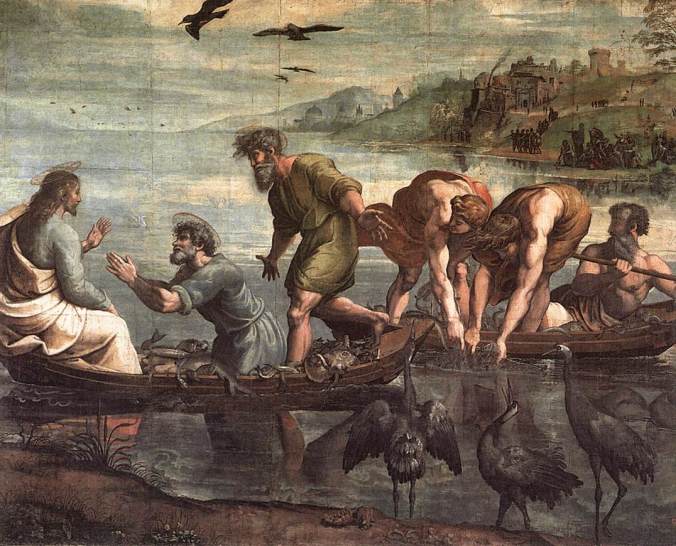
 Raphael,_The_Miraculous_Draught_of_Fishes_(1515)

January 22nd, 2017; Third Sunday of Ordinary Time

 Gospel Matthew 4:12-23 NA

When Jesus heard that John had been arrested, he withdrew to Galilee. He left Nazareth and went to live in Capernaum by the sea, in the region of Zebulun and Naphtali, that what had been said through Isaiah the prophet might be fulfilled: Land of Zebulun and land of Naphtali, the way to the sea, beyond the Jordan, Galilee of the Gentiles, the people who sit in darkness have seen a great light, on those dwelling in a land overshadowed by death light has arisen. From that time on, Jesus began to preach and say, “Repent, for the kingdom of heaven is at hand.” As he was walking by the Sea of Galilee, he saw two brothers, Simon who is called Peter, and his brother Andrew, casting a net into the sea; they were fishermen. He said to them, “Come after me, and I will make you fishers of men.” At once they left their nets and followed him. He walked along from there and saw two other brothers, James, the son of Zebedee, and his brother John. They were in a boat, with their father Zebedee, mending their nets. He called them, and immediately they left their boat and their father and followed him. He went around all of Galilee, teaching in their synagogues, proclaiming the gospel of the kingdom, and curing every disease and illness among the people.

Meditation Reflection:

John the Baptist prepared the way for Christ by proclaiming His coming, and calling to conversion those awaiting a savior.  John’s extreme ascetic life, illuminated consciences to common attachments which hinder people from receiving the Lord.  His lonely, austere, desert living, provides a sharp contrast to our often-inordinate desire for luxury, status, and concern for keeping up with the Jones’.  His fast of locusts and honey, casts light onto our indulgence in food and drink; and his camel-hair clothing convicts our consciences of secret vanity.  Lastly, his rejection of fame and power set an example of true Christian discipleship.  He rejected the title of Messiah for himself and insistently pointed to Jesus as the Christ.  He spoke the truth to peasants, religious leaders, and even political leaders, despite the risk of arrest and even death.  When the Lord finally came, he gracefully stepped to the side, saying “He must increase, but I must decrease.” (Jn 3:30).

Matthew situates the beginning of Jesus’ ministry with the waning of John’s.  Jesus had been baptized and spent 40 days in the desert fasting, praying, and being tempted. John had just been arrested and Jesus, His preparation finished, now began His work.  He commences by preaching the same message as John, “Repent, for the kingdom is at hand.”  Only this time, the kingdom is not coming, but rather has come in the Person of Jesus Christ.

What is the kingdom of God?  Although its meaning has great depth and connections, put simply, it refers to God’s rule over our hearts and the peace of union with Him.  To accept the rule of God, we must first reject the rule of other monarchs.  Thus, repentance is a necessary first step, in which we acknowledge the sins and desires that we have allowed to rule us, and we ask for God to be our liberator.  The Lord’s kingdom is a monarchy, but one that governs free individuals.  The Lord does not annex land through force, but He does liberate people who are enslaved and, through the merits and mercy of His Son, grant them citizenship.  Moreover, this citizenship is more akin to being an adopted member of a loving family than a mere nation-state.

Imagine Christ’s joy as He could finally roll up His sleeves and begin preaching the Gospel, healing the wounded, and most importantly – forgiving sins.  Since the Fall of Adam and Eve, God had patiently waited for the time when we would be ready to receive Him and He could heal all our wounds and strengthen us with His grace.

Jesus goes to Galilee to begin gathering up God’s scattered and lost sheep.  The havoc of disunity caused by human sin, becomes undone through union in Christ.  He rebuilds God’s people by building His Church.  He first calls two sets of brothers who have spent their days fishing, caring for their family, and awaiting the Messiah.  They, like Christ, obeyed the Lord in humble tasks of everyday life until He called them forth.  When asked to follow Him, they immediately left the security of their routines and their community, to say Yes to the Lord and His will.

We can learn from this encounter how to prepare for, and respond to, the coming of the kingdom of God in our own lives.  We can begin by answering the call of John the Baptist to repent.  We can ask the Holy Spirit to reveal to us our sins and our blind spots.  I can say from experience, He will.  Next, we watch and wait.  We live our daily lives open and receptive to God’s will.  St. Thomas taught that “grace builds on nature.”  This means that being a Christian doesn’t make us less ourselves and just robots following commands.  Rather, grace makes us the best version of ourselves.  It actually makes us more ourselves and raises our natural state in life to a super-natural level.  Peter, Andrew, James, and John were all fisherman.  In the kingdom of God, they become fishers of men.

The apostles model Christian discipleship, which is simply receptivity to the Lord in our daily lives.  It means saying “yes”, and following wherever He leads. True peace, justice, and happiness come through Christ alone.  Only He can free us from our worst enemy – our own sins, fears, weakness, and pride.  Only He can provide security.  When we experience the gift of being His disciples, we will understand John the Baptist’s passionate zeal for pointing others to the Lord as well.

Following Christ can look very ordinary on some days, and on others it can completely surprise you.  Whatever might be holding you back when Christ says to you, “Come and see,” let it go.  Drop your nets and set out after Him.

Consider:

  • Ask the Lord for a spirit of repentance.  Invite the Holy Spirit to show you what, or who, comes between you and God.
  • Reflect on the Christ’s call “Come Follow Me.”
  • How has God called you to be faithful in your everyday life? In your family, at your job, in your community?
  • How has grace “built” on your nature. How has encountering Christ made you a better version of yourself?  Where might Christ still want to work in your life?
  • Christ cured “EVERY disease and illness”. There is nothing He can’t conquer for His kingdom. What plagues you? Pray for healing in accord with His will.
  • Spend a few moments in joy, expressing gratitude for the freedom you have found in Christ’s love.

Make a Resolution (Practical Application):

  • Begin each day this week by saying, “Yes Lord, I will follow You.”  Repeat it throughout the day and in every circumstance.


~ Written by Angela Lambert © 2017

* To receive these weekly posts automatically in your email just click the “follow” tab in the bottom right hand corner and enter your email address.


Watch & Wait, Look & See

by Angela Lambert

20160815_171506644_ios

January 15th, 2017; Second Sunday of Ordinary Time

Gospel John 1:29-34 NAB

John the Baptist saw Jesus coming toward him and said, “Behold, the Lamb of God, who takes away the sin of the world. He is the one of whom I said, ‘A man is coming after me who ranks ahead of me because he existed before me.’ I did not know him, but the reason why I came baptizing with water was that he might be made known to Israel.” John testified further, saying, “I saw the Spirit come down like a dove from heaven and remain upon him. I did not know him, but the one who sent me to baptize with water told me, ‘On whomever you see the Spirit come down and remain, he is the one who will baptize with the Holy Spirit.’ Now I have seen and testified that he is the Son of God.”

Meditation Reflection:

How did John recognize Jesus as his Savior?  He prayed, waited, and listened.

Accustomed to instant gratification and the fast pace of life, together with a heavily marketed atmosphere, we can easily develop a tendency to expect Christ to sell Himself to us and to make His pitch with immediate persuasion. Whether we question God’s existence, His nearness, or His willingness to help us, we often complain that God is silent or distant.  Yet, we have to honestly ask ourselves, have we even asked God for His help?  Have we waited on the Lord, or are we expecting an immediate result?  Have we been receptive to the Lord’s prompting, or do we attempt to lead God, deaf to His guidance?

John the Baptist sought the Lord, venturing into the desert where he could encounter God away from the distractions of everyday life.  He waited on God, fully expecting an answer by spending his time preparing through preaching repentance and baptizing.    When the Savior came at last, John could receive Him and recognize Him as Lord because he was looking and listening.

It reminds me a little of family road trips.  The kid engrossed in his iPhone or tablet misses extraordinary sights, or at the very least, out of the ordinary landscapes.  The person vigilantly watching out the window however, can take in the beauty, appreciate the landscape, and spot the surprise spectacles.  By the time he has shouted “look!” and the distracted child responds, the sight has passed. Moreover, at the end of the journey, the one focused on the tablet retains the same vision of the world as when he left home, whereas the one who looked out the window broadened his vision and experience.

If we feel like God is distant, we need simply to look out the window and reach out to Him in prayer.  If we require His help, we need only to ask and listen.  When we look for the Savior, we find Him.  God does His part, and more.  We need to make the effort to look up from our commonplace experience and distractions and seek Him.

Psalm 40 begins by singing, “I have waited, waited for the LORD, and he stooped toward me and heard my cry.”  What a beautiful expression.  God has seen our suffering and heard our pleas.  He stooped to become man and dwell among us, personally healing and strengthening us.  When a person experiences the saving love of Christ, they cannot resist proclaiming it to others.  Like the child shouting “look!”, they instinctively cry out “look!” as well; or as John proclaimed, “Behold! The Lamb of God”.

Everyone seeks happiness, security, and love.  We can search for all these things online, in our careers, or the economy, but only Christ can deliver on His promises.  Archbishop Fulton Sheen described John the Baptist as “no frivolous reed shaken by every breath of popular applause.”  When we seek approval from others or from cultural standards, we become weak like a reed.  We sway at every idea, comment, or attack and easily break. Firmness of character and security of happiness can be found in Jesus Christ alone, who can provide peace and rewards of a supernatural level.  It is the Lord, who provides Faith, Hope, and Love.  It is His Holy Spirit who infuses us with His sevenfold gifts of Wisdom, Understanding, Counsel, Knowledge, Piety, Fortitude, and Fear of the Lord.  If we desire the Spirit’s fruits of love, joy, peace, patience, kindness, goodness, faithfulness, and self-control, we need merely to invite the Lord into our soul to dwell, and be receptive to the transformation He effects.

At the same time, to realize our need for a Savior, we must also acknowledge the reality of our sinfulness.  The first step to seeking the Lord is to grapple with our need for Him and our own insufficiency.  Sheen pointed out that, “Skepticism is never certain of itself, being less a firm intellectual position than a pose to justify bad behavior.”  Some who seem to seek God, actually hide behind their questions in order to avoid moral change.  Those who see the ugliness of their own sin look out the window, and run to the water to be cleansed.  They recognize the savior because they receive His grace and enjoy the beauty of His restoration.    They can proclaim with John, “Now I have seen, and testify that He is the Son of God.”  If you want to find out for yourself, respond to Christ’s invitation to “come and see” (Jn 1:39).  You might just see something incredible!

Consider:

  • Where can you go to encounter the Lord?
    • In a quiet place in your home for prayer? At Church or Eucharistic adoration?  In the Scriptures? In reading about the lives of the saints?  In visiting with a prayerful friend?  Taking time for prayer retreats? By listening to Christian radio in the car.
  • How do you sometimes approach the road trip of life more like the child distracted by a tablet, rather than the child looking out the window?
  • If you were to go out to the desert to see John the Baptist, what do you imagine it would be like? Would you want to receive the baptism of repentance?  For what would he call you to change in your life?
  • When has Christ “stooped toward you and heard your cry?” Did it fill you with peace and joy? Did you want to tell others?

Make a Resolution (Practical Application):

  • Watch, wait, and listen to the Lord this week by setting aside 5 minutes each day to seek Him out in prayer, Scripture, or even Christian radio.


~ Written by Angela Lambert © 2017

* To receive these weekly posts automatically in your email just click the “follow” tab in the bottom right hand corner and enter your email address.


The Universal Search For God

by Angela Lambert

magi

January 8th, 2017 Feast of the Epiphany

Gospel Matthew 2:1-12 NAB

When Jesus was born in Bethlehem of Judea, in the days of King Herod, behold, magi from the east arrived in Jerusalem, saying, “Where is the newborn king of the Jews? We saw his star at its rising and have come to do him homage.” When King Herod heard this, he was greatly troubled, and all Jerusalem with him. Assembling all the chief priests and the scribes of the people, He inquired of them where the Christ was to be born. They said to him, “In Bethlehem of Judea, for thus it has been written through the prophet: And you, Bethlehem, land of Judah, are by no means least among the rulers of Judah; since from you shall come a ruler, who is to shepherd my people Israel.” Then Herod called the magi secretly and ascertained from them the time of the star’s appearance. He sent them to Bethlehem and said, “Go and search diligently for the child. When you have found him, bring me word, that I too may go and do him homage.” After their audience with the king they set out. And behold, the star that they had seen at its rising preceded them, until it came and stopped over the place where the child was. They were overjoyed at seeing the star, and on entering the house they saw the child with Mary his mother. They prostrated themselves and did him homage. Then they opened their treasures and offered him gifts of gold, frankincense, and myrrh. And having been warned in a dream not to return to Herod, they departed for their country by another way.

Meditation Reflection:

Epiphany means “the manifestation of the divine.”  God manifested the Savior to the world, from the poor Jewish shepherds, to the wise Magi from the East. All human persons seek God, whether they call their search one for the divine or not.  It may begin as movement toward God’s Goodness through the conscience, toward His Truth through the pursuit of wisdom, or toward His Beauty through captivation by His creation or art.

Even those who attempt to deny the search, witness to its inherent reality in our nature. Those who develop a direct antagonism for religion expressed in a defiant atheism, reveal that they have grappled with the search, evidenced by their conclusion.  In addition, true atheism expresses a negative despair, rather than a fulfillment of life or joy.  If God’s nonexistence were true, shouldn’t it satiate our nature rather than leaving us feeling depressed?  If we are merely animals, shouldn’t we be content with food, security, and a nap?  And yet we are not.   On the other hand, those who seemingly ignore the search due to idling in the superficial pleasures of the world, also reveal something of the human person’s natural inclination toward God.  If a child shirked healthy food and exercise in favor of foods that pleasure the palette and sedentary entertainment, his body’s natural development would be harmed, evidenced by less development than normal and increased sickness.  Similarly, those who neglect the healthy development of the soul suffer similar emotional and spiritual disfigurement as well.

The birth of Christ fulfilled the desire of all humankind.  God created us with the capacity for love, destined for eternal life, and union with the divine.  The Jews tasted this through His revelation in the Old Covenant and His many signs and miracles.  The Gentiles also sensed this through their observations of creation and philosophy. As a result, the Jewish shepherds learned of Christ’s birth by the appearance of angels, and the magi from the East learned of Him through sighting a new star.  Although the journey may begin in different places and a person may traverse by different means, nevertheless, all converge on Christ.

In addition to the universal search for God, humankind evidences a universal desire for redemption.  We sense the eternal law in our conscience, as well as the pang of guilt for transgressing that law so many times and the feeling of helplessness to be able to perfect ourselves. For instance, we look to psychology, television, news, science, and nutrition, to discover the explanation as to why we do what we know we should not do.  After finding an explanation we seek the cure – again through self-help guides or better diet.  And yet we continue to feel guilt and unrest.  We continue in behaviors we know are self-destructive and negative.  We need a savior.

False gods and false prophets always promised cures in return for some kind of personal gain, promising quick cures that always came up short.  Similar to marketing scams , they do more to manipulate the person’s wound rather than heal it.  Christ proves the opposite of the false gods and demonstrates His authenticity by rejecting anything worldly we might offer.  He came poor and died poor.  He lived a hidden life for thirty years and avoided vainglory by never staying too long in one place during His public ministry and often commanding those He healed to tell no one.  Rather than lengthen His life, it was shortened.  He proved on the Cross that He did not come to take from us, but to give selflessly and unconditionally to us.

Jesus is the Savior we yearn for and there is no gimmick.  He did not come to manipulate, He did not offer false hopes or promises.  He is the Way, the Truth, and the Life, who offers pure, loving, relationship.  He alone satiates our search and nourishes our development.  The magi searched for God and found Him.  Jesus promises us as well, that all who seek Him shall find Him.  Hopefully we, like the Magi, can have the courage to venture out in search of the Lord.  Contemplating this mystery, Archbishop Fulton Sheen observed “No one who ever meets Christ with a good will returns the same way he came” (Life of Christ).

Consider:

  • Reflect on your journey to God.  What “pointed” you toward Him, like the star did for the Magi?
  • Has your search for God grown lax at times? How did your spiritual life atrophy afterward?
  • How might you reinvigorate your search for God? Could you increase your search through prayer, reading of Scripture, studying the faith, or fellowship with friends of faith?
  • Consider the gift of our savior. How has Christ freed and healed you?  What do you need Him to free you from, or heal you, of today?

Make a Resolution (Practical Application):

  • Choose one way to invigorate your search for Christ.
    • Ideas: Read a chapter of a Gospel each day; Read a book about Christ by an inspiring author, make time to visit with a Christian friend about the Lord, join a Bible study, read the lives of the saints and learn from their pursuit of Christ, talk with your family about Christ…


~ Written by Angela Lambert © 2017

* To receive these weekly posts automatically in your email just click the “follow” tab in the bottom right hand corner and enter your email address.


Mary’s Motherhood and Christian Discipleship

by Angela Lambert

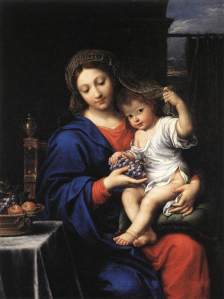
virgin-of-the-grapes

January 1st, 2017; Solemnity of the Blessed Virgin Mary, the Mother of God

Gospel Luke 2:16-21 NAB

The shepherds went in haste to Bethlehem and found Mary and Joseph, and the infant lying in the manger. When they saw this, they made known the message that had been told them about this child. All who heard it were amazed by what had been told them by the shepherds. And Mary kept all these things, reflecting on them in her heart. Then the shepherds returned, glorifying and praising God for all they had heard and seen, just as it had been told to them.
When eight days were completed for his circumcision, he was named Jesus, the name given him by the angel before he was conceived in the womb.

Meditation Reflection:

“Mary kept all these things, reflecting on them in her heart.”  When it comes to their children, mothers are contemplatives; they treasure and reflect on every little thing and never tire of gazing at their children in love.  I will never forget the first night I spent with my son in the hospital. The nurse urged me to sleep after an exhausting birth, but I couldn’t stop holding him and staring at him.  I was overcome with a love there is no vocabulary to describe, and in awe of this mystery beyond comprehension.  With each subsequent child, I experienced the same awe.  Moreover, rather than dividing my love, each child multiplied it by expanding my heart with love for each of them individually.

As Mary gazed with love on her child, she gazed not only on her son, but the Son of God.  Mary was the first person to contemplate the mystery that Jesus is both God and man, creator and savior, born to die that we might live.  She is the first to love Him with her whole heart and the only to have the privilege of loving Him with a mother’s heart.

When God the Son took on a human nature, He allowed Himself to become weak and vulnerable.  He experienced human development and the daily process of growth and maturation we all go through.  Mary and Joseph were not merely day care providers for Jesus.  They were the first disciples of Christ and lived their vocation as His family to the fullest.  As God, Jesus had all the divine attributes.  As man, He shared DNA with Mary, He adopted Mary and Joseph’s mannerisms, He received a formation within the context of His family.  Though He is both God and Man, Jesus is one Person.  As a result, since Mary is the mother of Jesus she is rightly called Mother of God.  This does not mean she is the origin of the Trinity.  However, we must remember that mothers are mothers of people, not merely bodies.  It would be strange to say that I am the mother of my son’s body but not the mother of my son the person.  In the same way, to bifurcate Mary’s motherhood as merely that of part of Jesus would be to bifurcate Jesus Himself.  Jesus is one Person, the Second Person of the Trinity, who, since the moment of His incarnation, is forever simultaneously both God and Man.

Mary revered our Lord as both.  She nurtured His human needs and she worshipped His divinity.  She, like Him, obeyed the Father in all things.  She was the first human to live fully God’s plan for all mankind – union with God of heart, mind, and will.  Moreover, she is the only human to love Him as her Son and to be loved by Him as His mother.

This deep, pure, motherly love of Mary extends to each one of us as well.  From the Cross, as Christ suffered and died for our redemption and rebirth, He entrusted Mary as mother to St. John.  In doing so, He gave all of us to her as her children.  In baptism, we are united to Christ as His Mystical Body.  In consequence, we are also united to Mary as our mystical Mother.  Rather than dividing her love, each person who accepts her as mother, multiplies her love and experiences the same tender attention she gives to each of her children.  Christ shares our nature, and He has also shared His Heavenly Father and His earthly Mother with us.  Through Christ we become adopted sons and daughters of God and cherished children of Mary.  Through Christ’s condescension to become our brother, He has invited us into His own family.

Mary is the mother of God because God became man.  Mothers never tire telling anyone who will listen about their children.  Moreover, mothers love their children simply for who they are, not merely what they do.  If we ask Mary, she will share with us about her Son and teach us how to love and follow Him for Who He is, and not merely what He can do for us.

“She is so full of love that no one who asks for her intercession is rejected, no matter how sinful he may be. The saints say that it has never been known since the world began that anyone had recourse to our Blessed Lady, with trust and perseverance, and was rejected.” St. Louis de Montfort

Consider:

  • How has meeting someone’s mother taught you something new about a person?
  • What do you cherish about your mother’s love?
  • If you are a parent, consider the mystery of your love for your children. Imagine Mary’s love for Jesus at each of the stages of growth your kids have experienced.
  • Adoptive parents repeatedly report that they love their adoptive kids as if they were theirs biologically. Consider Mary’s motherly love for you as her adoptive child, whom she loves as her very own.
  • Reflect on Christ’s love for Mary as His mother.
    • Consider the deep feelings of admiration and appreciation He has for her.
    • Reflect on their relationship and connection as mother and son.
    • Consider the comfort and strength He drew from her during His public ministry, knowing He had one person who understood His mission and supported Him no matter what.

Make a Resolution (Practical Application):

  • This week, read and reflect on the words of Mary in Scripture.
  • Ask Mary to be your mother and go to her each day with your needs. Ask her to tell you about Jesus and teach you how to follow Him.
  • Pray a decade of the rosary each day. Consider using the Scriptural rosary if you can.
    • (I have never prayed the rosary without experiencing some kind of grace. Mary always brings us to Jesus.)
    • Pope St. John Paul II said, “To pray the Rosary is to hand over our burdens to the merciful hearts of Christ and His mother.”


~ Written by Angela Lambert © 2017

* To receive these weekly posts automatically in your email just click the “follow” tab in the bottom right hand corner and enter your email address.


We Have Seen His Glory! Awe of God and Christmas Witness…

by Angela Lambert

nativity

December 25th, 2016; Christmas Liturgy

Gospel John 1:1-18

In the beginning was the Word, and the Word was with God, and the Word was God. He was in the beginning with God. All things came to be through him, and without him nothing came to be. What came to be through him was life, and this life was the light of the human race; the light shines in the darkness, and the darkness has not overcome it. A man named John was sent from God. He came for testimony, to testify to the light, so that all might believe through him. He was not the light, but came to testify to the light. The true light, which enlightens everyone, was coming into the world. He was in the world, and the world came to be through him, but the world did not know him. He came to what was his own, but his own people did not accept him. But to those who did accept him he gave power to become children of God, to those who believe in his name, who were born not by natural generation nor by human choice nor by a man’s decision but of God. And the Word became flesh and made his dwelling among us, and we saw his glory, the glory as of the Father’s only Son, full of grace and truth. John testified to him and cried out, saying, “This was he of whom I said, ‘The one who is coming after me ranks ahead of me because he existed before me.’” From his fullness we have all received, grace in place of grace, because while the law was given through Moses, grace and truth came through Jesus Christ. No one has ever seen God. The only Son, God, who is at the Father’s side, has revealed him.

Meditation Reflection:

Why, on Christmas, do we read John’s lofty, deep, theological reflection on Jesus as the Word, or Logos, rather than a quaint story of Mary and Joseph in the stable? Let’s consider.  For the past four weeks, we have contemplated the coming of Christ.  We examined the spirit of repentance necessary to receive Him, which John the Baptist so boldly and faithfully proclaimed.  We reflected on Mary’s fiat, her “yes” that made the Incarnation and our redemption possible, and Joseph’s “yes” which provided the incarnate Lord with a family.  Hopefully we have developed a deep appreciation for the Lord’s covenantal relationship with humankind, His desire for relationship, and His gracious condescension to include us in some small way in His work of our redemption.

Now, on Christmas Day, the Church invites us to stand in awe together, as God the Son, the Logos, the 2nd Person of the Trinity, who took a human nature at the moment of His conception, makes the invisible God visible at His holy birth.  Jesus Christ, God and man, born to die, once and for all debunked any misconceptions we may have formerly held; whether that of the distant god of the desists, or the hedonist, narcissistic gods of the pagan mythologies.

I love so very many verses in the Scriptures, but John 1:14 is my absolute favorite.  John the beloved disciple, passionately gives witness to his ineffable gift of seeing God: “And the Word became flesh and made his dwelling among us, and we saw his glory.” John identifies Jesus as the Word, or Logos in Greek.  In doing so, he affirms Jesus’ eternal divinity.  Lest we be deceived into thinking Jesus existed merely as an exceptional human person in history, John makes clear that the Son of God, through Whom all things were created, has taken on a human nature to redeem His creation.

Recall in Genesis chapter 1, the way in which God created.  “And God said, ‘let there be light’, and there was light” (Genesis 1:3).  God created out of nothing, by speaking.  To speak, we employ words.  Thus, Church Fathers have described the Trinitarian work of creation as God the Father speaking, God the Son as the Word spoken, and God the Holy Spirit as the goodness by which everything was declared good.  On Christmas day, therefore, we contemplate this beautiful and gracious mystery, that the Word through whom we received our existence, also became man to restore our fallen nature to its original end – union with God.

God’s love however. always exceeds our expectations and knows no other possibility than generosity.  Thus, John describes Jesus’ mission from the Father as establishing “grace upon grace”.  By this he means that instead of merely restoring us to our original manufacturer settings, Christ elevated our nature to an even higher order.  Through Baptism, God dwells in our very soul.  Through the Incarnation, our human nature became forever united to the divine nature in the Person of Jesus Christ, the Son of God.  Not even the angels can boast of this.

People first encountered Jesus as a man who then demonstrated He was God.  John invites us today to contemplate that Jesus is the eternal God, who became man.  Moreover, the God made man, Who opened for us entirely new horizons of living through the power of His grace and the gift of being children of God.

God literally dwelt among us, and He continues to literally dwell among us in His Eucharistic presence.  He united Himself with our human nature, and He unites with our soul personally at Baptism and ever more deeply the more times we give Him our own “yes.”  When we do this, we, like John, “see His glory.”  Christianity, at its foundation, is not a religion of “the book”, it is a religion of “witness to the risen Lord.”  Yes, this is expressed infallibly and inspired by the Holy Spirit through Sacred Scripture and Sacred Tradition.  However, contrary to secular assumptions about our faith, we do not believe because we have found a convincing philosophy in a book we read by a great guru (similar to say Buddhism), but because we have encountered the risen Christ – real, alive, and active in our lives.  We have proof because we have seen the transformation that He has accomplished in our souls, which we know is not false modesty but a true miracle.  Like the Samaritan woman at the well in John chapter 4, overcome with joy and astonishment, we witness to this encounter and invite others to “come and see.”  Eventually they can say, as her fellow villages exclaimed, “It is no longer because of your words that we believe, for we have heard for ourselves, and we know that this is indeed the Savior of the world.”

God has made His dwelling with us – Halleluiah! His light has cut through the darkness and given us hope. The Word has become man and dwelt among us, and we have seen His glory!

Consider:

  • Consider Christ’s divinity.
    • Reflect on His divine attributes – eternal, perfect, infinite, all-knowing, all-powerful, all-loving.
    • Reflect on His eternal Sonship to the Father.
    • Contemplate His work in Creation. Re-read Genesis chapter 1 and consider Christ, the Word, at work in our original beginning.
  • Consider Christ’s Incarnation and Redemptive work.
    • Reflect on how the Son became man, to suffer and die for our salvation.
    • Human persons are made in the image and likeness of God. Because of Original Sin and the Fall, we distorted that image.  Consider how Christ is at work in a new creation, restoring and elevating human kind to an even higher level of union with God.
  • Consider your witness of seeing Christ’s glory.
    • How has Christ transformed you. How has He freed you, strengthened you, enlightened you, and loved you?
    • In what ways do you experience Christ’s nearness?

Make a Resolution (Practical Application):

  • If you, like John or the Samaritan woman, were to give witness to meeting the Christ and seeing His glory, what would you say?  Write a testimony of your own eye witness of Christ’s true presence and saving action in your own life.
    • You don’t have to share it with anyone. You can simply take it to prayer and offer it as a prayer of praise and thanksgiving.
    • At the same time, as St. Peter advises, “always be prepared to make a defense to anyone who calls you to account for the hope that is in you, yet do it with gentleness and reverence” (1Peter 3:15). If an opportunity arises to share your testimony, pray for the grace and courage to give loving witness.


~ Written by Angela Lambert © 2016

* To receive these weekly posts automatically in your email just click the “follow” tab in the bottom right hand corner and enter your email address.


Joseph’s Steady Leadership When Faced With “It’s Complicated”

by Angela Lambert

st-joseph

December 18th, 2016; 4th Sunday in Advent

 Gospel Matthew 1:18-24 NAB

This is how the birth of Jesus Christ came about. When his mother Mary was betrothed to Joseph, but before they lived together, she was found with child through the Holy Spirit. Joseph her husband, since he was a righteous man, yet unwilling to expose her to shame, decided to divorce her quietly. Such was his intention when, behold, the angel of the Lord appeared to him in a dream and said, “Joseph, son of David, do not be afraid to take Mary your wife into your home. For it is through the Holy Spirit that this child has been conceived in her. She will bear a son and you are to name him Jesus, because he will save his people from their sins.” All this took place to fulfill what the Lord had said through the prophet: Behold, the virgin shall conceive and bear a son, and they shall name him Emmanuel, which means “God is with us.” When Joseph awoke, he did as the angel of the Lord had commanded him and took his wife into his home.

Meditation Reflection:

Immanuel, God-with-us.  We no longer must suffer alone, weak and afraid.  The Lord has come and brought with Him the comfort, strength, and peace of His holy presence dwelling in our souls and working in the world with His transforming grace.  We experience something of this peace and strength in family life.  Being with our parents makes us feel secure and protected.  Being with our children brings us joy and comfort.

The Holy Family experienced this as well, and made it possible for all of us.  Mary’s fiat, her “yes”, made the Incarnation possible and therefore the redemption of all mankind.  Joseph’s fiat, his “yes”, made the Holy Family possible.  He accepted Christ as He was, in the surprising and shocking form in which He came.  His decision to take Jesus and Mary into his home and make them His own family was the fruit of God’s grace in concert with his virtues.  This required serious discernment and prayer, both of which he models for all Christians.

Joseph was a just, or righteous man.  This does not mean he was without sin whatsoever, but it did mean he consistently strove for virtue, followed the Mosaic Law, and lived his faith.  Early Christian writings not included in the Bible, such as the Protoevangelium of James, indicate that Mary’s parents consecrated her to God and so she would serve God in the temple and take a vow of virginity.  As a result, she grew up in the Temple from the age of 3 until she was of marrying age.  It was a Jewish practice that at that point she would be entrusted to the care of a guardian who would protect her and would respect her vow of virginity by taking a vow of celibacy himself.  Oftentimes this would be a man who was older and widowed.  Some think this explains why Joseph had died by the time of Jesus’ public ministry.  According to the Protoevangelium of James, from among the men who wished to take Mary as their wife, Joseph was chosen as Mary’s husband by a miraculous sign.  Imagine his surprise, confusion, and disillusionment, when he learned she was pregnant. His response to the situation is so admirable, strong, and level-headed.  He’s a model for anyone who must make difficult decisions in complicated and emotional situations.

Joseph made a prudent decision, based on who he was and his faith.  Purity and honor being important virtues, he decided he could not take her into his home as his wife. (At the time, betrothal was a solemn contract with the weight of marriage, but preceded living together as husband and wife).  At the same time, he was a compassionate and merciful man.  Matthew tells us Joseph was “unwilling” to expose her to shame.  I imagine he had plenty of men and women urging him to exact the full measure of the Jewish law against her, to publicly humiliate her, and to get sweet revenge for embarrassing him. Joseph would not.  He was unwilling.  Joseph made a decision to do the right thing quietly. In the RSV translation, it says he “resolved to send her away quietly.”  To be resolved indicates a decision made with prudence, strength, and determination, detached from pettiness and emotion.

Joseph focused on how to thoughtfully and prayerfully doing the next right thing.  Because of this, God guided his discernment.  The RSV translation says, “But as he considered this, behold an angel of the Lord appeared to him”.  The word “considered” is important.  The spiritual life is ultimately one of love, fidelity, and receptivity.  We are followers of God, not leaders of God.  God guided Joseph’s considerations for his family, just as God guides every father who will invite the Lord into his discernment.  When God spoke, Joseph faithfully and lovingly followed through with God’s will.

Immanuel, God-with-us.  How might we as mothers and fathers invite God to be with us in our families and our decision-making?  How might we say yes to the Father and welcome His Son?  How might we accept the family that God has entrusted to us, rather than the one we imagine for ourselves?  God works in surprising and shocking ways.  This Advent, taking a moment to consider who we are and what we believe, may St. Joseph pray for us to have the kind of steady and faith-filled approach to life’s complications that he did.


Consider:

  • Joseph’s yes made it possible for Jesus to have a family.  Consider what a gift it was for him to grow up with Mary as His mom and Joseph as His foster-father.
  • Consider Joseph’s prayerful leadership. How might you imitate St. Joseph’s discernment in your own life?
  • Do you take time to “consider” things and “resolve” to follow through?
    • What things, habits, or people undermine that, urging you to react immediately and emotionally?
    • What things, habits, or people could help you develop deeper consideration and stronger resolve?
  • Ask Joseph to lead you and your family, as He did for Jesus and Mary. Pray for his protection, guidance, and love.

Make a Resolution (Practical Application):

  • Teresa of Avila and numerous other saints recommend devotion to St. Joseph and credit his powerful intercession for answers to their prayers.  I too can attest to this from my own life.  This week, ask St. Joseph to pray for you and for your family. st-joseph-prayer
  • Do you know someone who is like St. Joseph? Spend more time with that person and learn from his example.  Take him to coffee and ask him lots of questions and take his advice.
  • Surrender a complicated decision to the Lord in quiet prayer. Consider who you are, what our Christian faith says about the situation, and resolve to do the next right thing with the help of the Holy Spirit.


~ Written by Angela Lambert © 2016

* To receive these weekly posts automatically in your email just click the “follow” tab in the bottom right hand corner and enter your email address.