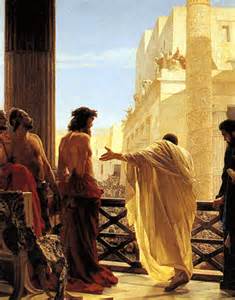
Looking for a Savior

by Angela Lambert


Jesus and Pilate

November 13th, 2016; 33rd Sunday in Ordinary Time

Gospel Luke 21:5-19

While some people were speaking about how the temple was adorned with costly stones and votive offerings, Jesus said, “All that you see here– the days will come when there will not be left a stone upon another stone that will not be thrown down.” Then they asked him, “Teacher, when will this happen? And what sign will there be when all these things are about to happen?” He answered, “See that you not be deceived, for many will come in my name, saying, ‘I am he,’ and ‘The time has come.’ Do not follow them! When you hear of wars and insurrections, do not be terrified; for such things must happen first, but it will not immediately be the end.” Then he said to them, “Nation will rise against nation, and kingdom against kingdom. There will be powerful earthquakes, famines, and plagues from place to place; and awesome sights and mighty signs will come from the sky. “Before all this happens, however, they will seize and persecute you, they will hand you over to the synagogues and to prisons, and they will have you led before kings and governors because of my name. It will lead to your giving testimony. Remember, you are not to prepare your defense beforehand, for I myself shall give you a wisdom in speaking that all your adversaries will be powerless to resist or refute.  You will even be handed over by parents, brothers, relatives, and friends, and they will put some of you to death.  You will be hated by all because of my name, but not a hair on your head will be destroyed. By your perseverance you will secure your lives.”

Meditation Reflection:

Oftentimes we imagine being a Christian means merely letting Jesus smooth out the rough edges of our lives to make it happier and more beautiful.  The Jews made this mistake by imagining that in fulfilling the law and the prophets the Messiah would simply restore the Davidic Kingdom to its former earthly glory.  To be fair, the Incarnation of the Son of God liberated us at an unimaginable level. God’s merciful love exceeds anything we have experienced or could expect.  He also exceeds all expectations of philosophy and the wisdom of the Greeks.  The Jews experienced a taste of God’s powerful action and the Greeks touched on the heights of God’s wisdom.  Jesus, the power and wisdom of God, makes both of these accessible to all and redirects our efforts toward an everlasting destination.

Christ counsels us to view this life as a pilgrimage and a battle.  We develop our faith, hope, and love, on earth which will bring a deep sense of joy but will never create an earthly utopia.  If we hope to find fullness here we will be sorely disappointed.  Just look at the reactions of the people to the current election.  Although presidents have a great deal of power, they are not omnipotent.  Moreover, their policies certainly affect our daily lives but the transformation of heart and development of culture is something only Christ can do through His grace and His followers.  Both candidates have significant flaws and neither are our savior.  The presidential election can never be the beginning of building a utopia or the end of the world, depending on your perspective.  Our reaction ought to be proportionate – working diligently for the common good within our democratic system but relying on Christ alone for the salvation of souls and the spiritual elevation of our country.  We can find relative happiness here, but for our joys to be lasting we need to direct them toward their true end – the heavenly kingdom.

Christ promises to equip us for both the physical and the mental battle.  As long as we live in the tension of sin and its effects, we will have to struggle against ourselves and others who oppose Christ’s kingdom, even family and friends.  Nevertheless, Jesus, the Wisdom of God, provides the supernatural insights to answer the world’s mistaken propaganda or the pressures applied by those we care about.  He also strengthens His disciples with supernatural perseverance to endure the physical suffering or possible martyrdom inflicted by worldly combatants.

As Catholics, we too enjoy beautiful churches that express the glory of God. Rightly so, we adorn them with gorgeous art, precious metals, and the finest materials.  We do this as an act of worship, as demonstrating concretely to ourselves and the world the value of God and of His sacrificial love.  Christian churches are an icon, a sign pointing to a heavenly kingdom much more enduring.  The magnificence of the sight of God will make all earthly analogies disappear. We ought to enjoy earthly icons of beauty, goodness, and truth in churches, nature, and most importantly in persons.  At the same time, we need to daily recall to where they point and adjust our expectations and priorities accordingly.   We should still aim for greatness, justice, and perfection, but remember that it will come to fulfillment in the eternal kingdom where Christ reigns victorious.

Consider:

  • At the end of your life, what do you hope will endure from it afterward? Consider the lives you have and might still change, the love with which you imbue the world, the truths you fought to defend, the family relationships you have built.
  • Imagine your life from the perspective of entering heaven. Though all is certainly a grace, what would you be proud of?  What would you regret? How might you live each day with more eternal purpose and significance?

Make a Resolution (Practical Application):

  • Begin each day by surrendering it to the Lord.  Look for three opportunities each day to build the kingdom of God – by acts of mercy, service, defending truth, helping someone heal or find justice, sharing the good news of Christ, offering up personal disappointments or suffering as a sacrifice… At the end of the day write down the things that built the kingdom of God.  Reflect on any missed opportunities and pray for the grace to act on them tomorrow.

Previous Related Posts:

~ Written by Angela Lambert © 2016

* To receive these weekly posts automatically in your email just click the “follow” tab in the bottom right hand corner and enter your email address.


Keeping Things in Perspective

by Angela Lambert

perspective

November 6th, 2016; 32nd Sunday in Ordinary Time

Gospel Luke 20:27-38

 Some Sadducees, those who deny that there is a resurrection, came forward and put this question to Jesus, saying, “Teacher, Moses wrote for us, If someone’s brother dies leaving a wife but no child, his brother must take the wife and raise up descendants for his brother. Now there were seven brothers; the first married a woman but died childless. Then the second and the third married her, and likewise all the seven died childless. Finally the woman also died. Now at the resurrection whose wife will that woman be? For all seven had been married to her.” Jesus said to them, “The children of this age marry and remarry; but those who are deemed worthy to attain to the coming age and to the resurrection of the dead neither marry nor are given in marriage. They can no longer die, for they are like angels; and they are the children of God because they are the ones who will rise. That the dead will rise even Moses made known in the passage about the bush, when he called out ‘Lord,’ the God of Abraham, the God of Isaac, and the God of Jacob; and he is not God of the dead, but of the living, for to him all are alive.”

Meditation Reflection:

As Christians, we profess a belief in life eternal with Christ in Heaven, yet we can sometimes operate in our daily lives forgetful of this mystery.  Like the Sadducees we ask Christ silly questions about heaven.  When we attach ourselves too much to earthly life, we fall into the trap of imagining heaven as merely an extension of the present but with a few more perks.

Jesus reminds us of the incomparable difference between our journey to God here and union with God there.  As St. Paul put it, “Eye has not seen and ear has not heard what God has ready for those who love Him” (I Corinthians 2:9).  Even the good things we experience here are merely a prelude to heaven.  Here we experience a taste, there we will enjoy the feast.

Jesus proposes to the Sadducees that contemplating the life of the angels can provide some insight into this mystery.  Like humans, angels are persons with rational intellects, free will, and the ability to love.  Unlike humans they do not have bodies, are neither male nor female, and do not procreate.  Each angel was individually created by God and is completely unique, so much so that some have compared it to being like different species from one another.  Because they live in eternity, their choices are permanent.  When God created them they each had the choice to either accept or reject God’s will for their life and His mission for them.  Some said yes to God’s will and others rejected it.  Those who rejected God’s will we call the fallen angels or demons.  Human persons have more than one moment to choose or reject God, but that space of time does have limits.  For us it ends when we die; at which moment our choice becomes permanent.

Consequently, the space of time in which we live on earth really is only a preparation for eternal life.  During this short period, we either choose to grow our love for God or develop a disdain for Him.  Only during our earthly lifespan can we develop and increase our capacity for God.  At the moment of death the opportunity for change ends.

In addition, it’s our chance to aid others in their chance of heaven, even in its most basic form – the beginning of life itself.  Whereas God created all of the angels at once, He creates human persons over a course of time and includes them in His work.  As a result, openness to life means openness to God’s creation of persons who will live eternally.  Those called to spiritual motherhood or fatherhood also contribute to this mystery as they minister to the birth and development of the child’s love for God which is necessary for true life.

The Sadducees’ challenge to Christ with the hypothetical situation of a woman married seven times, merely exposed their ignorance of God.  On earth marriage develops our capacity for love, self-gift, and sacrifice.  It brings new life into the world as well as caring for the development of each family member.  Marriage itself is not needed in heaven because no new life will be born there.  It is the eternal life of those who already exist.  Moreover, love will be perfected as we enjoy the perfect love of God and one another. The relationship of love experienced in marriage will remain a relationship of love in heaven.  However, the title of husband or wife will be eclipsed by the fullness of the title son or daughter of God and sister and brother in Christ.

As the liturgical year comes to a close (Advent marks the beginning of the “New Year” in the Church), we contemplate the end times and remember that this experience of earthly life will eventually come to an end.  We all get bogged down in our daily routine and anxious over matters that, if we considered our heavenly destination, shouldn’t really weigh us down.  Moreover, we could make better use of our limited time if we consider things from an eternal perspective.  This life is a preparation and an opportunity to participate in God’s work of spreading His kingdom.  The more souls that come to accept His will and love on earth, the more that will join the wedding feast of love in Heaven for eternity.

Consider:

  • How does a heavenly perspective change your earthly perspective?
  • When feeling discouraged, remember that this life is a journey not the destination. Endless, secure happiness cannot be found here but the work to attain it in heaven can.
  • Through prayer, identify one area where you struggle to accept God’s will over your own.
  • Each angel has a mission from God. You also have a mission.  How is God calling you to serve?
  • Consider first God’s vocational calling:
    • Is it to work for the salvation of your spouse through love and sacrifice and to possibly grow the human family by being open to life and to raising children in knowledge and love of the Lord?
    • Is it to administer the sacraments as a priest to bring eternal life to spiritual children?
    • Is it to spend your life in prayer and sacrifice for souls as a religious sister or brother?
    • Is it to devote your time and energy to God in a unique way as a single person, ready to do His will at every moment?
  • Consider next God’s occupational calling: How do you grow your love for God and develop it in others through your work?
    • Consider your special apostolate. Does God include you in His work of physical or emotional healing, protecting, providing, instruction of souls, encouragement, etc.?
    • How can you incorporate a heavenly perspective into your daily work? How do your daily activities and duties provide opportunities to detach from selfishness and develop greater love and compassion?  How might you help others to heaven through your work?

Make a Resolution (Practical Application):

  • Begin each day by writing down the tasks, challenges, and opportunities you anticipate that day.  Next to each, write one way it can be directed toward helping yourself and others to heaven.  For example, will it grow a virtue or minimize a vice if tackled with the help of grace?  Is it an opportunity to help others journey to God – either by giving them physical life, sustaining their life, healing, protecting, or developing an aspect of their soul?
  • Identify where your will is most at odds with God’s and do one thing each day to offset it. It could be a refusal or fear to do something God asks of you or an unwillingness to let go of something and trust God in the situation.
  • Pray the Serenity Prayer or the Suscipe of St. Ignatius each day. Click here for a pdf of the two prayrs: serenity-and-suscipe-prayers.

Related Posts:

Real Realism

The Glorious Reign of Christ Our King

The Sight of God… Gospel Meditation for the Feast of All Saints

~ Written by Angela Lambert © 2016

* To receive these weekly posts automatically in your email just click the “follow” tab in the bottom right hand corner and enter your email address.


Tough, Gentle Mercy

by Angela Lambert


littleacts-of-kindness

October 29th, 2016; 31st Sunday in Ordinary Time

Gospel Luke 19:1-10

At that time, Jesus came to Jericho and intended to pass through the town. Now a man there named Zacchaeus, who was a chief tax collector and also a wealthy man, was seeking to see who Jesus was; but he could not see him because of the crowd, for he was short in stature. So he ran ahead and climbed a sycamore tree in order to see Jesus, who was about to pass that way. When he reached the place, Jesus looked up and said, “Zacchaeus, come down quickly, for today I must stay at your house.” And he came down quickly and received him with joy. When they all saw this, they began to grumble, saying, “He has gone to stay at the house of a sinner.” But Zacchaeus stood there and said to the Lord, “Behold, half of my possessions, Lord, I shall give to the poor, and if I have extorted anything from anyone I shall repay it four times over.” And Jesus said to him, “Today salvation has come to this house because this man too is a descendant of Abraham. For the Son of Man has come to seek and to save what was lost.”

Meditation Reflection:

As Jesus’ disciples, we too share in His mission to seek and save the lost.  During the Jubilee Year of Mercy, Pope Francis has exhorted us to be more proactive in this mission – to intentionally practice mercy daily through concrete actions and to make efforts to see those in need of help around us.  People who are lost, by definition, don’t know their way back home.  Thus, we need to seek them out, to find them where they are drifting, and to gently walk the journey back with them.

How do we do this?  It depends on the relationship and the situation.  The one consistent in every attempt however, is prayer.  Since we follow Christ, we must begin by listening to Him and letting Him lead.

Each person and each situation require prudence and a tailored response.  I can propose some general ideas and lessons I’ve learned, but every lost or drifting soul must be cared for on a prayerful and individual basis.

Seeking the lost begins at home with the people God has entrusted to us.  It’s much easier to dote on our children than to discipline them and to complain or criticize our parents or spouse than to gently correct them.  Yet, those closest to us can drift away and get lost if sins get left unchecked.  Although people make their own choices, we must do what we can to seek them out when they begin to pull away from God or goodness.

For parents, this means doing the work of discipline.  For young children, it teaches them self-control, right from wrong, and starts them off on the right track with good habits.  For teens, it can be trickier.  Their struggles are heavier, more embarrassing at times, and better hidden.  Discipline has to not only reform their habits but also their minds and hearts.  How to reach a child’s heart is a daunting task to attempt and one prone to failure, nevertheless we have a Christian and parental duty to try the best we can out of love.  We must endeavor to be bold, suck it up, and lovingly try to help them get back on track just as our heavenly Father does for us.

“But you spare all things, because they are yours, O LORD and lover of souls, for your imperishable spirit is in all things! Therefore you rebuke offenders little by little, warn them and remind them of the sins they are committing, that they may abandon their wickedness and believe in you, O LORD!”  Wisdom 11:26-12:2

When another adult in one’s family begins to stray, it requires just as much care and prudence.  It also requires greater understanding, compassion, and forgiveness on our part since we will likely be affected ourselves by their choices or we may struggle with feelings of disappointment or betrayal.  If we can be patient and prayerful however, knowing them so well can work in our favor to gently move them in a way that resonates with them personally.

Friends and acquaintances may be less open about their struggles but we can do small things to let them know we see they’re hurting and we are here to help.  Pray about whether to have a direct conversation or to indirectly point them through example, invitations, or suggestions.  Ask Mary to help you see their need and do what you can to meet it.  It may be material needs that can be met with physical gifts, emotional needs that can be met with a listening ear or a word of encouragement, loneliness which can be soothed through invitation to coffee or dinner, or spiritual need which might be aided by being brave enough to share your own faith openly with them or to pray with them.

little-acts-of-love-2

Consider:

  • When have you received merciful love? How did it change you?
  • How have the challenges you have faced enabled you to recognize the same struggle in others and better equipped to help?
  • Who do you find the most difficult to love and who do you find it easiest to care for?

Make a Resolution (Practical Application):

  • Pray for Christ to show you an opportunity to offer mercy to someone each day this week.Works of Mercy
  • Consider joining with others to help: volunteer at a crisis pregnancy center, lead a bible study, volunteer at a food shelf, organize meals for a neighbor or colleague who is sick…


~ Written by Angela Lambert © 2016

* To receive these weekly posts automatically in your email just click the “follow” tab in the bottom right hand corner and enter your email address.


The Spiritual Merry-Go-Round

by Angela Lambert

merry-go-round

 October 23rd 2016; 30th Sunday in Ordinary Tie

Gospel Luke 18:9-14

Jesus addressed this parable to those who were convinced of their own righteousness and despised everyone else. “Two people went up to the temple area to pray; one was a Pharisee and the other was a tax collector. The Pharisee took up his position and spoke this prayer to himself, ‘O God, I thank you that I am not like the rest of humanity — greedy, dishonest, adulterous — or even like this tax collector. I fast twice a week, and I pay tithes on my whole income.’ But the tax collector stood off at a distance and would not even raise his eyes to heaven but beat his breast and prayed, ‘O God, be merciful to me a sinner.’ I tell you, the latter went home justified, not the former; for whoever exalts himself will be humbled, and the one who humbles himself will be exalted.

Meditation Reflection:

When we reach out to Christ in our crises, needing a savior, we experience the reality of His saving grace along with the reality of our own weakness.  Together, these produce humility in the soul, a recognition of our dependence on God and His graciousness.  Unfortunately, over time fallen human nature tends to forget the extent of God’s help and exaggerates its own abilities.  Likewise, together, these produce pride in the soul, a false conviction of our own independence.

In the Old Testament, we can find account after account of this cycle with the People of God.  It looks something like this:

  1. They love and obey God and things are going well.
  2. As things go well they begin to attribute it to themselves and grow lax in their fidelity to God.
  3. God warns them to turn back to Him and His help, otherwise on their own they will suffer defeat at the hands of an enemy.
  4. They ignore God’s warning, put their trust in themselves and/or false gods, and a foreign enemy conquers and enslaves them.
  5. They cry out to God in their helplessness and need, realize their mistake, and beg Him to help.
  6. God liberates and restores them.
  7. They love and obey God and things go well….and the cycle starts over.

Most of us can relate to this cycle in our own lives, whether one begins with stage #1, having grown up in the faith before falling away or at #2 trusting in oneself until hitting rock bottom.  Time has a funny way of dulling or obscuring our memories and unless we make a conscious effort to cultivate gratitude and humility we can easily forget our need.  Not only does this diminish our relationship with God but it can also obscure our judgment of others.  Confident in our own success we can dismiss the struggles of others currently working through a spiritual crisis.  In Jesus’ parable, the Pharisee could be described as at stage 2 and the tax collector at stage 5.  From the Pharisee’s vantage point, his forgetfulness of His own redemption led to callousness toward the tax collector’s need.

Pope Francis addressed contemporary examples of this attitude in his book “The Name of God is Mercy.”  He describes what happens when we begin to take grace for granted, noting:

This conduct comes when a person loses a sense of awe for salvation that has been granted to him.  When a person feels a little more secure, He begins to appropriate faculties which are not his own, but which are the Lord’s.  The awe seems to fade, and this is the basis for clericalism or for the conduct of people who feel pure.  What then prevails is a formal adherence to rules and to mental schemes.  When awe wears off, we think we can do everything alone, that we are the protagonists.

He even goes so far as to say he almost wishes the person to fall to produce the greater good of humility. He admits that “The degradation of awe’ is an expression that speaks to me.  At times, I have surprised myself by thinking that a few very rigid people would do well to slip a little, so that they could remember that they are sinners and thus meet Jesus.” (p. 97) Of course he does not wish someone to sin, however a reality check about the true state of our natural weakness and the need for grace many times only comes through the experience of failure.   Just as God allowed the Hebrews to stand on their own and fall in order that they might repent and return, Pope Francis acknowledges that by God allowing a person to stand on their own in virtue (which no one can do well or for long without grace) and fall He reveals a higher truth to them and deepens their conversion.

St. Paul, for instance, attributes his unanswered prayers for a suffering to be alleviated, to God’s efforts to protect Paul from falling to an even greater suffering of pride and self-aggrandizement from the extraordinary graces God had given to him.  God desires us to grow in holiness and reach perfection; surprisingly, that can sometimes mean allowing us to struggle a little so we remain on the right trajectory.

“Therefore, that I might not become too elated, a thorn in the flesh was given to me, an angel of Satan, to beat me, to keep me from being too elated. Three times I begged the Lord about this, that it might leave me, but he said to me, “My grace is sufficient for you, for power is made perfect in weakness.” I will rather boast most gladly of my weaknesses, in order that the power of Christ may dwell with me. Therefore, I am content with weaknesses, insults, hardships, persecutions, and constraints, for the sake of Christ, for when I am weak, then I am strong.“ 2 Corinthians 12:7-10

St. Augustine offers insights as well in his letter to Proba.  Commenting on St. Paul’s words in the above passage, Augustine encourages us that during times of suffering we may pray for God to remove the difficulty but not to despair if God chooses an alternative instead.  The alternative resolution may be greater provisions of His grace that you may endure the trial, rather than its removal so you can merely return to the illusion of self-sufficiency.

In the kind of affliction, then, which can bring either good or ill, we do not know what it is right to pray for; yet, because it is difficult, troublesome and against the grain for us, weak as we are, we do what every human would do, we pray that it may be taken away from us. We owe, however, at least this much in our duty to God: if he does not take it away, we must not imagine that we are being forgotten by him but because of our loving endurance of evil, must await greater blessings in its place. In this way, power shines forth more perfectly in weakness. These words are written to prevent us from having too great an opinion of ourselves if our prayer is granted, when we are impatient in asking for something that it would be better not to receive; and to prevent us from being dejected, and distrustful of God’s mercy toward us, if our prayer is not granted, when we ask for something that would bring us greater affliction, or completely ruin us through the corrupting influence of prosperity.”

God knows our nature.  He knows our timeless struggle of cycling through humility and pride, gratitude and forgetfulness. Daily prayer and surrender to divine providence provide strong medicine to break the destructive cycle in our own spiritual lives.  Whenever we feel quick to judge or a little too self-sufficient, let us remember back to the times we cried out to our savior and received His mercy and in turn cultivate compassion and empathy for others crying out to our savior from their own needs.  As my mother frequently recites, “But for the grace of God, there go I…”

Consider:

  • When have you cried out to God to save you?  When has God’s grace liberated you from the snares of a sin or vice?
  • In what ways do you rely on God every day? How does His grace continue to transform you and bless you?
  • Is there someone you feel tempted to judge or feel calloused toward rather than compassionate? What is it that bugs you about them?  Is there a particular sin you are more harsh about than others?
  • Can you recognize the above seven stage spiritual cycle in your own life? Was there a point where God helped break the cycle or do you feel you still keep circling?  Which number might describe your current situation?

Make a Resolution (Practical Application):

  • Show compassion toward someone struggling with a sin or vice.  Reach out in a concrete way this week to encourage or strengthen them.
  • Pray the Litany of Humility each day this week.https://www.ewtn.com/Devotionals/prayers/humility.htm
  • Make a gratitude list of all the things you only have as a result of God’s mercy.


~ Written by Angela Lambert © 2016

* To receive these weekly posts automatically in your email just click the “follow” tab in the bottom right hand corner and enter your email address.


Why Pray If God Already Knows?

by Angela Lambert

father

October 16th, 2016; 29th Sunday in Ordinary Time

Gospel Luke 18:1-8

Jesus told his disciples a parable about the necessity for them to pray always without becoming weary. He said, “There was a judge in a certain town who neither feared God nor respected any human being. And a widow in that town used to come to him and say, ‘Render a just decision for me against my adversary.’ For a long time the judge was unwilling, but eventually he thought, ‘While it is true that I neither fear God nor respect any human being, because this widow keeps bothering me I shall deliver a just decision for her lest she finally come and strike me.’” The Lord said, “Pay attention to what the dishonest judge says. Will not God then secure the rights of his chosen ones who call out to him day and night? Will he be slow to answer them? I tell you, he will see to it that justice is done for them speedily. But when the Son of Man comes, will he find faith on earth?”

Meditation Reflection:

If God is all-good, all-loving, all-knowing, and all-powerful, why should we pray?  Wouldn’t it be better to only offer prayers of thanksgiving or praise?  If we pray for someone or for something, are we not assuming we can change God’s mind and that to change His mind means there’s something lacking in His divine providence?

Questions such as these arise in many human hearts.  Jesus addresses it in this passage and points us toward some reasons we ought to pray, and more boldly, to pray for specific intentions. The great theologian Thomas Aquinas addressed these questions as well in the Summa Theologica (II.II.Q.83) and offers some clear questions and answers for us to contemplate.

In Article 2, “Whether it is becoming to pray,” he addresses this objection:

Objection 1:  It would seem that it is unbecoming to pray. Prayer seems to be necessary in order that we may make our needs known to the person to whom we pray. But according to Matthew 6:32, “Your Father knoweth that you have need of all these things.” Therefore it is not becoming to pray to God.”

This seems like a valid argument and even cites Scripture.  If God knows what I need anyway, and certainly He knows it better than me, why should I pray at all?  I myself have felt a little silly at times praying for intentions as I imagined God saying, “I know this already, move on.”

Yet, Jesus instructs us to pray for our daily bread (Matthew 6:11), to call out to God day and night (Luke 18:7), that whatever we ask in prayer shall be given to us (MT 18:19, MT 21:22, MK 11:24JN 14:13, JN 15:7 and many more).  Moreover, St. Paul says to pray without ceasing (1 Timothy 5:17).  So why does God want us to pray for things if He already knows our needs?

Aquinas’ response provides insight for us:

Reply to Objection 1. We need to pray to God, not in order to make known to Him our needs or desires but that we ourselves may be reminded of the necessity of having recourse to God’s help in these matters.”

First, we pray because we need to see the connection between our needs and God’s provisions.  If we don’t pray, we often take God’s gifts for granted or assume they resulted merely from chance, good luck, or our own efforts.  Through prayer, especially through persevering prayer, our disposition changes and we realize our total reliance on God’s graciousness.

Secondly, because of the transformative effect petitioning God can have on our faith and our relationship with God, sometimes God wills that something happens only if we pray for it.  Aquinas puts it this way: “Divine providence disposes not only what effects shall take place, but also from what causes and in what order these effects shall proceed. (II.II.Q.83A.2)”

In other words, God’s divine providence doesn’t change because of our prayers since God is all good and His desire is always perfect.  However, Aquinas points out that God’s divine providence desires not only certain good effects, but the prior causes of those effects as well.  For instance, God’s intention to provide for you might also include the source of that provision – either a particular job, an act of generosity by another, etc.  In consequence, we ought to pray for things because there are some things that God wills to give, but through the causation of our prayers.  Thus, He may provide a particular thing only if you pray for it because He wills that it be caused by your prayers.

If we ought to pray, then for what should we pray and for what shouldn’t we pray?  Should we pray for spiritual gifts only or can we pray for temporal things?

For example, early in my faith journey I was surprised at how God answered prayers and I noticed something.  I found that He kindly accepted my meager attempts and although I usually prayed for the solution to my problem, God saw the problem itself and provided a solution much more creatively and profoundly than I could have imagined.  As a result, I try to refine my prayers to petitions of presenting problems to the Lord and trusting in Him to provide the resolution.  Thus, my faith deepens as I see Him at work rather than prayers that feel like manipulation by demanding specific logistics.

 Aquinas offers insights into a couple of common questions in this regard that are helpful.  In Article 5, he presents this objection:

Now according to Romans 8:26, “we know not what we should pray for as we ought.” Therefore we ought not to ask for anything definite when we pray.”  The objector in this case cites Scripture correctly but draws the wrong conclusion.  It’s true that our prayers are often misguided, like my earlier example.  Nevertheless, as Aquinas points out, Scripture also says, that the Holy Spirit will enable us to pray as we ought.  He writes, “Although man cannot by himself know what he ought to pray for, “the Spirit,” as stated in the same passage, “helpeth our infirmity,” since by inspiring us with holy desires, He makes us ask for what is right. Hence our Lord said (John 4:24) that true adorers “must adore . . . in spirit and in truth.”

God is a patient and kind guide.  He accepts the true prayers of our hearts no matter how bungled the words we use to express them.  In addition, the more we invite the Holy Spirit to direct our prayer, the deeper and more authentic our prayers become.

In Article 6, Aquinas tackles the even harder question of whether we ought to pray for temporal things, i.e. the needs of our earthly well-being. He makes an insightful distinction between prayers for our needs verses disordered wants, “order” being the key word.  When it comes to praying for specific things we ought to petition God, but to have them appropriately prioritized.  For example, of highest importance would be those needs relevant to the salvation our souls, the souls of those we love, and the advancement of God’s kingdom.  Next in order would be our daily needs – food, clothing, shelter, friendship, etc.  Last would be our wants (“If you feel like treating me Lord….would be awesome!”)

Prayer is not a letter to Santa.  It’s not a childish wish list.  Prayer is relational.  We converse with God and deepen our relationship as our loving Father listens to our needs and provides for them.  We converse with the saints and with each other as we unite in prayer before the Lord for a petition.  Thus we see the beauty of the Christian family and experience a deepening of unity with the people of God as we rely on each other’s prayers as well as our own.  God wills our good, and He also wills at times for that good to come through prayer.  As a mother I often anticipate my children’s needs but I appreciate when they humbly ask and acknowledge the connection between their need and my generosity.  God loves us dearly and provides so many things for which we never even asked or dreamed.  Yet, He desires to partner with us and to bring about good through our cooperating efforts both in action and also in prayer and sacrifice.

Consider:

  • Consider how connected we feel to those who we rely on for help and those whom we help.
  • Have you ever tried to struggle with something on your own for a long time before finally asking God for help? Were you surprised at how quickly He helped you once you asked?
  • Pray to the Lord for the needs of your soul. What sins do you need His grace to overcome?  What virtues do you desire to grow?  What desires would you like the Lord to give you?
  • Pray to the Lord for the needs of the souls of those you love. With what are they struggling?  Where do they need conversion?  What holy desires do they need from the Holy Spirit?
  • Pray for the needs of the souls of you enemies. Pray for conversion in their hearts and gifts of grace.  Pray for blessings in their lives.
  • Pray for your needs – material, physical, emotional, relational.
  • Pray for your wants from a spirit of joy in God’s generosity. Avoid a demanding or complaining attitude and accept it may not be God’s will. On the other hand, remember God’s fatherly love and His desire for your “joy to be full.”

Make a Resolution (Practical Application):

  • Make a prayer intention list in your prayer journal. Write the date or make a check mark next to the ones He answers.  (remember some might be answered soon others may require time and perseverance)
  • Pray a prayer of surrender each day to God’s divine providence and openness to what surprises He may send you.


~ Written by Angela Lambert © 2016

* To receive these weekly posts automatically in your email just click the “follow” tab in the bottom right hand corner and enter your email address.


Hope in Christ in Times of Darkness

by Angela Lambert

light-in-dark

October 9th, 2016 28th Sunday in Ordinary Time

Gospel Luke 17:11-19 NAB

As Jesus continued his journey to Jerusalem, he traveled through Samaria and Galilee. As he was entering a village, ten lepers met him. They stood at a distance from him and raised their voices, saying, “Jesus, Master! Have pity on us!” And when he saw them, he said, “Go show yourselves to the priests.” As they were going they were cleansed. And one of them, realizing he had been healed, returned, glorifying God in a loud voice; and he fell at the feet of Jesus and thanked him. He was a Samaritan. Jesus said in reply, “Ten were cleansed, were they not? Where are the other nine? Has none but this foreigner returned to give thanks to God?” Then he said to him, “Stand up and go; your faith has saved you.”

Meditation Reflection:

On His way to Jerusalem, where He would be rejected and killed for our sins, Jesus encountered ten lepers.  Since leprosy is highly contagious those who suffered with its physical harms additionally suffered from social isolation and rejection as well, banished to stay separate from healthy people.  When the lepers saw Jesus they called out because they could not approach in their condition.  Jesus’ instructions to show themselves to the priests required them to make an act of faith and hope.  Faith believes God’s words and hope acts upon those promises before necessarily seeing them.   At that time, if someone believed they had been healed from leprosy, they had to show themselves to the priests for examination before being cleared to reenter the community.  The lepers did not question Jesus’ command but did as He instructed before they had been healed.  They acted with hope based on belief in Jesus and His words.  As they walked in hope, they were cured.

The virtues of faith and hope direct one toward the highest of all virtues – charity.  Charity is the love of God above all things and love of neighbor out of love for God.  Only one leper demonstrated this higher virtue.  Jesus, who knows the hearts of all men, indicated that the man who returned had a deeper and more fruitful faith than the other nine.  Why?  He returned to Jesus to say thank you.

Consider how many of us quickly forget God’s miraculous work in our lives shortly after the crisis is over. We fall back into our regular routines and grow complacent or even complain about mundane things. Even worse, when the next crisis upsets our lives, we sometimes forget God’s power and fall to discouragement and negativity.  How can we avoid this common mistake?

A simple thank you and a disposition of gratitude express, as well as develop, the essential virtues of the spiritual life. Every day, and many times throughout the day, we have to choose our attitude.  We regularly experience the temptation to succumb to negativity, skepticism, disgust, and even despair.  Our present culture, especially during the current election cycle, presents seemingly constant negative and depressing messages.  From mainstream news to social media to conversations at work, the temptation to view the state of our nation in an overly negative light and give up in despair is constant.  However, with faith in Christ’s promise and hope in His transformative love, we can work through this crisis with the aid of the Holy Spirit and supernatural grace.

If everything depended on us alone, then discouragement and despair would be a sensible response. Take for example the Gospel passage.  The lepers would have considered their future to consist merely of painful physical deterioration and utter loneliness. Their lives took a completely new trajectory when they encountered Christ.  This surprising, unexpected event, liberated them their illness and gave them new hope for their future.

Propping up hope that man can save himself, then deepening discouragement at the realization that we can’t, are two common ways the devil tries to lead us away from the Lord.  We can benefit from doing a daily attitude check and remembering that when we encounter Christ, surprising, unexpected things can happen and change our lives and our world.

A favorite author of mine and Catholic historian, Christopher Dawson, wrote an essay entitled “The Six Ages of the Church” which gives me perspective for our current situation as a Church and as a nation.   In this essay he proposed that throughout the course of its 2000 year history, the Church has (and continues) to experience a cycle of three stages: crisis, response, and flourishing. With each challenge the Church experiences setbacks and loss.  In response, new apostolates arise and face the challenge resulting in a time of flourishing and achievement.  The next crisis sets the Church back again but new responses emerge again as well, and so on and so forth.

Viewing history from this perch inspires hope as we consider every age poses its challenges and Christians have felt the same confusion, disillusionment, and fear that we do.  Yet, in every age the Holy Spirit worked in the hearts of God’s people and inspired them with new ways to meet those challenges, adapt, and overcome.

light-2

This cycle applies to our individual lives as well.  We will encounter challenges that leave us feeling confused and helpless.  Nevertheless, if we call out to Jesus and walk forward in faith and hope, He will transform our lives and we will indeed flourish.  During times of peace, the challenge is to remain grateful and to return to the Lord, remembering that He is the source of our health.  We are always dependent on Him.  During times of crisis, we need to remember God’s power to transform, possibly even through us.  Thanksgiving, counting our blessings, and confidently surrendering to the Lord should be our daily response.  No matter what our crisis – individually, locally, or nationally – there are always things for which to be grateful and always hope for renewal.  As St. Paul says in 1 Thessalonians 5: 18 In all circumstances, give thanks,
for this is the will of God for you in Christ Jesus.”

Consider:

  • Reflect back on times that God helped you through a difficulty.  Consider the feelings you experienced beforehand and the joy afterward.
  • Consider how your faith, hope, and charity have grown over the years. How have your encounters with Christ in your daily life deepened your convictions?
  • When do you feel discouraged, pessimistic, and negative? What areas of your life are particularly vulnerable to this attitude?  How might you change your perspective?  What might you be overlooking or taking for granted in the situation?  How might you make a positive difference in it?
  • If you have children, consider what kind of formation they will need to be Christian leaders in our present culture. What virtues could you help them develop?  What persons or saints could you point them to for inspiration?  How might you nurture and develop their faith and their conscience?  How can you teach by example in your own life?

Make a Resolution (Practical Application):

  • Make a gratitude list. Each day reflect and thank God for three things from that day.
  • Do one thing this week to make a positive contribution or change where you are usually negative.
    • (examples: bring a treat for everyone to a meeting you would rather avoid and choose to smile; pray for our leaders each day this week; tell someone thank you each day for something; if you don’t like the music at church, volunteer your musical talents; if you don’t like what your spouse cooks for dinner, cook something yourself for everyone; if you keep having negative encounters with your child, proactively plan an activity or time together that will be positive; etc.)
  • Reduce discouraging messages this week (either via media or negative friends), and increase encouraging messages (read Scripture, listen to uplifting music or inspiring biographies).

*note of thanks to reader Carl Cadwallader for the topic suggestion of hope in Christ in times of darkness.

light-shine

~ Written by Angela Lambert © 2016

* To receive these weekly posts automatically in your email just click the “follow” tab in the bottom right hand corner and enter your email address.


Toughening Up

by Angela Lambert
saved from ministrymatters.com

saved from ministrymatters.com

October 2nd, 2016; 27th Sunday in Ordinary Time

Gospel Luke 17:5-10 NAB

 The apostles said to the Lord, “Increase our faith.” The Lord replied, “If you have faith the size of a mustard seed, you would say to this mulberry tree, ‘Be uprooted and planted in the sea,’ and it would obey you.

“Who among you would say to your servant who has just come in from plowing or tending sheep in the field, ‘Come here immediately and take your place at table’?  Would he not rather say to him, ‘Prepare something for me to eat. Put on your apron and wait on me while I eat and drink. You may eat and drink when I am finished’? Is he grateful to that servant because he did what was commanded? So should it be with you. When you have done all you have been commanded, say, ‘We are unprofitable servants; we have done what we were obliged to do.’”

 Meditation Reflection:

We live in a culture rife with an entitlement attitude.  Generation Yers get the worst rap for this and to be fair university studies have provided proof of its epidemic.  Generation Z is too young to tell for certain but from my own anecdotal experience it doesn’t appear likely to be much different.  (I myself am on the very beginning edge of Gen Y, although I was somewhat sheltered from an entitlement perspective thanks to my mother’s tireless efforts to curb my many attempts at this attitude).

Merriam-Webster defines this attitude as: “the feeling or belief that you deserve to be given something (such as special privileges).”  A NY Post article from May 10, 2010 cited a University of New Hampshire study which concluded that: “Gen Yers are characterized by a ‘very inflated sense of self’ that leads to ‘unrealistic expectations’ and, ultimately, ‘chronic disappointment.’” (http://nypost.com).  Granted, not every Gen Yer suffers from an inflated sense of self, it does seem to be a cultural trend and it impacts our relationships and sense of satisfaction at work, in our families, and in our faith.

Because of the effects of Original Sin, we all tend toward a self-centered narcissism and will continue to spiral down if our trajectory isn’t changed by grace, parenting, or other formative agents.  Jesus’ interaction with the apostles in this passage reminds me of interactions I’ve had with my own children.  When asked to do the dishes, clean a bathroom, or fold laundry I am met with attitudes of “why me?”  On other occasions a child of mine actually notices things that need to be done around the house.  Rather than simply pitching in and taking care of the problem, they see it as a job opportunity for which they should be rewarded. The conversation looks something like this –

Child:  “Mom, what will you give me if I unload the dishes?”

Me.:  “Clean dishes on which to eat.”

Child: “Mom, what will you give me if I clean the cat’s litter box?”

Me:  “I’ll let you keep having the cat as a pet.”

Child: “Mom, what will you give me if I help with the laundry?”

Me: “Clean clothes.”

Child: “Ackh.  Mooooom.  Forget it.”

5 mintues later:

Child: “I’m bored.”
Me: “Then do the dishes.”
Child: “That’s boring too.  What can I do that’s fun?”

Me: “I’m not your cruise ship captain.  Do the dishes and maybe boredom won’t seem like such a bad thing.”

If only we could say our conversations with God didn’t look remarkably similar.  How often do we take an entitlement attitude with the Lord?  It looks something like “Look Lord, I went to Mass on Sunday! What do I get?”  Or, “I put a few dollars in the collection plate, what will you give me?”

The entitlement attitude affects our expectations for the work to reward ratio as well and may be somewhat analogous to the passage for today’s Gospel.  The same NY Post article cited another study which summarized the expectations of entitled employees:

According to another study, which will be published in the Journal of Management in September…when it comes to work, the two things Gen Yers care most about are a) high salaries, and b) lots of leisure time off the job. ‘They want everything,’ says Campbell. ‘They want the time off. They want the big bucks.’ …

To reach their conclusions, Campbell and co-author Jean Twenge — a professor of psychology at San Diego State and author of “Generation Me,” a book examining discontent among members of Gen Y — worked over the data from an ongoing survey of high school students conducted annually since 1975 by the University of Michigan. Among their findings was that while both Gen Y and Gen X want sizable salaries, Gen X workers show greater awareness that a hefty paycheck comes with a hefty workload.

As Christians, we ought to evaluate our own expectations of working for the Lord.  We can forget that it’s a privilege to work as a laborer for the Lord in bringing in His harvest and that it’s a blessing to have a job.  When we feel like complaining, “What do I get for “carrying this cross?”, we can remember that we get to carry a cross.  We get to work.  We get to be near to Christ in the most intimate and meritorious moment of His work of salvation. We even get to help.  We also gain numerous other rewards from carrying our cross and laboring with the Lord, taking His yoke upon our shoulders.  Growing up, whenever I would feel sorry for myself or want pity, my mom would respond with a singular word that I detested: “Tough”.  Sometimes she would even lengthen her response a little to: “Toughen up”.  I loathed these words and swore I would never be so unfeeling toward my own children. Of course, you can guess, there came one fateful day when those same words came issuing from my own mouth in response to my own child’s self-pity moment.  I realize now that my mom’s approach helped inoculate me from an entitlement attitude and in fact, made me tougher.  In one word she exposed my self-pity for being an “unrealistic expectation” and reset my expectations to something more along the lines of reality.  Crosses have a similar effect.  Sometimes we whine to God and it feels like He is coldly ignoring our need and simply retorting “tough.”  However, sometimes those very crosses strengthen us and enable us to increase in faith as well as hope and love.

If we want the Lord to increase our faith we need not look much further than prayer, sacraments, fellowship, and picking up our cross daily and following Him.  Yet, we often expect huge returns for minimal effort.  Christ reminds us today that we are blessed to labor in His kingdom.  We are blessed to be near Him in the cross.  The faith and satisfaction we will gain from hard earned sweat and blood in the field will give a much more satisfying feeling than the superficial reward of a participation trophy.

God provides the supernatural strength we need to follow Him, we just have to adjust our expectations and persevere when things get tough.  St. Paul reminds us in second letter to Timothy, that God enables us to toughen up through His grace that we might be courageous and noble:

“Beloved: I remind you, to stir into flame the gift of God that you have through the imposition of my hands. For God did not give us a spirit of cowardice but rather of power and love and self-control… bear your share of hardship for the gospel with the strength that comes from God.” 2Timothy 1:6-8

Consider:

  • What kind of attitude do you have toward God? How has it grown and matured over the years?
  • Reflect on the gift of working side by side with Christ as He brings in the harvest. Jesus says, “the harvest is ready but the laborers are few.”  Have you had the chance to be a part of someone’s spiritual journey?  How did it feel to see the seeds of faith grow into noble discipleship?
  • In what way could you adjust your expectations of discipleship? Do you suffer from an impulsiveness that needs instant gratification or are you able to delay gratification?
  • My mother’s discipline, though apparently counter-cultural at the time, inoculated me from suffering the poison of entitlement mentality (as much as I tried to get her to cave into the idea!). Who has been courageous enough in your life to lovingly adjust your perspective even if you fought them on it?
  • When have you felt deep satisfaction in work itself rather than the reward at the end? How does this relate to work as a disciple?

Make a Resolution (Practical Application):

  • Pray and reflect on the prayer of St. Francis this week.
  • Call or write a thank you to someone who has saved you or healed you from an entitlement attitude.
  •  If you have children, grandchildren, or work with children, reflect each day on your interactions with them and consider if there is an analogy to your own interactions with the Lord.

Related past posts:

https://taketimeforhim.com/2016/09/03/following-christ-at-all-costs/

https://taketimeforhim.com/2016/08/13/the-the-fork-in-the-road-for-every-christian/

https://taketimeforhim.com/2016/07/30/becoming-rich-investment-strategies-from-christ/

~ Written by Angela Lambert © 2016

* To receive these weekly posts automatically in your email just click the “follow” tab in the bottom right hand corner and enter your email address.


Christ in the Distressing Disguise of the Poor at our Doorstep

by Angela Lambert

richmanlazarus

September 25th, 2016; 26th Sunday in Ordinary Time

Gospel of Luke 16:19-31 NAB

Jesus said to the Pharisees: “There was a rich man who dressed in purple garments and fine linen and dined sumptuously each day. And lying at his door was a poor man named Lazarus, covered with sores, who would gladly have eaten his fill of the scraps that fell from the rich man’s table. Dogs even used to come and lick his sores. When the poor man died, he was carried away by angels to the bosom of Abraham. The rich man also died and was buried, and from the netherworld, where he was in torment, he raised his eyes and saw Abraham far off and Lazarus at his side. And he cried out, ‘Father Abraham, have pity on me. Send Lazarus to dip the tip of his finger in water and cool my tongue, for I am suffering torment in these flames.’ Abraham replied, ‘My child, remember that you received what was good during your lifetime while Lazarus likewise received what was bad; but now he is comforted here, whereas you are tormented. Moreover, between us and you a great chasm is established to prevent anyone from crossing who might wish to go from our side to yours or from your side to ours.’ He said, ‘Then I beg you, father, send him to my father’s house, for I have five brothers, so that he may warn them, lest they too come to this place of torment.’ But Abraham replied, ‘They have Moses and the prophets. Let them listen to them.’ He said, ‘Oh no, father Abraham, but if someone from the dead goes to them, they will repent.’ Then Abraham said, ‘If they will not listen to Moses and the prophets, neither will they be persuaded if someone should rise from the dead.’”

 Meditation Reflection:

Pope St. John Paul II often said that self-fulfillment and happiness can only be found in self-gift.  This paradoxical truth flies in the face of our cultural idolization of individualism summarized in mottos such as “looking out for number 1” or “YOLO – you only live once.”  We often ignore the needs of those right in front of us.  Lazarus lay at the rich man’s doorstep but we often ignore family members who live within our own home or are only a phone call away.

I recently read an article by Pierre Manent in First Things magazine  (“Repurposing Europe” April, 2016)  in which he reflects on the current state of political life in France from which any of us who lives in Western culture could learn.  Politics refers to the way in which people organize themselves as a community and view their responsibility toward the common good.  He observes that the move from Christendom to nationalism has been superseded by a move from nationalism to individualism.  Moreover, in a secular culture, the problem has been compounded by a lack of belief/reliance on divine providence.  In consequence, he asserts, France struggles with “a growing incapacity to propose goals for common action.”  Because of the “great withdrawal of loyalty from the community,” a society united merely by individual rights lacks the “capacity to gather and direct our powers, to give our common life form and force.”

Manent’s observations of his own French history resonates with the American experience as well.  Hyper-individualism, secularism, and a world-view that lacks an eternal horizon creates its own set of problems.  There are problems that are too big for us as individuals and require a unified effort which is only possible with a common view of the good and willingness to sacrifice for it.  There are also problems that are too big for us as a nation and can only be approached with a confidence in divine providence and the aid of a God who “protects the resident alien, comes to the aid of the orphan and the widow, but thwarts the way of the wicked” (Psalm 146:9).

In this year of mercy, Christ’s words exhort us in a special way to look beyond ourselves and to discover that our own happiness can only be found in concern for the well-being of others.  He does not scold the rich man for fine dinners, Jesus scolds him for ignoring Lazarus – who was sitting on his doorstep – while eating that dinner.  The cold-heartedness and lack of compassion for the suffering of another person fails to fit us for heaven – a place of perfect love and communion with God and all the saints.

Mother Teresa, famous for her compassion for the poor and recently canonized, advised us all to serve the poor in our own families and to comfort those in our own life who suffer spiritually, emotionally, or physically.    She found Christ in “the distressing disguise of the poorest of the poor.”  Sometimes we might hesitate to look too closely because it can be quite distressing.  We’d rather accept the fake smile and the rote “I’m fine” than dig deeper.  St. Mother Teresa acknowledges, “It is easy to love the people far away.  It is not always easy to love those close to us.  Bring love into your home, for this is where our love for each other must start.” I am challenged by this often as a teacher and a mother.  However, I pray for the grace to “cast out into the deep” (Luke 5:4), encouraged and convicted by Christ’s words that “whatever you did for one of these least brothers of mine, you did for Me” (Matthew 25:40).

We grow our capacity to love on earth.  People often complain about how mean it is that God would “send someone to Hell.”  In reality, individuals send themselves there.  God has made hell out of mercy that we might have the freedom to choose Him or reject Him, to choose Love or to reject Love.  We can see a glimpse of this in the differing experiences of people at the same event.  Sacrificing time to serve the needs of another will either bring you joy or pain depending on your disposition.  For example, with my first child, I had difficulty adjusting at first to the constant needs which thwarted at every moment whatever I wanted to do at the time.  At one point I felt like I could literally feel the fires of purgatory burning away my self-will as I stopped what I was doing to tend to his interrupting need.  The experience made me realize just how attached I actually was to my own desires and plans.  Thankfully, God’s grace and love for my children helped me to grow and detach.  I still struggle with impatience sometimes but I have a lot more peace now and enjoy my new priorities.  I have learned by experience that I was trading something less valuable for something much more valuable.  Rather than losing an opportunity I had been given the greatest opportunity:

“Then Jesus said to his disciples, ‘Whoever wishes to come after me must deny himself, take up his cross, and follow me.  For whoever wishes to save his life will lose it, but whoever loses his life for my sake will find it. What profit would there be for one to gain the whole world and forfeit his life? Or what can one give in exchange for his life? For the Son of Man will come with his angels in his Father’s glory, and then he will repay everyone according to his conduct.” Matthew 16:24-27

Let us continue to renew our efforts to share our joys with others and to invite them to our feast. Let’s keep practicing the works of mercy and praying for God to open our eyes to the needs of those around us.  I like to ask Mary’s intercession for this particular request because she especially showed compassion and insight toward the needs of others during her life (consider the Wedding Feast at Cana). Comforting the sorrowful, counseling the doubtful, and feeding the hungry can be met in a simple family meal together.  Kids soak up stability and comfort around the kitchen counter and something as simple as dinner or making banana bread can provide peace for their souls.

We accept God or reject God here, in this life and You Only Live Once.  I’ll close with this story of St. Martin of Tours surprising encounter with the Lord and his example of the right choice:

Even in the military Martin attempted to live the life of a monk. Though he was entitled to a servant because he was an officer, he insisted on switching roles with his servant, cleaning the servant’s boots instead of the other way around! It was on this garrison duty at Amiens that the event took place that has been portrayed in art throughout the ages. On a bitterly cold winter day, the young tribune Martin rode through the gates, probably dressed in the regalia of his unit — gleaming, flexible armor, ridged helmet, and a beautiful white cloak whose upper section was lined with lambswool. As he approached the gates he saw a beggar, with clothes so ragged that he was practically naked. The beggar must have been shaking and blue from the cold but no one reached out to help him. Martin, overcome with compassion, took off his mantle. In one quick stroke he slashed the lovely mantle in two with his sword, handed half to the freezing man and wrapped the remainder on his own shoulders. Many in the crowd thought this was so ridiculous a sight that they laughed and jeered but some realized that they were seeing Christian goodness. That night Martin dreamed that he saw Jesus wearing the half mantle he had given the beggar. Jesus said to the angels and saints that surrounded him, “See! this is the mantle that Martin, yet a catechumen, gave me.” When he woke, it was the “yet a catechumen” that spurred Martin on and he went immediately to be baptized. He was eighteen years old.” (http://www.catholic.org/saints/saint.php?saint_id=81)

Consider:

  • Why do the poor “distress” us? What do we worry will happen if we reach out?
  • Who are the poor at your doorstep? Children with many needs, a relative or colleague going through a difficult time, someone struggling with sorrow or mental illness, someone dealing with a chronic illness, a new employee or colleague who is overwhelmed and needing a little mentoring or a word of encouragement…
  • When serving others, what is most difficult for you to give up?
  • When have you experienced that “in giving you received”? Have you found that when you took a leap of faith and made a gift of self through sacrifice you actually found fulfillment and joy?
  • We all have different gifts to put at the service of the Lord. Consider and pray about what your gifts are and how you might use them more.  (Some ideas: encouraging, teaching, healing, serving, financial giving, leadership, administrating, prayer and fasting, offering up suffering, understanding, hospitality…)

Make a Resolution (Practical Application):

  • Make a list of all the people in your life and one need for each. Every day this week meet a need of at least one or two people on that list.
  • Read about the life of a saint each day. They provide concrete examples for us of love in action.


~ Written by Angela Lambert © 2016

* To receive these weekly posts automatically in your email just click the “follow” tab in the bottom right hand corner and enter your email address.


How can God be both Justice and Mercy?

by Angela Lambert

justice-and-mercy

September 11th, 2016; 24th Sunday in Ordinary Time

Gospel Luke 15:1-32 NAB

Tax collectors and sinners were all drawing near to listen to Jesus, but the Pharisees and scribes began to complain, saying, “This man welcomes sinners and eats with them.” So to them he addressed this parable. “What man among you having a hundred sheep and losing one of them would not leave the ninety-nine in the desert and go after the lost one until he finds it? And when he does find it, he sets it on his shoulders with great joy and, upon his arrival home, he calls together his friends and neighbors and says to them, ‘Rejoice with me because I have found my lost sheep.’ I tell you, in just the same way there will be more joy in heaven over one sinner who repents than over ninety-nine righteous people who have no need of repentance.

“Or what woman having ten coins and losing one would not light a lamp and sweep the house, searching carefully until she finds it? And when she does find it, she calls together her friends and neighbors and says to them, ‘Rejoice with me because I have found the coin that I lost.’ In just the same way, I tell you, there will be rejoicing among the angels of God over one sinner who repents.”

Meditation Reflection:

Justice versus mercy.  How can God be both? And how can we imitate Him when we need to apply concretely a mystery that surpasses our understanding?

In this Gospel Christ illuminates something of this mystery.  First, we should remember that we live in a highly competitive culture.  Consequently, we feel justice – giving each person his or her due – is necessary to keep things “fair.”  Secondly, as St. Augustine pointed out in The City of God, if we are earthly-minded and focused on building the “city of man”, then we often find ourselves at war with one another as we vie for limited resources.

The resources and good in the “city of God” however, Augustine notes, are unlimited.  Moreover, rather than being reduced when given away they multiply, and rather than being limited to temporary gain, they last eternally.

Our human tendency to want justice applied to others but mercy applied to us, often relates more to our striving to build the city of man rather than the noble cause for justice itself.  Justice is important, and God is justice as well as mercy.  However, we have to be aware of our own prejudices and since we suffer the effects of original sin, we tend to rationalize our double-standard.

The truth is, when God weighs our own faults and violations of divine and natural law, none of us will be able to balance the scale and achieve a just state.  We know God cares about justice because for us to rightly spend eternity with Him, the scale had to be balanced and so He sent His only Son to suffer and die for our sake, to tip the scale for us.  By helping us reach a state of justice, He acted mercifully.

To even begin to understand something of this mystery, of the harmony between Justice and Mercy in God, Jesus uses comparisons we can relate to – a shepherd looking for a lost sheep and a woman searching for a coin.  In each case you or I may not have cared.  They care because they view the sheep and the coin as their belonging.  When lost, they were impoverished in some way and in finding it their possessions became complete.  We belong to God.  You or I may not care about a particular person but God does.  He views each human person as His own treasure, and to lose one results in a loss, and to regain that person creates completion.

To clarify and impress this on us further, Jesus follows with the Parable of the Prodigal Son (verses 11-32).  Whereas in our work life if an employee or colleague leaves it may be disappointing but that person can be replaced by a new hire and eventually life goes on.  We see this in every realm of society – politics, business, entertainment, sports – except one.  The family.  If a child rebels and leaves his or her family, there remains a hole and a lingering pain for as long as the child remains estranged.  The family cannot simply find a replacement and move on with life.  It will always feel like a loss and incomplete.

The relationship between justice and mercy therefore can only be understood in light of relationship.  In the parable of the prodigal son, the rebellious child left home and eventually experienced the reality of the choices he had made.  With the money gone, he finally received his due, and this provoked conversion.  When he returned home, repentant and interiorly changed, his father was ecstatic to incorporate him back into the family.  The older son, focused on the earthly resources, became bitter at the apparent injustice.  It wasn’t fair.  Had he viewed it from a spiritual perspective, he would have seen that he had become enrichened.  Rather than focusing on the fattened calf he felt he “lost” to the feast of his wayward brother, he ought to have focused on the brother he gained back.

The deeper we grow in love, the more we begin to understand God’s ways.  Rather than seeing him merely as a judge, we need to see that He is foremost a father.  He will do what it takes to keep his family together and to help His children flourish.  Fathers and mothers make countless material sacrifices for their children and oftentimes with joy.  From the outside others might rightly marvel at how this could be.  Those who have children however, know by experience the deeper sense of satisfaction and pleasure one gains from these acts.

When considering justice and mercy, Christ exhorts us to view it in light of being God’s possession, His children, and love.

Consider:

  • Consider the difference between being an employee or member in comparison to being someone’s child. As we mourn the loss of so many lives 15 years ago today, 9/11, we feel pain not because we lost so many skilled workers, but because we lost sons, daughters, mothers, and fathers.  We feel sorrow at tragedies around the world too, but there is a particular pain associated with losing “our own”.  Consider that God views every one of us in this way.  You are God’s own.  You are God’s child.
  • Consider how love moves one to mercy and the more loving persons are, the more merciful they become.
  • Consider how you felt when you received mercy or when you gave mercy.
  • Reflect on how justice and mercy relate with one another. Sometimes being just enables one to be merciful.
  • Spend 5 minutes in silent prayer, just gazing on God who is Justice and Mercy.

Make a Resolution (Practical Application):

  • Pray each day for the conversion of someone who has left the faith. If possible, reach out to him or her through acts of kindness and mercy.
  • In light of the parable of the prodigal son, forgive someone who has returned to you apologetically.
  • If there is someone who has made serious changes (for the better) in his or her life, pray about giving them a second chance and incorporating them back into your life.
  • Practice one corporal work of mercy and one spiritual work of mercy each day this week. Works of Mercy
  • Pray Pope Francis’ Year of Mercy Prayer.

*Additional meditations on forgiveness and mercy: https://taketimeforhim.com/2016/04/09/love-and-mercy-in-superabundance/

https://taketimeforhim.com/2016/04/02/divine-mercy-can-you-believe-it/

https://taketimeforhim.com/2016/03/12/the-life-changing-power-of-grace-and-mercy/

https://taketimeforhim.com/2015/12/12/prepare-for-the-coming-of-christs-mercy-by-giving-mercy/

~ Written by Angela Lambert © 2016

* To receive these weekly posts automatically in your email just click the “follow” tab in the bottom right hand corner and enter your email address.


Following Christ At All Costs

by Angela Lambert
INDIA - OCTOBER 01:  Mother Teresa and the poor in Calcutta, India in October, 1979.  (Photo by Jean-Claude FRANCOLON/Gamma-Rapho via Getty Images)

INDIA – OCTOBER 01: Mother Teresa and the poor in Calcutta, India in October, 1979. (Photo by Jean-Claude FRANCOLON/Gamma-Rapho via Getty Images)

September 4th, 2016; 23rd Sunday in Ordinary Time

Gospel Luke 14:25-33 NAB

Great crowds were traveling with Jesus, and he turned and addressed them, “If anyone comes to me without hating his father and mother, wife and children, brothers and sisters, and even his own life, he cannot be my disciple. Whoever does not carry his own cross and come after me cannot be my disciple. Which of you wishing to construct a tower does not first sit down and calculate the cost to see if there is enough for its completion? Otherwise, after laying the foundation and finding himself unable to finish the work the onlookers should laugh at him and say, ‘This one began to build but did not have the resources to finish.’ Or what king marching into battle would not first sit down and decide whether with ten thousand troops he can successfully oppose another king advancing upon him with twenty thousand troops? But if not, while he is still far away, he will send a delegation to ask for peace terms. In the same way, anyone of you who does not renounce all his possessions cannot be my disciple.”

 Meditation Reflection:

How can Christ, whose new commandment to us was to “love one another as I have loved you” simultaneously ask that we hate our family members?  As we celebrate the canonization of Mother Teresa, we can look to her example to illuminate this paradox. Jesus’ challenge that “whoever does not carry his own cross and come after Me cannot be my disciple” proved a difficult task and one that required great love, detachment, and grace for Mother Teresa who left her home, her family, and even her beloved convent to serve the poorest of the poor on the streets in India.  Jesus rightly warns to count the cost before we set out on a project lest we find ourselves giving up midway.  Discipleship calls for a total gift of self, in response to the Lord who made the ultimate gift of self for us through His Incarnation, Death, and Resurrection.

In a perfect world, or at least in heaven, loves do not compete with one another and we aren’t painfully pulled in opposing directions.  In our current fallen state however, we come to crossroads where we must choose between two loves.  It’s one thing to forsake the love of a material good or a sinful habit, but the hardest love to forsake is that of someone with whom we have an intimate relationship who refuses to share us with Christ and gives us an ultimatum.

This ultimatum may not sound as direct as “it’s me or Christ!” but it will likely pit some aspect of following Christ against something the person wants of you.  Following Christ results in a life of sacrifice that’s counter-cultural.  Authentic Christians don’t blend in and that bothers people who don’t want to stir the waters. Living your faith, even quietly, can prick the conscience of another and result in lashing out to ease his or her own angst.  Similar to Jesus, Christians offer love unconditionally to others.  Unfortunately, the same is not always true on the other end and the painful choice between following Christ or making the person you care about happy must be made.

This choice takes as many forms as there are relationships.  For a teen it can be a couple breaking up because one chooses purity over promiscuity or being left out of social gatherings because of a refusal to drink.  For a young adult it can be a person choosing the religious life despite the discouragement of parents, or moving away from family and friends for a service they are called to by Christ. For parents it can mean getting the silent treatment from a child because you refuse to condone their wrong behavior.  For a spouse it can mean suffering the anger of the other sometimes even divorce because one refuses to compromise living out his or her faith to appease the other’s sin.  No one wants a rift in their family- whether between parents, children, or spouses.  At the same time not everything is in our control except our own decision to follow the Lord.   Navigating these situations can be confusing and spiritual direction should be sought to sort out how to authentically love in particular situations.

Mother Teresa desired to follow Christ and to give her whole life in love to Him.  First it meant leaving her family to join the Sisters of Loreto as a nun and serve in India as a teacher.  Next, she received her “call within a call” to go out into the streets and serve the poorest of the poor.  She was happy as a nun and asked Jesus if she could just serve Him more devoutly in the way she already was.  Each time however He repeated His request for her to satiate His thirst for souls by ministering to the poor and destitute.  He would ask her each time, “Wouldst thou refuse Me?”

Mother Teresa felt torn between two loves.  Her love for the other sisters, her students, and her life in the convent was certainly a noble love, but discipleship called her to follow Christ to a place that meant she would have to choose between the two.  Ultimately, Mother Teresa could not surrender her love for Jesus to anything else and so she gave up and gave in to the Lord.  As she followed Christ, Mother Teresa surrendered everything to Him – material goods, physical comforts, family, and even the convent.  She went into the most destitute streets with nothing but a sari and a passion for Jesus.

Mother Teresa did not want to have come so far only to turn back.  She had made a choice for Christ, to be a disciple, whatever may be.  Hopefully our discipleship will bring greater peace to our families and relationships and maybe our sacrifices will not be as large as Mother Teresa’s.  Only Christ knows the crosses we will have to carry but He asks that we be ready to face whatever may come with single minded devotion, lest we come so far only to turn back.

Contrary to cultural demands, Christians cannot compartmentalize their faith.  We are followers of Christ at church, at home, at work, when alone, or when with friends.  We have to be prepared that some people, even some we for whom we care deeply, may not tolerate our discipleship and choose to leave us.  In these instances, we can look to Christ for the grace and grit to carry our cross, a cross which He promises will end in a resurrection.

This Sunday, may we count the cost and, with the grace of Christ, decide to follow Him to the end.  The joy of Mother Teresa, and the light of love and mercy her life became, serves as a witness for us of the glorious destination of discipleship – a project worth completing!

Consider:

  • Are you a disciple of Christ?  If the answer is yes, what moves you to love Him and to follow Him? If the answer is no or not yet, what attracts you about Christ or piques your curiosity?
  • In what ways has discipleship caused you to live counter-culturally? Has it strained any of your relationships?
  • How has carrying your cross produced resurrections and blessings in your life? What have been some of the fruits of your discipleship?
  • What cross are you carrying right now? In what way does it resemble Jesus’ cross? How does it bring you closer to Him as you share in His experience?
  • It feels good to accomplish something hard that required grit and perseverance. Consider how it will feel to “finish the race” as St. Paul says, and to have followed Christ (with the help of His grace) to the end.

Make a Resolution (Practical Application):

  • Learn more about Mother Teresa or read a collection of her writings or quotations.
  • If you feel tension between following Christ and appeasing someone you love, seek spiritual direction this week from your priest or a wise and holy person you know. Reach out in person, by phone, or email.
  • Pray an Act Of Consecration to Jesus each day this week.

~ Written by Angela Lambert © 2016

* To receive these weekly posts automatically in your email just click the “follow” tab in the bottom right hand corner and enter your email address.