Prepare for the Coming of Christ’s Mercy by Giving Mercy

by Angela Lambert

December 13th, 2015; Third Sunday of Advent

Gospel Luke 3:10-18 NAB

The crowds asked John the Baptist, “What should we do?” He said to them in reply, “Whoever has two cloaks should share with the person who has none. And whoever has food should do likewise.” Even tax collectors came to be baptized and they said to him, “Teacher, what should we do?” He answered them, “Stop collecting more than what is prescribed.” Soldiers also asked him, “And what is it that we should do?” He told them, “Do not practice extortion, do not falsely accuse anyone, and be satisfied with your wages.” Now the people were filled with expectation, and all were asking in their hearts whether John might be the Christ. John answered them all, saying, “I am baptizing you with water, but one mightier than I is coming. I am not worthy to loosen the thongs of his sandals. He will baptize you with the Holy Spirit and fire. His winnowing fan is in his hand to clear his threshing floor and to gather the wheat into his barn, but the chaff he will burn with unquenchable fire.” Exhorting them in many other ways, he preached good news to the people.

Meditation Reflection:

Christ, the Image of God through which we were created came to restore that image which had been distorted by sin. St. Athanasius, an early Church Father, beautifully reflected:

What, then, must God do? or what else was it right to do, but to renew again the grace by which they had been made after His Image, so that through it men might be able once more to know Him? But how could this have been done except by the coming of the very Image Himself of God, our Savior Jesus Christ?

To prepare for His coming, John the Baptist offers practical advice. God is Justice and Mercy, therefore he instructs his followers to practice justice and mercy in their everyday life. In the same way, Pope Francis has instructed us to not only reflect on God’s mercy but to extend it in practical ways toward others in our everyday life. The Church summarizes the works of mercy under two categories – corporal and spiritual. Corporal works of mercy care for the physical needs of others and the spiritual works of mercy care for those of the soul. Pope Francis encourages us to renew our commitment to practicing them in concrete ways on a regular basis.

Corporal Works of Mercy:

  • Feed the hungry
  • Give drink to the thirsty
  • Clothe the naked
  • Shelter the homeless
  • Visit the sick
  • Ransom the captive (help prisoners)
  • Bury the dead

Spiritual Works of Mercy:

  • Instruct the ignorant (teaching people about the Christian faith)
  • Counsel the doubtful (encouraging someone struggling with the faith)
  • Admonish sinners (having the courage to tell someone what they are doing is wrong)
  • Bear wrongs patiently
  • Forgive offenses willingly
  • Comfort the afflicted
  • Pray for the living and the dead

Each of these can be practiced in obvious ways of almsgiving, but they can also be practiced in some very ordinary ways if done with love and intentionality. Feeding the hungry can mean going to the grocery store despite being tired or wanting to do anything other than grocery shopping. Giving drink to the thirsty can be smiling when you really want to sigh in exasperation when your child asks for a cup of water or milk just as you are about to go to bed for the night. Admonishing the sinner can mean doing the work of disciplining your children to teach them virtue when you would rather ignore the behavior and avoid the conflict or being honest with your friend when they are doing something wrong. Burying the dead means making the time to attend a funeral even though you are busy. Forgiving offenses willing and bearing wrongs patiently can be the most difficult. This means avoiding anger or retaliation and instead offering patience and understanding. Apply this to driving in traffic, shopping in a busy store, or putting up with annoying traits of your co-workers. Theses things are much easier said then done. Christ offers the grace we need to be a more merciful person than we could on our own. He also teaches us in the Lord’s prayer that we will be forgiven insofar as we forgive others. The more we offer mercy the more we will receive and the more we will be like God.

Consider:

  • If John the Baptist were to offer you advice, what would it be?
    • Would he see an injustice that you could correct or an opportunity for mercy you could take?
  • Reflect on the mercy God and others have shown you. Offer God and those persons your gratitude.
  • Pray about the works of mercy and write a list of ways that you could incorporate them into your life.

Make a Resolution (Practical Application):

* Image at the top of the post: Pope Francis embraces a patient at St. Francis of Assisi Hospital, where the pontiff addressed a group of recovering drug addicts, offering them a message of compassion and hope on July 24, 2013, in Rio de Janeiro. CNS photo

~ Written by Angela Lambert © 2015

* To receive these weekly posts automatically in your email just click the “follow” tab in the bottom right hand corner and enter your email address.

Making Straight the Path to Joy…Gospel Meditation for the Second Sunday of Advent

by Angela Lambert

john the baptist

December 6th, 2015; Second Sunday of Advent

Gospel of Luke 3:1-6 NAB

In the fifteenth year of the reign of Tiberius Caesar, when Pontius Pilate was governor of Judea, and Herod was tetrarch of Galilee, and his brother Philip tetrarch of the region of Ituraea and Trachonitis, and Lysanias was tetrarch of Abilene, during the high priesthood of Annas and Caiaphas, the word of God came to John the son of Zechariah in the desert. John went throughout the whole region of the Jordan, proclaiming a baptism of repentance for the forgiveness of sins, as it is written in the book of the words of the prophet Isaiah: A voice of one crying out in the desert:“Prepare the way of the Lord, make straight his paths. Every valley shall be filled and every mountain and hill shall be made low. The winding roads shall be made straight, and the rough ways made smooth, and all flesh shall see the salvation of God.”

Meditation Reflection:

John the Baptist, the last and possibly greatest of the prophets, receives the word from God to share with us regarding how to prepare for the coming of Christ – Repent. If we do not see our own sin, we do not recognize our need for a savior. In his book In the Beginning, Pope Benedict XVI makes the observation that our culture has replaced “sin” with terms like “non-standard” behavior. Moreover, personal responsibility often gets excused away by blaming anything other than the person. As a result, the task for evangelization today he concludes, is to be brave enough to talk about sin.

Don’t worry, this won’t be a throwback to fire and brimstone preaching. Recall the reason God asked for repentance – so we could receive healing and mercy. You probably know of someone who did not want to go to the doctor so he or she kept insisting they weren’t sick. Pretending to be healthy only causes their illness to worsen. Similarly, if we do not face our spiritual illnesses they grow in strength and deadliness. In The Dialogue of St. Catherine of Siena, she relates this advice to her from Christ regarding examining our souls:

I do not wish the soul to consider her sins, either in general or in particular, without also remembering the Blood and the broadness of my Mercy.”

Christ also revealed to St. Faustina that His greatest pain is when a soul refuses His mercy due to a lack of faith in His love and forgiveness. The Holy Spirit convicts us of our sins so that we may turn to Christ for forgiveness and transformation. It would be false modesty and possibly even the sin of pride or despair to willfully believe that Christ cannot or will not forgive you. In the first reading for today from Baruch 5:1, God commands: “Jerusalem, take off your robe of mourning and misery; put on the splendor of glory from God forever.” We must mourn our sins sincerely, then we must also accept the forgiveness and joy of God.

The Catechism defines sin in this way:

Sin is an offense against reason, truth, and right conscience; it is failure in genuine love for God and neighbor caused by a perverse attachment to certain goods. It wounds the nature of man and injures human solidarity. It has been defined as “an utterance, a deed, or a desire contrary to the eternal law.” Paragraph 1849

Sin usually means putting a lower good above a higher good – the order being God, Humans, Animals, Plants, Inanimate objects. When we put objects before people, people before God, animals before people, or things before animals, we act in a “disordered” way. In modern terms, our priorities are mixed up. When examining your life consider your priorities not merely as standard or non-standard, but as faithful to God or sinful.

The Church identifies seven capital sins, or those sins that encompass most of the sins or vices we commit. They include Pride, Avarice (Greed), Gluttony (Overindulgence), Envy, Wrath (Anger), Lust, and Sloth. Reading about each of these sins can be eye-opening. Every time I teach on this subject, I find more ways they apply to me and have to go to Confession. Self-knowledge however is the first step in the spiritual life. Jesus begins the beatitudes with “Blessed are the poor in spirit”, meaning those who recognize their poverty before God and need for Him. Then He says, “Blessed are those who mourn” meaning those who in seeing their sinful state grieve over their sins. This is followed up by the promise that one day they will rejoice (just as God prophesied through Baruch). The beatitudes continue to build from there to purity of heart wherein one may see God and finally a state of peace wherein one enjoys living as God’s child. Christ urges us to have the courage and humility to examine our consciences and our lives, to endure the unpleasant feelings so as to make it to the other side where we will have joy and peace.

Consider:

  • Reflect on Christ’s mercy and His mercy toward you in particular.
  • Read about and reflect on the seven capital sins. Here are some links to interesting reads about them:
  • Read and reflect on the Beatitudes. (Matthew 5:3-12)
    • Blessed are the poor in spirit: for theirs is the kingdom of heaven.
    • Blessed are the meek: for they shall possess the land.
    • Blessed are they who mourn: for they shall be comforted.
    • Blessed are they that hunger and thirst after justice: for they shall have their fill.
    • Blessed are the merciful: for they shall obtain mercy.
    • Blessed are the clean of heart: for they shall see God.
    • Blessed are the peacemakers: for they shall be called the children of God.
    • Blessed are they that suffer persecution for justice’ sake, for theirs is the kingdom of heaven.

Make a Resolution (Practical Application):

  • Actively try to overcome a sin through prayer and practicing the opposite virtue.
    • (for example, to oppose gluttony intentionally fast from something you like; or to oppose sloth, get up 30 minutes earlier than usual)
  • Reflect on one beatitude a day.
  • Extend mercy to someone in gratitude for Christ’s mercy toward you.


~ Written by Angela Lambert © 2015

* To receive these weekly posts automatically in your email just click the “follow” tab in the bottom right hand corner and enter your email address.


Appreciating the Advent of Christ…Gospel meditation for Luke 21:25-28, 34-36

by Angela Lambert

angels-announcing-the-birth-of-christ

November 29th, 2015; 1st Sunday in Advent

Gospel Luke 21:25-28, 34-36 NAB

Jesus said to his disciples: “There will be signs in the sun, the moon, and the stars, and on earth nations will be in dismay, perplexed by the roaring of the sea and the waves. People will die of fright in anticipation of what is coming upon the world, for the powers of the heavens will be shaken. And then they will see the Son of Man coming in a cloud with power and great glory. But when these signs begin to happen, stand erect and raise your heads because your redemption is at hand. “Beware that your hearts do not become drowsy from carousing and drunkenness and the anxieties of daily life, and that day catch you by surprise like a trap. For that day will assault everyone who lives on the face of the earth. Be vigilant at all times and pray that you have the strength to escape the tribulations that are imminent and to stand before the Son of Man.”

Meditation Reflection:

Today marks the first Sunday of Advent, a word which means “coming” and marks a time of preparation for the coming of Christ at Christmas. As quaint and humble as Christ’s appearance on earth as a baby in a manger is, it has had world-changing and life-changing effects. The incarnation of Christ stands as the axis of history. When God became man, He raised the dignity of human nature higher than that of the angels. No other creature shares such intimacy with God. Moreover, when the Second Person of the Trinity united our human nature with His divine nature (also called the hypostatic union) He transformed and renewed humanity.

The Western value of the intrinsic dignity of the human person stems from this Christian principle. The early Christians sensed the significance of this and translated it into their view of the human person even in the womb. In the Didache, one of the first “catechisms” or statements of faith possibly dating before A.D. 100, it is written: “you shall not murder a child by abortion nor kill that which is begotten.” Contrary to the Roman practice of infanticide, Christians believed that every stage of human life was sacred, including that of the child in the womb, because it experienced union with Christ who took up our humanity at the moment of conception in Mary’s womb. Because of this, human value does not have to be subject to utilitarianism or how useful one is to society. Rather, every human has inherent and inalienable value because it enjoys the dignity of union with God. The catechism summarizes the Christian belief in this way:

The Word became flesh to make us “partakers of the divine nature”:78 “For this is why the Word became man, and the Son of God became the Son of man: so that man, by entering into communion with the Word and thus receiving divine sonship, might become a son of God.”79 “For the Son of God became man so that we might become God.”80 “The only–begotten Son of God, wanting to make us sharers in his divinity, assumed our nature, so that he, made man, might make men gods.”81

online link

Despite secular attempts to downplay the impact of Christ, our calendar retains the mark of His coming. Modern attempts to replace B.C. (before Christ) with B.C.E. (before the common era) and A.D. (Anno Domini – in the year of our Lord) with C.E. (common era) still doesn’t change the fact that the “common era” is counted from before and after the coming of Christ. In fact, the coming of Christ has changed history universally to an extent unmatched by any other person, empire, or movement.

Jesus tells us to “Beware that your hearts do not become drowsy from carousing and drunkenness and the anxieties of daily life, and that day catch you by surprise like a trap.” During Advent we take a step back to readjust our perspective. Unfortunately, the craze leading up to Christmas tempts us to step backward rather than forward. We can too easily become either stressed by the anxieties of Christmas celebrations or distracted by feasting and consumerism that we forget the impact and gift of Christ in our lives. God became man, that we might become God. Advent is a time to reflect on this mystery and invite Christ to bring to perfection this good work that He has begun in us.

I am confident of this, that the one who began a good work in you will continue to complete it until the day of Christ Jesus. Philippians 1:6 NAB

Consider:

  • Reflect on the inestimable dignity you have in Christ. How might you align your view of yourself with God’s view of you?
  • Consider the gift of God becoming man. How does this deepen your feeling of confidence and security knowing that God has united Himself with our very nature?
  • God’s intimacy through Christ is startling and should have a startling effect on your life. Thank God for how He has transformed your heart and your life. Invite Him to transform it even more.

Make a Resolution (Practical Application):

  • Each day this week, thank Christ for His closeness to you. Keep it present to your mind by wearing a cross or carrying a scripture verse in your pocket.
  • Identify one way that you don’t live up to the dignity Christ has given you. Resolve to act or be treated in the way you ought as a son or daughter of God.
    • CCC 1691 “Christian, recognize your dignity and, now that you share in God’s own nature, do not return to your former base condition by sinning. Remember who is your head and of whose body you are a member. Never forget that you have been rescued from the power of darkness and brought into the light of the Kingdom of God.”
  • Pray for the unborn and for greater appreciation for the sacredness of life from conception to natural death.
  • Read and reflect on the Incarnation of Christ in the catechism (paragraphs 422-483) CCC 422-483

~ Written by Angela Lambert © 2015

* To receive these weekly posts automatically in your email just click the “follow” tab in the bottom right hand corner and enter your email address.


The Glorious Reign of Christ our King

by Angela Lambert

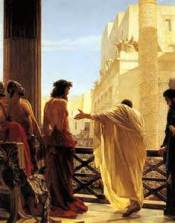
 Jesus and Pilate

Feast of Christ the King

Gospel John 18:33b-37

Pilate said to Jesus, “Are you the King of the Jews?” Jesus answered, “Do you say this on your own or have others told you about me?” Pilate answered, “I am not a Jew, am I? Your own nation and the chief priests handed you over to me. What have you done?” Jesus answered, “My kingdom does not belong to this world. If my kingdom did belong to this world, my attendants would be fighting to keep me from being handed over to the Jews. But as it is, my kingdom is not here.” So Pilate said to him, “Then you are a king?” Jesus answered, “You say I am a king. For this I was born and for this I came into the world, to testify to the truth. Everyone who belongs to the truth listens to my voice.”

Meditation Reflection:

Christ’s humble form in the Eucharist and His life of material poverty can sometimes cause us to forget the magnitude of His greatness and the awe-inspiring power and glory of His kingship. Advent marks the beginning of the New Year for the liturgy. As a result, the week prior marks the end of the year and so we reflect on the end of time when Christ will come again to reign in glory. Scripture attests to the fact that His Second Coming will be very different than His first. In the latter His glory was veiled so that we might have the freedom to accept or reject Him. In the former, everyone will see and know that He is God. The Truth will be revealed and we will no longer be able to live in unreality.

Pontius Pilate articulates this confusion well. He simply asks Jesus if He is the king of the Jews but Jesus describes His kingdom in terms foreign to Pilate’s political experience. Jesus’ kingdom includes those who love and live by Truth. Christ’s kingdom conquers hearts not lands and its members become citizens of this monarchy freely. Pilate asks the famous question “What is truth?” as Truth stands directly before him. At Christ’s Second Coming, no one will ask this question. Reality will be so bright that we cannot hide in blindness or denial.

For those who love Christ, who have been desiring to see in fullness the Lord they can only see by faith, it will be a glorious moment. When our king comes we will truly rejoice and feel both honored and unworthy to be His servants. We will sing songs of praise like those in the book of Revelation, grateful to be in His courts. For those who rely on lies or a self-created image they will cringe when the truth of their emptiness is exposed. The feast of Christ the King should encourage us and strengthen our hope to persevere in aligning ourselves with God who is Truth, Goodness, and Love. It seems unreal to the worldly but the reality check will come and Christ will reward those who know the Truth. In response to the culture of relativism the Christian can respond: You have your truth and I have mine…His name is Jesus.

Consider:

  • Reflect on Jesus’ words to Pilate: “You say I am a king. For this I was born and for this I came into the world, to testify to the truth. Everyone who belongs to the truth listens to my voice.”Who do you listen to when discerning the answers to important questions?
      • Do you consult Scripture, Christian spiritual writers, your priest, etc.?
      • Is there someone you know that loves you enough to speak Christ’s Truth to you despite whether it is something you want to hear or not?
      • Do you ask Christ in prayer?
      • Do you rely on cultural norms to determine your perspective?
      • Do media or secular friends play a role in your decision making?
    • Our culture is permeated by relativism – the belief that there is no objective truth. Do you believe that Truth is objective – the Person of Christ – or do you adhere to the cultural mantra “you have your truth and I have my truth”?
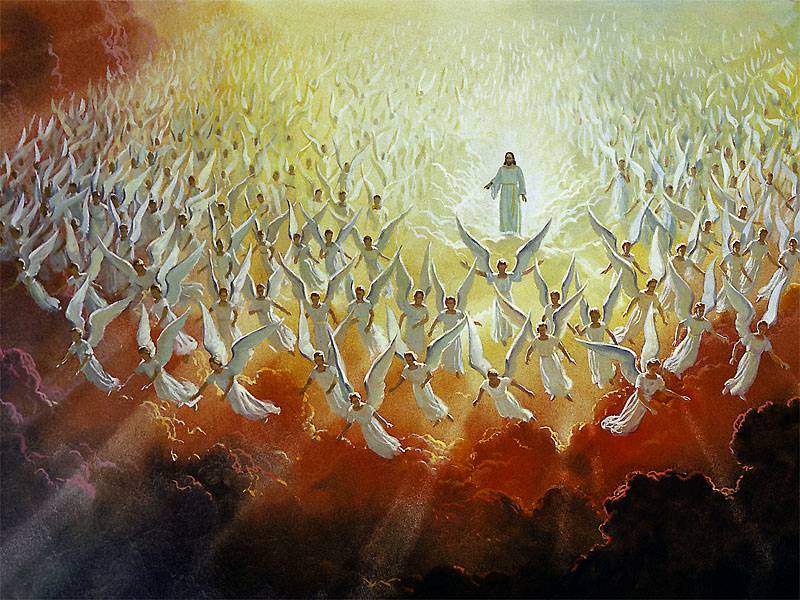
    • Imagine Jesus coming in all of His glory with His hosts of angels. Consider what it would feel like to be in His Kingdom.

Make a Resolution (Practical Application):

  • Pray for Christ’s kingdom to come in your own heart each day this week.
  • Start each day imagining the Second Coming of Christ. Walk through the rest of the day with joy and pride of being a member of His true, everlasting kingdom.
  • If you are blessed with a Truth-speaker in your life, take the time to thank him or her. They could probably use your encouragement. We know how Truth was treated while He was on earth.
  • If you struggle to understand or align yourself with one of Christ’s teachings in Scripture or through His Church, actively seek understanding by learning more through reading, talking with someone educated on the topic, praying about it, etc.

~ Written by Angela Lambert © 2015

* To receive these weekly posts automatically in your email just click the “follow” tab in the bottom right hand corner and enter your email address.

Real Realism… Gospel Meditation for Mark 13:24-32

by Angela Lambert

Jesus-Second-Coming

November 15th, 2015; 33rd Sunday in Ordinary Time

Gospel Mark 13:24-32

Jesus said to his disciples: “In those days after that tribulation the sun will be darkened, and the moon will not give its light, and the stars will be falling from the sky, and the powers in the heavens will be shaken. “And then they will see ‘the Son of Man coming in the clouds’ with great power and glory, and then he will send out the angels and gather his elect from the four winds, from the end of the earth to the end of the sky. “Learn a lesson from the fig tree. When its branch becomes tender and sprouts leaves, you know that summer is near. In the same way, when you see these things happening, know that he is near, at the gates. Amen, I say to you, this generation will not pass away until all these things have taken place. Heaven and earth will pass away, but my words will not pass away. “But of that day or hour, no one knows, neither the angels in heaven, nor the Son, but only the Father.”

Meditation Reflection:

A deeply spiritual friend of mine, made a comment once that has stuck with me – she said we must work to keep the invisible world visible. As a busy wife, homeschooling mother of eight, and one who practices charity toward anyone in need, she of all people knows how easy it is to be consumed by the tasks in front of us and forget about the invisible reality of God and the angels. Even in our work for God we can miss the forest for the trees. Moreover, our wounded human nature all too easily loses the spiritual perspective and succumbs to fear in times of distress, pride in hopes of honor, and avarice in the pursuit of making a living. Making time to meet with her always makes the invisible world more visible for me. I am left feeling energized and filled with joy and hope.   Jesus promises that if we seek first the kingdom of God, all things shall be added (Matthew 6:33). I truly believe this to be the case and have experienced it in my own life.

God revealed His name to Moses as YHWH, which means “I AM” or “I AM WHO AM” (Exodus 3:13-15). The Church Fathers explain that God revealed that He is existence. He is reality. All that is real has its existence in God. If therefore, we center our lives on doing God’s will, we can be confident about our decisions.   At some point, what seems real will come to an end. The sun, moon, stars, and earth only exist as long as God holds them in existence. God has revealed that at an hour only known to Him, they will pass away. This should only strike fear in our hearts if we were depending on the sun to rise tomorrow for our happiness. If Christ is our happiness, this will be a magnificent moment. Imagine being one of the “elect,” one of Christ’s lambs whom He promises to send out the angels to gather. The laws of science are temporary. The author of those laws is eternal. The sun may or may not rise tomorrow, but Christ is certain to gather those He loves who love Him in return. Let’s be intentional about keeping the invisible world visible and develop into true realists.

Consider:

  • Reflect on this quote by Pope Benedict XVI. What is the true definition of realism?
Even more, the Word of God is the foundation of everything, it is the true reality. And to be realistic, we must rely upon this reality. We must change our notion that matter, solid things, things we can touch, is the most solid, the most certain reality. At the end of the Sermon on the Mount, the Lord speaks to us about the two possible foundations for building the house of one’s life: sand and rock. He who builds on sand only builds on visible and tangible things, on success, on career, on money. Apparently these are the true realities. But all this one day will vanish. We can see this now with the fall of two large banks: this money disappears, it is nothing. And thus all things, which seem to be the true realities we can count on, are only realities of a secondary order. Who builds his life on these realities, on matter, on success, on appearances, builds upon sand. Only the Word of God is the foundation of all reality, it is as stable as the heavens and more than the heavens, it is reality. Therefore, we must change our concept of realism. The realist is he who recognizes the Word of God, in this apparently weak reality, as the foundation of all things. Realist is he who builds his life on this foundation, which is permanent. Thus the first verses of the Psalm invite us to discover what reality is and how to find the foundation of our life, how to build life. (Synod on the Word of God, October 2008)
  • What or who do you depend on to feel secure? Why?
  • How might you keep the invisible world visible?
  • Imagine what it would be like to see Christ or His angel coming to bring you to heaven, gathered together with all those who praise God’s name.

Make a Resolution (Practical Application):

  • Schedule time with a friend who inspires you in the spiritual life.
  • Listen to religious podcasts that raises your mind (and perspective) to God.
    • Suggestions: Bishop Barron wordonfire.org; Fr. Gallagher discerninghearts.com; see if your parish has podcasts of your priest’s homilies (more and more do)
  • Spend 5-10 minutes reading Scripture or a spiritual book.
  • Hang religious art or sayings in your home. This can be as simple as writing inspiring Scripture passages down and placing them where you might see them everyday.

~ Written by Angela Lambert © 2015

* To receive these weekly posts automatically in your email just click the “follow” tab in the bottom right hand corner and enter your email address.

Faith-filled Giving, Authentic Discipleship… Gospel Meditation for Mark 12:38-44 for Sunday November 8th, 2015

by Angela Lambert

Faith-filled Giving, Authentic Discipleship

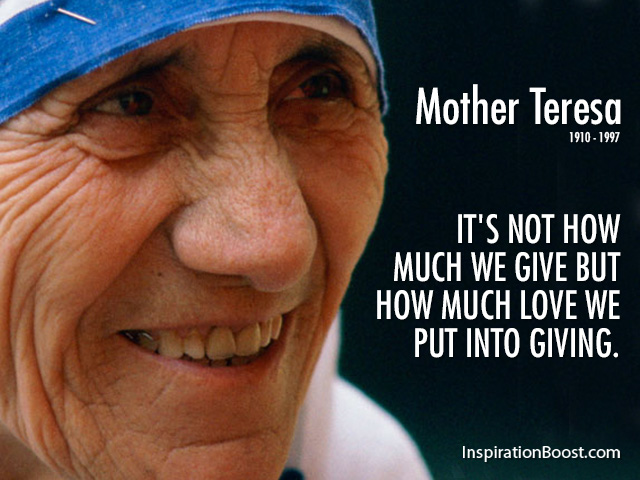
Mother-Teresa-Giving-Quote

November 8th, 2015; 32nd Sunday in Ordinary Time

Gospel Mark 12:38-44 NAB

In the course of his teaching Jesus said to the crowds, “Beware of the scribes, who like to go around in long robes and accept greetings in the marketplaces, seats of honor in synagogues, and places of honor at banquets. They devour the houses of widows and, as a pretext recite lengthy prayers. They will receive a very severe condemnation.” He sat down opposite the treasury and observed how the crowd put money into the treasury. Many rich people put in large sums. A poor widow also came and put in two small coins worth a few cents. Calling his disciples to himself, he said to them, “Amen, I say to you, this poor widow put in more than all the other contributors to the treasury. For they have all contributed from their surplus wealth, but she, from her poverty, has contributed all she had, her whole livelihood.”

Meditation Reflection:

Jesus observes two persons and each teaches us something different about discipleship and giving. Growing up both my parents communicated their conviction about giving in word and action. They taught us about tithing and the responsibility of stewardship. Stewardship refers to how God gave human persons the responsibility and authority to care for gifts He entrusts to us. This includes Creation (see Pope Francis’ encyclical Laudato Si), our talents, possessions, money, opportunities, and time. Scripturally and traditionally, tithing has been defined as giving God the first 10% of one’s income. My parents taught us to give 5% to our parish and 5% to charitable giving of our choice. This, they also taught, is just the beginning. One is called to be generous of heart and put all that one has been given at the service of Christ. Even if one has no income, is sick and suffering, unable to “do” anything for anyone else, that person can offer their suffering and prayers which has great power to build up the Church.

The rich people Jesus observed contributed from their “surplus.” It’s valuable to give but it doesn’t take faith to give your extra. Moreover, Jesus juxtaposes this observation with His critique of a hypocritical attitude which desires honor for oneself rather than giving honor to God. I personally know certain rich persons who give from faith not just surplus and who do so with great humility and gratitude. I have also observed other persons who only give if it will be visible to others, they will be recognized, and others will “see what a good person they are.” At times, the gift, though it looks large, is either merely the 10% they ought to give anyway or less.

Our parish should not have to “beg” for money. It’s our responsibility to give to God the honor and faith He deserves and giving the first 10% of our paycheck is a concrete way to show it. Unfortunately, it’s hard to remember to bring the check to Mass when I am trying to just get us all there on time, showered, and dressed somewhat appropriately. The longer I wait though the more burdened I feel. When my parish offered the option to have my tithing paid through automatic deduction from my checking account I signed up. I have my paycheck automatically deposited, and I have a great peace knowing my tithing is automatically given to God too. Many people say that you cannot out-give God. This is absolutely true; ask anyone who has ever tried. It’s okay to attend charitable banquets or galas, but let’s be intentional about our giving and remember that we are merely doing our duty as stewards to a God who has been so generous to us and is the source of all we have.

The widow in this passage challenges us to give God not just 10%, but everything. As a poor widow, in a time and culture where she would have no opportunity to earn a living, she was completely dependent on God. She demonstrated her faith when she gave Him the little she had. In the first reading today (1 Kgs 17:10-16) another poor widow showed similar faith by giving Elijah her last meal. He promises her that if she does this for God’s prophet, God will not let her flour or oil run out until the drought is over. She makes a leap of faith and prepares the little cake for Elijah. God keeps His promise by providing what she needs.   I wonder if the widow Jesus observed was recalling the same event when she gave her last coin. Jesus, who knows and judges hearts, holds her up as an example of profound giving.

Discipleship is not for minimalists. Jesus does not call us to mediocrity. Jesus demonstrates that love means giving one’s whole self with abandon to God, trusting in His goodness and love. Giving God 10% or more means acknowledging that He gave you 100% and it’s the least you can do. The more you love the easier it is to give. When we love God deeply, giving to Him can bring deep joy.

Consider:

  • Reflect on all of God’s gifts in your life – people, relationships, opportunities, food (especially ice cream!), clothing, housing, work, beauty in nature, His saving Truth and grace…
  • How have you benefited from the generosity of others?
  • Consider or “observe” someone authentically generous. Is there something(s) they do you could imitate?
  • Reflect on how you can’t out-give God. Consider how God always blesses you with more the more you give.

Make a Resolution (Practical Application):

  • Evaluate your giving and make a plan:
    • Financially – pray about how much to give to your parish, what charities you want to support, what people in your life you might give to.
    • Time – be intentional about making time for your family, friends, neighbors, parish, and local charities.
    • Talents – pray about who you could help with your skills, knowledge, etc.
  • Add warmth to your home
    • In his homily at the World Meeting of Families, Pope Francis commented on the solitude and loneliness that plagues our culture pointing to “the paradox of a globalized world filled with luxurious mansions and sky scrapers but a lessening of the warmth of homes and families.”
    • Add warmth to your home for your family and share that warmth with others in your life you could reach.
  • Pray for a heart of gratitude and the eyes to see the needs of others around you.
    • Giving can be simple: a cup of coffee, a warm smile, helping someone save face, showing patience toward someone, giving encouraging words or recognition, fixing something if you’re mechanical, helping someone with technology if you’re computer savvy…

~ Written by Angela Lambert © 2015

* To receive these weekly posts automatically in your email just click the “follow” tab in the bottom right hand corner and enter your email address.

The Sight of God…Gospel Meditation for Matthew 5:1-12 for the Feast of All Saints

by Angela Lambert

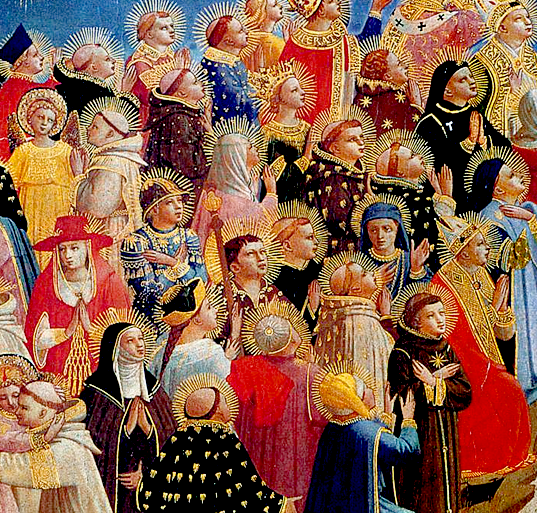
All Saints (3)

November 1st, 2015; Solemnity of All Saints

Gospel Matthew 5:1-12a NAB

When Jesus saw the crowds, he went up the mountain, and after he had sat down, his disciples came to him. He began to teach them, saying: “Blessed are the poor in spirit, for theirs is the Kingdom of heaven. Blessed are they who mourn, for they will be comforted. Blessed are the meek, for they will inherit the land. Blessed are they who hunger and thirst for righteousness, for they will be satisfied. Blessed are the merciful, for they will be shown mercy. Blessed are the clean of heart, for they will see God. Blessed are the peacemakers, for they will be called children of God. Blessed are they who are persecuted for the sake of righteousness, for theirs is the Kingdom of heaven. Blessed are you when they insult you and persecute you and utter every kind of evil against you falsely because of me. Rejoice and be glad, for your reward will be great in heaven.”

Meditation Reflection:

What kind of boss would fail to pay his or her employees for their work? What kind of friend would take your loyalty and sacrifices for granted? At the same time, how could you accept payment from someone who helped you? As we honor the saints this Sunday we reflect on the mystery of God’s justice and mercy. How He can be both at the same time will only be fully understood in Heaven. In fact, it will be one of the joys and marvels we will experience there. Fr. LaGrange, in his work Life Everlasting, teaches that in heaven we will see how justice and mercy are united in each and every work of God.

Justice means to give each person his or her due. According to Merriam-Webster, Mercy can be defined as “kind or forgiving treatment of someone who could be treated harshly.” The beatitudes in the Gospel today point to something of this reality. None of us deserve or merit heaven on our own. However, through baptism we receive the mercy of God merited by Christ’s sacrifice on the Cross. God has revealed that in this state of unity with His Son, we then can and ought to work for the building up of His kingdom in our own heart and the hearts of others. This He rewards based on our efforts. Although we do not deserve any reward outright, it would also not be just to give everyone the exact same reward despite their difference of effort.

The way it plays out in heaven is that all who open themselves to God’s mercy receive the joy of union with God in the Beatific vision. However, in light of God’s justice, the depth of penetration of that sight depends on how much we sought God out while on earth. We must remember that we are finite/limited but God is infinite/unlimited. God deserves to be pursued (justice). To describe this stratified vision we use the term “Light of Glory.” We need light to see and the brighter the light the greater the sight. In heaven we all receive the Light of Glory, but some have more light than others. In God’s mercy we all receive this light who accept it, and in God’s justice we receive it in the measure we pursued it during our life.

An analogy might be this: I extend my friendship to anyone who wishes it, even my enemies if they choose to change. However, the intimacy of that friendship will depend on how much time and energy a friend has invested in getting to know me at a deeper level and the number of shared experiences we have. The invitation is open to everyone but the level of acceptance varies. I’m not holding out on the person who only has a superficial knowledge of me but we live in reality and intimacy takes time and openness. God is reality. His friendship is offered to all. How much intimacy you have with God wholly depends on the time, effort, and openness you invest.

At the Second Vatican Council in 1965 the Church taught about the “universal call to holiness.” It means that every human person has the opportunity to become a saint. The means of sanctity are offered to all for those who accept it. We honor the saints today as we celebrate their witness to us that total love for God is possible. They witness to the truth of Christ’s promise in the beatitudes, that the “pure of heart will see God” and that those who are insulted and persecuted in His name can “rejoice and be glad, for [our] reward will be great in heaven.” God is a merciful realist. The path is revealed to us by Christ in the Gospel. God’s grace is available to assist us. Those who work more will receive more and those who work less will receive less. It’s the most basic lesson we teach our kids. All receive more than they deserve and at the same time it is proportioned to our efforts in union with Christ. What kind of friendship do you want with God? Go after it.

Consider:

  • Reread the beatitudes. Which one touches you the most? Why?
  • The Catechism has some beautiful reflections on this mystery. Consider this quotation from paragraph 2009:
   Filial adoption, in making us partakers by grace in the divine nature, can bestow true merit on us as a result of God’s gratuitous justice. This is our right by grace, the full right of love, making us “co-heirs” with Christ and worthy of obtaining “the promised inheritance of eternal life.” The merits of our good works are gifts of the divine goodness. “Grace has gone before us; now we are given what is due…. Our merits are God’s gifts.”
  • Reflect on God’s mercy in your life. Consider how even the good things you do He deserves some credit for.
  • Consider the times you failed to respond to God’s grace and did not live out the dignity of being His child.
  • Consider the mystery of the “gift” of a “right” to Heaven through Christ. Compare it to human adoption. Parents who adopt children testify again and again that they love their adopted children as their own and see no real distinction. Adopted children have all of the rights of biological children. We have been adopted by God through Christ with the rights of being His sons and daughters, brothers and sisters of His only begotten Son Jesus.

Make a Resolution (Practical Application):

  • Do something each day this week to deepen your relationship with God.
    • Read a spiritual book or learn more about God.
    • Spend additional time with God – in prayer, or adoration, or silence.
    • Identify something that undermines your love for God and make a resolution to give it up.
  • Pay it forward – extend an act of loving kindness toward someone in gratitude for God’s loving kindness toward you.
  • Reflect more on the mystery of God’s Justice and Mercy by reading the Catechism sections on Justification, Grace, and Merit (paragraphs 1987-2011)

~ Written by Angela Lambert © 2015

* To receive these weekly posts automatically in your email just click the “follow” tab in the bottom right hand corner and enter your email address.

Amazing Grace…Gospel Meditation for Mark 10:46-52

by Angela Lambert

amazing grace

October 25th, 2015; 30th Sunday in Ordinary Time

Gospel Mk 10:46-52 NAB

As Jesus was leaving Jericho with his disciples and a sizable crowd, Bartimaeus, a blind man, the son of Timaeus, sat by the roadside begging. On hearing that it was Jesus of Nazareth, he began to cry out and say, “Jesus, son of David, have pity on me.” And many rebuked him, telling him to be silent. But he kept calling out all the more, “Son of David, have pity on me.” Jesus stopped and said, “Call him.” So they called the blind man, saying to him, “Take courage; get up, Jesus is calling you.” He threw aside his cloak, sprang up, and came to Jesus. Jesus said to him in reply, “What do you want me to do for you?” The blind man replied to him, “Master, I want to see.” Jesus told him, “Go your way; your faith has saved you.” Immediately he received his sight and followed him on the way.

Meditation Reflection:

I love the reaction of the crowd in this passage. It seems that Bartimaeus was well known but simply as part of the common landscape of their everyday life. When Bartimaeus cries out to Jesus they react with (what looks like to me anyway) embarrassment. It reminds me of how little kids embarrass their parents by crying out in stores or talking too loudly during a silent part of Mass. Embarrassed, we quickly quiet them and try to impress on them the context of their surroundings. Similarly, the crowd tries to hush Bartimaeus. Jesus is extraordinary and important, Baritmaeus is extremely ordinary and unimportant. Doesn’t he know that he shouldn’t interrupt?

Yet, Jesus has come to transform the ordinary, weak, embarrassing aspects of our lives. We can’t impress Jesus by putting on a façade or hoping to impress Him. Rather, Bartimaeus serves as an example of the process of spiritual conversion. Bartimaeus knows he is blind and a beggar. The first step in the spiritual life is self-knowledge. It requires humble, prayerful, introspection wherein one acknowledges his or her weaknesses, sinful habits, and disordered attachments. It involves learning one’s limits as well as what one is motivated by – be it fear, ambition, anxiety, a need to please others, greed, lust, vanity, insecurity, or competitiveness. Whatever it may be, when we come to recognize it, we realize our incapacity to overcome it ourselves. We feel crippled and pitiful. We might beg for the help of others and it may get us through on a day by day basis. However, we yearn for wholeness, not just a daily life but the fullness of life.

Bartimaeus believed that Jesus could heal him. He cried out to Christ, despite how embarrassing it was to his family and community. Once we have self-knowledge, we must cry out to Christ as beggars. We have no real right to God’s help and yet He is our only hope. When we surrender control to God and humbly accept our dependence on His grace, we can then receive healing. When Jesus restored Bartimaeus’ sight He enabled him to live his full potential, be incorporated into society rather than live on its edges, and to joyfully follow Christ. Jesus can restore us as well so we can enjoy the freedom of living in communion with Christ and others unhindered by our former disability and enrichened by being our true selves. This truth resonates with every Christian who has experienced authentic conversion.   The song Amazing Grace remains a treasured classic, capable of provoking tears on many occasions because of this very fact.

Amazing Grace, how sweet the sound,
That saved a wretch like me….
I once was lost but now am found,
Was blind, but now, I see.T’was Grace that taught…
my heart to fear.
And Grace, my fears relieved.
How precious did that Grace appear…
the hour I first believed.Through many dangers, toils and snares…
we have already come.
T’was Grace that brought us safe thus far…
and Grace will lead us home.

The Lord has promised good to me…
His word my hope secures.
He will my shield and portion be…
as long as life endures.

When we’ve been here ten thousand years…
bright shining as the sun.
We’ve no less days to sing God’s praise…
then when we’ve first begun.

Amazing Grace, how sweet the sound,
That saved a wretch like me….
I once was lost but now am found,
Was blind, but now, I see.

Consider:

  • Acknowledge a weakness or difficulty of yours and lay it before Christ. Imagine you are Bartimaeus, crying out and begging, trusting that Jesus will heal you or help your situation.
  • Consider someone in your life that you could be more compassionate toward. Reflect on how their sin or weakness that bothers you is in fact quite pitiable. Rather than judging, pray for that person and ask Christ to help them.
  • Reflect on the song Amazing Grace. A beautiful performance of it by Andrea Boccelli can be found on youtube at this link:

Make a Resolution (Practical Application):

  • Pray for Christ’s mercy and healing each day this week. If possible, go to Him in the sacrament of Confession or attend a daily Mass.
  • Extend mercy toward someone this week. Show patience or offer encouragement to someone struggling.

~ Written by Angela Lambert © 2015

* To receive these weekly posts automatically in your email just click the “follow” tab in the bottom right hand corner and enter your email address.


Gospel Meditation for Mark 10:35-45 for Sunday October 18th, 2015

by Angela Lambert

agony in the garden

October 18th, 2015; 29th Sunday in Ordinary Time

Gospel of Mark 10:35-45 NAB

James and John, the sons of Zebedee, came to Jesus and said to him, “Teacher, we want you to do for us whatever we ask of you.” He replied, “What do you wish me to do for you?” They answered him, “Grant that in your glory we may sit one at your right and the other at your left.” Jesus said to them, “You do not know what you are asking. Can you drink the cup that I drink or be baptized with the baptism with which I am baptized?” They said to him, “We can.” Jesus said to them, “The cup that I drink, you will drink, and with the baptism with which I am baptized, you will be baptized; but to sit at my right or at my left is not mine to give but is for those for whom it has been prepared.” When the ten heard this, they became indignant at James and John. Jesus summoned them and said to them, “You know that those who are recognized as rulers over the Gentiles lord it over them, and their great ones make their authority over them felt. But it shall not be so among you. Rather, whoever wishes to be great among you will be your servant; whoever wishes to be first among you will be the slave of all. For the Son of Man did not come to be served but to serve and to give his life as a ransom for many.”

Meditation Reflection:

Mark’s Gospel centers on Christ as the Suffering Servant. It’s the shortest of the four Gospels but possibly the hardest message to swallow. Jesus repeats again and again that greatness in His kingdom is measured by how conformed we are to Christ on earth. Like James and John, we all desire to be conformed to His victory, His impressiveness, and His leadership. However, Jesus explains that conformity to Him means drinking the cup that He did – that of obedience to the Father and redemptive suffering. In the Garden of Gethsemane, just before Jesus’ Passion and death, Matthew recounts:

And going a little farther he fell on his face and prayed, “My Father, if it be possible, let this cup pass from me; nevertheless, not as I will, but as thou wilt.” MT 26:39

 If this was Jesus’ reaction to redemptive suffering, we can take comfort that He understands our own weakness and fear in the face of intense pain or difficulty. We can also learn from Christ’s example that despite these feelings, He surrendered His will to the Father and allowed Himself to be strengthened by an angel. Christ didn’t do it alone and we do not have to either. In fact, Christ suffered to redeem us from our sins but also to be near to us in our own suffering so that we would not be alone. From my experience, and I think it resonates with many Christians’, Christ is nearest during the hardest times. In the second reading for today from Hebrews 4:14-16 St. Paul encourages us that:

For we do not have a high priest who is unable to sympathize with our weaknesses, but one who has similarly been tested in every way, yet without sin. So let us confidently approach the throne of grace to receive mercy and to find grace for timely help.

St. Paul also says that Christ’s suffering and death are a “stumbling block to Jews and folly to Gentiles.” I would go a step further and say that the Church’s teaching on Redemptive Suffering is even more of a stumbling block. A life conformed to Christ’s example of love, generosity, humility, and mercy means a soft heart open to others and therefore open to pain. Nevertheless, suffering endured and offered up for others has redemptive power. St. Paul also makes the bold claim that,

Now I rejoice in my sufferings for your sake, and in my flesh I complete what is lacking in Christ’s afflictions for the sake of his body, that is, the church. Colossians 1:24

 Although Christ merited all of the graces necessary for the redemption of all men, He has given us a share in His redemptive work in that when we unite our suffering to His those graces are applied to the souls of others. Christ could build His kingdom without us, but He has chosen to not build it without our participation. This mystery poses a stumbling block for us but it also poses an opportunity for a share in Christ’s greatness. Moreover, those who have endured suffering for the sake of Christ’s kingdom all affirm, as do I, that the Lord “gives us joy to balance our affliction” (Psalm 90:15). Those who share in Christ’s death, also share in His resurrection; and those who share in His afflictions share in His glory. Whenever you suffer, whether physical or emotional, try to offer it up in union with Christ’s. It has tremendous power. Lean in near to Christ and receive His comfort and strength.

Consider:

  • Reflect on a difficult time in your life. Consider how Christ can relate to your situation. Consider the gifts and graces He provided to get you through.
  • Reflect on how “Pain is the price of love.”
    • Why do we avoid love out of a fear of pain?
    • Why is love worth the price?
    • How does Christ’s example shed light on this?
  • As part of the Mystical Body of Christ, we all benefit from the prayers and redemptive suffering of others. Thank God for the graces you have received from those you may not even know were praying for you!

Make a Resolution (Practical Application):

  • If you are going through a difficult time right now, reflect on the painting above of Christ in the Garden and ask for Him to be near. Offer your suffering up for someone in need of grace or conversion.
  • If you are not going through a difficult time right now, take 5 minutes to thank and praise God for His blessings.
  • Pray for, and if possible, reach out to someone suffering.

~ Written by Angela Lambert © 2015

To receive these weekly posts automatically in your email just click the “follow” tab in the bottom right hand corner and enter your email address.


Gospel Meditation for Mark 10:17-30 for Sunday October 11th, 2015

by Angela Lambert

Jesus and the Rich man

Gospel of Mark 10:17-30 NAB

As Jesus was setting out on a journey, a man ran up, knelt down before him, and asked him, “Good teacher, what must I do to inherit eternal life?” Jesus answered him, “Why do you call me good? No one is good but God alone. You know the commandments: You shall not kill; you shall not commit adultery; you shall not steal; you shall not bear false witness; you shall not defraud; honor your father and your mother.” He replied and said to him, “Teacher, all of these I have observed from my youth.” Jesus, looking at him, loved him and said to him, “You are lacking in one thing. Go, sell what you have, and give to the poor and you will have treasure in heaven; then come, follow me.” At that statement his face fell, and he went away sad, for he had many possessions. Jesus looked around and said to his disciples, “How hard it is for those who have wealth to enter the kingdom of God!” The disciples were amazed at his words. So Jesus again said to them in reply, “Children, how hard it is to enter the kingdom of God! It is easier for a camel to pass through the eye of a needle than for one who is rich to enter the kingdom of God.” They were exceedingly astonished and said among themselves, “Then who can be saved?” Jesus looked at them and said, “For human beings it is impossible, but not for God. All things are possible for God.” Peter began to say to him, “We have given up everything and followed you.” Jesus said, “Amen, I say to you, there is no one who has given up house or brothers or sisters or mother or father or children or lands for my sake and for the sake of the gospel who will not receive a hundred times more now in this present age: houses and brothers and sisters and mothers and children and lands, with persecutions, and eternal life in the age to come.”

Meditation Reflection:

Jesus is about to leave when the young man comes running to Him. The question must have been burning on his heart and he knew he had to get to Jesus and ask Him before He left. In every human soul, the question of eternal life singes until satisfied.

In his work, Pensees, the philosopher Pascal observed that we fill our lives with distractions just to avoid this very question. When we are quiet or alone, it surges up and must be dealt with. We realize the feebleness of our nature and our true vulnerability. We are then faced with the clear decision that either there is no God in which case I can live as I want but my life is meaningless, or there is a God and I can live forever but I must acknowledge His authority and live by His precepts.

Many of us make something of an effort. Like the rich young man, many of us modern religious persons live comfortable and fairly moral lives. We follow God’s rules while we pursue the average American dream. Yet, our hearts still burn for more. Thankfully, the man in the passage pushes Jesus on the issue. Jesus affirms that the man has done the minimum requirement for eternal life. So why isn’t he satisfied? This is why “Jesus, looking at him, loved him.” The man had opened his heart with a listening ear, courageous enough to seek out the answer rather than bury the discomfort. He asked Jesus that challenging question I have suggested in past posts – “Lord show me my blind spot.” And Jesus does, out of love.

Christ calls us beyond the minimum.

“You, therefore, must be perfect, as your heavenly Father is perfect” (Matthew 5:48)

The philosophical and theological definition of “perfect” is “full or complete.” This is why He tells the man he is “lacking” one thing only. Christ, God incarnate, is about to set out for a journey. He offers the man the opportunity to come follow Him. What a privilege! Yet to do this, he would have to leave everything behind – another fork in the road.

How many times do we turn down incredible opportunities to stay in our comfort zone?   We get sentimental or attached to any number of our possessions and it undermines our freedom to say yes to the gifts of Christ that come in the form of service opportunities, vocation, relationships, even careers we may end up finding more fulfilling but less lucrative. When we let fear, comfort, or greed hold even a small part of us back from God, we experience a nagging feeling of hunger because we are not quite full. It’s normal to feel this divided heart – a simultaneous desire for complete abandonment to God and the fullness of joy and peace that accompany it, and the safe visible comforts of a worldly success which give us a kind of safety net but leave us feeling a bit cowardly.

I appreciate that Jesus says it’s impossible for us to make this leap by human effort alone because it speaks to my own experience. Rather than being discouraged by my own failure, I find hope in Jesus’ words that “all is possible for God.” The difference between the Old and New Covenant, is that in the first God gave His saving truth but in the second He gave us the grace to live by that truth. The young man in this passage encountered Christ and saw His gaze of love. May we too be blessed to see this gaze of love for us and say yes to perfect fullness. It’s okay if we leave feeling sad. It’s difficult to give up attachments. We don’t actually know if the man in this passage is sad because he won’t give up his possessions or because he will. The important thing is that we respond to grace, confident in Christ’s promise that our “sadness will be turned to joy” (John 16:20).

Consider:

  • Do you avoid solitude or quiet? Do you have a nagging feeling inside? Do you know why? With the help of Christ, consider honestly what fears, comforts, or ambitions hold you back from following Him with complete freedom and abandonment.
  • When did you make a sacrifice for Christ that turned out to be a terrific blessing? What held you back at first? How did you overcome those inhibitions? How did Christ exceed your expectations?
    • (for example: when I personally felt called by Christ to stay home with my children I found it hard to leave my job and the feeling of achievement. However, I came to experience freedom from taking my identity in accomplishments and a fullness of love in my heart I had never imagined. When my kids were school aged and Christ called me back to teaching, I found it difficult to transition again. However, I have a richer experience at work than before because now it’s more fully in union with Christ and I am less pulled by earlier attachments. It has also enriched my relationship with my kids as God has purified me of attachments I had grown while at home with them.)

Make a Resolution (Practical Application):

  • Christ challenges that possessions hold us back. Give away a possession this week.
  • Choose one fear, comfort, or ambition that is holding you back from following Christ’s lead completely. Practice the opposite virtue and do concrete actions to detach yourself. Be sure to pray and ask for grace. You will need Christ to help. Talk with a Christian who knows and cares about you so they can offer ideas and perspective.
  • Thank God for His grace in your life. Make a list of His gifts and of all the fears He has already freed you from up to now.
  • If God’s providence creates the opportunity, have the courage and humility to encourage someone else with your witness about how God freed and fulfilled you.

~ Written by Angela Lambert © 2015

To receive these weekly posts automatically in your email just click the “follow” tab in the bottom right hand corner and enter your email address.