Gospel Meditation for Mark 10:2-12 for Sunday October 4th, 2015

by Angela Lambert

Mary undoer of knots

October 4th, 2015; 27th Sunday in Ordinary Time

Gospel of Mark 10:2-12 NAB

The Pharisees approached Jesus and asked, “Is it lawful for a husband to divorce his wife?” They were testing him. He said to them in reply, “What did Moses command you?” They replied, “Moses permitted a husband to write a bill of divorce and dismiss her.” But Jesus told them, “Because of the hardness of your hearts he wrote you this commandment. But from the beginning of creation, God made them male and female. For this reason a man shall leave his father and mother and be joined to his wife, and the two shall become one flesh. So they are no longer two but one flesh. Therefore what God has joined together, no human being must separate.” In the house the disciples again questioned Jesus about this. He said to them, “Whoever divorces his wife and marries another commits adultery against her; and if she divorces her husband and marries another, she commits adultery.”

Meditation Reflection:

Pope Francis recently visited the United States for the purpose of supporting and building up the family. At this past week’s Wednesday audience, he summarized his message in this way, a reminder of God’s beautiful plan for humankind:

The humanism of the Bible presents this icon: the human couple, united and fruitful, placed by God in the garden of world, to cultivate it and to guard it.”

Scripture reveals that the family in fact represents most completely the image of God. Moreover, the image of a God who has revealed Himself to be a communion of Persons of life-giving love. Even though it was Jesus who revealed God’s Trinitarian nature, we can see the Trinity already foreshadowed in the Old Testament. The first instance being when God created humans in His own image. We read in Genesis 1:26-28,

Then God said: Let us make human beings in our image, after our likeness…God created mankind in his image; in the image of God he created them; male and female he created them. God blessed them and God said to them: Be fertile and multiply; fill the earth and subdue it.”

God, who is One, referred to Himself as “us” and created two persons, distinct yet one to be His image. The unity of man and woman as the image of God is again affirmed in Genesis 2:18-24 when man is not complete without the creation of woman. Although we may joke that a dog is man’s best friend, (and at times both men and women feel that way!), the truth is that we were made to be a communion of persons in life-giving love. Woman is created from man’s side, showing that though she is different than man, she is also of the same nature and of equal dignity.

“The LORD God said: It is not good for the man to be alone. I will make a helper suited to him.After creating each of the kinds of animals however, “none proved to be a helper suited to the man. So the LORD God cast a deep sleep on the man, and while he was asleep, he took out one of his ribs and closed up its place with flesh. The LORD God then built the rib that he had taken from the man into a woman. When he brought her to the man, the man said: “This one, at last, is bone of my bones and flesh of my flesh; This one shall be called ‘woman,’ for out of man this one has been taken.” That is why a man leaves his father and mother and clings to his wife, and the two of them become one body.”

Because the family is the icon of the Trinity and therefore of God Himself, it makes sense that it has suffered the most from Satan’s attacks and from the effects of original sin. The unity between man and woman has been harmed and the joy of openness to life undermined. Sometimes we can feel so far of a distance from our nature at creation that it seems like God’s revelation about ourselves in Genesis is just a dream. Rather than unity we more often see power struggles, selfishness, adultery, use and abuse, and so on. In addition, the gift of fruitfulness has now been categorized as a health problem, worthy of universal “preventative care” as part of women’s health.

After the Fall of Adam and Eve however, God promised a Redeemer. In Genesis 3:15, called the protoevangelium, or “First Good News” God says to the snake, “I will put enmity between you and the woman, and between your offspring and hers; They will strike at your head, while you strike at their heel.” At the incarnation, “the Word became flesh and dwelt among us”(John 1:14). He brought us truth, healing, love, and redemption. Through Christ we now know the fullness of God’s revelation and we have access to the graces needed to become re-made in His likeness.

In today’s Gospel, Jesus juxtaposes the two possible views toward marriage: a skepticism based on the reality of sin, or a hopefulness based on the reality of redemption. Jesus has not given up on marriage and the family, He has come to redeem it. It is the very image of our Trinitarian God.

One of my favorite images right now is “Mary Undoer of Knots.” St. Paul calls Jesus the “New Adam” because by Christ’s obedience He untied the knot of Adam’s disobedience. Likewise, Mary is the New Eve, whose fiat, or Yes to God untied the knot of Eve’s “No”. Sometimes I feel like life is a knotted up ball of a mess and I feel overwhelmed and powerless. It’s then that I look at the image of Mary undoer of knots and I surrender my life back over to our Blessed Mother and Christ, confident that if I am patient, they will undo the knots, one at a time.

Consider:

  • Consider your own feelings regarding marriage and family.
    • What makes you feel discouraged? Surrender it to Christ and pray for Him to redeem it.
    • What makes you feel hopeful? Think of a couple you know who seem to be truly united in love, who will each other’s good and have Christ at the center of their relationship.
  • How might you image the Trinity more in your own family? In what ways do you bring harmony and unity in your family? In what ways do you undermine unity? (usually we all do both!)
  • Reflect on how authentic love is life-giving and creative. Sometimes this produces human life but even when that isn’t a possibility it still expresses itself in ways that are creative and constructive. Consider the phrase “a labor of love.” When we love something we can’t help but express and share it.

Make a Resolution (Practical Application):

~ Written by Angela Lambert © 2015

* You can receive weekly emails of these posts by following our website.  Just click on the small blue tab in the bottom right hand corner that says “follow” and enter your email address.

* These Sunday meditations are intended to engage the heart and imagination in prayer and include a practical application (resolutions) to your daily life. In our presentation on prayer I offer a more detailed discussion of ways to pray with Scripture that can take 5 minutes, 15 minutes, or half an hour and vary in depth depending on your time-frame and prayer goals.  


Gospel Meditation for Mark 9:38-48 for Sunday September 27th, 2015

by Angela Lambert

tree by its fruit

September 27th, 2015, 2015; 26th Sunday in Ordinary Time

Gospel of Mark 9:38-43, 45, 47-48 NAB

At that time, John said to Jesus, “Teacher, we saw someone driving out demons in your name, and we tried to prevent him because he does not follow us.” Jesus replied, “Do not prevent him. There is no one who performs a mighty deed in my name who can at the same time speak ill of me. For whoever is not against us is for us. Anyone who gives you a cup of water to drink because you belong to Christ, amen, I say to you, will surely not lose his reward.

Whoever causes one of these little ones who believe in me to sin, it would be better for him if a great millstone were put around his neck and he were thrown into the sea. If your hand causes you to sin, cut it off. It is better for you to enter into life maimed than with two hands to go into Gehenna, into the unquenchable fire. And if your foot causes you to sin, cut if off. It is better for you to enter into life crippled than with two feet to be thrown into Gehenna. And if your eye causes you to sin, pluck it out. Better for you to enter into the kingdom of God with one eye than with two eyes to be thrown into Gehenna, where “their worm does not die, and the fire is not quenched.”

Meditation Reflection:

Jesus says in Matthew 7:16 “You will know them by their fruits.” Hearts open to God bear good fruit. The apostles were upset that others were casting out demons but Jesus reminds them once again that in His kingdom we do not have to compete against one another for position. Everyone is called to union with God and this union always produces charitable works. Christ could tell these men were authentic because of the fruit they were bearing. St. Teresa of Avila used this as a litmus test for the authenticity of prayer as well. She did not base her estimation of prayer on her feelings or experiences but rather on the virtue it produced afterward.

God and sin are incompatible. Sin, by definition, is a rejection of God and God keeps His promise to respect the free will He bestowed on us at our creation. Our union with God therefore depends entirely upon our will. Those areas of our heart that we open up to God He fills, and those areas we keep closed off He respects. This may be why many describe it as feeling like a hole in their heart. Most of us are a mixed bag with some areas filled with Christ and other areas we keep closed off.

The joy of heaven however stems from a heart filled completely with God, total union. My all-time favorite book portraying the interior drama we experience as we wrestle with desire for God and attachment to sins is C.S. Lewis’ work The Great Divorce. Lewis imaginatively illustrates the complete divorce of Heaven and Hell/ the incompatibility between God and sin. He opens with a quote by George MacDonald which echoes the words of Christ in this Sunday’s Gospel. He writes:

No, there is no escape. There is no heaven with a little of hell in it, no plan to retain this or that of the devil in our hearts or our pockets. Out Satan must go, every hair and feather.

Lewis goes on to illustrate the way in which we rationalize our attachments and how if we become too stubborn in them, we can find ourselves rejecting heaven altogether to maintain one sin. Jesus uses strong language when He says to cut off whatever is causing you to sin. The truth is, there are some attachments and some sins that we nurse along rationalizing that it’s not that big of deal. Yet, each sin we hold on to prevents full union with God.

St. Augustine articulated it well in his account of his own conversion. In his book Confessions, he tells of when he had accepted Christ’s Truth intellectually, but wasn’t yet ready to live by Christ’s precepts. He remembers with humble honesty his prayer, “Grant me chastity and continency, but not yet.” He wanted to follow Christ, but he didn’t want to give up indulging his lust. After hearing of the heroic acts of the lives of the saints as well as of contemporary martyrs, Augustine was ashamed of his weakness. To add to the humiliation, after breaking up with his concubine, (whom he had a son with), she vowed to remain celibate out of love for him and kept that vow. Augustine however caved to his lust and felt his slavery when he could not keep the same promise. He finally begged God truly to free him and in that moment of willful surrender God healed him. Augustine received the grace to detach from lust and could then experience the fullness of love.

In his homily to religious in Philadelphia, Pope Francis reflected on St. Katharine Drexel’s response to Christ’s call and the need for each of us to share that same vision:

“One of the great challenges facing the Church in this generation is to foster in all the faithful a sense of personal responsibility for the Church’s mission, and to enable them to fulfill that responsibility as missionary disciples, as a leaven of the Gospel in our world.”

We all have a mission from Christ. Like St. Augustine, we must surrender those holes in our hearts to the Lord to heal with His grace, that we too might follow Him and bear great fruit.

 Consider:

  • Most sins fall under one of three categories: A vice we love and don’t want to give up, an attachment to something other than God that we rationalize, or a blind spot we don’t see about ourselves. Reflect on what is preventing you from full union with God in each of these categories. How does it undermine or hinder your ability to live the mission Christ has given you?
  • Consider the fruit of taking time for prayer, attending Mass, or going to Confession. Do you see a difference in your ability to be more kind, patient, understanding, strong, or persevere that day? How might making prayer a regular habit enrich your relationship with others better?
  • Ask Christ what His mission is for you. Try to listen openly. He has a mission for each person in every state of life.
    • Christ loves every human person, who are the people in your life that you can be Christ to?
    • Consider this quote from Mother Teresa: “It is easy to love the people far away. It is not always easy to love those close to us. It is easier to give a cup of rice to relieve hunger than to relieve the loneliness and pain of someone unloved in our own home. Bring love into your home for this is where our love for each other must start.”

Make a Resolution (Practical Application):

  • Pray for Christ to heal you of a sin you are struggling with. Pray that He will give you the strength to overcome it and to detach you from a desire for it. (note: detachment from sin is also a sacramental grace of Confession and the Eucharist)
  • Every time I have asked God to show me one of my blind spots He has answered with a “yes”. I have now learned to pray that He at least just show me one at a time! If you are courageous enough, ask Christ to reveal one of your blind spots to you.
    • (I also like to ask for the grace to receive that knowledge with humility, hope, and trust in God’s grace so I won’t be discouraged.)
  • Read The Great Divorce by C.S. Lewis. It’s unforgettable!

~ Written by Angela Lambert © 2015

* These Sunday meditations are intended to engage the heart and imagination in prayer and include a practical application (resolutions) to your daily life. In our presentation on prayer I offer a more detailed discussion of ways to pray with Scripture that can take 5 minutes, 15 minutes, or half an hour and vary in depth depending on your time-frame and prayer goals.  

* You can receive weekly emails of these posts by following our website.  Just click on the small blue tab in the bottom right hand corner that says “follow” and enter your email address.

To Serve is to Reign…Gospel Meditation for Mark 9:30-37

by Angela Jendro

pope-francis-hugging-disabled-childpope-selfie

25th  Sunday in Ordinary Time

Gospel of Mark 9:30-37 NAB

Jesus and his disciples left from there and began a journey through Galilee, but he did not wish anyone to know about it. He was teaching his disciples and telling them, “The Son of Man is to be handed over to men and they will kill him, and three days after his death the Son of Man will rise.” But they did not understand the saying, and they were afraid to question him. They came to Capernaum and, once inside the house, he began to ask them, “What were you arguing about on the way?” But they remained silent. They had been discussing among themselves on the way who was the greatest. Then he sat down, called the Twelve, and said to them, “If anyone wishes to be first, he shall be the last of all and the servant of all.” Taking a child, he placed it in the their midst, and putting his arms around it, he said to them, “Whoever receives one child such as this in my name, receives me; and whoever receives me, receives not me but the One who sent me.”

Meditation Reflection:

This week, a student of mine asked me why a woman cannot be the pope. This question, and its underlying one – why a woman can’t be a priest, gets asked every year. I myself wrestled with this question when I was in college. I’m glad I pursued the answered because there are beautiful theological reasons. Oftentimes however, what we are really asking is why a woman can’t hold what seems to be the highest and most powerful position in the Church. This seems sexist, unfair, and therefore not Christ-like. The apostles in today’s passage viewed leadership in Christ’s kingdom in a similar way. They were arguing along the way about who would have the highest position, the most power and prestige. If Christ’s kingdom resembled worldly kingdoms that would have been an appropriate question. Jesus corrects them in a pointed way. As God says in Isaiah 55:8 “‘For My thoughts are not your thoughts, nor are your ways My ways.” Jesus had just taught the apostles that the Son of Man, the Messiah, would have to suffer and be killed. Rather than considering that they might be called to follow in His footsteps they wonder who will take leadership afterward. Jesus clarifies what He means by His kingdom. His words would have been surprising to the apostles and they are still surprising to us today.

It’s hard to truly believe Jesus when He teaches that “Whoever receives one child such as this in my name, receives me; and whoever receives me, receives not me but the One who sent me.” We would rather believe that discipleship means visible worldly greatness. The world looks at the papacy and sees position and power. However, beginning with Pope Gregory the Great in the 6th century, the title the pope has used for himself has been “the servant of the servants of God.” Discipleship of Christ means following the path of humility and self-sacrifice, the same path Christ took. What can be more humble and self-sacrificing than caring for a small child, especially if you are its mother or father? This path of humility is open to all with equal opportunity. Some might even say that women have an unequal and greater opportunity since we alone have the ability to carry in our wombs new life at its most vulnerable stage.

Every Christian can become a saint if he or she cooperates with the grace of Christ. The Second Vatican Council used the phrase “the universal call to holiness” to describe the doctrine that God desires everyone to have perfect union with Him. The opportunity is equal, it’s or response which is unequal. Teresa of Avila said that what prevents individuals from experiencing greater depths of prayer and union with God is a lack of generosity, courage, and humility.

I wasn’t asked by Christ to be pope, but I was asked to be a mother and a teacher. In the world’s eyes there is nothing notable about my position except that I maybe “wasted” some of my talents and opportunities that I could have used for wealth and power instead. My eyes are on a different prize though. I don’t want to be the one in power, I want to be Jesus’ disciple. All I ask is that He say to me one day, “Well done my good and faithful servant.” I may not be the servant of the servants of God, but I accept being the servant of those He “put His arm around” and placed in my care.

Consider:

  • Who has God placed in your care? How has this made you grow in humility?
  • When do you feel tempted by worldly prestige?
  • Consider how you prioritize your life. How might Christ re-order your priorities? Ask for His help and grace.

Make a Resolution (Practical Application):

  • Write out your priorities – look at where you spend your time and money. Pray about it each day this week and ask Christ to show you where you are doing well and where you need to change.
  • Pope Francis visited the U.S. for the world meeting of families. Read one of his speeches or homilies from when he was here. Consider how he shares Christ’s values as it pertains to family and discipleship. [A couple of my favorite sources: vatican.va (vatican website) and zenit.org (Catholic news agency)]

~ Written by Angela (Lambert) Jendro © 2015; updated  © 2018

* These Sunday meditations are intended to engage the heart and imagination in prayer and include a practical application (resolutions) to your daily life. In our presentation on prayer I offer a more detailed discussion of ways to pray with Scripture that can take 5 minutes, 15 minutes, or half an hour and vary in depth depending on your time-frame and prayer goals.  


Gospel Meditation for Mark 8:27-35 for Sunday September 13th, 2015

by Angela Lambert

jesus-peter

September 13th, 2015; 24th Sunday in Ordinary Time

Gospel of Mark 8:27-35 NAB

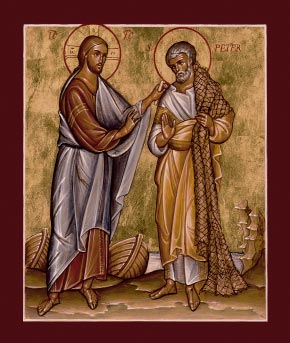
Jesus and his disciples set out for the villages of Caesarea Philippi. Along the way He asked his disciples, “Who do people say that I am?” They said in reply, “John the Baptist, others Elijah, still others one of the prophets.” And He asked them, “But who do you say that I am?” Peter said to Him in reply, “You are the Christ.” Then He warned them not to tell anyone about Him. He began to teach them that the Son of Man must suffer greatly and be rejected by the elders, the chief priests, and the scribes, and be killed, and rise after three days. He spoke this openly. Then Peter took Him aside and began to rebuke him. At this He turned around and, looking at His disciples, rebuked Peter and said, “Get behind me, Satan. You are thinking not as God does, but as human beings do.” He summoned the crowd with His disciples and said to them, “Whoever wishes to come after Me must deny himself, take up his cross, and follow Me. For whoever wishes to save his life will lose it, but whoever loses his life for My sake and that of the gospel will save it.”

Meditation Reflection:

“I just want you to be happy.” What do we mean by this phrase? Usually, it means “I don’t want to see you suffer.” Peter cared deeply for Jesus. He believed in Jesus’ greatness and identified Him accurately as the long-awaited Christ promised by God. Peter would do anything to help the Christ in His mission and to achieve success. However, when Jesus told the disciples that the Son of Man would have to suffer, be humiliated and rejected, and be killed Peter did not feel he could get behind that. He demonstrated a natural human reaction as a friend. His “rebuke” to Jesus probably sounded similar to rebukes you or I have made to friends. Something like “don’t say things like that, everything’s going to be fine;” or “I won’t let that happen to you, it can’t be God’s will that you suffer;” or “there must be another way, I don’t want to see you hurt.” He could have also rebuked Jesus that for such a thing to happen would in fact be contrary to the Scriptural prophecy regarding the Son of Man. This title, which Jesus uses in reference to Himself 81 times in the four Gospels comes from the book of Daniel. In Daniel’s prophetic vision, after the appearance of four beasts – we read in chapter 7:13:

“I beheld therefore in the vision of the night, and lo, one like a son of man came with the clouds of heaven, and he came even to the Ancient of days: and they presented him before him. And he gave him power, and glory, and a kingdom: and all peoples, tribes, and tongues shall serve him: his power is an everlasting power that shall not be taken away: and his kingdom shall not be destroyed.”

From a worldly point of view, Jesus’ teaching about the Son of Man seems contrary to Scripture’s and natural human sense. However, Jesus teaches that God’s truth goes above our understanding and can seem paradoxical. To save our lives, we may have to lose it. To find happiness, we may have to suffer pain. Power may appear as weakness.

Sometimes our seemingly encouraging words to our friends can be accurate but this Gospel challenges us to consider whether that is always the case. It’s possible that we sometimes avoid supporting or challenging our friend to carry a difficult cross by rationalizing that “we just want them to be happy.”  Jesus uses strong words toward Peter when he thinks this way. He sees it as a temptation from Satan; something that could undermine Jesus’ courage. Happiness defined as the easy and less painful path is worldly happiness. Christian happiness, Jesus reveals, means denying oneself, carrying one’s cross, and following Him. This is a hard choice for one’s own life and sometimes even more difficult to support a friend or child through. I find it harder to watch my children have to carry crosses than carrying one myself. Yet, I know that to remove every suffering from their path would stunt their growth as persons, and possibly even worse, to undermine their ability to follow Christ.

True happiness does not come from never suffering. Jesus challenges us that when we are tempted to be weak and enable a friend’s sin or avoidance of a cross, we are not in fact wishing them true happiness. It’s the easy road for them and also for us. The road to the fullness of joy is tough and requires self-denial. True friends encourage one another to carry their crosses, cheering them on, helping them when possible, praying for grace, helping to keep their eyes on Christ and the supernatural life – happiness beyond our human imagination.

Consider:

  • If you were Peter, would you have rebuked Jesus too? What might you have said after hearing Jesus teach about His mission being one of suffering?
  • What does the phrase “I just want you to be happy” really imply? What kind of happiness do you want for those you love? How can you help them find that happiness?
  • Jesus teaches that if we want to save our lives we must deny ourselves, pick up our cross, and follow Him. Ask Christ if there is something He is calling you to detach from. What cross does He want you to carry? Pray for the grace to see it, the courage to say yes, and the strength to carry it.
  • In light of today’s Gospel, reflect on who is your truest friend. Who sees your Christian calling the clearest and encourages you the most – even when it’s difficult.

Make a Resolution (Practical Application):

  • After reflecting on who is your truest friend, make time this week to reach out to him or her. Call, schedule a time to get together, or send a card. Do something to thank him or her and make time to nurture that friendship.
  • Identify one thing you could “deny yourself” which would enable you to follow Christ more closely. Make a goal just for this week. It could be something as simple as denying yourself 15-30 minutes of sleep or tv to read the Bible or a spiritual book; putting limits on a work project to make time for your family or friends; going to adoration one evening instead of out with friends; fasting from foods or drinks that are damaging your health or draining your energy; giving someone a compliment when you feel like criticizing them…

~ Written by Angela Lambert © 2015

* These Sunday meditations are intended to engage the heart and imagination in prayer and include a practical application (resolutions) to your daily life. In our presentation on prayer I offer a more detailed discussion of ways to pray with Scripture that can take 5 minutes, 15 minutes, or half an hour and vary in depth depending on your time-frame and prayer goals.  


Gospel Meditation for Mark 7:31-37 for Sunday September 6th, 2015

by Angela Lambert

Jesus heals two blind men, an apostle behind him. Mosaic (6th)

September 6th, 2015; 23rd Sunday in Ordinary Time

Gospel of Mark 7:31-37 NAB

Again Jesus left the district of Tyre and went by way of Sidon to the Sea of Galilee, to the district of the Decapolis. And people brought to him a deaf man who had a speech impediment and begged him to lay his hand on him. He took him off by himself away from the crowd. He put his finger into the man’s ears and, spitting, touched his tongue; then he looked up to heaven and groaned, and said to him, “Ephphatha!”— that is, “Be opened!” — And immediately the man’s ears were opened, his speech impediment was removed, and he spoke plainly. He ordered them not to tell anyone. But the more he ordered them not to, the more they proclaimed it. They were exceedingly astonished and they said, “He has done all things well. He makes the deaf hear and the mute speak.”

Meditation Reflection:

People brought to Him a deaf man who had a speech impediment and begged Him to lay His hand on him.” To have begged Christ, they must have loved the man dearly. Begging implies a kind of poverty and desperation. It can be hard enough to ask for help sometimes, but to beg can seem too humiliating to do. Jesus responds with such personal attention and care that it seems He too shares their concern that the man’s speech and hearing be restored. This passage underscores the centrality of our relational nature – both our relationship with others and with God. Relationship depends upon communication. Clearly the people in this passage had communicated their love to the man through their actions and their expressions. However, they begged Christ to remove the barrier of deafness and the speech impediment so that they might share words with the man and receive them in return. Truthful words can communicate our inner thoughts and feelings, a sharing of ourselves that can only be known if we choose to share it with others. Christ healed the man by restoring his ability to communicate and therefore enabling him to enjoy more freedom to relate to those he loved. Jesus went even further by connecting the man to God Himself. He took the man aside, physically touched him, and opened his ears to hear and his tongue to speak – both bodily and spiritually. Jesus, the Word of God, became man that we might have relationship with God. We can only know God’s inner thoughts and feelings if He chooses to share them with us verbally. Jesus is God’s incarnate communication. He desires to restore all of us to relationship with Him and with others. If we humble ourselves to beg Him to open our ears and free our tongues, He gives us hope in this passage that He will unite us at a deeper level than we can imagine to God and those we love.

If God is a dialogical unity, a being in relation, the highest creature made in his image and likeness reflects this constitution; thus he is called to fulfill himself in dialogue, in conversation, in encounter.” — Benedict XVI, Trinity Sunday, Genoa, May 18, 2008.

Consider:

  • Jesus healed the man by touching him and praying for him. Consider the power of human touch, words, and prayer.
  • Do you struggle with either hearing God or with speaking to God? Do you offer general prayers or do you really communicate with the Lord? How might you open yourself up to deeper communication with God?
  • Is there a person you struggle communicating with? Why do you think that is? How might you repair the relationship and soften the communications?
  • Consider the power of words to build up or break down a relationship. When was a time that someone’s words made a significant and positive difference in your life?

Make a Resolution (Practical Application):

  • Which Scripture passage do you love the most? Write it down and post it where you will see it every day.
  • Read one psalm a day. They are God’s words to you and beautiful words of prayer back to God.
  • If there is someone you struggle with, place the relationship before God and beg Him to bless it.
  • Intentionally think about the words you use each day this week. Ask Christ for self-control to guard against harsh, critical words. Ask the Holy Spirit to provide you with the right words to say to each person you meet in your day.

~ Written by Angela Lambert © 2015

* These Sunday meditations are intended to engage the heart and imagination in prayer and include a practical application (resolutions) to your daily life. In our presentation on prayer I offer a more detailed discussion of ways to pray with Scripture that can take 5 minutes, 15 minutes, or half an hour and vary in depth depending on your time-frame and prayer goals.  


Gospel Meditation for Mark 7:1-23 for Sunday August 30th, 2015

tissot-the-pharisees-question-jesus

Gospel of Mark 7:1-8, 14-15, 21-23 NAB

When the Pharisees with some scribes who had come from Jerusalem gathered around Jesus, they observed that some of his disciples ate their meals with unclean, that is, unwashed, hands. For the Pharisees and, in fact, all Jews, do not eat without carefully washing their hands, keeping the tradition of the elders. And on coming from the marketplace they do not eat without purifying themselves. And there are many other things that they have traditionally observed, the purification of cups and jugs and kettles and beds. So the Pharisees and scribes questioned him,
“Why do your disciples not follow the tradition of the elders but instead eat a meal with unclean hands?” He responded, “Well did Isaiah prophesy about you hypocrites, as it is written:
This people honors me with their lips, but their hearts are far from me; in vain do they worship me, teaching as doctrines human precepts. You disregard God’s commandment but cling to human tradition.” He summoned the crowd again and said to them, “Hear me, all of you, and understand. Nothing that enters one from outside can defile that person; but the things that come out from within are what defile. “From within people, from their hearts, come evil thoughts, unchastity, theft, murder, adultery, greed, malice, deceit, licentiousness, envy, blasphemy, arrogance, folly. All these evils come from within and they defile.”

Meditation Reflection:

I often hear parents describe their kids to me with such phrases as, “he’s a good kid – he gets good grades, plays sports, and has a lot of friends.” It’s tempting for us as parents to judge our kids by exterior standards such as grades, activities, and popularity. It’s not completely unfounded either. A person has to work hard to earn good grades and have self-discipline and ambition to strive in sports or music.  We’re happy to hear other kids find ours fun to be with and usually it means our child is kind or other-centered enough to form relationships. At the same time, we can make the mistake Jesus so often criticizes the Pharisees for – assuming the external conformities automatically equate to internal virtues. For example, I recently saw a news report about a robbery committed by a high school student who had just graduated valedictorian of her class. Some excellent athletes have committed crimes too and popular kids can be leaders or bullies.

As a mother I try to step back periodically and evaluate the external v. internal obedience of my children as it relates to discipline and forming good habits in them. It can be tempting to be complacent about their spiritual life if they are doing well in school and staying out of trouble.  On the flip side, days when I feel frustrated by my teenage boy’s relentless messiness and disorganization I have to step back and appreciate the positive internal qualities he has and remind myself, “but he has a good heart.” Even if remembering to turn in homework is a struggle, even if I find a pile of smelly dirty socks under his bed, even if I find pop cans and food scraps in the living room; he is a kind, caring, compassionate, and loving son. I have to remember to look interiorly and not get so caught up in the exterior. On a particularly frustrating day, I stopped, hugged my son, and said “I love you, even when you are difficult.” He hugged me back and said, “I love you too, even when you are difficult.” This struck me and made me appreciate the deeper love and relationship we had which had been overshadowed that day by the superficial discord. We had a good laugh together and I thanked God for that moment. Now when I tell people about my kids, I try not to describe their achievements but rather their character and personality.

As Catholics we can misjudge exterior practices for interior holiness as well. If a person goes to Mass, volunteers at Church, and is financially generous, we assume that they must be holy; or at least if we do those things we will be sufficiently holy. However, authentic goodness and genuine holiness proceed from inner virtue and love. This does not mean we should abandon exterior practices of devotion but we must continually strive for authenticity by harmonizing our interior motives with our exterior practices and vice versa.

St. Francis de Sales, in his spiritual classic Introduction to the Devout Life, challenges us to evaluate our spiritual life in context of the whole Gospel to guard against doing what is easy and appears holy while neglecting that which God might be calling us to in the moment or might transform our hearts at a deeper level. He writes,

One man sets great value on fasting, and believes himself to be leading a very devout life, so long as he fasts rigorously, although the while his heart is full of bitterness;—and while he will not moisten his lips with wine, perhaps not even with water, in his great abstinence, he does not scruple to steep them in his neighbor’s blood, through slander and detraction. Another man reckons himself as devout because he repeats many prayers daily, although at the same time he does not refrain from all manner of angry, irritating, conceited or insulting speeches among his family and neighbors. This man freely opens his purse in almsgiving, but closes his heart to all gentle and forgiving feelings towards those who are opposed to him; while that one is ready enough to forgive his enemies, but will never pay his rightful debts save under pressure. Meanwhile all these people are conventionally called religious, but nevertheless they are in no true sense really devout.

De Sales goes on to define true devotion as simply love of God which “not only leads us to do well, but to act carefully, diligently, and promptly.” It rests on spiritual receptivity to God’s will and a desire to please Him in every action of our day. Jesus says essentially the same thing to the Pharisees. The external observance of the Law demonstrates obedience and was originally intended to train the Israelites in virtue and relationship with God. The Pharisees in this passage seem to have lost the connection at some point, opting for an easier external obedience that excused or covered up an internal disobedience.

Whether it’s our kids, spouse, friends, colleagues, or ourselves, Christ urges us this week to take some time for introspection and gain perspective about the real state of our hearts and those we love.

Consider:

  • Which practices in the spiritual life come naturally for you? (e.g. giving financially, making time for prayer, kindness toward others, volunteering, fasting, learning the faith…)
  • Which practices do you find difficult or less appealing?
  • Read the quote by St. Francis de Sales again. Can you identify a disconnect in your own life? How might you remedy it?
  • What inner qualities do you want for your children? How might you nurture or develop those qualities? (e.g. deep faith, prayerfulness, compassion, enthusiasm, respectfulness, joy, gentleness, self-control…)

Make a Resolution (Practical Application):

  • Identify one vice you cover up or rationalize away the most. Practice the opposite virtue this week. Each day determine specifically how you will do so. (For example – if you gossip or complain about a particular person in your life – resolve to say something kind and affirming to that person if you will see them that day; make a list of five good qualities they possess; consider whether you are being fair in your frustration toward them; do something kind for them; offer up a prayer for them such as an Our Father or a rosary.)
  • Intentionally affirm someone in your daily life – your kids, spouse, friends, colleague… Tell them an inner quality you appreciate about them and the external way you see them display it.

~ Written by Angela Lambert © 2015

* These Sunday meditations are intended to engage the heart and imagination in prayer and include a practical application (resolutions) to your daily life. In our presentation on prayer I offer a more detailed discussion of ways to pray with Scripture that can take 5 minutes, 15 minutes, or half an hour and vary in depth depending on your time-frame and prayer goals.  

Gospel Meditation for John 6:60-69 for Sunday August 23rd, 2015

by Angela Lambert

Eucharist and cross

August 23rd, 2015; 21st Sunday in Ordinary Time

Gospel of John 6:60-69 NAB

Many of Jesus’ disciples who were listening said, “This saying is hard; who can accept it?”
Since Jesus knew that his disciples were murmuring about this, he said to them, “Does this shock you? What if you were to see the Son of Man ascending to where he was before? It is the spirit that gives life, while the flesh is of no avail. The words I have spoken to you are Spirit and life.
But there are some of you who do not believe.” Jesus knew from the beginning the ones who would not believe and the one who would betray him. And he said, “For this reason I have told you that no one can come to me unless it is granted him by my Father.” As a result of this, many of his disciples returned to their former way of life and no longer accompanied him. Jesus then said to the Twelve, “Do you also want to leave?” Simon Peter answered him, “Master, to whom shall we go? You have the words of eternal life. We have come to believe and are convinced that you are the Holy One of God.”

Meditation Reflection:

The psalmist exhorts us to “Taste and see the goodness of the Lord” (Psalm 34). He does not say, “see then taste”. Rather than requiring scientific evidence to support the miracle of the Eucharist before receiving it, Christ pleads with us to believe in Him and receive the Eucharist after which we will see its power to give life. Belief in the Eucharist should not be predicated upon whether it satisfies our natural reason or whether or not we feel like it. Instead, Christ’s word alone, His teaching as Lord and Savior of the world forms the basis for belief in the supernatural miracle of the Real Presence of Christ in the Eucharist. Because of its supernatural quality, it necessarily exceeds our natural experience and reasoning. This makes it difficult for any person to believe in such a transformation based on merely human experience.

The Catechism discusses this common problem, writing:

The first announcement of the Eucharist divided the disciples, just as the announcement of the Passion scandalized them: ‘This is a hard saying; who can listen to it?’ (Jn 6:60) The Eucharist and the Cross are stumbling blocks. It is the same mystery and it never ceases to be an occasion of division. ‘Will you also go away?’ (Jn 6:61): The Lord’s question echoes through the ages, as a loving invitation to discover that only He has ‘the words of eternal life’ (Jn 6:68) and that to receive in faith the gift of His Eucharist is to receive the Lord Himself.”

In this passage the followers of Christ divide between those who “returned to their former way of life” where their faith wasn’t challenged and those who, with Peter, can only say “We have come to believe and are convinced that You are the Holy one of God.” The passage seems to indicate that everyone present experienced confusion and found Christ’s teaching difficult to accept. Many of us share this same experience. We follow Christ and marvel at His actions in our life. Then we come to a point where one of His teachings, whether in Scripture or through His Church, seems too difficult. We are tempted to rationalize that no one could really believe it and then go on living as we were. Christ challenges us to respond instead like Peter by putting our trust in Him. If we are convinced that Jesus is the Christ, then we should be convinced that everything He says and promises is true.

Consider:

  • What makes you convinced that Jesus is God and Savior? Are you convinced?
  • What teaching of Christ do you struggle with the most? Do you follow Christ always or only when it makes sense to your natural reason?
  • Which is more reliable – Christ’s wisdom or your own? Why?
  • Do you find it hard to believe in the real presence of Christ in the Eucharist? If yes, why? If no, why not? If you have a deep belief in the Eucharist, consider how you might share that belief with someone else. Pray for a providential moment.

Make a Resolution (Practical Application):

  • Faith is a gift. Pray each day this week for an increase in the gift of faith. You could share the prayer of the man in Mark 9:24 who said to Christ, “Lord I believe, help my unbelief.”
  • Make an effort to deepen your belief in the Eucharist. Spend time praying at Church or adoration, go to a daily Mass, read about the Eucharist in the Catechism (http://www.vatican.va/archive/ccc_css/archive/catechism/p2s2c1a3.htm), read John 6 again, read about Eucharistic miracles. Ask the Holy Spirit to enlighten your mind and heart.

~ Written by Angela Lambert © 2015

* These Sunday meditations are intended to engage the heart and imagination in prayer and include a practical application (resolutions) to your daily life. In our presentation on prayer I offer a more detailed discussion of ways to pray with Scripture that can take 5 minutes, 15 minutes, or half an hour and vary in depth depending on your time-frame and prayer goals.  


The Mass – Both A Meal and an Encounter…Gospel Meditation for John 6:51-58 for Sunday August 16th, 2015

by Angela Lambert

Last Supper

August 16th, 2015; 20th Sunday in Ordinary Time

Gospel of John 6:51-58 NAB

Jesus said to the crowds: “I am the living bread that came down from heaven; whoever eats this bread will live forever; and the bread that I will give is my flesh for the life of the world.” The Jews quarreled among themselves, saying, “How can this man give us his flesh to eat?” Jesus said to them, “Amen, amen, I say to you, unless you eat the flesh of the Son of Man and drink his blood, you do not have life within you. Whoever eats my flesh and drinks my blood has eternal life, and I will raise him on the last day. For my flesh is true food, and my blood is true drink. Whoever eats my flesh and drinks my blood remains in me and I in him. Just as the living Father sent me and I have life because of the Father, so also the one who feeds on me will have life because of me. This is the bread that came down from heaven. Unlike your ancestors who ate and still died, whoever eats this bread will live forever.”

Meditation Reflection:

When I have old friends over for dinner, it is never merely a meal. It’s always an anticipated event, an encounter with people I dearly love at a deep level. It’s an exchange of conversation flavored by our shared history, values, and mutual respect. When I have new friends over for dinner, it’s never merely a meal either. It too is an encounter, a sharing of ourselves and opening up to discover common values as well as the excitement of hearing a person’s different perspective or experiences which can open up new horizons.

The great modern theologian, Fr. Romano Guardini (1885-1968), makes the beautiful insight that the Mass too is both a meal and an encounter (from his book Meditations before Mass). He asserts that Christ makes this connection when He talks about Himself in the passage above as both “bread” (meal) but also as “come down from heaven” (encounter). In the Mass Christ invites us to a dinner He has prepared that we might both be nourished by the food and refreshed in spirit by the personal encounter with Him either as a new or old friend.

Deep friendship is one of the greatest pleasures one can experience in life. Even the philosopher Aristotle considered it one of the highest virtues. To find someone who shares the same “vision of the Truth” as C.S. Lewis puts it, is a real joy. Scripture reminds us that “Faithful friends are beyond price” (Sirach 6:15) and we all know that for something to be expensive it must be rare. To spend time with that friend in person is even more delightful. To have that kind of friendship in marriage can result in an exchange of love and unity at the very depths of our humanness.

Christ desires this kind of friendship and union with each of us. That is why the image of a wedding feast is used to represent the culmination of the Christian life. Christ the bridegroom and the Church His bride are united body and soul in the Eucharist. Celebrating the Lord’s Supper presents the opportunity to encounter Christ at every level, from the surprises of a new friendship to the deepest and most intimate of relationships. The more dinners, the more the friendship can develop.

Consider:

  • Who is your closest friend? How did the friendship develop?
  • How would you describe your friendship with Christ? How has it developed?
  • Consider the role of meals in developing friendships. Whether it is as simple as coffee, drinks, lemonade, cookies, grilling, eating out, or cooking a full meal, or family dinners. How does food somehow enrich the experience and open people up to each other?
  • Consider why Christ would desire to be present to you in Person, in the flesh, in the context of a meal. Consider how personal it is and bonding. Also consider the addition of other people – how does eating with others add to the experience?

Make a Resolution (Practical Application):

  • Next Mass, approach the Lord’s Supper the way you would a dinner with a close friend. Prepare yourself for the encounter and treat it with the same attention and respect you would give your dinner guest or host.
  • On the way up the aisle to receive the Eucharist try to push away any distracting thoughts. Reflect on the real presence of Christ in the Eucharist. After receiving Christ, try to remain silent and focus on Him for a few minutes before talking, singing, or thinking of anything else.
  • Offer hospitality to someone. Make them dinner, or take them out for coffee and treat them as if they were Christ Himself visiting with you.

~ Written by Angela Lambert © 2015

* These Sunday meditations are intended to engage the heart and imagination in prayer and include a practical application (resolutions) to your daily life. In our presentation on prayer I offer a more detailed discussion of ways to pray with Scripture that can take 5 minutes, 15 minutes, or half an hour and vary in depth depending on your time-frame and prayer goals.  


Gospel Meditation for John 6: 41-51 for Sunday August 9th, 2015

by Angela Lambert

Eucharist

August 9th, 2015; 19th Sunday in Ordinary Time

Gospel of John 6:41-51 NAB

The Jews murmured about Jesus because he said, “I am the bread that came down from heaven,” and they said, “Is this not Jesus, the son of Joseph? Do we not know his father and mother? Then how can he say,‘I have come down from heaven’?” Jesus answered and said to them, “Stop murmuring among yourselves. No one can come to me unless the Father who sent me draw him, and I will raise him on the last day. It is written in the prophets: They shall all be taught by God. Everyone who listens to my Father and learns from him comes to me. Not that anyone has seen the Father except the one who is from God; he has seen the Father. Amen, amen, I say to you, whoever believes has eternal life. I am the bread of life. Your ancestors ate the manna in the desert, but they died; this is the bread that comes down from heaven so that one may eat it and not die. I am the living bread that came down from heaven; whoever eats this bread will live forever; and the bread that I will give is my flesh for the life of the world.”

Meditation Reflection:

During times of stress, anxiety, or packed schedules, we often do not feel like eating. Like the angel who ordered a weary and despairing Elijah to “Get up and eat, else the journey will be too long for you” (1Kings 19), good friends will make sure we do anyway urging that we will need it to “keep up our strength.”   Obeying the angel’s command and eating the food God provided, Elijah was enabled to “walk forty days and forty nights to the mountain of God.” In this chapter of John, Christ pleads with us to eat the living bread (whether or not we feel like it) that we may eat it and live forever.

Unfortunately we tend to give the Eucharist only a superficial glance. Like the Jews in this passage who murmur “Is this not Jesus, the son of Joseph? …Then how can He say “I have come down from heaven’?”, we think to ourselves, “it really just looks like bread, it’s a wafer, and not even a tasty one at that.” Other times we may say, “I believe it is Christ but I have a busy day. How much of a difference will it really make for me to go to a daily Mass, or how bad would it really be if I did something else today instead of going to Sunday Mass.” In the first example we judge by appearances, in the second we underestimate the transforming power of union with God incarnate.

To say going to Mass won’t add much to your day or week is to say that seeing your dearest friend or spouse wouldn’t improve your day any either. I too sometimes struggle with these thoughts about Mass, especially when it requires getting up early, but from what I have “tasted and seen,” I can confidently say that my day is remarkably different based on whether or not I have received the Eucharist. I receive so much strength and peace in Christ and find it easier to feel close to God or practice the virtues (especially patience!). We all get much more out of time spent with real friends than with acquaintances. Friendships take time to develop though and an investment of oneself. The more you invest in your friendship with Christ, the more you come to Him in the union of the Eucharist, the more you will taste the delight of His love and see transformation in your life. Consider these words of Fr. Lagrange from The Three Ages of the Spiritual Life:

“The reception of the Eucharist is called Communion, or the intimate union of the heart of God with the heart of man.”

Consider:

  • Have you ever had a powerful experience of God after receiving the Eucharist?
  • How could you be more fervent in your prayer at Mass? What would help you be more present to Christ and less distracted?
  • Reflect on the humility and love of Christ that He gives Himself to you in such an intimate way.
    • What does this say about His love for you?
    • How does sin cheapen this encounter?
  • Reflect on the lives of the saints – all of them centered their spiritual life on the Eucharist. What do they have to say about communion and Mass? What is the fruit of their love for the Eucharist?

Make a Resolution (Practical Application):

  • Pray to the Holy Spirit to prepare your heart to receive Christ. Pray for greater fervor and passion for Christ in the Eucharist.
  • Read about Eucharistic miracles.
  • Attend one daily Mass this week.
  • Go to confession if you have committed a serious sin.
  • Treat the encounter with Christ in the Eucharist with the same reverence and respect as you would your spouse in marital union.
  • Try to increase your awareness of any growth in virtue that you experience from frequent reception of the Eucharist. Although the transformation will take time, note what improvements you notice.

~ Written by Angela Lambert © 2015

* These Sunday meditations are intended to engage the heart and imagination in prayer and include a practical application (resolutions) to your daily life. In our presentation on prayer I offer a more detailed discussion of ways to pray with Scripture that can take 5 minutes, 15 minutes, or half an hour and vary in depth depending on your time-frame and prayer goals.  


Gospel Meditation John 6:24-35 for Sunday August 2nd

by Angela Lambert

Jesus teaching

August 2, 2015; 18th Sunday in Ordinary Time

Gospel of John 6: 24-35 NAB

When the crowd saw that neither Jesus nor his disciples were there, they themselves got into boats and came to Capernaum looking for Jesus. And when they found him across the sea they said to him, “Rabbi, when did you get here?” Jesus answered them and said, “Amen, amen, I say to you, you are looking for me not because you saw signs but because you ate the loaves and were filled. Do not work for food that perishes but for the food that endures for eternal life, which the Son of Man will give you. For on him the Father, God, has set his seal.” So they said to him, “What can we do to accomplish the works of God?” Jesus answered and said to them, “This is the work of God, that you believe in the one he sent.” So they said to him, “What sign can you do, that we may see and believe in you? What can you do? Our ancestors ate manna in the desert, as it is written: He gave them bread from heaven to eat.” So Jesus said to them, “Amen, amen, I say to you, it was not Moses who gave the bread from heaven; my Father gives you the true bread from heaven. For the bread of God is that which comes down from heaven and gives life to the world.” So they said to him, “Sir, give us this bread always.” Jesus said to them, “I am the bread of life; whoever comes to me will never hunger, and whoever believes in me will never thirst.”

Meditation Reflection:

Jesus instructs us to “work for the food that endures for eternal life.” The people respond wisely  by asking a follow up question, which in modern language could be phrased “tell us the job description.” The task seems simple enough – “believe in the one God sent.”

How is believing in Christ work though? If believing in Christ were merely an intellectual assent then it wouldn’t be much work at all. However, believing in Christ means believing He is the Savior sent to transform our hearts and lives. This requires not merely an assent of the intellect, but the arduous work of aligning our will with His and allowing Him to change our lives. In his famous book, What’s Wrong with the World, G.K. Chesterton astutely states the reason why so many people forsake believing in Christ and the reward that comes with it. He writes,

“The Christian ideal has not been tried and found wanting; it has been found difficult and left untried.”

Jesus does not say “I am the bread of life who will force feed you”. Rather, He states that those who come to Him will never hunger. Still, you may ask, how hard is it to come to Christ? Well, how hard is it to make it to Mass every Sunday? How difficult is it to attend one or more daily masses a week? How hard is it to find 30 minutes to pray with Scripture? How hard is it to listen, with your full attention, to your child, spouse, or friend in need? How difficult is it to turn to Christ in prayer when you are feeling anxious, frustrated, or angry rather than escaping through t.v., drinking, or shopping?

Coming to Christ and believing in Him is work, but like any job it gets easier as you get the hang of it. Imagine the career satisfaction you could experience in a job with that kind of reward. We all want happiness and we go to great lengths to achieve it. Christ promises that if we are wise enough to put all of our efforts toward relationship with Him, we will be guaranteed an abiding happiness we can find nowhere else.

Consider:

  • In your daily life, what is the biggest challenge to seeking Christ?
  • What do you hunger for most? How do you try to fill that hunger? How long does it last before feeling hungry again?
  • Do you seek Christ for the joy of relationship with Him, or do you seek Christ so He will just answer your petitions?
  • When was a time you experienced delight, satisfaction, peace, or happiness from God?

Make a Resolution (Practical Application):

  • Choose one way to come to Christ this week that has been difficult in the past. (wake up 30 minutes early to pray, spend 10 minutes with each of your kids, download a bible app to your phone, attend a daily Mass, make a holy hour at adoration)
  • Start a gratitude journal for God’s gifts to you each day. Before bed think back on your day and identify God’s grace at work in your heart and life.
  • The next time you feel anxious, frustrated, or angry, stop and sit in silence with God for 5 minutes. Find a quiet spot (even if it’s your car or bedroom), set a timer, and just turn your heart and ears toward God. Gently push away distractions and be in God’s presence. Let Christ fill your hunger and soothe your thirst.

~ Written by Angela Lambert © 2015

* These Sunday meditations are intended to engage the heart and imagination in prayer and include a practical application (resolutions) to your daily life. In our presentation on prayer I offer a more detailed discussion of ways to pray with Scripture that can take 5 minutes, 15 minutes, or half an hour and vary in depth depending on your time-frame and prayer goals.