Tough, Gentle Mercy

by Angela Lambert


littleacts-of-kindness

October 29th, 2016; 31st Sunday in Ordinary Time

Gospel Luke 19:1-10

At that time, Jesus came to Jericho and intended to pass through the town. Now a man there named Zacchaeus, who was a chief tax collector and also a wealthy man, was seeking to see who Jesus was; but he could not see him because of the crowd, for he was short in stature. So he ran ahead and climbed a sycamore tree in order to see Jesus, who was about to pass that way. When he reached the place, Jesus looked up and said, “Zacchaeus, come down quickly, for today I must stay at your house.” And he came down quickly and received him with joy. When they all saw this, they began to grumble, saying, “He has gone to stay at the house of a sinner.” But Zacchaeus stood there and said to the Lord, “Behold, half of my possessions, Lord, I shall give to the poor, and if I have extorted anything from anyone I shall repay it four times over.” And Jesus said to him, “Today salvation has come to this house because this man too is a descendant of Abraham. For the Son of Man has come to seek and to save what was lost.”

Meditation Reflection:

As Jesus’ disciples, we too share in His mission to seek and save the lost.  During the Jubilee Year of Mercy, Pope Francis has exhorted us to be more proactive in this mission – to intentionally practice mercy daily through concrete actions and to make efforts to see those in need of help around us.  People who are lost, by definition, don’t know their way back home.  Thus, we need to seek them out, to find them where they are drifting, and to gently walk the journey back with them.

How do we do this?  It depends on the relationship and the situation.  The one consistent in every attempt however, is prayer.  Since we follow Christ, we must begin by listening to Him and letting Him lead.

Each person and each situation require prudence and a tailored response.  I can propose some general ideas and lessons I’ve learned, but every lost or drifting soul must be cared for on a prayerful and individual basis.

Seeking the lost begins at home with the people God has entrusted to us.  It’s much easier to dote on our children than to discipline them and to complain or criticize our parents or spouse than to gently correct them.  Yet, those closest to us can drift away and get lost if sins get left unchecked.  Although people make their own choices, we must do what we can to seek them out when they begin to pull away from God or goodness.

For parents, this means doing the work of discipline.  For young children, it teaches them self-control, right from wrong, and starts them off on the right track with good habits.  For teens, it can be trickier.  Their struggles are heavier, more embarrassing at times, and better hidden.  Discipline has to not only reform their habits but also their minds and hearts.  How to reach a child’s heart is a daunting task to attempt and one prone to failure, nevertheless we have a Christian and parental duty to try the best we can out of love.  We must endeavor to be bold, suck it up, and lovingly try to help them get back on track just as our heavenly Father does for us.

“But you spare all things, because they are yours, O LORD and lover of souls, for your imperishable spirit is in all things! Therefore you rebuke offenders little by little, warn them and remind them of the sins they are committing, that they may abandon their wickedness and believe in you, O LORD!”  Wisdom 11:26-12:2

When another adult in one’s family begins to stray, it requires just as much care and prudence.  It also requires greater understanding, compassion, and forgiveness on our part since we will likely be affected ourselves by their choices or we may struggle with feelings of disappointment or betrayal.  If we can be patient and prayerful however, knowing them so well can work in our favor to gently move them in a way that resonates with them personally.

Friends and acquaintances may be less open about their struggles but we can do small things to let them know we see they’re hurting and we are here to help.  Pray about whether to have a direct conversation or to indirectly point them through example, invitations, or suggestions.  Ask Mary to help you see their need and do what you can to meet it.  It may be material needs that can be met with physical gifts, emotional needs that can be met with a listening ear or a word of encouragement, loneliness which can be soothed through invitation to coffee or dinner, or spiritual need which might be aided by being brave enough to share your own faith openly with them or to pray with them.

little-acts-of-love-2

Consider:

  • When have you received merciful love? How did it change you?
  • How have the challenges you have faced enabled you to recognize the same struggle in others and better equipped to help?
  • Who do you find the most difficult to love and who do you find it easiest to care for?

Make a Resolution (Practical Application):

  • Pray for Christ to show you an opportunity to offer mercy to someone each day this week.Works of Mercy
  • Consider joining with others to help: volunteer at a crisis pregnancy center, lead a bible study, volunteer at a food shelf, organize meals for a neighbor or colleague who is sick…


~ Written by Angela Lambert © 2016

* To receive these weekly posts automatically in your email just click the “follow” tab in the bottom right hand corner and enter your email address.


Following Christ At All Costs

by Angela Lambert
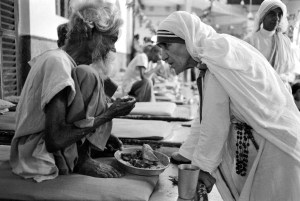
INDIA - OCTOBER 01:  Mother Teresa and the poor in Calcutta, India in October, 1979.  (Photo by Jean-Claude FRANCOLON/Gamma-Rapho via Getty Images)

INDIA – OCTOBER 01: Mother Teresa and the poor in Calcutta, India in October, 1979. (Photo by Jean-Claude FRANCOLON/Gamma-Rapho via Getty Images)

September 4th, 2016; 23rd Sunday in Ordinary Time

Gospel Luke 14:25-33 NAB

Great crowds were traveling with Jesus, and he turned and addressed them, “If anyone comes to me without hating his father and mother, wife and children, brothers and sisters, and even his own life, he cannot be my disciple. Whoever does not carry his own cross and come after me cannot be my disciple. Which of you wishing to construct a tower does not first sit down and calculate the cost to see if there is enough for its completion? Otherwise, after laying the foundation and finding himself unable to finish the work the onlookers should laugh at him and say, ‘This one began to build but did not have the resources to finish.’ Or what king marching into battle would not first sit down and decide whether with ten thousand troops he can successfully oppose another king advancing upon him with twenty thousand troops? But if not, while he is still far away, he will send a delegation to ask for peace terms. In the same way, anyone of you who does not renounce all his possessions cannot be my disciple.”

 Meditation Reflection:

How can Christ, whose new commandment to us was to “love one another as I have loved you” simultaneously ask that we hate our family members?  As we celebrate the canonization of Mother Teresa, we can look to her example to illuminate this paradox. Jesus’ challenge that “whoever does not carry his own cross and come after Me cannot be my disciple” proved a difficult task and one that required great love, detachment, and grace for Mother Teresa who left her home, her family, and even her beloved convent to serve the poorest of the poor on the streets in India.  Jesus rightly warns to count the cost before we set out on a project lest we find ourselves giving up midway.  Discipleship calls for a total gift of self, in response to the Lord who made the ultimate gift of self for us through His Incarnation, Death, and Resurrection.

In a perfect world, or at least in heaven, loves do not compete with one another and we aren’t painfully pulled in opposing directions.  In our current fallen state however, we come to crossroads where we must choose between two loves.  It’s one thing to forsake the love of a material good or a sinful habit, but the hardest love to forsake is that of someone with whom we have an intimate relationship who refuses to share us with Christ and gives us an ultimatum.

This ultimatum may not sound as direct as “it’s me or Christ!” but it will likely pit some aspect of following Christ against something the person wants of you.  Following Christ results in a life of sacrifice that’s counter-cultural.  Authentic Christians don’t blend in and that bothers people who don’t want to stir the waters. Living your faith, even quietly, can prick the conscience of another and result in lashing out to ease his or her own angst.  Similar to Jesus, Christians offer love unconditionally to others.  Unfortunately, the same is not always true on the other end and the painful choice between following Christ or making the person you care about happy must be made.

This choice takes as many forms as there are relationships.  For a teen it can be a couple breaking up because one chooses purity over promiscuity or being left out of social gatherings because of a refusal to drink.  For a young adult it can be a person choosing the religious life despite the discouragement of parents, or moving away from family and friends for a service they are called to by Christ. For parents it can mean getting the silent treatment from a child because you refuse to condone their wrong behavior.  For a spouse it can mean suffering the anger of the other sometimes even divorce because one refuses to compromise living out his or her faith to appease the other’s sin.  No one wants a rift in their family- whether between parents, children, or spouses.  At the same time not everything is in our control except our own decision to follow the Lord.   Navigating these situations can be confusing and spiritual direction should be sought to sort out how to authentically love in particular situations.

Mother Teresa desired to follow Christ and to give her whole life in love to Him.  First it meant leaving her family to join the Sisters of Loreto as a nun and serve in India as a teacher.  Next, she received her “call within a call” to go out into the streets and serve the poorest of the poor.  She was happy as a nun and asked Jesus if she could just serve Him more devoutly in the way she already was.  Each time however He repeated His request for her to satiate His thirst for souls by ministering to the poor and destitute.  He would ask her each time, “Wouldst thou refuse Me?”

Mother Teresa felt torn between two loves.  Her love for the other sisters, her students, and her life in the convent was certainly a noble love, but discipleship called her to follow Christ to a place that meant she would have to choose between the two.  Ultimately, Mother Teresa could not surrender her love for Jesus to anything else and so she gave up and gave in to the Lord.  As she followed Christ, Mother Teresa surrendered everything to Him – material goods, physical comforts, family, and even the convent.  She went into the most destitute streets with nothing but a sari and a passion for Jesus.

Mother Teresa did not want to have come so far only to turn back.  She had made a choice for Christ, to be a disciple, whatever may be.  Hopefully our discipleship will bring greater peace to our families and relationships and maybe our sacrifices will not be as large as Mother Teresa’s.  Only Christ knows the crosses we will have to carry but He asks that we be ready to face whatever may come with single minded devotion, lest we come so far only to turn back.

Contrary to cultural demands, Christians cannot compartmentalize their faith.  We are followers of Christ at church, at home, at work, when alone, or when with friends.  We have to be prepared that some people, even some we for whom we care deeply, may not tolerate our discipleship and choose to leave us.  In these instances, we can look to Christ for the grace and grit to carry our cross, a cross which He promises will end in a resurrection.

This Sunday, may we count the cost and, with the grace of Christ, decide to follow Him to the end.  The joy of Mother Teresa, and the light of love and mercy her life became, serves as a witness for us of the glorious destination of discipleship – a project worth completing!

Consider:

  • Are you a disciple of Christ?  If the answer is yes, what moves you to love Him and to follow Him? If the answer is no or not yet, what attracts you about Christ or piques your curiosity?
  • In what ways has discipleship caused you to live counter-culturally? Has it strained any of your relationships?
  • How has carrying your cross produced resurrections and blessings in your life? What have been some of the fruits of your discipleship?
  • What cross are you carrying right now? In what way does it resemble Jesus’ cross? How does it bring you closer to Him as you share in His experience?
  • It feels good to accomplish something hard that required grit and perseverance. Consider how it will feel to “finish the race” as St. Paul says, and to have followed Christ (with the help of His grace) to the end.

Make a Resolution (Practical Application):

  • Learn more about Mother Teresa or read a collection of her writings or quotations.
  • If you feel tension between following Christ and appeasing someone you love, seek spiritual direction this week from your priest or a wise and holy person you know. Reach out in person, by phone, or email.
  • Pray an Act Of Consecration to Jesus each day this week.

~ Written by Angela Lambert © 2016

* To receive these weekly posts automatically in your email just click the “follow” tab in the bottom right hand corner and enter your email address.


Eyes Wide Open…Gospel Meditation for Sunday August 7th, 2016

by Angela Lambert


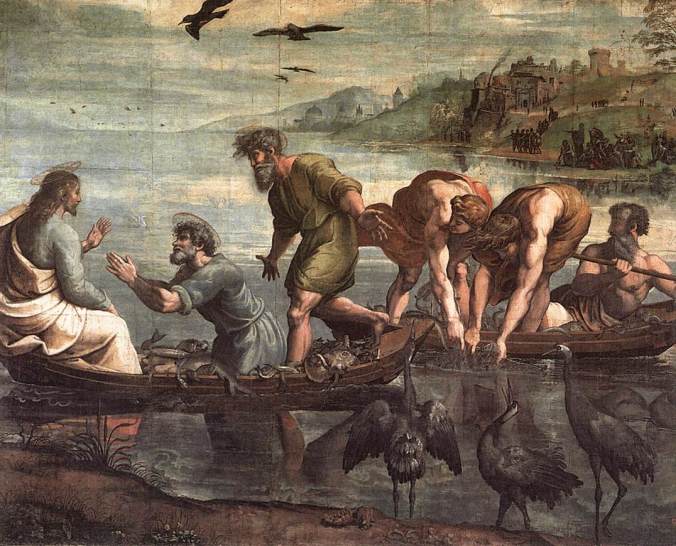
Raphael,_The_Miraculous_Draught_of_Fishes_(1515)

August 7th, 2016; 19th Sunday in Ordinary Time

Gospel of Luke 12:35-40 NAB

 “Jesus said to His disciples: ‘Gird your loins and light your lamps and be like servants who await their master’s return from a wedding, ready to open immediately when he comes and knocks.  Blessed are those servants whom the master finds vigilant on his arrival.  Amen, I say to you, he will gird himself, have them recline at table, and proceed to wait on them.  And should he come in the second or third watch and find them prepared in this way, blessed are those servants. Be sure of this: if the master of the house had known the hour when the thief was coming, he would not have let his house be broken into.  You also must be prepared, for at an hour you do not expect, the Son of Man will come.’”

Meditation Reflection:

Today Jesus emphasizes the need for disciples to be vigilant.  According to Wordbook, vigilant means to be “carefully observant or attentive; on the lookout for possible danger.”  Discipleship can suffer from the same waning of enthusiasm as any of our other noble tasks.  How many New Year’s diets end by February?  How many work-out videos get one viewing before gathering dust?  How many books are left only partially read?  How many friendships or relationships wither from slow neglect?  Jesus exhorts us to head off dangers to our faith by being aware and making efforts to protect ourselves from them.  Discipleship requires the same perseverance, effort, and watchfulness as anything else we hope to accomplish and maintain.

To achieve a goal of getting in shape, having someone to hold you accountable and work out with you will be necessary in order to avoid giving up early or choosing to watch tv instead of going to the gym.  Discipleship requires fellowship as well.  We need faith-filled friends to keep us accountable, inspire us to be better, and keep us in the habit of prayer and worship.  To achieve the goal of developing your mind through reading, you will need to choose a time, place, and frequency or it will never happen.  Forming a book club can also give that added boost of a deadline to motivate you.  Similarly, to grow nearer to Christ you will need to read Scripture regularly.  The same pitfalls apply here so being vigilant about sticking to a routine will be important and joining a bible study could also be motivating.

Wordbook’s synonym for vigilance illuminates the essence of discipleship as well: “open-eyed.” Here however, it’s our eyes of faith that we need to struggle to keep open.  In Hebrews 1:1, St. Paul defines faith as: “the assurance of things hoped for, the conviction of things not seen” (RSV).  He goes on to illustrate this with the example of Abraham who left for a land God promised without any sight of it beforehand – no map, no appraisal or inspection, no google images – only God’s word.  Moreover, after having received a son despite he and Sarah’s old age, Abraham was willing to sacrifice Isaac at God’s command. Imagine the paradox presented to Abraham.  God had promised Abraham many descendants through Isaac, and yet God also asked Abraham to sacrifice Isaac.  How could both of these things be true at the same time?  Abraham could find no assurance in natural reason or human experience and power.  Abraham merited the title Father of Faith by his response.  St. Paul relates, “[Abraham] considered that God was able to raise men even from the dead; hence, figuratively speaking, he did receive him back” (Hebrews 11:19 RSV).  Abraham had confidence that God is all-powerful and that God keeps His promises.  He didn’t limit God to our human experience.  He trusted God and proved his conviction when he risked everything to be obedient to the Lord.

How can we imitate the vigilant, open-eyed faith of Abraham?  Every day we need to open our eyes through prayer.  We need to ask for the gift of faith and trust.  We have to keep sharp through fellowship with faithful Christians and spiritual reading.  We need to deepen our trust through developing our relationship with Christ and receiving His grace in the sacraments.  Finally, many saints and spiritual writers suggest doing an examination of conscience every night.  Look back on the day and evaluate your choices.  When did you show love for God and for others?  What temptations did you overcome?  What inspirations of the Holy Spirit did you follow?  Secondly, where did you lean on your own understanding instead of God’s?  When did you relax into thinking and acting like a child of the world rather than a child of God?  What choices were motivated by a lack of faith, hope, or charity?  Ask God for forgiveness and an increase in grace to do better the next day.

Even if the end of the day doesn’t work for you, try to at least be more introspective throughout the day.  Jesus warned “Be sure of this, if the master of the house had known the hour when the thief was coming, he would not have let his house be broken into.”  Sins can make little strongholds in our soul if we are not vigilant in identifying them and putting them before the Lord for healing.  We never know when we will be attacked by temptation and sometimes it can be very subtle.  By developing a habit of staying alert we will be better able to avoid or overcome them.

Lastly, we never know when Jesus will come.  He too appears at surprising times in surprising ways.  If we live in faith, our hearts will be open to receive the gifts Christ desires to bestow on us.  We may have to take a step that makes no sense from a practical perspective unless God is real, all-powerful, and keeps His promises.  God will provide.  If therefore we seek first His kingdom, we can be assured that everything else will be taken care of (Matthew 6:33), and quite often in ways we could not have foreseen.

We have a tendency today to need to “see it to believe it.”  Although I still have to struggle to patiently trust God, at this point I have seen God act so many times in my life that I can say I believe it because I’ve seen it.  I’ve seen God provide over and over again, always in unexpected ways, and just at the right time.  He has done this at every level – family, relationships, work, finances, and health. Even though it’s easier to trust the wisdom of the world or our own strength which we can see right before us, we ought to vigilantly keep our eyes open to the wisdom and strength of our loving God which is far more reliable. He is coming, and it will be a day of great rejoicing we won’t want to miss!

Consider:

  •  Reflect on what practices have deepened your faith and helped you grow as a disciple of Christ?
  • Consider where you need further growth. Pray about how you could be more vigilant in that area.
  • Meditate on the words Jesus asked St. Faustina to have written below His image: “Jesus I trust in You.”
  • Reflect with gratitude on a time(s) when God came through for you in a surprising or powerful way.
  • Is there a part of your life that needs more trust in Jesus? Pray for an increase in faith and hope.

Make a Resolution (Practical Application):

  • Choose one way to be more vigilant in your faith life. Share your goal with someone who will encourage you and keep you accountable.
  • Pray the short prayer, “Jesus I trust in You” several times each day.
  • Pray Psalm 27 each day this week.


~ Written by Angela Lambert © 2016

* To receive these weekly posts automatically in your email just click the “follow” tab in the bottom right hand corner and enter your email address.


Becoming Rich: Investment Strategies From Christ

by Angela Lambert


July 31st, 2016; 18th Sunday in Ordinary Time

Gospel of Luke 12:13-21 NAB

Someone in the crowd said to Jesus, “Teacher, tell my brother to share the inheritance with me.” He replied to him, “Friend, who appointed me as your judge and arbitrator?” Then he said to the crowd, “Take care to guard against all greed, for though one may be rich, one’s life does not consist of possessions.” Then he told them a parable. “There was a rich man whose land produced a bountiful harvest. He asked himself, ‘What shall I do, for I do not have space to store my harvest?’ And he said, ‘This is what I shall do: I shall tear down my barns and build larger ones. There I shall store all my grain and other goods and I shall say to myself, “Now as for you,
you have so many good things stored up for many years, rest, eat, drink, be merry!”’ But God said to him, ‘You fool, this night your life will be demanded of you; and the things you have prepared, to whom will they belong?’ Thus will it be for all who store up treasure for themselves
but are not rich in what matters to God.”

Meditation Reflection:

Greed comes in many forms and we can be quite talented at excusing it with innumerable rationalizations.  The man in this encounter masked his greed with a case about justice.  We don’t know the circumstances surrounding the inheritance but Jesus, who knows the truth in each of our hearts, shows greater concern from the man’s motive than the actual facts of the case.

Greed has a vicious way of undermining our relationships with God, each other, and even ourselves.  We often operate with the mentality of the farmer in Christ’s parable.  The modern equivalent would go something like this:  Work hard in school and be successful in a bunch of extracurricular activities so you can get into a good college, so you can get a good job, so you can make a lot of money, so you will be secure and happy.  Yet, how many people follow this plan and find themselves at 40 years old burnt out, lonely, empty inside, and suffering from health issues related to the stressful pace they have been keeping for decades.  Ironically, we are both the richest country in the world and the most depressed. We keep a frenzied pace only to find ourselves exasperatedly sighing the same words of Ecclesiastes “For what profit comes to man from all the toil and anxiety of heart with which he has labored under the sun?” (2:22).

What is the point?! We clean the house and it’s messy again in a matter of hours.  We finish a project at work and another lands on our desk the next day.  Our kids finish one sport’s season and another begins.  Days fly off the calendar, then weeks, then years.  Everyone has to find a balance between work and life.  We have to be prudent, work hard, and plan for the future.  The problem is, it’s just sooooo easy to work and plan for more than we really need and miss out on the good stuff right in front of us.  Rather than plopping on the couch and watching a movie with our kids we run another load of laundry or get some work done on the computer.  Instead of going out with colleagues and deepening friendships, we put in a couple extra hours at work to get ahead.

Jesus reminds us to work and plan for our eternal future too.  We are made for meaning, purpose, and love.  Moreover, we are spiritual beings made for eternity with God.  Work labored for greed will produce a temporary reward, but work offered in love and service to God will bring eternal joy.  It will likely bring a deeper earthly joy as well.  Having the respect of others because of your position can feel good but it can also feel empty, not to mention add paranoia that someone will try to take it from you.  Having the respect of others because of your character is priceless and immune from circumstances.

Greed is an inordinate desire for wealth.  Every day we must pray and reflect on what really matters so we invest our time and efforts wisely and in the right order.  Through the grace of Christ, we have the opportunity to escape the crazed rat race and endless running on what feels like a gerbil wheel going in circles.  If we have the courage to surrender greed we can gain immeasurable wealth unaffected by the volatility of the stock market or our boss, and which produces deeper pleasure than money can buy. Working for your kids will mean more than working merely to afford fashionable clothing which will quickly be out of fashion, or a beautiful boat which won’t be as much fun without kids there to enjoy it with you, or the perfect house which will just be outdone by the Jones’ house that will be built next door in a year.  Doing work that improves the lives of others will give you deeper satisfaction than a simple paycheck.  No matter what your profession, how you conduct yourself and to what end is up to you.

As a teacher, I am reminded of this at graduation parties.  Our bonus, though not monetary, comes in the form of seeing kids we helped develop turn into amazing human beings.  It’s the emails from college or stopping by our classrooms to tell us everything they are up to or how something we taught them has stuck with them that is worth more than any zeros on a check. Similarly, I know wealthy individuals who find great joy in putting it at the service of the Lord and seeing the fruits of those spiritual endeavors. God promises in 2 Corinthians 9:6 “Consider this: whoever sows sparingly will also reap sparingly, and whoever sows bountifully will also reap bountifully.”  Be generous with God and labor to sow what matters so you can be “rich in what matters to God.”

Consider:

  • Reflect on what matters most in your life. Consider what gets in the way of those things versus what develops them.
  • Prayerfully consider what is “enough” for you. What would be sufficient and what work is necessary to meet that goal?
  • Ask God to reveal any desires that have become excessive or obsessive. Is there anything you are grasping after or worried about that prevents you from enjoying the gifts God has already given you?
  • What kind of work or charitable contributions brings you a feeling of satisfaction?
    • Do you find meaning in aspects of your job?
    • Do you enjoy providing for your family and seeing them thrive?
    • Do you have charitable projects you care about?
  • Has greed ever undermined your relationship with God? With another person?  With being true to yourself?

Make a Resolution (Practical Application):

  • Evaluate your investments in God, others, and yourself.  Decide on one thing you could do for each category to enrichen that relationship in your life.
  • The opposite virtue of greed is generosity. Do something generous this week.


~ Written by Angela Lambert © 2016

* To receive these weekly posts automatically in your email just click the “follow” tab in the bottom right hand corner and enter your email address.


The Priority of Being Present

by Angela Lambert

July 17th, 2016; 16th Sunday in Ordinary Time

20150814_015150000_iOS

Gospel of Luke 10:38-42 NAB

Jesus entered a village where a woman whose name was Martha welcomed him. She had a sister named Mary who sat beside the Lord at his feet listening to him speak. Martha, burdened with much serving, came to him and said, “Lord, do you not care that my sister has left me by myself to do the serving? Tell her to help me.” The Lord said to her in reply, “Martha, Martha, you are anxious and worried about many things. There is need of only one thing. Mary has chosen the better part and it will not be taken from her.”

Meditation Reflection:

Theologians and spiritual writers often reflect on this passage as a teaching on the active life of service and the contemplative life of prayer.  I find it also provides rich insights into the life of family. Martha’s home – her welcoming love and hospitality – together with the company of her sister Mary and brother Lazarus, became a place of respite and comfort for Christ.

His relationship with their family began with Martha’s initiative as He entered their village.  Just prior to this passage, Luke recounted the many places and people that either failed to receive Jesus or rejected him outright.  Martha however invited Him into her home and served Him with gracious hospitality.

In family life, welcoming children begins with a similar openness toward receiving others whenever they arrive and a readiness to serve.  In fact, in Luke 9:48, Jesus confirms this connection when He teaches: “Whoever receives this child in my name receives me, and whoever receives me receives the one who sent me.” Oftentimes however, parents become “burdened with much serving” like Martha.  Babies require constant care day and night, young children need continual help, and pre-teens need a frenetic amount of chauffeuring.

The Lord appreciates every sacrifice we make.  Things get out of balance however when we allow our work to become a source of anxiety and worry.   Jesus did not scold Martha for working too hard, He voiced His concern for her anxiousness.  Her worry had begun to undermine her ability to be present in the moment and began to skew her perspective.  When she tried to drag Mary into her frenzy Jesus prevented her and gently helped Martha see where she had crossed the line.

Pope Francis also noted this challenge to modern families in his newest apostolic letter The Joy of Love.  Citing responses he had received from the pre-synodal questionnaire he had sent out, he acknowledges:

Many of the respondents pointed to the problems families face in raising children.  In many cases, parents come home exhausted, now wanting to talk, and many families no longer even share a common meal.  Distractions abound, including an addiction to television…Other responses pointed to the effect of severe stress on families, who often seem more caught up with securing their future than with enjoying the present.  This is a broader cultural problem, aggravated by fears about steady employment, finances, and the future of children.” (Amoris Laetitia, par. 50)


My watershed moment like Martha’s occurred at Christmas time several years ago.  My three kids were young and yet also old enough to have new Christmas traditions of our own and we were going to host Christmas for our extended family. As a result, I had grand plans worked out into an organized to-do list so that we could accomplish everything from home-made frosted sugar cookies the kids and I would make together in Christmas shapes to the FoodNetwork recipes I would make for the family celebration.   That all came to an abrupt and painful halt when I became sick with the flu one week prior to Christmas day.  As the flu persisted and Christmas approached my stress level reached breaking point.  My mom called to say hi but instead had to methodically walk me back from my emotional cliff.  She went through my list with me one task at a time and asked the simple question over and over again: “and what would happen if that didn’t get done? And what if that didn’t get done…”

Although I had loving intentions behind each task, the element of service had been usurped by a ball of worry.  My mom, like Christ, gently gave me perspective.  Consequently, with the help of a great deal of divine grace, I surrendered our newly established Christmas traditions and accepted that we could do them next year.  I scaled back my expectations for hosting, humbly accepted help, and recalled that spending time together was the most important thing not the elaborate meal.    Since then, with the help of prayer and grace, I have worked to keep my life in better balance.

Christian service is not an end in and of itself.  Rather, it’s a loving encounter with another person.  Whether it’s care for kids, elderly parents, a disabled relative, or dedication at one’s job, we all need to make sure we keep the persons we are serving at the center and resist letting the tasks distract us with worry from the people whom we are caring about in the first place.  Jesus loved visiting Mary, Martha, and Lazarus because of the warm hospitality and because of the personal love, faith, and fellowship that they offered.  Despite our technological advances, we have become busier as a culture rather than more relaxed.  It requires intentional effort and grace to put people first and to be present in the moment.  It’s no small task to order our lives in such a way that we can work hard and have time to stop and listen to those we love.  When we become untethered by our to-do list, Mary appears to just be sitting around doing nothing.  Jesus reminds us that personal attention is just as important a “task” as the others, if not more important.

Mary chose the better part.  We too must pray for the grace to choose to spend time doing what feels like nothing with our kids, parents, and family; to just enjoy being with one another.  Similarly, we must choose to make time to just be with Christ so that our work remains in service to Him imbued with His love.  No one claims they treat their family and friends the best when they are stressed out and anxious.   By “practicing the presence of God”, as Brother Lawrence’s spiritual classic teaches, God will provide the peace we need to practice the presence of others as well.  It will be counter-cultural, and you will have to let go of competing with the super-moms and the super-colleagues, but Jesus assures us that choosing to be present to the people we care about over a frenzied attitude over work that needs to be done is the better part and we shouldn’t let anything take it from us.

Consider:

  •  Prayerfully consider how present you are to Christ.
    • Do you make time to sit with Him and listen?
    • Do you think of Him during the day or while at work?
    • Do you enjoy silent prayer or struggle with the feeling that you are “doing nothing”?
  • Prayerfully consider how present you are to your family.
    • When are your favorite times to connect?
    • What special moments do you recall with your parents or kids where you felt loved and listened to?
    • What things undermine your peace and your ability to focus on those around you?
    • What causes you to become stressed and distracted?
    • How could you re-order your life or adjust your expectations so you can resist unnecessary anxiety and give your loved ones the best version of yourself?
    • What do you need to take care of yourself so you can be a peaceful, present person?
      • How much sleep do you need? Be honest!
      • How and when do you relax?
      • What are your quirks or limitations it would help to acknowledge? (For example – running late makes you stressed so make an effort to arrive 5 minutes early or you need a bite to eat every couple of hours so make time for good food, etc.)
    • Pray for an increase in the virtue of Hope. Consider how worry can be combated by trust in Jesus. Jesus says, “Seek first the kingdom of God, and all these things will be added” (Matthew 6:33).  Pray for the grace to prioritize your life according to God’s will, then allow Him to make sure everything else gets worked out.
    • Reflect on the reality of our limitations: limitations of time in a day, energy, the need for rest and food, etc. It takes humility to live within our limitations but being more realistic about what we expect from ourselves and others as well as what we say yes or no to can greatly reduce unnecessary stress.

Make a Resolution (Practical Application):

  • Read “The Practice of the Presence of God” by Brother Lawrence (it’s a small, thin book but sticks with you)
  • Make a list of priorities. Then make a list of your schedule and activities.  Prayerfully evaluate if they align and make adjustments. Schedule in time for God, time to take care of yourself, and time for serving your family and at work.
  • Each day choose one person to whom you will be present and attentive. If possible decide who, when, and how. (It can be as simple as asking someone at work about their day at lunch or visiting with your kids at the dinner table.)


~ Written by Angela Lambert © 2016

* To receive these weekly posts automatically in your email just click the “follow” tab in the bottom right hand corner and enter your email address.


Compassion in Suprising Circumstances…Gospel Meditation for July 10th, 2016

20160308_173953000_iOS

by Angela Lambert

July 10th, 2016; 15th Sunday in Ordinary Time

Gospel of Luke 10:25-37 NAB

There was a scholar of the law who stood up to test him and said, “Teacher, what must I do to inherit eternal life?” Jesus said to him, “What is written in the law? How do you read it?” He said in reply, “You shall love the Lord, your God, with all your heart, with all your being, with all your strength, and with all your mind, and your neighbor as yourself.” He replied to him, “You have answered correctly; do this and you will live.” But because he wished to justify himself, he said to Jesus, “And who is my neighbor?” Jesus replied, “A man fell victim to robbers
as he went down from Jerusalem to Jericho. They stripped and beat him and went off leaving him half-dead. A priest happened to be going down that road, but when he saw him, he passed by on the opposite side. Likewise a Levite came to the place, and when he saw him, he passed by on the opposite side. But a Samaritan traveler who came upon him was moved with compassion at the sight. He approached the victim, poured oil and wine over his wounds and bandaged them. Then he lifted him up on his own animal, took him to an inn, and cared for him. The next day he took out two silver coins and gave them to the innkeeper with the instruction, ‘Take care of him. If you spend more than what I have given you, I shall repay you on my way back.’ Which of these three, in your opinion, was neighbor to the robbers’ victim?” He answered, “The one who treated him with mercy.” Jesus said to him, “Go and do likewise.”

Meditation Reflection:

G.K. Chesterton once said, “The Catholic faith has not been tried and found wanting, it has been found difficult and left untried.”  Judeo-Christian belief consists not merely in knowing God, but in covenant relationship with Him.  This means we cannot conveniently keep our faith in a box that we take out when we feel like it.  Relationship with God requires active following of His commands – from those given to Moses to those given by Christ.   The famous parable of the Good Samaritan illustrates our common human struggle for consistency between our faith and our practice of it.  It’s one thing to know God’s teachings, it’s another to do it.

As a religion teacher I am humbled by this struggle every day.  I begin each year by clarifying for my students that the Catholic faith I will share with them is true, freeing, and life-giving.  Nevertheless, as their teacher I know the faith well but I, like them, must struggle to practice it each day.  They need to know up front that I am a sinner working with the help of grace to conform my life to Christ’s.  They shouldn’t trust me because I live the faith perfectly but rather because every day I try.  

In Jesus’ parable three challenges to follow Jesus’ command, “Love one another as I have loved you” and the Lord’s command in the Old Testament to “love your neighbor as yourself” are presented – one representing a common failure and two representing Christian response.  The priest and the Levite, both of whom would have known the Law well and considered themselves strict adherents, pass by their fellow Jew in need.  They had what they considered prudential reasons to not stop, but in truth they were rationalizing their desire to look the other way and avoid the bother.  How often do we lack compassion for those nearest to us?  How often do we put off reaching out because we think we have more important or pressing matters?  In her speech as she received the Nobel Peace Prize, Mother Teresa urged  people in the West to show concern for those in their own homes and families.  She cited the plague of depression, loneliness, and deep emptiness experienced by children and the elderly often set aside by the busy lifestyles of adults.  She even noted that in some ways it’s easier to fill the needs of the poor in Calcutta because all they need is a little food or medical care.  In the Western culture, rich with material things, the needs go much deeper and prove more difficult to meet.  Her solution?  Begin with a smile.  This may sound easy but try practicing it, especially when you feel bothered or exasperated by annoying tendencies, mannerisms, habits, etc. of your loved ones.  It’s a shame that we tend to treat those closest to us the worst!  Imagine if we could have greater compassion for our families. If we mastered that, it would enable us to have compassion toward anyone.

The Samaritan, overlooked the animosity between his people and the Jews because he felt “moved with compassion” at the sight of another human person in such horrible pain and humiliation.  The Samaritan treated the man as person with personal care.   He did not shrink back from the blood but provided medical care himself.  For reasons not provided in the parable, he had to leave the man the next day but even still the Samaritan provided for the wounded man from his own wallet and risked even more money to see that the man was restored to full health.  The Samaritan took no half-measures.  He cared for the man, provided for him, then returned to see that the man was well again.  It can be uncomfortable and difficult to concern ourselves with the problems of persons with whom we are unfamiliar.  It’s easier to pass them over or look the other way and we can find plenty of reasons to rationalize that it’s not our problem.  Yet, to love as Christ loved, we must in fact seek out those in need, attend to them even at personal cost, and allow grace to soften our hearts so we may be moved with compassion.

Finally, the innkeeper had to make a decision as well.  Imagine his surprise when he opens the door to a prospective guest only to find a foreigner carrying a beaten, half-dead man. In addition to admitting two less than ideal guests, he is asked to care for the wounded man and, if need be, provide for any expenses required for his recovery, relying only on the promise of the Samaritan to return with payment. We too encounter analogous situations in numerous ways.  Unexpected guests in need of our love appear in family life, at work, or literally at our door.  It may be a child you hadn’t “planned”, a relative in need, a friend of your child or spouse, a struggling co-worker, or a client.

Discipleship means opening our eyes to the needs around us, allowing our hearts to be moved with compassion, and to share in the sorrow of someone we’d rather pass by.  It could be a friend who needs to talk despite your busy schedule, a child needing comfort in the middle of the night when you would rather sleep, a testy teen who needs patience and firm but loving rules, an awkward colleague whose lonely and has difficulty making friends, or encouraging a family member when tempted to criticize them.

Jesus said, “Amen, I say to you, whatever you did for one of these least brothers of mine, you did for me’” (Matthew 25:40).  These words motivated Mother Teresa every day and made possible the extraordinary love she showed to those that society found most repulsive. May we follow her example and also heed the exhortation from the first reading for today from Deuteronomy, especially in this special Year of Mercy:

For this command that I enjoin on you today is not too mysterious and remote for you. It is not up in the sky, that you should say, ‘Who will go up in the sky to get it for us and tell us of it, that we may carry it out?’ Nor is it across the sea, that you should say, ‘Who will cross the sea to get it for us and tell us of it, that we may carry it out?’ No, it is something very near to you, already in your mouths and in your hearts; you have only to carry it out.

 Consider:

  •  Who do you find difficult to love?  What behaviors particularly annoy you or what tasks of love do you avoid?
    • In your family: (ideas: sleepless infants, whining kids, testing teens, moody or preoccupied spouse, a manipulative relative, elderly parent or grandparent who is lonely or in need of care, a competitive sibling…)
    • In your work: (lonely co-worker, new person in need of extra help getting acclimated, competitive co-worker, difficult boss, insensitive cubicle-mate, overwhelmed colleague…)
    • In your home-life: (a friend in need after a surgery, a new baby, or a loss; a neighbor kid who seems left alone too much or neglected, a single-mom whose driveway needs plowed or a word of encouragement, a young family in need of a free babysitter so the couple can have some time together, a new neighbor in need of help getting to know everyone…)
  • Do you nurture compassion and understanding for those suffering in other countries? Do you make an effort to understand some of the complexities of their struggles and their personal challenges?
  • Have you ever been the recipient of someone’s compassionate mercy in a time of need?
  • What teachings do you find difficult to practice?

Make a Resolution (Practical Application):

  • Consider an aspect of discipleship in which you need to grow.  Decide how to practice it concretely each day this week.  (Think of who needs you, what he or she needs from you, and how you will meet that need.  For example exercising more patience toward someone by smiling at them intentionally each day and doing one thing that would be of help for them.)
  • Pray each day for compassion and a softened heart.
  • Read Mother Teresa’s speech from when she received the Nobel Peace Prize. http://www.nobelprize.org/nobel_prizes/peace/laureates/1979/teresa-lecture.html
  • Learn about the struggles of someone in foreign country.


~ Written by Angela Lambert © 2016

* To receive these weekly posts automatically in your email just click the “follow” tab in the bottom right hand corner and enter your email address.


Encountering Christ Through Your Life…Gospel Meditation for Sunday July 3rd, 2016

by Angela Lambert

pope francis and refugees

Pope Francis welcomes a group of Syrian refugees after landing at Ciampino airport in Rome following a visit at the Moria refugee camp in the Greek island of Lesbos, April 16. Filippo Monteforte / Pool via Reuters

July 3rd, 2016; 14th Sunday in Ordinary Time

Gospel of Luke 10:1-12, 17-20 NAB

At that time the Lord appointed seventy-two others whom he sent ahead of him in pairs to every town and place he intended to visit. He said to them, “The harvest is abundant but the laborers are few; so ask the master of the harvest to send out laborers for his harvest. Go on your way; behold, I am sending you like lambs among wolves. Carry no money bag, no sack, no sandals;
and greet no one along the way. Into whatever house you enter, first say, ‘Peace to this household.’ If a peaceful person lives there, your peace will rest on him; but if not, it will return to you. Stay in the same house and eat and drink what is offered to you, for the laborer deserves his payment. Do not move about from one house to another. Whatever town you enter and they welcome you, eat what is set before you, cure the sick in it and say to them, ‘The kingdom of God is at hand for you.’ Whatever town you enter and they do not receive you, go out into the streets and say, ‘The dust of your town that clings to our feet, even that we shake off against you.’ Yet know this: the kingdom of God is at hand. I tell you, it will be more tolerable for Sodom on that day than for that town.”

The seventy-two returned rejoicing, and said, “Lord, even the demons are subject to us because of your name.” Jesus said, “I have observed Satan fall like lightning from the sky. Behold, I have given you the power to ‘tread upon serpents’ and scorpions and upon the full force of the enemy and nothing will harm you. Nevertheless, do not rejoice because the spirits are subject to you,
but rejoice because your names are written in heaven.”

Meditation Reflection:

Jesus desires personal relationship with each human person.  At the same time, no man is an island, and therefore Jesus encounters persons within the context of their lives. Our experiences and choices, together with our relationships with others, form the framework through which we receive and respond to Christ.

Our personal encounter with Christ may begin with a personally appointed disciple of His, sent ahead of Him.  For some, a certain preparation may be needed before Christ’s visit will be fruitful.  Someone whose heart is hardened toward God by experiences of pain or falsehood may need their demons cast out so Christ can fully enter.  In some cases, this happens in a literal way through the name of Jesus and the authority granted by Him.  In other cases, it happens in a more analogous way through the softening of a heart by the experience of Christian love, the opening of a mind through seeds of truth, or the reception of mercy in a time of need.  An otherwise weak soul, may find the courage to say yes to Christ after being inspired by the bravery of another.  A proud soul may see the beauty of meekness through the gentle joy of colleague.  Our perception of God can be obscured by our experiences in life – either of prosperity or pain – but it can also be clarified by our experiences in life, especially through encounters with other Christians.

Christ call us to proclaim the kingdom of God to others and He equips us with the supernatural power and grace to do so.  The good news of the Lord’s presence and mercy is proclaimed through a myriad of ways and tailored to the individuals who will receive it.  God may call you to witness through your example, through your choices, through works of mercy, through your patience and kindness, through your prayers and sacrifices, or through words of teaching, encouragement, conviction, or comfort.  Conversions continue to take place even in surprising places.  Peter Leithart, writer for First Things magazine, reports in his article “Islamicization of Europe or Christianization of Islam?”, that many Muslim refugees migrating into Europe from Iraq, Afghanistan, Pakistan, and central Asia have been converting to Christianity and requesting baptism by the droves.  The article cites a variety of reasons for this phenomena but ultimately individuals in need have encountered Christ through the Christians who have aided them which sparked openness to Christianity and a desire for Christ.

The kingdom of God, which is none other than union with God, begins here on earth at the crucial crossroads of the human will.  The seventy-two sent out by Christ recounted their exhilaration at being able to cast out demons.  The devil seems oppressively powerful, yet at the simple name of Jesus, he is conquered.  Unfortunately, a simple “no” by the human will can shut Jesus out.  Relationship requires the reciprocal good will of two people.  Christ loves us, but if we do not love Him in return there can be no friendship.  As Christian disciples, we must pray to be His missionaries laboring in His harvest and take care to not turn others away by their encounter with us.  We should also not become discouraged if even after great feats people in our lives still reject God.    Ultimately, that is between them and God.  The stakes are high – heaven! – so let’s pray that we can open hearts to receive the Lord for all of eternity.

Consider:

  •  Consider how Christ has sent messengers ahead of Him to you.
    • Who brought to you His truth, sacraments, love, or compassion?
    • How did it increase your faith or clarify your understanding of Christ?
  • Consider how you are a messenger of Christ – to your family, your colleagues, your neighbors, and your friends.
    • In what ways to you demonstrate Christ’s love and truth to them?
    • In what ways could you improve your Christian witness?
  • Reflect on your receptivity. How open are you to the Word of God in Scripture, through His Church, through others?  What hinders you and what helps you?
  • Reflect on Christian evangelization occurring in Europe by reading Peter Leithart’s article:First Things. “Islamicization of Europe or Christianization of Islam?”

Make a Resolution (Practical Application):

  •  Each day prayerfully and intentionally decide on one person with whom you will share Christ.  Prayerfully decide how and when you will do it. (e.g. saying a kind word to someone who annoys you at work, praying with your children together before bed, doing something loving toward your spouse, forgiving someone in need of mercy, etc.)
  • Reach out to someone who has been instrumental in your own conversion and thank him or her. It could be as simple as an email, text, hand-written note, or phone call.

~ Written by Angela Lambert © 2016

* To receive these weekly posts automatically in your email just click the “follow” tab in the bottom right hand corner and enter your email address.


Excuses, Excuses…Be Brave! Be Determined!

merciful father

June 26th, 2016; 13th Sunday in Ordinary Time

Gospel of Luke 9:51-62

When the days for Jesus’ being taken up were fulfilled, he resolutely determined to journey to Jerusalem, and he sent messengers ahead of him. On the way they entered a Samaritan village
to prepare for his reception there, but they would not welcome him because the destination of his journey was Jerusalem. When the disciples James and John saw this they asked, “Lord, do you want us to call down fire from heaven to consume them?” Jesus turned and rebuked them, and they journeyed to another village. As they were proceeding on their journey someone said to him, “I will follow you wherever you go.” Jesus answered him, “Foxes have dens and birds of the sky have nests, but the Son of Man has nowhere to rest his head.” And to another he said, “Follow me.” But he replied, “Lord, let me go first and bury my father.” But he answered him, “Let the dead bury their dead. But you, go and proclaim the kingdom of God.” And another said, “I will follow you, Lord, but first let me say farewell to my family at home.” To him Jesus said, “No one who sets a hand to the plow and looks to what was left behind is fit for the kingdom of God.”

 Meditation Reflection:

Being a Christian means following Christ, wherever and whenever He goes.  Full discipleship requires 100% commitment, not the made-to-order or pick and choose buffet we are accustomed to in our culture.  Consider Jesus’ own example.  He needed to journey to Jerusalem.  Notice the attitude He chose – resolution and determination.  Followers of Christ need the same resolution and determination.  In fact, St. Teresa of Avila, the great Spanish mystic, emphasized repeatedly the need for determination in order to advance in the spiritual life.

As Jesus journeyed, doing the Father’s will, those He encountered each had an opportunity to join Him.  The Samaritans received messengers from Christ but rejected the Lord before He even arrived when they learned accepting Christ meant surrendering their bitterness toward Jerusalem.

The next person took the initiative to seek Jesus and requested to be in His company.  Jesus, who knows the hearts of each one of us, warned the man that being near to Christ would bring spiritual security and comfort but not necessarily the feeling of physical security and comfort.

The next two men Jesus invited to follow Him, but both requested to do something else first.  Their requests seem valid and even noble.  In fact, burying the dead is a corporal work of mercy and honoring your father and mother is the 4th commandment. Is Jesus asking us to neglect our duties?  Does Christian discipleship excuse neglecting our families?  Does God contradict Himself?  No.  Do we sometimes rationalize our cowardice or weakness by twisting God’s commands against Him?  Yes.  Many of us (including myself!), often excuse our lack of time for prayer by pitting it against the active life of charity.  It sounds something like this: “I don’t have time to sit and pray because I need to do…which God would want me to do.”  A practical example would be, “I could sit and pray (a.k.a. do nothing) or work an extra hour to provide for my family, or do a load of laundry and dishes, or run an errand.  God wants me to care for my family, that is my prayer.”

Sometimes that might be the case.  But, in truth, there’s usually time for both.  In addition, without prayer, even our loving activities can tend to be more self-loving rather than other-loving. Jesus knew the hearts of the two men who wanted to return to their families before following Him.  Rather than contradicting His command that we love one another, especially our families, He may have been calling them out on their rationalizations.  It reminds me of when I gather my kids for family prayer.  My two boys will often try to get out of it by appealing to my earlier request that they get outside for awhile or they were just about to start a chore I had assigned earlier.  In reality, they had time for both those things before and after prayer, it just sounds like a better excuse.

Let’s face it, we have an inner desire for God and we may even have authentic zeal for discipleship, but we also struggle with attachments that hold us back.  The good news, is that if we open ourselves up to Christ in prayer, He will reveal those attachments to us and provide the grace to overcome them.  It requires resolution and determination, but with God all things are possible.

Consider:

  • Like the Samaritans, how many of us hold on to bitterness, anger, or un-forgiveness?  Prayerfully ask Christ to reveal if any of these are holding you back from following Him.  Pray for the grace to surrender it to the Lord.
  • Like the man who proclaimed he would follow Christ wherever He goes, consider why you are a Christian. Is your love for the Lord intermixed with some self-love as well?  Do you complain when you encounter trials?  Are you impatient or upset when you experience discomfort?
  • What rationalizations do you use to delay responding to Christ or to responding more generously? What rationalizations have you overcome on your spiritual journey?   How has that experience strengthened your will to follow the Lord?
  • A favorite book of mine called “The Fire Within” by Fr. Thomas Dubay provides some great steps for identifying and overcoming attachments. Prayerfully read my summary of Fr. Dubay’s steps and see if you can identify one attachment and make a plan for rooting it out.identifying attachments

Make a Resolution (Practical Application):

  • Each day this week thank God for one deterrent He has helped you overcome or from which He has freed you, and invite Him to reveal and free you from a current hindrance you may or may not realize you have.
  • Pray for an increase in resolution and determination. Choose one concrete thing you can do this week to apply it.  (e.g. pray 15 minutes each morning or evening, say something kind to your spouse when you want to say something critical, hug your child when you want to throw your hands up in exasperation, choose a daily Mass to attend and do what it takes to get there, go to Confession…)
  • Using Fr. Dubay’s steps, identify a current attachment and do one thing each day to root it out.

~ Written by Angela Lambert © 2016

* To receive these weekly posts automatically in your email just click the “follow” tab in the bottom right hand corner and enter your email address.

Paradoxes of Discipleship

by Angela Lambert

carrying-the-cross-daily1

June 19th, 2016; 12th Sunday in Ordinary Time

Gospel of Luke 9:18-24

Once when Jesus was praying by himself, and the disciples were with him, he asked them, “Who do the crowds say that I am?” They said in reply, “John the Baptist; others, Elijah; still others, ‘One of the ancient prophets has arisen.’” Then he said to them, “But who do you say that I am?” Peter said in reply, “The Christ of God.” He scolded them and directed them not to tell this to anyone. He said, “The Son of Man must suffer greatly and be rejected by the elders, the chief priests, and the scribes, and be killed and on the third day be raised.” Then he said to all, “If anyone wishes to come after me, he must deny himself and take up his cross daily and follow me. For whoever wishes to save his life will lose it, but whoever loses his life for my sake will save it.”

 Meditation Reflection:

Often we feel burdened by the frenetic pace of life, even the endless duties of Christian service for our loved ones.  We can easily feel that we do not have time to “just sit and pray.”  As a result we rationalize that our work is our prayer and God wants more from us than mere words.  These thoughts carry quite a bit of merit given their truth.  Nevertheless, they do not abnegate our responsibility to spend time alone with God.  Who could really say he or she has more work to do than the Son of God did during His time on earth?  Who of us can dare say our service cannot wait while we pray alone with God but Christ’s could?  Even Mother Teresa, known for her tireless works of charity, spent several hours in prayer every morning before beginning her service for the poorest of the poor. Angelo Comastri, Archbishop of Loreto, attested to her insistence on the necessity of prayer first, describing his encounter with her in this way:

“She looked at me with two clear and piercing eyes. Then she asked me: «How many hours do you pray a day?» I was surprised by such a question and tried to defend myself by saying: «Mother, I expected you to speak about charity, to invite me to love the poor more. Why do you ask me how many hours I pray?» Mother Teresa took my hands and held them tightly in her own as if she wanted to pass on to me what she had in her heart; then she told me in confidence: «My child, without God we are too poor to be able to help the poor! Remember: I am only a poor woman who prays. When I pray, God puts His Love into my heart and so I can love the poor. By praying!http://www.vatican.va/jubilee_2000/magazine/documents/ju_mag_01091997_p-18_en.html

Time alone with God, especially time spent in silent contemplation or meditation may feel like you are doing nothing whereas in truth an incredible amount is being accomplished in the depths of your soul by God.  In prayer, God fills our souls supernaturally with grace which enables us to know, love, and serve Him in ways we could not without this aid.  For instance, those who had encountered Christ but had not spent time alone with Him like the apostles, had fairly good guesses about Christ’s identity, nevertheless they were wrong.  Peter, however, having dedicated Himself to following Christ and remaining near to Him, was enabled by the Holy Spirit to correctly determine the truth about Jesus.

Moreover, when spending time alone with Christ in silence, He reveals more of Himself to us as well as His mission for us.  After Peter perceived Jesus as the “Christ,” which means “Anointed One,” referring to the long awaited Messiah or “Son of Man” from earlier prophecies, Jesus next revealed the Christ would suffer, die, and be raised to life.  This would not have been the kind of glory the apostles were expecting from their leader.  Without grace, they must have questioned why they chose to follow someone who predicted He would seemingly fail in such a painful way.  He also promised a resurrection but this too would be hard to put in one’s trust without grace.  If that weren’t enough, Jesus went on to disclose an even harder truth: “If anyone wishes to come after me, he must deny himself and take up his cross daily and follow me.”  Self-denial? Intense suffering?  No marketing agent would put that on a billboard!

We can only make that kind of sacrifice aided by grace to trust that our Lord who suffered, died, and was raised to eternal life in Heaven, will raise us to eternal glory with Him if we endure the suffering and death to our worldly ambitions and sinful attachments on earth.  You only live once so the risk is big.  If Heaven isn’t for real, you won’t have a second chance at the pleasures or the fame the world has to offer.  Time alone with Christ must be a necessity for disciples.  Who do some secular people say Christ is?  A crutch for the weak, a glorified imaginary friend, an old superstition.  Who do disciples of Christ discover He is?  A trusted friend, a vigilant protector, a source of peace, a spring of joy.

In time alone with the one we love, Christ gifts us with the faith, hope, and love necessary to believe and act on His admonition: “For whoever wishes to save his life will lose it, but whoever loses his life for my sake will save it.”  For example, when in prayer, I felt Jesus call me to the vocation of motherhood, it took some grace and adjustment.  I was young and had more ambitious ideas of how to serve the Lord.  In time alone with Him at adoration however, He revealed to me that I had made some good guesses about the Christian life, but they were still very tainted by a worldly lens.  In time I came to see from His perspective.  I came to have faith but next I needed the hope and love to act on this call, which He provided through more time spent with Him.  I spent my 20’s at home raising my three kids, while my worldly peers pursued careers, partied, and travelled.  From a secular view, I had “no life”.  Sometimes, it even felt like that.  However, I had posted on my refrigerator John 15:13 “Greater love has no man than this, that a man lay down his life for his friends.” When tempted by the worldly lens that I had wasted my talents, I would spend time in prayer.  Without fail, I would walk away each time with the view of the greatness of my mission as a disciple and I felt unworthy of such an honor.  15 years later, I can see concrete examples of how in losing my life Christ saved it.  I can’t articulate the work He has done in my soul through my experience as a mother and my time alone with Christ in the home with my kids for 10 years.  I’m not saying that is His will for everyone.  It was however His will for me and in retrospect I can see why.  When I had finally become truly comfortable with my mission at home (and even homeschooling!) I was called to go out of the home, enroll my kids in school, and be a teacher again.  When this became absolutely clear I cried uncontrollably for an hour.  What had begun as a sacrifice became a sacrifice to surrender.  Christ blessed me however through ways only He can and through His Mystical Body, with the opportunity for all of my kids to attend the school at which I teach so we could still be together in some way during the day. I still rely on Christ to provide the faith, courage, and love to choose His will over the immediate visible rewards that come from my will and already I am seeing the fruits of His next call.

Our utilitarian culture measures worth by achievement.  Love however simply desires connection and time together.  Love bears fruits of good works, but its greatest joy is simply enjoying the nearness and attention of the beloved.  You are Christ’s beloved.  Your love should bear fruit of loving works, but Jesus’ greatest joy is time spent near Him, enjoying His presence.  As Mother Teresa advised, spend time alone with the Lord, and He will pour the love you need in your heart to carry your cross.  Paradoxically, you may find your cross to be your greatest blessing and that in losing your life for the Lord, it will be saved.

Consider:

  •  Consider how much time you spend alone with Christ.
    • What keeps you from making time for silent prayer and listening?
    • How has silent prayer with the Lord deepened your faith?
  • Consider the paradox that no matter how busy we are, if we make time for Christ somehow everything else still gets done.
  • With whom do you enjoy spending time together? Do you take joy in his or her presence even if nothing is being “accomplished”?  Do you know and love each other more deeply as a result?
  • If you have teens, consider the time you spend driving in the car. Often that space of time where you are simply alone in the quiet of the vehicle is when they open up about what’s on their minds or in their hearts.  What is it about a dedicated space of time that cannot be interrupted by tasks that opens people up to one another?
    • Consider how this relates to our relationship with the Lord. How many of us encounter Him during times when we have nowhere else we could go?  What if we simply carved out that time intentionally each day?
  • How has Christ deepened your faith, strengthened your trust, and made you more loving because of your relationship with Him?
  • Have you ever “died to something” in your life only to find that in fact Christ liberated you through it? Have you given something only to find you were given more in return?
  • What might Christ be asking you to surrender today? How might Christ value your contributions more than you do?  Pray for Him to reveal His view of your life and purify your own lens.

Make a Resolution (Practical Application):

  • Spend an additional 15 minutes a day this week alone with Jesus.
  • Visit Jesus at adoration one time this week.
  • Read about Christ in the Gospels or a spiritual book. One suggestion would be “Jesus of Nazareth” by Pope Benedict XVI.
  • Take 5 minutes for silent prayer a day.
  • Listen to Christian music once a day – while driving, walking, getting ready etc.
  • Listen to the song “How He Loves Us” by David Crowder Band

~ Written by Angela Lambert © 2016

* To receive these weekly posts automatically in your email just click the “follow” tab in the bottom right hand corner and enter your email address.


Why is There Suffering, and What is God Doing About It?…Gospel meditation for June 5th, 2016

by Angela Lambert

Jesus raises widow of Nain's son

June 5th, 2016; 10th Sunday in Ordinary Time

Gospel of Luke 7:11-17 NAB

Jesus journeyed to a city called Nain, and his disciples and a large crowd accompanied him. As he drew near to the gate of the city, a man who had died was being carried out, the only son of his mother, and she was a widow. A large crowd from the city was with her. When the Lord saw her, he was moved with pity for her and said to her, “Do not weep.” He stepped forward and touched the coffin; at this the bearers halted, and he said, “Young man, I tell you, arise!” The dead man sat up and began to speak, and Jesus gave him to his mother. Fear seized them all, and they glorified God, crying out “A great prophet has arisen in our midst,” and “God has visited his people.” This report about him spread through the whole of Judea and in all the surrounding region.

 Meditation Reflection:

Why is there evil in the world?  Why doesn’t God do anything about it? Some persons will answer that either God doesn’t exist or God doesn’t care.  Those persons willing to investigate the question further however, universally discover two things: human free will causes most evils and the person who has consistently done the most to alleviate suffering is God.  Utopian ideologies of the 19th and 20th centuries, endeavoring to eradicate evil through human efforts alone, all ended in countless deaths and totalitarian rule. Sin causes evil and only God can save us from ourselves.  Even death, God has revealed, did not originate with faulty genetics or evolution.  Sickness, death, toil, and pain entered the world through the original sin of Adam and Eve (Genesis 3; Romans 8:19-23).

God created human persons to experience Truth, Goodness, and Beauty.  He designed us to live in perfect friendship with Him and with each other in a unity of love and joy for eternity.    We all experience deep suffering at some point(s) in life.   The woman in this Gospel provides an example of both deep spiritual pain from losing her only son after having already lost her husband, as well as utter material destitution since she would have no legal rights to property or work without a husband or son.  Upon seeing this, Jesus is “moved with pity for her.” When we feel most vulnerable, most alone, and our hearts are breaking, we can look to this passage and take comfort in knowing that Christ is looking on us with pity.  Moreover, this pity moves Him to do something to alleviate our pain.  In this case, Jesus restored the man to life.  In doing so, He restored the woman’s life as well.  Although Christ does not always save those we love from earthly death, this miracle demonstrates His power and His love which brings new life in surprising and supernatural ways.  It also points to the hope that all will be made new in the resurrected life in the kingdom of God.

God became man to dwell among us (John 1:14) and to personally alleviate our suffering through His Word, His touch, and His sacrifice.  As the psalmist proclaims: “The LORD is near to the brokenhearted, and saves those who are crushed in spirit” (Ps. 34:18).  Moved with pity, Christ continues to reach directly into our hearts to dry our tears and heal our wounds. He anoints our wounds with grace through His sacraments, He dispels hurtful lies with His divine revelation, He forgives our sins in the sacrament of Confession and fortifies us with grace to overcome them, and He feeds us with His very own body and blood in the Eucharist.  Finally, He unites us as members of His body and extends His hand of mercy through His disciples operating under the direction and love of the Holy Spirit.

Does God care about our suffering?  Is He going to do anything about it?  Yes.  Quite a lot actually, if only you will allow Him.  Christ offers new life if we will accept it.  He offers healing if we turn to Him.  This is the witness of every Christian disciple.

Consider:

  •  Re-read the Gospel and imagine you are one of the persons present.
    • Consider the love of the mother for her only son. Consider her love for her husband as well.  The death of her son means the image of her husband is gone as well as their family together.  In addition, imagine you will now be destitute with no way to provide for yourself.  To your surprise, a man emerges from the crowd and gives your son, your family, your life, back to you.
    • Imagine you are one of the members of the crowd. Why might you be present and how might you be feeling toward the woman?  What would you think of Christ’s miracle?
    • Imagine Christ’s perspective. What does His response reveal about His heart and His character?
  • Consider the definition of pity. Dictionary.com defines it as: “sympathetic or kindly sorrow evoked by the suffering, distress, or misfortune of another, often leading one to give relief or aid or to show mercy.” The heart of Christ felt sorrow at the sight of the woman’s pain and it moved Him to help her.  Imagine Christ seeing you in your pain.  Consider His merciful look of pity which shares your sorrow and desires to bring you comfort.
  • Reflect on a time Christ comforted you or saved you when you were in dire need. Take time to appreciate all that He did and the incredible ways He acted in your life during that time.

Make a Resolution (Practical Application):

  • Begin each day with this prayer: “Lord show me the needs around me.  Move my heart with pity and enable me to show mercy to someone today.”
  • Surrender a pain to Christ to heal. Reach out to Him in His Word, His Sacraments, or His Church.  Spend 5 minutes of silence with Christ and your pain.
  • Make a gratitude list of the mercies Christ has shown you over the years and then each day.


~ Written by Angela Lambert © 2016

* To receive these weekly posts automatically in your email just click the “follow” tab in the bottom right hand corner and enter your email address.