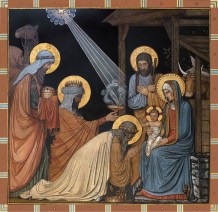
Jesus Christ – God’s Son and Our Warrior

OXYGEN VOLUME 13

by Angela Lambert

January 10th, 2016; The Baptism of the Lord

Gospel of Luke 3:15-16, 21-22

The people were filled with expectation, and all were asking in their hearts whether John might be the Christ. John answered them all, saying, “I am baptizing you with water, but one mightier than I is coming. I am not worthy to loosen the thongs of his sandals. He will baptize you with the Holy Spirit and fire.” After all the people had been baptized and Jesus also had been baptized and was praying, heaven was opened and the Holy Spirit descended upon him in bodily form like a dove. And a voice came from heaven, “You are my beloved Son; with you I am well pleased.”

Meditation Reflection:

The Baptism of Jesus marks the beginning of His public ministry. Up to this point He had spent His life as a carpenter and the son of Mary. Now at thirty years old, He begins His work as the Son of God ushering in the Kingdom. The Spirit of God descends upon Him as a dove and God affirms His Sonship audibly to those present. After so many long years of suffering under the weight of sin and death, God has finally come to fulfill all of His promises to save us from those things we cannot overcome on our own.

He stood up to read and was handed a scroll of the prophet Isaiah. He unrolled the scroll and found the passage where it was written: The Spirit of the Lord is upon me, because he has anointed me to bring glad tidings to the poor. He has sent me to proclaim liberty to captives and recovery of sight to the blind, to let the oppressed go free, and to proclaim a year acceptable to the Lord. Rolling up the scroll, he handed it back to the attendant and sat down, and the eyes of all in the synagogue looked intently at him. He said to them, “Today this Scripture passage is fulfilled in your hearing.” Luke 4: 16-20

 John had been baptizing as well but his was only a sign of repentance and preparation, it did not have the power to confer the forgiveness of sins or divine grace. John himself admits that his baptism is only a precursor for the one to come who will baptize with “the Holy Spirit and with fire” (Luke 3:16).   Jesus alone has the power to forgive our debt to God, to heal our wounded souls, and to release us from those sins that we cannot conquer on our own.

Sin which takes its full course can be aptly compared to addiction. Persons may or may not be aware that they have a problem. Their addiction slowly takes greater and greater hold of their life, consumes their thoughts, directs their choices, and begins to undermine their relationships, their health, and their joy. Having a glass of wine with dinner will not do harm to a temperate person. However, someone with an alcohol addiction cannot limit themselves to one glass. Every human person has one or more weakness that they cannot seem to keep in balance on their own. It may be pride, vanity, lust, greed, anger, envy, laziness, or gluttony. Book stores have rows of shelves with self-help books to help you deal with any one of these addictions. Books, therapists, goals, and gritty resolve can all be helpful and they can have a real impact in your life. But their power is limited. They could be compared to the Baptism of John – they provide awareness of the problem, contrition of heart, and desire for change but they cannot transform us from within or release us from the power our sin has over us.

God sees us suffering and has come in an intimate way to help each of us personally. Pope Benedict XVI, in his book Jesus of Nazareth, offers moving insights into the meaning of Jesus’ baptism for you and I. He writes,

“Now God speaks intimately, as one man to another.   Now He descends into the depth of their human sufferings.” Jesus of Nazareth, translated by Adrian Walker, Doubleday:New York, 2007. (p.67)

God does not point His finger and say “I told you so.” He has compassion for our suffering which is always the consequence of sin. Jesus did not need to be baptized. He had no sin to repent. Rather, at His baptism, Jesus took on our sin. Pope Benedict XVI reflects:

“Jesus loaded the burden of all mankind’s guilt upon His shoulders; He bore it down into the depths of the Jordan. He inaugurated His public activity by stepping into the place of sinners. His inaugural gesture is an anticipation of the Cross.”

 The primary mission of Christ is to free us from sin. This will require dying to pay our debt, and providing the transformative grace needed to heal our minds clouded by lies and faulty reasoning, strengthen our wills which can be too weak to make the right choice, and inflame our tepid hearts with divine love. The magnanimous lives of the saints are not beyond reach. They were the result of receptivity to the ordinary working of grace in the soul to the person open to Christ’s transformative fire within.

Through Christ, God no longer remains merely a transcendent God immune from the experience of our condition. The Son has become man and as such taken upon Himself every suffering we experience so that He may accompany each of us on our journey as an understanding and intimate ally as well to defend us and conquer in His own life every obstacle in our way. Pope Benedict offers these powerful words about this mystery:

“Jesus’ Baptism, then, is understood as a repetition of the whole of history, which both recapitulates the past and anticipates the future. His entering into the sin of others is a descent into the “inferno.” But He does not descend merely as the role of a spectator, as in Dante’s Inferno. Rather, He goes down in the role of one whose suffering-with-others is a transforming suffering that turns the underworld around, knocking down and flinging open the gates of the abyss. His Baptism is a descent into the house of the evil one, combat with the “strong man” (cf. Lk 11:22) who holds men captive (and the truth is that we are all very much captive to powers that anonymously manipulate us!)” (p.20)

 God had revealed to Mary and then to Joseph that Jesus was God’s Son. Now, God reveals to all mankind that His Son has come and dwells among us, ready to free us from that which enslaves us if we will let Him. If we are smart, we will take the Father’s advice heard audibly by those present and “Listen to Him.”

Consider:

  • Spend some time reflecting on the quotations from Pope Benedict XVI.
  • Imagine Christ taking upon His shoulders your particular sins and struggles, putting them to death in the depth of the water, and emerging with you victorious.
  • Examine what drives our decisions in a negative way. What weaknesses undermine your joy and/or your relationships? Surrender them to Christ and ask for His grace to transform you.
  • If you can’t think of any sins in particular, ask the Holy Spirit to reveal them to you, He will.
  • Consider sins you used to struggle with but with the help of Christ are now freed from. Take a moment to praise Him with gratitude.

Make a Resolution (Practical Application):

  • Choose one area of your life or heart that needs redeemed. Place it before Christ each day. Take concrete steps to overcome it with His help.
    • Receive grace through Confession and Communion.
    • Spend an extra 5 minutes in prayer reflecting on Scriptures that apply to the situation.
    • Pray a rosary for Mary to aid you as well.
    • Ask the Holy Spirit for help, your guardian angel, and St. Michael the Archangel.
    • Practice the opposite virtue.
  • Show compassion toward someone struggling with a sin that impacts you.

~ Written by Angela Lambert © 2015

* To receive these weekly posts automatically in your email just click the “follow” tab in the bottom right hand corner and enter your email address.


Setting goals for the New Year – Lessons from the Magi

by Angela Lambert

epiphany

The Manifestation of Christ – God & Man – Savior For All Who Will Receive Him.

January 3rd, 2016; The Epiphany of the Lord

Gospel of Matthew 2:1-12

When Jesus was born in Bethlehem of Judea, in the days of King Herod, behold, magi from the east arrived in Jerusalem, saying, “Where is the newborn king of the Jews? We saw his star at its rising and have come to do him homage.” When King Herod heard this, he was greatly troubled, and all Jerusalem with him. Assembling all the chief priests and the scribes of the people, He inquired of them where the Christ was to be born. They said to him, “In Bethlehem of Judea, for thus it has been written through the prophet: And you, Bethlehem, land of Judah, are by no means least among the rulers of Judah; since from you shall come a ruler, who is to shepherd my people Israel.” Then Herod called the magi secretly and ascertained from them the time of the star’s appearance. He sent them to Bethlehem and said, “Go and search diligently for the child. When you have found him, bring me word, that I too may go and do him homage.” After their audience with the king they set out. And behold, the star that they had seen at its rising preceded them, until it came and stopped over the place where the child was. They were overjoyed at seeing the star, and on entering the house they saw the child with Mary his mother. They prostrated themselves and did him homage. Then they opened their treasures and offered him gifts of gold, frankincense, and myrrh. And having been warned in a dream not to return to Herod, they departed for their country by another way.

Meditation Reflection:

You might be asking yourselves at this point, or at least your kids might like mine, “why do we keep having to go to all of these masses?!” Feast, after feast, after feast. For Christians, and Catholics in particular, Christmas season is not shopping season. It’s a time to reflect, ponder, and grow in our understanding and appreciation of the birth of our savior. A mystery of this grandeur naturally requires several days and weeks to digest and contemplate. Presently, our culture is celebrating the new-year which causes us to pause, reflect on our lives, and set new goals. In the liturgical calendar the new-year begins with Advent but has a similar process. We pause to reflect on our lives, but also to reflect on the great love of God who gave His only Son for our salvation. We contemplate this gift because it ought to change the way we approach our life and inform our goals for the next year.

During Advent we prepare for the coming of Christ. We repent of sins that keep us from Him and open our eyes and ears through prayer and spiritual reflection. On Christmas day we rejoice at the coming of our savior, God incarnate. We reflect on the mystery of God’s transcendence and immanence – that He is both completely other and above all, and at the same time intimately close and present. As Divine, Christ is all-powerful and as human, He comes in the weakest form possible as a vulnerable baby.

The Sunday after Christmas we celebrate the Holy Family. When God created man and woman in His image, He created them as a family. God’s work of restoring His image which had been distorted by sin begins with restoring the family. He enters humanity and spends His first thirty years simply being the son of Mary and Joseph. In this way, God bestows renewed greatness and dignity upon the call to family life.

On January 1st, the feast of Mary the Mother of God, we reflect on the question “who/what is Jesus?” After a few centuries of Christian reflection and worship this question began to emerge along with different answers. Some said He was merely a human, and some said He was only God and merely appeared to be human. After much debate, deliberation, prayer, and investigation into Scripture, the Church declared that Jesus is a Divine Person (the Second Person of the Trinity) with two natures – a divine nature and a human nature. If Jesus wasn’t human He couldn’t have suffered, died, and atoned for our sins. If He wasn’t God, His sacrifice would not have infinite value and therefore would not pay the debt owed to God. In both scenarios, we would not be saved! The mystery of who Jesus is hinges on His relationship to Mary. Mary has the title “Mother of God” because at the incarnation, Jesus was conceived in Mary’s womb and received His human nature from her. At the same time, the person who took a human nature at conception was God the Son. Mary is the mother of a son, not a body; and that son, is God.

The next question we need to ask is who did Jesus come to save? On the Feast of the Epiphany we celebrate that the Christ came to save all people universally who seek Him. Epiphany means “the manifestation of the divine.” The angels had announced the manifestation of Christ’s coming to the shepherds and they responded by going to visit the Christ child. God announces to His people who have been looking and waiting for Him for almost two thousand years that He had come.   Moreover, the new star in the sky proclaimed to all creation that the Christ had come and the magi who were looking and searching responded by following the star to the Christ-child as well. They offered Him gifts that recognized who the baby Jesus is – Gold because He is king, Frankincense because He is God, and Myrrh which is a burial ointment that foreshadowed His death.

God reveals Himself to all who will look and listen. He might reveal Christ to you through His People, through an angel, or through Creation. All should lead you to “the child with Mary His mother.” It should lead us all to offer Christ our worship and every gift we can give. He calls us all into communion with Him and His People the Church. Christ came to save us from sin and to restore us to unity as a human family in God. The magi teach by example that seeking the Lord requires openness, effort, perseverance, investigation, and reverence. As we celebrate the coming of Christ this Christmas season it should set the course of our entire year. We must live in response to this gracious encounter with our Lord and Savior.

Consider:

  • Reflect on how you first encountered Christ and any additional times you encountered Him in a deeper way.
    • How did this encounter enrichen your life?
    • How have you responded to this encounter?
  • Reflect on the mystery of Jesus’ divinity and humanity.
    • Consider Christ’s transcendence as God – eternal, all-knowing, all-powerful, all-loving, perfect, Creator of all that exits….
    • Consider Christ’s immanence as man – His vulnerability as an infant and child, His union with our very nature, His lived experience of everything we too experience, His appreciation for the simple things in life such as family and work, friendships, meals together…
  • Reflect on Mary’s motherhood.
    • Consider the faith and courage it required to believe God would work such a wonder in her.
    • Consider the hope and humility it required to trust God to enable her to mother such a son.
    • Consider her pure love for God and Jesus. Her heart must have been nearly bursting every day. A mother’s love is already hard to contain, add the contemplation of the mystery of God’s love to come as man on top and I don’t know how she managed to endure it except to “keep all these things, pondering them in her heart.” (Luke 2:19)
  • The word catholic means “universal.” Take a moment to praise God for extending His saving Truth and Love to all persons world-wide. Consider how you might grow in union with God and with others.

Make a Resolution (Practical Application):

  • Seek God actively in one way this week.
    • Some ideas: reading Scripture, silent prayer, service toward others, or attending a daily Mass.
  • Investigate God’s revelation.
    • Learn about Scripture and our Faith. Attend a Bible Study, join Faith Formation at your parish, read a book about the Faith or the Catechism, talk to a priest or religion teacher and ask him or her some of your questions.
  • Spend 5-10 minutes in silence reverencing the new-born king. Imagine yourself as one of the magi encountering Jesus held in His mother’s arms.
  • Offer a gift to Christ this week. Make it thoughtful, something you know He would appreciate from you.

~ Written by Angela Lambert © 2015

* To receive these weekly posts automatically in your email just click the “follow” tab in the bottom right hand corner and enter your email address.


The First Disciple of Christ Provides a Model for us All…Faith, Joy, and Love

by Angela Lambert

Visitation-Elizabeth-Joy.jpg

December 20th, 2015;  4th Sunday of Advent

Gospel of Luke 1:39-45

Mary set out and traveled to the hill country in haste to a town of Judah, where she entered the house of Zechariah and greeted Elizabeth. When Elizabeth heard Mary’s greeting, the infant leaped in her womb, and Elizabeth, filled with the Holy Spirit, cried out in a loud voice and said, “Blessed are you among women, and blessed is the fruit of your womb. And how does this happen to me, that the mother of my Lord should come to me? For at the moment the sound of your greeting reached my ears, the infant in my womb leaped for joy. Blessed are you who believed that what was spoken to you by the Lord would be fulfilled.”

Meditation Reflection:

Mary’s relationship with God offers a beautiful and powerful witness for all Christians of the path of discipleship. She begins by faithful adherence to the Covenant God had made with His people. She prays regularly, lives by God’s laws, and follows the requirements of the Jewish religion. Next God approaches her personally, offering her an opportunity and love beyond natural experience and imagination. Mary responds with belief of both mind and will. Christ becomes incarnate in her womb and she experiences a union with God she never could have anticipated had she not experienced it. Moreover, her loving yes to God makes possible the union of Christ with every human person when He takes on our nature.

Mary then travels “in haste” to her cousin Elizabeth who is pregnant in her old age. Union with Christ, the indwelling of the Trinity, produces what Fr. Dubay terms a “Fire Within” which always produces love of neighbor. Mary, the first disciple of Christ, begins her Christian walk through service to Christ and service toward others.

Upon meeting Elizabeth the Holy Spirit stirs in the hearts of both women and their unborn children. The gifts of knowledge and understanding were bestowed on them, even the unborn John the Baptist. Discipleship is accompanied by the gifts and fruits of the Holy Spirit which enable the Christian to live at a supernatural level which exceeds merely natural expectations. Moreover, upon receiving the Holy Spirt, disciples of Christ are given the infused virtues of Faith, Hope, and Charity (Love) at Baptism. Infused means they are given directly to the soul by God rather than acquired through habitual action like the moral virtues. Moreover, the theological virtues must be infused by God because they have as their end things beyond the limits of human nature.

The two women and their unborn children share a visible and overwhelming joy. John leaps in Elizabeth’s womb, Elizabeth cries out in a loud voice, and we see next in the Gospel that Mary breaks into rejoicing as well with her famous Magnificat – testifying with faith, hope, love, and joy to truths about God’s goodness and mercy. Mary sings the deepest sentiments of every Christian who has experienced the love of God in his or her life:

And Mary said:

“My soul proclaims the greatness of the Lord;

my spirit rejoices in God my savior.

For he has looked upon his handmaid’s lowliness;

behold, from now on will all ages call me blessed.

The Mighty One has done great things for me,

and holy is his name.

His mercy is from age to age

to those who fear him.

He has shown might with his arm,

dispersed the arrogant of mind and heart.

He has thrown down the rulers from their thrones

but lifted up the lowly.

The hungry he has filled with good things;

the rich he has sent away empty.

He has helped Israel his servant,

remembering his mercy,

according to his promise to our fathers,

to Abraham and to his descendants forever.”

 Discipleship begins with receiving God’s love which then ignites a fire in us to love Him in return. St. John, the beloved disciple, writes in his first letter, “We love because he first loved us.” (1John 4:19).   That love then spreads to every human person because Christians see Christ and the love He has for each one of us in others. As a result, St. John writes next in verses 20-21, “If anyone says, “I love God,” but hates his brother, he is a liar; for whoever does not love a brother whom he has seen cannot love God whom he has not seen. This is the commandment we have from him: whoever loves God must also love his brother.”

These last few days of Advent, let us prepare for the coming of Christ in our souls and the powerful transformation of love that it will effect. Let us take Mary as our example and cherish Christ within us in prayer, fellowship, and service.

Consider:

  • Where are you at in your Christian walk?
    • Consider how far you have come and reflect on the work of the Holy Spirit in your life.
    • Consider what the next step may be.
      • Do you struggle believing in the love and joy God has for you?
      • Is there something you are clinging to instead of God?
      • Has the joy of discipleship born fruits of service? How might you act on that?
      • Do you spend time in prayer praising and thanking God?
      • Is there a spiritual friend you could rejoice with and talk about God’s actions in your lives? Consider how Mary was not only a physical comfort to Elizabeth but also a spiritual comfort since they could relate to one another spiritually about God’s miraculous work in both of their lives.
    • Reflect on the Theological virtues of Faith, Hope, and Love.

Make a Resolution (Practical Application):

  • Reflect on one of the seven Gifts of the Holy Spirit for each day this week: Wisdom, Understanding, Counsel, Knowledge, Fortitude, Piety, Fear of the Lord.7 Gifts of the HS
  • Reflect on one of the Fruits of the Holy Spirit for each day this week: love, joy, peace, patience, kindness, goodness, generosity, gentleness, faithfulness, modesty, self-control, chastity.
  • Practice the corporal and spiritual works of mercy (see last week’s reflection).

~ Written by Angela Lambert © 2015

* To receive these weekly posts automatically in your email just click the “follow” tab in the bottom right hand corner and enter your email address.