God’s Concern for Our Real, Everyday Problems

by Angela Lambert

wedding at Cana

January 17th, 2016; 2nd Sunday in Ordinary time

Gospel of John 2:1-11 NAB

There was a wedding at Cana in Galilee, and the mother of Jesus was there. Jesus and his disciples were also invited to the wedding. When the wine ran short, the mother of Jesus said to him, “They have no wine.” And Jesus said to her, “Woman, how does your concern affect me? My hour has not yet come.” His mother said to the servers, “Do whatever he tells you.” Now there were six stone water jars there for Jewish ceremonial washings, each holding twenty to thirty gallons. Jesus told them, “Fill the jars with water.” So they filled them to the brim. Then he told them, “Draw some out now and take it to the headwaiter.” So they took it. And when the headwaiter tasted the water that had become wine, without knowing where it came from — although the servers who had drawn the water knew —, the headwaiter called the bridegroom and said to him, “Everyone serves good wine first, and then when people have drunk freely, an inferior one; but you have kept the good wine until now.” Jesus did this as the beginning of his signs at Cana in Galilee and so revealed his glory, and his disciples began to believe in him.

Meditation Reflection:

In his weekly Wednesday audience (from January 13, 2016), Pope Francis continued his reflections on God’s mercy by examining the Scriptures. God revealed that He is mercy, so much so that it could accurately be stated as part of His very nature or essence. Pope Francis continued on to assert that the image which best represents this particular kind of mercy is that of a mother. With these poignant words, he said:

The Lord is “merciful”: this word evokes a tender approach like that of a mother toward her child. Indeed, the Hebrew term used in the Bible evokes the viscera or even the maternal womb. Therefore, the image it suggests is that of a God who is moved and who softens for us like a mother when she takes her child in her arms, wanting only to love, protect, help, ready to give everything, even herself. This is the image that this term evokes. A love, therefore, which can be defined in the best sense as “visceral”.

The visceral, or deep inward feelings, of a mother for her child cannot be matched. It moves her to sacrifice everything, even joyfully, for her little ones. She is their best advocate, always working for their good and looking to their future. She offers the most sympathetic comfort and the fiercest protection.

Fathers can also offer an image of God’s love and mercy. Pope Francis goes on to compare God’s revelation that He is gracious to Christ’s parable about the prodigal son (originally titled the merciful father).

Then it is written that the Lord is “gracious”, in the sense of having grace, he has compassion and, in his greatness, he bends down to those who are weak and poor, ever ready to welcome, to understand, to forgive. He is like the father in the parable recounted in the Gospel of Luke (cf. Lk 15:11-32): a father who does not withdraw in resentment at the younger son for having forsaken him, but on the contrary, he continues to await him — he begot him — and then he runs to meet him and embraces him.

At the wedding at Cana, Jesus had just begun His public ministry. He had spent thirty years living a humble and seemingly ordinary Jewish life. He begins His public ministry by being baptized by John and then spending 40 days in the desert praying and fasting. He returns from this preparation and begins calling the apostles. Next He attends a wedding with His mother and brings His apostles along. The humanity of Jesus – the reality of His human relationships, real family, the limits of time and space – become apparent in this account. As Jesus transitions from private to public life, His plans bend around a wedding. Before He begins preaching and healing and casting out demons, He goes to Cana and celebrates the wedding of a couple he must have known or likely been related to. As usually happens at weddings, there occurs a snag. Moreover, this snag could embarrass the couple in a very humiliating way.

Mary’s motherly love advocates for the couple. She looks ahead and sees they are nearly out of wine. Rather than worry the bride and bridegroom, she goes to her Son and pleads for His help. She doesn’t demand He tell her His plan but rather trusts that He will take care of the problem. I imagine this is both because she knows Jesus’ compassionate heart and because she’s His mother and mothers expect their sons to do what they ask.

Jesus vocalizes the inconvenience of the situation. He did not plan that His first miracle would be to fix a snag at a wedding. Yet, in God’s divine providence, it reveals precisely the kind of love God’s miracles were intended for.   God became man to enter our misery and the embarrassing limitations we experience. As Pope Francis teaches, “For God is great and powerful, and this greatness and power are used to love us, who are so small, so incompetent.”

Together Mary and Jesus image the love of God for humankind in today’s Gospel. Mary sees the need and advocates for the couple, Jesus bends in compassion. God operates in the real, everyday of individuals. He did not come to offer propaganda for the masses. He came to care for His beloved children with the self-gift of a deeply loving mother and father.

Prompted by Mary’s presentation of the problem, Jesus is moved and softened. We can have confidence and take comfort in the truth that He will have the same response toward our needs, no matter how seemingly insignificant they may seem to the world. The everyday difficulties and humiliations our lives matter to God and He desires to care for us in our need.

In light of this mystery, Pope Francis offered these encouraging words:

Faithfulness in mercy is the very being of God. For this reason God is totally and always trustworthy. A solid and steadfast presence. This is the assurance of our faith. Thus, in this Jubilee of Mercy, let us entrust ourselves to him totally, and experience the joy of being loved by this “God who is merciful and gracious, slow to anger and abounding in love and faithfulness”.

Consider:

  • Consider the mystery of God’s immanence. The transcendent God, other from His creation, immune from suffering became man that He might share in our experience of pain so He could give us comfort.
  • How long do you wait to ask God for help? Do you reserve only your biggest problems for Him when you have ran out of solutions? Consider bringing to Him every concern as it occurs and sharing the burden with Him.
  • Consider how motherhood or fatherhood has made you more compassionate, merciful, and aware of the needs of others. How has it opened you to spiritual motherhood or fatherhood toward those who aren’t even your biological children?

Make a Resolution (Practical Application):

  • Intentionally entrust to God your difficulties each day this week – even the simple embarrassments.
  • Extend mercy and compassion toward your children or spiritual children this week. Bend toward someone’s need, save someone from humiliation, advocate for someone in need of help.
  • Pray for a tender heart like that of Christ’s.
  • Read Pope Francis’ Wednesday Audience address from this past week: Pope Francis 1/14/16 audience

~ Written by Angela Lambert © 2016

* To receive these weekly posts automatically in your email just click the “follow” tab in the bottom right hand corner and enter your email address.


Jesus Christ – God’s Son and Our Warrior

OXYGEN VOLUME 13

by Angela Lambert

January 10th, 2016; The Baptism of the Lord

Gospel of Luke 3:15-16, 21-22

The people were filled with expectation, and all were asking in their hearts whether John might be the Christ. John answered them all, saying, “I am baptizing you with water, but one mightier than I is coming. I am not worthy to loosen the thongs of his sandals. He will baptize you with the Holy Spirit and fire.” After all the people had been baptized and Jesus also had been baptized and was praying, heaven was opened and the Holy Spirit descended upon him in bodily form like a dove. And a voice came from heaven, “You are my beloved Son; with you I am well pleased.”

Meditation Reflection:

The Baptism of Jesus marks the beginning of His public ministry. Up to this point He had spent His life as a carpenter and the son of Mary. Now at thirty years old, He begins His work as the Son of God ushering in the Kingdom. The Spirit of God descends upon Him as a dove and God affirms His Sonship audibly to those present. After so many long years of suffering under the weight of sin and death, God has finally come to fulfill all of His promises to save us from those things we cannot overcome on our own.

He stood up to read and was handed a scroll of the prophet Isaiah. He unrolled the scroll and found the passage where it was written: The Spirit of the Lord is upon me, because he has anointed me to bring glad tidings to the poor. He has sent me to proclaim liberty to captives and recovery of sight to the blind, to let the oppressed go free, and to proclaim a year acceptable to the Lord. Rolling up the scroll, he handed it back to the attendant and sat down, and the eyes of all in the synagogue looked intently at him. He said to them, “Today this Scripture passage is fulfilled in your hearing.” Luke 4: 16-20

 John had been baptizing as well but his was only a sign of repentance and preparation, it did not have the power to confer the forgiveness of sins or divine grace. John himself admits that his baptism is only a precursor for the one to come who will baptize with “the Holy Spirit and with fire” (Luke 3:16).   Jesus alone has the power to forgive our debt to God, to heal our wounded souls, and to release us from those sins that we cannot conquer on our own.

Sin which takes its full course can be aptly compared to addiction. Persons may or may not be aware that they have a problem. Their addiction slowly takes greater and greater hold of their life, consumes their thoughts, directs their choices, and begins to undermine their relationships, their health, and their joy. Having a glass of wine with dinner will not do harm to a temperate person. However, someone with an alcohol addiction cannot limit themselves to one glass. Every human person has one or more weakness that they cannot seem to keep in balance on their own. It may be pride, vanity, lust, greed, anger, envy, laziness, or gluttony. Book stores have rows of shelves with self-help books to help you deal with any one of these addictions. Books, therapists, goals, and gritty resolve can all be helpful and they can have a real impact in your life. But their power is limited. They could be compared to the Baptism of John – they provide awareness of the problem, contrition of heart, and desire for change but they cannot transform us from within or release us from the power our sin has over us.

God sees us suffering and has come in an intimate way to help each of us personally. Pope Benedict XVI, in his book Jesus of Nazareth, offers moving insights into the meaning of Jesus’ baptism for you and I. He writes,

“Now God speaks intimately, as one man to another.   Now He descends into the depth of their human sufferings.” Jesus of Nazareth, translated by Adrian Walker, Doubleday:New York, 2007. (p.67)

God does not point His finger and say “I told you so.” He has compassion for our suffering which is always the consequence of sin. Jesus did not need to be baptized. He had no sin to repent. Rather, at His baptism, Jesus took on our sin. Pope Benedict XVI reflects:

“Jesus loaded the burden of all mankind’s guilt upon His shoulders; He bore it down into the depths of the Jordan. He inaugurated His public activity by stepping into the place of sinners. His inaugural gesture is an anticipation of the Cross.”

 The primary mission of Christ is to free us from sin. This will require dying to pay our debt, and providing the transformative grace needed to heal our minds clouded by lies and faulty reasoning, strengthen our wills which can be too weak to make the right choice, and inflame our tepid hearts with divine love. The magnanimous lives of the saints are not beyond reach. They were the result of receptivity to the ordinary working of grace in the soul to the person open to Christ’s transformative fire within.

Through Christ, God no longer remains merely a transcendent God immune from the experience of our condition. The Son has become man and as such taken upon Himself every suffering we experience so that He may accompany each of us on our journey as an understanding and intimate ally as well to defend us and conquer in His own life every obstacle in our way. Pope Benedict offers these powerful words about this mystery:

“Jesus’ Baptism, then, is understood as a repetition of the whole of history, which both recapitulates the past and anticipates the future. His entering into the sin of others is a descent into the “inferno.” But He does not descend merely as the role of a spectator, as in Dante’s Inferno. Rather, He goes down in the role of one whose suffering-with-others is a transforming suffering that turns the underworld around, knocking down and flinging open the gates of the abyss. His Baptism is a descent into the house of the evil one, combat with the “strong man” (cf. Lk 11:22) who holds men captive (and the truth is that we are all very much captive to powers that anonymously manipulate us!)” (p.20)

 God had revealed to Mary and then to Joseph that Jesus was God’s Son. Now, God reveals to all mankind that His Son has come and dwells among us, ready to free us from that which enslaves us if we will let Him. If we are smart, we will take the Father’s advice heard audibly by those present and “Listen to Him.”

Consider:

  • Spend some time reflecting on the quotations from Pope Benedict XVI.
  • Imagine Christ taking upon His shoulders your particular sins and struggles, putting them to death in the depth of the water, and emerging with you victorious.
  • Examine what drives our decisions in a negative way. What weaknesses undermine your joy and/or your relationships? Surrender them to Christ and ask for His grace to transform you.
  • If you can’t think of any sins in particular, ask the Holy Spirit to reveal them to you, He will.
  • Consider sins you used to struggle with but with the help of Christ are now freed from. Take a moment to praise Him with gratitude.

Make a Resolution (Practical Application):

  • Choose one area of your life or heart that needs redeemed. Place it before Christ each day. Take concrete steps to overcome it with His help.
    • Receive grace through Confession and Communion.
    • Spend an extra 5 minutes in prayer reflecting on Scriptures that apply to the situation.
    • Pray a rosary for Mary to aid you as well.
    • Ask the Holy Spirit for help, your guardian angel, and St. Michael the Archangel.
    • Practice the opposite virtue.
  • Show compassion toward someone struggling with a sin that impacts you.

~ Written by Angela Lambert © 2015

* To receive these weekly posts automatically in your email just click the “follow” tab in the bottom right hand corner and enter your email address.


Setting goals for the New Year – Lessons from the Magi

by Angela Lambert

epiphany

The Manifestation of Christ – God & Man – Savior For All Who Will Receive Him.

January 3rd, 2016; The Epiphany of the Lord

Gospel of Matthew 2:1-12

When Jesus was born in Bethlehem of Judea, in the days of King Herod, behold, magi from the east arrived in Jerusalem, saying, “Where is the newborn king of the Jews? We saw his star at its rising and have come to do him homage.” When King Herod heard this, he was greatly troubled, and all Jerusalem with him. Assembling all the chief priests and the scribes of the people, He inquired of them where the Christ was to be born. They said to him, “In Bethlehem of Judea, for thus it has been written through the prophet: And you, Bethlehem, land of Judah, are by no means least among the rulers of Judah; since from you shall come a ruler, who is to shepherd my people Israel.” Then Herod called the magi secretly and ascertained from them the time of the star’s appearance. He sent them to Bethlehem and said, “Go and search diligently for the child. When you have found him, bring me word, that I too may go and do him homage.” After their audience with the king they set out. And behold, the star that they had seen at its rising preceded them, until it came and stopped over the place where the child was. They were overjoyed at seeing the star, and on entering the house they saw the child with Mary his mother. They prostrated themselves and did him homage. Then they opened their treasures and offered him gifts of gold, frankincense, and myrrh. And having been warned in a dream not to return to Herod, they departed for their country by another way.

Meditation Reflection:

You might be asking yourselves at this point, or at least your kids might like mine, “why do we keep having to go to all of these masses?!” Feast, after feast, after feast. For Christians, and Catholics in particular, Christmas season is not shopping season. It’s a time to reflect, ponder, and grow in our understanding and appreciation of the birth of our savior. A mystery of this grandeur naturally requires several days and weeks to digest and contemplate. Presently, our culture is celebrating the new-year which causes us to pause, reflect on our lives, and set new goals. In the liturgical calendar the new-year begins with Advent but has a similar process. We pause to reflect on our lives, but also to reflect on the great love of God who gave His only Son for our salvation. We contemplate this gift because it ought to change the way we approach our life and inform our goals for the next year.

During Advent we prepare for the coming of Christ. We repent of sins that keep us from Him and open our eyes and ears through prayer and spiritual reflection. On Christmas day we rejoice at the coming of our savior, God incarnate. We reflect on the mystery of God’s transcendence and immanence – that He is both completely other and above all, and at the same time intimately close and present. As Divine, Christ is all-powerful and as human, He comes in the weakest form possible as a vulnerable baby.

The Sunday after Christmas we celebrate the Holy Family. When God created man and woman in His image, He created them as a family. God’s work of restoring His image which had been distorted by sin begins with restoring the family. He enters humanity and spends His first thirty years simply being the son of Mary and Joseph. In this way, God bestows renewed greatness and dignity upon the call to family life.

On January 1st, the feast of Mary the Mother of God, we reflect on the question “who/what is Jesus?” After a few centuries of Christian reflection and worship this question began to emerge along with different answers. Some said He was merely a human, and some said He was only God and merely appeared to be human. After much debate, deliberation, prayer, and investigation into Scripture, the Church declared that Jesus is a Divine Person (the Second Person of the Trinity) with two natures – a divine nature and a human nature. If Jesus wasn’t human He couldn’t have suffered, died, and atoned for our sins. If He wasn’t God, His sacrifice would not have infinite value and therefore would not pay the debt owed to God. In both scenarios, we would not be saved! The mystery of who Jesus is hinges on His relationship to Mary. Mary has the title “Mother of God” because at the incarnation, Jesus was conceived in Mary’s womb and received His human nature from her. At the same time, the person who took a human nature at conception was God the Son. Mary is the mother of a son, not a body; and that son, is God.

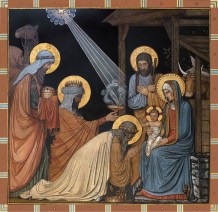
The next question we need to ask is who did Jesus come to save? On the Feast of the Epiphany we celebrate that the Christ came to save all people universally who seek Him. Epiphany means “the manifestation of the divine.” The angels had announced the manifestation of Christ’s coming to the shepherds and they responded by going to visit the Christ child. God announces to His people who have been looking and waiting for Him for almost two thousand years that He had come.   Moreover, the new star in the sky proclaimed to all creation that the Christ had come and the magi who were looking and searching responded by following the star to the Christ-child as well. They offered Him gifts that recognized who the baby Jesus is – Gold because He is king, Frankincense because He is God, and Myrrh which is a burial ointment that foreshadowed His death.

God reveals Himself to all who will look and listen. He might reveal Christ to you through His People, through an angel, or through Creation. All should lead you to “the child with Mary His mother.” It should lead us all to offer Christ our worship and every gift we can give. He calls us all into communion with Him and His People the Church. Christ came to save us from sin and to restore us to unity as a human family in God. The magi teach by example that seeking the Lord requires openness, effort, perseverance, investigation, and reverence. As we celebrate the coming of Christ this Christmas season it should set the course of our entire year. We must live in response to this gracious encounter with our Lord and Savior.

Consider:

  • Reflect on how you first encountered Christ and any additional times you encountered Him in a deeper way.
    • How did this encounter enrichen your life?
    • How have you responded to this encounter?
  • Reflect on the mystery of Jesus’ divinity and humanity.
    • Consider Christ’s transcendence as God – eternal, all-knowing, all-powerful, all-loving, perfect, Creator of all that exits….
    • Consider Christ’s immanence as man – His vulnerability as an infant and child, His union with our very nature, His lived experience of everything we too experience, His appreciation for the simple things in life such as family and work, friendships, meals together…
  • Reflect on Mary’s motherhood.
    • Consider the faith and courage it required to believe God would work such a wonder in her.
    • Consider the hope and humility it required to trust God to enable her to mother such a son.
    • Consider her pure love for God and Jesus. Her heart must have been nearly bursting every day. A mother’s love is already hard to contain, add the contemplation of the mystery of God’s love to come as man on top and I don’t know how she managed to endure it except to “keep all these things, pondering them in her heart.” (Luke 2:19)
  • The word catholic means “universal.” Take a moment to praise God for extending His saving Truth and Love to all persons world-wide. Consider how you might grow in union with God and with others.

Make a Resolution (Practical Application):

  • Seek God actively in one way this week.
    • Some ideas: reading Scripture, silent prayer, service toward others, or attending a daily Mass.
  • Investigate God’s revelation.
    • Learn about Scripture and our Faith. Attend a Bible Study, join Faith Formation at your parish, read a book about the Faith or the Catechism, talk to a priest or religion teacher and ask him or her some of your questions.
  • Spend 5-10 minutes in silence reverencing the new-born king. Imagine yourself as one of the magi encountering Jesus held in His mother’s arms.
  • Offer a gift to Christ this week. Make it thoughtful, something you know He would appreciate from you.

~ Written by Angela Lambert © 2015

* To receive these weekly posts automatically in your email just click the “follow” tab in the bottom right hand corner and enter your email address.


The First Disciple of Christ Provides a Model for us All…Faith, Joy, and Love

by Angela Lambert

Visitation-Elizabeth-Joy.jpg

December 20th, 2015;  4th Sunday of Advent

Gospel of Luke 1:39-45

Mary set out and traveled to the hill country in haste to a town of Judah, where she entered the house of Zechariah and greeted Elizabeth. When Elizabeth heard Mary’s greeting, the infant leaped in her womb, and Elizabeth, filled with the Holy Spirit, cried out in a loud voice and said, “Blessed are you among women, and blessed is the fruit of your womb. And how does this happen to me, that the mother of my Lord should come to me? For at the moment the sound of your greeting reached my ears, the infant in my womb leaped for joy. Blessed are you who believed that what was spoken to you by the Lord would be fulfilled.”

Meditation Reflection:

Mary’s relationship with God offers a beautiful and powerful witness for all Christians of the path of discipleship. She begins by faithful adherence to the Covenant God had made with His people. She prays regularly, lives by God’s laws, and follows the requirements of the Jewish religion. Next God approaches her personally, offering her an opportunity and love beyond natural experience and imagination. Mary responds with belief of both mind and will. Christ becomes incarnate in her womb and she experiences a union with God she never could have anticipated had she not experienced it. Moreover, her loving yes to God makes possible the union of Christ with every human person when He takes on our nature.

Mary then travels “in haste” to her cousin Elizabeth who is pregnant in her old age. Union with Christ, the indwelling of the Trinity, produces what Fr. Dubay terms a “Fire Within” which always produces love of neighbor. Mary, the first disciple of Christ, begins her Christian walk through service to Christ and service toward others.

Upon meeting Elizabeth the Holy Spirit stirs in the hearts of both women and their unborn children. The gifts of knowledge and understanding were bestowed on them, even the unborn John the Baptist. Discipleship is accompanied by the gifts and fruits of the Holy Spirit which enable the Christian to live at a supernatural level which exceeds merely natural expectations. Moreover, upon receiving the Holy Spirt, disciples of Christ are given the infused virtues of Faith, Hope, and Charity (Love) at Baptism. Infused means they are given directly to the soul by God rather than acquired through habitual action like the moral virtues. Moreover, the theological virtues must be infused by God because they have as their end things beyond the limits of human nature.

The two women and their unborn children share a visible and overwhelming joy. John leaps in Elizabeth’s womb, Elizabeth cries out in a loud voice, and we see next in the Gospel that Mary breaks into rejoicing as well with her famous Magnificat – testifying with faith, hope, love, and joy to truths about God’s goodness and mercy. Mary sings the deepest sentiments of every Christian who has experienced the love of God in his or her life:

And Mary said:

“My soul proclaims the greatness of the Lord;

my spirit rejoices in God my savior.

For he has looked upon his handmaid’s lowliness;

behold, from now on will all ages call me blessed.

The Mighty One has done great things for me,

and holy is his name.

His mercy is from age to age

to those who fear him.

He has shown might with his arm,

dispersed the arrogant of mind and heart.

He has thrown down the rulers from their thrones

but lifted up the lowly.

The hungry he has filled with good things;

the rich he has sent away empty.

He has helped Israel his servant,

remembering his mercy,

according to his promise to our fathers,

to Abraham and to his descendants forever.”

 Discipleship begins with receiving God’s love which then ignites a fire in us to love Him in return. St. John, the beloved disciple, writes in his first letter, “We love because he first loved us.” (1John 4:19).   That love then spreads to every human person because Christians see Christ and the love He has for each one of us in others. As a result, St. John writes next in verses 20-21, “If anyone says, “I love God,” but hates his brother, he is a liar; for whoever does not love a brother whom he has seen cannot love God whom he has not seen. This is the commandment we have from him: whoever loves God must also love his brother.”

These last few days of Advent, let us prepare for the coming of Christ in our souls and the powerful transformation of love that it will effect. Let us take Mary as our example and cherish Christ within us in prayer, fellowship, and service.

Consider:

  • Where are you at in your Christian walk?
    • Consider how far you have come and reflect on the work of the Holy Spirit in your life.
    • Consider what the next step may be.
      • Do you struggle believing in the love and joy God has for you?
      • Is there something you are clinging to instead of God?
      • Has the joy of discipleship born fruits of service? How might you act on that?
      • Do you spend time in prayer praising and thanking God?
      • Is there a spiritual friend you could rejoice with and talk about God’s actions in your lives? Consider how Mary was not only a physical comfort to Elizabeth but also a spiritual comfort since they could relate to one another spiritually about God’s miraculous work in both of their lives.
    • Reflect on the Theological virtues of Faith, Hope, and Love.

Make a Resolution (Practical Application):

  • Reflect on one of the seven Gifts of the Holy Spirit for each day this week: Wisdom, Understanding, Counsel, Knowledge, Fortitude, Piety, Fear of the Lord.7 Gifts of the HS
  • Reflect on one of the Fruits of the Holy Spirit for each day this week: love, joy, peace, patience, kindness, goodness, generosity, gentleness, faithfulness, modesty, self-control, chastity.
  • Practice the corporal and spiritual works of mercy (see last week’s reflection).

~ Written by Angela Lambert © 2015

* To receive these weekly posts automatically in your email just click the “follow” tab in the bottom right hand corner and enter your email address.


Prepare for the Coming of Christ’s Mercy by Giving Mercy

by Angela Lambert

December 13th, 2015; Third Sunday of Advent

Gospel Luke 3:10-18 NAB

The crowds asked John the Baptist, “What should we do?” He said to them in reply, “Whoever has two cloaks should share with the person who has none. And whoever has food should do likewise.” Even tax collectors came to be baptized and they said to him, “Teacher, what should we do?” He answered them, “Stop collecting more than what is prescribed.” Soldiers also asked him, “And what is it that we should do?” He told them, “Do not practice extortion, do not falsely accuse anyone, and be satisfied with your wages.” Now the people were filled with expectation, and all were asking in their hearts whether John might be the Christ. John answered them all, saying, “I am baptizing you with water, but one mightier than I is coming. I am not worthy to loosen the thongs of his sandals. He will baptize you with the Holy Spirit and fire. His winnowing fan is in his hand to clear his threshing floor and to gather the wheat into his barn, but the chaff he will burn with unquenchable fire.” Exhorting them in many other ways, he preached good news to the people.

Meditation Reflection:

Christ, the Image of God through which we were created came to restore that image which had been distorted by sin. St. Athanasius, an early Church Father, beautifully reflected:

What, then, must God do? or what else was it right to do, but to renew again the grace by which they had been made after His Image, so that through it men might be able once more to know Him? But how could this have been done except by the coming of the very Image Himself of God, our Savior Jesus Christ?

To prepare for His coming, John the Baptist offers practical advice. God is Justice and Mercy, therefore he instructs his followers to practice justice and mercy in their everyday life. In the same way, Pope Francis has instructed us to not only reflect on God’s mercy but to extend it in practical ways toward others in our everyday life. The Church summarizes the works of mercy under two categories – corporal and spiritual. Corporal works of mercy care for the physical needs of others and the spiritual works of mercy care for those of the soul. Pope Francis encourages us to renew our commitment to practicing them in concrete ways on a regular basis.

Corporal Works of Mercy:

  • Feed the hungry
  • Give drink to the thirsty
  • Clothe the naked
  • Shelter the homeless
  • Visit the sick
  • Ransom the captive (help prisoners)
  • Bury the dead

Spiritual Works of Mercy:

  • Instruct the ignorant (teaching people about the Christian faith)
  • Counsel the doubtful (encouraging someone struggling with the faith)
  • Admonish sinners (having the courage to tell someone what they are doing is wrong)
  • Bear wrongs patiently
  • Forgive offenses willingly
  • Comfort the afflicted
  • Pray for the living and the dead

Each of these can be practiced in obvious ways of almsgiving, but they can also be practiced in some very ordinary ways if done with love and intentionality. Feeding the hungry can mean going to the grocery store despite being tired or wanting to do anything other than grocery shopping. Giving drink to the thirsty can be smiling when you really want to sigh in exasperation when your child asks for a cup of water or milk just as you are about to go to bed for the night. Admonishing the sinner can mean doing the work of disciplining your children to teach them virtue when you would rather ignore the behavior and avoid the conflict or being honest with your friend when they are doing something wrong. Burying the dead means making the time to attend a funeral even though you are busy. Forgiving offenses willing and bearing wrongs patiently can be the most difficult. This means avoiding anger or retaliation and instead offering patience and understanding. Apply this to driving in traffic, shopping in a busy store, or putting up with annoying traits of your co-workers. Theses things are much easier said then done. Christ offers the grace we need to be a more merciful person than we could on our own. He also teaches us in the Lord’s prayer that we will be forgiven insofar as we forgive others. The more we offer mercy the more we will receive and the more we will be like God.

Consider:

  • If John the Baptist were to offer you advice, what would it be?
    • Would he see an injustice that you could correct or an opportunity for mercy you could take?
  • Reflect on the mercy God and others have shown you. Offer God and those persons your gratitude.
  • Pray about the works of mercy and write a list of ways that you could incorporate them into your life.

Make a Resolution (Practical Application):

* Image at the top of the post: Pope Francis embraces a patient at St. Francis of Assisi Hospital, where the pontiff addressed a group of recovering drug addicts, offering them a message of compassion and hope on July 24, 2013, in Rio de Janeiro. CNS photo

~ Written by Angela Lambert © 2015

* To receive these weekly posts automatically in your email just click the “follow” tab in the bottom right hand corner and enter your email address.

Making Straight the Path to Joy…Gospel Meditation for the Second Sunday of Advent

by Angela Lambert

john the baptist

December 6th, 2015; Second Sunday of Advent

Gospel of Luke 3:1-6 NAB

In the fifteenth year of the reign of Tiberius Caesar, when Pontius Pilate was governor of Judea, and Herod was tetrarch of Galilee, and his brother Philip tetrarch of the region of Ituraea and Trachonitis, and Lysanias was tetrarch of Abilene, during the high priesthood of Annas and Caiaphas, the word of God came to John the son of Zechariah in the desert. John went throughout the whole region of the Jordan, proclaiming a baptism of repentance for the forgiveness of sins, as it is written in the book of the words of the prophet Isaiah: A voice of one crying out in the desert:“Prepare the way of the Lord, make straight his paths. Every valley shall be filled and every mountain and hill shall be made low. The winding roads shall be made straight, and the rough ways made smooth, and all flesh shall see the salvation of God.”

Meditation Reflection:

John the Baptist, the last and possibly greatest of the prophets, receives the word from God to share with us regarding how to prepare for the coming of Christ – Repent. If we do not see our own sin, we do not recognize our need for a savior. In his book In the Beginning, Pope Benedict XVI makes the observation that our culture has replaced “sin” with terms like “non-standard” behavior. Moreover, personal responsibility often gets excused away by blaming anything other than the person. As a result, the task for evangelization today he concludes, is to be brave enough to talk about sin.

Don’t worry, this won’t be a throwback to fire and brimstone preaching. Recall the reason God asked for repentance – so we could receive healing and mercy. You probably know of someone who did not want to go to the doctor so he or she kept insisting they weren’t sick. Pretending to be healthy only causes their illness to worsen. Similarly, if we do not face our spiritual illnesses they grow in strength and deadliness. In The Dialogue of St. Catherine of Siena, she relates this advice to her from Christ regarding examining our souls:

I do not wish the soul to consider her sins, either in general or in particular, without also remembering the Blood and the broadness of my Mercy.”

Christ also revealed to St. Faustina that His greatest pain is when a soul refuses His mercy due to a lack of faith in His love and forgiveness. The Holy Spirit convicts us of our sins so that we may turn to Christ for forgiveness and transformation. It would be false modesty and possibly even the sin of pride or despair to willfully believe that Christ cannot or will not forgive you. In the first reading for today from Baruch 5:1, God commands: “Jerusalem, take off your robe of mourning and misery; put on the splendor of glory from God forever.” We must mourn our sins sincerely, then we must also accept the forgiveness and joy of God.

The Catechism defines sin in this way:

Sin is an offense against reason, truth, and right conscience; it is failure in genuine love for God and neighbor caused by a perverse attachment to certain goods. It wounds the nature of man and injures human solidarity. It has been defined as “an utterance, a deed, or a desire contrary to the eternal law.” Paragraph 1849

Sin usually means putting a lower good above a higher good – the order being God, Humans, Animals, Plants, Inanimate objects. When we put objects before people, people before God, animals before people, or things before animals, we act in a “disordered” way. In modern terms, our priorities are mixed up. When examining your life consider your priorities not merely as standard or non-standard, but as faithful to God or sinful.

The Church identifies seven capital sins, or those sins that encompass most of the sins or vices we commit. They include Pride, Avarice (Greed), Gluttony (Overindulgence), Envy, Wrath (Anger), Lust, and Sloth. Reading about each of these sins can be eye-opening. Every time I teach on this subject, I find more ways they apply to me and have to go to Confession. Self-knowledge however is the first step in the spiritual life. Jesus begins the beatitudes with “Blessed are the poor in spirit”, meaning those who recognize their poverty before God and need for Him. Then He says, “Blessed are those who mourn” meaning those who in seeing their sinful state grieve over their sins. This is followed up by the promise that one day they will rejoice (just as God prophesied through Baruch). The beatitudes continue to build from there to purity of heart wherein one may see God and finally a state of peace wherein one enjoys living as God’s child. Christ urges us to have the courage and humility to examine our consciences and our lives, to endure the unpleasant feelings so as to make it to the other side where we will have joy and peace.

Consider:

  • Reflect on Christ’s mercy and His mercy toward you in particular.
  • Read about and reflect on the seven capital sins. Here are some links to interesting reads about them:
  • Read and reflect on the Beatitudes. (Matthew 5:3-12)
    • Blessed are the poor in spirit: for theirs is the kingdom of heaven.
    • Blessed are the meek: for they shall possess the land.
    • Blessed are they who mourn: for they shall be comforted.
    • Blessed are they that hunger and thirst after justice: for they shall have their fill.
    • Blessed are the merciful: for they shall obtain mercy.
    • Blessed are the clean of heart: for they shall see God.
    • Blessed are the peacemakers: for they shall be called the children of God.
    • Blessed are they that suffer persecution for justice’ sake, for theirs is the kingdom of heaven.

Make a Resolution (Practical Application):

  • Actively try to overcome a sin through prayer and practicing the opposite virtue.
    • (for example, to oppose gluttony intentionally fast from something you like; or to oppose sloth, get up 30 minutes earlier than usual)
  • Reflect on one beatitude a day.
  • Extend mercy to someone in gratitude for Christ’s mercy toward you.


~ Written by Angela Lambert © 2015

* To receive these weekly posts automatically in your email just click the “follow” tab in the bottom right hand corner and enter your email address.


Appreciating the Advent of Christ…Gospel meditation for Luke 21:25-28, 34-36

by Angela Lambert

angels-announcing-the-birth-of-christ

November 29th, 2015; 1st Sunday in Advent

Gospel Luke 21:25-28, 34-36 NAB

Jesus said to his disciples: “There will be signs in the sun, the moon, and the stars, and on earth nations will be in dismay, perplexed by the roaring of the sea and the waves. People will die of fright in anticipation of what is coming upon the world, for the powers of the heavens will be shaken. And then they will see the Son of Man coming in a cloud with power and great glory. But when these signs begin to happen, stand erect and raise your heads because your redemption is at hand. “Beware that your hearts do not become drowsy from carousing and drunkenness and the anxieties of daily life, and that day catch you by surprise like a trap. For that day will assault everyone who lives on the face of the earth. Be vigilant at all times and pray that you have the strength to escape the tribulations that are imminent and to stand before the Son of Man.”

Meditation Reflection:

Today marks the first Sunday of Advent, a word which means “coming” and marks a time of preparation for the coming of Christ at Christmas. As quaint and humble as Christ’s appearance on earth as a baby in a manger is, it has had world-changing and life-changing effects. The incarnation of Christ stands as the axis of history. When God became man, He raised the dignity of human nature higher than that of the angels. No other creature shares such intimacy with God. Moreover, when the Second Person of the Trinity united our human nature with His divine nature (also called the hypostatic union) He transformed and renewed humanity.

The Western value of the intrinsic dignity of the human person stems from this Christian principle. The early Christians sensed the significance of this and translated it into their view of the human person even in the womb. In the Didache, one of the first “catechisms” or statements of faith possibly dating before A.D. 100, it is written: “you shall not murder a child by abortion nor kill that which is begotten.” Contrary to the Roman practice of infanticide, Christians believed that every stage of human life was sacred, including that of the child in the womb, because it experienced union with Christ who took up our humanity at the moment of conception in Mary’s womb. Because of this, human value does not have to be subject to utilitarianism or how useful one is to society. Rather, every human has inherent and inalienable value because it enjoys the dignity of union with God. The catechism summarizes the Christian belief in this way:

The Word became flesh to make us “partakers of the divine nature”:78 “For this is why the Word became man, and the Son of God became the Son of man: so that man, by entering into communion with the Word and thus receiving divine sonship, might become a son of God.”79 “For the Son of God became man so that we might become God.”80 “The only–begotten Son of God, wanting to make us sharers in his divinity, assumed our nature, so that he, made man, might make men gods.”81

online link

Despite secular attempts to downplay the impact of Christ, our calendar retains the mark of His coming. Modern attempts to replace B.C. (before Christ) with B.C.E. (before the common era) and A.D. (Anno Domini – in the year of our Lord) with C.E. (common era) still doesn’t change the fact that the “common era” is counted from before and after the coming of Christ. In fact, the coming of Christ has changed history universally to an extent unmatched by any other person, empire, or movement.

Jesus tells us to “Beware that your hearts do not become drowsy from carousing and drunkenness and the anxieties of daily life, and that day catch you by surprise like a trap.” During Advent we take a step back to readjust our perspective. Unfortunately, the craze leading up to Christmas tempts us to step backward rather than forward. We can too easily become either stressed by the anxieties of Christmas celebrations or distracted by feasting and consumerism that we forget the impact and gift of Christ in our lives. God became man, that we might become God. Advent is a time to reflect on this mystery and invite Christ to bring to perfection this good work that He has begun in us.

I am confident of this, that the one who began a good work in you will continue to complete it until the day of Christ Jesus. Philippians 1:6 NAB

Consider:

  • Reflect on the inestimable dignity you have in Christ. How might you align your view of yourself with God’s view of you?
  • Consider the gift of God becoming man. How does this deepen your feeling of confidence and security knowing that God has united Himself with our very nature?
  • God’s intimacy through Christ is startling and should have a startling effect on your life. Thank God for how He has transformed your heart and your life. Invite Him to transform it even more.

Make a Resolution (Practical Application):

  • Each day this week, thank Christ for His closeness to you. Keep it present to your mind by wearing a cross or carrying a scripture verse in your pocket.
  • Identify one way that you don’t live up to the dignity Christ has given you. Resolve to act or be treated in the way you ought as a son or daughter of God.
    • CCC 1691 “Christian, recognize your dignity and, now that you share in God’s own nature, do not return to your former base condition by sinning. Remember who is your head and of whose body you are a member. Never forget that you have been rescued from the power of darkness and brought into the light of the Kingdom of God.”
  • Pray for the unborn and for greater appreciation for the sacredness of life from conception to natural death.
  • Read and reflect on the Incarnation of Christ in the catechism (paragraphs 422-483) CCC 422-483

~ Written by Angela Lambert © 2015

* To receive these weekly posts automatically in your email just click the “follow” tab in the bottom right hand corner and enter your email address.


The Glorious Reign of Christ our King

by Angela Lambert

 Jesus and Pilate

Feast of Christ the King

Gospel John 18:33b-37

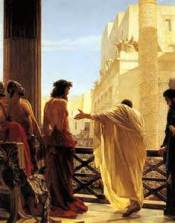
Pilate said to Jesus, “Are you the King of the Jews?” Jesus answered, “Do you say this on your own or have others told you about me?” Pilate answered, “I am not a Jew, am I? Your own nation and the chief priests handed you over to me. What have you done?” Jesus answered, “My kingdom does not belong to this world. If my kingdom did belong to this world, my attendants would be fighting to keep me from being handed over to the Jews. But as it is, my kingdom is not here.” So Pilate said to him, “Then you are a king?” Jesus answered, “You say I am a king. For this I was born and for this I came into the world, to testify to the truth. Everyone who belongs to the truth listens to my voice.”

Meditation Reflection:

Christ’s humble form in the Eucharist and His life of material poverty can sometimes cause us to forget the magnitude of His greatness and the awe-inspiring power and glory of His kingship. Advent marks the beginning of the New Year for the liturgy. As a result, the week prior marks the end of the year and so we reflect on the end of time when Christ will come again to reign in glory. Scripture attests to the fact that His Second Coming will be very different than His first. In the latter His glory was veiled so that we might have the freedom to accept or reject Him. In the former, everyone will see and know that He is God. The Truth will be revealed and we will no longer be able to live in unreality.

Pontius Pilate articulates this confusion well. He simply asks Jesus if He is the king of the Jews but Jesus describes His kingdom in terms foreign to Pilate’s political experience. Jesus’ kingdom includes those who love and live by Truth. Christ’s kingdom conquers hearts not lands and its members become citizens of this monarchy freely. Pilate asks the famous question “What is truth?” as Truth stands directly before him. At Christ’s Second Coming, no one will ask this question. Reality will be so bright that we cannot hide in blindness or denial.

For those who love Christ, who have been desiring to see in fullness the Lord they can only see by faith, it will be a glorious moment. When our king comes we will truly rejoice and feel both honored and unworthy to be His servants. We will sing songs of praise like those in the book of Revelation, grateful to be in His courts. For those who rely on lies or a self-created image they will cringe when the truth of their emptiness is exposed. The feast of Christ the King should encourage us and strengthen our hope to persevere in aligning ourselves with God who is Truth, Goodness, and Love. It seems unreal to the worldly but the reality check will come and Christ will reward those who know the Truth. In response to the culture of relativism the Christian can respond: You have your truth and I have mine…His name is Jesus.

Consider:

  • Reflect on Jesus’ words to Pilate: “You say I am a king. For this I was born and for this I came into the world, to testify to the truth. Everyone who belongs to the truth listens to my voice.”Who do you listen to when discerning the answers to important questions?
      • Do you consult Scripture, Christian spiritual writers, your priest, etc.?
      • Is there someone you know that loves you enough to speak Christ’s Truth to you despite whether it is something you want to hear or not?
      • Do you ask Christ in prayer?
      • Do you rely on cultural norms to determine your perspective?
      • Do media or secular friends play a role in your decision making?
    • Our culture is permeated by relativism – the belief that there is no objective truth. Do you believe that Truth is objective – the Person of Christ – or do you adhere to the cultural mantra “you have your truth and I have my truth”?
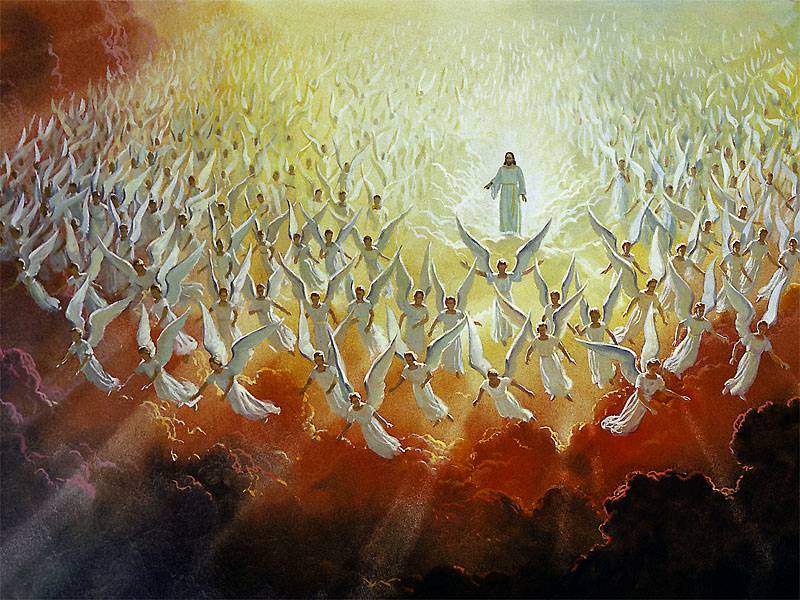
    • Imagine Jesus coming in all of His glory with His hosts of angels. Consider what it would feel like to be in His Kingdom.

Make a Resolution (Practical Application):

  • Pray for Christ’s kingdom to come in your own heart each day this week.
  • Start each day imagining the Second Coming of Christ. Walk through the rest of the day with joy and pride of being a member of His true, everlasting kingdom.
  • If you are blessed with a Truth-speaker in your life, take the time to thank him or her. They could probably use your encouragement. We know how Truth was treated while He was on earth.
  • If you struggle to understand or align yourself with one of Christ’s teachings in Scripture or through His Church, actively seek understanding by learning more through reading, talking with someone educated on the topic, praying about it, etc.

~ Written by Angela Lambert © 2015

* To receive these weekly posts automatically in your email just click the “follow” tab in the bottom right hand corner and enter your email address.

Real Realism… Gospel Meditation for Mark 13:24-32

by Angela Lambert

Jesus-Second-Coming

November 15th, 2015; 33rd Sunday in Ordinary Time

Gospel Mark 13:24-32

Jesus said to his disciples: “In those days after that tribulation the sun will be darkened, and the moon will not give its light, and the stars will be falling from the sky, and the powers in the heavens will be shaken. “And then they will see ‘the Son of Man coming in the clouds’ with great power and glory, and then he will send out the angels and gather his elect from the four winds, from the end of the earth to the end of the sky. “Learn a lesson from the fig tree. When its branch becomes tender and sprouts leaves, you know that summer is near. In the same way, when you see these things happening, know that he is near, at the gates. Amen, I say to you, this generation will not pass away until all these things have taken place. Heaven and earth will pass away, but my words will not pass away. “But of that day or hour, no one knows, neither the angels in heaven, nor the Son, but only the Father.”

Meditation Reflection:

A deeply spiritual friend of mine, made a comment once that has stuck with me – she said we must work to keep the invisible world visible. As a busy wife, homeschooling mother of eight, and one who practices charity toward anyone in need, she of all people knows how easy it is to be consumed by the tasks in front of us and forget about the invisible reality of God and the angels. Even in our work for God we can miss the forest for the trees. Moreover, our wounded human nature all too easily loses the spiritual perspective and succumbs to fear in times of distress, pride in hopes of honor, and avarice in the pursuit of making a living. Making time to meet with her always makes the invisible world more visible for me. I am left feeling energized and filled with joy and hope.   Jesus promises that if we seek first the kingdom of God, all things shall be added (Matthew 6:33). I truly believe this to be the case and have experienced it in my own life.

God revealed His name to Moses as YHWH, which means “I AM” or “I AM WHO AM” (Exodus 3:13-15). The Church Fathers explain that God revealed that He is existence. He is reality. All that is real has its existence in God. If therefore, we center our lives on doing God’s will, we can be confident about our decisions.   At some point, what seems real will come to an end. The sun, moon, stars, and earth only exist as long as God holds them in existence. God has revealed that at an hour only known to Him, they will pass away. This should only strike fear in our hearts if we were depending on the sun to rise tomorrow for our happiness. If Christ is our happiness, this will be a magnificent moment. Imagine being one of the “elect,” one of Christ’s lambs whom He promises to send out the angels to gather. The laws of science are temporary. The author of those laws is eternal. The sun may or may not rise tomorrow, but Christ is certain to gather those He loves who love Him in return. Let’s be intentional about keeping the invisible world visible and develop into true realists.

Consider:

  • Reflect on this quote by Pope Benedict XVI. What is the true definition of realism?
Even more, the Word of God is the foundation of everything, it is the true reality. And to be realistic, we must rely upon this reality. We must change our notion that matter, solid things, things we can touch, is the most solid, the most certain reality. At the end of the Sermon on the Mount, the Lord speaks to us about the two possible foundations for building the house of one’s life: sand and rock. He who builds on sand only builds on visible and tangible things, on success, on career, on money. Apparently these are the true realities. But all this one day will vanish. We can see this now with the fall of two large banks: this money disappears, it is nothing. And thus all things, which seem to be the true realities we can count on, are only realities of a secondary order. Who builds his life on these realities, on matter, on success, on appearances, builds upon sand. Only the Word of God is the foundation of all reality, it is as stable as the heavens and more than the heavens, it is reality. Therefore, we must change our concept of realism. The realist is he who recognizes the Word of God, in this apparently weak reality, as the foundation of all things. Realist is he who builds his life on this foundation, which is permanent. Thus the first verses of the Psalm invite us to discover what reality is and how to find the foundation of our life, how to build life. (Synod on the Word of God, October 2008)
  • What or who do you depend on to feel secure? Why?
  • How might you keep the invisible world visible?
  • Imagine what it would be like to see Christ or His angel coming to bring you to heaven, gathered together with all those who praise God’s name.

Make a Resolution (Practical Application):

  • Schedule time with a friend who inspires you in the spiritual life.
  • Listen to religious podcasts that raises your mind (and perspective) to God.
    • Suggestions: Bishop Barron wordonfire.org; Fr. Gallagher discerninghearts.com; see if your parish has podcasts of your priest’s homilies (more and more do)
  • Spend 5-10 minutes reading Scripture or a spiritual book.
  • Hang religious art or sayings in your home. This can be as simple as writing inspiring Scripture passages down and placing them where you might see them everyday.

~ Written by Angela Lambert © 2015

* To receive these weekly posts automatically in your email just click the “follow” tab in the bottom right hand corner and enter your email address.

Faith-filled Giving, Authentic Discipleship… Gospel Meditation for Mark 12:38-44 for Sunday November 8th, 2015

by Angela Lambert

Faith-filled Giving, Authentic Discipleship

Mother-Teresa-Giving-Quote

November 8th, 2015; 32nd Sunday in Ordinary Time

Gospel Mark 12:38-44 NAB

In the course of his teaching Jesus said to the crowds, “Beware of the scribes, who like to go around in long robes and accept greetings in the marketplaces, seats of honor in synagogues, and places of honor at banquets. They devour the houses of widows and, as a pretext recite lengthy prayers. They will receive a very severe condemnation.” He sat down opposite the treasury and observed how the crowd put money into the treasury. Many rich people put in large sums. A poor widow also came and put in two small coins worth a few cents. Calling his disciples to himself, he said to them, “Amen, I say to you, this poor widow put in more than all the other contributors to the treasury. For they have all contributed from their surplus wealth, but she, from her poverty, has contributed all she had, her whole livelihood.”

Meditation Reflection:

Jesus observes two persons and each teaches us something different about discipleship and giving. Growing up both my parents communicated their conviction about giving in word and action. They taught us about tithing and the responsibility of stewardship. Stewardship refers to how God gave human persons the responsibility and authority to care for gifts He entrusts to us. This includes Creation (see Pope Francis’ encyclical Laudato Si), our talents, possessions, money, opportunities, and time. Scripturally and traditionally, tithing has been defined as giving God the first 10% of one’s income. My parents taught us to give 5% to our parish and 5% to charitable giving of our choice. This, they also taught, is just the beginning. One is called to be generous of heart and put all that one has been given at the service of Christ. Even if one has no income, is sick and suffering, unable to “do” anything for anyone else, that person can offer their suffering and prayers which has great power to build up the Church.

The rich people Jesus observed contributed from their “surplus.” It’s valuable to give but it doesn’t take faith to give your extra. Moreover, Jesus juxtaposes this observation with His critique of a hypocritical attitude which desires honor for oneself rather than giving honor to God. I personally know certain rich persons who give from faith not just surplus and who do so with great humility and gratitude. I have also observed other persons who only give if it will be visible to others, they will be recognized, and others will “see what a good person they are.” At times, the gift, though it looks large, is either merely the 10% they ought to give anyway or less.

Our parish should not have to “beg” for money. It’s our responsibility to give to God the honor and faith He deserves and giving the first 10% of our paycheck is a concrete way to show it. Unfortunately, it’s hard to remember to bring the check to Mass when I am trying to just get us all there on time, showered, and dressed somewhat appropriately. The longer I wait though the more burdened I feel. When my parish offered the option to have my tithing paid through automatic deduction from my checking account I signed up. I have my paycheck automatically deposited, and I have a great peace knowing my tithing is automatically given to God too. Many people say that you cannot out-give God. This is absolutely true; ask anyone who has ever tried. It’s okay to attend charitable banquets or galas, but let’s be intentional about our giving and remember that we are merely doing our duty as stewards to a God who has been so generous to us and is the source of all we have.

The widow in this passage challenges us to give God not just 10%, but everything. As a poor widow, in a time and culture where she would have no opportunity to earn a living, she was completely dependent on God. She demonstrated her faith when she gave Him the little she had. In the first reading today (1 Kgs 17:10-16) another poor widow showed similar faith by giving Elijah her last meal. He promises her that if she does this for God’s prophet, God will not let her flour or oil run out until the drought is over. She makes a leap of faith and prepares the little cake for Elijah. God keeps His promise by providing what she needs.   I wonder if the widow Jesus observed was recalling the same event when she gave her last coin. Jesus, who knows and judges hearts, holds her up as an example of profound giving.

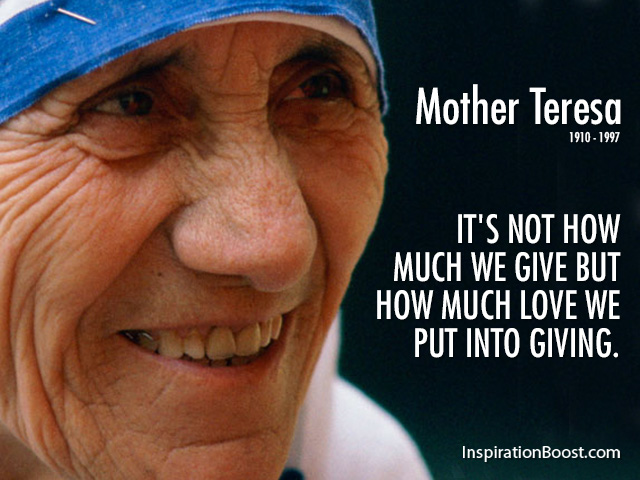
Discipleship is not for minimalists. Jesus does not call us to mediocrity. Jesus demonstrates that love means giving one’s whole self with abandon to God, trusting in His goodness and love. Giving God 10% or more means acknowledging that He gave you 100% and it’s the least you can do. The more you love the easier it is to give. When we love God deeply, giving to Him can bring deep joy.

Consider:

  • Reflect on all of God’s gifts in your life – people, relationships, opportunities, food (especially ice cream!), clothing, housing, work, beauty in nature, His saving Truth and grace…
  • How have you benefited from the generosity of others?
  • Consider or “observe” someone authentically generous. Is there something(s) they do you could imitate?
  • Reflect on how you can’t out-give God. Consider how God always blesses you with more the more you give.

Make a Resolution (Practical Application):

  • Evaluate your giving and make a plan:
    • Financially – pray about how much to give to your parish, what charities you want to support, what people in your life you might give to.
    • Time – be intentional about making time for your family, friends, neighbors, parish, and local charities.
    • Talents – pray about who you could help with your skills, knowledge, etc.
  • Add warmth to your home
    • In his homily at the World Meeting of Families, Pope Francis commented on the solitude and loneliness that plagues our culture pointing to “the paradox of a globalized world filled with luxurious mansions and sky scrapers but a lessening of the warmth of homes and families.”
    • Add warmth to your home for your family and share that warmth with others in your life you could reach.
  • Pray for a heart of gratitude and the eyes to see the needs of others around you.
    • Giving can be simple: a cup of coffee, a warm smile, helping someone save face, showing patience toward someone, giving encouraging words or recognition, fixing something if you’re mechanical, helping someone with technology if you’re computer savvy…

~ Written by Angela Lambert © 2015

* To receive these weekly posts automatically in your email just click the “follow” tab in the bottom right hand corner and enter your email address.