Stepping Outside Our Comfort Zone & Walking On Water

by Angela (Lambert) Jendro

lake superior pic


August 13th, 2017; 19th Sunday in Ordinary Time

Gospel of Matthew 14:22-33

After he had fed the people, Jesus made the disciples get into a boat and precede him to the other side, while he dismissed the crowds. After doing so, he went up on the mountain by himself to pray. When it was evening he was there alone. Meanwhile the boat, already a few miles offshore, was being tossed about by the waves, for the wind was against it. During the fourth watch of the night, he came toward them walking on the sea. When the disciples saw him walking on the sea they were terrified. “It is a ghost,” they said, and they cried out in fear. At once Jesus spoke to them, “Take courage, it is I; do not be afraid.” Peter said to him in reply, “Lord, if it is you, command me to come to you on the water.” He said, “Come.” Peter got out of the boat and began to walk on the water toward Jesus. But when he saw how strong the wind was he became frightened; and, beginning to sink, he cried out, “Lord, save me!” Immediately Jesus stretched out his hand and caught Peter, and said to him, “O you of little faith, why did you doubt?” After they got into the boat, the wind died down. Those who were in the boat did him homage, saying, “Truly, you are the Son of God.”

Meditation Reflection:

Exhilaration, adventure, a leap of faith – we get brave and step out onto the water…outside our comfort zone.   For a brief moment, his eyes fixed on Jesus, Peter did just that.  Then, a gust of wind distracted him, and Peter’s gaze turned to the strength of the wind rather than the strength of the Lord.  His faith sank and so did he.  Yet, as quick as he had turned from the Lord, he turned right back.  He immediately reached out to Christ for help.  Jesus did not delay, He caught Peter as soon as he asked. Jesus didn’t let Peter flounder in the water gasping for air as He lectured him.  He cast no words of spite, no “I told you so”, or “that’s what you get for not believing more in Me.”   Jesus came to reveal the Father’s love, and on this night He demonstrated the Lord’s compassionate mercy for our weak nature.

Discipleship calls us beyond our comfort zone, and even beyond our natural limits.  Yoked to Christ, He enables us to walk on water.  Like Peter, we might step out of the boat in total confidence in our Lord.  Once on the water however, we become fearful as we realize our total dependence on His supernatural help.  It’s much easier to have faith floating on the water in a boat, than walking on water barefooted.

I remember the excitement of getting my first teaching job, and the enthusiasm of teaching students about God.  Then, the first day of class arrived, and panic struck.  “Yikes!” I thought, “How I am I going to get through the day? What I am I going to say for a whole class period?! What if a student misbehaves? What if I’m a terrible teacher?…”  I also remember the joy of holding my first child in my arms the day he was born.  It was absolutely surreal.  Two days later the nurse walked us out to the car and waved goodbye.  As we put my son in the car seat and drove away anxiety erupted, “They’re just letting us take him?!  We don’t know anything!  What if I’m a terrible mother? What if I say or do something that scars him for life?!…”  Lastly, when I do speaking engagements or workshops, I’m exhilarated at the opportunity to share the joy of God’s saving love with others.  A half hour before the talk however, worried thoughts begin to percolate up, “Why did I agree to do this?  It would be far more comfortable to be at home watching Netflix.  What if I fail? What if everyone is bored? Who am I to do this, I’m a sinner like everyone else?”  Like Peter, I begin to sink but then I cry out to the Jesus.  He reminds me that I teach, mother, and speak because He has called me to.  He assures me that though I am not worthy, He is, and He is with me.  He also pushes me by filling my heart with so much gratitude for His love in my life that I can’t resist sharing it with others.

The challenge of discipleship is living at a level only sustainable if Christ is real, and if He’s someone ready to help.  It requires taking a risk, so much so that if Christ is not real, you would be at a loss.  Consider how many times God tells us in Scripture to be not afraid.  Pope St. John Paul II chose these words for his first statement as Pope, knowing how much we fear as we look around at the dangers that surround us.

When I begin to sink in fear a few verses come to mind that strengthen me.  First, I think of 2 Corinthians 12:8-9

“Three times I begged the Lord about this, that it might leave me, but he said to me, ‘My grace is sufficient for you, for power is made perfect in weakness.’ I will rather boast most gladly of my weaknesses, in order that the power of Christ may dwell with me.”

St. Paul felt too weak to face a challenge on his own.  Rather than remove the difficulty, Jesus promised to provide the strength.  St. Paul realized therefore, that the weaker he is, the more God’s power must be at work in him to accomplish God’s will.  He moved from anxiety to total confidence, and writes in his letter to the Philippians,

“I have the strength for everything through him who empowers me” (4:13)

We can trust Jesus to come through for us.  We can answer His call, even if it means going beyond our natural limits.   When we struggle to take that leap of faith beyond our comfort zone, Christ urges us to simply reach out and He will be there for us as He was for Peter.

“Ask and it will be given to you; seek and you will find; knock and the door will be opened to you. For everyone who asks, receives; and the one who seeks, finds; and to the one who knocks, the door will be opened” Matthew 7:7

Ask, seek, knock, and you just might walk on water.

Consider:

  • How has following Christ stretched you beyond what you expected?
  • When has Christ made an endeavor more fruitful than it would have been by your own merits?
  • Have you ever felt like Peter, walking on water, in awe of Christ’s divine power?
  • Have you ever faltered because of fear, worry, or anxiety?
  • What Scripture verses or memories reassure you of Christ’s aid?
  • Is Christ calling you to something outside your comfort zone right now?  What holds you back?  What inspires you forward?

Make a Resolution (Practical Application):

  • Take one risk each day for your faith.
    • Ideas: Inviting your spouse to pray together, praying as a family, saying “God bless” to someone on the phone or a at work, speaking up when someone is criticizing the Church or using God’s name in vain, sharing your faith with someone in need of comfort, going to the Sacrament of Confession, responding to God’s call in your vocation or job…

Related Posts:

On Taking Risks…Gospel Meditation John 6:1-15 for Sunday July 26th

Do You Have Skin In The Game?

Being a Worrier or a Wildflower

Do Not Let Your Hearts be Troubled… Peace and Surrender in Christ

~ Written by Angela M. Jendro © 2017

* To receive these weekly posts automatically in your email just click the “follow” tab in the bottom right hand corner and enter your email address.


Moments to Remember…A Reflection on the Transfiguration

by Angela (Lambert) Jendro

August 6th, 2017; Feast of the Transfiguration of the Lord

Gospel of Matthew 17:1-9

Jesus took Peter, James, and his brother, John, and led them up a high mountain by themselves. And he was transfigured before them; his face shone like the sun and his clothes became white as light. And behold, Moses and Elijah appeared to them, conversing with him. Then Peter said to Jesus in reply, “Lord, it is good that we are here. If you wish, I will make three tents here, one for you, one for Moses, and one for Elijah.” While he was still speaking, behold, a bright cloud cast a shadow over them, then from the cloud came a voice that said, “This is my beloved Son, with whom I am well pleased; listen to him.” When the disciples heard this, they fell prostrate and were very much afraid. But Jesus came and touched them, saying, “Rise, and do not be afraid.” And when the disciples raised their eyes, they saw no one else but Jesus alone. As they were coming down from the mountain, Jesus charged them, “Do not tell the vision to anyone until the Son of Man has been raised from the dead.”

Meditation Reflection:

For most of Jesus’ earthly life, He veiled His greatness.  Nevertheless, He remained God, with all of His divine attributes.  At the Transfiguration, Jesus unveiled a glimpse of His divinity to Peter, James, and John.  It was a sight they would never forget; and one Jesus needed them to see so they could be strengthened when their faith would be put to the ultimate test at the sight of His crucifixion and death.  Imagine John there below the Cross with Mary, Isaiah’s prophecy fulfilled as “His appearance was so marred, beyond human semblance” (Isaiah 52:14).  When all seemed to be lost, John must have clung in faith to the preview of Jesus’ resurrected glory.

Though divine, Jesus was also human.  The Transfiguration served to strengthen His human will as well.  Moses and Elijah appeared to Christ, conversing with Him, as all of the Law and prophecies God revealed through them were about to be fulfilled in Jesus’ suffering.  When “His Hour” finally came, agonizing in the Garden of Gethsemane as His fate approached, Jesus could be strengthened by the meaning of His sacrifice and the redemption it would bring upon all those He loved.

We too sometimes experience these Transfiguration moments – both as a disciple of Christ, and in our own personal lives.  Some people describe them as “conversion moments” which may occur through a major life event, the witness of another person’s life, unexpected mercy received, or a deep encounter with God in prayer.  While they aren’t the sum of a person’s faith, they do strengthen one’s loyalty to God and conviction of His truth and love.  They help a person persevere through those times when faith can be tested – either dryness in prayer, personal suffering, or persecution.  When tempted to abandon what we can’t see for what we can, we can think back to those Transfiguration moments and choose to stay with Christ at the Cross, convinced that He will conquer and we will one day see His resurrected form again.

These Transfiguration moments can occur in our vocations and jobs as well.  We need to treasure those moments of confirmation and joy to push through normal frustration and tedium.  The first time I held each of my children after they were born is etched forever in my mind and heart.  This got me through days where they all had the flu and I felt like all I did in one day was change diapers.  When my oldest picked me up from the airport, I marveled the whole time at how grown up he had become.  A week later, when he lost his keys and I had to invest multiple hours into looking for them, then rearrange my plans for the day to be with him while it got towed to a dealership and re-keyed, I reflected back on those two moments I just mentioned. My frustration was changed to peace as I thought, “My growing up, sweet baby, still needs me.  It might be a tedious day, but it’s worth it.”

Two weeks ago I was blessed to marry a dear friend of mine (thus the absence of posts these last two Sundays, and the new last name!).  We have a blended family and hesitated to leave for a honeymoon.  In the end, we decided to go.  We knew we needed to make memories that would last through tough times.  We also foresaw that after the hustle and bustle of planning a wedding and moving in, we would need to take time to remember our love and appreciate one another without distractions.

We forget so easily.  Today, let us remember the Transfiguration moments in our faith, our relationships, and our work, so we might deepen our appreciation for God’s active love in our lives.

Consider:

  • Reflect back on times you have encountered God in a powerful or meaningful way.
    • Can you recall a special time in prayer, at Mass, or when receiving a sacrament?
    • Was there a time God helped you out of a tough situation?
    • Did you experience His mercy through one of His followers?
    • Is there someone whose life inspired you?
  • Reflect on your vocation (single, married, nun/monk, or priest).
    • When/how did you know God was calling you to this vocation?
    • When have you felt deep joy and peace in your calling?
    • When has your vocation been particularly challenging?
  • Consider how you have been transfigured in Christ.  How has Christ and His grace changed you?

Make a Resolution (Practical Application):

  • Each morning, ask the Holy Spirit to open your eyes to God’s presence and activity throughout the day.  Each evening, reflect back on God’s blessings.
  • Encourage someone who is struggling – through words, actions, prayer, or all three.


~ Written by Angela (Lambert) Jendro © 2017

* To receive these weekly posts automatically in your email just click the “follow” tab in the bottom right hand corner and enter your email address.


Preparing the Soil…Spiritual Receptivity

by Angela Lambert

July 16th, 2017; 15th Sunday Ordinary Time

Gospel of Matthew 13:1-23

On that day, Jesus went out of the house and sat down by the sea. Such large crowds gathered around him that he got into a boat and sat down, and the whole crowd stood along the shore. And he spoke to them at length in parables, saying:

 “A sower went out to sow. And as he sowed, some seed fell on the path, and birds came and ate it up. Some fell on rocky ground, where it had little soil. It sprang up at once because the soil was not deep, and when the sun rose it was scorched, and it withered for lack of roots. Some seed fell among thorns, and the thorns grew up and choked it. But some seed fell on rich soil, and produced fruit, a hundred or sixty or thirtyfold. Whoever has ears ought to hear.”

The disciples approached him and said, “Why do you speak to them in parables?” He said to them in reply, “Because knowledge of the mysteries of the kingdom of heaven has been granted to you, but to them it has not been granted. To anyone who has, more will be given and he will grow rich; from anyone who has not, even what he has will be taken away. This is why I speak to them in parables, because they look but do not see and hear but do not listen or understand. Isaiah’s prophecy is fulfilled in them, which says: You shall indeed hear but not understand, you shall indeed look but never see. Gross is the heart of this people, they will hardly hear with their ears, they have closed their eyes, lest they see with their eyes and hear with their ears and understand with their hearts and be converted, and I heal them. “But blessed are your eyes, because they see, and your ears, because they hear. Amen, I say to you, many prophets and righteous people longed to see what you see but did not see it, and to hear what you hear but did not hear it. “

Hear then the parable of the sower. The seed sown on the path is the one who hears the word of the kingdom without understanding it, and the evil one comes and steals away what was sown in his heart. The seed sown on rocky ground is the one who hears the word and receives it at once with joy. But he has no root and lasts only for a time. When some tribulation or persecution comes because of the word, he immediately falls away. The seed sown among thorns is the one who hears the word, but then worldly anxiety and the lure of riches choke the word and it bears no fruit. But the seed sown on rich soil is the one who hears the word and understands it, who indeed bears fruit and yields a hundred or sixty or thirtyfold.”

Meditation Reflection:

St. Paul tells us that “Jesus is the same yesterday, and today, and forever” (Hebrews 13:8).  So why does the Word of Christ set some people’s hearts on fire while others pass it by with apathy or disdain?  Does Jesus play favorites with who He invites to understand His message and who He lets go?  How does He choose to whom “knowledge of the mysteries of heaven is granted”?

Jesus’ answers in a surprising way – He is the sower who offers Himself to everyone; whether it takes root depends on us. We are responsible for the extent to which we receive His Word.

It reminds me of my kids’ proverbial complaint that I’m not fair.  Each one is certain that they have more chores than the others, and that they receive less than the others.  I remind them that it only appears that way because they see their work but don’t see the work their siblings do.  Either, because sometimes it occurs when they are not around, or because they just refuse to acknowledge it.  Similarly, the appearance of others receiving more stems from ingratitude and envy rather than a material difference.  It’s easy to fall into the same trap spiritually as God’s children.  God treats us all fairly, it’s our perception that tends to need adjustment.

Jesus’ parable illustrates the affect that attitude has on our faith.  For God’s Word to be sown in our hearts and transformative, we must be receptive.  Receptivity requires an attitude of gratitude, humility, and love. Resistance undermines the work God can do within us, and the fruit it can bear in our lives.

The seed that falls on the path has no effect because it’s met with apathy or hostility.  Consider the things that deaden our hearts or fuel them with anger towards God.  Certainly secular culture, infused with hedonistic consumerism, dulls our desire for God by distracting us with instant gratifications and claiming that God is irrelevant to society.  When things go wrong or we suffer however, our faith in God’s existence suddenly appears but only to blame Him.  Anger and apathy make relationship impossible with anyone.  Relationships require investment, interest, and openness.  Much like the futility of reasoning with someone who’s already discounted you, if we don’t care about God except to shake our fist at Him, nothing He says or does will be convincing.

The rocky soil illustrates faith rooted only in sentimentality and emotions.  It resembles the infatuation stage of a relationship.  During that time, the couple is enamored with one another and experience strong feelings that say their love will last forever.  Those feelings however, do not, as C.S. Lewis puts it, deliver on their promises.  Feelings, by nature, come and go.  Lasting love is a decision not an emotion.  The infatuation stage in our relationship with God may include powerful feelings of love for the Lord and the desire for holiness.   When a person encounters suffering or confusion, that love will either wither from shallowness, or go deeper to root down further in the soil.   Fair weather friends make for rocky relationships, and the same goes for our relationship with God.

For those who make it past luke-warmness, and deeper than mere emotions, thorns still threaten to choke out faith with worldly anxiety and desires.  To live in the world but not of the world, is no easy task.  Worry about our comfort, security, and what others think about us can quickly turn our gaze from God back to earth, crowding out room for His grace. We sit down to pray but our phone buzzes with a notification.  Worry or desire pulls us away from Scripture and back into our technology.  Social events fill up the calendar and we think we are too busy to go to Church.  We might tell ourselves that we just have to prioritize these worldly things for a time, and then we will be able to relax and give God our whole selves.  It tends to only be a trick we play on ourselves, like the carrot at the end of the stick – the donkey keeps walking but the carrot keeps moving at the same time he does.

A person who has found Christ, realizes that in Him they have everything.  A humble heart, open to the Lord, fills with gratitude as it receives grace upon grace.  Apathy turns to zeal, sentimentality to conviction, and the constant grasping after the next thing is replaced with spiritual fulfillment and peace.  In this rich soil, the soul begins to bear fruits of faith, hope, and love, along with joy, peace, patience, kindness, goodness, faithfulness, gentleness, and self-control (see Galatians 5:22-23).

When we find ourselves saying, “Why doesn’t God speak to me?  I pray but don’t hear anything?,” or “I just don’t feel like praying or going to Church, I don’t get anything out of it,” or “My life always feels so out of control no matter what I do, why can’t I ever just find peace?”; we can take a step back and evaluate the soil in our souls.  The Word of God has come to us in the flesh and remains with us, what can we do to better receive Him?  Begin with asking for His help.

Consider:

  • When do you struggle with feelings of not caring about God or your faith?  What or who fuels that hardening of heart, and what/who softens your heart toward God?
  • Despite my love for flowers and home-grown vegetables, I’m a terrible gardener because I’m not attentive enough about keeping things watered or clearing away weeds.  How can you be more attentive to the garden of your soul?  What does it need to be watered, and what weeds need clearing away?
  • Pray about how deeply your faith is rooted.  Is it guided primarily by emotions or by principle?  Consider how your relationship with God is similar to, or different than, your relationships with others.
  • Ask the Holy Spirit to reveal the thorns in your spiritual life.  Prayerfully consider what competes with your prayer time, Mass, your generosity with the Lord, or your openness to His teachings.  Ask for Christ to remove the thorns and replace them with greater love.
  • Mary exemplifies perfect receptivity to the Lord, rooted in deep love and enduring the hardest tribulations.  Ask for her intercession to soften your heart and to “open your eyes to see and your ears to hear” as she did.

Make a Resolution (Practical Application):

Work on preparing the soil for Christ:

  • If you need more gratitude: each night list 10 things you are thankful for from the day.
  • If you need more humility and detachment: Pray the Humility Prayer each day.
  • If you need more openness:  Read Scripture for 5 minutes each day.  It could be the daily readings (which can be found at http://usccb.org), a devotional, or simply opening up one of the Gospels (Matthew, Mark, Luke, or John).

Related Posts:

~ Written by Angela Lambert © 2017

* To receive these weekly posts automatically in your email just click the “follow” tab in the bottom right hand corner and enter your email address.


Because of Your Name….

by Angela Lambert

person in prayer


June 25th 2017; 12th Sunday Ordinary Time

Gospel of Matthew 10:26-33

Jesus said to the Twelve: “Fear no one. Nothing is concealed that will not be revealed, nor secret that will not be known. What I say to you in the darkness, speak in the light; what you hear whispered, proclaim on the housetops. And do not be afraid of those who kill the body but cannot kill the soul; rather, be afraid of the one who can destroy both soul and body in Gehenna. Are not two sparrows sold for a small coin? Yet not one of them falls to the ground without your Father’s knowledge. Even all the hairs of your head are counted. So do not be afraid; you are worth more than many sparrows. Everyone who acknowledges me before others I will acknowledge before my heavenly Father. But whoever denies me before others, I will deny before my heavenly Father.”

Meditation Reflection:

Because of Christ’ Name, we suffer.  But by His Holy Name, we are saved.

As long as you remain lukewarm in your faith, keep it private, and compartmentalize it from the rest of your life, you will likely enjoy peace with the world.  If you proclaim Jesus to be a great teacher like Buddha, but refrain from calling Him God, people will respect you and your “spirituality.”  If you acknowledge Christ as one way and not The Way, most people will put up with your belief, since they afford everyone a little bit of foolishness.

One problem…to proclaim a nice moral teacher who isn’t God and isn’t the Way, the Truth, and the Life, is not to proclaim Jesus Christ.  Jesus promises that “Everyone who acknowledges Me before others I will acknowledge before My heavenly Father.”  To do that however, we must  proclaim the God Who became Man, that He is the fullness of Revelation – Divine Truth, the Savior of all mankind, and Love incarnate.  To proclaim a myth of our own making, and worse to belittle Christ by using a weakened, distorted, version of Him as our inspiration, is to deny Christ.  Jesus warns “But whoever denies Me before others, I will deny before My heavenly Father.”

To proclaim Christ takes serious guts, and I don’t’ just mean speaking about Christ.  Simply living your faith in everyday life will incite criticism and even personal attacks by others.

If you go to Church every Sunday despite competing demands for your time, you may be accused of being too rigid or too zealous.  Those who would prefer you prioritize them over God will accuse you of being uncharitable or having an unhealthy scrupulosity.  Those whose own church attendance looks lackluster in comparison will more likely try to find fault with your devotion rather than to imitate it.

If you believe that Jesus is the Truth – the Word of God, prepare to be accused of intolerance, close-mindedness, and archaic thinking.  Even if you do not “push your beliefs on others”, your simple rejection of the religion of Relativism will offend its many followers (note: Relativism states that there is no objective truth, except, paradoxically, Relativism).  Moreover, no matter how hard persons try to rationalize sins, their God-given consciences sense the truth and can’t help but react at reminders.  People who want to live in darkness hate the light. It happens at every age.  Teens who don’t drink or engage in pre-marital sex, get left out of parties and certain social groups. Adults who put God and family first, get left out of some events or opportunities at work, or in neighborhood gatherings.

It’s hard to follow Christ, especially when it means staying up at night with a newborn, while colleagues or friends fly off to sunny vacations.  It takes humility to make time for Mass and soccer games, knowing others will “get ahead” in their career because of their willingness to work all hours and days.  And what do you get for your sacrifice and virtue? Consider, how did Cain react toward Abel? How did Joseph’s brothers treat his piety? You will be honored by God and those who are Godly, but you will be scorned by those of the world.

Jesus is the Truth, and Satan is the father of lies.  Those who live by Truth will threaten those lies.  In retaliation, just as Satan spread lies to Adam and Eve about God, and just as he continues to spread lies about Jesus, Satan will spread lies about Jesus’ followers too.  We can feel helpless in these situations because it’s hard to defend ourselves when the other person fights dirty.  Jesus knows our struggle and has experienced our pain.  Thus, He assures us beforehand to “Fear no one.  Nothing is concealed that will not be revealed.”  Jesus promises that the Truth will conquer in the end.  It requires more patience, a lot of faith, and Holy Spirit courage though.

It’s hard to suffer unjust treatment and unwarranted animosity, especially when you are simply trying to live your own quiet Christian life.  Take heart however, people don’t get bothered by the lukewarm or the mediocre; whereas greatness is always challenged.  The more you are treated like Christ (the real Christ, not the mythical nice guy in sandals), the more it means you are becoming Christ-like.  So, as Pope St. John Paul II repeated again and again, “Be not afraid.”  Let Christ’s love in you soften hearts, even if they scream at you first.  Let the light of Christ radiate in you and cut through the darkness.  As the prophet Jeremiah witnessed in today’s first reading (Jer 20:10-13), “the Lord is with me, like a mighty champion: my persecutors will stumble, they will not triumph.”

Consider:

  • When did Jesus experience the most criticism and rejection?  Consider how His mighty works of healing and love, were met with envy and anger by some of the Jews.
  • Consider the mystery of the Cross.  Christ suffered out of love for us and was rejected.  Yet He rose again to new life and brought about our salvation.  How might we offer our pain and suffering from others’ rejections for their salvation, like Christ has done for us?
  • Reflect on a time when you “preferred darkness to light.”  How did you rationalize your sin or your way of thinking?  How did you react toward someone whose life shined a light on it?
  • Reflect on a time when you preferred light to darkness.  When have you experienced joy and freedom when the Truth in someone else’s life, freed you from a lie in your own?

 Make a Resolution (Practical Application):

  • Each day this week, pray an Our Father or a Hail Mary for someone who is persecuting you.
  • Each day this week, pray Psalm 69.
  • Offer this prayer each day:
Lord, I don’t want my light to be so dim as to not make a difference.

I beg You to make Your Divine Light shine through me with such radiance,

That it frees with Your Truth, those held captive by lies,

Guides those who are lost, back to You,

And lifts up lonely, discouraged souls with Your Love.


~ Written by Angela Lambert © 2017

* To receive these weekly posts automatically in your email just click the “follow” tab in the bottom right hand corner and enter your email address.


Putting your sweat and blood into it…

by Angela Lambert

June 18th,2017;  Solemnity of the Body and Blood of Christ

 Gospel of John 6:51-58

Jesus said to the Jewish crowds: “I am the living bread that came down from heaven; whoever eats this bread will live forever; and the bread that I will give is my flesh for the life of the world.” The Jews quarreled among themselves, saying, “How can this man give us his flesh to eat?” Jesus said to them, “Amen, amen, I say to you, unless you eat the flesh of the Son of Man and drink his blood, you do not have life within you. Whoever eats my flesh and drinks my blood has eternal life, and I will raise him on the last day. For my flesh is true food, and my blood is true drink. Whoever eats my flesh and drinks my blood remains in me and I in him. Just as the living Father sent me and I have life because of the Father, so also the one who feeds on me will have life because of me. This is the bread that came down from heaven. Unlike your ancestors who ate and still died, whoever eats this bread will live forever.”

Meditation Reflection:

Today we celebrate Christ’s gift of His Body and Blood.  Consider the meaning of giving our body to another.  Husband and wife express the intimacy and totality of their love in physical unity.  Every new life enters the world through the sacrificial gift of a mother, who offers her body and blood to her child.  Fathers invest their sweat and blood in their children as well in the myriad of ways they meet their children’s needs. How many dads have went to bed after a day of working to provide for their family, playing with their kids, building out part of the house to make room for more kids, or helping to finish their adult child’s basement saying, “my whole body hurts.”  Even friendship is demonstrated in physical sacrifice.  If you’ve ever called on friends to help you move, or been the friend who said yes to that call, you know what I mean!

The Son of God became man, in every way.  He invested His mind and heart, and His body and blood.  He desires nearness to us in the most intimate of ways.  Jesus spent thirty-three years living humbly, and bringing tangible, immanent love to those He encountered.  His sacrificial suffering and death of the Cross atoned for our sins, giving us new life as children of God for eternity.

Jesus instituted the Sacrament of the Eucharist for two reasons.  He established it as memorial so that His sacrifice on the Cross would be made present again every time the Mass is celebrated so that we might be nourished by its graces.  Secondly, because He wants to be as near to us as possible.  When we receive the Eucharist at Communion, Jesus offers Himself in the most intimate and loving way, like that of a husband and wife.  Through His Eucharistic presence, He continues to be with us in a tangible way.  Human beings need physical closeness, especially when we need comfort in sorrow or in expressions of love.  Jesus Christ is, and will forever continue to be, both God and man.  It’s easy to take His presence in the Eucharist for granted, especially when it requires the eyes and heart of faith.  Today we take time to reflect as a Church on the beautiful, and mysterious gift, to cherish our Lord, and to deepen our appreciation for the sweat and blood He puts into His love.

Consider:

  • Consider the many ways we express love physically.  Why is physical love so important?  How does it create intimacy in relationships?
  • Reflect on Christ’s physical expressions of love – during His hidden life, His public ministry, His sacrifice on the Cross, and His Eucharistic presence today.
  • This year the Solemnity of Christ’s Body and Blood falls on the same Sunday as Father’s day.  Consider the ways in which dad’s offer their bodies and blood for their families.

Make a Resolution (Practical Application):

  • Visit Christ at Church this week.  Spend time in prayer near the tabernacle, or at Eucharistic Adoration.
  • Make a physical sacrifice of love for someone this week, in appreciation of Christ’s physical sacrifice.


~ Written by Angela Lambert © 2017

* To receive these weekly posts automatically in your email just click the “follow” tab in the bottom right hand corner and enter your email address.


Finding Fulfillment in Self-Gift

by Angela Lambert

June 11th, 2017;  Solemnity of the Most Holy Trinity


Gospel of John 3:16-18

God so loved the world that he gave his only Son, so that everyone who believes in him might not perish but might have eternal life. For God did not send his Son into the world to condemn the world, but that the world might be saved through him. Whoever believes in him will not be condemned, but whoever does not believe has already been condemned, because he has not believed in the name of the only Son of God.

Meditation Reflection:

Consider for a moment this incredible fact: we are made in the image and likeness of the Trinitarian God.  Although God’s essence exceeds our understanding, He has nevertheless revealed His nature to us and even given us an experience of it imprinted on our own human nature.

God has revealed that He is Love (1 Jn 4:8) and that He is Father, Son, and Holy Spirit (Mt 28:19).  From the Father, we observe that God is creative.  From the Holy Spirit, we observe His immanent might and love operative in our souls.  And from the Son, we learn that God’s creative, mighty, love, is sacrificial.

What does this mean for you and me?

We live in a culture that forms us to be autonomous, independent, and self-seeking.  Humanitarian works and acts of kindness may be valued to the extent that they make life more  pleasant in general, but not to the extent that it requires personal sacrifice – a real loss of some kind.

Human happiness does come through self-realization and self-fulfillment, but not in the way our culture defines those terms.  The Trinity is a relationship of three divine Persons in mutual self-gift and love.  This means that, as creatures made in the image of the Trinity, we achieve self-fulfillment through self-giving love.

It’s a paradox, but one that Christ emphasized over and over in both His teachings and His life.

“For whoever would save his life will lose it, and whoever loses his life for My sake, will find it.”  (MT 16:25)

Christian discipleship means living and being as Christ.  The Gospel today proclaims that Jesus came from the Father, for us.  Pope Benedict XVI concludes from this that Jesus’ whole “being itself is service” (Introduction to Christianity; Ignatius Press).  Avoid imagining Jesus as just a really nice guy however.  Pope Benedict isn’t referring to volunteering more.  He means that Jesus’ whole existence is one of relationship, and a relationship of service.  Thus, Christian discipleship transforms us from self-centered lives, to God and others-centered lives.

To be God-centered, to be from God and for others as Christ was, requires a radically different worldview than our secular culture.

Pope St. John Paul II, as he examined God’s words in Genesis (2:18) that “It is not good that the man should be alone; I will make him a helper fit for him,” concludes that the human person is made for relationship.  He writes

“ ‘alone,’ man does not completely realize this essence.  He realizes it only by existing ‘with someone’ – and even more deeply and completely – by existing ‘for someone.’”

He’s not saying that we must become slaves with no individual identity.  Rather, he’s saying that men and women find self-fulfillment through self-gift.  Self-gift, by definition, means giving yourself to someone.  It means we find happiness in loving sacrifice.

St. Mother Teresa said that everyone has an opportunity to love as Christ did, and therein find happiness.  To find that someone we simply need to look around us.   As we celebrate the Blessed Trinity today, let us celebrate the gift of relational love.  Mary always perceived the needs of others around her, let us pray for her intercession to see opportunities for self-gift around us as well, even it means sacrifice.

Consider:

  • Consider the eternal relationship of love between the Father, the Son, and the Holy Spirit.
  • Imagine the joy of heaven, where the saints share in that relationship of love.
  • Reflect in a prayer of gratitude for each experience of loving relationship God has gifted you with.
  • Pray for reconciliation in relationships that need healing.

Make a Resolution (Practical Application):

  • Each day this week, find one way to love another person.  Ask for Mary’s intercession.

Related Posts:

The Most Marvelous Mystery! Gospel Meditation for the Solemnity of the Most Holy Trinity

Determined Discipleship

Do Not Let Your Hearts Be Troubled…Peace and Surrender in Christ

Finding True Love

~ Written by Angela Lambert © 2017

* To receive these weekly posts automatically in your email just click the “follow” tab in the bottom right hand corner and enter your email address.


Do Not Let Your Hearts Be Troubled…Peace and Surrender in Christ

by Angela Lambert

May 14th, 2017; 5th Sunday of Easter

 Gospel of John 14:1-12

Jesus said to his disciples: “Do not let your hearts be troubled. You have faith in God; have faith also in me. In my Father’s house there are many dwelling places. If there were not, would I have told you that I am going to prepare a place for you? And if I go and prepare a place for you, I will come back again and take you to myself, so that where I am you also may be. Where I am going you know the way.” Thomas said to him, “Master, we do not know where you are going; how can we know the way?” Jesus said to him, I am the way and the truth and the life. No one comes to the Father except through me. If you know me, then you will also know my Father. From now on you do know him and have seen him.” Philip said to him, “Master, show us the Father, and that will be enough for us.” Jesus said to him, “Have I been with you for so long a time and you still do not know me, Philip? Whoever has seen me has seen the Father. How can you say, ‘Show us the Father’? Do you not believe that I am in the Father and the Father is in me? The words that I speak to you I do not speak on my own. The Father who dwells in me is doing his works. Believe me that I am in the Father and the Father is in me, or else, believe because of the works themselves. Amen, amen, I say to you, whoever believes in me will do the works that I do, and will do greater ones than these, because I am going to the Father.”

Meditation Reflection:

Do not let my heart be troubled? Jesus knows what it’s like to work, to have family, to experience crises.  He should know the stress we encounter.  How can He order such a thing?

Then I remember, I say the same thing to my loved ones.  I remind them that everything will be okay.  We can get through anything together and that I am here for them.  Jesus assures us that He is near and that He cares.  When we cry out to God, “where are you?!”, “how can you let this happen?!”, “do you see or care?!”.  He answers, yes.  Jesus tells us, that He and the Father are one. If we wrestle with whether God cares about our struggles, we need look no further than Jesus.  Christ witnesses the Father’s love.  A love that isn’t remote or detached.  Rather, an immanent, incarnate, self-sacrificing, and eternal love.

When Christ says, “everything will be okay,” we can trust Him.  Many of the apostles doubted as Jesus hung on the Cross and died.  His mission appeared extinguished and their hopes dashed.  They reeled in confusion and fear.  We too can experience times like this.  When God allows suffering without revealing His reason, our faith gets tested – we either succumb to the confusion and fear like most of the apostles, or we remain with Him at the Cross like Mary and John.  Mary and John remained because they loved Jesus unconditionally.  They trusted Him when all visible signs were removed.  The more we draw near to Christ and develop our relationship with Him, the stronger our trust will be in times of darkness.  The saints experienced unshakable peace because they cooperated with grace and reached a state of total surrender to the Lord.

St. Teresa of Avila, declared a doctor of the Church, composed this beautiful prayer which describes this union:

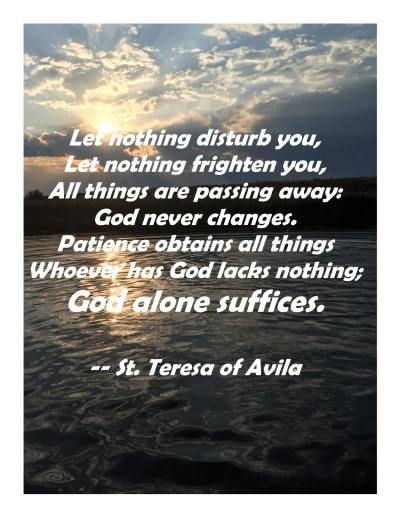
Let nothing disturb you, Let nothing frighten you, All things are passing away: God never changes. Patience obtains all things Whoever has God lacks nothing; God alone suffices. — St. Teresa of Avila

In His Father’s house there are many rooms, and one especially prepared for you by Christ.  Trust in His love, Trust His Wisdom, Trust His Goodness…and let nothing trouble your hearts, that His Peace may be with you always.

Consider:

  • When have you experienced the peace of Christ?  After Mass, in praying with Scripture, in nature, through other Christians?
  • Consider the fears and anxieties you carry.  Lay them before the Lord in prayer and surrender them.  Consider the power of Christ to provide, the love of Christ which motivates Him, and the faithfulness of Christ who remains near us in every trial.
  • In what areas of your life do you trust God completely?  In what areas do you rely on yourself or conventional wisdom rather than Him?

Make a Resolution (Practical Application):

  • Choose your biggest worry.  Begin and end each day surrendering it to God in prayer.
  • Pray the prayer of St. Teresa of Avila each day this week.
  • We make an act of trust in God when we tithe.  If you do not tithe already, begin this week.  If you tithe already but feel called to tithe more (10% is the commonly suggested amount), prayerfully make a financial act of trust in the Lord.
  • Pray Psalm 23 each day this week.
Why do you trust Jesus Christ?  Post in the comments section below!

Related Posts:

~ Written by Angela Lambert © 2017

* To receive these weekly posts automatically in your email just click the “follow” tab in the bottom right hand corner and enter your email address.


We All Need a Loving Gate-Keeper and Filter…Christ the Good Shepherd

by Angela Lambert

May 7th, 2017 4th Sunday of Easter


Gospel of John 10:1-19

Jesus said: “Amen, amen, I say to you, whoever does not enter a sheepfold through the gate but climbs over elsewhere is a thief and a robber. But whoever enters through the gate is the shepherd of the sheep. The gatekeeper opens it for him, and the sheep hear his voice, as the shepherd calls his own sheep by name and leads them out. When he has driven out all his own, he walks ahead of them, and the sheep follow him, because they recognize his voice. But they will not follow a stranger; they will run away from him, because they do not recognize the voice of strangers.” Although Jesus used this figure of speech, the Pharisees did not realize what he was trying to tell them. So Jesus said again, “Amen, amen, I say to you, I am the gate for the sheep. All who came before me are thieves and robbers, but the sheep did not listen to them. I am the gate. Whoever enters through me will be saved, and will come in and go out and find pasture. A thief comes only to steal and slaughter and destroy; I came so that they might have life and have it more abundantly.”

Meditation Reflection:

Quite often as a mom, I feel like a gate-keeper.  Before my kids go somewhere I need to know with whom, who the parents are, and approve.  Technology plagues me even more, with parent controls, ratings evaluations, and restrictions. The ever-multiplying accounts, passwords, devices, programs, and updates can feel like an interminable game of whack-a-mole.  Christmas and birthdays used to be fun, now they feel like a migraine-inducing tidal wave of gate-keeping duties, with impatient children complaining as I set the perimeter that I am being too slow, and of course, too controlling.  I’ve at least developed a one-line response to save my overtaxed brain from responding to the myriad of “logical” arguments and pleas of trust from my young teens. “It’s as simple as this,” I say, “You will not have unfiltered access to the internet.”  The Church could consider adding that as the 11th Commandment for the modern era.

Let’s face it, even adults, as children of God, need filters.   We too can be easily allured by promises of pleasure, freedom, status, or adventure from false advertisers; and I don’t just mean commercially.    Despite having everything, Adam and Eve fell prey to Satan’s proposition that God’s single rule (not to eat the fruit of the tree of knowledge of good and evil) was controlling, and denying them fun out of selfish motivations.  Satan continues to deceive us through similar false promises.

Just as predators try to find ways to get around parents to manipulate children, spiritual “thieves and robbers” try to get around Christ to attack us, God’s children.  First, they try to separate us from His influence by undermining our trust in Him, His Word, or His Church.  Common attempts sound something like: “Christ’s teachings hold you back. If you want to get ahead in life you have to be willing to get your hands dirty”, or “It’s not that you are going against Christ’s teachings, you are just modernizing them.”  In regards to those difficult passages in Scripture, the ones that really strike at your conscience, you will be urged to simply pass over them or interpret them in a more relaxed way – “Forgive others, yes, but forgive my ex?, I don’t think He meant that…”  Jesus stresses that we must die to ourselves in this life and deny ourselves.  Instead we rationalize that He only meant that symbolically, or at least in a modest way – like going on a diet or not aiming too high. Finally, the Church, Christ’s living voice of authority, is the clearest voice of our Shepherd and therefore the harshest recipient of worldly criticism.

We are children of God, in need of a loving gate-keeper.  Christ’s commands, given through Scripture and the Church, can seem restrictive and controlling if we have an adolescent view.  However, as we develop in spiritual maturity, we begin to appreciate the wisdom and the love underlying them.  When I’m tempted to brush off a Church teaching or a little pull at my conscience, I stop and recall that Christ loves me more than I love myself, and He is far wiser than me.  Who am I going to trust?  Any other false shepherd – whether secular culture, another person, or my own impulses – eventually drains rather than fills and proves a destructive, rather than uplifting force.

Christ, our Good Shepherd, leads to green pasture. He refreshes our souls and leads us beside peaceful waters (Psalm 23).  Jesus lamented to St. Faustina that distrust on the part of souls causes Him the greatest pain.  As a mom of teens, I know what He means.   I want my kids to trust me too, and so I repeat the prayer He gave to St. Faustina, “Jesus I trust in You.”

Consider:

  •  When have you been steered wrong – by others, by cultural norms, or by your own impulses?  What was the reason?  What did you learn?
  • When have you been steered right by Christ?  How has His wisdom brought deeper joy and fullness of life, even amidst suffering, than these other voices?
  • Have you ever had to be the gate-keeper for loved ones?  Consider the love it takes to be strong and the need for them to trust you.
  • How can you trust Christ more and listen to His voice more often?  Could you attend Church more regularly?  Could you invest more time into Christian friendships?  Do you make time to study your Bible, read quality devotionals, or learn more about your faith?

Make a Resolution (Practical Application):

  •  Choose one way to listen more to the voice of Christ this week.
    • Ideas:  Add 10 minutes to your prayer time, pray the rosary in the car, listen to Christian radio, listen to Christian podcasts, read the daily Scriptures (these can be found at usccb.org), post inspirational Scripture quotes in places you will see them often, meet with a Christian friend.
  • Consider adding a filter, rating restrictions, or accountability software to your personal technology.

Related posts:

~ Written by Angela Lambert © 2017

* To receive these weekly posts automatically in your email just click the “follow” tab in the bottom right hand corner and enter your email address.


Stating the Facts & Facing the Conclusions

by Angela Lambert

March 26th, 2017; 4th Sunday of Lent

Gospel of John 9:1-41

As Jesus passed by He saw a man blind from birth. His disciples asked him, “Rabbi, who sinned, this man or his parents, that he was born blind?” Jesus answered, “Neither he nor his parents sinned; it is so that the works of God might be made visible through him. We have to do the works of the one who sent me while it is day. Night is coming when no one can work. While I am in the world, I am the light of the world.” When he had said this, he spat on the ground and made clay with the saliva, and smeared the clay on his eyes, and said to him, “Go wash in the Pool of Siloam” —which means Sent—. So he went and washed, and came back able to see. His neighbors and those who had seen him earlier as a beggar said, “Isn’t this the one who used to sit and beg?” Some said, “It is,” but others said, “No, he just looks like him.” He said, “I am.” So they said to him, “How were your eyes opened?” He replied, “The man called Jesus made clay and anointed my eyes and told me, ‘Go to Siloam and wash.’ So I went there and washed and was able to see.” And they said to him, “Where is he?” He said, “I don’t know.” They brought the one who was once blind to the Pharisees. Now Jesus had made clay and opened his eyes on a sabbath. So then the Pharisees also asked him how he was able to see. He said to them, “He put clay on my eyes, and I washed, and now I can see.” So some of the Pharisees said, “This man is not from God, because he does not keep the sabbath.” But others said, “How can a sinful man do such signs?” And there was a division among them. So they said to the blind man again, “What do you have to say about him, since he opened your eyes?” He said, “He is a prophet.” Now the Jews did not believe that he had been blind and gained his sight until they summoned the parents of the one who had gained his sight. They asked them, “Is this your son, who you say was born blind? How does he now see?” His parents answered and said, “We know that this is our son and that he was born blind. We do not know how he sees now, nor do we know who opened his eyes. Ask him, he is of age; he can speak for himself.” His parents said this because they were afraid of the Jews, for the Jews had already agreed that if anyone acknowledged him as the Christ, he would be expelled from the synagogue. For this reason his parents said, “He is of age; question him.” So a second time they called the man who had been blind and said to him, “Give God the praise! We know that this man is a sinner.” He replied, “If he is a sinner, I do not know. One thing I do know is that I was blind and now I see.” So they said to him, “What did he do to you? How did he open your eyes?” He answered them, “I told you already and you did not listen. Why do you want to hear it again? Do you want to become his disciples, too?” They ridiculed him and said, “You are that man’s disciple; we are disciples of Moses! We know that God spoke to Moses, but we do not know where this one is from.” The man answered and said to them, “This is what is so amazing, that you do not know where he is from, yet he opened my eyes. We know that God does not listen to sinners, but if one is devout and does his will, he listens to him. It is unheard of that anyone ever opened the eyes of a person born blind. If this man were not from God, he would not be able to do anything.” They answered and said to him, “You were born totally in sin, and are you trying to teach us?” Then they threw him out. When Jesus heard that they had thrown him out, he found him and said, “Do you believe in the Son of Man?” He answered and said, “Who is he, sir, that I may believe in him?” Jesus said to him, “You have seen him, the one speaking with you is he.” He said, “I do believe, Lord,” and he worshiped him. Then Jesus said, “I came into this world for judgment, so that those who do not see might see, and those who do see might become blind.” Some of the Pharisees who were with him heard this and said to him, “Surely we are not also blind, are we?” Jesus said to them, “If you were blind, you would have no sin; but now you are saying, ‘We see,’ so your sin remains.

 Meditation Reflection:

Another long passage.  Why?  Two in a row?  Is it because it’s Lent and the Church wants to test or patience?  No, despite our ever-shortening attention spans, we still need to hear real stories of real people’s transformation in Christ.

John could only include a sliver of these experiences in his Gospel, so he reserved room for the most powerful or most instructive.  His Gospel is not written as myth or legend, but as testimony.  Jesus’ encounter with the Samaritan woman at the well taught us the surprising nature of the kingdom of God which we, like many of the Jews at the time, may find difficult to understand on a natural level. Jesus’ healing of the man born blind, testifies to the undeniable evidence of Jesus’ divine origin.  Thus, discipleship of Christ cannot be sustained by natural reason alone, which is why believing in Him as merely a good moral teacher is not enough and not very effective.  Rather, disciples follow Christ based on faith in Who He is.  This faith may develop gradually over a period of time and interaction like the Samaritan woman’s village with whom Jesus spent two days, or happen in a miraculous moment like the man born blind.  Either way, the call of discipleship exceeds our understanding, and can only make sense if we believe that Jesus is truly God.

Discipleship, therefore, begins with encounter and follows with witness.  The man born blind stated the facts of the situation without interpretation several times.  The Pharisees refused to acknowledge the logical conclusion so they tried to raise doubts about the premises.  Finally, the exasperated man connected the dots for them and stated the logical conclusion. He was born blind, now he is not blind; only God could have given him sight ; God only blesses those whom He approves; therefore…Jesus is from God.  For the Pharisees to reject Christ when the miracle was standing right in front of them, was to willingly choose blindness.  God acts in our lives daily and has sent His only Son for our salvation.  We have no more excuses for our ignorance.

The Pharisees tried to pit Jesus against Moses, but Jesus is the fulfillment of God’s promise to send a new Moses.  Moses received the Law from God and brought it to the people.  Jesus is God, and communicates the New Law from His own authority.  He also, therefore, has the authority to correct any misinterpretations or mis-applications of the Old Law.

God also promised, that someone from the line of David would always be king.  As the New David, Jesus takes up the crown as eternal king.  When God told the prophet Samuel to go to the house of Jesse and anoint one of his sons as the new king, Samuel expected the oldest to be chosen.  Instead, God chose the youngest.  This was such an unforeseen call, that David wasn’t even present at the visit but instead was tasked with tending the sheep.  Just as God said to Samuel regarding David, “Not as man sees does God see, because man sees the appearance but the LORD looks into the heart” (1 Samuel 16:7), so the blind man gave witness to Jesus by his miraculous and supernatural sight.  One thing I do know is that I was blind and now I see…It is unheard of that anyone ever opened the eyes of a person born blind. If this man were not from God, he would not be able to do anything.”

All Christians are called to bear witness to Christ, evidenced by His transformative power in their lives.  How others react to that witness, brings to light their true state of soul.  We all have an innate yearning for God.  We sometimes avoid Him however to continue in some of our sins.  Sometimes we feign ignorance, rationalize away Christ’s teaching, or discount the witness given by the lives of strong Christians we know, so we can avoid facing the truth about our attachments.  We cannot hide any longer.  Christ has come, His light has shone, and He continues to live and act through His Mystical Body the Church.  He has given a New Law as our Eternal King.  His expectations exceed our natural abilities and weakness, but His grace makes the Christian life possible.

The more our relationship with Christ develops, the more our faith will strengthen and our trust in Him will grow.  Then, when the Christian life tests our minds and hearts, we will hopefully respond as St. Peter did, “Lord, to whom shall we go? You have the words of eternal life; and we have believed and have come to know, that you are the Holy One of God.” (John 6:68-69) and to give witness as St. John does at the beginning of His Gospel: “the Word became flesh and dwelt among us, full of grace and truth; we have beheld His glory, glory as the only-begotten Son from the Father.” (John 1:14)

Consider:

  • Where would you consider yourself in your spiritual journey?
    • Initial Outreach – just beginning the search for God, curious about Jesus but unsure of whether to follow Him
    • Early Development – responding to Christ, learning His truths, forming convictions, developing Christian habits, shedding sinful habits, wavering but growing stronger
    • Disciple – follower of Christ, faith in Him and trust in Him above oneself, motivated by love and loyalty, allowing Christ full authority to transform you, witness of His life in you
  • If, like the man born blind, you were asked to testify about your encounter with Christ, what would you say?  What would be the “facts” of the case, and what would be your conclusions?
  • How has the Christian witness of others strengthened your faith or moved you to make a serious change in your life?

Make a Resolution (Practical Application):

  • Each morning take five minutes of prayer to think about your day ahead, and resolve to  witness to Christ in one to three concrete ways.
    • Consider in each aspect – home, work, recreation, family time.
    • Think of ways in each area you can live your Christian faith and witness to Christ by either your words or your actions.
    • Resolve on one thing to say or do in each area for the day.
    • At the end of the day, reflect back on how you did.  Praise God for your successes, and where you failed ask for grace to do better tomorrow.

~ Written by Angela Lambert © 2017

* To receive these weekly posts automatically in your email just click the “follow” tab in the bottom right hand corner and enter your email address.


Hope…When Least Expected

by Angela Lambert

woman at well

March 19th, 2017; 3rd Sunday of Lent

Gospel of John 4:5-42

 Jesus came to a town of Samaria called Sychar, near the plot of land that Jacob had given to his son Joseph. Jacob’s well was there. Jesus, tired from his journey, sat down there at the well. It was about noon. A woman of Samaria came to draw water. Jesus said to her, “Give me a drink.” His disciples had gone into the town to buy food. The Samaritan woman said to him, “How can you, a Jew, ask me, a Samaritan woman, for a drink?” —For Jews use nothing in common with Samaritans.— Jesus answered and said to her, “If you knew the gift of God and who is saying to you, ‘Give me a drink, ‘ you would have asked him and he would have given you living water.” The woman said to him, “Sir, you do not even have a bucket and the cistern is deep; where then can you get this living water? Are you greater than our father Jacob, who gave us this cistern and drank from it himself with his children and his flocks?”

Jesus answered and said to her, “Everyone who drinks this water will be thirsty again; but whoever drinks the water I shall give will never thirst; the water I shall give will become in him a spring of water welling up to eternal life.” The woman said to him, “Sir, give me this water, so that I may not be thirsty or have to keep coming here to draw water.”

Jesus said to her, “Go call your husband and come back.” The woman answered and said to him, “I do not have a husband.  Jesus answered her, “You are right in saying, ‘I do not have a husband.’ For you have had five husbands, and the one you have now is not your husband. What you have said is true.” The woman said to him, “Sir, I can see that you are a prophet. Our ancestors worshiped on this mountain; but you people say that the place to worship is in Jerusalem.” Jesus said to her, “Believe me, woman, the hour is coming when you will worship the Father neither on this mountain nor in Jerusalem. You people worship what you do not understand; we worship what we understand, because salvation is from the Jews. But the hour is coming, and is now here, when true worshipers will worship the Father in Spirit and truth; and indeed the Father seeks such people to worship him. God is Spirit, and those who worship him must worship in Spirit and truth.” The woman said to him, “I know that the Messiah is coming, the one called the Christ; when he comes, he will tell us everything.” Jesus said to her, “I am he, the one speaking with you.”

At that moment his disciples returned, and were amazed that he was talking with a woman, but still no one said, “What are you looking for?” or “Why are you talking with her?” The woman left her water jar and went into the town and said to the people, “Come see a man who told me everything I have done. Could he possibly be the Christ?” They went out of the town and came to him. Meanwhile, the disciples urged him, “Rabbi, eat.” But he said to them, “I have food to eat of which you do not know.” So the disciples said to one another, “Could someone have brought him something to eat?” Jesus said to them, “My food is to do the will of the one who sent me and to finish his work. Do you not say, ‘In four months the harvest will be here’? I tell you, look up and see the fields ripe for the harvest. The reaper is already receiving payment and gathering crops for eternal life, so that the sower and reaper can rejoice together. For here the saying is verified that ‘One sows and another reaps.’ I sent you to reap what you have not worked for; others have done the work, and you are sharing the fruits of their work.”

Many of the Samaritans of that town began to believe in him because of the word of the woman who testified, “He told me everything I have done.” When the Samaritans came to him, they invited him to stay with them; and he stayed there two days. Many more began to believe in him because of his word, and they said to the woman, “We no longer believe because of your word; for we have heard for ourselves, and we know that this is truly the savior of the world.”

Meditation Reflection:

What a long passage.  Why?  Why does John give this much space in his Gospel to one woman’s conversion?  Jesus encountered multitudes of people during His brief public ministry.  John even gives a disclaimer at the end of his Gospel, apologizing that he could only include a handful of Jesus’ miracles, enough to make the point that He is the Son of God, because they were too innumerable to recount in written form.

The woman at the well’s encounter with Christ, models the process of conversion.  Jesus approached her when she least expected it.  She went to the well at noon, the worst time of the day, to avoid the other women.  Sin has a way of isolating us from others as we try to cover up our sins or rationalize our choices.

Jesus initiated the conversation.  He sought her.  He began with a request, but in fact desired to offer her healing and salvation.  Every Christian’s conversion begins with an encounter with Christ, and the experience of Him having sought us before we sought Him.  Discipleship is not a project, club, or philosophy.  It’s a response.  It’s a realization that what Christ asks of us, is in fact His invitation to receive from Him.

Next, He addressed her sins.  She skirted the issue, and even when confronted directly, she tried to distract Him with a theological debate.  By the end however, she felt relief and joy. From her encounter, she learned that the Christ, the anointed one of God, had come.  Moreover, He had come to her – despite her personal unfaithfulness, as well as the unfaithfulness of her people the Samaritans. Jesus revealed Himself as the Savior, come through the promise of the Jews, and at the same time for the salvation of all.

Imagine her hopelessness as she approached the well in the heat of the day.  Women of her time would view success as a good marriage and large family.  She had already had five husbands and given up on marriage altogether with the man she was living with. She had no friends and was excluded from the community of women.  There was no way back for her, and no opportunity going forward.

God gives surprisingly and super-abundantly.  Met with physical thirst, Jesus offered her the living waters of eternal life.  It took awhile for her to wrap her mind around what He was saying.  Eventually however, she recognized the work of God and ran to the people of her town to tell them.  She left her water jug, despite her physical thirst and needs.  She boldly told everyone of her experience, despite the shame of her reputation among them.

Her witness was so moving that they went to Jesus to see for themselves.  They too encountered Christ in an unexpected and surprising way – through the seemingly least religious woman in town.  By the end of their encounter however, they too were converted.

During Lent, Jesus comes to meet us in our shame and our thirst.  As a Church, we endeavor to hear Him through increased prayer and introspection.  We recall that He came to save us, while we were still sinners.  We remember that He first sought us, but we must respond.  Thankfully, He is patient.  Our transformation in Christ will become our witness, and our witness will bring Christ to others.  But first, we must set aside our tactics for avoiding our sins, and allow Christ to lead us through them.

Consider:

  • The woman went to the well at noon instead of morning because of shame:
    • What are you ashamed of? What do you hide from others?
  • Imagine meeting Jesus there.
    • Would you feel surprised? What excuses might you make?
  • Imagine Jesus calling you out on your sins.
    • What are your competing loves? Be honest.
  • How is Jesus the living water compared to these other “spouses”?
  • How are the other pleasures you seek temporary and always needing replenishing, whereas Christ’s joy is abiding?
  • Jesus offers her life, and commands her to sin no more.  Let Jesus confront your sin.  You too must choose. You cannot have both.

Make a Resolution (Practical Application):

  • When God confronted King David about his sin through the prophet Nathan, David responded by composing Psalm 51.  He acknowledged his sin, asked for forgiveness, and trusted God to transform his heart.
  • Do an examination of conscience this week.  If possible, meet Christ in the sacrament of Confession.

~ Written by Angela Lambert © 2017

* To receive these weekly posts automatically in your email just click the “follow” tab in the bottom right hand corner and enter your email address.