Christ’s Kingdom Come

by Angela Lambert

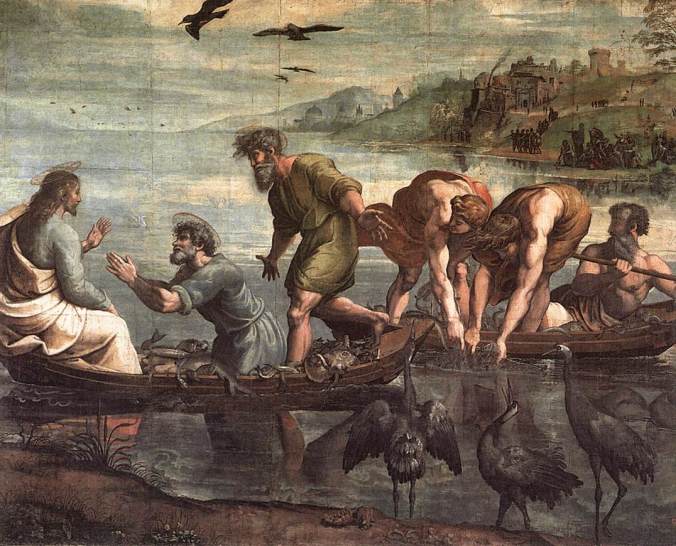
 Raphael,_The_Miraculous_Draught_of_Fishes_(1515)

January 22nd, 2017; Third Sunday of Ordinary Time

 Gospel Matthew 4:12-23 NA

When Jesus heard that John had been arrested, he withdrew to Galilee. He left Nazareth and went to live in Capernaum by the sea, in the region of Zebulun and Naphtali, that what had been said through Isaiah the prophet might be fulfilled: Land of Zebulun and land of Naphtali, the way to the sea, beyond the Jordan, Galilee of the Gentiles, the people who sit in darkness have seen a great light, on those dwelling in a land overshadowed by death light has arisen. From that time on, Jesus began to preach and say, “Repent, for the kingdom of heaven is at hand.” As he was walking by the Sea of Galilee, he saw two brothers, Simon who is called Peter, and his brother Andrew, casting a net into the sea; they were fishermen. He said to them, “Come after me, and I will make you fishers of men.” At once they left their nets and followed him. He walked along from there and saw two other brothers, James, the son of Zebedee, and his brother John. They were in a boat, with their father Zebedee, mending their nets. He called them, and immediately they left their boat and their father and followed him. He went around all of Galilee, teaching in their synagogues, proclaiming the gospel of the kingdom, and curing every disease and illness among the people.

Meditation Reflection:

John the Baptist prepared the way for Christ by proclaiming His coming, and calling to conversion those awaiting a savior.  John’s extreme ascetic life, illuminated consciences to common attachments which hinder people from receiving the Lord.  His lonely, austere, desert living, provides a sharp contrast to our often-inordinate desire for luxury, status, and concern for keeping up with the Jones’.  His fast of locusts and honey, casts light onto our indulgence in food and drink; and his camel-hair clothing convicts our consciences of secret vanity.  Lastly, his rejection of fame and power set an example of true Christian discipleship.  He rejected the title of Messiah for himself and insistently pointed to Jesus as the Christ.  He spoke the truth to peasants, religious leaders, and even political leaders, despite the risk of arrest and even death.  When the Lord finally came, he gracefully stepped to the side, saying “He must increase, but I must decrease.” (Jn 3:30).

Matthew situates the beginning of Jesus’ ministry with the waning of John’s.  Jesus had been baptized and spent 40 days in the desert fasting, praying, and being tempted. John had just been arrested and Jesus, His preparation finished, now began His work.  He commences by preaching the same message as John, “Repent, for the kingdom is at hand.”  Only this time, the kingdom is not coming, but rather has come in the Person of Jesus Christ.

What is the kingdom of God?  Although its meaning has great depth and connections, put simply, it refers to God’s rule over our hearts and the peace of union with Him.  To accept the rule of God, we must first reject the rule of other monarchs.  Thus, repentance is a necessary first step, in which we acknowledge the sins and desires that we have allowed to rule us, and we ask for God to be our liberator.  The Lord’s kingdom is a monarchy, but one that governs free individuals.  The Lord does not annex land through force, but He does liberate people who are enslaved and, through the merits and mercy of His Son, grant them citizenship.  Moreover, this citizenship is more akin to being an adopted member of a loving family than a mere nation-state.

Imagine Christ’s joy as He could finally roll up His sleeves and begin preaching the Gospel, healing the wounded, and most importantly – forgiving sins.  Since the Fall of Adam and Eve, God had patiently waited for the time when we would be ready to receive Him and He could heal all our wounds and strengthen us with His grace.

Jesus goes to Galilee to begin gathering up God’s scattered and lost sheep.  The havoc of disunity caused by human sin, becomes undone through union in Christ.  He rebuilds God’s people by building His Church.  He first calls two sets of brothers who have spent their days fishing, caring for their family, and awaiting the Messiah.  They, like Christ, obeyed the Lord in humble tasks of everyday life until He called them forth.  When asked to follow Him, they immediately left the security of their routines and their community, to say Yes to the Lord and His will.

We can learn from this encounter how to prepare for, and respond to, the coming of the kingdom of God in our own lives.  We can begin by answering the call of John the Baptist to repent.  We can ask the Holy Spirit to reveal to us our sins and our blind spots.  I can say from experience, He will.  Next, we watch and wait.  We live our daily lives open and receptive to God’s will.  St. Thomas taught that “grace builds on nature.”  This means that being a Christian doesn’t make us less ourselves and just robots following commands.  Rather, grace makes us the best version of ourselves.  It actually makes us more ourselves and raises our natural state in life to a super-natural level.  Peter, Andrew, James, and John were all fisherman.  In the kingdom of God, they become fishers of men.

The apostles model Christian discipleship, which is simply receptivity to the Lord in our daily lives.  It means saying “yes”, and following wherever He leads. True peace, justice, and happiness come through Christ alone.  Only He can free us from our worst enemy – our own sins, fears, weakness, and pride.  Only He can provide security.  When we experience the gift of being His disciples, we will understand John the Baptist’s passionate zeal for pointing others to the Lord as well.

Following Christ can look very ordinary on some days, and on others it can completely surprise you.  Whatever might be holding you back when Christ says to you, “Come and see,” let it go.  Drop your nets and set out after Him.

Consider:

  • Ask the Lord for a spirit of repentance.  Invite the Holy Spirit to show you what, or who, comes between you and God.
  • Reflect on the Christ’s call “Come Follow Me.”
  • How has God called you to be faithful in your everyday life? In your family, at your job, in your community?
  • How has grace “built” on your nature. How has encountering Christ made you a better version of yourself?  Where might Christ still want to work in your life?
  • Christ cured “EVERY disease and illness”. There is nothing He can’t conquer for His kingdom. What plagues you? Pray for healing in accord with His will.
  • Spend a few moments in joy, expressing gratitude for the freedom you have found in Christ’s love.

Make a Resolution (Practical Application):

  • Begin each day this week by saying, “Yes Lord, I will follow You.”  Repeat it throughout the day and in every circumstance.


~ Written by Angela Lambert © 2017

* To receive these weekly posts automatically in your email just click the “follow” tab in the bottom right hand corner and enter your email address.


Watch & Wait, Look & See

by Angela Lambert

20160815_171506644_ios

January 15th, 2017; Second Sunday of Ordinary Time

Gospel John 1:29-34 NAB

John the Baptist saw Jesus coming toward him and said, “Behold, the Lamb of God, who takes away the sin of the world. He is the one of whom I said, ‘A man is coming after me who ranks ahead of me because he existed before me.’ I did not know him, but the reason why I came baptizing with water was that he might be made known to Israel.” John testified further, saying, “I saw the Spirit come down like a dove from heaven and remain upon him. I did not know him, but the one who sent me to baptize with water told me, ‘On whomever you see the Spirit come down and remain, he is the one who will baptize with the Holy Spirit.’ Now I have seen and testified that he is the Son of God.”

Meditation Reflection:

How did John recognize Jesus as his Savior?  He prayed, waited, and listened.

Accustomed to instant gratification and the fast pace of life, together with a heavily marketed atmosphere, we can easily develop a tendency to expect Christ to sell Himself to us and to make His pitch with immediate persuasion. Whether we question God’s existence, His nearness, or His willingness to help us, we often complain that God is silent or distant.  Yet, we have to honestly ask ourselves, have we even asked God for His help?  Have we waited on the Lord, or are we expecting an immediate result?  Have we been receptive to the Lord’s prompting, or do we attempt to lead God, deaf to His guidance?

John the Baptist sought the Lord, venturing into the desert where he could encounter God away from the distractions of everyday life.  He waited on God, fully expecting an answer by spending his time preparing through preaching repentance and baptizing.    When the Savior came at last, John could receive Him and recognize Him as Lord because he was looking and listening.

It reminds me a little of family road trips.  The kid engrossed in his iPhone or tablet misses extraordinary sights, or at the very least, out of the ordinary landscapes.  The person vigilantly watching out the window however, can take in the beauty, appreciate the landscape, and spot the surprise spectacles.  By the time he has shouted “look!” and the distracted child responds, the sight has passed. Moreover, at the end of the journey, the one focused on the tablet retains the same vision of the world as when he left home, whereas the one who looked out the window broadened his vision and experience.

If we feel like God is distant, we need simply to look out the window and reach out to Him in prayer.  If we require His help, we need only to ask and listen.  When we look for the Savior, we find Him.  God does His part, and more.  We need to make the effort to look up from our commonplace experience and distractions and seek Him.

Psalm 40 begins by singing, “I have waited, waited for the LORD, and he stooped toward me and heard my cry.”  What a beautiful expression.  God has seen our suffering and heard our pleas.  He stooped to become man and dwell among us, personally healing and strengthening us.  When a person experiences the saving love of Christ, they cannot resist proclaiming it to others.  Like the child shouting “look!”, they instinctively cry out “look!” as well; or as John proclaimed, “Behold! The Lamb of God”.

Everyone seeks happiness, security, and love.  We can search for all these things online, in our careers, or the economy, but only Christ can deliver on His promises.  Archbishop Fulton Sheen described John the Baptist as “no frivolous reed shaken by every breath of popular applause.”  When we seek approval from others or from cultural standards, we become weak like a reed.  We sway at every idea, comment, or attack and easily break. Firmness of character and security of happiness can be found in Jesus Christ alone, who can provide peace and rewards of a supernatural level.  It is the Lord, who provides Faith, Hope, and Love.  It is His Holy Spirit who infuses us with His sevenfold gifts of Wisdom, Understanding, Counsel, Knowledge, Piety, Fortitude, and Fear of the Lord.  If we desire the Spirit’s fruits of love, joy, peace, patience, kindness, goodness, faithfulness, and self-control, we need merely to invite the Lord into our soul to dwell, and be receptive to the transformation He effects.

At the same time, to realize our need for a Savior, we must also acknowledge the reality of our sinfulness.  The first step to seeking the Lord is to grapple with our need for Him and our own insufficiency.  Sheen pointed out that, “Skepticism is never certain of itself, being less a firm intellectual position than a pose to justify bad behavior.”  Some who seem to seek God, actually hide behind their questions in order to avoid moral change.  Those who see the ugliness of their own sin look out the window, and run to the water to be cleansed.  They recognize the savior because they receive His grace and enjoy the beauty of His restoration.    They can proclaim with John, “Now I have seen, and testify that He is the Son of God.”  If you want to find out for yourself, respond to Christ’s invitation to “come and see” (Jn 1:39).  You might just see something incredible!

Consider:

  • Where can you go to encounter the Lord?
    • In a quiet place in your home for prayer? At Church or Eucharistic adoration?  In the Scriptures? In reading about the lives of the saints?  In visiting with a prayerful friend?  Taking time for prayer retreats? By listening to Christian radio in the car.
  • How do you sometimes approach the road trip of life more like the child distracted by a tablet, rather than the child looking out the window?
  • If you were to go out to the desert to see John the Baptist, what do you imagine it would be like? Would you want to receive the baptism of repentance?  For what would he call you to change in your life?
  • When has Christ “stooped toward you and heard your cry?” Did it fill you with peace and joy? Did you want to tell others?

Make a Resolution (Practical Application):

  • Watch, wait, and listen to the Lord this week by setting aside 5 minutes each day to seek Him out in prayer, Scripture, or even Christian radio.


~ Written by Angela Lambert © 2017

* To receive these weekly posts automatically in your email just click the “follow” tab in the bottom right hand corner and enter your email address.


The Universal Search For God

by Angela Lambert

magi

January 8th, 2017 Feast of the Epiphany

Gospel Matthew 2:1-12 NAB

When Jesus was born in Bethlehem of Judea, in the days of King Herod, behold, magi from the east arrived in Jerusalem, saying, “Where is the newborn king of the Jews? We saw his star at its rising and have come to do him homage.” When King Herod heard this, he was greatly troubled, and all Jerusalem with him. Assembling all the chief priests and the scribes of the people, He inquired of them where the Christ was to be born. They said to him, “In Bethlehem of Judea, for thus it has been written through the prophet: And you, Bethlehem, land of Judah, are by no means least among the rulers of Judah; since from you shall come a ruler, who is to shepherd my people Israel.” Then Herod called the magi secretly and ascertained from them the time of the star’s appearance. He sent them to Bethlehem and said, “Go and search diligently for the child. When you have found him, bring me word, that I too may go and do him homage.” After their audience with the king they set out. And behold, the star that they had seen at its rising preceded them, until it came and stopped over the place where the child was. They were overjoyed at seeing the star, and on entering the house they saw the child with Mary his mother. They prostrated themselves and did him homage. Then they opened their treasures and offered him gifts of gold, frankincense, and myrrh. And having been warned in a dream not to return to Herod, they departed for their country by another way.

Meditation Reflection:

Epiphany means “the manifestation of the divine.”  God manifested the Savior to the world, from the poor Jewish shepherds, to the wise Magi from the East. All human persons seek God, whether they call their search one for the divine or not.  It may begin as movement toward God’s Goodness through the conscience, toward His Truth through the pursuit of wisdom, or toward His Beauty through captivation by His creation or art.

Even those who attempt to deny the search, witness to its inherent reality in our nature. Those who develop a direct antagonism for religion expressed in a defiant atheism, reveal that they have grappled with the search, evidenced by their conclusion.  In addition, true atheism expresses a negative despair, rather than a fulfillment of life or joy.  If God’s nonexistence were true, shouldn’t it satiate our nature rather than leaving us feeling depressed?  If we are merely animals, shouldn’t we be content with food, security, and a nap?  And yet we are not.   On the other hand, those who seemingly ignore the search due to idling in the superficial pleasures of the world, also reveal something of the human person’s natural inclination toward God.  If a child shirked healthy food and exercise in favor of foods that pleasure the palette and sedentary entertainment, his body’s natural development would be harmed, evidenced by less development than normal and increased sickness.  Similarly, those who neglect the healthy development of the soul suffer similar emotional and spiritual disfigurement as well.

The birth of Christ fulfilled the desire of all humankind.  God created us with the capacity for love, destined for eternal life, and union with the divine.  The Jews tasted this through His revelation in the Old Covenant and His many signs and miracles.  The Gentiles also sensed this through their observations of creation and philosophy. As a result, the Jewish shepherds learned of Christ’s birth by the appearance of angels, and the magi from the East learned of Him through sighting a new star.  Although the journey may begin in different places and a person may traverse by different means, nevertheless, all converge on Christ.

In addition to the universal search for God, humankind evidences a universal desire for redemption.  We sense the eternal law in our conscience, as well as the pang of guilt for transgressing that law so many times and the feeling of helplessness to be able to perfect ourselves. For instance, we look to psychology, television, news, science, and nutrition, to discover the explanation as to why we do what we know we should not do.  After finding an explanation we seek the cure – again through self-help guides or better diet.  And yet we continue to feel guilt and unrest.  We continue in behaviors we know are self-destructive and negative.  We need a savior.

False gods and false prophets always promised cures in return for some kind of personal gain, promising quick cures that always came up short.  Similar to marketing scams , they do more to manipulate the person’s wound rather than heal it.  Christ proves the opposite of the false gods and demonstrates His authenticity by rejecting anything worldly we might offer.  He came poor and died poor.  He lived a hidden life for thirty years and avoided vainglory by never staying too long in one place during His public ministry and often commanding those He healed to tell no one.  Rather than lengthen His life, it was shortened.  He proved on the Cross that He did not come to take from us, but to give selflessly and unconditionally to us.

Jesus is the Savior we yearn for and there is no gimmick.  He did not come to manipulate, He did not offer false hopes or promises.  He is the Way, the Truth, and the Life, who offers pure, loving, relationship.  He alone satiates our search and nourishes our development.  The magi searched for God and found Him.  Jesus promises us as well, that all who seek Him shall find Him.  Hopefully we, like the Magi, can have the courage to venture out in search of the Lord.  Contemplating this mystery, Archbishop Fulton Sheen observed “No one who ever meets Christ with a good will returns the same way he came” (Life of Christ).

Consider:

  • Reflect on your journey to God.  What “pointed” you toward Him, like the star did for the Magi?
  • Has your search for God grown lax at times? How did your spiritual life atrophy afterward?
  • How might you reinvigorate your search for God? Could you increase your search through prayer, reading of Scripture, studying the faith, or fellowship with friends of faith?
  • Consider the gift of our savior. How has Christ freed and healed you?  What do you need Him to free you from, or heal you, of today?

Make a Resolution (Practical Application):

  • Choose one way to invigorate your search for Christ.
    • Ideas: Read a chapter of a Gospel each day; Read a book about Christ by an inspiring author, make time to visit with a Christian friend about the Lord, join a Bible study, read the lives of the saints and learn from their pursuit of Christ, talk with your family about Christ…


~ Written by Angela Lambert © 2017

* To receive these weekly posts automatically in your email just click the “follow” tab in the bottom right hand corner and enter your email address.


Mary’s Motherhood and Christian Discipleship

by Angela Lambert

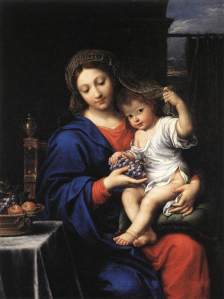
virgin-of-the-grapes

January 1st, 2017; Solemnity of the Blessed Virgin Mary, the Mother of God

Gospel Luke 2:16-21 NAB

The shepherds went in haste to Bethlehem and found Mary and Joseph, and the infant lying in the manger. When they saw this, they made known the message that had been told them about this child. All who heard it were amazed by what had been told them by the shepherds. And Mary kept all these things, reflecting on them in her heart. Then the shepherds returned, glorifying and praising God for all they had heard and seen, just as it had been told to them.
When eight days were completed for his circumcision, he was named Jesus, the name given him by the angel before he was conceived in the womb.

Meditation Reflection:

“Mary kept all these things, reflecting on them in her heart.”  When it comes to their children, mothers are contemplatives; they treasure and reflect on every little thing and never tire of gazing at their children in love.  I will never forget the first night I spent with my son in the hospital. The nurse urged me to sleep after an exhausting birth, but I couldn’t stop holding him and staring at him.  I was overcome with a love there is no vocabulary to describe, and in awe of this mystery beyond comprehension.  With each subsequent child, I experienced the same awe.  Moreover, rather than dividing my love, each child multiplied it by expanding my heart with love for each of them individually.

As Mary gazed with love on her child, she gazed not only on her son, but the Son of God.  Mary was the first person to contemplate the mystery that Jesus is both God and man, creator and savior, born to die that we might live.  She is the first to love Him with her whole heart and the only to have the privilege of loving Him with a mother’s heart.

When God the Son took on a human nature, He allowed Himself to become weak and vulnerable.  He experienced human development and the daily process of growth and maturation we all go through.  Mary and Joseph were not merely day care providers for Jesus.  They were the first disciples of Christ and lived their vocation as His family to the fullest.  As God, Jesus had all the divine attributes.  As man, He shared DNA with Mary, He adopted Mary and Joseph’s mannerisms, He received a formation within the context of His family.  Though He is both God and Man, Jesus is one Person.  As a result, since Mary is the mother of Jesus she is rightly called Mother of God.  This does not mean she is the origin of the Trinity.  However, we must remember that mothers are mothers of people, not merely bodies.  It would be strange to say that I am the mother of my son’s body but not the mother of my son the person.  In the same way, to bifurcate Mary’s motherhood as merely that of part of Jesus would be to bifurcate Jesus Himself.  Jesus is one Person, the Second Person of the Trinity, who, since the moment of His incarnation, is forever simultaneously both God and Man.

Mary revered our Lord as both.  She nurtured His human needs and she worshipped His divinity.  She, like Him, obeyed the Father in all things.  She was the first human to live fully God’s plan for all mankind – union with God of heart, mind, and will.  Moreover, she is the only human to love Him as her Son and to be loved by Him as His mother.

This deep, pure, motherly love of Mary extends to each one of us as well.  From the Cross, as Christ suffered and died for our redemption and rebirth, He entrusted Mary as mother to St. John.  In doing so, He gave all of us to her as her children.  In baptism, we are united to Christ as His Mystical Body.  In consequence, we are also united to Mary as our mystical Mother.  Rather than dividing her love, each person who accepts her as mother, multiplies her love and experiences the same tender attention she gives to each of her children.  Christ shares our nature, and He has also shared His Heavenly Father and His earthly Mother with us.  Through Christ we become adopted sons and daughters of God and cherished children of Mary.  Through Christ’s condescension to become our brother, He has invited us into His own family.

Mary is the mother of God because God became man.  Mothers never tire telling anyone who will listen about their children.  Moreover, mothers love their children simply for who they are, not merely what they do.  If we ask Mary, she will share with us about her Son and teach us how to love and follow Him for Who He is, and not merely what He can do for us.

“She is so full of love that no one who asks for her intercession is rejected, no matter how sinful he may be. The saints say that it has never been known since the world began that anyone had recourse to our Blessed Lady, with trust and perseverance, and was rejected.” St. Louis de Montfort

Consider:

  • How has meeting someone’s mother taught you something new about a person?
  • What do you cherish about your mother’s love?
  • If you are a parent, consider the mystery of your love for your children. Imagine Mary’s love for Jesus at each of the stages of growth your kids have experienced.
  • Adoptive parents repeatedly report that they love their adoptive kids as if they were theirs biologically. Consider Mary’s motherly love for you as her adoptive child, whom she loves as her very own.
  • Reflect on Christ’s love for Mary as His mother.
    • Consider the deep feelings of admiration and appreciation He has for her.
    • Reflect on their relationship and connection as mother and son.
    • Consider the comfort and strength He drew from her during His public ministry, knowing He had one person who understood His mission and supported Him no matter what.

Make a Resolution (Practical Application):

  • This week, read and reflect on the words of Mary in Scripture.
  • Ask Mary to be your mother and go to her each day with your needs. Ask her to tell you about Jesus and teach you how to follow Him.
  • Pray a decade of the rosary each day. Consider using the Scriptural rosary if you can.
    • (I have never prayed the rosary without experiencing some kind of grace. Mary always brings us to Jesus.)
    • Pope St. John Paul II said, “To pray the Rosary is to hand over our burdens to the merciful hearts of Christ and His mother.”


~ Written by Angela Lambert © 2017

* To receive these weekly posts automatically in your email just click the “follow” tab in the bottom right hand corner and enter your email address.


We Have Seen His Glory! Awe of God and Christmas Witness…

by Angela Lambert

nativity

December 25th, 2016; Christmas Liturgy

Gospel John 1:1-18

In the beginning was the Word, and the Word was with God, and the Word was God. He was in the beginning with God. All things came to be through him, and without him nothing came to be. What came to be through him was life, and this life was the light of the human race; the light shines in the darkness, and the darkness has not overcome it. A man named John was sent from God. He came for testimony, to testify to the light, so that all might believe through him. He was not the light, but came to testify to the light. The true light, which enlightens everyone, was coming into the world. He was in the world, and the world came to be through him, but the world did not know him. He came to what was his own, but his own people did not accept him. But to those who did accept him he gave power to become children of God, to those who believe in his name, who were born not by natural generation nor by human choice nor by a man’s decision but of God. And the Word became flesh and made his dwelling among us, and we saw his glory, the glory as of the Father’s only Son, full of grace and truth. John testified to him and cried out, saying, “This was he of whom I said, ‘The one who is coming after me ranks ahead of me because he existed before me.’” From his fullness we have all received, grace in place of grace, because while the law was given through Moses, grace and truth came through Jesus Christ. No one has ever seen God. The only Son, God, who is at the Father’s side, has revealed him.

Meditation Reflection:

Why, on Christmas, do we read John’s lofty, deep, theological reflection on Jesus as the Word, or Logos, rather than a quaint story of Mary and Joseph in the stable? Let’s consider.  For the past four weeks, we have contemplated the coming of Christ.  We examined the spirit of repentance necessary to receive Him, which John the Baptist so boldly and faithfully proclaimed.  We reflected on Mary’s fiat, her “yes” that made the Incarnation and our redemption possible, and Joseph’s “yes” which provided the incarnate Lord with a family.  Hopefully we have developed a deep appreciation for the Lord’s covenantal relationship with humankind, His desire for relationship, and His gracious condescension to include us in some small way in His work of our redemption.

Now, on Christmas Day, the Church invites us to stand in awe together, as God the Son, the Logos, the 2nd Person of the Trinity, who took a human nature at the moment of His conception, makes the invisible God visible at His holy birth.  Jesus Christ, God and man, born to die, once and for all debunked any misconceptions we may have formerly held; whether that of the distant god of the desists, or the hedonist, narcissistic gods of the pagan mythologies.

I love so very many verses in the Scriptures, but John 1:14 is my absolute favorite.  John the beloved disciple, passionately gives witness to his ineffable gift of seeing God: “And the Word became flesh and made his dwelling among us, and we saw his glory.” John identifies Jesus as the Word, or Logos in Greek.  In doing so, he affirms Jesus’ eternal divinity.  Lest we be deceived into thinking Jesus existed merely as an exceptional human person in history, John makes clear that the Son of God, through Whom all things were created, has taken on a human nature to redeem His creation.

Recall in Genesis chapter 1, the way in which God created.  “And God said, ‘let there be light’, and there was light” (Genesis 1:3).  God created out of nothing, by speaking.  To speak, we employ words.  Thus, Church Fathers have described the Trinitarian work of creation as God the Father speaking, God the Son as the Word spoken, and God the Holy Spirit as the goodness by which everything was declared good.  On Christmas day, therefore, we contemplate this beautiful and gracious mystery, that the Word through whom we received our existence, also became man to restore our fallen nature to its original end – union with God.

God’s love however. always exceeds our expectations and knows no other possibility than generosity.  Thus, John describes Jesus’ mission from the Father as establishing “grace upon grace”.  By this he means that instead of merely restoring us to our original manufacturer settings, Christ elevated our nature to an even higher order.  Through Baptism, God dwells in our very soul.  Through the Incarnation, our human nature became forever united to the divine nature in the Person of Jesus Christ, the Son of God.  Not even the angels can boast of this.

People first encountered Jesus as a man who then demonstrated He was God.  John invites us today to contemplate that Jesus is the eternal God, who became man.  Moreover, the God made man, Who opened for us entirely new horizons of living through the power of His grace and the gift of being children of God.

God literally dwelt among us, and He continues to literally dwell among us in His Eucharistic presence.  He united Himself with our human nature, and He unites with our soul personally at Baptism and ever more deeply the more times we give Him our own “yes.”  When we do this, we, like John, “see His glory.”  Christianity, at its foundation, is not a religion of “the book”, it is a religion of “witness to the risen Lord.”  Yes, this is expressed infallibly and inspired by the Holy Spirit through Sacred Scripture and Sacred Tradition.  However, contrary to secular assumptions about our faith, we do not believe because we have found a convincing philosophy in a book we read by a great guru (similar to say Buddhism), but because we have encountered the risen Christ – real, alive, and active in our lives.  We have proof because we have seen the transformation that He has accomplished in our souls, which we know is not false modesty but a true miracle.  Like the Samaritan woman at the well in John chapter 4, overcome with joy and astonishment, we witness to this encounter and invite others to “come and see.”  Eventually they can say, as her fellow villages exclaimed, “It is no longer because of your words that we believe, for we have heard for ourselves, and we know that this is indeed the Savior of the world.”

God has made His dwelling with us – Halleluiah! His light has cut through the darkness and given us hope. The Word has become man and dwelt among us, and we have seen His glory!

Consider:

  • Consider Christ’s divinity.
    • Reflect on His divine attributes – eternal, perfect, infinite, all-knowing, all-powerful, all-loving.
    • Reflect on His eternal Sonship to the Father.
    • Contemplate His work in Creation. Re-read Genesis chapter 1 and consider Christ, the Word, at work in our original beginning.
  • Consider Christ’s Incarnation and Redemptive work.
    • Reflect on how the Son became man, to suffer and die for our salvation.
    • Human persons are made in the image and likeness of God. Because of Original Sin and the Fall, we distorted that image.  Consider how Christ is at work in a new creation, restoring and elevating human kind to an even higher level of union with God.
  • Consider your witness of seeing Christ’s glory.
    • How has Christ transformed you. How has He freed you, strengthened you, enlightened you, and loved you?
    • In what ways do you experience Christ’s nearness?

Make a Resolution (Practical Application):

  • If you, like John or the Samaritan woman, were to give witness to meeting the Christ and seeing His glory, what would you say?  Write a testimony of your own eye witness of Christ’s true presence and saving action in your own life.
    • You don’t have to share it with anyone. You can simply take it to prayer and offer it as a prayer of praise and thanksgiving.
    • At the same time, as St. Peter advises, “always be prepared to make a defense to anyone who calls you to account for the hope that is in you, yet do it with gentleness and reverence” (1Peter 3:15). If an opportunity arises to share your testimony, pray for the grace and courage to give loving witness.


~ Written by Angela Lambert © 2016

* To receive these weekly posts automatically in your email just click the “follow” tab in the bottom right hand corner and enter your email address.


Keeping Things in Perspective

by Angela Lambert

perspective

November 6th, 2016; 32nd Sunday in Ordinary Time

Gospel Luke 20:27-38

 Some Sadducees, those who deny that there is a resurrection, came forward and put this question to Jesus, saying, “Teacher, Moses wrote for us, If someone’s brother dies leaving a wife but no child, his brother must take the wife and raise up descendants for his brother. Now there were seven brothers; the first married a woman but died childless. Then the second and the third married her, and likewise all the seven died childless. Finally the woman also died. Now at the resurrection whose wife will that woman be? For all seven had been married to her.” Jesus said to them, “The children of this age marry and remarry; but those who are deemed worthy to attain to the coming age and to the resurrection of the dead neither marry nor are given in marriage. They can no longer die, for they are like angels; and they are the children of God because they are the ones who will rise. That the dead will rise even Moses made known in the passage about the bush, when he called out ‘Lord,’ the God of Abraham, the God of Isaac, and the God of Jacob; and he is not God of the dead, but of the living, for to him all are alive.”

Meditation Reflection:

As Christians, we profess a belief in life eternal with Christ in Heaven, yet we can sometimes operate in our daily lives forgetful of this mystery.  Like the Sadducees we ask Christ silly questions about heaven.  When we attach ourselves too much to earthly life, we fall into the trap of imagining heaven as merely an extension of the present but with a few more perks.

Jesus reminds us of the incomparable difference between our journey to God here and union with God there.  As St. Paul put it, “Eye has not seen and ear has not heard what God has ready for those who love Him” (I Corinthians 2:9).  Even the good things we experience here are merely a prelude to heaven.  Here we experience a taste, there we will enjoy the feast.

Jesus proposes to the Sadducees that contemplating the life of the angels can provide some insight into this mystery.  Like humans, angels are persons with rational intellects, free will, and the ability to love.  Unlike humans they do not have bodies, are neither male nor female, and do not procreate.  Each angel was individually created by God and is completely unique, so much so that some have compared it to being like different species from one another.  Because they live in eternity, their choices are permanent.  When God created them they each had the choice to either accept or reject God’s will for their life and His mission for them.  Some said yes to God’s will and others rejected it.  Those who rejected God’s will we call the fallen angels or demons.  Human persons have more than one moment to choose or reject God, but that space of time does have limits.  For us it ends when we die; at which moment our choice becomes permanent.

Consequently, the space of time in which we live on earth really is only a preparation for eternal life.  During this short period, we either choose to grow our love for God or develop a disdain for Him.  Only during our earthly lifespan can we develop and increase our capacity for God.  At the moment of death the opportunity for change ends.

In addition, it’s our chance to aid others in their chance of heaven, even in its most basic form – the beginning of life itself.  Whereas God created all of the angels at once, He creates human persons over a course of time and includes them in His work.  As a result, openness to life means openness to God’s creation of persons who will live eternally.  Those called to spiritual motherhood or fatherhood also contribute to this mystery as they minister to the birth and development of the child’s love for God which is necessary for true life.

The Sadducees’ challenge to Christ with the hypothetical situation of a woman married seven times, merely exposed their ignorance of God.  On earth marriage develops our capacity for love, self-gift, and sacrifice.  It brings new life into the world as well as caring for the development of each family member.  Marriage itself is not needed in heaven because no new life will be born there.  It is the eternal life of those who already exist.  Moreover, love will be perfected as we enjoy the perfect love of God and one another. The relationship of love experienced in marriage will remain a relationship of love in heaven.  However, the title of husband or wife will be eclipsed by the fullness of the title son or daughter of God and sister and brother in Christ.

As the liturgical year comes to a close (Advent marks the beginning of the “New Year” in the Church), we contemplate the end times and remember that this experience of earthly life will eventually come to an end.  We all get bogged down in our daily routine and anxious over matters that, if we considered our heavenly destination, shouldn’t really weigh us down.  Moreover, we could make better use of our limited time if we consider things from an eternal perspective.  This life is a preparation and an opportunity to participate in God’s work of spreading His kingdom.  The more souls that come to accept His will and love on earth, the more that will join the wedding feast of love in Heaven for eternity.

Consider:

  • How does a heavenly perspective change your earthly perspective?
  • When feeling discouraged, remember that this life is a journey not the destination. Endless, secure happiness cannot be found here but the work to attain it in heaven can.
  • Through prayer, identify one area where you struggle to accept God’s will over your own.
  • Each angel has a mission from God. You also have a mission.  How is God calling you to serve?
  • Consider first God’s vocational calling:
    • Is it to work for the salvation of your spouse through love and sacrifice and to possibly grow the human family by being open to life and to raising children in knowledge and love of the Lord?
    • Is it to administer the sacraments as a priest to bring eternal life to spiritual children?
    • Is it to spend your life in prayer and sacrifice for souls as a religious sister or brother?
    • Is it to devote your time and energy to God in a unique way as a single person, ready to do His will at every moment?
  • Consider next God’s occupational calling: How do you grow your love for God and develop it in others through your work?
    • Consider your special apostolate. Does God include you in His work of physical or emotional healing, protecting, providing, instruction of souls, encouragement, etc.?
    • How can you incorporate a heavenly perspective into your daily work? How do your daily activities and duties provide opportunities to detach from selfishness and develop greater love and compassion?  How might you help others to heaven through your work?

Make a Resolution (Practical Application):

  • Begin each day by writing down the tasks, challenges, and opportunities you anticipate that day.  Next to each, write one way it can be directed toward helping yourself and others to heaven.  For example, will it grow a virtue or minimize a vice if tackled with the help of grace?  Is it an opportunity to help others journey to God – either by giving them physical life, sustaining their life, healing, protecting, or developing an aspect of their soul?
  • Identify where your will is most at odds with God’s and do one thing each day to offset it. It could be a refusal or fear to do something God asks of you or an unwillingness to let go of something and trust God in the situation.
  • Pray the Serenity Prayer or the Suscipe of St. Ignatius each day. Click here for a pdf of the two prayrs: serenity-and-suscipe-prayers.

Related Posts:

Real Realism

The Glorious Reign of Christ Our King

The Sight of God… Gospel Meditation for the Feast of All Saints

~ Written by Angela Lambert © 2016

* To receive these weekly posts automatically in your email just click the “follow” tab in the bottom right hand corner and enter your email address.


The Spiritual Merry-Go-Round

by Angela Lambert

merry-go-round

 October 23rd 2016; 30th Sunday in Ordinary Tie

Gospel Luke 18:9-14

Jesus addressed this parable to those who were convinced of their own righteousness and despised everyone else. “Two people went up to the temple area to pray; one was a Pharisee and the other was a tax collector. The Pharisee took up his position and spoke this prayer to himself, ‘O God, I thank you that I am not like the rest of humanity — greedy, dishonest, adulterous — or even like this tax collector. I fast twice a week, and I pay tithes on my whole income.’ But the tax collector stood off at a distance and would not even raise his eyes to heaven but beat his breast and prayed, ‘O God, be merciful to me a sinner.’ I tell you, the latter went home justified, not the former; for whoever exalts himself will be humbled, and the one who humbles himself will be exalted.

Meditation Reflection:

When we reach out to Christ in our crises, needing a savior, we experience the reality of His saving grace along with the reality of our own weakness.  Together, these produce humility in the soul, a recognition of our dependence on God and His graciousness.  Unfortunately, over time fallen human nature tends to forget the extent of God’s help and exaggerates its own abilities.  Likewise, together, these produce pride in the soul, a false conviction of our own independence.

In the Old Testament, we can find account after account of this cycle with the People of God.  It looks something like this:

  1. They love and obey God and things are going well.
  2. As things go well they begin to attribute it to themselves and grow lax in their fidelity to God.
  3. God warns them to turn back to Him and His help, otherwise on their own they will suffer defeat at the hands of an enemy.
  4. They ignore God’s warning, put their trust in themselves and/or false gods, and a foreign enemy conquers and enslaves them.
  5. They cry out to God in their helplessness and need, realize their mistake, and beg Him to help.
  6. God liberates and restores them.
  7. They love and obey God and things go well….and the cycle starts over.

Most of us can relate to this cycle in our own lives, whether one begins with stage #1, having grown up in the faith before falling away or at #2 trusting in oneself until hitting rock bottom.  Time has a funny way of dulling or obscuring our memories and unless we make a conscious effort to cultivate gratitude and humility we can easily forget our need.  Not only does this diminish our relationship with God but it can also obscure our judgment of others.  Confident in our own success we can dismiss the struggles of others currently working through a spiritual crisis.  In Jesus’ parable, the Pharisee could be described as at stage 2 and the tax collector at stage 5.  From the Pharisee’s vantage point, his forgetfulness of His own redemption led to callousness toward the tax collector’s need.

Pope Francis addressed contemporary examples of this attitude in his book “The Name of God is Mercy.”  He describes what happens when we begin to take grace for granted, noting:

This conduct comes when a person loses a sense of awe for salvation that has been granted to him.  When a person feels a little more secure, He begins to appropriate faculties which are not his own, but which are the Lord’s.  The awe seems to fade, and this is the basis for clericalism or for the conduct of people who feel pure.  What then prevails is a formal adherence to rules and to mental schemes.  When awe wears off, we think we can do everything alone, that we are the protagonists.

He even goes so far as to say he almost wishes the person to fall to produce the greater good of humility. He admits that “The degradation of awe’ is an expression that speaks to me.  At times, I have surprised myself by thinking that a few very rigid people would do well to slip a little, so that they could remember that they are sinners and thus meet Jesus.” (p. 97) Of course he does not wish someone to sin, however a reality check about the true state of our natural weakness and the need for grace many times only comes through the experience of failure.   Just as God allowed the Hebrews to stand on their own and fall in order that they might repent and return, Pope Francis acknowledges that by God allowing a person to stand on their own in virtue (which no one can do well or for long without grace) and fall He reveals a higher truth to them and deepens their conversion.

St. Paul, for instance, attributes his unanswered prayers for a suffering to be alleviated, to God’s efforts to protect Paul from falling to an even greater suffering of pride and self-aggrandizement from the extraordinary graces God had given to him.  God desires us to grow in holiness and reach perfection; surprisingly, that can sometimes mean allowing us to struggle a little so we remain on the right trajectory.

“Therefore, that I might not become too elated, a thorn in the flesh was given to me, an angel of Satan, to beat me, to keep me from being too elated. Three times I begged the Lord about this, that it might leave me, but he said to me, “My grace is sufficient for you, for power is made perfect in weakness.” I will rather boast most gladly of my weaknesses, in order that the power of Christ may dwell with me. Therefore, I am content with weaknesses, insults, hardships, persecutions, and constraints, for the sake of Christ, for when I am weak, then I am strong.“ 2 Corinthians 12:7-10

St. Augustine offers insights as well in his letter to Proba.  Commenting on St. Paul’s words in the above passage, Augustine encourages us that during times of suffering we may pray for God to remove the difficulty but not to despair if God chooses an alternative instead.  The alternative resolution may be greater provisions of His grace that you may endure the trial, rather than its removal so you can merely return to the illusion of self-sufficiency.

In the kind of affliction, then, which can bring either good or ill, we do not know what it is right to pray for; yet, because it is difficult, troublesome and against the grain for us, weak as we are, we do what every human would do, we pray that it may be taken away from us. We owe, however, at least this much in our duty to God: if he does not take it away, we must not imagine that we are being forgotten by him but because of our loving endurance of evil, must await greater blessings in its place. In this way, power shines forth more perfectly in weakness. These words are written to prevent us from having too great an opinion of ourselves if our prayer is granted, when we are impatient in asking for something that it would be better not to receive; and to prevent us from being dejected, and distrustful of God’s mercy toward us, if our prayer is not granted, when we ask for something that would bring us greater affliction, or completely ruin us through the corrupting influence of prosperity.”

God knows our nature.  He knows our timeless struggle of cycling through humility and pride, gratitude and forgetfulness. Daily prayer and surrender to divine providence provide strong medicine to break the destructive cycle in our own spiritual lives.  Whenever we feel quick to judge or a little too self-sufficient, let us remember back to the times we cried out to our savior and received His mercy and in turn cultivate compassion and empathy for others crying out to our savior from their own needs.  As my mother frequently recites, “But for the grace of God, there go I…”

Consider:

  • When have you cried out to God to save you?  When has God’s grace liberated you from the snares of a sin or vice?
  • In what ways do you rely on God every day? How does His grace continue to transform you and bless you?
  • Is there someone you feel tempted to judge or feel calloused toward rather than compassionate? What is it that bugs you about them?  Is there a particular sin you are more harsh about than others?
  • Can you recognize the above seven stage spiritual cycle in your own life? Was there a point where God helped break the cycle or do you feel you still keep circling?  Which number might describe your current situation?

Make a Resolution (Practical Application):

  • Show compassion toward someone struggling with a sin or vice.  Reach out in a concrete way this week to encourage or strengthen them.
  • Pray the Litany of Humility each day this week.https://www.ewtn.com/Devotionals/prayers/humility.htm
  • Make a gratitude list of all the things you only have as a result of God’s mercy.


~ Written by Angela Lambert © 2016

* To receive these weekly posts automatically in your email just click the “follow” tab in the bottom right hand corner and enter your email address.


Why Pray If God Already Knows?

by Angela Lambert

father

October 16th, 2016; 29th Sunday in Ordinary Time

Gospel Luke 18:1-8

Jesus told his disciples a parable about the necessity for them to pray always without becoming weary. He said, “There was a judge in a certain town who neither feared God nor respected any human being. And a widow in that town used to come to him and say, ‘Render a just decision for me against my adversary.’ For a long time the judge was unwilling, but eventually he thought, ‘While it is true that I neither fear God nor respect any human being, because this widow keeps bothering me I shall deliver a just decision for her lest she finally come and strike me.’” The Lord said, “Pay attention to what the dishonest judge says. Will not God then secure the rights of his chosen ones who call out to him day and night? Will he be slow to answer them? I tell you, he will see to it that justice is done for them speedily. But when the Son of Man comes, will he find faith on earth?”

Meditation Reflection:

If God is all-good, all-loving, all-knowing, and all-powerful, why should we pray?  Wouldn’t it be better to only offer prayers of thanksgiving or praise?  If we pray for someone or for something, are we not assuming we can change God’s mind and that to change His mind means there’s something lacking in His divine providence?

Questions such as these arise in many human hearts.  Jesus addresses it in this passage and points us toward some reasons we ought to pray, and more boldly, to pray for specific intentions. The great theologian Thomas Aquinas addressed these questions as well in the Summa Theologica (II.II.Q.83) and offers some clear questions and answers for us to contemplate.

In Article 2, “Whether it is becoming to pray,” he addresses this objection:

Objection 1:  It would seem that it is unbecoming to pray. Prayer seems to be necessary in order that we may make our needs known to the person to whom we pray. But according to Matthew 6:32, “Your Father knoweth that you have need of all these things.” Therefore it is not becoming to pray to God.”

This seems like a valid argument and even cites Scripture.  If God knows what I need anyway, and certainly He knows it better than me, why should I pray at all?  I myself have felt a little silly at times praying for intentions as I imagined God saying, “I know this already, move on.”

Yet, Jesus instructs us to pray for our daily bread (Matthew 6:11), to call out to God day and night (Luke 18:7), that whatever we ask in prayer shall be given to us (MT 18:19, MT 21:22, MK 11:24JN 14:13, JN 15:7 and many more).  Moreover, St. Paul says to pray without ceasing (1 Timothy 5:17).  So why does God want us to pray for things if He already knows our needs?

Aquinas’ response provides insight for us:

Reply to Objection 1. We need to pray to God, not in order to make known to Him our needs or desires but that we ourselves may be reminded of the necessity of having recourse to God’s help in these matters.”

First, we pray because we need to see the connection between our needs and God’s provisions.  If we don’t pray, we often take God’s gifts for granted or assume they resulted merely from chance, good luck, or our own efforts.  Through prayer, especially through persevering prayer, our disposition changes and we realize our total reliance on God’s graciousness.

Secondly, because of the transformative effect petitioning God can have on our faith and our relationship with God, sometimes God wills that something happens only if we pray for it.  Aquinas puts it this way: “Divine providence disposes not only what effects shall take place, but also from what causes and in what order these effects shall proceed. (II.II.Q.83A.2)”

In other words, God’s divine providence doesn’t change because of our prayers since God is all good and His desire is always perfect.  However, Aquinas points out that God’s divine providence desires not only certain good effects, but the prior causes of those effects as well.  For instance, God’s intention to provide for you might also include the source of that provision – either a particular job, an act of generosity by another, etc.  In consequence, we ought to pray for things because there are some things that God wills to give, but through the causation of our prayers.  Thus, He may provide a particular thing only if you pray for it because He wills that it be caused by your prayers.

If we ought to pray, then for what should we pray and for what shouldn’t we pray?  Should we pray for spiritual gifts only or can we pray for temporal things?

For example, early in my faith journey I was surprised at how God answered prayers and I noticed something.  I found that He kindly accepted my meager attempts and although I usually prayed for the solution to my problem, God saw the problem itself and provided a solution much more creatively and profoundly than I could have imagined.  As a result, I try to refine my prayers to petitions of presenting problems to the Lord and trusting in Him to provide the resolution.  Thus, my faith deepens as I see Him at work rather than prayers that feel like manipulation by demanding specific logistics.

 Aquinas offers insights into a couple of common questions in this regard that are helpful.  In Article 5, he presents this objection:

Now according to Romans 8:26, “we know not what we should pray for as we ought.” Therefore we ought not to ask for anything definite when we pray.”  The objector in this case cites Scripture correctly but draws the wrong conclusion.  It’s true that our prayers are often misguided, like my earlier example.  Nevertheless, as Aquinas points out, Scripture also says, that the Holy Spirit will enable us to pray as we ought.  He writes, “Although man cannot by himself know what he ought to pray for, “the Spirit,” as stated in the same passage, “helpeth our infirmity,” since by inspiring us with holy desires, He makes us ask for what is right. Hence our Lord said (John 4:24) that true adorers “must adore . . . in spirit and in truth.”

God is a patient and kind guide.  He accepts the true prayers of our hearts no matter how bungled the words we use to express them.  In addition, the more we invite the Holy Spirit to direct our prayer, the deeper and more authentic our prayers become.

In Article 6, Aquinas tackles the even harder question of whether we ought to pray for temporal things, i.e. the needs of our earthly well-being. He makes an insightful distinction between prayers for our needs verses disordered wants, “order” being the key word.  When it comes to praying for specific things we ought to petition God, but to have them appropriately prioritized.  For example, of highest importance would be those needs relevant to the salvation our souls, the souls of those we love, and the advancement of God’s kingdom.  Next in order would be our daily needs – food, clothing, shelter, friendship, etc.  Last would be our wants (“If you feel like treating me Lord….would be awesome!”)

Prayer is not a letter to Santa.  It’s not a childish wish list.  Prayer is relational.  We converse with God and deepen our relationship as our loving Father listens to our needs and provides for them.  We converse with the saints and with each other as we unite in prayer before the Lord for a petition.  Thus we see the beauty of the Christian family and experience a deepening of unity with the people of God as we rely on each other’s prayers as well as our own.  God wills our good, and He also wills at times for that good to come through prayer.  As a mother I often anticipate my children’s needs but I appreciate when they humbly ask and acknowledge the connection between their need and my generosity.  God loves us dearly and provides so many things for which we never even asked or dreamed.  Yet, He desires to partner with us and to bring about good through our cooperating efforts both in action and also in prayer and sacrifice.

Consider:

  • Consider how connected we feel to those who we rely on for help and those whom we help.
  • Have you ever tried to struggle with something on your own for a long time before finally asking God for help? Were you surprised at how quickly He helped you once you asked?
  • Pray to the Lord for the needs of your soul. What sins do you need His grace to overcome?  What virtues do you desire to grow?  What desires would you like the Lord to give you?
  • Pray to the Lord for the needs of the souls of those you love. With what are they struggling?  Where do they need conversion?  What holy desires do they need from the Holy Spirit?
  • Pray for the needs of the souls of you enemies. Pray for conversion in their hearts and gifts of grace.  Pray for blessings in their lives.
  • Pray for your needs – material, physical, emotional, relational.
  • Pray for your wants from a spirit of joy in God’s generosity. Avoid a demanding or complaining attitude and accept it may not be God’s will. On the other hand, remember God’s fatherly love and His desire for your “joy to be full.”

Make a Resolution (Practical Application):

  • Make a prayer intention list in your prayer journal. Write the date or make a check mark next to the ones He answers.  (remember some might be answered soon others may require time and perseverance)
  • Pray a prayer of surrender each day to God’s divine providence and openness to what surprises He may send you.


~ Written by Angela Lambert © 2016

* To receive these weekly posts automatically in your email just click the “follow” tab in the bottom right hand corner and enter your email address.


Hope in Christ in Times of Darkness

by Angela Lambert

light-in-dark

October 9th, 2016 28th Sunday in Ordinary Time

Gospel Luke 17:11-19 NAB

As Jesus continued his journey to Jerusalem, he traveled through Samaria and Galilee. As he was entering a village, ten lepers met him. They stood at a distance from him and raised their voices, saying, “Jesus, Master! Have pity on us!” And when he saw them, he said, “Go show yourselves to the priests.” As they were going they were cleansed. And one of them, realizing he had been healed, returned, glorifying God in a loud voice; and he fell at the feet of Jesus and thanked him. He was a Samaritan. Jesus said in reply, “Ten were cleansed, were they not? Where are the other nine? Has none but this foreigner returned to give thanks to God?” Then he said to him, “Stand up and go; your faith has saved you.”

Meditation Reflection:

On His way to Jerusalem, where He would be rejected and killed for our sins, Jesus encountered ten lepers.  Since leprosy is highly contagious those who suffered with its physical harms additionally suffered from social isolation and rejection as well, banished to stay separate from healthy people.  When the lepers saw Jesus they called out because they could not approach in their condition.  Jesus’ instructions to show themselves to the priests required them to make an act of faith and hope.  Faith believes God’s words and hope acts upon those promises before necessarily seeing them.   At that time, if someone believed they had been healed from leprosy, they had to show themselves to the priests for examination before being cleared to reenter the community.  The lepers did not question Jesus’ command but did as He instructed before they had been healed.  They acted with hope based on belief in Jesus and His words.  As they walked in hope, they were cured.

The virtues of faith and hope direct one toward the highest of all virtues – charity.  Charity is the love of God above all things and love of neighbor out of love for God.  Only one leper demonstrated this higher virtue.  Jesus, who knows the hearts of all men, indicated that the man who returned had a deeper and more fruitful faith than the other nine.  Why?  He returned to Jesus to say thank you.

Consider how many of us quickly forget God’s miraculous work in our lives shortly after the crisis is over. We fall back into our regular routines and grow complacent or even complain about mundane things. Even worse, when the next crisis upsets our lives, we sometimes forget God’s power and fall to discouragement and negativity.  How can we avoid this common mistake?

A simple thank you and a disposition of gratitude express, as well as develop, the essential virtues of the spiritual life. Every day, and many times throughout the day, we have to choose our attitude.  We regularly experience the temptation to succumb to negativity, skepticism, disgust, and even despair.  Our present culture, especially during the current election cycle, presents seemingly constant negative and depressing messages.  From mainstream news to social media to conversations at work, the temptation to view the state of our nation in an overly negative light and give up in despair is constant.  However, with faith in Christ’s promise and hope in His transformative love, we can work through this crisis with the aid of the Holy Spirit and supernatural grace.

If everything depended on us alone, then discouragement and despair would be a sensible response. Take for example the Gospel passage.  The lepers would have considered their future to consist merely of painful physical deterioration and utter loneliness. Their lives took a completely new trajectory when they encountered Christ.  This surprising, unexpected event, liberated them their illness and gave them new hope for their future.

Propping up hope that man can save himself, then deepening discouragement at the realization that we can’t, are two common ways the devil tries to lead us away from the Lord.  We can benefit from doing a daily attitude check and remembering that when we encounter Christ, surprising, unexpected things can happen and change our lives and our world.

A favorite author of mine and Catholic historian, Christopher Dawson, wrote an essay entitled “The Six Ages of the Church” which gives me perspective for our current situation as a Church and as a nation.   In this essay he proposed that throughout the course of its 2000 year history, the Church has (and continues) to experience a cycle of three stages: crisis, response, and flourishing. With each challenge the Church experiences setbacks and loss.  In response, new apostolates arise and face the challenge resulting in a time of flourishing and achievement.  The next crisis sets the Church back again but new responses emerge again as well, and so on and so forth.

Viewing history from this perch inspires hope as we consider every age poses its challenges and Christians have felt the same confusion, disillusionment, and fear that we do.  Yet, in every age the Holy Spirit worked in the hearts of God’s people and inspired them with new ways to meet those challenges, adapt, and overcome.

light-2

This cycle applies to our individual lives as well.  We will encounter challenges that leave us feeling confused and helpless.  Nevertheless, if we call out to Jesus and walk forward in faith and hope, He will transform our lives and we will indeed flourish.  During times of peace, the challenge is to remain grateful and to return to the Lord, remembering that He is the source of our health.  We are always dependent on Him.  During times of crisis, we need to remember God’s power to transform, possibly even through us.  Thanksgiving, counting our blessings, and confidently surrendering to the Lord should be our daily response.  No matter what our crisis – individually, locally, or nationally – there are always things for which to be grateful and always hope for renewal.  As St. Paul says in 1 Thessalonians 5: 18 In all circumstances, give thanks,
for this is the will of God for you in Christ Jesus.”

Consider:

  • Reflect back on times that God helped you through a difficulty.  Consider the feelings you experienced beforehand and the joy afterward.
  • Consider how your faith, hope, and charity have grown over the years. How have your encounters with Christ in your daily life deepened your convictions?
  • When do you feel discouraged, pessimistic, and negative? What areas of your life are particularly vulnerable to this attitude?  How might you change your perspective?  What might you be overlooking or taking for granted in the situation?  How might you make a positive difference in it?
  • If you have children, consider what kind of formation they will need to be Christian leaders in our present culture. What virtues could you help them develop?  What persons or saints could you point them to for inspiration?  How might you nurture and develop their faith and their conscience?  How can you teach by example in your own life?

Make a Resolution (Practical Application):

  • Make a gratitude list. Each day reflect and thank God for three things from that day.
  • Do one thing this week to make a positive contribution or change where you are usually negative.
    • (examples: bring a treat for everyone to a meeting you would rather avoid and choose to smile; pray for our leaders each day this week; tell someone thank you each day for something; if you don’t like the music at church, volunteer your musical talents; if you don’t like what your spouse cooks for dinner, cook something yourself for everyone; if you keep having negative encounters with your child, proactively plan an activity or time together that will be positive; etc.)
  • Reduce discouraging messages this week (either via media or negative friends), and increase encouraging messages (read Scripture, listen to uplifting music or inspiring biographies).

*note of thanks to reader Carl Cadwallader for the topic suggestion of hope in Christ in times of darkness.

light-shine

~ Written by Angela Lambert © 2016

* To receive these weekly posts automatically in your email just click the “follow” tab in the bottom right hand corner and enter your email address.


Toughening Up

by Angela Lambert
saved from ministrymatters.com

saved from ministrymatters.com

October 2nd, 2016; 27th Sunday in Ordinary Time

Gospel Luke 17:5-10 NAB

 The apostles said to the Lord, “Increase our faith.” The Lord replied, “If you have faith the size of a mustard seed, you would say to this mulberry tree, ‘Be uprooted and planted in the sea,’ and it would obey you.

“Who among you would say to your servant who has just come in from plowing or tending sheep in the field, ‘Come here immediately and take your place at table’?  Would he not rather say to him, ‘Prepare something for me to eat. Put on your apron and wait on me while I eat and drink. You may eat and drink when I am finished’? Is he grateful to that servant because he did what was commanded? So should it be with you. When you have done all you have been commanded, say, ‘We are unprofitable servants; we have done what we were obliged to do.’”

 Meditation Reflection:

We live in a culture rife with an entitlement attitude.  Generation Yers get the worst rap for this and to be fair university studies have provided proof of its epidemic.  Generation Z is too young to tell for certain but from my own anecdotal experience it doesn’t appear likely to be much different.  (I myself am on the very beginning edge of Gen Y, although I was somewhat sheltered from an entitlement perspective thanks to my mother’s tireless efforts to curb my many attempts at this attitude).

Merriam-Webster defines this attitude as: “the feeling or belief that you deserve to be given something (such as special privileges).”  A NY Post article from May 10, 2010 cited a University of New Hampshire study which concluded that: “Gen Yers are characterized by a ‘very inflated sense of self’ that leads to ‘unrealistic expectations’ and, ultimately, ‘chronic disappointment.’” (http://nypost.com).  Granted, not every Gen Yer suffers from an inflated sense of self, it does seem to be a cultural trend and it impacts our relationships and sense of satisfaction at work, in our families, and in our faith.

Because of the effects of Original Sin, we all tend toward a self-centered narcissism and will continue to spiral down if our trajectory isn’t changed by grace, parenting, or other formative agents.  Jesus’ interaction with the apostles in this passage reminds me of interactions I’ve had with my own children.  When asked to do the dishes, clean a bathroom, or fold laundry I am met with attitudes of “why me?”  On other occasions a child of mine actually notices things that need to be done around the house.  Rather than simply pitching in and taking care of the problem, they see it as a job opportunity for which they should be rewarded. The conversation looks something like this –

Child:  “Mom, what will you give me if I unload the dishes?”

Me.:  “Clean dishes on which to eat.”

Child: “Mom, what will you give me if I clean the cat’s litter box?”

Me:  “I’ll let you keep having the cat as a pet.”

Child: “Mom, what will you give me if I help with the laundry?”

Me: “Clean clothes.”

Child: “Ackh.  Mooooom.  Forget it.”

5 mintues later:

Child: “I’m bored.”
Me: “Then do the dishes.”
Child: “That’s boring too.  What can I do that’s fun?”

Me: “I’m not your cruise ship captain.  Do the dishes and maybe boredom won’t seem like such a bad thing.”

If only we could say our conversations with God didn’t look remarkably similar.  How often do we take an entitlement attitude with the Lord?  It looks something like “Look Lord, I went to Mass on Sunday! What do I get?”  Or, “I put a few dollars in the collection plate, what will you give me?”

The entitlement attitude affects our expectations for the work to reward ratio as well and may be somewhat analogous to the passage for today’s Gospel.  The same NY Post article cited another study which summarized the expectations of entitled employees:

According to another study, which will be published in the Journal of Management in September…when it comes to work, the two things Gen Yers care most about are a) high salaries, and b) lots of leisure time off the job. ‘They want everything,’ says Campbell. ‘They want the time off. They want the big bucks.’ …

To reach their conclusions, Campbell and co-author Jean Twenge — a professor of psychology at San Diego State and author of “Generation Me,” a book examining discontent among members of Gen Y — worked over the data from an ongoing survey of high school students conducted annually since 1975 by the University of Michigan. Among their findings was that while both Gen Y and Gen X want sizable salaries, Gen X workers show greater awareness that a hefty paycheck comes with a hefty workload.

As Christians, we ought to evaluate our own expectations of working for the Lord.  We can forget that it’s a privilege to work as a laborer for the Lord in bringing in His harvest and that it’s a blessing to have a job.  When we feel like complaining, “What do I get for “carrying this cross?”, we can remember that we get to carry a cross.  We get to work.  We get to be near to Christ in the most intimate and meritorious moment of His work of salvation. We even get to help.  We also gain numerous other rewards from carrying our cross and laboring with the Lord, taking His yoke upon our shoulders.  Growing up, whenever I would feel sorry for myself or want pity, my mom would respond with a singular word that I detested: “Tough”.  Sometimes she would even lengthen her response a little to: “Toughen up”.  I loathed these words and swore I would never be so unfeeling toward my own children. Of course, you can guess, there came one fateful day when those same words came issuing from my own mouth in response to my own child’s self-pity moment.  I realize now that my mom’s approach helped inoculate me from an entitlement attitude and in fact, made me tougher.  In one word she exposed my self-pity for being an “unrealistic expectation” and reset my expectations to something more along the lines of reality.  Crosses have a similar effect.  Sometimes we whine to God and it feels like He is coldly ignoring our need and simply retorting “tough.”  However, sometimes those very crosses strengthen us and enable us to increase in faith as well as hope and love.

If we want the Lord to increase our faith we need not look much further than prayer, sacraments, fellowship, and picking up our cross daily and following Him.  Yet, we often expect huge returns for minimal effort.  Christ reminds us today that we are blessed to labor in His kingdom.  We are blessed to be near Him in the cross.  The faith and satisfaction we will gain from hard earned sweat and blood in the field will give a much more satisfying feeling than the superficial reward of a participation trophy.

God provides the supernatural strength we need to follow Him, we just have to adjust our expectations and persevere when things get tough.  St. Paul reminds us in second letter to Timothy, that God enables us to toughen up through His grace that we might be courageous and noble:

“Beloved: I remind you, to stir into flame the gift of God that you have through the imposition of my hands. For God did not give us a spirit of cowardice but rather of power and love and self-control… bear your share of hardship for the gospel with the strength that comes from God.” 2Timothy 1:6-8

Consider:

  • What kind of attitude do you have toward God? How has it grown and matured over the years?
  • Reflect on the gift of working side by side with Christ as He brings in the harvest. Jesus says, “the harvest is ready but the laborers are few.”  Have you had the chance to be a part of someone’s spiritual journey?  How did it feel to see the seeds of faith grow into noble discipleship?
  • In what way could you adjust your expectations of discipleship? Do you suffer from an impulsiveness that needs instant gratification or are you able to delay gratification?
  • My mother’s discipline, though apparently counter-cultural at the time, inoculated me from suffering the poison of entitlement mentality (as much as I tried to get her to cave into the idea!). Who has been courageous enough in your life to lovingly adjust your perspective even if you fought them on it?
  • When have you felt deep satisfaction in work itself rather than the reward at the end? How does this relate to work as a disciple?

Make a Resolution (Practical Application):

  • Pray and reflect on the prayer of St. Francis this week.
  • Call or write a thank you to someone who has saved you or healed you from an entitlement attitude.
  •  If you have children, grandchildren, or work with children, reflect each day on your interactions with them and consider if there is an analogy to your own interactions with the Lord.

Related past posts:

https://taketimeforhim.com/2016/09/03/following-christ-at-all-costs/

https://taketimeforhim.com/2016/08/13/the-the-fork-in-the-road-for-every-christian/

https://taketimeforhim.com/2016/07/30/becoming-rich-investment-strategies-from-christ/

~ Written by Angela Lambert © 2016

* To receive these weekly posts automatically in your email just click the “follow” tab in the bottom right hand corner and enter your email address.