Keeping Christ in Christmas, and John the Baptist in Advent

2nd Sunday of Advent

Take Time For Him Book cover

Excerpt from Take Time For Him: Simple, Soulful Gospel Meditations to Ignite the Busy Person’s Spiritual Life (click to order your own copy from Amazon!  Remember to rate it and leave a review!)

Gospel of Matthew 3:1-12

Meditation Reflection:

 The image of John the Baptist, dressed in camel hair and eating locusts, preaching the message of repentance and authentic sorrow for sins, provides a stark contrast to the marketing images flooding us of jolly Santas, piles of presents, and delicious foods. I can understand why marketers find Santa and reindeer more appealing for sales than a desert ascetic speaking about sin, but the ubiquitous advertising easily obscures the serious spiritual work we are meant to do. People also feel ever more pressure to prepare for Christmas by finding the perfect gifts within the time constraints of frantic schedules and limited budgets. Nevertheless, the Gospel writers remind us that preparation for Christmas is ultimately preparation for the Incarnation of God our Savior. He brings the gift of heaven, but we must prepare ourselves to receive that gift through repentance.

The push to start Christmas sales has lamentably encroached on Thanksgiving and even cast a shadow over Halloween.  Even worse, it has completely usurped Advent in our culture, making it seem nearly impossible in the four weeks leading up to Christmas to make time for introspection, increased prayer, and sacrifice. On the flip side, by the time Catholics celebrate Christmas on the Eve of Christmas day and for the two weeks following it, the rest of the culture has already moved on and we feel we are celebrating alone.

So how can we balance living in the culture that we do, and still honor the important process of conversion Advent is meant to procure? We can no longer wait to buy a Christmas tree until December 23rd because there won’t be any left. We can’t leave them up for the duration of the Liturgical Christmas season because the tree will be a fire hazard at that point, plus we will have missed our road-side tree pick up provided by our garbage companies. Each person must determine how to be “in the world but not of the world” (cf. 1 John 2) in their own situation. For myself, I have surrendered the Christmas tree battle and get one the weekend after Thanksgiving. I love Christmas trees, and if I’m going to go to all the work of decorating it with the kids, I want it to last as long as possible! I also must admit that I look forward to the Hallmark Christmas movies that start up on Thanksgiving and, if possible, make a weekend of it during Advent with my mother and my daughter. Black Friday deals make Christmas gifts more affordable although I am too exhausted on Cyber Mondays to get online after work. However, I reserve some Christmas feasting for the real Christmas season. I play Christmas music all the way to the Epiphany even though secular stations have returned to their normal broadcasting. I keep my Christmas decorations out (except for the live tree). In my classroom at school I leave Christmas lights up in my room until Lent, reminding the kids that Jesus is the Light of the World.

Amidst the early holiday cheer and parties however, spiritual sacrifice, examination of conscience, and remorse for sins is harder to carve time for, and yet the most important. When the kids were little, I would do Bible crafts and the kids had fun placing a felt ornament on our Jesse tree corresponding to a daily Scripture passage we would read. Now that my kids are older, it’s harder to find a time we are all home to pray together. As a busy mom, I appreciate that the Church offers practical advice regarding spiritual preparation during Advent, and oftentimes opportunities organized by the parish to help us. Scripturally, spiritual preparation consists of prayer, fasting, and almsgiving. Parishes often offer Advent reflections, retreats, and youth ministry events to facilitate more introspective prayer during this time. I would recommend adding one of these events to your calendar just as you would any Christmas party invitation.

Fasting during advent is especially difficult, with so many Christmas parties and cookie exchanges taking place, but consider fasting from something simple and achievable, so that even during the celebration, you remain connected to Christ and honor the preparation for His coming that He deserves. I wouldn’t suggest giving up sweets altogether, but maybe you set a limit for yourself or give up something else that’s meaningful to you, especially something you tend to overindulge in. Maybe you decide you will only have one adult beverage at the Christmas party or one desert, or you resolve to bite your tongue when tempted to gossip about a coworker of family member.

Almsgiving may be the one aspect of Advent that lingers in our culture as generosity during the Christmas season seems to be a sentiment that still resonates in people’s hearts. Parishes, schools, offices, and neighborhoods band together for charitable causes and provide opportunities for us to give. We can participate with a spirit of giving to Christ who says, “Whatever you did for one of these least brothers of mine, you did it for me” (Matthew 25:40). Let’s not forget that Christmas also provides less visible opportunities for giving, like keeping our eyes open for family members, neighbors, or colleagues who are lonely and inviting them to our homes.

Fasting and almsgiving can further be applied in our interactions with one another. Christmas get-togethers bring out the best and the worst in people. The heightened social contact creates situations for enjoyable fellowship but also tense discord. Here we can practice the spiritual works of mercy. We can fast from gossip and give encouragement, fast from pettiness and bear wrongs patiently, fast from competitiveness and offer warmth. When we encounter someone, we find annoying, frustrating, or difficult to be around, we can reflect on the compassion of the Lord, who became man, for love of that same person. When we are moved by the generosity and love of others towards ourselves, we can praise Christ as we tangibly experience His love in our own lives.

Advent has become an uphill battle, but the view from the top makes climbing it worth all the effort it took to get there. This Advent I hope you can find a way to prepare your heart and your life for Christ a little more in some small way. I hope you experience the peace from repenting of sin to receive His generous healing. Let’s demonstrate our authentic gratitude for his grace through prayer and acts of love. Let’s try to keep Christ in Christmas, and John the Baptist in Advent.

Consider:

  • “Emmanuel” means God-with-us. Consider the gift of the Incarnation, that God became man, and dwelt among
  • How has your heart and life opened to Christ over the years? How has He dwelt more and more in your life?
  • Are there any areas of your life from which you keep Christ closed off? Are there any places, people, or activities you wouldn’t feel comfortable having Christ present?
  • Reflect on the people you will encounter this season. Consider them from Christ’s point of view. How might you be the hands and heart of Christ to them in your interactions?

Make a Resolution (Practical Application):

  • Choose one way this Advent to pray, fast, and
  • Put a church sponsored Advent or Christmas event on your calendar, then attend
  • Fast from gossip and critical
  • Intentionally give to Christ, above your regular Choose a charity or a particular person and be generous to Jesus by being generous to them.

*For posts directly to your email click the FOLLOW tab!  You can also follow me on Facebook or Twitter @ taketimeforhim

Additional Recommendations for Spiritual Reading:

*As an Amazon Associate I earn from qualifying purchases.

Get your own published papercopy of this year’s guided meditations!

Hi Everyone!Take Time For Him Book cover

By God’s grace, I have finally published a book of guided Scripture meditations for this year!  Check out Take Time For Him: Simple, Soulful Gospel Meditations to Ignite the Busy Person’s Spiritual Life on Amazon!  

ORDER YOUR OWN COPY TO PRAY WITH!  Highlight passages you love and freely write notes and thoughts in the margins.  Keep on your shelf to look back and reflect on your year with the Lord.

This is my first book on Amazon, so please RATE and REVIEW it so more people can find it as they search for prayer tools.  If you feel moved to, please SHARE it on your social media page.

My hope is for us to grow in prayer together. I will be praying for you, and please pray for me!

Thank you all for your encouragement and requests over the years.  The idea came from a reader and each time I was tempted to quit the attempt, another reader would reach out with encouraging words at just the right moment.  This book is an effort to serve you better and to, through Christ, “continually offer up a sacrifice of praise to God.” (Hebrews 13:15 RSV)

May God embrace you in His Divine Love,

+Angela M. Jendro 


*I am also an amazon affiliate, so by clicking the link on this page I earn additional proceeds from the book.

Finding Perspective

by Angela M. Jendro
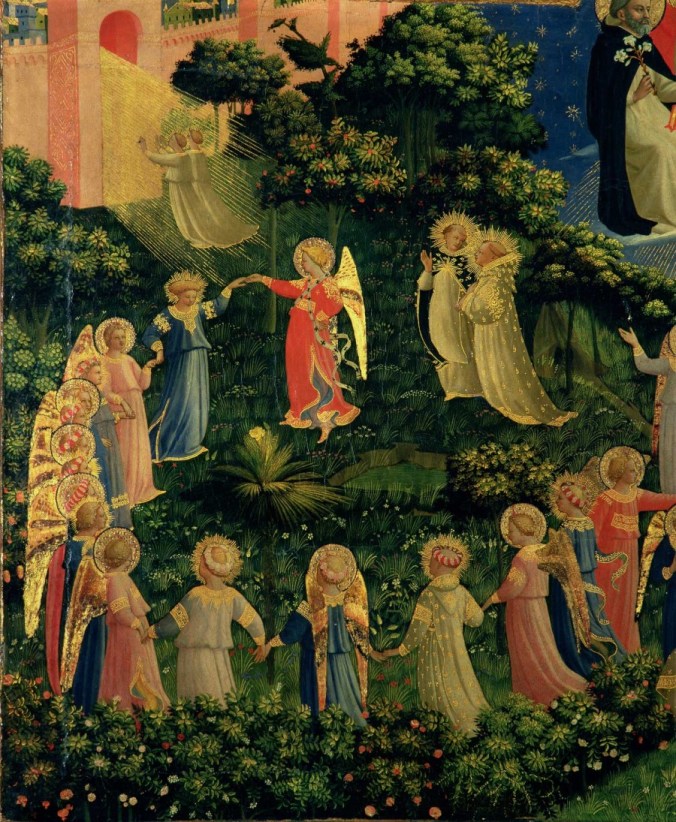
Fra_Angelico_Last_Judgment

Fra Angelico “The Last Judgment” (detail: Paradise)

32nd Sunday in Ordinary Time

Gospel Luke 20:27-38

Meditation Reflection:

As Christians, we profess a belief in life eternal with Christ in Heaven, yet we can sometimes operate in our daily lives forgetful of this mystery. Like the Sadducees we ask Christ silly questions about heaven. When we attach ourselves too much to earthly life, we fall into the trap of imagining heaven as merely an extension of the present but with a few more perks.

Jesus reminds us of the incomparable difference between our journey to God here, and union with God there. As St. Paul says: “But, as it is written,

     ‘What no eye has seen, nor ear heard,

     Nor the heart of man conceived,

     What God has prepared for those who love him,’” (I Corinthians 2:9 RSV).

Even the good things we experience here are merely a prelude to heaven. Here we experience a taste, there we will enjoy the feast.

Jesus proposes to the Sadducees that contemplating the life of the angels can provide some insight into this mystery. Like humans, angels are persons with rational intellects, free will, and the ability to love. Unlike humans they do not have bodies, are neither male nor female, and do not procreate. Each angel was individually created by God and is completely unique, so much so that some have compared it to being like different species from one another. Because they live in eternity, their choices are permanent. When God created them they each had the choice to either accept or reject God’s will for their life and His mission for them. Some said yes to God’s will and others rejected it. Those who rejected God’s will we call the fallen angels or demons. Human persons have more than one moment to choose or reject God, but that space of time does have limits. For us it ends when we die; at which moment our choice becomes permanent.

Consequently, the space of time in which we live on earth really is only a preparation for eternal life. During this short period, we either choose to grow our love for God or develop a disdain for Him. Only during our earthly lifespan can we develop and increase our capacity for God. At the moment of death the opportunity for change ends.

In addition, it’s our chance to aid others in their openness to heaven, even in its most basic form – the beginning of life itself. Whereas God created all of the angels at once, He creates human persons over a course of time and includes them in His work. As a result, openness to having children means openness to God’s creation of persons who will live eternally! For those called to spiritual motherhood or fatherhood, they contribute to this mystery as they minister to the birth and development of the child’s love for God which is also necessary for true life.

The Sadducees’ challenge to Christ with the hypothetical situation of a woman married seven times, merely exposed their ignorance of God. On earth marriage develops our capacity for love, self-gift, and sacrifice. It brings new life into the world as well as caring for the development of each family member. Marriage itself is not needed in heaven because no new life will be born there. It is the eternal life of those who already exist. Moreover, love will be perfected as we enjoy the perfect love of God and one another. The relationship of love experienced in marriage will remain a relationship of love in heaven. However, the title of husband or wife will be eclipsed by the fullness of the title son or daughter of God and sister and brother in Christ.

As the liturgical year comes to a close (Advent marks the beginning of the “New Year” in the Church), we contemplate the end times and remember that this experience of earthly life will eventually come to an end. We all get bogged down in our daily routine and anxious over matters that, if we considered our heavenly destination, shouldn’t really weigh us down. Moreover, we could make better use of our limited time if we consider things from an eternal perspective. This life is a preparation and an opportunity to participate in God’s work of spreading His kingdom. The more souls that come to accept His will and love on earth, the more that will join the wedding feast of love in Heaven for eternity.

Consider:

  • How does a heavenly perspective change your earthly perspective?
  • When feeling discouraged, remember that this life is a journey not the destination. Endless, secure happiness cannot be found here but the work to attain it in heaven can.
  • Through prayer, identify one area where you struggle to accept God’s will over your own.
  • Each angel has a mission from God. You also have a mission. How is God calling you to serve?
  • Consider first God’s vocational calling:
    • Is it to work for the salvation of your spouse through love and sacrifice and to possibly grow the human family by being open to life and to raising children in knowledge and love of the Lord?
    • Is it to administer the sacraments as a priest to bring eternal life to spiritual children?
    • Is it to spend your life in prayer and sacrifice for souls as a religious sister or brother?
    • Is it to devote your time and energy to God in a unique way as a single person, ready to do His will at every moment?
  • Consider next God’s occupational calling: How do you grow your love for God and develop it in others through your work?
    • Consider your special apostolate. Does God include you in His work of physical or emotional healing, protecting, providing, instruction of souls, encouragement, etc.?
    • How can you incorporate a heavenly perspective into your daily work? How do your daily activities and duties provide opportunities to detach from selfishness and develop greater love and compassion? How might you help others to heaven through your work?

Make a Resolution (Practical Application):

  • Begin each day by writing down the tasks, challenges, and opportunities you anticipate that day. Next to each, write one way it can be directed toward helping yourself and others to heaven. For example, will it grow a virtue or minimize a vice if tackled with the help of grace? Is it an opportunity to help others journey to God – either by giving them physical life, sustaining their life, healing, protecting, or developing an aspect of their soul?
  • Identify where your will is most at odds with God’s and do one thing each day to offset it. It could be a refusal or fear to do something God asks of you or an unwillingness to let go of something and trust God in the situation.
  • Pray the Serenity Prayer or the Suscipe of St. Ignatius each day.


~ Written by Angela Lambert Jendro © 2016 and edited © 2019

Follow bar

For additional reading on this topic here are some suggestions below:

They are linked to Amazon.  As a disclaimer, please know that I am an affiliate and do  make a percentage of sales.

The Spiritual Merry-Go-Round

by Angela Jendro

merry-go-round

 30th Sunday in Ordinary Time

Gospel of Luke 18:9-14 NAB

Meditation Reflection:

When we reach out to Christ in our crises, needing a savior, we experience the reality of His saving grace along with the reality of our own weakness.  Together, these produce humility in the soul, a recognition of our dependence on God and His graciousness.  Unfortunately, over time fallen human nature tends to forget the extent of God’s help and exaggerates its own abilities.  Likewise, together, these produce pride in the soul, a false conviction of our own independence.

In the Old Testament, we can find account after account of this cycle with the People of God.  It looks something like this:

  1. They love and obey God and things are going well.
  2. As things go well they begin to attribute it to themselves and grow lax in their fidelity to God.
  3. God warns them to turn back to Him and His help, otherwise on their own they will suffer defeat at the hands of an enemy.
  4. They ignore God’s warning, put their trust in themselves and/or false gods, and a foreign enemy conquers and enslaves them.
  5. They cry out to God in their helplessness and need, realize their mistake, and beg Him to help.
  6. God liberates and restores them.
  7. They love and obey God and things go well….and the cycle starts over.

Most of us can relate to this cycle in our own lives, whether one begins with stage #1, having grown up in the faith before falling away or at #2 trusting in oneself until hitting rock bottom.  Time has a funny way of dulling or obscuring our memories and unless we make a conscious effort to cultivate gratitude and humility we can easily forget our need.  Not only does this diminish our relationship with God but it can also obscure our judgment of others.  Confident in our own success we can dismiss the struggles of others currently working through a spiritual crisis.  In Jesus’ parable, the Pharisee could be described as at stage 2 and the tax collector at stage 5.  From the Pharisee’s vantage point, his forgetfulness of His own redemption led to callousness toward the tax collector’s need.

Pope Francis addressed contemporary examples of this attitude in his book “The Name of God is Mercy.”  He describes what happens when we begin to take grace for granted, noting:

This conduct comes when a person loses a sense of awe for salvation that has been granted to him.  When a person feels a little more secure, He begins to appropriate faculties which are not his own, but which are the Lord’s.  The awe seems to fade, and this is the basis for clericalism or for the conduct of people who feel pure.  What then prevails is a formal adherence to rules and to mental schemes.  When awe wears off, we think we can do everything alone, that we are the protagonists.

He even goes so far as to say he almost wishes the person to fall to produce the greater good of humility. He admits that “The degradation of awe’ is an expression that speaks to me.  At times, I have surprised myself by thinking that a few very rigid people would do well to slip a little, so that they could remember that they are sinners and thus meet Jesus.” (p. 97) Of course he does not wish someone to sin, however a reality check about the true state of our natural weakness and the need for grace many times only comes through the experience of failure.   Just as God allowed the Hebrews to stand on their own and fall in order that they might repent and return, Pope Francis acknowledges that by God allowing a person to stand on their own in virtue (which no one can do well or for long without grace) and fall He reveals a higher truth to them and deepens their conversion.

St. Paul, for instance, attributes his unanswered prayers for a suffering to be alleviated, to God’s efforts to protect Paul from falling to an even greater suffering of pride and self-aggrandizement from the extraordinary graces God had given to him.  God desires us to grow in holiness and reach perfection; surprisingly, that can sometimes mean allowing us to struggle a little so we remain on the right trajectory.

“Therefore, that I might not become too elated, a thorn in the flesh was given to me, an angel of Satan, to beat me, to keep me from being too elated. Three times I begged the Lord about this, that it might leave me, but he said to me, “My grace is sufficient for you, for power is made perfect in weakness.” I will rather boast most gladly of my weaknesses, in order that the power of Christ may dwell with me. Therefore, I am content with weaknesses, insults, hardships, persecutions, and constraints, for the sake of Christ, for when I am weak, then I am strong.“ 2 Corinthians 12:7-10

St. Augustine offers insights as well in his letter to Proba.  Commenting on St. Paul’s words in the above passage, Augustine encourages us that during times of suffering we may pray for God to remove the difficulty but not to despair if God chooses an alternative instead.  The alternative resolution may be greater provisions of His grace that you may endure the trial, rather than its removal after which you might merely return to the illusion of self-sufficiency.

In the kind of affliction, then, which can bring either good or ill, we do not know what it is right to pray for; yet, because it is difficult, troublesome and against the grain for us, weak as we are, we do what every human would do, we pray that it may be taken away from us. We owe, however, at least this much in our duty to God: if he does not take it away, we must not imagine that we are being forgotten by him but because of our loving endurance of evil, must await greater blessings in its place. In this way, power shines forth more perfectly in weakness. These words are written to prevent us from having too great an opinion of ourselves if our prayer is granted, when we are impatient in asking for something that it would be better not to receive; and to prevent us from being dejected, and distrustful of God’s mercy toward us, if our prayer is not granted, when we ask for something that would bring us greater affliction, or completely ruin us through the corrupting influence of prosperity.”

God knows our nature.  He knows our timeless struggle of cycling through humility and pride, gratitude and forgetfulness. Daily prayer and surrender to divine providence provide strong medicine to break the destructive cycle in our own spiritual lives.  Whenever we feel quick to judge or a little too self-sufficient, let us remember back to the times we cried out to our savior and received His mercy and in turn cultivate compassion and empathy for others crying out to our savior from their own needs.  As my mother frequently recites, “But for the grace of God, there go I…”

Consider:

  • When have you cried out to God to save you?  When has God’s grace liberated you from the snares of a sin or vice?
  • In what ways do you rely on God every day? How does His grace continue to transform you and bless you?
  • Is there someone you feel tempted to judge or feel calloused toward rather than compassionate?
  • Can you recognize the above seven stage spiritual cycle in your own life? Was there a point where God helped break the cycle or do you feel you still keep circling?  Which number might describe your current situation?

Make a Resolution (Practical Application):

  • Show compassion toward someone struggling with a sin or vice.  Reach out in a concrete way this week to encourage or strengthen them.
  • Pray the Litany of Humility each day this week.
  • Make a gratitude list of all the things you only have as a result of God’s mercy.


~ Written by Angela Jendro © 2016

Follow bar


Toughening Up

taking up cross

27th Sunday in Ordinary Time

Gospel Luke 17:5-10 NAB

The apostles said to the Lord, “Increase our faith.” The Lord replied, “If you have faith the size of a mustard seed, you would say to this mulberry tree, ‘Be uprooted and planted in the sea,’ and it would obey you.

“Who among you would say to your servant who has just come in from plowing or tending sheep in the field, ‘Come here immediately and take your place at table’? Would he not rather say to him, ‘Prepare something for me to eat. Put on your apron and wait on me while I eat and drink. You may eat and drink when I am finished’? Is he grateful to that servant because he did what was commanded? So should it be with you. When you have done all you have been commanded, say, ‘We are unprofitable servants; we have done what we were obliged to do.’”

Meditation Reflection:

We live in a culture rife with an entitlement attitude. Generation Y-ers get the worst rap for this and to be fair university studies have provided proof of its epidemic. Generation Z is too young to tell for certain but doesn’t appear likely to be much different. (I myself am on the very beginning edge of Gen Y, although I was somewhat sheltered from an entitlement perspective thanks to my mother’s tireless efforts to curb my attitude).

Merriam-Webster defines this attitude as: “the feeling or belief that you deserve to be given something (such as special privileges).” A NY Post article “The worst generation?” from May 10, 2010 cited a University of New Hampshire study which concluded that: “Gen Yers are characterized by a ‘very inflated sense of self’ that leads to ‘unrealistic expectations’ and, ultimately, ‘chronic disappointment.’” ). Granted, not every Gen Yer suffers from an inflated sense of self, it does seem to be a cultural trend and it impacts our relationships and sense of satisfaction at work, in our families, and in our faith.

Because of the effects of Original Sin, we all tend toward a self-centered narcissism and will continue to spiral down if our trajectory isn’t changed by grace, parenting, or other formative agents. Jesus’ interaction with the apostles in this passage reminds me of interactions I’ve had with my own children. When asked to do the dishes, clean a bathroom, or fold laundry I am met with attitudes of “why me?” On other occasions a child of mine actually notices things that need to be done around the house. Rather than simply pitching in and taking care of the problem, they see it as a job opportunity for which they should be rewarded. The conversation looks something like this –

Child: “Mom, what will you give me if I unload the dishes?”

Me.: “Clean dishes on which to eat.”

Child: “Mom, what will you give me if I clean the cat’s litter box?”

Me: “I’ll let you keep having the cat as a pet.”

Child: “Mom, what will you give me if I help with the laundry?”

Me: “Clean clothes.”

Child: “Ackh. Mooooom. Forget it.”

5 mintues later:

Child: “I’m bored.”
Me: “Then do the dishes.”
Child: “That’s boring too. What can I do that’s fun?”

Me: “I’m not your cruise ship captain. Do the dishes and maybe boredom won’t seem like such a bad thing.”

If only we could say our conversations with God didn’t look remarkably similar. How often do we take an entitlement attitude with the Lord? It looks something like “Look Lord, I went to Mass on Sunday! What do I get?” Or, “I put a few dollars in the collection plate, what will you give me?”

The entitlement attitude affects our expectations for the work to reward ratio as well and may be somewhat analogous to the passage for today’s Gospel. The same NY Post article cited another study which summarized the expectations of entitled employees:

According to another study, which will be published in the Journal of Management in September. Co-author Stacy Campbell, an assistant professor of management at Kennesaw State University, says the study revealed that when it comes to work, the two things Gen Yers care most about are a) high salaries, and b) lots of leisure time off the job.

‘They want everything,’ says Campbell. ‘They want the time off. They want the big bucks.’

To reach their conclusions, Campbell and co-author Jean Twenge — a professor of psychology at San Diego State and author of “Generation Me,” a book examining discontent among members of Gen Y — worked over the data from an ongoing survey of high school students conducted annually since 1975 by the University of Michigan. Among their findings was that while both Gen Y and Gen X want sizable salaries, Gen X workers show greater awareness that a hefty paycheck comes with a hefty workload.

As Christians, we ought to evaluate our own expectations of working for the Lord. We can forget that it’s a privilege to work as a laborer for the Lord in bringing in His harvest and that it’s a blessing to have a job. When we feel like complaining, “What do I get for “carrying this cross?”, we can remember that we get to carry a cross. We get to work. We get to be near to Christ in the most intimate and meritorious moment of His work of salvation. We even get to help. We also gain numerous other rewards from carrying our cross and laboring with the Lord, taking His yoke upon our shoulders. Growing up, whenever I would feel sorry for myself or want pity, my mom would respond with a singular word that I detested: “Tough”. Sometimes she would even lengthen her response a little to: “Toughen up”. I loathed these words and swore I would never be so unfeeling toward my own children. Of course, you can guess, there came one fateful day when those same words came issuing from my own mouth in response to my own child’s self-pity moment. I realize now that my mom’s approach helped inoculate me from an entitlement attitude and in fact, made me tougher. In one word she exposed my self-pity for being an “unrealistic expectation” and reset my expectations to something more along the lines of reality. Crosses have a similar effect. Sometimes we whine to God and it feels like He is coldly ignoring our need and simply retorting “tough.” However, sometimes those very crosses strengthen us and enable us to increase in faith as well as hope and love.

If we want the Lord to increase our faith we need not look much further than prayer, sacraments, fellowship, and picking up our cross daily and following Him. Yet, we often expect huge returns for minimal effort. Christ reminds us today that we are blessed to labor in His kingdom. We are blessed to be near Him in the cross. The faith and satisfaction we will gain from hard earned sweat and blood in the field will give a much more satisfying feeling than the superficial reward of a participation trophy.

God provides the supernatural strength we need to follow Him, we just have to adjust our expectations and persevere when things get tough. St. Paul reminds us in second letter to Timothy, that God enables us to toughen up through His grace that we might be courageous and noble:

“Beloved: I remind you, to stir into flame the gift of God that you have through the imposition of my hands. For God did not give us a spirit of cowardice but rather of power and love and self-control… bear your share of hardship for the gospel with the strength that comes from God.” 2Timothy 1:6-8

Consider:

  • What kind of attitude do you have toward God? How has it grown and matured over the years?
  • Reflect on the gift of working side by side with Christ as He brings in the harvest. Jesus says, “the harvest is ready but the laborers are few.” Have you had the chance to be a part of someone’s spiritual journey? How did it feel to see the seeds of faith grow into noble discipleship?
  • In what way could you adjust your expectations of discipleship? Do you suffer from an impulsiveness that needs instant gratification or are you able to delay gratification?
  • My mother’s discipline, though apparently counter-cultural at the time, inoculated me from suffering the poison of entitlement mentality (as much as I tried to get her to cave into the idea!). Who has been courageous enough in your life to lovingly adjust your perspective even if you fought them on it?
  • When have you felt deep satisfaction in work itself rather than the reward at the end? How does this relate to work as a disciple?

Make a Resolution (Practical Application):

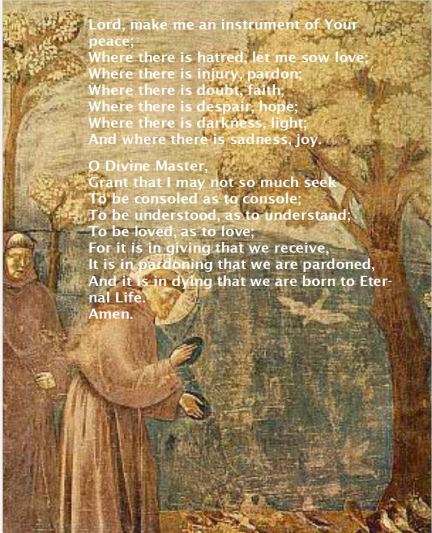
  • Pray and reflect on the prayer of St. Francis this week.
  • Call or write a thank you to someone who has saved you or healed you from an entitlement attitude.
  • If you have children, grandchildren, or work with children, reflect each day on your interactions with them and consider if there is an analogy to your own interactions with the Lord.

~ Written by Angela (Lambert) Jendro © 2016

Follow bar

prayer of st francis

Sometimes the Small Stuff Matters

by Angela Jendro

 25th Sunday in Ordinary Time

Gospel of Luke 16:10-13 NAB

Jesus said to his disciples: “The person who is trustworthy in very small matters is also trustworthy in great ones; and the person who is dishonest in very small matters is also dishonest in great ones. If, therefore, you are not trustworthy with dishonest wealth, who will trust you with true wealth? If you are not trustworthy with what belongs to another, who will give you what is yours? No servant can serve two masters. He will either hate one and love the other, or be devoted to one and despise the other. You cannot serve both God and mammon.”

Meditation Reflection:

Few things of importance are gained overnight with little to no effort. As tempting as the get rich quick scheme can be, it never proves to be reliable or lasting. The temptation appears in many forms but inevitably produces the same results. Diets that promise to drop weight fast only leave you gaining it right back because they don’t involve long-term lifestyle changes. New clothes, cars, or homes you hope will boost your self-confidence leave you with the same empty feeling at night if you haven’t become the person you can be proud of on the inside. Stress might be soothed by pills or substances temporarily, but only the hard work of managing stress through healthy ways will actually change your situation or give you authentic contentment.

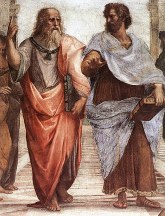
True change comes through the hard, slow, daily process of building character. The Plato and Aristotle_Raphaelphilosopher Aristotle, in his famous book on Ethics, defined virtue as a habit of doing the good. He taught that a person only acquires a virtue after having chosen it regularly over a long period of time and in many circumstances. For instance, if I tell the truth once, it doesn’t make me a truthful person. To say that I have the virtue of honesty means I have told the truth regularly for many years. As Jesus points out in this passage, a person’s character is shown as much, if not more so, in the small matters as in the larger ones. A truthful person will be pained by lying, even in small exaggerations. On the other hand, a person who lies easily about daily matters to avoid responsibility or make things easier, will certainly lie when the stakes are much higher.

It can be tempting to compartmentalize our life, especially our faith life, and not uncommon in our culture for a person to think they can act one way at work, another at home, and another at church. However, our choices become our habits and our character. Like the fast, easy, changes marketed to us, compartmentalization is only a temporary illusion. If you swear around your friends often, you will eventually let a swear word slip at work or in front of your children. If you are dishonest at home with your spouse, you will be dishonest with your boss. We can’t sit in the pew and believe ourselves to be disciples of Christ, if we distort His Gospel the rest of the week by not following Him at work and home too.

Jesus wants to bring us interior peace and this requires being authentic. We build Christian virtues by practicing them daily in all situations. We make choices based on what we care about most. This is why we can’t serve God and the world. Those daily choices build a path one way or the other, like everything else in life. Jesus lived this teaching as well.  He did the Father’s will in everything. Then when in the Garden of Gethsemane He feared His impending crucifixion, He prayed, “Father, if you are willing, take this cup away from me; still, not my will but yours be done” (Luke 22:42).

If we love God and if we truly believe that Jesus is the Way, the Truth, and the Life, then we will try to imitate Christ in every choice no matter where we are. The beautiful result is that the more Christ like you grow, the more He will shine in every work you do. The Church calls this “sanctifying the temporal world.” It may be the slow, difficult, unglamorous path, but it will certainly be more lasting and, thankfully, Jesus gives us His Spirit and grace to help us.

Consider:

  • What virtues would your family or friends confirm that you have already? What kind of person do you try to be?
  • What virtues would you like to acquire that you presently struggle with? How might you begin working on them?
  • In what way do you compartmentalize your faith? Are there places, persons, or circumstances you hide your beliefs or act contrary to your faith?
  • Consider how you might apply Jesus’ teaching to your everyday responsibilities and the people you interact with. Mother Teresa touted the greatness of doing small things with great love. How might you incorporate that into your daily work?
  • Aristotle was right about the necessity of practice to build virtue. However, we often still struggle to overcome our own weakness and we can’t become truly Christ-like without the aid of grace. Consider the power of prayer, reading Scripture, and the sacraments through which the Holy Spirit can strengthen and change your heart.

Make a Resolution (Practical Application):

  • Focus on faithfulness to God in the small matters this week. Be especially diligent in the everyday little tasks or interactions to act Christ-like.

~ Written by Angela Jendro © 2019

Follow bar

How can God be both Justice and Mercy?

by Angela Jendro

24th Sunday in Ordinary Time

Gospel Luke 15:1-32 NAB

Tax collectors and sinners were all drawing near to listen to Jesus, but the Pharisees and scribes began to complain, saying, “This man welcomes sinners and eats with them.” So to them he addressed this parable. “What man among you having a hundred sheep and losing
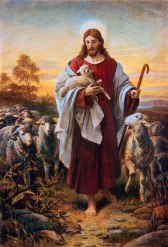
490px-Bernhard_Plockhorst_-_Good_Shephard

by Bernhard Plockhorst

one of them would not leave the ninety-nine in the desert and go after the lost one until he finds it? And when he does find it, he sets it on his shoulders with great joy and, upon his arrival home, he calls together his friends and neighbors and says to them, ‘Rejoice with me because I have found my lost sheep.’ I tell you, in just the same way there will be more joy in heaven over one sinner who repents than over ninety-nine righteous people who have no need of repentance.

“Or what woman having ten coins and losing one would not light a lamp and sweep the house, searching carefully until she finds it? And when she does find it, she calls together her friends and neighbors and says to them, ‘Rejoice with me because I have found the coin that I lost.’ In just the same way, I tell you, there will be rejoicing among the angels of God over one sinner who repents.”

Then he said, “A man had two sons, and the younger son said to his father, ‘Father give me the share of your estate that should come to me.’ So the father divided the property between them. After a few days, the younger son collected all his belongings and set off to a distant country where he squandered his inheritance on a life of dissipation.  When he had freely spent everything, a severe famine struck that country, and he found himself in dire need. So he hired himself out to one of the local citizens who sent him to his farm to tend the swine. And he longed to eat his fill of the pods on which the swine fed, but nobody gave him any. Coming to his senses he thought, ‘How many of my father’s hired workers have more than enough food to eat, but here am I, dying from hunger. I shall get up and go to my father and

552px-Rembrandt_Harmensz_van_Rijn_-_Return_of_the_Prodigal_Son_-_Google_Art_Project

Return of the Prodigal Son By Rembrandt

I shall say to him, “Father, I have sinned against heaven and against you. I no longer deserve to be called your son; treat me as you would treat one of your hired workers.”’ So he got up and went back to his father. While he was still a long way off, his father caught sight of him, and was filled with compassion. He ran to his son, embraced him and kissed him. His son said to him, ‘Father, I have sinned against heaven and against you; I no longer deserve to be called your son.’ But his father ordered his servants, ‘Quickly bring the finest robe and put it on him; put a ring on his finger and sandals on his feet. Take the fattened calf and slaughter it. Then let us celebrate with a feast, because this son of mine was dead, and has come to life again; he was lost, and has been found.’ Then the celebration began. Now the older son had been out in the field and, on his way back, as he neared the house, he heard the sound of music and dancing.  He called one of the servants and asked what this might mean. The servant said to him, ‘Your brother has returned and your father has slaughtered the fattened calf because he has him back safe and sound.’ He became angry,
and when he refused to enter the house, his father came out and pleaded with him. He said to his father in reply, ‘Look, all these years I served you and not once did I disobey your orders; yet you never gave me even a young goat to feast on with my friends. But when your son returns, who swallowed up your property with prostitutes, for him you slaughter the fattened calf.’ He said to him, ‘My son, you are here with me always; everything I have is yours. But now we must celebrate and rejoice, because your brother was dead and has come to life again; he was lost and has been found.’”

Meditation Reflection:

Justice versus mercy. How can God be both? And how can we imitate Him when we need to apply concretely a mystery that surpasses our understanding?

In this Gospel Christ illuminates something of this mystery. First, we should remember that we live in a highly competitive culture. Consequently, we feel justice – giving each person his or her due – is necessary to keep things “fair.” Secondly, as St. Augustine pointed out in The City of God, if we are earthly-minded and focused on building the “city of man”, then we often find ourselves at war with one another as we vie for limited resources.

The resources and goods in the “city of God” however, Augustine notes, are unlimited. Moreover, rather than being reduced when given away they multiply, and rather than being limited to temporary gain, they last eternally.

Our human tendency to want justice applied to others but mercy applied to us, often relates more to our striving to build the city of man rather than the noble cause for justice itself. Justice is important, and God is justice as well as mercy. However, we have to be aware of our own prejudices and since we suffer the effects of original sin, we tend to rationalize our double-standard.

The truth is, when God weighs our own faults and violations of divine and natural law, none of us will be able to balance the scale and achieve a just state. We know God cares about justice because for us to rightly spend eternity with Him, the scale had to be balanced and so He sent His only Son to suffer and die for our sake, to tip the scale for us. By helping us reach a state of justice, He acted mercifully.

To even begin to understand something of this mystery, of the harmony between Justice and Mercy in God, Jesus uses comparisons we can relate to – a shepherd looking for a lost sheep and a woman searching for a coin. In each case you or I may not have cared. They care because they view the sheep and the coin as their belonging. When lost, they were impoverished in some way and in finding it their possessions became complete. We belong to God. You or I may not care about a particular person but God does. He views each human person as His own treasure, and to lose one results in a loss, and to regain that person creates completion.

To clarify and impress this on us further, Jesus follows with the Parable of the Prodigal Son (verses 11-32). Whereas in our work life if an employee or colleague leaves it may be disappointing but that person can be replaced by a new hire and eventually life goes on. We see this in every realm of society – politics, business, entertainment, sports – except one, the family. If a child rebels and leaves his or her family, there remains a hole and a lingering pain for as long as the child remains estranged. The family cannot simply find a replacement and move on with life. It will always feel like a loss and incomplete.

The relationship between justice and mercy therefore can only be understood in light of relationship. In the parable of the prodigal son, the rebellious child left home and eventually experienced the reality of the choices he had made. With the money gone, he finally received his due, and this provoked conversion. When he returned home, repentant and interiorly changed, his father was ecstatic to incorporate him back into the family. The older son, focused on the earthly resources, became bitter at the apparent injustice. It wasn’t fair. Had he viewed it from a spiritual perspective, he would have seen that he had become enrichened. Rather than focusing on the fattened calf he felt he “lost” to the feast of his wayward brother, he ought to have focused on the brother he regained.

The deeper we grow in love, the more we begin to understand God’s ways. Rather than seeing him merely as a judge, we need to see that He is foremost a father. He will do what it takes to keep his family together and to help His children flourish. Fathers and mothers make countless material sacrifices for their children and oftentimes with joy. From the outside others might rightly marvel at how this could be. Those who have children however, know by experience the deeper sense of satisfaction and pleasure one gains from these acts.

When considering justice and mercy, Christ exhorts us to view it in light of being God’s possession, His children, and love.

Consider:

  • Consider the difference between being an employee in comparison to being someone’s child. You are God’s own. You are God’s child.
  • Consider how love moves one to mercy and the more loving persons are, the more merciful they become.
  • Consider how you felt when you received mercy or when you gave mercy.
  • Reflect on how justice and mercy relate with one another. Sometimes being just enables one to be merciful.
  • Spend 5 minutes in silent prayer, just gazing on God who is Justice and Mercy.

Make a Resolution (Practical Application):

  • Pray each day for the conversion of someone who has left the faith. If possible, reach out to him or her through acts of kindness and mercy.
  • In light of the parable of the prodigal son, forgive someone who has returned to you apologetically.
  • If there is someone who has made serious changes (for the better) in his or her life, pray about giving them a second chance and incorporating them back into your life.
  • Practice one corporal work of mercy and one spiritual work of mercy each day this week.


~ Written by Angela Jendro © 2019

Follow bar

Following Christ At All Costs

by Angela M. Jendro

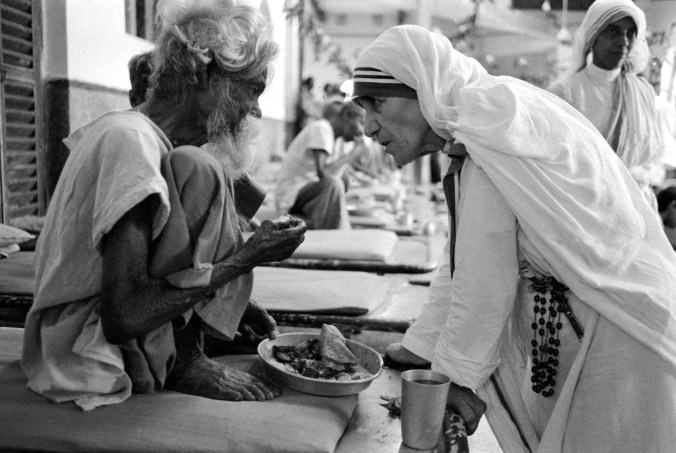
Mother Teresa and the poor in Calcutta, India in October, 1979.

Mother Teresa and the poor in Calcutta, India in October, 1979. Jean-Claude Francolon | Gamma-Rapho | Getty Images

23rd Sunday of Ordinary Time

Gospel Luke 14:25-33 NAB

Great crowds were traveling with Jesus, and he turned and addressed them, “If anyone comes to me without hating his father and mother, wife and children, brothers and sisters, and even his own life, he cannot be my disciple. Whoever does not carry his own cross and come after me cannot be my disciple. Which of you wishing to construct a tower does not first sit down and calculate the cost to see if there is enough for its completion? Otherwise, after laying the foundation and finding himself unable to finish the work the onlookers should laugh at him and say, ‘This one began to build but did not have the resources to finish.’ Or what king marching into battle would not first sit down and decide whether with ten thousand troops he can successfully oppose another king advancing upon him with twenty thousand troops? But if not, while he is still far away, he will send a delegation to ask for peace terms. In the same way, anyone of you who does not renounce all his possessions cannot be my disciple.”

Meditation Reflection:

How can Christ, whose new commandment to us was to “love one another as I have loved you” simultaneously ask that we hate our family members? As we celebrate the feast day of St. Mother Teresa this week, we can look to her example to illuminate this paradox. Jesus’ challenge that “whoever does not carry his own cross and come after Me cannot be my disciple” proved a difficult task and one that required great love, detachment, and grace for Mother Teresa who left her home, her family, and even her beloved convent to serve the poorest of the poor in the streets in India. Jesus rightly warns to count the cost before we set out on a project lest we find ourselves giving up midway. Discipleship calls for a total gift of self, in response to the Lord who made the ultimate gift of self for us through His Incarnation, Death, and Resurrection.

In a perfect world, or at least in heaven, loves do not compete with one another and we aren’t painfully pulled in opposing directions. In our current fallen state however, we come to crossroads where we must choose between two loves. It’s one thing to forsake the love of a material good or a sinful habit, but the hardest love to forsake is that of someone with whom we have a relationship but refuses to share us with Christ and gives us an ultimatum.

This ultimatum may not sound as direct as “it’s me or Christ!” but it will likely pit some aspect of following Christ against something the person wants of you. Following Christ results in a life of sacrifice that’s counter-cultural. Authentic Christians don’t blend in and that bothers people who don’t want to stir the waters. Living your faith, even quietly, can prick the conscience of another and result in lashing out to ease his or her own angst. Similar to Jesus, Christians offer love unconditionally to others. Unfortunately, the same is not always true on the other end and the painful choice between following Christ or making the person you care about happy must be made.

This choice takes as many forms as there are relationships. For a teen it can be a couple breaking up because one chooses purity over promiscuity or being left out of social gatherings because of a refusal to drink. For a young adult it can be a person choosing the religious life despite the discouragement of parents, or moving away from family and friends for a service they are called to by Christ. For parents it can mean getting the silent treatment from a child because you refuse to condone their wrong behavior. For a spouse it can mean suffering the anger of the other because one refuses to compromise living out his or her faith to appease the other’s sin. No one wants a rift in their family – whether between parents, children, or spouses. At the same time not everything is in our control except our own decision to follow the Lord. Navigating these situations can be confusing and spiritual direction should be sought to sort out how to authentically love in particular situations.

Mother Teresa desired to follow Christ and to give her whole life in love to Him. First it meant leaving her family to join the Sisters of Loreto as a nun and serve in India as a teacher. Next, she received her “call within a call” to go out into the streets and serve the poorest of the poor. She was happy as a nun and asked Jesus if she could just serve Him more devoutly in the way she already was. Each time however He repeated His request for her to satiate His thirst for souls by ministering to the poor and destitute. He would ask her each time, “Wouldst thou refuse Me?”

Mother Teresa felt torn between two loves. Her love for the other sisters, her students, and her life in the convent was certainly a noble love, but discipleship called her to follow Christ to a place that meant she would have to choose between the two. Ultimately, Mother Teresa could not surrender her love for Jesus to anything else and so she gave up and gave in to the Lord. As she followed Christ, Mother Teresa surrendered everything to Him – material goods, physical comforts, family, and even the convent walls. She went into the most destitute streets with nothing but a sari and a passion for Jesus.

Contrary to cultural demands, Christians cannot compartmentalize their faith. We are followers of Christ at church, at home, at work, when alone, or when with friends. We have to be prepared that some people, even some we for whom we care deeply, may not tolerate our discipleship and choose to leave us. In these instances, we can look to Christ for the grace and grit to carry our cross, a cross which He promises will end in a resurrection.

This Sunday, may we count the cost and, with the grace of Christ, decide to follow Him to the end. The joy of Mother Teresa, and the light of love and mercy her life became, serves as a witness for us of the glorious destination of discipleship – a project worth completing!

Consider:

  • Are you a disciple of Christ? If the answer is yes, what moves you to love Him and to follow Him? If the answer is no or not yet, what attracts you about Christ or piques your curiosity?
  • In what ways has discipleship caused you to live counter-culturally? Has it strained any of your relationships?
  • How has carrying your cross produced resurrections and blessings in your life? What have been some of the fruits of your discipleship?
  • What cross are you carrying right now? In what way does it resemble Jesus’ cross? How does it bring you closer to Him as you share in His experience?
  • It feels good to accomplish something hard that required grit and perseverance. Consider how it will feel to “finish the race” as St. Paul says, and to have followed Christ (with the help of His grace) to the end.

Make a Resolution (Practical Application):

Follow bar

The Fork In The Road For Every Christian

by Angela Jendro

fork in the road

20th Sunday in Ordinary Time

Gospel Luke 12:49-53 NAB

Jesus said to his disciples: “I have come to set the earth on fire, and how I wish it were already blazing! There is a baptism with which I must be baptized, and how great is my anguish until it is accomplished! Do you think that I have come to establish peace on the earth?  No, I tell you, but rather division. From now on a household of five will be divided, three against two and two against three; a father will be divided against his son and a son against his father, a mother against her daughter and a daughter against her mother, a mother-in-law against her daughter-in-law and a daughter-in-law against her mother-in-law.”

Meditation Reflection:

Imagine someone else saying the same words as Jesus did.  You might accuse them of not being very Christian.  Isn’t Jesus the Prince of Peace?  Isn’t He the nicest guy there ever was?  Aren’t Christians supposed to be nice people? Yet, Jesus exclaimed with great passion His eagerness to set the world ablaze.  This doesn’t seem to fit the sandal-wearing, nice, historical moral teacher image our culture likes to portray Jesus as.

fire pic

Jesus does bring peace, but not a superficial conciliation. He came to defeat sin and redeem mankind, accomplished through His own baptism of the Cross, one that caused Him great “anguish until it is accomplished.Fire purifies and destroys.  Christ came to set fire to sin, to destroy its corrupting influence in our lives, and to make room for life in God.  That battle begins within ourselves and extends to sin outside ourselves.  Purification can burn, but at the end of the process one feels liberated and empowered. To ignite this fire and make our purification possible, Christ knew He had to suffer and die first – something that caused Him distress as He waited in anticipation.

As disciples of Christ, we share in both His rewards and His suffering.  Christ’s words about causing division seem shocking.  Isn’t He supposed to bring unity and harmony? Jesus offers unity, but not everyone accepts it.  Note that although Jesus often ate with sinners, not every sinner chose to eat with Him and several found His witness challenging enough that they tried to silence Him altogether by crucifying Him.

I often quote G.K. Chesterton who said, “The Christian ideal has not been tried and found wanting. It’s been found difficult; and left untried.”  At the fork in the road therefore, where one mfork in the road 2ust choose the path of discipleship or the path of least resistance, Christians must resolve and accept that as they walk to the left after Christ, some of their closest companions may walk to the right instead and their paths will separate.  Although Christians, like Christ, ought to keep the door open to those friendships, oftentimes living our faith can mean losing some relationships.  Jesus is Goodness, Truth, and Love.  Yet, He was rejected by many.  As we strive to be more Christ-like, we have to prepare ourselves for the same experience.

Even in the Old Testament, authentic prophets consistently experienced rejection and suffering.  The community they came to help change would pressure them to conform instead.  When God’s prophets refused, they found themselves exiled or running from death threats.  The first reading for this Sunday’s liturgy provides an evocative image of this from the life of Jeremiah:

“And so they took Jeremiah and threw him into the cistern of Prince Malchiah…There was no water in the cistern, only mud, and Jeremiah sank into the mud.” Jeremiah 38:6

stuck in the mud

This image strikes me because of the several analogous experiences I can think of in my own life.  Jeremiah acts in truth and love only to be thrown into a pit.  The mud makes the image even better as a symbol of the depressive reality of ones you love rejecting Christ (and you) in favor of persisting in their sins.  When Jeremiah “sank into the mud,” I am reminded of the feeling of helplessness and despair that can discourage me in these moments. Thankfully, Jeremiah did not remain in the mud forever, Jesus’ death was followed by His resurrection, and God will lift us up too.  David expresses this in Psalm 40:2

“The LORD heard my cry. He drew me out of the pit of destruction, out of the mud of the swamp; he set my feet upon a crag; he made firm my steps.”

Walking the path of discipleship may take you down a different road than some of the persons you love.  You might experience the pain of division and loss, not because you didn’t invite them along but because they refuse to come with you.  This fork in the road can come in many different forms at different times in our lives.  Choosing between following Christ and following someone we love is as painful as fire.

Our contemporary culture adds even more pressure.  It seems more rare these days to find people who can be friends even though they have different views and beliefs. Instead, the attitude appears to be that one must condone the decisions of another or they can’t be friends.

Discipleship may be difficult but in the end Christ conquers all.  He can provide the guidance to achieve the tricky balance of loving others without condoning sin, as well as the humility to be receptive to the hard truth about our own sins a Christian friend might challenge.  Every person must make a choice and, praise be to Christ, He provides us with the grace and the guts we will need to follow Him no matter the cost.

Have you had a similar experience?  If you’d be willing to share, write a short account of your fork in the road in the comment section below!

that you and I may be mutually encouraged by one another’s faith, yours and mine. Romans 1:12

Consider:

  •  How has Christ set your heart on fire?
    • How has He purified it?
    • How has that purification made you more zealous and joyful?
  • Has living out your Christian faith ever caused you to experience persecution from persons you care about?
    • In what ways did it feel like you were sinking into a pit of mud?
    • In what ways did God lift you up from the pit and set you on rock?
  • Who are your true friends who accept you as you are, complete with respect for your beliefs?
  • Have you ever been the one doing the persecuting or rejecting? Consider why we find it difficult to be around people who challenge us to be better simply by the way they are living their own lives.
  • Are there persons with whom you struggle to be an authentic Christian around? Do you live your faith at work or out with friends, or do you hide it so they won’t think differently about you?

Make a Resolution (Practical Application):

  • Pray Psalm 40 each day this week.
  • Resolve to let your faith be seen in some small way, especially in a place where you usually lack the courage. (e.g. wearing a cross necklace, having a small crucifix or rosary on your desk, writing favorite bible verses on notecards and placing them in places you will see – whether in your work space or at home, walking away from conversations that disparage the faith or other persons, etc.)

~ Written by Angela Jendro © 2019

Follow bar


Eyes Wide Open

Ascension of Christ_ Getty Images

Ascension of Christ: Getty Images

by Angela M Jendro

 19th Sunday in Ordinary Time

Gospel of Luke 12:35-40 NAB

“Jesus said to His disciples: ‘Gird your loins and light your lamps and be like servants who await their master’s return from a wedding, ready to open immediately when he comes and knocks. Blessed are those servants whom the master finds vigilant on his arrival. Amen, I say to you, he will gird himself, have them recline at table, and proceed to wait on them. And should he come in the second or third watch and find them prepared in this way, blessed are those servants. Be sure of this: if the master of the house had known the hour when the thief was coming, he would not have let his house be broken into. You also must be prepared, for at an hour you do not expect, the Son of Man will come.’”

Meditation Reflection:

Jesus emphasized the need for disciples to be vigilant. According to Wordbook, vigilant means to be “carefully observant or attentive; on the lookout for possible danger.” Discipleship can suffer from the same waning of enthusiasm as any of our other noble goals. How many New Year’s diets or exercise plans end by February? How many books are left only partially read? How many friendships or relationships wither from slow neglect? Jesus exhorts us to head off dangers to our faith by being aware and making efforts to protect ourselves from them. Discipleship requires the same perseverance, effort, and watchfulness as anything else we hope to accomplish and maintain.

Similarly, the same strategies to keep healthy habits can be applied to discipleship. For instance, to achieve the goal of getting in shape, partnering with a friend for accountability will greatly increase your chance of success. Discipleship requires fellowship as well. We need faith-filled friends to keep us accountable, inspire us to be better, and keep us in the habit of prayer and worship. To achieve the goal of developing your mind through reading, you will need to choose a time, place, and frequency or it will never happen. Forming a book club can also provide that boost of a deadline to motivate you. Similarly, to grow nearer to Christ you will need to read Scripture regularly. The same pitfalls apply here so being vigilant about sticking to a routine will be important and joining a bible study could be motivating.

The synonym for vigilance illuminates the essence of discipleship as well: “open-eyed.” Thus, Jesus exhorts us to keep our eyes of faith open to judge things from the perspective of faith rather than the world. In Hebrews 1:1, St. Paul defines faith as: “the assurance of things hoped for, the conviction of things not seen” (RSV). He goes on to illustrate this with the example of Abraham who left for a land God promised without any sight of it beforehand – no map, no appraisal or inspection, no google images – only God’s word. Moreover, after having received a son despite he and Sarah’s old age, Abraham was willing to sacrifice Isaac at God’s command. Imagine the paradox presented to Abraham. God had promised Abraham many descendants through Isaac, and yet God also asked Abraham to sacrifice Isaac. How could both of these things be true at the same time? Abraham could find no assurance in natural reason or human experience and power. Abraham merited the title Father of Faith by his response. St. Paul relates, “[Abraham] considered that God was able to raise men even from the dead; hence, figuratively speaking, he did receive him back” (Hebrews 11:19 RSV). Abraham had confidence that God is all-powerful and that God keeps His promises. He didn’t limit God to our human experience. He trusted God and proved his conviction when he risked everything to be obedient to the Lord.

How can we imitate the vigilant, open-eyed faith of Abraham? Every day we need to open our eyes through prayer. We need to ask for the gift of faith and trust. We must stay sharp through fellowship with faithful Christians and spiritual reading. We need to deepen our trust through developing our relationship with Christ and receiving His grace in the sacraments. Finally, many saints and spiritual writers suggest doing an examination of conscience every night. Look back on the day and evaluate your choices. When did you show love for God and for others? What temptations did you overcome? What inspirations of the Holy Spirit did you follow? Secondly, where did you lean on your own understanding instead of God’s? When did you relax into thinking and acting like a child of the world rather than a child of God? What choices were motivated by a lack of faith, hope, or charity? Ask God for forgiveness and an increase in grace to do better the next day.

Even if the end of the day doesn’t work for you, try to at least be more introspective throughout the day. Jesus warned “Be sure of this, if the master of the house had known the hour when the thief was coming, he would not have let his house be broken into.” Sins can make little strongholds in our soul if we are not vigilant in identifying them and putting them before the Lord for healing. We never know when we will be attacked by temptation and sometimes it can be very subtle. By developing a habit of staying alert we will be better prepared to avoid or overcome them.

If we vigilantly live in faith, our hearts will be stay open to receive Christ and to respond to the promptings of His Spirit. A habit of holiness characteristic of the saints is their awareness of God’s presence and activity throughout their day. They also witness fidelity to the Spirit when called to serve in a way that makes no sense from a practical perspective unless God is real, all-powerful, and keeps His promises. Like Abraham, the Father of Faith, they have confidence that if God is asking then God will provide. If therefore we seek first His kingdom, we can be assured that everything else will be taken care of (Matthew 6:33), and quite often in ways we could not have foreseen.

Consider many people’s demand to “see it to believe it.” Yet, Jesus says “Come, and you will see” (John 1:39) Faith means walking with Christ, and in that walk your experience will confirm the faith you embarked upon. It entails some risk which is why encouragement from other believers’ experiences is an essential part of vigilance. I still struggle to patiently trust God, but at the same time I have seen God act so many times in my life that I can say I believe it because I’ve seen it. I just need to recall those times to strengthen my faith when it’s difficult. Consider how often in the Scriptures it exhorts the audience to recall a mighty work of God in the past to keep them strong in the present.

I have seen God provide over and again, always in unexpected ways, and just at the right time. He has done this at every level – family, relationships, work, finances, and health. Even though it’s easier to trust the wisdom of the world or our own strength which we can see right before us, we ought to vigilantly keep our eyes open to the wisdom and strength of our loving God which is far more reliable. He is coming, and it will be a day of great rejoicing we won’t want to miss!

Consider:

  • Reflect on what practices have deepened your faith and helped you grow as a disciple of Christ.
  • Consider where you need further growth. Pray about how you could be more vigilant in that area.
  • Meditate on the words Jesus told St. Faustina to have written below His image: “Jesus I trust in You.”
  • Reflect with gratitude on a time(s) when God came through for you in a surprising or powerful way.
  • Is there a part of your life that needs more trust in Jesus? Pray for an increase in faith and hope.

Make a Resolution (Practical Application):

  • Choose one way to be more vigilant in your faith life. Share your goal with someone who will encourage you and keep you accountable.
  • Pray the short prayer, “Jesus I trust in You” several times each day.
  • Pray Psalm 27 each day this week.

~ Written by Angela Jendro © 2019

Follow bar

Suggested Reading: 

Abandonment to Divine Providence by Fr. Jean Pierre de Caussade

33 Days to Merciful Love: by Fr. Michael Gaitley

Catholic Bible: Revised Standard Version, Compact Edition