Get your own published papercopy of this year’s guided meditations!

Hi Everyone!Take Time For Him Book cover

By God’s grace, I have finally published a book of guided Scripture meditations for this year!  Check out Take Time For Him: Simple, Soulful Gospel Meditations to Ignite the Busy Person’s Spiritual Life on Amazon!  

ORDER YOUR OWN COPY TO PRAY WITH!  Highlight passages you love and freely write notes and thoughts in the margins.  Keep on your shelf to look back and reflect on your year with the Lord.

This is my first book on Amazon, so please RATE and REVIEW it so more people can find it as they search for prayer tools.  If you feel moved to, please SHARE it on your social media page.

My hope is for us to grow in prayer together. I will be praying for you, and please pray for me!

Thank you all for your encouragement and requests over the years.  The idea came from a reader and each time I was tempted to quit the attempt, another reader would reach out with encouraging words at just the right moment.  This book is an effort to serve you better and to, through Christ, “continually offer up a sacrifice of praise to God.” (Hebrews 13:15 RSV)

May God embrace you in His Divine Love,

+Angela M. Jendro 


*I am also an amazon affiliate, so by clicking the link on this page I earn additional proceeds from the book.

Toughening Up

taking up cross

27th Sunday in Ordinary Time

Gospel Luke 17:5-10 NAB

The apostles said to the Lord, “Increase our faith.” The Lord replied, “If you have faith the size of a mustard seed, you would say to this mulberry tree, ‘Be uprooted and planted in the sea,’ and it would obey you.

“Who among you would say to your servant who has just come in from plowing or tending sheep in the field, ‘Come here immediately and take your place at table’? Would he not rather say to him, ‘Prepare something for me to eat. Put on your apron and wait on me while I eat and drink. You may eat and drink when I am finished’? Is he grateful to that servant because he did what was commanded? So should it be with you. When you have done all you have been commanded, say, ‘We are unprofitable servants; we have done what we were obliged to do.’”

Meditation Reflection:

We live in a culture rife with an entitlement attitude. Generation Y-ers get the worst rap for this and to be fair university studies have provided proof of its epidemic. Generation Z is too young to tell for certain but doesn’t appear likely to be much different. (I myself am on the very beginning edge of Gen Y, although I was somewhat sheltered from an entitlement perspective thanks to my mother’s tireless efforts to curb my attitude).

Merriam-Webster defines this attitude as: “the feeling or belief that you deserve to be given something (such as special privileges).” A NY Post article “The worst generation?” from May 10, 2010 cited a University of New Hampshire study which concluded that: “Gen Yers are characterized by a ‘very inflated sense of self’ that leads to ‘unrealistic expectations’ and, ultimately, ‘chronic disappointment.’” ). Granted, not every Gen Yer suffers from an inflated sense of self, it does seem to be a cultural trend and it impacts our relationships and sense of satisfaction at work, in our families, and in our faith.

Because of the effects of Original Sin, we all tend toward a self-centered narcissism and will continue to spiral down if our trajectory isn’t changed by grace, parenting, or other formative agents. Jesus’ interaction with the apostles in this passage reminds me of interactions I’ve had with my own children. When asked to do the dishes, clean a bathroom, or fold laundry I am met with attitudes of “why me?” On other occasions a child of mine actually notices things that need to be done around the house. Rather than simply pitching in and taking care of the problem, they see it as a job opportunity for which they should be rewarded. The conversation looks something like this –

Child: “Mom, what will you give me if I unload the dishes?”

Me.: “Clean dishes on which to eat.”

Child: “Mom, what will you give me if I clean the cat’s litter box?”

Me: “I’ll let you keep having the cat as a pet.”

Child: “Mom, what will you give me if I help with the laundry?”

Me: “Clean clothes.”

Child: “Ackh. Mooooom. Forget it.”

5 mintues later:

Child: “I’m bored.”
Me: “Then do the dishes.”
Child: “That’s boring too. What can I do that’s fun?”

Me: “I’m not your cruise ship captain. Do the dishes and maybe boredom won’t seem like such a bad thing.”

If only we could say our conversations with God didn’t look remarkably similar. How often do we take an entitlement attitude with the Lord? It looks something like “Look Lord, I went to Mass on Sunday! What do I get?” Or, “I put a few dollars in the collection plate, what will you give me?”

The entitlement attitude affects our expectations for the work to reward ratio as well and may be somewhat analogous to the passage for today’s Gospel. The same NY Post article cited another study which summarized the expectations of entitled employees:

According to another study, which will be published in the Journal of Management in September. Co-author Stacy Campbell, an assistant professor of management at Kennesaw State University, says the study revealed that when it comes to work, the two things Gen Yers care most about are a) high salaries, and b) lots of leisure time off the job.

‘They want everything,’ says Campbell. ‘They want the time off. They want the big bucks.’

To reach their conclusions, Campbell and co-author Jean Twenge — a professor of psychology at San Diego State and author of “Generation Me,” a book examining discontent among members of Gen Y — worked over the data from an ongoing survey of high school students conducted annually since 1975 by the University of Michigan. Among their findings was that while both Gen Y and Gen X want sizable salaries, Gen X workers show greater awareness that a hefty paycheck comes with a hefty workload.

As Christians, we ought to evaluate our own expectations of working for the Lord. We can forget that it’s a privilege to work as a laborer for the Lord in bringing in His harvest and that it’s a blessing to have a job. When we feel like complaining, “What do I get for “carrying this cross?”, we can remember that we get to carry a cross. We get to work. We get to be near to Christ in the most intimate and meritorious moment of His work of salvation. We even get to help. We also gain numerous other rewards from carrying our cross and laboring with the Lord, taking His yoke upon our shoulders. Growing up, whenever I would feel sorry for myself or want pity, my mom would respond with a singular word that I detested: “Tough”. Sometimes she would even lengthen her response a little to: “Toughen up”. I loathed these words and swore I would never be so unfeeling toward my own children. Of course, you can guess, there came one fateful day when those same words came issuing from my own mouth in response to my own child’s self-pity moment. I realize now that my mom’s approach helped inoculate me from an entitlement attitude and in fact, made me tougher. In one word she exposed my self-pity for being an “unrealistic expectation” and reset my expectations to something more along the lines of reality. Crosses have a similar effect. Sometimes we whine to God and it feels like He is coldly ignoring our need and simply retorting “tough.” However, sometimes those very crosses strengthen us and enable us to increase in faith as well as hope and love.

If we want the Lord to increase our faith we need not look much further than prayer, sacraments, fellowship, and picking up our cross daily and following Him. Yet, we often expect huge returns for minimal effort. Christ reminds us today that we are blessed to labor in His kingdom. We are blessed to be near Him in the cross. The faith and satisfaction we will gain from hard earned sweat and blood in the field will give a much more satisfying feeling than the superficial reward of a participation trophy.

God provides the supernatural strength we need to follow Him, we just have to adjust our expectations and persevere when things get tough. St. Paul reminds us in second letter to Timothy, that God enables us to toughen up through His grace that we might be courageous and noble:

“Beloved: I remind you, to stir into flame the gift of God that you have through the imposition of my hands. For God did not give us a spirit of cowardice but rather of power and love and self-control… bear your share of hardship for the gospel with the strength that comes from God.” 2Timothy 1:6-8

Consider:

  • What kind of attitude do you have toward God? How has it grown and matured over the years?
  • Reflect on the gift of working side by side with Christ as He brings in the harvest. Jesus says, “the harvest is ready but the laborers are few.” Have you had the chance to be a part of someone’s spiritual journey? How did it feel to see the seeds of faith grow into noble discipleship?
  • In what way could you adjust your expectations of discipleship? Do you suffer from an impulsiveness that needs instant gratification or are you able to delay gratification?
  • My mother’s discipline, though apparently counter-cultural at the time, inoculated me from suffering the poison of entitlement mentality (as much as I tried to get her to cave into the idea!). Who has been courageous enough in your life to lovingly adjust your perspective even if you fought them on it?
  • When have you felt deep satisfaction in work itself rather than the reward at the end? How does this relate to work as a disciple?

Make a Resolution (Practical Application):

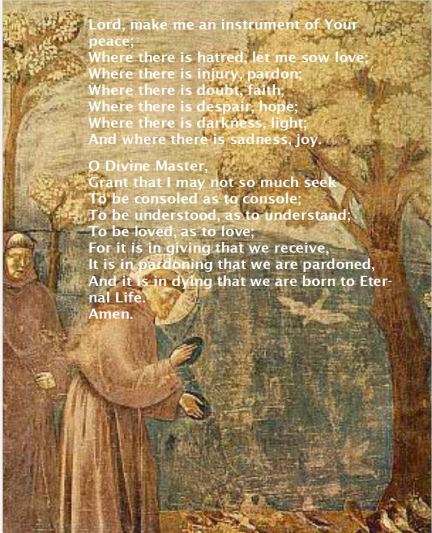
  • Pray and reflect on the prayer of St. Francis this week.
  • Call or write a thank you to someone who has saved you or healed you from an entitlement attitude.
  • If you have children, grandchildren, or work with children, reflect each day on your interactions with them and consider if there is an analogy to your own interactions with the Lord.

~ Written by Angela (Lambert) Jendro © 2016

Follow bar

prayer of st francis

Christ in the Distressing Disguise of the Poor at our Doorstep

by Angela Jendro

26th Sunday in Ordinary Time

Gospel of Luke 16:19-31 NAB

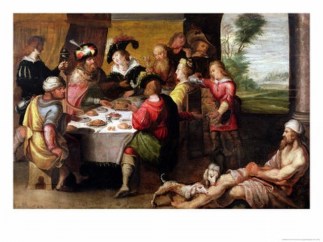
Jesus said to the Pharisees: “There was a rich man who dressed in purple garments and fine linen and dined sumptuously each day. And lying at his door was a poor man named  lazarusLazarus, covered with sores, who would gladly have eaten his fill of the scraps that fell from the rich man’s table. Dogs even used to come and lick his sores. When the poor man died, he was carried away by angels to the bosom of Abraham. The rich man also died and was buried, and from the netherworld, where he was in torment, he raised his eyes and saw Abraham far off and Lazarus at his side. And he cried out, ‘Father Abraham, have pity on me. Send Lazarus to dip the tip of his finger in water and cool my tongue, for I am suffering torment in these flames.’ Abraham replied, ‘My child, remember that you received what was good during your lifetime while Lazarus likewise received what was bad; but now he is comforted here, whereas you are tormented. Moreover, between us and you a great chasm is established to prevent anyone from crossing who might wish to go from our side to yours or from your side to ours.’ He said, ‘Then I beg you, father, send him to my father’s house, for I have five brothers, so that he may warn them, lest they too come to this place of torment.’ But Abraham replied, ‘They have Moses and the prophets. Let them listen to them.’ He said, ‘Oh no, father Abraham, but if someone from the dead goes to them, they will repent.’ Then Abraham said, ‘If they will not listen to Moses and the prophets, neither will they be persuaded if someone should rise from the dead.’”
Meditation Reflection:

Pope St. John Paul II often said that self-fulfillment and happiness can only be found in self-gift. This paradoxical truth flies in the face of our cultural idolization of individualism summarized in mottos such as “looking out for number 1” or “YOLO – you only live once.” We often ignore the needs of those right in front of us. Like Lazarus who lay at the rich man’s doorstep, we often ignore family members who live within our own home or are only a phone call away.

In truth, we all need community for some things, and individualism can even undermine the needs of the individual. The rich man thought Lazarus was insignificant, but Lazarus had a role in his long term prosperity. I came across an interesting connection in an article by Pierre Manent in First Things magazine (“Repurposing Europe” April, 2016). Manent reflected on the current state of political life in France from which any of us who live in Western culture could learn. He observed that the historic move from Christendom to Nationalism has now been superseded by a move from Nationalism to Individualism. Moreover, in a secular culture, the problem has been compounded by a lack of belief/reliance on divine providence. In consequence, he asserted, France struggles with “a growing incapacity to propose goals for common action.” Because of the “great withdrawal of loyalty from the community,” a society united merely by individual rights lacks the “capacity to gather and direct our powers, to give our common life form and force.”

Manent’s observations of his own French history has some application to the American experience as well. Hyper-individualism, secularism, and a world-view that lacks an eternal horizon creates its own set of problems. There are problems that are too big for us as individuals and require a unified effort which is only possible with a common view of the good and willingness to sacrifice for it. There are also problems that are too big for us as a nation and can only be approached with a confidence in divine providence and the aid of a God who “protects the resident alien, comes to the aid of the orphan and the widow, but thwarts the way of the wicked” (Psalm 146:9).

Christ’s words exhort us in a special way to look beyond ourselves and to discover that our own happiness requires concern for the well-being of others. Jesus did not scold the rich man for fine dinners, He scolded him for ignoring Lazarus – who was sitting on his doorstep – while eating that dinner. The cold-heartedness and lack of compassion for the suffering of another person fails to fit us for heaven – a place of perfect love and communion with God and all the saints.

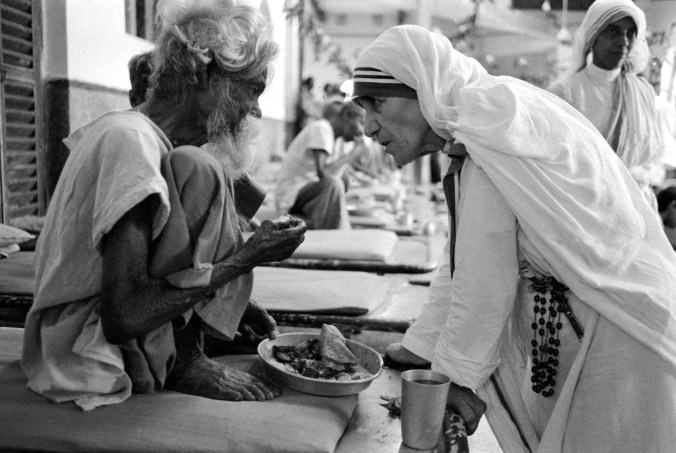
Mother Teresa, famous for her compassion for the poor and recently canonized, advised us all to serve the poor in our own families and to comfort those in our own life who suffer spiritually, emotionally, or physically.  She found Christ in “the distressing disguise of the poorest of the poor.” Sometimes we might hesitate to look too closely because it can be quite distressing. We’d rather accept the fake smile and the rote response “I’m fine” than dig deeper. St. Mother Teresa acknowledges, “It is easy to love the people far away.  It is not always easy to love those close to us.  Bring love into your home, for this is where our love for each other must start.” I am challenged by this often as a teacher and a mother. However, I pray for the grace to “cast out into the deep” (Luke 5:4), encouraged and convicted by Christ’s words that “whatever you did for one of these least brothers of mine, you did for Me” (Matthew 25:40).

We grow our capacity to love on earth. People often complain about how mean it is that God would “send someone to Hell.” In reality, individuals send themselves there. God has made hell out of mercy that we might have the freedom to choose Him or reject Him, to choose Love or to reject Love. We can see a glimpse of this in the differing experiences of people at the same event. Sacrificing time to serve the needs of another will either bring you joy or pain depending on your disposition. For example, with my first child, I had difficulty adjusting at first to the constant needs which thwarted at every moment whatever I wanted to do at the time (even doing the dishes!). At one point I felt like I could literally feel the fires of purgatory burning away my self-will as I stopped what I was doing to tend to his interrupting need. The experience made me realize just how attached I actually was to my own desires and plans. Thankfully, God’s grace and love for my children helped me to grow and detach. I still struggle with impatience sometimes but I have a lot more peace now and enjoy my new priorities. I have learned by experience that I was trading something less valuable for something much more valuable. Rather than losing an opportunity I had been given the greatest opportunity:

“Then Jesus said to his disciples, ‘Whoever wishes to come after me must deny himself, take up his cross, and follow me. For whoever wishes to save his life will lose it, but whoever loses his life for my sake will find it. What profit would there be for one to gain the whole world and forfeit his life? Or what can one give in exchange for his life? For the Son of Man will come with his angels in his Father’s glory, and then he will repay everyone according to his conduct.” Matthew 16:24-27


Let us continue to renew our efforts to share our joys with others and to invite them to our feast. Let’s keep practicing the works of mercy and praying for God to open our eyes to the needs of those around us. I like to ask Mary’s intercession for this particular request because she especially showed compassion and insight toward the needs of others during her life (consider the Wedding Feast at Cana). Comforting the sorrowful, counseling the doubtful, and feeding the hungry can be met in a simple family meal together. Kids soak up stability and comfort around the kitchen counter and something as simple as dinner or making banana bread can provide peace for their souls.

We accept God or reject God here, in this life and You Only Live Once. I’ll close with this story of St. Martin of Tours surprising encounter with the Lord and his example of the right choice:

Even in the military Martin attempted to live the life of a monk. Though he was entitled to a servant because he was an officer, he insisted on switching roles with his servant, cleaning the servant’s boots instead of the other way around!

It was on this garrison duty at Amiens that the event took place that has been portrayed in art throughout the ages. On a bitterly cold winter day, the young tribune Martin rode through the gates, probably dressed in the regalia of his unit — gleaming, flexible armor, ridged helmet, and a beautiful white cloak whose upper section was lined with lambswool. As he approached the gates he saw a beggar, with clothes so ragged that he was practically naked. The beggar must have been shaking and blue from the cold but no one reached out to help him. Martin, overcome with compassion, took off his mantle. In one quick stroke he slashed the lovely mantle in two with his sword, handed half to the freezing man and wrapped the remainder on his own shoulders. Many in the crowd thought this was so ridiculous a sight that they laughed and jeered but some realized that they were seeing Christian goodness. That night Martin dreamed that he saw Jesus wearing the half mantle he had given the beggar. Jesus said to the angels and saints that surrounded him, “See! this is the mantle that Martin, yet a catechumen, gave me.” When he woke, it was the “yet a catechumen” that spurred Martin on and he went immediately to be baptized. He was eighteen years old.” (http://www.catholic.org/saints/saint.php?saint_id=81)

Consider:

  • Why do the poor “distress” us? What do we worry will happen if we reach out?
  • Who are the poor at your doorstep? Children with many needs, a relative or colleague going through a difficult time, someone struggling with sorrow or mental illness, someone dealing with a chronic illness, a new employee or colleague who is overwhelmed and needing a little mentoring or a word of encouragement…
  • When serving others, what is most difficult for you to give up?
  • When have you experienced that “in giving you received”? Have you found that when you took a leap of faith and made a gift of self through sacrifice you actually found fulfillment and joy?
  • We all have different gifts to put at the service of the Lord. Consider and pray about what your gifts are and how you might use them more. (Some ideas: encouraging, teaching, healing, serving, financial giving, leadership, administrating, prayer and fasting, offering up suffering, understanding, hospitality…)

Make a Resolution (Practical Application):

  • Make a list of all the people in your life and one need for each. Every day this week meet a need of at least one or two people on that list.
  • Read about the life of a saint each day. They provide concrete examples for us of love in action.


~ Written by Angela Jendro © 2019

Follow bar


Following Christ At All Costs

by Angela M. Jendro

Mother Teresa and the poor in Calcutta, India in October, 1979.

Mother Teresa and the poor in Calcutta, India in October, 1979. Jean-Claude Francolon | Gamma-Rapho | Getty Images

23rd Sunday of Ordinary Time

Gospel Luke 14:25-33 NAB

Great crowds were traveling with Jesus, and he turned and addressed them, “If anyone comes to me without hating his father and mother, wife and children, brothers and sisters, and even his own life, he cannot be my disciple. Whoever does not carry his own cross and come after me cannot be my disciple. Which of you wishing to construct a tower does not first sit down and calculate the cost to see if there is enough for its completion? Otherwise, after laying the foundation and finding himself unable to finish the work the onlookers should laugh at him and say, ‘This one began to build but did not have the resources to finish.’ Or what king marching into battle would not first sit down and decide whether with ten thousand troops he can successfully oppose another king advancing upon him with twenty thousand troops? But if not, while he is still far away, he will send a delegation to ask for peace terms. In the same way, anyone of you who does not renounce all his possessions cannot be my disciple.”

Meditation Reflection:

How can Christ, whose new commandment to us was to “love one another as I have loved you” simultaneously ask that we hate our family members? As we celebrate the feast day of St. Mother Teresa this week, we can look to her example to illuminate this paradox. Jesus’ challenge that “whoever does not carry his own cross and come after Me cannot be my disciple” proved a difficult task and one that required great love, detachment, and grace for Mother Teresa who left her home, her family, and even her beloved convent to serve the poorest of the poor in the streets in India. Jesus rightly warns to count the cost before we set out on a project lest we find ourselves giving up midway. Discipleship calls for a total gift of self, in response to the Lord who made the ultimate gift of self for us through His Incarnation, Death, and Resurrection.

In a perfect world, or at least in heaven, loves do not compete with one another and we aren’t painfully pulled in opposing directions. In our current fallen state however, we come to crossroads where we must choose between two loves. It’s one thing to forsake the love of a material good or a sinful habit, but the hardest love to forsake is that of someone with whom we have a relationship but refuses to share us with Christ and gives us an ultimatum.

This ultimatum may not sound as direct as “it’s me or Christ!” but it will likely pit some aspect of following Christ against something the person wants of you. Following Christ results in a life of sacrifice that’s counter-cultural. Authentic Christians don’t blend in and that bothers people who don’t want to stir the waters. Living your faith, even quietly, can prick the conscience of another and result in lashing out to ease his or her own angst. Similar to Jesus, Christians offer love unconditionally to others. Unfortunately, the same is not always true on the other end and the painful choice between following Christ or making the person you care about happy must be made.

This choice takes as many forms as there are relationships. For a teen it can be a couple breaking up because one chooses purity over promiscuity or being left out of social gatherings because of a refusal to drink. For a young adult it can be a person choosing the religious life despite the discouragement of parents, or moving away from family and friends for a service they are called to by Christ. For parents it can mean getting the silent treatment from a child because you refuse to condone their wrong behavior. For a spouse it can mean suffering the anger of the other because one refuses to compromise living out his or her faith to appease the other’s sin. No one wants a rift in their family – whether between parents, children, or spouses. At the same time not everything is in our control except our own decision to follow the Lord. Navigating these situations can be confusing and spiritual direction should be sought to sort out how to authentically love in particular situations.

Mother Teresa desired to follow Christ and to give her whole life in love to Him. First it meant leaving her family to join the Sisters of Loreto as a nun and serve in India as a teacher. Next, she received her “call within a call” to go out into the streets and serve the poorest of the poor. She was happy as a nun and asked Jesus if she could just serve Him more devoutly in the way she already was. Each time however He repeated His request for her to satiate His thirst for souls by ministering to the poor and destitute. He would ask her each time, “Wouldst thou refuse Me?”

Mother Teresa felt torn between two loves. Her love for the other sisters, her students, and her life in the convent was certainly a noble love, but discipleship called her to follow Christ to a place that meant she would have to choose between the two. Ultimately, Mother Teresa could not surrender her love for Jesus to anything else and so she gave up and gave in to the Lord. As she followed Christ, Mother Teresa surrendered everything to Him – material goods, physical comforts, family, and even the convent walls. She went into the most destitute streets with nothing but a sari and a passion for Jesus.

Contrary to cultural demands, Christians cannot compartmentalize their faith. We are followers of Christ at church, at home, at work, when alone, or when with friends. We have to be prepared that some people, even some we for whom we care deeply, may not tolerate our discipleship and choose to leave us. In these instances, we can look to Christ for the grace and grit to carry our cross, a cross which He promises will end in a resurrection.

This Sunday, may we count the cost and, with the grace of Christ, decide to follow Him to the end. The joy of Mother Teresa, and the light of love and mercy her life became, serves as a witness for us of the glorious destination of discipleship – a project worth completing!

Consider:

  • Are you a disciple of Christ? If the answer is yes, what moves you to love Him and to follow Him? If the answer is no or not yet, what attracts you about Christ or piques your curiosity?
  • In what ways has discipleship caused you to live counter-culturally? Has it strained any of your relationships?
  • How has carrying your cross produced resurrections and blessings in your life? What have been some of the fruits of your discipleship?
  • What cross are you carrying right now? In what way does it resemble Jesus’ cross? How does it bring you closer to Him as you share in His experience?
  • It feels good to accomplish something hard that required grit and perseverance. Consider how it will feel to “finish the race” as St. Paul says, and to have followed Christ (with the help of His grace) to the end.

Make a Resolution (Practical Application):

Follow bar

The Priority of Being Present

by Angela M Jendro

20150814_015150000_iOS

Gospel of Luke 10:38-42 NAB

Jesus entered a village where a woman whose name was Martha welcomed him. She had a sister named Mary who sat beside the Lord at his feet listening to him speak. Martha, burdened with much serving, came to him and said, “Lord, do you not care that my sister has left me by myself to do the serving? Tell her to help me.” The Lord said to her in reply, “Martha, Martha, you are anxious and worried about many things. There is need of only one thing. Mary has chosen the better part and it will not be taken from her.”

Meditation Reflection:

Theologians and spiritual writers often point to this passage as a teaching on the active life of service and the contemplative life of prayer.  I find it also provides rich insights into the life of family. Martha’s home – her welcoming love and hospitality – together with the company of her sister Mary and brother Lazarus, became a place of respite and comfort for Christ.

His relationship with their family began with Martha’s initiative as He entered their village.  Just prior to this passage, Luke recounted the many places and people that either failed to receive Jesus or rejected him outright.  Martha however invited Him into her home and served Him with gracious hospitality.

In family life, welcoming children begins with a similar openness toward receiving others whenever they arrive and a readiness to serve.  In fact, in Luke 9:48, Jesus lauded this service, promising: “Whoever receives this child in my name receives me, and whoever receives me receives the one who sent me.” Oftentimes however, parents become “burdened with much serving” like Martha.  Babies require constant care day and night, young children need continual help, pre-teens need a frenetic amount of chauffeuring, and teens still require guidance and massive food intake.

These daily battles don’t go unnoticed by Chirst and He appreciates every sacrifice we make.  He also understands how even the best intentions and sacrificial serving can go awry if we allow our work to become a source of untethered anxiety and worry, distracting us from the relationships that it was meant to nurture and undermining our own spiritual health.   Jesus did not scold Martha for working too hard, He voiced His concern for her anxiousness.  Her worry had sabotaged her ability to be present in the moment and began to skew her perspective.  When she tried to drag Mary into her frenzy Jesus prevented her and gently helped Martha see where she had crossed the line.

Pope Francis also noted this challenge to modern families in his apostolic letter The Joy of Love .  Citing responses he had received from the questionnaire he had sent out prior to the Synod on the Family, he acknowledged:

Many of the respondents pointed to the problems families face in raising children.  In many cases, parents come home exhausted, not wanting to talk, and many families no longer even share a common meal.  Distractions abound, including an addiction to television…Other responses pointed to the effect of severe stress on families, who often seem more caught up with securing their future than with enjoying the present.  This is a broader cultural problem, aggravated by fears about steady employment, finances, and the future of children.” (The Joy of Love  par. 50)


My watershed moment like Martha’s occurred at Christmas time several years ago.  My three kids were pretty young, and at the same time old enough for us to have established Christmas traditions of our own.  In addition, we were going to host the Christmas Eve celebration for our extended family. As a result, I had grand plans worked out into an organized to-do list so that we could accomplish everything from home-made frosted sugar cookies the kids and I would make together in Christmas shapes to the FoodNetwork recipes I would make for the family celebration.   That all came to an abrupt and painful halt when I became sick with the flu one week prior to Christmas day.  As the flu persisted and Christmas approached my stress level reached breaking point.  My mom called to say hi but instead had to methodically walk me back from my emotional cliff.  She went through my list with me one task at a time and asked the simple question over and over again: “and what would happen if that didn’t get done? And what if that didn’t get done…”

Although I had loving intentions behind each task, the element of service had been usurped by a ball of worry.  My mom, like Christ, gently gave me perspective.  Consequently, with the help of a great deal of divine grace, I surrendered our newly established Christmas traditions and accepted that we could do them next year.  I scaled back my expectations for hosting, humbly accepted help, and recalled that spending time together was the most important thing not the elaborate meal.    Since then, with the help of prayer and grace, I have worked to keep that perspective and peace.

Christian service is not an end in and of itself.  Rather, it’s a loving encounter with another person.  Whether it’s care for kids, elderly parents, a disabled relative, a nextdoor neighbor,  or dedication at one’s job, we all need to make sure we keep the persons we are serving at the center and resist letting the tasks distract us with worry from the people whom we are caring about in the first place.  Jesus loved visiting Mary, Martha, and Lazarus because of the warm hospitality and because of the personal love, faith, and fellowship that they offered.  Despite our technological advances, we have become busier as a culture rather than more relaxed.  It requires intentional effort and grace to put people first and to be present in the moment.  It’s no small task to order our lives in such a way that we can work hard and have time to stop and listen to those we love.  To a stressed out Martha, Mary appeared to just be sitting around doing nothing.  Jesus reminded her that personal attention is just as important a “task” as the others, if not more important.

Mary chose the better part.  We too must pray for the grace to choose to spend time doing what feels like nothing with our kids, parents, and family; to just enjoy being with one another.  Similarly, we must choose to make time to just be with Christ so that our work remains in service to Him imbued with His love.  No one claims they treat their family and friends the best when they are stressed out and anxious.   By “practicing the presence of God”, as Brother Lawrence’s spiritual classic teaches, God will provide the peace we need to practice the presence of others as well.  It will be counter-cultural, and you will have to let go of competing with the super-moms and the super-colleagues, but Jesus assures us that choosing to be present to the people we care about over a frenzied attitude over work that needs to be done is the better part and we shouldn’t let anything take it from us.

Consider:

  •  Prayerfully consider how present you are to Christ.
    • Do you make time to sit with Him and listen?
    • Do you think of Him during the day or while at work?
    • Do you enjoy silent prayer or struggle with the feeling that you are “doing nothing”?
  • Prayerfully consider how present you are to your family.
    • When are your favorite times to connect?
    • What special moments do you recall with your parents or kids where you felt loved and listened to?
    • What things undermine your peace and your ability to focus on those around you?
    • What causes you to become stressed and distracted?
    • How could you re-order your life or adjust your expectations so you can resist unnecessary anxiety and give your loved ones the best version of yourself?
    • What do you need to take care of yourself so you can be a peaceful, present person?
      • How much sleep do you need? Be honest!
      • How and when do you relax?
      • What are your quirks or limitations it would help to acknowledge? (For example – running late makes you stressed so make an effort to arrive 5 minutes early or you need a bite to eat every couple of hours so make time for good food, etc.)
    • Pray for an increase in the virtue of Hope. Consider how worry can be combated by trust in Jesus. Jesus says, “Seek first the kingdom of God, and all these things will be added” (Matthew 6:33).  Pray for the grace to prioritize your life according to God’s will, then allow Him to make sure everything else gets worked out.
    • Reflect on the reality of our limitations: limitations of time in a day, energy, the need for rest and food, etc. It takes humility to live within our limitations but being more realistic about what we expect from ourselves and others as well as what we say yes or no to can greatly reduce unnecessary stress.

Make a Resolution (Practical Application):

  • Make a list of priorities. Then make a list of your schedule and activities.  Prayerfully evaluate if they align and make adjustments. Schedule in time for God, time to take care of yourself, and time for serving your family and at work.
  • Each day choose one person to whom you will be present and attentive. If possible decide who, when, and how. (It can be as simple as asking someone at work about their day at lunch or visiting with your kids at the dinner table.)

Comments: 

  1. You can help encourage one another by sharing your own example of a “Martha” or “Mary moment.
  2. Share your resolution for the week! How are you going to apply today’s meditation to your life?  Then let us know how it’s going.

For further reading click here to buy them from Amazon!

Follow me on Twitter and Facebook @taketimeforhim


(16th Sunday of Ordinary Time)

~ Written by Angela (Lambert) Jendro © 2016; edited and updated © 2019

* To receive these weekly posts automatically in your email just click the “follow” tab in the bottom right hand corner and enter your email address.


Excuses, Excuses…Be Brave! Be Determined!

13th Sunday in Ordinary Time

Gospel of Luke 9:51-62

When the days for Jesus’ being taken up were fulfilled, he resolutely determined to journey to Jerusalem, and he sent messengers ahead of him. On the way they entered a Samaritan village to prepare for his reception there, but they would not welcome him because the destination of his journey was Jerusalem. When the disciples James and John saw this they asked, “Lord, do you want us to call down fire from heaven to consume them?” Jesus turned and rebuked them, and they journeyed to another village. As they were proceeding on their journey someone said to him, “I will follow you wherever you go.” Jesus answered him, “Foxes have dens and birds of the sky have nests, but the Son of Man has nowhere to rest his head.” And to another he said, “Follow me.” But he replied, “Lord, let me go first and bury my father.” But he answered him, “Let the dead bury their dead. But you, go and proclaim the kingdom of God.” And another said, “I will follow you, Lord, but first let me say farewell to my family at home.” To him Jesus said, “No one who sets a hand to the plow and looks to what was left behind is fit for the kingdom of God.”

Meditation Reflection:

Being a Christian means following Christ, wherever and whenever He goes. Full discipleship requires 100% commitment, not the made-to-order or pick and choose buffet we are accustomed to in our culture. Consider Jesus’ own example. He needed to journey to Jerusalem. Notice the attitude He chose – resolution and determination. Followers of Christ need the same resolution and determination. In fact, St. Teresa of Avila, the great Spanish mystic and doctor of the Church, emphasized repeatedly the need for determination in order to advance in the spiritual life.

As Jesus journeyed, doing the Father’s will, those He encountered each had an opportunity to join Him. The Samaritans received messengers from Christ but rejected the Lord before He even arrived when they learned accepting Christ meant surrendering their bitterness toward Jerusalem.

The next person took the initiative to seek Jesus and requested to be in His company. Jesus, who knows the hearts of each one of us, warned the man that being near to Christ would bring spiritual security and comfort but not necessarily the feeling of physical security and comfort.

The next two men Jesus invited to follow Him, but both requested to do something else first. Their requests seem valid and even noble. In fact, burying the dead is a corporal work of mercy and honoring your father and mother is the 4th commandment. Is Jesus asking us to neglect our duties? Does Christian discipleship excuse neglecting our families? Does God contradict Himself? No. Do we sometimes rationalize our cowardice or weakness by twisting God’s commands against Him? Yes. Many of us (including myself!), often excuse our lack of time for prayer by pitting it against the active life of charity. It sounds something like this: “I don’t have time to sit and pray because I need to do…which God would want me to do.” A practical example would be, “I could ‘just’ sit and pray, or work an extra hour to provide for my family, or do a load of laundry and dishes, or run an errand. God wants me to care for my family, that is my prayer.”

Sometimes that might be the case. But, in truth, there’s usually time for both. In addition, without prayer, even our loving activities can tend to be more self-loving rather than other-loving. Jesus knew the hearts of the two men who wanted to return to their families before following Him. Rather than contradicting His command that we love one another, especially our families, He may have been calling them out on their rationalizations. It reminds me of when I gather my kids for family prayer. My two boys will often try to get out of it by appealing to my earlier request that they get outside for awhile or they were just about to start a chore I had assigned. In reality, they had time for both those things before and after prayer, it just sounds like a better excuse.

Let’s face it, we have an inner desire for God and we may even have authentic zeal for discipleship, but we also struggle with attachments that hold us back. The good news is that if we open ourselves up to Christ in prayer, He will reveal those attachments to us and provide the grace to overcome them. It requires resolution, determination, and being honest with ourselves, but with God all things are possible.

Consider:

  • Like the Samaritans, how many of us hold on to bitterness, anger, or un-forgiveness? Prayerfully ask Christ to reveal if any of these are holding you back from following Him. Pray for the grace to surrender it to the Lord.
  • Like the man who proclaimed he would follow Christ wherever He goes, consider why you are a Christian. Is your love for the Lord intermixed with some self-love as well? Do you complain when you encounter trials? Are you impatient or upset when you experience discomfort?
  • What rationalizations do you use to delay responding to Christ or to responding more generously? What rationalizations have you overcome on your spiritual journey?   How has that experience strengthened your will to follow the Lord?
  • A favorite book of mine called “The Fire Within” by Fr. Thomas Dubay provides some great steps for identifying and overcoming attachments. Prayerfully read my summary of Fr. Dubay’s steps and see if you can identify one attachment and make a plan for rooting it out: identifying attachments

Make a Resolution (Practical Application):

  • Each day this week thank God for one deterrent He has helped you overcome or from which He has freed you, and invite Him to reveal and free you from a current hindrance you may or may not realize you have.
  • Pray for an increase in resolution and determination. Choose one concrete thing you can do this week to apply it. (e.g. pray 15 minutes each morning or evening, say something kind to your spouse when you want to say something critical, hug your child when you want to throw your hands up in exasperation, choose a daily Mass to attend and do what it takes to get there, go to Confession…)
  • Using Fr. Dubay’s steps, identify a current attachment and do one thing each day to root it out.identifying attachments


~ Written by Angela Lambert Jendro © 2016; edited and updated © 2019

* To receive these weekly posts automatically in your email just click the “follow” tab in the bottom right hand corner and enter your email address.


The Most Marvelous Mystery!

Solemnity of the Holy Trinity

Gospel of John 16:12-15 NAB

Jesus said to his disciples: “I have much more to tell you, but you cannot bear it now. But when he comes, the Spirit of truth, he will guide you to all truth. He will not speak on his own, but he will speak what he hears, and will declare to you the things that are coming. He will glorify me,because he will take from what is mine and declare it to you. Everything that the Father has is mine; for this reason I told you that he will take from what is mine and declare it to you.”

Meditation Reflection:

The mystery of the Trinity transcends our comprehension and its reality cannot be rightly conceived in our imagination. At the same time, God desired that we know something of His nature and being. Christ revealed this truth during His public ministry since we could not have known it otherwise. Still, we lack understanding without supernatural help and so Jesus explains to His apostles, “I have much more to tell you, but you cannot bear it now. But when he comes, the Spirit of truth, he will guide you to all truth.” When the Holy Spirit descended on the apostles at Pentecost, He opened their eyes of faith, elevated their understanding, and fortified their courage to believe and proclaim such extraordinary truths.

The Holy Spirit continues His work today in our own hearts as well. We know from Genesis that we image God, but because of sin we struggle to know what that looks like. Through Baptism however, the Trinity comes to dwell in our very souls.   His image grows within us and begins to radiate more and more brightly in our minds and in our lives to the extent that we cooperate with His gifts.

So what is the Trinity? What did God reveal about Himself? What are we supposed to image? The Church explains it in this way:

“The Trinity is One. We do not confess three Gods, but one God in three persons, the “consubstantial Trinity”.83 The divine persons do not share the one divinity among themselves but each of them is God whole and entire…” (CCC 253)

“The divine persons are really distinct from one another. “God is one but not solitary.”86 “Father”, “Son”, “Holy Spirit” are not simply names designating modalities of the divine being, for they are really distinct from one another: “He is not the Father who is the Son, nor is the Son he who is the Father, nor is the Holy Spirit he who is the Father or the Son.”87 They are distinct from one another in their relations of origin: “It is the Father who generates, the Son who is begotten, and the Holy Spirit who proceeds.”88 The divine Unity is Triune.” (CCC 254)

The divine persons are relative to one another. Because it does not divide the divine unity, the real distinction of the persons from one another resides solely in the relationships which relate them to one another” (CCC 255)

Understand? Great! Just kidding. I can explain…kind of. First, we must accept that we cannot fully comprehend or imagine the Trinity so let go of that goal. However, it does not mean that we can know nothing of the Trinity. God revealed His Trinitarian reality and so we ought to accept and contemplate this mystery with the help of the Holy Spirit.

First, God is one. He has one divine nature. We tend to imagine it divided into three parts but this is where our imagination fails us. Each person of the Trinity is wholly God.

Secondly, God is three. Our imagination tries to reconcile this with His oneness by imagining God as having three different modes or faces but being essentially the same. Not the case. God is three distinct persons.

So how can God be one and three? In heaven you will see the face of God and something of this mystery. This incredible vision will be the source of joy so great that you will have to be supernaturally empowered to take it in without being overcome. Live a holy life so you can one day have this awesome opportunity! From Christ’s teachings we know that God’s oneness and threeness reveal that His essence is one of relationship. God is a relationship of Three Persons. I mentioned in a prior post that when God created us in His image, He created a family. A man and a woman become “one flesh” and a child is born who is both of their nature and yet distinct as well. The union of persons in life-giving love images God who is also a union of persons in life-giving love. Is it no wonder that Satan’s primary attack against God is directed at His image; thus Satan’s efforts to promote a self-centered individualism in contrast to the other-centered gift of self required for an intimate union of persons.

We cannot imagine God’s Triune nature but we can contemplate it and try to live as an image of it with the help of the Holy Spirit and the graces of the Sacraments. Baptism unites us to God and each other, the Eucharist nourishes that unity, and Confession reconciles us when we have separated ourselves through sin. The more we open ourselves to God the more we will see Him. That process begins on earth and the joy that accompanies it begins here as well. We can look forward with hope and anticipation to the day that God enables us to see more of Him in heaven and we will be free to sing endless songs of praise and love.

Consider:

  • Consider your relationship with God the Father.
    • What does it mean to be a son or daughter of God?
      • Consider your dignity as an heir of heaven where your Christ your brother reigns as king and Mary your mother reigns as queen.
      • In a family, each member is irreplaceable. You are an irreplaceable member of God’s family. You matter to God and to every member of the Christian family.
    • How does that affect the way you see yourself?
    • How does that affect the choices you make?
  • Consider your relationship with God the Son.
    • God became man so you could encounter Him directly. He shared in the human experience so He could be closer to you. Reflect on times you have encountered Christ.
    • Consider the mysteries of His life – how has He experienced similar sufferings to yours?
    • He still draws near to you today through the Eucharist and His Mystical Body the Church. Reflect on the immanence of Christ in your daily life.
  • Consider your relationship with the Holy Spirit.
    • The Holy Spirit opens our eyes to see Christ and enlightens our understanding to appropriate His teachings.
    • When was a time the Holy Spirit brought comfort and peace to your soul?
    • When was a time He gave you fortitude and perseverance in your Christian walk?
    • When was a time He gave you wisdom to discern the right choice to make when faced with a difficult decision? Invite the Holy Spirit to guide your decisions today as well.

Make a Resolution (Practical Application):

  • Take a moment today to appreciate God’s creation.
  • Visit Christ present in the Eucharist.
  • Pray to the Holy Spirit each day to reveal God more to you, and to transform your heart that your life might reveal God more to someone else.

~ Written by Angela Jendro © 2016  edited ©2019

* To receive these weekly posts automatically in your email just click the “follow” tab in the bottom right hand corner and enter your email address.


New and Improved: This Upgrade is Worth the Price!

5th Sunday in Easter

Gospel of John 13: 31-33A; 34-35 NAB

When Judas had left them, Jesus said, “Now is the Son of Man glorified, and God is glorified in him. If God is glorified in him, God will also glorify him in himself, and God will glorify him at once. My children, I will be with you only a little while longer. I give you a new commandment: love one another. As I have loved you, so you also should love one another. This is how all will know that you are my disciples, if you have love for one another.”

Meditation Reflection:

As consumers we regularly hear the pitch “new and improved” for every product from toothpaste to vehicles. Oftentimes we consider this prospective as something positive. Every time Apple comes out with a new iPhone my kids work to convince me of its superiority over the one I already own. However, although new cars, new appliances, or new clothes can seem appealing, learning a new technology seems more work than it’s worth unless the benefits are considerable. This attitude spills over into my spiritual life as well. I appreciate when God simply keeps things running smoothly as they are. When offered something new, though it sounds exciting, it also sounds like a lot of work. “New” has the allure of surprise and opportunity, but it also has the anxiety of unfamiliarity, making mistakes during the learning process, discomfort of discerning how to act in new situations, and the fear of the unknown. Today’s Gospel recounts the inauguration of the “New” Covenant. A savvy consumer would ask “how is it new” and “is it worth the price”?

During the Last Supper, Christ’s Passion began with Judas’ betrayal. Once Judas left to execute his plans, Jesus spoke to the other disciples about the New Covenant being inaugurated that night. A covenant refers to a solemn agreement between God and man, usually sealed in the blood of a sacrifice. God had made these types of agreements in the past through Noah, Abraham, Moses, and David. His New Covenant however, on the night the Jews celebrated the Passover, was mediated through His Son, Who would also be the sacrificial lamb and Whose blood would bind us to the Father. Moreover, whereas God’s covenant with Abraham extended to Abraham’s family, the covenant with Moses extended to a nation, and the covenant with David extended to a kingdom, the New Covenant extended to all of humanity.

A marketing executive might take issue with Christ’s assertion that He gives a “new” commandment however when He instructed us to love one another. Jews treasured a passage in Deuteronomy as the heart of the Old Covenant. It’s called the Shema (see Deuteronomy 6:4-9). Jesus Himself referenced it in His teaching:

And one of the scribes came up and heard them disputing with one another, and seeing that he answered them well, asked him, “Which commandment is the most important of all?” Jesus answered, “The most important is, ‘Hear, O Israel: The Lord our God, the Lord is one. And you shall love the Lord your God with all your heart and with all your soul and with all your mind and with all your strength.’ The second is this: ‘You shall love your neighbor as yourself.’ There is no other commandment greater than these. Mark 12:28–30

Jesus’ “new” commandment sounds very similar – to love. Is this false advertising? The difference may seem slight on the surface but upon closer investigation it transcends the old model to a remarkable degree. Jesus did not eliminate the old, but he did present a new and improved model. In the new version Christ added the stipulation, “As I have loved you, so you also should love one another.” Christ set a new standard for love of God and neighbor – humble service marked by suffering and sacrifice. Put that on a billboard. Any buyers?

A faith that’s merely a get rich quick scheme – prosperity, reward, and status at no cost – is not the Gospel. Consider Jesus’ difficult teachings about discipleship:

Then he said to all, “If anyone wishes to come after me, he must deny himself and take up his cross daily and follow me. For whoever wishes to save his life will lose it, but whoever loses his life for my sake will save it.” Luke 9:23-24

The early Church verified this teaching by their lives and their instructions:

“[Paul and Barnabas] strengthened the spirits of the disciples and exhorted them to persevere in the faith, saying, “It is necessary for us to undergo many hardships to enter the kingdom of God.” Acts 14:22

Why does it have to be so hard? Human nature. As much as we idolize change in our culture, in practice we avoid it. Change as simple as healthy living often gets abandoned because of the sacrifice and discomfort one experiences in the beginning. Those who have made the change can attest that they feel more energetic, happier, and it would be painful to go back to their bad habits. However one can only experience this feeling if one perseveres through the initial pain of re-habituating one’s body and one’s lifestyle. Similarly, to love as Christ loved will feel uncomfortable and painful in the beginning. It means re-habituating one’s whole lifestyle – the measuring standard must be readjusted, and priorities re-evaluated. Many give up after a short while. However, those who persevere can attest that this new lifestyle makes one feel deeper joy, peace, and energy than before and it would be painful to return to their former habits.

At present, human free will presents a tension between sin and grace, which means we suffer – both interiorly as we wrestle between love of self and love of God, and exteriorly as we suffer from the sinful choices of ourselves and others.

Christ’s Paschal Mystery offers hope in that it did not end on the Cross but rather at the Resurrection and Ascension into Heaven. Eventually, our conversion will be complete, and we will have interior peace. At some point this world will come to an end and those who choose love will spend eternity together with each other and with God.

Oftentimes I just want God to restore things to how they used to be, much like the Jews, who expected God would save them by restoring Israel to its former glory as a kingdom under David’s reign. God’s love exceeds our imagination though, and most of the time His answer is not to go back, but to offer something new and improved. St. John recounts in the book of Revelation:

Then I, John, saw a new heaven and a new earth. The former heaven and the former earth had passed away…I heard a loud voice from the throne saying, “Behold, God’s dwelling is with the human race. He will dwell with them and they will be his people and God himself will always be with them as their God. He will wipe every tear from their eyes, and there shall be no more death or mourning, wailing or pain, for the old order has passed away.” The One who sat on the throne said, “Behold, I make all things new.” (see Revelation 21:1-5)

We can be confident that the time, discomfort, and sacrifice for this upgrade will be worth the effort, and Christ will be there to help. It will be new, surprising, beyond imagining, and exceed all expectations.

Consider:

  • Recall a time when you kicked a bad habit or developed a healthy habit. How long did it take? How did it feel afterward?
  • What healthy spiritual habits have you developed? Consider the work it took to establish them and the fruits you enjoy as a result.
  • What spiritual habits do you need to develop? How might you begin work on one today?
  • Consider what it means to love as Christ loved. In each circumstance below, can you think of a time that you either extended that kind of love to another or received that kind of love from someone else?
    • Humble service
    • Self-sacrifice
    • Suffering for someone’s good
    • Rejoicing at elevating someone else
    • Forgiveness and mercy, even toward an enemy
    • Patience and kindness toward someone who aggravates you

Make a Resolution (Practical Application):

  • Exchange a bad spiritual habit for a good spiritual habit. Make a plan: decide which habit to address and how to develop it. When, where, and how will you achieve it? Remember to pray for grace as you do! Transformation can only take place by the power of the Holy Spirit.
  • Opportunities to love as Christ loved are present every day in family life.
    • Intentionally practice Christ-like love toward family members today.
    • Spend some time each day reading a little bit of Pope Francis’ apostolic exhortationThe Joy of Love, especially the chapters pertaining to family life.


~ Written by Angela Jendro © 2019

* To receive these weekly posts automatically in your email just click the “follow” tab in the bottom right hand corner and enter your email address.


Love and Mercy in Superabundance

by Angela Jendro

3rd Sunday in Easter

Gospel John 21:1-19 NAB

At that time, Jesus revealed himself again to his disciples at the Sea of Tiberias. He revealed himself in this way. Together were Simon Peter, Thomas called Didymus, Nathanael from Cana in Galilee, Zebedee’s sons, and two others of his disciples. Simon Peter said to them, “I am going fishing.” They said to him, “We also will come with you.” So they went out and got into the boat, but that night they caught nothing. When it was already dawn, Jesus was standing on the shore; but the disciples did not realize that it was Jesus. Jesus said to them, “Children, have you caught anything to eat?” They answered him, “No.” So he said to them, “Cast the net over the right side of the boat and you will find something.” So they cast it, and were not able to pull it in because of the number of fish. So the disciple whom Jesus loved said to Peter, “It is the Lord.” When Simon Peter heard that it was the Lord, he tucked in his garment, for he was lightly clad, and jumped into the sea. The other disciples came in the boat, for they were not far from shore, only about a hundred yards, dragging the net with the fish. When they climbed out on shore, they saw a charcoal fire with fish on it and bread. Jesus said to them, “Bring some of the fish you just caught.” So Simon Peter went over and dragged the net ashore full of one hundred fifty-three large fish. Even though there were so many, the net was not torn. Jesus said to them, “Come, have breakfast.” And none of the disciples dared to ask him, “Who are you?” because they realized it was the Lord. Jesus came over and took the bread and gave it to them, and in like manner the fish. This was now the third time Jesus was revealed to his disciples after being raised from the dead. When they had finished breakfast, Jesus said to Simon Peter, “Simon, son of John, do you love me more than these?” Simon Peter answered him, “Yes, Lord, you know that I love you.” Jesus said to him, “Feed my lambs.” He then said to Simon Peter a second time, “Simon, son of John, do you love me?” Simon Peter answered him, “Yes, Lord, you know that I love you.” Jesus said to him, “Tend my sheep.” Jesus said to him the third time, “Simon, son of John, do you love me?” Peter was distressed that Jesus had said to him a third time, “Do you love me?” and he said to him, “Lord, you know everything; you know that I love you.” Jesus said to him, “Feed my sheep. Amen, amen, I say to you, when you were younger, you used to dress yourself and go where you wanted; but when you grow old, you will stretch out your hands, and someone else will dress you and lead you where you do not want to go.” He said this signifying by what kind of death he would glorify God. And when he had said this, he said to him, “Follow me.”

Meditation Reflection:

I was recently presented with the question, “How can we know that the Christian religion is the true one as opposed to others?” I responded that ours is the only one whose founder has risen from the dead.

The miracle of Christ’s resurrection affirms the truth of His teachings and the divinity of His truths. The apostles evangelized by bearing witness to this event, one that they experienced with their own eyes. Many struggle to trust in Jesus because we cannot see Him. However, the Gospels, Acts of the Apostles, and numerous Epistles all testify that our faith does not rely on mere ideology but rather the physical resurrection of our Lord witnessed by reputable persons who all suffered for their testimony. Not a single apostle recanted his position to avoid martyrdom. All of them endured severe trials and difficulties with no monetary or physical reward. They had no ulterior motive. They did not say they “believed” Jesus had risen from the dead, but rather that they had all “seen” the risen Lord.

God knows we struggle to believe without seeing. Despite our weak faith, He mercifully became incarnate that we might see Him when He redeemed us. Moreover, He exceeded all expectations of the imagination by liberating us Himself rather than sending someone in his place.

We have all heard stories of backpackers or journalists who cross an enemy line and become imprisoned in a dangerous or violent country. Imagine if you were that person, afraid in your cell as to what will come of you, praying that your president will learn of your state and send someone to save you. You might hope for a diplomatic solution or even military special ops to heroically liberate you. Consider your surprise however if the president himself were to show up in military gear and break you out of prison at his own personal risk.

Christ reveals the love of God that exceeds any possible expectation or imagination. He condescends to our limitations even though He deserves better. He liberates us at His own painful expense. Moreover, He gives us a share in His resurrection and a chance at new life.

The Christian life is a response to the love and mercy we have first received from our Lord. Peter fed the Lord’s sheep because of his love and gratitude for His mercy. Jesus did not throw away their friendship after Peter’s betrayal. Instead He gave Peter a second chance, an opportunity for contrition, forgiveness, and conversion.

Jesus gives each of us this same opportunity. He comes to wherever we are, offering us something to eat and an outstretched hand of friendship. He asks each of us the same question: “Do you love Me?” If the answer is yes, then He insists we respond in kind by extending a hand up to others and accompany them toward their conversion.

The love of Christ and the call to feed His sheep begins in our families. Jesus asks that if we love Him, we ought to give generously and tenderly to those placed by Him in our daily lives, beginning with our families and reaching out from there. Pope Francis’ recent apostolic exhortation “The Joy of Love” addresses in a comprehensive way the joy of love in families – both the ideal as the gift God has given to us, and the painful “irregularities” that need careful healing. It’s a beautiful, rich document of encouragement based on the proceedings of the synod on the family and provides plenty of food for reflection. Although it’s quite lengthy Pope Francis encourages us in the opening pages to take our time reading it.

Christ has blessed us with His mercy and generous love. All He asks is that we pay it forward with mercy and love toward the people in our lives.

Consider:

  • It’s easy to be discouraged by our failures. Consider the encounter of Peter with Christ. What failure would weigh heavy on your heart if you faced the Lord? How would you respond to His hand up and His offer of mercy?
  • Who in your life needs your mercy? How might you offer him or her a hand up?
  • Consider how Christ can be recognized by His superabundance. When the apostles pulled in such a large catch, John knew immediately it was the Lord.
    • When has Christ surprised you by exceeding your expectations?
    • Ask for the gift of surrender and openness. Rather than giving Christ a list of tasks you would like Him to help accomplish, surrender the logistics to Him and do the tasks He sets before

Make a Resolution (Practical Application):

  • Offer mercy toward someone each day this week. (See this link for a list of the corporal and spiritual works of mercy:Work of Mercy )
  • Offer Christ your work week. Give him one week of being in charge and trust Him to accomplish His will. Just do the tasks He sets before you and let Him bring things together.
  • Begin reading Pope Francis’ Apostolic Exhortation The Joy of Love

~ Written by Angela Jendro © 2019

* To receive these weekly posts automatically in your email just click the “follow” tab in the bottom right hand corner and enter your email address.


Receiving Christ’s Gift Graciously

Palm Sunday

excerpt from Lenten Journey: Through the Desert to the Eternal Spring by Angela Jendro

Gospel of Luke 22:14-23:56 NAB full version. Luke 23:1-49 NAB shortened version and reprinted here below.

The elders of the people, chief priests and scribes, arose and brought Jesus before Pilate. They brought charges against him, saying, “We found this man misleading our people; he opposes the payment of taxes to Caesar and maintains that he is the Christ, a king.” Pilate asked him, “Are you the king of the Jews?” He said to him in reply, “You say so.” Pilate then addressed the chief priests and the crowds, “I find this man not guilty.” But they were adamant and said, “He is inciting the people with his teaching throughout all Judea,
from Galilee where he began even to here.”

On hearing this Pilate asked if the man was a Galilean; and upon learning that he was under Herod’s jurisdiction, he sent him to Herod who was in Jerusalem at that time. Herod was very glad to see Jesus; he had been wanting to see him for a long time, for he had heard about him and had been hoping to see him perform some sign. He questioned him at length, but he gave him no answer. The chief priests and scribes, meanwhile, stood by accusing him harshly. Herod and his soldiers treated him contemptuously and mocked him, and after clothing him in resplendent garb, he sent him back to Pilate. Herod and Pilate became friends that very day, even though they had been enemies formerly. Pilate then summoned the chief priests, the rulers, and the people and said to them, “You brought this man to me and accused him of inciting the people to revolt. I have conducted my investigation in your presence and have not found this man guilty of the charges you have brought against him, nor did Herod, for he sent him back to us. So no capital crime has been committed by him. Therefore I shall have him flogged and then release him.”

But all together they shouted out, “Away with this man! Release Barabbas to us.” — Now Barabbas had been imprisoned for a rebellion that had taken place in the city and for murder. — Again Pilate addressed them, still wishing to release Jesus, but they continued their shouting, “Crucify him!  Crucify him!” Pilate addressed them a third time, “What evil has this man done? I found him guilty of no capital crime. Therefore I shall have him flogged and then release him.” With loud shouts, however, they persisted in calling for his crucifixion, and their voices prevailed. The verdict of Pilate was that their demand should be granted. So he released the man who had been imprisoned for rebellion and murder, for whom they asked, and he handed Jesus over to them to deal with as they wished.

As they led him away they took hold of a certain Simon, a Cyrenian, who was coming in from the country; and after laying the cross on him, they made him carry it behind Jesus. A large crowd of people followed Jesus, including many women who mourned and lamented him. Jesus turned to them and said, “Daughters of Jerusalem, do not weep for me; weep instead for yourselves and for your children for indeed, the days are coming when people will say, ‘Blessed are the barren, the wombs that never bore and the breasts that never nursed.’ At that time people will say to the mountains, ‘Fall upon us!’ and to the hills, ‘Cover us!’ for if these things are done when the wood is green what will happen when it is dry?” Now two others, both criminals, were led away with him to be executed.

When they came to the place called the Skull, they crucified him and the criminals there, one on his right, the other on his left. Then Jesus said, “Father, forgive them, they know not what they do.” They divided his garments by casting lots. The people stood by and watched; the rulers, meanwhile, sneered at him and said, “He saved others, let him save himself if he is the chosen one, the Christ of God.” Even the soldiers jeered at him. As they approached to offer him wine they called out, “If you are King of the Jews, save yourself.” Above him there was an inscription that read, “This is the King of the Jews.” Now one of the criminals hanging there reviled Jesus, saying, “Are you not the Christ? Save yourself and us.” The other, however, rebuking him, said in reply, “Have you no fear of God, for you are subject to the same condemnation? And indeed, we have been condemned justly, for the sentence we received corresponds to our crimes, but this man has done nothing criminal. “Then he said, “Jesus, remember me when you come into your kingdom.” He replied to him, “Amen, I say to you, today you will be with me in Paradise.”

It was now about noon and darkness came over the whole land until three in the afternoon because of an eclipse of the sun. Then the veil of the temple was torn down the middle. Jesus cried out in a loud voice, “Father, into your hands I commend my spirit”; and when he had said this he breathed his last.

The centurion who witnessed what had happened glorified God and said, “This man was innocent beyond doubt.” When all the people who had gathered for this spectacle saw what had happened, they returned home beating their breasts; but all his acquaintances stood at a distance, including the women who had followed him from Galilee and saw these events.

Meditation Reflection:

Today marks the beginning of Holy Week with Palm Sunday. The Gospel follows Christ through the events of His Paschal Mystery beginning with His final entrance into Jerusalem and culminating in His death.

Recall the Pope’s theology of sin. He teaches that the process of conversion begins with acknowledging our sin, confessing it with contrition to the Lord, then trusting in Christ’s mercy to forgive and heal us. As we unite ourselves to Christ this week, remembering the events of His suffering let us contemplate the third aspect of conversion – trusting gratitude for Christ’s mercy.

In the Office of Readings for today, a sermon by St. Andrew of Crete (d. 740), a bishop, offers a beautiful idea for how to honor Christ today…

“So let us spread before his feet, not garments or soulless olive branches, which delight the eye for a few hours and then wither, but ourselves, clothed in his grace, or rather, clothed completely in him. We who have been baptized into Christ must ourselves be the garments that we spread before him. Now that the crimson stains of our sins have been washed away in the saving waters of baptism and we have become white as pure wool, let us present the conqueror of death, not with mere branches of palms but with the real rewards of his victory. Let our souls take the place of the welcoming branches as we join today in the children’s holy song: Blessed is he who comes in the name of the Lord. Blessed is the king of Israel.”

This response inspires us to approach holy week with an attitude of deep appreciation; to follow the footsteps of the suffering Christ and feel the grace of His mercy accomplished through His sacrificial love. Numerous Gospel accounts tell of Pharisees or Sadducees wanting to kill Jesus but being unable. Christ could have escaped the Cross, it was within His power. He chose to surrender Himself which was the only reason they could apprehend Him. He chose to suffer as the sacrifice for our sins for the sole purpose of our redemption – to be freed from slavery to sin and death, to experience healing and supernatural strength, to experience union with God as His beloved children, and that our “joy may be full” (John 15:11).

Reflecting on Christ’s suffering however, especially if we have the courage to connect it to our own weakness and personal sins, requires more than a small amount of humility. It means we realize our dependence (something we hate in our culture) and our unworthiness. Christ endured things we could not, and when asked to offer something back in return, even trivial things, we often fail.   How many of us sigh at the length of the reading on Palm Sunday, and yet how much easier to read it than to live it! How much longer it was for Christ to actually endure the events we recall!

Distracted thoughts and limited attention spans will always burden us due to our weakened nature from original sin. We can work to minimize our distractions however and lengthen our attention by changing our habits. For instance, we can replace some of our thoughts about worldly matters with thoughts of spiritual matters through regular Scripture reading, good Christian books and conversation, or listening to Christian talk radio. We can replace worldly images in our imagination with images of Christ through praying the psalms and listening to Christian music. Rather than secular songs interrupting our prayer, over time we might find Christian songs interrupting our mundane tasks instead.

This Holy Week let’s do our best to, as St. Andrew suggested, lay our transformed selves before Christ. Let us ease His suffering with songs of praise and thanksgiving. Let us offer Him hope on the Cross by demonstrating that His sacrifice will bear much fruit.

 Consider:

  • Take time to reflect on those things Christ has conquered in your life – sin, addiction, lies you had believed, fears, pride, loneliness, despair…
  • Examine areas of your life in need of Christ. Imagine His blood washing over them and healing them. Invite Him to free you in that area as a grace of this Holy Week. Resolve to cooperate with Him in this effort.
  • Sacrifice is the proof of love. Christ would have suffered every pain for you alone.

Make a Resolution (Practical Application):

  • Pray the Stations of the Cross.
  • Pray a psalm of thanksgiving each day for God’s help.
  • Pray psalm 21, the psalm Jesus quoted from the Cross when He said, “My God My God, why have you abandoned Me.”
  • Listen to Christian radio on your drive or as you get ready in the morning.
    • Ideas: local Christian music stations; download the Relevant Radio app and listen to Catholic programming.
  • Offer encouragement to someone who is suffering.
  • Offer mercy to someone in thanksgiving for Christ’s mercy to you.

~ Written by Angela Jendro © 2019

* To receive these weekly posts automatically in your email just click the “follow” tab in the bottom right hand corner and enter your email address.