Finding Yourself…

by Angela Lambert

July 2nd, 2017; 13th Sunday Ordinary Time

 Gospel of Matthew 10:37-42

Jesus said to his apostles: “Whoever loves father or mother more than me is not worthy of me, and whoever loves son or daughter more than me is not worthy of me; and whoever does not take up his cross and follow after me is not worthy of me. Whoever finds his life will lose it, and whoever loses his life for my sake will find it. “Whoever receives you receives me, and whoever receives me receives the one who sent me. Whoever receives a prophet because he is a prophet will receive a prophet’s reward, and whoever receives a righteous man because he is a righteous man will receive a righteous man’s reward. And whoever gives only a cup of cold water to one of these little ones to drink because the little one is a disciple—amen, I say to you, he will surely not lose his reward.”

Meditation Reflection:

I would think of this passage often when my kids were little.  After finally getting them tucked into bed, just as I would sit down to finally relax, I would hear a little voice call out “Mooooooooom.   I’m thirsty.” Fighting the frustration in my thoughts and body, I would remind myself, “And whoever gives only a cup of cold water to one of these little ones to drink…”

Following Christ means loving Him above all things, including all people, and most importantly above ourselves.  If He were only a man this directive would be ridiculous and arrogant.  Jesus gives this command because He is God.  St. Augustine famously wrote:

“There can only be two basic loves… the love of God unto the forgetfulness of self, or the love of self unto the forgetfulness and denial of God.”

As much as we may try to avoid this decision, the limits imposed on us by time and space force a choice.  Sometimes it means a clear fork in the road, while at other times it may mean small daily sacrifices.

Discipleship applies to every vocation – priest, religious, married, and single. Priests and religious give a clear witness of total gift of self to God.  Their remarkable vows and their counter-cultural lives attest to their faith in eternal life as they sacrifice worldly goods for heavenly.  Just this week, a friend of mine who’s a nun, came by with three sisters to take some furniture I was giving away.  That same day two workmen were at the house working on taping and mudding the basement that’s being finished.  As they came upstairs to take a break, they saw three nuns in full habit and me carrying a large bookshelf out of the house.  Imagine their surprise!  One offered to help when he saw us struggle to lift it to the truck.  Later one of the sisters asked him to help us tie down the furniture and he generously assisted. I have no doubts that will be a sight they remember forever, and a story they will tell for at least the next week.

Married and single persons blend in to society more as even secular persons marry or remain single.  However, it doesn’t take long for Christians to stand out even in these vocations.  The disciple of Christ remains faithful to marriage vows even when the culture dismisses them.  Catholic families notoriously stand out as they tend to (though are not required to) exceed the usual one girl and one boy trend.  Every mother I know who has more than three kids, has recounted to me comments made to them about the number of children they have.  These comments come from family members as well as complete strangers in places as random as the grocery store.  Openness to life necessitates losing your “life” to receive it back from Christ.  It affects your body, your sleep, your emotions, your free time, your career choices, your travel, your finances, and so on. Once when I was congratulating a couple I know who were pregnant with their sixth child, the father conveyed his struggle that now they would have to get a full size van.  Many of lamented the min-van transition, but the large 12 passenger van step is even harder.  That is sacrifice.  However, any mother or father will tell you, when you hold that baby in your arms you realize it’s completely worth it.

Finally, single persons stand out in their discipleship too.  the Christian who lives chastely and temperately, puts others before themselves, and makes decisions prayerfully, shines a bright light in a culture that glamorizes promiscuity, partying, and self-advancement. They use their freedom to give of their time generously rather than selfishly.  A single woman I know put it this way to me – she said that she was totally free for the Lord to call at any moment.  Whereas others served God through their obligations to their family or religious order, she said, God needs some people who can be available any time anywhere.  I hadn’t thought of that before she shared that insight with me.  Of course she had to go to work and take care of her home, but she recognized that she had tremendously more “free” time and flexibility than the other vocations and intentionally chose to consecrate that time and freedom to God.

Discipleship comes at a cost, but Jesus promises it to be an investment.  Things of this world will always be insecure.  Jobs can be lost, stock markets dive, beauty and health get marred by illness, and so on.  Every investment we make in the Lord however will merit glory in heaven forever.  When I drag my tired body off the couch to give my thirsty daughter a cup of water at night, it remains treasured by God forever along with every sacrifice of love that we make.

We can’t be in two places at once and there will always be only 24 hours in a day.  We have to make choices.  Jesus encourages us to be strong against temptations no matter where, or from whom, they come. He also sent the Holy Spirit to provide the gifts of fortitude and counsel we will need to make those decisions prayerfully and follow through on them courageously.  He also gave us the gift of the Church to guide us and inspire us.

Jesus pointed out that you can tell a tree by it’s fruits.  Even though self-love appears prudent, in our culture it has produced the highest levels of depression, “anger issues”, and suicide in history.  Love of God above all things is only prudent from an eternal perspective, it requires faith. However it has produced thousands upon thousands of saints, the first mark of which is Joy.

Consider:

  • When have you chosen yourself over God?  How did you rationalize it?  How did you feel afterward?
  • When have you chosen God over yourself?  How did God provide for you in that decision and bless you afterward?
  • Reflect on Jesus’ paradoxical words that we find ourselves in losing ourselves.  Pope St. John Paul II expressed the same idea saying that we find self-fulfillment through self-gift.  Others have expressed this phenomenon by saying that when they volunteered somewhere, they received more than they gave.
  • Who has been a witness to you by their Christian discipleship?  What stuck out to you about them?
  • In what ways do you witness to Christ in your life?  What makes it difficult?  What makes it rewarding?
  • How can you practice Works of Mercy in your everyday life and your vocation.

Make a Resolution (Practical Application):

  • Pray for an increase in the Gifts of the Holy Spirit (Wisdom, Understanding, Counsel, Knowledge, Fortitude, Piety, and Fear of the Lord), and the grace needed to follow Christ.
  • Intentionally practice one Works of Mercy each day this week.


~ Written by Angela Lambert © 2017

* To receive these weekly posts automatically in your email just click the “follow” tab in the bottom right hand corner and enter your email address.


Because of Your Name….

by Angela Lambert

person in prayer


June 25th 2017; 12th Sunday Ordinary Time

Gospel of Matthew 10:26-33

Jesus said to the Twelve: “Fear no one. Nothing is concealed that will not be revealed, nor secret that will not be known. What I say to you in the darkness, speak in the light; what you hear whispered, proclaim on the housetops. And do not be afraid of those who kill the body but cannot kill the soul; rather, be afraid of the one who can destroy both soul and body in Gehenna. Are not two sparrows sold for a small coin? Yet not one of them falls to the ground without your Father’s knowledge. Even all the hairs of your head are counted. So do not be afraid; you are worth more than many sparrows. Everyone who acknowledges me before others I will acknowledge before my heavenly Father. But whoever denies me before others, I will deny before my heavenly Father.”

Meditation Reflection:

Because of Christ’ Name, we suffer.  But by His Holy Name, we are saved.

As long as you remain lukewarm in your faith, keep it private, and compartmentalize it from the rest of your life, you will likely enjoy peace with the world.  If you proclaim Jesus to be a great teacher like Buddha, but refrain from calling Him God, people will respect you and your “spirituality.”  If you acknowledge Christ as one way and not The Way, most people will put up with your belief, since they afford everyone a little bit of foolishness.

One problem…to proclaim a nice moral teacher who isn’t God and isn’t the Way, the Truth, and the Life, is not to proclaim Jesus Christ.  Jesus promises that “Everyone who acknowledges Me before others I will acknowledge before My heavenly Father.”  To do that however, we must  proclaim the God Who became Man, that He is the fullness of Revelation – Divine Truth, the Savior of all mankind, and Love incarnate.  To proclaim a myth of our own making, and worse to belittle Christ by using a weakened, distorted, version of Him as our inspiration, is to deny Christ.  Jesus warns “But whoever denies Me before others, I will deny before My heavenly Father.”

To proclaim Christ takes serious guts, and I don’t’ just mean speaking about Christ.  Simply living your faith in everyday life will incite criticism and even personal attacks by others.

If you go to Church every Sunday despite competing demands for your time, you may be accused of being too rigid or too zealous.  Those who would prefer you prioritize them over God will accuse you of being uncharitable or having an unhealthy scrupulosity.  Those whose own church attendance looks lackluster in comparison will more likely try to find fault with your devotion rather than to imitate it.

If you believe that Jesus is the Truth – the Word of God, prepare to be accused of intolerance, close-mindedness, and archaic thinking.  Even if you do not “push your beliefs on others”, your simple rejection of the religion of Relativism will offend its many followers (note: Relativism states that there is no objective truth, except, paradoxically, Relativism).  Moreover, no matter how hard persons try to rationalize sins, their God-given consciences sense the truth and can’t help but react at reminders.  People who want to live in darkness hate the light. It happens at every age.  Teens who don’t drink or engage in pre-marital sex, get left out of parties and certain social groups. Adults who put God and family first, get left out of some events or opportunities at work, or in neighborhood gatherings.

It’s hard to follow Christ, especially when it means staying up at night with a newborn, while colleagues or friends fly off to sunny vacations.  It takes humility to make time for Mass and soccer games, knowing others will “get ahead” in their career because of their willingness to work all hours and days.  And what do you get for your sacrifice and virtue? Consider, how did Cain react toward Abel? How did Joseph’s brothers treat his piety? You will be honored by God and those who are Godly, but you will be scorned by those of the world.

Jesus is the Truth, and Satan is the father of lies.  Those who live by Truth will threaten those lies.  In retaliation, just as Satan spread lies to Adam and Eve about God, and just as he continues to spread lies about Jesus, Satan will spread lies about Jesus’ followers too.  We can feel helpless in these situations because it’s hard to defend ourselves when the other person fights dirty.  Jesus knows our struggle and has experienced our pain.  Thus, He assures us beforehand to “Fear no one.  Nothing is concealed that will not be revealed.”  Jesus promises that the Truth will conquer in the end.  It requires more patience, a lot of faith, and Holy Spirit courage though.

It’s hard to suffer unjust treatment and unwarranted animosity, especially when you are simply trying to live your own quiet Christian life.  Take heart however, people don’t get bothered by the lukewarm or the mediocre; whereas greatness is always challenged.  The more you are treated like Christ (the real Christ, not the mythical nice guy in sandals), the more it means you are becoming Christ-like.  So, as Pope St. John Paul II repeated again and again, “Be not afraid.”  Let Christ’s love in you soften hearts, even if they scream at you first.  Let the light of Christ radiate in you and cut through the darkness.  As the prophet Jeremiah witnessed in today’s first reading (Jer 20:10-13), “the Lord is with me, like a mighty champion: my persecutors will stumble, they will not triumph.”

Consider:

  • When did Jesus experience the most criticism and rejection?  Consider how His mighty works of healing and love, were met with envy and anger by some of the Jews.
  • Consider the mystery of the Cross.  Christ suffered out of love for us and was rejected.  Yet He rose again to new life and brought about our salvation.  How might we offer our pain and suffering from others’ rejections for their salvation, like Christ has done for us?
  • Reflect on a time when you “preferred darkness to light.”  How did you rationalize your sin or your way of thinking?  How did you react toward someone whose life shined a light on it?
  • Reflect on a time when you preferred light to darkness.  When have you experienced joy and freedom when the Truth in someone else’s life, freed you from a lie in your own?

 Make a Resolution (Practical Application):

  • Each day this week, pray an Our Father or a Hail Mary for someone who is persecuting you.
  • Each day this week, pray Psalm 69.
  • Offer this prayer each day:
Lord, I don’t want my light to be so dim as to not make a difference.

I beg You to make Your Divine Light shine through me with such radiance,

That it frees with Your Truth, those held captive by lies,

Guides those who are lost, back to You,

And lifts up lonely, discouraged souls with Your Love.


~ Written by Angela Lambert © 2017

* To receive these weekly posts automatically in your email just click the “follow” tab in the bottom right hand corner and enter your email address.


Finding Fulfillment in Self-Gift

by Angela Lambert

June 11th, 2017;  Solemnity of the Most Holy Trinity


Gospel of John 3:16-18

God so loved the world that he gave his only Son, so that everyone who believes in him might not perish but might have eternal life. For God did not send his Son into the world to condemn the world, but that the world might be saved through him. Whoever believes in him will not be condemned, but whoever does not believe has already been condemned, because he has not believed in the name of the only Son of God.

Meditation Reflection:

Consider for a moment this incredible fact: we are made in the image and likeness of the Trinitarian God.  Although God’s essence exceeds our understanding, He has nevertheless revealed His nature to us and even given us an experience of it imprinted on our own human nature.

God has revealed that He is Love (1 Jn 4:8) and that He is Father, Son, and Holy Spirit (Mt 28:19).  From the Father, we observe that God is creative.  From the Holy Spirit, we observe His immanent might and love operative in our souls.  And from the Son, we learn that God’s creative, mighty, love, is sacrificial.

What does this mean for you and me?

We live in a culture that forms us to be autonomous, independent, and self-seeking.  Humanitarian works and acts of kindness may be valued to the extent that they make life more  pleasant in general, but not to the extent that it requires personal sacrifice – a real loss of some kind.

Human happiness does come through self-realization and self-fulfillment, but not in the way our culture defines those terms.  The Trinity is a relationship of three divine Persons in mutual self-gift and love.  This means that, as creatures made in the image of the Trinity, we achieve self-fulfillment through self-giving love.

It’s a paradox, but one that Christ emphasized over and over in both His teachings and His life.

“For whoever would save his life will lose it, and whoever loses his life for My sake, will find it.”  (MT 16:25)

Christian discipleship means living and being as Christ.  The Gospel today proclaims that Jesus came from the Father, for us.  Pope Benedict XVI concludes from this that Jesus’ whole “being itself is service” (Introduction to Christianity; Ignatius Press).  Avoid imagining Jesus as just a really nice guy however.  Pope Benedict isn’t referring to volunteering more.  He means that Jesus’ whole existence is one of relationship, and a relationship of service.  Thus, Christian discipleship transforms us from self-centered lives, to God and others-centered lives.

To be God-centered, to be from God and for others as Christ was, requires a radically different worldview than our secular culture.

Pope St. John Paul II, as he examined God’s words in Genesis (2:18) that “It is not good that the man should be alone; I will make him a helper fit for him,” concludes that the human person is made for relationship.  He writes

“ ‘alone,’ man does not completely realize this essence.  He realizes it only by existing ‘with someone’ – and even more deeply and completely – by existing ‘for someone.’”

He’s not saying that we must become slaves with no individual identity.  Rather, he’s saying that men and women find self-fulfillment through self-gift.  Self-gift, by definition, means giving yourself to someone.  It means we find happiness in loving sacrifice.

St. Mother Teresa said that everyone has an opportunity to love as Christ did, and therein find happiness.  To find that someone we simply need to look around us.   As we celebrate the Blessed Trinity today, let us celebrate the gift of relational love.  Mary always perceived the needs of others around her, let us pray for her intercession to see opportunities for self-gift around us as well, even it means sacrifice.

Consider:

  • Consider the eternal relationship of love between the Father, the Son, and the Holy Spirit.
  • Imagine the joy of heaven, where the saints share in that relationship of love.
  • Reflect in a prayer of gratitude for each experience of loving relationship God has gifted you with.
  • Pray for reconciliation in relationships that need healing.

Make a Resolution (Practical Application):

  • Each day this week, find one way to love another person.  Ask for Mary’s intercession.

Related Posts:

The Most Marvelous Mystery! Gospel Meditation for the Solemnity of the Most Holy Trinity

Determined Discipleship

Do Not Let Your Hearts Be Troubled…Peace and Surrender in Christ

Finding True Love

~ Written by Angela Lambert © 2017

* To receive these weekly posts automatically in your email just click the “follow” tab in the bottom right hand corner and enter your email address.


Real Super-Powers…Meditation on Pentecost

by Angela Lambert

June 4th, 2017 Pentecost

 (First Reading) Acts of the Apostles 2:1-11

When the time for Pentecost was fulfilled, they were all in one place together. And suddenly there came from the sky a noise like a strong driving wind, and it filled the entire house in which they were. Then there appeared to them tongues as of fire, which parted and came to rest on each one of them. And they were all filled with the Holy Spirit and began to speak in different tongues, as the Spirit enabled them to proclaim. Now there were devout Jews from every nation under heaven staying in Jerusalem. At this sound, they gathered in a large crowd, but they were confused because each one heard them speaking in his own language. They were astounded, and in amazement they asked, “Are not all these people who are speaking Galileans? Then how does each of us hear them in his native language? We are Parthians, Medes, and Elamites, inhabitants of Mesopotamia, Judea and Cappadocia, Pontus and Asia, Phrygia and Pamphylia, Egypt and the districts of Libya near Cyrene, as well as travelers from Rome, both Jews and converts to Judaism, Cretans and Arabs, yet we hear them speaking in our own tongues of the mighty acts of God.”

Meditation Reflection:

Not only is God’s kingdom surprising in nature, He empowers us to do surprising things.  Just when we think we have God figured out, that we have the rituals down and expectations met and relax into comfortable religion, He surprises us again.  Jesus’ requests can seem boring at times – Jesus had told the apostles not to depart from Jerusalem, but to wait for the gift of the Holy Spirit (Acts 1:4-5).  They waited 10 days, from the time Jesus ascended into heaven, before the Holy Spirit came.  Imagine if they had given up, gotten antsy, decided to re-interpret what Jesus said, or do things their own way.  Instead, they faithfully waited together, spending their time in prayer.

Their trust in Christ’s word produced great fruit.  They received the gift of the Holy Spirit and unexpected abilities.  They could speak in different languages despite never having learned them.  Peter, a fisherman, could understand Scripture at new depths and articulate the connection between the events of Christ’s life with the Old Testament prophecies.  In the Name of Jesus, the apostles healed many people, and by the authority given to them by Christ, began baptizing and forgiving sins.  On Pentecost day alone, about 3,000 people were baptized.  Christ’s kingdom had finally come and all who believed received freedom in the Spirit.

The Holy Spirit continues to be operative in the Church and in the souls of every baptized individual.  It’s easy to theorize about the Holy Spirit without realizing just how immanent and active He is.  If we open ourselves up to Him, we may be surprised at just how much He empowers us.  To make a modern analogy, consider our cultural love for super-heroes.  Most of them are humans with an added power which enables them to do super-natural things.   While super hero stories make for great entertainment (and t-shirts), the super powers of the Holy Spirit are real.  Real people have been given the power to turn away from addictions and sins to live in the freedom of Christian virtue.  Real people have forgiven hated enemies and found reconciliation.  People paralyzed by anxiety and fear have found peace.  People in sorrow or depression have found comfort and joy.

The lives of the saints evidence the super-heroic power of the Holy Spirit in generous souls.  Some have endured torture and martyrdom with boldness, singing hymns of praise as they were killed.  Others have plumbed great depths of Scripture and Theology.  Still others have been given the mystical gift of the stigmata, suffering with the wounds of Christ.

Recent saints such as Pope St. John Paul II, St. Mother Teresa of Calcutta, St. Gianna Molla, and St. Padre Pio show the myriad of ways the Holy Spirit works in persons of faith in every vocation and state in life.  Each of them needed super-natural fortitude to persevere through the trials they encountered.  Each needed infused faith to stay close to God when all seemed lost.  Each brought healing, mercy, and super-natural love to those God had placed in their lives.  And each was enabled by the Spirit to sacrifice their lives in a heroic way out of Christian love.  Every saint testifies that the heroic things they do come from the Holy Spirit.  They too marvel at the miracles wrought through them, because they know more than anyone their own limitations.

Although these examples seem extraordinary, the Church teaches that the Holy Spirit makes sainthood possible for each of us if we allow Him.  The Gifts and Fruits of the Holy Spirit transform us and allow us to live as sons and daughters of God.  The only thing holding us back, is resistance by our own self-will.  The more we surrender to the Holy Spirit the more operative He can be within us.  When I neglect prayer, even for industrious reasons, I see my natural self and how easily I become frustrated, impatient, selfish, anxious, unfocused, or short-tempered.  On the other hand, when I make time for prayer a priority, my whole day I experience fruits of the Spirit that make me the best version of myself, or you could say the “super-natural” version of myself.  When tempted to skip prayer “to get more done”, I ask myself, “What do my kids, students, family, and friends need more from me – peacefulness or a longer checklist”?  Paradoxically, when I make time for prayer, more actually gets done as well, or at least the most important things.

We are saved by the merits of Christ’s sacrifice on the Cross, but we are sanctified (which means to be made holy) through the Holy Spirit.  Christ sent the Spirit on Pentecost to continue His work of Redemption.  We are forgiven in Baptism, and we are transformed over the course of our lives more and more through the working of the Spirit within us.  Jesus proclaimed that His kingdom was not of this world, meaning it exceeds the natural.  With the gift of the Holy Spirit, He has enabled us to live in the freedom and truth of His kingdom – to live super-naturally.  Maybe we all love super-hero stories, because we sense in our hearts that we are all called to be super-heroes too.

Consider:

  • Our culture tries to compartmentalize faith to something reserved for Sundays, or reduce it to a natural level like a social club or charitable works.  Consider to what extent you are affected by this tendency.   Do you compartmentalize your faith or reduce it to a natural level?
  • Consider the living, real, Person of the Holy Spirit.  Reflect on the incredible gift of baptism that He dwells within your very soul.
  • When have you experienced the Gifts of the Holy Spirit in your soul?
    • Gifts of the Holy Spirit enable us to fight for our faith and follow Christ’s command to love as He did (which goes above and beyond natural love – thus requires super-natural help).
    • The 7 gifts of the Holy Spirit are: Wisdom, Understanding, Knowledge, Counsel, Fortitude, Piety, Fear of the Lord.
  • When have you seen the Fruits of the Holy Spirit in your life?
  • Jesus said that you can tell a tree by its fruits.  Similarly, when we are docile to the Holy Spirit and unite ourselves to Him through prayer, He bears fruits in us.
  • The Fruits of the Spirit can be found in Galatians 5:22-23: love, joy, peace, patience, kindness, generosity, faithfulness, gentleness, and self-control.
  • Simply by adding a few minutes of prayer each day, you could grow in each of these fruits.  Imagine if you added 10 minutes of prayer or more!  Imagine if you sprinkled a couple of minutes of prayer throughout your day, inviting the Spirit to bear fruit in you.

Make a Resolution (Practical Application):

  • Reflect on one Gift or Fruit of the Holy Spirit a day.  Pray for an increase in it and greater awareness of the Holy Spirit working in your soul.
  • Pray the Prayer to the Holy Spirit each day:
Come, Holy Spirit, fill the hearts of your faithful. And kindle in them the fire of your love. Send forth your Spirit and they shall be created. And you will renew the face of the earth. Lord, by the light of the Holy Spirit you have taught the hearts of your faithful. In the same Spirit help us to relish what is right and always rejoice in your consolation. We ask this through Christ our Lord. Amen.

Related Posts:

Holy Spirit Help Me!

The Most Marvelous Mystery! Gospel Meditation for the Solemnity of the Most Holy Trinity

Love and Mercy in Superabundance


~ Written by Angela Lambert © 2017

* To receive these weekly posts automatically in your email just click the “follow” tab in the bottom right hand corner and enter your email address.


Finding True Love

by Angela Lambert

May 21st, 2017; 6th Sunday Easter

Gospel of John 14:15-21

Jesus said to his disciples: “If you love me, you will keep my commandments. And I will ask the Father, and he will give you another Advocate to be with you always, the Spirit of truth, whom the world cannot accept, because it neither sees nor knows him. But you know him, because he remains with you, and will be in you. I will not leave you orphans; I will come to you. In a little while the world will no longer see me, but you will see me, because I live and you will live. On that day you will realize that I am in my Father and you are in me and I in you. Whoever has my commandments and observes them is the one who loves me. And whoever loves me will be loved by my Father, and I will love him and reveal myself to him.”

Meditation Reflection:

Every human person yearns for love, intimacy, and understanding.  We may not need to be loved or understood by everyone, but we desire that connection with at least one person and preferably a whole community.  Without it, we suffer an oppressive loneliness leading to depression, anxiety, and confusion.

Given the rapid advances in communication, it would seem we should feel more connected than ever and therefore happier than ever.  Yet, consider the high rate of depression and suicide in our culture, despite the unprecedented wealth and physical well-being compared to any other time in history.  So, if we are relatively wealthy, healthy, and connected, why aren’t we happy?

Jesus reveals the answer in today’s Gospel passage.  The world offers superficial connection, defining love as self-gratification rather than self-gift. Self-centered love uses others to make oneself feel good or to advance one toward a personal goal.  It might demonstrate a modicum of virtue, but only insofar as it provides personal reward.  Intimate married love has been replaced with casual sex and pornography.  Intimate family love through the gift of children has been replaced with pets (not that pets are bad, just that they are not kids).  Intimacy of friendship or shared work carry some comradery, but disillusionment ensues when they are quickly exchanged for a personal advancement.  All of these experiences leave people feeling used and alone, rather than loved.

Pope Francis sheds light on our pain by identifying the source of our wounds.  He connects our pain with our disconnect from Truth and the experience of mercy.  In his book, The Name of God is Mercy, he writes,

“…humanity is wounded, deeply wounded.  Either it does not know how to cure its wounds or it believes that it’s not possible to cure them.  And it’s not just a question of social ills or people wounded by poverty, social exclusion, or one of the many slaveries of the third millennium.  Relativism wounds people too:  all things seem equal, all things appear the same…  Pius XII, more than half a century ago, said that the tragedy of our age was that it had lost its sense of sin, the awareness of sin.  Today we add further to the tragedy by considering our illness, our sins, to be incurable, things that cannot be healed or forgiven.  We lack the actual concrete experience of mercy. The fragility of our era is this, too:  we don’t believe that there is a chance for redemption; for a hand to raise you up; for an embrace to save you, forgive you, pick you up, flood you with infinite, patient, indulgent love; to put you back on your feet.  We need mercy.”

Pope Francis calls relativism a wound because it disables our ability to determine right from wrong and truth from error.  Christ forbids us from judging other people because only He knows what is in their hearts.  However, we must be able to make moral judgements about actions and choices.  It’s just as important to know the dangers of sin to the spiritual life, as it is to know the dangers of gravity when leaping from high places.   I tell my boys all the time, especially in the summer when they are careening down the hill on their bikes or scooters, “Force = Mass times Acceleration –  think about how fast you are going, because you could get hurt badly!”  The same truth becomes even more important as they get older.  Now that my oldest has his driving permit and is nearing his license, I try to curb the teenage boy’s “need for speed” with the same physics lesson.  I’m not being judgmental, I’m being loving by teaching him the truth.  The same applies to the spiritual life.  Sin wounds, hurts, and can even kill.  The Truth of Christ is a saving gift.

In today’s Gospel Jesus teaches that Truth, Goodness, and Love are inseparable.  Without truth and without virtue, we will miss out on love.  Jesus said that He is the Truth (Jn 14:6), and those who love Him follow His commands.  God is a relationship of three distinct Persons in one divine nature.  The three Persons of the Trinity share a unity that exceeds our understanding, but Jesus unveiled a glimpse of its experience.  He speaks on numerous occasions of the unity of He and the Father. That unity comes from a relationship of love and obedience through an eternal self-gift.  The Holy Spirit is described as the Love between the Father and the Son. For us to share in the intimate relationship of the Trinity, we must share in God’s love through the gift of the Holy Spirit.

When we place our faith in Christ, He sends the Holy Spirit that we may live by His Truth, following His commands, and thereby grow in intimate love.  Jesus told the apostles,

I give you a new commandment: love one another. As I have loved you, so you also should love one another. This is how all will know that you are my disciples, if you have love for one another.” (John 13:34-35)

Christians must not only love, but love like Christ – sacrificial, unconditional, and merciful.  Merciful love means speaking the Truth instead of enabling someone in their self-deception or rationalization.  It means never helping someone sin, but always helping them when they try to leave their sin.

To love in this way, we need supernatural grace which flows from the indwelling of the Holy Spirit.  St. Cyril of Alexandria, a bishop and Doctor of the Church, describes the Spirit’s transformative power in a beautiful way in a commentary he wrote on the Gospel of John:

 “After Christ had completed his mission on earth, it still remained necessary for us to become sharers in the divine nature of the Word. We had to give up our own life and be so transformed that we would begin to live an entirely new kind of life that would be pleasing to God. This was something we could do only by sharing in the Holy Spirit…

Only by his own presence within us in this way could he give us confidence to cry out, Abba, Father, make it easy for us to grow in holiness and, through our possession of the all-powerful Spirit, fortify us invincibly against the wiles of the devil and the assaults of men.

 It can easily be shown from examples both in the Old Testament and the New that the Spirit changes those in whom he comes to dwell; he so transforms them that they begin to live a completely new kind of life…

Does this not show that the Spirit changes those in whom he comes to dwell and alters the whole pattern of their lives? With the Spirit within them it is quite natural for people who had been absorbed by the things of this world to become entirely other-worldly in outlook, and for cowards to become men of great courage.”

The Holy Spirit infuses us with Divine Love which bears fruit in our lives.  This love is so exceptional, that Jesus tells His disciples it will be evident to the world that they are His followers.  The fruit of worldly love is loneliness, anxiety, and depression.  The fruit of Christian love is intimacy with God and His followers, peace, and joy.  Worldly wisdom wounds, but Christian wisdom heals.  The great paradox of happiness, which Pope St. John Paul II re-iterated time and again, is that self-fulfillment can only be found in self-gift.  Christians experience the intimacy of friendship in their shared vision of the Truth, the intimacy of true love in living their vocational call to sacramental married love, Holy Orders, vows of religious life, or the single vocation, and above all – the deepest, most intimate, abiding love of our Trinitarian God dwelling in our soul as His very own Temple.    Happiness is loving and being loved, Truly.

Consider:

  •  Consider the relationship between Truth and Love.  Why is honesty necessary for relationship?  How does honesty deepen intimacy?
  • Have you ever had to make a decision that required you to choose between worldly wisdom and Christian wisdom?  Which did you follow and why?  What were the results?
  • Consider the power of the Holy Spirit to transform us.  Have you experienced spiritual healing, transformation, or love through the Holy Spirit?  Have you witnessed it at work in another person?

Make a Resolution (Practical Application):

  •  Grow in your relationship with Christ who is the Truth, by studying Scripture or studying the faith.  Read a spiritual book, join a bible study, listen to Christian talk radio or podcasts, or visit with someone advanced in the faith who can teach you.
  • Invite the Holy Spirit to bear more fruits of love within you by connecting with Him in prayer and/or the sacraments.  Add just 5-10 minutes of prayer to your day (or if possible, I highly recommend adding a daily Mass), and note the change in your reactions to others and to situations, or to the level of peace you feel amidst whatever is happening around you.

Related Posts:

~ Written by Angela Lambert © 2017

* To receive these weekly posts automatically in your email just click the “follow” tab in the bottom right hand corner and enter your email address.


Do Not Let Your Hearts Be Troubled…Peace and Surrender in Christ

by Angela Lambert

May 14th, 2017; 5th Sunday of Easter

 Gospel of John 14:1-12

Jesus said to his disciples: “Do not let your hearts be troubled. You have faith in God; have faith also in me. In my Father’s house there are many dwelling places. If there were not, would I have told you that I am going to prepare a place for you? And if I go and prepare a place for you, I will come back again and take you to myself, so that where I am you also may be. Where I am going you know the way.” Thomas said to him, “Master, we do not know where you are going; how can we know the way?” Jesus said to him, I am the way and the truth and the life. No one comes to the Father except through me. If you know me, then you will also know my Father. From now on you do know him and have seen him.” Philip said to him, “Master, show us the Father, and that will be enough for us.” Jesus said to him, “Have I been with you for so long a time and you still do not know me, Philip? Whoever has seen me has seen the Father. How can you say, ‘Show us the Father’? Do you not believe that I am in the Father and the Father is in me? The words that I speak to you I do not speak on my own. The Father who dwells in me is doing his works. Believe me that I am in the Father and the Father is in me, or else, believe because of the works themselves. Amen, amen, I say to you, whoever believes in me will do the works that I do, and will do greater ones than these, because I am going to the Father.”

Meditation Reflection:

Do not let my heart be troubled? Jesus knows what it’s like to work, to have family, to experience crises.  He should know the stress we encounter.  How can He order such a thing?

Then I remember, I say the same thing to my loved ones.  I remind them that everything will be okay.  We can get through anything together and that I am here for them.  Jesus assures us that He is near and that He cares.  When we cry out to God, “where are you?!”, “how can you let this happen?!”, “do you see or care?!”.  He answers, yes.  Jesus tells us, that He and the Father are one. If we wrestle with whether God cares about our struggles, we need look no further than Jesus.  Christ witnesses the Father’s love.  A love that isn’t remote or detached.  Rather, an immanent, incarnate, self-sacrificing, and eternal love.

When Christ says, “everything will be okay,” we can trust Him.  Many of the apostles doubted as Jesus hung on the Cross and died.  His mission appeared extinguished and their hopes dashed.  They reeled in confusion and fear.  We too can experience times like this.  When God allows suffering without revealing His reason, our faith gets tested – we either succumb to the confusion and fear like most of the apostles, or we remain with Him at the Cross like Mary and John.  Mary and John remained because they loved Jesus unconditionally.  They trusted Him when all visible signs were removed.  The more we draw near to Christ and develop our relationship with Him, the stronger our trust will be in times of darkness.  The saints experienced unshakable peace because they cooperated with grace and reached a state of total surrender to the Lord.

St. Teresa of Avila, declared a doctor of the Church, composed this beautiful prayer which describes this union:

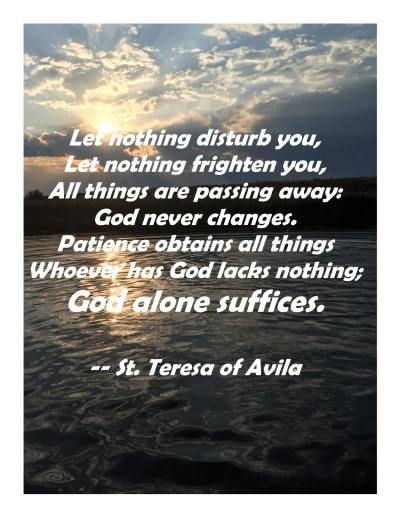
Let nothing disturb you, Let nothing frighten you, All things are passing away: God never changes. Patience obtains all things Whoever has God lacks nothing; God alone suffices. — St. Teresa of Avila

In His Father’s house there are many rooms, and one especially prepared for you by Christ.  Trust in His love, Trust His Wisdom, Trust His Goodness…and let nothing trouble your hearts, that His Peace may be with you always.

Consider:

  • When have you experienced the peace of Christ?  After Mass, in praying with Scripture, in nature, through other Christians?
  • Consider the fears and anxieties you carry.  Lay them before the Lord in prayer and surrender them.  Consider the power of Christ to provide, the love of Christ which motivates Him, and the faithfulness of Christ who remains near us in every trial.
  • In what areas of your life do you trust God completely?  In what areas do you rely on yourself or conventional wisdom rather than Him?

Make a Resolution (Practical Application):

  • Choose your biggest worry.  Begin and end each day surrendering it to God in prayer.
  • Pray the prayer of St. Teresa of Avila each day this week.
  • We make an act of trust in God when we tithe.  If you do not tithe already, begin this week.  If you tithe already but feel called to tithe more (10% is the commonly suggested amount), prayerfully make a financial act of trust in the Lord.
  • Pray Psalm 23 each day this week.
Why do you trust Jesus Christ?  Post in the comments section below!

Related Posts:

~ Written by Angela Lambert © 2017

* To receive these weekly posts automatically in your email just click the “follow” tab in the bottom right hand corner and enter your email address.


We All Need a Loving Gate-Keeper and Filter…Christ the Good Shepherd

by Angela Lambert

May 7th, 2017 4th Sunday of Easter


Gospel of John 10:1-19

Jesus said: “Amen, amen, I say to you, whoever does not enter a sheepfold through the gate but climbs over elsewhere is a thief and a robber. But whoever enters through the gate is the shepherd of the sheep. The gatekeeper opens it for him, and the sheep hear his voice, as the shepherd calls his own sheep by name and leads them out. When he has driven out all his own, he walks ahead of them, and the sheep follow him, because they recognize his voice. But they will not follow a stranger; they will run away from him, because they do not recognize the voice of strangers.” Although Jesus used this figure of speech, the Pharisees did not realize what he was trying to tell them. So Jesus said again, “Amen, amen, I say to you, I am the gate for the sheep. All who came before me are thieves and robbers, but the sheep did not listen to them. I am the gate. Whoever enters through me will be saved, and will come in and go out and find pasture. A thief comes only to steal and slaughter and destroy; I came so that they might have life and have it more abundantly.”

Meditation Reflection:

Quite often as a mom, I feel like a gate-keeper.  Before my kids go somewhere I need to know with whom, who the parents are, and approve.  Technology plagues me even more, with parent controls, ratings evaluations, and restrictions. The ever-multiplying accounts, passwords, devices, programs, and updates can feel like an interminable game of whack-a-mole.  Christmas and birthdays used to be fun, now they feel like a migraine-inducing tidal wave of gate-keeping duties, with impatient children complaining as I set the perimeter that I am being too slow, and of course, too controlling.  I’ve at least developed a one-line response to save my overtaxed brain from responding to the myriad of “logical” arguments and pleas of trust from my young teens. “It’s as simple as this,” I say, “You will not have unfiltered access to the internet.”  The Church could consider adding that as the 11th Commandment for the modern era.

Let’s face it, even adults, as children of God, need filters.   We too can be easily allured by promises of pleasure, freedom, status, or adventure from false advertisers; and I don’t just mean commercially.    Despite having everything, Adam and Eve fell prey to Satan’s proposition that God’s single rule (not to eat the fruit of the tree of knowledge of good and evil) was controlling, and denying them fun out of selfish motivations.  Satan continues to deceive us through similar false promises.

Just as predators try to find ways to get around parents to manipulate children, spiritual “thieves and robbers” try to get around Christ to attack us, God’s children.  First, they try to separate us from His influence by undermining our trust in Him, His Word, or His Church.  Common attempts sound something like: “Christ’s teachings hold you back. If you want to get ahead in life you have to be willing to get your hands dirty”, or “It’s not that you are going against Christ’s teachings, you are just modernizing them.”  In regards to those difficult passages in Scripture, the ones that really strike at your conscience, you will be urged to simply pass over them or interpret them in a more relaxed way – “Forgive others, yes, but forgive my ex?, I don’t think He meant that…”  Jesus stresses that we must die to ourselves in this life and deny ourselves.  Instead we rationalize that He only meant that symbolically, or at least in a modest way – like going on a diet or not aiming too high. Finally, the Church, Christ’s living voice of authority, is the clearest voice of our Shepherd and therefore the harshest recipient of worldly criticism.

We are children of God, in need of a loving gate-keeper.  Christ’s commands, given through Scripture and the Church, can seem restrictive and controlling if we have an adolescent view.  However, as we develop in spiritual maturity, we begin to appreciate the wisdom and the love underlying them.  When I’m tempted to brush off a Church teaching or a little pull at my conscience, I stop and recall that Christ loves me more than I love myself, and He is far wiser than me.  Who am I going to trust?  Any other false shepherd – whether secular culture, another person, or my own impulses – eventually drains rather than fills and proves a destructive, rather than uplifting force.

Christ, our Good Shepherd, leads to green pasture. He refreshes our souls and leads us beside peaceful waters (Psalm 23).  Jesus lamented to St. Faustina that distrust on the part of souls causes Him the greatest pain.  As a mom of teens, I know what He means.   I want my kids to trust me too, and so I repeat the prayer He gave to St. Faustina, “Jesus I trust in You.”

Consider:

  •  When have you been steered wrong – by others, by cultural norms, or by your own impulses?  What was the reason?  What did you learn?
  • When have you been steered right by Christ?  How has His wisdom brought deeper joy and fullness of life, even amidst suffering, than these other voices?
  • Have you ever had to be the gate-keeper for loved ones?  Consider the love it takes to be strong and the need for them to trust you.
  • How can you trust Christ more and listen to His voice more often?  Could you attend Church more regularly?  Could you invest more time into Christian friendships?  Do you make time to study your Bible, read quality devotionals, or learn more about your faith?

Make a Resolution (Practical Application):

  •  Choose one way to listen more to the voice of Christ this week.
    • Ideas:  Add 10 minutes to your prayer time, pray the rosary in the car, listen to Christian radio, listen to Christian podcasts, read the daily Scriptures (these can be found at usccb.org), post inspirational Scripture quotes in places you will see them often, meet with a Christian friend.
  • Consider adding a filter, rating restrictions, or accountability software to your personal technology.

Related posts:

~ Written by Angela Lambert © 2017

* To receive these weekly posts automatically in your email just click the “follow” tab in the bottom right hand corner and enter your email address.


Getting the Last Word…but Making it a Blessing

by Angela Lambert


February 18th, 2017; 7th Sunday of Ordinary Time

Gospel Matthew 5:38-48

Jesus said to his disciples: “You have heard that it was said, An eye for an eye and a tooth for a tooth. But I say to you, offer no resistance to one who is evil. When someone strikes you on your right cheek, turn the other one as well. If anyone wants to go to law with you over your tunic, hand over your cloak as well. Should anyone press you into service for one mile, go for two miles. Give to the one who asks of you, and do not turn your back on one who wants to borrow. “You have heard that it was said, You shall love your neighbor and hate your enemy. But I say to you, love your enemies and pray for those who persecute you, that you may be children of your heavenly Father, for he makes his sun rise on the bad and the good, and causes rain to fall on the just and the unjust. For if you love those who love you, what recompense will you have? Do not the tax collectors do the same? And if you greet your brothers only, what is unusual about that? Do not the pagans do the same? So be perfect, just as your heavenly Father is perfect.”

Meditation Reflection:

In 1981, Pope St. John Paul II was shot by a Turkish assassin Ali Agca.  The attempt occurred on the feast of Our Lady of Fatima and JPII credits Mary for “guiding the bullet” which just barely missed a major artery.  Even while in the ambulance, JPII voiced his forgiveness of the assassin.  Later after he had recovered, he visited Agca in prison and offered his forgiveness in person.  Agca had not offered an apology and only inquired as to why he wasn’t dead.  This encounter however had an impact and later when he was released from prison, Agca travelled to St. Peter’s to place roses on John Paul II’s tomb.

Forgiveness and love is the mark of Christ, and therefore the signifier of His followers.  John tells us that “God is Love.”  The term “perfect” means “full, or complete.” When Jesus refers to His Heavenly Father’s perfection therefore, He means that God’s love lacks nothing and is total.  By contrast, “even tax collectors” love their friends, but their love is imperfect because it is incomplete.  Total love includes those who love us and those who do not.

But how we can love someone who hates us or hurts us?  Does Jesus mean we must be friends with people who wish us harm or take advantage of us?  No.  Love is defined as “willing another person’s good.”  Thankfully, this does not require feelings of love, or even reciprocal friendship.  It doesn’t even mean trusting the person. It simply means choosing not to act in revenge or anger, and instead doing that which promotes the good of the other.  Thus, we can pray for our enemies, in which we petition God on their behalf for graces to be bestowed upon them.  We can speak kindly, act respectfully, and do the right thing toward others, not because they necessarily deserve it, but because it’s the kind of person we want to be.

Authentic love sometimes means tough love.  It can require choices that appear unloving but are in fact healthy boundaries.  Loving an addict for instance or someone with mental illness will require tough love, but will be more effective toward their health than enabling them in their sickness.  Disciplining children is tough love, but it helps the child grow in goodness.

Christ calls His followers to imitate His mercy.  This demand goes above and beyond natural strength and even natural wisdom or common sense.  It only makes sense considering the mystery of Christ’s suffering, death, and resurrection for our salvation, and it can only be accomplished with the aid of His divine grace.

Christ loved us while we were yet sinners.  He willed our good and worked for our salvation even when we were mired in sin and rejected Him.  As His disciples, we can work for the salvation of others, even when they too are mired in sin and working against us.

This can be tricky, but my mother offered me advice about these situations that I have found to be a guiding principle. When tempted to react vengefully when faced with difficult people and situations, she would say, “don’t let their behavior change who you are.”  Her wisdom strengthened my resolve and shed light on how to decide what to do.  No matter what others are doing or how low they sink, the truth is, if we just fire back we sink to their level too.  Jesus wants us to rise above, with the help of His grace and the light of His example.  Whether it transforms the other person or not, it will definitely transform us.

Loving our enemy is necessary to stop the cycle of violence, and our only hope for human unity.  When we are the ones caught up in it, we want to get the last word in or throw the last punch.  When we are the observer however, we just want it to stop.  As a mom, I get tired of hearing my kids bicker. Both claim it’s the other’s fault and point the finger at who started it.  Both go on and on and on, despite my attempts to break it up because they are obsessed with having the last word.  I wonder if God views our bickering in the same way.  Maybe the other person did start it, so what?  Why can’t we just stop?  No one can move on unless we do and everyone is miserable.

Loving our enemy is a supernatural virtue.  To cultivate charity, we need to connect to God and His stream of grace in prayer and the sacraments.  We must meditate on the Gospels to develop our sense of what Jesus would do.  We need to make time for fellowship with Christians walking the walk and learn from their insights and examples.  In this way, we can grow in love until it fills every gap in our heart and reaches the fullness of perfection like that of our Father in heaven.

Consider:

  • Who do you find easy to love and why?
  • Who do you find difficult to love? Who could you identify as your enemy?
    • In what way do they provoke you to strike back?
    • How might you react with love instead? How could you “will their good”?
  • Consider how we love our children even when they disobey, say hurtful things, or work against us. Do you ever feel anger toward your kids, but choose/will what’s good for them?
  • Consider God’s perspective as our Father and us as His children. How does He view our bickering, feuds, back-biting, and competitiveness?  What would He say to you about how you treat your brother or sister in Christ?
  • We can pick our friends but we can’t pick our family. Consider how loving our natural siblings can cultivate the virtues needed to love our spiritual siblings.
  • Read the story of St. Maria Goretti and reflect on her example of tough love, forgiveness, and the transformation it caused in her assailant.

Make a Resolution (Practical Application):

  • Pick one person who makes your life difficult.
    • 1) Begin each day with a sincere prayer for them. (not a list of all their flaws that God should fix, but rather for God’s blessing upon them!)
    • 2) Resolve each day this week to refrain from snide remarks to them or about them, gossip, or any kind of action that would anger or hurt them.
    • 3) Do one kind thing for them.


~ Written by Angela Lambert © 2017

* To receive these weekly posts automatically in your email just click the “follow” tab in the bottom right hand corner and enter your email address.


Keeping it Real

by Angela Lambert

20141130_175201795_ios

February 11th, 2017; 6th Sunday of Ordinary Time

Gospel of Matthew 5:20-22a, 27-28, 33-34a, 37

Jesus said to his disciples: “I tell you, unless your righteousness surpasses that of the scribes and Pharisees, you will not enter the kingdom of heaven.  “You have heard that it was said to your ancestors, You shall not kill; and whoever kills will be liable to judgment. But I say to you, whoever is angry with brother will be liable to judgment. “You have heard that it was said, You shall not commit adultery. But I say to you, everyone who looks at a woman with lust has already committed adultery with her in his heart. “Again you have heard that it was said to your ancestors, Do not take a false oath, but make good to the Lord all that you vow. But I say to you, do not swear at all. Let your ‘Yes’ mean ‘Yes,’ and your ‘No’ mean ‘No.’ Anything more is from the evil one.”

 Meditation Reflection:

Freedom in Christ, is founded on freedom from being fake.  We are masters at the false front.  By an early age most of us can pull off “I’m fine” to anyone who asks, no matter how untrue it may be.  Keeping up appearances, looking successful, and seeming to be more than we are occurs in every time period and culture.   Social media amplifies today’s version, as we can literally craft our public persona via selective posts and pictures.

We not only mask our imperfections, we often mask our sins as well.  From the back-handed compliment, to disparaging remarks prefaced by “God bless her soul, but…”, to shallow mantras like “You only live once” or “it’s not like it’s against the law”, we rationalize our viciousness in countless ways.  Like addicts, we deny we have a problem with sin and we excuse and blame our behavior on everyone and everything but ourselves.

Just has sobriety can only be achieved through facing reality, so human freedom from sin can only be wrought from an utter realness about ourselves.  When Moses asked God to reveal His Name, God responded that it is “YHWH” or “I AM”.  God revealed that He is.  God is being and existence.  Thus, union with God requires utter realness and authenticity.

C.S. Lewis writes about this mystery in a brilliantly imaginative way in his book “The Great Divorce.”  The divorce in this case refers to the divide between heaven and hell, and describes the process of purgation for those still travelling to heaven.  He describes inhabitants of hell, drawing from scriptural imagery, as phantoms.  On the opposite spectrum, he calls those in heaven “solid people.” The main character arrives at a gray bus stop, phantom-ish, and his journey toward heaven is one of becoming more solid – or more “real”.  To do this he must surrender all that he keeps false within himself.  I won’t give away more than that, as I highly recommend this read!  I will only offer this teaser – Lewis creates numerous characters whose struggle to move from ghostish versions of themselves to the authentic provides deep insight into the rationalizations with which most of us struggle, the pain of conversion, and the joy of authentic freedom.

In the Beatitudes, Jesus teaches us interior conversion and introspection.  In today’s Gospel passage, He directly calls us out on how we tip toe around the truth and avoid real virtue and, in consequence, real love and relationship.

How many times have we heard the excuse, “well, it’s not like I’ve killed anyone.  I’m a decent person.”  Yet, harboring anger can be deeply destructive and emerge in violence that might be more subtle, but no less real.  Passive-aggressive behaviors, online bullying, slander, gossip, critical remarks and callous attitudes prevent relationship and they hold us back from heaven.  Jesus states clearly, “I tell you, unless your righteousness surpasses that of the scribes and Pharisees, you will not enter the kingdom of heaven”  (MT 5:20) and “be perfect therefore, as your heavenly father is perfect” (MT 5:48)  A man who loves his wife, doesn’t look lustfully at other women.  A woman who loves her husband, doesn’t flirt with other men.  Does it matter whether or not it’s technically adultery?  Jesus calls out the dishonesty.  Either way, it certainly feels like cheating to the other spouse.  Why?  Because love is total, exclusive, and lifelong.  Our love for our spouse should mirror love for God. In fact, God created the first man and woman in the state of marriage because as two persons in a relationship of life-giving love, they imaged the Triune God.

Authenticity begins by simply letting our Yes be yes, and our No be no.  Drop the exaggerations and minimizations.  Leave the white lies.  Take down the false fronts.  It feels like going a day without make-up at first, but not forever.  As we become more at peace with ourselves, we become more comfortable in the truth.  Eventually the fake-ness we clung to in the past will feel like too much make-up, caked on, that you can’t wait to wash off at the end of the day.

Jesus wants us, not the façades we create.  He accepts us as we are and helps us become the truest version of ourselves.  When this happens, we can begin to experience the real relationship, and real love necessary for heaven.

Consider:

  • List your most common struggles in a day, then pray about what interior attitude or disposition underlies it.
    • consider the 7 capital sins for ideas (pride, envy, greed, anger, sloth, lust, and gluttony)
  • What is your most common/tempting rationalization?
  • In what ways have you grown in authenticity over the years? Reflect on how good it feels to be yourself.
  • Who is someone you can be completely yourself around; who knows the “real” you?
  • Consider how honesty is necessary for relationship.

Make a Resolution (Practical Application):

  • Tackle one rationalization this week.  Be direct with yourself and with God.  Name the struggle, occasions of temptation, and the rationalization you use.  Decide on how you will avoid the temptation or create a counter-mantra to repeat when you hear yourself rationalizing.
    • Example:
      • Daily struggle: Crabby toward your spouse and kids
      • Occasions of temptation: Getting out the door in the morning, right after a long day at work, or when interrupted during a project.
      • Rationalizations: “They’re my family and should love me unconditionally – this is just who I am”; “I work hard to care for my family, and it just means I will be stressed out”
      • Counter-mantras: “They’re my family – they deserve my best behavior”;  “I need to find balance in my life so I can be a peaceful person to my family”
      • Avoiding temptation – Begin the day 10 minutes earlier so you aren’t stressed about running late (even better, begin with a prayer!); create transition time between work and home – listen to Christian music on the drive and count your blessings so you arrive with a positive attitude; adjust expectations for completing projects – expect to get interrupted by kids and be grateful for them, try to include them in the project if possible


~ Written by Angela Lambert © 2017

* To receive these weekly posts automatically in your email just click the “follow” tab in the bottom right hand corner and enter your email address.


Joseph’s Steady Leadership When Faced With “It’s Complicated”

by Angela Lambert

st-joseph

December 18th, 2016; 4th Sunday in Advent

 Gospel Matthew 1:18-24 NAB

This is how the birth of Jesus Christ came about. When his mother Mary was betrothed to Joseph, but before they lived together, she was found with child through the Holy Spirit. Joseph her husband, since he was a righteous man, yet unwilling to expose her to shame, decided to divorce her quietly. Such was his intention when, behold, the angel of the Lord appeared to him in a dream and said, “Joseph, son of David, do not be afraid to take Mary your wife into your home. For it is through the Holy Spirit that this child has been conceived in her. She will bear a son and you are to name him Jesus, because he will save his people from their sins.” All this took place to fulfill what the Lord had said through the prophet: Behold, the virgin shall conceive and bear a son, and they shall name him Emmanuel, which means “God is with us.” When Joseph awoke, he did as the angel of the Lord had commanded him and took his wife into his home.

Meditation Reflection:

Immanuel, God-with-us.  We no longer must suffer alone, weak and afraid.  The Lord has come and brought with Him the comfort, strength, and peace of His holy presence dwelling in our souls and working in the world with His transforming grace.  We experience something of this peace and strength in family life.  Being with our parents makes us feel secure and protected.  Being with our children brings us joy and comfort.

The Holy Family experienced this as well, and made it possible for all of us.  Mary’s fiat, her “yes”, made the Incarnation possible and therefore the redemption of all mankind.  Joseph’s fiat, his “yes”, made the Holy Family possible.  He accepted Christ as He was, in the surprising and shocking form in which He came.  His decision to take Jesus and Mary into his home and make them His own family was the fruit of God’s grace in concert with his virtues.  This required serious discernment and prayer, both of which he models for all Christians.

Joseph was a just, or righteous man.  This does not mean he was without sin whatsoever, but it did mean he consistently strove for virtue, followed the Mosaic Law, and lived his faith.  Early Christian writings not included in the Bible, such as the Protoevangelium of James, indicate that Mary’s parents consecrated her to God and so she would serve God in the temple and take a vow of virginity.  As a result, she grew up in the Temple from the age of 3 until she was of marrying age.  It was a Jewish practice that at that point she would be entrusted to the care of a guardian who would protect her and would respect her vow of virginity by taking a vow of celibacy himself.  Oftentimes this would be a man who was older and widowed.  Some think this explains why Joseph had died by the time of Jesus’ public ministry.  According to the Protoevangelium of James, from among the men who wished to take Mary as their wife, Joseph was chosen as Mary’s husband by a miraculous sign.  Imagine his surprise, confusion, and disillusionment, when he learned she was pregnant. His response to the situation is so admirable, strong, and level-headed.  He’s a model for anyone who must make difficult decisions in complicated and emotional situations.

Joseph made a prudent decision, based on who he was and his faith.  Purity and honor being important virtues, he decided he could not take her into his home as his wife. (At the time, betrothal was a solemn contract with the weight of marriage, but preceded living together as husband and wife).  At the same time, he was a compassionate and merciful man.  Matthew tells us Joseph was “unwilling” to expose her to shame.  I imagine he had plenty of men and women urging him to exact the full measure of the Jewish law against her, to publicly humiliate her, and to get sweet revenge for embarrassing him. Joseph would not.  He was unwilling.  Joseph made a decision to do the right thing quietly. In the RSV translation, it says he “resolved to send her away quietly.”  To be resolved indicates a decision made with prudence, strength, and determination, detached from pettiness and emotion.

Joseph focused on how to thoughtfully and prayerfully doing the next right thing.  Because of this, God guided his discernment.  The RSV translation says, “But as he considered this, behold an angel of the Lord appeared to him”.  The word “considered” is important.  The spiritual life is ultimately one of love, fidelity, and receptivity.  We are followers of God, not leaders of God.  God guided Joseph’s considerations for his family, just as God guides every father who will invite the Lord into his discernment.  When God spoke, Joseph faithfully and lovingly followed through with God’s will.

Immanuel, God-with-us.  How might we as mothers and fathers invite God to be with us in our families and our decision-making?  How might we say yes to the Father and welcome His Son?  How might we accept the family that God has entrusted to us, rather than the one we imagine for ourselves?  God works in surprising and shocking ways.  This Advent, taking a moment to consider who we are and what we believe, may St. Joseph pray for us to have the kind of steady and faith-filled approach to life’s complications that he did.


Consider:

  • Joseph’s yes made it possible for Jesus to have a family.  Consider what a gift it was for him to grow up with Mary as His mom and Joseph as His foster-father.
  • Consider Joseph’s prayerful leadership. How might you imitate St. Joseph’s discernment in your own life?
  • Do you take time to “consider” things and “resolve” to follow through?
    • What things, habits, or people undermine that, urging you to react immediately and emotionally?
    • What things, habits, or people could help you develop deeper consideration and stronger resolve?
  • Ask Joseph to lead you and your family, as He did for Jesus and Mary. Pray for his protection, guidance, and love.

Make a Resolution (Practical Application):

  • Teresa of Avila and numerous other saints recommend devotion to St. Joseph and credit his powerful intercession for answers to their prayers.  I too can attest to this from my own life.  This week, ask St. Joseph to pray for you and for your family. st-joseph-prayer
  • Do you know someone who is like St. Joseph? Spend more time with that person and learn from his example.  Take him to coffee and ask him lots of questions and take his advice.
  • Surrender a complicated decision to the Lord in quiet prayer. Consider who you are, what our Christian faith says about the situation, and resolve to do the next right thing with the help of the Holy Spirit.


~ Written by Angela Lambert © 2016

* To receive these weekly posts automatically in your email just click the “follow” tab in the bottom right hand corner and enter your email address.