New Book – Lenten Journey: Through the Desert to the Eternal Spring by Angela Jendro


Lenten Journey_Through the Desert to the Eternal Spring by Angela M Jendro

Make a spiritual pilgrimage this Lent with guided meditations on theLenten Journey pic Sunday Gospels by Angela M Jendro, complete with real life applications and ideas for translating your meditation into action.
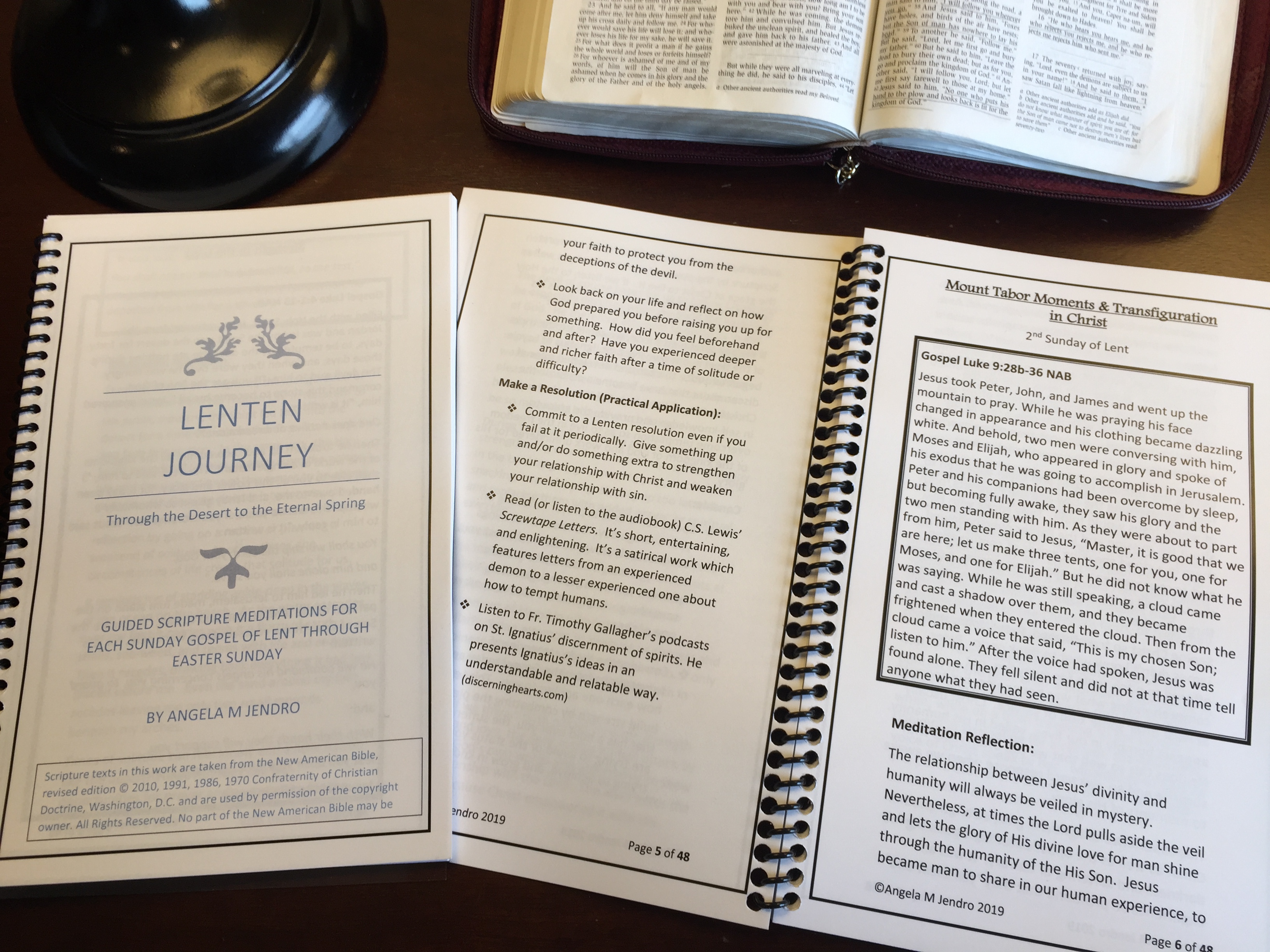
  • Download for free to your pdf reader for easy access on the go, or print to paper to make your handwritten notes.
  • No price for e-book,  Free Will Offering accepted via Paypal and/or Prayers for the author 🙂


For printed booklet – visit our Online store tab or purchase below:


Printed Booklet – Lenten Journey: Through the Desert to the Eternal Spring

Free shipping within the U.S. 48 pages Guided Scripture meditatins for each Sunday of Lent through Holy Week and Easter Sunday. Encounter Christ in a new way with reflections that relate to your daily life, considerations to take to prayer, and ideas for concrete application.

$15.00


Pushing the Limits

by Angela (Lambert) Jendro


March 25th, 2018 Palm Sunday

Gospel of Mark 14-15 NAB

The Passover and the Feast of Unleavened Bread were to take place in two days’ time. So the chief priests and the scribes were seeking a way to arrest him by treachery and put him to death. They said, “Not during the festival, for fear that there may be a riot among the people.”

When he was in Bethany reclining at table in the house of Simon the leper, a woman came with an alabaster jar of perfumed oil, costly genuine spikenard. She broke the alabaster jar and poured it on his head. There were some who were indignant. “Why has there been this waste of perfumed oil? It could have been sold for more than three hundred days’ wages and the money given to the poor.” They were infuriated with her. Jesus said, “Let her alone. Why do you make trouble for her? She has done a good thing for me. The poor you will always have with you, and whenever you wish you can do good to them, but you will not always have me. She has done what she could. She has anticipated anointing my body for burial. Amen, I say to you, wherever the gospel is proclaimed to the whole world, what she has done will be told in memory of her.”
Then Judas Iscariot, one of the Twelve, went off to the chief priests to hand him over to them.
When they heard him they were pleased and promised to pay him money. Then he looked for an opportunity to hand him over.

On the first day of the Feast of Unleavened Bread, when they sacrificed the Passover lamb, his disciples said to him, “Where do you want us to go and prepare for you to eat the Passover?” He sent two of his disciples and said to them, “Go into the city and a man will meet you, carrying a jar of water. Follow him. Wherever he enters, say to the master of the house, ‘The Teacher says, “Where is my guest room where I may eat the Passover with my disciples?”‘ Then he will show you a large upper room furnished and ready. Make the preparations for us there.” The disciples then went off, entered the city, and found it just as he had told them; and they prepared the Passover.

When it was evening, he came with the Twelve. And as they reclined at table and were eating, Jesus said, “Amen, I say to you, one of you will betray me, one who is eating with me.” They began to be distressed and to say to him, one by one, “Surely it is not I?” He said to them, “One of the Twelve, the one who dips with me into the dish. For the Son of Man indeed goes, as it is written of him, but woe to that man by whom the Son of Man is betrayed. It would be better for that man if he had never been born.”  While they were eating, he took bread, said the blessing, broke it, and gave it to them, and said, “Take it; this is my body.” Then he took a cup, gave thanks, and gave it to them, and they all drank from it. He said to them, “This is my blood of the covenant, which will be shed for many. Amen, I say to you, I shall not drink again the fruit of the vine until the day when I drink it new in the kingdom of God.”

Then, after singing a hymn, they went out to the Mount of Olives. Then Jesus said to them, “All of you will have your faith shaken, for it is written: I will strike the shepherd, and the sheep will be dispersed. But after I have been raised up, I shall go before you to Galilee.” Peter said to him,
“Even though all should have their faith shaken, mine will not be.” Then Jesus said to him, “Amen, I say to you, this very night before the cock crows twice you will deny me three times.”
But he vehemently replied, “Even though I should have to die with you, I will not deny you.” And they all spoke similarly. Then they came to a place named Gethsemane, and he said to his disciples, “Sit here while I pray.” He took with him Peter, James, and John, and began to be troubled and distressed. Then he said to them, “My soul is sorrowful even to death. Remain here and keep watch.” He advanced a little and fell to the ground and prayed that if it were possible the hour might pass by him; he said, “Abba, Father, all things are possible to you. Take this cup away from me, but not what I will but what you will.” When he returned he found them asleep.
He said to Peter, “Simon, are you asleep? Could you not keep watch for one hour? Watch and pray that you may not undergo the test. The spirit is willing but the flesh is weak.” Withdrawing again, he prayed, saying the same thing. Then he returned once more and found them asleep, for they could not keep their eyes open and did not know what to answer him. He returned a third time and said to them, “Are you still sleeping and taking your rest? It is enough. The hour has come. Behold, the Son of Man is to be handed over to sinners. Get up, let us go. See, my betrayer is at hand.”

Then, while he was still speaking, Judas, one of the Twelve, arrived, accompanied by a crowd with swords and clubs who had come from the chief priests, the scribes, and the elders. His betrayer had arranged a signal with them, saying, “The man I shall kiss is the one; arrest him and lead him away securely.” He came and immediately went over to him and said, “Rabbi.” And he kissed him. At this they laid hands on him and arrested him. One of the bystanders drew his sword, struck the high priest’s servant, and cut off his ear. Jesus said to them in reply, “Have you come out as against a robber, with swords and clubs, to seize me? Day after day I was with you teaching in the temple area, yet you did not arrest me; but that the Scriptures may be fulfilled.” And they all left him and fled. Now a young man followed him wearing nothing but a linen cloth about his body. They seized him, but he left the cloth behind and ran off naked.

They led Jesus away to the high priest, and all the chief priests and the elders and the scribes came together. Peter followed him at a distance into the high priest’s courtyard and was seated with the guards, warming himself at the fire. The chief priests and the entire Sanhedrin kept trying to obtain testimony against Jesus in order to put him to death, but they found none. Many gave false witness against him, but their testimony did not agree. Some took the stand and testified falsely against him, alleging, “We heard him say, ‘I will destroy this temple made with hands and within three days I will build another not made with hands.'”  Even so their testimony did not agree. The high priest rose before the assembly and questioned Jesus, saying, “Have you no answer? What are these men testifying against you?” But he was silent and answered nothing. Again the high priest asked him and said to him, “Are you the Christ, the son of the Blessed One?” Then Jesus answered, “I am; and ‘you will see the Son of Man seated at the right hand of the Power and coming with the clouds of heaven.'” At that the high priest tore his garments and said, “What further need have we of witnesses? You have heard the blasphemy. What do you think?” They all condemned him as deserving to die. Some began to spit on him.
They blindfolded him and struck him and said to him, “Prophesy!” And the guards greeted him with blows.

While Peter was below in the courtyard, one of the high priest’s maids came along. Seeing Peter warming himself, she looked intently at him and said, “You too were with the Nazarene, Jesus.”
But he denied it saying, “I neither know nor understand what you are talking about.” So he went out into the outer court. Then the cock crowed. The maid saw him and began again to say to the bystanders, “This man is one of them.” Once again he denied it. A little later the bystanders said to Peter once more, “Surely you are one of them; for you too are a Galilean.” He began to curse and to swear, “I do not know this man about whom you are talking.” And immediately a cock crowed a second time. Then Peter remembered the word that Jesus had said to him, “Before the cock crows twice you will deny me three times.” He broke down and wept.

As soon as morning came, the chief priests with the elders and the scribes, that is, the whole Sanhedrin held a council. They bound Jesus, led him away, and handed him over to Pilate. Pilate questioned him, “Are you the king of the Jews?” He said to him in reply, “You say so.” The chief priests accused him of many things. Again Pilate questioned him, “Have you no answer? See how many things they accuse you of.” Jesus gave him no further answer, so that Pilate was amazed. Now on the occasion of the feast he used to release to them one prisoner whom they requested. A man called Barabbas was then in prison along with the rebels who had committed murder in a rebellion. The crowd came forward and began to ask him to do for them as he was accustomed. Pilate answered, “Do you want me to release to you the king of the Jews?” For he knew that it was out of envy that the chief priests had handed him over. But the chief priests stirred up the crowd to have him release Barabbas for them instead. Pilate again said to them in reply, “Then what do you want me to do with the man you call the king of the Jews?” They shouted again, “Crucify him. “Pilate said to them, “Why? What evil has he done?” They only shouted the louder, “Crucify him.” So Pilate, wishing to satisfy the crowd, released Barabbas to them and, after he had Jesus scourged, handed him over to be crucified.

The soldiers led him away inside the palace, that is, the praetorium, and assembled the whole cohort. They clothed him in purple and, weaving a crown of thorns, placed it on him. They began to salute him with, “Hail, King of the Jews!” and kept striking his head with a reed and spitting upon him. They knelt before him in homage. And when they had mocked him, they stripped him of the purple cloak, dressed him in his own clothes, and led him out to crucify him. They pressed into service a passer-by, Simon, a Cyrenian, who was coming in from the country, the father of Alexander and Rufus, to carry his cross. They brought him to the place of Golgotha — which is translated Place of the Skull — They gave him wine drugged with myrrh, but he did not take it.
Then they crucified him and divided his garments by casting lots for them to see what each should take. It was nine o’clock in the morning when they crucified him. The inscription of the charge against him read, “The King of the Jews.” With him they crucified two revolutionaries,
one on his right and one on his left. Those passing by reviled him, shaking their heads and saying, “Aha! You who would destroy the temple and rebuild it in three days, save yourself by coming down from the cross.” Likewise the chief priests, with the scribes, mocked him among themselves and said, “He saved others; he cannot save himself. Let the Christ, the King of Israel,
come down now from the cross that we may see and believe.” Those who were crucified with him also kept abusing him.

At noon darkness came over the whole land until three in the afternoon. And at three o’clock Jesus cried out in a loud voice, “Eloi, Eloi, lema sabachthani?” which is translated, “My God, my God, why have you forsaken me?” Some of the bystanders who heard it said, “Look, he is calling Elijah.” One of them ran, soaked a sponge with wine, put it on a reed and gave it to him to drink saying, “Wait, let us see if Elijah comes to take him down.” Jesus gave a loud cry and breathed his last.

The veil of the sanctuary was torn in two from top to bottom. When the centurion who stood facing him saw how he breathed his last he said, “Truly this man was the Son of God!” There were also women looking on from a distance. Among them were Mary Magdalene, Mary the mother of the younger James and of Joses, and Salome. These women had followed him when he was in Galilee and ministered to him. There were also many other women who had come up with him to Jerusalem. When it was already evening, since it was the day of preparation, the day before the sabbath, Joseph of Arimathea, a distinguished member of the council, who was himself awaiting the kingdom of God, came and courageously went to Pilate and asked for the body of Jesus. Pilate was amazed that he was already dead. He summoned the centurion and asked him if Jesus had already died. And when he learned of it from the centurion, he gave the body to Joseph. Having bought a linen cloth, he took him down, wrapped him in the linen cloth,
and laid him in a tomb that had been hewn out of the rock. Then he rolled a stone against the entrance to the tomb. Mary Magdalene and Mary the mother of Joses watched where he was laid.

Meditation Reflection:

Palm Sunday we recall the Passion of Christ.  We remember His entry into Jerusalem received by adoring crowds which quickly turned to Crucifixion and mocking crowds.  In this account we see ourselves and the fickleness of our own faith.  Peter’s exchange with Jesus at the Last Supper depicts the Christian struggle well:

Peter said to him, “Even though all should have their faith shaken, mine will not be.”

Then Jesus said to him, “Amen, I say to you, this very night before the cock crows twice you will deny me three times.”

But he vehemently replied, “Even though I should have to die with you, I will not deny you.”

And they all spoke similarly.

When has Peter’s attitude been our own?  Complete confidence in our loyalty to Christ – our faith in Who He is, our Hope in Him alone, our perception of undivided Love.  Yet, Christ knows the truth in our hearts.  He knows the real limit of our faith, the weakness of our hope, and the dissipation of our love when confronted with suffering and disappointment.  As long as God’s plan corresponds with our plan, we feel ready to follow Him with magnanimous discipleship.  Yet, when His will deviates from ours, especially if it’s inexplicable to our natural understanding, we often falter.

The Passion of Christ’s love reveals our own tepidity.  (Just consider how we complain at reading or standing at Mass for the length of this Gospel passage.  Yet, how much longer it was for Christ to actually endure!)  However, He also redeems it by taking on our weak human failings Himself, and through the power of His victory, bestowing that grace on our souls so that we may have in truth the magnanimous friendship with Christ we desire in intention.

Venerable Archbishop Fulton Sheen, in his reflections for the third station on the Way of the Cross, reflected:

Three times Our Savior was tempted on the mountain, and three times He fell on the way to Mount Calvary.  Thus did He atone for our three falls – to the temptation of the flesh, the world, and the devil.”   (The Way of the Cross, originally written 1932; currently published by Society of St. Paul 2006)

“He advanced a little and fell to the ground and prayed that if it were possible the hour might pass by him; he said, “Abba, Father, all things are possible to you. Take this cup away from me, but not what I will but what you will.””

How we have all prayed the first part of this prayer!  Begging our Heavenly Father, “all things are possible to You, take this cup away from me”.  The agony of the deepest human suffering pleads in these very words.  The proverbial question “if You are all Good and all Powerful God, why am I suffering?”

The mystery is revealed in Jesus Christ alone.  “But not what I will but what You will.”  God wills our eternal salvation.  He wills it in conformity with respect for human free will.  Human choices cause suffering, but God’s will directs all things, even the events of His Son’s suffering and death, to the triumph of love.  Most of the time we won’t know the particulars of how everything will play out, but we do know the final ending.  Christ conquers – sin, human weakness, even death.  Those who exalt themselves in sin will be humbled, and those who persevere in humility will be exalted.  In Him we find healing, wholeness, strength, and eternal joy.  St. Paul promises that God works all things for good for those who love Him (Romans 8:28), not just some things.   Christ promises the Cross to His followers, but He also promises Resurrection. And the two are inseparable.

Fallen human nature resists faith in the power of the Cross.  Instead it often mocks it like the passersby at Jesus’ crucifixion.

In the account of Jesus’ Passion, individuals respond to His impending Cross in ways that we may relate.  Progress in our spiritual journey corresponds to how far we are willing to follow Christ.  Hopefully each year, we walk a step closer to the Cross and abide with Him a little longer.  Many things can trip us up however as we see in today’s Gospel.

I’ll follow until:

  • Jesus isn’t Who I want Him to be.  He won’t make me materially rich:  Judas
  • I’m tired or bored: Apostles asleep during Jesus’ Agony in the Garden
  • I’m threatened: disciples fleeing the crowd with swords; Peter recognized by the maid
  • I’m caught: young man in linen cloth
  • I’ll cause a rift or make waves: Pilate
  • Even still, Jesus invites His betrayers into His mercy.
“But God proves his love for us in that while we were still sinners Christ died for us.” Romans 5:8

This Holy Week, let us remain with Him.  Let us stay close to Him in prayer without falling asleep or rushing off to distractions.  Let us enter into the mystery of His suffering, death, and resurrection by accepting the griefs within our own situations and dying to what we cannot change, so that we may rise with Him who can redeem every sin and every situation.

Consider:

  • First and foremost, consider Christ’s love for you.  Reflect on how He has shared in your suffering.  Have you ever felt alone, betrayed, anxious, mocked, lied about, physically hurting, or exhausted?  Remember that Christ walks with you through the pain to resurrection in Him.
  • How can your love for Christ be strengthened?
    • Jesus observes in us that “The Spirit is willing but the flesh is weak.” Consider times when you have experienced this.  (Sleeping when you should be praying, resting instead of the effort to show up for someone hurting…)
    • Have you ever sold out Christ for a worldly gain? Consider when you have prioritized money, status, or worldly acknowledgement over doing God’s will for you.
    • Pilate’s betrayal sprang from “wishing to satisfy the crowd.” Sometimes we deny Christ by failing to speak up out of fear of being persecuted on His account. When asked “Are you a Christian?” or “Are you Catholic?”, how do you respond?  Do you hesitate or qualify it?  Or do you respond confidently, “Always be ready to give an explanation to anyone who asks you for a reason for your hope as St. Peter tells us (I Peter 3:15).
    • What fears can the devil use to tempt you away from following the Lord? How does he stir up your anxiety, and worry you into hiding, away from the Cross, like the other apostles?

 Make a Resolution (Practical Application):

  • Pray the Stations of the Cross or the Sorrowful Mysteries of the Rosary this week.
  • Reflect on one section of this Gospel passage a day this week.

Related Posts:

~ Written by Angela Jendro © 2018

* To receive these weekly posts automatically in your email just click the “follow” tab in the bottom right hand corner and enter your email address.


Desert Decisions

by Angela (Lambert) Jendro

February 18th, 2018 1st Sunday of Lent

Gospel of Mark 1:12-15 NAB

The Spirit drove Jesus out into the desert, and he remained in the desert for forty days, tempted by Satan. He was among wild beasts, and the angels ministered to him. After John had been arrested, Jesus came to Galilee proclaiming the gospel of God: “This is the time of fulfillment. The kingdom of God is at hand. Repent, and believe in the gospel.”

Meditation Reflection:

The transition from Christ’s hidden life to His public ministry began with His Baptism and then the temptation in the desert.  There,  He had to decide whether to work for self-gain in this world, or self-sacrifice for the next.

At the Incarnation Christ, though the Second Person of the Blessed Trinity, took on a human nature and humbly chose to live the human experience.

Who, though he was in the form of God, did not regard equality with God something to be grasped. Rather, he emptied himself, taking the form of a slave, coming in human likeness; and found human in appearance, he humbled himself, becoming obedient to death, even death on a cross. Philippians 2:7

In consequence, Jesus grew “in wisdom and stature” (Luke 2:52 RSV), obedient to His parents, embracing the temporal condition of human development.  He did not begin His public ministry until the age of 30, which marked full manhood at the time and the transition to leadership roles.  It was also the age Levitical priests would enter the full service of the Lord (see Numbers 4:3, 30).

The commencement of His mission was preceded by temptation and trial.  He, like us, had to choose which trajectory His life would take.  In the desert, Satan enticed the Lord to direct His divine gifts to pampering His human nature.  Matthew (4:1-11) details the temptations specifically: bodily pleasure (bread), tremendous fame (leap from temple pinnacle), and worldly power (all the kingdoms of the earth).  Satan forced the choice before the Lord: the immediacy of the visible world and self-gain without the Cross, or the work of establishing the invisible kingdom of God which would require self-immolation and suffering Crucifixion before rising again.

Each of us faces the same temptations and the same choice.  We can either use our God-given gifts to promote ourselves and worldly achievements, or direct them to the Father’s will and the building up of His kingdom.

Lent provides a time to step into the desert with the Lord, to pray and fast, and to re-orient the trajectory of our lives.  As a Church, the People of God, we take 40 days each year to shed the illusion that we can live for both worlds or that we can have the kingdom without the Cross.

Through fasting, with the help of grace, we deny ourselves tempting pleasures to strengthen our will and remember that “man shall not live by bread alone, but by every word that proceeds from the mouth of God” (MT 4:4).  Furthermore, it reveals the truth of just how attached we may be and loosens the hold that habit may have over us.  Fasting also unites us to the redemptive value Christ has placed on suffering through His own suffering and death.  In fact, on one occasion Jesus even says to His disciples that some demons “cannot be driven out by anything but prayer and fasting” (Mark 9:29).  Thus, through our Lenten fasting, we join our sacrifices to His, to cast out the demons in our lives with His help, so that we might share in His mission and thus share in the hope of His Resurrection.

Through prayer we draw closer to the Lord, that the invisible might become more visible and His grace might transform us.  Encountering Christ in the Scriptures, the Mass, the Rosary, the lives of the saints, Eucharistic Adoration, the Stations of the Cross, and other prayerful devotions, our love for Him is enkindled and our discipleship strengthened.

Finally, the Lenten practice of almsgiving takes us outside of ourselves through service of the needs of others.  This can range from sharing your money with the poor to sharing a blanket with your child.  It also includes sharing your time with someone sorrowing, lonely, or sick. It begins with meeting the needs of your family then your co-workers or neighbors and friends, your local parish and community, and finally the world-wide needs of the Church.  Catholic Relief Service’s “Operation Rice Bowl” provides an opportunity as a family to make simpler meals during Lent and to donate the money saved to feed the hungry in poor areas of the world (https://www.crsricebowl.org/about)

Together as Christians, we join Christ in the desert during Lent.  We draw away from the immediate and tempting pleasures of the moment and of this world, and draw nearer to Christ and the eternal, even more real, pleasures of the Heaven.  At the end of this purification we share in the joy of His resurrection at Easter.  Easter is the beginning of a new creation, and we hope to be a new, or renewed, creation Easter Sunday as well. Lent is a time to “repent and believe in the gospel” so that, transformed by grace, we may live in the Kingdom of God which is now at hand in Jesus Christ.

Consider:

  • Consider in prayer the deeper, truer, reality of the spiritual world.  Reflect on the illusory promises of pleasure, fame, and status compared with the enduring graces of Christian love, strength, and joy.
  • Ask Christ in prayer to reveal an attachment you may have, that up until now you have been blind to such as subtle forms of pride, vanity, greed, or pleasures.
  • Take time for gratitude.
  • Ask Mary to help you see the needs around you as she did at the Wedding at Cana.

Make a Resolution (Practical Application):

  • Swap out 15 minutes of media time for 15 minutes of prayer or silence.

Related Posts:

~ Written by Angela Jendro © 2018

* To receive these weekly posts automatically in your email just click the “follow” tab in the bottom right hand corner and enter your email address.


Hope…When Least Expected

by Angela Lambert

woman at well

March 19th, 2017; 3rd Sunday of Lent

Gospel of John 4:5-42

 Jesus came to a town of Samaria called Sychar, near the plot of land that Jacob had given to his son Joseph. Jacob’s well was there. Jesus, tired from his journey, sat down there at the well. It was about noon. A woman of Samaria came to draw water. Jesus said to her, “Give me a drink.” His disciples had gone into the town to buy food. The Samaritan woman said to him, “How can you, a Jew, ask me, a Samaritan woman, for a drink?” —For Jews use nothing in common with Samaritans.— Jesus answered and said to her, “If you knew the gift of God and who is saying to you, ‘Give me a drink, ‘ you would have asked him and he would have given you living water.” The woman said to him, “Sir, you do not even have a bucket and the cistern is deep; where then can you get this living water? Are you greater than our father Jacob, who gave us this cistern and drank from it himself with his children and his flocks?”

Jesus answered and said to her, “Everyone who drinks this water will be thirsty again; but whoever drinks the water I shall give will never thirst; the water I shall give will become in him a spring of water welling up to eternal life.” The woman said to him, “Sir, give me this water, so that I may not be thirsty or have to keep coming here to draw water.”

Jesus said to her, “Go call your husband and come back.” The woman answered and said to him, “I do not have a husband.  Jesus answered her, “You are right in saying, ‘I do not have a husband.’ For you have had five husbands, and the one you have now is not your husband. What you have said is true.” The woman said to him, “Sir, I can see that you are a prophet. Our ancestors worshiped on this mountain; but you people say that the place to worship is in Jerusalem.” Jesus said to her, “Believe me, woman, the hour is coming when you will worship the Father neither on this mountain nor in Jerusalem. You people worship what you do not understand; we worship what we understand, because salvation is from the Jews. But the hour is coming, and is now here, when true worshipers will worship the Father in Spirit and truth; and indeed the Father seeks such people to worship him. God is Spirit, and those who worship him must worship in Spirit and truth.” The woman said to him, “I know that the Messiah is coming, the one called the Christ; when he comes, he will tell us everything.” Jesus said to her, “I am he, the one speaking with you.”

At that moment his disciples returned, and were amazed that he was talking with a woman, but still no one said, “What are you looking for?” or “Why are you talking with her?” The woman left her water jar and went into the town and said to the people, “Come see a man who told me everything I have done. Could he possibly be the Christ?” They went out of the town and came to him. Meanwhile, the disciples urged him, “Rabbi, eat.” But he said to them, “I have food to eat of which you do not know.” So the disciples said to one another, “Could someone have brought him something to eat?” Jesus said to them, “My food is to do the will of the one who sent me and to finish his work. Do you not say, ‘In four months the harvest will be here’? I tell you, look up and see the fields ripe for the harvest. The reaper is already receiving payment and gathering crops for eternal life, so that the sower and reaper can rejoice together. For here the saying is verified that ‘One sows and another reaps.’ I sent you to reap what you have not worked for; others have done the work, and you are sharing the fruits of their work.”

Many of the Samaritans of that town began to believe in him because of the word of the woman who testified, “He told me everything I have done.” When the Samaritans came to him, they invited him to stay with them; and he stayed there two days. Many more began to believe in him because of his word, and they said to the woman, “We no longer believe because of your word; for we have heard for ourselves, and we know that this is truly the savior of the world.”

Meditation Reflection:

What a long passage.  Why?  Why does John give this much space in his Gospel to one woman’s conversion?  Jesus encountered multitudes of people during His brief public ministry.  John even gives a disclaimer at the end of his Gospel, apologizing that he could only include a handful of Jesus’ miracles, enough to make the point that He is the Son of God, because they were too innumerable to recount in written form.

The woman at the well’s encounter with Christ, models the process of conversion.  Jesus approached her when she least expected it.  She went to the well at noon, the worst time of the day, to avoid the other women.  Sin has a way of isolating us from others as we try to cover up our sins or rationalize our choices.

Jesus initiated the conversation.  He sought her.  He began with a request, but in fact desired to offer her healing and salvation.  Every Christian’s conversion begins with an encounter with Christ, and the experience of Him having sought us before we sought Him.  Discipleship is not a project, club, or philosophy.  It’s a response.  It’s a realization that what Christ asks of us, is in fact His invitation to receive from Him.

Next, He addressed her sins.  She skirted the issue, and even when confronted directly, she tried to distract Him with a theological debate.  By the end however, she felt relief and joy. From her encounter, she learned that the Christ, the anointed one of God, had come.  Moreover, He had come to her – despite her personal unfaithfulness, as well as the unfaithfulness of her people the Samaritans. Jesus revealed Himself as the Savior, come through the promise of the Jews, and at the same time for the salvation of all.

Imagine her hopelessness as she approached the well in the heat of the day.  Women of her time would view success as a good marriage and large family.  She had already had five husbands and given up on marriage altogether with the man she was living with. She had no friends and was excluded from the community of women.  There was no way back for her, and no opportunity going forward.

God gives surprisingly and super-abundantly.  Met with physical thirst, Jesus offered her the living waters of eternal life.  It took awhile for her to wrap her mind around what He was saying.  Eventually however, she recognized the work of God and ran to the people of her town to tell them.  She left her water jug, despite her physical thirst and needs.  She boldly told everyone of her experience, despite the shame of her reputation among them.

Her witness was so moving that they went to Jesus to see for themselves.  They too encountered Christ in an unexpected and surprising way – through the seemingly least religious woman in town.  By the end of their encounter however, they too were converted.

During Lent, Jesus comes to meet us in our shame and our thirst.  As a Church, we endeavor to hear Him through increased prayer and introspection.  We recall that He came to save us, while we were still sinners.  We remember that He first sought us, but we must respond.  Thankfully, He is patient.  Our transformation in Christ will become our witness, and our witness will bring Christ to others.  But first, we must set aside our tactics for avoiding our sins, and allow Christ to lead us through them.

Consider:

  • The woman went to the well at noon instead of morning because of shame:
    • What are you ashamed of? What do you hide from others?
  • Imagine meeting Jesus there.
    • Would you feel surprised? What excuses might you make?
  • Imagine Jesus calling you out on your sins.
    • What are your competing loves? Be honest.
  • How is Jesus the living water compared to these other “spouses”?
  • How are the other pleasures you seek temporary and always needing replenishing, whereas Christ’s joy is abiding?
  • Jesus offers her life, and commands her to sin no more.  Let Jesus confront your sin.  You too must choose. You cannot have both.

Make a Resolution (Practical Application):

  • When God confronted King David about his sin through the prophet Nathan, David responded by composing Psalm 51.  He acknowledged his sin, asked for forgiveness, and trusted God to transform his heart.
  • Do an examination of conscience this week.  If possible, meet Christ in the sacrament of Confession.

~ Written by Angela Lambert © 2017

* To receive these weekly posts automatically in your email just click the “follow” tab in the bottom right hand corner and enter your email address.


We Have Seen His Glory…Gospel Meditation for Second Sunday of Lent

by Angela Lambert


March 12th, 2017; 2nd Sunday of Lent

Gospel of Matthew 17:1-9

Jesus took Peter, James, and John his brother, and led them up a high mountain by themselves. And he was transfigured before them; his face shone like the sun and his clothes became white as light. And behold, Moses and Elijah appeared to them, conversing with him. Then Peter said to Jesus in reply, “Lord, it is good that we are here. If you wish, I will make three tents here, one for you, one for Moses, and one for Elijah. “While he was still speaking, behold, a bright cloud cast a shadow over them, then from the cloud came a voice that said, “This is my beloved Son, with whom I am well pleased; listen to him.” When the disciples heard this, they fell prostrate and were very much afraid. But Jesus came and touched them, saying, “Rise, and do not be afraid.” And when the disciples raised their eyes, they saw no one else but Jesus alone. As they were coming down from the mountain, Jesus charged them, “Do not tell the vision to anyone
until the Son of Man has been raised from the dead.”

 Meditation Reflection:

It requires little effort to encounter Jesus in His humbled, human form.  Belief in His human existence doesn’t require faith, since the historical evidence regarding His time on earth exceeds that of other great figures of history.  The wisdom of His teachings resonates with Christians, Muslims, Buddhists, and secular persons alike.  Thus, to view Jesus as a great Teacher doesn’t equate to faith per se either, but merely to good education. Limiting Christ to His human form, His own people had no qualms about making Him famous one day, shouting “Hosanna in the highest!”, and killing Him the next, shouting “Crucify Him!”.

Discipleship requires encountering Christ as He truly is – both human and divine; a great teacher, and God’s only Son sent as ransom for our sins.  To see Jesus’ divinity means strenuous effort to move beyond easy earthly worldviews and comforts.  Christ’s divinity and His redemptive love add a supernatural dimension to reality which impacts our decision making. Why turn the other cheek if justice can only be meted out on earth?  Why forsake wealth, travel, status, or pleasures if “you only live once” and this life is it? God works in surprising ways. He calls us to follow Him and to do things we cannot do on our own.   Discipleship requires faith, because it requires decisions that necessitate grace being real, and the Cross being the path to Resurrection.

Jesus took Peter, James, and John up the high mountain.  If invited to climb a high mountain (without the reason even being stated), how many of us would choose to relax at the bottom instead.  Looking up we might say, “I bet the view is beautiful, but it’s too much work.”  Peter, James, and John could not have anticipated what they saw that day.  They embarked on an arduous hike for the simple reason that Christ brought them.  Although easy to imagine as we read it in Scripture, consider the inertia you feel when trying to make time for exercise in the day, or how many excuses and competing priorities crowd out taking time aside for prayer.

These three wanted to be great in Christ’s kingdom.  Climbing the mountain of the Transfiguration, Jesus revealed that greatness meant trust in His Person.  He didn’t make a case to them as to why they should climb, nor did He make any promises about what they would get out of it.  They followed because He took them, and they trusted Him.

True to His character, God gave super-abundantly.  Peter, James, and John witnessed a magnificent sight.  They saw Jesus in His glorified form, His divine nature radiating through His human nature.  They saw Moses and Elijah conversing with Him, and so fulfillment of some of the greatest promises of the Old Covenant. Aware of the presence of God as His voice spoke from the heavens, they fell prostrate on the ground, overwhelmed and unworthy of such a profound gift.

Peter, James, and John did indeed become great in Christ’s kingdom.  Christ made Peter the head of His Church and the first pope.  James became the bishop of the Christian community in Jerusalem.  John, the beloved disciple and the contemplative theologian, received Mary into his home after Jesus’ death, wrote the intensely deep 4th Gospel, three letters included in Scripture, and the book of Revelation.

Their discipleship developed gradually however.  They believed they had found the Messiah when they first encountered Christ and left their possessions and careers to follow Him at His request. Inspired by the Holy Spirit, and having witnessed innumerable miracles, they came to believe He was the only begotten Son of God. Despite all of this however, the last, and hardest belief would be accepting that His messianic kingdom could only come through the Cross.  Whenever Jesus prophesied that He would be rejected, suffer, and die by crucifixion, the disciples vigorously protested.  They could not conceive any way in which that would make sense – naturally or super-naturally.

Jesus had compassion on their weakness.  He brought them up the high mountain and gave them a glimpse of His divine power, so that during the horrific events of His arrest, scourging, crowning of thorns, carrying the cross, and crucifixion, they would not lose faith.

Each person’s spiritual journey, though unique to the individual, at the same time follows a similar pattern.  Discipleship begins with an invitation from Christ.  To follow Him, we must leave some things behind to attain greater things ahead.  To move further, we must develop the conviction that Jesus is truly our Savior. Having begun the work of following Him, we start to witness His miracles, experience wonder at His teachings, and zeal begins to grow.  The most difficult test to discipleship however, remains the cross.  We might praise Jesus for dying for us, but when we must face the cross in our own lives we easily falter.  Jesus sometimes strengthens us with “Transfiguration moments” prior to these tests.  It might be consolation in prayer, blessings in our daily lives, heightened sight of His grace at work, or interior touches of His love in our soul.  Before great crosses, Jesus strengthens our faith, so that when His divinity is utterly hidden, we can recollect the times we saw it unveiled and persevere in trust.

Consider:

  • When have you felt the call of Christ? What have you left behind to pursue Him? How has it exceeded your expectations?
  • What would you consider your “Transfiguration” moment(s)? When have you been moved in awe by Christ’s divinity?
  • When has your faith been tested? When have you found it most hard to trust Christ? How do those transfiguration moments strengthen your faith in Him?

Make a Resolution (Practical Application):

  • At the end of each day this week, write down at least one time you “saw” Christ that day.
  • Pray the serenity-and-suscipe-prayers each day.

~ Written by Angela Lambert © 2017

* To receive these weekly posts automatically in your email just click the “follow” tab in the bottom right hand corner and enter your email address.


Receiving Christ’s Gift Graciously…Gospel Meditation for Palm Sunday

by Angela Lambert

 20151018_033423133_iOS

Blessed be the LORD, Who has shown me the wonders of His love.” Psalm 31:22

 March 20th, 2016; Palm Sunday

Gospel of Luke 22:14-23:56

Since the reading is so lengthy, click this link to the passage: Gospel of Luke 22:14-23:56

Meditation Reflection:

Today marks the beginning of Holy Week. I will write another post about the significance of this week’s liturgies, especially the Easter Triduum (Holy Thursday, Good Friday, and the Easter Vigil). For now however I want to focus on today – Palm Sunday. The Gospel follows Christ through the events of His Paschal Mystery beginning with His final entrance into Jerusalem and culminating in His death.

Three weeks ago I referenced the Pope’s theology of sin (“Living in Denial” 2/28/16). He teaches that the process of conversion begins with acknowledging our sin, confessing it with contrition to the Lord, then trusting in Christ’s mercy to forgive and heal us. As we unite ourselves to Christ this week, remembering the events of His suffering let us contemplate the third aspect of conversion – trusting gratitude for Christ’s mercy.

In the Office of Readings for today, a sermon by St. Andrew of Crete (d. 740), a bishop, offers a beautiful idea for how to honor Christ today…

So let us spread before his feet, not garments or soulless olive branches, which delight the eye for a few hours and then wither, but ourselves, clothed in his grace, or rather, clothed completely in him. We who have been baptized into Christ must ourselves be the garments that we spread before him. Now that the crimson stains of our sins have been washed away in the saving waters of baptism and we have become white as pure wool, let us present the conqueror of death, not with mere branches of palms but with the real rewards of his victory. Let our souls take the place of the welcoming branches as we join today in the children’s holy song: Blessed is he who comes in the name of the Lord. Blessed is the king of Israel. http://divineoffice.org/lent-hw-sun-or/?date=20160320

This response inspires us to approach holy week with an attitude of deep appreciation; to follow the footsteps of the suffering Christ and feel the grace of His mercy accomplished through His sacrificial love. Numerous Gospel accounts tell of Pharisees or Sadducees wanting to kill Jesus but being unable. Christ could have escaped the Cross, it was within His power. He chose to surrender Himself which was the only reason they could apprehend Him. He chose to suffer as the sacrifice for our sins for the sole purpose of our redemption – to be freed from slavery to sin and death, to experience healing and supernatural strength, to experience union with God as His beloved children, and that our “joy may be full” (Jn 15:11).

Reflecting on Christ’s suffering however, especially if we have the courage to connect it to our own weakness and personal sins, requires more than a small amount of humility. It means we realize our dependence (something we hate in our culture) and our unworthiness. Christ endured things we could not and when asked to offer back something trivial in return we often fail.   How many of us sigh at the length of the reading on Palm Sunday, and yet how much easier to read it than to live it! How much longer it was for Christ to actually endure the events we recall.

Distracted thoughts and limited attention spans will always burden due to our weakened nature from original sin. We can work to minimize our distractions however and lengthen our attention by replacing our thoughts about everyday matters with thoughts of God through regular spiritual reading or listening to Catholic talk radio. We can replace worldly images in our imagination with images of Christ through praying the psalms and listening to Christian music. Rather than secular songs interrupting our prayer, over time Christian songs may interrupt our mundane tasks.

This Holy Week, let’s do our best to, as St. Andrew suggested, lay our transformed selves before Christ. Let us ease His suffering with songs of praise and thanksgiving. Let us offer Him hope on the Cross by demonstrating that His sacrifice would bear much fruit in our lives.  Be a gracious receiver by using the gift Christ gave you to live a holy and joyful life.

Consider:

  • Take time to reflect on those things Christ has conquered in your life – sin, addiction, lies you had believed, fears, pride, loneliness, despair…
  • Examine areas of your life in need of Christ. Imagine His blood washing over them and healing them. Invite Him to free you in that area as a grace of this Holy Week. Resolve to cooperate with Him in this effort.
  • Sacrifice is the proof of love. Christ would have suffered every pain for you alone.

Make a Resolution (Practical Application):

  • Pray the Stations of the Cross.
  • Pray a psalm of thanksgiving each day for God’s help.
  • Pray psalm 21, the psalm Jesus quoted from the Cross when He said, “My God My God, why have you abandoned Me.”
  • Listen to Christian radio on your drive or as you get ready in the morning.
    • Ideas: local Christian music stations; download the Relevant Radio app and listen to Catholic programming.
  • Offer encouragement to someone who is suffering.
  • Offer mercy to someone in thanksgiving for Christ’s mercy to you.

~ Written by Angela Lambert © 2016

* To receive these weekly posts automatically in your email just click the “follow” tab in the bottom right hand corner and enter your email address.


Open Arms of the Father…Gospel Meditation for the 4th Sunday of Lent

by Angela Lambert


20150822_000547723_iOS

“But God is indeed waiting for you; He asks of you only the courage to go to Him.”  Pope Francis, The Church of Mercy

March 6th, 2016; 4th Sunday in Lent

Gospel Luke 15:1-3, 11-32

Tax collectors and sinners were all drawing near to listen to Jesus, but the Pharisees and scribes began to complain, saying, “This man welcomes sinners and eats with them.” So to them Jesus addressed this parable: “A man had two sons, and the younger son said to his father, ‘Father give me the share of your estate that should come to me.’ So the father divided the property between them. After a few days, the younger son collected all his belongings and set off to a distant country where he squandered his inheritance on a life of dissipation. When he had freely spent everything, a severe famine struck that country, and he found himself in dire need. So he hired himself out to one of the local citizens who sent him to his farm to tend the swine. And he longed to eat his fill of the pods on which the swine fed, but nobody gave him any. Coming to his senses he thought, ‘How many of my father’s hired workers have more than enough food to eat, but here am I, dying from hunger. I shall get up and go to my father and I shall say to him, “Father, I have sinned against heaven and against you. I no longer deserve to be called your son; treat me as you would treat one of your hired workers.”’ So he got up and went back to his father. While he was still a long way off, his father caught sight of him, and was filled with compassion. He ran to his son, embraced him and kissed him. His son said to him, ‘Father, I have sinned against heaven and against you; I no longer deserve to be called your son.’ But his father ordered his servants, ‘Quickly bring the finest robe and put it on him; put a ring on his finger and sandals on his feet. Take the fattened calf and slaughter it. Then let us celebrate with a feast, because this son of mine was dead, and has come to life again; he was lost, and has been found.’ Then the celebration began. Now the older son had been out in the field and, on his way back, as he neared the house, he heard the sound of music and dancing. He called one of the servants and asked what this might mean. The servant said to him, ‘Your brother has returned and your father has slaughtered the fattened calf because he has him back safe and sound.’ He became angry, and when he refused to enter the house, his father came out and pleaded with him. He said to his father in reply, ‘Look, all these years I served you and not once did I disobey your orders; yet you never gave me even a young goat to feast on with my friends. But when your son returns who swallowed up your property with prostitutes, for him you slaughter the fattened calf.’ He said to him, ‘My son, you are here with me always; everything I have is yours. But now we must celebrate and rejoice, because your brother was dead and has come to life again; he was lost and has been found.’”

Meditation Reflection:

We often live in denial of ours sins and this can make it easy to imagine God as loving since we see ourselves as so deserving. When our hearts are struck however by the realization of a failure, when shame settles in our stomach at our weakness or self-centeredness, we can mistakenly assume God views us as a failure too and wants nothing to do with us. The parable of the Prodigal Son however, also known as the parable of the Merciful Father, reveals the truth about authentic love.

The Father had freely given his sons everything in love – life, nurturing their growth, and even inheritance of his estate. The first son responds with obedience, loyalty, and service. The second son responds with ingratitude, an entitlement attitude, and complacency. When he asks for his future inheritance, his father not only allows him to leave but also allows him to take his gifts with him. Mistaking license for freedom the son’s gifts eventually run out and difficult times reveal the short sightedness of his choices. The glamour of evil had worn off and without his father’s gifts he was starving and living worse than pigs.

Some Christians take their faith for granted. The spiritual gifts they had enjoyed from the sacraments, living in Christian fellowship, and possibly growing up in a Christian home seem less glamorous and more restrictive than worldliness. At first, missing mass on Sunday to sleep in, put in an extra day at work, travel, or any number of things might not seem that big of a deal. Next, spending time with worldly friends begins to outweigh Christian friends. As seeming independence and success increase, a person may feel he or she no longer needs God. They too mistake license for freedom, take their gifts from God, and leave. Over time however they begin to experience life without grace. The absence of God’s peace, the kindness of His followers, the richness of Scriptures wanes and they begin to hunger. When hard times hit, without that spiritual connection to God, a person finds themselves starving and desperate. Where can one turn for help? A person who uses others finds themselves being used by others. Alcohol or drugs lose their ability to satiate and only make matters worse if not out of control. All former numbing mechanisms – shopping, eating, gaming, gambling, traveling, even over-working cannot help but rather become enslaving.

When one hits rock bottom, crawling back to God can seem unthinkable and disingenuous. How could you ask God for help now when you so brazenly rejected Him earlier or slothfully let Him fall by the wayside. Don’t you deserve to be miserable? Maybe God is saying “I told you so.”

Jesus tells us otherwise. Our pride imagines God reacting this way. Jesus reveals that God is watching the horizon, waiting hopefully, and running to embrace us when we return. The father in this parable doesn’t accept the demotion suggested by his son. He embraces him, and raises him back to the dignity he had left behind; transforming him from servant of pigs to a son.

The older son’s jealousy reveals a hint of the same mistaken view as the younger son. Although he made the right choice, he still considers his brother’s prodigal lifestyle as glamorous. As a result, it seems like he is being rewarded for leaving and rewarded for returning. However, the father and the younger son know the terrible poverty, anxiety, and shame his choices had brought upon him. The older son, though working in the fields all those years, also enjoyed the peace and dignity of living as his father’s son. He did not have the glamour of debauchery nor did he have the impoverishment of it either. Fr. Dubay, in his book The Fire Within, summarizes this misconception well:

“Contrary to what the world thinks, attachments are killjoys. The worldly man and woman take it for granted that the more they can multiply experiences and accumulate possessions, the more they shall be filled with contentment. They so want to believe this that they will discount a constant stream of evidences to the contrary. Boredom at parties, hangovers after bouts of drinking, heartburn after overeating, aftereffects of drug abuse, emptiness after loveless sexual encounters and failure to find fulfillment in fine fashions or in expensive excursions make it abundantly clear that sense pleasures are not joy. No matter how intense they may be for the moment, they inevitably leave in their wake a vacuous disillusionment. Where one does find genuine joy is in the heart and on the lips of those who have generously given up all else to have Christ.”

God loves us as a merciful father. He pours out blessings in our lives even if we will take them for granted. A little time on our own however and we realize how much we rely on God’s supernatural aid and relationship. He assures us that He is waiting anxiously for our return, running to meet us if we come back to Him and offering us the peace and protection of His home.

Consider:

  • When have you felt truly sorry about something. What motivated the regret?
  • Have you ever experienced the gift of forgiveness from someone?
  • Is there someone you need to forgive?
  • Reflect on the father in the parable looking out at the horizon and seeing his son in the distance. Consider how God is waiting for you with the same longing.
  • Have you ever fallen for worldly deceptions? How did they turn out differently than what you first expected?
  • How does your dignity as God’s son or daughter outweigh and outshine the false beauty of the world?

Make a Resolution (Practical Application):

  • Choose one sinful attachment to surrender and turn to God.
  • Read Psalm 51 each day this week.
  • Examine your conscience each night and pray an act of contrition.
  • Return to God in the sacrament of Confession.

~ Written by Angela Lambert © 2016

* To receive these weekly posts automatically in your email just click the “follow” tab in the bottom right hand corner and enter your email address.


Strength in the Lord…Gospel Meditation for Feb.14th, 2016

by Angela Lambert

ocean waves

Gospel Luke 4:1-13

Filled with the Holy Spirit, Jesus returned from the Jordan and was led by the Spirit into the desert for forty days, to be tempted by the devil. He ate nothing during those days, and when they were over he was hungry. The devil said to him, “If you are the Son of God, command this stone to become bread.” Jesus answered him, “It is written, One does not live on bread alone.” Then he took him up and showed him all the kingdoms of the world in a single instant. The devil said to him, “I shall give to you all this power and glory; for it has been handed over to me, and I may give it to whomever I wish. All this will be yours, if you worship me.” Jesus said to him in reply, “It is written: You shall worship the Lord, your God, and him alone shall you serve.” Then he led him to Jerusalem, made him stand on the parapet of the temple, and said to him, “If you are the Son of God, throw yourself down from here, for it is written: He will command his angels concerning you, to guard you, and: With their hands they will support you, lest you dash your foot against a stone.” Jesus said to him in reply, “It also says, You shall not put the Lord, your God, to the test.” When the devil had finished every temptation, he departed from him for a time.

Meditation Reflection:

Directly after His Baptism, before He begins His public work, Jesus is first led by the Spirit into the desert to fast, pray, and face temptation. In the same way, the Holy Spirit periodically draws us away from the noise of life and the distractions of the senses to be able to connect with God in a deeper interior way. In some cases we choose to place ourselves in quiet reflection by going on a retreat or planning a weekend of solitude. At other times, the circumstances of life create solitude for us.

It reminds me of standing ankle-deep in the waves of the ocean on the beach. As the water cascades over my feet it carries with it a flurry of sand, shells, sea-weed, and teems with life and energy. Then it recedes, drawing back everything it had just placed before me. Even the sand around my feet recedes leaving me only two small mounds beneath my arches. These times can feel lonely and a little barren like the desert. However, they can be opportunities for prayer and preparation for the next mission God has for us when the water will return again replenished and shimmering.

The devil of course hates for us to follow Christ and he especially despises when we build the kingdom of God. He therefore attempts to derail us in any way possible. He prevents us from God’s work in a myriad of ways tailored to our own personal weaknesses. The devil distracts us with physical pleasures and the lie that if we don’t satisfy our body’s whims and desires we will die, or at least be so miserable it’s not worth living! Giving up sweets, pop, alcohol, snacking, over-sleeping, staying up to late, etc. during Lent help to strengthen our will over our body.

Next the devil tries to redirect the trajectory of our work by aiming our talents at building the kingdom of self rather than the kingdom of God. He tempted Jesus with the enticing offer to be king without the cross. He lures us to avoid suffering and seek success.

Lastly, if both of these tactics are thwarted the devil twists God’s own words and tries to skew our relationship with the Lord. The devil hates the Church because Christ gave it His authority to preach truth by the power of the Holy Spirit. If we listen to the Holy Spirit through Christ’s Church the devil loses his power to trick us “and will depart for a time”.

If we pay careful attention, we can learn the tricks of the devil in our own lives. St. Ignatius of Loyola began to notice this too and developed rules of discernment that have become a classic in the Christian life. Ask the Holy Spirit to help you grow in self-knowledge and provide the grace to overcome temptation so as to live in the freedom of the kingdom of God and work unhindered for His glory.

Consider:

  • Spend some time in prayer reflecting on your average day. Consider what things unnecessarily slow you down, distract you, make you late, frustrate your work, or prevent you from getting started on something. Implement a plan to combat one of them.
  • Consider the three categories of temptations from the Gospel today and how each one applies to you. This Lent build strength by combating the pleasure that has a hold over you, the suffering you are trying to avoid or the status you are trying to achieve, and grow in knowledge of your faith to protect you from the deceptions of the devil.
  • Look back on your life and reflect on how God prepared you before raising you up for something. How did you feel beforehand and after? Have you experienced deeper and richer faith after a time of solitude or difficulty?

Make a Resolution (Practical Application):

  • Commit to a Lenten resolution even if you fail at it periodically. Give something up and/or do something extra to strengthen your relationship with Christ and weaken your relationship with sin.
  • Read (or listen to the audiobook) C.S. Lewis’ Screwtape Letters. It’s short, entertaining, and enlightening. It’s a satirical work which features letters from an experienced demon to a lesser experienced one about how to tempt humans.
  • Listen to Fr. Timothy Gallagher’s podcasts on St. Ignatius’ discernment of spirits. He presents Ignatius’s ideas in an understandable and relatable way. It will aid you in understanding your everyday experiences and how they relate to the spiritual life.

~ Written by Angela Lambert © 2016

* To receive these weekly posts automatically in your email just click the “follow” tab in the bottom right hand corner and enter your email address.