Because of Your Name….

by Angela Lambert

person in prayer


June 25th 2017; 12th Sunday Ordinary Time

Gospel of Matthew 10:26-33

Jesus said to the Twelve: “Fear no one. Nothing is concealed that will not be revealed, nor secret that will not be known. What I say to you in the darkness, speak in the light; what you hear whispered, proclaim on the housetops. And do not be afraid of those who kill the body but cannot kill the soul; rather, be afraid of the one who can destroy both soul and body in Gehenna. Are not two sparrows sold for a small coin? Yet not one of them falls to the ground without your Father’s knowledge. Even all the hairs of your head are counted. So do not be afraid; you are worth more than many sparrows. Everyone who acknowledges me before others I will acknowledge before my heavenly Father. But whoever denies me before others, I will deny before my heavenly Father.”

Meditation Reflection:

Because of Christ’ Name, we suffer.  But by His Holy Name, we are saved.

As long as you remain lukewarm in your faith, keep it private, and compartmentalize it from the rest of your life, you will likely enjoy peace with the world.  If you proclaim Jesus to be a great teacher like Buddha, but refrain from calling Him God, people will respect you and your “spirituality.”  If you acknowledge Christ as one way and not The Way, most people will put up with your belief, since they afford everyone a little bit of foolishness.

One problem…to proclaim a nice moral teacher who isn’t God and isn’t the Way, the Truth, and the Life, is not to proclaim Jesus Christ.  Jesus promises that “Everyone who acknowledges Me before others I will acknowledge before My heavenly Father.”  To do that however, we must  proclaim the God Who became Man, that He is the fullness of Revelation – Divine Truth, the Savior of all mankind, and Love incarnate.  To proclaim a myth of our own making, and worse to belittle Christ by using a weakened, distorted, version of Him as our inspiration, is to deny Christ.  Jesus warns “But whoever denies Me before others, I will deny before My heavenly Father.”

To proclaim Christ takes serious guts, and I don’t’ just mean speaking about Christ.  Simply living your faith in everyday life will incite criticism and even personal attacks by others.

If you go to Church every Sunday despite competing demands for your time, you may be accused of being too rigid or too zealous.  Those who would prefer you prioritize them over God will accuse you of being uncharitable or having an unhealthy scrupulosity.  Those whose own church attendance looks lackluster in comparison will more likely try to find fault with your devotion rather than to imitate it.

If you believe that Jesus is the Truth – the Word of God, prepare to be accused of intolerance, close-mindedness, and archaic thinking.  Even if you do not “push your beliefs on others”, your simple rejection of the religion of Relativism will offend its many followers (note: Relativism states that there is no objective truth, except, paradoxically, Relativism).  Moreover, no matter how hard persons try to rationalize sins, their God-given consciences sense the truth and can’t help but react at reminders.  People who want to live in darkness hate the light. It happens at every age.  Teens who don’t drink or engage in pre-marital sex, get left out of parties and certain social groups. Adults who put God and family first, get left out of some events or opportunities at work, or in neighborhood gatherings.

It’s hard to follow Christ, especially when it means staying up at night with a newborn, while colleagues or friends fly off to sunny vacations.  It takes humility to make time for Mass and soccer games, knowing others will “get ahead” in their career because of their willingness to work all hours and days.  And what do you get for your sacrifice and virtue? Consider, how did Cain react toward Abel? How did Joseph’s brothers treat his piety? You will be honored by God and those who are Godly, but you will be scorned by those of the world.

Jesus is the Truth, and Satan is the father of lies.  Those who live by Truth will threaten those lies.  In retaliation, just as Satan spread lies to Adam and Eve about God, and just as he continues to spread lies about Jesus, Satan will spread lies about Jesus’ followers too.  We can feel helpless in these situations because it’s hard to defend ourselves when the other person fights dirty.  Jesus knows our struggle and has experienced our pain.  Thus, He assures us beforehand to “Fear no one.  Nothing is concealed that will not be revealed.”  Jesus promises that the Truth will conquer in the end.  It requires more patience, a lot of faith, and Holy Spirit courage though.

It’s hard to suffer unjust treatment and unwarranted animosity, especially when you are simply trying to live your own quiet Christian life.  Take heart however, people don’t get bothered by the lukewarm or the mediocre; whereas greatness is always challenged.  The more you are treated like Christ (the real Christ, not the mythical nice guy in sandals), the more it means you are becoming Christ-like.  So, as Pope St. John Paul II repeated again and again, “Be not afraid.”  Let Christ’s love in you soften hearts, even if they scream at you first.  Let the light of Christ radiate in you and cut through the darkness.  As the prophet Jeremiah witnessed in today’s first reading (Jer 20:10-13), “the Lord is with me, like a mighty champion: my persecutors will stumble, they will not triumph.”

Consider:

  • When did Jesus experience the most criticism and rejection?  Consider how His mighty works of healing and love, were met with envy and anger by some of the Jews.
  • Consider the mystery of the Cross.  Christ suffered out of love for us and was rejected.  Yet He rose again to new life and brought about our salvation.  How might we offer our pain and suffering from others’ rejections for their salvation, like Christ has done for us?
  • Reflect on a time when you “preferred darkness to light.”  How did you rationalize your sin or your way of thinking?  How did you react toward someone whose life shined a light on it?
  • Reflect on a time when you preferred light to darkness.  When have you experienced joy and freedom when the Truth in someone else’s life, freed you from a lie in your own?

 Make a Resolution (Practical Application):

  • Each day this week, pray an Our Father or a Hail Mary for someone who is persecuting you.
  • Each day this week, pray Psalm 69.
  • Offer this prayer each day:
Lord, I don’t want my light to be so dim as to not make a difference.

I beg You to make Your Divine Light shine through me with such radiance,

That it frees with Your Truth, those held captive by lies,

Guides those who are lost, back to You,

And lifts up lonely, discouraged souls with Your Love.


~ Written by Angela Lambert © 2017

* To receive these weekly posts automatically in your email just click the “follow” tab in the bottom right hand corner and enter your email address.


Finding True Love

by Angela Lambert

May 21st, 2017; 6th Sunday Easter

Gospel of John 14:15-21

Jesus said to his disciples: “If you love me, you will keep my commandments. And I will ask the Father, and he will give you another Advocate to be with you always, the Spirit of truth, whom the world cannot accept, because it neither sees nor knows him. But you know him, because he remains with you, and will be in you. I will not leave you orphans; I will come to you. In a little while the world will no longer see me, but you will see me, because I live and you will live. On that day you will realize that I am in my Father and you are in me and I in you. Whoever has my commandments and observes them is the one who loves me. And whoever loves me will be loved by my Father, and I will love him and reveal myself to him.”

Meditation Reflection:

Every human person yearns for love, intimacy, and understanding.  We may not need to be loved or understood by everyone, but we desire that connection with at least one person and preferably a whole community.  Without it, we suffer an oppressive loneliness leading to depression, anxiety, and confusion.

Given the rapid advances in communication, it would seem we should feel more connected than ever and therefore happier than ever.  Yet, consider the high rate of depression and suicide in our culture, despite the unprecedented wealth and physical well-being compared to any other time in history.  So, if we are relatively wealthy, healthy, and connected, why aren’t we happy?

Jesus reveals the answer in today’s Gospel passage.  The world offers superficial connection, defining love as self-gratification rather than self-gift. Self-centered love uses others to make oneself feel good or to advance one toward a personal goal.  It might demonstrate a modicum of virtue, but only insofar as it provides personal reward.  Intimate married love has been replaced with casual sex and pornography.  Intimate family love through the gift of children has been replaced with pets (not that pets are bad, just that they are not kids).  Intimacy of friendship or shared work carry some comradery, but disillusionment ensues when they are quickly exchanged for a personal advancement.  All of these experiences leave people feeling used and alone, rather than loved.

Pope Francis sheds light on our pain by identifying the source of our wounds.  He connects our pain with our disconnect from Truth and the experience of mercy.  In his book, The Name of God is Mercy, he writes,

“…humanity is wounded, deeply wounded.  Either it does not know how to cure its wounds or it believes that it’s not possible to cure them.  And it’s not just a question of social ills or people wounded by poverty, social exclusion, or one of the many slaveries of the third millennium.  Relativism wounds people too:  all things seem equal, all things appear the same…  Pius XII, more than half a century ago, said that the tragedy of our age was that it had lost its sense of sin, the awareness of sin.  Today we add further to the tragedy by considering our illness, our sins, to be incurable, things that cannot be healed or forgiven.  We lack the actual concrete experience of mercy. The fragility of our era is this, too:  we don’t believe that there is a chance for redemption; for a hand to raise you up; for an embrace to save you, forgive you, pick you up, flood you with infinite, patient, indulgent love; to put you back on your feet.  We need mercy.”

Pope Francis calls relativism a wound because it disables our ability to determine right from wrong and truth from error.  Christ forbids us from judging other people because only He knows what is in their hearts.  However, we must be able to make moral judgements about actions and choices.  It’s just as important to know the dangers of sin to the spiritual life, as it is to know the dangers of gravity when leaping from high places.   I tell my boys all the time, especially in the summer when they are careening down the hill on their bikes or scooters, “Force = Mass times Acceleration –  think about how fast you are going, because you could get hurt badly!”  The same truth becomes even more important as they get older.  Now that my oldest has his driving permit and is nearing his license, I try to curb the teenage boy’s “need for speed” with the same physics lesson.  I’m not being judgmental, I’m being loving by teaching him the truth.  The same applies to the spiritual life.  Sin wounds, hurts, and can even kill.  The Truth of Christ is a saving gift.

In today’s Gospel Jesus teaches that Truth, Goodness, and Love are inseparable.  Without truth and without virtue, we will miss out on love.  Jesus said that He is the Truth (Jn 14:6), and those who love Him follow His commands.  God is a relationship of three distinct Persons in one divine nature.  The three Persons of the Trinity share a unity that exceeds our understanding, but Jesus unveiled a glimpse of its experience.  He speaks on numerous occasions of the unity of He and the Father. That unity comes from a relationship of love and obedience through an eternal self-gift.  The Holy Spirit is described as the Love between the Father and the Son. For us to share in the intimate relationship of the Trinity, we must share in God’s love through the gift of the Holy Spirit.

When we place our faith in Christ, He sends the Holy Spirit that we may live by His Truth, following His commands, and thereby grow in intimate love.  Jesus told the apostles,

I give you a new commandment: love one another. As I have loved you, so you also should love one another. This is how all will know that you are my disciples, if you have love for one another.” (John 13:34-35)

Christians must not only love, but love like Christ – sacrificial, unconditional, and merciful.  Merciful love means speaking the Truth instead of enabling someone in their self-deception or rationalization.  It means never helping someone sin, but always helping them when they try to leave their sin.

To love in this way, we need supernatural grace which flows from the indwelling of the Holy Spirit.  St. Cyril of Alexandria, a bishop and Doctor of the Church, describes the Spirit’s transformative power in a beautiful way in a commentary he wrote on the Gospel of John:

 “After Christ had completed his mission on earth, it still remained necessary for us to become sharers in the divine nature of the Word. We had to give up our own life and be so transformed that we would begin to live an entirely new kind of life that would be pleasing to God. This was something we could do only by sharing in the Holy Spirit…

Only by his own presence within us in this way could he give us confidence to cry out, Abba, Father, make it easy for us to grow in holiness and, through our possession of the all-powerful Spirit, fortify us invincibly against the wiles of the devil and the assaults of men.

 It can easily be shown from examples both in the Old Testament and the New that the Spirit changes those in whom he comes to dwell; he so transforms them that they begin to live a completely new kind of life…

Does this not show that the Spirit changes those in whom he comes to dwell and alters the whole pattern of their lives? With the Spirit within them it is quite natural for people who had been absorbed by the things of this world to become entirely other-worldly in outlook, and for cowards to become men of great courage.”

The Holy Spirit infuses us with Divine Love which bears fruit in our lives.  This love is so exceptional, that Jesus tells His disciples it will be evident to the world that they are His followers.  The fruit of worldly love is loneliness, anxiety, and depression.  The fruit of Christian love is intimacy with God and His followers, peace, and joy.  Worldly wisdom wounds, but Christian wisdom heals.  The great paradox of happiness, which Pope St. John Paul II re-iterated time and again, is that self-fulfillment can only be found in self-gift.  Christians experience the intimacy of friendship in their shared vision of the Truth, the intimacy of true love in living their vocational call to sacramental married love, Holy Orders, vows of religious life, or the single vocation, and above all – the deepest, most intimate, abiding love of our Trinitarian God dwelling in our soul as His very own Temple.    Happiness is loving and being loved, Truly.

Consider:

  •  Consider the relationship between Truth and Love.  Why is honesty necessary for relationship?  How does honesty deepen intimacy?
  • Have you ever had to make a decision that required you to choose between worldly wisdom and Christian wisdom?  Which did you follow and why?  What were the results?
  • Consider the power of the Holy Spirit to transform us.  Have you experienced spiritual healing, transformation, or love through the Holy Spirit?  Have you witnessed it at work in another person?

Make a Resolution (Practical Application):

  •  Grow in your relationship with Christ who is the Truth, by studying Scripture or studying the faith.  Read a spiritual book, join a bible study, listen to Christian talk radio or podcasts, or visit with someone advanced in the faith who can teach you.
  • Invite the Holy Spirit to bear more fruits of love within you by connecting with Him in prayer and/or the sacraments.  Add just 5-10 minutes of prayer to your day (or if possible, I highly recommend adding a daily Mass), and note the change in your reactions to others and to situations, or to the level of peace you feel amidst whatever is happening around you.

Related Posts:

~ Written by Angela Lambert © 2017

* To receive these weekly posts automatically in your email just click the “follow” tab in the bottom right hand corner and enter your email address.


Do Not Let Your Hearts Be Troubled…Peace and Surrender in Christ

by Angela Lambert

May 14th, 2017; 5th Sunday of Easter

 Gospel of John 14:1-12

Jesus said to his disciples: “Do not let your hearts be troubled. You have faith in God; have faith also in me. In my Father’s house there are many dwelling places. If there were not, would I have told you that I am going to prepare a place for you? And if I go and prepare a place for you, I will come back again and take you to myself, so that where I am you also may be. Where I am going you know the way.” Thomas said to him, “Master, we do not know where you are going; how can we know the way?” Jesus said to him, I am the way and the truth and the life. No one comes to the Father except through me. If you know me, then you will also know my Father. From now on you do know him and have seen him.” Philip said to him, “Master, show us the Father, and that will be enough for us.” Jesus said to him, “Have I been with you for so long a time and you still do not know me, Philip? Whoever has seen me has seen the Father. How can you say, ‘Show us the Father’? Do you not believe that I am in the Father and the Father is in me? The words that I speak to you I do not speak on my own. The Father who dwells in me is doing his works. Believe me that I am in the Father and the Father is in me, or else, believe because of the works themselves. Amen, amen, I say to you, whoever believes in me will do the works that I do, and will do greater ones than these, because I am going to the Father.”

Meditation Reflection:

Do not let my heart be troubled? Jesus knows what it’s like to work, to have family, to experience crises.  He should know the stress we encounter.  How can He order such a thing?

Then I remember, I say the same thing to my loved ones.  I remind them that everything will be okay.  We can get through anything together and that I am here for them.  Jesus assures us that He is near and that He cares.  When we cry out to God, “where are you?!”, “how can you let this happen?!”, “do you see or care?!”.  He answers, yes.  Jesus tells us, that He and the Father are one. If we wrestle with whether God cares about our struggles, we need look no further than Jesus.  Christ witnesses the Father’s love.  A love that isn’t remote or detached.  Rather, an immanent, incarnate, self-sacrificing, and eternal love.

When Christ says, “everything will be okay,” we can trust Him.  Many of the apostles doubted as Jesus hung on the Cross and died.  His mission appeared extinguished and their hopes dashed.  They reeled in confusion and fear.  We too can experience times like this.  When God allows suffering without revealing His reason, our faith gets tested – we either succumb to the confusion and fear like most of the apostles, or we remain with Him at the Cross like Mary and John.  Mary and John remained because they loved Jesus unconditionally.  They trusted Him when all visible signs were removed.  The more we draw near to Christ and develop our relationship with Him, the stronger our trust will be in times of darkness.  The saints experienced unshakable peace because they cooperated with grace and reached a state of total surrender to the Lord.

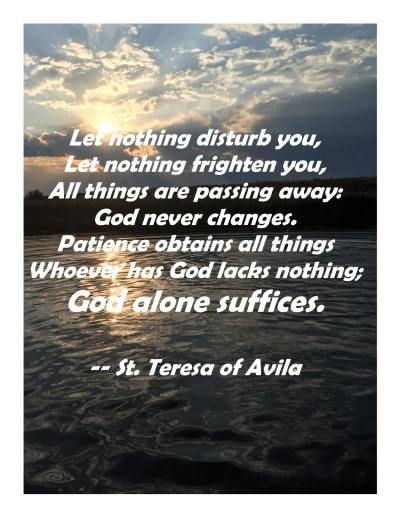
St. Teresa of Avila, declared a doctor of the Church, composed this beautiful prayer which describes this union:

Let nothing disturb you, Let nothing frighten you, All things are passing away: God never changes. Patience obtains all things Whoever has God lacks nothing; God alone suffices. — St. Teresa of Avila

In His Father’s house there are many rooms, and one especially prepared for you by Christ.  Trust in His love, Trust His Wisdom, Trust His Goodness…and let nothing trouble your hearts, that His Peace may be with you always.

Consider:

  • When have you experienced the peace of Christ?  After Mass, in praying with Scripture, in nature, through other Christians?
  • Consider the fears and anxieties you carry.  Lay them before the Lord in prayer and surrender them.  Consider the power of Christ to provide, the love of Christ which motivates Him, and the faithfulness of Christ who remains near us in every trial.
  • In what areas of your life do you trust God completely?  In what areas do you rely on yourself or conventional wisdom rather than Him?

Make a Resolution (Practical Application):

  • Choose your biggest worry.  Begin and end each day surrendering it to God in prayer.
  • Pray the prayer of St. Teresa of Avila each day this week.
  • We make an act of trust in God when we tithe.  If you do not tithe already, begin this week.  If you tithe already but feel called to tithe more (10% is the commonly suggested amount), prayerfully make a financial act of trust in the Lord.
  • Pray Psalm 23 each day this week.
Why do you trust Jesus Christ?  Post in the comments section below!

Related Posts:

~ Written by Angela Lambert © 2017

* To receive these weekly posts automatically in your email just click the “follow” tab in the bottom right hand corner and enter your email address.


We Have Seen His Glory…Gospel Meditation for Second Sunday of Lent

by Angela Lambert


March 12th, 2017; 2nd Sunday of Lent

Gospel of Matthew 17:1-9

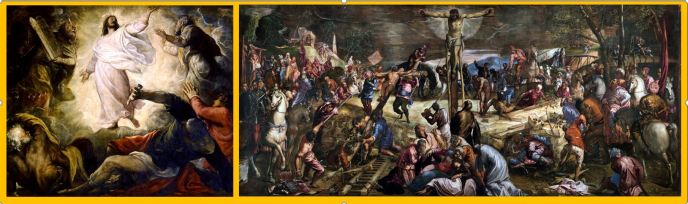
Jesus took Peter, James, and John his brother, and led them up a high mountain by themselves. And he was transfigured before them; his face shone like the sun and his clothes became white as light. And behold, Moses and Elijah appeared to them, conversing with him. Then Peter said to Jesus in reply, “Lord, it is good that we are here. If you wish, I will make three tents here, one for you, one for Moses, and one for Elijah. “While he was still speaking, behold, a bright cloud cast a shadow over them, then from the cloud came a voice that said, “This is my beloved Son, with whom I am well pleased; listen to him.” When the disciples heard this, they fell prostrate and were very much afraid. But Jesus came and touched them, saying, “Rise, and do not be afraid.” And when the disciples raised their eyes, they saw no one else but Jesus alone. As they were coming down from the mountain, Jesus charged them, “Do not tell the vision to anyone
until the Son of Man has been raised from the dead.”

 Meditation Reflection:

It requires little effort to encounter Jesus in His humbled, human form.  Belief in His human existence doesn’t require faith, since the historical evidence regarding His time on earth exceeds that of other great figures of history.  The wisdom of His teachings resonates with Christians, Muslims, Buddhists, and secular persons alike.  Thus, to view Jesus as a great Teacher doesn’t equate to faith per se either, but merely to good education. Limiting Christ to His human form, His own people had no qualms about making Him famous one day, shouting “Hosanna in the highest!”, and killing Him the next, shouting “Crucify Him!”.

Discipleship requires encountering Christ as He truly is – both human and divine; a great teacher, and God’s only Son sent as ransom for our sins.  To see Jesus’ divinity means strenuous effort to move beyond easy earthly worldviews and comforts.  Christ’s divinity and His redemptive love add a supernatural dimension to reality which impacts our decision making. Why turn the other cheek if justice can only be meted out on earth?  Why forsake wealth, travel, status, or pleasures if “you only live once” and this life is it? God works in surprising ways. He calls us to follow Him and to do things we cannot do on our own.   Discipleship requires faith, because it requires decisions that necessitate grace being real, and the Cross being the path to Resurrection.

Jesus took Peter, James, and John up the high mountain.  If invited to climb a high mountain (without the reason even being stated), how many of us would choose to relax at the bottom instead.  Looking up we might say, “I bet the view is beautiful, but it’s too much work.”  Peter, James, and John could not have anticipated what they saw that day.  They embarked on an arduous hike for the simple reason that Christ brought them.  Although easy to imagine as we read it in Scripture, consider the inertia you feel when trying to make time for exercise in the day, or how many excuses and competing priorities crowd out taking time aside for prayer.

These three wanted to be great in Christ’s kingdom.  Climbing the mountain of the Transfiguration, Jesus revealed that greatness meant trust in His Person.  He didn’t make a case to them as to why they should climb, nor did He make any promises about what they would get out of it.  They followed because He took them, and they trusted Him.

True to His character, God gave super-abundantly.  Peter, James, and John witnessed a magnificent sight.  They saw Jesus in His glorified form, His divine nature radiating through His human nature.  They saw Moses and Elijah conversing with Him, and so fulfillment of some of the greatest promises of the Old Covenant. Aware of the presence of God as His voice spoke from the heavens, they fell prostrate on the ground, overwhelmed and unworthy of such a profound gift.

Peter, James, and John did indeed become great in Christ’s kingdom.  Christ made Peter the head of His Church and the first pope.  James became the bishop of the Christian community in Jerusalem.  John, the beloved disciple and the contemplative theologian, received Mary into his home after Jesus’ death, wrote the intensely deep 4th Gospel, three letters included in Scripture, and the book of Revelation.

Their discipleship developed gradually however.  They believed they had found the Messiah when they first encountered Christ and left their possessions and careers to follow Him at His request. Inspired by the Holy Spirit, and having witnessed innumerable miracles, they came to believe He was the only begotten Son of God. Despite all of this however, the last, and hardest belief would be accepting that His messianic kingdom could only come through the Cross.  Whenever Jesus prophesied that He would be rejected, suffer, and die by crucifixion, the disciples vigorously protested.  They could not conceive any way in which that would make sense – naturally or super-naturally.

Jesus had compassion on their weakness.  He brought them up the high mountain and gave them a glimpse of His divine power, so that during the horrific events of His arrest, scourging, crowning of thorns, carrying the cross, and crucifixion, they would not lose faith.

Each person’s spiritual journey, though unique to the individual, at the same time follows a similar pattern.  Discipleship begins with an invitation from Christ.  To follow Him, we must leave some things behind to attain greater things ahead.  To move further, we must develop the conviction that Jesus is truly our Savior. Having begun the work of following Him, we start to witness His miracles, experience wonder at His teachings, and zeal begins to grow.  The most difficult test to discipleship however, remains the cross.  We might praise Jesus for dying for us, but when we must face the cross in our own lives we easily falter.  Jesus sometimes strengthens us with “Transfiguration moments” prior to these tests.  It might be consolation in prayer, blessings in our daily lives, heightened sight of His grace at work, or interior touches of His love in our soul.  Before great crosses, Jesus strengthens our faith, so that when His divinity is utterly hidden, we can recollect the times we saw it unveiled and persevere in trust.

Consider:

  • When have you felt the call of Christ? What have you left behind to pursue Him? How has it exceeded your expectations?
  • What would you consider your “Transfiguration” moment(s)? When have you been moved in awe by Christ’s divinity?
  • When has your faith been tested? When have you found it most hard to trust Christ? How do those transfiguration moments strengthen your faith in Him?

Make a Resolution (Practical Application):

  • At the end of each day this week, write down at least one time you “saw” Christ that day.
  • Pray the serenity-and-suscipe-prayers each day.

~ Written by Angela Lambert © 2017

* To receive these weekly posts automatically in your email just click the “follow” tab in the bottom right hand corner and enter your email address.


Determined Discipleship

by Angela Lambert

(c) National Galleries of Scotland; Supplied by The Public Catalogue Foundation

March 5th, 2017; 9th First Sunday of Lent

Gospel Matthew 4:1-11

At that time Jesus was led by the Spirit into the desert to be tempted by the devil. He fasted for forty days and forty nights, and afterwards he was hungry. The tempter approached and said to him, “If you are the Son of God, command that these stones become loaves of bread.” He said in reply, “It is written: One does not live on bread alone, but on every word that comes forth from the mouth of God.” Then the devil took him to the holy city, and made him stand on the parapet of the temple, and said to him, “If you are the Son of God, throw yourself down. For it is written: He will command his angels concerning you and with their hands they will support you, lest you dash your foot against a stone.” Jesus answered him, “Again it is written, You shall not put the Lord, your God, to the test.” Then the devil took him up to a very high mountain, and showed him all the kingdoms of the world in their magnificence, and he said to him, “All these I shall give to you, if you will prostrate yourself and worship me.” At this, Jesus said to him, “Get away, Satan! It is written: The Lord, your God, shall you worship and him alone shall you serve.” Then the devil left him and, behold, angels came and ministered to him.

Meditation Reflection:

Before Jesus began His public ministry, He went into the desert to pray and fast for forty days. Spending time in the desert meant leaving comforts, distractions, and entertainment, and being alone in solitude.  This may sound appealing, especially if you have a demanding job or little kids.  Yet, when we do make time to be alone in the silence, it can be uncomfortable and disconcerting.  We must face ourselves, the inner thoughts we have been pushing to the side, fears, insecurities, doubts, ambitions, and vanities.  The biggest battle most of us will face, is with ourselves and the enemy loves to bite at our heels as we do.  Thus, Jesus prepares for His ministry by enduring all the temptations you and I experience, and overcoming them.

Satan first tempts Christ with bread.  He waited until Jesus was at the end of His fast when He would be tired, hungry, and physically weak.  Similarly, the devil tries to exacerbate our problems when we are worn out and vulnerable.  How many of us have failed to pray in the morning because we didn’t want to give up the comfort of sleep? When have you missed Mass because it would be an inconvenience or it was cold outside?  Are there times when putting your feet up, having a beer or glass of wine, and watching tv took precedence over interacting with your spouse or kids at the end of a long work day (especially when kids require discipline or help with homework)? How many opportunities do we miss because we would rather stay in our comfort zone?  Unless we overcome our own slothful inertia, we cannot be strong enough to be the salt of the earth that Jesus needs from His disciples.

After overcoming our desires for pleasure and comfort, the next hurdle is fame and ambition.  Satan loves to stroke our ego and promote the lie that the measure of our worth is measured by our success.  Yet, our Lord chose a life of humility and rejected some of the apostles’ notions that His kingdom would bring them worldly notoriety.  God works the most through the small and the weak.  St. Paul even states that in our weakness God’s power is brought to perfection (I Corinthians 2:12). Until we curb our own ambitions, we won’t be free to work for God’s ambitions.

Finally, the ultimate stumbling block of the Christian faith, is suffering.  Satan’s third temptation offered Jesus the kingdom without the Cross;  a short cut around humiliation and struggle.  Whether it’s discipleship, marriage, family, or work, many people give up when things get hard.  Our culture of instant gratification further softens our resolve, along with the false expectation that we should always be happy.

Christ endured and overcame every temptation, that we might be strengthened to do the same.  Jesus unites Himself to us in our struggle and imbues us with His divine grace.

During Lent, we step away into the desert so that we might encounter the truth about ourselves.  We struggle against our own will through acts of fasting and self-denial.  We battle our greed and self-centeredness through works of charity and alms-giving.  We increase our prayer, and contemplate the mystery of Christ’s suffering, death, and resurrection, to deepen our love for our savior and to more closely follow Him.

Don’t be discouraged if you have already cheated on your Lenten sacrifice.  Self-knowledge is the beginning of conversion and develops humility.  Each day, we must pick up our cross, and as our awareness of our own weakness intensifies, our awareness of our need for Christ will also intensify. Whether you give something up or do something extra (or both), choose something that will touch the temptation you find most difficult – comfort, notoriety, or happiness at the expense of Christian fidelity.  Discipleship is difficult, and even the apostles’ conversions took time, so be patient.  Moved by love however, they eventually stopped trying to change Christ, and instead accepted Christ.  If we take time for Him, our love for Him will deepen, and we too will be more conformed to our Lord, and able to joyfully celebrate His final victory at the Resurrection on Easter.

Consider:

  • Which comforts or pleasures tempt you the most? Sleep, soda, alcohol, television, food, desserts, gossip, sports, music, movies?
  • What do you want others to notice about you most? What do you take the most pride in?  Do you feel small or unimportant if your work isn’t acknowledged or honored by others?
  • How do you avoid suffering? Do you avoid conflict with your spouse or kids?  Do you take short cuts at work?  Do you try to get ahead by putting others down or by neglecting your duties toward God or family?
  • Consider past Lents. How has God strengthened you?  How have you grown as a Christian?
  • Invite Christ into this Lent. Be docile to the Holy Spirit and ask Him to strengthen an area of your faith life.

Make a Resolution (Practical Application):

  • Each morning, begin with the prayer by St. Francis de Sales:

My God, I give you this day. I offer you, now, all of the good that I shall do and I promise to accept, for love of you, all of the difficulty that I shall meet. Help me to conduct myself during this day in a manner pleasing to you. Amen.

~ Written by Angela Lambert © 2017

* To receive these weekly posts automatically in your email just click the “follow” tab in the bottom right hand corner and enter your email address.


Day of Prayer for the Legal Protection of Unborn Children

mother-teresa-and-abortion

Each year on the anniversary of the legalization of abortion in the United States, the Catholic Church unites in prayer and fasting for the legal protection of unborn children.  As Christians, we value every human life because we are all children of God – not matter our race, gender, age, size, abilities, or health.

God became man at Jesus’ conception in Mary’s womb.  As a result we all share a special connection to our Lord, even from conception.

In addition, abortion wounds women as it treats her unique and incredible gift to give life as somehow decreasing her value in certain situations rather than elevating it. Women in crisis need our support and encouragement.  We need to work as a society to appreciate and protect women’s irreplaceable role of giving life to all persons.

This means we need to change how we look at pregnancy in the workplace and the career track.  It means facing the responsibility that is inherent in sex and its power to generate new human life.  It means remembering that crisis pregnancies were the result of a choice made by BOTH the mother AND the father.  Moreover, showing young women that they can rise to challenges in life and that others will be there to help them.  We need to demonstrate that, with God’s grace, good things can come out of mistakes and if we face our failures we can find a way forward.  We need to encourage women in crisis pregnancies that they can give their child life both physically through the pregnancy, but also by choosing a loving adoptive family if she isn’t able to raise the child.  Adoption is a loving choice and a sacrifice by the birth mother we need to honor more.

Abortion supports sexism as it not only kills the woman in the womb, but it degrades the value of motherhood as merely biological.  In addition, if abortion is promoted as a “remedy” or as “healthcare”, it implies that pregnancy is not a sacrificial and sacred gift to be honored, but rather a cancer if unwanted, or a consumer choice if desired.  Most importantly, abortion causes life-long emotional, and sometimes physical, wounds to mothers.  To treat abortion as a simple, non-emotional procedure, is sexist callousness and a failure to authentically work for the protection and flourishing of women.

I have seen the pain of women who have suffered the choice of abortion, and the pressures they encountered by boyfriends, family, and the culture since they supposedly had a “choice.”  I have also seen the healing and freedom of women who made it through the crisis and chose life.

May we pray today, and every day, for greater love and support for mothers and unborn children and the conversion of our own hearts in this matter.

Below is a link for rosary meditations specifically for these intentions:

Praying for the Unborn and Mothers in Crisis…Meditations on the Sorrowful Mysteries of the Rosary


Mary’s Motherhood and Christian Discipleship

by Angela Lambert

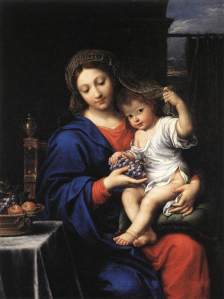
virgin-of-the-grapes

January 1st, 2017; Solemnity of the Blessed Virgin Mary, the Mother of God

Gospel Luke 2:16-21 NAB

The shepherds went in haste to Bethlehem and found Mary and Joseph, and the infant lying in the manger. When they saw this, they made known the message that had been told them about this child. All who heard it were amazed by what had been told them by the shepherds. And Mary kept all these things, reflecting on them in her heart. Then the shepherds returned, glorifying and praising God for all they had heard and seen, just as it had been told to them.
When eight days were completed for his circumcision, he was named Jesus, the name given him by the angel before he was conceived in the womb.

Meditation Reflection:

“Mary kept all these things, reflecting on them in her heart.”  When it comes to their children, mothers are contemplatives; they treasure and reflect on every little thing and never tire of gazing at their children in love.  I will never forget the first night I spent with my son in the hospital. The nurse urged me to sleep after an exhausting birth, but I couldn’t stop holding him and staring at him.  I was overcome with a love there is no vocabulary to describe, and in awe of this mystery beyond comprehension.  With each subsequent child, I experienced the same awe.  Moreover, rather than dividing my love, each child multiplied it by expanding my heart with love for each of them individually.

As Mary gazed with love on her child, she gazed not only on her son, but the Son of God.  Mary was the first person to contemplate the mystery that Jesus is both God and man, creator and savior, born to die that we might live.  She is the first to love Him with her whole heart and the only to have the privilege of loving Him with a mother’s heart.

When God the Son took on a human nature, He allowed Himself to become weak and vulnerable.  He experienced human development and the daily process of growth and maturation we all go through.  Mary and Joseph were not merely day care providers for Jesus.  They were the first disciples of Christ and lived their vocation as His family to the fullest.  As God, Jesus had all the divine attributes.  As man, He shared DNA with Mary, He adopted Mary and Joseph’s mannerisms, He received a formation within the context of His family.  Though He is both God and Man, Jesus is one Person.  As a result, since Mary is the mother of Jesus she is rightly called Mother of God.  This does not mean she is the origin of the Trinity.  However, we must remember that mothers are mothers of people, not merely bodies.  It would be strange to say that I am the mother of my son’s body but not the mother of my son the person.  In the same way, to bifurcate Mary’s motherhood as merely that of part of Jesus would be to bifurcate Jesus Himself.  Jesus is one Person, the Second Person of the Trinity, who, since the moment of His incarnation, is forever simultaneously both God and Man.

Mary revered our Lord as both.  She nurtured His human needs and she worshipped His divinity.  She, like Him, obeyed the Father in all things.  She was the first human to live fully God’s plan for all mankind – union with God of heart, mind, and will.  Moreover, she is the only human to love Him as her Son and to be loved by Him as His mother.

This deep, pure, motherly love of Mary extends to each one of us as well.  From the Cross, as Christ suffered and died for our redemption and rebirth, He entrusted Mary as mother to St. John.  In doing so, He gave all of us to her as her children.  In baptism, we are united to Christ as His Mystical Body.  In consequence, we are also united to Mary as our mystical Mother.  Rather than dividing her love, each person who accepts her as mother, multiplies her love and experiences the same tender attention she gives to each of her children.  Christ shares our nature, and He has also shared His Heavenly Father and His earthly Mother with us.  Through Christ we become adopted sons and daughters of God and cherished children of Mary.  Through Christ’s condescension to become our brother, He has invited us into His own family.

Mary is the mother of God because God became man.  Mothers never tire telling anyone who will listen about their children.  Moreover, mothers love their children simply for who they are, not merely what they do.  If we ask Mary, she will share with us about her Son and teach us how to love and follow Him for Who He is, and not merely what He can do for us.

“She is so full of love that no one who asks for her intercession is rejected, no matter how sinful he may be. The saints say that it has never been known since the world began that anyone had recourse to our Blessed Lady, with trust and perseverance, and was rejected.” St. Louis de Montfort

Consider:

  • How has meeting someone’s mother taught you something new about a person?
  • What do you cherish about your mother’s love?
  • If you are a parent, consider the mystery of your love for your children. Imagine Mary’s love for Jesus at each of the stages of growth your kids have experienced.
  • Adoptive parents repeatedly report that they love their adoptive kids as if they were theirs biologically. Consider Mary’s motherly love for you as her adoptive child, whom she loves as her very own.
  • Reflect on Christ’s love for Mary as His mother.
    • Consider the deep feelings of admiration and appreciation He has for her.
    • Reflect on their relationship and connection as mother and son.
    • Consider the comfort and strength He drew from her during His public ministry, knowing He had one person who understood His mission and supported Him no matter what.

Make a Resolution (Practical Application):

  • This week, read and reflect on the words of Mary in Scripture.
  • Ask Mary to be your mother and go to her each day with your needs. Ask her to tell you about Jesus and teach you how to follow Him.
  • Pray a decade of the rosary each day. Consider using the Scriptural rosary if you can.
    • (I have never prayed the rosary without experiencing some kind of grace. Mary always brings us to Jesus.)
    • Pope St. John Paul II said, “To pray the Rosary is to hand over our burdens to the merciful hearts of Christ and His mother.”


~ Written by Angela Lambert © 2017

* To receive these weekly posts automatically in your email just click the “follow” tab in the bottom right hand corner and enter your email address.


Looking for a Savior

by Angela Lambert


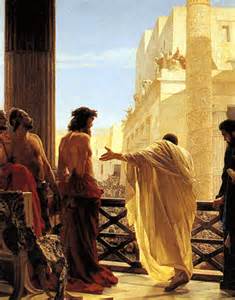
Jesus and Pilate

November 13th, 2016; 33rd Sunday in Ordinary Time

Gospel Luke 21:5-19

While some people were speaking about how the temple was adorned with costly stones and votive offerings, Jesus said, “All that you see here– the days will come when there will not be left a stone upon another stone that will not be thrown down.” Then they asked him, “Teacher, when will this happen? And what sign will there be when all these things are about to happen?” He answered, “See that you not be deceived, for many will come in my name, saying, ‘I am he,’ and ‘The time has come.’ Do not follow them! When you hear of wars and insurrections, do not be terrified; for such things must happen first, but it will not immediately be the end.” Then he said to them, “Nation will rise against nation, and kingdom against kingdom. There will be powerful earthquakes, famines, and plagues from place to place; and awesome sights and mighty signs will come from the sky. “Before all this happens, however, they will seize and persecute you, they will hand you over to the synagogues and to prisons, and they will have you led before kings and governors because of my name. It will lead to your giving testimony. Remember, you are not to prepare your defense beforehand, for I myself shall give you a wisdom in speaking that all your adversaries will be powerless to resist or refute.  You will even be handed over by parents, brothers, relatives, and friends, and they will put some of you to death.  You will be hated by all because of my name, but not a hair on your head will be destroyed. By your perseverance you will secure your lives.”

Meditation Reflection:

Oftentimes we imagine being a Christian means merely letting Jesus smooth out the rough edges of our lives to make it happier and more beautiful.  The Jews made this mistake by imagining that in fulfilling the law and the prophets the Messiah would simply restore the Davidic Kingdom to its former earthly glory.  To be fair, the Incarnation of the Son of God liberated us at an unimaginable level. God’s merciful love exceeds anything we have experienced or could expect.  He also exceeds all expectations of philosophy and the wisdom of the Greeks.  The Jews experienced a taste of God’s powerful action and the Greeks touched on the heights of God’s wisdom.  Jesus, the power and wisdom of God, makes both of these accessible to all and redirects our efforts toward an everlasting destination.

Christ counsels us to view this life as a pilgrimage and a battle.  We develop our faith, hope, and love, on earth which will bring a deep sense of joy but will never create an earthly utopia.  If we hope to find fullness here we will be sorely disappointed.  Just look at the reactions of the people to the current election.  Although presidents have a great deal of power, they are not omnipotent.  Moreover, their policies certainly affect our daily lives but the transformation of heart and development of culture is something only Christ can do through His grace and His followers.  Both candidates have significant flaws and neither are our savior.  The presidential election can never be the beginning of building a utopia or the end of the world, depending on your perspective.  Our reaction ought to be proportionate – working diligently for the common good within our democratic system but relying on Christ alone for the salvation of souls and the spiritual elevation of our country.  We can find relative happiness here, but for our joys to be lasting we need to direct them toward their true end – the heavenly kingdom.

Christ promises to equip us for both the physical and the mental battle.  As long as we live in the tension of sin and its effects, we will have to struggle against ourselves and others who oppose Christ’s kingdom, even family and friends.  Nevertheless, Jesus, the Wisdom of God, provides the supernatural insights to answer the world’s mistaken propaganda or the pressures applied by those we care about.  He also strengthens His disciples with supernatural perseverance to endure the physical suffering or possible martyrdom inflicted by worldly combatants.

As Catholics, we too enjoy beautiful churches that express the glory of God. Rightly so, we adorn them with gorgeous art, precious metals, and the finest materials.  We do this as an act of worship, as demonstrating concretely to ourselves and the world the value of God and of His sacrificial love.  Christian churches are an icon, a sign pointing to a heavenly kingdom much more enduring.  The magnificence of the sight of God will make all earthly analogies disappear. We ought to enjoy earthly icons of beauty, goodness, and truth in churches, nature, and most importantly in persons.  At the same time, we need to daily recall to where they point and adjust our expectations and priorities accordingly.   We should still aim for greatness, justice, and perfection, but remember that it will come to fulfillment in the eternal kingdom where Christ reigns victorious.

Consider:

  • At the end of your life, what do you hope will endure from it afterward? Consider the lives you have and might still change, the love with which you imbue the world, the truths you fought to defend, the family relationships you have built.
  • Imagine your life from the perspective of entering heaven. Though all is certainly a grace, what would you be proud of?  What would you regret? How might you live each day with more eternal purpose and significance?

Make a Resolution (Practical Application):

  • Begin each day by surrendering it to the Lord.  Look for three opportunities each day to build the kingdom of God – by acts of mercy, service, defending truth, helping someone heal or find justice, sharing the good news of Christ, offering up personal disappointments or suffering as a sacrifice… At the end of the day write down the things that built the kingdom of God.  Reflect on any missed opportunities and pray for the grace to act on them tomorrow.

Previous Related Posts:

~ Written by Angela Lambert © 2016

* To receive these weekly posts automatically in your email just click the “follow” tab in the bottom right hand corner and enter your email address.


How can God be both Justice and Mercy?

by Angela Lambert

justice-and-mercy

September 11th, 2016; 24th Sunday in Ordinary Time

Gospel Luke 15:1-32 NAB

Tax collectors and sinners were all drawing near to listen to Jesus, but the Pharisees and scribes began to complain, saying, “This man welcomes sinners and eats with them.” So to them he addressed this parable. “What man among you having a hundred sheep and losing one of them would not leave the ninety-nine in the desert and go after the lost one until he finds it? And when he does find it, he sets it on his shoulders with great joy and, upon his arrival home, he calls together his friends and neighbors and says to them, ‘Rejoice with me because I have found my lost sheep.’ I tell you, in just the same way there will be more joy in heaven over one sinner who repents than over ninety-nine righteous people who have no need of repentance.

“Or what woman having ten coins and losing one would not light a lamp and sweep the house, searching carefully until she finds it? And when she does find it, she calls together her friends and neighbors and says to them, ‘Rejoice with me because I have found the coin that I lost.’ In just the same way, I tell you, there will be rejoicing among the angels of God over one sinner who repents.”

Meditation Reflection:

Justice versus mercy.  How can God be both? And how can we imitate Him when we need to apply concretely a mystery that surpasses our understanding?

In this Gospel Christ illuminates something of this mystery.  First, we should remember that we live in a highly competitive culture.  Consequently, we feel justice – giving each person his or her due – is necessary to keep things “fair.”  Secondly, as St. Augustine pointed out in The City of God, if we are earthly-minded and focused on building the “city of man”, then we often find ourselves at war with one another as we vie for limited resources.

The resources and good in the “city of God” however, Augustine notes, are unlimited.  Moreover, rather than being reduced when given away they multiply, and rather than being limited to temporary gain, they last eternally.

Our human tendency to want justice applied to others but mercy applied to us, often relates more to our striving to build the city of man rather than the noble cause for justice itself.  Justice is important, and God is justice as well as mercy.  However, we have to be aware of our own prejudices and since we suffer the effects of original sin, we tend to rationalize our double-standard.

The truth is, when God weighs our own faults and violations of divine and natural law, none of us will be able to balance the scale and achieve a just state.  We know God cares about justice because for us to rightly spend eternity with Him, the scale had to be balanced and so He sent His only Son to suffer and die for our sake, to tip the scale for us.  By helping us reach a state of justice, He acted mercifully.

To even begin to understand something of this mystery, of the harmony between Justice and Mercy in God, Jesus uses comparisons we can relate to – a shepherd looking for a lost sheep and a woman searching for a coin.  In each case you or I may not have cared.  They care because they view the sheep and the coin as their belonging.  When lost, they were impoverished in some way and in finding it their possessions became complete.  We belong to God.  You or I may not care about a particular person but God does.  He views each human person as His own treasure, and to lose one results in a loss, and to regain that person creates completion.

To clarify and impress this on us further, Jesus follows with the Parable of the Prodigal Son (verses 11-32).  Whereas in our work life if an employee or colleague leaves it may be disappointing but that person can be replaced by a new hire and eventually life goes on.  We see this in every realm of society – politics, business, entertainment, sports – except one.  The family.  If a child rebels and leaves his or her family, there remains a hole and a lingering pain for as long as the child remains estranged.  The family cannot simply find a replacement and move on with life.  It will always feel like a loss and incomplete.

The relationship between justice and mercy therefore can only be understood in light of relationship.  In the parable of the prodigal son, the rebellious child left home and eventually experienced the reality of the choices he had made.  With the money gone, he finally received his due, and this provoked conversion.  When he returned home, repentant and interiorly changed, his father was ecstatic to incorporate him back into the family.  The older son, focused on the earthly resources, became bitter at the apparent injustice.  It wasn’t fair.  Had he viewed it from a spiritual perspective, he would have seen that he had become enrichened.  Rather than focusing on the fattened calf he felt he “lost” to the feast of his wayward brother, he ought to have focused on the brother he gained back.

The deeper we grow in love, the more we begin to understand God’s ways.  Rather than seeing him merely as a judge, we need to see that He is foremost a father.  He will do what it takes to keep his family together and to help His children flourish.  Fathers and mothers make countless material sacrifices for their children and oftentimes with joy.  From the outside others might rightly marvel at how this could be.  Those who have children however, know by experience the deeper sense of satisfaction and pleasure one gains from these acts.

When considering justice and mercy, Christ exhorts us to view it in light of being God’s possession, His children, and love.

Consider:

  • Consider the difference between being an employee or member in comparison to being someone’s child. As we mourn the loss of so many lives 15 years ago today, 9/11, we feel pain not because we lost so many skilled workers, but because we lost sons, daughters, mothers, and fathers.  We feel sorrow at tragedies around the world too, but there is a particular pain associated with losing “our own”.  Consider that God views every one of us in this way.  You are God’s own.  You are God’s child.
  • Consider how love moves one to mercy and the more loving persons are, the more merciful they become.
  • Consider how you felt when you received mercy or when you gave mercy.
  • Reflect on how justice and mercy relate with one another. Sometimes being just enables one to be merciful.
  • Spend 5 minutes in silent prayer, just gazing on God who is Justice and Mercy.

Make a Resolution (Practical Application):

  • Pray each day for the conversion of someone who has left the faith. If possible, reach out to him or her through acts of kindness and mercy.
  • In light of the parable of the prodigal son, forgive someone who has returned to you apologetically.
  • If there is someone who has made serious changes (for the better) in his or her life, pray about giving them a second chance and incorporating them back into your life.
  • Practice one corporal work of mercy and one spiritual work of mercy each day this week. Works of Mercy
  • Pray Pope Francis’ Year of Mercy Prayer.

*Additional meditations on forgiveness and mercy: https://taketimeforhim.com/2016/04/09/love-and-mercy-in-superabundance/

https://taketimeforhim.com/2016/04/02/divine-mercy-can-you-believe-it/

https://taketimeforhim.com/2016/03/12/the-life-changing-power-of-grace-and-mercy/

https://taketimeforhim.com/2015/12/12/prepare-for-the-coming-of-christs-mercy-by-giving-mercy/

~ Written by Angela Lambert © 2016

* To receive these weekly posts automatically in your email just click the “follow” tab in the bottom right hand corner and enter your email address.


Becoming Rich: Investment Strategies From Christ

by Angela Lambert


July 31st, 2016; 18th Sunday in Ordinary Time

Gospel of Luke 12:13-21 NAB

Someone in the crowd said to Jesus, “Teacher, tell my brother to share the inheritance with me.” He replied to him, “Friend, who appointed me as your judge and arbitrator?” Then he said to the crowd, “Take care to guard against all greed, for though one may be rich, one’s life does not consist of possessions.” Then he told them a parable. “There was a rich man whose land produced a bountiful harvest. He asked himself, ‘What shall I do, for I do not have space to store my harvest?’ And he said, ‘This is what I shall do: I shall tear down my barns and build larger ones. There I shall store all my grain and other goods and I shall say to myself, “Now as for you,
you have so many good things stored up for many years, rest, eat, drink, be merry!”’ But God said to him, ‘You fool, this night your life will be demanded of you; and the things you have prepared, to whom will they belong?’ Thus will it be for all who store up treasure for themselves
but are not rich in what matters to God.”

Meditation Reflection:

Greed comes in many forms and we can be quite talented at excusing it with innumerable rationalizations.  The man in this encounter masked his greed with a case about justice.  We don’t know the circumstances surrounding the inheritance but Jesus, who knows the truth in each of our hearts, shows greater concern from the man’s motive than the actual facts of the case.

Greed has a vicious way of undermining our relationships with God, each other, and even ourselves.  We often operate with the mentality of the farmer in Christ’s parable.  The modern equivalent would go something like this:  Work hard in school and be successful in a bunch of extracurricular activities so you can get into a good college, so you can get a good job, so you can make a lot of money, so you will be secure and happy.  Yet, how many people follow this plan and find themselves at 40 years old burnt out, lonely, empty inside, and suffering from health issues related to the stressful pace they have been keeping for decades.  Ironically, we are both the richest country in the world and the most depressed. We keep a frenzied pace only to find ourselves exasperatedly sighing the same words of Ecclesiastes “For what profit comes to man from all the toil and anxiety of heart with which he has labored under the sun?” (2:22).

What is the point?! We clean the house and it’s messy again in a matter of hours.  We finish a project at work and another lands on our desk the next day.  Our kids finish one sport’s season and another begins.  Days fly off the calendar, then weeks, then years.  Everyone has to find a balance between work and life.  We have to be prudent, work hard, and plan for the future.  The problem is, it’s just sooooo easy to work and plan for more than we really need and miss out on the good stuff right in front of us.  Rather than plopping on the couch and watching a movie with our kids we run another load of laundry or get some work done on the computer.  Instead of going out with colleagues and deepening friendships, we put in a couple extra hours at work to get ahead.

Jesus reminds us to work and plan for our eternal future too.  We are made for meaning, purpose, and love.  Moreover, we are spiritual beings made for eternity with God.  Work labored for greed will produce a temporary reward, but work offered in love and service to God will bring eternal joy.  It will likely bring a deeper earthly joy as well.  Having the respect of others because of your position can feel good but it can also feel empty, not to mention add paranoia that someone will try to take it from you.  Having the respect of others because of your character is priceless and immune from circumstances.

Greed is an inordinate desire for wealth.  Every day we must pray and reflect on what really matters so we invest our time and efforts wisely and in the right order.  Through the grace of Christ, we have the opportunity to escape the crazed rat race and endless running on what feels like a gerbil wheel going in circles.  If we have the courage to surrender greed we can gain immeasurable wealth unaffected by the volatility of the stock market or our boss, and which produces deeper pleasure than money can buy. Working for your kids will mean more than working merely to afford fashionable clothing which will quickly be out of fashion, or a beautiful boat which won’t be as much fun without kids there to enjoy it with you, or the perfect house which will just be outdone by the Jones’ house that will be built next door in a year.  Doing work that improves the lives of others will give you deeper satisfaction than a simple paycheck.  No matter what your profession, how you conduct yourself and to what end is up to you.

As a teacher, I am reminded of this at graduation parties.  Our bonus, though not monetary, comes in the form of seeing kids we helped develop turn into amazing human beings.  It’s the emails from college or stopping by our classrooms to tell us everything they are up to or how something we taught them has stuck with them that is worth more than any zeros on a check. Similarly, I know wealthy individuals who find great joy in putting it at the service of the Lord and seeing the fruits of those spiritual endeavors. God promises in 2 Corinthians 9:6 “Consider this: whoever sows sparingly will also reap sparingly, and whoever sows bountifully will also reap bountifully.”  Be generous with God and labor to sow what matters so you can be “rich in what matters to God.”

Consider:

  • Reflect on what matters most in your life. Consider what gets in the way of those things versus what develops them.
  • Prayerfully consider what is “enough” for you. What would be sufficient and what work is necessary to meet that goal?
  • Ask God to reveal any desires that have become excessive or obsessive. Is there anything you are grasping after or worried about that prevents you from enjoying the gifts God has already given you?
  • What kind of work or charitable contributions brings you a feeling of satisfaction?
    • Do you find meaning in aspects of your job?
    • Do you enjoy providing for your family and seeing them thrive?
    • Do you have charitable projects you care about?
  • Has greed ever undermined your relationship with God? With another person?  With being true to yourself?

Make a Resolution (Practical Application):

  • Evaluate your investments in God, others, and yourself.  Decide on one thing you could do for each category to enrichen that relationship in your life.
  • The opposite virtue of greed is generosity. Do something generous this week.


~ Written by Angela Lambert © 2016

* To receive these weekly posts automatically in your email just click the “follow” tab in the bottom right hand corner and enter your email address.