Day of Prayer for the Legal Protection of Unborn Children

mother-teresa-and-abortion

Each year on the anniversary of the legalization of abortion in the United States, the Catholic Church unites in prayer and fasting for the legal protection of unborn children.  As Christians, we value every human life because we are all children of God – not matter our race, gender, age, size, abilities, or health.

God became man at Jesus’ conception in Mary’s womb.  As a result we all share a special connection to our Lord, even from conception.

In addition, abortion wounds women as it treats her unique and incredible gift to give life as somehow decreasing her value in certain situations rather than elevating it. Women in crisis need our support and encouragement.  We need to work as a society to appreciate and protect women’s irreplaceable role of giving life to all persons.

This means we need to change how we look at pregnancy in the workplace and the career track.  It means facing the responsibility that is inherent in sex and its power to generate new human life.  It means remembering that crisis pregnancies were the result of a choice made by BOTH the mother AND the father.  Moreover, showing young women that they can rise to challenges in life and that others will be there to help them.  We need to demonstrate that, with God’s grace, good things can come out of mistakes and if we face our failures we can find a way forward.  We need to encourage women in crisis pregnancies that they can give their child life both physically through the pregnancy, but also by choosing a loving adoptive family if she isn’t able to raise the child.  Adoption is a loving choice and a sacrifice by the birth mother we need to honor more.

Abortion supports sexism as it not only kills the woman in the womb, but it degrades the value of motherhood as merely biological.  In addition, if abortion is promoted as a “remedy” or as “healthcare”, it implies that pregnancy is not a sacrificial and sacred gift to be honored, but rather a cancer if unwanted, or a consumer choice if desired.  Most importantly, abortion causes life-long emotional, and sometimes physical, wounds to mothers.  To treat abortion as a simple, non-emotional procedure, is sexist callousness and a failure to authentically work for the protection and flourishing of women.

I have seen the pain of women who have suffered the choice of abortion, and the pressures they encountered by boyfriends, family, and the culture since they supposedly had a “choice.”  I have also seen the healing and freedom of women who made it through the crisis and chose life.

May we pray today, and every day, for greater love and support for mothers and unborn children and the conversion of our own hearts in this matter.

Below is a link for rosary meditations specifically for these intentions:

Praying for the Unborn and Mothers in Crisis…Meditations on the Sorrowful Mysteries of the Rosary


Mary’s Motherhood and Christian Discipleship

by Angela Lambert

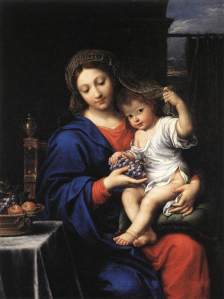
virgin-of-the-grapes

January 1st, 2017; Solemnity of the Blessed Virgin Mary, the Mother of God

Gospel Luke 2:16-21 NAB

The shepherds went in haste to Bethlehem and found Mary and Joseph, and the infant lying in the manger. When they saw this, they made known the message that had been told them about this child. All who heard it were amazed by what had been told them by the shepherds. And Mary kept all these things, reflecting on them in her heart. Then the shepherds returned, glorifying and praising God for all they had heard and seen, just as it had been told to them.
When eight days were completed for his circumcision, he was named Jesus, the name given him by the angel before he was conceived in the womb.

Meditation Reflection:

“Mary kept all these things, reflecting on them in her heart.”  When it comes to their children, mothers are contemplatives; they treasure and reflect on every little thing and never tire of gazing at their children in love.  I will never forget the first night I spent with my son in the hospital. The nurse urged me to sleep after an exhausting birth, but I couldn’t stop holding him and staring at him.  I was overcome with a love there is no vocabulary to describe, and in awe of this mystery beyond comprehension.  With each subsequent child, I experienced the same awe.  Moreover, rather than dividing my love, each child multiplied it by expanding my heart with love for each of them individually.

As Mary gazed with love on her child, she gazed not only on her son, but the Son of God.  Mary was the first person to contemplate the mystery that Jesus is both God and man, creator and savior, born to die that we might live.  She is the first to love Him with her whole heart and the only to have the privilege of loving Him with a mother’s heart.

When God the Son took on a human nature, He allowed Himself to become weak and vulnerable.  He experienced human development and the daily process of growth and maturation we all go through.  Mary and Joseph were not merely day care providers for Jesus.  They were the first disciples of Christ and lived their vocation as His family to the fullest.  As God, Jesus had all the divine attributes.  As man, He shared DNA with Mary, He adopted Mary and Joseph’s mannerisms, He received a formation within the context of His family.  Though He is both God and Man, Jesus is one Person.  As a result, since Mary is the mother of Jesus she is rightly called Mother of God.  This does not mean she is the origin of the Trinity.  However, we must remember that mothers are mothers of people, not merely bodies.  It would be strange to say that I am the mother of my son’s body but not the mother of my son the person.  In the same way, to bifurcate Mary’s motherhood as merely that of part of Jesus would be to bifurcate Jesus Himself.  Jesus is one Person, the Second Person of the Trinity, who, since the moment of His incarnation, is forever simultaneously both God and Man.

Mary revered our Lord as both.  She nurtured His human needs and she worshipped His divinity.  She, like Him, obeyed the Father in all things.  She was the first human to live fully God’s plan for all mankind – union with God of heart, mind, and will.  Moreover, she is the only human to love Him as her Son and to be loved by Him as His mother.

This deep, pure, motherly love of Mary extends to each one of us as well.  From the Cross, as Christ suffered and died for our redemption and rebirth, He entrusted Mary as mother to St. John.  In doing so, He gave all of us to her as her children.  In baptism, we are united to Christ as His Mystical Body.  In consequence, we are also united to Mary as our mystical Mother.  Rather than dividing her love, each person who accepts her as mother, multiplies her love and experiences the same tender attention she gives to each of her children.  Christ shares our nature, and He has also shared His Heavenly Father and His earthly Mother with us.  Through Christ we become adopted sons and daughters of God and cherished children of Mary.  Through Christ’s condescension to become our brother, He has invited us into His own family.

Mary is the mother of God because God became man.  Mothers never tire telling anyone who will listen about their children.  Moreover, mothers love their children simply for who they are, not merely what they do.  If we ask Mary, she will share with us about her Son and teach us how to love and follow Him for Who He is, and not merely what He can do for us.

“She is so full of love that no one who asks for her intercession is rejected, no matter how sinful he may be. The saints say that it has never been known since the world began that anyone had recourse to our Blessed Lady, with trust and perseverance, and was rejected.” St. Louis de Montfort

Consider:

  • How has meeting someone’s mother taught you something new about a person?
  • What do you cherish about your mother’s love?
  • If you are a parent, consider the mystery of your love for your children. Imagine Mary’s love for Jesus at each of the stages of growth your kids have experienced.
  • Adoptive parents repeatedly report that they love their adoptive kids as if they were theirs biologically. Consider Mary’s motherly love for you as her adoptive child, whom she loves as her very own.
  • Reflect on Christ’s love for Mary as His mother.
    • Consider the deep feelings of admiration and appreciation He has for her.
    • Reflect on their relationship and connection as mother and son.
    • Consider the comfort and strength He drew from her during His public ministry, knowing He had one person who understood His mission and supported Him no matter what.

Make a Resolution (Practical Application):

  • This week, read and reflect on the words of Mary in Scripture.
  • Ask Mary to be your mother and go to her each day with your needs. Ask her to tell you about Jesus and teach you how to follow Him.
  • Pray a decade of the rosary each day. Consider using the Scriptural rosary if you can.
    • (I have never prayed the rosary without experiencing some kind of grace. Mary always brings us to Jesus.)
    • Pope St. John Paul II said, “To pray the Rosary is to hand over our burdens to the merciful hearts of Christ and His mother.”


~ Written by Angela Lambert © 2017

* To receive these weekly posts automatically in your email just click the “follow” tab in the bottom right hand corner and enter your email address.


Looking for a Savior

by Angela Lambert


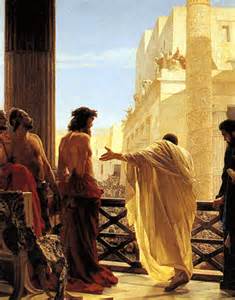
Jesus and Pilate

November 13th, 2016; 33rd Sunday in Ordinary Time

Gospel Luke 21:5-19

While some people were speaking about how the temple was adorned with costly stones and votive offerings, Jesus said, “All that you see here– the days will come when there will not be left a stone upon another stone that will not be thrown down.” Then they asked him, “Teacher, when will this happen? And what sign will there be when all these things are about to happen?” He answered, “See that you not be deceived, for many will come in my name, saying, ‘I am he,’ and ‘The time has come.’ Do not follow them! When you hear of wars and insurrections, do not be terrified; for such things must happen first, but it will not immediately be the end.” Then he said to them, “Nation will rise against nation, and kingdom against kingdom. There will be powerful earthquakes, famines, and plagues from place to place; and awesome sights and mighty signs will come from the sky. “Before all this happens, however, they will seize and persecute you, they will hand you over to the synagogues and to prisons, and they will have you led before kings and governors because of my name. It will lead to your giving testimony. Remember, you are not to prepare your defense beforehand, for I myself shall give you a wisdom in speaking that all your adversaries will be powerless to resist or refute.  You will even be handed over by parents, brothers, relatives, and friends, and they will put some of you to death.  You will be hated by all because of my name, but not a hair on your head will be destroyed. By your perseverance you will secure your lives.”

Meditation Reflection:

Oftentimes we imagine being a Christian means merely letting Jesus smooth out the rough edges of our lives to make it happier and more beautiful.  The Jews made this mistake by imagining that in fulfilling the law and the prophets the Messiah would simply restore the Davidic Kingdom to its former earthly glory.  To be fair, the Incarnation of the Son of God liberated us at an unimaginable level. God’s merciful love exceeds anything we have experienced or could expect.  He also exceeds all expectations of philosophy and the wisdom of the Greeks.  The Jews experienced a taste of God’s powerful action and the Greeks touched on the heights of God’s wisdom.  Jesus, the power and wisdom of God, makes both of these accessible to all and redirects our efforts toward an everlasting destination.

Christ counsels us to view this life as a pilgrimage and a battle.  We develop our faith, hope, and love, on earth which will bring a deep sense of joy but will never create an earthly utopia.  If we hope to find fullness here we will be sorely disappointed.  Just look at the reactions of the people to the current election.  Although presidents have a great deal of power, they are not omnipotent.  Moreover, their policies certainly affect our daily lives but the transformation of heart and development of culture is something only Christ can do through His grace and His followers.  Both candidates have significant flaws and neither are our savior.  The presidential election can never be the beginning of building a utopia or the end of the world, depending on your perspective.  Our reaction ought to be proportionate – working diligently for the common good within our democratic system but relying on Christ alone for the salvation of souls and the spiritual elevation of our country.  We can find relative happiness here, but for our joys to be lasting we need to direct them toward their true end – the heavenly kingdom.

Christ promises to equip us for both the physical and the mental battle.  As long as we live in the tension of sin and its effects, we will have to struggle against ourselves and others who oppose Christ’s kingdom, even family and friends.  Nevertheless, Jesus, the Wisdom of God, provides the supernatural insights to answer the world’s mistaken propaganda or the pressures applied by those we care about.  He also strengthens His disciples with supernatural perseverance to endure the physical suffering or possible martyrdom inflicted by worldly combatants.

As Catholics, we too enjoy beautiful churches that express the glory of God. Rightly so, we adorn them with gorgeous art, precious metals, and the finest materials.  We do this as an act of worship, as demonstrating concretely to ourselves and the world the value of God and of His sacrificial love.  Christian churches are an icon, a sign pointing to a heavenly kingdom much more enduring.  The magnificence of the sight of God will make all earthly analogies disappear. We ought to enjoy earthly icons of beauty, goodness, and truth in churches, nature, and most importantly in persons.  At the same time, we need to daily recall to where they point and adjust our expectations and priorities accordingly.   We should still aim for greatness, justice, and perfection, but remember that it will come to fulfillment in the eternal kingdom where Christ reigns victorious.

Consider:

  • At the end of your life, what do you hope will endure from it afterward? Consider the lives you have and might still change, the love with which you imbue the world, the truths you fought to defend, the family relationships you have built.
  • Imagine your life from the perspective of entering heaven. Though all is certainly a grace, what would you be proud of?  What would you regret? How might you live each day with more eternal purpose and significance?

Make a Resolution (Practical Application):

  • Begin each day by surrendering it to the Lord.  Look for three opportunities each day to build the kingdom of God – by acts of mercy, service, defending truth, helping someone heal or find justice, sharing the good news of Christ, offering up personal disappointments or suffering as a sacrifice… At the end of the day write down the things that built the kingdom of God.  Reflect on any missed opportunities and pray for the grace to act on them tomorrow.

Previous Related Posts:

~ Written by Angela Lambert © 2016

* To receive these weekly posts automatically in your email just click the “follow” tab in the bottom right hand corner and enter your email address.


How can God be both Justice and Mercy?

by Angela Lambert

justice-and-mercy

September 11th, 2016; 24th Sunday in Ordinary Time

Gospel Luke 15:1-32 NAB

Tax collectors and sinners were all drawing near to listen to Jesus, but the Pharisees and scribes began to complain, saying, “This man welcomes sinners and eats with them.” So to them he addressed this parable. “What man among you having a hundred sheep and losing one of them would not leave the ninety-nine in the desert and go after the lost one until he finds it? And when he does find it, he sets it on his shoulders with great joy and, upon his arrival home, he calls together his friends and neighbors and says to them, ‘Rejoice with me because I have found my lost sheep.’ I tell you, in just the same way there will be more joy in heaven over one sinner who repents than over ninety-nine righteous people who have no need of repentance.

“Or what woman having ten coins and losing one would not light a lamp and sweep the house, searching carefully until she finds it? And when she does find it, she calls together her friends and neighbors and says to them, ‘Rejoice with me because I have found the coin that I lost.’ In just the same way, I tell you, there will be rejoicing among the angels of God over one sinner who repents.”

Meditation Reflection:

Justice versus mercy.  How can God be both? And how can we imitate Him when we need to apply concretely a mystery that surpasses our understanding?

In this Gospel Christ illuminates something of this mystery.  First, we should remember that we live in a highly competitive culture.  Consequently, we feel justice – giving each person his or her due – is necessary to keep things “fair.”  Secondly, as St. Augustine pointed out in The City of God, if we are earthly-minded and focused on building the “city of man”, then we often find ourselves at war with one another as we vie for limited resources.

The resources and good in the “city of God” however, Augustine notes, are unlimited.  Moreover, rather than being reduced when given away they multiply, and rather than being limited to temporary gain, they last eternally.

Our human tendency to want justice applied to others but mercy applied to us, often relates more to our striving to build the city of man rather than the noble cause for justice itself.  Justice is important, and God is justice as well as mercy.  However, we have to be aware of our own prejudices and since we suffer the effects of original sin, we tend to rationalize our double-standard.

The truth is, when God weighs our own faults and violations of divine and natural law, none of us will be able to balance the scale and achieve a just state.  We know God cares about justice because for us to rightly spend eternity with Him, the scale had to be balanced and so He sent His only Son to suffer and die for our sake, to tip the scale for us.  By helping us reach a state of justice, He acted mercifully.

To even begin to understand something of this mystery, of the harmony between Justice and Mercy in God, Jesus uses comparisons we can relate to – a shepherd looking for a lost sheep and a woman searching for a coin.  In each case you or I may not have cared.  They care because they view the sheep and the coin as their belonging.  When lost, they were impoverished in some way and in finding it their possessions became complete.  We belong to God.  You or I may not care about a particular person but God does.  He views each human person as His own treasure, and to lose one results in a loss, and to regain that person creates completion.

To clarify and impress this on us further, Jesus follows with the Parable of the Prodigal Son (verses 11-32).  Whereas in our work life if an employee or colleague leaves it may be disappointing but that person can be replaced by a new hire and eventually life goes on.  We see this in every realm of society – politics, business, entertainment, sports – except one.  The family.  If a child rebels and leaves his or her family, there remains a hole and a lingering pain for as long as the child remains estranged.  The family cannot simply find a replacement and move on with life.  It will always feel like a loss and incomplete.

The relationship between justice and mercy therefore can only be understood in light of relationship.  In the parable of the prodigal son, the rebellious child left home and eventually experienced the reality of the choices he had made.  With the money gone, he finally received his due, and this provoked conversion.  When he returned home, repentant and interiorly changed, his father was ecstatic to incorporate him back into the family.  The older son, focused on the earthly resources, became bitter at the apparent injustice.  It wasn’t fair.  Had he viewed it from a spiritual perspective, he would have seen that he had become enrichened.  Rather than focusing on the fattened calf he felt he “lost” to the feast of his wayward brother, he ought to have focused on the brother he gained back.

The deeper we grow in love, the more we begin to understand God’s ways.  Rather than seeing him merely as a judge, we need to see that He is foremost a father.  He will do what it takes to keep his family together and to help His children flourish.  Fathers and mothers make countless material sacrifices for their children and oftentimes with joy.  From the outside others might rightly marvel at how this could be.  Those who have children however, know by experience the deeper sense of satisfaction and pleasure one gains from these acts.

When considering justice and mercy, Christ exhorts us to view it in light of being God’s possession, His children, and love.

Consider:

  • Consider the difference between being an employee or member in comparison to being someone’s child. As we mourn the loss of so many lives 15 years ago today, 9/11, we feel pain not because we lost so many skilled workers, but because we lost sons, daughters, mothers, and fathers.  We feel sorrow at tragedies around the world too, but there is a particular pain associated with losing “our own”.  Consider that God views every one of us in this way.  You are God’s own.  You are God’s child.
  • Consider how love moves one to mercy and the more loving persons are, the more merciful they become.
  • Consider how you felt when you received mercy or when you gave mercy.
  • Reflect on how justice and mercy relate with one another. Sometimes being just enables one to be merciful.
  • Spend 5 minutes in silent prayer, just gazing on God who is Justice and Mercy.

Make a Resolution (Practical Application):

  • Pray each day for the conversion of someone who has left the faith. If possible, reach out to him or her through acts of kindness and mercy.
  • In light of the parable of the prodigal son, forgive someone who has returned to you apologetically.
  • If there is someone who has made serious changes (for the better) in his or her life, pray about giving them a second chance and incorporating them back into your life.
  • Practice one corporal work of mercy and one spiritual work of mercy each day this week. Works of Mercy
  • Pray Pope Francis’ Year of Mercy Prayer.

*Additional meditations on forgiveness and mercy: https://taketimeforhim.com/2016/04/09/love-and-mercy-in-superabundance/

https://taketimeforhim.com/2016/04/02/divine-mercy-can-you-believe-it/

https://taketimeforhim.com/2016/03/12/the-life-changing-power-of-grace-and-mercy/

https://taketimeforhim.com/2015/12/12/prepare-for-the-coming-of-christs-mercy-by-giving-mercy/

~ Written by Angela Lambert © 2016

* To receive these weekly posts automatically in your email just click the “follow” tab in the bottom right hand corner and enter your email address.


Becoming Rich: Investment Strategies From Christ

by Angela Lambert


July 31st, 2016; 18th Sunday in Ordinary Time

Gospel of Luke 12:13-21 NAB

Someone in the crowd said to Jesus, “Teacher, tell my brother to share the inheritance with me.” He replied to him, “Friend, who appointed me as your judge and arbitrator?” Then he said to the crowd, “Take care to guard against all greed, for though one may be rich, one’s life does not consist of possessions.” Then he told them a parable. “There was a rich man whose land produced a bountiful harvest. He asked himself, ‘What shall I do, for I do not have space to store my harvest?’ And he said, ‘This is what I shall do: I shall tear down my barns and build larger ones. There I shall store all my grain and other goods and I shall say to myself, “Now as for you,
you have so many good things stored up for many years, rest, eat, drink, be merry!”’ But God said to him, ‘You fool, this night your life will be demanded of you; and the things you have prepared, to whom will they belong?’ Thus will it be for all who store up treasure for themselves
but are not rich in what matters to God.”

Meditation Reflection:

Greed comes in many forms and we can be quite talented at excusing it with innumerable rationalizations.  The man in this encounter masked his greed with a case about justice.  We don’t know the circumstances surrounding the inheritance but Jesus, who knows the truth in each of our hearts, shows greater concern from the man’s motive than the actual facts of the case.

Greed has a vicious way of undermining our relationships with God, each other, and even ourselves.  We often operate with the mentality of the farmer in Christ’s parable.  The modern equivalent would go something like this:  Work hard in school and be successful in a bunch of extracurricular activities so you can get into a good college, so you can get a good job, so you can make a lot of money, so you will be secure and happy.  Yet, how many people follow this plan and find themselves at 40 years old burnt out, lonely, empty inside, and suffering from health issues related to the stressful pace they have been keeping for decades.  Ironically, we are both the richest country in the world and the most depressed. We keep a frenzied pace only to find ourselves exasperatedly sighing the same words of Ecclesiastes “For what profit comes to man from all the toil and anxiety of heart with which he has labored under the sun?” (2:22).

What is the point?! We clean the house and it’s messy again in a matter of hours.  We finish a project at work and another lands on our desk the next day.  Our kids finish one sport’s season and another begins.  Days fly off the calendar, then weeks, then years.  Everyone has to find a balance between work and life.  We have to be prudent, work hard, and plan for the future.  The problem is, it’s just sooooo easy to work and plan for more than we really need and miss out on the good stuff right in front of us.  Rather than plopping on the couch and watching a movie with our kids we run another load of laundry or get some work done on the computer.  Instead of going out with colleagues and deepening friendships, we put in a couple extra hours at work to get ahead.

Jesus reminds us to work and plan for our eternal future too.  We are made for meaning, purpose, and love.  Moreover, we are spiritual beings made for eternity with God.  Work labored for greed will produce a temporary reward, but work offered in love and service to God will bring eternal joy.  It will likely bring a deeper earthly joy as well.  Having the respect of others because of your position can feel good but it can also feel empty, not to mention add paranoia that someone will try to take it from you.  Having the respect of others because of your character is priceless and immune from circumstances.

Greed is an inordinate desire for wealth.  Every day we must pray and reflect on what really matters so we invest our time and efforts wisely and in the right order.  Through the grace of Christ, we have the opportunity to escape the crazed rat race and endless running on what feels like a gerbil wheel going in circles.  If we have the courage to surrender greed we can gain immeasurable wealth unaffected by the volatility of the stock market or our boss, and which produces deeper pleasure than money can buy. Working for your kids will mean more than working merely to afford fashionable clothing which will quickly be out of fashion, or a beautiful boat which won’t be as much fun without kids there to enjoy it with you, or the perfect house which will just be outdone by the Jones’ house that will be built next door in a year.  Doing work that improves the lives of others will give you deeper satisfaction than a simple paycheck.  No matter what your profession, how you conduct yourself and to what end is up to you.

As a teacher, I am reminded of this at graduation parties.  Our bonus, though not monetary, comes in the form of seeing kids we helped develop turn into amazing human beings.  It’s the emails from college or stopping by our classrooms to tell us everything they are up to or how something we taught them has stuck with them that is worth more than any zeros on a check. Similarly, I know wealthy individuals who find great joy in putting it at the service of the Lord and seeing the fruits of those spiritual endeavors. God promises in 2 Corinthians 9:6 “Consider this: whoever sows sparingly will also reap sparingly, and whoever sows bountifully will also reap bountifully.”  Be generous with God and labor to sow what matters so you can be “rich in what matters to God.”

Consider:

  • Reflect on what matters most in your life. Consider what gets in the way of those things versus what develops them.
  • Prayerfully consider what is “enough” for you. What would be sufficient and what work is necessary to meet that goal?
  • Ask God to reveal any desires that have become excessive or obsessive. Is there anything you are grasping after or worried about that prevents you from enjoying the gifts God has already given you?
  • What kind of work or charitable contributions brings you a feeling of satisfaction?
    • Do you find meaning in aspects of your job?
    • Do you enjoy providing for your family and seeing them thrive?
    • Do you have charitable projects you care about?
  • Has greed ever undermined your relationship with God? With another person?  With being true to yourself?

Make a Resolution (Practical Application):

  • Evaluate your investments in God, others, and yourself.  Decide on one thing you could do for each category to enrichen that relationship in your life.
  • The opposite virtue of greed is generosity. Do something generous this week.


~ Written by Angela Lambert © 2016

* To receive these weekly posts automatically in your email just click the “follow” tab in the bottom right hand corner and enter your email address.


Loving Confidence in Prayer

by Angela Lambert

Jesus teach prayerjesus-fasting-in-wilderness-desert

July 24th, 2016; 17th Sunday in Ordinary Time

Gospel of Luke 11:1-13 NAB

Jesus was praying in a certain place, and when he had finished, one of his disciples said to him, “Lord, teach us to pray just as John taught his disciples.” He said to them, “When you pray, say: Father, hallowed be your name, your kingdom come. Give us each day our daily bread and forgive us our sins for we ourselves forgive everyone in debt to us, and do not subject us to the final test.” And he said to them, “Suppose one of you has a friend to whom he goes at midnight and says, ‘Friend, lend me three loaves of bread, for a friend of mine has arrived at my house from a journey and I have nothing to offer him,’ and he says in reply from within, ‘Do not bother me; the door has already been locked and my children and I are already in bed. I cannot get up to give you anything.’ I tell you, if he does not get up to give the visitor the loaves because of their friendship, he will get up to give him whatever he needs because of his persistence. “And I tell you, ask and you will receive; seek and you will find; knock and the door will be opened to you. For everyone who asks, receives; and the one who seeks, finds; and to the one who knocks, the door will be opened. What father among you would hand his son a snake when he asks for a fish? Or hand him a scorpion when he asks for an egg? If you then, who are wicked, know how to give good gifts to your children, how much more will the Father in heaven give the Holy Spirit to those who ask him?”

Meditation Reflection:

Jesus Christ is the visible image of the invisible God.  “Whoever has seen Me has seen the Father” (John 14:9), He says. In contrast, pagan gods tended to be images of the visible traits of humankind.  Thus, they tended to mirror fallen man’s tendencies toward power, greed, lust, and narcissism.

This answered man’s nagging questions about the origins of good and evil but it also left him subject to the whims of unpredictable powers.  Be it Greek, Roman, or Babylonian gods, people tried to satiate the needs of their deities to avoid calamities and possibly manipulate them for favors.  This explains, for instance, why the Romans did not care who a person worshiped provided they did their part to appease the Roman gods too and why they blamed Christians for the fall of Rome.

This appeasement of the gods should not be mistaken for relationship.  It would be more apt to describe it as mutual manipulation.   In some places it spiraled into superstition bordering on the obsessive-compulsive.  For instance, some farmers would address one god for the successful tilling of soil, another for the planting of seed, another for the growth of the seed, another for the harvest, and so on.  Even well after the West became Christianized this practice proved difficult to root out since it had become so ingrained in the culture and in fallen man’s temptation to control rather than to trust.  In modern times, we must resist the secular attempt to lump Christianity with all of the other religions into one vague spirituality.  The history of pagan worship differs in an absolute way from Judeo-Christian worship. God has distinguished Himself from every other faith from the moment He revealed Himself to Abraham to the death and Resurrection of His Son and the sending of His Holy Spirit.

This difference is most notable in the way in which Christians pray.  Rather than the “multiplying of words” to appease or manipulate, Christian prayer is grounded in familial relationship.  When Jesus teaches the apostles to pray He shares with them His own prayer.  Through Baptism we become incorporated into the Mystical Body of Christ, receiving adoption and becoming children of God (see John 1:12, Galatians 3:26, Romans 8:15-16).  We cannot make ourselves someone’s child.  The intimacy and privilege of familial relationship comes to us as a gift – either through nature or through the will of the parents by adoption.  God has willfully adopted us and Christ has made that possible through His sacrifice. Thus, He teaches us to address God as Father and enter into a relationship of sonship or daughterhood with the Lord.  Consequently, we should begin prayer by simply meditating on the gift of God’s fatherhood and the reliable, selfless, pure love that it bestows.  Even one moment of contemplation of this sublime gift moves our hearts to praise God and so Jesus instructs our next words to be “hallowed be Your Name.”

In pagan practices, calling on gods by name provided connection and sometimes a power over them. This can be true to some extent even in our human relationships.  On the positive side, by knowing someone’s name a person can network, get in contact with him or her, or continue the relationship.  On the negative side, it can also mean identity theft, access to personal information for the purpose of fraud, etc.  Christ instructs His disciples to avoid these tendencies with God’s name.  God desires authentic relationship.  He knows every person’s hearts and He cannot be manipulated.  Thus, Jesus warns, “Not everyone who says to me, ‘Lord, Lord,’ will enter the kingdom of heaven, but only the one who does the will of my Father in heaven (MT 7:21)

As a result, authentic relationship with God recognizes Him as the true Good and petitions: “Your kingdom come.”  God ought to rule our lives, not the other way around.  How does God do this?  How does His kingdom of love, joy, and peace come to reign in our hearts?  Through the gift of the Holy Spirit.  Consequently, Jesus teaches us to ask God for our daily bread and explains directly after that God will always increase the Holy Spirit if we ask: “If you then, who are wicked, know how to give good gifts to your children, how much more will the Father in heaven give the Holy Spirit to those who ask him?”

Lastly, since sin and hatred are incompatible with God, Jesus tells us to give forgiveness and ask for forgiveness that we may be reconciled with God and one another.  Moreover, He encourages us to ask in advance for God to spare us from temptations which would be too much for us and lead to abandoning Him.

Should you be afraid of God’s response (or lack thereof) if you pray, Jesus reveals to us how God views our prayers so that we may be confident when we approach Him.  God is not an image of us, we are an image of Him.  Even though we may be lazy or slow to help others, God is not.  As a teenager I noticed the difference between my response to my parents requests and their response to mine.  If asked to run to the store or help with a chore, I might drag my feet, feel too tired, grumble, or say no.  If I needed something however, they always responded promptly and reliably.  When I became a mother I finally understood this phenomenon. (Even while writing this I have been interrupted with requests from my kids a dozen times!)  The difference was mature love.  The love of good parents is an image of the love of God – self-less, prompt, generous, and happy to help.  Hopefully as children of God, we can mature in our prayer so that our petitions move from the emotional demands of a toddler or elementary school child, to the respectful, humble, and grateful petition of an adult child confident in the relationship with his or her parents.

Consider:

  • Have you ever helped someone even when it was inconvenient and would rather have avoided it?  Have you done things for your kids you never would have imagined doing before you had them?
  • Consider the difference between asking your mom or dad for help as opposed to a friend or neighbor. What things might you ask of them that you wouldn’t from the others?
  • Reflect on God’s love as that of a perfect Father. Reflect on the loving gratitude that should emanate from this relationship.
  • Where do you need God’s kingdom to come more in your life? Where do you need His peace, joy, justice, love…?
  • Do you forgive others as you would have God forgive you? Are there any grudges you need to let go?  Are you quick to reconcile when someone apologizes?
  • Imagine how Christ must have looked while praying alone. Imagine you are one of the apostles, witnessing Him regularly taking time in solitude with the Lord.  What do you think moved them so much that they asked Him to teach them to pray in the same way?  Ask Christ to teach you to pray as He did too.
  • Pray for an increase in trust and a purified sight of God.

Make a Resolution (Practical Application):

  • Pray the Our Father slowly and meditatively each day this week.
  • Pray each day for an increase in trust.
    • Maybe repeat the words given to St. Faustina by Christ to have written under His image: “Jesus I Trust in You.”
    • Or pray the words of the father who brought his son possessed by a mute spirit to Christ (MT 9:22-24) “But if you can do anything, have compassion on us and help us.” Jesus said to him, “‘If you can!’ Everything is possible to one who has faith.” Then the boy’s father cried out, “I do believe, help my unbelief!”
  • Each day be forgiving toward someone in the same way you would like God to be patient and forgiving toward you.
    • Ideas: The person who cuts you off in traffic, the colleague who annoyingly one-ups you, the child who throws a tantrum or acts ungratefully, the spouse who forgets something or acts irritably, the fast food employee who messes up your order…

~ Written by Angela Lambert © 2016

* To receive these weekly posts automatically in your email just click the “follow” tab in the bottom right hand corner and enter your email address.


The Priority of Being Present

by Angela Lambert

July 17th, 2016; 16th Sunday in Ordinary Time

20150814_015150000_iOS

Gospel of Luke 10:38-42 NAB

Jesus entered a village where a woman whose name was Martha welcomed him. She had a sister named Mary who sat beside the Lord at his feet listening to him speak. Martha, burdened with much serving, came to him and said, “Lord, do you not care that my sister has left me by myself to do the serving? Tell her to help me.” The Lord said to her in reply, “Martha, Martha, you are anxious and worried about many things. There is need of only one thing. Mary has chosen the better part and it will not be taken from her.”

Meditation Reflection:

Theologians and spiritual writers often reflect on this passage as a teaching on the active life of service and the contemplative life of prayer.  I find it also provides rich insights into the life of family. Martha’s home – her welcoming love and hospitality – together with the company of her sister Mary and brother Lazarus, became a place of respite and comfort for Christ.

His relationship with their family began with Martha’s initiative as He entered their village.  Just prior to this passage, Luke recounted the many places and people that either failed to receive Jesus or rejected him outright.  Martha however invited Him into her home and served Him with gracious hospitality.

In family life, welcoming children begins with a similar openness toward receiving others whenever they arrive and a readiness to serve.  In fact, in Luke 9:48, Jesus confirms this connection when He teaches: “Whoever receives this child in my name receives me, and whoever receives me receives the one who sent me.” Oftentimes however, parents become “burdened with much serving” like Martha.  Babies require constant care day and night, young children need continual help, and pre-teens need a frenetic amount of chauffeuring.

The Lord appreciates every sacrifice we make.  Things get out of balance however when we allow our work to become a source of anxiety and worry.   Jesus did not scold Martha for working too hard, He voiced His concern for her anxiousness.  Her worry had begun to undermine her ability to be present in the moment and began to skew her perspective.  When she tried to drag Mary into her frenzy Jesus prevented her and gently helped Martha see where she had crossed the line.

Pope Francis also noted this challenge to modern families in his newest apostolic letter The Joy of Love.  Citing responses he had received from the pre-synodal questionnaire he had sent out, he acknowledges:

Many of the respondents pointed to the problems families face in raising children.  In many cases, parents come home exhausted, now wanting to talk, and many families no longer even share a common meal.  Distractions abound, including an addiction to television…Other responses pointed to the effect of severe stress on families, who often seem more caught up with securing their future than with enjoying the present.  This is a broader cultural problem, aggravated by fears about steady employment, finances, and the future of children.” (Amoris Laetitia, par. 50)


My watershed moment like Martha’s occurred at Christmas time several years ago.  My three kids were young and yet also old enough to have new Christmas traditions of our own and we were going to host Christmas for our extended family. As a result, I had grand plans worked out into an organized to-do list so that we could accomplish everything from home-made frosted sugar cookies the kids and I would make together in Christmas shapes to the FoodNetwork recipes I would make for the family celebration.   That all came to an abrupt and painful halt when I became sick with the flu one week prior to Christmas day.  As the flu persisted and Christmas approached my stress level reached breaking point.  My mom called to say hi but instead had to methodically walk me back from my emotional cliff.  She went through my list with me one task at a time and asked the simple question over and over again: “and what would happen if that didn’t get done? And what if that didn’t get done…”

Although I had loving intentions behind each task, the element of service had been usurped by a ball of worry.  My mom, like Christ, gently gave me perspective.  Consequently, with the help of a great deal of divine grace, I surrendered our newly established Christmas traditions and accepted that we could do them next year.  I scaled back my expectations for hosting, humbly accepted help, and recalled that spending time together was the most important thing not the elaborate meal.    Since then, with the help of prayer and grace, I have worked to keep my life in better balance.

Christian service is not an end in and of itself.  Rather, it’s a loving encounter with another person.  Whether it’s care for kids, elderly parents, a disabled relative, or dedication at one’s job, we all need to make sure we keep the persons we are serving at the center and resist letting the tasks distract us with worry from the people whom we are caring about in the first place.  Jesus loved visiting Mary, Martha, and Lazarus because of the warm hospitality and because of the personal love, faith, and fellowship that they offered.  Despite our technological advances, we have become busier as a culture rather than more relaxed.  It requires intentional effort and grace to put people first and to be present in the moment.  It’s no small task to order our lives in such a way that we can work hard and have time to stop and listen to those we love.  When we become untethered by our to-do list, Mary appears to just be sitting around doing nothing.  Jesus reminds us that personal attention is just as important a “task” as the others, if not more important.

Mary chose the better part.  We too must pray for the grace to choose to spend time doing what feels like nothing with our kids, parents, and family; to just enjoy being with one another.  Similarly, we must choose to make time to just be with Christ so that our work remains in service to Him imbued with His love.  No one claims they treat their family and friends the best when they are stressed out and anxious.   By “practicing the presence of God”, as Brother Lawrence’s spiritual classic teaches, God will provide the peace we need to practice the presence of others as well.  It will be counter-cultural, and you will have to let go of competing with the super-moms and the super-colleagues, but Jesus assures us that choosing to be present to the people we care about over a frenzied attitude over work that needs to be done is the better part and we shouldn’t let anything take it from us.

Consider:

  •  Prayerfully consider how present you are to Christ.
    • Do you make time to sit with Him and listen?
    • Do you think of Him during the day or while at work?
    • Do you enjoy silent prayer or struggle with the feeling that you are “doing nothing”?
  • Prayerfully consider how present you are to your family.
    • When are your favorite times to connect?
    • What special moments do you recall with your parents or kids where you felt loved and listened to?
    • What things undermine your peace and your ability to focus on those around you?
    • What causes you to become stressed and distracted?
    • How could you re-order your life or adjust your expectations so you can resist unnecessary anxiety and give your loved ones the best version of yourself?
    • What do you need to take care of yourself so you can be a peaceful, present person?
      • How much sleep do you need? Be honest!
      • How and when do you relax?
      • What are your quirks or limitations it would help to acknowledge? (For example – running late makes you stressed so make an effort to arrive 5 minutes early or you need a bite to eat every couple of hours so make time for good food, etc.)
    • Pray for an increase in the virtue of Hope. Consider how worry can be combated by trust in Jesus. Jesus says, “Seek first the kingdom of God, and all these things will be added” (Matthew 6:33).  Pray for the grace to prioritize your life according to God’s will, then allow Him to make sure everything else gets worked out.
    • Reflect on the reality of our limitations: limitations of time in a day, energy, the need for rest and food, etc. It takes humility to live within our limitations but being more realistic about what we expect from ourselves and others as well as what we say yes or no to can greatly reduce unnecessary stress.

Make a Resolution (Practical Application):

  • Read “The Practice of the Presence of God” by Brother Lawrence (it’s a small, thin book but sticks with you)
  • Make a list of priorities. Then make a list of your schedule and activities.  Prayerfully evaluate if they align and make adjustments. Schedule in time for God, time to take care of yourself, and time for serving your family and at work.
  • Each day choose one person to whom you will be present and attentive. If possible decide who, when, and how. (It can be as simple as asking someone at work about their day at lunch or visiting with your kids at the dinner table.)


~ Written by Angela Lambert © 2016

* To receive these weekly posts automatically in your email just click the “follow” tab in the bottom right hand corner and enter your email address.


Encountering Christ Through Your Life…Gospel Meditation for Sunday July 3rd, 2016

by Angela Lambert

pope francis and refugees

Pope Francis welcomes a group of Syrian refugees after landing at Ciampino airport in Rome following a visit at the Moria refugee camp in the Greek island of Lesbos, April 16. Filippo Monteforte / Pool via Reuters

July 3rd, 2016; 14th Sunday in Ordinary Time

Gospel of Luke 10:1-12, 17-20 NAB

At that time the Lord appointed seventy-two others whom he sent ahead of him in pairs to every town and place he intended to visit. He said to them, “The harvest is abundant but the laborers are few; so ask the master of the harvest to send out laborers for his harvest. Go on your way; behold, I am sending you like lambs among wolves. Carry no money bag, no sack, no sandals;
and greet no one along the way. Into whatever house you enter, first say, ‘Peace to this household.’ If a peaceful person lives there, your peace will rest on him; but if not, it will return to you. Stay in the same house and eat and drink what is offered to you, for the laborer deserves his payment. Do not move about from one house to another. Whatever town you enter and they welcome you, eat what is set before you, cure the sick in it and say to them, ‘The kingdom of God is at hand for you.’ Whatever town you enter and they do not receive you, go out into the streets and say, ‘The dust of your town that clings to our feet, even that we shake off against you.’ Yet know this: the kingdom of God is at hand. I tell you, it will be more tolerable for Sodom on that day than for that town.”

The seventy-two returned rejoicing, and said, “Lord, even the demons are subject to us because of your name.” Jesus said, “I have observed Satan fall like lightning from the sky. Behold, I have given you the power to ‘tread upon serpents’ and scorpions and upon the full force of the enemy and nothing will harm you. Nevertheless, do not rejoice because the spirits are subject to you,
but rejoice because your names are written in heaven.”

Meditation Reflection:

Jesus desires personal relationship with each human person.  At the same time, no man is an island, and therefore Jesus encounters persons within the context of their lives. Our experiences and choices, together with our relationships with others, form the framework through which we receive and respond to Christ.

Our personal encounter with Christ may begin with a personally appointed disciple of His, sent ahead of Him.  For some, a certain preparation may be needed before Christ’s visit will be fruitful.  Someone whose heart is hardened toward God by experiences of pain or falsehood may need their demons cast out so Christ can fully enter.  In some cases, this happens in a literal way through the name of Jesus and the authority granted by Him.  In other cases, it happens in a more analogous way through the softening of a heart by the experience of Christian love, the opening of a mind through seeds of truth, or the reception of mercy in a time of need.  An otherwise weak soul, may find the courage to say yes to Christ after being inspired by the bravery of another.  A proud soul may see the beauty of meekness through the gentle joy of colleague.  Our perception of God can be obscured by our experiences in life – either of prosperity or pain – but it can also be clarified by our experiences in life, especially through encounters with other Christians.

Christ call us to proclaim the kingdom of God to others and He equips us with the supernatural power and grace to do so.  The good news of the Lord’s presence and mercy is proclaimed through a myriad of ways and tailored to the individuals who will receive it.  God may call you to witness through your example, through your choices, through works of mercy, through your patience and kindness, through your prayers and sacrifices, or through words of teaching, encouragement, conviction, or comfort.  Conversions continue to take place even in surprising places.  Peter Leithart, writer for First Things magazine, reports in his article “Islamicization of Europe or Christianization of Islam?”, that many Muslim refugees migrating into Europe from Iraq, Afghanistan, Pakistan, and central Asia have been converting to Christianity and requesting baptism by the droves.  The article cites a variety of reasons for this phenomena but ultimately individuals in need have encountered Christ through the Christians who have aided them which sparked openness to Christianity and a desire for Christ.

The kingdom of God, which is none other than union with God, begins here on earth at the crucial crossroads of the human will.  The seventy-two sent out by Christ recounted their exhilaration at being able to cast out demons.  The devil seems oppressively powerful, yet at the simple name of Jesus, he is conquered.  Unfortunately, a simple “no” by the human will can shut Jesus out.  Relationship requires the reciprocal good will of two people.  Christ loves us, but if we do not love Him in return there can be no friendship.  As Christian disciples, we must pray to be His missionaries laboring in His harvest and take care to not turn others away by their encounter with us.  We should also not become discouraged if even after great feats people in our lives still reject God.    Ultimately, that is between them and God.  The stakes are high – heaven! – so let’s pray that we can open hearts to receive the Lord for all of eternity.

Consider:

  •  Consider how Christ has sent messengers ahead of Him to you.
    • Who brought to you His truth, sacraments, love, or compassion?
    • How did it increase your faith or clarify your understanding of Christ?
  • Consider how you are a messenger of Christ – to your family, your colleagues, your neighbors, and your friends.
    • In what ways to you demonstrate Christ’s love and truth to them?
    • In what ways could you improve your Christian witness?
  • Reflect on your receptivity. How open are you to the Word of God in Scripture, through His Church, through others?  What hinders you and what helps you?
  • Reflect on Christian evangelization occurring in Europe by reading Peter Leithart’s article:First Things. “Islamicization of Europe or Christianization of Islam?”

Make a Resolution (Practical Application):

  •  Each day prayerfully and intentionally decide on one person with whom you will share Christ.  Prayerfully decide how and when you will do it. (e.g. saying a kind word to someone who annoys you at work, praying with your children together before bed, doing something loving toward your spouse, forgiving someone in need of mercy, etc.)
  • Reach out to someone who has been instrumental in your own conversion and thank him or her. It could be as simple as an email, text, hand-written note, or phone call.

~ Written by Angela Lambert © 2016

* To receive these weekly posts automatically in your email just click the “follow” tab in the bottom right hand corner and enter your email address.


Paradoxes of Discipleship

by Angela Lambert

carrying-the-cross-daily1

June 19th, 2016; 12th Sunday in Ordinary Time

Gospel of Luke 9:18-24

Once when Jesus was praying by himself, and the disciples were with him, he asked them, “Who do the crowds say that I am?” They said in reply, “John the Baptist; others, Elijah; still others, ‘One of the ancient prophets has arisen.’” Then he said to them, “But who do you say that I am?” Peter said in reply, “The Christ of God.” He scolded them and directed them not to tell this to anyone. He said, “The Son of Man must suffer greatly and be rejected by the elders, the chief priests, and the scribes, and be killed and on the third day be raised.” Then he said to all, “If anyone wishes to come after me, he must deny himself and take up his cross daily and follow me. For whoever wishes to save his life will lose it, but whoever loses his life for my sake will save it.”

 Meditation Reflection:

Often we feel burdened by the frenetic pace of life, even the endless duties of Christian service for our loved ones.  We can easily feel that we do not have time to “just sit and pray.”  As a result we rationalize that our work is our prayer and God wants more from us than mere words.  These thoughts carry quite a bit of merit given their truth.  Nevertheless, they do not abnegate our responsibility to spend time alone with God.  Who could really say he or she has more work to do than the Son of God did during His time on earth?  Who of us can dare say our service cannot wait while we pray alone with God but Christ’s could?  Even Mother Teresa, known for her tireless works of charity, spent several hours in prayer every morning before beginning her service for the poorest of the poor. Angelo Comastri, Archbishop of Loreto, attested to her insistence on the necessity of prayer first, describing his encounter with her in this way:

“She looked at me with two clear and piercing eyes. Then she asked me: «How many hours do you pray a day?» I was surprised by such a question and tried to defend myself by saying: «Mother, I expected you to speak about charity, to invite me to love the poor more. Why do you ask me how many hours I pray?» Mother Teresa took my hands and held them tightly in her own as if she wanted to pass on to me what she had in her heart; then she told me in confidence: «My child, without God we are too poor to be able to help the poor! Remember: I am only a poor woman who prays. When I pray, God puts His Love into my heart and so I can love the poor. By praying!http://www.vatican.va/jubilee_2000/magazine/documents/ju_mag_01091997_p-18_en.html

Time alone with God, especially time spent in silent contemplation or meditation may feel like you are doing nothing whereas in truth an incredible amount is being accomplished in the depths of your soul by God.  In prayer, God fills our souls supernaturally with grace which enables us to know, love, and serve Him in ways we could not without this aid.  For instance, those who had encountered Christ but had not spent time alone with Him like the apostles, had fairly good guesses about Christ’s identity, nevertheless they were wrong.  Peter, however, having dedicated Himself to following Christ and remaining near to Him, was enabled by the Holy Spirit to correctly determine the truth about Jesus.

Moreover, when spending time alone with Christ in silence, He reveals more of Himself to us as well as His mission for us.  After Peter perceived Jesus as the “Christ,” which means “Anointed One,” referring to the long awaited Messiah or “Son of Man” from earlier prophecies, Jesus next revealed the Christ would suffer, die, and be raised to life.  This would not have been the kind of glory the apostles were expecting from their leader.  Without grace, they must have questioned why they chose to follow someone who predicted He would seemingly fail in such a painful way.  He also promised a resurrection but this too would be hard to put in one’s trust without grace.  If that weren’t enough, Jesus went on to disclose an even harder truth: “If anyone wishes to come after me, he must deny himself and take up his cross daily and follow me.”  Self-denial? Intense suffering?  No marketing agent would put that on a billboard!

We can only make that kind of sacrifice aided by grace to trust that our Lord who suffered, died, and was raised to eternal life in Heaven, will raise us to eternal glory with Him if we endure the suffering and death to our worldly ambitions and sinful attachments on earth.  You only live once so the risk is big.  If Heaven isn’t for real, you won’t have a second chance at the pleasures or the fame the world has to offer.  Time alone with Christ must be a necessity for disciples.  Who do some secular people say Christ is?  A crutch for the weak, a glorified imaginary friend, an old superstition.  Who do disciples of Christ discover He is?  A trusted friend, a vigilant protector, a source of peace, a spring of joy.

In time alone with the one we love, Christ gifts us with the faith, hope, and love necessary to believe and act on His admonition: “For whoever wishes to save his life will lose it, but whoever loses his life for my sake will save it.”  For example, when in prayer, I felt Jesus call me to the vocation of motherhood, it took some grace and adjustment.  I was young and had more ambitious ideas of how to serve the Lord.  In time alone with Him at adoration however, He revealed to me that I had made some good guesses about the Christian life, but they were still very tainted by a worldly lens.  In time I came to see from His perspective.  I came to have faith but next I needed the hope and love to act on this call, which He provided through more time spent with Him.  I spent my 20’s at home raising my three kids, while my worldly peers pursued careers, partied, and travelled.  From a secular view, I had “no life”.  Sometimes, it even felt like that.  However, I had posted on my refrigerator John 15:13 “Greater love has no man than this, that a man lay down his life for his friends.” When tempted by the worldly lens that I had wasted my talents, I would spend time in prayer.  Without fail, I would walk away each time with the view of the greatness of my mission as a disciple and I felt unworthy of such an honor.  15 years later, I can see concrete examples of how in losing my life Christ saved it.  I can’t articulate the work He has done in my soul through my experience as a mother and my time alone with Christ in the home with my kids for 10 years.  I’m not saying that is His will for everyone.  It was however His will for me and in retrospect I can see why.  When I had finally become truly comfortable with my mission at home (and even homeschooling!) I was called to go out of the home, enroll my kids in school, and be a teacher again.  When this became absolutely clear I cried uncontrollably for an hour.  What had begun as a sacrifice became a sacrifice to surrender.  Christ blessed me however through ways only He can and through His Mystical Body, with the opportunity for all of my kids to attend the school at which I teach so we could still be together in some way during the day. I still rely on Christ to provide the faith, courage, and love to choose His will over the immediate visible rewards that come from my will and already I am seeing the fruits of His next call.

Our utilitarian culture measures worth by achievement.  Love however simply desires connection and time together.  Love bears fruits of good works, but its greatest joy is simply enjoying the nearness and attention of the beloved.  You are Christ’s beloved.  Your love should bear fruit of loving works, but Jesus’ greatest joy is time spent near Him, enjoying His presence.  As Mother Teresa advised, spend time alone with the Lord, and He will pour the love you need in your heart to carry your cross.  Paradoxically, you may find your cross to be your greatest blessing and that in losing your life for the Lord, it will be saved.

Consider:

  •  Consider how much time you spend alone with Christ.
    • What keeps you from making time for silent prayer and listening?
    • How has silent prayer with the Lord deepened your faith?
  • Consider the paradox that no matter how busy we are, if we make time for Christ somehow everything else still gets done.
  • With whom do you enjoy spending time together? Do you take joy in his or her presence even if nothing is being “accomplished”?  Do you know and love each other more deeply as a result?
  • If you have teens, consider the time you spend driving in the car. Often that space of time where you are simply alone in the quiet of the vehicle is when they open up about what’s on their minds or in their hearts.  What is it about a dedicated space of time that cannot be interrupted by tasks that opens people up to one another?
    • Consider how this relates to our relationship with the Lord. How many of us encounter Him during times when we have nowhere else we could go?  What if we simply carved out that time intentionally each day?
  • How has Christ deepened your faith, strengthened your trust, and made you more loving because of your relationship with Him?
  • Have you ever “died to something” in your life only to find that in fact Christ liberated you through it? Have you given something only to find you were given more in return?
  • What might Christ be asking you to surrender today? How might Christ value your contributions more than you do?  Pray for Him to reveal His view of your life and purify your own lens.

Make a Resolution (Practical Application):

  • Spend an additional 15 minutes a day this week alone with Jesus.
  • Visit Jesus at adoration one time this week.
  • Read about Christ in the Gospels or a spiritual book. One suggestion would be “Jesus of Nazareth” by Pope Benedict XVI.
  • Take 5 minutes for silent prayer a day.
  • Listen to Christian music once a day – while driving, walking, getting ready etc.
  • Listen to the song “How He Loves Us” by David Crowder Band

~ Written by Angela Lambert © 2016

* To receive these weekly posts automatically in your email just click the “follow” tab in the bottom right hand corner and enter your email address.


Longing For Nearness to the One We Love…Scripture Meditation for the Solemnity of the Ascension of Christ

by Angela Lambert

laudario_ascension_detail_sm

May 8th, 2016; Feast of the Ascension

A reading from Acts of the Apostles 1:1-11 (NAB)

In the first book, Theophilus, I dealt with all that Jesus did and taught until the day he was taken up, after giving instructions through the Holy Spirit to the apostles whom he had chosen. He presented himself alive to them by many proofs after he had suffered, appearing to them during forty days and speaking about the kingdom of God. While meeting with them, he enjoined them not to depart from Jerusalem, but to wait for “the promise of the Father about which you have heard me speak; for John baptized with water, but in a few days you will be baptized with the Holy Spirit.” When they had gathered together they asked him, “Lord, are you at this time going to restore the kingdom to Israel?” He answered them, “It is not for you to know the times or seasons that the Father has established by his own authority. But you will receive power when the Holy Spirit comes upon you, and you will be my witnesses in Jerusalem, throughout Judea and Samaria, and to the ends of the earth.” When he had said this, as they were looking on, he was lifted up, and a cloud took him from their sight. While they were looking intently at the sky as he was going, suddenly two men dressed in white garments stood beside them. They said, “Men of Galilee, why are you standing there looking at the sky? This Jesus who has been taken up from you into heaven will return in the same way as you have seen him going into heaven.”

 Meditation Reflection:

Jesus spent forty days with the apostles before ascending to Heaven.  During that time He proved He wasn’t a hallucination or a ghost.  He ate with them, spoke with them, embraced them, and even let Thomas put his finger in the wound mark in His side.  Having finished preparing the apostles to lead on earth, Christ ascended to reign in glory by the Father’s right hand in Heaven.  The apostles were left staring at the sky wondering what to do next.  Christ gave them instructions to wait and promised to send the Holy Spirit who would teach them all they needed and so God could dwell not merely with them as He had been the last few years, but within them.  Two angels appear assuring them Christ would return and the apostles then waited in hope and longing.

The twelve experienced a tension every Christian in love with Christ faces.  They belonged to two worlds – their hearts remained with Christ but their bodies remained on earth.  Christians are not dualists however.  Christ remained present in a real and substantial way with His Church and His followers dwell with Him in Heaven even while on this earthly sojourn just in an incomplete way.  St. Augustine expressed this beautifully in a sermon that is read today in the Office of Readings:

For just as He remained with us even after His ascension, so too we are already in heaven with Him, even though what is promised us has not yet been fulfilled in our bodies.  Christ is now exalted above the heavens, but He still suffers on earth all the pain that we, the members of His body have to bear…Why do we on earth not strive to find rest with Him in heaven even now, through faith, hope, and love that unites us to Him?  While in heaven He is also with us; and we while on earth are with Him.”  St. Augustine – sermon; office of readings for the Solemnity of the Ascension of the Lord

Christ didn’t abandon us when He ascended but rather He enabled Himself to be even closer to us.  Through the indwelling of the Trinity, made possible through Baptism by the suffering, death, resurrection, and ascension of Christ, He is no longer limited by space and time as He was when He walked the earth.  During His public ministry, Christ often longed to stay at a place and continue His work, but had to move on to bring the Gospel to other.  Now, reigning in Heaven and dwelling in His followers, He can be nearer to us than ever.  Suffering with us, comforting us, rejoicing with us.

Moreover, St. Paul teaches that the Church is the Mystical Body of Christ with Christ as the head and His members as His body.  As a result we truly experience the grace and love of the Lord run through our veins and He experiences our joys and sufferings as well.  Every member of the body matters and every pain is endured by the whole body.  Stub a toe or break even a finger and everything seems to be affected.  Moreover, it seems as though when we have pain our brain can barely see past it without intentional effort.  Paul knew this reality intimately since Christ personally accused Paul of persecuting Him when he was persecuting the Christians.  In the same way, the health of the mind and the health of the body have a positive effect on all the members.  Making time to simply eat right, exercise some, get rest, and feed the mind energizes the whole person.

It may feel like a huge chasm between earth and heaven, but the only canyon separating the two is sin.  Because of Christ’s Paschal Mystery which merited Redemption for us, every person who seeks Him can find Him and everyone who wishes to remain in Him can do so through membership in His Mystical Body.  The sacraments provide a real and substantial connection between heaven and earth, the invisible and the visible, the perfect and the trainees.

Even the smallest separation can be intensely painful however depending upon the degree of love.  For instance, the more Teresa of Avila experienced union with Christ, despite having extraordinary gifts of rapture and brief moments of spiritual ecstasy, the more painful it became to endure everyday life without the intimate vision of the Lord.  Many saints speak of the same longing and even viewed death as a gift, their marriage to the Lord being fulfilled by crossing the threshold of their home together.

Our union with Christ will be fulfilled in heaven but it begins now.  We can be with Him as much as we allow Him to dwell within us and as much as we seek Him out in prayer and Sacraments.  Moreover, in this Year of Mercy, we are reminded that “whatsoever you do to the least of these, you do unto Me.”  Mother Teresa sought the Lord she loved in the poorest of the poor.  If you miss Christ and want to be near Him, you will find Him dwelling within you and in the poor around you, even those in your own home or workplace.

Consider:

  •  In what ways do you experience the beginning of heaven here on earth? (Remember heaven is union with God, joy and peace in His presence, enjoying the fellowship of loved ones…)
  • In what ways is heaven still distant?
  • Have you ever experienced the bittersweet pain of being physically apart from someone you love for a time? How did that distance deepen your relationship?  How did it feel when it was over and you could be together?
    • Consider your relationship with Christ in the same way. You can talk, relate, and love each other, but there remains a longing for being together in both body and spirit and being able to see each other.
    • Consider how the sacraments provide a real experience of heaven touching earth, of physically being near to the one you love.

Make a Resolution (Practical Application):

  • Spend time with Christ in prayer each day or at daily Mass.
  • Intentionally look for Christ in those around you. Seek His face in the poor (especially the spiritually poor).  Do one act of love and kindness toward Christ through one of His members.
  • Each day begin by recalling: “This isn’t heaven. I have to wait.  But the more Christ dwells in me, the more heavenly this earth will be.”

~ Written by Angela Lambert © 2016

* To receive these weekly posts automatically in your email just click the “follow” tab in the bottom right hand corner and enter your email address.