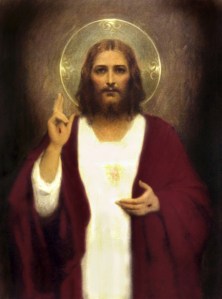
Attainable Unconditional Love…Gospel Meditation for the 6th Week of Easter

by Angela Lambert

sacred-heart-jesus-chambers-w600x810

May 1st, 2016; 6th Sunday of Easter

Gospel John 14:23-29

Jesus said to his disciples: “Whoever loves me will keep my word, and my Father will love him,
and we will come to him and make our dwelling with him. Whoever does not love me does not keep my words; yet the word you hear is not mine but that of the Father who sent me. “I have told you this while I am with you. The Advocate, the Holy Spirit, whom the Father will send in my name, will teach you everything and remind you of all that I told you. Peace I leave with you; my peace I give to you. Not as the world gives do I give it to you. Do not let your hearts be troubled or afraid. You heard me tell you, ‘I am going away and I will come back to you.’
If you loved me, you would rejoice that I am going to the Father; for the Father is greater than I.
And now I have told you this before it happens, so that when it happens you may believe.”

Meditation Reflection:

“As the world gives” tends to leave a person bitter and disillusioned.  It begins with promises of security and pleasure but lacks real permanency or loyalty.  After awhile we even struggle to relax during periods of calm, worrying that it won’t endure long.    Nothing seems to last and this causes anxiety in good times and in bad.

The philosopher Pascal lamented that man is but a feeble reed, easily brought to its end by the smallest ailment.  Most of our lives, he asserts, are spent trying to distract ourselves from the unsettling dread we feel when we take time to think about the purpose of our lives or the reality of our mortality.  He concludes that this universal experience supports the fact that happiness can be found in God alone:

“All men seek happiness. This is without exception…And yet after such a great number of years, no one without faith has reached the point to which all continually look. All complain, princes and subjects, noblemen and commoners, old and young, strong and weak, learned and ignorant, healthy and sick, of all countries, all times, all ages, and all conditions…A trial so long, so continuous, and so uniform, should certainly convince us of our inability to reach the good by our own efforts.” Pascal Pensees

Pope Francis observed that we have created an entire “throwaway culture,” marked by the readiness to discard even relationships and people as soon as they become inevitably difficult.  Consequently, he says, people begin to despair and make the assumption that they will never experience unconditional love.  Because they have never experienced mercy, they conclude that they never will.  As a result, they struggle in the darkness of sin, feeling alone and without the possibility of healing.

The fragility of our era is this,  too:  we don’t believe that there is a chance for redemption; for a hand to raise you up; for an embrace to save you, forgive you, pick you up, flood you with infinite, patient, indulgent love; to put you back on your feet.  We need mercy.” Pope Francis, The Name of God is Mercy

Christ however offers the peace every human soul longs for – permanent, deep, and healing.  Moreover, we do not have to chase after it like a greyhound that will never catch the rabbit.  Rather, Christ bestows His peace freely as a fruit of His unconditional love.  To receive this peace we merely need to enter into a relationship of love with Him. Relationship with Christ is merciful and enduring.  Jesus doesn’t throw us away when we become difficult or even when we betray Him. He persists in pursuing us, binding our wounds, and transforming our hearts. His greatest pain, he revealed to St. Faustina, is our lack of trust in Him.  To Mother Teresa, He said, “I thirst”; meaning He thirsts for our souls and relationship with us.

Relationships are risky – they require two people to both freely choose to love one another.  No matter how faithful, how loving, how sacrificial one partner is willing to be, if the other walks away the relationship ends.  Christ is the ultimate risk taker.  He loves us no matter what, even if that love is unrequited.  Moreover, the partner who walks away suffers the greatest loss because he or she closes himself off from the riches of the other partner’s love.  When we walk away from Christ, we close ourselves off from the love He longs to bestow upon us.

Jesus offers peace, love, and joy.  All we must do is live in a loving relationship with Christ.  To do this He says, we must follow His commands.  We live in a wounded world confused about authentic love.  Jesus teaches us through His commands and offers the perfect example for us to imitate.

We can chase after the illusion of love or embrace the God who is love.  If we choose the latter, God will dwell within us and our joy will be complete.  It feels more risky because it’s harder to see at first. Ultimately however, it’s the soundest reality and truest love.

Consider:

  • Jesus says, “Do not let your hearts be troubled or afraid.” What do you allow to cause you anxiety and fear?  Surrender each thing to the Lord and entrust your concerns to Him.
  • Reflect on the love of Christ. Consider the freedom and joy experienced by the saints in every generation for the last two thousand years.
  • Reflect on how Christ has blessed you over the course of your life. Then reflect on how He has blessed you this week. What needs has He met?  What has He conquered for you?  When have you felt the embrace of His love?  When have you experienced His beauty or glory?

Make a Resolution (Practical Application):

  • Examine your day each night or morning.  Thank God for His blessings.  Recognize when He came to your aid.  Identify when you failed to love Christ or your neighbor and ask for Jesus’ help to do better the next day.


~ Written by Angela Lambert © 2016

* To receive these weekly posts automatically in your email just click the “follow” tab in the bottom right hand corner and enter your email address.


New and Improved: This Upgrade is Worth the Price!…Gospel Meditation for John 13:31-35

by Angela Lambert

new-improved

March 24th, 2016; 5th Sunday in Easter

Gospel of John 13: 31-33A; 34-35

When Judas had left them, Jesus said, “Now is the Son of Man glorified, and God is glorified in him. If God is glorified in him, God will also glorify him in himself, and God will glorify him at once. My children, I will be with you only a little while longer. I give you a new commandment: love one another. As I have loved you, so you also should love one another. This is how all will know that you are my disciples, if you have love for one another.”

 Meditation Reflection:

As consumers we regularly hear the pitch “new and improved” for every product from toothpaste to vehicles. Oftentimes we consider this prospective as something positive.  Every time Apple comes out with a new iPhone my kids work to convince me of its superiority over the one I already own.  However, though a new car, new appliances, or new clothes seems appealing, learning a new technology seems more work than its worth unless the benefits are considerable.  This attitude spills over into my spiritual life as well.  I appreciate when God simply keeps things running smoothly as they are.  When offered something new, though it sounds exciting, it also sounds like a lot of work.  “New” has the allure of surprise and opportunity, but it also has the anxiety of unfamiliarity, making mistakes during the learning process, discomfort of discerning how to act in new situations, and the fear of the unknown.  Today’s Gospel recounts the inauguration of the “New” Covenant.  A savvy consumer would ask “how is it new” and “is it worth the price”?

During the Last Supper, Christ’s Passion begins with the betrayal by Judas.  Thus, when Judas leaves to execute his plans, Jesus speaks to the other disciples about the New Covenant being inaugurated that night. A covenant refers to a solemn agreement between God and man.  God had made these types of agreements in the past with Noah, Abraham, Moses, and David.  His New Covenant differs in that God does not make a covenant with Jesus, but rather Jesus is God who makes the covenant with us.  His covenant with Abraham extended to Abraham’s family, the covenant with Moses extended to a nation, and the covenant with David extended to a kingdom.  Now the covenant with the apostles extends to all of humanity.

A marketing executive might take issue with Christ’s assertion that He gives a “new” commandment however when He instructs us to love one another.  Jews treasured a passage in Deuteronomy as the heart of the Old Covenant.  It’s called the Shema (see Deuteronomy 6:4-9).  Jesus Himself referenced it in His teaching:

Mark 12:28–30
And one of the scribes came up and heard them disputing with one another, and seeing that he answered them well, asked him, “Which commandment is the most important of all?” Jesus answered, “The most important is, ‘Hear, O Israel: The Lord our God, the Lord is one. And you shall love the Lord your God with all your heart and with all your soul and with all your mind and with all your strength.’ The second is this: ‘You shall love your neighbor as yourself.’ There is no other commandment greater than these.

Jesus’ “new” commandment sounds very similar – to love.  Is this false advertising?  The difference may seem slight on the surface but upon closer investigation it transcends the old model to a remarkable degree.  Jesus doesn’t eliminate the old, but he does present a new and improved model.  In the new version Christ adds the stipulation, “As I have loved you, so you also should love one another.”  Christ sets a new standard as His love will be demonstrated in humble service marked by suffering, sacrifice, and agony.  Put that on a billboard.  Any buyers?

A faith that’s merely a get rich quick scheme – prosperity, reward, and status at no cost – is not the Gospel.

“[Paul and Barnabas] strengthened the spirits of the disciples and exhorted them to persevere in the faith, saying, “It is necessary for us to undergo many hardships to enter the kingdom of God.” Acts 14:22

Why does it have to be so hard?  Human nature.  As much as we idolize change in our culture, in practice we avoid it.  Change as simple as healthy living often gets abandoned because of the sacrifice and discomfort one experiences in the beginning.  Those who have made the change can attest that they feel more energetic, more happy, and it would be painful to go back to their bad habits.  However one only experiences this feeling if one perseveres through the initial pain of re-habituating one’s body and one’s lifestyle.  Similarly, to love as Christ loved will feel uncomfortable and painful in the beginning.  It means re-habituating one’s whole lifestyle – the measuring standard must be readjusted and priorities re-evaluated.  Many give up after a short while.  However, those who persevere can attest that this new lifestyle makes one feel deeper joy, peace, and energy than before and it would be painful to return to their former habits.

At the present human free will presents a tension between sin and grace which means we suffer – both interiorly as we wrestle between love of self and love of God, and exteriorly as we suffer from the sinful choices of ourselves and others.

Christ’s Paschal Mystery offers hope in that it did not end on the Cross but rather at the Resurrection and Ascension into Heaven.  Eventually, our conversion will be complete and we will have interior peace.  At some point this world will come to an end and those who choose love will spend eternity together with each other and with God.

Oftentimes I just want God to restore things to how they used to be.  Much like the Jews, who expected God would save them by restoring Israel to its former glory as a kingdom under David’s reign.  God’s love exceeds our imagination though and most of the time His answer is not to go back but to offer something new and improved.  St. John recounts in the book of Revelation:

Then I, John, saw a new heaven and a new earth. The former heaven and the former earth had passed away…I heard a loud voice from the throne saying, “Behold, God’s dwelling is with the human race. He will dwell with them and they will be his people and God himself will always be with them as their God. He will wipe every tear from their eyes, and there shall be no more death or mourning, wailing or pain, for the old order has passed away.” The One who sat on the throne said, “Behold, I make all things new.”  (see Revelation 21:1-5)

We can be confident that the time, discomfort, and sacrifice will be worth it for this upgrade and Christ will be there to help.

Consider:

  • Recall a time when you kicked a bad habit or developed a healthy habit. How long did it take?  How did it feel afterward?
  • What healthy spiritual habits have you developed? Consider the work it took to establish them and the fruits you enjoy as a result.
  • What spiritual habits do you need to develop? How might you begin work on one today?
  • Consider what it means to love as Christ loved. In each circumstance below, can you think of a time that you either extended that kind of love to another or received that kind of love from someone else?
    • Humble service
    • Self-sacrifice
    • Suffering for someone’s good
    • Rejoicing at elevating someone else
    • Forgiveness and mercy, even toward an enemy

Make a Resolution (Practical Application):

  • Exchange a bad spiritual habit for a good spiritual habit.  Make a plan: decide which habit to address and how to develop it.  When, where, and how will you achieve it?  Remember to pray for grace as you do!
  • Opportunities to love as Christ loved are present every day in family life.
    • Intentionally practice Christ-like love toward family members today.
    • Spend some time each day reading a little bit of Pope Francis’ new apostolic exhortation “The Joy of Love”, especially the chapters pertaining to family life.

~ Written by Angela Lambert © 2016

* To receive these weekly posts automatically in your email just click the “follow” tab in the bottom right hand corner and enter your email address.


Love and Mercy in Superabundance

by Angela Lambert

Raphael,_The_Miraculous_Draught_of_Fishes_(1515)

Gospel John 21:1-19 (April 10th, 2016; 3rd Sunday in Easter)

At that time, Jesus revealed himself again to his disciples at the Sea of Tiberias. He revealed himself in this way. Together were Simon Peter, Thomas called Didymus, Nathanael from Cana in Galilee, Zebedee’s sons, and two others of his disciples. Simon Peter said to them, “I am going fishing.” They said to him, “We also will come with you.” So they went out and got into the boat, but that night they caught nothing. When it was already dawn, Jesus was standing on the shore; but the disciples did not realize that it was Jesus. Jesus said to them, “Children, have you caught anything to eat?” They answered him, “No.” So he said to them, “Cast the net over the right side of the boat and you will find something.” So they cast it, and were not able to pull it in because of the number of fish. So the disciple whom Jesus loved said to Peter, “It is the Lord.” When Simon Peter heard that it was the Lord, he tucked in his garment, for he was lightly clad, and jumped into the sea. The other disciples came in the boat, for they were not far from shore, only about a hundred yards, dragging the net with the fish. When they climbed out on shore, they saw a charcoal fire with fish on it and bread. Jesus said to them, “Bring some of the fish you just caught.” So Simon Peter went over and dragged the net ashore full of one hundred fifty-three large fish. Even though there were so many, the net was not torn. Jesus said to them, “Come, have breakfast.” And none of the disciples dared to ask him, “Who are you?” because they realized it was the Lord. Jesus came over and took the bread and gave it to them, and in like manner the fish. This was now the third time Jesus was revealed to his disciples after being raised from the dead. When they had finished breakfast, Jesus said to Simon Peter, “Simon, son of John, do you love me more than these?” Simon Peter answered him, “Yes, Lord, you know that I love you.” Jesus said to him, “Feed my lambs.” He then said to Simon Peter a second time, “Simon, son of John, do you love me?” Simon Peter answered him, “Yes, Lord, you know that I love you.” Jesus said to him, “Tend my sheep.” Jesus said to him the third time, “Simon, son of John, do you love me?” Peter was distressed that Jesus had said to him a third time, “Do you love me?” and he said to him, “Lord, you know everything; you know that I love you.” Jesus said to him, “Feed my sheep. Amen, amen, I say to you, when you were younger, you used to dress yourself and go where you wanted; but when you grow old, you will stretch out your hands, and someone else will dress you and lead you where you do not want to go.” He said this signifying by what kind of death he would glorify God. And when he had said this, he said to him, “Follow me.”

 Meditation Reflection:

I was recently presented with the question, “How can we know that the Christian religion is the true one as opposed to others?”  I responded that ours is the only one whose founder has risen from the dead.

The miracle of Christ’s resurrection affirms the truth of His teachings and the divinity of His truths.  The apostles evangelized by bearing witness to this event, one that they experienced with their own eyes. Many struggle to trust in Jesus because we cannot see Him.  However, the Gospels, Acts of the Apostles, and numerous Epistles all testify that our faith does not rely on mere ideology but rather the physical resurrection of our Lord witnessed by reputable persons who all suffered for their testimony.  Not a single apostle recanted his position to avoid martyrdom.  All of them endured severe trials and difficulties with no monetary or physical reward.  They had no ulterior motive.  They did not say they “believed” Jesus had risen from the dead, but rather that they had all “seen” the risen Lord.

God knows we struggle to believe without seeing.  Despite our weak faith, He mercifully became incarnate that we might see Him when He redeemed us.  Moreover, He exceeded all expectations of the imagination by liberating us Himself rather than sending someone in his place.

We have all heard stories of backpackers or journalists who cross an enemy line and become imprisoned in a dangerous or violent country.  Imagine if you were that person, afraid in your cell as to what will come of you, praying that your president will learn of your state and send someone to save you.  You might hope for a diplomatic solution or even military special ops to heroically liberate you.  Consider your surprise however if the president himself were to show up in military gear and break you out of prison at his own personal risk.

Christ reveals the love of God that exceeds any possible expectation or imagination.  He condescends to our limitations even though He deserves better.  He liberates us at His own painful expense.  Moreover, He gives us a share in His resurrection and a chance at new life.

The Christian life is a response to the love and mercy we have first received from our Lord.  Peter fed the Lord’s sheep because of his love and gratitude for His mercy.  Jesus did not throw away their friendship after Peter’s betrayal.  Instead He gave Peter a second chance, an opportunity for contrition, forgiveness, and conversion.

Jesus gives each of us this same opportunity.  He comes to wherever we are, offering us something to eat and an outstretched hand of friendship.  He asks each of us the same question: “Do you love Me?”  If the answer is yes, then He insists we respond in kind by extending a hand up to others and accompany them toward their conversion.

Pope Francis just released his apostolic exhortation “The Joy of Love” on Friday.  It’s a beautiful, rich document of encouragement based on the proceedings of the synod on the family.  Although it’s quite lengthy Pope Francis encourages us in the opening pages to take our time reading it.  He addresses in a comprehensive way the joy of love in families – both the ideal as the gift God has given to us, and the painful “irregularities” that need careful healing.  The love of Christ and the call to feed His sheep begins in our families.   Jesus asks that if we love Him, we ought to give generously and tenderly to those placed by Him in our daily lives, beginning with our families and reaching out from there.

Consider:

  •  It’s easy to be discouraged by our failures.  Consider the encounter of Peter with Christ.  What failure would weigh heavy on your heart if you faced the Lord?  How would you respond to His hand up and His offer of mercy?
  • Who in your life needs your mercy? How might you offer him or her a hand up?
  • Consider how Christ can be recognized by His superabundance. When the apostles pulled in such a large catch, John knew immediately it was the Lord.
    • When has Christ surprised you by exceeding your expectations?
    • Ask for the gift of surrender and openness. Rather than giving Christ a list of tasks you would like Him to help accomplish, surrender the logistics to Him and do the tasks He sets before

Make a Resolution (Practical Application):

  • Offer mercy toward someone each day this week. (See this link for a list of the corporal and spiritual Works of Mercy)
  • Offer Christ your work week. Give him one week of being in charge and trust Him to accomplish His will.  Just do the tasks He sets before you and let Him bring things together.
  • Begin reading Pope Francis “The Joy of Love”

~ Written by Angela Lambert © 2016

* To receive these weekly posts automatically in your email just click the “follow” tab in the bottom right hand corner and enter your email address.


To Serve is to Reign…Gospel Meditation for Mark 9:30-37

by Angela Jendro

pope-francis-hugging-disabled-childpope-selfie

25th  Sunday in Ordinary Time

Gospel of Mark 9:30-37 NAB

Jesus and his disciples left from there and began a journey through Galilee, but he did not wish anyone to know about it. He was teaching his disciples and telling them, “The Son of Man is to be handed over to men and they will kill him, and three days after his death the Son of Man will rise.” But they did not understand the saying, and they were afraid to question him. They came to Capernaum and, once inside the house, he began to ask them, “What were you arguing about on the way?” But they remained silent. They had been discussing among themselves on the way who was the greatest. Then he sat down, called the Twelve, and said to them, “If anyone wishes to be first, he shall be the last of all and the servant of all.” Taking a child, he placed it in the their midst, and putting his arms around it, he said to them, “Whoever receives one child such as this in my name, receives me; and whoever receives me, receives not me but the One who sent me.”

Meditation Reflection:

This week, a student of mine asked me why a woman cannot be the pope. This question, and its underlying one – why a woman can’t be a priest, gets asked every year. I myself wrestled with this question when I was in college. I’m glad I pursued the answered because there are beautiful theological reasons. Oftentimes however, what we are really asking is why a woman can’t hold what seems to be the highest and most powerful position in the Church. This seems sexist, unfair, and therefore not Christ-like. The apostles in today’s passage viewed leadership in Christ’s kingdom in a similar way. They were arguing along the way about who would have the highest position, the most power and prestige. If Christ’s kingdom resembled worldly kingdoms that would have been an appropriate question. Jesus corrects them in a pointed way. As God says in Isaiah 55:8 “‘For My thoughts are not your thoughts, nor are your ways My ways.” Jesus had just taught the apostles that the Son of Man, the Messiah, would have to suffer and be killed. Rather than considering that they might be called to follow in His footsteps they wonder who will take leadership afterward. Jesus clarifies what He means by His kingdom. His words would have been surprising to the apostles and they are still surprising to us today.

It’s hard to truly believe Jesus when He teaches that “Whoever receives one child such as this in my name, receives me; and whoever receives me, receives not me but the One who sent me.” We would rather believe that discipleship means visible worldly greatness. The world looks at the papacy and sees position and power. However, beginning with Pope Gregory the Great in the 6th century, the title the pope has used for himself has been “the servant of the servants of God.” Discipleship of Christ means following the path of humility and self-sacrifice, the same path Christ took. What can be more humble and self-sacrificing than caring for a small child, especially if you are its mother or father? This path of humility is open to all with equal opportunity. Some might even say that women have an unequal and greater opportunity since we alone have the ability to carry in our wombs new life at its most vulnerable stage.

Every Christian can become a saint if he or she cooperates with the grace of Christ. The Second Vatican Council used the phrase “the universal call to holiness” to describe the doctrine that God desires everyone to have perfect union with Him. The opportunity is equal, it’s or response which is unequal. Teresa of Avila said that what prevents individuals from experiencing greater depths of prayer and union with God is a lack of generosity, courage, and humility.

I wasn’t asked by Christ to be pope, but I was asked to be a mother and a teacher. In the world’s eyes there is nothing notable about my position except that I maybe “wasted” some of my talents and opportunities that I could have used for wealth and power instead. My eyes are on a different prize though. I don’t want to be the one in power, I want to be Jesus’ disciple. All I ask is that He say to me one day, “Well done my good and faithful servant.” I may not be the servant of the servants of God, but I accept being the servant of those He “put His arm around” and placed in my care.

Consider:

  • Who has God placed in your care? How has this made you grow in humility?
  • When do you feel tempted by worldly prestige?
  • Consider how you prioritize your life. How might Christ re-order your priorities? Ask for His help and grace.

Make a Resolution (Practical Application):

  • Write out your priorities – look at where you spend your time and money. Pray about it each day this week and ask Christ to show you where you are doing well and where you need to change.
  • Pope Francis visited the U.S. for the world meeting of families. Read one of his speeches or homilies from when he was here. Consider how he shares Christ’s values as it pertains to family and discipleship. [A couple of my favorite sources: vatican.va (vatican website) and zenit.org (Catholic news agency)]

~ Written by Angela (Lambert) Jendro © 2015; updated  © 2018

* These Sunday meditations are intended to engage the heart and imagination in prayer and include a practical application (resolutions) to your daily life. In our presentation on prayer I offer a more detailed discussion of ways to pray with Scripture that can take 5 minutes, 15 minutes, or half an hour and vary in depth depending on your time-frame and prayer goals.