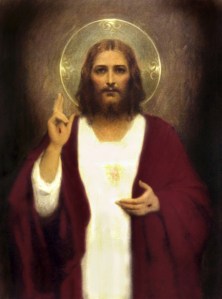
Why is There Suffering, and What is God Doing About It?…Gospel meditation for June 5th, 2016

by Angela Lambert

Jesus raises widow of Nain's son

June 5th, 2016; 10th Sunday in Ordinary Time

Gospel of Luke 7:11-17 NAB

Jesus journeyed to a city called Nain, and his disciples and a large crowd accompanied him. As he drew near to the gate of the city, a man who had died was being carried out, the only son of his mother, and she was a widow. A large crowd from the city was with her. When the Lord saw her, he was moved with pity for her and said to her, “Do not weep.” He stepped forward and touched the coffin; at this the bearers halted, and he said, “Young man, I tell you, arise!” The dead man sat up and began to speak, and Jesus gave him to his mother. Fear seized them all, and they glorified God, crying out “A great prophet has arisen in our midst,” and “God has visited his people.” This report about him spread through the whole of Judea and in all the surrounding region.

 Meditation Reflection:

Why is there evil in the world?  Why doesn’t God do anything about it? Some persons will answer that either God doesn’t exist or God doesn’t care.  Those persons willing to investigate the question further however, universally discover two things: human free will causes most evils and the person who has consistently done the most to alleviate suffering is God.  Utopian ideologies of the 19th and 20th centuries, endeavoring to eradicate evil through human efforts alone, all ended in countless deaths and totalitarian rule. Sin causes evil and only God can save us from ourselves.  Even death, God has revealed, did not originate with faulty genetics or evolution.  Sickness, death, toil, and pain entered the world through the original sin of Adam and Eve (Genesis 3; Romans 8:19-23).

God created human persons to experience Truth, Goodness, and Beauty.  He designed us to live in perfect friendship with Him and with each other in a unity of love and joy for eternity.    We all experience deep suffering at some point(s) in life.   The woman in this Gospel provides an example of both deep spiritual pain from losing her only son after having already lost her husband, as well as utter material destitution since she would have no legal rights to property or work without a husband or son.  Upon seeing this, Jesus is “moved with pity for her.” When we feel most vulnerable, most alone, and our hearts are breaking, we can look to this passage and take comfort in knowing that Christ is looking on us with pity.  Moreover, this pity moves Him to do something to alleviate our pain.  In this case, Jesus restored the man to life.  In doing so, He restored the woman’s life as well.  Although Christ does not always save those we love from earthly death, this miracle demonstrates His power and His love which brings new life in surprising and supernatural ways.  It also points to the hope that all will be made new in the resurrected life in the kingdom of God.

God became man to dwell among us (John 1:14) and to personally alleviate our suffering through His Word, His touch, and His sacrifice.  As the psalmist proclaims: “The LORD is near to the brokenhearted, and saves those who are crushed in spirit” (Ps. 34:18).  Moved with pity, Christ continues to reach directly into our hearts to dry our tears and heal our wounds. He anoints our wounds with grace through His sacraments, He dispels hurtful lies with His divine revelation, He forgives our sins in the sacrament of Confession and fortifies us with grace to overcome them, and He feeds us with His very own body and blood in the Eucharist.  Finally, He unites us as members of His body and extends His hand of mercy through His disciples operating under the direction and love of the Holy Spirit.

Does God care about our suffering?  Is He going to do anything about it?  Yes.  Quite a lot actually, if only you will allow Him.  Christ offers new life if we will accept it.  He offers healing if we turn to Him.  This is the witness of every Christian disciple.

Consider:

  •  Re-read the Gospel and imagine you are one of the persons present.
    • Consider the love of the mother for her only son. Consider her love for her husband as well.  The death of her son means the image of her husband is gone as well as their family together.  In addition, imagine you will now be destitute with no way to provide for yourself.  To your surprise, a man emerges from the crowd and gives your son, your family, your life, back to you.
    • Imagine you are one of the members of the crowd. Why might you be present and how might you be feeling toward the woman?  What would you think of Christ’s miracle?
    • Imagine Christ’s perspective. What does His response reveal about His heart and His character?
  • Consider the definition of pity. Dictionary.com defines it as: “sympathetic or kindly sorrow evoked by the suffering, distress, or misfortune of another, often leading one to give relief or aid or to show mercy.” The heart of Christ felt sorrow at the sight of the woman’s pain and it moved Him to help her.  Imagine Christ seeing you in your pain.  Consider His merciful look of pity which shares your sorrow and desires to bring you comfort.
  • Reflect on a time Christ comforted you or saved you when you were in dire need. Take time to appreciate all that He did and the incredible ways He acted in your life during that time.

Make a Resolution (Practical Application):

  • Begin each day with this prayer: “Lord show me the needs around me.  Move my heart with pity and enable me to show mercy to someone today.”
  • Surrender a pain to Christ to heal. Reach out to Him in His Word, His Sacraments, or His Church.  Spend 5 minutes of silence with Christ and your pain.
  • Make a gratitude list of the mercies Christ has shown you over the years and then each day.


~ Written by Angela Lambert © 2016

* To receive these weekly posts automatically in your email just click the “follow” tab in the bottom right hand corner and enter your email address.


Christ’s gift and a Mother’s gift…Gospel meditation for the Solemnity of the Most Holy Body and Blood of Christ

by Angela Lambert

eucharist and crowd

May 29th, 2016; The Solemnity of the Most Holy Body and Blood of Christ

 Gospel of Luke 9:11b-17 NAB

Jesus spoke to the crowds about the kingdom of God, and he healed those who needed to be cured. As the day was drawing to a close, the Twelve approached him and said, “Dismiss the crowd so that they can go to the surrounding villages and farms and find lodging and provisions; for we are in a deserted place here.” He said to them, “Give them some food yourselves.” They replied, “Five loaves and two fish are all we have, unless we ourselves go and buy food for all these people.” Now the men there numbered about five thousand. Then he said to his disciples, “Have them sit down in groups of about fifty.” They did so and made them all sit down. Then taking the five loaves and the two fish, and looking up to heaven, he said the blessing over them, broke them, and gave them to the disciples to set before the crowd. They all ate and were satisfied. And when the leftover fragments were picked up, they filled twelve wicker baskets.

Meditation Reflection:

Christ loves us with His whole being.  He became man that He might personally uplift our hearts with His truth, extend His hand to heal our wounds, and feed us with His own Body and Blood.  Mothers have the privilege of experiencing this kind of self-gift.  A mother literally shares her body with her child and shares in Christ’s pain at his or her birth.  A mother continues to feed her infant with her own body and tend to the constant needs of her newborn.  As her child grows a mother does everything she possibly can to care for the child’s physical, emotional, and intellectual development.  Mothers take joy when their kids eat and grow, when they can comfort and guide them, and when they can make sure their child knows how loved he or she is.

Christ urges us to trust Him and His love as well.  He soothes us in our worries assuring us of His care:

“Therefore I tell you, do not be anxious about your life, what you shall eat or what you shall drink, nor about your body, what you shall put on.  Is not life more than food, and the body more than clothing?  Look at the birds of the air they neither sow nor reap nor gather into barns, and yet your heavenly Father feeds them.  Are you not of more value than they?…But seek first His kingdom and His righteousness, and all these things shall be yours as well.” Matthew 6: 25-33)

Today’s Gospel confirms that Jesus cares about our needs, even the basic ones like what’s for dinner. Moreover, He can provide in surprising ways since He can do the miraculous.  The crowd of thousands ate their fill after having spent the day in a deserted place listening to Christ speak about the kingdom.  So many times we try to cure ourselves or numb the pain in ways that only turn out to be self-destructive and leave us hungering.  Instead, we should try reaching out to Christ in prayer and receiving the cure for all our pain in His Eucharistic Body and Blood.

Jesus heals our hearts and frees us from the lies that we allow to burden us.  He forgives our sins and gives us a new start with the grace and hope to be better.  He fortifies us with His strength to persevere and He gently provides rest for our soul with His peace.  He does all of this personally, directly, through His incarnate and immanent presence in the Eucharist.  Christ gave His Body and Blood on the Cross to give birth to our new life.  He instructed us to take and eat of this same Body and Blood which He made the sacrifice of the New Covenant.    The Son of God became man that He might dwell among us and apply His grace to our soul.  Today we honor the gift of His Body and Blood through which He feeds us superabundantly, strengthens us, comforts us, and nourishes our growth.  Through the gift of His most holy Body and Blood, we receive life.  Moreover, He continues to provide this gift that we might grow in health and maturity to the fullness of Christian life in the kingdom of God.

Consider:

  • Imagine you are one of the person’s in the crowd listening to Jesus speak about the kingdom of God and curing all those who needed it.
    • What would you hear Jesus say?
    • From what would He heal you?
    • How might His Truth and His touch free you?
    • Consider how you have this very opportunity at the Mass – to hear Christ preach about the Kingdom through His priest and to touch you through His Eucharistic presence.
  •  Consider how a mother gives of her body for her child.  A mother’s love tends to be a complete self – gift.  Consider how the gift of her very body and blood, given in love,  is a unique way to give of her whole self in imitation of Christ.

Make a Resolution (Practical Application):

  • Reflect on the gift of Christ’s most holy Body and Blood on the Cross and in the Eucharist each day this week.
  • Attend a daily Mass this week in addition to the Sunday Mass.
  • Give Christ your own Body through a physical sacrifice. Cheerfully offer Christ your labor of service for your family or work, look for a providential opportunity to serve Christ with your physical efforts, offer your sickness or suffering, or prayerfully consider something to fast from each day.


~ Written by Angela Lambert © 2016

* To receive these weekly posts automatically in your email just click the “follow” tab in the bottom right hand corner and enter your email address.


The Most Marvelous Mystery! Gospel Meditation for the Solemnity of the Most Holy Trinity

by Angela Lambert

May 22nd, 2016; Solemnity of the Most Trinity 3Holy Trinity

Gospel of John 16:12-15 NAB

Jesus said to his disciples: “I have much more to tell you, but you cannot bear it now. But when he comes, the Spirit of truth, he will guide you to all truth. He will not speak on his own, but he will speak what he hears, and will declare to you the things that are coming. He will glorify me, because he will take from what is mine and declare it to you. Everything that the Father has is mine; for this reason I told you that he will take from what is mine and declare it to you.”

Meditation Reflection:

The mystery of the Trinity transcends our comprehension and its reality cannot be rightly conceived in our imagination.  At the same time, God desired that we know something of His nature and being. Christ revealed this truth during His public ministry since we could not have known it otherwise. Still, we lack understanding without supernatural help and so Jesus explains to His apostles, “I have much more to tell you, but you cannot bear it now. But when he comes, the Spirit of truth, he will guide you to all truth.”  When the Holy Spirit descended on the apostles at Pentecost, He opened their eyes of faith, elevated their understanding, and fortified their courage to believe and proclaim such wonderful truths.

The Holy Spirit continues His work today in our own hearts as well.  We know from Genesis that we image God, but because of sin we struggle to know what that looks like.  Through Baptism however, the Trinity comes to dwell in our very souls.   His image grows within us and begins to radiate more and more brightly in our minds and in our lives to the extent that we cooperate with His gifts.

So what is the Trinity? What did God reveal about Himself? What are we supposed to image?  The Church explains it in this way:

“The Trinity is One. We do not confess three Gods, but one God in three persons, the “consubstantial Trinity”.83 The divine persons do not share the one divinity among themselves but each of them is God whole and entire…” (CCC 253)

“The divine persons are really distinct from one another. “God is one but not solitary.”86 “Father”, “Son”, “Holy Spirit” are not simply names designating modalities of the divine being, for they are really distinct from one another: “He is not the Father who is the Son, nor is the Son he who is the Father, nor is the Holy Spirit he who is the Father or the Son.”87 They are distinct from one another in their relations of origin: “It is the Father who generates, the Son who is begotten, and the Holy Spirit who proceeds.”88 The divine Unity is Triune.” (CCC 254)

The divine persons are relative to one another. Because it does not divide the divine unity, the real distinction of the persons from one another resides solely in the relationships which relate them to one another” (CCC 255)

Understand?  Great!  Just kidding.  I can explain…kind of.  First, we must accept that we cannot fully comprehend or imagine the Trinity so let go of that goal.  However, it does not mean that we can know nothing of the Trinity.  God revealed His Trinitarian reality and so we ought to accept and contemplate this mystery with the help of the Holy Spirit.

First, God is one.  He has one divine nature.  We tend to imagine it divided into three parts but this is where our imagination fails us.  Each person of the Trinity is wholly God.

Secondly, God is three.  Our imagination tries to reconcile this with His oneness by imagining God as having three different modes or faces but being essentially the same.  Not the case.  God is three distinct persons.

So how can God be one and three?  In heaven you will see the face of God and something of this mystery.  This incredible vision will be the source of joy so great that you will have to be supernaturally empowered to take it in without being overcome.  Live a holy life so you can one day have this awesome opportunity!  From Christ’s teachings we know that God’s oneness and threeness reveal that His essence is one of relationship.  God is a relationship of Three Persons.  I mentioned in a prior post that when God created us in His image, He created a family.  A man and a woman become “one flesh” and a child is born who is both of their nature and yet distinct as well.  The union of persons in life-giving love images God who is also a union of persons in life-giving love.  Is it no wonder that Satan’s primary attack against God is directed at His image; thus Satan’s efforts to promote a self-centered individualism in contrast to the other-centered gift of self required for an intimate union of persons?

We cannot imagine God’s Triune nature but we can contemplate it and try to live as an image of it with the help of the Holy Spirit and the graces of the Sacraments.  Baptism unites us to God and each other, the Eucharist nourishes that unity, and Confession reconciles us when we have separated ourselves through sin.  The more we open ourselves to God the more we will see Him.  That process begins on earth and the joy that accompanies it begins here as well.  We can look forward with hope and anticipation to the day that God enables us to see more of Him in heaven and we will be free to sing endless songs of praise and love.

Consider:

  •  Consider your relationship with God the Father.
    • What does it mean to be a son or daughter of God?
      • Consider your dignity as an heir of heaven where your Christ your brother reigns as king and Mary your mother reigns as queen.
      • In a family, each member is irreplaceable. You are an irreplaceable member of God’s family.  You matter to God and to every member of the Christian family.
    • How does that affect the way you see yourself?
    • How does that affect the choices you make?
  • Consider your relationship with God the Son.
    • God became man so you could encounter Him directly. He shared in the human experience so He could be closer to you.  Reflect on times you have encountered Christ.
    • Consider the mysteries of His life – how has He experienced similar sufferings to yours?
    • He still draws near to you today through the Eucharist and His Mystical Body the Church. Reflect on the immanence of Christ in your daily life.
  • Consider your relationship with the Holy Spirit.
    • The Holy Spirit opens our eyes to see Christ and enlightens our understanding to appropriate His teachings.
    • When was a time the Holy Spirit brought comfort and peace to your soul?
    • When was a time He gave you fortitude and perseverance in your Christian walk?
    • When was a time He gave you wisdom to discern the right choice to make when faced with a difficult decision? Invite the Holy Spirit to guide your decisions today as well.

Make a Resolution (Practical Application):

  • Take a moment today to appreciate God’s creation.
  • Visit Christ present in the Eucharist.
  • Pray to the Holy Spirit each day to reveal God more to you, and to transform your heart that your life might reveal God more to someone else.


~ Written by Angela Lambert © 2016

* To receive these weekly posts automatically in your email just click the “follow” tab in the bottom right hand corner and enter your email address.


Attainable Unconditional Love…Gospel Meditation for the 6th Week of Easter

by Angela Lambert

sacred-heart-jesus-chambers-w600x810

May 1st, 2016; 6th Sunday of Easter

Gospel John 14:23-29

Jesus said to his disciples: “Whoever loves me will keep my word, and my Father will love him,
and we will come to him and make our dwelling with him. Whoever does not love me does not keep my words; yet the word you hear is not mine but that of the Father who sent me. “I have told you this while I am with you. The Advocate, the Holy Spirit, whom the Father will send in my name, will teach you everything and remind you of all that I told you. Peace I leave with you; my peace I give to you. Not as the world gives do I give it to you. Do not let your hearts be troubled or afraid. You heard me tell you, ‘I am going away and I will come back to you.’
If you loved me, you would rejoice that I am going to the Father; for the Father is greater than I.
And now I have told you this before it happens, so that when it happens you may believe.”

Meditation Reflection:

“As the world gives” tends to leave a person bitter and disillusioned.  It begins with promises of security and pleasure but lacks real permanency or loyalty.  After awhile we even struggle to relax during periods of calm, worrying that it won’t endure long.    Nothing seems to last and this causes anxiety in good times and in bad.

The philosopher Pascal lamented that man is but a feeble reed, easily brought to its end by the smallest ailment.  Most of our lives, he asserts, are spent trying to distract ourselves from the unsettling dread we feel when we take time to think about the purpose of our lives or the reality of our mortality.  He concludes that this universal experience supports the fact that happiness can be found in God alone:

“All men seek happiness. This is without exception…And yet after such a great number of years, no one without faith has reached the point to which all continually look. All complain, princes and subjects, noblemen and commoners, old and young, strong and weak, learned and ignorant, healthy and sick, of all countries, all times, all ages, and all conditions…A trial so long, so continuous, and so uniform, should certainly convince us of our inability to reach the good by our own efforts.” Pascal Pensees

Pope Francis observed that we have created an entire “throwaway culture,” marked by the readiness to discard even relationships and people as soon as they become inevitably difficult.  Consequently, he says, people begin to despair and make the assumption that they will never experience unconditional love.  Because they have never experienced mercy, they conclude that they never will.  As a result, they struggle in the darkness of sin, feeling alone and without the possibility of healing.

The fragility of our era is this,  too:  we don’t believe that there is a chance for redemption; for a hand to raise you up; for an embrace to save you, forgive you, pick you up, flood you with infinite, patient, indulgent love; to put you back on your feet.  We need mercy.” Pope Francis, The Name of God is Mercy

Christ however offers the peace every human soul longs for – permanent, deep, and healing.  Moreover, we do not have to chase after it like a greyhound that will never catch the rabbit.  Rather, Christ bestows His peace freely as a fruit of His unconditional love.  To receive this peace we merely need to enter into a relationship of love with Him. Relationship with Christ is merciful and enduring.  Jesus doesn’t throw us away when we become difficult or even when we betray Him. He persists in pursuing us, binding our wounds, and transforming our hearts. His greatest pain, he revealed to St. Faustina, is our lack of trust in Him.  To Mother Teresa, He said, “I thirst”; meaning He thirsts for our souls and relationship with us.

Relationships are risky – they require two people to both freely choose to love one another.  No matter how faithful, how loving, how sacrificial one partner is willing to be, if the other walks away the relationship ends.  Christ is the ultimate risk taker.  He loves us no matter what, even if that love is unrequited.  Moreover, the partner who walks away suffers the greatest loss because he or she closes himself off from the riches of the other partner’s love.  When we walk away from Christ, we close ourselves off from the love He longs to bestow upon us.

Jesus offers peace, love, and joy.  All we must do is live in a loving relationship with Christ.  To do this He says, we must follow His commands.  We live in a wounded world confused about authentic love.  Jesus teaches us through His commands and offers the perfect example for us to imitate.

We can chase after the illusion of love or embrace the God who is love.  If we choose the latter, God will dwell within us and our joy will be complete.  It feels more risky because it’s harder to see at first. Ultimately however, it’s the soundest reality and truest love.

Consider:

  • Jesus says, “Do not let your hearts be troubled or afraid.” What do you allow to cause you anxiety and fear?  Surrender each thing to the Lord and entrust your concerns to Him.
  • Reflect on the love of Christ. Consider the freedom and joy experienced by the saints in every generation for the last two thousand years.
  • Reflect on how Christ has blessed you over the course of your life. Then reflect on how He has blessed you this week. What needs has He met?  What has He conquered for you?  When have you felt the embrace of His love?  When have you experienced His beauty or glory?

Make a Resolution (Practical Application):

  • Examine your day each night or morning.  Thank God for His blessings.  Recognize when He came to your aid.  Identify when you failed to love Christ or your neighbor and ask for Jesus’ help to do better the next day.


~ Written by Angela Lambert © 2016

* To receive these weekly posts automatically in your email just click the “follow” tab in the bottom right hand corner and enter your email address.


New Beginnings…Gospel Meditation for the 5th Sunday of Lent

by Angela Lambert

woman caught in adultery

March 13th, 2016; 5th Sunday in Lent

Gospel of John 8:1-7 NAB

Jesus went to the Mount of Olives. But early in the morning he arrived again in the temple area, and all the people started coming to him, and he sat down and taught them. Then the scribes and the Pharisees brought a woman who had been caught in adultery and made her stand in the middle. They said to him, “Teacher, this woman was caught in the very act of committing adultery. Now in the law, Moses commanded us to stone such women. So what do you say?” They said this to test him, so that they could have some charge to bring against him. Jesus bent down and began to write on the ground with his finger. But when they continued asking him, he straightened up and said to them, “Let the one among you who is without sin be the first to throw a stone at her.” Again he bent down and wrote on the ground. And in response, they went away one by one, beginning with the elders. So he was left alone with the woman before him. Then Jesus straightened up and said to her, “Woman, where are they? Has no one condemned you?” She replied, “No one, sir.” Then Jesus said, “Neither do I condemn you. Go, and from now on do not sin any more.”

Meditation Reflection:

This is the Jubilee Year, a year of new beginnings and forgiveness of debts; freedom and jubilation. During Lent Christ and His Church work to free us from two things that steal our joy – ingratitude and bitterness. To regain our joy we must overcome our own complacency about the gift of our salvation from slavery to sins in our lives. We must also let go of bitterness from the past and show the same mercy and compassion toward others that we have received from Christ. Like the Pharisees and scribes in today’s Gospel, we are quick to demand strict justice for the sins of others while sweeping our own failures under the rug.

As we near the end of Lent, our sacrifices and austerity can feel burdensome and tiring. Our share in Christ’s suffering however also anticipates a share in His resurrection. There’s a saying that one cannot feast until they have fasted. It’s a human reality that when we overindulge on a regular basis we lose the ability to appreciate things. For example, kids who are spoiled with gifts constantly lose a sense of gratitude and, paradoxically, the joy of receiving a gift. Similarly, a person spared the work of chores or academic rigor loses the opportunity for the feeling of self-respect and pride at a job well done. Good work reaps satisfaction and deep joy. As the Psalmist proclaims,

“Those that sow in tears shall reap rejoicing; Although they go forth weeping, carrying the seed to be sown, they shall come back rejoicing, carrying their sheaves.” (Psalm 126)  

Christians experience the same paradox in the life of faith. Examining our sins, rooting them out, asking for help, fasting, and praying is both tedious and sometimes tearful. However, only when we really come to grips with our weakness and sin do we experience the joy of receiving the gift of salvation from our Redeemer.

Resurrection also means newness. We need to let God create something totally new rather than holding on to a past we can’t change. God commands through the prophet Isaiah:

“Remember not the events of the past, the things of long ago consider not; see, I am doing something new!… for I put water in the desert and rivers in the wasteland for my chosen people to drink, the people whom I formed for myself, that they might announce my praise.” Isaiah 43:18-21

Christ offered the woman caught in adultery a new beginning, instructing her to “Go, and from now on do not sin any more.” Christ’s words are more than a suggestion. As the Logos, the divine Word of God, Christ effects what He says. In consequence, when He tells her not to sin anymore, He also empowers her with His supernatural grace to do just that. The weakness she had succumbed to before was not only forgiven, but replaced with strength to act virtuously. The sacraments of Communion and Confession offer the same graces. We receive both forgiveness and the strength of will to change. When we experience this gift of freedom it produces an abundance of joy and gratitude that spills over into a sharing of the same gift with others.

Pope Francis encouraged that, “There is no saint without a past, and no sinner without a future.” St. Catherine of Genoa provides one such example. She was prayerful and devoted as a child. At age thirteen she even tried to enter a convent but was turned away because she was too young. Then at sixteen she entered an arranged marriage.   Catholicsaints.info summarizes it well:

“They were a childless couple, he was careless and unsuccessful as a husband and provider, often cruel, violent and unfaithful, and reduced them to bankruptcy. Catherine became indifferent to her faith, and fell into a depression.” (catholicsaints.info/saint-catherine-of-genoa/)

When she was twenty-six however she regretted deeply her lukewarmness and was ashamed of her current faith life in contrast to her aspirations as a child. She humbly threw herself before Christ by going to Confession and praying for Him to restore her previous devotion. Rather than perfect herself so as to be “worthy” of prayer, she acknowledged her weakness and asked Christ to save her. He responded generously by restoring her faith and, in His superabundance, granted revelations and extraordinary spiritual gifts from God that would last the rest of her life.

Christ offers us a new beginning. Let us pray for the grace to let go of the past and accept a new start.

Consider:

  • Who do you need to forgive? What do you need to let go of from the past?
  • What “new beginning” is Christ offering to you? What is holding you back?
  • Reflect on the mercy the woman in the Gospel experienced and the joy and relief she must have felt. Consider how Christ offers this same opportunity to you.
  • Consider areas of hypocrisy in your own life. What faults do you tend to be most critical toward? What faults of your own do you overlook or refuse to acknowledge?
  • Consider a time you felt truly grateful. What gift did you receive? What made it so special?

Make a Resolution (Practical Application):

  • Pray Psalm 51 each day this week.
  • Choose one thing from the past you are bitter about and decide to let it go. Do something concrete to achieve this.
  • Choose one thing from the past that Christ has forgiven you for but you have not. Lay it before Him each day this week and ask Him to help you surrender it.
  • Practice one work of mercy each day this week.
  • Carry a small stone in your pocket this week. When tempted to criticize or complain grab the stone and hold onto it rather than throw it.


~ Written by Angela Lambert © 2016

* To receive these weekly posts automatically in your email just click the “follow” tab in the bottom right hand corner and enter your email address.


Open Arms of the Father…Gospel Meditation for the 4th Sunday of Lent

by Angela Lambert


20150822_000547723_iOS

“But God is indeed waiting for you; He asks of you only the courage to go to Him.”  Pope Francis, The Church of Mercy

March 6th, 2016; 4th Sunday in Lent

Gospel Luke 15:1-3, 11-32

Tax collectors and sinners were all drawing near to listen to Jesus, but the Pharisees and scribes began to complain, saying, “This man welcomes sinners and eats with them.” So to them Jesus addressed this parable: “A man had two sons, and the younger son said to his father, ‘Father give me the share of your estate that should come to me.’ So the father divided the property between them. After a few days, the younger son collected all his belongings and set off to a distant country where he squandered his inheritance on a life of dissipation. When he had freely spent everything, a severe famine struck that country, and he found himself in dire need. So he hired himself out to one of the local citizens who sent him to his farm to tend the swine. And he longed to eat his fill of the pods on which the swine fed, but nobody gave him any. Coming to his senses he thought, ‘How many of my father’s hired workers have more than enough food to eat, but here am I, dying from hunger. I shall get up and go to my father and I shall say to him, “Father, I have sinned against heaven and against you. I no longer deserve to be called your son; treat me as you would treat one of your hired workers.”’ So he got up and went back to his father. While he was still a long way off, his father caught sight of him, and was filled with compassion. He ran to his son, embraced him and kissed him. His son said to him, ‘Father, I have sinned against heaven and against you; I no longer deserve to be called your son.’ But his father ordered his servants, ‘Quickly bring the finest robe and put it on him; put a ring on his finger and sandals on his feet. Take the fattened calf and slaughter it. Then let us celebrate with a feast, because this son of mine was dead, and has come to life again; he was lost, and has been found.’ Then the celebration began. Now the older son had been out in the field and, on his way back, as he neared the house, he heard the sound of music and dancing. He called one of the servants and asked what this might mean. The servant said to him, ‘Your brother has returned and your father has slaughtered the fattened calf because he has him back safe and sound.’ He became angry, and when he refused to enter the house, his father came out and pleaded with him. He said to his father in reply, ‘Look, all these years I served you and not once did I disobey your orders; yet you never gave me even a young goat to feast on with my friends. But when your son returns who swallowed up your property with prostitutes, for him you slaughter the fattened calf.’ He said to him, ‘My son, you are here with me always; everything I have is yours. But now we must celebrate and rejoice, because your brother was dead and has come to life again; he was lost and has been found.’”

Meditation Reflection:

We often live in denial of ours sins and this can make it easy to imagine God as loving since we see ourselves as so deserving. When our hearts are struck however by the realization of a failure, when shame settles in our stomach at our weakness or self-centeredness, we can mistakenly assume God views us as a failure too and wants nothing to do with us. The parable of the Prodigal Son however, also known as the parable of the Merciful Father, reveals the truth about authentic love.

The Father had freely given his sons everything in love – life, nurturing their growth, and even inheritance of his estate. The first son responds with obedience, loyalty, and service. The second son responds with ingratitude, an entitlement attitude, and complacency. When he asks for his future inheritance, his father not only allows him to leave but also allows him to take his gifts with him. Mistaking license for freedom the son’s gifts eventually run out and difficult times reveal the short sightedness of his choices. The glamour of evil had worn off and without his father’s gifts he was starving and living worse than pigs.

Some Christians take their faith for granted. The spiritual gifts they had enjoyed from the sacraments, living in Christian fellowship, and possibly growing up in a Christian home seem less glamorous and more restrictive than worldliness. At first, missing mass on Sunday to sleep in, put in an extra day at work, travel, or any number of things might not seem that big of a deal. Next, spending time with worldly friends begins to outweigh Christian friends. As seeming independence and success increase, a person may feel he or she no longer needs God. They too mistake license for freedom, take their gifts from God, and leave. Over time however they begin to experience life without grace. The absence of God’s peace, the kindness of His followers, the richness of Scriptures wanes and they begin to hunger. When hard times hit, without that spiritual connection to God, a person finds themselves starving and desperate. Where can one turn for help? A person who uses others finds themselves being used by others. Alcohol or drugs lose their ability to satiate and only make matters worse if not out of control. All former numbing mechanisms – shopping, eating, gaming, gambling, traveling, even over-working cannot help but rather become enslaving.

When one hits rock bottom, crawling back to God can seem unthinkable and disingenuous. How could you ask God for help now when you so brazenly rejected Him earlier or slothfully let Him fall by the wayside. Don’t you deserve to be miserable? Maybe God is saying “I told you so.”

Jesus tells us otherwise. Our pride imagines God reacting this way. Jesus reveals that God is watching the horizon, waiting hopefully, and running to embrace us when we return. The father in this parable doesn’t accept the demotion suggested by his son. He embraces him, and raises him back to the dignity he had left behind; transforming him from servant of pigs to a son.

The older son’s jealousy reveals a hint of the same mistaken view as the younger son. Although he made the right choice, he still considers his brother’s prodigal lifestyle as glamorous. As a result, it seems like he is being rewarded for leaving and rewarded for returning. However, the father and the younger son know the terrible poverty, anxiety, and shame his choices had brought upon him. The older son, though working in the fields all those years, also enjoyed the peace and dignity of living as his father’s son. He did not have the glamour of debauchery nor did he have the impoverishment of it either. Fr. Dubay, in his book The Fire Within, summarizes this misconception well:

“Contrary to what the world thinks, attachments are killjoys. The worldly man and woman take it for granted that the more they can multiply experiences and accumulate possessions, the more they shall be filled with contentment. They so want to believe this that they will discount a constant stream of evidences to the contrary. Boredom at parties, hangovers after bouts of drinking, heartburn after overeating, aftereffects of drug abuse, emptiness after loveless sexual encounters and failure to find fulfillment in fine fashions or in expensive excursions make it abundantly clear that sense pleasures are not joy. No matter how intense they may be for the moment, they inevitably leave in their wake a vacuous disillusionment. Where one does find genuine joy is in the heart and on the lips of those who have generously given up all else to have Christ.”

God loves us as a merciful father. He pours out blessings in our lives even if we will take them for granted. A little time on our own however and we realize how much we rely on God’s supernatural aid and relationship. He assures us that He is waiting anxiously for our return, running to meet us if we come back to Him and offering us the peace and protection of His home.

Consider:

  • When have you felt truly sorry about something. What motivated the regret?
  • Have you ever experienced the gift of forgiveness from someone?
  • Is there someone you need to forgive?
  • Reflect on the father in the parable looking out at the horizon and seeing his son in the distance. Consider how God is waiting for you with the same longing.
  • Have you ever fallen for worldly deceptions? How did they turn out differently than what you first expected?
  • How does your dignity as God’s son or daughter outweigh and outshine the false beauty of the world?

Make a Resolution (Practical Application):

  • Choose one sinful attachment to surrender and turn to God.
  • Read Psalm 51 each day this week.
  • Examine your conscience each night and pray an act of contrition.
  • Return to God in the sacrament of Confession.

~ Written by Angela Lambert © 2016

* To receive these weekly posts automatically in your email just click the “follow” tab in the bottom right hand corner and enter your email address.