Rising with Christ

by Angela (Lambert) Jendro

 See the source image

April 1st, 2018 Easter Sunday

Gospel of Mark 16:1-7 NAB

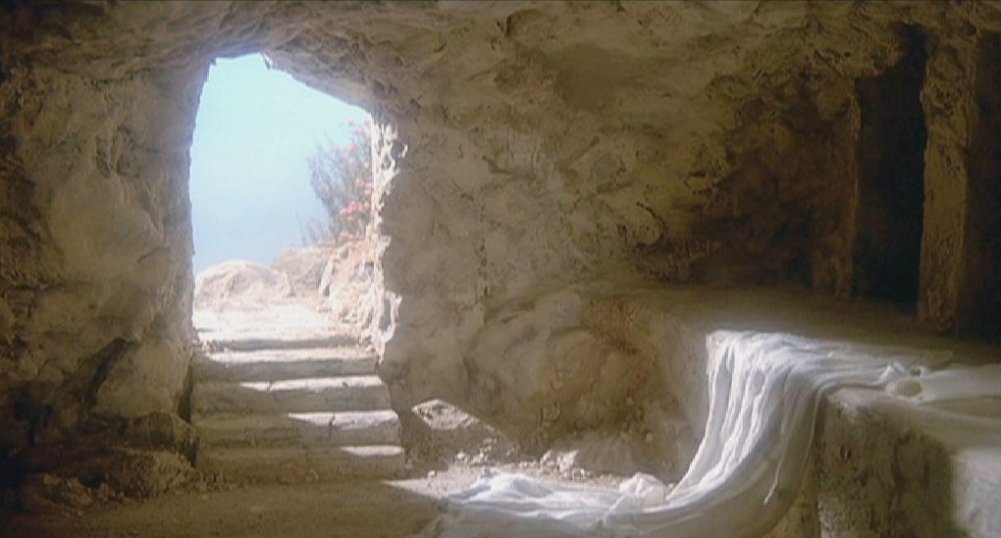
When the sabbath was over, Mary Magdalene, Mary, the mother of James, and Salome bought spices so that they might go and anoint him. Very early when the sun had risen, on the first day of the week, they came to the tomb. They were saying to one another, “Who will roll back the stone for us from the entrance to the tomb?” When they looked up, they saw that the stone had been rolled back; it was very large. On entering the tomb they saw a young man sitting on the right side, clothed in a white robe, and they were utterly amazed. He said to them, “Do not be amazed! You seek Jesus of Nazareth, the crucified. He has been raised; he is not here. Behold the place where they laid him. But go and tell his disciples and Peter,  ‘He is going before you to Galilee; there you will see him, as he told you.'”

Meditation Reflection:

Christ’s resurrection initiated resurrection to new life for every human person who accepts it.  In the Church’s liturgy every Sunday is an Easter. The first day of the new week is now the first day of our new life.

As we worship our Lord and celebrate His victory, we ought to share in His Easter joy.  He invites us to rise with Him.  As hard as suffering and sacrifice may be, rising can also be a challenge.  It means the courage to step forward into a new life, to accept change, and to embrace the unknown new.  It also means forgiveness and letting go of the past.  As painful as cycles of sin or anger may be, we sometimes hold on to them simply because of their familiarity.

Easter joy promises lasting life, not a passing phase.  Christ’s victory over sin and Satan is permanent. When we step forward in faith and hope, we entrust ourselves to the Lord Who has already won.  His grace can sustain us because He has merited it for us and He has proven it. Jesus promised the apostles,

Because I live, you will live also” (John 14:19)

Through the blood and water that poured out from His side on the Cross, Jesus has dispensed His grace through Baptism and the sacraments.  He pours out upon us both the forgiveness of sins and the supernatural grace to sin less and love as He loves more.

This Easter, step out in hope.  Allow Christ to roll away the stone and give you the courage and the humility to begin again in the life He has won for you.

Consider:

  • Reflect on the victory of Christ.  Imagine His reign from Heaven as our Eternal High Priest and King who intercedes for us and fights for our salvation.
  • Consider the areas of your life that have been renewed in Christ.  Reflect on the light and the joy that infuses them.
  • Consider the areas of your life where you still hold on to self-will, fear, pride, or anger.  Pray for Christ to raise you from that tomb as well.
  • Spend 5 minutes in prayers of gratitude for Christ’s blessings to you this past year.

Make a Resolution (Practical Application):

  •  Begin forming a new (good) habit that reflects y our faith in Christ.  For example – one work of mercy a day, 10 minutes of prayer a day, refraining from gossip or crude language, learning about the Bible, listening to Christian music, driving with generosity rather than impatience…
  • Next Sunday is the Feast of Divine Mercy.  Pray the Chaplet of Mercy or read about the devotion given to St. Faustina and commemorated by Pope St. John Paul II. (See my past post Divine Mercy…Can you believe it?)


~ Written by Angela Jendro © 2018

* To receive these weekly posts automatically in your email just click the “follow” tab in the bottom right hand corner and enter your email address.


Pushing the Limits

by Angela (Lambert) Jendro


March 25th, 2018 Palm Sunday

Gospel of Mark 14-15 NAB

The Passover and the Feast of Unleavened Bread were to take place in two days’ time. So the chief priests and the scribes were seeking a way to arrest him by treachery and put him to death. They said, “Not during the festival, for fear that there may be a riot among the people.”

When he was in Bethany reclining at table in the house of Simon the leper, a woman came with an alabaster jar of perfumed oil, costly genuine spikenard. She broke the alabaster jar and poured it on his head. There were some who were indignant. “Why has there been this waste of perfumed oil? It could have been sold for more than three hundred days’ wages and the money given to the poor.” They were infuriated with her. Jesus said, “Let her alone. Why do you make trouble for her? She has done a good thing for me. The poor you will always have with you, and whenever you wish you can do good to them, but you will not always have me. She has done what she could. She has anticipated anointing my body for burial. Amen, I say to you, wherever the gospel is proclaimed to the whole world, what she has done will be told in memory of her.”
Then Judas Iscariot, one of the Twelve, went off to the chief priests to hand him over to them.
When they heard him they were pleased and promised to pay him money. Then he looked for an opportunity to hand him over.

On the first day of the Feast of Unleavened Bread, when they sacrificed the Passover lamb, his disciples said to him, “Where do you want us to go and prepare for you to eat the Passover?” He sent two of his disciples and said to them, “Go into the city and a man will meet you, carrying a jar of water. Follow him. Wherever he enters, say to the master of the house, ‘The Teacher says, “Where is my guest room where I may eat the Passover with my disciples?”‘ Then he will show you a large upper room furnished and ready. Make the preparations for us there.” The disciples then went off, entered the city, and found it just as he had told them; and they prepared the Passover.

When it was evening, he came with the Twelve. And as they reclined at table and were eating, Jesus said, “Amen, I say to you, one of you will betray me, one who is eating with me.” They began to be distressed and to say to him, one by one, “Surely it is not I?” He said to them, “One of the Twelve, the one who dips with me into the dish. For the Son of Man indeed goes, as it is written of him, but woe to that man by whom the Son of Man is betrayed. It would be better for that man if he had never been born.”  While they were eating, he took bread, said the blessing, broke it, and gave it to them, and said, “Take it; this is my body.” Then he took a cup, gave thanks, and gave it to them, and they all drank from it. He said to them, “This is my blood of the covenant, which will be shed for many. Amen, I say to you, I shall not drink again the fruit of the vine until the day when I drink it new in the kingdom of God.”

Then, after singing a hymn, they went out to the Mount of Olives. Then Jesus said to them, “All of you will have your faith shaken, for it is written: I will strike the shepherd, and the sheep will be dispersed. But after I have been raised up, I shall go before you to Galilee.” Peter said to him,
“Even though all should have their faith shaken, mine will not be.” Then Jesus said to him, “Amen, I say to you, this very night before the cock crows twice you will deny me three times.”
But he vehemently replied, “Even though I should have to die with you, I will not deny you.” And they all spoke similarly. Then they came to a place named Gethsemane, and he said to his disciples, “Sit here while I pray.” He took with him Peter, James, and John, and began to be troubled and distressed. Then he said to them, “My soul is sorrowful even to death. Remain here and keep watch.” He advanced a little and fell to the ground and prayed that if it were possible the hour might pass by him; he said, “Abba, Father, all things are possible to you. Take this cup away from me, but not what I will but what you will.” When he returned he found them asleep.
He said to Peter, “Simon, are you asleep? Could you not keep watch for one hour? Watch and pray that you may not undergo the test. The spirit is willing but the flesh is weak.” Withdrawing again, he prayed, saying the same thing. Then he returned once more and found them asleep, for they could not keep their eyes open and did not know what to answer him. He returned a third time and said to them, “Are you still sleeping and taking your rest? It is enough. The hour has come. Behold, the Son of Man is to be handed over to sinners. Get up, let us go. See, my betrayer is at hand.”

Then, while he was still speaking, Judas, one of the Twelve, arrived, accompanied by a crowd with swords and clubs who had come from the chief priests, the scribes, and the elders. His betrayer had arranged a signal with them, saying, “The man I shall kiss is the one; arrest him and lead him away securely.” He came and immediately went over to him and said, “Rabbi.” And he kissed him. At this they laid hands on him and arrested him. One of the bystanders drew his sword, struck the high priest’s servant, and cut off his ear. Jesus said to them in reply, “Have you come out as against a robber, with swords and clubs, to seize me? Day after day I was with you teaching in the temple area, yet you did not arrest me; but that the Scriptures may be fulfilled.” And they all left him and fled. Now a young man followed him wearing nothing but a linen cloth about his body. They seized him, but he left the cloth behind and ran off naked.

They led Jesus away to the high priest, and all the chief priests and the elders and the scribes came together. Peter followed him at a distance into the high priest’s courtyard and was seated with the guards, warming himself at the fire. The chief priests and the entire Sanhedrin kept trying to obtain testimony against Jesus in order to put him to death, but they found none. Many gave false witness against him, but their testimony did not agree. Some took the stand and testified falsely against him, alleging, “We heard him say, ‘I will destroy this temple made with hands and within three days I will build another not made with hands.'”  Even so their testimony did not agree. The high priest rose before the assembly and questioned Jesus, saying, “Have you no answer? What are these men testifying against you?” But he was silent and answered nothing. Again the high priest asked him and said to him, “Are you the Christ, the son of the Blessed One?” Then Jesus answered, “I am; and ‘you will see the Son of Man seated at the right hand of the Power and coming with the clouds of heaven.'” At that the high priest tore his garments and said, “What further need have we of witnesses? You have heard the blasphemy. What do you think?” They all condemned him as deserving to die. Some began to spit on him.
They blindfolded him and struck him and said to him, “Prophesy!” And the guards greeted him with blows.

While Peter was below in the courtyard, one of the high priest’s maids came along. Seeing Peter warming himself, she looked intently at him and said, “You too were with the Nazarene, Jesus.”
But he denied it saying, “I neither know nor understand what you are talking about.” So he went out into the outer court. Then the cock crowed. The maid saw him and began again to say to the bystanders, “This man is one of them.” Once again he denied it. A little later the bystanders said to Peter once more, “Surely you are one of them; for you too are a Galilean.” He began to curse and to swear, “I do not know this man about whom you are talking.” And immediately a cock crowed a second time. Then Peter remembered the word that Jesus had said to him, “Before the cock crows twice you will deny me three times.” He broke down and wept.

As soon as morning came, the chief priests with the elders and the scribes, that is, the whole Sanhedrin held a council. They bound Jesus, led him away, and handed him over to Pilate. Pilate questioned him, “Are you the king of the Jews?” He said to him in reply, “You say so.” The chief priests accused him of many things. Again Pilate questioned him, “Have you no answer? See how many things they accuse you of.” Jesus gave him no further answer, so that Pilate was amazed. Now on the occasion of the feast he used to release to them one prisoner whom they requested. A man called Barabbas was then in prison along with the rebels who had committed murder in a rebellion. The crowd came forward and began to ask him to do for them as he was accustomed. Pilate answered, “Do you want me to release to you the king of the Jews?” For he knew that it was out of envy that the chief priests had handed him over. But the chief priests stirred up the crowd to have him release Barabbas for them instead. Pilate again said to them in reply, “Then what do you want me to do with the man you call the king of the Jews?” They shouted again, “Crucify him. “Pilate said to them, “Why? What evil has he done?” They only shouted the louder, “Crucify him.” So Pilate, wishing to satisfy the crowd, released Barabbas to them and, after he had Jesus scourged, handed him over to be crucified.

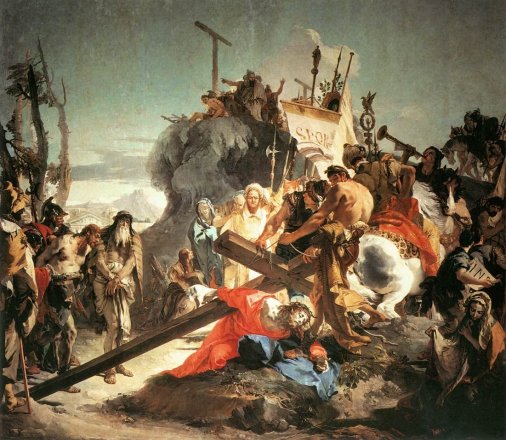
The soldiers led him away inside the palace, that is, the praetorium, and assembled the whole cohort. They clothed him in purple and, weaving a crown of thorns, placed it on him. They began to salute him with, “Hail, King of the Jews!” and kept striking his head with a reed and spitting upon him. They knelt before him in homage. And when they had mocked him, they stripped him of the purple cloak, dressed him in his own clothes, and led him out to crucify him. They pressed into service a passer-by, Simon, a Cyrenian, who was coming in from the country, the father of Alexander and Rufus, to carry his cross. They brought him to the place of Golgotha — which is translated Place of the Skull — They gave him wine drugged with myrrh, but he did not take it.
Then they crucified him and divided his garments by casting lots for them to see what each should take. It was nine o’clock in the morning when they crucified him. The inscription of the charge against him read, “The King of the Jews.” With him they crucified two revolutionaries,
one on his right and one on his left. Those passing by reviled him, shaking their heads and saying, “Aha! You who would destroy the temple and rebuild it in three days, save yourself by coming down from the cross.” Likewise the chief priests, with the scribes, mocked him among themselves and said, “He saved others; he cannot save himself. Let the Christ, the King of Israel,
come down now from the cross that we may see and believe.” Those who were crucified with him also kept abusing him.

At noon darkness came over the whole land until three in the afternoon. And at three o’clock Jesus cried out in a loud voice, “Eloi, Eloi, lema sabachthani?” which is translated, “My God, my God, why have you forsaken me?” Some of the bystanders who heard it said, “Look, he is calling Elijah.” One of them ran, soaked a sponge with wine, put it on a reed and gave it to him to drink saying, “Wait, let us see if Elijah comes to take him down.” Jesus gave a loud cry and breathed his last.

The veil of the sanctuary was torn in two from top to bottom. When the centurion who stood facing him saw how he breathed his last he said, “Truly this man was the Son of God!” There were also women looking on from a distance. Among them were Mary Magdalene, Mary the mother of the younger James and of Joses, and Salome. These women had followed him when he was in Galilee and ministered to him. There were also many other women who had come up with him to Jerusalem. When it was already evening, since it was the day of preparation, the day before the sabbath, Joseph of Arimathea, a distinguished member of the council, who was himself awaiting the kingdom of God, came and courageously went to Pilate and asked for the body of Jesus. Pilate was amazed that he was already dead. He summoned the centurion and asked him if Jesus had already died. And when he learned of it from the centurion, he gave the body to Joseph. Having bought a linen cloth, he took him down, wrapped him in the linen cloth,
and laid him in a tomb that had been hewn out of the rock. Then he rolled a stone against the entrance to the tomb. Mary Magdalene and Mary the mother of Joses watched where he was laid.

Meditation Reflection:

Palm Sunday we recall the Passion of Christ.  We remember His entry into Jerusalem received by adoring crowds which quickly turned to Crucifixion and mocking crowds.  In this account we see ourselves and the fickleness of our own faith.  Peter’s exchange with Jesus at the Last Supper depicts the Christian struggle well:

Peter said to him, “Even though all should have their faith shaken, mine will not be.”

Then Jesus said to him, “Amen, I say to you, this very night before the cock crows twice you will deny me three times.”

But he vehemently replied, “Even though I should have to die with you, I will not deny you.”

And they all spoke similarly.

When has Peter’s attitude been our own?  Complete confidence in our loyalty to Christ – our faith in Who He is, our Hope in Him alone, our perception of undivided Love.  Yet, Christ knows the truth in our hearts.  He knows the real limit of our faith, the weakness of our hope, and the dissipation of our love when confronted with suffering and disappointment.  As long as God’s plan corresponds with our plan, we feel ready to follow Him with magnanimous discipleship.  Yet, when His will deviates from ours, especially if it’s inexplicable to our natural understanding, we often falter.

The Passion of Christ’s love reveals our own tepidity.  (Just consider how we complain at reading or standing at Mass for the length of this Gospel passage.  Yet, how much longer it was for Christ to actually endure!)  However, He also redeems it by taking on our weak human failings Himself, and through the power of His victory, bestowing that grace on our souls so that we may have in truth the magnanimous friendship with Christ we desire in intention.

Venerable Archbishop Fulton Sheen, in his reflections for the third station on the Way of the Cross, reflected:

Three times Our Savior was tempted on the mountain, and three times He fell on the way to Mount Calvary.  Thus did He atone for our three falls – to the temptation of the flesh, the world, and the devil.”   (The Way of the Cross, originally written 1932; currently published by Society of St. Paul 2006)

“He advanced a little and fell to the ground and prayed that if it were possible the hour might pass by him; he said, “Abba, Father, all things are possible to you. Take this cup away from me, but not what I will but what you will.””

How we have all prayed the first part of this prayer!  Begging our Heavenly Father, “all things are possible to You, take this cup away from me”.  The agony of the deepest human suffering pleads in these very words.  The proverbial question “if You are all Good and all Powerful God, why am I suffering?”

The mystery is revealed in Jesus Christ alone.  “But not what I will but what You will.”  God wills our eternal salvation.  He wills it in conformity with respect for human free will.  Human choices cause suffering, but God’s will directs all things, even the events of His Son’s suffering and death, to the triumph of love.  Most of the time we won’t know the particulars of how everything will play out, but we do know the final ending.  Christ conquers – sin, human weakness, even death.  Those who exalt themselves in sin will be humbled, and those who persevere in humility will be exalted.  In Him we find healing, wholeness, strength, and eternal joy.  St. Paul promises that God works all things for good for those who love Him (Romans 8:28), not just some things.   Christ promises the Cross to His followers, but He also promises Resurrection. And the two are inseparable.

Fallen human nature resists faith in the power of the Cross.  Instead it often mocks it like the passersby at Jesus’ crucifixion.

In the account of Jesus’ Passion, individuals respond to His impending Cross in ways that we may relate.  Progress in our spiritual journey corresponds to how far we are willing to follow Christ.  Hopefully each year, we walk a step closer to the Cross and abide with Him a little longer.  Many things can trip us up however as we see in today’s Gospel.

I’ll follow until:

  • Jesus isn’t Who I want Him to be.  He won’t make me materially rich:  Judas
  • I’m tired or bored: Apostles asleep during Jesus’ Agony in the Garden
  • I’m threatened: disciples fleeing the crowd with swords; Peter recognized by the maid
  • I’m caught: young man in linen cloth
  • I’ll cause a rift or make waves: Pilate
  • Even still, Jesus invites His betrayers into His mercy.
“But God proves his love for us in that while we were still sinners Christ died for us.” Romans 5:8

This Holy Week, let us remain with Him.  Let us stay close to Him in prayer without falling asleep or rushing off to distractions.  Let us enter into the mystery of His suffering, death, and resurrection by accepting the griefs within our own situations and dying to what we cannot change, so that we may rise with Him who can redeem every sin and every situation.

Consider:

  • First and foremost, consider Christ’s love for you.  Reflect on how He has shared in your suffering.  Have you ever felt alone, betrayed, anxious, mocked, lied about, physically hurting, or exhausted?  Remember that Christ walks with you through the pain to resurrection in Him.
  • How can your love for Christ be strengthened?
    • Jesus observes in us that “The Spirit is willing but the flesh is weak.” Consider times when you have experienced this.  (Sleeping when you should be praying, resting instead of the effort to show up for someone hurting…)
    • Have you ever sold out Christ for a worldly gain? Consider when you have prioritized money, status, or worldly acknowledgement over doing God’s will for you.
    • Pilate’s betrayal sprang from “wishing to satisfy the crowd.” Sometimes we deny Christ by failing to speak up out of fear of being persecuted on His account. When asked “Are you a Christian?” or “Are you Catholic?”, how do you respond?  Do you hesitate or qualify it?  Or do you respond confidently, “Always be ready to give an explanation to anyone who asks you for a reason for your hope as St. Peter tells us (I Peter 3:15).
    • What fears can the devil use to tempt you away from following the Lord? How does he stir up your anxiety, and worry you into hiding, away from the Cross, like the other apostles?

 Make a Resolution (Practical Application):

  • Pray the Stations of the Cross or the Sorrowful Mysteries of the Rosary this week.
  • Reflect on one section of this Gospel passage a day this week.

Related Posts:

~ Written by Angela Jendro © 2018

* To receive these weekly posts automatically in your email just click the “follow” tab in the bottom right hand corner and enter your email address.


Lent – That Others May See More of Jesus In Us

by Angela (Lambert) Jendro


March 18th, 2018 5th Sunday of Lent

Gospel of John12:20-33 NAB

Some Greeks who had come to worship at the Passover Feast came to Philip, who was from Bethsaida in Galilee, and asked him, “Sir, we would like to see Jesus.” Philip went and told Andrew; then Andrew and Philip went and told Jesus. Jesus answered them, “The hour has come for the Son of Man to be glorified. Amen, amen, I say to you, unless a grain of wheat falls to the ground and dies, it remains just a grain of wheat; but if it dies, it produces much fruit. Whoever loves his life loses it, and whoever hates his life in this world will preserve it for eternal life. Whoever serves me must follow me, and where I am, there also will my servant be. The Father will honor whoever serves me. “I am troubled now. Yet what should I say? ‘Father, save me from this hour’? But it was for this purpose that I came to this hour. Father, glorify your name.” Then a voice came from heaven, “I have glorified it and will glorify it again.” The crowd there heard it and said it was thunder; but others said, “An angel has spoken to him.” Jesus answered and said, “This voice did not come for my sake but for yours. Now is the time of judgment on this world; now the ruler of this world will be driven out. And when I am lifted up from the earth, I will draw everyone to myself.” He said this indicating the kind of death he would die.

Meditation Reflection:

Someone may say to you, “[Your Name], I would like to see Jesus.”  Imagine that for a moment and take it in.  A person looking to you with a hopeful and somewhat anxious expression, addressing you by name, and depending on you to connect them to Christ.

“Why me?” you might say.  Yet, in a secular culture void of God, searching souls see Christ from a distance and feel more at a loss to find their way to Him than you may think.  Thus, your relationship with Jesus, and their relationship with you, provides the bridge they need.

Yet, to be Christ’s light and love in the world, to be a bridge, demands a serious choice which will decide the trajectory of your whole life.  Jesus made this choice, and so must each of His followers.

The choice – to live for yourself or to live for the Lord, to build a life of your own making or to build the kingdom of God.

A grain of wheat, in and of itself, is small and insignificant – enough to feed only a bird. Yet, within it lies tremendous potential – enough to feed human persons.  The movement from potential to actuality however begins with death.

If a grain were a conscious soul with a mind and will, it would see before it a decision:

  1. Go on living as a seed for itself, unchanged and comfortable.
  2. Surrender itself to the Creator, be broken apart in death and then transformed into something new and quite different from its experience as a seed.

Although the second option sounds scary, to grow and change also entails being lifted up from the ground, becoming tall stalks of wheat, and finally, maturing to the point where it can be picked as harvest for others.  The first choice may be easier, but the second adds so much more meaning to its life.

As Jesus’ “Hour” approached, He came to the final crossroads of His decision.  He had said Yes to the Father when He agreed to become man at the incarnation, He said No to Satan in the desert when offered the kingdoms of the world without the Cross, and now as His final suffering and death approached He weighed His decision aloud for His disciples to hear and one day follow.

Jesus didn’t want to suffer but He did want to save us. So what was He really to do?  Christ’s magnanimous love refused to live for Himself, and so chose the path to the Cross.  He chose to die that He might be lifted up – on the Cross and in His Resurrection – and thereby bear fruit that gives all mankind who plucks it life eternal.

As Christ’s disciples, we first must receive life from our Lord who has become our spiritual bread.  Under the appearance of wheat bread in the host, He gives His very Body, Blood, Soul, and Divinity to us in the Eucharist.  With this union and grace, we then are asked to allow Him to transform our souls.

He begins by breaking down sin and selfishness.  Dying to ourselves marks the first stage of development.  Thus prayer, fasting, and almsgiving facilitate this process by putting God first, denying ourselves pleasures, and opening ourselves up to the poor around us.

From this death to self however, which no doubt is painful, emerges transformation.  Sin and self at bay, Christ is more free to build virtues within us and to grow authentic Christian love.  The process snowballs positively as the greater one loves, the easier sacrifice becomes.  In full Christian development, love is so perfected that it, like Christ, can’t bear to choose pleasure or comfort over love of God and neighbor. We experience something of this in human loves between parent and child, spouses, or dear friends.  In loving relationships, giving of one’s self or possessions is felt to be an opportunity rather than a burden.

In this fifth week of Lent, you may be feeling the pain of perseverance in the commitments you made Ash Wednesday.  However, the more weak you feel on your own, the more reliant you become on Christ and His grace to support you.  Have hope, we are past the midpoint!  Just as there can be no Easter Sunday without Good Friday, we can’t truly feast until we’ve fasted.  The more we enter in to Lent, the more joy we will experience during Easter.

Like Jesus, we might pray to the Father:

“I am troubled now. Yet what should I say? ‘Father, save me from this hour’? But it was for this purpose that I came to this hour.”

We choose death to self because we desire life in Christ – which we know to be much happier, peaceful, and fulfilling than anything we could construct for ourselves.  We don’t die for its own sake but rather to receive greater life.

Jesus teaches, “Whoever serves me must follow me, and where I am, there also will my servant be.”  In consequence, as we approach Holy Week we endeavor to be with our Lord wherever He is – at the Last Supper on Holy Thursday, at the Cross on Good Friday, waiting in anticipation Holy Saturday, and rejoicing in His Resurrection on Easter Sunday.

If we persevere and remain near to Christ, those near to us can be blessed by His Presence too. Our lived discipleship might drive out the lies of Satan with Christ’s Truth.  You can be a witness that Christ brings true happiness to someone disillusioned by the world’s false promises.  Your unconditional love can drive out the lie that someone is only as valuable as they are useful.  Your forgiveness can drive away the temptation of despair with the truth of mercy.

Christ’s saving love draws everyone to Himself.  If we allow ourselves to be conformed to Him, we just might be that bridge to Christ for someone’s salvation, or that stalk of wheat which they pluck to receive our Lord for the first time.

Consider:

  • Meditate on the words, “we would like to see Jesus.”  Make this your prayer to the Holy Spirit and spend 5 minutes in silent prayer listening.
  • Consider Christ’s gift of self for you.  Pray about how you might give more of yourself to Him and to others.
  • In what ways does your life witness your faith to others?  In what ways do you hide your faith?
    •  Are you a joyful or a gloomy Christian? Do you greet people with a smile? (one of Mother Teresa’s common suggestions)
    • In conversations, does your speech reflect your Christian values or do you participate in gossip or vulgar jokes.
    • Do you speak about your church or priest with respect or are you overly critical?
    • Do you reach out to persons at work or in your neighborhood who seem to be friendless or having a tough time, or are you too focused on your own life?

 Make a Resolution (Practical Application):


~ Written by Angela Jendro © 2018

* To receive these weekly posts automatically in your email just click the “follow” tab in the bottom right hand corner and enter your email address.


I Can’t Believe My Eyes!


by Angela (Lambert) Jendro

February 25th, 2018 2nd Sunday of Lent

Gospel of Mark 9:2-10 NAB

Jesus took Peter, James, and John and led them up a high mountain apart by themselves. And he was transfigured before them, and his clothes became dazzling white, such as no fuller on earth could bleach them. Then Elijah appeared to them along with Moses, and they were conversing with Jesus. Then Peter said to Jesus in reply, “Rabbi, it is good that we are here! Let us make three tents: one for you, one for Moses, and one for Elijah.” He hardly knew what to say, they were so terrified. Then a cloud came, casting a shadow over them; from the cloud came a voice,  “This is my beloved Son. Listen to him.” Suddenly, looking around, they no longer saw anyone but Jesus alone with them. As they were coming down from the mountain, he charged them not to relate what they had seen to anyone, except when the Son of Man had risen from the dead. So they kept the matter to themselves, questioning what rising from the dead meant.

Meditation Reflection:

I can’t believe my eyes!  Peter, James, and John must surely have thought this at the Transfiguration. They would again – though for a different reason – at the Cross; and again at the sight of the risen Lord (their disbelief so great Jesus urged them to touch Him and feel for themselves). There, at the Transfiguration, Jesus’ divinity and Messianic promise radiated unveiled in glory.  Despite the awe inspired by this divine theophany, they struggled to understand what Jesus meant by rising from the dead.

The Apostles believed Jesus to be the Messiah and remained with Him through the entire three-year tenure of His public ministry.  Nevertheless, they often underestimated Christ, and despite the innumerable miracles they witnessed firsthand, regularly regressed to earthly problem solving without calculating the supernatural aid of their divine Master.  Consider the storm on the sea in which they were sure they would drown while Jesus lay asleep (Mark 4:35-41), or their concern over forgetting to bring bread on their voyage even though Jesus had just multiplied loaves and fishes on two different occasions for the multitudes (Mark 8:14-21).  Despite the pervasive modern attitude that “I’ll believe it when I see it,” we like the disciples, tend to ignore the very rule we place on God.  Miracle after miracle He works in our lives, and yet we continue to worry.  Jesus could very well say to many of us, “Having eyes do you not see, and having ears do you not hear? And do you not remember?” (Mark 8:18 RSV).

How could there be so much intimacy with the incarnate Lord – so much love, and so much loyalty – and yet so little trust?  They lacked the gift of the Holy Spirit and sanctifying grace won for us by Christ’s Paschal Mystery.  The bridge from human weakness and anxiety to the strength of Christian peace is the beams of the Cross.

Everyone’s spiritual journey is unique.  At the same time, we are all human and so the stages of our spiritual development share some commonality just like our physical development.  We begin more easily trusting that which is familiar to us in the natural, visible world, and distrusting that which is possible only to God who transcends our understanding.  Discipleship requires the movement of grace and receptivity to the invitation of Christ. We need the Holy Spirit to enable us to follow the Lord where He leads, even though it may mystify and surprise us.  As God reminds us in Isaiah 55:8-9:

For My thoughts are not your thoughts, neither are your ways My ways, says the Lord.  For as the heavens are higher than the earth, so are my ways higher than your ways and my thoughts than your thoughts.” RSV

Every disciple of Christ struggles to move from the immediacy of visible world, to consistent sight of the even deeper reality of the invisible world.  The two are not mutually exclusive, but rather intimately related to one another.  As Catholics we call it the “sacramental principle.” God knows our struggle, which is why “the Word became flesh and dwelt among us” (John 1: 14 RSV).

During Lent we take a step back to evaluate just how deep our faith really goes and to examine what “safety nets” of ours we keep erected in case God doesn’t come through for us.  These attachments hold us back from full freedom in the Lord.  Like the apostles, we worry about things like bread and tents (financial and physical security), when Christ has provided everything we need and more…including life itself and a room in His Father’s house.

During Lent, as we contemplate the awesome, sacrificial love of Christ, we are challenged to invite Him more fully into every aspect of our lives.  Certainly He has proven that we can trust Him – the man that died and rose again for us, the man who is also God!

So, consider: What limits do you place on God? Where’s the boundary of your faith? Do you trust God to secure your eternal home, but doubt with matters related to your earthly one?  Sometimes the visible world can seem more real than the invisible.  The immediacy and demands of each day’s tasks can beguile our imagination into feeling as if God is remote and unrelated to the day’s needs, at least in any concrete or practical way.   But, God is Lord of Heaven and Earth.  His power and His love know no bounds.

Abraham believed this to his very core.  He trusted God to be Who He claimed to be.  His faith was so confident that he didn’t even hesitate when he raised the knife to sacrifice his only beloved son and his only hope of a legacy.  St. Paul described Abraham’s magnanimous faith in his letter to the Hebrews saying:

By faith Abraham, when he was tested, offered up Isaac, and he who had received the promises was ready to offer up his only son, of whom it was said “Through Isaac shall your descendants be named.’  He considered that God was able to raise men even from the dead; hence he did receive him back, and this was a symbol.” (Hebrews 11:17-19 RSV).

The eyes of faith see the visible and the invisible.  They “understand that the world was created by the word of God, so that what is seen was made out of things which do not appear” (Hebrews 11: 3).  Faith trusts that God is who He says He is, and who He has shown Himself to be time and again.  Yes, it exceeds our understanding, because “with God, nothing is impossible.”  So, as we journey through Lent, may we spend more time with the Lord and develop greater awareness of His daily presence.  Hopefully by the end, we will be somewhat closer to the confidence of St. Paul in his letter to the Romans:

“Brothers and sisters: If God is for us, who can be against us? He who did not spare his own Son but handed him over for us all, how will he not also give us everything else along with him?” Romans 8:31-32 NAB

Consider:

  • Sarah conceived Isaac despite being barren and past the natural age.  St. Paul writes that God did this because of her faith saying, “she considered Him faithful Who had promised” (Hebrews 11: 11 RSV).
    • Consider God’s faithfulness.  How has God been there for you when it counted?  How has He answered prayers in a way you didn’t expect?  How has He brought good out of a bad situation?
    • Consider God’s generosity. Ask the Holy Spirit to help you look back on the day, week, year, and course of your life and see God’s blessings.  Then spend a few minutes in prayers of gratitude.
    • Entrust to God your cares.  Make a list of your worries or of what’s weighing on your heart, and place them in the care of Christ in prayer.

Make a Resolution (Practical Application):

Related Posts:

~ Written by Angela Jendro © 2018

* To receive these weekly posts automatically in your email just click the “follow” tab in the bottom right hand corner and enter your email address.


Desert Decisions

by Angela (Lambert) Jendro

February 18th, 2018 1st Sunday of Lent

Gospel of Mark 1:12-15 NAB

The Spirit drove Jesus out into the desert, and he remained in the desert for forty days, tempted by Satan. He was among wild beasts, and the angels ministered to him. After John had been arrested, Jesus came to Galilee proclaiming the gospel of God: “This is the time of fulfillment. The kingdom of God is at hand. Repent, and believe in the gospel.”

Meditation Reflection:

The transition from Christ’s hidden life to His public ministry began with His Baptism and then the temptation in the desert.  There,  He had to decide whether to work for self-gain in this world, or self-sacrifice for the next.

At the Incarnation Christ, though the Second Person of the Blessed Trinity, took on a human nature and humbly chose to live the human experience.

Who, though he was in the form of God, did not regard equality with God something to be grasped. Rather, he emptied himself, taking the form of a slave, coming in human likeness; and found human in appearance, he humbled himself, becoming obedient to death, even death on a cross. Philippians 2:7

In consequence, Jesus grew “in wisdom and stature” (Luke 2:52 RSV), obedient to His parents, embracing the temporal condition of human development.  He did not begin His public ministry until the age of 30, which marked full manhood at the time and the transition to leadership roles.  It was also the age Levitical priests would enter the full service of the Lord (see Numbers 4:3, 30).

The commencement of His mission was preceded by temptation and trial.  He, like us, had to choose which trajectory His life would take.  In the desert, Satan enticed the Lord to direct His divine gifts to pampering His human nature.  Matthew (4:1-11) details the temptations specifically: bodily pleasure (bread), tremendous fame (leap from temple pinnacle), and worldly power (all the kingdoms of the earth).  Satan forced the choice before the Lord: the immediacy of the visible world and self-gain without the Cross, or the work of establishing the invisible kingdom of God which would require self-immolation and suffering Crucifixion before rising again.

Each of us faces the same temptations and the same choice.  We can either use our God-given gifts to promote ourselves and worldly achievements, or direct them to the Father’s will and the building up of His kingdom.

Lent provides a time to step into the desert with the Lord, to pray and fast, and to re-orient the trajectory of our lives.  As a Church, the People of God, we take 40 days each year to shed the illusion that we can live for both worlds or that we can have the kingdom without the Cross.

Through fasting, with the help of grace, we deny ourselves tempting pleasures to strengthen our will and remember that “man shall not live by bread alone, but by every word that proceeds from the mouth of God” (MT 4:4).  Furthermore, it reveals the truth of just how attached we may be and loosens the hold that habit may have over us.  Fasting also unites us to the redemptive value Christ has placed on suffering through His own suffering and death.  In fact, on one occasion Jesus even says to His disciples that some demons “cannot be driven out by anything but prayer and fasting” (Mark 9:29).  Thus, through our Lenten fasting, we join our sacrifices to His, to cast out the demons in our lives with His help, so that we might share in His mission and thus share in the hope of His Resurrection.

Through prayer we draw closer to the Lord, that the invisible might become more visible and His grace might transform us.  Encountering Christ in the Scriptures, the Mass, the Rosary, the lives of the saints, Eucharistic Adoration, the Stations of the Cross, and other prayerful devotions, our love for Him is enkindled and our discipleship strengthened.

Finally, the Lenten practice of almsgiving takes us outside of ourselves through service of the needs of others.  This can range from sharing your money with the poor to sharing a blanket with your child.  It also includes sharing your time with someone sorrowing, lonely, or sick. It begins with meeting the needs of your family then your co-workers or neighbors and friends, your local parish and community, and finally the world-wide needs of the Church.  Catholic Relief Service’s “Operation Rice Bowl” provides an opportunity as a family to make simpler meals during Lent and to donate the money saved to feed the hungry in poor areas of the world (https://www.crsricebowl.org/about)

Together as Christians, we join Christ in the desert during Lent.  We draw away from the immediate and tempting pleasures of the moment and of this world, and draw nearer to Christ and the eternal, even more real, pleasures of the Heaven.  At the end of this purification we share in the joy of His resurrection at Easter.  Easter is the beginning of a new creation, and we hope to be a new, or renewed, creation Easter Sunday as well. Lent is a time to “repent and believe in the gospel” so that, transformed by grace, we may live in the Kingdom of God which is now at hand in Jesus Christ.

Consider:

  • Consider in prayer the deeper, truer, reality of the spiritual world.  Reflect on the illusory promises of pleasure, fame, and status compared with the enduring graces of Christian love, strength, and joy.
  • Ask Christ in prayer to reveal an attachment you may have, that up until now you have been blind to such as subtle forms of pride, vanity, greed, or pleasures.
  • Take time for gratitude.
  • Ask Mary to help you see the needs around you as she did at the Wedding at Cana.

Make a Resolution (Practical Application):

  • Swap out 15 minutes of media time for 15 minutes of prayer or silence.

Related Posts:

~ Written by Angela Jendro © 2018

* To receive these weekly posts automatically in your email just click the “follow” tab in the bottom right hand corner and enter your email address.


The Peace of Christ

By Angela (Lambert) Jendro

February 4th, 2018 5th Sunday in Ordinary Time

Gospel of Mark 1:29-39 NAB

On leaving the synagogue Jesus entered the house of Simon and Andrew with James and John. Simon’s mother-in-law lay sick with a fever. They immediately told him about her. He approached, grasped her hand, and helped her up. Then the fever left her and she waited on them. When it was evening, after sunset, they brought to him all who were ill or possessed by demons. The whole town was gathered at the door. He cured many who were sick with various diseases, and he drove out many demons, not permitting them to speak because they knew him.
Rising very early before dawn, he left and went off to a deserted place, where he prayed. Simon and those who were with him pursued him and on finding him said, “Everyone is looking for you.” He told them, “Let us go on to the nearby villages that I may preach there also. For this purpose have I come.” So he went into their synagogues, preaching and driving out demons throughout the whole of Galilee.

Meditation Reflection:

Everyone encounters suffering in some form.  Whether physical sickness, the sickness of a loved one, spiritual or emotional sickness from Satan’s lies and those of the secular culture, the pain of divorce or the loss of a job, or just the “drudgery” of life Job complained of in the first reading (Job 7:1).  Even worse, underlying every difficulty is the grating anxiety to find an escape, and the fearful suspicion there may not be one.

Science, medicine, psychology, exercise, achievements, and vacations can only provide a partial remedy.  Escapes into addiction only worsen the problem.

It has always stuck me how many times Jesus says, “Peace be with you” together with His admonition to “Be not afraid.”  Jesus, both man and God, has experienced our suffering and even our anxiety.  He has compassion for our weakness and reaches out with His divine power to save us.  As David proclaimed in today’s Psalm,

He heals the brokenhearted
and binds up their wounds.
Psalm 147:3

Jesus, the Word of God, through whom all things came to be (John 1:3), came to heal the wounds of sin and restore us to wholeness.  Moreover, because God always gives in abundance, Jesus imparted gifts upon us even greater than those lost by Adam and Eve (CCC, par. 420).

Jesus Christ not only heals the brokenhearted, He embraces them in His own Divine Love.  The lonely He makes children of God and their souls His dwelling place.  A Christian can never be truly lonely, since they only need to look interiorly to find their Lord.  In addition, each Christian is incorporated into Christ’s Mystical Body the Church, and shares in the stream of grace that runs through it, and connects us one to another.  Any suffering you endure can be offered up as a grace and blessing for someone else, and vice versa.   Christ therefore transforms the “drudgery” of daily work by making even the smallest task, if done in love, a noble and efficacious participation in His work of redemption.

Even death no longer hangs over us as a futile end.  In Christ it has become the consummation of our earthly service, and the commencement of our heavenly reward.  The longing for God which begins here, finds it’s fulfillment and joy in eternity; much like a wedding marks the transition from the growing love of engagement, to the total union of marriage.  Thus, heaven is described by God as a wedding feast in the book of Revelation:

Let us rejoice and be glad and give him glory.

For the wedding day of the Lamb has come,

his bride has made herself ready.

She was allowed to wear a bright, clean linen garment.” – The linen represents the righteous deeds of the holy ones.

Then the angel said to me, “Write this: Blessed are those who have been called to the wedding feast of the Lamb.”

Revelation 19:7-9

No wonder “the whole town was gathered at the door” in today’s Gospel.  Jesus is the savior every human person longs for and needs.  He gives freely and abundantly.   May we seek Him out for ourselves, and also bring Him to others in need of His healing.

Simon Peter said to Jesus, “Everyone is looking for you.”  His words remain true today and in every age.

Consider:

  • Take a few minutes to lay your burdens and anxieties before Christ in prayer.  Approach Him with trusting faith to help you.
  • Take a few minutes to bring the burdens and anxieties of those you love before Christ.
  • Consider the difference between the temporary or partial relief you find in natural comforts, compared to the fullness of the peace of Christ found in prayer.

Make a Resolution (Practical Application):

Like the people in Simon Peter’s town, seek out Christ.   Choose one concrete way to encounter Him each day this week.

  • Ideas: Take 5 minutes for silent prayer, visit Christ in Eucharistic Adoration, spend 10 minutes with Christ in Scripture, attend a daily Mass, read about the life of a saint or one of their writings, make time to visit a Christian friend who always seems to make Christ visible to you.

~ Written by Angela Jendro © 2018

* To receive these weekly posts automatically in your email just click the “follow” tab in the bottom right hand corner and enter your email address.


Soaking up the Sun of God

by Angela (Lambert) Jendro

 Epiphany 2.png


January 7, 2018 The Epiphany of the Lord

Gospel of Matthew 2:1-12 NAB

When Jesus was born in Bethlehem of Judea, in the days of King Herod, behold, magi from the east arrived in Jerusalem, saying, “Where is the newborn king of the Jews? We saw his star at its rising and have come to do him homage.” When King Herod heard this, he was greatly troubled, and all Jerusalem with him. Assembling all the chief priests and the scribes of the people, He inquired of them where the Christ was to be born. They said to him, “In Bethlehem of Judea, for thus it has been written through the prophet: And you, Bethlehem, land of Judah, are by no means least among the rulers of Judah; since from you shall come a ruler, who is to shepherd my people Israel.” Then Herod called the magi secretly and ascertained from them the time of the star’s appearance. He sent them to Bethlehem and said, “Go and search diligently for the child. When you have found him, bring me word, that I too may go and do him homage.” After their audience with the king they set out. And behold, the star that they had seen at its rising preceded them, until it came and stopped over the place where the child was. They were overjoyed at seeing the star, and on entering the house they saw the child with Mary his mother. They prostrated themselves and did him homage. Then they opened their treasures and offered him gifts of gold, frankincense, and myrrh. And having been warned in a dream not to return to Herod, they departed for their country by another way.

Meditation Reflection:

After the bustle and excitement of Christmas celebrations, the days following often produce mixed feelings.  On the one hand a sigh of welcomed relaxation and the comfort of settling back into normalcy.  On the other hand, a sigh of sadness as we ache from missing our loved ones, along with a moan of pain as the brutal cold and darkness depress our commute.

Although the Christmas decorations may be coming down and routine returning , the true “Spirit of Christmas” (as every Hallmark movie loves to reference), ought to remain present and illuminate our homes.  The Feast of the Epiphany witnesses that the birth of Christ has ushered in a light that radiates with the strength of mid-summer rays and remains enduringly without diminishment.

The wise men travelled an arduous distance to find this light in the darkness.  As we begin surfing the internet for discount airline tickets and the brief relief of a warm, sunny vacation, we can take a lesson from the magi and intentionally seek out the true and lasting “Sun” of God.  Rather than merely making plans for the Caribbean, make plans to seek the Lord as well, where you can soak in the warmth of His rays of grace and love.  Surf for Christ-destinations such as Eucharistic Adoration, Mass, Confession, Scripture, spiritual reading, or silent prayer. Vacations refresh us with the energy we need to keep going in our daily routine.  Breaking away to soak up quality time with Christ will do the same.  It will refresh our weary spirits, lighten our dark moods, and deepen our lives with purpose and personal connection.

So, wrap up and stack your red and green decor in totes, and without a doubt discard the once fragrant Christmas tree that has now dried up into a mess of needles and a worrisome fire hazard.  Keep the light of Christ however.  After having drawn near to Him at His birth, remain with Him.  Keep close to Him.  Lay your whole self before Him in homage as the magi did, and offer Him every gift and talent you possess.  “Then you shall be radiant at what you see, your heart shall throb and overflow” (Isaiah 60:5).

Christmas celebrates the appearance of our long awaited Savior which lasts eternally not just one day. His coming should be transformative and therefore change the way we think and act, and re-prioritize our hopes and desires.  The New Year doesn’t mark the end of the holidays.  Rather, it marks the beginning of our new, and renewed, life in Christ.  The Magi left Bethlehem filled with joy and hope.  Mary left Bethlehem with Jesus in her arms close to her heart.  May we leave this Christmas season in the same way.

Consider:

  • Spend a few minutes in prayer drawing near to Christ like Mary, Joseph, and the Magi.  Surrender to Him in humility, love, and homage as they did.
  • How might you keep close to Christ daily and weekly?  Where might you encounter Him?
  • What gifts might you offer to Jesus?
    • Gold (wealth) – how well are you doing at tithing? Do you give the Lord your first 10% in thanksgiving and faith? Is there some way He is asking you to be more generous with your money or with your time and service?
    • Frankincense (used in worship of God) – How can you offer Christ your worship?  What might you offer to Him as a sacrifice?  How can you apply your talents and abilities to advancing the Kingdom of God?
      • [For example: offer patience with a family member as a sacrifice, offer your daily work as a sacrifice – especially the most tedious aspects, or offer living your faith authentically in the workplace rather than joining in un-Christian jokes, conversations, or activities.]
    • Myrrh (used as ointment for burial) – How can you honor Christ’s death for you?  Do you live as one saved or persist in certain sins?  Consider how to live more intentionally as one freed by Christ.  Meditate on the sufferings of Christ and unite your own suffering to His.

Make a Resolution (Practical Application):

  • Choose one “gift” to present to Jesus for this year.
  • Seek Christ this week in an intentional way.  Set aside 10-15 minutes for prayer or spiritual reading, or seek Him in the sacraments.

Related Posts:

Setting goals for the New Year – Lessons from the Magi

The Universal Search For God

~ Written by Angela Jendro © 2018

* To receive these weekly posts automatically in your email just click the “follow” tab in the bottom right hand corner and enter your email address.


Making Room for Christ

by Angela (Lambert) Jendro

 making room for christ to come

December 10th, 2017 2nd Sunday of Advent

Gospel of Mark 1:1-8 NAB

The beginning of the gospel of Jesus Christ the Son of God.  As it is written in Isaiah the prophet: Behold, I am sending my messenger ahead of you; he will prepare your way. A voice of one crying out in the desert: “Prepare the way of the Lord, make straight his paths.” John the Baptist appeared in the desert proclaiming a baptism of repentance for the forgiveness of sins. People of the whole Judean countryside and all the inhabitants of Jerusalem were going out to him and were being baptized by him in the Jordan River as they acknowledged their sins. John was clothed in camel’s hair, with a leather belt around his waist. He fed on locusts and wild honey. And this is what he proclaimed: “One mightier than I is coming after me. I am not worthy to stoop and loosen the thongs of his sandals. I have baptized you with water; he will baptize you with the Holy Spirit.”

Meditation Reflection:

It’s the time of year for making room – in our closets, our homes, our schedules, and our lives.

We live in a culture so in love with stuff that we need storage units just to hold the overflow of possessions. Additionally, the rampant competitiveness in the culture adds pressure to our schedule, forcing our waking hours to overflow into the late night and early mornings.

When I was single I could handle quite a bit of buildup in things and reduction in sleep.  A few weeks into motherhood however it became clear we would all drown if I didn’t take regular action.   When my kids were younger we had a tradition every year of cleaning out their rooms and closets a couple of weeks before Christmas and a couple of weeks before their birthdays.  I would give them two bags – one for garbage and one for giveaway.  Anything broken, grown out of, or no longer used had to go to make room for the new gifts.  I too would clean out my things and reassess our calendar.

Advent provides an opportunity for us to do the same thing in our spiritual lives a few weeks before Christmas.  In anticipation of the greatest gift – Jesus Christ, the Son of God – we must make room in our souls, our schedules, and our lives.  It’s a time to step back and make an honest examination of what occupies our hearts.  Much like when I hold up an old sweater and debate whether I will really wear it again or not, I must examine the things I spend time and energy on and ask if they are still worth it, or just taking up valuable space.

If it’s so difficult to let go of an old ratty sweater overrun with pills, how much more difficult to let go of old bad habits or frames of mind.  We hold on to useless or worn out things simply because we hate change and we love nostalgia.  We may rationalize that we will “use that someday” but we don’t even know all the “thats” we have anymore.  We just don’t want to let go of something that’s been with us so long.

Similarly, we resist honestly evaluating our priorities, bad habits and sins.  In some ways they can begin to feel a part of our identity.  However, the process of decluttering our soul can be marvelously freeing and enable us to move forward in our lives.  The questions we must ask will vary as much as the clutter in our homes.  You may have to consider, “Am I a hard worker, or have I become a workaholic? Or the opposite: “Do I have a healthy amount of down time in my life, or have I just become lazy?”  About attitudes one might ask “Am I someone who doesn’t get riled up about much, or am I just complacent?” or the opposite: “Am I someone who cares passionately about things, or do I make an idol out of causes or get too involved in other people’s business?”

Outside perspective can help.  If you share a closet, garage, or home with someone, they will quickly tell you which items have been hogging space for no reason.   Loving family and friends can also offer valuable insight.  They can more easily identify the ways you have grown as a person and the things that hold you back.  The Holy Spirit can also guide you if you ask.  He can enlighten your mind to see things from God’s perspective and soothe you with grace to let the lesser goods go.

After decluttering, the final preparations for Christmas celebrations involve cleaning.  Mineral build up on the faucet, sticky fingerprints and globs of ketchup on the refrigerator, half-finished projects that have become an eyesore or safety hazard, and dusty surfaces dull the beauty of our homes.  It takes time and sweat, but the shiny glean in every room renews our appreciation of the gifts God has bestowed upon us and the joy of home.

In the same way, our virtues and gifts can dull from the challenges of everyday life.   Stepping back for a little introspection can help us reclaim those pieces of ourselves we love and let them shine again.

Some things may need to go and some things may be reasonable to keep, or some things may need a deep clean, but at the end of the process our souls shine with the beauty God has given us, and Christ has more room to fill with His divine presence and peace.

Consider:

  • Prayerfully list your priorities.  Where do God, work, family, friends, hobbies, and self-care rank?
  • Consider your schedule: How well do you balance time for God, time for taking care of yourself, time for helping others, and time to accomplish your work well?
  • Consider your possessions:  How well do your things represent your priorities?  Are there ways your possessions could better reflect what matters to you?
  • Consider your heart:  What occupies your desires most?  Be honest.  Then relate them back to your priority list.  Prayerfully ask the Holy Spirit to increase your desire for the Lord and for loving relationship with others, and to decrease your desire for what competes with them.
  • Consider your mind:  What occupies your thoughts?  What do you spend time learning about?  How well are you making time for introspection and spiritual growth?  Do you take the time to think of others or to identify your own needs?  What tends to distract you or consume your mind? How might you detach somewhat?

Make a Resolution (Practical Application):

  • Make room for Christ in your home, your schedule, and your heart.  Declutter your biggest horde, simplify your time commitments, and increase your prayer and spiritual reading by 10 minutes.
  • Do an examination of conscience and encounter Christ in the Sacrament of Reconciliation.

Related Posts:


~ Written by Angela Jendro © 2017

* To receive these weekly posts automatically in your email just click the “follow” tab in the bottom right hand corner and enter your email address.


Fueling the Fire of Love

by Angela (Lambert) Jendro

20170217_010616065_iOS 

November 12th, 2017 32nd Sunday in Ordinary Time

Gospel of Matthew 25:1-13 NAB

Jesus told his disciples this parable: “The kingdom of heaven will be like ten virgins who took their lamps and went out to meet the bridegroom. Five of them were foolish and five were wise. The foolish ones, when taking their lamps, brought no oil with them, but the wise brought flasks of oil with their lamps. Since the bridegroom was long delayed, they all became drowsy and fell asleep. At midnight, there was a cry, ‘Behold, the bridegroom! Come out to meet him!’ Then all those virgins got up and trimmed their lamps. The foolish ones said to the wise, ‘Give us some of your oil, for our lamps are going out.’ But the wise ones replied, ‘No, for there may not be enough for us and you. Go instead to the merchants and buy some for yourselves.’ While they went off to buy it, the bridegroom came and those who were ready went into the wedding feast with him. Then the door was locked. Afterwards the other virgins came and said, ‘Lord, Lord, open the door for us!’ But he said in reply, ‘Amen, I say to you, I do not know you.’ Therefore, stay awake, for you know neither the day nor the hour.”

Meditation Reflection:

What do we need to be ready for Christ?  At Baptism we received a lighted candle, and the call to be the light of Christ in the world.  Sometimes we may feel that zeal and live our faith in a powerful way.  Other times the routine and busyness of every day drains our energy and we become drowsy or complacent.  Work projects or sports tournaments begin to overshadow weekly Sunday Mass and after rationalizing missing one Sunday we easily slip into missing most.  Seeing our bible collect dust we might open it up and resolve to read it every day until we’ve completed it cover to cover.  Half-way through Genesis, the first book of the Bible, we give up.  Maybe we are going through a tough time and it renews our zeal to pray daily.  After it passes we continue a little longer in thanksgiving.  A few weeks into the hum drum of life without much drama we begin to forget that time with the Lord.

So how do we keep our candles lit during the long wait? Heaven is union with God and so we need to burn with the fire of His love.  Authentic love perseveres because it’s rooted deeper than the emotions.  It requires conviction, consistent nurturing, and Christ’s grace.

Every relationship requires effort and ongoing time and attention to be sustained.  In the same way, we can fuel our love for Christ by developing our convictions through ongoing study of Scripture, the teachings of our Faith, and the lives of the saints.  We can nurture our relationship by setting aside time with the Lord daily in prayer and weekly at Mass.  Lastly, we can ask Christ for His grace to sustain us and transform us.  Most importantly, when we come to the banquet of His love in the Eucharist, He fills us with His divine love which burns away anything that comes between us and Him.

We can also root out things that undermine our relationship with Christ by rooting them out in our human relationships as well.  Being attentive to our family, friends, neighbors, and coworkers will require many of the same virtues we need to be attentive to the Lord.  To listen to our loved one when they need to talk will mean saying no to whatever else was occupying our attention at that moment.  To visit someone will mean scheduling time and moving other things around to make it happen.

Christ wants to visit us today.  Where can He find an open door and a lighted lamp?  Hopefully He can find us at prayer, speak to us in Scripture, and be received by us in the Eucharist at Mass.  Then, when He comes again for the final time, we will be ready and our joy will be complete.  During our lives we will have said, “Come Lord, enter my heart and be welcomed by my love.”  And at the end of our lives, He will stretch His hand out to us, where we will find the door open and He will say to us, “Come my child, enter my heart and be welcomed eternally by my love.”

Consider:

  • When has your faith been most on fire for the Lord?  Was it after a retreat, an experience in prayer, a profound event in your life, a speaker or book you read, sacred music that lifted your heart?
  • What competes with your devotion to Christ?  Distractions from pleasures, anxiety from stress, a busy schedule, a pull toward laziness, numbness from emotional pain, an addiction?
  • How do you prepare for guests, especially at the holidays?  Consider the extra thoughtfulness you put into preparing food they will like or attentiveness to the little details that will add warmth to the experience.
  • Consider Christ visiting.  How might you be attentive to Him? Schedule time for conversation.  Welcome Him through others by works of mercy.

Make a Resolution (Practical Application):

  • Resolve on one thing this week to detach you from something that competes with love for Christ, and one thing to keep the fire of love lit for Him.
    •  Ideas for detachment:  Identify an attachment (click here for how to: identifying attachments), then practice the opposite virtue.  If you don’t pray because you sleep through your morning alarm, resolve to get up at the right time or 10 minutes earlier.  If you have work or sports on Sundays, look ahead to find a Mass time that will work, even if you have to visit a different parish to do so.  If possible, change your work schedule.
    • Ideas for feeding the fire:  10 minutes of prayer, spiritual reading, learning about your faith through books, podcasts, or a class at church, reading about the life of a saint, spending time with a faith-filled Christian friend.

~ Written by Angela Jendro © 2017

* To receive these weekly posts automatically in your email just click the “follow” tab in the bottom right hand corner and enter your email address.


Keeping it Simple and Keeping it Real

by Angela (Lambert) Jendro


October 29th, 2017 30th Sunday in Ordinary Time

Gospel of Matthew 22:32-40 NAB

When the Pharisees heard that Jesus had silenced the Sadducees, they gathered together, and one of them, a scholar of the law tested him by asking, “Teacher, which commandment in the law is the greatest?” He said to him, “You shall love the Lord, your God, with all your heart, with all your soul, and with all your mind. This is the greatest and the first commandment. The second is like it: You shall love your neighbor as yourself. The whole law and the prophets depend on these two commandments.”

Meditation Reflection:

St. John tells us that “God is Love” (I John 4:8).  He actively loves you and I at every moment.  He created the world out of nothing to be a home for humankind and continues to hold all things in existence and guide them by His divine providence. He created each of our souls at the moment of our conception.  The Second Person of the Trinity even became man, suffered, and died for our Redemption after we sinned so we could become new creations by grace.  Even before creation however, He was Love.  In His very essence God is a union of three divine Persons – Father, Son, and Holy Spirit.  His very nature is an eternal relationship of love.

Moreover, Genesis reveals that God’s love is so great He made humankind in His image to participate in His love. Thus the God who is love, created us to also be love. In the first creation account He created man and woman at the same time, that they too might be a union of persons, capable of love and creativity like God.

“God created mankind in His image; in the image of God He created them; male and female He created them. God blessed them and God said to them: Be fertile and multiply.” Genesis 1:27-28

In the second Genesis account God created man first but he felt alone and unfulfilled.  There was no suitable partner for him among all of God’s animals.  Why?  Aren’t dogs and cats adorable?  Wouldn’t it be wonderful to enjoy God-given reign over all of creation without having to share it with anyone? Adam had water front property, lush gardens, and plenty of food.  He had everything a single person could desire – power, pleasure, abundance, security, and was surrounded by affectionate pets.  Why was he unhappy?

“The LORD God said: It is not good for the man to be alone. I will make a helper suited to him. Genesis 2:18

Made in the image of God, Adam could only find fulfillment through being a union of persons.  Together Adam and Eve could unite both body and soul.  They could know one another, choose one another, and love one another, both spiritually and physically.

In the Beginning, living in God’s image was simple and joy-filled.  Adam and Eve walked with God in the Garden.  Their work was without toil and they rested each Sabbath to worship God and rejoice in gratitude.  As Pope Benedict XVI explains:

In the creation account the sabbath is depicted as the day when the human being, in the freedom of worship, participates in God’s freedom, in God’s rest, and thus in God’s peace.” (In the Beginning…A Catholic Understanding of the Story of Creation and the Fall, 1990)

Things only get complicated after the Fall, that first dreadful sin.  God is a realist.  He made everything according to a rational order and taught Adam and Eve those laws so they might be safe and flourish.  In their moment of temptation however, they rebelled in pride, chasing the illusion that they could be the creators of reality rather than creatures already a part of reality.  Yet, the truth is always true.  God said their choice would bring death, the serpent said it wouldn’t, and Adam and Eve chose based on their senses – “it seemed good and looked delightful.”  They chose against God and they found He was right – death entered the world.

It’s easy to point the finger at their foolishness, but consider our own common teenage rebellions.  Despite the love and trustworthy guidance of good parents, how often do teens think to themselves, “I know more than mom and dad.  I’m going to do this my way and ignore their rules,” only to find themselves suffering the results their parents had warned them of?

When have you thought the same thing about God’s guidance?  God guides us through the natural law, Scriptures, and the Church.  Yet, we still struggle with the tempting thought that what we feel like doing is better than what we ought to do.  Again and again, we suffer when our feelings prove illusory and God’s guidance true.

People will often say, “The Church isn’t realistic.  It needs to get with the times.”  Abstinence for unmarried persons instead of birth control? Fantasy.  Truthfulness at work?  You’ll never get ahead.  Children instead of pets?  Maybe one or two, but beyond that will be misery.  Church every Sunday?  That’s excessive.  Resting on Sunday?  Who will get all the work done?

Yet, the truth remains the truth.  Our illusions do not change reality.  We chase where our impulses lead only to find ourselves depressed and unhappy.

Happiness is simple.  It means being a real realist. It means living as a human person not something else you or the culture imagines.  It may not be easy, but God gives us grace to live in His truth.

God’s laws only become complicated inasmuch as we make them complicated.  In my classroom I have a mini basketball and hoop for kids to play during passing time.  I begin the year with two rules: when the bell rings the ball gets put away, and no blood (I don’t want kids getting hurt and there’s a reason I’m a teacher and not a doctor or nurse).  Some classes get it and those are the only two rules that I ever need.  They have a little fun and our class begins on a positive note.  Others overcomplicate things.  They start fighting over the ball, becoming overly rough or competitive, launching it over people’s heads, or they keep trying to shoot the ball into its rightful place despite missing many times.  In consequence, they force me to make more rules to ensure that my basic two are met and what began as simple fun becomes a frustration.

Jesus teaches that God really only has two rules as well.  If we simply love God with our whole self – heart, mind, and soul, everything else falls into place.  Living in union with God we find our true selves and the source of all happiness.  From our free relationship of love with God, we then seek to love others, His image among us.  Through self-gift and loving relationship, we find self-fulfillment and deep joy because we are living in reality, feeding on real food and journeying toward our real end.

All the other rules are in response to the myriad of ways we violate the basic two.  If we loved God first then our neighbor, we would have the common sense to do the other things as well.  If I love God, I’m going to spend Sunday with Him.  If I love my neighbor, I’m not going to lie or cheat him, and if I see him in need I will want to help.

Developing Christian common sense may take time, depending on your past formation or experiences.  Jesus knows our brokenness, blindness, and weakness.  He came to be our Healer, the true Light to guide us, and the source of Strength to transform us.  Love has a mysterious and beautiful power to melt away sadness and hurt, and fill us with joy.  You might begin by needing a rule to go to Mass on Sunday, but once you experience the touch of Christ’s love, you will find it a gift instead.

Consider:

  • When have you experienced God’s love – through another person, in prayer, or at Mass?
  • When has God’s truth been a sure guide for you during a confusing time?
  • Which laws of God, either through Scripture or the Church, do you find most difficult to accept or to live out?
  • How has God’s grace enabled you to live virtuously or love at a level you couldn’t have imagined before?
  • How might you love God more?  What areas of your heart, mind, soul, or strength do you still withhold from him?  Is there a teaching of Christ you struggle to accept?  Is there someone you find difficult to give generously of your heart to? Do you spend Sunday with the Lord and family or use your strength for more work instead? Do you spend time thanking God and being in His presence, or do you love something else more?
  • Reflect on Mary’s perfect love exemplified by her simple Yes at every moment.

Make a Resolution (Practical Application):

  • Each day this week give God more of your heart, mind, or strength.  Ask Him to increase your love for Him in each of these areas then do one concrete thing a day to act on that love.
  •               Ideas:
    • To love God more with your mind spend 5 more minutes a day with Scripture, listen to Christian podcasts or radio, learn about the faith at your parish or by reading a spiritual book.
    • To love God more with your heart, increase your affection for Him by making a gratitude list, praying a Psalm  (especially 23, 27, 119, or 139), meditating on the rosary, or attending a daily Mass.
    • To love God more with your strength, do something of service for someone in need.  Care for someone who is sick, help out a co-worker who is swamped, volunteer to help at your church by taking care of the building or grounds or by helping with the service as a greeter or usher.   Most importantly, resolve to avoid servile work on Sunday and instead play with your kids or go visit a friend.

Related Posts

~ Written by Angela Jendro © 2017

* To receive these weekly posts automatically in your email just click the “follow” tab in the bottom right hand corner and enter your email address.