Why Pray If God Already Knows?

by Angela Lambert

father

October 16th, 2016; 29th Sunday in Ordinary Time

Gospel Luke 18:1-8

Jesus told his disciples a parable about the necessity for them to pray always without becoming weary. He said, “There was a judge in a certain town who neither feared God nor respected any human being. And a widow in that town used to come to him and say, ‘Render a just decision for me against my adversary.’ For a long time the judge was unwilling, but eventually he thought, ‘While it is true that I neither fear God nor respect any human being, because this widow keeps bothering me I shall deliver a just decision for her lest she finally come and strike me.’” The Lord said, “Pay attention to what the dishonest judge says. Will not God then secure the rights of his chosen ones who call out to him day and night? Will he be slow to answer them? I tell you, he will see to it that justice is done for them speedily. But when the Son of Man comes, will he find faith on earth?”

Meditation Reflection:

If God is all-good, all-loving, all-knowing, and all-powerful, why should we pray?  Wouldn’t it be better to only offer prayers of thanksgiving or praise?  If we pray for someone or for something, are we not assuming we can change God’s mind and that to change His mind means there’s something lacking in His divine providence?

Questions such as these arise in many human hearts.  Jesus addresses it in this passage and points us toward some reasons we ought to pray, and more boldly, to pray for specific intentions. The great theologian Thomas Aquinas addressed these questions as well in the Summa Theologica (II.II.Q.83) and offers some clear questions and answers for us to contemplate.

In Article 2, “Whether it is becoming to pray,” he addresses this objection:

Objection 1:  It would seem that it is unbecoming to pray. Prayer seems to be necessary in order that we may make our needs known to the person to whom we pray. But according to Matthew 6:32, “Your Father knoweth that you have need of all these things.” Therefore it is not becoming to pray to God.”

This seems like a valid argument and even cites Scripture.  If God knows what I need anyway, and certainly He knows it better than me, why should I pray at all?  I myself have felt a little silly at times praying for intentions as I imagined God saying, “I know this already, move on.”

Yet, Jesus instructs us to pray for our daily bread (Matthew 6:11), to call out to God day and night (Luke 18:7), that whatever we ask in prayer shall be given to us (MT 18:19, MT 21:22, MK 11:24JN 14:13, JN 15:7 and many more).  Moreover, St. Paul says to pray without ceasing (1 Timothy 5:17).  So why does God want us to pray for things if He already knows our needs?

Aquinas’ response provides insight for us:

Reply to Objection 1. We need to pray to God, not in order to make known to Him our needs or desires but that we ourselves may be reminded of the necessity of having recourse to God’s help in these matters.”

First, we pray because we need to see the connection between our needs and God’s provisions.  If we don’t pray, we often take God’s gifts for granted or assume they resulted merely from chance, good luck, or our own efforts.  Through prayer, especially through persevering prayer, our disposition changes and we realize our total reliance on God’s graciousness.

Secondly, because of the transformative effect petitioning God can have on our faith and our relationship with God, sometimes God wills that something happens only if we pray for it.  Aquinas puts it this way: “Divine providence disposes not only what effects shall take place, but also from what causes and in what order these effects shall proceed. (II.II.Q.83A.2)”

In other words, God’s divine providence doesn’t change because of our prayers since God is all good and His desire is always perfect.  However, Aquinas points out that God’s divine providence desires not only certain good effects, but the prior causes of those effects as well.  For instance, God’s intention to provide for you might also include the source of that provision – either a particular job, an act of generosity by another, etc.  In consequence, we ought to pray for things because there are some things that God wills to give, but through the causation of our prayers.  Thus, He may provide a particular thing only if you pray for it because He wills that it be caused by your prayers.

If we ought to pray, then for what should we pray and for what shouldn’t we pray?  Should we pray for spiritual gifts only or can we pray for temporal things?

For example, early in my faith journey I was surprised at how God answered prayers and I noticed something.  I found that He kindly accepted my meager attempts and although I usually prayed for the solution to my problem, God saw the problem itself and provided a solution much more creatively and profoundly than I could have imagined.  As a result, I try to refine my prayers to petitions of presenting problems to the Lord and trusting in Him to provide the resolution.  Thus, my faith deepens as I see Him at work rather than prayers that feel like manipulation by demanding specific logistics.

 Aquinas offers insights into a couple of common questions in this regard that are helpful.  In Article 5, he presents this objection:

Now according to Romans 8:26, “we know not what we should pray for as we ought.” Therefore we ought not to ask for anything definite when we pray.”  The objector in this case cites Scripture correctly but draws the wrong conclusion.  It’s true that our prayers are often misguided, like my earlier example.  Nevertheless, as Aquinas points out, Scripture also says, that the Holy Spirit will enable us to pray as we ought.  He writes, “Although man cannot by himself know what he ought to pray for, “the Spirit,” as stated in the same passage, “helpeth our infirmity,” since by inspiring us with holy desires, He makes us ask for what is right. Hence our Lord said (John 4:24) that true adorers “must adore . . . in spirit and in truth.”

God is a patient and kind guide.  He accepts the true prayers of our hearts no matter how bungled the words we use to express them.  In addition, the more we invite the Holy Spirit to direct our prayer, the deeper and more authentic our prayers become.

In Article 6, Aquinas tackles the even harder question of whether we ought to pray for temporal things, i.e. the needs of our earthly well-being. He makes an insightful distinction between prayers for our needs verses disordered wants, “order” being the key word.  When it comes to praying for specific things we ought to petition God, but to have them appropriately prioritized.  For example, of highest importance would be those needs relevant to the salvation our souls, the souls of those we love, and the advancement of God’s kingdom.  Next in order would be our daily needs – food, clothing, shelter, friendship, etc.  Last would be our wants (“If you feel like treating me Lord….would be awesome!”)

Prayer is not a letter to Santa.  It’s not a childish wish list.  Prayer is relational.  We converse with God and deepen our relationship as our loving Father listens to our needs and provides for them.  We converse with the saints and with each other as we unite in prayer before the Lord for a petition.  Thus we see the beauty of the Christian family and experience a deepening of unity with the people of God as we rely on each other’s prayers as well as our own.  God wills our good, and He also wills at times for that good to come through prayer.  As a mother I often anticipate my children’s needs but I appreciate when they humbly ask and acknowledge the connection between their need and my generosity.  God loves us dearly and provides so many things for which we never even asked or dreamed.  Yet, He desires to partner with us and to bring about good through our cooperating efforts both in action and also in prayer and sacrifice.

Consider:

  • Consider how connected we feel to those who we rely on for help and those whom we help.
  • Have you ever tried to struggle with something on your own for a long time before finally asking God for help? Were you surprised at how quickly He helped you once you asked?
  • Pray to the Lord for the needs of your soul. What sins do you need His grace to overcome?  What virtues do you desire to grow?  What desires would you like the Lord to give you?
  • Pray to the Lord for the needs of the souls of those you love. With what are they struggling?  Where do they need conversion?  What holy desires do they need from the Holy Spirit?
  • Pray for the needs of the souls of you enemies. Pray for conversion in their hearts and gifts of grace.  Pray for blessings in their lives.
  • Pray for your needs – material, physical, emotional, relational.
  • Pray for your wants from a spirit of joy in God’s generosity. Avoid a demanding or complaining attitude and accept it may not be God’s will. On the other hand, remember God’s fatherly love and His desire for your “joy to be full.”

Make a Resolution (Practical Application):

  • Make a prayer intention list in your prayer journal. Write the date or make a check mark next to the ones He answers.  (remember some might be answered soon others may require time and perseverance)
  • Pray a prayer of surrender each day to God’s divine providence and openness to what surprises He may send you.


~ Written by Angela Lambert © 2016

* To receive these weekly posts automatically in your email just click the “follow” tab in the bottom right hand corner and enter your email address.


Christ in the Distressing Disguise of the Poor at our Doorstep

by Angela Lambert

richmanlazarus

September 25th, 2016; 26th Sunday in Ordinary Time

Gospel of Luke 16:19-31 NAB

Jesus said to the Pharisees: “There was a rich man who dressed in purple garments and fine linen and dined sumptuously each day. And lying at his door was a poor man named Lazarus, covered with sores, who would gladly have eaten his fill of the scraps that fell from the rich man’s table. Dogs even used to come and lick his sores. When the poor man died, he was carried away by angels to the bosom of Abraham. The rich man also died and was buried, and from the netherworld, where he was in torment, he raised his eyes and saw Abraham far off and Lazarus at his side. And he cried out, ‘Father Abraham, have pity on me. Send Lazarus to dip the tip of his finger in water and cool my tongue, for I am suffering torment in these flames.’ Abraham replied, ‘My child, remember that you received what was good during your lifetime while Lazarus likewise received what was bad; but now he is comforted here, whereas you are tormented. Moreover, between us and you a great chasm is established to prevent anyone from crossing who might wish to go from our side to yours or from your side to ours.’ He said, ‘Then I beg you, father, send him to my father’s house, for I have five brothers, so that he may warn them, lest they too come to this place of torment.’ But Abraham replied, ‘They have Moses and the prophets. Let them listen to them.’ He said, ‘Oh no, father Abraham, but if someone from the dead goes to them, they will repent.’ Then Abraham said, ‘If they will not listen to Moses and the prophets, neither will they be persuaded if someone should rise from the dead.’”

 Meditation Reflection:

Pope St. John Paul II often said that self-fulfillment and happiness can only be found in self-gift.  This paradoxical truth flies in the face of our cultural idolization of individualism summarized in mottos such as “looking out for number 1” or “YOLO – you only live once.”  We often ignore the needs of those right in front of us.  Lazarus lay at the rich man’s doorstep but we often ignore family members who live within our own home or are only a phone call away.

I recently read an article by Pierre Manent in First Things magazine  (“Repurposing Europe” April, 2016)  in which he reflects on the current state of political life in France from which any of us who lives in Western culture could learn.  Politics refers to the way in which people organize themselves as a community and view their responsibility toward the common good.  He observes that the move from Christendom to nationalism has been superseded by a move from nationalism to individualism.  Moreover, in a secular culture, the problem has been compounded by a lack of belief/reliance on divine providence.  In consequence, he asserts, France struggles with “a growing incapacity to propose goals for common action.”  Because of the “great withdrawal of loyalty from the community,” a society united merely by individual rights lacks the “capacity to gather and direct our powers, to give our common life form and force.”

Manent’s observations of his own French history resonates with the American experience as well.  Hyper-individualism, secularism, and a world-view that lacks an eternal horizon creates its own set of problems.  There are problems that are too big for us as individuals and require a unified effort which is only possible with a common view of the good and willingness to sacrifice for it.  There are also problems that are too big for us as a nation and can only be approached with a confidence in divine providence and the aid of a God who “protects the resident alien, comes to the aid of the orphan and the widow, but thwarts the way of the wicked” (Psalm 146:9).

In this year of mercy, Christ’s words exhort us in a special way to look beyond ourselves and to discover that our own happiness can only be found in concern for the well-being of others.  He does not scold the rich man for fine dinners, Jesus scolds him for ignoring Lazarus – who was sitting on his doorstep – while eating that dinner.  The cold-heartedness and lack of compassion for the suffering of another person fails to fit us for heaven – a place of perfect love and communion with God and all the saints.

Mother Teresa, famous for her compassion for the poor and recently canonized, advised us all to serve the poor in our own families and to comfort those in our own life who suffer spiritually, emotionally, or physically.    She found Christ in “the distressing disguise of the poorest of the poor.”  Sometimes we might hesitate to look too closely because it can be quite distressing.  We’d rather accept the fake smile and the rote “I’m fine” than dig deeper.  St. Mother Teresa acknowledges, “It is easy to love the people far away.  It is not always easy to love those close to us.  Bring love into your home, for this is where our love for each other must start.” I am challenged by this often as a teacher and a mother.  However, I pray for the grace to “cast out into the deep” (Luke 5:4), encouraged and convicted by Christ’s words that “whatever you did for one of these least brothers of mine, you did for Me” (Matthew 25:40).

We grow our capacity to love on earth.  People often complain about how mean it is that God would “send someone to Hell.”  In reality, individuals send themselves there.  God has made hell out of mercy that we might have the freedom to choose Him or reject Him, to choose Love or to reject Love.  We can see a glimpse of this in the differing experiences of people at the same event.  Sacrificing time to serve the needs of another will either bring you joy or pain depending on your disposition.  For example, with my first child, I had difficulty adjusting at first to the constant needs which thwarted at every moment whatever I wanted to do at the time.  At one point I felt like I could literally feel the fires of purgatory burning away my self-will as I stopped what I was doing to tend to his interrupting need.  The experience made me realize just how attached I actually was to my own desires and plans.  Thankfully, God’s grace and love for my children helped me to grow and detach.  I still struggle with impatience sometimes but I have a lot more peace now and enjoy my new priorities.  I have learned by experience that I was trading something less valuable for something much more valuable.  Rather than losing an opportunity I had been given the greatest opportunity:

“Then Jesus said to his disciples, ‘Whoever wishes to come after me must deny himself, take up his cross, and follow me.  For whoever wishes to save his life will lose it, but whoever loses his life for my sake will find it. What profit would there be for one to gain the whole world and forfeit his life? Or what can one give in exchange for his life? For the Son of Man will come with his angels in his Father’s glory, and then he will repay everyone according to his conduct.” Matthew 16:24-27

Let us continue to renew our efforts to share our joys with others and to invite them to our feast. Let’s keep practicing the works of mercy and praying for God to open our eyes to the needs of those around us.  I like to ask Mary’s intercession for this particular request because she especially showed compassion and insight toward the needs of others during her life (consider the Wedding Feast at Cana). Comforting the sorrowful, counseling the doubtful, and feeding the hungry can be met in a simple family meal together.  Kids soak up stability and comfort around the kitchen counter and something as simple as dinner or making banana bread can provide peace for their souls.

We accept God or reject God here, in this life and You Only Live Once.  I’ll close with this story of St. Martin of Tours surprising encounter with the Lord and his example of the right choice:

Even in the military Martin attempted to live the life of a monk. Though he was entitled to a servant because he was an officer, he insisted on switching roles with his servant, cleaning the servant’s boots instead of the other way around! It was on this garrison duty at Amiens that the event took place that has been portrayed in art throughout the ages. On a bitterly cold winter day, the young tribune Martin rode through the gates, probably dressed in the regalia of his unit — gleaming, flexible armor, ridged helmet, and a beautiful white cloak whose upper section was lined with lambswool. As he approached the gates he saw a beggar, with clothes so ragged that he was practically naked. The beggar must have been shaking and blue from the cold but no one reached out to help him. Martin, overcome with compassion, took off his mantle. In one quick stroke he slashed the lovely mantle in two with his sword, handed half to the freezing man and wrapped the remainder on his own shoulders. Many in the crowd thought this was so ridiculous a sight that they laughed and jeered but some realized that they were seeing Christian goodness. That night Martin dreamed that he saw Jesus wearing the half mantle he had given the beggar. Jesus said to the angels and saints that surrounded him, “See! this is the mantle that Martin, yet a catechumen, gave me.” When he woke, it was the “yet a catechumen” that spurred Martin on and he went immediately to be baptized. He was eighteen years old.” (http://www.catholic.org/saints/saint.php?saint_id=81)

Consider:

  • Why do the poor “distress” us? What do we worry will happen if we reach out?
  • Who are the poor at your doorstep? Children with many needs, a relative or colleague going through a difficult time, someone struggling with sorrow or mental illness, someone dealing with a chronic illness, a new employee or colleague who is overwhelmed and needing a little mentoring or a word of encouragement…
  • When serving others, what is most difficult for you to give up?
  • When have you experienced that “in giving you received”? Have you found that when you took a leap of faith and made a gift of self through sacrifice you actually found fulfillment and joy?
  • We all have different gifts to put at the service of the Lord. Consider and pray about what your gifts are and how you might use them more.  (Some ideas: encouraging, teaching, healing, serving, financial giving, leadership, administrating, prayer and fasting, offering up suffering, understanding, hospitality…)

Make a Resolution (Practical Application):

  • Make a list of all the people in your life and one need for each. Every day this week meet a need of at least one or two people on that list.
  • Read about the life of a saint each day. They provide concrete examples for us of love in action.


~ Written by Angela Lambert © 2016

* To receive these weekly posts automatically in your email just click the “follow” tab in the bottom right hand corner and enter your email address.


Following Christ At All Costs

by Angela Lambert
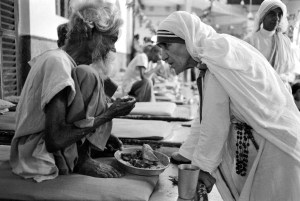
INDIA - OCTOBER 01:  Mother Teresa and the poor in Calcutta, India in October, 1979.  (Photo by Jean-Claude FRANCOLON/Gamma-Rapho via Getty Images)

INDIA – OCTOBER 01: Mother Teresa and the poor in Calcutta, India in October, 1979. (Photo by Jean-Claude FRANCOLON/Gamma-Rapho via Getty Images)

September 4th, 2016; 23rd Sunday in Ordinary Time

Gospel Luke 14:25-33 NAB

Great crowds were traveling with Jesus, and he turned and addressed them, “If anyone comes to me without hating his father and mother, wife and children, brothers and sisters, and even his own life, he cannot be my disciple. Whoever does not carry his own cross and come after me cannot be my disciple. Which of you wishing to construct a tower does not first sit down and calculate the cost to see if there is enough for its completion? Otherwise, after laying the foundation and finding himself unable to finish the work the onlookers should laugh at him and say, ‘This one began to build but did not have the resources to finish.’ Or what king marching into battle would not first sit down and decide whether with ten thousand troops he can successfully oppose another king advancing upon him with twenty thousand troops? But if not, while he is still far away, he will send a delegation to ask for peace terms. In the same way, anyone of you who does not renounce all his possessions cannot be my disciple.”

 Meditation Reflection:

How can Christ, whose new commandment to us was to “love one another as I have loved you” simultaneously ask that we hate our family members?  As we celebrate the canonization of Mother Teresa, we can look to her example to illuminate this paradox. Jesus’ challenge that “whoever does not carry his own cross and come after Me cannot be my disciple” proved a difficult task and one that required great love, detachment, and grace for Mother Teresa who left her home, her family, and even her beloved convent to serve the poorest of the poor on the streets in India.  Jesus rightly warns to count the cost before we set out on a project lest we find ourselves giving up midway.  Discipleship calls for a total gift of self, in response to the Lord who made the ultimate gift of self for us through His Incarnation, Death, and Resurrection.

In a perfect world, or at least in heaven, loves do not compete with one another and we aren’t painfully pulled in opposing directions.  In our current fallen state however, we come to crossroads where we must choose between two loves.  It’s one thing to forsake the love of a material good or a sinful habit, but the hardest love to forsake is that of someone with whom we have an intimate relationship who refuses to share us with Christ and gives us an ultimatum.

This ultimatum may not sound as direct as “it’s me or Christ!” but it will likely pit some aspect of following Christ against something the person wants of you.  Following Christ results in a life of sacrifice that’s counter-cultural.  Authentic Christians don’t blend in and that bothers people who don’t want to stir the waters. Living your faith, even quietly, can prick the conscience of another and result in lashing out to ease his or her own angst.  Similar to Jesus, Christians offer love unconditionally to others.  Unfortunately, the same is not always true on the other end and the painful choice between following Christ or making the person you care about happy must be made.

This choice takes as many forms as there are relationships.  For a teen it can be a couple breaking up because one chooses purity over promiscuity or being left out of social gatherings because of a refusal to drink.  For a young adult it can be a person choosing the religious life despite the discouragement of parents, or moving away from family and friends for a service they are called to by Christ. For parents it can mean getting the silent treatment from a child because you refuse to condone their wrong behavior.  For a spouse it can mean suffering the anger of the other sometimes even divorce because one refuses to compromise living out his or her faith to appease the other’s sin.  No one wants a rift in their family- whether between parents, children, or spouses.  At the same time not everything is in our control except our own decision to follow the Lord.   Navigating these situations can be confusing and spiritual direction should be sought to sort out how to authentically love in particular situations.

Mother Teresa desired to follow Christ and to give her whole life in love to Him.  First it meant leaving her family to join the Sisters of Loreto as a nun and serve in India as a teacher.  Next, she received her “call within a call” to go out into the streets and serve the poorest of the poor.  She was happy as a nun and asked Jesus if she could just serve Him more devoutly in the way she already was.  Each time however He repeated His request for her to satiate His thirst for souls by ministering to the poor and destitute.  He would ask her each time, “Wouldst thou refuse Me?”

Mother Teresa felt torn between two loves.  Her love for the other sisters, her students, and her life in the convent was certainly a noble love, but discipleship called her to follow Christ to a place that meant she would have to choose between the two.  Ultimately, Mother Teresa could not surrender her love for Jesus to anything else and so she gave up and gave in to the Lord.  As she followed Christ, Mother Teresa surrendered everything to Him – material goods, physical comforts, family, and even the convent.  She went into the most destitute streets with nothing but a sari and a passion for Jesus.

Mother Teresa did not want to have come so far only to turn back.  She had made a choice for Christ, to be a disciple, whatever may be.  Hopefully our discipleship will bring greater peace to our families and relationships and maybe our sacrifices will not be as large as Mother Teresa’s.  Only Christ knows the crosses we will have to carry but He asks that we be ready to face whatever may come with single minded devotion, lest we come so far only to turn back.

Contrary to cultural demands, Christians cannot compartmentalize their faith.  We are followers of Christ at church, at home, at work, when alone, or when with friends.  We have to be prepared that some people, even some we for whom we care deeply, may not tolerate our discipleship and choose to leave us.  In these instances, we can look to Christ for the grace and grit to carry our cross, a cross which He promises will end in a resurrection.

This Sunday, may we count the cost and, with the grace of Christ, decide to follow Him to the end.  The joy of Mother Teresa, and the light of love and mercy her life became, serves as a witness for us of the glorious destination of discipleship – a project worth completing!

Consider:

  • Are you a disciple of Christ?  If the answer is yes, what moves you to love Him and to follow Him? If the answer is no or not yet, what attracts you about Christ or piques your curiosity?
  • In what ways has discipleship caused you to live counter-culturally? Has it strained any of your relationships?
  • How has carrying your cross produced resurrections and blessings in your life? What have been some of the fruits of your discipleship?
  • What cross are you carrying right now? In what way does it resemble Jesus’ cross? How does it bring you closer to Him as you share in His experience?
  • It feels good to accomplish something hard that required grit and perseverance. Consider how it will feel to “finish the race” as St. Paul says, and to have followed Christ (with the help of His grace) to the end.

Make a Resolution (Practical Application):

  • Learn more about Mother Teresa or read a collection of her writings or quotations.
  • If you feel tension between following Christ and appeasing someone you love, seek spiritual direction this week from your priest or a wise and holy person you know. Reach out in person, by phone, or email.
  • Pray an Act Of Consecration to Jesus each day this week.

~ Written by Angela Lambert © 2016

* To receive these weekly posts automatically in your email just click the “follow” tab in the bottom right hand corner and enter your email address.


The View From Mount Humility

by Angela Lambert

20160820_204509111_iOS


August 28th, 2016; 22nd Sunday in Ordinary Time

Gospel of Luke 14:1,7-14  NAB

On a sabbath Jesus went to dine at the home of one of the leading Pharisees, and the people there were observing him carefully. He told a parable to those who had been invited, noticing how they were choosing the places of honor at the table. “When you are invited by someone to a wedding banquet, do not recline at table in the place of honor. A more distinguished guest than you may have been invited by him, and the host who invited both of you may approach you and say, ‘Give your place to this man,’ and then you would proceed with embarrassment to take the lowest place. Rather, when you are invited, go and take the lowest place so that when the host comes to you he may say, ‘My friend, move up to a higher position.’ Then you will enjoy the esteem of your companions at the table. For every one who exalts himself will be humbled, but the one who humbles himself will be exalted.” Then he said to the host who invited him, “When you hold a lunch or a dinner, do not invite your friends or your brothers or your relatives or your wealthy neighbors, in case they may invite you back and you have repayment. Rather, when you hold a banquet, invite the poor, the crippled, the lame, the blind; blessed indeed will you be because of their inability to repay you. For you will be repaid at the resurrection of the righteous.”

Meditation Reflection:

If pride comes before the fall, once could say humility comes before the ascent.  Our selfie-culture promotes self-assertion and our own honor and fame, bolstering pride and feeding competitiveness.  Yet, studies have shown that the social media craze can make persons feel depressed as they strive to compete with the seemingly perfect and glamorous lives of their friends based on the pictures they post.

I can certainly relate.  It seems like the night I order pizza for the kids someone posts a colorful, healthy, made-from-scratch dinner their family is enjoying.  As I take a mental break from the tedium of work, I see a post of someone’s adventurous travels.  When I take a moment to relax after having a difficult parenting day, I see a pictures of friends with their smiling kids, dressed in clean matching clothes, doing a fun family activity.  The temptation can be to respond by working on one’s own image and creating the appearance of similar importance and prestige (the definition of which varies based on what’s important to you).  In Jesus’ time, one’s image and importance could be seen by where one sat at the table. It’s not much different however than seeking social recognition online, at work, or amongst one’s peers based on achievements, physical appearance, or possessions.

For every vice with which one struggles, St. Francis de Sales advises conquering it by aiming for the opposite virtue.  To combat pride therefore, one must cultivate humility.

Humility does NOT mean self-hate or false modesty.  Rather, it refers to an authentic and accurate view of one’s worth as well as the worth of others.  Pride takes many forms as we vie with one another for our place – some obvious and others subtle.

Merriam-Webster defines humility as “not thinking of yourself as better than other people.” God revealed the inherent dignity of every human person by creating each one in His image and likeness (independent of differences in appearance or abilities) and by Christ dying on the cross to save each and every one of us.  If God would become man, to suffer and die for someone, how can I not value them as anything less than priceless?  It doesn’t make me any less, but it also means I’m not anything more.     C.S. Lewis captured this mystery well in his essay, “The Weight of Glory”.  In it, he reflects on the grandeur of the human person, whose immortal nature will share in the either the horror of hell or the magnificent glory of God in Heaven.  He writes:

There are no ordinary people. You have never talked to a mere mortal. Nations, cultures, arts, civilization—these are mortal, and their life is to ours as the life of a gnat. But it is immortals whom we joke with, work with, marry, snub, and exploit—immortal horrors or everlasting splendours. This does not mean that we are to be perpetually solemn. We must play. But our merriment must be of that kind (and it is, in fact, the merriest kind) which exists between people who have, from the outset, taken each other seriously—no flippancy, no superiority, no presumption. And our charity must be a real and costly love, with deep feeling for the sins in spite of which we love the sinner—no mere tolerance or indulgence which parodies love as flippancy parodies merriment. Next to the Blessed Sacrament itself, your neighbour is the holiest object presented to your senses. If he is your Christian neighbour he is holy in almost the same way, for in him also Christ vere latitat—the glorifier and the glorified, Glory Himself, is truly hidden.”

In consequence, we need not honor others because we think so little of ourselves, but rather because we rejoice in our shared glory as sons and daughters of God.

A second reflection on humility relates to a definition which can be found in the Catholic Encyclopedia, which defines it further in this way:

“Humility in a higher and ethical sense is that by which a man has a modest estimate of his own worth, and submits himself to others. According to this meaning no man can humiliate another, but only himself, and this he can do properly only when aided by Divine grace.”

“Submitting oneself to others” is verbiage that sounds as archaic as the Latin in which it was originally written.  In our anti-authroity, “look out for #1” society this just seems antiquated.  I have been blessed however to experience the receiving end of this idea and I will admit that it creates a loving, peaceful community.  Just the other day, I walked in late to a meeting at work and a co-worker saw my need as I scanned the full room futily for an open seat.  He waved me over,  reached for a folding chair next to the wall, then opened it for me in an open spot he had found.  It made me feel cared for and respected.  Similarly, I am blessed to work at a place where colleagues regularly open the door for one another, ask genuinely how one is doing, and offer help whenever they see a need. This practice of showing deference toward others, far from demeaning one, creates esteem.

As a parent however I am finding it ever more difficult to create a sense of deference in my children.  On a recent road trip they argued that I was being a hypocrite because I made them take turns between the bucket seats in our van and the back seat but I always got to sit up front.  “Why do you get to sit up front?” they asked, “and why don’t you have to take a turn being squished in the back bench seat?”  “Because I’m an adult” I replied.  It seemed obvious to me. That thought would never have crossed my mind as a child. I had done my time sitting in the back as a kid.  Yet, it was not so obvious to them.  A similar incident occurred during a trip for my sister’s wedding. My dad had graciously rented a mini-van to help drive us as well as other extended family around.  On one excursion my aunt decided to come along and my kids began to fight over who had to give up a bucket seat for her.  She kindly offered to sit in the far back which, I remarked, was virtuous of her, but denied my kids the opportunity to practice virtue themselves.  Much like Jesus’ parable, her humility resulted in being urged to a place of honor (even if its’ prime seating in a van!), whereas one of my children had to be scolded and moved to the back.

Practicing deference shows love and respect.  It means honoring one another rather than grasping at it for oneself.  This doesn’t mean you will be destined to be a doormat, but as Sirach proclaims in chapter 3:17-18:

“My child, conduct your affairs with humility, and you will be loved more than a giver of gifts. Humble yourself the more, the greater you are, and you will find favor with God.”

Paradoxically, when we celebrate and appreciate others, we ourselves experience celebration and appreciation too.  Moreover, by valuing what truly maters in others, we learn to value ourselves more authentically as well.  It means we feel secure in our worth as sons and daughters of God.  We feel loved for who we are and not just what we can do.  It frees us to be teachable and learn from those who know more or have more experience.  It also frees us to mentor others in love rather than pride who could learn from us.  This builds the kingdom of God and gives us a taste of the wedding feast of heaven, where everyone rejoices in the grace of God and the work He has accomplished in the souls of every person there, including ourselves.

Jesus accepted the invitation to dine at the home of a leading Pharisee.  Humility does not therefore entail avoiding all social opportunities.  Instead, Christ exhorts us to evaluate the reasons for our decisions and to be aware of the snares of subtle pride.  Christ dined with the Pharisee to teach, heal, and save.  Others had come to be taught, healed, and saved.  Still others, Jesus observed, concerned themselves with image, honor, and their place at the prestigious table.  Jesus teaches us to celebrate the honors of others and thereby frees us from the striving and grasping after notoriety.  Instead of de-valuing your own worth, it actually means you feel secure and content with who you are and it frees you from judging yourself in comparison to others.  A good friend of mine once said, “to compare is to despair.”  I have found that to be true.  If however you take joy in other people you will be happy in any circumstance – either celebrating their successes, or being thankful to be in a position to offer help if they are in need.

Consider:

  • In what ways or areas do you sometimes over-estimate yourself? In what ways or areas do you sometimes under-estimate yourself?
  • Consider the deference Christ shows toward you by dying on the Cross for you, inviting you into relationship with Him, and transforming your life with his grace.
  • How might you show greater deference and humility toward others?
    • In your home and family.
    • Toward your peers and colleagues.
  • Reflect on the relationship between being humble and being teachable.
  • Consider the relationship between humility and service.
  • Consider the relationship between being humble and accepting the responsibility of leadership.
  • How does Christ model true humility in each of these ways?
    • Think of His obedience to Mary and Joseph.
    • Consider His relationships with His family, friends, and disciples.
    • Reflect on His humiliation on the Cross to elevate us.
  • With whom, or in what situations, do you struggle with pride, over-competitiveness, or excessive focus on your image the most? Invite Christ to help you with His grace to acquire peace and humility in that.

Make a Resolution (Practical Application):

  • Pray the Litany of Humility each day this week.
  • Choose one person or area of your life in which you struggle with pride, over-competitiveness, or excessive focus on your image. Each morning this week, decide on one way in which you can practice humility in relation to that person or situation.
    • Examples: Towards Persons – ask him/her for help when needed, offer assistance, encouragement, or praise. Toward situations – Let others speak first at meetings, choose a simpler hair style or clothing for the day, invite a visitor in even if the house is a mess.
  • ~ Written by Angela Lambert © 2016
* To receive these weekly posts automatically in your email just click the “follow” tab in the bottom right hand corner and enter your email address.


The Fork In The Road For Every Christian

by Angela Jendro

fork in the road

20th Sunday in Ordinary Time

Gospel Luke 12:49-53 NAB

Jesus said to his disciples: “I have come to set the earth on fire, and how I wish it were already blazing! There is a baptism with which I must be baptized, and how great is my anguish until it is accomplished! Do you think that I have come to establish peace on the earth?  No, I tell you, but rather division. From now on a household of five will be divided, three against two and two against three; a father will be divided against his son and a son against his father, a mother against her daughter and a daughter against her mother, a mother-in-law against her daughter-in-law and a daughter-in-law against her mother-in-law.”

Meditation Reflection:

Imagine someone else saying the same words as Jesus did.  You might accuse them of not being very Christian.  Isn’t Jesus the Prince of Peace?  Isn’t He the nicest guy there ever was?  Aren’t Christians supposed to be nice people? Yet, Jesus exclaimed with great passion His eagerness to set the world ablaze.  This doesn’t seem to fit the sandal-wearing, nice, historical moral teacher image our culture likes to portray Jesus as.

fire pic

Jesus does bring peace, but not a superficial conciliation. He came to defeat sin and redeem mankind, accomplished through His own baptism of the Cross, one that caused Him great “anguish until it is accomplished.Fire purifies and destroys.  Christ came to set fire to sin, to destroy its corrupting influence in our lives, and to make room for life in God.  That battle begins within ourselves and extends to sin outside ourselves.  Purification can burn, but at the end of the process one feels liberated and empowered. To ignite this fire and make our purification possible, Christ knew He had to suffer and die first – something that caused Him distress as He waited in anticipation.

As disciples of Christ, we share in both His rewards and His suffering.  Christ’s words about causing division seem shocking.  Isn’t He supposed to bring unity and harmony? Jesus offers unity, but not everyone accepts it.  Note that although Jesus often ate with sinners, not every sinner chose to eat with Him and several found His witness challenging enough that they tried to silence Him altogether by crucifying Him.

I often quote G.K. Chesterton who said, “The Christian ideal has not been tried and found wanting. It’s been found difficult; and left untried.”  At the fork in the road therefore, where one mfork in the road 2ust choose the path of discipleship or the path of least resistance, Christians must resolve and accept that as they walk to the left after Christ, some of their closest companions may walk to the right instead and their paths will separate.  Although Christians, like Christ, ought to keep the door open to those friendships, oftentimes living our faith can mean losing some relationships.  Jesus is Goodness, Truth, and Love.  Yet, He was rejected by many.  As we strive to be more Christ-like, we have to prepare ourselves for the same experience.


Even in the Old Testament, authentic prophets consistently experienced rejection and suffering.  The community they came to help change would pressure them to conform instead.  When God’s prophets refused, they found themselves exiled or running from death threats.  The first reading for this Sunday’s liturgy provides an evocative image of this from the life of Jeremiah:

“And so they took Jeremiah and threw him into the cistern of Prince Malchiah…There was no water in the cistern, only mud, and Jeremiah sank into the mud.” Jeremiah 38:6

stuck in the mud

This image strikes me because of the several analogous experiences I can think of in my own life.  Jeremiah acts in truth and love only to be thrown into a pit.  The mud makes the image even better as a symbol of the depressive reality of ones you love rejecting Christ (and you) in favor of persisting in their sins.  When Jeremiah “sank into the mud,” I am reminded of the feeling of helplessness and despair that can discourage me in these moments. Thankfully, Jeremiah did not remain in the mud forever, Jesus’ death was followed by His resurrection, and God will lift us up too.  David expresses this in Psalm 40:2

“The LORD heard my cry. He drew me out of the pit of destruction, out of the mud of the swamp; he set my feet upon a crag; he made firm my steps.”

Walking the path of discipleship may take you down a different road than some of the persons you love.  You might experience the pain of division and loss, not because you didn’t invite them along but because they refuse to come with you.  This fork in the road can come in many different forms at different times in our lives.  Choosing between following Christ and following someone we love is as painful as fire.

Our contemporary culture adds even more pressure.  It seems more rare these days to find people who can be friends even though they have different views and beliefs. Instead, the attitude appears to be that one must condone the decisions of another or they can’t be friends.

Discipleship may be difficult but in the end Christ conquers all.  He can provide the guidance to achieve the tricky balance of loving others without condoning sin, as well as the humility to be receptive to the hard truth about our own sins a Christian friend might challenge.  Every person must make a choice and, praise be to Christ, He provides us with the grace and the guts we will need to follow Him no matter the cost.

Have you had a similar experience?  If you’d be willing to share, write a short account of your fork in the road in the comment section below!

that you and I may be mutually encouraged by one another’s faith, yours and mine. Romans 1:12

Consider:

  •  How has Christ set your heart on fire?
    • How has He purified it?
    • How has that purification made you more zealous and joyful?
  • Has living out your Christian faith ever caused you to experience persecution from persons you care about?
    • In what ways did it feel like you were sinking into a pit of mud?
    • In what ways did God lift you up from the pit and set you on rock?
  • Who are your true friends who accept you as you are, complete with respect for your beliefs?
  • Have you ever been the one doing the persecuting or rejecting? Consider why we find it difficult to be around people who challenge us to be better simply by the way they are living their own lives.
  • Are there persons with whom you struggle to be an authentic Christian around? Do you live your faith at work or out with friends, or do you hide it so they won’t think differently about you?

Make a Resolution (Practical Application):

  • Pray Psalm 40 each day this week.
  • Resolve to let your faith be seen in some small way, especially in a place where you usually lack the courage. (e.g. wearing a cross necklace, having a small crucifix or rosary on your desk, writing favorite bible verses on notecards and placing them in places you will see – whether in your work space or at home, walking away from conversations that disparage the faith or other persons, etc.)

~ Written by Angela jendro © 2019

Follow bar


Eyes Wide Open…Gospel Meditation for Sunday August 7th, 2016

by Angela Lambert


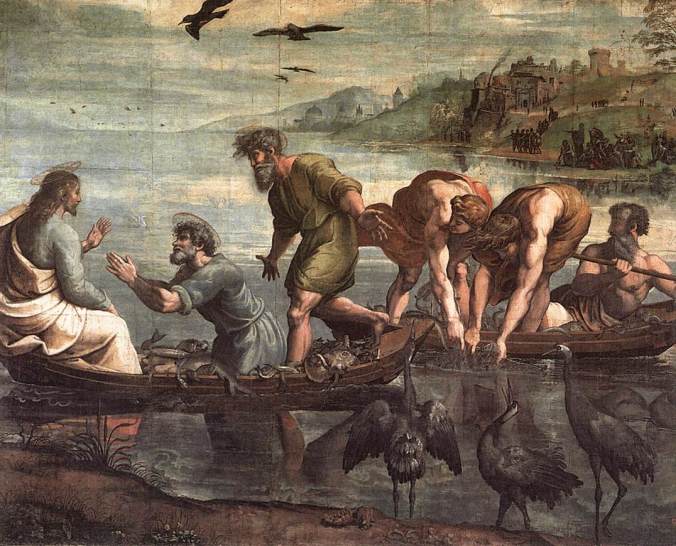
Raphael,_The_Miraculous_Draught_of_Fishes_(1515)

August 7th, 2016; 19th Sunday in Ordinary Time

Gospel of Luke 12:35-40 NAB

 “Jesus said to His disciples: ‘Gird your loins and light your lamps and be like servants who await their master’s return from a wedding, ready to open immediately when he comes and knocks.  Blessed are those servants whom the master finds vigilant on his arrival.  Amen, I say to you, he will gird himself, have them recline at table, and proceed to wait on them.  And should he come in the second or third watch and find them prepared in this way, blessed are those servants. Be sure of this: if the master of the house had known the hour when the thief was coming, he would not have let his house be broken into.  You also must be prepared, for at an hour you do not expect, the Son of Man will come.’”

Meditation Reflection:

Today Jesus emphasizes the need for disciples to be vigilant.  According to Wordbook, vigilant means to be “carefully observant or attentive; on the lookout for possible danger.”  Discipleship can suffer from the same waning of enthusiasm as any of our other noble tasks.  How many New Year’s diets end by February?  How many work-out videos get one viewing before gathering dust?  How many books are left only partially read?  How many friendships or relationships wither from slow neglect?  Jesus exhorts us to head off dangers to our faith by being aware and making efforts to protect ourselves from them.  Discipleship requires the same perseverance, effort, and watchfulness as anything else we hope to accomplish and maintain.

To achieve a goal of getting in shape, having someone to hold you accountable and work out with you will be necessary in order to avoid giving up early or choosing to watch tv instead of going to the gym.  Discipleship requires fellowship as well.  We need faith-filled friends to keep us accountable, inspire us to be better, and keep us in the habit of prayer and worship.  To achieve the goal of developing your mind through reading, you will need to choose a time, place, and frequency or it will never happen.  Forming a book club can also give that added boost of a deadline to motivate you.  Similarly, to grow nearer to Christ you will need to read Scripture regularly.  The same pitfalls apply here so being vigilant about sticking to a routine will be important and joining a bible study could also be motivating.

Wordbook’s synonym for vigilance illuminates the essence of discipleship as well: “open-eyed.” Here however, it’s our eyes of faith that we need to struggle to keep open.  In Hebrews 1:1, St. Paul defines faith as: “the assurance of things hoped for, the conviction of things not seen” (RSV).  He goes on to illustrate this with the example of Abraham who left for a land God promised without any sight of it beforehand – no map, no appraisal or inspection, no google images – only God’s word.  Moreover, after having received a son despite he and Sarah’s old age, Abraham was willing to sacrifice Isaac at God’s command. Imagine the paradox presented to Abraham.  God had promised Abraham many descendants through Isaac, and yet God also asked Abraham to sacrifice Isaac.  How could both of these things be true at the same time?  Abraham could find no assurance in natural reason or human experience and power.  Abraham merited the title Father of Faith by his response.  St. Paul relates, “[Abraham] considered that God was able to raise men even from the dead; hence, figuratively speaking, he did receive him back” (Hebrews 11:19 RSV).  Abraham had confidence that God is all-powerful and that God keeps His promises.  He didn’t limit God to our human experience.  He trusted God and proved his conviction when he risked everything to be obedient to the Lord.

How can we imitate the vigilant, open-eyed faith of Abraham?  Every day we need to open our eyes through prayer.  We need to ask for the gift of faith and trust.  We have to keep sharp through fellowship with faithful Christians and spiritual reading.  We need to deepen our trust through developing our relationship with Christ and receiving His grace in the sacraments.  Finally, many saints and spiritual writers suggest doing an examination of conscience every night.  Look back on the day and evaluate your choices.  When did you show love for God and for others?  What temptations did you overcome?  What inspirations of the Holy Spirit did you follow?  Secondly, where did you lean on your own understanding instead of God’s?  When did you relax into thinking and acting like a child of the world rather than a child of God?  What choices were motivated by a lack of faith, hope, or charity?  Ask God for forgiveness and an increase in grace to do better the next day.

Even if the end of the day doesn’t work for you, try to at least be more introspective throughout the day.  Jesus warned “Be sure of this, if the master of the house had known the hour when the thief was coming, he would not have let his house be broken into.”  Sins can make little strongholds in our soul if we are not vigilant in identifying them and putting them before the Lord for healing.  We never know when we will be attacked by temptation and sometimes it can be very subtle.  By developing a habit of staying alert we will be better able to avoid or overcome them.

Lastly, we never know when Jesus will come.  He too appears at surprising times in surprising ways.  If we live in faith, our hearts will be open to receive the gifts Christ desires to bestow on us.  We may have to take a step that makes no sense from a practical perspective unless God is real, all-powerful, and keeps His promises.  God will provide.  If therefore we seek first His kingdom, we can be assured that everything else will be taken care of (Matthew 6:33), and quite often in ways we could not have foreseen.

We have a tendency today to need to “see it to believe it.”  Although I still have to struggle to patiently trust God, at this point I have seen God act so many times in my life that I can say I believe it because I’ve seen it.  I’ve seen God provide over and over again, always in unexpected ways, and just at the right time.  He has done this at every level – family, relationships, work, finances, and health. Even though it’s easier to trust the wisdom of the world or our own strength which we can see right before us, we ought to vigilantly keep our eyes open to the wisdom and strength of our loving God which is far more reliable. He is coming, and it will be a day of great rejoicing we won’t want to miss!

Consider:

  •  Reflect on what practices have deepened your faith and helped you grow as a disciple of Christ?
  • Consider where you need further growth. Pray about how you could be more vigilant in that area.
  • Meditate on the words Jesus asked St. Faustina to have written below His image: “Jesus I trust in You.”
  • Reflect with gratitude on a time(s) when God came through for you in a surprising or powerful way.
  • Is there a part of your life that needs more trust in Jesus? Pray for an increase in faith and hope.

Make a Resolution (Practical Application):

  • Choose one way to be more vigilant in your faith life. Share your goal with someone who will encourage you and keep you accountable.
  • Pray the short prayer, “Jesus I trust in You” several times each day.
  • Pray Psalm 27 each day this week.


~ Written by Angela Lambert © 2016

* To receive these weekly posts automatically in your email just click the “follow” tab in the bottom right hand corner and enter your email address.


Becoming Rich: Investment Strategies From Christ

by Angela Lambert


July 31st, 2016; 18th Sunday in Ordinary Time

Gospel of Luke 12:13-21 NAB

Someone in the crowd said to Jesus, “Teacher, tell my brother to share the inheritance with me.” He replied to him, “Friend, who appointed me as your judge and arbitrator?” Then he said to the crowd, “Take care to guard against all greed, for though one may be rich, one’s life does not consist of possessions.” Then he told them a parable. “There was a rich man whose land produced a bountiful harvest. He asked himself, ‘What shall I do, for I do not have space to store my harvest?’ And he said, ‘This is what I shall do: I shall tear down my barns and build larger ones. There I shall store all my grain and other goods and I shall say to myself, “Now as for you,
you have so many good things stored up for many years, rest, eat, drink, be merry!”’ But God said to him, ‘You fool, this night your life will be demanded of you; and the things you have prepared, to whom will they belong?’ Thus will it be for all who store up treasure for themselves
but are not rich in what matters to God.”

Meditation Reflection:

Greed comes in many forms and we can be quite talented at excusing it with innumerable rationalizations.  The man in this encounter masked his greed with a case about justice.  We don’t know the circumstances surrounding the inheritance but Jesus, who knows the truth in each of our hearts, shows greater concern from the man’s motive than the actual facts of the case.

Greed has a vicious way of undermining our relationships with God, each other, and even ourselves.  We often operate with the mentality of the farmer in Christ’s parable.  The modern equivalent would go something like this:  Work hard in school and be successful in a bunch of extracurricular activities so you can get into a good college, so you can get a good job, so you can make a lot of money, so you will be secure and happy.  Yet, how many people follow this plan and find themselves at 40 years old burnt out, lonely, empty inside, and suffering from health issues related to the stressful pace they have been keeping for decades.  Ironically, we are both the richest country in the world and the most depressed. We keep a frenzied pace only to find ourselves exasperatedly sighing the same words of Ecclesiastes “For what profit comes to man from all the toil and anxiety of heart with which he has labored under the sun?” (2:22).

What is the point?! We clean the house and it’s messy again in a matter of hours.  We finish a project at work and another lands on our desk the next day.  Our kids finish one sport’s season and another begins.  Days fly off the calendar, then weeks, then years.  Everyone has to find a balance between work and life.  We have to be prudent, work hard, and plan for the future.  The problem is, it’s just sooooo easy to work and plan for more than we really need and miss out on the good stuff right in front of us.  Rather than plopping on the couch and watching a movie with our kids we run another load of laundry or get some work done on the computer.  Instead of going out with colleagues and deepening friendships, we put in a couple extra hours at work to get ahead.

Jesus reminds us to work and plan for our eternal future too.  We are made for meaning, purpose, and love.  Moreover, we are spiritual beings made for eternity with God.  Work labored for greed will produce a temporary reward, but work offered in love and service to God will bring eternal joy.  It will likely bring a deeper earthly joy as well.  Having the respect of others because of your position can feel good but it can also feel empty, not to mention add paranoia that someone will try to take it from you.  Having the respect of others because of your character is priceless and immune from circumstances.

Greed is an inordinate desire for wealth.  Every day we must pray and reflect on what really matters so we invest our time and efforts wisely and in the right order.  Through the grace of Christ, we have the opportunity to escape the crazed rat race and endless running on what feels like a gerbil wheel going in circles.  If we have the courage to surrender greed we can gain immeasurable wealth unaffected by the volatility of the stock market or our boss, and which produces deeper pleasure than money can buy. Working for your kids will mean more than working merely to afford fashionable clothing which will quickly be out of fashion, or a beautiful boat which won’t be as much fun without kids there to enjoy it with you, or the perfect house which will just be outdone by the Jones’ house that will be built next door in a year.  Doing work that improves the lives of others will give you deeper satisfaction than a simple paycheck.  No matter what your profession, how you conduct yourself and to what end is up to you.

As a teacher, I am reminded of this at graduation parties.  Our bonus, though not monetary, comes in the form of seeing kids we helped develop turn into amazing human beings.  It’s the emails from college or stopping by our classrooms to tell us everything they are up to or how something we taught them has stuck with them that is worth more than any zeros on a check. Similarly, I know wealthy individuals who find great joy in putting it at the service of the Lord and seeing the fruits of those spiritual endeavors. God promises in 2 Corinthians 9:6 “Consider this: whoever sows sparingly will also reap sparingly, and whoever sows bountifully will also reap bountifully.”  Be generous with God and labor to sow what matters so you can be “rich in what matters to God.”

Consider:

  • Reflect on what matters most in your life. Consider what gets in the way of those things versus what develops them.
  • Prayerfully consider what is “enough” for you. What would be sufficient and what work is necessary to meet that goal?
  • Ask God to reveal any desires that have become excessive or obsessive. Is there anything you are grasping after or worried about that prevents you from enjoying the gifts God has already given you?
  • What kind of work or charitable contributions brings you a feeling of satisfaction?
    • Do you find meaning in aspects of your job?
    • Do you enjoy providing for your family and seeing them thrive?
    • Do you have charitable projects you care about?
  • Has greed ever undermined your relationship with God? With another person?  With being true to yourself?

Make a Resolution (Practical Application):

  • Evaluate your investments in God, others, and yourself.  Decide on one thing you could do for each category to enrichen that relationship in your life.
  • The opposite virtue of greed is generosity. Do something generous this week.


~ Written by Angela Lambert © 2016

* To receive these weekly posts automatically in your email just click the “follow” tab in the bottom right hand corner and enter your email address.


Loving Confidence in Prayer

by Angela Lambert

Jesus teach prayerjesus-fasting-in-wilderness-desert

July 24th, 2016; 17th Sunday in Ordinary Time

Gospel of Luke 11:1-13 NAB

Jesus was praying in a certain place, and when he had finished, one of his disciples said to him, “Lord, teach us to pray just as John taught his disciples.” He said to them, “When you pray, say: Father, hallowed be your name, your kingdom come. Give us each day our daily bread and forgive us our sins for we ourselves forgive everyone in debt to us, and do not subject us to the final test.” And he said to them, “Suppose one of you has a friend to whom he goes at midnight and says, ‘Friend, lend me three loaves of bread, for a friend of mine has arrived at my house from a journey and I have nothing to offer him,’ and he says in reply from within, ‘Do not bother me; the door has already been locked and my children and I are already in bed. I cannot get up to give you anything.’ I tell you, if he does not get up to give the visitor the loaves because of their friendship, he will get up to give him whatever he needs because of his persistence. “And I tell you, ask and you will receive; seek and you will find; knock and the door will be opened to you. For everyone who asks, receives; and the one who seeks, finds; and to the one who knocks, the door will be opened. What father among you would hand his son a snake when he asks for a fish? Or hand him a scorpion when he asks for an egg? If you then, who are wicked, know how to give good gifts to your children, how much more will the Father in heaven give the Holy Spirit to those who ask him?”

Meditation Reflection:

Jesus Christ is the visible image of the invisible God.  “Whoever has seen Me has seen the Father” (John 14:9), He says. In contrast, pagan gods tended to be images of the visible traits of humankind.  Thus, they tended to mirror fallen man’s tendencies toward power, greed, lust, and narcissism.

This answered man’s nagging questions about the origins of good and evil but it also left him subject to the whims of unpredictable powers.  Be it Greek, Roman, or Babylonian gods, people tried to satiate the needs of their deities to avoid calamities and possibly manipulate them for favors.  This explains, for instance, why the Romans did not care who a person worshiped provided they did their part to appease the Roman gods too and why they blamed Christians for the fall of Rome.

This appeasement of the gods should not be mistaken for relationship.  It would be more apt to describe it as mutual manipulation.   In some places it spiraled into superstition bordering on the obsessive-compulsive.  For instance, some farmers would address one god for the successful tilling of soil, another for the planting of seed, another for the growth of the seed, another for the harvest, and so on.  Even well after the West became Christianized this practice proved difficult to root out since it had become so ingrained in the culture and in fallen man’s temptation to control rather than to trust.  In modern times, we must resist the secular attempt to lump Christianity with all of the other religions into one vague spirituality.  The history of pagan worship differs in an absolute way from Judeo-Christian worship. God has distinguished Himself from every other faith from the moment He revealed Himself to Abraham to the death and Resurrection of His Son and the sending of His Holy Spirit.

This difference is most notable in the way in which Christians pray.  Rather than the “multiplying of words” to appease or manipulate, Christian prayer is grounded in familial relationship.  When Jesus teaches the apostles to pray He shares with them His own prayer.  Through Baptism we become incorporated into the Mystical Body of Christ, receiving adoption and becoming children of God (see John 1:12, Galatians 3:26, Romans 8:15-16).  We cannot make ourselves someone’s child.  The intimacy and privilege of familial relationship comes to us as a gift – either through nature or through the will of the parents by adoption.  God has willfully adopted us and Christ has made that possible through His sacrifice. Thus, He teaches us to address God as Father and enter into a relationship of sonship or daughterhood with the Lord.  Consequently, we should begin prayer by simply meditating on the gift of God’s fatherhood and the reliable, selfless, pure love that it bestows.  Even one moment of contemplation of this sublime gift moves our hearts to praise God and so Jesus instructs our next words to be “hallowed be Your Name.”

In pagan practices, calling on gods by name provided connection and sometimes a power over them. This can be true to some extent even in our human relationships.  On the positive side, by knowing someone’s name a person can network, get in contact with him or her, or continue the relationship.  On the negative side, it can also mean identity theft, access to personal information for the purpose of fraud, etc.  Christ instructs His disciples to avoid these tendencies with God’s name.  God desires authentic relationship.  He knows every person’s hearts and He cannot be manipulated.  Thus, Jesus warns, “Not everyone who says to me, ‘Lord, Lord,’ will enter the kingdom of heaven, but only the one who does the will of my Father in heaven (MT 7:21)

As a result, authentic relationship with God recognizes Him as the true Good and petitions: “Your kingdom come.”  God ought to rule our lives, not the other way around.  How does God do this?  How does His kingdom of love, joy, and peace come to reign in our hearts?  Through the gift of the Holy Spirit.  Consequently, Jesus teaches us to ask God for our daily bread and explains directly after that God will always increase the Holy Spirit if we ask: “If you then, who are wicked, know how to give good gifts to your children, how much more will the Father in heaven give the Holy Spirit to those who ask him?”

Lastly, since sin and hatred are incompatible with God, Jesus tells us to give forgiveness and ask for forgiveness that we may be reconciled with God and one another.  Moreover, He encourages us to ask in advance for God to spare us from temptations which would be too much for us and lead to abandoning Him.

Should you be afraid of God’s response (or lack thereof) if you pray, Jesus reveals to us how God views our prayers so that we may be confident when we approach Him.  God is not an image of us, we are an image of Him.  Even though we may be lazy or slow to help others, God is not.  As a teenager I noticed the difference between my response to my parents requests and their response to mine.  If asked to run to the store or help with a chore, I might drag my feet, feel too tired, grumble, or say no.  If I needed something however, they always responded promptly and reliably.  When I became a mother I finally understood this phenomenon. (Even while writing this I have been interrupted with requests from my kids a dozen times!)  The difference was mature love.  The love of good parents is an image of the love of God – self-less, prompt, generous, and happy to help.  Hopefully as children of God, we can mature in our prayer so that our petitions move from the emotional demands of a toddler or elementary school child, to the respectful, humble, and grateful petition of an adult child confident in the relationship with his or her parents.

Consider:

  • Have you ever helped someone even when it was inconvenient and would rather have avoided it?  Have you done things for your kids you never would have imagined doing before you had them?
  • Consider the difference between asking your mom or dad for help as opposed to a friend or neighbor. What things might you ask of them that you wouldn’t from the others?
  • Reflect on God’s love as that of a perfect Father. Reflect on the loving gratitude that should emanate from this relationship.
  • Where do you need God’s kingdom to come more in your life? Where do you need His peace, joy, justice, love…?
  • Do you forgive others as you would have God forgive you? Are there any grudges you need to let go?  Are you quick to reconcile when someone apologizes?
  • Imagine how Christ must have looked while praying alone. Imagine you are one of the apostles, witnessing Him regularly taking time in solitude with the Lord.  What do you think moved them so much that they asked Him to teach them to pray in the same way?  Ask Christ to teach you to pray as He did too.
  • Pray for an increase in trust and a purified sight of God.

Make a Resolution (Practical Application):

  • Pray the Our Father slowly and meditatively each day this week.
  • Pray each day for an increase in trust.
    • Maybe repeat the words given to St. Faustina by Christ to have written under His image: “Jesus I Trust in You.”
    • Or pray the words of the father who brought his son possessed by a mute spirit to Christ (MT 9:22-24) “But if you can do anything, have compassion on us and help us.” Jesus said to him, “‘If you can!’ Everything is possible to one who has faith.” Then the boy’s father cried out, “I do believe, help my unbelief!”
  • Each day be forgiving toward someone in the same way you would like God to be patient and forgiving toward you.
    • Ideas: The person who cuts you off in traffic, the colleague who annoyingly one-ups you, the child who throws a tantrum or acts ungratefully, the spouse who forgets something or acts irritably, the fast food employee who messes up your order…

~ Written by Angela Lambert © 2016

* To receive these weekly posts automatically in your email just click the “follow” tab in the bottom right hand corner and enter your email address.


The Priority of Being Present

by Angela Lambert

July 17th, 2016; 16th Sunday in Ordinary Time

20150814_015150000_iOS

Gospel of Luke 10:38-42 NAB

Jesus entered a village where a woman whose name was Martha welcomed him. She had a sister named Mary who sat beside the Lord at his feet listening to him speak. Martha, burdened with much serving, came to him and said, “Lord, do you not care that my sister has left me by myself to do the serving? Tell her to help me.” The Lord said to her in reply, “Martha, Martha, you are anxious and worried about many things. There is need of only one thing. Mary has chosen the better part and it will not be taken from her.”

Meditation Reflection:

Theologians and spiritual writers often reflect on this passage as a teaching on the active life of service and the contemplative life of prayer.  I find it also provides rich insights into the life of family. Martha’s home – her welcoming love and hospitality – together with the company of her sister Mary and brother Lazarus, became a place of respite and comfort for Christ.

His relationship with their family began with Martha’s initiative as He entered their village.  Just prior to this passage, Luke recounted the many places and people that either failed to receive Jesus or rejected him outright.  Martha however invited Him into her home and served Him with gracious hospitality.

In family life, welcoming children begins with a similar openness toward receiving others whenever they arrive and a readiness to serve.  In fact, in Luke 9:48, Jesus confirms this connection when He teaches: “Whoever receives this child in my name receives me, and whoever receives me receives the one who sent me.” Oftentimes however, parents become “burdened with much serving” like Martha.  Babies require constant care day and night, young children need continual help, and pre-teens need a frenetic amount of chauffeuring.

The Lord appreciates every sacrifice we make.  Things get out of balance however when we allow our work to become a source of anxiety and worry.   Jesus did not scold Martha for working too hard, He voiced His concern for her anxiousness.  Her worry had begun to undermine her ability to be present in the moment and began to skew her perspective.  When she tried to drag Mary into her frenzy Jesus prevented her and gently helped Martha see where she had crossed the line.

Pope Francis also noted this challenge to modern families in his newest apostolic letter The Joy of Love.  Citing responses he had received from the pre-synodal questionnaire he had sent out, he acknowledges:

Many of the respondents pointed to the problems families face in raising children.  In many cases, parents come home exhausted, now wanting to talk, and many families no longer even share a common meal.  Distractions abound, including an addiction to television…Other responses pointed to the effect of severe stress on families, who often seem more caught up with securing their future than with enjoying the present.  This is a broader cultural problem, aggravated by fears about steady employment, finances, and the future of children.” (Amoris Laetitia, par. 50)


My watershed moment like Martha’s occurred at Christmas time several years ago.  My three kids were young and yet also old enough to have new Christmas traditions of our own and we were going to host Christmas for our extended family. As a result, I had grand plans worked out into an organized to-do list so that we could accomplish everything from home-made frosted sugar cookies the kids and I would make together in Christmas shapes to the FoodNetwork recipes I would make for the family celebration.   That all came to an abrupt and painful halt when I became sick with the flu one week prior to Christmas day.  As the flu persisted and Christmas approached my stress level reached breaking point.  My mom called to say hi but instead had to methodically walk me back from my emotional cliff.  She went through my list with me one task at a time and asked the simple question over and over again: “and what would happen if that didn’t get done? And what if that didn’t get done…”

Although I had loving intentions behind each task, the element of service had been usurped by a ball of worry.  My mom, like Christ, gently gave me perspective.  Consequently, with the help of a great deal of divine grace, I surrendered our newly established Christmas traditions and accepted that we could do them next year.  I scaled back my expectations for hosting, humbly accepted help, and recalled that spending time together was the most important thing not the elaborate meal.    Since then, with the help of prayer and grace, I have worked to keep my life in better balance.

Christian service is not an end in and of itself.  Rather, it’s a loving encounter with another person.  Whether it’s care for kids, elderly parents, a disabled relative, or dedication at one’s job, we all need to make sure we keep the persons we are serving at the center and resist letting the tasks distract us with worry from the people whom we are caring about in the first place.  Jesus loved visiting Mary, Martha, and Lazarus because of the warm hospitality and because of the personal love, faith, and fellowship that they offered.  Despite our technological advances, we have become busier as a culture rather than more relaxed.  It requires intentional effort and grace to put people first and to be present in the moment.  It’s no small task to order our lives in such a way that we can work hard and have time to stop and listen to those we love.  When we become untethered by our to-do list, Mary appears to just be sitting around doing nothing.  Jesus reminds us that personal attention is just as important a “task” as the others, if not more important.

Mary chose the better part.  We too must pray for the grace to choose to spend time doing what feels like nothing with our kids, parents, and family; to just enjoy being with one another.  Similarly, we must choose to make time to just be with Christ so that our work remains in service to Him imbued with His love.  No one claims they treat their family and friends the best when they are stressed out and anxious.   By “practicing the presence of God”, as Brother Lawrence’s spiritual classic teaches, God will provide the peace we need to practice the presence of others as well.  It will be counter-cultural, and you will have to let go of competing with the super-moms and the super-colleagues, but Jesus assures us that choosing to be present to the people we care about over a frenzied attitude over work that needs to be done is the better part and we shouldn’t let anything take it from us.

Consider:

  •  Prayerfully consider how present you are to Christ.
    • Do you make time to sit with Him and listen?
    • Do you think of Him during the day or while at work?
    • Do you enjoy silent prayer or struggle with the feeling that you are “doing nothing”?
  • Prayerfully consider how present you are to your family.
    • When are your favorite times to connect?
    • What special moments do you recall with your parents or kids where you felt loved and listened to?
    • What things undermine your peace and your ability to focus on those around you?
    • What causes you to become stressed and distracted?
    • How could you re-order your life or adjust your expectations so you can resist unnecessary anxiety and give your loved ones the best version of yourself?
    • What do you need to take care of yourself so you can be a peaceful, present person?
      • How much sleep do you need? Be honest!
      • How and when do you relax?
      • What are your quirks or limitations it would help to acknowledge? (For example – running late makes you stressed so make an effort to arrive 5 minutes early or you need a bite to eat every couple of hours so make time for good food, etc.)
    • Pray for an increase in the virtue of Hope. Consider how worry can be combated by trust in Jesus. Jesus says, “Seek first the kingdom of God, and all these things will be added” (Matthew 6:33).  Pray for the grace to prioritize your life according to God’s will, then allow Him to make sure everything else gets worked out.
    • Reflect on the reality of our limitations: limitations of time in a day, energy, the need for rest and food, etc. It takes humility to live within our limitations but being more realistic about what we expect from ourselves and others as well as what we say yes or no to can greatly reduce unnecessary stress.

Make a Resolution (Practical Application):

  • Read “The Practice of the Presence of God” by Brother Lawrence (it’s a small, thin book but sticks with you)
  • Make a list of priorities. Then make a list of your schedule and activities.  Prayerfully evaluate if they align and make adjustments. Schedule in time for God, time to take care of yourself, and time for serving your family and at work.
  • Each day choose one person to whom you will be present and attentive. If possible decide who, when, and how. (It can be as simple as asking someone at work about their day at lunch or visiting with your kids at the dinner table.)


~ Written by Angela Lambert © 2016

* To receive these weekly posts automatically in your email just click the “follow” tab in the bottom right hand corner and enter your email address.


Compassion in Suprising Circumstances…Gospel Meditation for July 10th, 2016

20160308_173953000_iOS

by Angela Lambert

July 10th, 2016; 15th Sunday in Ordinary Time

Gospel of Luke 10:25-37 NAB

There was a scholar of the law who stood up to test him and said, “Teacher, what must I do to inherit eternal life?” Jesus said to him, “What is written in the law? How do you read it?” He said in reply, “You shall love the Lord, your God, with all your heart, with all your being, with all your strength, and with all your mind, and your neighbor as yourself.” He replied to him, “You have answered correctly; do this and you will live.” But because he wished to justify himself, he said to Jesus, “And who is my neighbor?” Jesus replied, “A man fell victim to robbers
as he went down from Jerusalem to Jericho. They stripped and beat him and went off leaving him half-dead. A priest happened to be going down that road, but when he saw him, he passed by on the opposite side. Likewise a Levite came to the place, and when he saw him, he passed by on the opposite side. But a Samaritan traveler who came upon him was moved with compassion at the sight. He approached the victim, poured oil and wine over his wounds and bandaged them. Then he lifted him up on his own animal, took him to an inn, and cared for him. The next day he took out two silver coins and gave them to the innkeeper with the instruction, ‘Take care of him. If you spend more than what I have given you, I shall repay you on my way back.’ Which of these three, in your opinion, was neighbor to the robbers’ victim?” He answered, “The one who treated him with mercy.” Jesus said to him, “Go and do likewise.”

Meditation Reflection:

G.K. Chesterton once said, “The Catholic faith has not been tried and found wanting, it has been found difficult and left untried.”  Judeo-Christian belief consists not merely in knowing God, but in covenant relationship with Him.  This means we cannot conveniently keep our faith in a box that we take out when we feel like it.  Relationship with God requires active following of His commands – from those given to Moses to those given by Christ.   The famous parable of the Good Samaritan illustrates our common human struggle for consistency between our faith and our practice of it.  It’s one thing to know God’s teachings, it’s another to do it.

As a religion teacher I am humbled by this struggle every day.  I begin each year by clarifying for my students that the Catholic faith I will share with them is true, freeing, and life-giving.  Nevertheless, as their teacher I know the faith well but I, like them, must struggle to practice it each day.  They need to know up front that I am a sinner working with the help of grace to conform my life to Christ’s.  They shouldn’t trust me because I live the faith perfectly but rather because every day I try.  

In Jesus’ parable three challenges to follow Jesus’ command, “Love one another as I have loved you” and the Lord’s command in the Old Testament to “love your neighbor as yourself” are presented – one representing a common failure and two representing Christian response.  The priest and the Levite, both of whom would have known the Law well and considered themselves strict adherents, pass by their fellow Jew in need.  They had what they considered prudential reasons to not stop, but in truth they were rationalizing their desire to look the other way and avoid the bother.  How often do we lack compassion for those nearest to us?  How often do we put off reaching out because we think we have more important or pressing matters?  In her speech as she received the Nobel Peace Prize, Mother Teresa urged  people in the West to show concern for those in their own homes and families.  She cited the plague of depression, loneliness, and deep emptiness experienced by children and the elderly often set aside by the busy lifestyles of adults.  She even noted that in some ways it’s easier to fill the needs of the poor in Calcutta because all they need is a little food or medical care.  In the Western culture, rich with material things, the needs go much deeper and prove more difficult to meet.  Her solution?  Begin with a smile.  This may sound easy but try practicing it, especially when you feel bothered or exasperated by annoying tendencies, mannerisms, habits, etc. of your loved ones.  It’s a shame that we tend to treat those closest to us the worst!  Imagine if we could have greater compassion for our families. If we mastered that, it would enable us to have compassion toward anyone.

The Samaritan, overlooked the animosity between his people and the Jews because he felt “moved with compassion” at the sight of another human person in such horrible pain and humiliation.  The Samaritan treated the man as person with personal care.   He did not shrink back from the blood but provided medical care himself.  For reasons not provided in the parable, he had to leave the man the next day but even still the Samaritan provided for the wounded man from his own wallet and risked even more money to see that the man was restored to full health.  The Samaritan took no half-measures.  He cared for the man, provided for him, then returned to see that the man was well again.  It can be uncomfortable and difficult to concern ourselves with the problems of persons with whom we are unfamiliar.  It’s easier to pass them over or look the other way and we can find plenty of reasons to rationalize that it’s not our problem.  Yet, to love as Christ loved, we must in fact seek out those in need, attend to them even at personal cost, and allow grace to soften our hearts so we may be moved with compassion.

Finally, the innkeeper had to make a decision as well.  Imagine his surprise when he opens the door to a prospective guest only to find a foreigner carrying a beaten, half-dead man. In addition to admitting two less than ideal guests, he is asked to care for the wounded man and, if need be, provide for any expenses required for his recovery, relying only on the promise of the Samaritan to return with payment. We too encounter analogous situations in numerous ways.  Unexpected guests in need of our love appear in family life, at work, or literally at our door.  It may be a child you hadn’t “planned”, a relative in need, a friend of your child or spouse, a struggling co-worker, or a client.

Discipleship means opening our eyes to the needs around us, allowing our hearts to be moved with compassion, and to share in the sorrow of someone we’d rather pass by.  It could be a friend who needs to talk despite your busy schedule, a child needing comfort in the middle of the night when you would rather sleep, a testy teen who needs patience and firm but loving rules, an awkward colleague whose lonely and has difficulty making friends, or encouraging a family member when tempted to criticize them.

Jesus said, “Amen, I say to you, whatever you did for one of these least brothers of mine, you did for me’” (Matthew 25:40).  These words motivated Mother Teresa every day and made possible the extraordinary love she showed to those that society found most repulsive. May we follow her example and also heed the exhortation from the first reading for today from Deuteronomy, especially in this special Year of Mercy:

For this command that I enjoin on you today is not too mysterious and remote for you. It is not up in the sky, that you should say, ‘Who will go up in the sky to get it for us and tell us of it, that we may carry it out?’ Nor is it across the sea, that you should say, ‘Who will cross the sea to get it for us and tell us of it, that we may carry it out?’ No, it is something very near to you, already in your mouths and in your hearts; you have only to carry it out.

 Consider:

  •  Who do you find difficult to love?  What behaviors particularly annoy you or what tasks of love do you avoid?
    • In your family: (ideas: sleepless infants, whining kids, testing teens, moody or preoccupied spouse, a manipulative relative, elderly parent or grandparent who is lonely or in need of care, a competitive sibling…)
    • In your work: (lonely co-worker, new person in need of extra help getting acclimated, competitive co-worker, difficult boss, insensitive cubicle-mate, overwhelmed colleague…)
    • In your home-life: (a friend in need after a surgery, a new baby, or a loss; a neighbor kid who seems left alone too much or neglected, a single-mom whose driveway needs plowed or a word of encouragement, a young family in need of a free babysitter so the couple can have some time together, a new neighbor in need of help getting to know everyone…)
  • Do you nurture compassion and understanding for those suffering in other countries? Do you make an effort to understand some of the complexities of their struggles and their personal challenges?
  • Have you ever been the recipient of someone’s compassionate mercy in a time of need?
  • What teachings do you find difficult to practice?

Make a Resolution (Practical Application):

  • Consider an aspect of discipleship in which you need to grow.  Decide how to practice it concretely each day this week.  (Think of who needs you, what he or she needs from you, and how you will meet that need.  For example exercising more patience toward someone by smiling at them intentionally each day and doing one thing that would be of help for them.)
  • Pray each day for compassion and a softened heart.
  • Read Mother Teresa’s speech from when she received the Nobel Peace Prize. http://www.nobelprize.org/nobel_prizes/peace/laureates/1979/teresa-lecture.html
  • Learn about the struggles of someone in foreign country.


~ Written by Angela Lambert © 2016

* To receive these weekly posts automatically in your email just click the “follow” tab in the bottom right hand corner and enter your email address.