Pushing the Limits

by Angela (Lambert) Jendro


March 25th, 2018 Palm Sunday

Gospel of Mark 14-15 NAB

The Passover and the Feast of Unleavened Bread were to take place in two days’ time. So the chief priests and the scribes were seeking a way to arrest him by treachery and put him to death. They said, “Not during the festival, for fear that there may be a riot among the people.”

When he was in Bethany reclining at table in the house of Simon the leper, a woman came with an alabaster jar of perfumed oil, costly genuine spikenard. She broke the alabaster jar and poured it on his head. There were some who were indignant. “Why has there been this waste of perfumed oil? It could have been sold for more than three hundred days’ wages and the money given to the poor.” They were infuriated with her. Jesus said, “Let her alone. Why do you make trouble for her? She has done a good thing for me. The poor you will always have with you, and whenever you wish you can do good to them, but you will not always have me. She has done what she could. She has anticipated anointing my body for burial. Amen, I say to you, wherever the gospel is proclaimed to the whole world, what she has done will be told in memory of her.”
Then Judas Iscariot, one of the Twelve, went off to the chief priests to hand him over to them.
When they heard him they were pleased and promised to pay him money. Then he looked for an opportunity to hand him over.

On the first day of the Feast of Unleavened Bread, when they sacrificed the Passover lamb, his disciples said to him, “Where do you want us to go and prepare for you to eat the Passover?” He sent two of his disciples and said to them, “Go into the city and a man will meet you, carrying a jar of water. Follow him. Wherever he enters, say to the master of the house, ‘The Teacher says, “Where is my guest room where I may eat the Passover with my disciples?”‘ Then he will show you a large upper room furnished and ready. Make the preparations for us there.” The disciples then went off, entered the city, and found it just as he had told them; and they prepared the Passover.

When it was evening, he came with the Twelve. And as they reclined at table and were eating, Jesus said, “Amen, I say to you, one of you will betray me, one who is eating with me.” They began to be distressed and to say to him, one by one, “Surely it is not I?” He said to them, “One of the Twelve, the one who dips with me into the dish. For the Son of Man indeed goes, as it is written of him, but woe to that man by whom the Son of Man is betrayed. It would be better for that man if he had never been born.”  While they were eating, he took bread, said the blessing, broke it, and gave it to them, and said, “Take it; this is my body.” Then he took a cup, gave thanks, and gave it to them, and they all drank from it. He said to them, “This is my blood of the covenant, which will be shed for many. Amen, I say to you, I shall not drink again the fruit of the vine until the day when I drink it new in the kingdom of God.”

Then, after singing a hymn, they went out to the Mount of Olives. Then Jesus said to them, “All of you will have your faith shaken, for it is written: I will strike the shepherd, and the sheep will be dispersed. But after I have been raised up, I shall go before you to Galilee.” Peter said to him,
“Even though all should have their faith shaken, mine will not be.” Then Jesus said to him, “Amen, I say to you, this very night before the cock crows twice you will deny me three times.”
But he vehemently replied, “Even though I should have to die with you, I will not deny you.” And they all spoke similarly. Then they came to a place named Gethsemane, and he said to his disciples, “Sit here while I pray.” He took with him Peter, James, and John, and began to be troubled and distressed. Then he said to them, “My soul is sorrowful even to death. Remain here and keep watch.” He advanced a little and fell to the ground and prayed that if it were possible the hour might pass by him; he said, “Abba, Father, all things are possible to you. Take this cup away from me, but not what I will but what you will.” When he returned he found them asleep.
He said to Peter, “Simon, are you asleep? Could you not keep watch for one hour? Watch and pray that you may not undergo the test. The spirit is willing but the flesh is weak.” Withdrawing again, he prayed, saying the same thing. Then he returned once more and found them asleep, for they could not keep their eyes open and did not know what to answer him. He returned a third time and said to them, “Are you still sleeping and taking your rest? It is enough. The hour has come. Behold, the Son of Man is to be handed over to sinners. Get up, let us go. See, my betrayer is at hand.”

Then, while he was still speaking, Judas, one of the Twelve, arrived, accompanied by a crowd with swords and clubs who had come from the chief priests, the scribes, and the elders. His betrayer had arranged a signal with them, saying, “The man I shall kiss is the one; arrest him and lead him away securely.” He came and immediately went over to him and said, “Rabbi.” And he kissed him. At this they laid hands on him and arrested him. One of the bystanders drew his sword, struck the high priest’s servant, and cut off his ear. Jesus said to them in reply, “Have you come out as against a robber, with swords and clubs, to seize me? Day after day I was with you teaching in the temple area, yet you did not arrest me; but that the Scriptures may be fulfilled.” And they all left him and fled. Now a young man followed him wearing nothing but a linen cloth about his body. They seized him, but he left the cloth behind and ran off naked.

They led Jesus away to the high priest, and all the chief priests and the elders and the scribes came together. Peter followed him at a distance into the high priest’s courtyard and was seated with the guards, warming himself at the fire. The chief priests and the entire Sanhedrin kept trying to obtain testimony against Jesus in order to put him to death, but they found none. Many gave false witness against him, but their testimony did not agree. Some took the stand and testified falsely against him, alleging, “We heard him say, ‘I will destroy this temple made with hands and within three days I will build another not made with hands.'”  Even so their testimony did not agree. The high priest rose before the assembly and questioned Jesus, saying, “Have you no answer? What are these men testifying against you?” But he was silent and answered nothing. Again the high priest asked him and said to him, “Are you the Christ, the son of the Blessed One?” Then Jesus answered, “I am; and ‘you will see the Son of Man seated at the right hand of the Power and coming with the clouds of heaven.'” At that the high priest tore his garments and said, “What further need have we of witnesses? You have heard the blasphemy. What do you think?” They all condemned him as deserving to die. Some began to spit on him.
They blindfolded him and struck him and said to him, “Prophesy!” And the guards greeted him with blows.

While Peter was below in the courtyard, one of the high priest’s maids came along. Seeing Peter warming himself, she looked intently at him and said, “You too were with the Nazarene, Jesus.”
But he denied it saying, “I neither know nor understand what you are talking about.” So he went out into the outer court. Then the cock crowed. The maid saw him and began again to say to the bystanders, “This man is one of them.” Once again he denied it. A little later the bystanders said to Peter once more, “Surely you are one of them; for you too are a Galilean.” He began to curse and to swear, “I do not know this man about whom you are talking.” And immediately a cock crowed a second time. Then Peter remembered the word that Jesus had said to him, “Before the cock crows twice you will deny me three times.” He broke down and wept.

As soon as morning came, the chief priests with the elders and the scribes, that is, the whole Sanhedrin held a council. They bound Jesus, led him away, and handed him over to Pilate. Pilate questioned him, “Are you the king of the Jews?” He said to him in reply, “You say so.” The chief priests accused him of many things. Again Pilate questioned him, “Have you no answer? See how many things they accuse you of.” Jesus gave him no further answer, so that Pilate was amazed. Now on the occasion of the feast he used to release to them one prisoner whom they requested. A man called Barabbas was then in prison along with the rebels who had committed murder in a rebellion. The crowd came forward and began to ask him to do for them as he was accustomed. Pilate answered, “Do you want me to release to you the king of the Jews?” For he knew that it was out of envy that the chief priests had handed him over. But the chief priests stirred up the crowd to have him release Barabbas for them instead. Pilate again said to them in reply, “Then what do you want me to do with the man you call the king of the Jews?” They shouted again, “Crucify him. “Pilate said to them, “Why? What evil has he done?” They only shouted the louder, “Crucify him.” So Pilate, wishing to satisfy the crowd, released Barabbas to them and, after he had Jesus scourged, handed him over to be crucified.

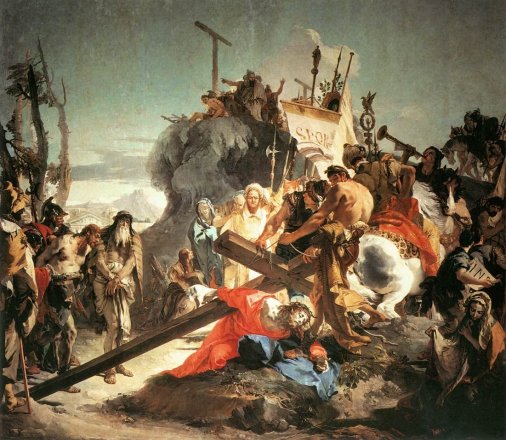
The soldiers led him away inside the palace, that is, the praetorium, and assembled the whole cohort. They clothed him in purple and, weaving a crown of thorns, placed it on him. They began to salute him with, “Hail, King of the Jews!” and kept striking his head with a reed and spitting upon him. They knelt before him in homage. And when they had mocked him, they stripped him of the purple cloak, dressed him in his own clothes, and led him out to crucify him. They pressed into service a passer-by, Simon, a Cyrenian, who was coming in from the country, the father of Alexander and Rufus, to carry his cross. They brought him to the place of Golgotha — which is translated Place of the Skull — They gave him wine drugged with myrrh, but he did not take it.
Then they crucified him and divided his garments by casting lots for them to see what each should take. It was nine o’clock in the morning when they crucified him. The inscription of the charge against him read, “The King of the Jews.” With him they crucified two revolutionaries,
one on his right and one on his left. Those passing by reviled him, shaking their heads and saying, “Aha! You who would destroy the temple and rebuild it in three days, save yourself by coming down from the cross.” Likewise the chief priests, with the scribes, mocked him among themselves and said, “He saved others; he cannot save himself. Let the Christ, the King of Israel,
come down now from the cross that we may see and believe.” Those who were crucified with him also kept abusing him.

At noon darkness came over the whole land until three in the afternoon. And at three o’clock Jesus cried out in a loud voice, “Eloi, Eloi, lema sabachthani?” which is translated, “My God, my God, why have you forsaken me?” Some of the bystanders who heard it said, “Look, he is calling Elijah.” One of them ran, soaked a sponge with wine, put it on a reed and gave it to him to drink saying, “Wait, let us see if Elijah comes to take him down.” Jesus gave a loud cry and breathed his last.

The veil of the sanctuary was torn in two from top to bottom. When the centurion who stood facing him saw how he breathed his last he said, “Truly this man was the Son of God!” There were also women looking on from a distance. Among them were Mary Magdalene, Mary the mother of the younger James and of Joses, and Salome. These women had followed him when he was in Galilee and ministered to him. There were also many other women who had come up with him to Jerusalem. When it was already evening, since it was the day of preparation, the day before the sabbath, Joseph of Arimathea, a distinguished member of the council, who was himself awaiting the kingdom of God, came and courageously went to Pilate and asked for the body of Jesus. Pilate was amazed that he was already dead. He summoned the centurion and asked him if Jesus had already died. And when he learned of it from the centurion, he gave the body to Joseph. Having bought a linen cloth, he took him down, wrapped him in the linen cloth,
and laid him in a tomb that had been hewn out of the rock. Then he rolled a stone against the entrance to the tomb. Mary Magdalene and Mary the mother of Joses watched where he was laid.

Meditation Reflection:

Palm Sunday we recall the Passion of Christ.  We remember His entry into Jerusalem received by adoring crowds which quickly turned to Crucifixion and mocking crowds.  In this account we see ourselves and the fickleness of our own faith.  Peter’s exchange with Jesus at the Last Supper depicts the Christian struggle well:

Peter said to him, “Even though all should have their faith shaken, mine will not be.”

Then Jesus said to him, “Amen, I say to you, this very night before the cock crows twice you will deny me three times.”

But he vehemently replied, “Even though I should have to die with you, I will not deny you.”

And they all spoke similarly.

When has Peter’s attitude been our own?  Complete confidence in our loyalty to Christ – our faith in Who He is, our Hope in Him alone, our perception of undivided Love.  Yet, Christ knows the truth in our hearts.  He knows the real limit of our faith, the weakness of our hope, and the dissipation of our love when confronted with suffering and disappointment.  As long as God’s plan corresponds with our plan, we feel ready to follow Him with magnanimous discipleship.  Yet, when His will deviates from ours, especially if it’s inexplicable to our natural understanding, we often falter.

The Passion of Christ’s love reveals our own tepidity.  (Just consider how we complain at reading or standing at Mass for the length of this Gospel passage.  Yet, how much longer it was for Christ to actually endure!)  However, He also redeems it by taking on our weak human failings Himself, and through the power of His victory, bestowing that grace on our souls so that we may have in truth the magnanimous friendship with Christ we desire in intention.

Venerable Archbishop Fulton Sheen, in his reflections for the third station on the Way of the Cross, reflected:

Three times Our Savior was tempted on the mountain, and three times He fell on the way to Mount Calvary.  Thus did He atone for our three falls – to the temptation of the flesh, the world, and the devil.”   (The Way of the Cross, originally written 1932; currently published by Society of St. Paul 2006)

“He advanced a little and fell to the ground and prayed that if it were possible the hour might pass by him; he said, “Abba, Father, all things are possible to you. Take this cup away from me, but not what I will but what you will.””

How we have all prayed the first part of this prayer!  Begging our Heavenly Father, “all things are possible to You, take this cup away from me”.  The agony of the deepest human suffering pleads in these very words.  The proverbial question “if You are all Good and all Powerful God, why am I suffering?”

The mystery is revealed in Jesus Christ alone.  “But not what I will but what You will.”  God wills our eternal salvation.  He wills it in conformity with respect for human free will.  Human choices cause suffering, but God’s will directs all things, even the events of His Son’s suffering and death, to the triumph of love.  Most of the time we won’t know the particulars of how everything will play out, but we do know the final ending.  Christ conquers – sin, human weakness, even death.  Those who exalt themselves in sin will be humbled, and those who persevere in humility will be exalted.  In Him we find healing, wholeness, strength, and eternal joy.  St. Paul promises that God works all things for good for those who love Him (Romans 8:28), not just some things.   Christ promises the Cross to His followers, but He also promises Resurrection. And the two are inseparable.

Fallen human nature resists faith in the power of the Cross.  Instead it often mocks it like the passersby at Jesus’ crucifixion.

In the account of Jesus’ Passion, individuals respond to His impending Cross in ways that we may relate.  Progress in our spiritual journey corresponds to how far we are willing to follow Christ.  Hopefully each year, we walk a step closer to the Cross and abide with Him a little longer.  Many things can trip us up however as we see in today’s Gospel.

I’ll follow until:

  • Jesus isn’t Who I want Him to be.  He won’t make me materially rich:  Judas
  • I’m tired or bored: Apostles asleep during Jesus’ Agony in the Garden
  • I’m threatened: disciples fleeing the crowd with swords; Peter recognized by the maid
  • I’m caught: young man in linen cloth
  • I’ll cause a rift or make waves: Pilate
  • Even still, Jesus invites His betrayers into His mercy.
“But God proves his love for us in that while we were still sinners Christ died for us.” Romans 5:8

This Holy Week, let us remain with Him.  Let us stay close to Him in prayer without falling asleep or rushing off to distractions.  Let us enter into the mystery of His suffering, death, and resurrection by accepting the griefs within our own situations and dying to what we cannot change, so that we may rise with Him who can redeem every sin and every situation.

Consider:

  • First and foremost, consider Christ’s love for you.  Reflect on how He has shared in your suffering.  Have you ever felt alone, betrayed, anxious, mocked, lied about, physically hurting, or exhausted?  Remember that Christ walks with you through the pain to resurrection in Him.
  • How can your love for Christ be strengthened?
    • Jesus observes in us that “The Spirit is willing but the flesh is weak.” Consider times when you have experienced this.  (Sleeping when you should be praying, resting instead of the effort to show up for someone hurting…)
    • Have you ever sold out Christ for a worldly gain? Consider when you have prioritized money, status, or worldly acknowledgement over doing God’s will for you.
    • Pilate’s betrayal sprang from “wishing to satisfy the crowd.” Sometimes we deny Christ by failing to speak up out of fear of being persecuted on His account. When asked “Are you a Christian?” or “Are you Catholic?”, how do you respond?  Do you hesitate or qualify it?  Or do you respond confidently, “Always be ready to give an explanation to anyone who asks you for a reason for your hope as St. Peter tells us (I Peter 3:15).
    • What fears can the devil use to tempt you away from following the Lord? How does he stir up your anxiety, and worry you into hiding, away from the Cross, like the other apostles?

 Make a Resolution (Practical Application):

  • Pray the Stations of the Cross or the Sorrowful Mysteries of the Rosary this week.
  • Reflect on one section of this Gospel passage a day this week.

Related Posts:

~ Written by Angela Jendro © 2018

* To receive these weekly posts automatically in your email just click the “follow” tab in the bottom right hand corner and enter your email address.


Lent – That Others May See More of Jesus In Us

by Angela (Lambert) Jendro


March 18th, 2018 5th Sunday of Lent

Gospel of John12:20-33 NAB

Some Greeks who had come to worship at the Passover Feast came to Philip, who was from Bethsaida in Galilee, and asked him, “Sir, we would like to see Jesus.” Philip went and told Andrew; then Andrew and Philip went and told Jesus. Jesus answered them, “The hour has come for the Son of Man to be glorified. Amen, amen, I say to you, unless a grain of wheat falls to the ground and dies, it remains just a grain of wheat; but if it dies, it produces much fruit. Whoever loves his life loses it, and whoever hates his life in this world will preserve it for eternal life. Whoever serves me must follow me, and where I am, there also will my servant be. The Father will honor whoever serves me. “I am troubled now. Yet what should I say? ‘Father, save me from this hour’? But it was for this purpose that I came to this hour. Father, glorify your name.” Then a voice came from heaven, “I have glorified it and will glorify it again.” The crowd there heard it and said it was thunder; but others said, “An angel has spoken to him.” Jesus answered and said, “This voice did not come for my sake but for yours. Now is the time of judgment on this world; now the ruler of this world will be driven out. And when I am lifted up from the earth, I will draw everyone to myself.” He said this indicating the kind of death he would die.

Meditation Reflection:

Someone may say to you, “[Your Name], I would like to see Jesus.”  Imagine that for a moment and take it in.  A person looking to you with a hopeful and somewhat anxious expression, addressing you by name, and depending on you to connect them to Christ.

“Why me?” you might say.  Yet, in a secular culture void of God, searching souls see Christ from a distance and feel more at a loss to find their way to Him than you may think.  Thus, your relationship with Jesus, and their relationship with you, provides the bridge they need.

Yet, to be Christ’s light and love in the world, to be a bridge, demands a serious choice which will decide the trajectory of your whole life.  Jesus made this choice, and so must each of His followers.

The choice – to live for yourself or to live for the Lord, to build a life of your own making or to build the kingdom of God.

A grain of wheat, in and of itself, is small and insignificant – enough to feed only a bird. Yet, within it lies tremendous potential – enough to feed human persons.  The movement from potential to actuality however begins with death.

If a grain were a conscious soul with a mind and will, it would see before it a decision:

  1. Go on living as a seed for itself, unchanged and comfortable.
  2. Surrender itself to the Creator, be broken apart in death and then transformed into something new and quite different from its experience as a seed.

Although the second option sounds scary, to grow and change also entails being lifted up from the ground, becoming tall stalks of wheat, and finally, maturing to the point where it can be picked as harvest for others.  The first choice may be easier, but the second adds so much more meaning to its life.

As Jesus’ “Hour” approached, He came to the final crossroads of His decision.  He had said Yes to the Father when He agreed to become man at the incarnation, He said No to Satan in the desert when offered the kingdoms of the world without the Cross, and now as His final suffering and death approached He weighed His decision aloud for His disciples to hear and one day follow.

Jesus didn’t want to suffer but He did want to save us. So what was He really to do?  Christ’s magnanimous love refused to live for Himself, and so chose the path to the Cross.  He chose to die that He might be lifted up – on the Cross and in His Resurrection – and thereby bear fruit that gives all mankind who plucks it life eternal.

As Christ’s disciples, we first must receive life from our Lord who has become our spiritual bread.  Under the appearance of wheat bread in the host, He gives His very Body, Blood, Soul, and Divinity to us in the Eucharist.  With this union and grace, we then are asked to allow Him to transform our souls.

He begins by breaking down sin and selfishness.  Dying to ourselves marks the first stage of development.  Thus prayer, fasting, and almsgiving facilitate this process by putting God first, denying ourselves pleasures, and opening ourselves up to the poor around us.

From this death to self however, which no doubt is painful, emerges transformation.  Sin and self at bay, Christ is more free to build virtues within us and to grow authentic Christian love.  The process snowballs positively as the greater one loves, the easier sacrifice becomes.  In full Christian development, love is so perfected that it, like Christ, can’t bear to choose pleasure or comfort over love of God and neighbor. We experience something of this in human loves between parent and child, spouses, or dear friends.  In loving relationships, giving of one’s self or possessions is felt to be an opportunity rather than a burden.

In this fifth week of Lent, you may be feeling the pain of perseverance in the commitments you made Ash Wednesday.  However, the more weak you feel on your own, the more reliant you become on Christ and His grace to support you.  Have hope, we are past the midpoint!  Just as there can be no Easter Sunday without Good Friday, we can’t truly feast until we’ve fasted.  The more we enter in to Lent, the more joy we will experience during Easter.

Like Jesus, we might pray to the Father:

“I am troubled now. Yet what should I say? ‘Father, save me from this hour’? But it was for this purpose that I came to this hour.”

We choose death to self because we desire life in Christ – which we know to be much happier, peaceful, and fulfilling than anything we could construct for ourselves.  We don’t die for its own sake but rather to receive greater life.

Jesus teaches, “Whoever serves me must follow me, and where I am, there also will my servant be.”  In consequence, as we approach Holy Week we endeavor to be with our Lord wherever He is – at the Last Supper on Holy Thursday, at the Cross on Good Friday, waiting in anticipation Holy Saturday, and rejoicing in His Resurrection on Easter Sunday.

If we persevere and remain near to Christ, those near to us can be blessed by His Presence too. Our lived discipleship might drive out the lies of Satan with Christ’s Truth.  You can be a witness that Christ brings true happiness to someone disillusioned by the world’s false promises.  Your unconditional love can drive out the lie that someone is only as valuable as they are useful.  Your forgiveness can drive away the temptation of despair with the truth of mercy.

Christ’s saving love draws everyone to Himself.  If we allow ourselves to be conformed to Him, we just might be that bridge to Christ for someone’s salvation, or that stalk of wheat which they pluck to receive our Lord for the first time.

Consider:

  • Meditate on the words, “we would like to see Jesus.”  Make this your prayer to the Holy Spirit and spend 5 minutes in silent prayer listening.
  • Consider Christ’s gift of self for you.  Pray about how you might give more of yourself to Him and to others.
  • In what ways does your life witness your faith to others?  In what ways do you hide your faith?
    •  Are you a joyful or a gloomy Christian? Do you greet people with a smile? (one of Mother Teresa’s common suggestions)
    • In conversations, does your speech reflect your Christian values or do you participate in gossip or vulgar jokes.
    • Do you speak about your church or priest with respect or are you overly critical?
    • Do you reach out to persons at work or in your neighborhood who seem to be friendless or having a tough time, or are you too focused on your own life?

 Make a Resolution (Practical Application):


~ Written by Angela Jendro © 2018

* To receive these weekly posts automatically in your email just click the “follow” tab in the bottom right hand corner and enter your email address.


Desert Decisions

by Angela (Lambert) Jendro

February 18th, 2018 1st Sunday of Lent

Gospel of Mark 1:12-15 NAB

The Spirit drove Jesus out into the desert, and he remained in the desert for forty days, tempted by Satan. He was among wild beasts, and the angels ministered to him. After John had been arrested, Jesus came to Galilee proclaiming the gospel of God: “This is the time of fulfillment. The kingdom of God is at hand. Repent, and believe in the gospel.”

Meditation Reflection:

The transition from Christ’s hidden life to His public ministry began with His Baptism and then the temptation in the desert.  There,  He had to decide whether to work for self-gain in this world, or self-sacrifice for the next.

At the Incarnation Christ, though the Second Person of the Blessed Trinity, took on a human nature and humbly chose to live the human experience.

Who, though he was in the form of God, did not regard equality with God something to be grasped. Rather, he emptied himself, taking the form of a slave, coming in human likeness; and found human in appearance, he humbled himself, becoming obedient to death, even death on a cross. Philippians 2:7

In consequence, Jesus grew “in wisdom and stature” (Luke 2:52 RSV), obedient to His parents, embracing the temporal condition of human development.  He did not begin His public ministry until the age of 30, which marked full manhood at the time and the transition to leadership roles.  It was also the age Levitical priests would enter the full service of the Lord (see Numbers 4:3, 30).

The commencement of His mission was preceded by temptation and trial.  He, like us, had to choose which trajectory His life would take.  In the desert, Satan enticed the Lord to direct His divine gifts to pampering His human nature.  Matthew (4:1-11) details the temptations specifically: bodily pleasure (bread), tremendous fame (leap from temple pinnacle), and worldly power (all the kingdoms of the earth).  Satan forced the choice before the Lord: the immediacy of the visible world and self-gain without the Cross, or the work of establishing the invisible kingdom of God which would require self-immolation and suffering Crucifixion before rising again.

Each of us faces the same temptations and the same choice.  We can either use our God-given gifts to promote ourselves and worldly achievements, or direct them to the Father’s will and the building up of His kingdom.

Lent provides a time to step into the desert with the Lord, to pray and fast, and to re-orient the trajectory of our lives.  As a Church, the People of God, we take 40 days each year to shed the illusion that we can live for both worlds or that we can have the kingdom without the Cross.

Through fasting, with the help of grace, we deny ourselves tempting pleasures to strengthen our will and remember that “man shall not live by bread alone, but by every word that proceeds from the mouth of God” (MT 4:4).  Furthermore, it reveals the truth of just how attached we may be and loosens the hold that habit may have over us.  Fasting also unites us to the redemptive value Christ has placed on suffering through His own suffering and death.  In fact, on one occasion Jesus even says to His disciples that some demons “cannot be driven out by anything but prayer and fasting” (Mark 9:29).  Thus, through our Lenten fasting, we join our sacrifices to His, to cast out the demons in our lives with His help, so that we might share in His mission and thus share in the hope of His Resurrection.

Through prayer we draw closer to the Lord, that the invisible might become more visible and His grace might transform us.  Encountering Christ in the Scriptures, the Mass, the Rosary, the lives of the saints, Eucharistic Adoration, the Stations of the Cross, and other prayerful devotions, our love for Him is enkindled and our discipleship strengthened.

Finally, the Lenten practice of almsgiving takes us outside of ourselves through service of the needs of others.  This can range from sharing your money with the poor to sharing a blanket with your child.  It also includes sharing your time with someone sorrowing, lonely, or sick. It begins with meeting the needs of your family then your co-workers or neighbors and friends, your local parish and community, and finally the world-wide needs of the Church.  Catholic Relief Service’s “Operation Rice Bowl” provides an opportunity as a family to make simpler meals during Lent and to donate the money saved to feed the hungry in poor areas of the world (https://www.crsricebowl.org/about)

Together as Christians, we join Christ in the desert during Lent.  We draw away from the immediate and tempting pleasures of the moment and of this world, and draw nearer to Christ and the eternal, even more real, pleasures of the Heaven.  At the end of this purification we share in the joy of His resurrection at Easter.  Easter is the beginning of a new creation, and we hope to be a new, or renewed, creation Easter Sunday as well. Lent is a time to “repent and believe in the gospel” so that, transformed by grace, we may live in the Kingdom of God which is now at hand in Jesus Christ.

Consider:

  • Consider in prayer the deeper, truer, reality of the spiritual world.  Reflect on the illusory promises of pleasure, fame, and status compared with the enduring graces of Christian love, strength, and joy.
  • Ask Christ in prayer to reveal an attachment you may have, that up until now you have been blind to such as subtle forms of pride, vanity, greed, or pleasures.
  • Take time for gratitude.
  • Ask Mary to help you see the needs around you as she did at the Wedding at Cana.

Make a Resolution (Practical Application):

  • Swap out 15 minutes of media time for 15 minutes of prayer or silence.

Related Posts:

~ Written by Angela Jendro © 2018

* To receive these weekly posts automatically in your email just click the “follow” tab in the bottom right hand corner and enter your email address.


Shining a Light into The Darkness


by Angela (Lambert) Jendro


January 27th, 2018 4th Sunday in Ordinary Time

Gospel of Mark 1:21-28 NAB

Then they came to Capernaum, and on the sabbath Jesus entered the synagogue and taught. The people were astonished at his teaching, for he taught them as one having authority and not as the scribes. In their synagogue was a man with an unclean spirit; he cried out, “What have you to do with us, Jesus of Nazareth? Have you come to destroy us? I know who you are—the Holy One of God!” Jesus rebuked him and said, “Quiet! Come out of him!” The unclean spirit convulsed him and with a loud cry came out of him. All were amazed and asked one another, “What is this? A new teaching with authority. He commands even the unclean spirits and they obey him.” His fame spread everywhere throughout the whole region of Galilee.

Meditation Reflection:

Jesus casts out demons with the power and authority of God Himself.  He frees us from their lies and from the darkness of sin.  This is truly a gift and a great relief.

Our present secular culture needs this gift.  Marked by the highest levels of anxiety and depression, the darkness from which these symptoms often proceed need to be cast out with the authority and light of Christ.

The great theologian Hans Urs von Balthasar (1905-1988), explored the relationship between darkness, sin, and anxiety in his work The Christian and Anxiety (Ignatius Press).  He notes,

The main effect of darkness is that it separates, isolates, makes lonely.”

Similarly, the darkness of sin separates the sinner from others, isolates him from God whose light he evades to continue in sin, resulting in dark loneliness.  In Exodus, the penultimate plague aptly describes the culmination of Pharaoh’s obstinate evasion of God, who had made Himself visibly manifest.  A darkness came over the Egyptians for three days, “a darkness to be felt” (Exodus 10:21) The dense, suffocating, darkness effected a social paralysis, symptomatic of their spiritual sickness.

and there was thick darkness in all the land of Egypt three days; they did not see one another, nor did any rise from his place for three days; but all the people of Israel had light where they dwelt.”

Von Balthasar further wrote that the loss of light signifies the loss of reality.  Without light we cannot see and therefore remain trapped by our imagination. Reflecting on Wisdom chapter 17, he writes, “The wicked are afraid of Nothing, of nothing real.”  God is Reality.  His divine Name, Yahweh, which means “I Am”, revealed Him to be existence itself.  Therefore, to hide from His Light, to duck His Truth, means to retreat into an imaginary world of one’s own creation.  In addition, it deprives us of the answers we need most of all – Who am I?  What is my purpose?  What’s the meaning of life? How do I find happiness?

Like living in denial of a physical illness,  one can only self-soothe by justifying sin for so long before the underlying dread and pain of spiritual illness becomes too intense to leave untreated.

Sin can become paralyzing.  Moreover Satan, the “Accuser” as Jesus calls him, whispers fearful lies into the darkness so as to keep a person from reentering the light.  The demons of shame, despair, and distrust bind the sinner to his dark loneliness.

And into this darkness, Christ the Light came.  He “spoke with authority” because he spoke Truth, thereby dispelling lies.  His Light cast out the demons of darkness, His Truth cast out the Father of Lies, and His merciful love strengthened and healed so that the sinner might become whole again.  How many miracles of Jesus demonstrate this!  The paralyzed man who could walk again.  The lepers, cast out from society, healed and able to rejoin their families.  The demoniacs freed and restored to their loved ones.  Christ’s light shone on prostitutes, tax collectors, and pagans.  He liberated them from a kingdom of degradation and made them citizens and children of His Kingdom of God.

Christ continues to bring His light into the darkness through His Mystical Body the Church.  He invites us into His healing love, then His light begins to shine in us.  Wherever we are, that light shines simply by union with Him.

Elizabeth Leseur (1866-1914), a devout Catholic living in an upper-class, atheistic, French society provides a concrete example of how to be a light in darkness.  Elisabeth and her husband Felix loved one another intensely and shared an inspiring intimacy of marital friendship. As a result, it pained her severely that he was an ardent atheist.  Her love for God and her love for Felix were both so deep, and yet she couldn’t share that deepest part of herself with the man she loved the most, nor see him receive the joys and graces she enjoyed as a Christian.

She made it her apostolate to pray and sacrifice for his conversion and for their friends.  Most everyone in their society of friendship were intellectuals and anti-Catholic.  Her diary reveals how she prayerfully navigated ministering to them, bringing light to the darkness through her hidden interior life, her faithful exterior practices, her patient silence, and her readiness to speak boldly and intelligently for Christ if the moment necessitated it.  After her death, her husband discovered her secret diary.  The insights into her interior life, together with his experience of her daily love during their married life, softened his heart and converted his soul.  He went from being a hardened atheist to late becoming a Catholic priest!

Elisabeth brought her light into the darkness and it freed the one she loved the most.  One of her resolutions in her diary, can be instructive for us in the same effort.  In today’s Gospel Jesus spoke with authority and it struck people.  Elisabeth discovered the same thing in her own interactions.  She found that somehow her personal conviction of faith, was itself a strong testimony, strengthened more by authenticity and simple truth than by long explanations trying to persuade.  She writes,

“Each time the conversation leads me to speak of faith, I will do so simply, but in a direct and firm way that will leave no doubt as to my convictions.  Cleverness is nothing in such things; I am struck with the fact that unbelievers have more sympathy with people of deep faith than with those of variable and utilitarian views.  These dear unbelievers attend more to those who are ‘intransigent’ regarding the Faith than to those who by subtlety and compromise hope to bring them to accept the Faith. And yet the bold statement must be made with the most intelligent sympathy and the liveliest and most delicate charity.” The Secret Diary of Elisabeth Leseur; Sophia Institute Press

Our culture suffers under “a darkness that can be felt,” but Christ’s light shines into that darkness to cast it out and replace it with freedom.

“In Him was life, and the life was the light of men.  The light shines in the darkness, and the darkness has not overcome it.” John 1:4-5

May the light of Christ shine in us!

Consider:

  • Are there shadows of darkness with which you struggle?  Bring them to prayer and expose them to the light of Christ in Scripture and the sacraments.
  • Compare who the world says that you are and what your worth is, with who Christ says that you are.  Which do you listen to more?  How might you strengthen Christ’s voice within you?
  • Spend 5 minutes of silent prayer, loving Christ and receiving His love.
  • How might you grow your relationship with Christ and let Him shine more brightly in your life?  How might you bring His warmth, love, and truth to those in your life?

Make a Resolution (Practical Application):

  • Resolve to pray for and develop a deeper love for Christ and to shine Him more brightly.
  • Pray the Prayer of St Francis of Assisi daily. 
  • Pray the Rosary.  Mary always purifies and strengthens our love for Jesus.

Related Posts:

~ Written by Angela Jendro © 2018

* To receive these weekly posts automatically in your email just click the “follow” tab in the bottom right hand corner and enter your email address.


Where Truth & Love Reign

by Angela (Lambert) Jendro

 love one another

November 26th, 2017 Solemnity of Christ the King

Gospel of Matthew 25:31-46 NAB

Jesus said to his disciples: “When the Son of Man comes in his glory, and all the angels with him, he will sit upon his glorious throne, and all the nations will be assembled before him. And he will separate them one from another, as a shepherd separates the sheep from the goats. He will place the sheep on his right and the goats on his left. Then the king will say to those on his right, ‘Come, you who are blessed by my Father. Inherit the kingdom prepared for you from the foundation of the world. For I was hungry and you gave me food, I was thirsty and you gave me drink, a stranger and you welcomed me, naked and you clothed me, ill and you cared for me, in prison and you visited me.’ Then the righteous will answer him and say, ‘Lord, when did we see you hungry and feed you, or thirsty and give you drink? When did we see you a stranger and welcome you, or naked and clothe you? When did we see you ill or in prison, and visit you?’ And the king will say to them in reply, ‘Amen, I say to you, whatever you did for one of the least brothers of mine, you did for me.’ Then he will say to those on his left, ‘Depart from me, you accursed, into the eternal fire prepared for the devil and his angels. For I was hungry and you gave me no food, I was thirsty and you gave me no drink, a stranger and you gave me no welcome, naked and you gave me no clothing, ill and in prison, and you did not care for me.’ Then they will answer and say, ‘Lord, when did we see you hungry or thirsty or a stranger or naked or ill or in prison, and not minister to your needs?’ He will answer them, ‘Amen, I say to you, what you did not do for one of these least ones, you did not do for me.’ And these will go off to eternal punishment, but the righteous to eternal life.”

Meditation Reflection:

At first glance, this passage can seem a little harsh.  We like to imagine a more sentimental Jesus, gently escorting every person to eternal pleasure, not a rigid judge calculating our deeds and sending some to eternal suffering.

Jesus is king and judge, but as He often reminded His followers – His kingdom is not of this world. When pressed by Pilate to explain further, Jesus answered “I came into the world for this, to bear witness to the truth; and all who are on the side of truth listen to my voice” (John 18:37).

We, like Pilate, may ask “Truth? What is that?” (John 18:38).

Truth is Reality.  As Pope Benedict XVI often said in his writings, it means acknowledging that God is the Creator and we are creatures.  The laws of nature that govern the health of our soul are as real and concrete as the laws that govern the health our body.

The truth is also that God is love and we are made in His image.  Though weakened by sin, we have been re-made by Christ and transformed by His grace to image God’s love again.  Thus, St. John can say,

My dear friends, let us love one another, since love is from God and everyone who loves is a child of God and knows God.  Whoever fails to love does not know God, because God is love…as long as we love one another God remains in us and His love comes to its perfection in us.” 1John 4:7-8,12

So if the Truth is that God is love and we are love, what does that mean on an everyday level?  How does that look?  How does it translate to our schedules?

Pope St. John Paul II defined love clearly and simply: it is self-gift.  Thus the paradox of human happiness he concluded, is that we find fulfillment for ourselves in giving of ourselves.

This means fighting the pull of self-centeredness and mere consumerism.  We have to turn our attention from acquiring things, to giving of ourselves.  Should we try to over-complicate the matter or pay mere lip service, Jesus states clearly the fruits of authentic love: feeding the hungry, clothing the naked, visiting the sick or imprisoned…

Jesus is Truth and Love.  No one can pretend to be something they are not when standing before Him.  Those who love will rejoice to be fully united with the King of Love.  Confident in His mercy, they will say yes to His transforming grace which will free them from any remaining pulls of worldliness or selfishness so they can be free to fully enter the Communion of Saints and Angels in union with God.  Those who prefer the Kingdom of Self will refuse to enter the Kingdom of Self-Gift, preferring to be alone.

We see this in an analogous way during the holidays.  Time with family requires a sacrifice of time, generosity of food and travel, hospitality, patience, and attentiveness toward others.  The more we love our family, the easier those things become, so much so we may even look forward to those opportunities as a gift of service that brings us joy.  The less we love, the more burdensome they seem, so much so a person may choose to remain alone on the holiday rather than deal with it all.

It’s not so much that Jesus will come to decide who “gets” to go to Heaven and who doesn’t, since He came to offer Redemption to all.  It’s more the case that He will come as Judge of the Truth about our decision to accept or reject His saving grace in our hearts.  The world might say, “show me the money,” but Jesus will say, “Show me your love.”

Life is short, eternity is long.  We must begin EVERY day with prayer – even just 5-10 minutes and go to Mass EVERY Sunday, to unite ourselves to the source of Love and Grace.  From this union with Christ, fruits of His Spirit of love will permeate the actions and decisions of our day (see Galatians 5:22-23). If we first love God above all things, we will then love our neighbor as ourselves because we will see God’s image in them and desire as Christ does to mend its wounds of sin that their God-given dignity and glory might shine more gloriously.

Sound too simplistic?  Give it a try.  Compare a day began with 10 minutes of prayer and a day without.  I can attest that I am a far more loving person with prayer and a far more frazzled impatient person without it.  See how your week goes after attending Sunday Mass.  Try going to one daily Mass in addition and notice the fruits that follow in your interactions with others that day.

Consider:

  • Consider how love makes work or service less burdensome.
  • Consider how selfishness undermines relationship and causes discord in your family, friendships, and work.
  • Consider how Christ’s love and grace has transformed you.  How has He changed you for the better over the years?  How has His Spirit changed the way you think and act? What are areas of your life that still need transformation?
  • When have you experienced self-fulfillment/happiness through self-gift?  How might you continue to give of yourself to those in your daily life?
  • Take a moment for gratitude, to thank Christ for the sins that He has conquered so far in you.  Then take a moment for petition, asking Christ to conquer those sins that still remain.  Finally, take a moment for intercession, praying for those in need of healing that Christ might conquer the sins burdening them.
  • Close your eyes and imagine the joy of Heaven.  Imagine Christ coming in all His glory, shining brighter than the sun, smiling, and holding out His hand for you to join Him.

Make a Resolution (Practical Application):

  • Begin every day this week with 5-10 minutes of prayer.  Read the Scriptures, thank God, surrender your day to Christ, spend a couple of minutes in silence.
  • Intentionally practice one corporal and one spiritual Works of Mercy a day.
  • Read about the life of a saint who is similar to you in some way to learn from his or her example.  You can research “patron saint of__________” to find someone with an affinity to your work or your struggle.  You could also try researching someone with your same vocation such as married, single, or religious. You can find saints who were young or old, men or women, from small towns or big cities, were well educated and travelled or simple and hidden.  You may also like to research a saint who shares your name.

~ Written by Angela Jendro © 2017

* To receive these weekly posts automatically in your email just click the “follow” tab in the bottom right hand corner and enter your email address.


Keeping it Simple and Keeping it Real

by Angela (Lambert) Jendro


October 29th, 2017 30th Sunday in Ordinary Time

Gospel of Matthew 22:32-40 NAB

When the Pharisees heard that Jesus had silenced the Sadducees, they gathered together, and one of them, a scholar of the law tested him by asking, “Teacher, which commandment in the law is the greatest?” He said to him, “You shall love the Lord, your God, with all your heart, with all your soul, and with all your mind. This is the greatest and the first commandment. The second is like it: You shall love your neighbor as yourself. The whole law and the prophets depend on these two commandments.”

Meditation Reflection:

St. John tells us that “God is Love” (I John 4:8).  He actively loves you and I at every moment.  He created the world out of nothing to be a home for humankind and continues to hold all things in existence and guide them by His divine providence. He created each of our souls at the moment of our conception.  The Second Person of the Trinity even became man, suffered, and died for our Redemption after we sinned so we could become new creations by grace.  Even before creation however, He was Love.  In His very essence God is a union of three divine Persons – Father, Son, and Holy Spirit.  His very nature is an eternal relationship of love.

Moreover, Genesis reveals that God’s love is so great He made humankind in His image to participate in His love. Thus the God who is love, created us to also be love. In the first creation account He created man and woman at the same time, that they too might be a union of persons, capable of love and creativity like God.

“God created mankind in His image; in the image of God He created them; male and female He created them. God blessed them and God said to them: Be fertile and multiply.” Genesis 1:27-28

In the second Genesis account God created man first but he felt alone and unfulfilled.  There was no suitable partner for him among all of God’s animals.  Why?  Aren’t dogs and cats adorable?  Wouldn’t it be wonderful to enjoy God-given reign over all of creation without having to share it with anyone? Adam had water front property, lush gardens, and plenty of food.  He had everything a single person could desire – power, pleasure, abundance, security, and was surrounded by affectionate pets.  Why was he unhappy?

“The LORD God said: It is not good for the man to be alone. I will make a helper suited to him. Genesis 2:18

Made in the image of God, Adam could only find fulfillment through being a union of persons.  Together Adam and Eve could unite both body and soul.  They could know one another, choose one another, and love one another, both spiritually and physically.

In the Beginning, living in God’s image was simple and joy-filled.  Adam and Eve walked with God in the Garden.  Their work was without toil and they rested each Sabbath to worship God and rejoice in gratitude.  As Pope Benedict XVI explains:

In the creation account the sabbath is depicted as the day when the human being, in the freedom of worship, participates in God’s freedom, in God’s rest, and thus in God’s peace.” (In the Beginning…A Catholic Understanding of the Story of Creation and the Fall, 1990)

Things only get complicated after the Fall, that first dreadful sin.  God is a realist.  He made everything according to a rational order and taught Adam and Eve those laws so they might be safe and flourish.  In their moment of temptation however, they rebelled in pride, chasing the illusion that they could be the creators of reality rather than creatures already a part of reality.  Yet, the truth is always true.  God said their choice would bring death, the serpent said it wouldn’t, and Adam and Eve chose based on their senses – “it seemed good and looked delightful.”  They chose against God and they found He was right – death entered the world.

It’s easy to point the finger at their foolishness, but consider our own common teenage rebellions.  Despite the love and trustworthy guidance of good parents, how often do teens think to themselves, “I know more than mom and dad.  I’m going to do this my way and ignore their rules,” only to find themselves suffering the results their parents had warned them of?

When have you thought the same thing about God’s guidance?  God guides us through the natural law, Scriptures, and the Church.  Yet, we still struggle with the tempting thought that what we feel like doing is better than what we ought to do.  Again and again, we suffer when our feelings prove illusory and God’s guidance true.

People will often say, “The Church isn’t realistic.  It needs to get with the times.”  Abstinence for unmarried persons instead of birth control? Fantasy.  Truthfulness at work?  You’ll never get ahead.  Children instead of pets?  Maybe one or two, but beyond that will be misery.  Church every Sunday?  That’s excessive.  Resting on Sunday?  Who will get all the work done?

Yet, the truth remains the truth.  Our illusions do not change reality.  We chase where our impulses lead only to find ourselves depressed and unhappy.

Happiness is simple.  It means being a real realist. It means living as a human person not something else you or the culture imagines.  It may not be easy, but God gives us grace to live in His truth.

God’s laws only become complicated inasmuch as we make them complicated.  In my classroom I have a mini basketball and hoop for kids to play during passing time.  I begin the year with two rules: when the bell rings the ball gets put away, and no blood (I don’t want kids getting hurt and there’s a reason I’m a teacher and not a doctor or nurse).  Some classes get it and those are the only two rules that I ever need.  They have a little fun and our class begins on a positive note.  Others overcomplicate things.  They start fighting over the ball, becoming overly rough or competitive, launching it over people’s heads, or they keep trying to shoot the ball into its rightful place despite missing many times.  In consequence, they force me to make more rules to ensure that my basic two are met and what began as simple fun becomes a frustration.

Jesus teaches that God really only has two rules as well.  If we simply love God with our whole self – heart, mind, and soul, everything else falls into place.  Living in union with God we find our true selves and the source of all happiness.  From our free relationship of love with God, we then seek to love others, His image among us.  Through self-gift and loving relationship, we find self-fulfillment and deep joy because we are living in reality, feeding on real food and journeying toward our real end.

All the other rules are in response to the myriad of ways we violate the basic two.  If we loved God first then our neighbor, we would have the common sense to do the other things as well.  If I love God, I’m going to spend Sunday with Him.  If I love my neighbor, I’m not going to lie or cheat him, and if I see him in need I will want to help.

Developing Christian common sense may take time, depending on your past formation or experiences.  Jesus knows our brokenness, blindness, and weakness.  He came to be our Healer, the true Light to guide us, and the source of Strength to transform us.  Love has a mysterious and beautiful power to melt away sadness and hurt, and fill us with joy.  You might begin by needing a rule to go to Mass on Sunday, but once you experience the touch of Christ’s love, you will find it a gift instead.

Consider:

  • When have you experienced God’s love – through another person, in prayer, or at Mass?
  • When has God’s truth been a sure guide for you during a confusing time?
  • Which laws of God, either through Scripture or the Church, do you find most difficult to accept or to live out?
  • How has God’s grace enabled you to live virtuously or love at a level you couldn’t have imagined before?
  • How might you love God more?  What areas of your heart, mind, soul, or strength do you still withhold from him?  Is there a teaching of Christ you struggle to accept?  Is there someone you find difficult to give generously of your heart to? Do you spend Sunday with the Lord and family or use your strength for more work instead? Do you spend time thanking God and being in His presence, or do you love something else more?
  • Reflect on Mary’s perfect love exemplified by her simple Yes at every moment.

Make a Resolution (Practical Application):

  • Each day this week give God more of your heart, mind, or strength.  Ask Him to increase your love for Him in each of these areas then do one concrete thing a day to act on that love.
  •               Ideas:
    • To love God more with your mind spend 5 more minutes a day with Scripture, listen to Christian podcasts or radio, learn about the faith at your parish or by reading a spiritual book.
    • To love God more with your heart, increase your affection for Him by making a gratitude list, praying a Psalm  (especially 23, 27, 119, or 139), meditating on the rosary, or attending a daily Mass.
    • To love God more with your strength, do something of service for someone in need.  Care for someone who is sick, help out a co-worker who is swamped, volunteer to help at your church by taking care of the building or grounds or by helping with the service as a greeter or usher.   Most importantly, resolve to avoid servile work on Sunday and instead play with your kids or go visit a friend.

Related Posts

~ Written by Angela Jendro © 2017

* To receive these weekly posts automatically in your email just click the “follow” tab in the bottom right hand corner and enter your email address.


Love Beats the Deadline

by Angela (Lambert) Jendro

wedding of the lamb

October 15th, 2017  28th Sunday in Ordinary Time

 Gospel of Matthew 22:1-14 NAB

Jesus again in reply spoke to the chief priests and elders of the people in, saying, “The kingdom of heaven may be likened to a king who gave a wedding feast for his son. He dispatched his servants to summon the invited guests to the feast, but they refused to come. A second time he sent other servants, saying, ‘Tell those invited: “Behold, I have prepared my banquet, my calves and fattened cattle are killed, and everything is ready; come to the feast.”‘ Some ignored the invitation and went away, one to his farm, another to his business. The rest laid hold of his servants, mistreated them, and killed them. The king was enraged and sent his troops, destroyed those murderers, and burned their city. Then he said to his servants, ‘The feast is ready, but those who were invited were not worthy to come. Go out, therefore, into the main roads and invite to the feast whomever you find.’ The servants went out into the streets and gathered all they found, bad and good alike, and the hall was filled with guests. But when the king came in to meet the guests, he saw a man there not dressed in a wedding garment. The king said to him, ‘My friend, how is it that you came in here without a wedding garment?’ But he was reduced to silence. Then the king said to his attendants, ‘Bind his hands and feet, and cast him into the darkness outside, where there will be wailing and grinding of teeth.’ Many are invited, but few are chosen.”

Meditation Reflection:

Jesus often compares Heaven to a wedding feast. Weddings celebrate a sacred union in love of two persons.  It means total gift of self and lifelong commitment.   Marriage best represents God’s invitation to relationship with us and His desire for total self-gift.  Though He made numerous covenants with the Hebrew people, He also made clear that He desired their hearts in addition to outward obedience, and authentic respect to mere lip service.

God is both transcendent and immanent.  He is both God almighty who existed before creation and exceeds our understanding, and the God Who sent His Son to become incarnate, walk the earth with us, and suffer and die for us. Even now His Holy Spirit guides us and Christ is present to us in the sacraments and His Mystical Body the Church.

The book of Revelation beautifully prophecies the wedding of the Lamb to which we have each received an invitation.  Christ – the Lamb, has come and His bride – the Church, has prepared her heart for him:

Let us rejoice and be glad and give the glory to Him, for the marriage of the Lamb has come and His bride has made herself ready.  It was given to her to clothe herself in fine linen, birth and clean; for the fine linen is the righteous acts of the saints.  Then He said to me, ‘Write, “Blessed are those who are invited to the marriage supper of the Lamb.”’ Revelation 19:7-9

Christ loves each and every person passionately.  He pursues them, woos them, fights for them, and offers eternal union with Him in Heaven.  In today’s Gospel however, He laments that not everyone says yes.  They come up with excuses, put Him off, or avoid Him altogether.  Eventually the door is shut.  Harsh, you might say?

Jesus strikes at our complacency.  We all too easily forget the gift of salvation, of our eternal destination, and our higher calling.  The frenetic pace of life, the constant stream of tasks, or the allure of diversions become a dangerous siren call, singing that we are made for earth and we have all the time in the world.

However, every day we are one day closer to eternity.  If we didn’t grow our love for the Lord then we weakened it.  Love needs ongoing nurturing.  Relationships are work!  Even a relationship with God.

Moreover, sometimes indecision is a decision.  Deadlines are part of reality.  If I stay undecided about my son playing basketball, eventually the registration closes. If I hem and haw about planning a family trip, eventually a year passes without travel and I have essentially said no.  Lastly, if a couple is in a serious relationship of several years and one person drags his/her feet about marriage, eventually the other will need to move on from the relationship to find someone else to build a life with.

Thankfully Jesus waits patiently our entire life.  He reminds us today however, that death is the deadline.  By that point we have said yes or no to the Lord and even our indecision reveals itself as a rejection of Christ.

But let’s not wait until the last moment.  I have heard persons who put off kids, when they finally held their first in their arms say, “why did we wait so long?”   Couples in love when they finally meet say “I wish I had met you sooner.”  The more we love, the more we see how much greater it is than anything else we had previously thought to be more important.  We will say the same of Christ – I wish I had let you in sooner.

We can ask ourselves, what holds us back from the wedding?  What keeps me from union with the Lord?  What do I need to do to prepare myself for this marriage?  The King of Heaven and Earth has personally invited you.  Drop everything, get dressed, and go!

Consider:

  • The Mass is actually a mystical participation in the eternal wedding feast of the Lamb in heaven.
    • What things or habits undermine getting to Mass or distract you during Mass?
      • Is it sleeping in, kids’ activities, running errands, going into work, exercising instead, watching news, or just relaxing?
    •  What helps you enter more deeply into the Mass?
      • Getting to know the priest and parishioners so you feel more a part of the community, reading the Gospel ahead of time, learning about the Mass, participating as a musician, greeter, usher, or extraordinary minister of Holy Communion, writing down key points from the homily?
  • Imagine you were to enter Heaven today.  What aspects of your heart and character would Jesus praise you for, as clothing you in garments for the king?  What vices or attitudes would He ask you to change in order to be properly dressed?
  • The lives of the saints illustrate the transformation possible with the grace of God.  Each began like you and me, but through relationship with Christ they were made perfectly ready for heaven by the end of their life.  If you were to appear in a book of the Lives of the Saints, what would it say?  Where would it begin, and how would you like it to end?
  • We cannot perfect ourselves, but we can cooperate with the grace of Christ and let Him purify our hearts.  Take a moment to offer a prayer of surrender the Lord.  Offer to Him all your struggles, worries, imperfections, and desires.
“I am confident of this, that the one who began a good work in you will continue to complete it until the day of Christ Jesus.”  Philippians 1:6

Make a Resolution (Practical Application):

  • Do one thing each day this week to prepare for the eternal wedding feast of heaven.  Change out of one garment of vice or unforgiveness, and put on a garment of virtue and love.  As St. Peter says, “Above all, let your love for one another be intense, because love covers a multitude of sins.” (I Peter 4:8)
  • Resolve to attend Mass every Sunday and make the necessary arrangements for that to happen.
  • Spend five minutes with Christ when you first wake up, midday, and in the evening.  Invite Him into your life right where you are at that moment.
  • Read about the life of a saint.  You could research a saint whose personality, experiences, or work is similar to yours.  You could also just read about the saint of the day.  Catholicculture.org gives a nice summary. Click on the tab “liturgical year” then select “today”.
  • Learn more about the Mass.  Attend a “teaching Mass” where the priest explains each of the parts as he celebrates it.  Read a book about the Mass.  Read “The Lamb’s Supper” by Scott Hahn which is about the relationship between the Mass and Heaven based on the book of Revelation.

Related Posts:

~ Written by Angela Jendro © 2017

* To receive these weekly posts automatically in your email just click the “follow” tab in the bottom right hand corner and enter your email address.


Choosing between Adolescent Illusions or Adult Freedom

by Angela (Lambert) Jendro
fra-angelico-the-annunciation1

In the top left, Adam and Eve leaving the Garden after pridefully rejecting God for false illusions of freedom. In contrast, Mary humbly receives God at the Annunciation, finding true freedom in service.

October 8th,2017 27th Sunday in Ordinary Time

Gospel of Matthew 21:33-43 NAB

Jesus said to the chief priests and the elders of the people: “Hear another parable. There was a landowner who planted a vineyard, put a hedge around it, dug a wine press in it, and built a tower. Then he leased it to tenants and went on a journey. When vintage time drew near, he sent his servants to the tenants to obtain his produce. But the tenants seized the servants and one they beat, another they killed, and a third they stoned. Again he sent other servants, more numerous than the first ones, but they treated them in the same way. Finally, he sent his son to them, thinking, ‘They will respect my son.’ But when the tenants saw the son, they said to one another, ‘This is the heir. Come, let us kill him and acquire his inheritance.’ They seized him, threw him out of the vineyard, and killed him. What will the owner of the vineyard do to those tenants when he comes?” They answered him, “He will put those wretched men to a wretched death and lease his vineyard to other tenants who will give him the produce at the proper times.” Jesus said to them, “Did you never read in the Scriptures: The stone that the builders rejected has become the cornerstone; by the Lord has this been done, and it is wonderful in our eyes? Therefore, I say to you, the kingdom of God will be taken away from you and given to a people that will produce its fruit.”

Meditation Reflection:

Spiritual growth, like physical and emotional development, must move from childhood and adolescence to reach mature adulthood. As our Heavenly Father, the Lord patiently endures our annoying behaviors of immaturity and lovingly guides us into adulthood.  Unfortunately, just as some grown adults seem stuck in adolescent thinking and habits, so too many of us hold on to immature spiritual attitudes and resist the leadership of our Father, thus stunting our growth.

Weighed down by the effects of original sin, tempted by the Enemy and bolstered by our own pride, most often we substitute a false sense of entitlement and independence for rightful gratitude and obedience to God.  Like the teen who begins to think his parents owe him everything he desires, or defies their rules with a sense of superiority, we can get stuck in the trap of demanding God’s goodness while denying His Lordship.

Pope Benedict XVI relates this struggle to the original temptation of Adam and Eve, which he describes as a denial of their “creatureliness.”  Having grown accustomed to the paradisiacal gift of their existence and the beautiful Garden, the Enemy introduced the idea of entitlement and ingratitude.  Satan himself had refused to live in gratitude, preferring his own self-centered pride.

Called “the father of lies,” Satan lives in eternal anger at God who is reality itself (as revealed to Moses when He shared His Name – YHWH – “I AM”).  The Enemy prefers his Illusions of entitled independence to a life of gift.  However, illusions cannot satisfy but only leave us empty.

Angry at God, he tries to recruit others to his side.  He hates to see persons living in the joy of God’s love, therefore he proposed an alternative, distorted view of the Lord to Adam and Eve.    He suggested that their experience was not in fact paradisiacal, but rather quite impoverished.  To depend on God or obey His laws, he proposed, would be to accept slavery to a selfish and manipulative deity.  In truth Satan was the selfish, manipulative one with a god-complex, whereas the Lord had been nothing but generous and truthful with Adam and Eve.  Satan argued that contrary to their experience, freedom and happiness lay in rebellion rather than rightful relationship with the Lord.  Rather than rebuking the serpent for such hateful lies, they thought about the serpent’s words and chose to reject what they knew about God from experience for the false hope of a better life without God.

This same temptation infects each of us, their children, both from within our own rebellious hearts and the sly lies of the Enemy.  Jesus’ parable tells of God’s care for us, providing everything we need.  He rightly expects only His due, and yet we resist Him.

God blesses us with every good thing, but envy looks outward and turns back to God in complaint that we don’t have more. Every week that God blesses us with life, He asks only for one day in return.  Moreover, as our loving Father, He doesn’t even ask that the day be spent in chores but rather that we rest and spend time with Him and our family. Yet, how often do we complain that setting aside work to worship the Lord is burdensome!

Consider also our prayers of entreaty for God to provide – a job, a home, possibly a spouse and children.  We praise God for a short while when He bestows these gifts, but soon begin to complain about them.  Even worse, we easily forget that they were even gifts and delude ourselves that we have achieved them single-handedly.  Confident now in our own abilities we fall into the destructive cycle of always grasping for more, never satisfied and never at rest, spiritually alone; producing the hell-ish existence that Satan hoped for us.

Do not be deceived, my beloved brothers: all good giving and every perfect gift is from above, coming down from the Father of lights.  James 1:16

Today’s Gospel reiterates the theme from each of the readings this past week, “The Kingdom of God is at hand” (Luke 10:11).  Christ has come and He invites every human person to relationship with Him.  We must make a choice and take responsibility for the consequences like adults.

Moreover, we must examine or attitude toward those whom Jesus has sent with His authority to bring God’s truth to us. Jesus told His apostles that “Whoever listens to you listens to me. Whoever rejects you rejects Me. And whoever rejects Me rejects the One who sent Me(Luke 10:16). Jesus established the Church to preserve, protect, and promulgate His Word.  When we feel like characterizing the moral law or Church teaching as oppressive rather than freeing, we can remember from whom that lie comes.  We must decide if we trust God or tempting illusions.

Jesus invites us into mature relationship with the Lord.  He offers the freedom and dignity of spiritual adulthood through the guidance of the Holy Spirit, Scripture, and the Church.  He even provides the grace to transform our hearts from weakness to strength, from selfishness to self-gift, and from illusions to Truth.

He asks each and every one of us today, “which do you choose”?

Consider:

  • Invite the Holy Spirit to guide you in a prayer of gratitude.   Ask Him to open your heart and mind, as you reflect on every good thing that comes from God.
  • Consider where envy, greed, or pride distorts your perception and causes discontentment to fester.   Reflect on the situation(s) from the perspective of Christ’s example.
    • Greed or Envy: The newest gadget is only an illusory pleasure, whereas union with Christ in prayer and sacraments yields deep abiding joy.
    • Pride: In the Kingdom of God, service and sacrifice rank highest rather than lowest.
  • Consider how an adult views freedom in contrast with an adolescent.  Do you trust God’s guidance to be freeing, or do your own judgment or worldly wisdom?
  • How is the Lord visiting you today?  What fruits is He asking for as produce of the gifts He has bestowed upon you?  How might you put your gifts more at the service of God and others?

Make a Resolution (Practical Application):

  • Make a list of each of God’s gifts in your life.
  • For each gift, offer one fruit a day for each back to God. For example:
    • Your Job:  Offer the fruit of Christian witness by refraining from vulgar language or joining in crude jokes.  Be truthful where you are tempted to lie or exaggerate.  Do one act of service for a co-worker.  Be joyful for the day and refrain from complaint.  Refuse to begin or join gossip.
    • Your Family:  Do one act of humble service for your spouse, children, or parents.  Combat taking your spouse or parents for granted by recognizing them with a word of thanks or deed of kindness, out of gratitude their contributions.

~ Written by Angela Jendro © 2017

* To receive these weekly posts automatically in your email just click the “follow” tab in the bottom right hand corner and enter your email address.


Love Shows Up

by Angela (Lambert) Jendro

20140329_231735329_iOS

October 1st, 2017  26th Sunday in Ordinary Time

 Gospel of Matthew 21:28-32 NAB

Jesus said to the chief priests and elders of the people: “What is your opinion? A man had two sons. He came to the first and said, ‘Son, go out and work in the vineyard today.’ He said in reply, ‘I will not, ‘ but afterwards changed his mind and went. The man came to the other son and gave the same order. He said in reply, ‘Yes, sir, ‘but did not go. Which of the two did his father’s will?” They answered, “The first.” Jesus said to them, “Amen, I say to you, tax collectors and prostitutes are entering the kingdom of God before you. When John came to you in the way of righteousness, you did not believe him; but tax collectors and prostitutes did. Yet even when you saw that, you did not later change your minds and believe him.”

Meditation Reflection:

Jesus knows us so well!  How often do we pay lip service to God?  How many spiritual goals and good intentions fall quickly by the wayside left undone?  In the morning, the first words on our mind and lips should be an expression of gratitude to the Lord, entrusting the day to His care.  Instead, we hit the snooze button and possibly let less godly words be the first on our lips.  As the day progresses, opportunities arise at every moment to be at the service of the Lord.  Do we embrace the tasks at hand and the duties before us, or de we try to avoid work and get by on minimal effort?

At the same time, if we hear God’s call, often it may seem outrageous at first, especially His insistence on forgiving others.  God challenges us to live beyond our natural limits, to participate in His divine love.  Our first response may be no, but upon further reflection and with the softening effect of grace, we may rise to the challenge after all.

Inauthentic love disappoints.  It makes big promises and grand plans only to fail to follow through on them.  Real love acts.  It proves itself by keeping promises, showing up, and responding to the needs of the beloved.

When St. Mother Teresa began her ministry to the poorest of the poor, she simply went out into the streets and showed up to comfort and aid those she met.  For the children she found aimless and alone, she began to teach them by gathering them together and writing with a stick in the dirt. For the sick, she begged the pharmacist for medicine.  For the dying, she offered what comforts she could along with loving companionship. God grew the ministry, Mother Teresa simply went out into the vineyard each day to work.

Practical goals and intentional habits form a framework of love that infuses our day with charity. However, when we don’t know where to begin, Jesus reminds us to start by jut showing up when asked.   It’s amazing how deep of an impression it can make.

When I consider who has touched my life, it has been those who laughed with me, shouldered burdens with me, encouraged me, or reached out in ordinary ways when I needed it. I remember when my mom chose to leave a law firm she enjoyed so she could open her own and have more time available for her kids.  It meant that despite the many responsibilities she had at her job every day, I could count on her to listen when I needed some advice, to cheer for me at school events, and to be there when I had a tough time.  Even now as a grown adult, I can still count on my mom to show up no matter what.

Above all, the Lord shows up.  He created our souls at the moment of our conception.   He became man, suffered and died on the Cross, and rose again for our salvation.  His angels guide and protect us.  His Mother intercedes for us. His very Spirit dwells within us as His Temple (1Cor 6:19). He is united to us as a Head to a body (Col 1:18), and as a vine to its branches (Jn 15:5).  God is always faithful.

But so great is Your faithful love, I may come into Your house, and before Your holy temple bow down in reverence of You.”  (Psalm 5:7)

The Lord is my Shepherd, I shall not want” (Psalm 23:1)

I will delight and rejoice in your faithful love. Be brave, take heart, all who put your hope in the Lord” (Psalm 31: 7, 24)

Better one day in Your courts than a thousand at my own devices.”  (Psalm 84:10)

Blessed are those who observe His instruction, who seek Him with all their hearts” (Psalm 119:2)

Love is about showing up and being there for someone. Love for Christ answers yes to His call and shows up for prayer. Love has the strength and perseverance to do the right thing even when it’s hard.  It may not be glamorous, but following through on our daily duties, even if we resist at first, makes an eternal impression on God.

Consider:

  •  How can you make yourself more available to God?  How can you hear His call more acutely and act more faithfully?
    • In times of prayer – when, where, and how do you pray.  How much do you listen in prayer?
    • In the duties of family life – what does your spouse, children, or parents need from you?
    • In the duties of your work life – how might your work become more of an offering to God?  Ask God what He desires from you and spend a few minutes listening to Him. Is He asking you for greater diligence, or do you need better boundaries on your work?  Is He asking you to reign in some of your conversations with co-workers, or is He asking you to make a greater effort at reaching out to them?
  • How do you respond to the work God asks of you each day?  What often derails you from following through with your commitments?  Is it distractions, sloth, fear…?
  • Reflect on the times God has shown up for you.  When has He proven His faithfulness in a time of need?  What blessings has He showered upon you?
  • Offer prayers of thanksgiving and blessing for those who have loved you over the years and those who continue to be there for you today.  Consider especially the persons you may be taking for granted.

Make a Resolution (Practical Application):

  •  The Psalms sing God’s praises, especially of His faithful love.  Pray one Psalm in the morning, one midday at lunch, and one at night.
  • Identify one thing you have said “no” to God about, and do it today.

*A great resource for learning to hear God’s voice is St. Ignatius’ Rules of Discernment.  Fr. Timothy Gallagher has an excellent podcast series explaining each one and giving practical examples.  You can listen to them for free online at this link:  Fr. Timothy Gallagher “Discernment of Spirits”

I also recommend the spiritual classic, “The Practice of the Presence of God” by Brother Lawrence.  It’s a small, thin book but a little goes a long way.

Related Posts: 

Authentic Love

Stepping Outside Our Comfort Zone & Walking On Water

Preparing the Soil…Spiritual Receptivity

~ Written by Angela Jendro © 2017

* To receive these weekly posts automatically in your email just click the “follow” tab in the bottom right hand corner and enter your email address.


How To Be Happy For Others and Like It

by Angela (Lambert) Jendro

i tim 6

September 24th, 2017  25th Sunday in Ordinary Time

 Gospel of Matthew 20:1-16a NAB

 Jesus told his disciples this parable: “The kingdom of heaven is like a landowner who went out at dawn to hire laborers for his vineyard. After agreeing with them for the usual daily wage, he sent them into his vineyard. Going out about nine o’clock, the landowner saw others standing idle in the marketplace, and he said to them, ‘You too go into my vineyard, and I will give you what is just.’ So they went off. And he went out again around noon, and around three o’clock, and did likewise. Going out about five o’clock, the landowner found others standing around, and said to them, ‘Why do you stand here idle all day?’ They answered, ‘Because no one has hired us.’ He said to them, ‘You too go into my vineyard.’ When it was evening the owner of the vineyard said to his foreman, ‘Summon the laborers and give them their pay, beginning with the last and ending with the first.’ When those who had started about five o’clock came, each received the usual daily wage. So when the first came, they thought that they would receive more, but each of them also got the usual wage. And on receiving it they grumbled against the landowner, saying, ‘These last ones worked only one hour, and you have made them equal to us, who bore the day’s burden and the heat.’ He said to one of them in reply, ‘My friend, I am not cheating you. Did you not agree with me for the usual daily wage? Take what is yours and go. What if I wish to give this last one the same as you? Or am I not free to do as I wish with my own money? Are you envious because I am generous?’ Thus, the last will be first, and the first will be last.”

Meditation Reflection:

The kingdom of Heaven, from which Jesus came, far exceeds any social construct we observe on earth.  Here our relationships, all the way from the inter-national to the personal, become skewed due to our two greatest weaknesses – pride and envy.

It’s childish really. Parents and elementary school teachers tire from the petty cases brought to them over and again throughout the day by children seeking “justice.” Moreover, in family life it can spiral out of control as one act of pride or envy against another is fought with counter measures of pride and envy and so on.  Rather than accept their own guilt for their personal bad reaction, kids try to pass on blame and push parents to the classic question, “Who started it?”  As everyone points fingers and clamor for justice, the poor mom and dad beg the kids to settle down and just be merciful with one another.

St. Paul tells us, “Love is patient, love is kind…”  In other words, love tries to be understanding instead of over-reacting.  Love shows compassion toward weakness, even weakness of character. Love is generous rather than miserly.  Love doesn’t look out for #1, it looks out for the beloved.

Jesus’ parable of the landowner and day laborers illustrates the striking difference between our natural inclination and experience and the kingdom of Heaven. When I hear this parable I know that I shouldn’t agree with the laborers who were upset, but I can’t help feeling their disappointment with them.  I hate to admit that even thoughts of, “why weren’t the guys the landowner found in the afternoon not there in the morning?”  Even worse, my imagination considers multiple reasons they were late, all being their own fault or the product of vice.

However, Jesus knows our fallen thoughts so He includes important details in the parable to counter such accusations.  Thus, prior to hiring the last crew at 5:00, he asks them why they have been standing there idle all day.  They respond with an innocent explanation – no one had hired them.   “Exposed!”, as my kids would say.  My thoughts reveal a childish attitude of rivalry rather than a mature disposition of love.

But what about the unfair pay?  And why did the landowner pay the last men first in front of everyone else?  Every parent knows if you plan to treat one kid and not the others on a particular day, at least keep it on the down-low.  You spontaneously stop for DQ with one of your sons on the way home from a baseball game?  Only a rookie parent would fail to have the ice cream finished being eaten and all evidence thrown away in an inconspicuous garbage before entering the house.  Never mind that you make a point treat the other kids individually  too at various times.  If one kid walks in the house with a half-eaten blizzard, mutinous anarchy erupts.  One stray DQ napkin, and the moment the door to the van opens the other kids point and yell “What?!  You went without us?  Unfair!!!”  Their envious rivalry takes all spontaneity out of love.

On the surface, the laborers’ disappointment seems fair, however Jesus reveals that it stems from envy.  Next to pride, envy is the most cited root of the many social and personal ills discussed in the Catechism.

Jesus invites us to consider a different way of thinking, living, and being. To imagine a kingdom free of pride, envy, ambition, lust, and selfishness we have to think of it in terms of love.  Not the fluffy, emotional kind of love.  Rather, courageous and deep love which wills the good of the other and finds joy in sacrifice if it means enriching or healing the beloved.

Jesus compares His relationship with us to the love a groom has for his bride, willing to give everything even at a sacrifice, and with great joy.  He compares our interconnection with one another to a body united to Him as its head.  Thus, one person’s pain is shared by everyone, and one person’s gain is rejoiced in by everyone.

Consider the parable again from Christ’s perspective.  The men the landowner found late in the day were aimless, anxious, and in danger of starvation.  If they did not work that day, they would not have a day’s wage and would be unable to provide for themselves and their families.  They owned no land to provide them with some kind of security.  They had no annual salary, health insurance, or any kind of future protection.  They lived day to day, always uncertain about tomorrow.

The first men hired physically toiled longer, but they also had the peace of mind that at least for that day they would have a wage and therefore food. Moreover, there’s a certain dignity related to putting in a hard day’s work.

If those without work were strangers, it would be easier to rationalize competitiveness.  Imagine however that the ones hired later are your sons or daughters, or close friends.  It would be hard to truly enjoy your wage knowing how worried you might be that they only worked a few hours that day and would earn too little to eat enough on.  Upon seeing your beloved child or friend provided a full day’s wage, you would rejoice with them as well as enjoy your own wage more because your friend received the same.  You would also rejoice that they had the opportunity to be productive and their work valued.

Jesus invites us all into His Kingdom.  He finds us standing idle, looking for meaning and purpose, waiting for Truth and Mercy.  He promises a just wage for working for Him – the gift of enduring love, authentic meaning, and eternal happiness with Him.  If we love our neighbor, we will feel pained seeing them still standing idle, wasting the day, impoverished and anxious.  We would want the same reward for them that we received from Christ no matter when they joined His crew.  In fact, to have labored with the Lord, is a gift in and of itself.  When it comes to serving our beloved, we don’t ask how little can I do for them but rather how much?

Consider:

  • Consider how quickly we tend to assume the worst about a person.  When have you misjudged someone’s intentions or situation?  How might you see others through the lens of love rather than rivalry?
  • Consider the dignity of work.  When have you put in a hard day’s work and loved it?  Why does it feel good to be productive?
  • Consider the joy connected to laboring out of love.  Which tasks would seem ridiculous to take pleasure in if you didn’t love the person?
  • Consider the contrast between envy and love.  Envy becomes angry at another’s blessings, love rejoices when another is blessed.  Envy competes for what it believes to be limited resources or opportunities.  Love understands that God can bless everyone.

Make a Resolution (Practical Application):

  • Combat envy with the opposite virtues of contentedness and gratitude.  Do one thing each day this week to nurture contentedness and express gratitude.

Related Posts:

How can God be both Justice and Mercy?

Prepare for the Coming of Christ’s Mercy by Giving Mercy

The Beatitudes: Climbing the Mountain of God by Way of the Valley of Humility


~ Written by Angela Jendro © 2017

* To receive these weekly posts automatically in your email just click the “follow” tab in the bottom right hand corner and enter your email address.