Pushing the Limits

by Angela (Lambert) Jendro


March 25th, 2018 Palm Sunday

Gospel of Mark 14-15 NAB

The Passover and the Feast of Unleavened Bread were to take place in two days’ time. So the chief priests and the scribes were seeking a way to arrest him by treachery and put him to death. They said, “Not during the festival, for fear that there may be a riot among the people.”

When he was in Bethany reclining at table in the house of Simon the leper, a woman came with an alabaster jar of perfumed oil, costly genuine spikenard. She broke the alabaster jar and poured it on his head. There were some who were indignant. “Why has there been this waste of perfumed oil? It could have been sold for more than three hundred days’ wages and the money given to the poor.” They were infuriated with her. Jesus said, “Let her alone. Why do you make trouble for her? She has done a good thing for me. The poor you will always have with you, and whenever you wish you can do good to them, but you will not always have me. She has done what she could. She has anticipated anointing my body for burial. Amen, I say to you, wherever the gospel is proclaimed to the whole world, what she has done will be told in memory of her.”
Then Judas Iscariot, one of the Twelve, went off to the chief priests to hand him over to them.
When they heard him they were pleased and promised to pay him money. Then he looked for an opportunity to hand him over.

On the first day of the Feast of Unleavened Bread, when they sacrificed the Passover lamb, his disciples said to him, “Where do you want us to go and prepare for you to eat the Passover?” He sent two of his disciples and said to them, “Go into the city and a man will meet you, carrying a jar of water. Follow him. Wherever he enters, say to the master of the house, ‘The Teacher says, “Where is my guest room where I may eat the Passover with my disciples?”‘ Then he will show you a large upper room furnished and ready. Make the preparations for us there.” The disciples then went off, entered the city, and found it just as he had told them; and they prepared the Passover.

When it was evening, he came with the Twelve. And as they reclined at table and were eating, Jesus said, “Amen, I say to you, one of you will betray me, one who is eating with me.” They began to be distressed and to say to him, one by one, “Surely it is not I?” He said to them, “One of the Twelve, the one who dips with me into the dish. For the Son of Man indeed goes, as it is written of him, but woe to that man by whom the Son of Man is betrayed. It would be better for that man if he had never been born.”  While they were eating, he took bread, said the blessing, broke it, and gave it to them, and said, “Take it; this is my body.” Then he took a cup, gave thanks, and gave it to them, and they all drank from it. He said to them, “This is my blood of the covenant, which will be shed for many. Amen, I say to you, I shall not drink again the fruit of the vine until the day when I drink it new in the kingdom of God.”

Then, after singing a hymn, they went out to the Mount of Olives. Then Jesus said to them, “All of you will have your faith shaken, for it is written: I will strike the shepherd, and the sheep will be dispersed. But after I have been raised up, I shall go before you to Galilee.” Peter said to him,
“Even though all should have their faith shaken, mine will not be.” Then Jesus said to him, “Amen, I say to you, this very night before the cock crows twice you will deny me three times.”
But he vehemently replied, “Even though I should have to die with you, I will not deny you.” And they all spoke similarly. Then they came to a place named Gethsemane, and he said to his disciples, “Sit here while I pray.” He took with him Peter, James, and John, and began to be troubled and distressed. Then he said to them, “My soul is sorrowful even to death. Remain here and keep watch.” He advanced a little and fell to the ground and prayed that if it were possible the hour might pass by him; he said, “Abba, Father, all things are possible to you. Take this cup away from me, but not what I will but what you will.” When he returned he found them asleep.
He said to Peter, “Simon, are you asleep? Could you not keep watch for one hour? Watch and pray that you may not undergo the test. The spirit is willing but the flesh is weak.” Withdrawing again, he prayed, saying the same thing. Then he returned once more and found them asleep, for they could not keep their eyes open and did not know what to answer him. He returned a third time and said to them, “Are you still sleeping and taking your rest? It is enough. The hour has come. Behold, the Son of Man is to be handed over to sinners. Get up, let us go. See, my betrayer is at hand.”

Then, while he was still speaking, Judas, one of the Twelve, arrived, accompanied by a crowd with swords and clubs who had come from the chief priests, the scribes, and the elders. His betrayer had arranged a signal with them, saying, “The man I shall kiss is the one; arrest him and lead him away securely.” He came and immediately went over to him and said, “Rabbi.” And he kissed him. At this they laid hands on him and arrested him. One of the bystanders drew his sword, struck the high priest’s servant, and cut off his ear. Jesus said to them in reply, “Have you come out as against a robber, with swords and clubs, to seize me? Day after day I was with you teaching in the temple area, yet you did not arrest me; but that the Scriptures may be fulfilled.” And they all left him and fled. Now a young man followed him wearing nothing but a linen cloth about his body. They seized him, but he left the cloth behind and ran off naked.

They led Jesus away to the high priest, and all the chief priests and the elders and the scribes came together. Peter followed him at a distance into the high priest’s courtyard and was seated with the guards, warming himself at the fire. The chief priests and the entire Sanhedrin kept trying to obtain testimony against Jesus in order to put him to death, but they found none. Many gave false witness against him, but their testimony did not agree. Some took the stand and testified falsely against him, alleging, “We heard him say, ‘I will destroy this temple made with hands and within three days I will build another not made with hands.'”  Even so their testimony did not agree. The high priest rose before the assembly and questioned Jesus, saying, “Have you no answer? What are these men testifying against you?” But he was silent and answered nothing. Again the high priest asked him and said to him, “Are you the Christ, the son of the Blessed One?” Then Jesus answered, “I am; and ‘you will see the Son of Man seated at the right hand of the Power and coming with the clouds of heaven.'” At that the high priest tore his garments and said, “What further need have we of witnesses? You have heard the blasphemy. What do you think?” They all condemned him as deserving to die. Some began to spit on him.
They blindfolded him and struck him and said to him, “Prophesy!” And the guards greeted him with blows.

While Peter was below in the courtyard, one of the high priest’s maids came along. Seeing Peter warming himself, she looked intently at him and said, “You too were with the Nazarene, Jesus.”
But he denied it saying, “I neither know nor understand what you are talking about.” So he went out into the outer court. Then the cock crowed. The maid saw him and began again to say to the bystanders, “This man is one of them.” Once again he denied it. A little later the bystanders said to Peter once more, “Surely you are one of them; for you too are a Galilean.” He began to curse and to swear, “I do not know this man about whom you are talking.” And immediately a cock crowed a second time. Then Peter remembered the word that Jesus had said to him, “Before the cock crows twice you will deny me three times.” He broke down and wept.

As soon as morning came, the chief priests with the elders and the scribes, that is, the whole Sanhedrin held a council. They bound Jesus, led him away, and handed him over to Pilate. Pilate questioned him, “Are you the king of the Jews?” He said to him in reply, “You say so.” The chief priests accused him of many things. Again Pilate questioned him, “Have you no answer? See how many things they accuse you of.” Jesus gave him no further answer, so that Pilate was amazed. Now on the occasion of the feast he used to release to them one prisoner whom they requested. A man called Barabbas was then in prison along with the rebels who had committed murder in a rebellion. The crowd came forward and began to ask him to do for them as he was accustomed. Pilate answered, “Do you want me to release to you the king of the Jews?” For he knew that it was out of envy that the chief priests had handed him over. But the chief priests stirred up the crowd to have him release Barabbas for them instead. Pilate again said to them in reply, “Then what do you want me to do with the man you call the king of the Jews?” They shouted again, “Crucify him. “Pilate said to them, “Why? What evil has he done?” They only shouted the louder, “Crucify him.” So Pilate, wishing to satisfy the crowd, released Barabbas to them and, after he had Jesus scourged, handed him over to be crucified.

The soldiers led him away inside the palace, that is, the praetorium, and assembled the whole cohort. They clothed him in purple and, weaving a crown of thorns, placed it on him. They began to salute him with, “Hail, King of the Jews!” and kept striking his head with a reed and spitting upon him. They knelt before him in homage. And when they had mocked him, they stripped him of the purple cloak, dressed him in his own clothes, and led him out to crucify him. They pressed into service a passer-by, Simon, a Cyrenian, who was coming in from the country, the father of Alexander and Rufus, to carry his cross. They brought him to the place of Golgotha — which is translated Place of the Skull — They gave him wine drugged with myrrh, but he did not take it.
Then they crucified him and divided his garments by casting lots for them to see what each should take. It was nine o’clock in the morning when they crucified him. The inscription of the charge against him read, “The King of the Jews.” With him they crucified two revolutionaries,
one on his right and one on his left. Those passing by reviled him, shaking their heads and saying, “Aha! You who would destroy the temple and rebuild it in three days, save yourself by coming down from the cross.” Likewise the chief priests, with the scribes, mocked him among themselves and said, “He saved others; he cannot save himself. Let the Christ, the King of Israel,
come down now from the cross that we may see and believe.” Those who were crucified with him also kept abusing him.

At noon darkness came over the whole land until three in the afternoon. And at three o’clock Jesus cried out in a loud voice, “Eloi, Eloi, lema sabachthani?” which is translated, “My God, my God, why have you forsaken me?” Some of the bystanders who heard it said, “Look, he is calling Elijah.” One of them ran, soaked a sponge with wine, put it on a reed and gave it to him to drink saying, “Wait, let us see if Elijah comes to take him down.” Jesus gave a loud cry and breathed his last.

The veil of the sanctuary was torn in two from top to bottom. When the centurion who stood facing him saw how he breathed his last he said, “Truly this man was the Son of God!” There were also women looking on from a distance. Among them were Mary Magdalene, Mary the mother of the younger James and of Joses, and Salome. These women had followed him when he was in Galilee and ministered to him. There were also many other women who had come up with him to Jerusalem. When it was already evening, since it was the day of preparation, the day before the sabbath, Joseph of Arimathea, a distinguished member of the council, who was himself awaiting the kingdom of God, came and courageously went to Pilate and asked for the body of Jesus. Pilate was amazed that he was already dead. He summoned the centurion and asked him if Jesus had already died. And when he learned of it from the centurion, he gave the body to Joseph. Having bought a linen cloth, he took him down, wrapped him in the linen cloth,
and laid him in a tomb that had been hewn out of the rock. Then he rolled a stone against the entrance to the tomb. Mary Magdalene and Mary the mother of Joses watched where he was laid.

Meditation Reflection:

Palm Sunday we recall the Passion of Christ.  We remember His entry into Jerusalem received by adoring crowds which quickly turned to Crucifixion and mocking crowds.  In this account we see ourselves and the fickleness of our own faith.  Peter’s exchange with Jesus at the Last Supper depicts the Christian struggle well:

Peter said to him, “Even though all should have their faith shaken, mine will not be.”

Then Jesus said to him, “Amen, I say to you, this very night before the cock crows twice you will deny me three times.”

But he vehemently replied, “Even though I should have to die with you, I will not deny you.”

And they all spoke similarly.

When has Peter’s attitude been our own?  Complete confidence in our loyalty to Christ – our faith in Who He is, our Hope in Him alone, our perception of undivided Love.  Yet, Christ knows the truth in our hearts.  He knows the real limit of our faith, the weakness of our hope, and the dissipation of our love when confronted with suffering and disappointment.  As long as God’s plan corresponds with our plan, we feel ready to follow Him with magnanimous discipleship.  Yet, when His will deviates from ours, especially if it’s inexplicable to our natural understanding, we often falter.

The Passion of Christ’s love reveals our own tepidity.  (Just consider how we complain at reading or standing at Mass for the length of this Gospel passage.  Yet, how much longer it was for Christ to actually endure!)  However, He also redeems it by taking on our weak human failings Himself, and through the power of His victory, bestowing that grace on our souls so that we may have in truth the magnanimous friendship with Christ we desire in intention.

Venerable Archbishop Fulton Sheen, in his reflections for the third station on the Way of the Cross, reflected:

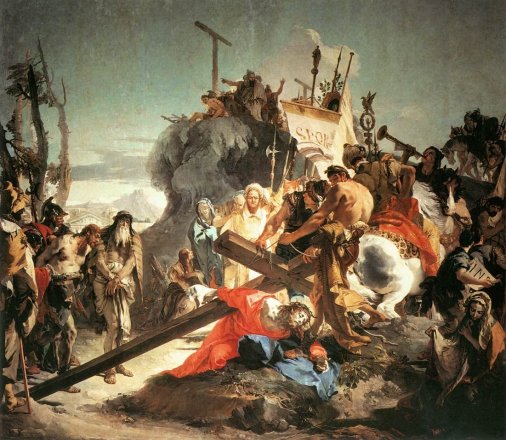
Three times Our Savior was tempted on the mountain, and three times He fell on the way to Mount Calvary.  Thus did He atone for our three falls – to the temptation of the flesh, the world, and the devil.”   (The Way of the Cross, originally written 1932; currently published by Society of St. Paul 2006)

“He advanced a little and fell to the ground and prayed that if it were possible the hour might pass by him; he said, “Abba, Father, all things are possible to you. Take this cup away from me, but not what I will but what you will.””

How we have all prayed the first part of this prayer!  Begging our Heavenly Father, “all things are possible to You, take this cup away from me”.  The agony of the deepest human suffering pleads in these very words.  The proverbial question “if You are all Good and all Powerful God, why am I suffering?”

The mystery is revealed in Jesus Christ alone.  “But not what I will but what You will.”  God wills our eternal salvation.  He wills it in conformity with respect for human free will.  Human choices cause suffering, but God’s will directs all things, even the events of His Son’s suffering and death, to the triumph of love.  Most of the time we won’t know the particulars of how everything will play out, but we do know the final ending.  Christ conquers – sin, human weakness, even death.  Those who exalt themselves in sin will be humbled, and those who persevere in humility will be exalted.  In Him we find healing, wholeness, strength, and eternal joy.  St. Paul promises that God works all things for good for those who love Him (Romans 8:28), not just some things.   Christ promises the Cross to His followers, but He also promises Resurrection. And the two are inseparable.

Fallen human nature resists faith in the power of the Cross.  Instead it often mocks it like the passersby at Jesus’ crucifixion.

In the account of Jesus’ Passion, individuals respond to His impending Cross in ways that we may relate.  Progress in our spiritual journey corresponds to how far we are willing to follow Christ.  Hopefully each year, we walk a step closer to the Cross and abide with Him a little longer.  Many things can trip us up however as we see in today’s Gospel.

I’ll follow until:

  • Jesus isn’t Who I want Him to be.  He won’t make me materially rich:  Judas
  • I’m tired or bored: Apostles asleep during Jesus’ Agony in the Garden
  • I’m threatened: disciples fleeing the crowd with swords; Peter recognized by the maid
  • I’m caught: young man in linen cloth
  • I’ll cause a rift or make waves: Pilate
  • Even still, Jesus invites His betrayers into His mercy.
“But God proves his love for us in that while we were still sinners Christ died for us.” Romans 5:8

This Holy Week, let us remain with Him.  Let us stay close to Him in prayer without falling asleep or rushing off to distractions.  Let us enter into the mystery of His suffering, death, and resurrection by accepting the griefs within our own situations and dying to what we cannot change, so that we may rise with Him who can redeem every sin and every situation.

Consider:

  • First and foremost, consider Christ’s love for you.  Reflect on how He has shared in your suffering.  Have you ever felt alone, betrayed, anxious, mocked, lied about, physically hurting, or exhausted?  Remember that Christ walks with you through the pain to resurrection in Him.
  • How can your love for Christ be strengthened?
    • Jesus observes in us that “The Spirit is willing but the flesh is weak.” Consider times when you have experienced this.  (Sleeping when you should be praying, resting instead of the effort to show up for someone hurting…)
    • Have you ever sold out Christ for a worldly gain? Consider when you have prioritized money, status, or worldly acknowledgement over doing God’s will for you.
    • Pilate’s betrayal sprang from “wishing to satisfy the crowd.” Sometimes we deny Christ by failing to speak up out of fear of being persecuted on His account. When asked “Are you a Christian?” or “Are you Catholic?”, how do you respond?  Do you hesitate or qualify it?  Or do you respond confidently, “Always be ready to give an explanation to anyone who asks you for a reason for your hope as St. Peter tells us (I Peter 3:15).
    • What fears can the devil use to tempt you away from following the Lord? How does he stir up your anxiety, and worry you into hiding, away from the Cross, like the other apostles?

 Make a Resolution (Practical Application):

  • Pray the Stations of the Cross or the Sorrowful Mysteries of the Rosary this week.
  • Reflect on one section of this Gospel passage a day this week.

Related Posts:

~ Written by Angela Jendro © 2018

* To receive these weekly posts automatically in your email just click the “follow” tab in the bottom right hand corner and enter your email address.


Keeping Christ in Christmas and John the Baptist in Advent

by Angela (Lambert) Jendro


December 16th, 2017 3rd Sunday in Advent

Gospel of Matthew 22:15-21 NAB

A man named John was sent from God. He came for testimony, to testify to the light, so that all might believe through him. He was not the light, but came to testify to the light.

And this is the testimony of John. When the Jews from Jerusalem sent priests and Levites to him to ask him, “Who are you?” He admitted and did not deny it, but admitted, “I am not the Christ.” So they asked him, “What are you then? Are you Elijah?” And he said, “I am not.” “Are you the Prophet?” He answered, “No.” So they said to him, “Who are you, so we can give an answer to those who sent us? What do you have to say for yourself?” He said: “I am the voice of one crying out in the desert, ‘make straight the way of the Lord,'” as Isaiah the prophet said.” Some Pharisees were also sent. They asked him, “Why then do you baptize if you are not the Christ or Elijah or the Prophet?” John answered them, “I baptize with water; but there is one among you whom you do not recognize, the one who is coming after me, whose sandal strap I am not worthy to untie.” This happened in Bethany across the Jordan, where John was baptizing.

Meditation Reflection:

For the second week in a row, we have another Gospel passage about John the Baptist.  John is considered the last, and greatest, of the prophets of the Old Covenant.  Jesus even said of him, “among those born of women there has been none greater than John the Baptist” (Matthew 11:11).   However, both John and Jesus proclaim that even the most magnificent of what has been so far, pales in comparison to the coming of the incarnate God and to His indwelling in the souls of the baptized. Thus, Jesus finishes his sentence with: “yet the least in the Kingdom of heaven is greater than he.”

John the Baptist’s message of repentance and spiritual preparation for our salvation is at the heart of Advent.  The weeks leading up to Christmas we evaluate how well we have been living as children of God, gifted with the grace of God dwelling in our midst and within our very souls.  It’s also a time to open ourselves to new possibilities and new challenges as disciples of Christ.  Thus, the message of John for repentance produces the necessary disposition for conversion.

Last year I wrote about the challenge of keeping John the Baptist in Advent.  I’d like to repost that below.  John prepared the way of the Lord, and he can help us do the same.

*********************************************************************************************

The image of John the Baptist, dressed in camel hair and eating locusts, preaching the message of repentance and authentic sorrow for sins, provides a stark contrast to the marketing images flooding us of jolly Santas, piles of presents, and delicious foods. I can understand why marketers find Santas and reindeer more appealing for sales than a desert ascetic speaking about sin.  People also feel increased pressures to prepare for Christmas by finding the perfect gifts within the time constraints of frantic schedules and limited budgets.  Nevertheless, the Gospel writers remind us that preparation for Christmas is ultimately preparation for the Incarnation of God our Savior.  He brings the gift of heaven, but we must prepare ourselves to receive that gift through repentance.

The push to start Christmas sales has lamentably encroached on Thanksgiving and even cast a shadow over Halloween.  However, it has completely replaced Advent in our culture.  It has become increasingly difficult to make the weeks leading up to Christmas a time of introspection, increased prayer, and sacrifice.  By the time Catholics celebrate Christmas on the Eve of Christmas day and for the two weeks following it, the rest of the culture has already moved on.

So how can we balance living in the culture that we do and still honor the important process of conversion Advent is meant to procure?  We can no longer wait to buy a Christmas tree until December 23rd because there won’t be any left.  We can’t leave them up for the duration of the Liturgical Christmas season because the tree will be a fire hazard at that point, plus we will have missed our road side tree pick up provided by our garbage companies.  I have surrendered this battle and get a tree the weekend after Thanksgiving.  I also have to admit that I look forward to the Hallmark Christmas movies and, if possible, make a weekend of it with my mother and my daughter.  Black Friday deals make Christmas gifts more affordable although I am too exhausted on Cyber Mondays to get online after work.  However, I reserve some Christmas feasting for Christmas.  I play Christmas music during the liturgical Christmas season and keep my Christmas decorations out (with the exception of the live tree).  In my classroom at school I leave Christmas lights up in my room until Lent, reminding the kids that Jesus is the Light of the World.

Spiritual sacrifice, examination of conscience, and remorse for sins is harder to find time for.  When the kids were little we would do Bible crafts and the kids had fun placing a felt ornament on our Jesse tree corresponding to a daily Scripture passage we would read.  Now that my kids are older, it’s harder to find a time we are all home to pray together.

As a busy mom, I appreciate that the Church offers practical advice regarding spiritual preparation during Advent, and oftentimes opportunities organized by the parish to help us.  Scripturally, spiritual preparation consists of prayer, fasting, and almsgiving.  Parishes often offer Advent reflections, retreats, and youth ministry events to facilitate more introspective prayer during this time.  We can add one of these events to our calendar just as we would any Christmas party invitation.  Fasting is especially difficult, with so many Christmas parties and cookie exchanges taking place, but consider fasting from something simple and achievable, so that even in those moments you are connected to Christ and honoring the preparation for His coming that He deserves.  I wouldn’t suggest giving up sweets altogether, but maybe you set a  limit for yourself or give up something else that’s meaningful to you.  Almsgiving may be the one aspect of Advent that lingers in our culture as generosity during the Christmas season seems to be a sentiment that still resonates in people’s hearts.  Parishes, schools, offices, and neighborhoods band together for charitable causes and provide opportunities for us to give.  We can participate with a spirit of giving to Christ who says, “Whatever you do for the least of these you do unto Me.”  Let’s not forget that Christmas also provides less visible opportunities for giving, like keeping our eyes open for family members, neighbors, or colleagues who are lonely and inviting them to our homes.

Fasting and almsgiving can further be applied in our interactions with one another.  The increased social contact brings with it both joy and discord; providing many more opportunities for spiritual works of mercy.  Christmas get-togethers bring out the best and worst in people.  It provides opportunities to fast from gossip and to give encouragement; to fast from pettiness and to bear wrongs patiently, to fast from competitiveness and to give comfort.  When we encounter persons we find annoying, frustrating, or difficult to be around, we can reflect on the compassion of the Lord, who became man, for love of that same person.  When we are moved by the generosity and love of others towards ourselves, we can praise Christ as we tangibly experience His love in our own lives.

Advent has become an uphill battle, but the view from the top makes climbing it worth all the effort.    This Advent I hope we can find a way to prepare our hearts and our lives for Christ a little more in some small way.  I hope we acknowledge and surrender to Him sins we need Him to heal.  Let’s demonstrate our authentic gratitude for his grace through prayer and acts of love.  Finally, let’s try to keep Christ in Christmas, and John the Baptist in Advent.

Consider:

  • “Emmanuel” means God-with-us.  Consider the gift of the Incarnation, that God became man, and dwelt among us.
  •  How has your heart and life opened to Christ over the years?  How has He dwelt more and more in your life?
  • Are there any areas of your life from which you keep Christ closed off?  Are there any places, people, or activities you wouldn’t feel comfortable having Christ present?
  • Reflect on the people you will encounter this season.  Consider them from Christ’s point of view.  How might you be the hands and heart of Christ to them in your interactions?

Make a Resolution (Practical Application):

  • Choose one way this Advent to pray, fast, and give.
  • Put a church sponsored Advent or Christmas event on your calendar, then attend it.
  •  Fast from gossip and critical remarks.
  • Intentionally give to Christ, above your regular tithing.  Choose a charity or a particular person, and be generous to Jesus by being generous to them.

~ Written by Angela Jendro © 2017

* To receive these weekly posts automatically in your email just click the “follow” tab in the bottom right hand corner and enter your email address.


The Vocation To Love

by Angela (Lambert) Jendro


November 19th, 2017 33rd Sunday in Ordinary Time

Gospel of Matthew 25:14-30 NAB

Jesus told his disciples this parable: “A man going on a journey called in his servants and entrusted his possessions to them. To one he gave five talents; to another, two; to a third, one–to each according to his ability. Then he went away. Immediately the one who received five talents went and traded with them, and made another five. Likewise, the one who received two made another two. But the man who received one went off and dug a hole in the ground and buried his master’s money.

After a long time the master of those servants came back and settled accounts with them. The one who had received five talents came forward bringing the additional five. He said, ‘Master, you gave me five talents. See, I have made five more.’ His master said to him, ‘Well done, my good and faithful servant. Since you were faithful in small matters, I will give you great responsibilities. Come, share your master’s joy.’ Then the one who had received two talents also came forward and said, ‘Master, you gave me two talents. See, I have made two more.’ His master said to him, ‘Well done, my good and faithful servant. Since you were faithful in small matters, I will give you great responsibilities. Come, share your master’s joy.’ Then the one who had received the one talent came forward and said, ‘Master, I knew you were a demanding person, harvesting where you did not plant and gathering where you did not scatter; so out of fear I went off and buried your talent in the ground. Here it is back.’ His master said to him in reply, ‘You wicked, lazy servant! So you knew that I harvest where I did not plant and gather where I did not scatter? Should you not then have put my money in the bank so that I could have got it back with interest on my return? Now then! Take the talent from him and give it to the one with ten. For to everyone who has, more will be given and he will grow rich; but from the one who has not, even what he has will be taken away. And throw this useless servant into the darkness outside, where there will be wailing and grinding of teeth.'”

Meditation Reflection:

Fair doesn’t always mean equal. Most often it requires a sliding scale.  Chores and responsibilities in the home depend on age and ability.  In the same way, privileges correspond to the level of responsibility and trustworthiness.  The workplace organizes in roles determined by qualification and experience, thus each is expected to contribute in the manner expected of their specific job.

Jesus reveals that in the kingdom of God there’s a sliding scale as well.  Each person has a job which is suited to his or her abilities and expectations for outcome that correspond to them.  Thanks be to God!

It seems reasonable so what’s the problem?  Sin.  I’d like to consider specifically Envy and Sloth.  Envy stirs discontent within us.  It looks around at others and desires their gifts and goods, and rejoices at their misfortunes.  It makes us want others’ privileges without necessarily their responsibilities.  It convinces us the grass is greener on the other side and blinds us to the Cross present in every state and place in life.

Envy can even distort spiritual aspirations.  The Lord has a plan for each one of us (Jeremiah 29:11). He has poured out His redemptive love for all mankind and invites everyone to Heaven.  He calls us each to love where He has placed us, not where He has placed someone else.

Sometimes love includes warm feelings and gratitude, other times it tries our patience and drains us.  At all times however, love is faithful.  I love my kids when receiving their hugs and when disciplining them during a tantrum, when being met with appreciation or the attitude that I can’t do anything right.   I love my students when engaging in an inspiring conversation with them, and when having to track down their missing homework or correct a bad behavior.

During the difficult tasks of love however, it’s tempting to think that we are in the wrong place.  We look around us and consider if we would be happier doing something else for the Lord.  And yet, precisely in faithfully loving during good times and bad, we most resemble our Lord and act as His disciples.

The second obstacle to faithful love is sloth.  Sloth is physical and/or spiritual laziness.  It especially undermines our strength of perseverance in the unappealing aspects of relational love such as the daily routine of chores, conflict resolution, work deadlines, bearing wrongs patiently, praying when we don’t feel like it, or going to Mass even though we’d rather sleep in.  It’s then that we want to just bury the talent God gave us and click the next episode of Netflix.

But God has made us with a purpose and has entrusted us with a noble task.  He calls us to greatness through great love.  Jesus called St. Mother Teresa to greatness through “small acts done with great love.” Before her, St. Therese of Lisieux the Little Flower, from whom Mother Teresa chose her name, learned the “Little Way” from Jesus and Mary.  Though a cloistered Carmelite nun who died at a young age, Jesus inspired millions through the love He poured into her and through her, so much so that Pope St. John Paull II proclaimed her a Doctor of the Church on October 19th, 1997.

In his homily, he described her missionary aspirations, which Christ asked her to fulfill not by travel (as she wished)  but through contemplative prayer and sacrifice.  Though not the martyr’s glorious death she desired, she came to understand that each is called to a different service, but all are called to the same purpose – love.  In fact, she concluded and exclaimed, “O Jesus, my Love … at last I have found my vocation; my vocation is Love!'” (Ms B, 3vº).  She understood that Christ simply wanted us to love with faithfulness wherever we were and that fidelity contributed to Christ’s larger mission (she is in fact the patron saint of missions).  Pope St. John Paul II described her insight in his homily saying,

 “Thérèse of Lisieux did not only grasp and describe the profound truth of Love as the centre and heart of the Church, but in her short life she lived it intensely. It is precisely this convergence of doctrine and concrete experience, of truth and life, of teaching and practice, which shines with particular brightness in this saint, and which makes her an attractive model especially for young people and for those who are seeking true meaning for their life.”

John Paul II followed the Little Way and Christ called him to love in astounding and public ways, travelling around the world, encountering millions of people, and fighting deathly philosophies becoming a saint through love too.  At the same time, St. Therese’s parents, who lived a simple Catholic family life, were canonized saints by Pope Francis in October of 2015.  Whether a pope or a parent, all are called to love and through that love be saints.  It’s love that God gives to us, and love that He wants returned – not buried and barren, but fruitfully multiplied.  Love gives love, and in giving it receives.  As St. John exclaimed in his first letter:

“We love because he first loved us.I John 4:19

Consider:

  • Who is someone who loves you faithfully in both times of crisis and the ordinary, yet repetitive, needs of everyday?
  • What makes you feel the most loved?
  • Where has God placed you to love?  Who are the people in your family, neighborhood, friendships, and work?  How might you show them love?  What practical help might they need?  What encouragement, time, or conversation may they need?  How might you brighten their day or help carry their burden?
  • Pray that the Holy Spirit will enable you to see opportunities to love, even in the difficult ways like disciplining or meeting deadlines.
  • Consider if envy or sloth ever undermine your vocation to love.  To you ever undervalue your vocation or your work?  Does it ever feel like it’s not enough?  Do you feel overwhelmed or tempted by distraction?

Make a Resolution (Practical Application):

  • Choose one person each day to love – with intention, patience, perseverance, and generosity.
  • Read John Paul II’s homily about St. Therese of Lisieux when he proclaimed her a Doctor of the Church.
  • Read about Mother Teresa or some of her writings.
  • Spend time with someone loving and learn from their example.

~ Written by Angela Jendro © 2017

* To receive these weekly posts automatically in your email just click the “follow” tab in the bottom right hand corner and enter your email address.


Love Shows Up

by Angela (Lambert) Jendro

20140329_231735329_iOS

October 1st, 2017  26th Sunday in Ordinary Time

 Gospel of Matthew 21:28-32 NAB

Jesus said to the chief priests and elders of the people: “What is your opinion? A man had two sons. He came to the first and said, ‘Son, go out and work in the vineyard today.’ He said in reply, ‘I will not, ‘ but afterwards changed his mind and went. The man came to the other son and gave the same order. He said in reply, ‘Yes, sir, ‘but did not go. Which of the two did his father’s will?” They answered, “The first.” Jesus said to them, “Amen, I say to you, tax collectors and prostitutes are entering the kingdom of God before you. When John came to you in the way of righteousness, you did not believe him; but tax collectors and prostitutes did. Yet even when you saw that, you did not later change your minds and believe him.”

Meditation Reflection:

Jesus knows us so well!  How often do we pay lip service to God?  How many spiritual goals and good intentions fall quickly by the wayside left undone?  In the morning, the first words on our mind and lips should be an expression of gratitude to the Lord, entrusting the day to His care.  Instead, we hit the snooze button and possibly let less godly words be the first on our lips.  As the day progresses, opportunities arise at every moment to be at the service of the Lord.  Do we embrace the tasks at hand and the duties before us, or de we try to avoid work and get by on minimal effort?

At the same time, if we hear God’s call, often it may seem outrageous at first, especially His insistence on forgiving others.  God challenges us to live beyond our natural limits, to participate in His divine love.  Our first response may be no, but upon further reflection and with the softening effect of grace, we may rise to the challenge after all.

Inauthentic love disappoints.  It makes big promises and grand plans only to fail to follow through on them.  Real love acts.  It proves itself by keeping promises, showing up, and responding to the needs of the beloved.

When St. Mother Teresa began her ministry to the poorest of the poor, she simply went out into the streets and showed up to comfort and aid those she met.  For the children she found aimless and alone, she began to teach them by gathering them together and writing with a stick in the dirt. For the sick, she begged the pharmacist for medicine.  For the dying, she offered what comforts she could along with loving companionship. God grew the ministry, Mother Teresa simply went out into the vineyard each day to work.

Practical goals and intentional habits form a framework of love that infuses our day with charity. However, when we don’t know where to begin, Jesus reminds us to start by jut showing up when asked.   It’s amazing how deep of an impression it can make.

When I consider who has touched my life, it has been those who laughed with me, shouldered burdens with me, encouraged me, or reached out in ordinary ways when I needed it. I remember when my mom chose to leave a law firm she enjoyed so she could open her own and have more time available for her kids.  It meant that despite the many responsibilities she had at her job every day, I could count on her to listen when I needed some advice, to cheer for me at school events, and to be there when I had a tough time.  Even now as a grown adult, I can still count on my mom to show up no matter what.

Above all, the Lord shows up.  He created our souls at the moment of our conception.   He became man, suffered and died on the Cross, and rose again for our salvation.  His angels guide and protect us.  His Mother intercedes for us. His very Spirit dwells within us as His Temple (1Cor 6:19). He is united to us as a Head to a body (Col 1:18), and as a vine to its branches (Jn 15:5).  God is always faithful.

But so great is Your faithful love, I may come into Your house, and before Your holy temple bow down in reverence of You.”  (Psalm 5:7)

The Lord is my Shepherd, I shall not want” (Psalm 23:1)

I will delight and rejoice in your faithful love. Be brave, take heart, all who put your hope in the Lord” (Psalm 31: 7, 24)

Better one day in Your courts than a thousand at my own devices.”  (Psalm 84:10)

Blessed are those who observe His instruction, who seek Him with all their hearts” (Psalm 119:2)

Love is about showing up and being there for someone. Love for Christ answers yes to His call and shows up for prayer. Love has the strength and perseverance to do the right thing even when it’s hard.  It may not be glamorous, but following through on our daily duties, even if we resist at first, makes an eternal impression on God.

Consider:

  •  How can you make yourself more available to God?  How can you hear His call more acutely and act more faithfully?
    • In times of prayer – when, where, and how do you pray.  How much do you listen in prayer?
    • In the duties of family life – what does your spouse, children, or parents need from you?
    • In the duties of your work life – how might your work become more of an offering to God?  Ask God what He desires from you and spend a few minutes listening to Him. Is He asking you for greater diligence, or do you need better boundaries on your work?  Is He asking you to reign in some of your conversations with co-workers, or is He asking you to make a greater effort at reaching out to them?
  • How do you respond to the work God asks of you each day?  What often derails you from following through with your commitments?  Is it distractions, sloth, fear…?
  • Reflect on the times God has shown up for you.  When has He proven His faithfulness in a time of need?  What blessings has He showered upon you?
  • Offer prayers of thanksgiving and blessing for those who have loved you over the years and those who continue to be there for you today.  Consider especially the persons you may be taking for granted.

Make a Resolution (Practical Application):

  •  The Psalms sing God’s praises, especially of His faithful love.  Pray one Psalm in the morning, one midday at lunch, and one at night.
  • Identify one thing you have said “no” to God about, and do it today.

*A great resource for learning to hear God’s voice is St. Ignatius’ Rules of Discernment.  Fr. Timothy Gallagher has an excellent podcast series explaining each one and giving practical examples.  You can listen to them for free online at this link:  Fr. Timothy Gallagher “Discernment of Spirits”

I also recommend the spiritual classic, “The Practice of the Presence of God” by Brother Lawrence.  It’s a small, thin book but a little goes a long way.

Related Posts: 

Authentic Love

Stepping Outside Our Comfort Zone & Walking On Water

Preparing the Soil…Spiritual Receptivity

~ Written by Angela Jendro © 2017

* To receive these weekly posts automatically in your email just click the “follow” tab in the bottom right hand corner and enter your email address.


How To Be Happy For Others and Like It

by Angela (Lambert) Jendro

i tim 6

September 24th, 2017  25th Sunday in Ordinary Time

 Gospel of Matthew 20:1-16a NAB

 Jesus told his disciples this parable: “The kingdom of heaven is like a landowner who went out at dawn to hire laborers for his vineyard. After agreeing with them for the usual daily wage, he sent them into his vineyard. Going out about nine o’clock, the landowner saw others standing idle in the marketplace, and he said to them, ‘You too go into my vineyard, and I will give you what is just.’ So they went off. And he went out again around noon, and around three o’clock, and did likewise. Going out about five o’clock, the landowner found others standing around, and said to them, ‘Why do you stand here idle all day?’ They answered, ‘Because no one has hired us.’ He said to them, ‘You too go into my vineyard.’ When it was evening the owner of the vineyard said to his foreman, ‘Summon the laborers and give them their pay, beginning with the last and ending with the first.’ When those who had started about five o’clock came, each received the usual daily wage. So when the first came, they thought that they would receive more, but each of them also got the usual wage. And on receiving it they grumbled against the landowner, saying, ‘These last ones worked only one hour, and you have made them equal to us, who bore the day’s burden and the heat.’ He said to one of them in reply, ‘My friend, I am not cheating you. Did you not agree with me for the usual daily wage? Take what is yours and go. What if I wish to give this last one the same as you? Or am I not free to do as I wish with my own money? Are you envious because I am generous?’ Thus, the last will be first, and the first will be last.”

Meditation Reflection:

The kingdom of Heaven, from which Jesus came, far exceeds any social construct we observe on earth.  Here our relationships, all the way from the inter-national to the personal, become skewed due to our two greatest weaknesses – pride and envy.

It’s childish really. Parents and elementary school teachers tire from the petty cases brought to them over and again throughout the day by children seeking “justice.” Moreover, in family life it can spiral out of control as one act of pride or envy against another is fought with counter measures of pride and envy and so on.  Rather than accept their own guilt for their personal bad reaction, kids try to pass on blame and push parents to the classic question, “Who started it?”  As everyone points fingers and clamor for justice, the poor mom and dad beg the kids to settle down and just be merciful with one another.

St. Paul tells us, “Love is patient, love is kind…”  In other words, love tries to be understanding instead of over-reacting.  Love shows compassion toward weakness, even weakness of character. Love is generous rather than miserly.  Love doesn’t look out for #1, it looks out for the beloved.

Jesus’ parable of the landowner and day laborers illustrates the striking difference between our natural inclination and experience and the kingdom of Heaven. When I hear this parable I know that I shouldn’t agree with the laborers who were upset, but I can’t help feeling their disappointment with them.  I hate to admit that even thoughts of, “why weren’t the guys the landowner found in the afternoon not there in the morning?”  Even worse, my imagination considers multiple reasons they were late, all being their own fault or the product of vice.

However, Jesus knows our fallen thoughts so He includes important details in the parable to counter such accusations.  Thus, prior to hiring the last crew at 5:00, he asks them why they have been standing there idle all day.  They respond with an innocent explanation – no one had hired them.   “Exposed!”, as my kids would say.  My thoughts reveal a childish attitude of rivalry rather than a mature disposition of love.

But what about the unfair pay?  And why did the landowner pay the last men first in front of everyone else?  Every parent knows if you plan to treat one kid and not the others on a particular day, at least keep it on the down-low.  You spontaneously stop for DQ with one of your sons on the way home from a baseball game?  Only a rookie parent would fail to have the ice cream finished being eaten and all evidence thrown away in an inconspicuous garbage before entering the house.  Never mind that you make a point treat the other kids individually  too at various times.  If one kid walks in the house with a half-eaten blizzard, mutinous anarchy erupts.  One stray DQ napkin, and the moment the door to the van opens the other kids point and yell “What?!  You went without us?  Unfair!!!”  Their envious rivalry takes all spontaneity out of love.

On the surface, the laborers’ disappointment seems fair, however Jesus reveals that it stems from envy.  Next to pride, envy is the most cited root of the many social and personal ills discussed in the Catechism.

Jesus invites us to consider a different way of thinking, living, and being. To imagine a kingdom free of pride, envy, ambition, lust, and selfishness we have to think of it in terms of love.  Not the fluffy, emotional kind of love.  Rather, courageous and deep love which wills the good of the other and finds joy in sacrifice if it means enriching or healing the beloved.

Jesus compares His relationship with us to the love a groom has for his bride, willing to give everything even at a sacrifice, and with great joy.  He compares our interconnection with one another to a body united to Him as its head.  Thus, one person’s pain is shared by everyone, and one person’s gain is rejoiced in by everyone.

Consider the parable again from Christ’s perspective.  The men the landowner found late in the day were aimless, anxious, and in danger of starvation.  If they did not work that day, they would not have a day’s wage and would be unable to provide for themselves and their families.  They owned no land to provide them with some kind of security.  They had no annual salary, health insurance, or any kind of future protection.  They lived day to day, always uncertain about tomorrow.

The first men hired physically toiled longer, but they also had the peace of mind that at least for that day they would have a wage and therefore food. Moreover, there’s a certain dignity related to putting in a hard day’s work.

If those without work were strangers, it would be easier to rationalize competitiveness.  Imagine however that the ones hired later are your sons or daughters, or close friends.  It would be hard to truly enjoy your wage knowing how worried you might be that they only worked a few hours that day and would earn too little to eat enough on.  Upon seeing your beloved child or friend provided a full day’s wage, you would rejoice with them as well as enjoy your own wage more because your friend received the same.  You would also rejoice that they had the opportunity to be productive and their work valued.

Jesus invites us all into His Kingdom.  He finds us standing idle, looking for meaning and purpose, waiting for Truth and Mercy.  He promises a just wage for working for Him – the gift of enduring love, authentic meaning, and eternal happiness with Him.  If we love our neighbor, we will feel pained seeing them still standing idle, wasting the day, impoverished and anxious.  We would want the same reward for them that we received from Christ no matter when they joined His crew.  In fact, to have labored with the Lord, is a gift in and of itself.  When it comes to serving our beloved, we don’t ask how little can I do for them but rather how much?

Consider:

  • Consider how quickly we tend to assume the worst about a person.  When have you misjudged someone’s intentions or situation?  How might you see others through the lens of love rather than rivalry?
  • Consider the dignity of work.  When have you put in a hard day’s work and loved it?  Why does it feel good to be productive?
  • Consider the joy connected to laboring out of love.  Which tasks would seem ridiculous to take pleasure in if you didn’t love the person?
  • Consider the contrast between envy and love.  Envy becomes angry at another’s blessings, love rejoices when another is blessed.  Envy competes for what it believes to be limited resources or opportunities.  Love understands that God can bless everyone.

Make a Resolution (Practical Application):

  • Combat envy with the opposite virtues of contentedness and gratitude.  Do one thing each day this week to nurture contentedness and express gratitude.

Related Posts:

How can God be both Justice and Mercy?

Prepare for the Coming of Christ’s Mercy by Giving Mercy

The Beatitudes: Climbing the Mountain of God by Way of the Valley of Humility


~ Written by Angela Jendro © 2017

* To receive these weekly posts automatically in your email just click the “follow” tab in the bottom right hand corner and enter your email address.


Christian Conflict Resolution

by Angela (Lambert) Jendro

September 10, 2017; 23rd Sunday in Ordinary Time

 Gospel of Matthew 18:15-20 NAB

Jesus said to his disciples: “If your brother sins against you, go and tell him his fault between you and him alone. If he listens to you, you have won over your brother. If he does not listen, take one or two others along with you, so that ‘every fact may be established on the testimony of two or three witnesses.’ If he refuses to listen to them, tell the church. If he refuses to listen even to the church, then treat him as you would a Gentile or a tax collector. Amen, I say to you, whatever you bind on earth shall be bound in heaven, and whatever you loose on earth shall be loosed in heaven. Again, amen, I say to you, if two of you agree on earth about anything for which they are to pray, it shall be granted to them by my heavenly Father. For where two or three are gathered together in my name, there am I in the midst of them”

Meditation Reflection:

Incorporation into the Christian community means being adopted into a family.  This in turn means we have a greater responsibility toward our brothers and sisters in Christ.

Jesus knows families can struggle with dysfunctional ways of dealing with things – from gossip, to triangulating, to manipulation or passive aggressive tactics, and more.  As the head of the Christian family however, He provides us with clear instructions about the best way to love our brother or sister in difficult situations.

First, Jesus tells us to confront our loved one directly if they have hurt us in some way.  This means we cannot play the martyr, hope they read our mind, let it build up, or sweep it under the rug.  Jesus knows healthy relationships require honest communication and ongoing reconciliation.  We all sin and we all inevitably treat our loved ones unfairly or unkindly.  To move forward reconciliation is essential.  In our pride however, we sometimes don’t even realize we are hurting the one we love unless they tell us.  Jesus instructs, therefore, that Christian love should make the person aware of their sin.  The Church actually lists this as a Spiritual Work of Mercy called “admonish the sinner.”  It’s not meant to be mean or judgmental, but to help a person grow into Christian maturity.

If the person won’t listen, likely claiming that you are being unfair, then Jesus proposes you bring another witness or two.  The goal would be to open the person’s eyes to their sin so they can be healed and reconciliation can be restored.  Sometimes the perspective of a couple of people can help to establish with objectivity the truth of the situation.

It’s amazing how blind we are to our sinful attitudes and habits, especially toward our family!  Even when confronted, we hold on so tightly, and refuse to change.  We often rationalize, “This is how I am. My family should just love me unconditionally.”  However, because our family loves us unconditionally, we should try even harder to change because we want to give them the best version of ourselves not the worst.

In general, Jesus wants us to avoid the tornadic plague of gossip or the festering sore of passive aggressive retaliation.  He wants His family to be happy, healthy, and loving.  Direct communication and the ally of one or two close friends is usually enough for most problems.  However, there are some injustices which require wider assistance and, if not changed, are too destructive to let go on.  For instance, if a family member refuses to change his or her abusive behavior or treat an addiction, it needs to be brought to light for the whole community.  If the person still refuses to change, family members are sometimes forced to separate themselves from the person in order to protect themselves and others, and to, in love, withdraw from enabling the abuser or addict. It may seem extreme and even un-Christian, however Jesus came to conquer sin not to support it.  Paradoxically, separating from addicts or abusers can motivate change.  At the very least, it is a way of evangelizing.  It shows by your actions that the behavior is wrong.  Lastly, Jesus is teaching us that although we have a serious responsibility toward the souls of our Christian brothers and sisters, after we have gone through the process He laid out, we may feel sorrow for their situation but we are not responsible for their behavior.  At that point, we can have peace that we have done everything we could.  We must work tirelessly for the salvation of souls, but we must also know the limits placed on us by free will.

Thankfully, we can always be a blessing to others through prayer and sacrifice.  Even if we must separate from someone physically, financially, or even in communication, we can still pray for them.   Moreover, just as Jesus exhorted us to confront a person together, He also exhorts us to pray for others together.  As children of God, and heirs with Christ (Romans 8:17), our prayers come before Him with all the force and influence a son or daughter can have on their father, especially when they plead with him as a family.

In conclusion, the vocation of marriage plays an important role in the formation of this mindset and the practice of applying Christian love to all different kinds of situations.  In his encyclical Familaris Consortio, Pope St. John Paull II called the family the first “school” of Christian love, from which persons develop the Christian self-giving necessary for mature interaction with the world as adults.  He writes:

The family is the first and fundamental school of social living: as a community of love, it finds in self-giving the law that guides it and makes it grow. The self- giving that inspires the love of husband and wife for each other is the model and norm for the self-giving that must be practiced in the relationships between brothers and sisters and the different generations living together in the family. And the communion and sharing that are part of everyday life in the home at times of joy and at times of difficulty are the most concrete and effective pedagogy for the active, responsible and fruitful inclusion of the children in the wider horizon of society.

Familiaris Consortio par. 37

True love is more than an emotion.  It’s a decision to choose the good for one’s beloved.  The best course of action isn’t always easy and it isn’t always clear.  Thankfully, we are not alone in this.  We can look to Jesus and to our Christian family to show us the way.

Consider:

  •  Consider the gift of being God’s daughter or son.  Reflect on Jesus’ love for you as your Brother.
  • Consider how you handle conflict. What do you do well? What could you improve?
  • How might you apply Jesus’ instructions for resolving problems to a situation in your life?
  • When has someone shown “tough love” toward you? How did their loving honesty help you grow?
  • St. Padre Pio said, “Prayer is the best weapon we possess. It is the key that opens the heart of God.”   Consider the power of prayer.  Reflect on the gift of being able to actively fight for our brothers and sisters by praying for them to a God who loves us and will listen to us.

Make a Resolution (Practical Application):

  •  Apply Jesus’ process to a conflict in your life this week.
  • Resolve not to gossip this week.
  • Say a prayer every day for someone who bothers you.

Related Posts:

Finding Peace Amidst Division

Authentic Love

Getting the Last Word…But Making it a Blessing

~ Written by Angela Jendro © 2017

* To receive these weekly posts automatically in your email just click the “follow” tab in the bottom right hand corner and enter your email address.


Authentic Love

by Angela (Lambert) Jendro

August 19th, 2017; 20th Sunday in Ordinary Time

Gospel of Matthew 16:21-27 NAB

Jesus began to show his disciples that he must go to Jerusalem and suffer greatly from the elders, the chief priests, and the scribes, and be killed and on the third day be raised. Then Peter took Jesus aside and began to rebuke him, “God forbid, Lord! No such thing shall ever happen to you.” He turned and said to Peter, “Get behind me, Satan! You are an obstacle to me. You are thinking not as God does, but as human beings do.” Then Jesus said to his disciples, “Whoever wishes to come after me must deny himself, take up his cross, and follow me. For whoever wishes to save his life will lose it, but whoever loses his life for my sake will find it. What profit would there be for one to gain the whole world and forfeit his life? Or what can one give in exchange for his life? For the Son of Man will come with his angels in his Father’s glory, and then he will repay all according to his conduct.”

Meditation Reflection:

Peter loved Jesus.  He left everything to follow Him. Peter put his whole heart into the mission and his courage and zeal expressed themselves in extraordinary ways.  Moved by faith, Peter walked on water.  With his heart open to the Holy Spirit, he boldly answered Jesus’ questions to the disciples “Who do you say that I am?” by proclaiming that Jesus is the Christ and the Son of God.

Love inspires, emboldens, strengthens, and provides unique insights into the beloved.  Like the love between a husband and wife, a mother or father and their children, a beloved brother or sister, or a dearest friend, love wells up inside and can’t help but express itself exclamations of affection, physical closeness, and fierce protectiveness.

Due to our wounded, fallen nature however, our love can also be misdirected.  In this Gospel passage, Peter’s love mixed with his pride and with his worldly understanding to embolden him in a way that undermined, rather than supported, Jesus.

Our love needs conversion to be authentic and to be true to our beloved.  It requires ongoing formation in what is True and Good as God has revealed it, rather than as our emotions direct us or the culture.  It requires practice as well, to break bad habits and form good ones, or to overcome personal weaknesses that hurt the relationship.

Peter loved Jesus and was honored to be given the keys to the kingdom just one chapter prior to this.  However, his pride and ambition, together with his cultural assumptions about what that kingdom would look like, misdirected his love to preserving an earthly kingdom by preserving Jesus’ earthly life.  Just when Jesus needed the support of His disciples the most, as His “Hour” of Redemptive suffering for all mankind approached, Peter pulled Him aside and tried to dissuade Him.

Similar to Peter, our love needs Christ’s grace and truth to be authentic.  Consider the sentiment “I just want you to be happy.”  It can motivate noble sacrifice, but it can also rationalize weakness.  If we define happiness as merely earthly comfort, ease, security, and pleasure, we risk encouraging our beloved to turn from their cross rather than helping them carry it.  Yet, in trying to save their life, we could actually cripple them.

Consider the paradox inherent in parenting.  Kids need protection, nurturing, and comfort.  At the same time, to mature into adulthood, they also need to work through difficulties, setbacks, and pain.  The temptation to remove everything hard undermines the maturation process, whereas supporting them through the struggle without removing it for them can aid their maturation.  To know when to intervene and when to stand back is NOT easy!  It requires the counsel of the Holy Spirit and the grace of fortitude.  When Jesus’ life was threatened by King Herod, Mary and Joseph fled to Egypt to protect Him.  When Jesus was scourged and crucified however, Mary stood by Him, feeling every pain with Him, but knew it was necessary for His mission.

In marriage, family life, and friendship, authentic love needs conversion.  When we say “I just want you to be happy,” we have to be honest about which kind of happiness we desire for them.  Jesus is clear,

Whoever wishes to come after me must deny himself, take up his cross, and follow me. For whoever wishes to save his life will lose it, but whoever loses his life for my sake will find it.” 


Those we love will struggle with sin.  It’s the battle of this life.  Authentic love won’t condone the sin or escaping it.  Rather, it will strengthen a person to speak the truth in love and support the beloved through the pain of conversion because true life and true freedom is found in the Lord. In the first reading for today (Jeremiah 20:7-9), the prophet Jeremiah expresses authentic love.  His human nature desired comfort and to simply be liked.  Nevertheless, his people had succumbed to habits of sin and needed to be corrected lest they die eternally from their destructive behavior and attitudes.  He didn’t want to speak out anymore because every time he did they met him with anger.  However, when he tried to remain silent, the truth welled up in him and he couldn’t hold it in any longer without suffering even greater pain.

True love can’t stand to see sin hurting it’s beloved.  Our friends and family need us to battle for their souls with the strength of prayer, God’s Truth, and the cross, not sentimentality.  And we need those who love us to battle for our souls in the same way.

To do this, we need to actively cooperate with the Holy Spirit that our love can be fully converted.  St. Paul states it well when he says,

“Do not conform yourselves to this age but be transformed by the renewal of your mind, that you may discern what is the will of God, what is good and pleasing and perfect.” Romans 12:2

It will take time, effort, and support.  However, we can be encouraged by Peter’s example.  Peter’s conversion took time as well, but by the end of his life his love had become so perfect, that he accepted the cross and crucifixion for himself that he had once tried to dissuade Jesus from.

I’ll end with two quotes that I read often which give me hope:

Pope Francis   January 19, 2016

“there is no saint without a past and no sinner without a future


St. Josemaria Escriva

“A saint is a sinner that keeps trying.”

Consider:

  • Reflect on Mary’s love for Jesus.  Consider her fierce protection when He was young.  Consider her fierce loyalty to His mission on the Cross, despite both of their suffering.
  • Consider the words “I just want you to be happy.”  Pray about what true happiness is, where it can be found, and how it can be attained.
  • When has Christian love required you to carry a cross?  Who supported you?  Who tried to dissuade you?
  • When have you had to stand by someone while they carried a cross?  In what ways were you tempted to encourage them to leave the cross?  How were you able to support them in their pain or struggle and make the burden easier?

Make a Resolution (Practical Application):

  • Do one thing each day for “the renewal of your mind, that you may discern what is the will of God, what is good and pleasing and perfect.”
    • Spend 5 minutes with Scripture
    • Read a good Christian book
    • Listen to Christian podcasts
    • Visit with a Christian friend
  • Support a friend on their spiritual journey who is struggling with a sin or with a cross.
    • Pray and sacrifice for them; Speak truth in love; Visit them; encourage them with Scriptures of hope and resurrection after the Cross.


~ Written by Angela Jendro © 2017

* To receive these weekly posts automatically in your email just click the “follow” tab in the bottom right hand corner and enter your email address.


Following the Leader…Christian Discipleship and Leadership

by Angela (Lambert) Jendro


August 27th, 2017; 21st Sunday in Ordinary Time

 Gospel of Matthew 16:13-20 NAB

 Jesus went into the region of Caesarea Philippi and he asked his disciples, “Who do people say that the Son of Man is?” They replied, “Some say John the Baptist, others Elijah, still others Jeremiah or one of the prophets.” He said to them, “But who do you say that I am?” Simon Peter said in reply, “You are the Christ, the Son of the living God.” Jesus said to him in reply, “Blessed are you, Simon son of Jonah. For flesh and blood has not revealed this to you, but my heavenly Father. And so I say to you, you are Peter, and upon this rock I will build my church, and the gates of the netherworld shall not prevail against it. I will give you the keys to the kingdom of heaven. Whatever you bind on earth shall be bound in heaven; and whatever you loose on earth shall be loosed in heaven.” Then he strictly ordered his disciples to tell no one that he was the Christ.

Meditation Reflection:

Generally speaking, our culture loathes the word “authority.”  It appears to undermine our values of autonomy, self-expression, independence, and freedom.  Moreover, the idea of monarch-rule seems archaic and undemocratic.  In consequence, our cultural norms and assumptions can hinder our understanding and appreciation of the Kingdom of God.

God’s Chosen People became a kingdom under Saul, then famously David.  David’s authority however came from God.  He was chosen by God and anointed king by God’s prophet Samuel.  Moreover, David’s success as a leader corresponded with his fidelity to the Lord.

The Kingdom of Israel served as a glimpse, or foreshadowing of the Kingdom Jesus would establish.  Thus, Jesus acted as the New David.  However, instead of assigning authority to protect the physical security of His people, lands, and finances, He assigned authority to leaders He wished to protect the souls of His people, the Truth He came to reveal, and the path He opened for our salvation.

The Pope, like David, is a human being.  This means he will falter at times, sin, and struggle with human limitations.  We must be careful however, not to project our cultural norm on our understanding of his role.  Our leaders our voted upon to represent our views.  They operate at a natural human level, with the responsibility to protect our physical security, rights, lands, and commerce.  The Pope’s position, begun with Peter, has a different role.  Christ chose Peter.  Christ bestowed His authority upon Peter to be Christ’s representative, not the representative of popular opinion.  Lastly, the Holy Spirit empowered Peter supernaturally to identify correctly the truth about Christ, which could only be known by a supernatural grace.  The Pope is called to shepherd people on the way to salvation.  This resembles a family structure more so than a political one.

I am grateful to God to live in our democracy.  In my opinion, despite its flaws, it’s still the best, and most free, country in the world.  Nevertheless, I don’t run my family like a democracy.  If decisions were made by vote we would eat doughnuts every morning, live way outside our means, and discipline would devolve to mob rule.  Much to my children’s chagrin, our family is run as a monarchy.  Though they push against the rules, we have much more peace, justice, and love as a result.  In this monarchy, God is our king, and my husband and I are His stewards.

At times, my kids have accused me of being either overly strict or overly protective when I said no to something they wanted to do.  To encourage me to soften, they would make life difficult for me, then add “no one really cares Mom, it’s not that big of a deal.”  Even though I felt for them, and in a secular culture what they said was true, I also knew I had to hold the line because, at the end of the day, I would be held responsible before God.  So, I often respond to them, “I have to do what’s right for you, because it’s my responsibility and I will have to face God one day.” And when I fail to hold the line, and am a weak parent, I ask God for forgiveness and the grace to be stronger.

So, contrary to our cultural norms and assumptions, I have seemingly Medieval parenting methods to my children.  Yet, as parents we all know that raising kids to be mature adults is different than running a nation-state.  Kids need us to exercise our authority, especially in decisions that they are too young to make. We are in a better position to discern what is safe from what is too risky, truth from lie, and wisdom from folly.  Of course, unlike Christ we are not all-knowing, so oftentimes we need the Holy Spirit to guide us in our position and enable us by His grace to make the right choices.

Discipleship means that Christ is our king.  We can embrace this monarchy because our king is also our loving, self-sacrificing, and divine Savior.  As king, He chose to bestow His authority upon some of His subjects to govern for Him on earth and promised to safeguard it until the end of the world.

Upon Peter, and every pope thereafter, He bestowed the authority to say who Christ is, and gave them the supernatural ability to be correct.  The role of pope is to preserve, protect, and promulgate the Deposit of Faith given by Christ.  In addition, when confusion over Christ’s revelation occurs, for the sake of unity someone must be the authority that determines which response is correct and which is false.  During the first councils of the early church the question of whether Jesus is God, Man, or both was a long, heated, argument.  If determined as a vote, our doctrine would be that of Arius’ interpretation – Jesus was only a man but the highest possible one.  The pope recognized Athanasius’ response as the true one – that Jesus is both God and man.

In the vocation of marriage, Jesus bestows His authority on mothers and fathers over their children.  Thus, as children we have an obligation to obey our parents.  And as parents, we have the responsibility of exercising our authority in a Christian manner.  It’s not always easy.  When kids are fighting I would rather just yell “stop bickering” (which is never really effective), than get up, intervene, and if necessary impose consequences for bad behavior.  Crafting Christian rules takes time and effort, both of which are in short supply.  Enforcing the rules with appropriate consequences means suffering the rebuffs and anger of resistant kids.  As kids get older, knowing what decision to make in given circumstances becomes even more difficult.  They require even more prayer and the inspiration of the Holy Spirit.

Nevertheless, we can find peace and confidence in our divine monarch, Jesus Christ.  He reigns in our souls with supernatural power and grace.  Despite our natural limitations, He transforms us into one Body, one family in God. His Holy Spirit guides us – enlightening our minds, strengthening our wills, and inflaming our hearts with love.  Our unity in Christ can be seen visibly in the family and in the Church. Our trust is not in ourselves, but in Him who enables us to complete the mission He entrusted to us.

Consider:                                                      

  • To what extent does Jesus reign in your heart and in your life?  When do you let Him lead, and when do you resist His commands?
  • Our culture tends to value being a leader over a follower.  How does this influence our discipleship?  Do we value being followers or wish only to lead?
  • In what ways has Christ appointed you His steward?  In your vocation – who has He entrusted to your care?  In your occupation – who or what has He entrusted to you and what fruit do you think He expects to see from it?  In His Creation – what does He ask of you for its care?
  • How do you respond to the authority of Christ’s vicar on earth, the pope?  Do you accept his guidance on matters of faith and morals or do you resist?  Is your faith strong enough to see not just the human, visible reality of the Church, but the divine, invisible reality as well? What has made this either easier or harder for you?
  • Consider the relationship between authority and unity.  How are the two related and necessary?

Make a Resolution (Practical Application):

  •  Each morning, look ahead at the day.  Invite Christ to lead you in each aspect, and for the grace to follow.  Even if you are called to lead others, let Christ lead you first.
    • Examples:
    • If you make a to-do list at work or home, prayerfully consider first how Christ would prioritize the items rather than how you want to prioritize them.
    • What expectations would Christ want to see in your family? Are there any that need greater implementation?
    • What expectations does Christ have for you at work? Do you honor Him by respectful, honest, and edifying language, free from vulgarity or slander?  Do you honor Him in action through diligence in your work and mercy towards your co-workers?
  • Pray the Suscipe prayer by St. Ignatius or the Serenity Prayer.  Click here for a copy of both: serenity-and-suscipe-prayers

~ Written by Angela Jendro © 2017

* To receive these weekly posts automatically in your email just click the “follow” tab in the bottom right hand corner and enter your email address.


Preparing the Soil…Spiritual Receptivity

by Angela Lambert

July 16th, 2017; 15th Sunday Ordinary Time

Gospel of Matthew 13:1-23

On that day, Jesus went out of the house and sat down by the sea. Such large crowds gathered around him that he got into a boat and sat down, and the whole crowd stood along the shore. And he spoke to them at length in parables, saying:

 “A sower went out to sow. And as he sowed, some seed fell on the path, and birds came and ate it up. Some fell on rocky ground, where it had little soil. It sprang up at once because the soil was not deep, and when the sun rose it was scorched, and it withered for lack of roots. Some seed fell among thorns, and the thorns grew up and choked it. But some seed fell on rich soil, and produced fruit, a hundred or sixty or thirtyfold. Whoever has ears ought to hear.”

The disciples approached him and said, “Why do you speak to them in parables?” He said to them in reply, “Because knowledge of the mysteries of the kingdom of heaven has been granted to you, but to them it has not been granted. To anyone who has, more will be given and he will grow rich; from anyone who has not, even what he has will be taken away. This is why I speak to them in parables, because they look but do not see and hear but do not listen or understand. Isaiah’s prophecy is fulfilled in them, which says: You shall indeed hear but not understand, you shall indeed look but never see. Gross is the heart of this people, they will hardly hear with their ears, they have closed their eyes, lest they see with their eyes and hear with their ears and understand with their hearts and be converted, and I heal them. “But blessed are your eyes, because they see, and your ears, because they hear. Amen, I say to you, many prophets and righteous people longed to see what you see but did not see it, and to hear what you hear but did not hear it. “

Hear then the parable of the sower. The seed sown on the path is the one who hears the word of the kingdom without understanding it, and the evil one comes and steals away what was sown in his heart. The seed sown on rocky ground is the one who hears the word and receives it at once with joy. But he has no root and lasts only for a time. When some tribulation or persecution comes because of the word, he immediately falls away. The seed sown among thorns is the one who hears the word, but then worldly anxiety and the lure of riches choke the word and it bears no fruit. But the seed sown on rich soil is the one who hears the word and understands it, who indeed bears fruit and yields a hundred or sixty or thirtyfold.”

Meditation Reflection:

St. Paul tells us that “Jesus is the same yesterday, and today, and forever” (Hebrews 13:8).  So why does the Word of Christ set some people’s hearts on fire while others pass it by with apathy or disdain?  Does Jesus play favorites with who He invites to understand His message and who He lets go?  How does He choose to whom “knowledge of the mysteries of heaven is granted”?

Jesus’ answers in a surprising way – He is the sower who offers Himself to everyone; whether it takes root depends on us. We are responsible for the extent to which we receive His Word.

It reminds me of my kids’ proverbial complaint that I’m not fair.  Each one is certain that they have more chores than the others, and that they receive less than the others.  I remind them that it only appears that way because they see their work but don’t see the work their siblings do.  Either, because sometimes it occurs when they are not around, or because they just refuse to acknowledge it.  Similarly, the appearance of others receiving more stems from ingratitude and envy rather than a material difference.  It’s easy to fall into the same trap spiritually as God’s children.  God treats us all fairly, it’s our perception that tends to need adjustment.

Jesus’ parable illustrates the affect that attitude has on our faith.  For God’s Word to be sown in our hearts and transformative, we must be receptive.  Receptivity requires an attitude of gratitude, humility, and love. Resistance undermines the work God can do within us, and the fruit it can bear in our lives.

The seed that falls on the path has no effect because it’s met with apathy or hostility.  Consider the things that deaden our hearts or fuel them with anger towards God.  Certainly secular culture, infused with hedonistic consumerism, dulls our desire for God by distracting us with instant gratifications and claiming that God is irrelevant to society.  When things go wrong or we suffer however, our faith in God’s existence suddenly appears but only to blame Him.  Anger and apathy make relationship impossible with anyone.  Relationships require investment, interest, and openness.  Much like the futility of reasoning with someone who’s already discounted you, if we don’t care about God except to shake our fist at Him, nothing He says or does will be convincing.

The rocky soil illustrates faith rooted only in sentimentality and emotions.  It resembles the infatuation stage of a relationship.  During that time, the couple is enamored with one another and experience strong feelings that say their love will last forever.  Those feelings however, do not, as C.S. Lewis puts it, deliver on their promises.  Feelings, by nature, come and go.  Lasting love is a decision not an emotion.  The infatuation stage in our relationship with God may include powerful feelings of love for the Lord and the desire for holiness.   When a person encounters suffering or confusion, that love will either wither from shallowness, or go deeper to root down further in the soil.   Fair weather friends make for rocky relationships, and the same goes for our relationship with God.

For those who make it past luke-warmness, and deeper than mere emotions, thorns still threaten to choke out faith with worldly anxiety and desires.  To live in the world but not of the world, is no easy task.  Worry about our comfort, security, and what others think about us can quickly turn our gaze from God back to earth, crowding out room for His grace. We sit down to pray but our phone buzzes with a notification.  Worry or desire pulls us away from Scripture and back into our technology.  Social events fill up the calendar and we think we are too busy to go to Church.  We might tell ourselves that we just have to prioritize these worldly things for a time, and then we will be able to relax and give God our whole selves.  It tends to only be a trick we play on ourselves, like the carrot at the end of the stick – the donkey keeps walking but the carrot keeps moving at the same time he does.

A person who has found Christ, realizes that in Him they have everything.  A humble heart, open to the Lord, fills with gratitude as it receives grace upon grace.  Apathy turns to zeal, sentimentality to conviction, and the constant grasping after the next thing is replaced with spiritual fulfillment and peace.  In this rich soil, the soul begins to bear fruits of faith, hope, and love, along with joy, peace, patience, kindness, goodness, faithfulness, gentleness, and self-control (see Galatians 5:22-23).

When we find ourselves saying, “Why doesn’t God speak to me?  I pray but don’t hear anything?,” or “I just don’t feel like praying or going to Church, I don’t get anything out of it,” or “My life always feels so out of control no matter what I do, why can’t I ever just find peace?”; we can take a step back and evaluate the soil in our souls.  The Word of God has come to us in the flesh and remains with us, what can we do to better receive Him?  Begin with asking for His help.

Consider:

  • When do you struggle with feelings of not caring about God or your faith?  What or who fuels that hardening of heart, and what/who softens your heart toward God?
  • Despite my love for flowers and home-grown vegetables, I’m a terrible gardener because I’m not attentive enough about keeping things watered or clearing away weeds.  How can you be more attentive to the garden of your soul?  What does it need to be watered, and what weeds need clearing away?
  • Pray about how deeply your faith is rooted.  Is it guided primarily by emotions or by principle?  Consider how your relationship with God is similar to, or different than, your relationships with others.
  • Ask the Holy Spirit to reveal the thorns in your spiritual life.  Prayerfully consider what competes with your prayer time, Mass, your generosity with the Lord, or your openness to His teachings.  Ask for Christ to remove the thorns and replace them with greater love.
  • Mary exemplifies perfect receptivity to the Lord, rooted in deep love and enduring the hardest tribulations.  Ask for her intercession to soften your heart and to “open your eyes to see and your ears to hear” as she did.

Make a Resolution (Practical Application):

Work on preparing the soil for Christ:

  • If you need more gratitude: each night list 10 things you are thankful for from the day.
  • If you need more humility and detachment: Pray the Humility Prayer each day.
  • If you need more openness:  Read Scripture for 5 minutes each day.  It could be the daily readings (which can be found at http://usccb.org), a devotional, or simply opening up one of the Gospels (Matthew, Mark, Luke, or John).

Related Posts:

~ Written by Angela Lambert © 2017

* To receive these weekly posts automatically in your email just click the “follow” tab in the bottom right hand corner and enter your email address.


Sharing the Burden, Lightening the Load

by Angela Lambert

July 9th, 2017; 14th Sunday Ordinary Time

Gospel of Matthew 11:25-30
At that time Jesus exclaimed: “I give praise to you, Father, Lord of heaven and earth, for although you have hidden these things from the wise and the learned you have revealed them to little ones. Yes, Father, such has been your gracious will. All things have been handed over to me by my Father. No one knows the Son except the Father, and no one knows the Father except the Son and anyone to whom the Son wishes to reveal him.”

“Come to me, all you who labor and are burdened, and I will give you rest. Take my yoke upon you and learn from me, for I am meek and humble of heart; and you will find rest for yourselves. For my yoke is easy, and my burden light.”

Meditation Reflection:
If many hands make light work, how much lighter if one of those hands belongs to Jesus!

Being yoked together assumes a commitment and a partnership. Both can’t pull in opposite directions or at different times. They must work together. Being yoked to Christ means we must surrender our self-determined ways for a Christ-determined way. Jesus assures us, however, that He won’t be a tyrant or arrogant about it. Instead, He is meek and humble of heart. We can trust Him. We can be vulnerable with Christ and lean on Him in our weakness without being afraid of being betrayed or taken advantage of.

Christ strengthens us to act with greater courage and perseverance than we can on our own. He counsels us, enabling us to make wise decisions. He opens our understanding, especially through meditating on His divine words in Scripture. He comforts us in our sorrow, drawing near when His loving presence is the only balm for grief. He rejoices in our happiness, elevating our joy.

We all try to carry our burdens alone too often, and for too long.  Today is the day to lay them down.  So, today’s reflection is short, and the Consider singular – Lay your burdens before the Lord. Name each one, surrender it to Him, and let Him carry it with you.

Make a Resolution (Practical Application):

  • Each morning, offer the day to the Lord and ask to be yoked to Him in each thing ahead. At the end of each day, reflect back, give thanks for His help, and ask for grace where you were resistant.

~ Written by Angela Lambert © 2017
* To receive these weekly posts automatically in your email just click the “follow” tab in the bottom right hand corner and enter your email address.